A flag is a piece of cloth which can be attached to a pole, which is used as a sign, signal, or symbol of something, especially of a particular country. It is normally flown at full most – atop a pole.

The national flag is the highest and most recognisable symbol of national pride, a symbol of a nation’s glory. It displays the sense of belonging and pride to the citizens. Certain flag etiquettes and norms are attached to the use of the national flag. The flag is to be prepared and used according to the prescribed size, dimensions and colour. It should never touch the ground. If a flag is damaged, torn or discoloured, then it must be disposed off in a dignified manner according to the rules.
Recently, I have noticed a tendency in the Indian Armed Forces to display the national Flag in a conical shape, especially in offices of senior officers and in auditoriums. It goes against the basic tenets of the Indian Flag Code.
As per the Indian Flag Code – Para 2.2(v) – When a flag is displayed on a speaker’s platform, it should be flown on the speaker’s right as he faces the audience or flat against the wall, above and behind the speaker.
Indian Flag Code Para 2.2(ix) says that the Flag should not be used as a festoon, rosette or bunting or in any other manner for decoration.

Flags are half-masted as a sign of respect and to express a collective sense of sorrow during a time of national mourning. National flags are recognised throughout the world as the ultimate symbol of their respective nations, the act of half-masting is a dramatic visual statement that speaks to the sense of loss that is shared by all their citizens.
When lowering a flag to the half-mast position, it must first be raised to the masthead (top of the flagpole) then lowered slowly to the half-mast position. To lower a flag that is at the half-mast position, the flag is first hoisted to the masthead, and then lowered completely.

In Canada, Flags placed on a flagpole with cravat on a flagpole with base as a sign of mourning. This practice was customary in former times but has faded in modern times. The flagpole is placed at the entrance of the building (indoors, never outdoors). The flag is draped with a piece of black crepe (ribbon, tied in a bow at the base of the finial. The ends, cut diagonally, should hang halfway down the sleeve of the flag. A cravat is never attached to the National Flag of Canada.
The portion of the US Flag denoting honour is the canton of blue containing the stars representing states and the soldiers. The field of blue dresses from left to right and is inverted only when draped as a funeral cloth over the casket of a soldier/ veteran who has served the US in uniform.
At events, such as military funerals, the US Flag is folded thirteen times. After the flag is completely folded and tucked in, it has the appearance of a cocked hat, reminding of the soldiers who served under General George Washington, the sailors and marines who served under Naval Commander John Paul Jones. The thirteen folds represent: –

- The first fold is a symbol of life.
- The second fold is a symbol of our belief in eternal life.
- The third fold is made in honour and remembrance of the soldiers/ veterans, who gave a portion of their life for the defence of the country.
- The fourth fold represents the American citizens trusting in God, it is Him we turn to in times of peace, as well as in times of war, for His divine guidance.
- The fifth fold is a tribute to the country.
- The sixth fold is a pledge of allegiance to the flag of the United States of America.
- The seventh fold is a tribute to the armed forces.
- The eighth fold is a tribute to the mother.
- The ninth fold is a tribute to womanhood.
- The tenth fold is a tribute to father.
- The eleventh fold represents the lower portion of the seal of King David and King Solomon and glorifies the God of Abraham, Isaac and Jacob.
- The twelfth fold represents an emblem of eternity.
- The thirteenth and last fold, when the flag is completely folded, the stars are uppermost, reminding USA’s national motto, In God We Trust.
Covering of the dead with flags and carried from the field of battle on a caisson – this custom began during the Napoleonic Wars (1796-1815.)

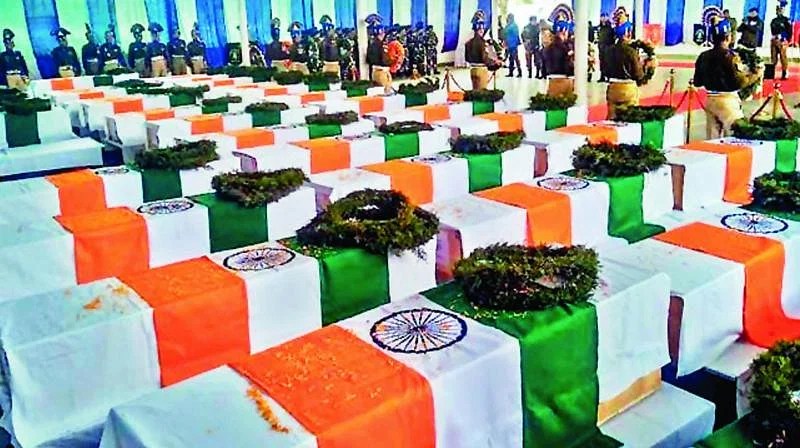
Paragraph 3.58 of the Indian Flag code states that on occasions of state/ military/ central para- military forces funerals, the flag shall be draped over the bier or coffin with the saffron towards the head of the bier or coffin. The flag shall not be lowered into the grave or burnt in the pyre.
When the U.S. flag covers the casket, it is placed so the union blue field is at the head and over the left shoulder. It is not placed in the grave and is not allowed to touch the ground.
In Canada, being laid to rest with the flag is an honour that is not solely reserved for the funerals of soldiers, veterans and dignitaries; all Canadians are eligible. As the National Flag belongs to all Canadians, any Canadian may choose to have their casket draped with the flag. When draping a casket, the top of the leaf should point to the right and the stem to the left when observing from the foot of the casket.
Historically, during naval warfare or acts of maritime piracy, enemy ships may have deceived their targets by flying the colours of allied nations before hoisting their proper identifying flags at the time of attack. This may be the origin of the expression to show one’s true colours, meaning to reveal one’s true nature after misleading or deceiving behaviour.
The things that the flag stands for were created by the experiences of great people. Everything that it stands for was written by their lives. The flag is the embodiment, not of sentiment, but of history – Thomas Woodrow Wilson, the 28th president of the United States from 1913 to 1921.
 REJINCES