Nature’s Stone Art

‘Art is contemplation. It is the pleasure of the mind which searches into nature and which there divines the spirit of which nature herself is animated.’ –Auguste Rodin (French sculptor)

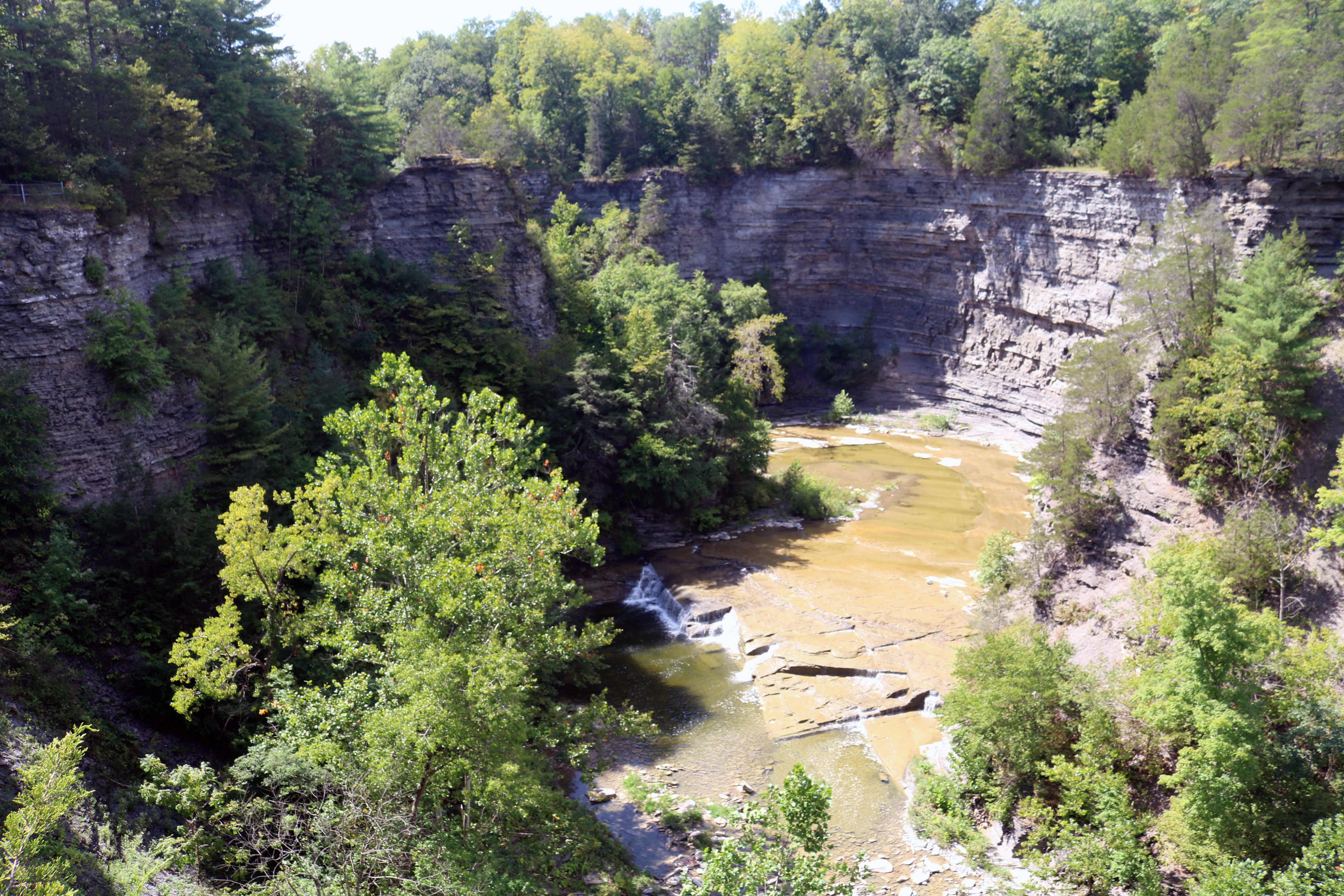
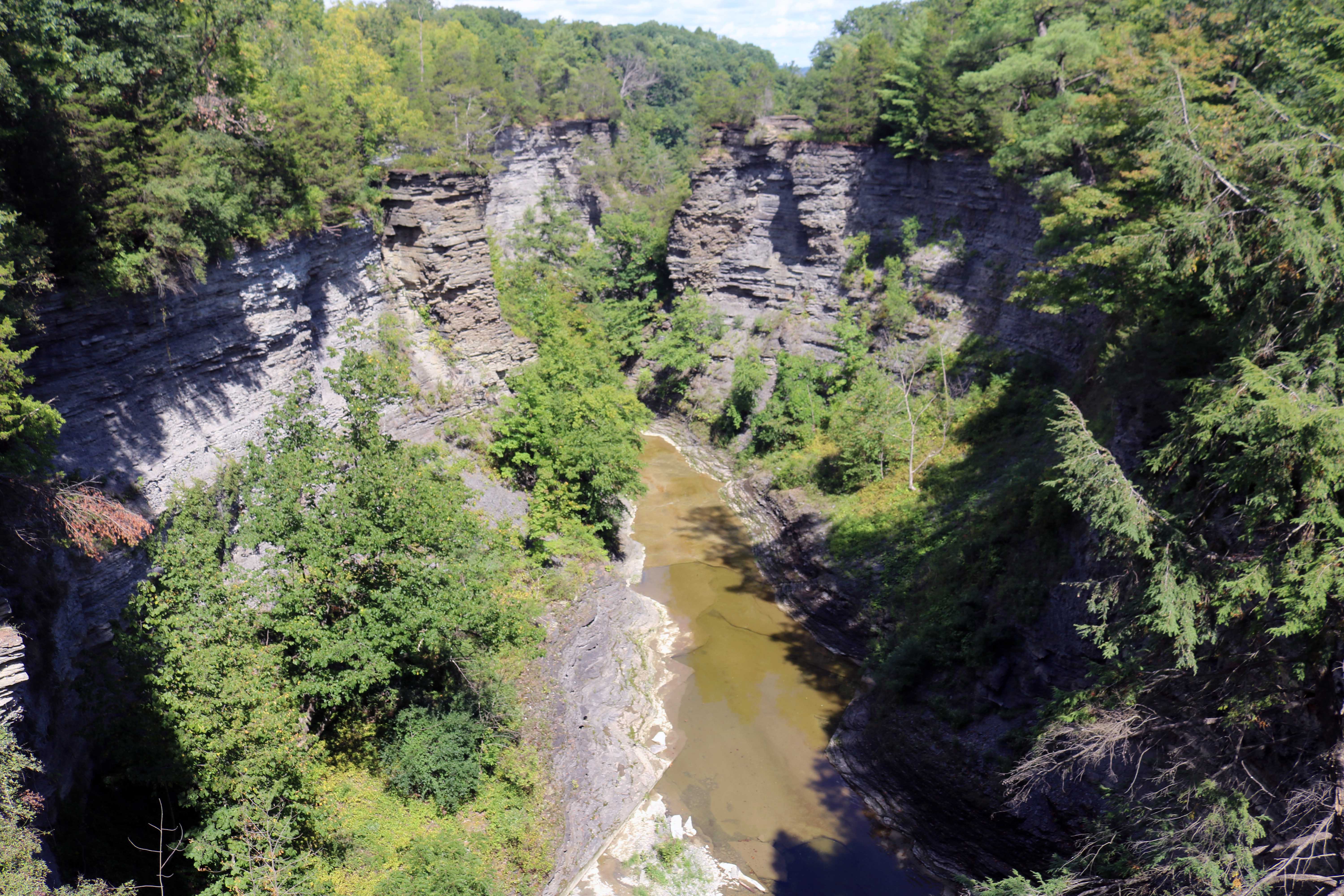
The trail through the gorges at Finger Lake area is a display of nature’s work of art of stone sculpting by water, snow, wind, natural fractures in the rock, type of bedrock, and winter climate.
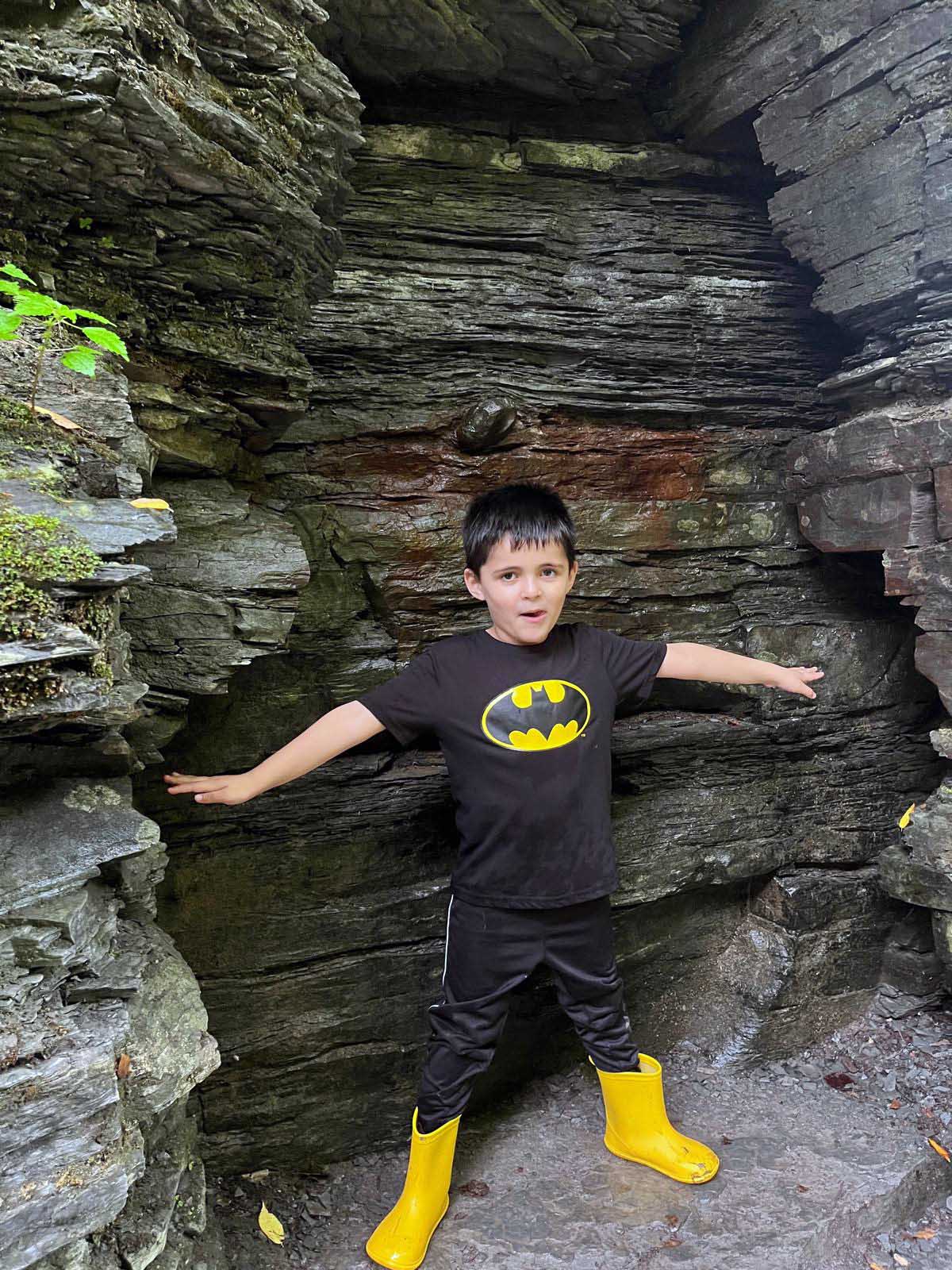
In addition to the carving of the gorge by water, much of the erosive forces fractured the rock along joints and natural cracksWater filled these cracks and expanded when it froze. This pried the rock apart, creating massive gorges over thousands of years.
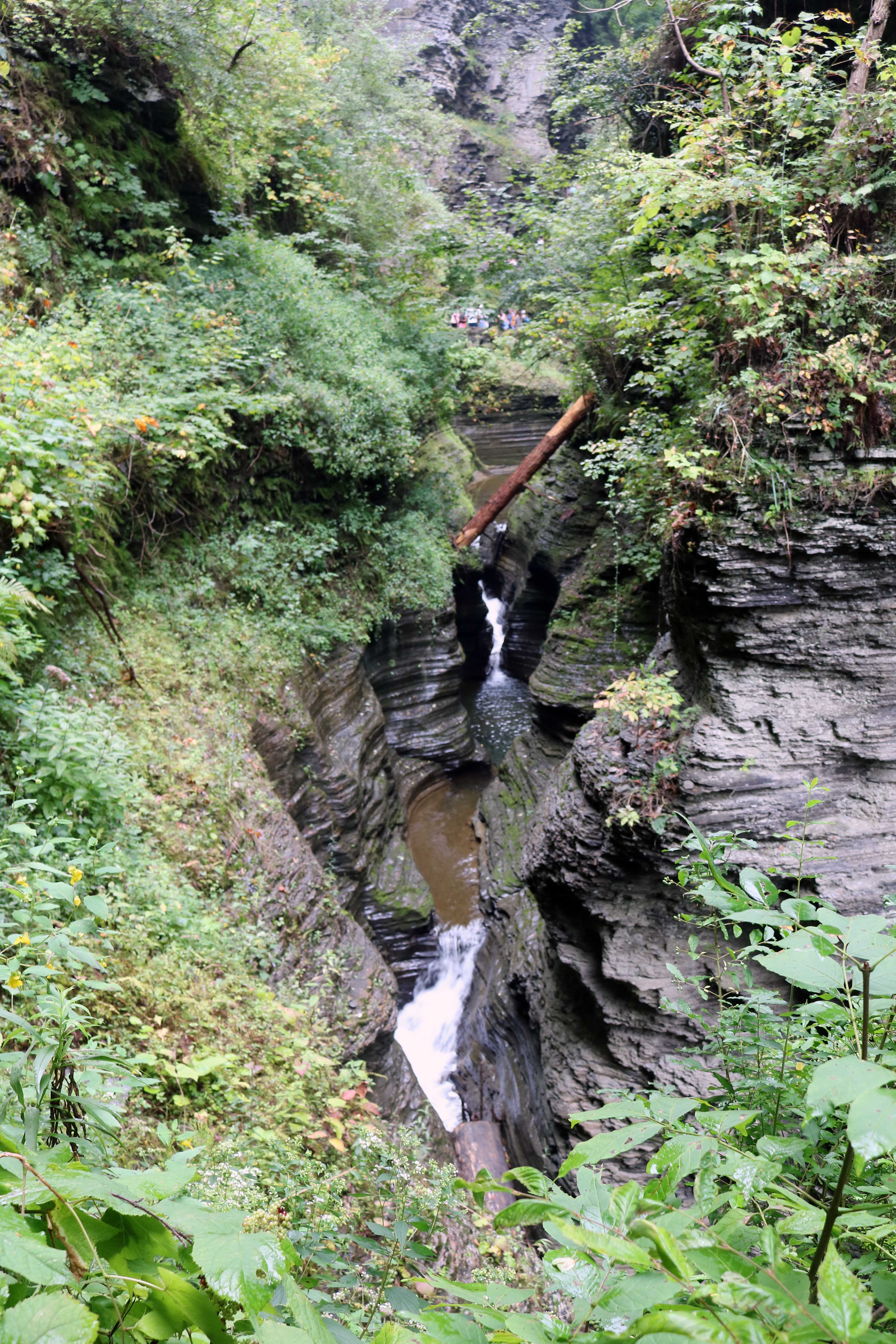
Beginning about two million years ago, glacial periods blanketed New York state in thick Laurentide Ice Sheet . The ice advanced and melted in cycles. The most recent glacial period took place about 21,000 years ago during the Wisconsin Era. This was when ice sculpted the region’s lakes, hills, and other landscape features. The gorges began to flow into the deep trough of Seneca Lake and has been shaping the gorges ever since. While we do not know its exact depth, scientists estimate the Laurentide Ice Sheet was a mile thick.

The long and narrow shape of the gorges is due to the ancient rivers, widened and deepened by glaciers flowing south. Before receding, the glaciers dammed the flow of water with debris, creating the lakes we have today.

Look at the rim of the gorge. Twelve thousand Years ago the river flowed up there. The gorge did not exist. and this chasm was full of solid rock. Since then, the creek has gradually eroded into a canyon.

Since then, thousands of floods have cut the gorge, seeping away fallen rocks, tumbling boulders and prying slabs from stream-bed. Each passing torrent deposited mud, sand and stones at the bottom of the gorge.
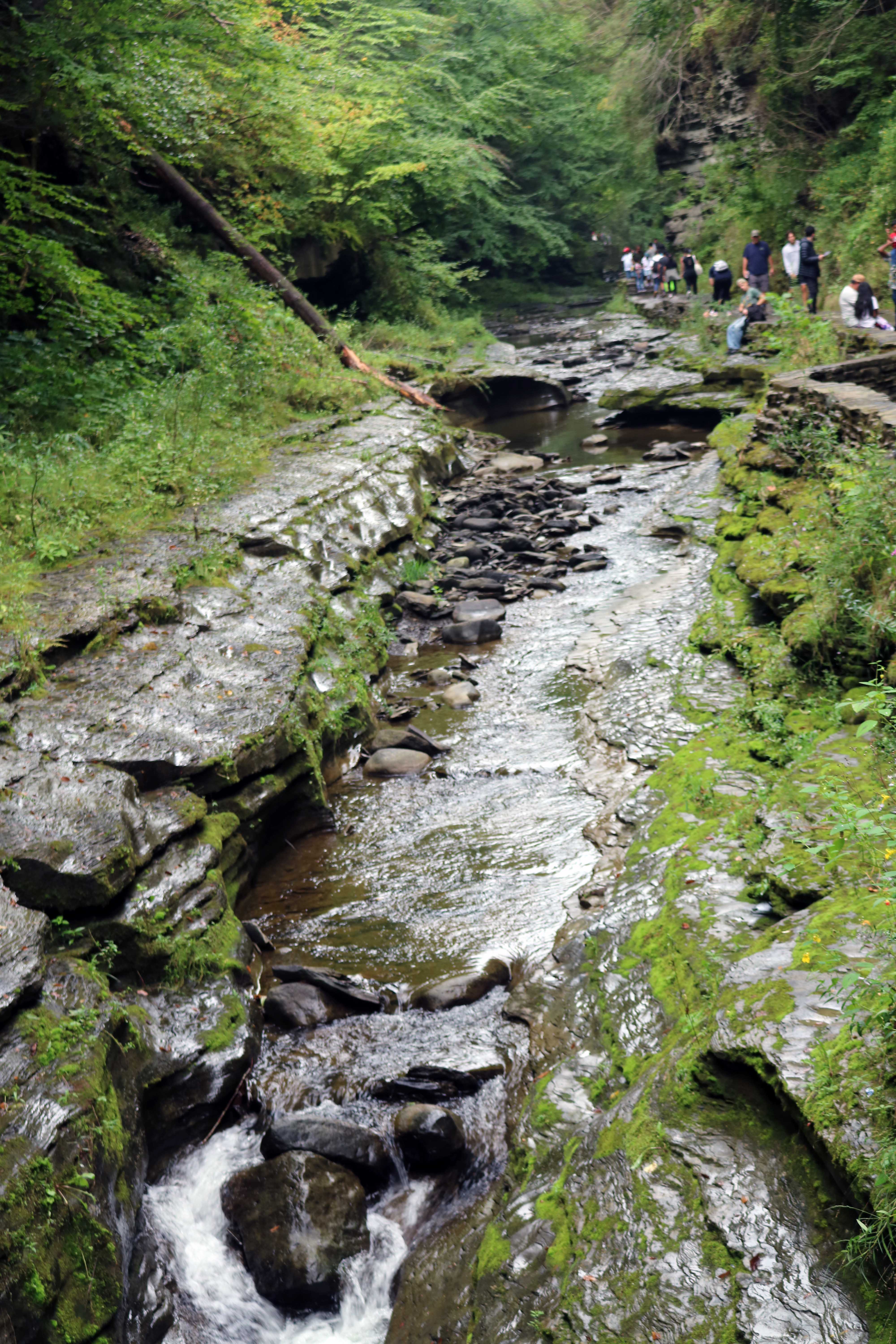
Rocks loosened by ice eventually fell from the cliffs, gradually widening the gorge. Over time, floods have washed the rocks of the gorge into the southern end of gorge.
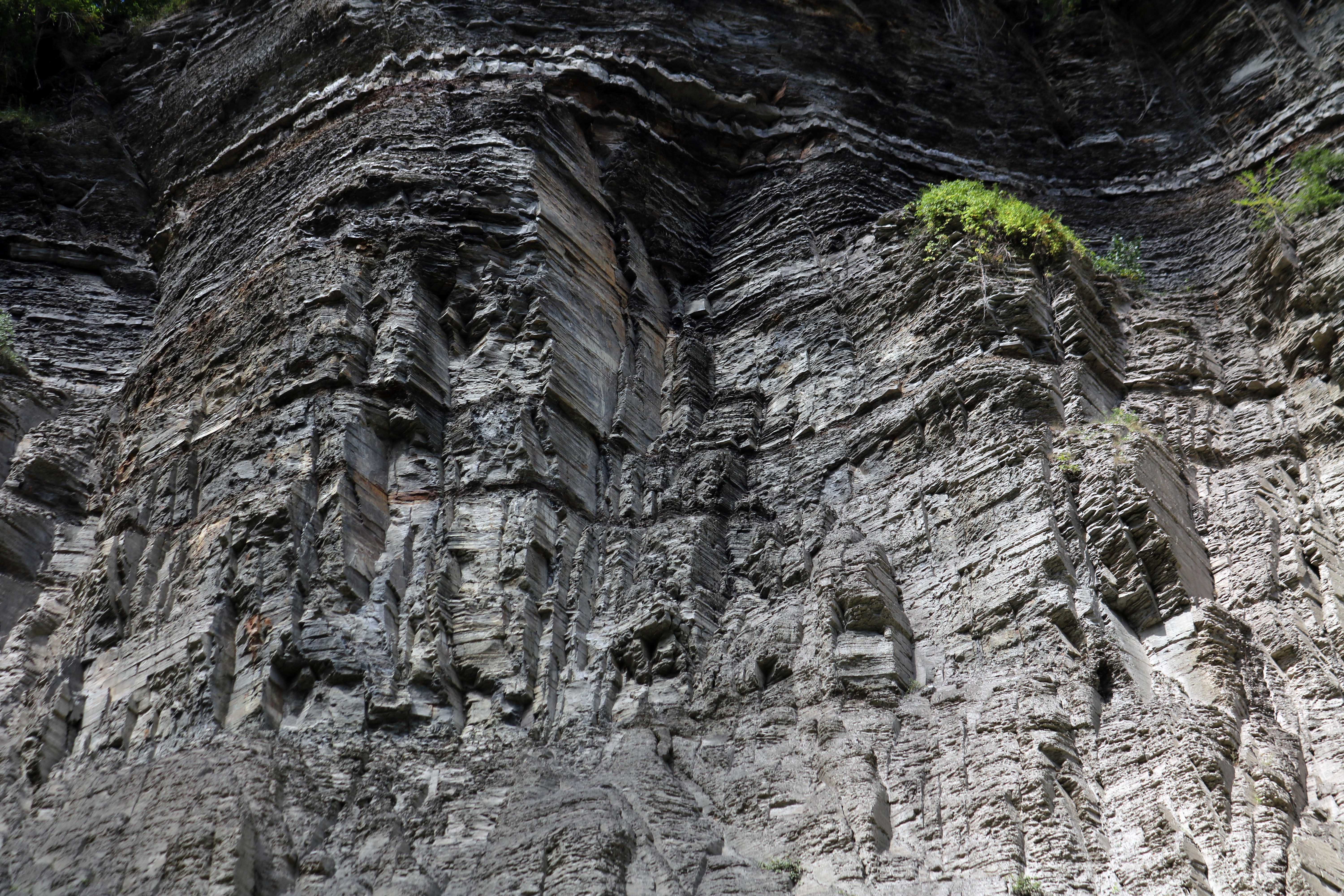
These Fractures tell a story. Look at the cracks, called joints, that run up the walls. They begin from the creek-bed and go up the wall.  These cracks are from the great continental collision that pushed up the Appalachian Mountains in the Finger Lakes region.
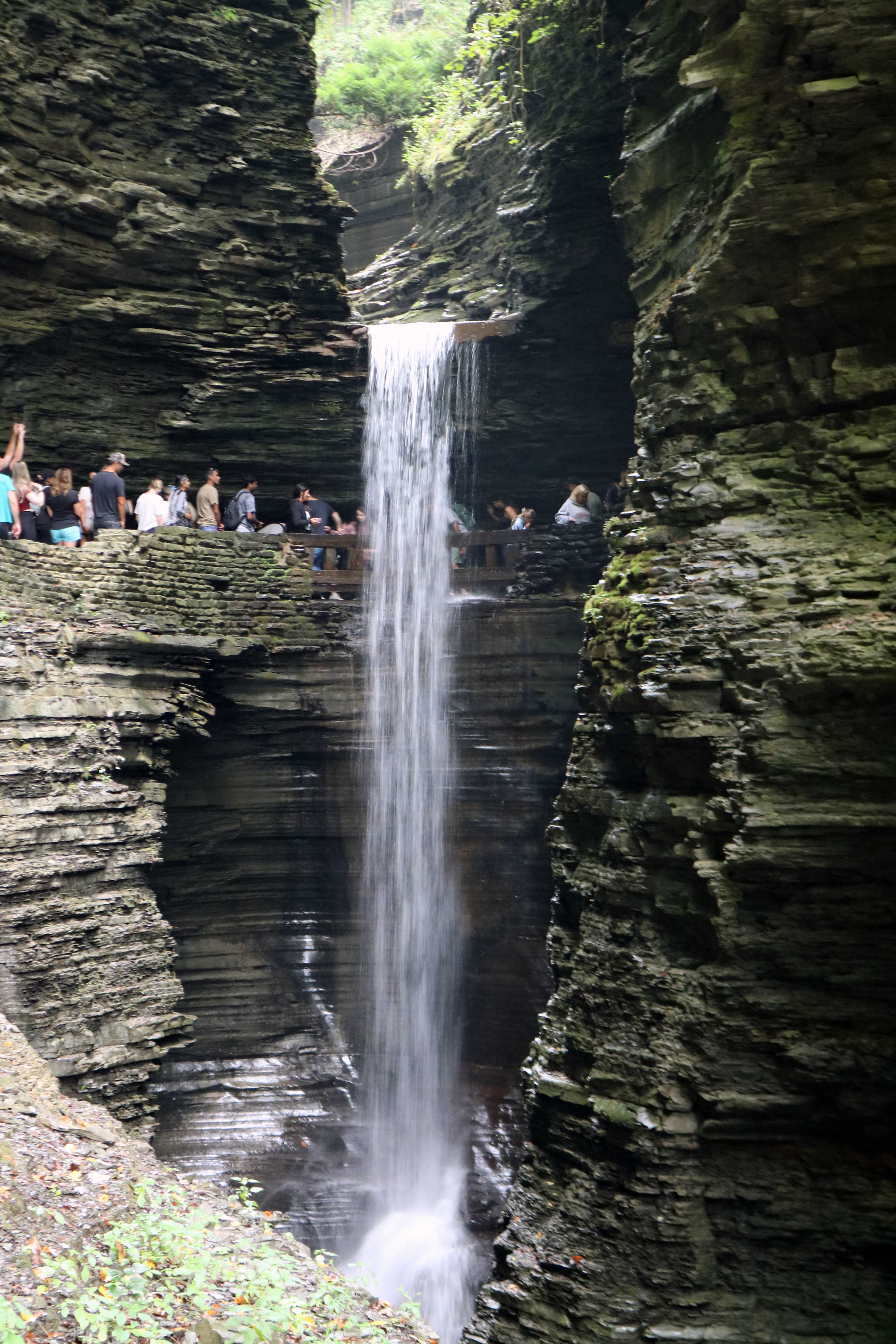
The gorge pours over light gray limestone and weaker, dark shale beneath it. As the shale erodes, limestone blocks break off, causing the waterfall to move slowly upstream. The falls in the gorges have eroded nearly a mile into the hillside since the end of the Ice Age.
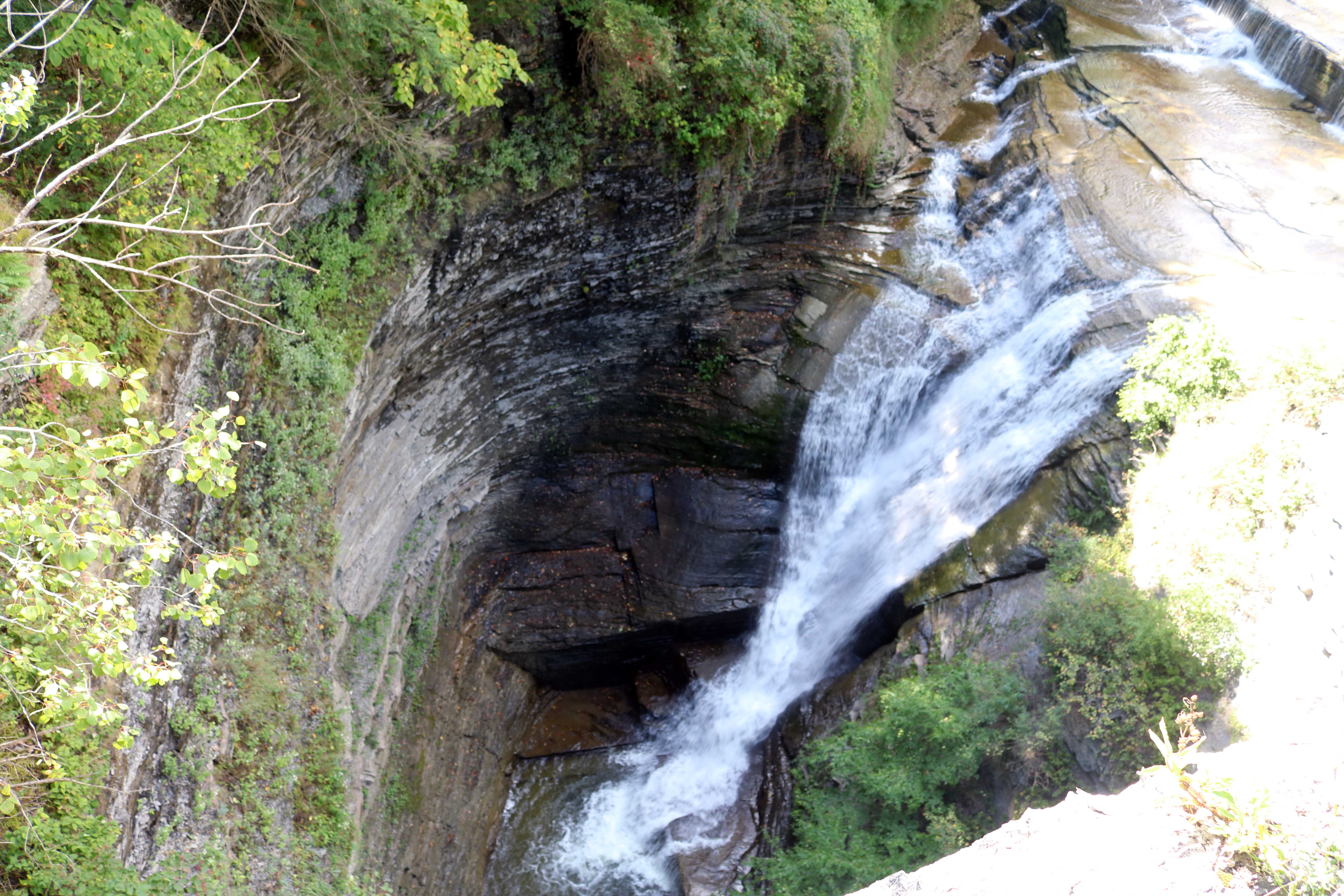
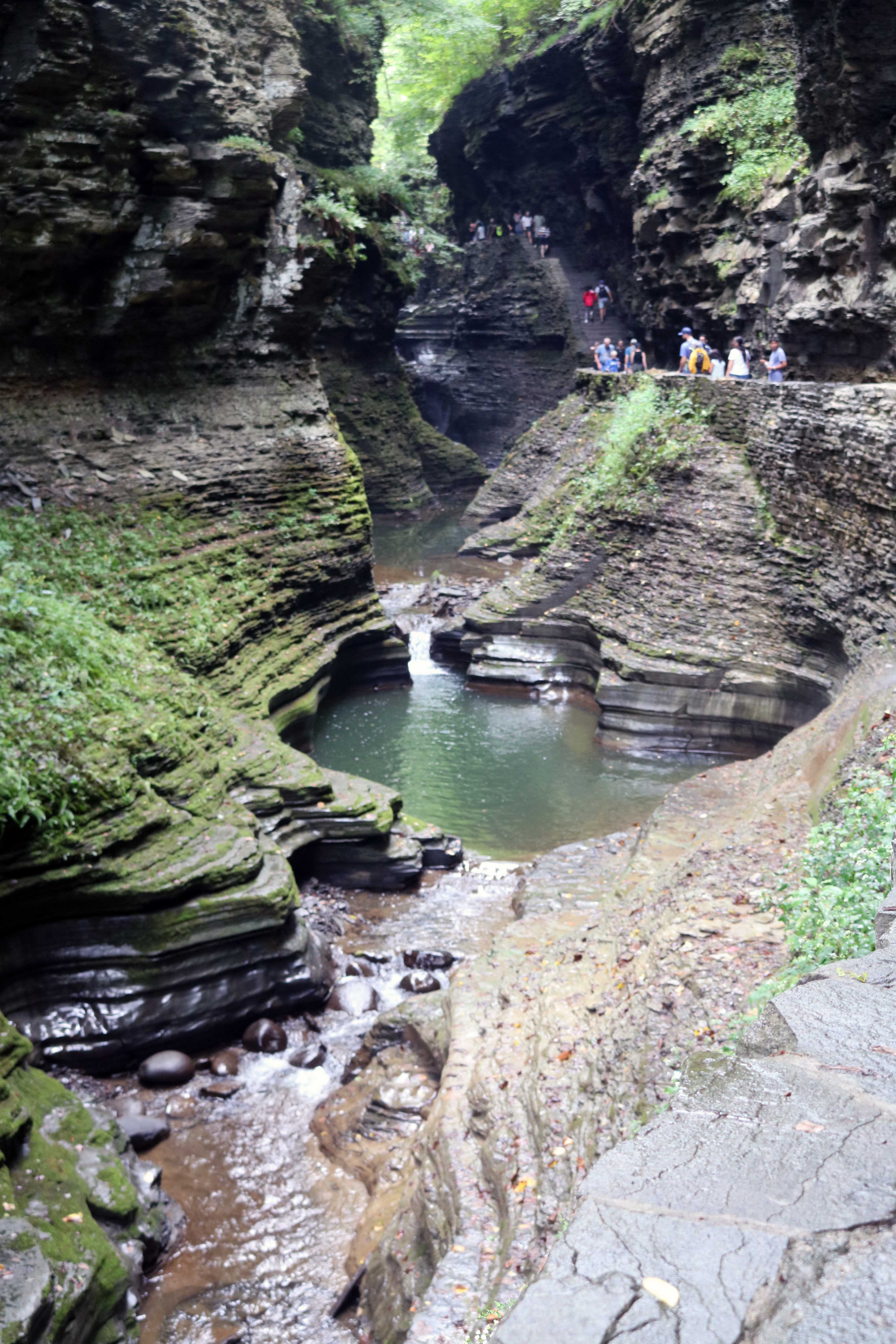
The waterfalls in the gorges have has crated many natural pools due to erosion.

A sea covered much of New York State during the Devonian Period, long before the dinosaurs. The ancient Acadian Mountains slowly eroded to become sand, silt, and clay that rivers carried to the sea, eventually filling it in. Millions of years of pressure from overlying material and natural cementing eventually hardened the sediments into rocks.
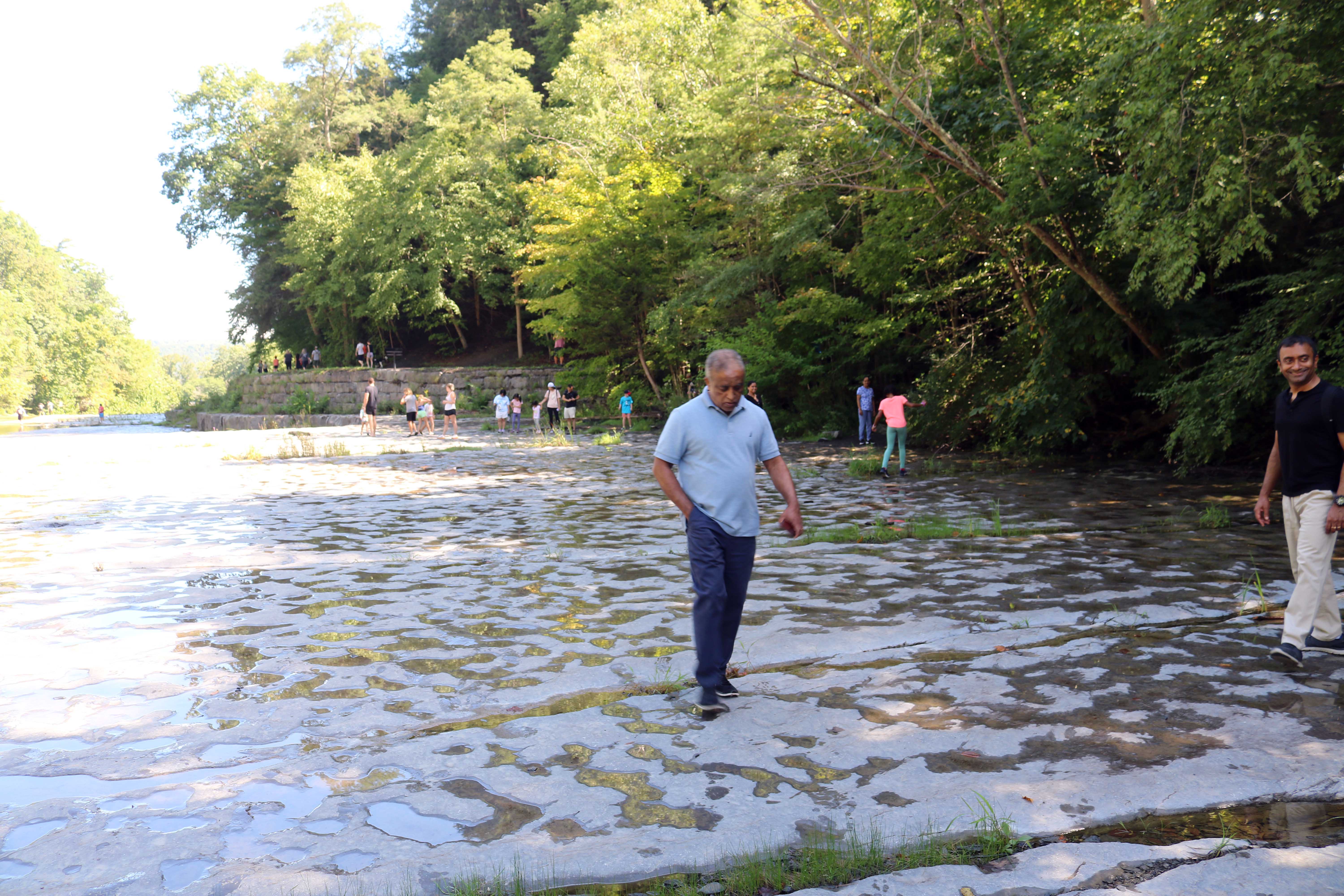
This area formed the bottom of an ancient sea. Marine invertebrates, including species of corals, which once lived here. These rocks were formed at the bottom of an ancient sea 380 million years ago.
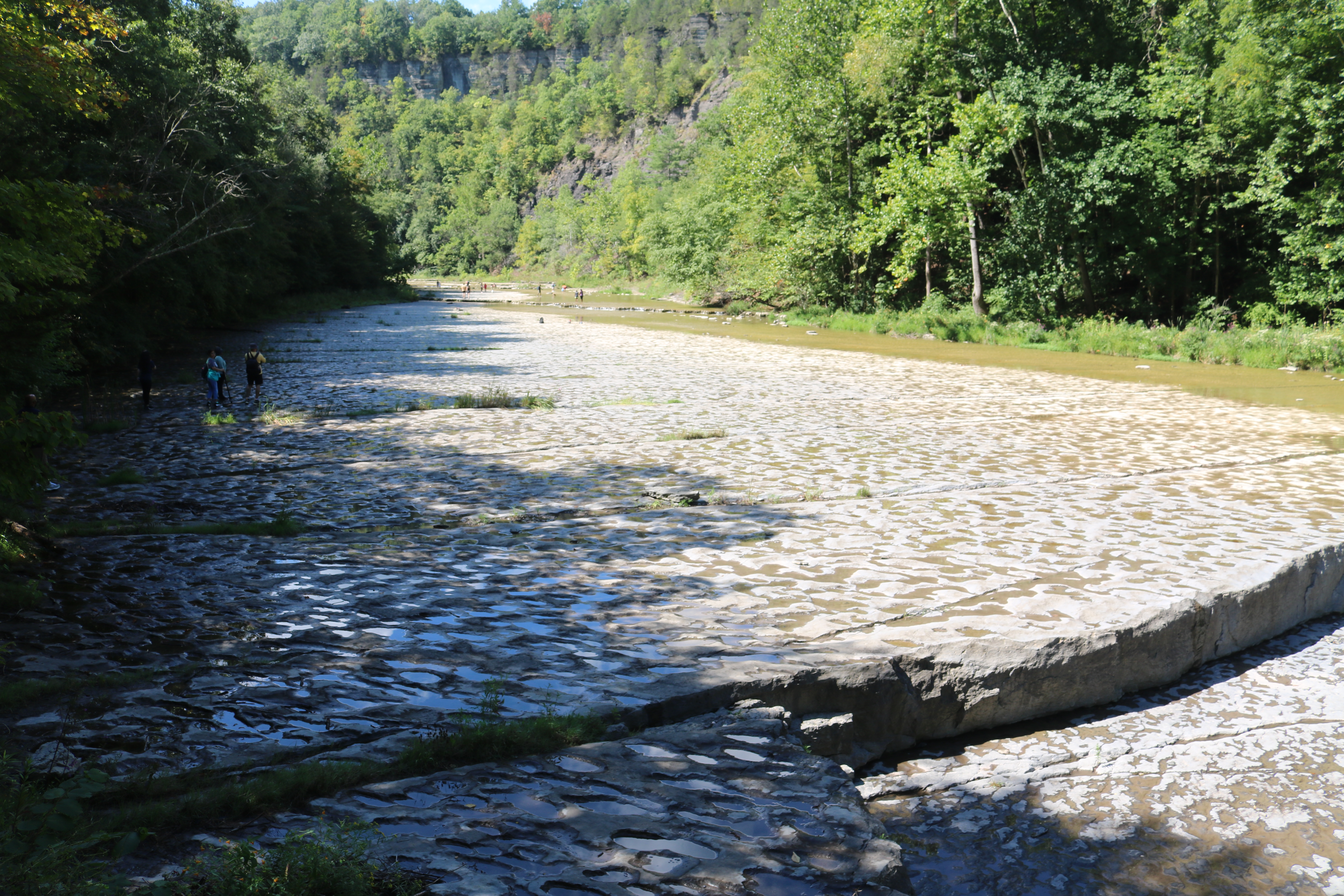
The gorge floor is made of light-gray limestone that once was lime mud made from the skeletons and shells of algae and other marine organisms. Above the limestone, the crumbly rock on the gorge’s walls is called shale.  This shale was clay and silt that settled on top of the lime mud and eventually hardened into rock.

These pits are formed by rainwater which is naturally a little acidic. The water in the puddles dissolved the limestone due to chemical weathering.

Physical weathering occurs on the gorge walls when freezing splits shale into thin fragments that eventually fall. It is for the observers to decipher the art from their perspective.

Look deep into nature, and then you will understand everything better.’ – Albert Einstein

Taughannock Falls

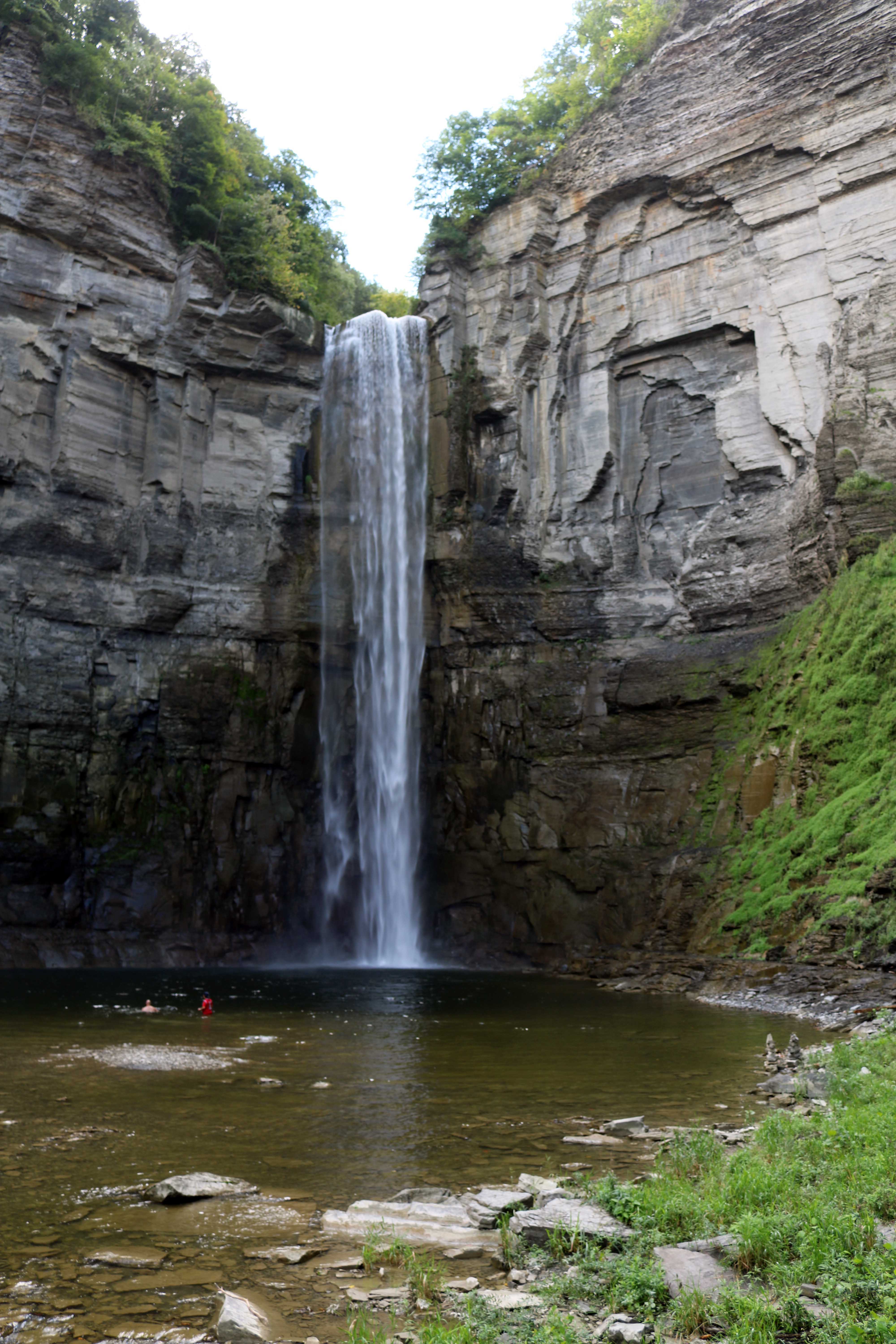
On 01 September 2024, we visited the Taughannock Falls in the Finger Lake area of New York State. The falls roars down a hanging valley, drawing thousands of visitors who hike the wide winding canyon to the viewing area at its base. In summer, it dries considerably, offering visitors a less wet experience walking up the creek bed. Behold! This fall is 215 feet – about 33 ft higher than Niagara Falls.

Erosion from water and ice has carved out 400 ft high cliffs over thousands of years. The pool at the base of the falls is deep and littered with gigantic boulders from rock falls akin to the Niagara Falls. This area has recorded many rockfalls which killed and maimed few tourists. This canyon is most active as far as erosion. It is also one of the most beautiful gorges filled with waterfalls.

The name Taughannock comes from Native American language meaning The Great Falls of the Woods.  The Gorge Trail runs from the main park entrance, past the Lower Falls, and along the gorge all the way to Taughannock Falls.

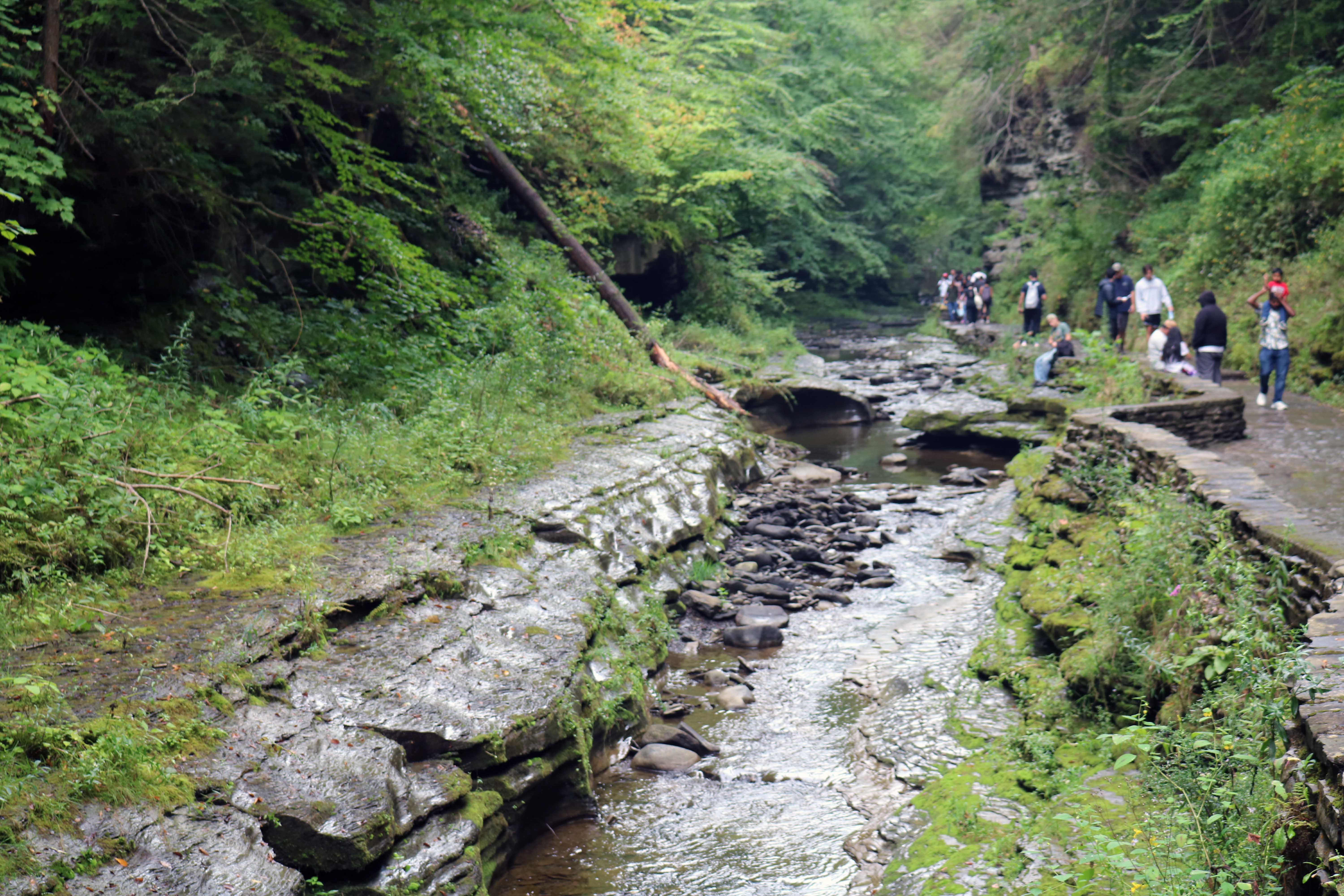
When we visited the area at the end of summer, the water level was low, and it facilitated us to walk in the creek bed. Throughout the trail, there are many information boards placed, some about the history, geology and the landscape.

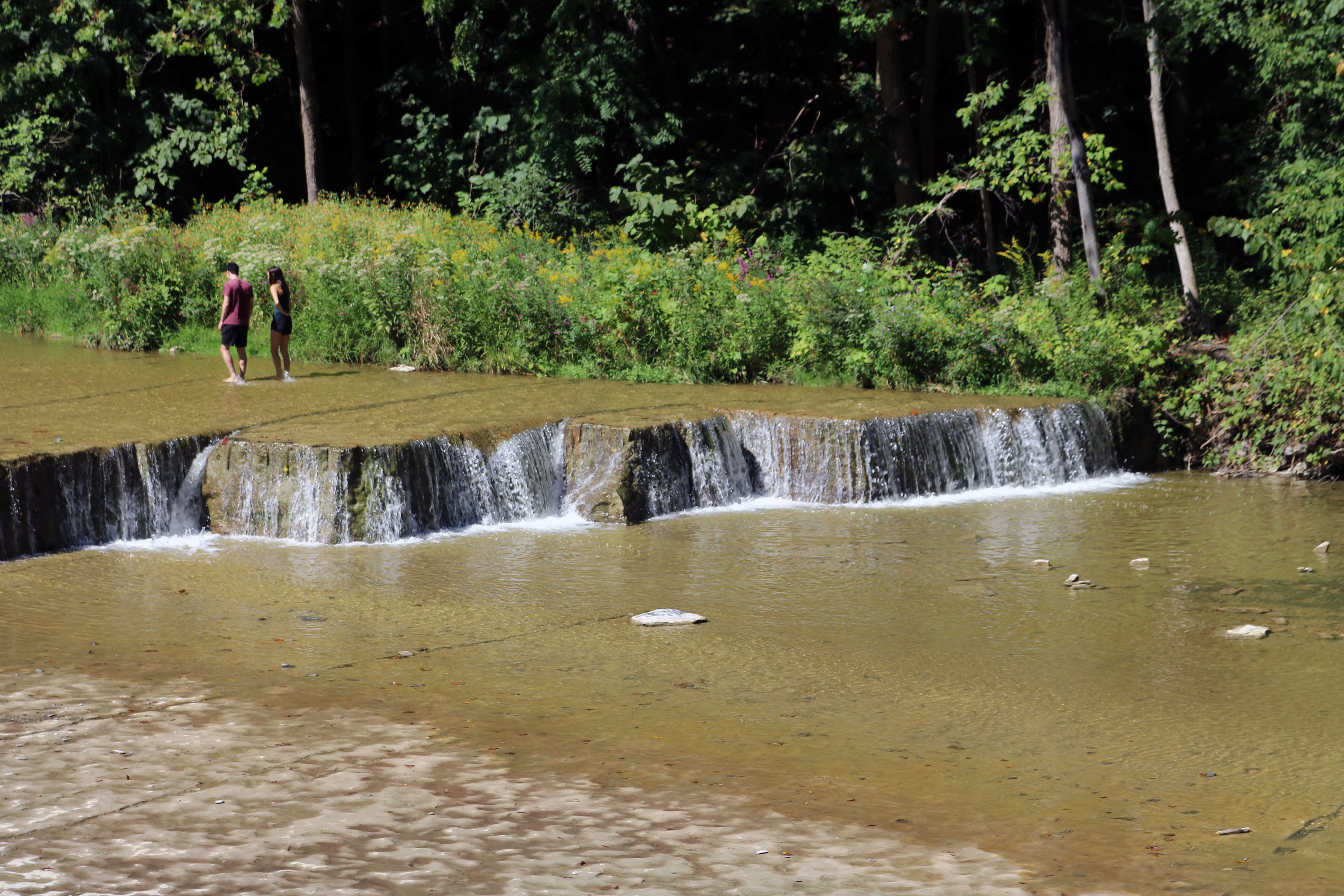
As we entered the park, the lower falls -19 feet tall falls on average stretch to about 50 feet in width, that tumble over a blocky ledge – welcomed us.  During floods, the creek will swell to cover the entire creek – over 100 feet wide.

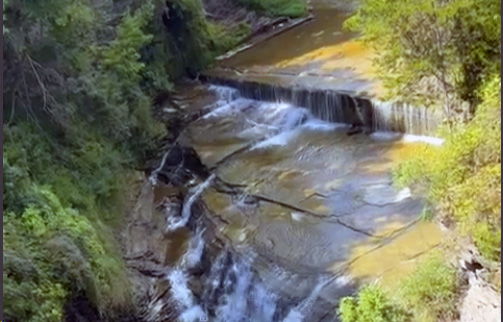
We began our hike along the ripple-like pattern on the limestone creek bed which was once an ocean bed. It features symmetrical cracks in the rock, sometimes at very distinct 90-degree angles. The ripple pattern in this area is the result of erosion from acidic rains and abrasive effect of flowing sand. Acidic rain puddles in the creek bed dissolves the limestone and the sand particles will swirl around in these dimples, further carving them out over millions of years.

We walked through the gorge trail, and it culminated about 300 ft from the falls, a perfect distance for photography.

Photography session completed, we set out we commenced our trek to the Upper Taughannock Falls.

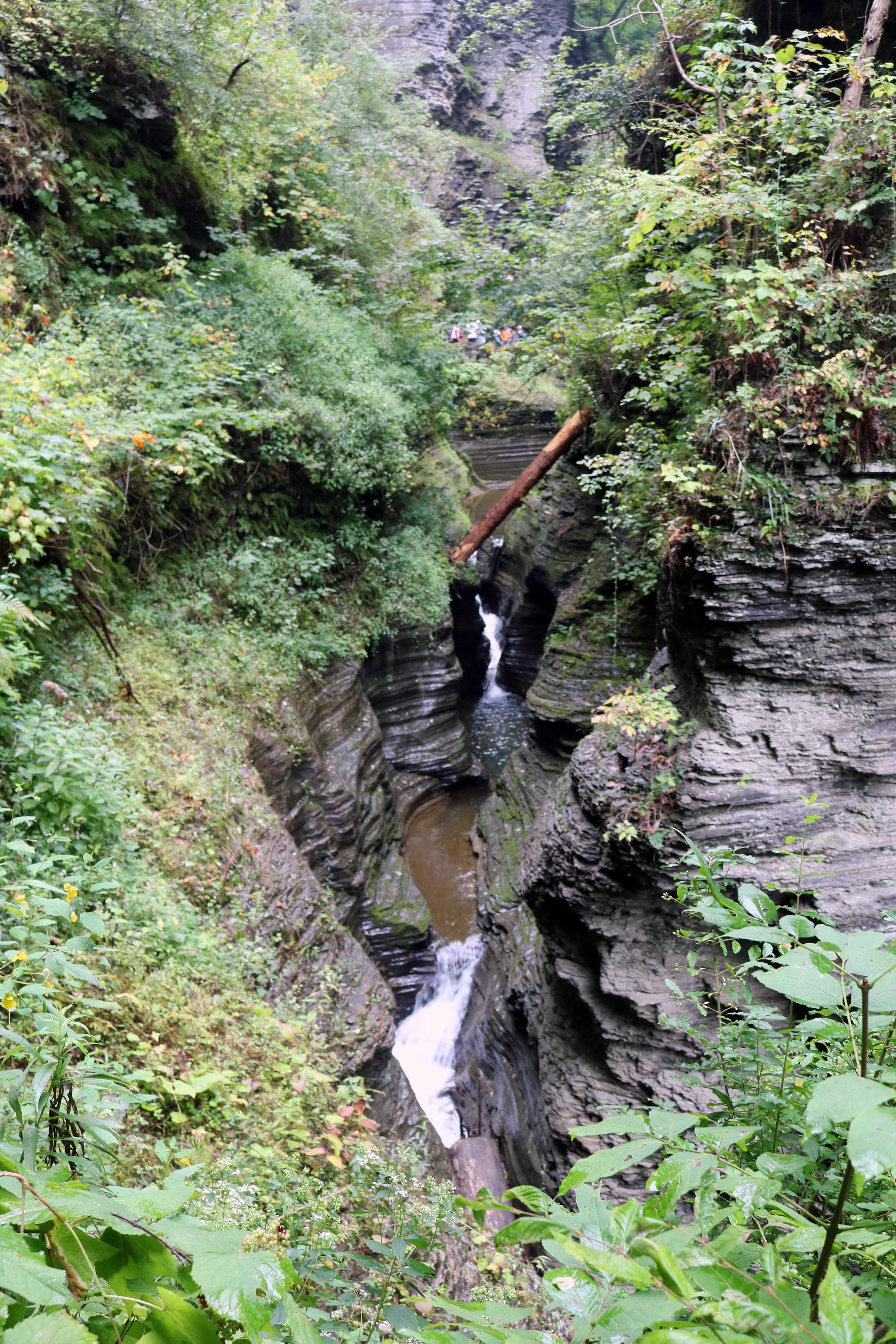
As we trekked ahead to the Upper Taughannock Falls, we entered the V-shaped notch in the streambed.

Over the years numerous rock falls have occurred at the falls e. The cliffs surrounding the falls are quite unstable and is prone to rockfalls.

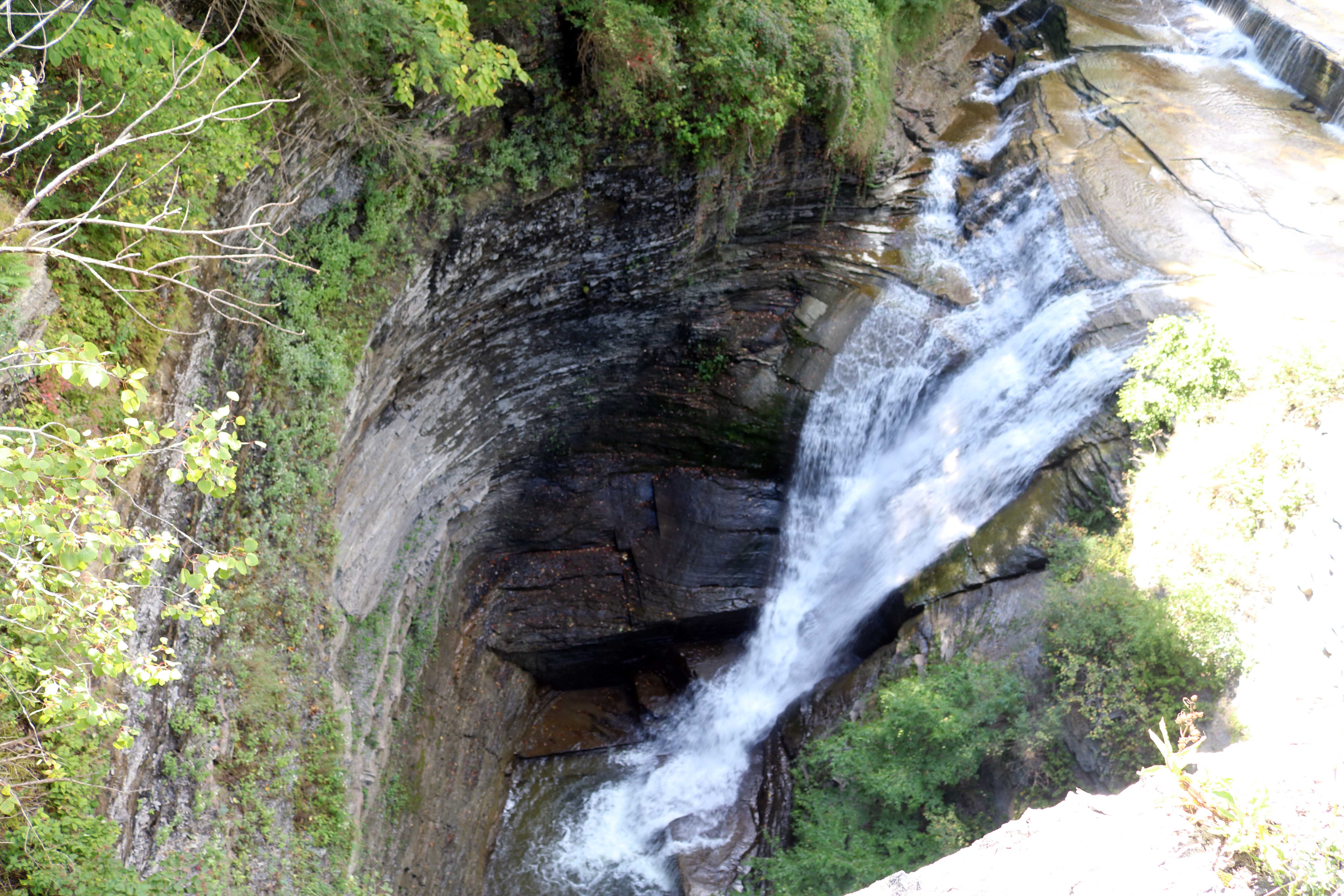
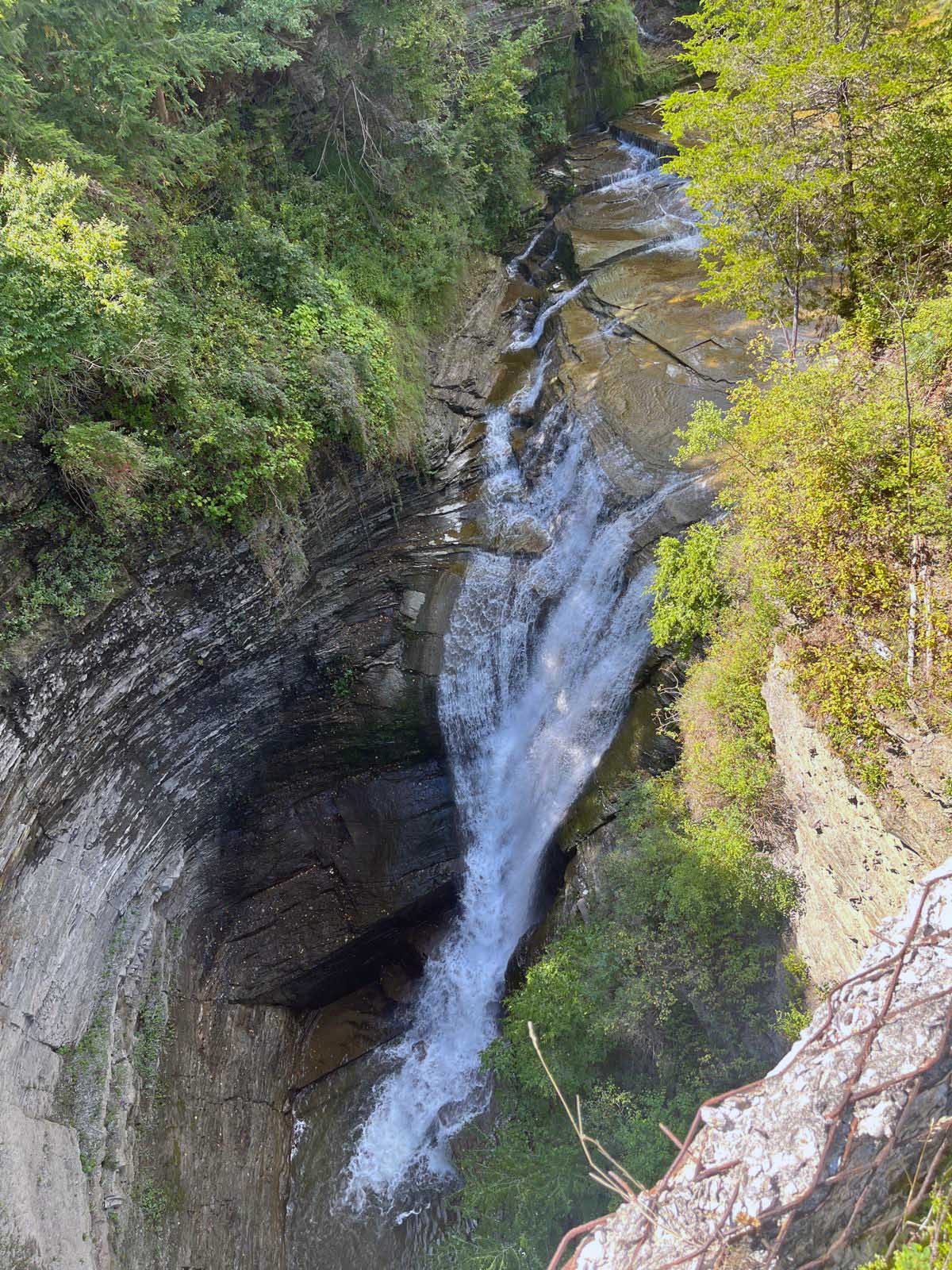
Upper Taughannock Falls is significant in stature, and especially unique in appearance. It is overshadowed and overlooked by its much larger downstream sibling. The Upper Falls marks the point where the creek plunges into Taughannock Gorge, which is considerably narrower here than at the larger falls downstream.

The upper falls drop 58 feet where the creek transitions from sheeting across a broad smooth bedrock shelf, plunging over a small 3-foot ledge which is so uniform that it looks like a dam.

The water then funnels into a booming horsetail type fall, transitioning from a broader breadth at its top to a narrow plunge of water at its base. As we viewed this fall from a bridge looking nearly straight down, it appeared much taller. Thus culminated our long-weekend of adventure.

I go to nature to be soothed and healed, and to have my senses put in order.” – John Burroughs – American naturalist and nature essayist. 

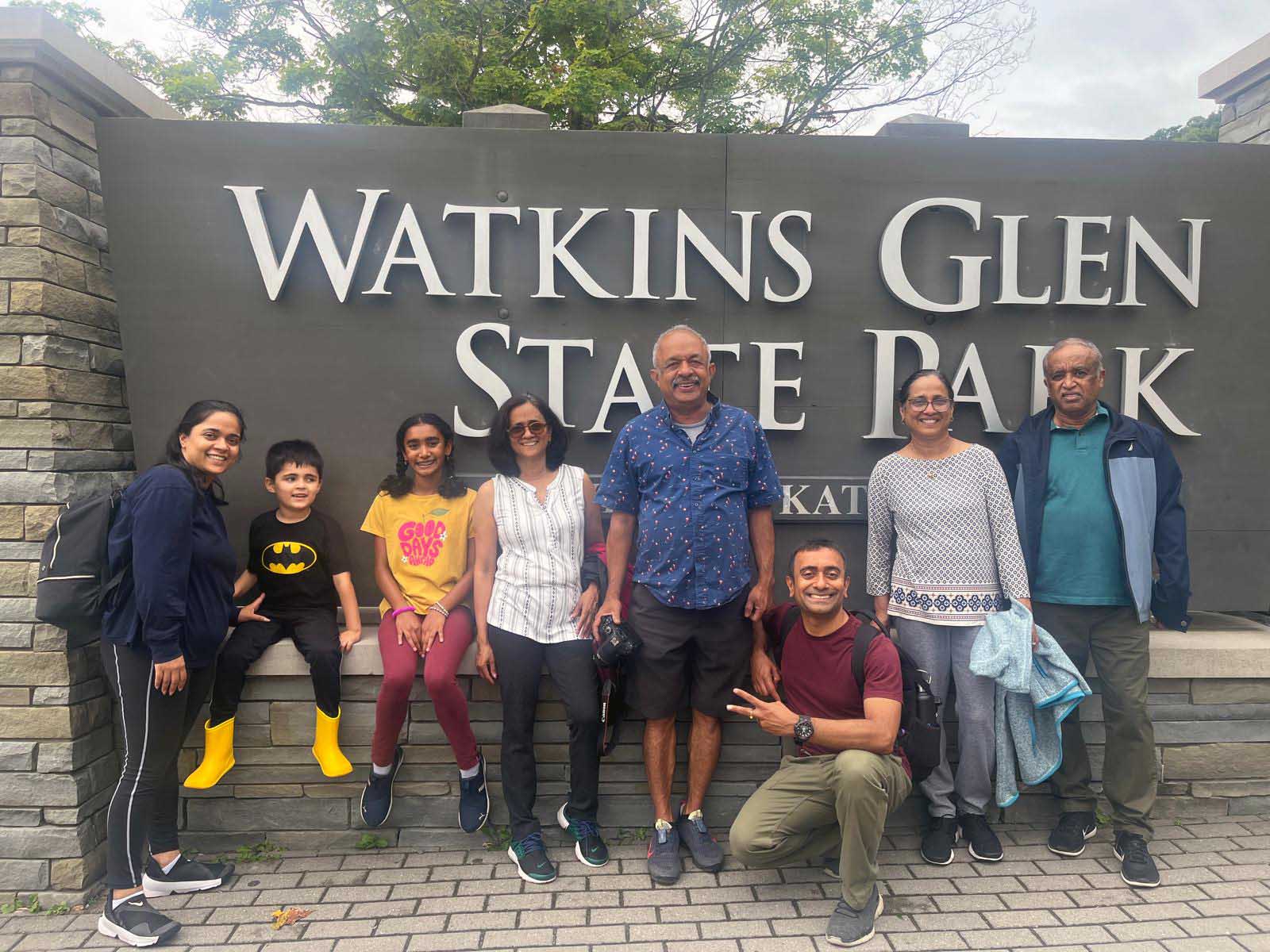
Watkins Glen State Park, New York

For the long weekend of September 2024, we organised a family trip to Watkins Glen State Park on Finger Lakes in New York State.

The park with stunning waterfalls, dramatic flumes, and picturesque potholes combine to make a gorgeous waterscape.  The park’s landscape encompasses stone staircases, arched bridges, and winding tunnels that weave up and through the scenic gorge.

About 400 million years ago (Devonian Period,) this area was covered by a shallow sea. The erosion of the nearby Arcadian Mountain Range filled this sea with layers of sand and silt. This led to the formation of the sandstone and shale bedrock that characterises the Finger Lakes Region.

300 million years ago (Permian Period,) the supercontinent Pangaea was formed causing uplift in the northeast of what is now North America. The inland seas that once covered the area become land. Streams began to cut their way through the newly uplifted bedrock.

2.5 million to 12,000 years ago (Pleistocene Epoch,) deep valleys were cut along what is now the Finger Lakes and Great Lakes. The global climate began to cool, marked by mass extinctions, repeated cycles of glaciations and melt (probably more than 40 times). The five Great Lakes and Finger Lakes are remnants of those massive glacial lakes.

12,000 years ago to date (Holocene Epoch,) the massive lakes that engulfed the present-day Finger Lakes receded. They left large basins and valleys behind, exposing enormous sheer cliffs along its southern half. Some of these cliffs still hang directly over the lake today. Others have receded away from the lake due to erosion.

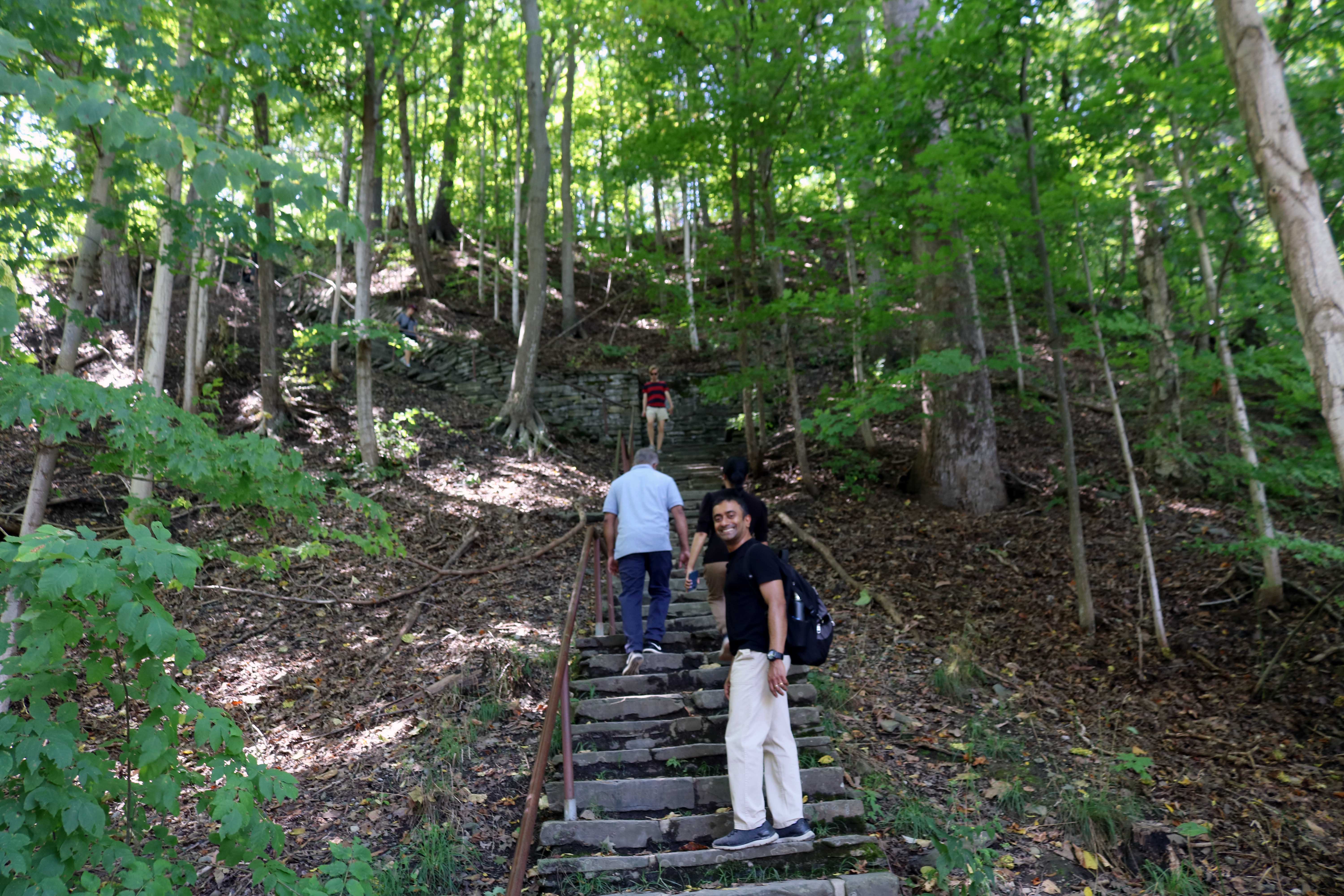
Watkins Glen State Park comprises of a series of waterfalls and gorges that are too beautiful to be missed. A two-mile hike took us past 19 waterfalls and up over 800 stone steps. There are several small trails leading off the Gorge Trail, a hiker’s dream.

Enroute the trail, such markers are placed to facilitate dealing with any emergency.

We entered the Trail through a tunnel chiseled into the rock face.

The first falls that welcomed us into the gorge was aptly named the Entrance Cascade The falls drop a total of 43 feet in two distinct sections; first down a swishing flume-like slot which drops 17 feet and the second a sheer 26 feet out of the canyon.

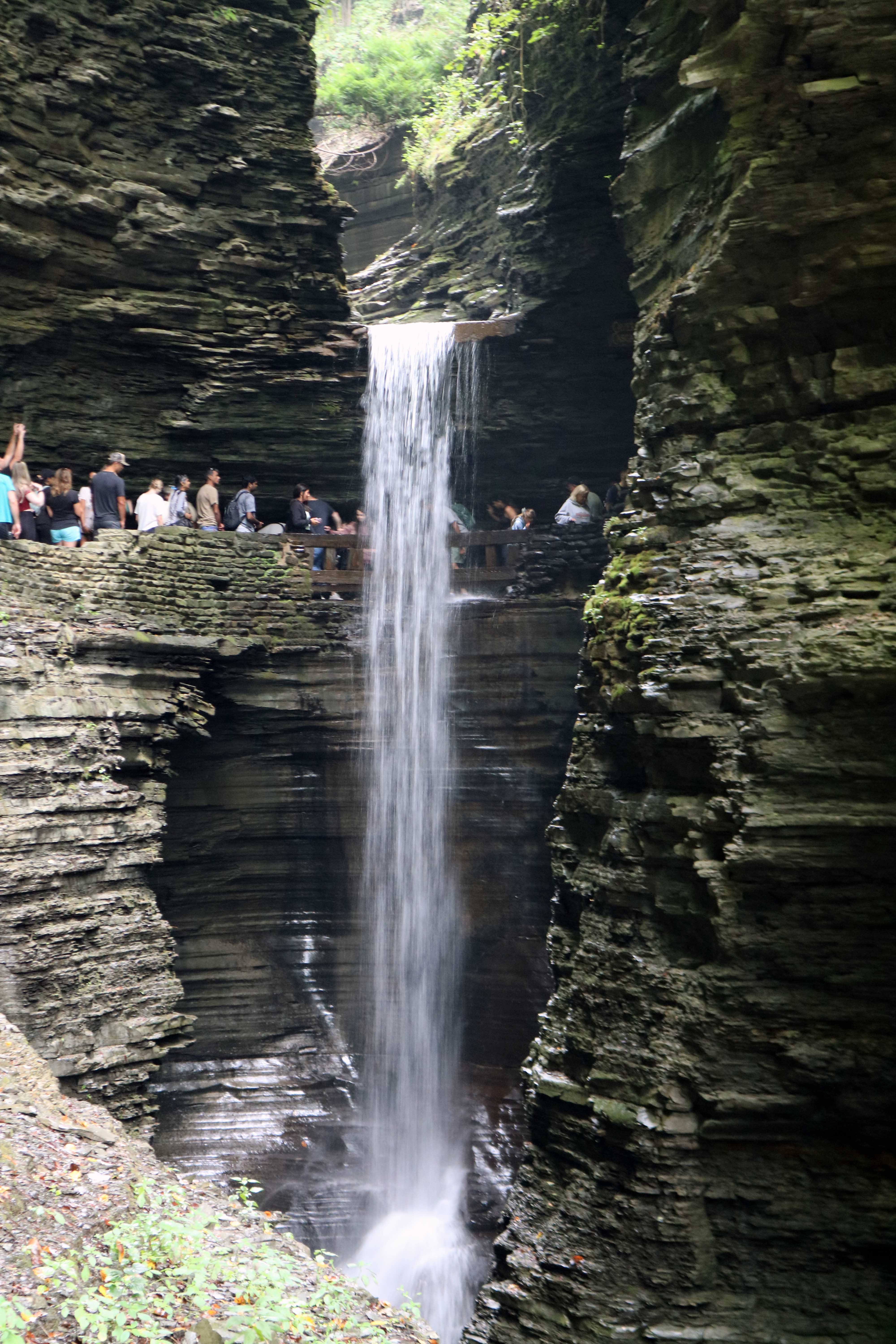
Cavern Cascade was the next waterfall we encountered and is the tallest waterfall along Glen Creek and is almost certainly the most unique waterfall in the canyon (52 feet.) The Trail passes behind the falls, and we reached out and touched the falling water.

This is the Triple cascade aka Glen of Pools, a very pretty chain of pothole pools separated from one another by small tumbles ranging from 6 inches to about 3 feet in height.

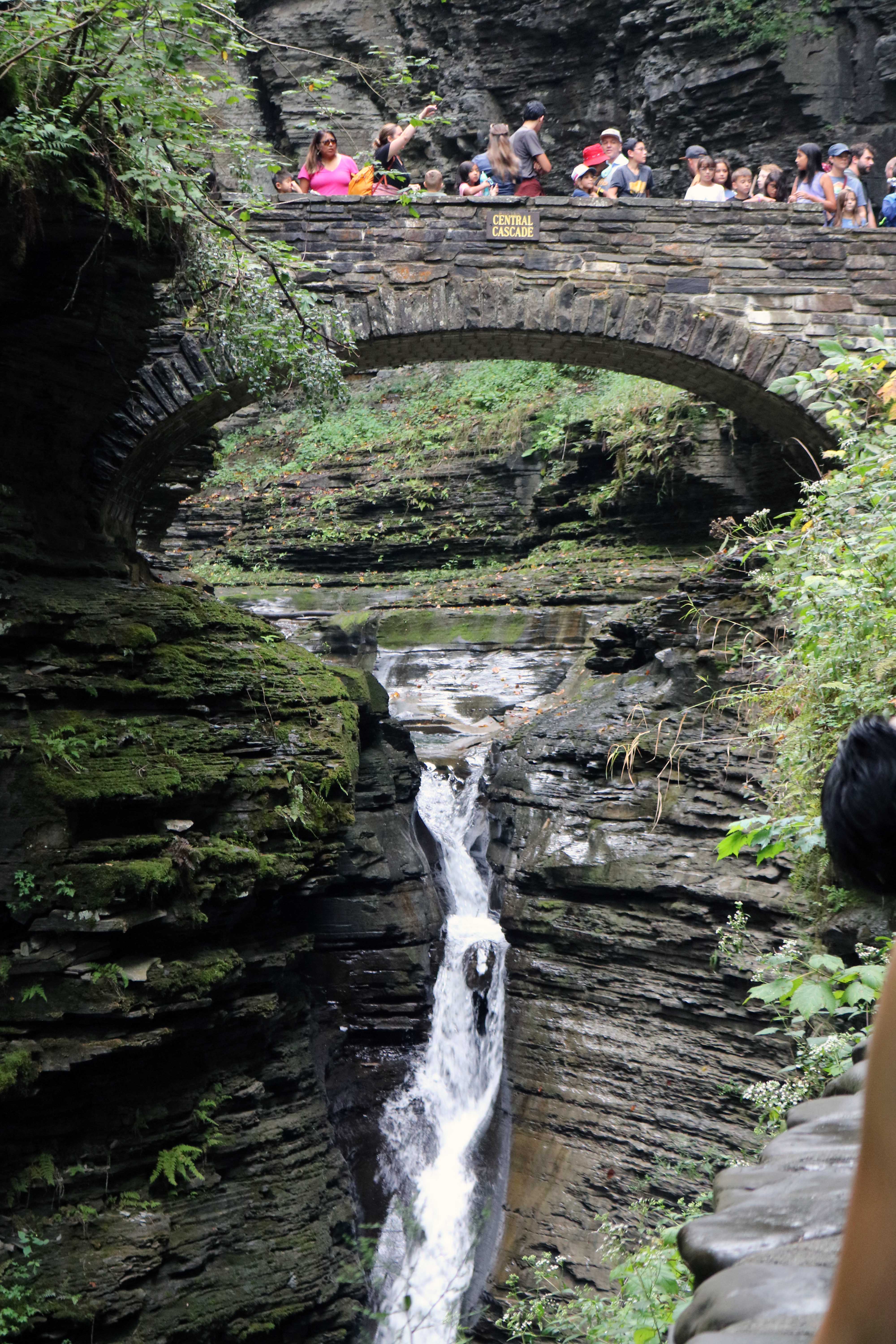
Central Cascade is the third major waterfall we encountered, halfway up the gorge – hence its name – drops 41 feet in a narrow horsetail-type fall with the stone arch bridge above.

The Triple Cascade with its triple stair-step form is certainly eye-catching. The waters tumble a total of twelve feet in three steps. Adjacent to it is the Rainbow Falls with its stone arch footbridge above.

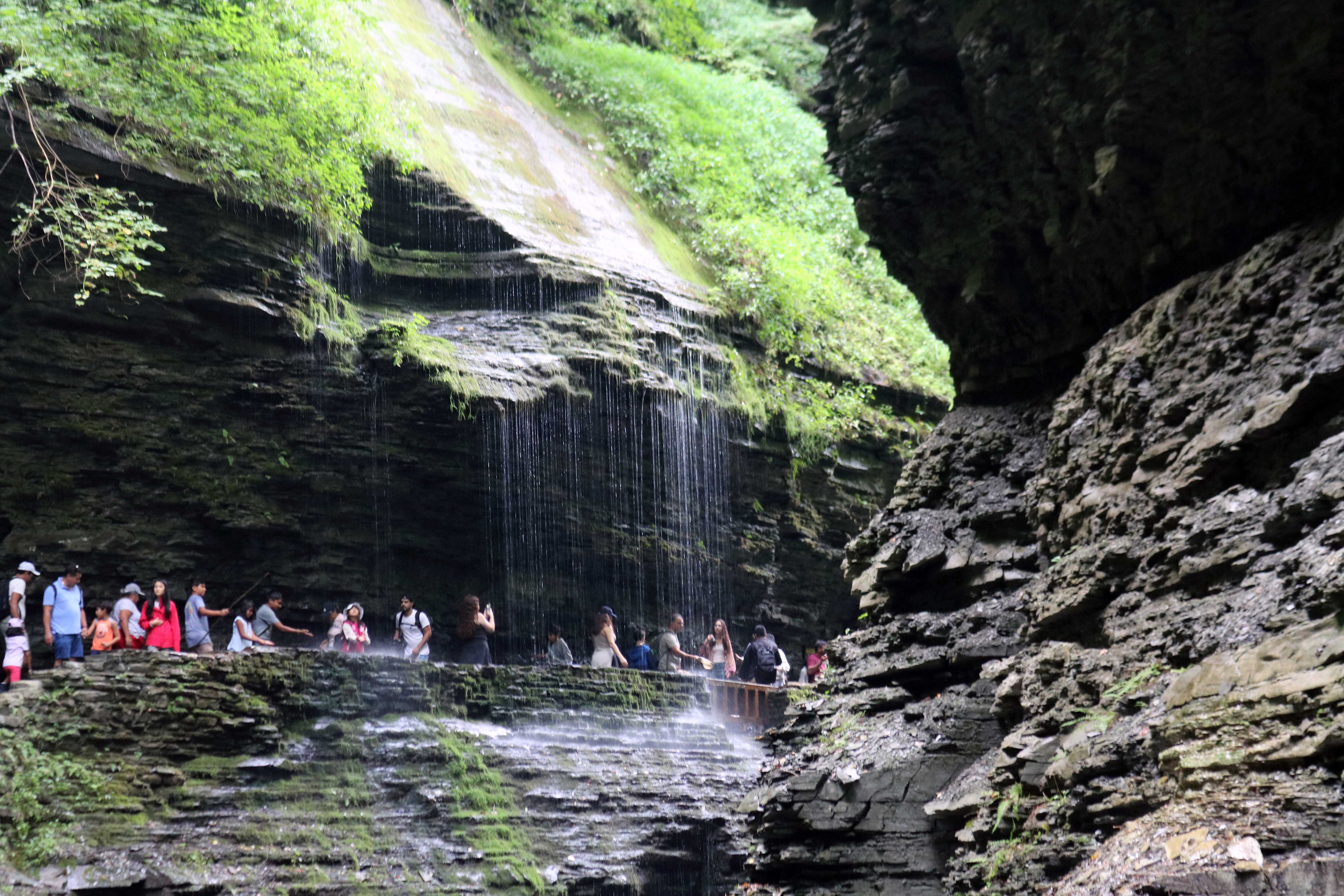
Rainbow Falls first slides over an angled pitch of moss-covered rock, then plunges over an undercut cliff in dozens of tiny rivulets which bead down onto the stone railing lining the trail as it passes directly beneath the falls.

Pluto Falls is in the Spiral Gorge, where the creek squeezes through and narrows to two feet wide, dancing between potholes with small falls in between.

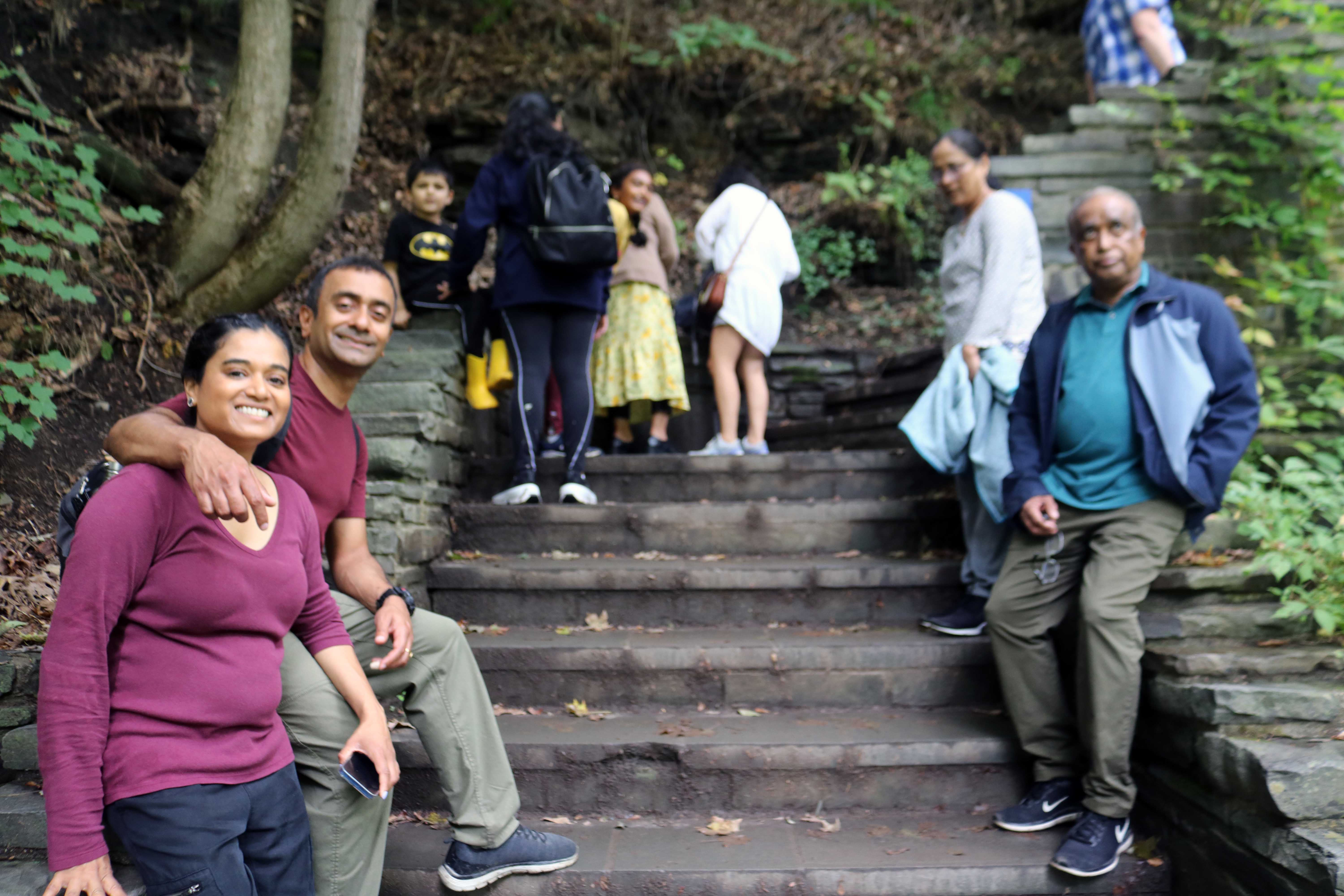
Jacob’s Ladder was the final ascent of 180 stone steps to the Upper Entrance to the park to the Gorge Trail along Glen Creek. This marked the end of our hike.

Remembering General Paddy

General Sundararajan Padmanabhan PVSM, AVSM, VSM (General Paddy) (5 December 1940 – 18 August 2024) –was our Artillery Brigade Commander in 1986 and I, a Lieutenant with 75 Medium Regiment (BASANTAR RIVER,) then located at Gurgaon. 

Our first interaction was during the Administrative Inspection of the Regiment.  I was positioned at the Radio store that day.  Brigadier Paddy walked in and asked me to demonstrate measuring the resistance of the cable drums in the store.  I took out the multimeter, positioned the switch to 1000Ώ, connected the probes to the cables and read off the resistance.

Brigadier Paddy asked me the principle on which the resistance was measured.  I explained, “Multimeters measure resistance by injecting a small current into the circuit, and then measuring the voltage drop across those points in the circuit. The known current, and the resulting voltage drop are then used to calculate the resistance using Ohm’s Law, V = I × R.”

What principle is it based on?” queried Brigadier Paddy.

Ohm’s Law, Sir” I replied.

Isn’t it based on Post Office Box?” asked Brigadier Paddy.

A Post Office Box is used to measure an unknown resistance. It works on the principle of Wheatstone bridge to identify the resistance of wire connected and then by using wire resistivity and cross section calculating length of wire and thus determining where the cable had broken. This is based on the Ohms Law, Sir” I stood my ground, having faith in the basics of physics taught to us by Mr. PT Cherian at Sainik School Amaravathinagar. (To read more about Mr. PT Cherian, please click here.)

Well done young man, I need to go back and revisit my basic physics,” said Brigadier Paddy patting my back as he left the store.

After the inspection, Colonel Mahaveer Singh, our Commanding Officer while debriefing all the officers said, “Reji, I must compliment you for your confidence and knowledge.  I did not understand a word of what you discussed.  I thought you both were conversing in Thamizh.”

Thank you, Sir,” I said.

It is not easy to engage in a conversation with Brigadier Paddy.  You got him confused,” said Colonel Mahaveer in his innocent way.

With Veteran Colonel Mahaveer Singh during Golden Jubilee celebrations of 75 Medium Regiment in 2018

Fast forward and our next encounter was during the Gunners’ Day celebration at Delhi in 2001.  General Paddy was the Chief of the Army Staff, and I was a Lieutenant Colonel posted at the Army Headquarters.  I wished him good evening and went on to thank him for all the support he gave our Commanding Officer Colonel Mahaveer Singh on quite a few issues that I had had with the local police.  (Click here to read more about it.)

You were the young man who made me re-visit my basic physics when I visited your regiment.  On your issues with the Police, it was your Commanding Officer who took a strong stand supporting you and I had to follow suit.  I did hardly anything other than backing your Commanding Officer,” replied General Paddy.

After that I met Mrs. Angela Rajan conversing in Thamizh with an elegant woman, gracious and stylish.  Mrs. Rajan is the wife of Major General Daniel Rajan from our school – he was the Military secretary to General Padmanabhan.  They both had commanded 7 Field Regiment (GAZALA.)

On seeing me, Mrs. Rajan greeted me in Thamizh and said, “haven’t met you for a long time since our meeting at Udhampur in 1991. How is the family?”

Our conversation in Thamizh went on for a few minutes and the other lady joined in.  After five minutes I asked, “We haven’t been introduced, Madam, you are….”

Mrs. Rajan promptly said, “Reji, what!!! You do not know her? She is the Chief’s wife?”

I realised that the brick that I dropped had actually landed on my toes. Flustered a bit, and apologising, in a jiffy I evaporated from the scene to condense among our course mates in the party.

A few years later I was in command of my unit and we were deployed in Op Parakram. The Gujarat Riots had broken out. When the army was called out, General Paddy tasked the Bison Division, then Commanded by General Zameer Uddin (Zoom) Shah for the task of quelling the riots. The task of course was executed with typical military efficiency in 48 hours. But it was the decision then that I had contemplated with great admiration. Years later, General Paddy said that many eyebrows were raised at the choice of the formation for the task and that he had to hold his ground, entertaining no debate on a military decision.

That was the quintessential General Paddy. Brilliant, witty, extremely generous and a true leader of men. Adieus General, we pray your legacy will live on and flourish.