
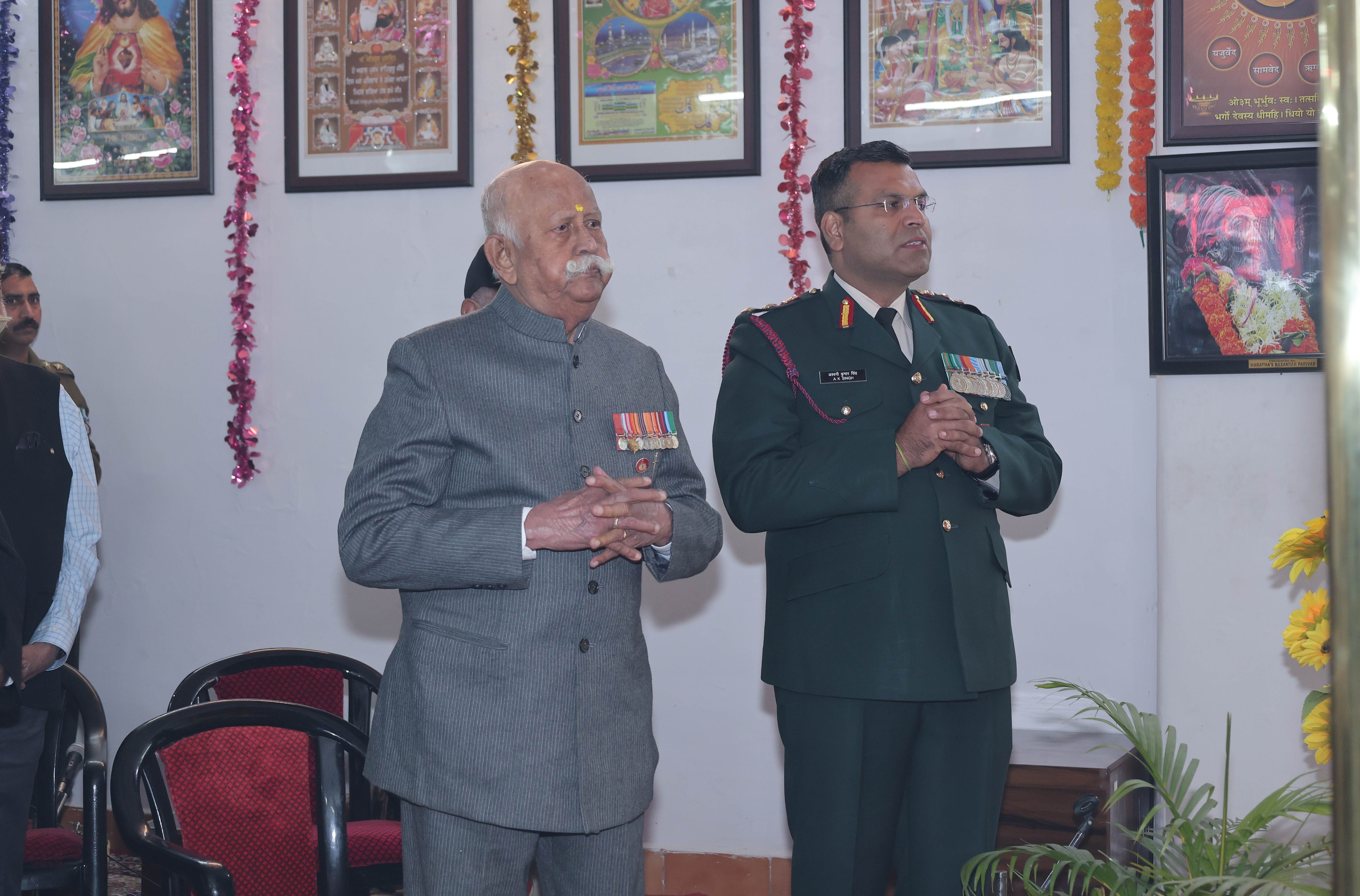
On 16 December 2025, I attended the Mandir Parade during the Diamond Jubilee of our Regiment – 75 Medium Regiment (Basantar River,) I had a terrifying realisation: I might have forgotten my ATM PIN, my wedding anniversary, and where I parked my car, but the aartis and slokas I learned forty years ago were still part of my DNA, still rearing to go.
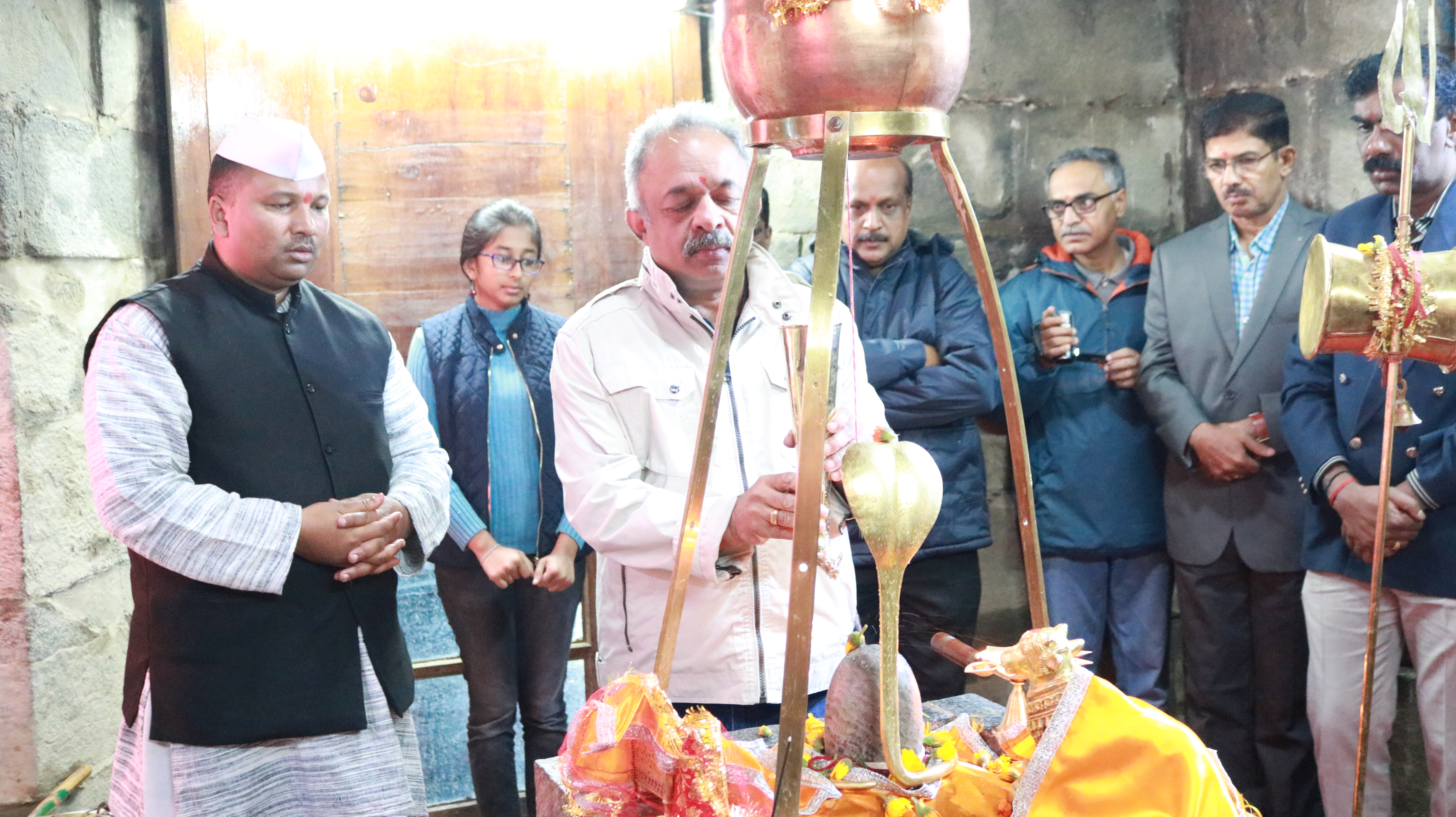
This wasn’t my first spiritual flashback. Back in 2017, during a trip to Kashmir with my Sainik School buddies, the local Religious Teacher saw me reciting verses with such gusto that he handed me the gaumukhi shringi (that fancy horn-shaped copper vessel). I held it with the confidence of a man who knew exactly what he was doing. I was also secretly hoping I wouldn’t accidentally pour holy water down my own sleeve!
What began as a leadership lesson became something far deeper. The aartis and slokas I learned in the Mandir, the hymns I heard in the Gurudwara, the prayers I offered at the Peer Baba’s shrine in Kashmir, and the Lord’s Prayer I whispered each morning and evening – they all came to feel like different doors to the same Sacred Room.
Decades later, standing at the Mandir Parade of our Regiment’s Diamond Jubilee, I understood that I had not merely memorised verses. I had absorbed a lesson that transcends religion: that faith, in all its forms, is the language of trust – and in the Army, trust is everything.
How did a Christian boy end up as a part-time Pandit?
It all started in 1982 when I was commissioned as a Second Lieutenant. Our Regiment was like a multi faith buffet: one battery of Brahmins, one of Jats, and one from the South, even more multi faith. Our Commanding Officer, Lieutenant Colonel AN Suryanarayanan, took one look at my work-in-progress Hindi and decided the best cure was immmersion therapy. He posted me to the Brahmin Battery. Our Battery Commander, late Major Daulat Bhardwaj, gave me the ultimate leadership pep talk: “To command Brahmins, you must become a Brahmin. You must be mentally alert, morally straight, and spiritually superior.”
I said, “Sir, the Academy made me physically tough, but I’m a Christian. My spiritual ‘superiority’ usually involves a Sunday hymn and a bit of cake afterward.”
Major Daulat wasn’t having it. “Get to the Mandir Parade. Learn the mantras. Rote-learn those until you’re singing them in your sleep.”
A month later, I was a lean, mean, chanting machine. I did have a moment of panic thinking about the Ten Commandments – specifically the part about no other gods before me – but I figured the Almighty was probably okay with it. After all, I was pretty sure that He wouldn’t be mean enough and just waiting to push me into hell at the slightest provocation.
More seriously, all officers of the Indian Army are trained to internalise and adopt the religious customs and practices of the men they command. It is an inherent part of the trust and rapport-building process.
The Test Behind the Mandir Parade
In 1986, I was the Senior Subaltern – the most senior Captain or Lieutenant in the Regiment – tasked with supervising, mentoring, and maintaining discipline among the junior officers.
One morning, after the Mandir Parade, the young officers approached me, with Late Captain Pratap Singh, Maha Vir Chakra (Posthumous), leading the pack. Captain Pratap spoke for the group. “We heard from our soldiers that you are well versed with the aartis and slokas recited in the Mandir. We wanted to check for ourselves. We stood behind you during the Parade to see if you were merely lip-syncing. You came out with flying colours.”
Their curiosity now piqued, and Captain Gulshan Rai Kaushik pressed further – दिल मांगे मोर Dil Mange More (The heart wants more.) They needed answers as to how had I learned all the aartis and slokas – especially being a Malayalee Christian.
I smiled and explained. It had begun in my early days with the Regiment, when Lieutenant Colonel AN Suryanarayanan and Late Major Daulat Bhardwaj had taken it upon themselves to rechristen me – not as a convert, but as a Brahmin in spirit. To command men of faith, they taught me, one must first understand their faith. And to understand, one must participate. What began as a leadership lesson had, over time, become a part of who I was.
Kashmir: Where Atheism Goes to Die
On my first assignment to the Kashmir Valley as a young Captain in 1987, my belief in God Almighty was instantly rekindled – not through theology, but through the sheer inhospitality of the terrain: sub-zero temperatures, heavy snowfall, avalanches, thin air deficient in oxygen, altitudes above 10,000 feet. If you want to find God, don’t go to a cathedral or a temple; go to a mountain road where one wrong turn sends your jeep into a gorge that doesn’t even have a bottom.
I was with a Punjab Battalion. On Sundays, attendance at the Mandir and the Gurudwara was mandatory. It was a Parade, which in Army-speak means: You will be spiritual, and you will be spiritual at 0800 hours sharp.
Then there was the Peer Baba shrine on the road to Headquarters. Legend had it that if you didn’t stop to pay your respects, your vehicle would develop a sudden urge to fly off a cliff. I became a very frequent visitor. Between the Mandir, the Gurudwara, the Peer Baba, and my own morning & evening Lord’s Prayer, I had a feeling that I must be the most spiritually insured man in Northern Command.
I, a Christian by birth, continued my own rituals – the Lord’s Prayer each morning and evening, a habit instilled by my father. It was right there in Kashmir, amidst the swirling snow and the will-my-jeep-survive-this-turn terror, that I finally cracked the code on Secularism. In the Army, secularism isn’t some fancy political theory – it’s essentially Spiritual All-Risk Insurance. I realised that whether I was chanting a sloka, bowing at a Gurudwara, nodding to the Peer Baba, or whispering the Lord’s Prayer, I was knocking on different doors of the same cosmic office. I wasn’t entirely sure who was signed in on the duty roster that day – Jesus, the Gurus, the Hindu Deities, or the Baba – but considering the sub-zero madness and the bottomless gorges, I figured it was best to keep all of them on speed dial. After all, when you’re 10,000 feet up, you don’t argue with the Management; you just make sure you’re on good terms with the whole Board of Directors.
Siachen: The High-Altitude Prayer Meeting
During later years of field service, I had a stint at the Siachen Glacier – the world’s highest battlefield, a disputed territory between India and Pakistan, renowned for its treacherous terrain, freezing cold at minus 40 degrees Celsius, crevasses, avalanches, and, lastly, enemy action. Statistics reveal that since 1984, when the Indian Army first occupied Siachen, more lives have been lost to the weather than to enemy action.
At minus 40 degrees, your breath freezes, your tea and everything else turns into a brick, and your brain starts wondering why you didn’t join the Navy. In Siachen, everyone is religious and your dependence on faith increases exponentially each following day. When the ice beneath your feet groans like a hungry monster and the air is too thin to support a conversation, let alone a firefight, you start talking to whoever is listening upstairs. Faith isn’t a luxury there; it’s the only thing that keeps you from checking your sanity at the base camp.
The Conclusion of a Confused Christian
Looking back, I understand now that the Indian Army’s genius lies not in imposing a single faith, but in embracing all faiths as one. The Army doesn’t care which door you use to enter the Sacred Room, as long as you show up. I learned that trust is the real currency. If my men saw me chanting their slokas, they knew I wasn’t just their officer; I was one of them. In the end, who kept me safe through the shelling, the avalanches, and the sub-zero madness? Was it Jesus? The Guru Granth Sahib? The Peer Baba? Or the Hindu deities? I like to think they all took turns. And honestly, considering the frequent messes that I got into, they probably needed teamwork. I honestly hope that this genius of the Indian Army is not changing its colors anytime soon.
Besides, considering your duty as a warrior, you should not waver. Indeed, for a warrior, there is no better engagement than fighting for upholding of righteousness. – Bhagavad Gita 2.31
You are my Protector everywhere; why should I feel any fear or anxiety? – Sri Guru Granth Sahib Ji on Ang (page) 103.
Be strong and courageous. Do not be afraid or terrified because of them, for the Lord your God goes with you; he will never leave you nor forsake you. – Deuteronomy 31:6
O you who have believed, remember the favor of Allah upon you when armies came to attack you and We sent upon them a wind and armies of angels you did not see. And ever is Allah, of what you do, Seeing. – Surah Al-Ahzab 33:9
 REJINCES