Lunar Landscape of Nea Kameni to Heraklion


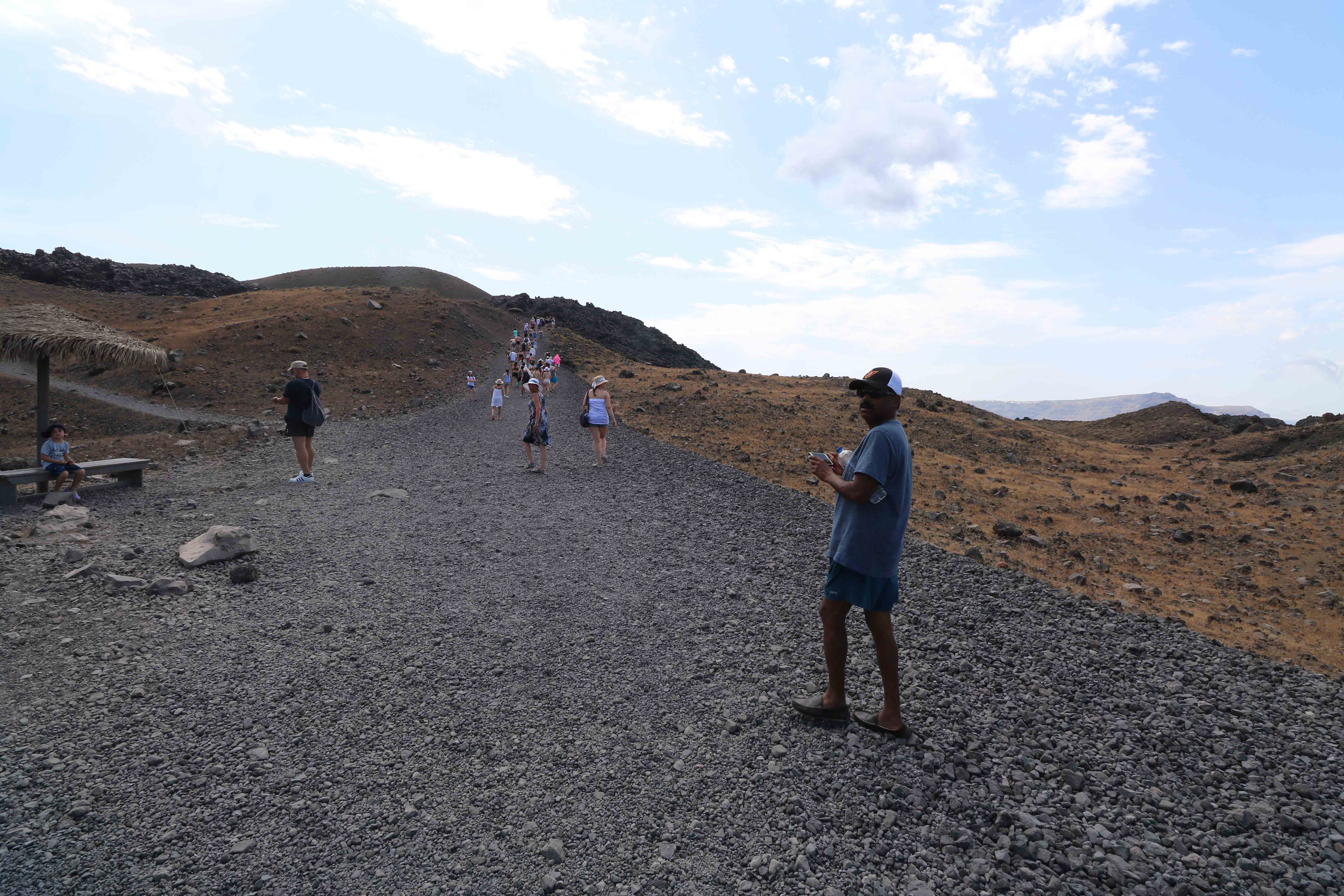
Our boat anchored at the wooden pier of Erinia cove of Nea Kameni island.  We disembarked from the boat and entered the Nea Kameni National Geological Park.  There is a two Euro entry fee and the proceeds go to support monitoring of the volcano.


Vegetation is sparse with the volcanic rocks covered by red grassy bushes and yellow sulfur deposits.  The 30-minute hike up over this volcanic mountain is moderately challenging but worth the effort for the breathtaking view that it offers.  Hikers need to keep to the track full of stones and gravel formed due to cooling lava.  Hence, proper walking shoes are a must.


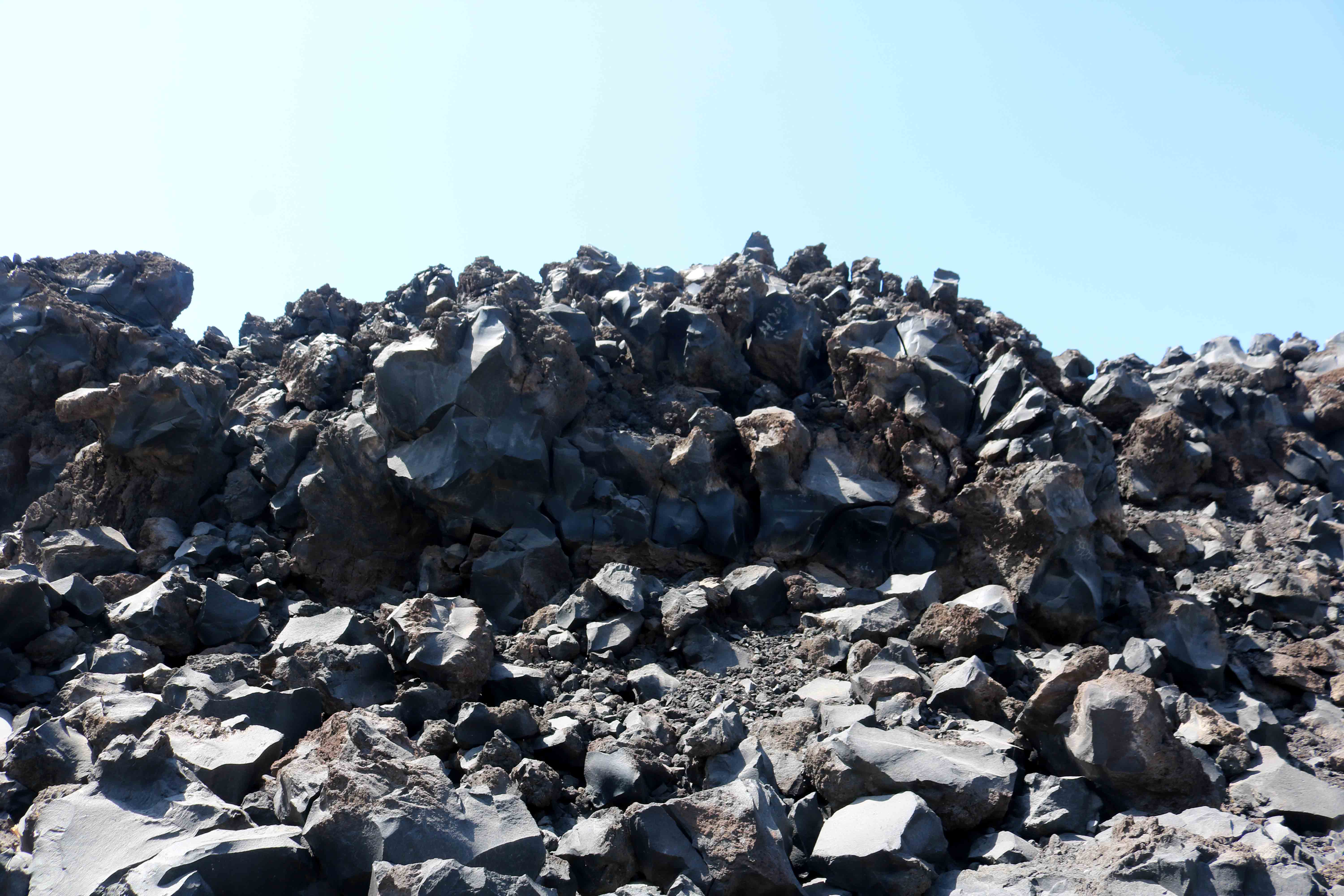
As we stepped into the Geological Park, the terrain was akin to that of a lunar-landscape.  As we climbed up the hill, on the sides were solidified lava ejected by the volcano called volcanic bombs.  These are the oldest volcanic bombs on the island and were the result of volcanic eruptions of 1573.


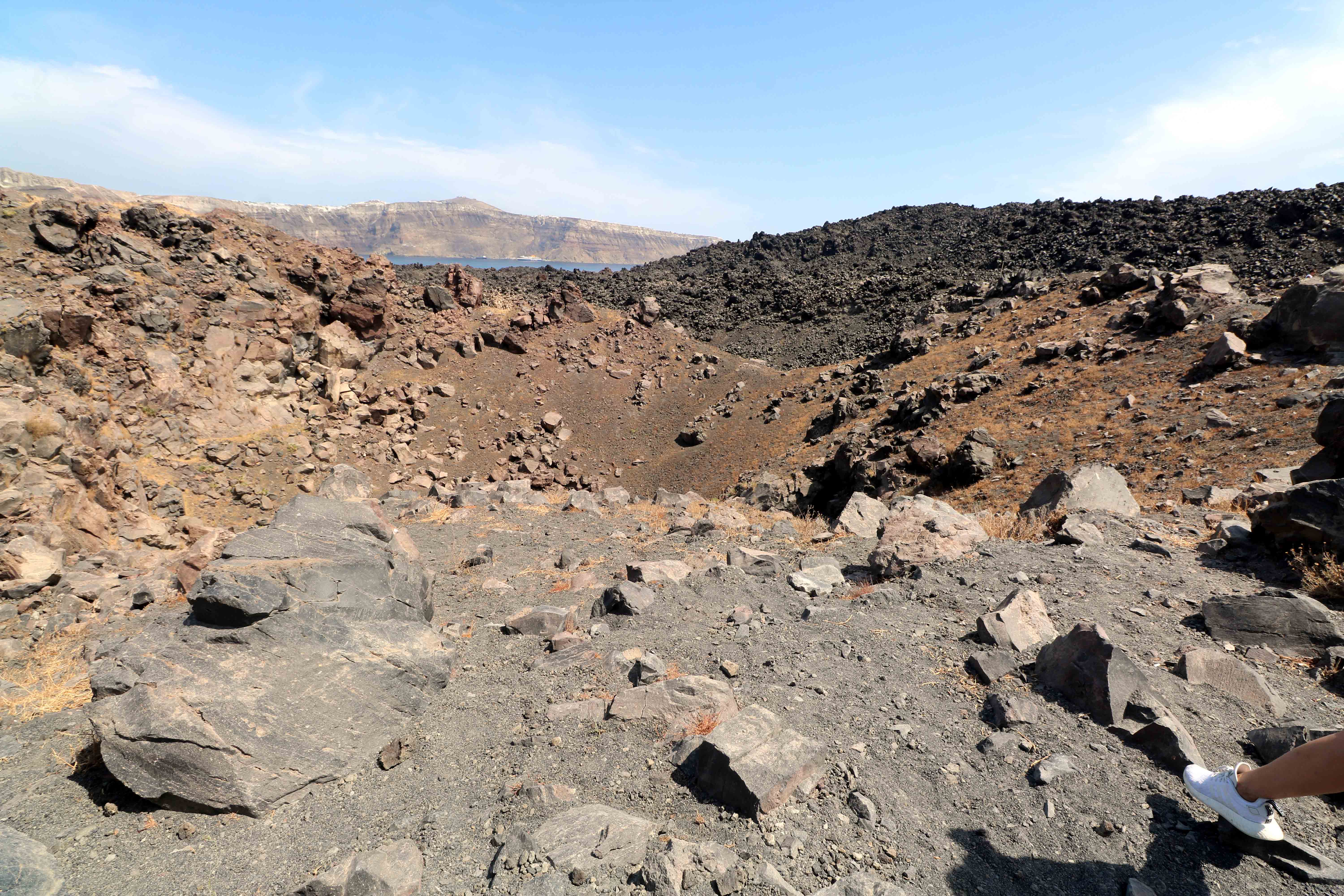
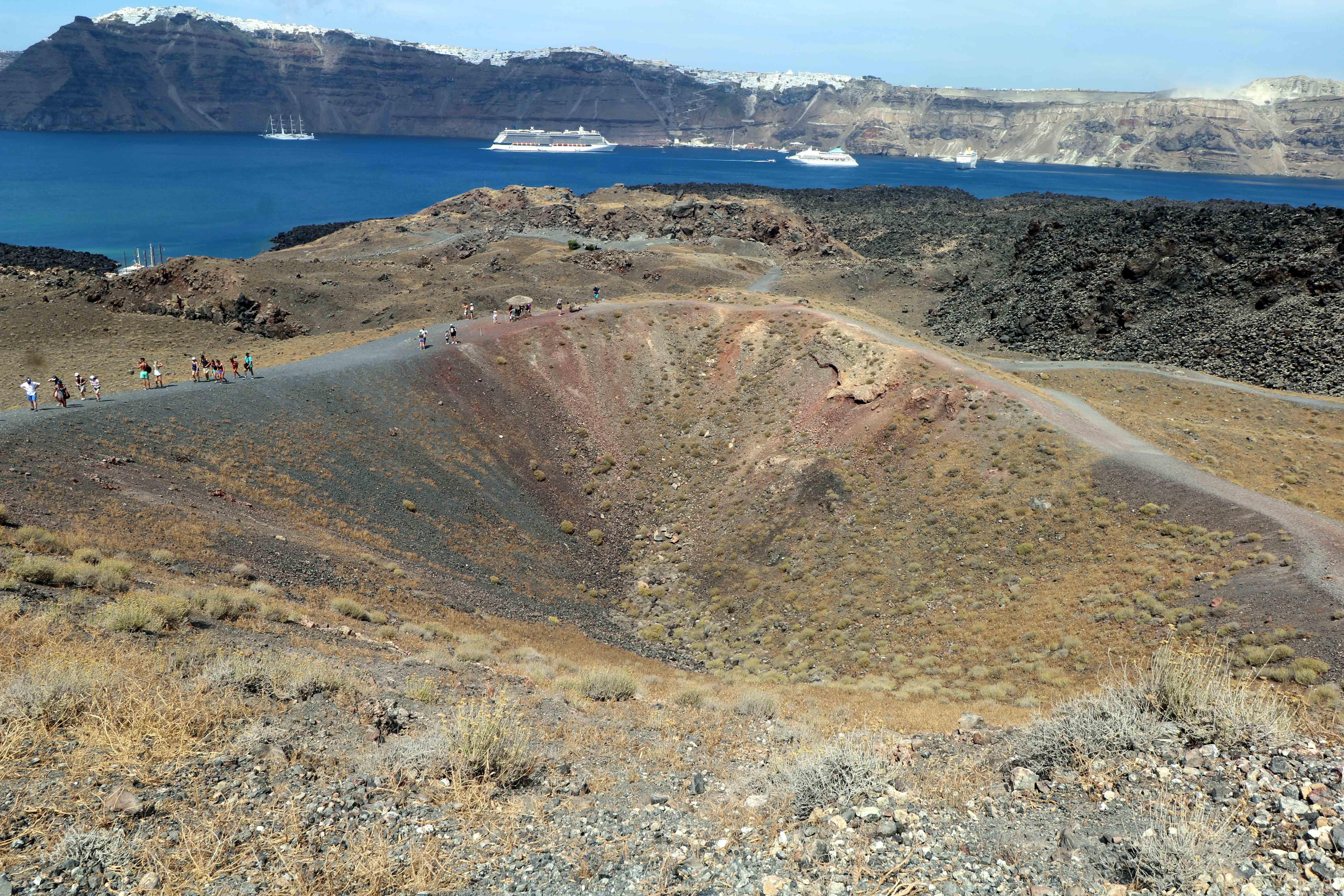
Further walking up, we reached slopes of the dome of Mikri Kameni, the oldest lava on the island. The path that led us to the top of this dome, to the crater of 1570 eruption.


Our next halt was at the Dafne crater caused due to volcanic activity of 1925-1926.


We then came to the twin craters formed as a result of 1940 volcanic eruption.


Climbing further up, we came to Georgios dome peak.  The crater here was created in August 1940 by two large volcanic eruptions atop of the dome of George, which was created in 1866.


On top of the hill at about 127 meter we saw deposits of solidified Lava.  These rocks were formed due to cooling and solidifying of molten lava which erupted in 1950.


On the top we could see that many sensors were deployed. The seismic sensors monitor tectonic activity that may precede a volcanic eruption.  Carbon dioxide (CO2) emissions are also monitored.  With modern technology and monitoring, it is believed that scientists are in a position to forecast the volcano’s next eruption, at least a few months to a year in advance.


After spending about 90 minutes at Nea Kameni, our boat headed back to the Fira port.  As we stepped out of the boat, we could hear the cacophony of donkey drivers hailing for passengers.  The donkey is Santorini’s logo, its trademark mascot. During a Greek wedding, the bride rides a donkey to the church and back to her home.  We all decided to take the donkey ride up the 588 steps of Karavolades stairs.


These donkeys are well trained and the rider is required to sit firmly on the saddle.  There are no reigns and so the rider has little or no control over the animal’s movements.  As we sat on the donkey, they set off on the way up.  There were many pedestrians walking up and down, so also other donkeys coming down the stairs.  These donkeys steered their way through this ‘crowd’, as if they exactly knew what to do.   For the donkeys it appeared that their only aim was to reach the top as quickly as possible. The level of training was quite akin to that of the famed ‘Mule Artillery’ of the Indian Army.


On reaching the top, the donkeys stood at the donkey-taxi stand.  The drivers helped everyone to dismount.  We then had dinner at the Fira and returned to our hotel.

On June 15, after breakfast we checked out of our hotel.  Our ferry to Crete island was scheduled for 4 PM.  We then set out to explore the area around our hotel.


Economy of Santorini, like all other Greek islands, is supported by tourism.   Santorini grows a special variety of small cherry tomatoes, fava beans, yellow peas, cucumbers and white eggplants.   There are lots of wild fig trees growing all over the island.


Unlike the mainland of Greece, Santorini does not grow olive trees due to the strong winds and the lack of water.  Instead they grow a lot of pistachio trees.  The olive tree above grows between the buildings at the hotel.


From the Hotel, we walked down to Kamari beach resort.  On the Southern end towers the enormous rock of Mesa Vouno with the archaeological site of Ancient Thira on its top, 400 meters above the sea. The beach offers a wide range of facilities like sun-beds, umbrellas and various water sports.


The water is deep and blue, the sand is black.  The beach is filled with black sand and pebbles as a result of extensive volcanic activity over centuries.


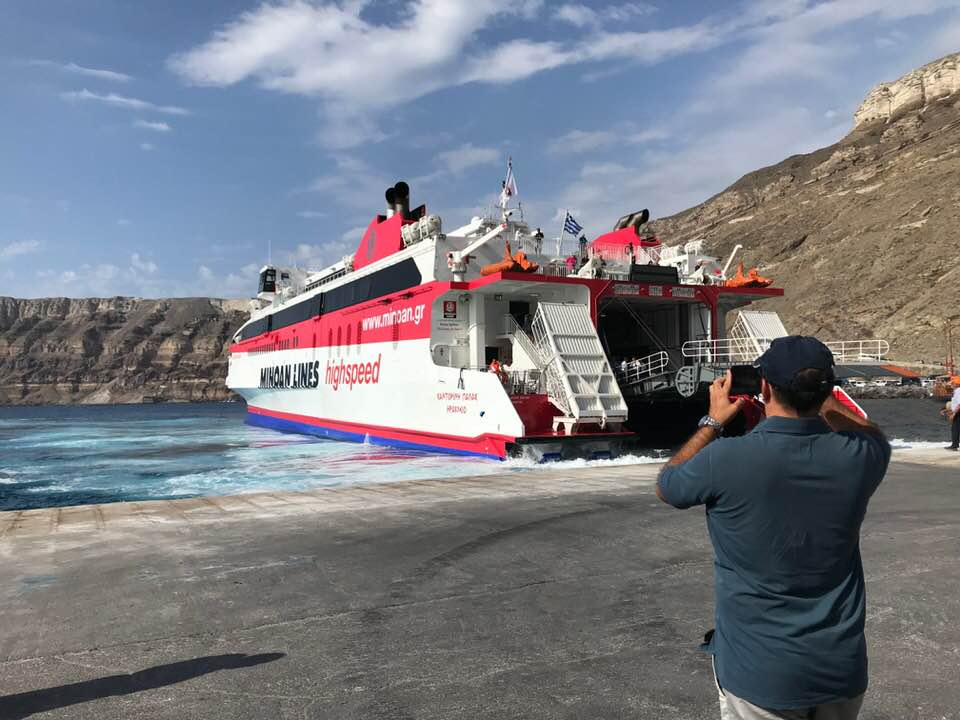
We boarded the high-speed ferry operated by Minoan Lines to Heraklion, Crete.  The cruise was very comfortable and smooth.


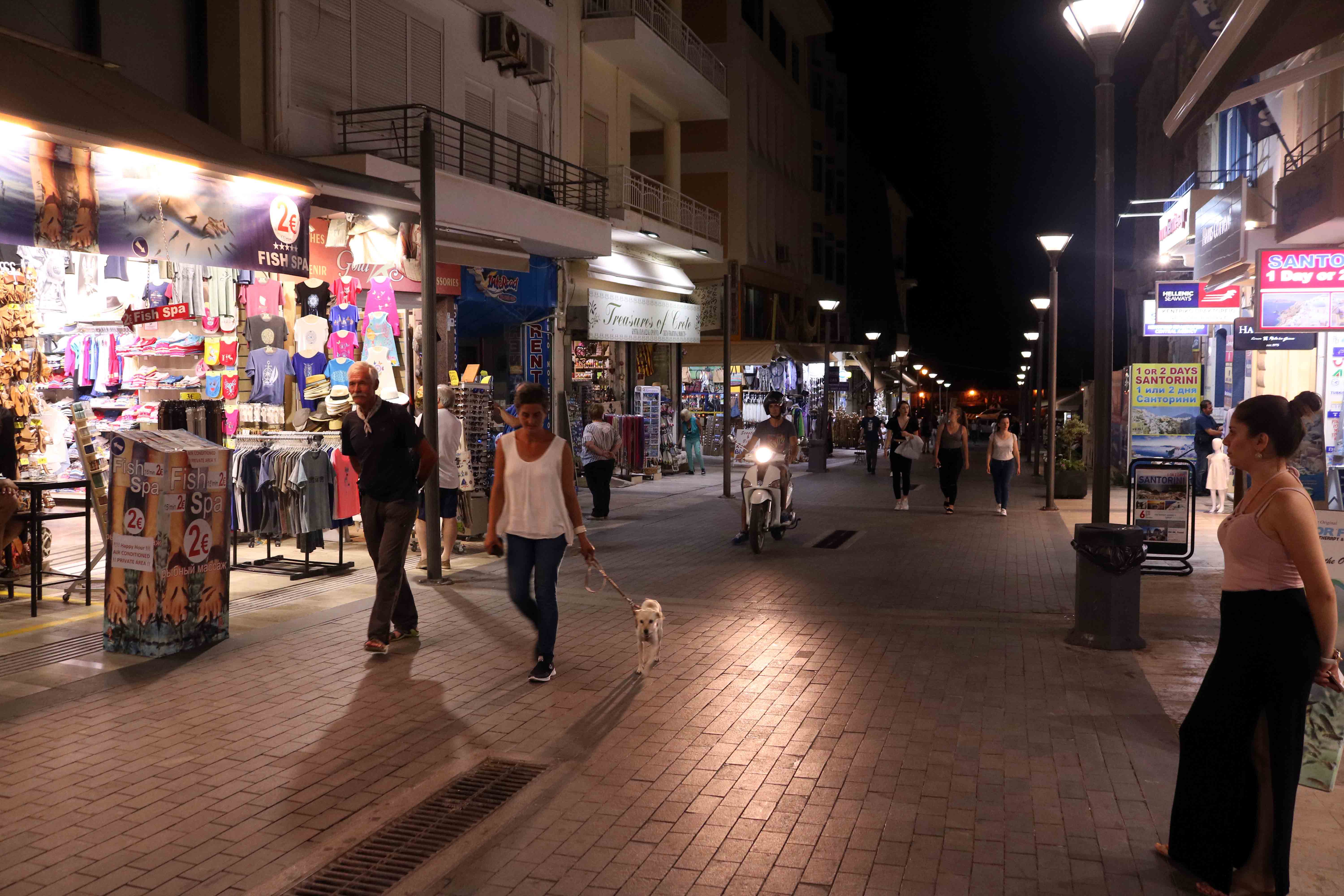
We reached Heraklion port by 5:30 PM.  We drove to our hotel by taxi and checked in.  As the night fell, we walked to explore the city.


We walked to the largest cistern to provide drinking water to the Heraklion port. The cistern consists of two oblong vaulted chambers linked by arched openings. Light and air enter the cisterns through large light shafts on the top of the vaults.  Today, all the daily garden watering needs of Heraklion Port Authority (about 7000 litre of water) is provided from an underground cistern, built by the Venetians (People from Venice), hundreds of years ago.


Venetians also built a series of shipyards (known as Arsenali) at the southern and the eastern area of the port, in order to house and protect the activities of the building and repairing of ships.  These large, barrel-vaulted buildings were shipyards built by the Venetians and were capable of housing ships in need of protection or repair and for the construction of new vessels.


Night life in Heraklion is very hectic with shops, restaurants, taverns, discos, clubs, etc, all open till 3 o’clock in the morning.


Summer in Crete and in Greece means ‘tables outside’: The guests meet the local people and everyone joins the party.  We had Cretan cuisine for dinner and retired to our hotel.

Volcanoes of Santorini


On June 16, after breakfast we set out to visit the volcanic islands of Nea Kameni, meaning ‘new burnt’ and Palea Kameni meaning ‘old burnt’.


During the Bronze Age, Santorini was called Strongyli, meaning ‘rounded.’  Devastating volcanic eruption of 1650 BC resulted in decimation of Strongyli, creating the crescent shaped Santorini and several surrounding islands.

The island of Hiera was formed due to volcanic eruption which started around 197 BC.  In 47 AD the volcano reawakened spewing huge quantities of magma forming a new island which merged with Hiera to form Palia Kameni.  Breakup of Palia Kameni occurred between 1457 and 1458, as per Roman historian Aurelius Victor’s ‘Historia Romana’. At that time the island had a perimeter of 5,550 meters.  It gradually acquired its present shape through fragmentation by great cracks and collapse of its shoreline, with the current perimeter of only about 4000 meters. Like a slumbering demon, the volcano remained dormant for the next seven centuries. It became active again, very violently in 726 AD.

Nea Kameni is Eastern Mediterranean’s youngest volcanic landform.  It is a protected natural monument and national geological park.  In 1573 AD, about 65 years after Palea Kameni reached its present form, volcanic activity broke out resulting in the formation of a small island called Mikra Kameni meaning ‘small burnt’.  Formation of Nea Kameni commenced with the volcanic eruptions from 1701 to 1711.  Volcanic eruptions of 1866 to 1870 caused the smaller island of Mikra Kameni, to be joined with the larger Nea Kameni.  During the period 1939-1941, many eruptions occurred in Nea Kameni which changed the topography of the island.  The volcanic activity ended in July 1941.  Today, magma exists at depths of a few kilometers, giving Nea Kameni its trademark sulfur odour.


From our hotel we rode a local bus to Fira, the capital of Santorini on the West coast of the main island.  Fira is a ‘whitewashed’ town of cafes, bars, restaurants and shops, all filled with tourists.  We had to now go to Gialos, the old port of Fira to sail to the volcanic islands.   Till a few decades ago, Gialos was the main commercial port of the island.  The port now is active mostly in summer and serves only the cruise ships, the excursion boats to the volcano, and a few fishing boats.   The port is located about 275 meters below the cliff.

Alighting from the bus, we walked to the cable-car terminal to purchase tickets for the ride to the port.  The queue was pretty long and we got our tickets after about 30 minutes.  The ladies made use of this time to buy trinkets and memorabilia from the shops around, while the men stood in the queue.


There is a zigzag track of 588 steps called Karavolades stairs from the Fira to the Old Port.  There were many tourists walking up and down these steps.  There are mule-taxis, that operate on the same track, taking tourists up and down.   The Karavolades stairs have several large bends which offer magnificent view of the volcanic islands.


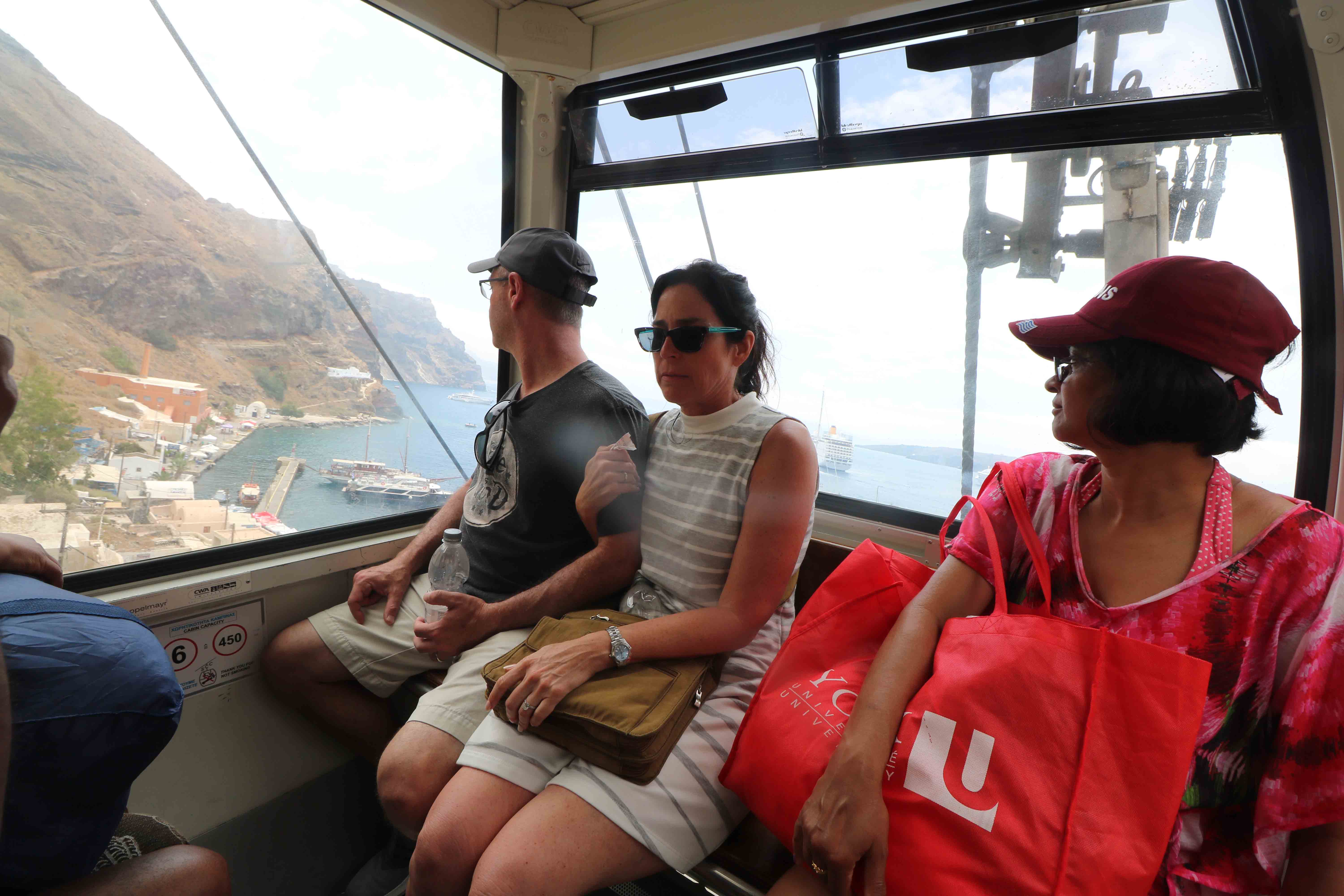
The fastest option to reach the old port is surely by the cable car system, commissioned in 1982.  The project was funded by Loula & Evangelos Nomikos Foundation created by the wealthy Santorini ship owner Evangelos Nomikos.   He mediated with the traditional mule drivers who were operating here and ensured that a part of the income went to the mule drivers and the rest to the city. The cable car runs every 20 minutes and a single ride takes 3 minutes. The cable car ride to the old port gave us a stunning view of the volcanic islands, bizarre cliff sides and still blue waters.


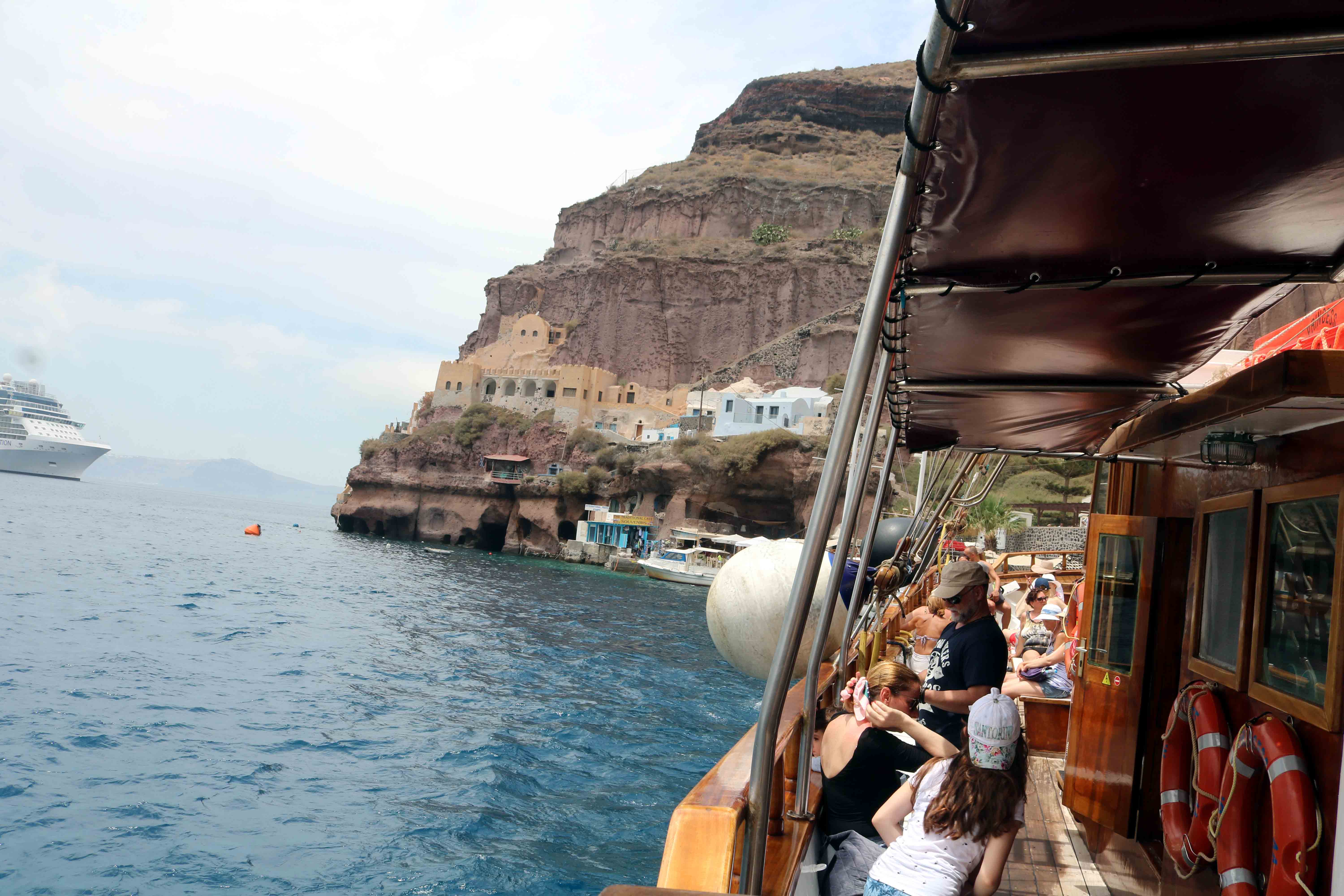
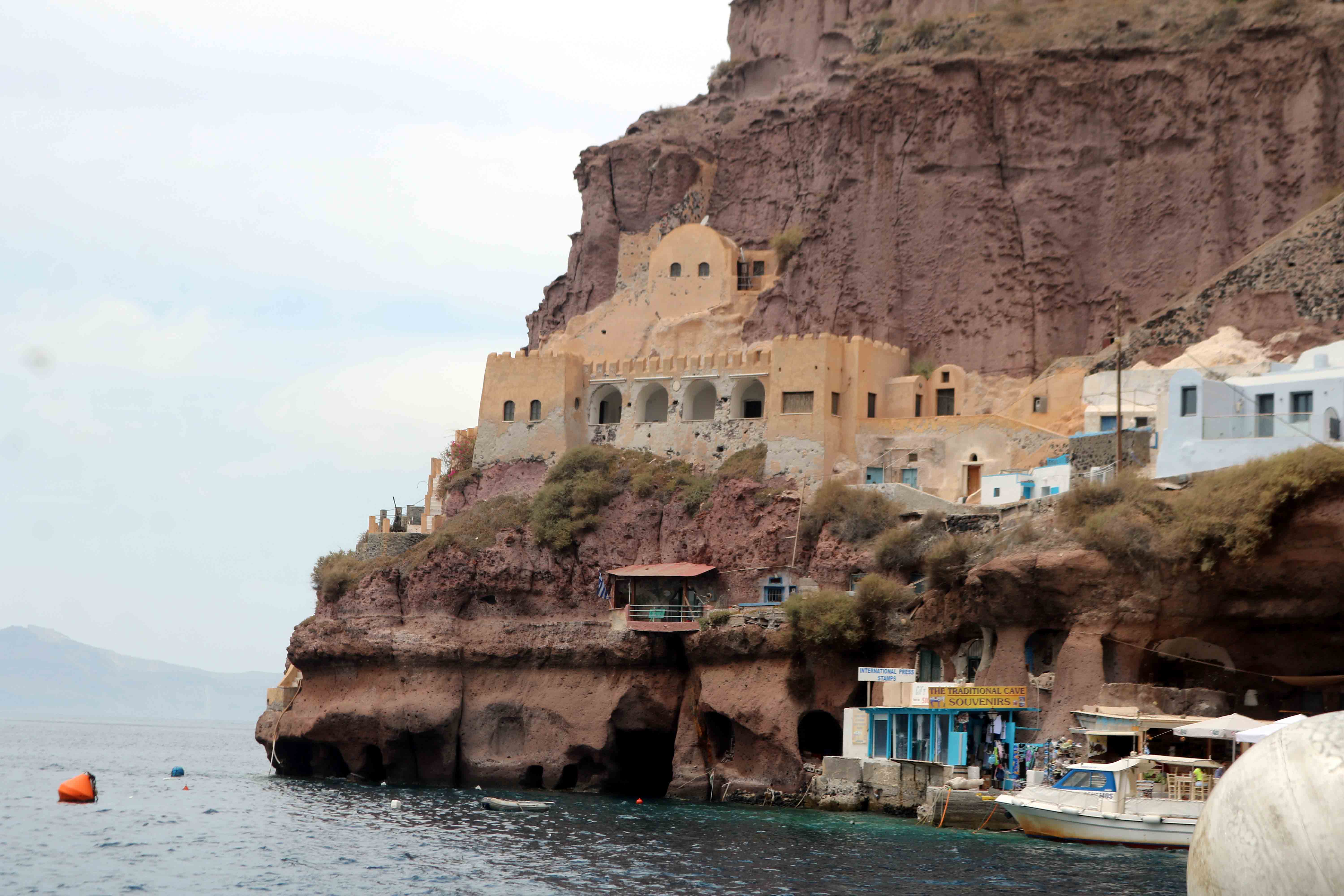
On all sides of the old port were restaurants, taverns and small shops, mostly catering to cruise ship tourists who come ashore by chartered boats as the huge cruise ships cannot berth at the harbour.  At one end of the port is the caved houses that appear stuck on to the rock and rock caves that have been created by erosion.  We booked our tickets for the boat journey to the volcanic islands and had lunch at a restaurant at the pier.


We set sail on a boat from the port at around 2 PM to the island of Palea Kameni.  After about 20 minutes, the boat anchored at the cove of Agios Nikolaos.


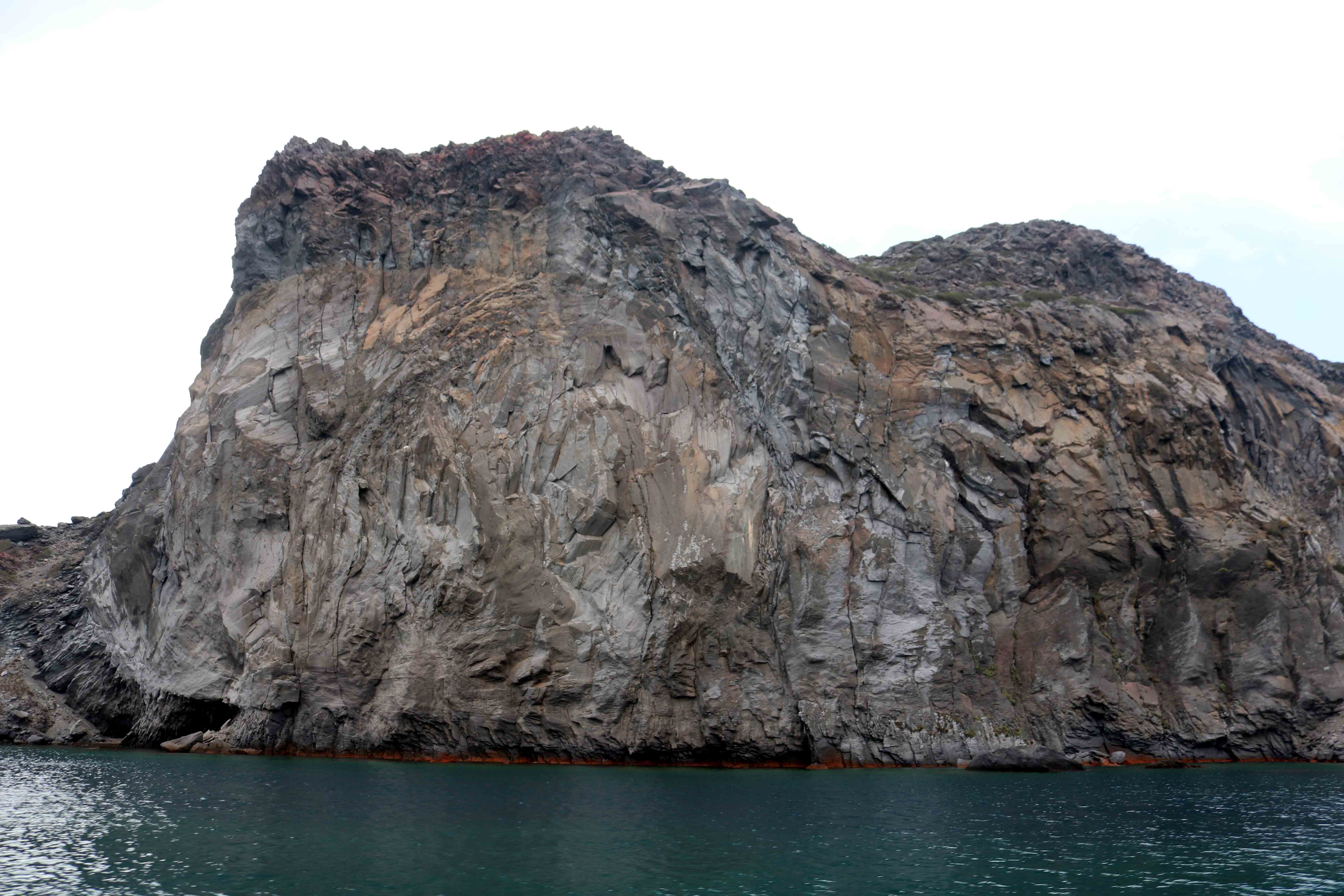
As we came closer to Palea Kameni island, we were greeted by steep cliffs formed by solidified lava.


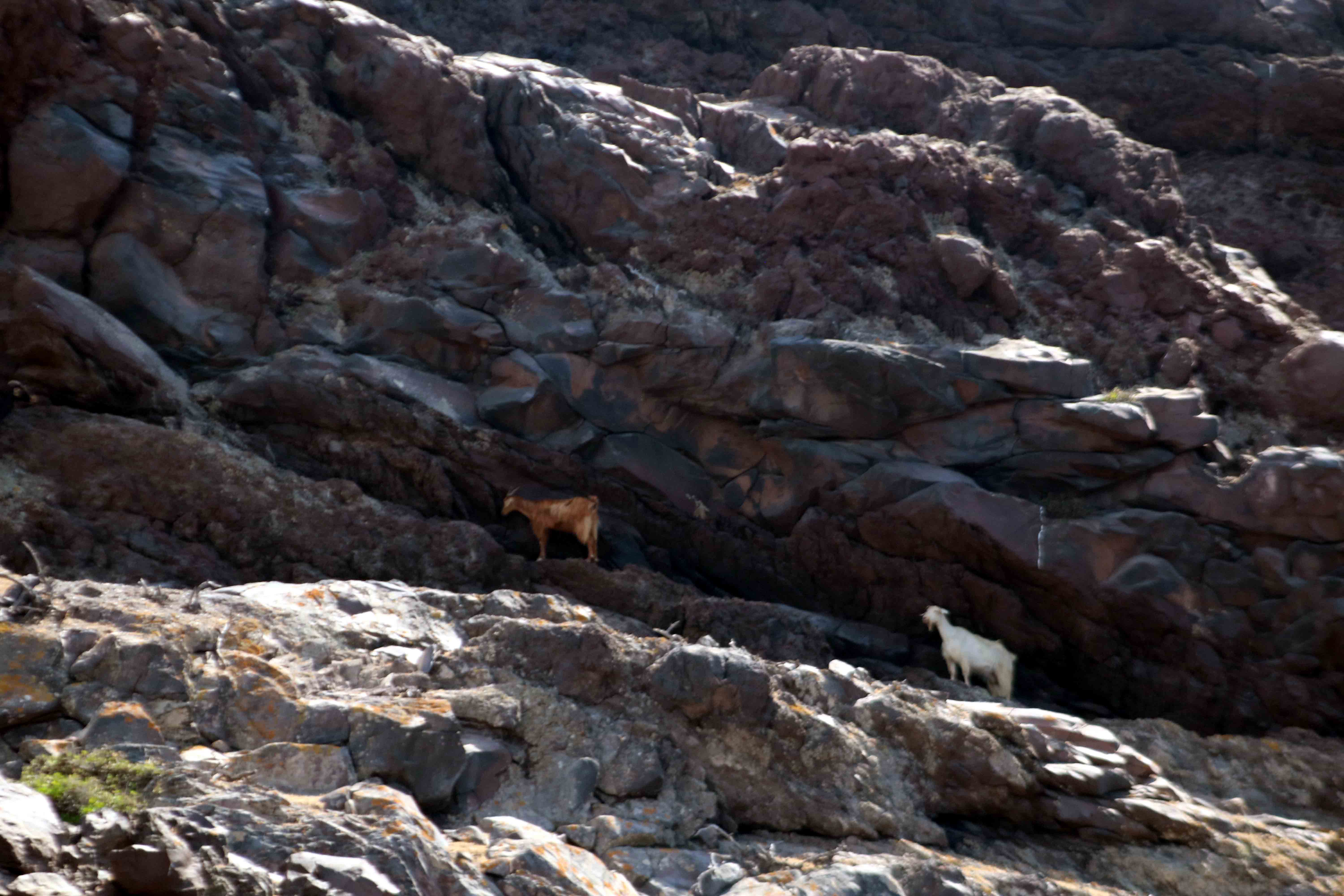
The cove is formed between small cliffs filled with solidified lava rocks.  The island is uninhabited, but we saw goats grazing, presumably wild, miraculously perched on the ledges on the cliff, chewing away on the almost non-existent shrubbery.


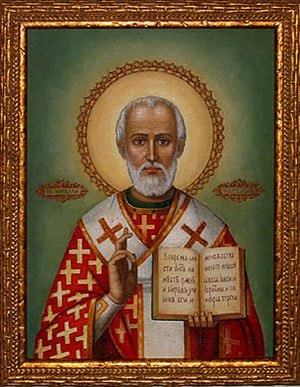
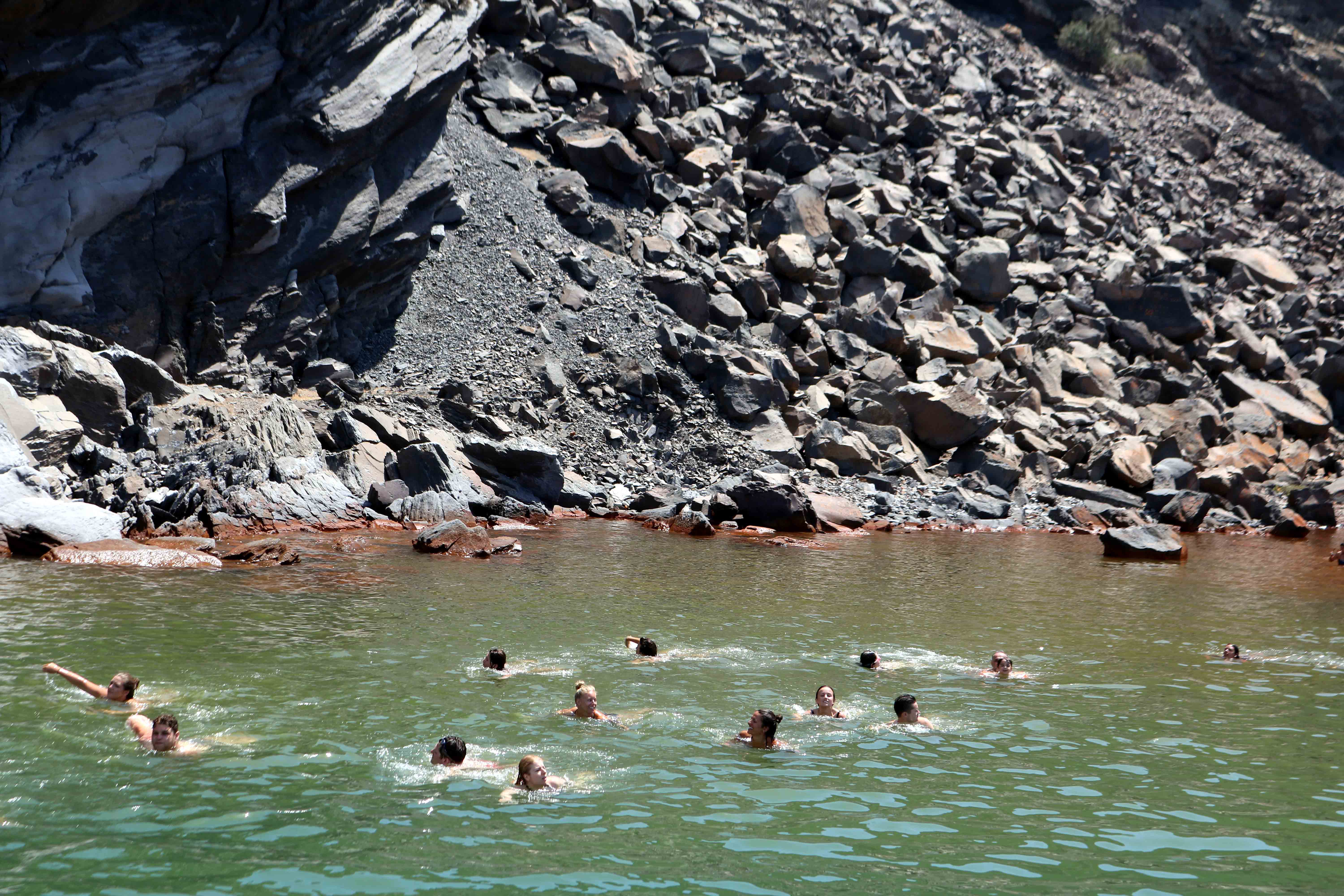
The boat anchored about 75 meter away from the hot springs.  We had to jump seven meters from the boat deck, plunging into deep cold sea water which is greenish yellow and then swim for about five minutes towards the orange coloured hot springs.  (Attempt this only if you are a good swimmer.)  At the mouth of the hot springs stands a little Greek Orthodox church dedicated to Saint Nikolaos, the patron saint of sailors in Greece.


Due to volcanic activity in the cove area, the water is warm and rich in sulphur, iron and manganese.   This gives the water an orange colour and is believed to have therapeutic benefits.  As one swims closer to the cliff where the water is orange, one can feel the increasing water temperature.  It is slightly warm and there is no fear of getting burned.  The seafloor around the hot springs is muddy, rocky and slippery, making it difficult to walk on.

After about half hour stay at the cove, a swim in the warm waters, a view of how the earth would have evolved, the boat steamed off to Nea Kameni, the younger sister island of Palea Kameni.

Newlyweds Do Fight

Almost all married people fight, although many are ashamed to admit it. Actually a marriage in which no quarreling at all takes place may well be one that is dead or dying from emotional undernourishment. If you care, you probably fight” said noted American author Flora Davis.

Captain Deepak Malik (name changed), a young officer, newlywed, once sought my interview as he had some pressing private issues.  I ordered him to meet me next morning at 11 AM.  All the while I tried to fathom as to what could be the problem he might be facing.  Is it that his young wife has not been able to adjust to the Indian Army’s way of life?  Is it that she is scared of me as the Commanding Officer?  Is it that she felt that some officers or soldiers misbehaved with her?  My mind went into an overdrive, searching for all possible problems a young couple could face.  Surely, I was preparing myself as to how to deal with it.

Next morning at 11 AM, Captain Malik showed up at my office.  I asked him “What is the pressing issue?“.  Taking a long deep breath, he answered “Sir, everyday there is a fight between my wife and me.  It is becoming too much for me to handle.

How many times do you fight?”  I questioned.  “Once a day” was his prompt reply.

Oh! that is not an issue at all.  When we got married, we fought twice on a working day and four times on a holiday.  Young man, you are doing pretty well.  Remember, your wife is an individual, she comes from a different family and background.  It is natural to have differences of opinion and at this age and it got to end up in a fight.  If you do not fight, then there is a problem – either of you are faking it.  Now get off from my office and attend to your work”  I said to him, feeling relieved.

After a month, I met the couple at the Officers’ Mess function and I enquired about their well being.  Captain Malik said “I asked for the Commanding Officer’s interview thinking that after hearing my sob story, he might excuse me the morning Physical Training, instead he gave me kick and threw me out.   Now I realise what married life is all about.”

Marriage is all about communication – honest, frank, open, accepting and respecting.  It must be full of love for each other.  It should neither be sarcastic nor hurtful.

It is an art as to how newlyweds deal with arguments, big and small.  They end up causing heartburn and a lot of tension in marriage. Both partners need to find a communication style that works for both and respect the boundaries mutually set.

It is mostly small and pretty issues which end up in arguments, at times running out of hand.  It could be about the ‘mess’ in the bedroom, clutter in the washroom,  what to watch on TV, what to eat for dinner, which movie to go, visiting family members, how often you spend time with each other’s friends – the list is endless, even though very small.

Life of a newlywed is challenging – it is all about adjustments and at times compromises – many were least expecting these. Reality dawns on the couple  when they live together, away from their parents.  It is all the more challenging for an Army wife who hails from a non-Military background.  It is going to be a roller coaster ride for the bride and she is bound to be scared at each step.  The husband got to explain everything in detail to her and provide more than needed support for her to adjust to the military environs.

Taking a holiday and travelling to a place of interest to both will do a lot good.  Sometimes this may also lead to a fight, but the thrill of the first holiday together will much outweigh the fight.   This time can be utilised to review your progress together and also plan for future.

His money – Her money – Our money‘ – especially when both spouses are earning – is another point for a fight.  Now you got to row the boat together, hence the need for proper budgeting after mutual discussions.

When you marry someone, you marry into a family. Learning how to live with each other’s family needs ‘diplomatic’ skills many a time. Always keep the interest of your spouse ahead of everyone else.

Each of you are individuals and hence need ‘my time’.  Allow your spouse this benefit too- to pursue hobbies or interests or even lazing around doing nothing.  You both will have many interests common and many divergent.  You got to accommodate each other.

Sex is an important part of married life.  Both got to be expressive and enjoy the pleasure.  It is not all about the ‘physical sex’ on which you spend no more than five minutes.  It is all about foreplay, caressing, speaking those lovely lines and so on.  Go as far as your imagination can take you, but be equally careful not to make it a nightmare for your partner.  When one partner feels there isn’t enough sex, it will cause issues. Both need to be open and respectful about how you are feeling and your needs.

Everyone has different plans in life. The husband may want a child whereas the wife may not. It could be the in-laws who are more in a hurry to see a grandchild. Either way, having children is a huge decision and can cause tensions if both are not on the same page.

I’ve learned that just because two people argue,
it doesn’t mean they don’t love each other.
And just because they don’t argue,
it doesn’t mean they do.     
Omer Washington

Sikhs and Kerala Floods


Offering free meals to anyone and everyone is a great Sikh tradition known as  of Langar (लंगर).  It  has remained a core part of the Sikh faith from inception.  Every Sikh temple or Gurdwara (गुरुद्वारा ) around the world offers people a free meal at any time regardless of sex, colour or religion. There are no rituals involved and everyone eats together. The aim is to inculcate the feeling of equality amongst all, a Sikh teaching around equality.

When the state of Kerala faced disastrous floods in August 2018, Sikh volunteers from the UK- based philanthropist group – Khalsa Aid – reached Kerala and setup a Langar at Kochi for some 3,000 people.  On seeing the plight of the people, they expanded the Langar relief to serve 13,000 people twice a day.

These Sikh volunteers, joined hands with Kochi administration, took over the kitchen at Rajiv Gandhi Indoor Stadium at Kochi, where the aid materials were pouring in.  Food supplies and cereals like wheat, rice, vegetables poured in, but with no one to cook a meal.  The Sikh volunteers purchased  spices and utensils, took over the kitchen at the stadium and kept  the kitchen fires going.  The food from this kitchen was distributed at various relief camps for the needy.

Hardly any media or social media showed the contribution of the Sikh volunteers in bringing succour to the flood affected.  The Kerala Government and administrative officials seemed ignorant about the contribution of the Sikh volunteers as there was hardly any gratitude expressed for these volunteers.

Let us now turn a few pages of Kerala history to 1923.

As per the caste system prevalent in Kerala (then broadly divided into Malabar, Cochin and Travancore kingdoms) and the rest of India of that time, low-caste Hindus were not allowed entry into the temples.  They were not even allowed even to walk on the roads that led to the temples.

In the Kakinada meet of the Congress Party in 1923, TK Madhavan presented a report citing the discrimination that the depressed caste people were facing in Kerala and the need to abolish untouchabiity – a practice in which some lower caste people were kept at a distance, denied of social equality and made to suffer  for their touch was considered contaminating or polluting the higher caste people.

In Kerala, a committee was formed comprising people of different castes to fight untouchability.  Satyagraha movement began on 30th March 1924 at the Mahadeva Temple at Vaikom town in Travancore, which denied entry of lower caste people – mostly Ezhavas.  Satyagraha  is a form of nonviolent resistance or civil resistance and the term was coined and developed by Mahatma Gandhi to oust the British from India.  People who offered satyagraha are called Satyagrahis .  The Satyagrahis in batches entered the temple and were arrested by the police.

On 01 October 1924, a group of forward caste Hindus marched in a procession and submitted a petition to the Regent Maharani Sethulakshmi Bai of Travancore with approximately 25,000 signatures for allowing entry to the temple for everyone.

On 23 November 1925, all the gates of the temple were opened to all Hindus except the Eastern gate.  In 1928, backward castes got  the right to walk on public roads leading to all temples in Travancore.  This was the first time that an organised movement was conducted on such a massive scale for the basic rights of the untouchables and other backward castes in Kerala.

As the sathyagraha commenced in 1923, a few Sikh volunteers reached Vaikom in support of the demonstrators. They established a Langar there to feed the Sathyagrahis.  How they reached Vaikom from Punjab in those days with a scant railway network and how they cooked food for Keralites who only ate rice got to be researched.


This is an archived image of the Sikh volunteers with Ezhava sathyagrahis.

After successfully completing the Satyagraha and after the Temple Entry Proclamation, some of the Sikhs remained in Vaikom. Some Ezhava youth were attracted to the concepts of Sikhism.  It is believed that many Ezhavas joined the religion. Many families later returned to Hinduism and the number of Sikh Ezhavas dwindled.

In Sikhism, the practice of the Langar is believed to have been started by the first Sikh Guru, Guru Nanak. The concept of Langar was prevalent in Punjab from the 12th Century – from the time of Baba Farid and Sufi saints.  Guru Angad, the second Guru institutionalised it for all Sikh temples.  Guru Amar Das, the third Guru established langar as a prominent institution and required people to dine together irrespective of their caste and social rank. He insisted on all those who visited him attend laṅgar before they could speak to him.

From the beginning till date, Sikhs have followed the words of their Gurus and have been rendering yeoman service to humanity by providing food not only in their places of worship, but also to the needy wherever and whenever it is required.

Hats off to the spirit and commitment of this great community of Sikhs. 


Ship On Fire


During the term break at the Indian Military Academy, I paid a visit to the Indian Naval Ship anchored at Kochi Naval Base, which housed the Midshipmen from our course. I boarded the ship at about 9 AM and was received by our course mates and was taken to the bunks where they stayed.

As the Midshipmen were to attend to their daily training, I was ‘ordered’ to sleep on Saurav’s bunk and stay put until they returned for lunch break. I was also ordered not to come out of the bunk as an ‘alien’ in the ship would attract the wrath of the senior officers of the ship. What a great place to sleep – for a Gentleman Cadet on a term break from the Academy, even a hard rock becomes a soft bed the very moment he gets an opportunity to sleep.

Suddenly the fire alarm in the ship went off. I first thought I was dreaming, but the commotion with many boots striking the metal decks of the ship made me realise that it was indeed a fire alarm. I looked out through the port holes and I could see three fire-tenders parked alongside the ship.

As an Army Cadet, I took the orders seriously – that too to stay put at the post and not to abandon it until last man and last bullet. So I decided to roll over and continue sleeping. Midshipmen came down for lunch and that is when it dawned on them that I was still asleep – like a good Army Cadet.

It seems someone reported some smoke somewhere on board and Pixie was the Officer on Duty and he immediately raised the fire alarm, called the Fire Station and they promptly dispatched the fire tenders. As I did not know the procedure to be adopted and also not to disclose my alien-on-board status, I thought it wise to continue sleeping, even if the entire ship caught fire.

Wine & Sunset at Santorini


While at Megalochori, we visited Katsoyannopoulos Vineyard for wine tasting.  The vineyards of Santorini date back almost 5000 years and are believed to be the oldest in Europe.  Volcanic eruptions left behind a mixture of volcanic ash, pumice stone and pieces of solidified lava and sand, which together make up the soil of Santorini.   This soil, rich in essential minerals, result in wines with low pH level or high acidity.


About 1400 hectares is under vineyard cultivation in Santorini.


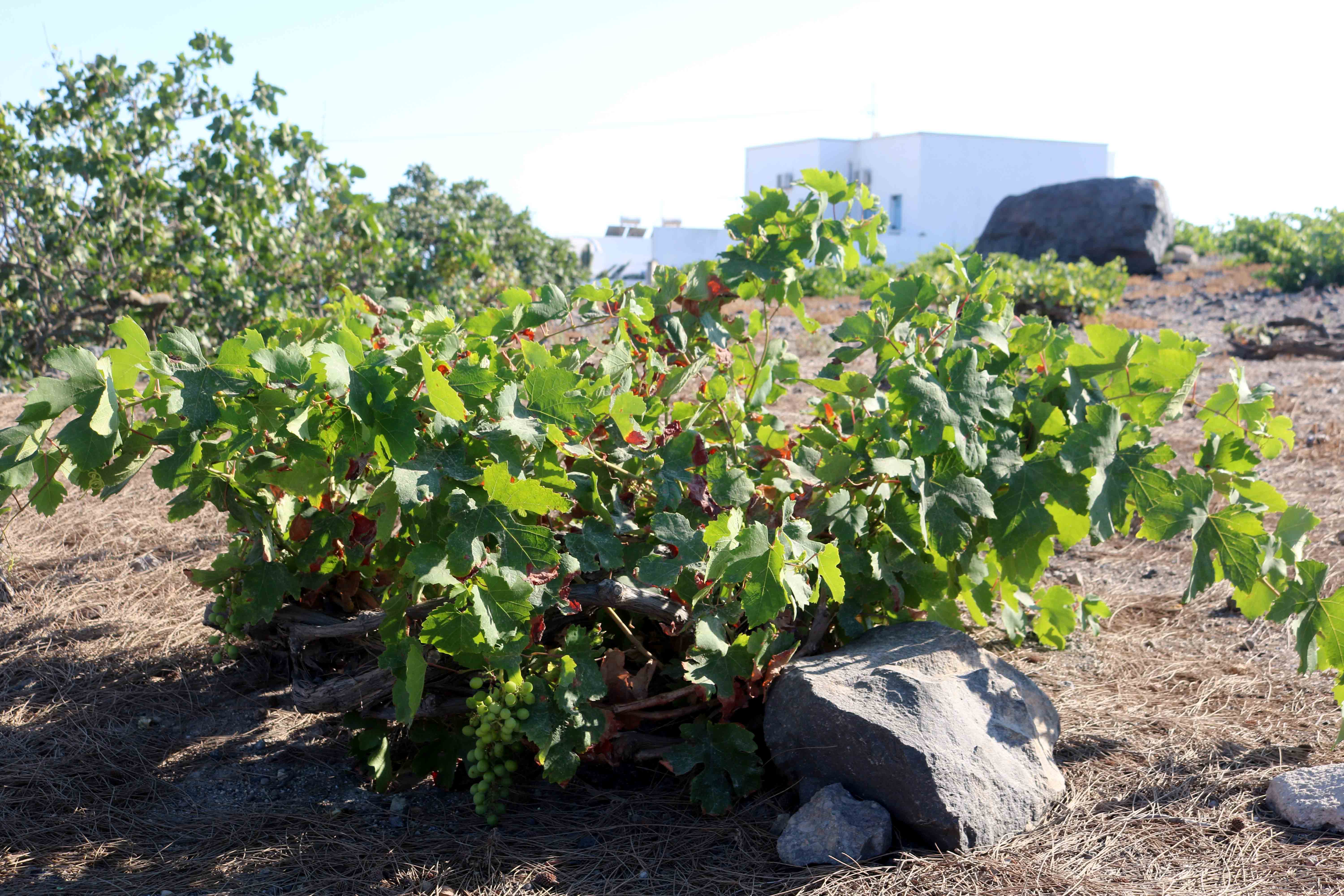
Lack of rain coupled with constantly blowing sea-winds has resulted in vines being grown in the “koulara” method, that is, they are woven into continuous circles to form a basket.  This protects the vines ion from the strong winds and the harsh summer sun.


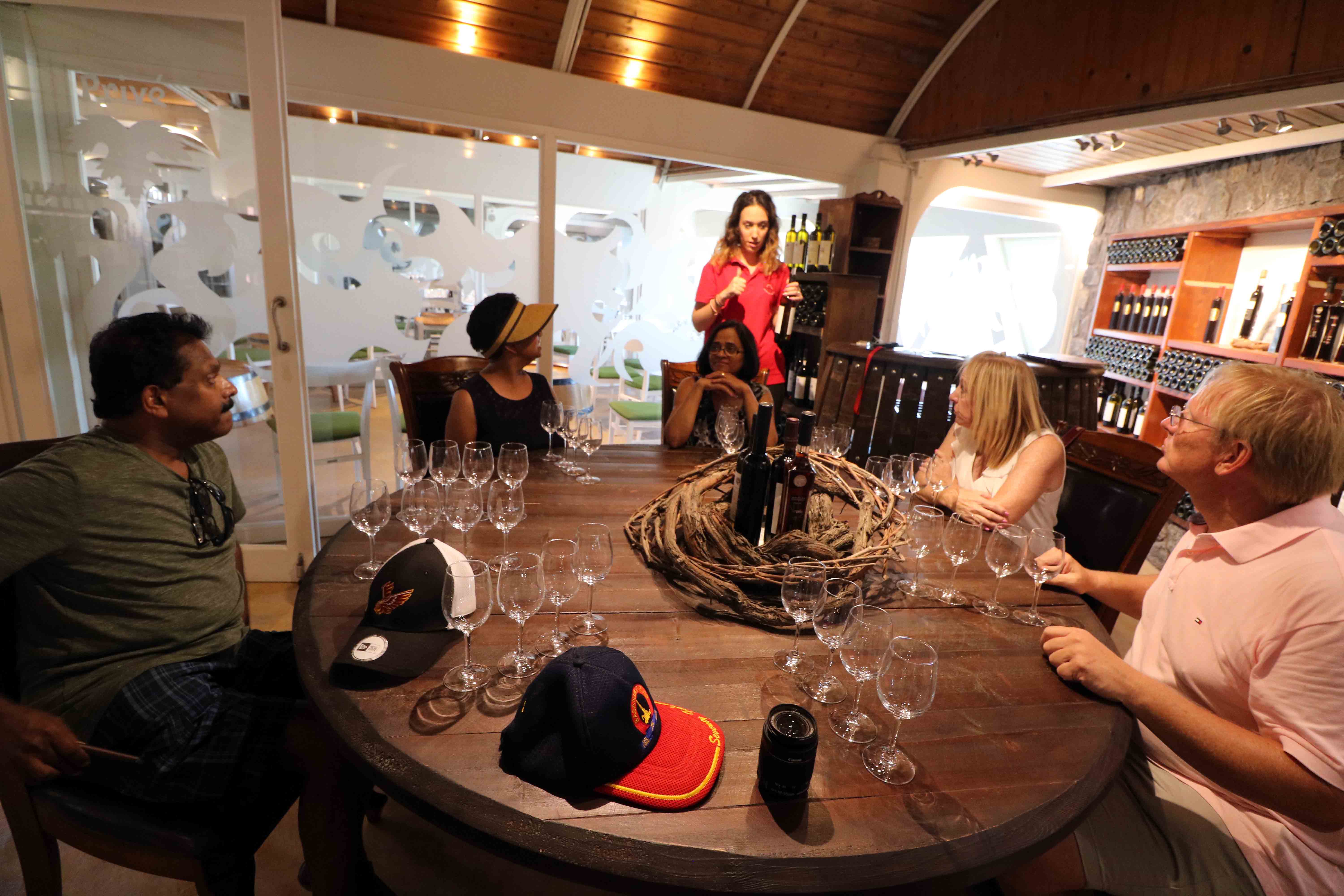
After viewing the vines, we visited the Wine Museum showcasing history of wine and the life of vine-growers in Santorini from 1660 to 1970.  It was followed by wine tasting where we tasted four vines – two red and two white.  The white wines from Santorini are bone-dry with a distinct aroma of citrus combined with hints of smoke and minerals from the volcanic soil.   The dessert wines are sweet with aromas of crème, chocolate and dried apricots.


From Megalochori, we drove to the northern tip of Santorini and reached the village of Oia (pronounced ia).  It is considered to be the best sunset viewing location on the entire island. Oia is one of the most beautiful and picturesque villages of Santorini, situated atop an impressive cliff.  It offers a spectacular view over the volcanoes of Palia and Nea Kameni and the island of Thirassia.


Like the other Greek villages and cities, cobblestone paved lanes led us through the village to its Western end.  Both sides of the lanes are lined with shops selling jewellery, paintings, gifts, etc.  There are many taverns, cafes, and restaurants too.

We visited the Church of Our Panagia Platsanis located in the village centre.  It was originally constructed inside the walls of the Castle of Oia. The church was rebuilt in the village center, on higher and more stable ground following the earthquake of 1956.


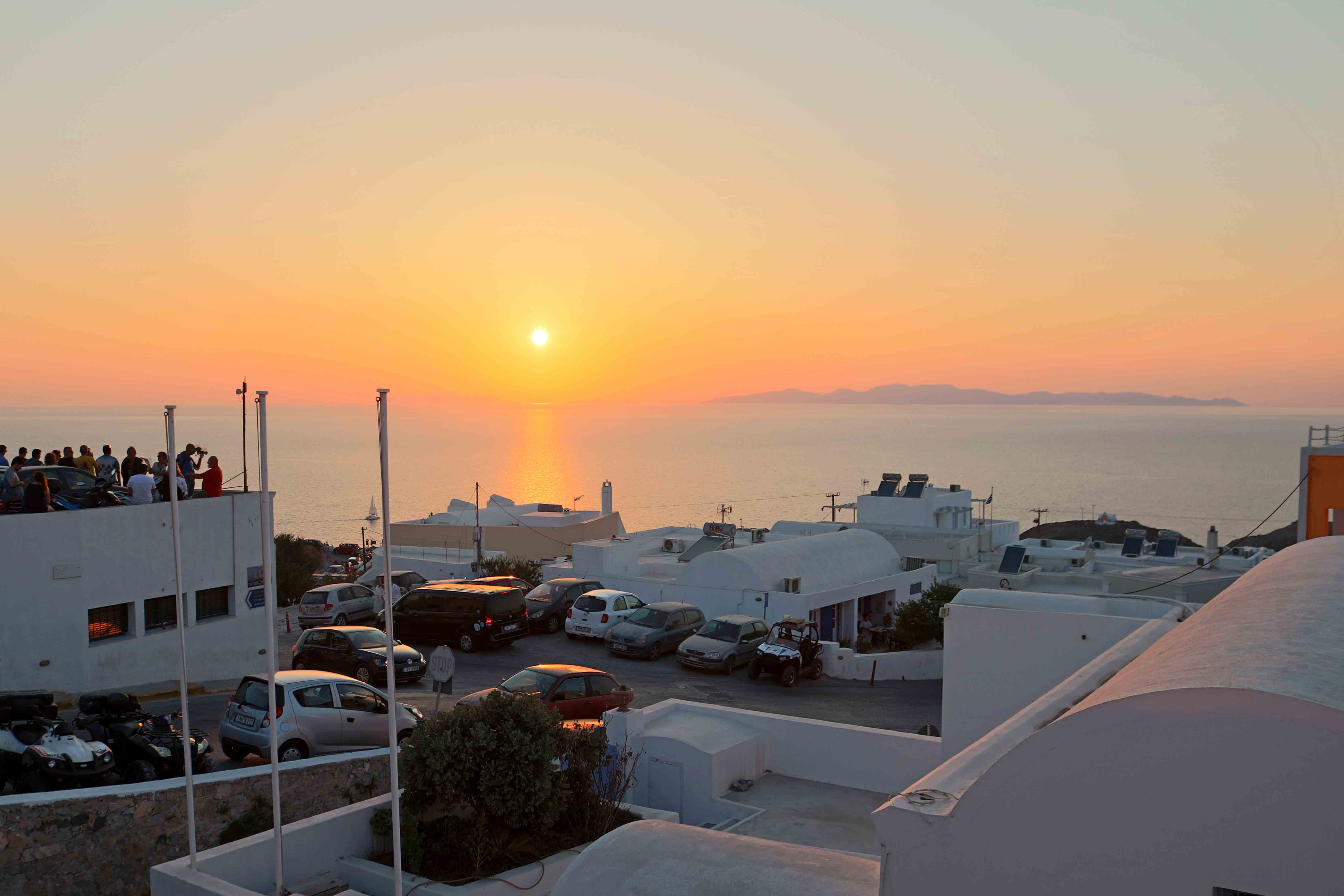
As the sun was setting, the area was getting crowded.  Every parking space was occupied and also all the seats in the cafes and restaurants were taken by tourists – all awaiting the sunset.


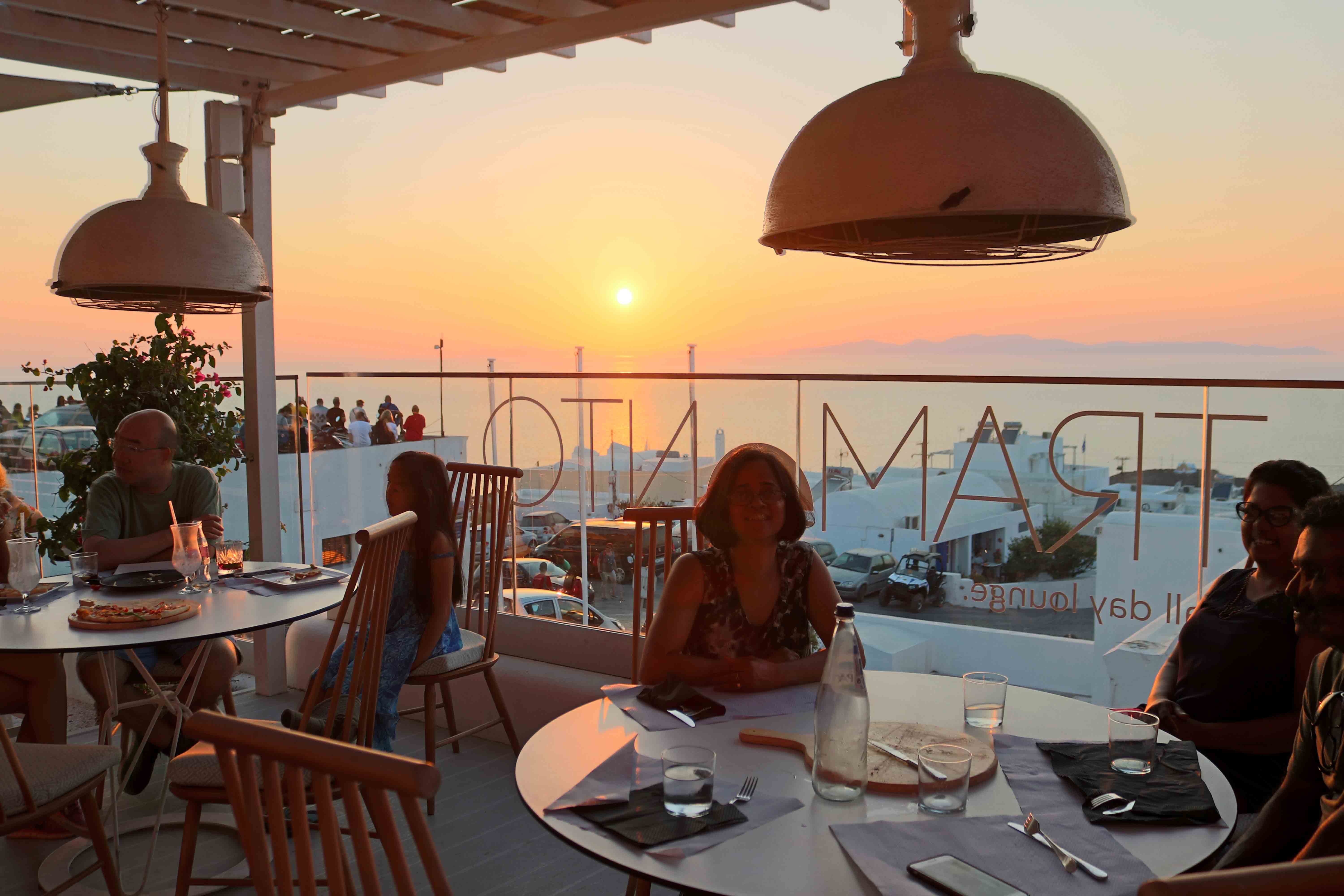
We too took up a vantage position at a cafe to enjoy every single moment of that spectacular natural phenomenon.


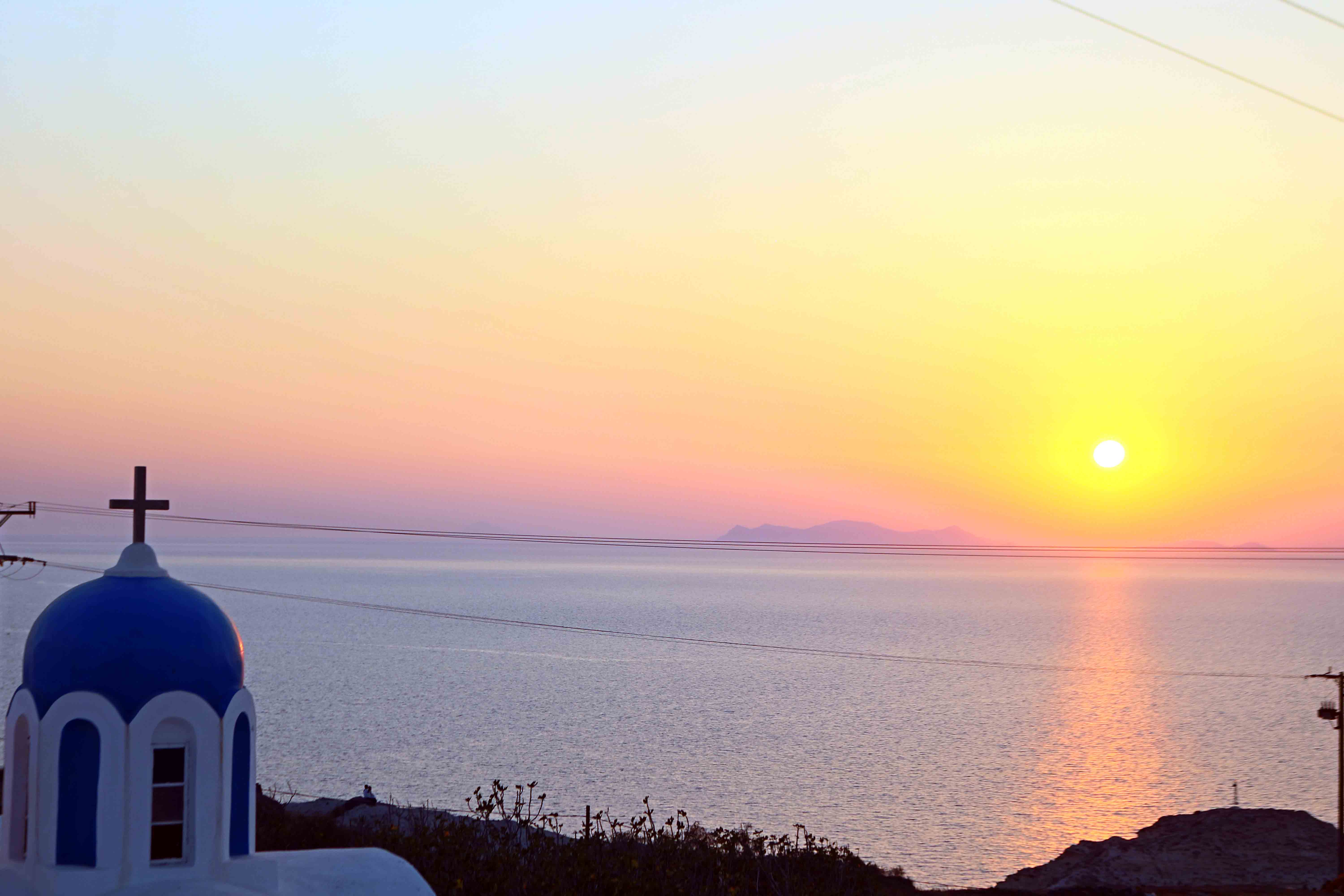
As minutes clicked past, the sky appeared to have been painted with various colors like yellow and orange in striking contrast to the blue dome of the church.


The sun then turned to myriad shades of pink and purple as it went down into the Aegean Sea. Sunset over water is often both spectacular and sublime. It’s just that we often wait until we reach Greece or some such similar destination to realize how incredibly beautiful it is. After watching the sunset and dinner, we retired to our beds after a tiring day of walking in the hot sun.

Are You Prepared to Meet an Emergency for 72 Hours?

Introduction

State of Kerala, India, was battered by the rains, causing havoc, displacing humans, and above all causing irreparable damage to the environment.  Having been involved with rescue missions in such natural disaster while serving with the Indian Army for over two decades and also with the experience gained in Canada for the past 15 years, I thought it appropriate to work out a survival plan for all.  If you are adequately prepared to face a range of emergencies, anytime, anywhere; you have a great chance of survival, God and nature willing.

Aim

The aim of this paper is to lay down a few steps that will help you take care of yourself and your loved ones during an emergency.

Know Where You Live

A country like India, where the terrain, climate, culture and social conditions differ drastically every square kilometer, knowing the risks in your region can help you better prepare.  It may be heavy rains and floods in Kerala or in the East; water logging in Mumbai, blizzards and avalanches in J&K and Sikkim; tsunamis and cyclones in coastal regions; earthquakes in the Himalayan regions – the list is endless.  Along with natural disasters, there are other types of risks, such as long power outages and industrial or transportation accidents, etc.   It could even be spread of a life threatening epidemic raging like the Nipah Virus epidemic which Kerala recently witnessed.

Plan for an Emergency

Every household needs an emergency plan to suit their location and area.  It will surely help you and your family know what to do in case of an emergency. It is surely worth the effort.   The plan once made must be discussed with every family member and clear instructions as what each member is expected to execute must be clearly defined.

Keep this document in an easy-to-find, easy-to-remember place (with your emergency kit).  Photocopy this plan and keep it in your car and/or at work, and a copy close to your phone.  If you completed your plan online, keep an electronic version on your computer and also store it in a cloud and must also be saved on everyone’s cell-phones.

Love Thy Neighbours

Please take your neighbours also into consideration while working out your emergency plan – they are always your first responders in case of any emergency and you are also expected to reciprocate.

Neighbourhood Safety Plan

Work with your neighbours or the Resident Welfare Associations (RWA)  to identify people who may need extra help during an emergency.  Like in the Army, you may also assign ‘buddies’.  Assets like doctors and health professionals, military veterans, retired police and administrative officials, and above all the youth group – they are all assets of your neighbourhood.  Ensure that you include them in your neighbourhood plan and allocate duties and responsibilities to them.

Revisiting the Plan

Please revisit your plan and also your neighbourhood plan at least once a year.  That should be the time you must restock your kit(, change the batteries, food and bottled water.  Any breaks like Onam holidays, Pooja holidays or any weekend is the most suitable time when most members are available.  Write yourself a reminder to update your emergency plan one year from now.

Household Plan

  • Emergency Exits. Draw up a floor plan of your home that shows all possible exits from each room.  Plan a main exit route and an alternate exit route from each room.  If you live in an apartment, plan to use the stairs instead of the elevators.  Identify an evacuation route from your neighbourhood in case you need to leave in a hurry and always plan for more than one option.
  • Meeting PlacesRandevu (RV). Identify safe places where everyone should meet if you cannot go home or you need to evacuate. Specify a meeting place near home or outside immediate neighbourhood.

Make Copies of Important Documents.

Make copies of birth and marriage certificates, passports, licences, wills, land deeds and insurance. Take photos of family members in case a lost persons record is created. Keep them in a safe place, both inside and outside your home. You might want to put them in a safety deposit box or give them to friends and family who live out of town.

Workplace

Learn about the emergency evacuation plans in place and what you will need to do. You may want to have some basic supplies at work, such as water and food that do not  spoil, in case you need to stay put for a while.   Check  with your employer about workplace emergency plans, including fire alarms, emergency exits, meeting points, and designated safety personnel or floor wardens.

Children

Ask your children’s school or daycare about their emergency policies. Find out how they will contact families during an emergency.  Find out what type of authorisation the school or daycare requires to release your children to a designated person if you can’t pick them up.   Make sure the school or daycare has updated contact information for parents, caregivers and designated persons.

Plan for pets

In case of an evacuation, remember that pets are not allowed in some public shelters or hotels. In case of an evacuation, prepare to take your pets with you to the home of a relative or friend, or take steps to identify pet-friendly hotels or pet boarding facilities in your area and further away from home.

Special Health Needs

  • Support Network. Establish a personal support network of friends, relatives, health-care providers, co-workers and neighbours who understand your special needs and also of your family members’.
  • Prepare a Health List. Make a list of all your health/ medical needs.  Keep a copy of this information in your emergency kit, and give a copy to your personal support network.   The list must include:-
    • Accommodation needs
    • Insurance information
    • Allergies
    • Medical conditions
    • Emergency contacts
    • Medication
    • Family medical history
    • Recent vaccinations
    • Health screenings
    • Surgeries
  • Grab&Go Medical Bag. Talk to your doctor about preparing a grab-and-go bag, if possible, with a two-week supply of medication and medical supplies. Include prescriptions and medical documents. Remember that pharmacies may be closed for some time, even after an emergency is over.

Out-of-Town Contact

Choose an out-of-town contact who lives far enough away that he or she is unlikely to be affected by the same event. If you have recently moved to a new area, make arrangements through friends, cultural associations or community organisations.  Arrange for each family member to call, e-mail or text the same out-of-town contact person in case of an emergency.

Home Safety

  • Make sure you have a working carbon monoxide detector, smoke alarm, fire extinguisher and well-stocked first aid kit. If you live in an apartment, or if you are staying in a hotel, know where the fire alarms and at least two emergency exits are located.
  • Make sure you have a fire extinguisher on every level of your home, including one in your kitchen. Everyone in your home should know where to find the fire extinguishers. All capable adults and older children should know how to use it. See manufacturer’s instructions regarding the lifetime of your fire extinguisher.
  • Older children and adults should know how to turn off your home’s water, electricity and gas. Make large, easy-to-see signs for water and gas shut-offs as well as for the electrical panel.
  • Teach children how and when to dial emergency numbers as well as how to call the designated out-of-town contact.
  • Limit phone calls to urgent messages only. Keep calls short to free up the lines for others.
  • When notifying emergency services of your location, provide the exact street or civic address and nearest intersection.

When an Emergency Strikes

  • Follow your emergency plan.
  • Get your emergency kit.
  • Make sure you are safe before assisting others.
  • Listen to the radio or television for information from authorities. Local officials may advise you to stay where you are. Follow their instructions.
  • Stay put until all is safe or until you are ordered to evacuate.

Evacuation Orders

  • Authorities will not ask you to leave your home unless they have reason to believe that you may be in danger.
  • If you are ordered to evacuate, take your emergency kit, your wallet, personal identification for each family member and copies of essential family documents with you. Bring a cellular phone and spare battery or a power bank or charger with you, if you have one. Use travel routes specified by local authorities.
  • If you have time, call or e-mail your out-of-town contact. Tell them where you are going and when you expect to arrive. Once you are safe, let them know. Tell them if any family members have become separated.
  • If possible, leave a note telling others when you left and where you are. Shut off water and electricity if officials tell you to do so.
  • Take pets with you.
  • Lock your home.
  • If you go to an evacuation centre, register your personal information at the registration desk. Do not return home until authorities advise that it is safe to do so.

Preparing an Emergency Kit

  • In an emergency, you will need some basic supplies. You may need to get by without power or tap water. Be prepared to be self-sufficient for at least 72 hours.
  • You may have some of the items already, such as food, water and a battery-operated or crank flashlight. The key is to make sure they are organised and easy to find.
  • Make sure your kit is easy to carry and everyone in the household knows where it is.
  • Keep it in a backpack, duffle bag or suitcase with wheels, in an easy-to-reach, accessible place, such as your front-hall closet.
  • If you have many people in your household, your emergency kit could get heavy. It’s a good idea to separate some of these supplies in backpacks. That way, your kit will be more portable and each person can personalise his or her own grab-and-go emergency kit.

Basic Emergency Kit

  • Water – at least two litres of water per person per day; include small bottles that can be carried easily in case of an evacuation order
  • Food that won’t spoil, such as canned food, energy bars and dried foods (replace food and water once a year)
  • Manual can-opener
  • Crank or battery-powered flashlight (and extra batteries). Replace batteries once a year.
  • Crank, battery-powered radio (and extra batteries).
  • Granb&Go medical bag.
  • First aid kit
  • Extra keys to your car and house
  • Some cash in smaller currencies. Automated bank machines and their networks may not work during an emergency. You may have difficulty using debit or credit cards.
  • A copy of your emergency plan and contact information
  • Recommended additional items
    • Two additional litres of water per person per day for cooking and cleaning
    • Candles and matches or lighter
    • Change of clothing and footwear for each household member
    • Sleeping bag or warm blanket for each household member
    • Toiletries
    • Utensils
    • Garbage bags
    • Water purifying tablets
    • Basic tools (hammer, pliers, wrench, screwdrivers, work gloves, dust mask, pocket knife)
    • A whistle (to draw prompt attention)
    • If you think your water is contaminated, check with your municipality or local authorities for details. When in doubt, do not drink water you suspect may be contaminated.

Emergency Vehicle Kit

Prepare a small kit and keep it in your vehicle to include:

  • Blanket
  • Candle in a deep can and matches
  • Extra clothing and shoes
  • First aid kit with seat-belt cutter
  • Flashlight (crank or battery-powered). Replace batteries once a year.
  • Food that won’t spoil (such as energy bars)
  • List of contact numbers
  • Radio (crank or battery-powered). Replace batteries once a year.
  • Small shovel
  • Warning light or road flares
  • Water
  • Whistle

Conclusion

An emergency may occur at any time and human being over centuries have faced many such ones.  In case you are adequately prepared, you are in a better position to face it and also help others to go through the ordeal.  Always remember “Preparedness is the calm before, during and after any storm.”

(Based on Government of Canada Emergency Preparedness Guide)

‘Kerala Model’ Disaster Management


Disaster struck Kerala in August 2018 in the form of  heavy rains, which created floods and landslides causing  unprecedented damage to the people, property and ecology.  The tragedy struck Kerala just prior to Onam festival to welcome the mythological  king of Kerala – Mahabali.  I am reminded of the Onam song ‘മാവേലി നാട് വാണീടും കാലം, മനുഷ്യരെല്ലാരും ഒന്നു പോലെ’ (When Mahabali ruled, the people where all together).  When the tragedy struck causing havoc to human life, the people of Kerala, irrespective of their faith or religion came together to save fellow humans.

What are the lessons to be learnt from the way this tragedy was handles at all levels – from federal  government to the local village administration to the last man standing.


Youth Power
.     The youth of Kerala were the first to emerge and organise themselves into small groups and bring succour to those affected.  They forgot their well known political rivalries and united to show that they can surmount any tragedies.  Girls and boys – all put their hands on deck, working day and night – to organise rescue and relief.

Political Strength.            The ruling coalition and the opposition – all came together to work with a single aim to bring succour to the flood affected people of Kerala.  The strength of the grass-root organs of all political parties showed their mettle in bringing relief to the people.    Only one political party and its various outfits did not play their part and they have been ‘trolled out’ in the social media.

Religious Organisation.  Various religious organisations and institutions opened their gates to accommodate all those displaced by the tragedy.  Muslims were reported to be cleaning Hindu temples and Christians taking shelter in temples and mosques – the list is endless.  In effect – Gods (with their Godmen) were submerged – Humanity emerged.


Supermen Fishermen
.      The role played by the fishermen of Kerala in rescuing the people – especially in the hilly areas where they would have never dreamt of taking their boats – would be etched in gold in Kerala’s history.  They were poor fishermen, who left their families near the seashore and ventured inland to save their brethren without caring for their personal safety and without even asking for any compensation for their loss of livelihood and damage to their boats.


State Machinery
.             Unlike what was seen in other Indian states, the state machinery from Members of Parliament, Members of Legislative Assembly, District Collectors – all were out in full force to help the victims.  Some of them were seen physically handling rescued persons and rescue materials.  The role played by two women District Collectors – Ms TV Anupama, in-charge of Thrissur, and Ms K Vasuki, in-charge of Thiruvananthapuram – needs a special mention.  The leadership of the Chief Minister Mr Pinarayi Vijayan proved that he is a man with a vision and a good leader by  maintaining a cool head and providing necessary instructions in ensuring that no stone was left unturned in providing relief to the flood affected.  It is no wonder that he is nicknamed ഇരട്ട-ചങ്കൻ (Iratta-Chankan) meaning man with double hearts.

Local Government.         Kerala state has a well established local government at City/ Town/ Village levels.    They were the first to organise rescue efforts without awaiting any orders from the top.  They worked in tandem with the Armed Forces, National Disaster Management Force (NDRF). Kerala Police, Fire Force and various other agencies.   They provided helpful terrain and water-flow information to the rescue teams, provided guides and all other possible assistance.


Role of Media
.   The Malyalam media played their part well in informing people about the floods, passing information about people stranded at various places and rescue efforts in progress.  National English and Hindi media might not have had adequate interest in Kerala, but after a few days they also pitched in.  It is pertinent to mention here that in the early days of the flood, various international media houses gave more airtime to cover floods in Kerala than the Indian English and Hindi channels.

Social Media.     The social media had a very positive impact on the rescue missions being undertaken.  Victims could communicate with the rescue teams and people outside and was of immense help.  The social media ensured connectivity with the world community, especially with many Keralites working or settled abroad, wishing to know the status of their near and dear ones.  There were a few cases of rumour mongering reported and the state police has already registered cases to deal with them.

Federal Government.     The role played by the Central Government calls for some retrospection.  When monetary and material aid started flowing from many countries with sizeable Keralite work force, the Central Government refused to accept it.  The Central Government initially granted 100 Crore which was later revised to 500 Crore – a tiny portion of the money needed for rehabilitation of the flood affected.  The Union Food Minister wanted the state to pay for the food grains released, but later, succumbing to the pressures of Kerala’s political leadership, the decision was reversed.  It might be the first time in Indian history that various persons and business houses and many state governments and organisations have donated much more than the money given by the Central Government for disaster rehabilitation.     Is it all because the ruling party has hardly any presence in the state?


That was the Kerala model of disaster management.  There is a need to iron out many folds and deficiencies, but the common folks in Kerala have risen up to the occasion.  An Indian Army officer undertaking rescue operations said “I did not see any victims; all I saw were Heroes.”

The HEROES are the people of Kerala.


Santorini -An Island on a Volcano


On June 13, after breakfast, we sailed from Mykonos to Santorini Island on a high-speed ferry.  The voyage lasted over two hours.  The ferry offered comfortable seating and a few restaurants, but the menu was expensive as seen in all ferries in Greece.


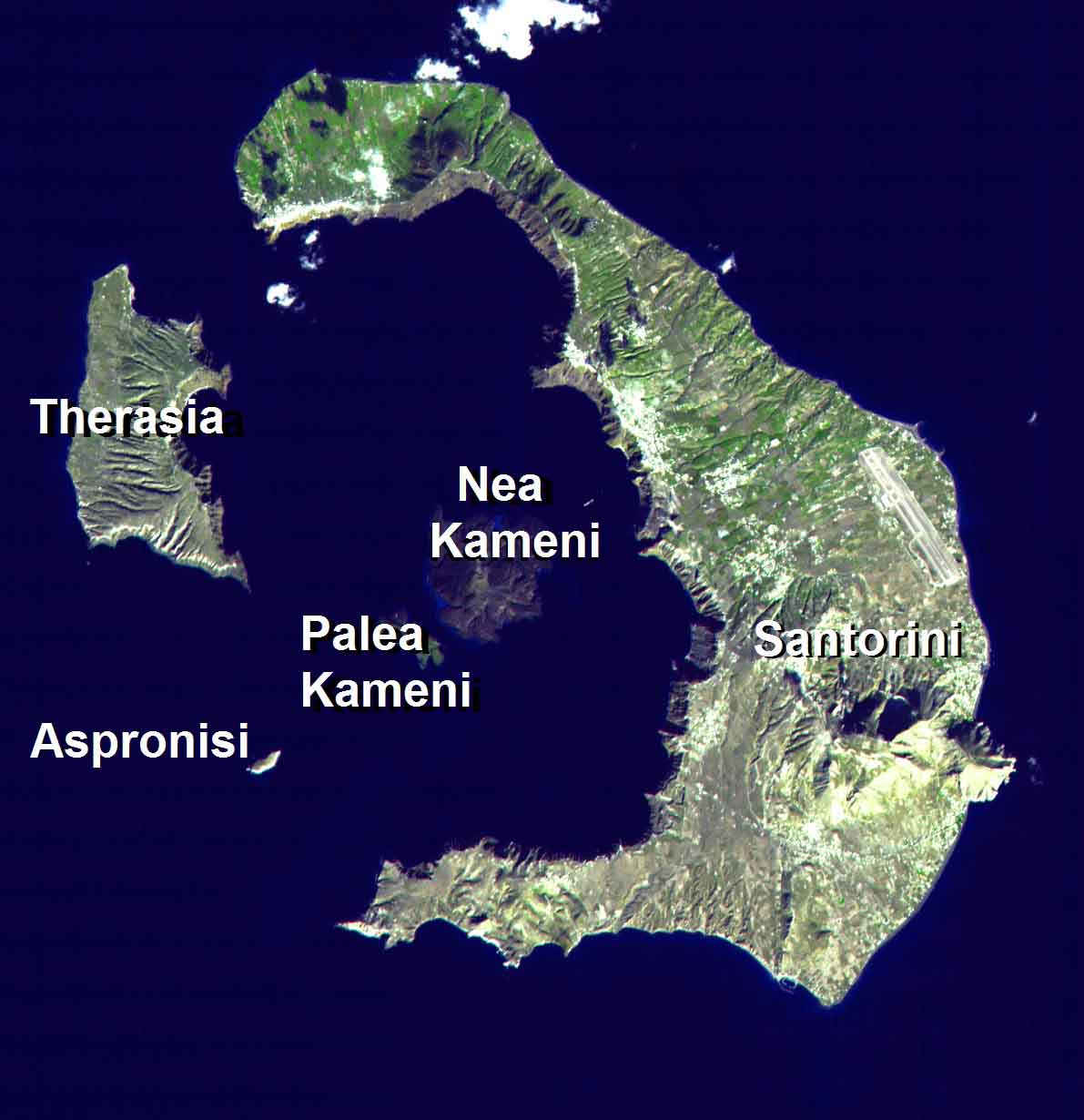
Crescent-shaped Santorini or Thíra in the Aegean Sea, is a group of islands consisting of Santorni, Therasia, Aspronísi, Palea and Nea Kaméni.  Santorini, the youngest volcanic land in the Eastern Mediterranean, is still an active volcano and probably the only volcano in the world whose crater is in the sea.  The islands that form Santorini came into existence as a result of intensive volcanic activity.  12 huge eruptions occurred, one every 20,000 years approximately, and each violent eruption caused the collapse of the volcano’s central part creating a large crater (Caldera). The volcano, however, managed to recreate itself over and over again.

The last big eruption occurred 3,600 years ago during the Minoan Age, when ash, pumice and lava stones covered the islands.  The eruption destroyed the thriving local prehistoric civilization, evidence of which was found during the excavations. The solid material and gases emerging from the volcano’s interior created a huge vacuum underneath, causing the collapse of the central part and the creation of today’s Caldera– with a size of 8×4 km and a depth of up to 400m below sea level.


Eruption of the submarine volcano Kolúmbo, located 6.5 km North-East of Santorini, on 27 September 1650, was actually the largest recorded volcanic eruption in Eastern Mediterranean during the past millennium.   The most recent volcanic activity on the island occurred in 1950.  The whole island is actually a huge natural geological/volcanological museum where you can observe a wide range of geological structures and forms.

Caldera is a lagoon of sea water surrounded on three sides by the steep cliffs of Santorini and on the fourth side by the island of Thirassia, which was part of Santorini before the eruption. The currently active volcano on the island of Nea Kameni sits in the middle of the Caldera.  It is active but presently not at risk of erupting.


As our ferry pulled closer to Santorini Island, we could see the steep escarpment of Santorini Island formed due to volcanic activity.


The colours of different layers of rocks up the escarpment is due to lava deposited during various volcanic eruptions.  The upper crust is mostly pumice and below it is red and black granite.


We  checked into our hotel and post lunch set out to explore Santorini.  Our first halt was Pyrgos, a medieval settlement that is nestled at the highest spot of the island. We drove up to the entrance of the settlement by taxi.  As the village lanes are narrow and cobblestoned, we had to walk up to the castle and churches atop the hill.  On to the left of the image above is the castle, which is well-preserved despite the serious damage caused by the earthquake of 1956.  It was built to protect the people from marauding pirates.


Pyrgos is said to be the first capital of Santorini, before the onset of the 19th century. It is built on top of a hill overlooking the Aegean Sea, which makes it an exceptional observatory.


As we walked up the track, close to its entrance to the castle lies the church of Agia (Saint ) Theodosia.  This church was built in 1639 and renovated in 1857, but it collapsed in the earthquake of 1956. In its place, the present church was built in 1965.


Further uphill we walked and came to  the church of Christos.  The bell tower of the church is visible from a distance. This is the only church on the island with an octagonal cupola while the rest have a round cupola on top.  The bell tower and the yellow flag of Greek Orthodox Church resembles that of old Syrian Orthodox churches of Kerala.


We walked downhill and drove to the village of Megalochori.  Here we all for the first time saw a Pistachio tree with fruit.  The debate that erupted amongst us was as to whether Pistachio is a nut or not.  Pistachio, though known as a nut, the fruit of the Pistachio is botanically a drupe, a type of fleshy fruit (like a coconut), the edible portion of which is the seed.


Megalochori  offers a nice mix of white Cycladic (Cyclades –a civilisation that existed in the Bronze Age)  houses, several churches and narrow alleys.  A prominent feature of the historical homes and mansions are the high walls, inner courtyards and solid wooden door entrances, built for privacy and for safety against pirates.


In the center of the village, stood a wonderful traditional square with taverns, restaurants with bougainvillea-covered patios and trees providing shade for a quick cup of coffee. The square is the heart and soul of Megalochori, a gathering place for the locals to play a game of cards


Megalochori has two well-known bell towers spanning the street. This one is part of the Panagia church and is characterised by the clock on top.

Megalochori is famous for its winery and wines and we went ahead to visit a winery, covered in the next part.

Colonel KPR Hari, Vir Chakra

The battle of Waterloo was won on the fields of Eton is a famous British Army quote after they trounced a much stronger French army.  After the battle of Kargil, especially with Major KPR Hari’s action, leading his company of 1 Bihar Regiment to capture Jubar Top, and also gallantry actions of many young officers of Indian Army during the battle of Kargil, I was tempted to rewrite the quote as “The battle of Kargil was won on the fields of Khadakwasla.”

When we moved in to the National Defence Academy (NDA), Khadakwasla, in our second semester, Hari was there to welcome us to the E Squadron (61st Course) in June 1979.  In those days, E Squadron believed more in moulding youngsters into ‘men of steel.’  That obviously meant rigorous Physical Training (PT) by day and by night, and practising heavily for cross-country, boxing and sports competions – football, hockey and basketball.  Our Squadron earned the nickname of ‘PT Squadron.’

In all the events that E Squadron excelled in, Cadet Hari was the champion.  His agility and skill was proven beyond doubt and we ended winning the Commandant’s Banner as Champion Squadron in 1979.

Hari always sported his bright smile – characterised by a broken incisor – a loss he suffered during a boxing bout.  We used to undertake cycling tours around Khadakwasla (obviously the unofficial ones) to Sinhagarh Fort, Munshi Dam and Panshet Dam.

Nothing could deter Hari during our NDA days, whatever difficulty he faced, he always took it with a smile.  It appeared that neither success nor failure had any impact on him – he kept going ahead, without ever looking behind.  The very same quality he carried with him during his service as an officer.

Hari was commissioned in to Bihar Regiment – Infantry – and I to the Regiment of Artillery.  We never served together during our Army days, but did meet many times, especially while travelling to our hometowns in Kerala from Delhi.

While I was posted at the Military Intelligence Directorate during the Kargil war of 1999, situation (sitrep) of 06 July caught my eye.  It described action of Major KPR Hari and 1 Bihar in capturing Jubar Top.  I was not surprised – Hari had it in him and he would have done it that way only.

The sitrep said that Hari, disregarding his own personal safety crawled through the boulders over a stiff cliff and destroyed the enemy Heavy Machine Gun bunker and killed two enemy personnel.  I knew his gallant act would be recognised and glorified.

Major KPR Hari was awarded Vir Chakra – a well deserved honour – for his gallant action.  His citation read:-

“On 06 July 1999, Major KPR Hari attacked Jubar Top, an enemy stronghold at a height of 16,800 feet Batalik Sector of Jammu and Kashmir.

Major KPR Hari launched a two pronged attack under heavy enemy artillery and small arm fire.  He crawled through the boulders over a teep cliff leading towards Jubar Top avoiding enemy fire.  He reached 50 meters short of the enemy bunker and in a swift and bold manoeuvre closed in with the enemy bunker along with six soldiers continously firing and lobbing grenades.

Major KPR Hari with utter disregard for personal safety destroyed the enemy Heavy Machine Gun bunker and killed two enemy personnel who were engaging the advancing troops.  The enemy sensing immediate capture withdrew leaving huge quantity of arms, ammunition and equipment.  The post was captured at 0500 hours without any casualty.  Major KPR Hari then along with another officer kept the momentum of attack and captured Jubar Top by 1800 hours.

Major KPR Hari displayed initiative, bold action, indomitable courage, strong determination and exceptional leadership in the face of extreme danger from the enemy.”

After I bid goodbye to Indian Army and moved to Canada, I met Hari only once.  That was during our course-mate Commander Vinod Kumar’s (Indian Navy) daughter’s wedding in December 2015.  He was as cheerful and smiling as he always was.

Last year I heard the sad news that Hari was battling pancreatic cancer.  I thought that he will beat this ordeal too.  He fought like a good boxer of E Squadron, but breathed his last on 17 August 2018.  I am sure he will now be smiling and thanking his Creator for a great meaningful life that the God had bestowed on him.

“Soldier, rest! thy warfare o’er,
Sleep the sleep that knows not breaking;
Dream of battled fields no more,
Days of danger, nights of waking.”    Sir Walter Scott, Scottish author and playwright

The Gorkha Brave-Heart Who Killed Death

A heart rendering article on Captain Manoj Kumar Pandey, Param Vir Chakra, (25 June 1975 – 3 July 1999) of 1/11 Gorkha Rifles (GR), beautifully penned by Major General Raj Mehta, Param Vishisht Seva Medal, Vishisht Seva Medal, my Guru and mentor from my early military days at the National Defence Academy.


Capt Manoj Pandey, PVC (Posthumous), 1/11 GR, challenged death at alpine heights during the Kargil War – and won

When brave-hearts are martyred in India, we invariably compensate for the loss by naming residential colonies, roads, airports, auditoriums, tournaments after them. We rarely reflect over the intent that drove them to martyrdom. We do not understand why, when living was an option, they chose to die, fiercely upholding the timeless  ethic of Naam, Namak, Nishan  (नाम, नमक, निशान) [Honour, Integrity, Flag]  that has been in the Indian soldiers DNA since the ancient killing battlefields of Kurukshetra (कुरुक्षेत्र).

Capt Manoj Pandey, PVC (P), 1/11 GR was one such driven officer who died at Bunkers Area en route to Khalubar Top at 5287m (17346ft)  sacrificing his life for sustaining the Idea of India. This story is about his selfless sacrifice on night 2/3 July 1999, his bloodied Khukri (खुकुरी) [inwardly curved traditional knife of a Gorkha soldier] flashing as he exhorted his charged Gorkhas with Naa Chhodnu!” (I will not spare you) as he fell. They did, several of them dying with him but neutralizing the entrenched Pakistanis with bullets, khukris, grenades – and grit.

The story of Manoj’s heroism is available on the internet in narrative and video formats. A mainstream Hindi film covers his martyrdom. Nothing could, however, be better than hearing about him first hand from his then Commanding Officer, Colonel Lalit Rai, Vir Chakra. I was privileged to do just that because Lalit is a colleague of old; a bold, brave and courageous third generation 11 Gorkha Regiment officer of pedigree and conviction. A Bishops Cotton, Bangalore product, his grandfather and father preceded him in the Regiment. Commissioned in 7/11 GR, he was commanding newly raised 17 Rashtriya Rifles (RR) (Maratha) in Doda, J&K, in 1997 when I came across him as the Deputy Commander of the RR Sector Headquarters which operationally controlled his Unit. He led from the front in an intense Counter-Insurgency deployment grid where I was as much in operations as our Units; the Deputy’s being a command not staff assignment when deployed on the Counter Insurgency grid. This is where I saw Lalit repeatedly leading his command in encounter situations.

In June 1999, when the Kargil War had commenced, he was offered a chance to command 1/11 GR by his Colonel of the Regiment. This Battalion had decades earlier been commanded by his Father and urgently needed a replacement Commanding Officer (CO). Lalit accepted the challenge despite not having served in 1/11 GR. He was landed by helicopter 48 hours later, when the Unit, looking forward to some respite after a tough Siachen tenure, was pitch-forked instead into alpine war.

A crisis was unfolding in the strategic but primitively developed Yaldor Sub-Sector. Ordered to retake Khalubar Top from infiltrating Pakistani Pathan troops and with non-existent road communications, his immediate task was to lead a 14 hour forced march into war with all equipment/ammunition carried back-pack  with whatever troops he could muster even as his Second-in-Command (2IC) marshaled the balance men.    This was on 2 July 1999 and this is where young Manoj enters the narrative. A word about him is necessary before the daunting terrain where his bravery – and Lalit’s – manifested, becomes our point of focus.

IC-56959-W Capt Manoj Pandey was born on 25 June 1975 in Rudha, Sitapur District, Uttar Pradesh, to Gopichand and Mohini Pandey. Gopichand was a man of very modest means, but Manoj, the family elder, never put a financial burden on his parents as he blazed through Sainik School and Laxmi Bai Secondary School, both in Lucknow with a brilliant all-round performance in academics, National Cadet Corps and sports.  Asked during his Services Selection Board interview on why he wanted to become an officer, his convincing “To win the PVC” response saw him selected for the National Defence Academy (NDA). Commissioned into 1/11 GR, a famous Battalion raised in 1918 in Mesopotamia, Manoj served in the Kashmir valley and Siachen before Kargil happened.

In the remote, near inaccessible Batalik sector, the infiltrators had occupied a number of ridges whose recapture was a must as these dominated the Batalik-Leh route. It took some time before the ingress routes to the four roughly parallel ridges were blocked by India. General VP Malik, then Army Chief in his book, From Surprise to Victory, recalls that a direct note to him by then 2IC Lieutenant Colonel Asthana brought out to him the importance of retaking Khalubar Ridge on priority. It had a Pakistani helicopter- supplied dump behind and clearly had to be recaptured and it was the Gorkhas led by Colonel Rai and, on his vulnerable flank, Manoj, who did it.


Lalit recalls that it was night 2 July that he chose to head for Khalubar Top with 40 odd men. Directly under observation of the entrenched Northern Light Infantry (NLI) Pakistani troops (Pathans among them), very effective fire was being brought on his column from Khalubar Top and flanks, causing severe casualties. To prevent getting day-lighted before he reached his objective and getting decimated, he ordered Capt Manoj Pandey to take his 5 Platoon, Bravo Company to neutralize “Pehalwan Chowki”, later named as “Bunkers Area”.  The CO had by now sustained a bullet wound in his leg and splinter wounds in his calf but slogged on.


Capt Manoj Pandey, with experience of the successful, gut-wrenching attack on Jubar Top behind him, rushed to carry out his CO’s directive. Ordering Havaldar Bhim Bahadur Diwan to encircle the Bunkers Area with his section from the right, Manoj took on the main bunkers from the left with  the battle-cry “Jai Mahakali, Aayo Gorkhali”  on his lips. He cleared the first two enemy bunkers with dispatch. While clearing the third, he was hit on his shoulders and legs but continued to lead the assault on the fourth bunker, neutralizing it with a grenade. “Naa Chhodnu” he commanded his men, but, at that instant, got hit in the forehead by an MG bullet. His furious Gorkhas captured all six bunkers, killing 11 Pakistanis but sustaining serious losses in the brutal close-quarter combat.  Several Gorkhas were found dead with frozen fingers on rifle triggers, all weapons pointed towards the enemy bunkers with bloodied Khukris nearby and several decapitated Pakistani soldiers heads lying around. The brave young officer had led his men from the front. A compulsive diarist, he had lived up to his own hand-written prophecy that he would “kill death” before death overtook him. He was just 24 and had fully lived up to the timeless ethic of Naam, Namak, Nishan.


Doodle of Capt Pandey’s PVC act created after interaction with Col Lalit Rai, VrC. Made by Chief Designer, Ravi Ranjan. The doodle can be seen in Gallery 8 of the Punjab State War Heroes Memorial and Museum, Amritsar, curated by the author and his 10 researchers, then working under Department of Soldier Welfare, Government of Punjab.

The narrative does not of course, end here. Colonel Rai, with his right flank secured by Manoj, went up the 80 degree gradient, still under withering enemy fire. He was wounded but soldiered on despite losing men all around him, besides the grievous loss of young Manoj and many of his men. Nearing the top, he knew that his ammunition was about to finish and after that it would just be Gorkha grit and Khukris…nothing more. He personally knew he had two rounds left…One for the enemy who confronted him and one for himself. He was able to contact his Forward Observation Officer (FOO) who was on Kukarthang Ridge and asked him if he was indeed headed on Khalubar Top. On confirmation of the same, he asked the FOO to bring own Artillery fire on his position as only a few yards now separated him and the enemy. The stratagem of Defensive Fire Save Our Souls (DFSOS) literally means just that…The last recourse of a courageous soldier to break enemy cohesion. It was a desperate gamble that paid off. The marauding Pakistani Pathans suddenly received a barrage of deathly accurate Bofors 155mm High Explosive shells on them and were decapitated. When the Gorkhas took out their khukris in the brutal hand-to-hand combat that followed, Pakistani heads rolled and there were many…After capturing what was indeed a near impossible objective to capture, the CO did a head count…He had just 8 of his 40 men left and had lost his bravest-of-brave officer, Capt Manoj Pandey along with over half of No. 5 Platoon…1/11 GR had won yet again but at cost…Col Lalit Rai was awarded a Vir Chakra for his outstanding ‘follow me’ leadership and Capt Manoj Pandey a very richly deserved posthumous PVC.


His PVC citation read:  Lieutenant Manoj Kumar Pandey took part in a series of boldly led attacks during Operation Vijay, forcing back the intruders with heavy losses in Batalik including the capture of Jubar Top. On the night of 2/3 July 1999 during the advance to Khalubar as his platoon approached its final objective; it came under heavy and intense enemy fire from the surrounding heights. Lieutenant Pandey was tasked to clear the interfering enemy positions to prevent his battalion from getting day lighted, being in a vulnerable position. He quickly moved his platoon to an advantageous position under intense enemy fire, sent one section to clear the enemy positions from the right and himself proceeded to clear the enemy positions from the left. Fearlessly assaulting the first enemy position, he killed two enemy personnel and destroyed the second position by killing two more. He was injured on the shoulder and legs while clearing the third position. Undaunted and without caring for his grievous injuries, he continued to lead the assault on the fourth position urging his men and destroyed the same with a grenade, even as he got a fatal burst on his forehead. This singular daredevil act of Lieutenant Manoj Kumar Pandey provided the critical firm base for the companies, which finally led to capture of Khalubar. The officer, however, succumbed to his injuries.

Lieutenant Manoj Kumar Pandey, thus, displayed most conspicuous bravery, indomitable courage, outstanding leadership and devotion to duty and made the supreme sacrifice in the highest traditions of the Indian Army.


The award was received by his Father on the Republic’s 52nd anniversary on 26 Jan, 2000.

As mentioned earlier, Manoj was a compulsive diarist and wrote eloquently about things dear to him. A poem on his Mother states: “She is the star which shines brightly in the darkness, someone who will always give and bless.”  Poignantly, just under this poem, he had written his own epitaph: “If death strikes before I prove my blood, I promise (swear), I will kill death.”

Elsewhere in the diary, he had again reflected:  “Some goals are so worthy, it’s glorious even to fail”.  Such thoughtful statements from a young man deployed in a war zone with death always lurking around go a long way to show that Manoj was a young man of great substance and courage both mental and physical…A young man who had adapted to whatever hand destiny would deal out to him. His writings stated that this officer would contest whatever God had in store for him and put infinite value on his life before fate took over. He was a true, proud Indian and someone who in death has become deathless…


Younger brother Manmohan says on visiting the Dras Kargil Memorial: “I had come here to pray at the place where my brother sacrificed his life in the line of duty. This place is a temple for me”. My father and mother have visited the memorial several times and it was my dream to visit the place,” he said. I am so glad I have been able to visit it and remember my hero, my brother…”

In 2004, Col Lalit Rai had arranged a visit by the parents and siblings of Capt Manoj Kumar to the NDA. It was a dedication ceremony during which a portrait of the brave-heart was presented to Mike Squadron, the squadron where he spent three learning years. Lalit spoke with pride and deep respect for his officer. His father made a brief, poignant address, asking the seated cadets to follow the path of Manoj and, if needed, sacrifice their lives for the Idea of India. The program left the family in tears of pride – and the cadets with an irresistible urge to “do a Manoj” when and if destiny called.


Dedication Ceremony at NDA. Col Lalit Rai, VrC, is on the right of Mr Gopichand Pandey.

The sacrifice of Manoj has impacted on aam aadmi (आम आदमी) [common man] in different but positive ways. One example worth narration concerns a re-employed fellow officer and the father of Manoj.  Col AK Jayachandran, 12 ASSAM, who became a senior Bank Executive post his retirement writes that “In life there are some days when one feels terrible and some days, when one feels really good from within. One such thing happened on a Friday evening at around 7 PM last year in Sep. I was set to go home from the Bank. One clerk and an officer were all who remained. The phone rang. An old man was on the other side. He was irate & quite fed up. To cut a long story short, he’d approached his bank’s branch to settle his dues from his son’s pension, which had not been correctly calculated. They’d kept fobbing him off.

He could rarely get through and couldn’t explain his problem properly either. Finally he got my number from someone and called. I took his details – told my guys to take a look at it and tell me if he was really due. They did that and yes – there were arrears due to him. Looking at the printout, I saw the name, Capt Manoj Pandey …no wife… …pension to parents …date of death- Kargil war days. Speaking to the old man at 7:30 PM, I asked him if he was the father of PVC Capt Manoj Pandey. He confirmed.

I said I would call again. Meanwhile, my staff had closed their systems…both youngsters…ready for a weekend. I sat them down and told them that we had a “PVC”, who hadn’t been paid his dues by the bank. I gave them a short brief on what Kargil was all about; told them that we had to credit the dues tonight.

They quietly went and switched on their system. They worked out his dues and arrears, which was around Rs 8 Lakh. This amount was credited into his father’s account at about 9 PM. I called up the father and told him that his account had been credited…he was very surprised, said it could’ve waited till Monday. I apologized for the banks delay and told him that having come to know, waiting till Monday would have been the biggest disrespect/dishonour to the PVC, so we had to do it tonight. I then asked the father to speak to both my subordinates. They paid their respects to him. The old man thanked us and broke down…he said that this one act had accorded more respect to the memory of his son, than any other civilian award. It was an emotional moment. One of these days, you look in the mirror and like the mug that looks back at you…!

Capt Manoj Pandey, PVC (P), 1/11 GR deserved that kind of rare respect – in life and in death.


Major General Raj Mehta, AVSM, VSM.   The officer is Chief Mentor, Sarthi Museum Consultants, Mohali, Punjab.

Exploring Mykonos Island


June 12, Tuesday, was spent exploring Mykonos Island.  After breakfast, we boarded a bus from Chora to Paradise Beach, a 10 km trip. We walked about a kilometer to reach Paradise Beach.  Here we rented a canopy with sun-beds.  We enjoyed a swim in the cool, crystal-clear, blue green coastal waters. The setting simply forces you to adopt a laid back attitude and let the rhythm slow down under the warm and bright sunlight. A local Greek cocktail played its part too.


The famous Paradise beach is a nice, flat, white-sandy beach of impeccable beauty, dotted with a number of popular bars.  It is a getaway, mainly for the young and also for the not so young.  It is now Greece’s number one open-air seaside clubbing venue.  There is live music playing from all the restaurants.  Sun-beds with grass canopy are available on rent. It has to be seen to believe.  The place comes alive mainly with the hep crowd, young, wild and rich. Glamorous parties and endless entertainment in the infinite sunshine with a picturesque landscape as a backdrop.


After lunch, we returned to Chora.

Located on the island’s Western harbour is Chora.  It is a very beautiful old town, which in the past was visited by merchant fleets from all over. Today it has become a popular tourist destination.  There are whitewashed houses, windmills, a multitude of chapels, busy back streets with balconies full of flowers and multi-coloured fishing boats in the port.  It becomes very crowded after sunset as tourists throng this luxurious marketplace, restaurants, bars and discos.


We got off from the bus and headed towards the windmills on foot.  From as early as the 16th century these windmills have been the classic landmarks of Mykonos. Due to its geographic location, Mykonos being situated on major sea trade-route, traded in grains. The need to grind grain flour and then ship it out to distant lands, must have made Mykonians to set up windmills, as there was plenty of regular wind all the year round.  To facilitate easy access to the harbour, these windmills were positioned in or around the main port.

The windmills of Mykonos must have contributed to the economic prosperity of the island in those days.  In 1700 AD, about 11 windmills were in operation around the port.  With the advent of modern technology, especially after World War I, these windmills ceased their operations as more efficient flour mills were commissioned. Today these well preserved windmills stand as iconic landmarks of a medieval period, sentinels of simplicity to balance the surfeit of all round glamour!

Though the Greek islands have been blessed with strong dry winds that blow from the Aegean Sea all through the year, we did not come across any wind turbines in any of the islands we visited.  There were no solar panels either to be seen.  May be the Greeks did not want to displease Anemoi – the Geek God of wind – and Helios – their Sun God.


From the area of the windmills, narrow and endless cobblestone paved alleys lead us to Little Venice.  It is a charming little area looking into the sea.  Buildings with balconies that overhang the water and the windmills in the background make this area the subject of many paintings and is a photographers dream.


Little Venice is an area that lines the waterfront with rows of Eighteenth century fishing houses with balconies that jut into the sea. These houses originally belonged to shipping merchants which gave them direct access to the sea. Being built right on the water, it resembles Venice of Italy, hence the name ‘Little Venice’.


The old fishing houses have been converted to house cafes, restaurants, bars and shops. Taking advantage of the beautiful view both by day and especially at sunset, restaurants have been set up all along the sea front, to give diners a unique experience.  It is quite peaceful during the morning but afternoon onward, you will be jostling for a seat. This area becomes a beehive of activity at sunset as thousands of people throng here to watch the enchanting sunset

Most of the cafes will start putting out reserved signs on the tables that are right on the edge of the sea as these are the prime tables. You may not find fine dining here but it is all about the experience of sitting beside the seawaters for a special dinner, a once in a life time experience.


Like in Venice, the balconies of houses here are interconnected over the lanes at many places.  It is to facilitate the residents to move around in rains without getting their feet and shoes wet and muddy.


Surrounded by the boutiques and bars in Little Venice stands the flower-bedecked Church of Panagia Paraportiani (Our Lady of the Postern Gate). This church is a cluster of four whitewashed chapels, topped by a further bright white chapel on the upper storey, reached by an external staircase. Built between the Fourteenth and Seventeenth Centuries, the church once guarded the entrance to the town’s castle, long since destroyed.


The multi-layered nature of the church gives it a unique shape, rising from the squared-off white chapels on the ground level to the domed church of the Virgin Mary on the top.  The church has no windows or doors as seen from the sea.  Rather from the seaside, it does not resemble a church.  It was constructed this way not to attract attention of attacking pirates.


From Chora, we took a bus ride of 10 kilometres to Elia Beach.  Elia is the longest sandy beach of Mykonos, offering a wide choice of taverns and bars as well as water sports facilities such as water-skiing, parasailing and windsurfing.   There are comfortable lounge beds and umbrellas lined along the sand.  We enjoyed the views of the Aegean Sea and the nearby island of Naxos on the horizon, obviously with a cocktail in hand.  Elia is one of the most popular nudist and gay beaches in Mykonos.


We returned to Little Venice in the evening, well before sunset to take up our reserved seats at the restaurant at the brim of the sea.  The area was thronging with tourists as everyone comes here in the evening, to watch the magnificent sunset.  As the sun goes down, the sky shows off some brilliant colours of red, orange and pink.  The reflection on the water is awesome. The expression “picture perfect postcard” some how seemed be so very apt. At sunset, we watched a profusion of colours ever so slowly leak out of the Aegean sky, enjoyed a sumptuous Mediterranean dinner, mainly of seafood and Greek salad and then returned to our hotel, quite exhausted and a lot more contended.


Mykonos Island- A romantic Getaway


Early morning on June 11, we checked out of the hotel and drove to Piraeus Ferry Port and boarded the high-speed ferry operated by Hellenic Seaways.  The journey of about three hours was very comfortable, more so because it was a large ferry and hence more stable.  Food in the restaurants onboard was pretty expensive. Luckily our hotel had provided us with packed breakfast.  I would recommend travellers to read a book or watch a downloaded movie during this journey.


After three hours of sailing on the Aegean Sea, Mykonos Island with its prominent whitewashed buildings with blue windows and doors came into our view.    As per Greek mythology, Mykonos was formed from the petrified bodies of giants killed by Hercules. The island took its name from the grandson of Apollo, ‘Mykonos’. Some how, all these Greek deities still seem to be hanging in the air.


It is mandatory in Greece for the houses to be whitewashed with blue painted windows and doors – the colour of the Greek flag.  In 1974, the then military government made it a law that all houses must be painted in the beautiful Greek colors of white and blue as a patriotic gesture to represent the colours of the Greek flag.  The law remains in place although some island authorities have begun to permit other pastel colours.


Mykonos is one of the islands of the Cyclades and is one of the most beautiful sites, very popular with tourists traveling to Greece. It is a relatively small island, measuring 85.5 km2; inhabited by about ten thousand people.  Tourism is their mainstay and they receive visitors from all over the world with open arms.  Mykonos has a rich night life with many restaurants and cafes which attract famous performers and the not so famous ordinary people and lots of young couple in love. Add white sandy beaches, crystal clear, blue green sea and breathtaking cliff-side views, make it a romantic paradise.


Myknonian landscape is dotted with many churches and many more little chapels.   It appeared that every household or family had a small chapel attached to their homes.  Roof of these small chapels were painted blue, red or white, depending on the family occupation.  Red indicated that the chapel belonged to a farmer family, blue meant the owning family are seafarers, sailors or fisher-folk, and white indicated that the family were migrants.  .


As per Mykonian customs, the bones of a person buried in the church is excavated by the priest after six years and is handed over to the family.  The family then place the bones in their family chapel.


98% of Greek population is Greek Orthodox Christians and the rest two percent is Muslims, Catholic and Jewish. Greece and Russia are the only countries to have such a great proportion of Orthodox Christians. Even though Catholics  and Orthodox  believe in the same God, they differ in that for Catholics deem the Pope as infallible while Orthodox believers don’t.   Catholic priests cannot marry, while Orthodox priests can marry before being ordained as a priest.  Latin is the main language used during Roman Catholic services, while Orthodox churches use native languages.  Catholics venerate statues as much as  Orthodox believers venerate icons.

Our family belong to the Syrian Orthodox Church of Kerala, India.  It is believed that Saint Thomas, disciple of Jesus, spread Christianity in Kerala in the First Century.  These Christians received episcopal support from Persian bishops, who traveled to Kerala in merchant ships through the spice route. Hence they are called Syrian Orthodox Christians and use Syriac and Malayalam – language of Kerala – in their services.

After checking into our hotel, we travelled to Ano Mera, a village about seven kilometers away to visit the 18th Century Monastery of Panagia Tourliani.


The church looked almost similar to many of our Syrian Orthodox churches in Kerala.  A marble bell tower with intricate folk carvings was a standout point of the church building.


The altar screen, like those seen in our Orthodox Churches, has small icons carefully placed amid the wooden structure’s painted green, red, and gold-leaf flowers.  At the top are carved figures of the apostles and large icons depicting the New Testament scenes.


Most liturgical instruments used during prayers looked similar to those in our Orthodox churches.


After lunch, we walked to the jetty at Mykonos Port to board a boat to the island of Delos.  According to Greek mythology, Delos is the birthplace of Apollo, God of music, and his Moon-Goddess twin sister Artemis, Goddess of hunting.  In 1100 BC, Delos was inhabited by the Ionians who worshiped God Apollo. (The Ionians were one of the four major tribes that the Greeks considered themselves to be divided into during the ancient period; the other three being the Dorians, Aeolians, and Achaeans.)  The Ionians also managed to develop the island into a powerful commercial and spiritual centre (7th century BC).  Thereafter, the Roman period was the most prosperous and wealthy period for Delos which turned the island into an important port.  In 88 BC, the King of Pontos who was against the Romans completely destroyed Delos and Mykonos.


History of Delos remains completely unknown after this period as there are no historical records. The excavations that brought to light rich archaeological finds in Delos started in 1873 and continue to be carried out by the French School of Archaeology.


The island boasted of many temples, market places, living quarters, theatres, gymnasium, etc, all to cater for traders, sailors and locals.


As trade prospered, rich merchants, bankers, and ship-owners from all over the world settled in Delos.  They attracted many builders, artists and craftsmen to build luxurious houses, richly decorated with statues, frescoes and mosaic floors. This well preserved house has an atrium with a mosaic floor which portrays Dionysus seated on a leopard.


The houses in Delos varied in size, layout and construction based on the requirement and wealth of the owner.  Most houses looked inwards and the rooms were built around an open square to allow air-circulation and to receive light.  Ground floor rooms did not have windows making the houses cooler, safer and quieter.  These houses had separate kitchen and latrines and drainage system.


This is a theatre in ruins.


Rainwater was collected in drains connected to a large reservoir.

In the evening, we returned to Mykonos island, after spending over three hours at Delos.

Historical Landmarks of Athens


After lunch, we set out on foot to explore the city of Athens to visit other important historical landmarks.  Our first stop was at the Panathenaic Stadium.


Panathenaic Stadium or Panathinaiko, is also known as the Kallimarmaro, which means ‘beautifully marbled’ and is the world’s only stadium made entirely of marble.  It was built in 1896 for the first modern Olympics on the ruins of the ancient marble stadium that was built in 329 AD for the Panathenaic Games, replacing an even older stadium made of wood.  In 140 AD it was enlarged and renovated and it seated 50,000.  During the 1896 Olympics it accommodated 80,000 spectators.


The stadium was excavated in 1869 and hosted the Zappas Olympics in 1870 and 1875. After being refurbished, it hosted the opening and closing ceremonies of the first modern Olympics in 1896 and was the venue for four of the nine contested sports.  In the 2004 Athens Olympic Games, archery contests were held here and was the finishing venue for the Marathon race.


We then walked to the Zappeion Exhibition Hall, or the Zappeion as the Athenians call it.  It has witnessed the history of Athens for the past 130 years. A major scene for some of the most significant moments in the country’s history, it has always been integrally linked to the Olympic Games.    It was built by Evangelis Zappas, a rich businessman living in Romania, who participated in the Greek War of Independence (1821–1832).


From the Zappeion we moved to the Greek Parliament Building.  This building was erected between 1836 and 1842 as the royal palace for King Otto I, the first king of modern Greece. After a fire damaged the palace in 1909, the king moved to a nearby building (now the presidential palace) and the original palace became known as the ‘Old Palace’. In 1929, after the monarchy was abolished, the Greek government decided to move the parliament from its existing building (now the National Historical Museum) to the old Palace. The parliament has resided here ever since 1935.


In front of the Parliament Building is the Tomb of the Unknown Soldier.  The monument, with a large relief depicting a nude, dying hoplite (citizen soldier of Ancient Greece, quite different from a professional soldiers), was inaugurated on March 25, 1932, on the Greek day of independence. On either side of the tomb are excerpts from Pericles’s famous funeral oration inscribed on the wall.

The Tomb is guarded by the Evzones, a special unit of the Hellenic Army, also known as Tsoliades. A pair of soldiers guard for one hour and throughout these 60 minutes, they stand perfectly still until it is time to switch with another guard


We were impressed by the ceremonial uniform the guards were turned in.  The uniform consists of the Phareon -a hat – made from red baize with a black tuft, white shirt with loose sleeves, Phermeli, a handmade waistcoat with many shapes wrought on it, Greek kilt made of 30 meters of white cloth, Tsarouchia, traditional leather shoes of Evzones with a small tuft in front, (each shoe weighs three kilos) and a leather belt.


As we stood there at 3 pm, we witnessed the elaborate drill associated with the changing of guards, very similar to such ceremonies worldwide.  The only difference here is that most drill movements are carried out in slow-motion.  The change of guard takes place every hour and it attracts many tourists.


Since 1914, Greece (Hellenic Republic) has mandatory military service (conscription) of nine months for men between the ages of 16 and 45, quite in tune with the practice in ancient Greece.  Citizens discharged from active service are normally placed in the reserve and are subject to periodic recall of one to ten days at irregular intervals.  That could well be the reason that we hardly ever came across a Police Officer or a Police Cruiser.

Our next stop was the Athenian Triology, three buildings, the Academy, the University Building and the National Library, located next to each other.


The Academy is the most magnificent of all the neoclassical buildings, constructed in Athens during the nineteenth century. The Academy is the most acclaimed of the three buildings.  It was constructed in marble between 1859 and 1885.


The design of the central temple, with a large Ionic portico, was based on the East side of the classical Erechtheion at the Acropolis. Relief sculptures atop the entrance symbolise the birth of Goddess Athena.

Flanking the main temple are two tall Ionic (the Ionians were one of four major tribes of ancient Greece) columns with statues of Athena and Apollo. Athena, the Greek Goddess of wisdom, arts, civilization, warfare and justice is shown dressed in armor, holding a shield and a spear. Apollo, God of music and poetry, is depicted holding a lyre in his left hand.  On either side of the main entrance leading to the Academy are the statues of the famous Greek philosophers Plato and Socrates, shown seated.


The next building was the University.  It has functioned as a university ever since its establishment in 1837 and is the oldest institution of higher education in modern Greece.  Today it is one of the largest universities by enrollment in Europe, with over 100,000 registered students.

To the left of the steps leading to the building stands a statue of John Capodistrias, who founded the University after declaration of Greek independance in 1821.   On to the right is the statue of Alexander Korais, a Greek scholar credited with laying the foundations of Modern Greek literature and a major figure in Greek Enlightenment.


The frieze (wall decorations) inside the portico shows King Ortho with great Greek arts and science personalities of the time.


We then moved on to the National Library of Greece.  This library building was built at the end of the nineteenth century, as the last of the neoclassical trilogy of Athens.  In front of the building is the statue of Paul Vallianos, one of the Vallianos brothers who helped fund the construction of the building.  The library’s collections include more than half a million books, with many dating back before 1500 AD.  It boasts of the largest and best-kept collections of ancient Greek manuscripts.


From the National Library we took a taxi to the base of  Lykavittos hill.  Lykavittos is the highest hill in Athens, rising 277 meters, and is visible from all over the city. We then boarded the funicular (cable based) railway, operating every 30 minutes, to reach the top of the hill.


Perched on top of Lykavittos sits the whitewashed chapel of St George. This Greek Orthodox chapel was built here in the nineteenth century and replaced an older Byzantine church dedicated to Prophet Elias.


The hill top offered many a scintillating view over the Acropolis and the city of Athens, especially the Acropolis, the Temple of Zeus, the Panathenaic Stadium and the Parliament Building.  We returned to the base of the hill by the funicular railway, though there were many tourists walking downhill.

By now we were all well and truly exhausted and we decided to return to the hotel as we had to catch the early morning ferry to Mykonos island.

Brigadier GM Sankar – A Friend in Deed


I have had the fortune of associating with Sankar from our NDA days from 1979 onward.  Being course-mates  at the NDA and IMA and commissioned to the Regiment of Artillery in 1982, our Army careers ran nearly parallel.  But unlike parallel lines, we met often, especially undergoing army training courses at the Mecca of Gunners  – School of Artillery, Devlali, Maharashtra.

We also enjoyed our Army Headquarters, Delhi, tenure  at the turn of the millennia  – Sankar with the Military Operations (MO) Directorate and I with the Military Intelligence (MI) Directorate.

We did the Young Officers’ course at the beginning of our officer life, Introductory Surveillance and Target Acquisition Course, Long Gunnery Staff Course (LGSC)  and Automated Data Processing [ADP] (Computer) Course at Devlali.  It was a great association through all these courses as we shared one table – obviously the one at the last row – reserved by God especially for the intellectuals who were least interested in the grades we got, but only interested in real learning.

Our main pass time during the courses  was smoking (in those days smoking was permitted during lectures), but we listened attentively to the lectures.  We both were very much liked by some of our instructors – only those who smoked – as our last bench seats facilitated them to pinch a cigarette off us.  We did oblige our smoker course officers too, even though some took advantage of our magnanimity.

When we came to Devlali for LGSC in August 1989, Sankar was a bachelor and I was married.  My wife Marina was doing her final year of Pharmacy graduation at Gulburga.  She used to come to Devlali during weekends when she could manage off for a day or two.  It was a monthly ritual and I did not attend classes whenever Marina joined me.  It was my dutiful friend Sankar who ‘managed’ my absence in those days.

After Marina graduated in April 1990, she conceived our daughter Nidhi.  Her monthly appointment with the gynaecologist was on Saturdays and whenever I could not spare myself due to training commitments, it was Sankar who took Marina on his scooter to the Military Hospital.  He was always a bit scared to carry pregnant Marina on the pillion of his scooter and that must have been the only time he would have observed speed-limits in Devlali.

Towards the end of LGSC, there was a group innovation project to be executed.  The core idea for the innovation was mooted by Sankar and I (remember -Innovations always germinate from the last-benches).  Sankar worked very hard for the fructification of the project and at the end of it we never got any mention in the credits.   Obviously, the instructor officers never took us ‘seriously.’

As LGSC was coming to a close, Sankar got engaged to Rohini.  Brave and thoughtful of Rohini, she accompanied by her little younger brother Rajesh to  visit Sankar at Devlali on a weekend, to familiarise with the military environment and culture.  For sure, Saturday’s dinner was scheduled at our home.

Rohini , Rajesh and Sankar reached our home by dot 7 PM.  After customary introductions, I asked Rohini to take a tour of our home and make a note of all the appliances and other accessories, which she dutifully did.  Now I said to her that when she gets married to Sankar, she got to get these from her home as it is the minimum standard to be maintained by an army officer.  Rajesh exclaimed that it would not be possible for his poor Appa to procure all these before the wedding.

Marina ‘briefed’  Rohini about the ‘training’ she had to undergo on becoming an army officer’s wife.  To make the ‘story’ palatable. Marina showed some photographs of her when we were at  the Indo-Pak border in Kashmir prior to LGSC.  By midnight after dinner we broke off.

On Sunday morning they were invited to another friend’s home for breakfast.  Our friend on seeing the gloomy faces of Rohini and Rajesh asked Rohini as to where they went last evening.  On hearing her reply he knew what would have happened.  He came running to our home and took Marina and I to his home.  Now we told Rohini that it was a ‘prank’ being played on her.  All this while, Sankar, my true friend remained silent (he must have enjoyed the fun at Rohini’s expense).
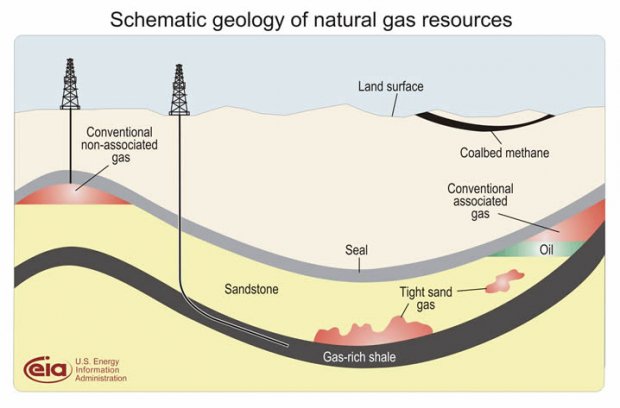
A week before the end of LGSC, we had to travel to Pune to write the computer aptitude test.  We had no clue as to  what it was all about and so travelled merrily to Pune – all to enjoy three days of absence from the course.  Many other officers were also there and all of them barring two of us were all serious about the test.

The test was for three hours and it was all about logic, analysis and intelligence tests.  Who can beat the last-bench intellectuals in such a  test – we were the only two who qualified in the test.  This resulted in us rejoining at Devlali for the ADP Course  in January 1990.

That was when the wedding of Rohini and Sankar was  – before the commencement of ADP Course.  I took two weeks leave prior to the course to attend their wedding at Vashi, Mumbai.  After that it was a journey together as a family, especially at Delhi.

Marina migrated to Canada in February 2002 and I was posted out forthwith to command  125 SATA Regiment as the Indian Army was mobilised to the Western Sector in the aftermath of militant attack on Indian Parliament in December 2001.  Our son Nikhil was despatched to my parents in Kerala and Nidhi had to write her final examination of Grade 5 in April.  For sure, without winking an eyelid, we left her in the loving care of Rohini and Sankar.  We are all very indebted to the family for this great gesture.

When I released my book ‘Suit, Boot & Tie’ in March  2017, I had invited Rohini and Sankar to grace the occasion.  As Sankar had some important military commitment, he could not attend.  Rohini travelled all the way from Mumbai to Bangalore to grace the occasion.  We reminisced a lot about our life together throughout the two days.  Thank you Rohini for this great gesture.

God has been magnanimous with Rohini and Sankar as they have been blessed with Roshan and Nisha – two extremely intelligent, smart and humane kids – who will surely carry on ahead – much ahead of what Rohini and Sankar have achieved.

Today, Sankar is hanging up his boots – after 36 years of dedicated service to the Indian Army.  I wish him all the best in his second innings.  I also need to acknowledge just how much I have been shaped by Sankar. I have a myriad of experiences, too many to mention, that have impacted me in a memorable and meaningful way.   What I have written is  barely scratches on the surface of all that I have learned from Sankar over the years.

We, the Koduvath family, are extremely grateful for the role that Sankar and his family have played throughout our happy years and these years that we will always cherish fondly.

Athens – A Historical City


On June 10, we set out to visit the Acropolis Museum. Voted one of the best museums in the world, with a total area of 25,000 square meter, the museum showcases Greek history through its three floors.  The museum was inaugurated in the summer of 2009.


The Museum is built above a large urban settlement on the Makriyianni site dating from Archaic to Early Christian Athens.   This discovery is being integrated into the Museum and is yet to open to public.  As we walked on the glass floor, we could see excavation and restoration process of the Makriyianni site.


On the ground floor, the ‘Gallery of the Slopes of the Acropolis’ houses exhibits from the sanctuaries that were established on the slopes of the Acropolis, as well as objects that Athenians used in everyday life from all historic periods. ‘Archaic Gallery’, on the first floor, hosts the magnificent sculptures that graced the first temples on the Acropolis.  Photography is not permitted in these two floors.


Third floor, ‘Parthenon Gallery’, where sculptures of the Parthenon period are exhibited in continuous sequence along the perimeter.


The most impressive among the exhibits is the Caryatids.  A Caryatid is s a sculpted female statue, used as a column or a pillar, supporting the structure on her head. This Greek term literally means ‘maidens of Karyai.’   These original statues once supported the roof of the North porch of Erectheion.  Five statues of Caryatids are in the museum.  Statue on right-rear was smashed by a Turkish canon-ball in 1687, when the Parthenon was shelled during a battle between the Turks and the Venetians.  The sixth is installed at the British Museum in London, which acquired it nearly two centuries ago after Lord Elgin, the British ambassador to the Ottoman Empire.  He had it sawed off the Erechtheion’s porch, along with shiploads of adornments from the Parthenon to decorate his mansion in Scotland before selling the pieces to pay debts.  Cast reproductions of six Caryatids now support the porch of Erectheion.


After spending about three hours at the museum, we walked to the iconic Acropolis.  An `acropolis’ is any citadel or complex built on a high hill. The name derives from the Greek language meaning ‘High City’ or ‘City on the Edge’ or ‘City in the Air.  Most famous being the Acropolis of Athens, built in the Fifth century BC.

Acropolis is the most characteristic monument of the ancient Greek civilisation. It symbolises democracy and the beginning of Western civilisation and stands as an icon of European culture.  More than half of the sculptures and artifacts from the Acropolis are in the British Museum in London and their return to Greece is a cultural and a political issue between the two nations, yet to be resolved.  The Brits claim that Lord Elgin saved the marbles from destruction, and acquired them fairly.


As we walked up the hill, we come across the Propylaea, meaning a monumental gate or entrance to a specific space, usually to a temple or religious complex.


As we climbed up the Propylaea, on the Southern flank stands the Temple of Athena Nike.  It was a place of worship for deities associated with wars, ‘Nike’ Gods or Goddesses.  The Nike statute had no wings, as it was customary for Nike statues of the time, the temple acquired the name Apteros Nike (wing-less victory). It is said that the statue was deprived of wings so it could never leave the city of Athens.


Propylaea stands as an impressive building that surrounds the natural entrance to the plateau.


After walking for about five minutes on the plateau, we were at the Parthenon.  The Parthenon is a former temple dedicated to Goddess Athena, considered the patron Goddess of Athens. Construction began in 447 BC and was completed in 438 BC, although decoration of the building continued until 432 BC. It is the most important surviving building of Classical Greece.  The temple was built to shelter the monumental statue of Athena that was made of gold and ivory.

In 1975, the Greek government began a concerted effort to restore the Parthenon and other Acropolis structures and these efforts are still ongoing.


Walking around the Parthenon, we came to the Erechtheion.  This temple was built to house the religious artifacts that the old temple housed. Construction of the Erechtheion began in 420BC.  It is an intricate temple designed to accommodate the uneven ground on which it stands.  The need was to build a temple without disturbing sacred shrines like the altars to Poseidon and Hephaestus, and the spot where Poseidon is believed to have hit the Acropolis with his trident. Other shrines that needed to be accommodated included the sacred olive tree, a well containing sea water and the tomb of Kekrops.


The temple faces East and its entrance is lined with six long Ionic columns.


To the North and West, the wall of the temple drops dramatically to almost twice the altitude of the front and South sides.


The temple is unusual in that it incorporates two porches; one at the North-West corner which is supported by tall Ionic columns, and one at the South-West corner which is supported by six massive female statues, the famous Caryatids.  The Caryatids (replica as the original is in the museum) have become the temple’s signature feature, as they stand and seem to casually support the weight of the porch roof on their heads.


Acropolis also provides an excellent view of Athens and some important historical monuments adjacent to it.


The Odeon of Herodes Atticus, built at the base of the Acropolis is an ancient amphitheatre.  This ancient theater, with a capacity of about 5,000, was built in the Roman times, about 161 AD. by the Roman philosopher, teacher and politician Herodes Atticus in memory of his wife Aspasia Regilla.  It was destroyed in 267 AD and was in ruins until restored in the 1950s.  Since then it has been the main venue of the Athens Festival, which runs from May through October each year.  Many world renowned musicians have held concerts here and was the venue for the Miss Universe 1973 pageant.


This is the facade at the entrance to Odeon of Herodes Atticus


Temple of Olympian Zeus in Athens, also known as the Olympieion, is located on the South-East of Acropolis.  It was built over several centuries starting in 174 BC and completed by Roman emperor Hadrian in 131 AD. Its unusually tall columns and ambitious layout made the temple one of the largest ever built in the ancient world.


The Theatre of Dionysus Eleuthereus is considered to be the world’s first theatre, built at the foot of the Acropolis, cut into its southern cliff.  Dedicated to Dionysus, the God of plays and wine, the theatre could seat 17,000 people.  It was the location for ancient Athens’ biggest theatrical celebration, the Dionysia.  It was an engineering marvel with perfect proportion of depth/circumference. Here is where the great masterpieces by Aeschylus and Sophocles were first performed. I tried to imagine the great  Greek tragedies being enacted with 17000 spectators, seated all around. The thought quietly transported me into a bygone era.

So time for first impressions. Great food, great people and an immense sense of history in every nook and cranny, all together a great getaway.

Greece – The Cradle of Western Civilization


(Image Courtesy Google)

Greece was our destination in the Summer of 2018.  Greece is a country in South-Eastern-Europe with thousands of islands in the Aegean and Ionian seas with Athens as its Capital.

First traces of human habitation in Greece appeared during the Paleolithic Age (120000 – 10000 BC). During the Neolithic Age that followed (7000 – 3000 BC), many buildings spread throughout the country.  The beginning of the Bronze Age (3000-1100 BC) is marked by the appearance of the first urban centers in Greece.


Conquest of Greece in 146 BC by Romans ended Greek dominance.  Christianity was propagated in Greece by Apostle Paul during the First Century.  By the Third Century, Greece became part of the Byzantine Empire.

The Ottomans empire expanded to engulf Greece from the Fourteenth Century.  Around four centuries of Ottoman domination ended with the Greek War of Independence in 1821.  The Greek State took its current form after the end of World War II.  In 1974, after the seven-year dictatorship, a referendum was held and the government changed from a Constitutional Monarchy to a Presidential Parliamentary Democracy, and in 1981 Greece became a member of the European Union.


We landed at Athens on June 09 and drove straight to our hotel.  We were briefed by our Tour Coordinator at the hotel


After completing our  check-in formalities at the hotel, we walked to ‘I Kriti’ Restaurant nearby as recommended by our Tour Coordinator.  The restaurant served a sumptuous Cretan food consisting of fish, lamb in a pan, pork ribs and Greek salad.   Crete is the largest island of Greece and every Cretan village has its own signature cheese, which form part of every Cretan cuisine. They are usually made from sheep or goat’s milk, or a combination of both and each cheese variety has its local interpretation.  We were also entertained by a local musician playing his accordion.


After lunch we walked to National Archeological Museum housed in the old parliament building.  It is an imposing neoclassical building of the nineteenth century which earlier served as the Greek Parliament.  It houses over 20,000 exhibits, providing  a panoramic view of the great Greek civilization.

Some of the museum exhibits of extraordinary splendour  that caught our attention are:-

 
Dipylon Amphora
. This is a large Ancient Greek painted vase, made around 750 BC.  Such large sized painted vases were used as grave markers.  The vase was made on a potter’s wheel in three sections that were joined together to form a single large vessel,  over five feet high. The base has a hole to allow offerings to be poured for the dead.


Kauros
. A marble statue of a naked youth (530 BC), erected on the grave of Kroisos, who fell in battle, according to the epigram carved on the front of the pedestal.  He is represented standing frontally with his left leg forward and fists clenched.  He symbolises youthfulness, beauty, power and hope.


Kore (Maiden)
. This marble statue of a maiden (550-540 BC), stood on the grave of Phrasikleia. The Kore is depicted by the sculptor wearing a wreath on the head, jewellery and a long gown.

Statues depicting men had their left foot forward and women were depicted standing with their feet together.  This could also prove my observation of ‘Left Foot First’.  Please click here to read my earlier post.


Sphinx
. This marble statue of a Sphinx (570-550 BC) is one of the earliest known Archaic Sphinxes and it was set above a grave.  Sphinx is a mythical creature with the head of a human and the body of a lion.


Bronze statue of Zeus or Poseidon. This statue (460 BC) was recovered for the seabed is still debated as to whether it represented Zeus or Poseidon.  The statue is over two meter tall.  The God is depicted with left leg forward in a  great stride, with His left arm forward, while throwing the thunderbolt or the trident held in His right hand.  Notable feature is  the exquisite rendering of motion and anatomy.


Funerary Stele
. This marble piece (400 BC) was found in 1870 in an ancient cemetery. It shows a lady seated on a chair, looks at a piece of jewellery held in her raised right hand. Opposite her, a sorrowful standing attendant holds an open jewellery box belonging to a dead woman.  The sorrowful expressions on the face of the two ladies, their hairstyles and rendering of their jewellery and dress is all very impressive.


Artemision Jockey
. Bronze statue of a horse and a young jockey (140 BC) retrieved in 1928 and 1937 in pieces from the seafloor. The word Artemision comes from Cape Artemision, the site of the shipwreck. The young jockey, probably of African origin, holds the reins of the galloping horse in his left hand and a whip in his right. The contractions and furrows in his face, especially on the forehead, reveal agony and passion.


Statue of Hermes
. This marble statue (27 BC-AD 14), is probably a funerary and was found in 1860. Hermes was the  Greek God of trade, wealth, luck, fertility, animal husbandry, sleep, language, thieves, and travel.  He is depicted standing, wearing a short cloak that is wound around his left arm. In his right hand he is holding  a purse and in his left the Caduceus, his staff.


Bronze Statue of a Youth
. A bronze statue (340-330 BC), recovered in 1990 from  an ancient shipwreck on the sea floor.  It depicts either Perseus, who would have been holding the head of Medusa, or, more probably, Paris, with the ‘apple of Strife’, ready to award it to the most beautiful Goddess, Aphrodite.  Outstanding feature of this statue is the strongly modeled muscles and the expressive face.

National Archeological Museum with its numerous and outstanding exhibits give the visitor a peep into Greek history.   Unique treasures displayed with detailed captions and signboards will mesmerise you and it is really worth a visit.  The sculpture collection depicts the evolution of ancient Greek sculpture from 700 BC to the Fifth Century AD.  It requires plenty of time to read through various information boards and enjoy the artistic value of the statues and artifacts displayed.


We returned to our hotel rooms by dusk.  We had dinner at the roof-top restaurant of the hotel which offered a stunning view of illuminated Acropolis.

I felt a fleeting sense of awe and humility. Looking at the brilliance of what is left of a more than 2000 year old structure, i couldn’t help but feel that despite the ravages of time, here is where history stands tall, with elegance and poise.

After Action Report -Thai Cave Rescue


In their first public appearance since emerging from their ten-day ordeal in the cave, the boys recounted their side of an extraordinary story that captured the imagination of the world.


(Photo courtesy (Vincent Thian/The Associated Press)

A packed crowd greeted the youngsters after they were discharged from hospital in Chiang Rai, and watched as they played with footballs on a small makeshift pitch before taking their seats.

Sitting beside the boys were the Thai Navy SEALs who stayed inside the cave with them after they were found, as well as members of the medical team who looked after them after the rescue.

Thai authorities organised a  press conference, for which questions were pre-screened,  More than 100 questions were sent in by the media, though only a handful were selected.   The media was urged to give the boys uninterrupted time with their families so as not to harm their recovery

Dressed in matching team shirts, the boys and their coach Ake appeared happy and relaxed as they faced the world’s media.  The boys introduced themselves  with their nicknames and the position they played on the team.

The largely joyous mood of the press conference was tempered, however, when the boys and Ake discussed the loss of Saman Kunan, the former Thai Navy SEAL who had died during the rescue effort. Ake said the team were shocked to learn of Saman Kunan’s death, called him a hero.   In memory of the navy diver, Ake and the boys decided to spend time as novice Buddhist monks — a practice considered a high honour in Thailand.

The boys thanked their rescuers and medical staff, and paid tribute to Kunan. They also bowed before a portrait of the Thai king.

The boys explained as to when they realised that they were trapped, how they adapted to their surroundings and their eventual joy at being found, ten days later.  They described their rescue as a miracle, thanked the experts who saved them and discussed how the experience would affect the rest of their lives.

Contrary to the belief that the team entered the cave complex to celebrate the birthday of Night on the day the team went missing, Ake said that the boys were merely curious to look inside as some of them had never been there before.  He said it was not unusual for the group to participate in group activities after soccer practice on Saturday afternoons.

They explored the caves for about an hour, before deciding to return.   By this time the cave had become partially flooded and their exit was blocked.   All the boys can swim, country to earlier reports, and they to swam to safety when the water started rising.

At his point, they realised that they were trapped. With no obvious way out, the group retreated about 200 meter further into the cave to find somewhere to rest for the night.

There they found a bit of slope with a small water source,  Ake instructed the team to drink water dripping from the roof of the cave as it would be purer than the dirty floodwater on the floor.   Having eaten after soccer practice, the boys had no food during their ordeal.  Instead, they drank water from the cave.

Before they slept, Ake told them to say a prayer and they prayed that night. The team were not scared and Ake hoped the water level would drop the next day, and that help would arrive.

The waters did not subside, however.  Instead the levels rose fast.  Ake ordered the group to find higher ground. Concerned that they might soon be submerged, he instructed the boys to start digging and look for a potential exit.  They managed to burrow a hole into the cave in shifts after the water rose by three meter.

Adun, the only member who spoke English, responded with a “Hello”  in disbelief  to the first British diver who reached the group.  Adun, like other members of the group, was busy digging — looking for a possible way out — when some of the boys thought they heard the sound of people talking.  Ake instructed the group to stay quiet. He asked one of the boys to move closer to the ledge and shine a flashlight on the water, but the boy was too scared, and Adun volunteered instead.

The boys described how they formed a bond with the Thai Navy SEALs who remained with them in the cave while rescuers worked out a plan to free them. They played checkers — and one of the Navy SEALs sitting alongside them at the press conference always won.   This SEAL was titled ‘King of the Cave.  One SEAL had spent most of the time in just his underwear and a small piece of foil, having stripped off his clothes to give to the boys to keep warm.

None of the boys wanted to leave the cave first when rescuers asked for volunteers when the decision was made to extract the boys through the floodwaters.  Ake joked he and the boys made the decision on who should go first based on who lived the furthest away. Ake thought the rescued kids would go straight home and those who got out first could spread the word.

When asked about the lessons they’ve learned from the incident, Ake said he was going to live life more carefully.   Ardun said though people can’t predict the future, the experience had taught him about the consequences of acting carelessly.   Other boys said though they still dreamed of becoming soccer players, some said they now wanted to become Navy SEALs.

The boys and Ake apologised to their parents for not telling them they went to the cave.

Thai authorities are concerned about their long-term psychological health.  They urged the media to respect the boys’ privacy in the future, out of concern for their mental health.  They are also in the process of granting four team members who are stateless Thai citizenship.

The day after the press conference the boys were allowed to go home.   Doctors have advised their families that they should avoid contact with journalists for at least a month.


Wild Boar Boys Football Team Rescue Operations


Rescue operations of Thai Wild Boar Boys Football Team and coach, a group of ‘Unlucky Thirteen’ captured the world’s attention, as divers successfully brought them out of the flooded Tham Luang cave complex.  “The number 13 may be lucky or unlucky, but one cannot blame the number for it and will always follow number 12 and precede number 14” – from my blogpost ‘Arithmetic of Licence Plates.’

‘God Himself never did any miracle, but it was always through humans’, I had written in my earlier blogpost ‘Randomness of Life.’  We must thank the God Almighty for the efforts of the rescue team, but should never forget to thank all those members of the rescue team, who untiringly executed the dangerous rescue operation.


First, let us bow our heads and say a few prayers for Kunont, also known as Gunan or Kunan, who laid down his life, without caring for his personal safety.  He was part of the North Face Adventure Team, one of Thailand’s top trail runners and a former Navy Seal diver.

Kunont made his way through a submerged cave to bring oxygen.  He  then ran out of oxygen on his way back to the entrance, highlighting how hard it would be to rescue the boys untrained in diving.  On his way back he lost consciousness and  his friend tried to help bring him out.  Kunont, in a soldierly way, did the supreme sacrifice in trying to save others.


(Image Courtesy Australian Associated Press)

Dr Richard Harris, 53, an anesthesiologist from Adelaide, works for the South Australian Ambulance Services.  He is an expert in cave-diving.  He joined the rescue team on the request of British officials.

Risking his own life, Harris made the treacherous trip into the subterranean chamber to check on the boys after they had been trapped for more than two weeks.  After examining them, Harris recommended that the weakest of the boys be rescued before their stronger teammates — against the earlier opinion of saving the strongest first.


Ekapol Chantawong, affectionately known as “Ake,” is the assistant coach of the football team.  Ekapol had already cheated death; when he was just 10 years old.  His parents and brother were killed by a disease that ravaged his village, only sparing him.  He lived with extended family members for a short time after his family’s deaths, but felt sad and lonely.  This lead him to be a Buddhist Monk.

Ake would be there at the field waiting for kids to show up after school. According to him, it is a great way to keep the children healthy, away from modern gizmos and other diversions and also to interact with friends.  The members of the Wild Boars are a team on and off the soccer field, traveling to competitions, cycling mountain roads and swimming in waterfalls together.

The team entered the cave complex to celebrate the birthday of Peerapat Sompiangjai, nicknamed Night, turned 17 on 23 June, the day the team went missing.  Before they were found, the group had to survive for nine days in the darkness unaware of the desperate search efforts.

How did this team survive through the ordeal?

Air.    Most caves naturally ‘breathe’ through various pores and cracks.  However, as the days went on, oxygen levels dipped to about 15% where the team were huddled. The usual level is about 21%.  Ake, being a Buddhist Monk, had trained the team in breathing techniques to make sure they used as little air as possible,

Food.    The team had bought snacks to celebrate Night’s birthday, and it was these snacks that helped sustain them after getting trapped in the caves. Ake reportedly refused to eat any food so the boys would have more for themselves, leaving him the weakest when divers eventually found the team on 2 July.  What a great leader!

Water.    Humans  can survive for many months without food, but water is an absolute necessity.  As it was monsoon season, the cave had adequate water  and they chose clean water to drink,  Water dripping from the cave ceiling would have really helped.

Hypothermia.    It is a medical emergency that occurs when your body loses heat faster than it can produce.  It can often be a risk underground, especially in flooded caves.  The team used rocks to dig five metres deeper into the cave to create a tunnel so that they could keep warm.

Disorientation.   The team had to handle the total darkness of the cave, without any awareness of time or of the massive search efforts to find them.  Meditation training by Ake helped the team withstand disorientation.

Stress.   The efforts of Ake must have been instrumental in keeping them calm.  Meditation would have helped them handle the stress.

When the rescuers managed to get through to the team, they delivered letters from their families and took notes back to allow them communication with the outside world.  In his letter, Ake apologised to the parents for taking the boys into the cave network, but several replied to say they did not blame him.

“I promise I will take care of the kids as best as I can,” he wrote.

Lesson to be learnt from the rescue operations are:-

Planning and Coordination of Rescue Efforts.    Coordination between various Thai agencies and also international agencies ensured speedy rescue. A mission which was expected to take a few weeks was executed in few days.

Leadership of the Coach Ake.    Exemplary leadership demonstrated by the coach of Wild Boars football team in ensuring survival of the entire team.   Surely, he must be well trained in First-Aid, CPR, survival skills, child psychology, etc. Our son works as a Swimming Instructor and Life Guard in Canada and he is well trained in these aspects.

Team-Work.     The entire team of teens must have listened to their coach – else they would not have survived through this ordeal.

Trust in the Leader.    The coach must be enjoying a lot of trust and confidence of the team of teens for sure.

Dedication of the Rescue Team.     Despite losing a rescue diver, Saman Kunan, the rescue team endured to complete the dangerous mission.

Composition of Rescue Team.    A doctor with cave-diving experience first went into the chamber and approved the boys for the operation.

No VIPs.    The VIPs kept away from the scene, thus all resources like helicopters, road-space, etc were available to the rescue team.

No Media Presence.    Media and their camera crew were kept away from the scene and there were no reporters milling around to give the ‘latest situation reports.’

Crowd Management.    Local population appear to have cooperated with the authorities and there was no crowding – especially those with their cellphones – all ready to post images on the social media.


Quarantining of the Team
..    Thai health officials said that some of the first boys freed had elevated white-blood cell levels, indicating infections, and two showed signs of pneumonia but were responding well to treatment. They are expected to be quarantined in hospital for at least seven days.

Post Trauma Support.    A psychiatrist is evaluating the rescued team and would provide needed counseling and psychological support.

Kudos to all those involved in this rescue mission and Rest In Peace Saman Kunan,  – you have achieved Great Glory – true to the spirit of a soldier.

Rose Garden 2018

For centuries, roses have inspired love and brought beauty to those who have received them. In fact, the rose’s rich heritage dates back thousands of years.  People have been passionate about roses since the beginning of time.  We have over fifty bushes in our garden.


Jawaharlal Nehru, the first Prime Minister of India,  was fond of Red rose. He always wore a Red rose on his jacket until his last breath.


It is said that the floors of Cleopatra’s palace were carpeted with delicate rose petals.  Shakespeare refers to roses more than 50 times throughout his writings. It is also New York’s state flower.


1,000 years old. That’s the age the world’s oldest living rose is thought to be. Today it continues to flourish on the wall of the Hildesheim Cathedral of Germany.


It was in seventeenth century that French explorer Samuel deChamplain brought the first cultivated roses to North America.  Roses are truly ageless. Recently, archaeologists discovered the fossilized remains of wild roses over 40 million years old.


The people of ancient Greece used roses on festive occasions to adorn themselves with garlands of roses, and splash themselves with rose-scented oil.  Napoleon’s wife Josephine so adored roses, she grew more than 250 varieties


The largest rose bloom ever bred was a pink rose measuring approximately 33 inches in diameter, bred by Nikita K. Rulhoksoffski from San Onofre, California.


Red roses are the traditional symbol for love, romance.  It reflects beauty and perfection.  Myth has it that Venus’ son Cupid accidentally shot arrows into the rose garden when a bee stung him, and it was the ‘sting’ of the arrows that caused the roses to grow thorns.  When Venus walked through the garden and pricked her foot on a thorn, it was the droplets of her blood which turned the roses red.


Pink Rose depict gentleness, grace, gladness, joy and sweetness.  It  can also convey happiness, gracefulness and admiration.


Bright, cheerful and joyful are what come to mind when thinking of a yellow rose. Giving yellow roses can tell someone the joy they bring you and the friendship you share.


White roses, the purist of colors, represent innocence, purity and charm. White roses are traditionally used in weddings and can represent new beginnings. We believe that white roses can also express remembrance and innocence.   Why white roses are so special is no mystery – it’s a myth. Perhaps it started with the Romans who believed white roses grew where the tears of Venus fell as she mourned the loss of her beloved Adonis.


Orange roses evoke energy, and enthusiasm, desire and excitement. Giving orange roses can symbolise your passionate romance and share your excitement of the relationship with your loved one.


Love at first sight or just an enchanting way to say, “I love you!” Lavender roses can offer a daily reminder of your love and eagerness to grow your relationship.


Peach-colored rose is gifted when are you grateful for someone or just want to show your appreciation.  It shows appreciation and gratitude or a different way to say “Thank You!”   They symbolise innocence and purity.


Cream roses are indicative of charm and thoughtfulness and goes well with pink ‘thank you’ roses.  Gifting a bunch of cream roses is an ideal way to show someone that you care – but without any romantic intentions.

” How did it happen that their lips came together? How does it happen that birds sing, that snow melts, that the rose unfolds, that the dawn whitens behind the stark shapes of trees on the quivering summit of the hill? A kiss, and all was said.”   Victor Hugo

” What’s in a name? That which we call a rose by any other name would smell as sweet.”  William Shakespeare

Peonies – A Symbol of Honour, Fortune, and a Happy Relationship


Peonies are outrageously beautiful in bloom, with lush foliage. They bloom from late May through  June in Toronto.  The flowers last only two weeks.


Their stems are not strong enough to support the heavy blossoms, hence they need support.  Peony cages are placed in spring around the plant as they grow.


Peony is named after Paeon (also spelled Paean), a student of Asclepius, the Greek god of medicine and healing.  They are also the 12th anniversary flower – because the peony symbolises honour, fortune, and a happy relationship.. It is the state flower of Indiana.


Peonies are native to China. They are highly valued there, and are often referred to as the “king of flowers”. They were the national flower prior to 1929, when they were replaced by the plum tree. Chinese name for the peony is ‘Sho Yu’ meaning “most beautiful”.


Peonies of three types grow in our garden- Tree Peonies, Herbaceous Peonies and Itoh peonies.


Herbaceous peonies (also known as bush peonies) die to the ground in Winter.  They re-emerge in March, or when the snow melts. Many find that they are deer resistant, but not always. Peonies are long lived, minimal care plants.


Tree peonies are called tree peonies for the woody stems that they have. Tree peonies have woody stems that defoliate in the fall, but the woody stems stay intact, above the ground. They tend to bloom earlier and with larger flowers than the bush peony.


Itoh or Intersectional peonies are a cross between the herbaceous (or bush) peony and the tree peony.  These crosses have produced new, exciting colors.  The plants have the lovely leaf form of the tree peonies, but die to the ground in the Winter.  Since they are recent introductions and are still in short supply they command a high price.


Itoh Peonies derive its name from Japanese horticulturist, Dr. Toichi Itoh, who successfully created seven peony hybrids from a tree peony bred with an herbaceous peony.  Dr. Itoh passed away before ever seeing his creations bloom. Years later, American horticulturist, Louis Smirnow bought some of these original Itoh peonies from Dr. Itoh’s widow and continued Itoh’s work.


Peonies like full sun, and though they can manage with half a day, they bloom best in a sunny spot.  They come in every color except for blue. Pink, and white, are the most popular colours.  Peonies can live upto a hundred years.  In ancient times peonies were believed to relieve headaches and help with asthma.


Early Spring Tulips 2018


‘April rains bring in May flowers’ is a common saying in Canada. This year, tulips sprouted as the days warmed up in April, but we had two snowfalls thereafter. Many plants either died or did not grow properly, but we still boast of the best Tulip Garden in Town.


Tulips Originated in Persia and Turkey and were brought to Europe in the 16th century.


Cultivated varieties, referred to as ‘Dutch tulips,’ originated in the Netherlands.


They got their common name from the Turkish word for gauze (with which turbans were wrapped) – reflecting the turban-like appearance of a tulip in full bloom.


Yellow tulips symbolises cheerful thoughts.


The brightly colored, upright flowers may be single or double, and vary in shape from simple cups, bowls, and goblets to more complex forms.


Tulips typically bear cup-shaped flowers in almost every shade but true blue. They can be double or single, fringed or twisted, perfumed or non-scented.


Purple symbolises royalty.


The eleventh wedding anniversary flower is also tulip. It conveys forgiveness.
These are different shades of Red Tulips in our garden. Red tulips are most strongly associated with true love.


Tulips are spring flowers and it arrival signals the coming of a new season. Most tulips have six petals, but some can have many more.


Some of the Tulips are still blooming – may be due to the late setting in of spring.


Red tulips are the hue of choice to express that you are deeply in love. The color red evokes passion and romance.


They are gone in two weeks – and that’s the saddest part.


Gardening for Fun & Happiness

So God created man in his own image, in the image of God he created him,  God blessed them and said to them, Be fruitful and increase in number; fill the earth and subdue it. Rule over the fish in the sea and the birds in the sky and over every living creature that moves on the ground.‘  (Genesis 1:27, 28)

God gave man the right to rule over everything on earth.  It must not translate into exploitation of nature, but being fruitful.  It is all about the power of creativity that God blessed us humans with.  It exhorts all humans to be part of creation and one of the best way to execute God’s command would be to tend to your garden.  It may be a few indoor pots, a small home-garden or your farm.

May 03 is Garden Meditation Day. This is a day to take some time out for yourself to relax and meditate or the least, visit a garden if you do not own one.  It is the time to get on to hands-on work, like digging in the garden, planting seeds, pruning plants and so on.  It can actually be a form of meditating.

Research has proved that that when we become involved in physical activities that involve creativity, planning, problem-solving, physical labour, it reduces stress, anxiety, and depression.  It can also be a good exercise for weight-loss.  The act of tending to your garden, planting saplings, de-weeding, will always make you feel better and also give you the power to be part of creation and being close to mother nature.

A mere look at your garden or plants can generate a lot of emotional changes which will surely have a positive effect on your blood pressure, heart activity, muscle tension, and neural activity.  It will surely calm your nerves, soothe your emotions and provide lot of happiness.

Today, we have literally taken the God’s word of ‘ruling over the earth.’  Gardening is the best way to ‘go green’ and support mother nature.  A well kept garden, why even a few indoor plants will surely impact the quality of air at your home.  It helps keep the house warm in winters and cool in summers, thus reducing carbon imprint and also save a few bucks.

A vegetable garden in your backyard will provide you with fresh and good quality vegetables.  In case you resort to organic farming – without use of artificial fertilisers and pesticides – you will have a regular bountiful harvest of organic vegetables.

One summer morning, as I was tending to the roses in the garden, an octogenarian stopped his car and came out to compliment me on the excellent garden.  He said “your work has improved the property value of your home by a hundred thousand dollars and your neighbour’s by at least fifty thousand.  I retired from being a real-estate agent for over forty years and this I can vouch for from my experience.

A garden or a landscaping is an investment for the future.  A well manicured lawn, well kept flowerbeds, well pruned trees – all add ‘curb-appeal’ of your home.  It is a sure shot recipe to sell your home faster.

Gardening and landscaping is truly becoming an art form. Planning, planting and watching your own garden grow can fill you  with satisfaction and pride. Gardening is truly a life-time hobby. The more you learn the more proficient you get and the possibilities become endless.  It is all about taking the first step, getting your hands dirty and your shoes soiled.  As time pass by, you will surely enjoy it – especially post-retirement.

So what’s stopping you from starting your own garden and landscape design or even get some indoor plants?

Lieutenant General Rajendra Ramrao Nimbhorkar, PVSM, UYSM, AVSM, SM**, VSM- A Soldier Par Excellence

As I received a letter from General Nimbhorkar about his impending adieu to the profession of arms on 30 April 2018, after over five decades in uniform, I was struck by the thought that I was indeed fortunate to have been associated with one of the finest soldiers and an excellent human being. Our first meeting was in 2002, when I took over command of the Regiment in Rajasthan.  Our Regiment had mobilised as part of the general mobilisation ordered in the wake of the terrorist attack on the Indian Parliament (Op PARAKRAM). We were deployed as part of the newly raised 41 Arty Division, and I met then Col Nimbhorkar as the Colonel Administration of the formation during its raising.

There he was, an Infantry Officer, heading the administrative and operational logistics organisation of an Artillery Division.  He introduced himself in his soft and calm voice with a pleasant smile.  I was pretty sure that behind the smile was a smart, intelligent, tough and a chivalrous officer, who knew his beans pretty well, else he would not have been handpicked for the prestigious and difficult appointment.

General Nimbhorkar is a product of Sainik School, Satara (Maharashtra), National Defence Academy (NDA), Indian Military Academy (IMA).  Like most Sainik School graduates, he too came from a humble family background.  He was commissioned to 15 Punjab Regiment in 1979, which he commanded in Kashmir.  He graduated in courses at Defence Service Staff College,  and Higher command courses in India and the National Defence College, Dhaka.

As I look back over my two decades with the Indian Army, I observe that few military leaders are equally well admired by their superiors, subordinates, and peers and the admiration continues far beyond the years of association. The spoken reputation simply cuts across the hierarchical rank and file. I can say without hesitation that Gen RR Nimbhorkar belonged to this select few. There are a number of remarkable military facets about Gen Nimbhorkar. Some of them are worth mentioning.  During his long years with the Army, he was destined to be part of almost every major operation that was launched by the Indian Army. In his younger years up to command of his unit, he has walked on foot almost every inch of the line of control in Jammu and Kashmir. His command assignments at the Unit, Brigade, Division and Corps levels were all in operational areas. To say the least, he was someone who rose to the top through sheer hard core soldiering.

So we knew him as a hard core Infantry soldier. But during his tenure with the Artillery Division, he became a Gunner in letter and spirit and the Gunners accepted him as one of their own. When he spoke about artillery ammunition planning (a nightmare for most Gunners), one wondered whether he was wearing the wrong lanyard and beret! As he rose through the military hierarchy, many of the Gunners continued their association with him and to them he always remained a sort of a benevolent Colonel Commandant.

The most prominent part of his uniform were the rows of ribbons of the medals he had been awarded and they were plenty and they speak a lot about his military career.


Today, he stands tall as the most decorated officer of the Indian Army.  The above ribbons adorn his uniform, over his left chest and he surely holds them close to heart as he deserves much more for all his actions during his military service.  For the benefit of non-military readers, let me explain these ribbons.
1.     United Nations Angola Verification Mission Medal for his service as a Military Observer.
2.     Nine Years Long Service Medal
3.    20 Years Long Service Medal
4.    30 Years Long Service Medal
5.    50th Anniversary of Indian Independence Medal
6.    Videsh Seva Medal for service in a foreign land.
7.    High Altitude Service Medal for serving in areas above 9000 feet altitude.
8.    Samanya Seva Medal awarded for active service
9.    Operation Vijay Medal awarded to all participants of Operation Vijay – better known as Kargil War
10.  Special Services Medal.
11.   Samanya Seva Medal awarded for active service in Eastern Theatre.
12.   Wound Medal or Parakram Padak is awarded to those who sustain wounds as a result of direct enemy action in any type of operations or counter-insurgency actions.  The General was critically wounded while commanding his Battalion during Operation Vijay.
13.   Vishisht Seva Medal (VSM) awarded for distinguished service of an exceptional order.
14.  Sena Medal (SM).  The General was awarded Sena Medal twice(SM**) – once for gallantry as Captain commanding an Infantry  Company in Dras sector and for distinguished service as a Brigadier commanding an Infantry Brigade.
15.    Ati Vishisht Seva Medal (AVSM) awarded in recognition for distinguished service of an exceptional order.
16.    Uttam Yudh Seva Medal (UYSM) awarded for a high degree of distinguished services in an operational context of war, conflict, or hostilities.
17.    Param Vishisht Seva Medal (AVSM) awarded in recognition for peace-time service of the most exceptional order.

General Nimbhorkar is a great leader, a true and gallant soldier, an outstanding administrator, a voracious reader, and above all a great human being.

My salutes to him from Canada – thousands of miles away -on the eve of his retirement.  I am sure he will remember David Frost’s lines: –
The woods are lovely, dark and deep,
But I have promises to keep,
And miles to go before I sleep,
And miles to go before I sleep.

(Written in collaboration with Veteran Brigadier Azad Sameer)

Golden Jubilee – 75 Medium Regiment (Basantar River)


Veteran Colonel Joginder Singh, Mrs Kiranjit, Marina and I – we all travelled from Toronto, Canada to Faridkot, Punjab, India – to celebrate the Golden Jubilee of the raising of our regiment – 75 Medium Regiment (Basntar River).  A reunion, is a gathering of people who have shared a past, and the joy of reuniting is to see the individuals with whom the past was shared. Here we were reuniting to  share our past, the good old regimental days, with those brave officers and soldiers, who now carry the mantle, history and traditions.

Our Regiment was raised in 1966 at Delhi and was equipped with 130 mm Russian Guns.  It had three batteries – one battery was of Brahmins (other than those from the Southern and Eastern States of India), the second had Jats and the third was manned by the soldiers from the four Southern States.  By the turn of the century, the Regiment was reorganised with soldiers from all over India, from all castes and religions.

The Regiment was awarded Honour Title “BASANTAR RIVER” in recognition of  outstanding contribution by all Officers and soldiers during the 1971 Indo-Pak War.  The Regiment provided fire support for the most  famous battle of Zafarwal  in that the two Param Vir Chkra (Highest Gallantry Ward) winners – Second Lieutenant Arun Khetrapal of 17 Poona Horse and Major Hoshiar Singh of 3 Grenadiers – both were supported by the Regiment’s Observation Post (OP) Officers – Captain SC Sehgal and Captain Mohan Krishnan.  Captain Sehgal was awarded Vir Chakra posthumously for his gallant actions and Capt Mohan Krishnan was awarded Mention-in-Despatches.


As we landed at New Delhi Railway Station – there was an impromptu get-together.  We were met by Veteran Major General PK Ramachandran, Brigadier Madan Sheel Sharma,  Veteran Colonel Ashok Arora  and Veteran Colonel Ranjan Deb.  We were received at Faridkot Railway Station with all the fanfare and were escorted to the Officers’ Mess


With the present team of officers of the Great Regiment – ably commanded by Colonel DR Jadhav – They made the event come alive and memorable.  They surely left no stone unturned to make the event a grand success.


During lunch at the Officers’ Mess, we met Mrs Sneh Thadan, wife of Late Brigadier KN Thadani.  Lieutenant Colonel Thadani commanded our Regiment during the 1971 Indo-Pak war and was awarded Vishisht Seva Medal for his exemplary leadership and planning.  There was Veteran Brigadier MS Brar VSM, SM. He was the Battery Commander with Hudson Horse during Battle of Basantar River of the Indo-Pak conflict of 1971.


Veteran Brigadier AN Suryanarayanan – our Commanding Officer when I joined the Regiment in December 1982 – was there in his smart and erect posture with his signature mustache..


Veteran Colonel Mahaveer Singh – the Commanding Officer under whom I served the longest – 1983 to 1988 was at his cheerful best as expected.


The Stalwarts here – From Left – Veteran Brigadier JPS Ahluvalia (Commanding Officer 1990 -93), – Veteran Brigadier AK Sikka (first Battery Commander under whom I served), – Veteran Brigadier AN Suryanarayanan – Veteran Colonel Mahaveer Sing and – Veteran Brigadier Rajesh Kumar – Adjutant of our Regiment during Indo-Pak War of 1971


There was a Wreath Laying a wreath at the War Memorial of the Regiment, where all veterans and serving soldiers paid their respect to all those who laid down their lives, serving the motherland.  The bust of Captain SC Sehgal, Vir Chakra  and Captain Pratap Singh, Maha Vir Chakra aptly adorned the memorial.

Captain Pratap Singh and I served with the Regiment from 1984 to 1988.   During his deployment in Siachin Glacier in 1988, Capt  Pratap Singh was performing the duties of OP officer at Bana Post, the highest post in the glacier.  On 26 May 1988 he volunteered to cut the ropes tied by the enemy to launch assault on Bana Post and hence prevented its capture.  While he went on to accomplish this task, a booby trap laid by enemy exploded causing severe injuries, yet this brave officer, with cold courage and determination, completed his task before succumbing to injuries. For his outstanding, exemplary and gallant act in the best traditions of Indian Army he was awarded Maha Vir Chakra posthumously.


We presented a Silver Trophy to the Regiment on the occasion – replica of a Bofors Gun the Regiment is currently equipped with.


There were many occasions for us to interact with Veteran Soldiers who served under our command and it I had many a goose bumps as they recounted and reminisced various events, sports competitions, operations, etc.


I was lucky to  meet and interact with Colonel PR Ravikumar and Colonel UV Rao – the smart Young Officers who served with me.  Colonel Ravi commanded our Regiment  and Colonel Rao is commanding a newly raised Medium Regiment.


During the Golden Jubilee party at the Officers’ Mess, Mrs Sneh Thadani cut the cake.


It was indeed a moment of pride for me as I sat down to sign the Visitors’ Book at the Officers Mess as the  table on which I was signing had the photograph  of Major General BK Guha, Colonel of Regiment.  He was the Senior Subaltern when I joined the Regiment in December 1982.


As I bid goodbye to the Regiment, I spoke to Colonel Jadhav “The Regiment was good –  that is why so many Veterans turned up; the Regiment is good – that is why you could put up such a great show; and the Regiment will surely remain good for the times to come.”  , We all enjoyed every bit of the moments we shared and will ever be etched in our memory.