
A Parsi, Not a Muslim
Feroze Gandhi was a Parsi, not a Muslim as some mistakenly claim. Born Feroze Jehangir Ghandy in Bombay to Faredoon Jehangir, he later adopted the spelling “Gandhi” after his involvement in the freedom struggle. A politician and journalist of considerable talent, he served as publisher of the National Herald and Navjivan newspapers from Lucknow, publications that became influential voices in India’s independence movement.
The Fateful Meeting
In 1930, while still a student, Feroze encountered Kamala Nehru and her daughter Indira among the women demonstrators picketing outside Ewing Christian College in Allahabad. When Kamala fainted under the oppressive heat, Feroze rushed to comfort her. The encounter proved transformative. The very next day, he abandoned his studies to join the Indian independence movement—a decision that shaped his life. That same year, he was imprisoned alongside Lal Bahadur Shastri in Faizabad Jail, where he spent nineteen months as a political prisoner.
A Proposal and a Promise
Feroze first proposed to Indira in 1933, when she was just sixteen. Both Indira and her mother rejected the proposal, citing her youth. Yet Feroze remained close to the Nehru family, particularly to Kamala Nehru. When her health deteriorated in April 1935, he helped arrange her treatment in Europe and visited her at the TB sanatorium, remaining at her bedside when she died. Kamala was so deeply impressed by his devotion that on her deathbed, she insisted that Indira marry him.
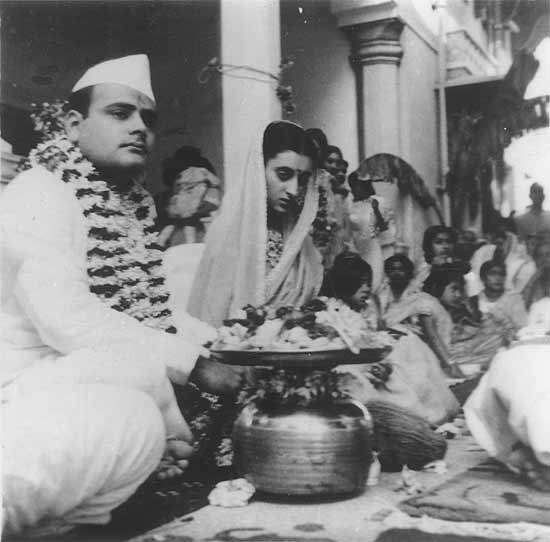
The marriage finally took place in March 1942, according to Hindu rituals. Indira wore a khadi sari that her father Jawaharlal Nehru had woven—a pale pink, not the traditional bridal red. This sari became a family heirloom, worn by Sonia Gandhi at her wedding in 1968 and by Priyanka Gandhi in 1996. The choice of pink over fiery red symbolised the family’s understated elegance and commitment to simplicity.
Political Rise and Independence
In 1952, Feroze Gandhi won independent India’s first general elections from the Rae Bareli constituency in Uttar Pradesh, with Indira serving as his campaign organizer. He quickly established himself as a formidable parliamentary force, unafraid to criticize his father-in-law’s government and champion the fight against corruption. Re-elected in 1957, he delivered his most significant blow in 1958 by exposing the Haridas Mundhra scandal involving the government-controlled LIC insurance company. The revelations severely embarrassed Nehru’s administration and forced the resignation of Finance Minister T.T. Krishnamachari.
Personal Turmoil and Separation
The narrative that Feroze and Indira lived separately after Sanjay’s birth contains some truth. Behind this separation lay the machinations of M.O. Mathai, Nehru’s personal secretary—a Syrian Christian from Central Travancore (like me) whose remarkable rise from cook’s helper to the Prime Minister’s secretary is a story in itself. Mathai successfully drove a wedge between Nehru and Feroze, exacerbating tensions that were already present.
Feroze had aligned himself with fiery young parliamentarians like Chandrasekhar (who later became Prime Minister) and Mohan Dharia, who frequently opposed Nehru’s policies in Parliament and party forums. The trio were known as Young Turks. To avoid confrontation with his father-in-law, Feroze maintained distance—he entered Teen-Murti Bhavan through the Right Flank to visit Indira upstairs.
A Personal Account
This remarkable history was narrated to me by two individuals who witnessed it firsthand. Ms. Bimla Behn, the gracious hostess of Teen-Murti Bhavan during Nehru’s premiership, shared intimate details of life within those walls. Mr. Sharma, the caretaker who served from Nehru’s time onward, corroborated her accounts.
I had the privilege of meeting them during the first week of November 1984, when our Regiment was deployed for VVIP security duties as Mrs. Gandhi’s body lay in state at Teen-Murti Bhavan following her assassination on 31 October. In the solemn intervals between duties, they spoke of the relationships they had observed—between Nehru, Feroze, and Indira—bringing history alive with their personal recollections.
The Brahmachari Connection
Bimla Behn also recounted how Indira, after Nehru’s death, was appointed Minister of Communications in Lal Bahadur Shastri’s cabinet. During those years, she suffered chronically from cold and a runny nose—a condition so persistent that photographs from the period invariably show her clutching a handkerchief. It was then that she encountered Dhirendra Brahmachari, who introduced her to yoga as a remedy. Regular practice not only cured her ailment but sparked a lifelong commitment to yogic discipline.
The Tragedy of Sanjay Gandhi
Regarding Sanjay Gandhi’s untimely death, I learned details from the President of the Delhi Flying Club in 1984, who was related to an officer in our unit. The aircraft involved had been imported as a Complete Knock-Down (CKD) kit, arriving in boxes. A week before the fatal flight, Sanjay ordered the club president to assemble the plane. Despite lacking test flights and certification from the Directorate General of Civil Aviation, Sanjay insisted on flying it. On 23 June 1980, near Safdarjung Airport, a malfunction caused the aircraft to crash, killing Sanjay Gandhi instantly.
Legacy
Feroze Gandhi’s life was marked by courage, integrity, and independence. Though often remembered primarily as Indira Gandhi’s husband and Jawaharlal Nehru’s son-in-law, he carved his own identity—as a freedom fighter, a crusading journalist, and a parliamentarian who dared to hold power accountable. His exposure of the Mundhra scandal remains a landmark in Indian parliamentary history, demonstrating that even within the confines of family, truth and justice must prevail.
So please do not get carried away by any propaganda taking rounds in the social media.
 REJINCES
Dear Reji,
I have searched the web and have not found any information which says that M O Mathai was helper to a cook in Teen Murthi Bhavan. The only information that I could find was that he had done his degree from Madras University and was working in a tea estate in Assam and then joined Pt Nehru in 1945.
LikeLiked by 1 person
The story is that MO Mathai gained entry to the Nehru household when he joined as an assistant to the cook at the Teen Murthy Bhawan and then he ensured that he was seen by Nehru. He used to do all chores for him, serving him bed-tea, breakfast, polish his shoes, prepare his dress, etc. Nehru realised that Mathai was well educated and could also handle his files, take down notes, type a letter, etc and slowly he worked his way up to become Nehru’s Personal Secretary. This was narrated to me by Mr Nekh Raj Sharma, who was the caretaker at Teen Murthy Bhawan in 1984 and had been working there since Nehru days. Hence the information that MO Mathai was with Nehru from 1945 seems a bit inaccurate or else Mr Sharma is inaccurate as Nehru moved into Teen Murthy Bhawan in 1950 on becoming the Prime Minister. During the British Raj, Teen Murthy Bhawan was the official residence of the Chief of the Army Staff, the number two in the hierarchy following the Governor General.
LikeLiked by 1 person
Interesting…The article repeats much that is known. The family has turned uninteresting because of the muck it has placed itself in. Sanjay was the original brat and brought about mayhem with his ill thought through programs. The two brothers and bahus were antagonistic to each other…Sad, really. The family was once a part of worthwhile national history. Raj
LikeLiked by 1 person
The Gandhi name was given by Mahatma Gandhi .Feroze’s surname was spelled as Ghandhy/Gandhy/Ghandy, indicating his Persian Parsi (Zoroastrian) background, but not “Gandhi”. However, for political gains it was changed to a Hindu-sounding surname ‘Gandhi’
LikeLiked by 1 person
There is no Parsi surname of Ghandhy/Gandhy/Ghandy. It is GANDHI. Please refer https://parsiiranisurnames.tripod.com/id9.html
LikeLike
Long ago I had served in Rae Bareli. I have visited the family haveli of Firoze Gandhi. They follow islam as a religion.
LikeLike
Interesting read
LikeLiked by 1 person