
Our Grandson James Carter Parkinson-Watson
Month: December 2019
The Power of Reading: Unlocking Mind, Language, and Leadership
A Lesson from Dr. Shashi Tharoor
Recently, I watched a video clip of Dr. Shashi Tharoor – a Member of Parliament famously known for his idiosyncratic command of the English language. In it, a high school student asked him to offer a difficult word from his vast vocabulary, one she had never heard. He paused for a moment, then replied with a single word: “READ.”
The simplicity belied the profundity. Reading, he suggested, is the gateway to everything else.
Reading: Exercise for the Mind
Reading is to the mind what exercise is to the body, observed Joseph Addison, the celebrated essayist, poet, playwright, and politician. Who among us does not wish to exercise their mind? Reading sharpens intellect, stimulates critical and analytical thinking, assimilates new information, and enhances problem-solving abilities. The benefits are, quite literally, endless.
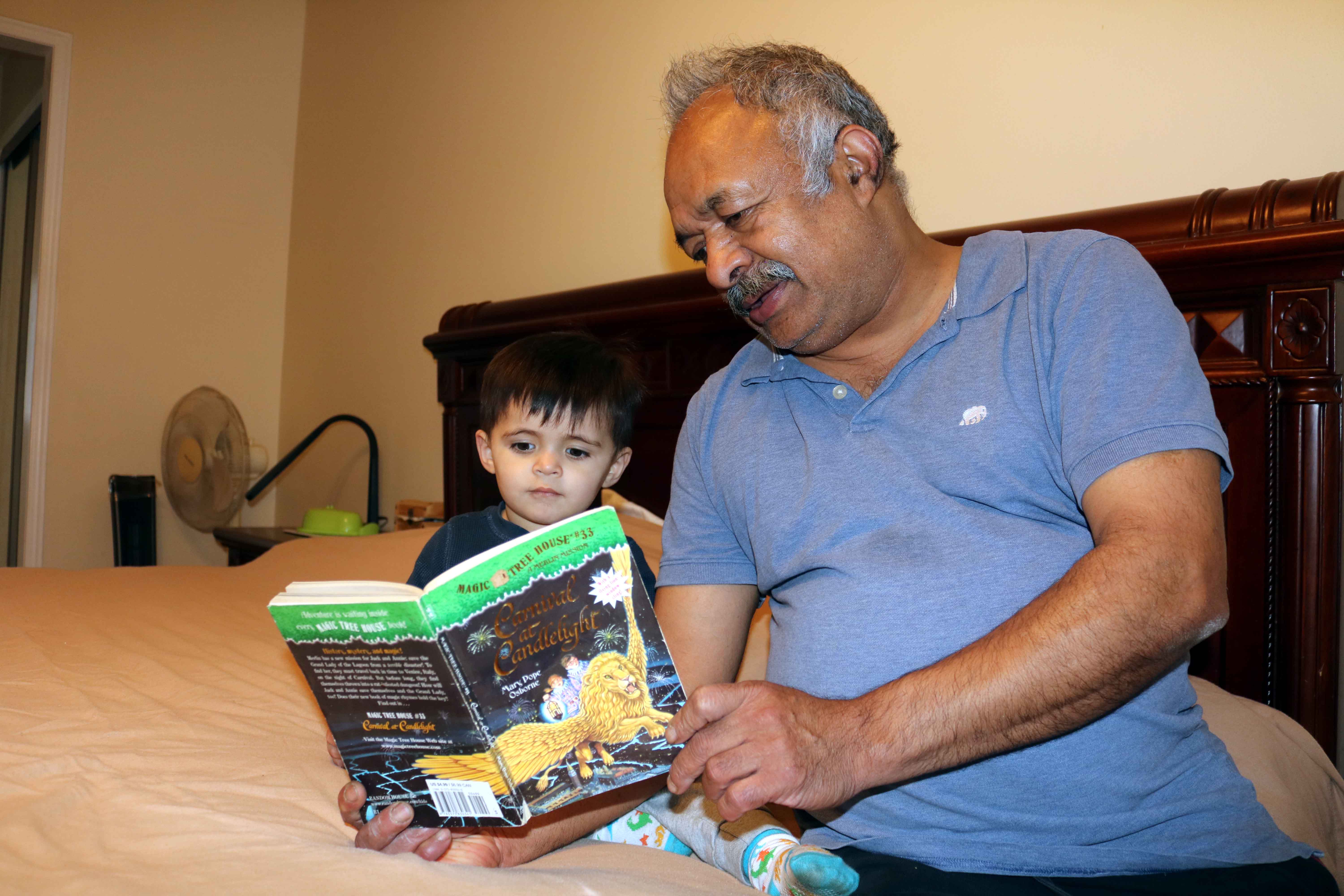
One who does not observe cannot paint. One who does not listen cannot sing. And one who does not read can never truly write. Shashi Tharoor attributes his legendary vocabulary and impeccable spelling not to rote memorisation, but to extensive reading. He rarely consults a dictionary, instead deducing the meaning of unfamiliar words contextually as they appear across different passages and paragraphs.
The CARS Challenge
Students aspiring for professional courses worldwide—Medical College Admission Test (MCAT), Pharmacy College Admission Test (PCAT), Law School Admission Test (LSAT), and various management entrance exams – must contend with the Critical Analysis and Reasoning Skills (CARS) section. For many, this section proves to be their personal Waterloo.
CARS is essentially an advanced form of the comprehension questions that have long been staple in English language examinations. But while traditional comprehension tested language skills alone, CARS evaluates knowledge, critical analysis, and reasoning power – all compressed within stringent time constraints.
Many students struggle with this section because it demands intuition and prior knowledge of diverse subjects. One must navigate difficult words and grasp their precise contextual meanings; failure to do so inevitably consumes precious time. Students accustomed to formulas, theorems, and scientific theories find CARS particularly uncomfortable. They may have mastered the art of cramming subject matter without truly understanding conceptual aspects – but CARS cannot be crammed for. It must be cultivated over time, through extensive reading and relentless practice.
Building the Reading Muscle
To develop the skills CARS tests, one recommended approach is regular reading of editorial pages in leading English newspapers and economic dailies. Even assimilating ten percent of what one reads expands knowledge base. Ultimately, it all comes down to reading.
Becoming a better reader requires reading more—and building reading stamina begins young. Children of parents who read invariably become better readers themselves; they imitate what they observe, and the habit becomes ingrained. So put down your mobile phone. Switch off the television when in your children’s company. Pick up a book instead. Everything from books to magazines builds reading stamina.
Notably, CARS passages rarely concern natural sciences—they encompass virtually everything else.
The Right Way to Read for CARS
When practising for CARS, read passages normally. Never skim. Never skip lines. You may think you are reading faster, but you will inevitably miss essential information—”missing the woods for the trees.” With deliberate, attentive reading, you will find yourself extracting relevant information more efficiently. Prior knowledge of passage subjects helps immensely but must never become a hindrance to answering questions objectively.
Consider this simple passage:
While Nelson Mandela is the father of South Africa, Mahatma Gandhi is our grandfather,” Harris Majeke, South Africa’s ambassador to India, said. “Mandela was inspired by the Satyagraha campaign led by Gandhi. It was a compelling act of passive protest against oppression. This would later inspire the formation of the African National Congress and strengthen Mandela’s belief in our shared humanity.” It is true that there is a direct connection between Gandhi’s campaign against discrimination in South Africa and the anti-apartheid movement there. “The African National Congress, which in 1952 launched the first mass movement against apartheid under the leadership of Dr. Albert Luthuli, had been founded in 1912 on the model of the Indian National Congress, with which Gandhi had been closely associated,” writes Claude Markovits in “The Un-Gandhian Gandhi: The Life and the Afterlife of the Mahatma.
A student unfamiliar with Mahatma Gandhi, Nelson Mandela, Claude Markovits, South African history, Satyagraha as passive protest, or the evils of apartheid will struggle to comprehend, analyse, and answer questions on this passage satisfactorily.
Reading for Pleasure, Learning for Life
The ideal preparation for CARS combines reading for pleasure with utilising what I call dead time – those interstitial moments spent travelling, waiting for someone, or anticipating an event. As Shashi Tharopor’s example demonstrates, one naturally acquires new words and phrases, practices forming opinions, and learns to reason beyond the text.
Reading for pleasure differs fundamentally from reading to learn. The latter – grasping concepts, retaining them permanently – varies among individuals but represents a common denominator among successful people who rely primarily on their intellect. Fortunately, this skill can be acquired, enhanced, and fine-tuned.
Kevin Horsley’s bestseller Unlimited Memory explores advanced learning strategies for faster learning, better retention, and enhanced productivity. Yet reading for pleasure remains primary; without this habit, reading to learn becomes nearly impossible. Like swimming and cycling, reading for pleasure grows increasingly difficult to acquire with advancing years.
A Practical Lesson
Our niece, commuting four hours by train from her Kerala university each weekend, once complained about ogling and eve-teeing from fellow male travellers. Both victim and perpetrators, I observed, lacked any concept of utilising dead time. I advised her to read during journeys – it would divert attention from the ogling Romeos, many of whom would be intimidated by the sight of a girl with an English book. Meanwhile, she would gain knowledge, improve vocabulary, and enhance language skills.
Within a month, she reported success. Five years later, she still carries a book while travelling and has evolved into a young woman of considerable general awareness.
Reading vs Television
A Kingston University, London study revealed that book readers demonstrate greater empathy than television viewers. When watching a film or show based on a book, one perceives it through the director’s lens. When reading, one controls the pace, makes assumptions, and shapes perception according to personal imagination. Television viewers, the study found, exhibited more anti-social behaviour than readers. Among readers, fiction enthusiasts showed the best social skills; comedy readers excelled at relating to people; romance and drama lovers demonstrated the greatest empathy and ability to see through others’ eyes.
Readers Become Leaders

Good readers make great leaders. Abraham Lincoln had merely one year of formal education; his reading compensated for the rest. Roosevelt reportedly read two books daily. Thomas Jefferson amassed one of the most exhaustive personal libraries of his era. Bill Gates reads approximately fifty books annually – as he puts it, Reading is absolutely essential to success.
Even in the military profession, I have observed that those who rise to the highest echelons possess varied qualities of head and heart – but reading remains an invariable common denominator.
Dr. Tharoor’s single-word answer READ encapsulates a lifetime of wisdom. In that one word lies the key to vocabulary, knowledge, critical thinking, empathy, and ultimately, leadership itself. The question is not whether we can afford to read, but whether we can afford not to.
- “Coming into contact with a good book and possessing it, is indeed an everlasting enrichment.” Dr. APJ Abdul Kalam
- “Reading maketh a full man; conference a ready man; and writing an exact man” Francis Bacon
- “Books are uniquely portable magic” Stephen King
- “Time is a river and books are boats” Dan Brown
- “Any book that helps a child to form of a habit of reading, make reading one of his deep and continuing needs is good for him” Maya Angelou
- “It is what you read when you don’t have to that determines what you will be when you can’t help it” Oscar Wilde
Exploring Downtown Montreal

Early in the morning on August 31, we drove to Mount Royal. This hill at its 233 meters of altitude and 200 hectares in area, quite literally in typical tactical language of a young subaltern, ‘dominates’ Montreal. Mount Royal owes its name to Jacques Cartier who then turned the name Mont Royal to name the city Montreal! Mount Royal is nicknamed the ‘Mountain’ by Montrealers. The park atop the mountain was created in 1876 and designed by the same landscape architect as the Central Park in New York, Frederick Law Olmsted.

We parked our car at the base of Mount Royal, next to the Notre-Dame-des-Neiges Cemetery and then We took a stroll inside the cemetery. It stands as a celebration of Montréal’s religious, cultural, historical, architectural and environmental heritage. It is Canada’s largest Catholic cemetery with over 900,000 people buried there since 1854. Over the years, it has become not only a natural haven for local flora and fauna but also home to some rare tree species.

With the city thriving, a resting place for the departed had to be established far from the city, for reasons of health and hygiene, as well as for lack of space in the downtown area. In 1852 the first cemetery was created on Mount Royal and was used for burial of Anglophone Protestants. The Notre-Dame-des-Neiges Catholic cemetery followed in 1854.
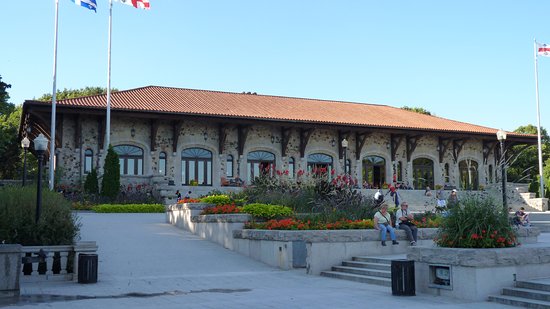
We then trekked our way up the mountain, walking through a pine forest to the summit to the Mount Royal Chalet. This building was commissioned in 1931 by the then Mayor, Camillien Houde to provide employment during the Great Depression. It was designed by the Québec architect Aristide Beaugrand-Champagne with a stone facade, large windows and elegant doors. Inside the chalet, are paintings depicting the history of Montreal. It also houses a food counter and a souvenir shop.

Kondiaronk Lookout located outside the Mount Royal Chalet is the best-known lookout point on Mount Royal, offering an exceptional view of Montreal and its skyscrapers as well as the St. Lawrence River.

Our trek then continued to the Iron Cross. It was erected in 1924, the cross atop Mount Royal to commemorate the day of January 6, 1643. The cross stands 30 metres high and when lit, can be seen from nearly 80 kilometers away, weather permitting.
In December of 1642 Montreal was threatened by a dangerous flood. The city’s founder, Paul de Chomedey de Maisonneuve, prayed to the Virgin Mary, vowing to raise a cross to honour her if the settlement remained safe from the flood. His prayer was answered and the water receded. He fulfilled his promise, carrying a wooden cross to the top of Mount Royal on January 6, 1643, raising it in the Virgin Mary’s honour.
In 1874 the Saint-Jean-Baptiste Society decided to raise a new metal cross to honor Maisonneuve. The project was funded by public subscription. However, the project ran into financial difficulties and soon came to a grinding halt. Ultimately the project was completed 50 years later, in September 1924. After five years, the cross was handed over to Montreal City.

After walking around Mount Royal, we drove to Parc Olympique, one of the most controversial structures in Montreal. Built for the 1976 Olympic Games, it remained unfinished until the 1980s. The Olympics cost $1.6 billion to the city (including $1.1bn for the stadium), 13 times over budget, with a string of officials convicted of breach of trust and the greatest white elephant of a stadium ever built. The city was left with a debt that took 30 years to pay off.
The city had hosted one of the most successful World Fairs ever in 1967 -the Expo 67 – and the city, to add another feather in its cap, bid for the XXI Olympiad.
During the opening ceremony of the Olympics, out of sight of the cameras and the throng inside the stadium, the staff were frantically working to clear away the building debris. In the final scrambling months before the Games, 3,000 labourers had worked in teams 24 hours a day to make it possible for the Olympics to begin at all. They just about succeeded.
On culmination of the Olympics, the City realised that it might cost a lot to tear down the structure and also cost an enormous amount to operate. It was also the only time in the history of the Olympics that the host nation did not win a single Gold Medal!
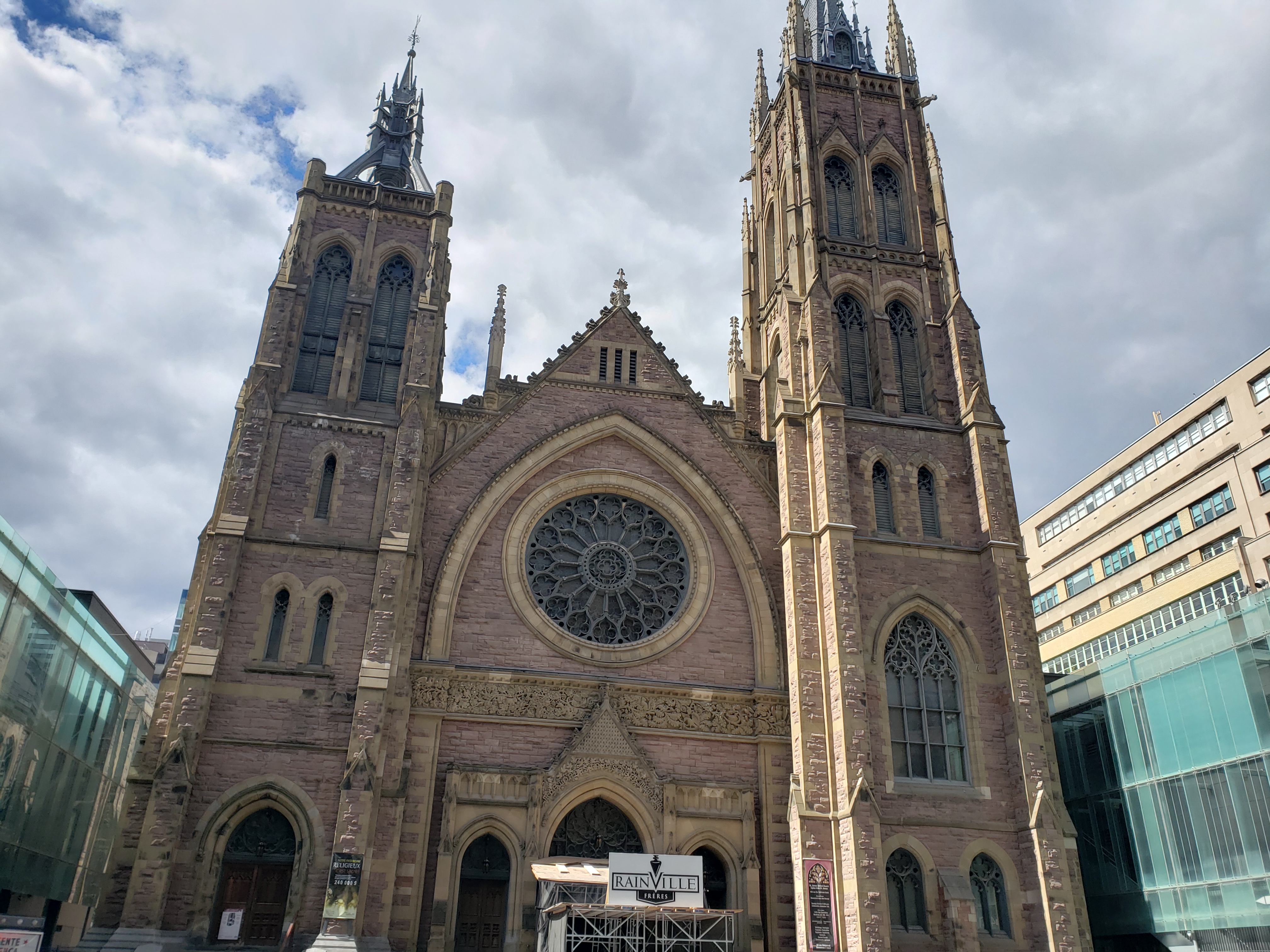
We then drove to St James United Church on Sainte-Catherine Street. It is one of the city’s religious heritage gems built in 1889 by Methodist Loyalists who left New York City in the late 1700s. The church is characterised by its spectacular stained-glass rose window, massive towers, gargoyles and High Victorian Gothic Revival architecture.
Montreal is a city that quite literally creeps under your skin and into your bloodstream. I had a sense of wanting to stay on and explore a lot more of the city’s history and heritage. But then plans are plans and we decided to stick to our schedule and accordingly, after lunch, we commenced our return journey to Toronto.
Montreal : Expo 67 & 1976 Summer Olympics

(Image Courtesy Google)
After the cruise on Saint Lawrence River, we drove to Saint Helena’s Island and undertook an electric car ride to explore the island. This ride traces the history of the island from 1611 to the present day, highlighting its natural, cultural and military heritage. City of Montreal came into world prominence with the conduct of Expo 67 and 1976 Summer Olympics. Let me take you through this trip based on these two events which were mostly held on Saint Helena’s Island, also called Montreal’s baby sister island.

This island was named by Samuel de Champlain – founder of Montreal – in 1611 in honour of his wife, Hélène Boullé. Located in the Saint Lawrence River, South-East of the city of Montreal, it was purchased by the British government in 1812. In 1870, the Canadian government acquired the island and converted into a public park. Up until the construction of the Jacques-Cartier Bridge in 1930, it was only accessible by ferry. The island was originally much smaller than it is today. In preparation for Expo 67, the City of Montreal consolidated several of the surrounding islands and enlarged it using earth excavated from the river bed and the construction of the Montreal Metro tunnels.
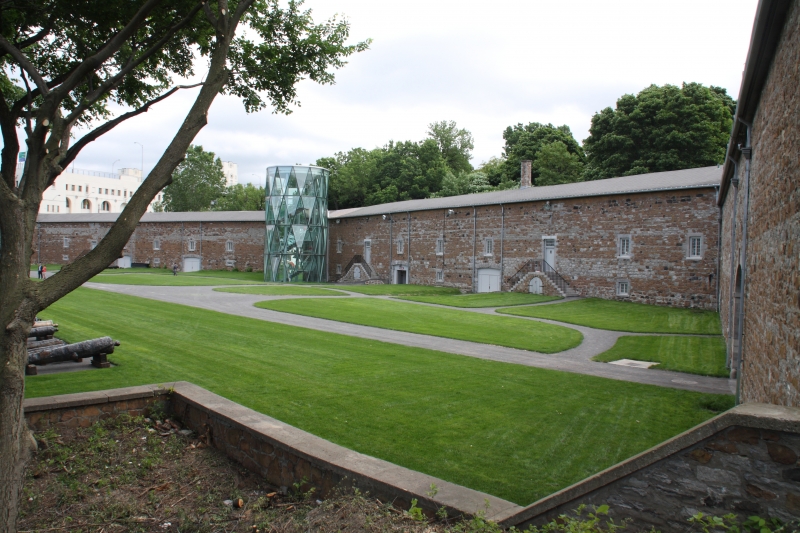
As a good soldier, let me begin with the Saint Helena’s Island’s buildings of military history value. Above is the Fort built in 1824 by the British for protection against the United States. It served as a storage and distribution centre for weapons and ammunition. Today the Fort is home to the David M. Stewart Museum, where historical artifacts from Canada’s colonial past, particularly that of New France are displayed.
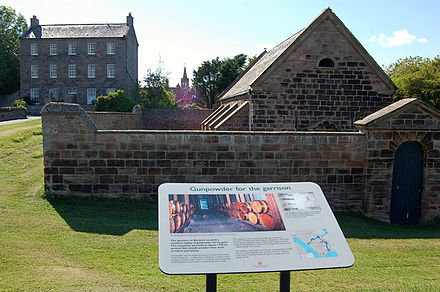
This is the Large powder magazine located in the centre of the Island, protected by a wall. It had a storage capacity of 5,000 barrels of gun powder.

The Military Cemetery is home to over 1000 fallen soldiers. According to the commemorative plaque in the graveyard, there are a total of 58 known soldiers and many unknown buried here. The plaque says that “several wives and many children were also buried here”, but there is no mention whatsoever of 800 unknown soldiers buried in mass graves.
That was the military history aspect and now let me take you through what unfolded during Expo 67. The name ‘Expo,’ which is simply an abbreviation of exposition, was coined by Montreal, and world fairs since have continued to call it ‘Expo.’ Expo 67 had pavilions from 62 participating nations. Among the companies, Kodak and the telephone industry had their own pavilion. The pavilion visitors liked the most was that of telephone industry, followed by Czechoslovakia.
From the time of Expo 67, various art works were commissioned on the island. Let us visit some of the artworks that impressed me.

This is the iconic sculpture ‘L’homme’ (The Man), commissioned in 1967 as a gift from the International Nickel Company, showcasing the theme of Expo 67- ‘Man and His World’. It took five months to complete at a cost of $135,000. Today it is valued between 50 and 200 million Dollars.

The Iris sculpture was done in 1967 by Québec artist Raoul Hunter in conjunction with Expo 67. It has four curved petals made of aluminum sheets. All the concave surfaces converge towards each other, creating an enveloping effect.

La Ville Imaginaire is a sculpture made out of white granite. It was a gift from Portugal in 1997 to commemorate the 30th anniversary of Montreal’s Metro subway system and Expo 67. It depicts reflection as to how humans create mythical spaces, both out of necessity and in response to challenges.
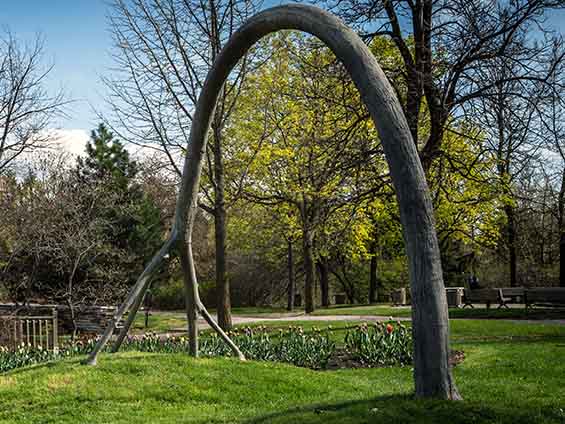
This sculpture, l’Arc, next to the Iris, is made of ultra-high performance concrete. Inaugurated on September 11, 2009, it was built in honour of the Chilean president Salvador Allende, who died in 1973. It depicts a curved tree with its branches touching the ground. It was designed by Michel de Broin as a complex symbol whose meaning was to be open to individual interpretation.
Main attraction of Expo 67 was that the visitors had to stamp their passports at the entrance to each pavilion. It encouraged people to visit more pavilions than they would have otherwise, only to get more stamps in their passport. Let me take you through some of pavilions as they stand today.

Montreal’s famous geodesic ball, the Biosphere, was the US Pavilion during Expo 67. Instead of using bolts, the structure was welded together due to time constraints and covered with an acrylic shell. In 1976, when the structure was being repaired, welding torches set fire to the Biosphere, completely burning off the acrylic shell in less than 30 minutes, leaving behind only the steel skeleton. During Expo 67, the pavilion trumpeted America’s ‘Race to the Moon,’ and also the American entertainment industry. The Biosphere was later purchased for $17.5 million and restored to become Canada’s first Ecowatch Centre on World Environment Day June 6, 1995.

French Pavilion from Expo 67 is now home to the Montreal Casino. According to the original Expo 67 description of the pavilion, it featured ‘aluminum sun-breaker strips, providing an attractive sculpture effect’ and ‘a steel arrow.’

Jamaican pavilion, a replica of a 19th century two-story Jamaican country shop was constructed of thick, sand-colored plaster walls with shuttered upper windows and a cedar shingle roof. It has been completely renovated and is now a very popular wedding destination, surrounded by trees and nature.

Building off the success of the 1967 Expo, Montreal mayor Jean Drapeau wanted to cement Montreal’s place in the world as a truly International City. Thus the city took on hosting the XXI Olympic Games in 1976. Montreal Olympics was best known for Nadia Comăneci – the first person to score a perfect 10 at the Olympic Games – and also infamously for Canada becoming the first Olympic hosting nation not to win any Gold Medal.

This is the Olympic Basin which was used for canoeing and rowing competitions during the 1976 Olympic Games. It extends over 2.2 kilometres in length; it is 110 metres wide and 2.5 metres deep. The Basin’s unique installations and it’s calm waters make it the pride of every rowing enthusiast. The pavilions of Expo 67 of India, Germany, Australia, Myanmar, Mexico and Thailand had to be demolished to make way for the Basin. Today many competitive boating events are held here such as the Canadian Masters Championships and the Montréal International Dragon Boat Race Festival.

Circuit Gilles-Villeneuve is a 4,361-metre long car-racing track which has played host to the Formula 1 Grand Prix du Canada since 1978. The track is well-regarded for its smooth asphalt surface and the meticulous manner in which the track is maintained. These track conditions contribute to the high-calibre racing performances by the F1 cars. When it is not hosting an event, the Circuit is where cycling, para-cycling, inline skating and running enthusiasts come to train.
From Saint Helena’s Island, we drove to our hotel in Montreal City for a well deserved rest and to explore the city next day.
 REJINCES