On May 07, 2025, more than two weeks after gunmen killed 26 civilians in Pahalgam, Kashmir, India, blaming Islamabad for the attack, launched missiles at multiple sites in Pakistan-Occupied Kashmir and Pakistan’s Punjab province. For the following three days, both India and Pakistan launched missiles, drones and artillery at each other, bringing the subcontinent to the brink of a full-fledged war.

Already there is growing evidence that future wars will see a significant use of drones and long-range precision weapons, alongside a potentially greater reliance on artillery tactics. Drones, particularly loitering munitions and reconnaissance Unmanned Aerial Vehicles (UAVs) are more prominent in present-day battlefields. Army Air Defence Artillery got to adapt to counter-drone threats and maintain its ability to strike at depth. The four-day Indo- Pak face off provided further evidence to this evolving nature of future warfare. It is axiomatic that India-Pakistan conflicts of the future will follow a similar trend.
The war in Ukraine has starkly highlighted the evolving role and challenges of tanks in modern warfare, challenging the notion that the era of the battle tank might be over. This conflict has highlighted the importance of electronic warfare capabilities, network-centric warfare, and the integration of UAVs and drones. It has demonstrated the critical role of logistical and repair support for sustaining tank operations, as well as the necessity for Main Battle Tanks (MBTs) to operate within a combined arms approach, including infantry, artillery, air defence, aviation and air support. This evolution reflects a broader trend towards high-tech, multi-domain combat operations, where traditional tank strengths are augmented by Electronic Warfare (EW) and advanced defensive systems to meet the demands of modern conflict.
In the Ukrainian war only a small fraction of tank losses was due to enemy tanks, with the majority attributed to mines, artillery, anti-tank missiles, and increasingly, drones. This has highlighted the diminished role of traditional tank-on-tank engagements and the rising significance of asymmetric threats, including kamikaze drones, which have proven effective at targeting tanks. In view of these threats, there is an urgent need for redesigning the MBTs and armoured tactics. Modern MBTs must be lighter, versatile and capable of defending against hemispheric 360-degree threats, marking a departure from the focus on frontal armour and long-range firepower.
A new dimension, with the development of Artificial Intelligence (AI) and robotics are the land drones or Unmanned Ground Vehicles (UGVs). In Ukraine, these vehicles are operating on the front lines to carry weapons and explosives, to conduct remote mining and de-mining, and to evacuate wounded soldiers from the battlefield. Use of UGVs is an asymmetric response to the enemy’s numerical advantage.
A key drone-countermeasure to the drones is by EW, controlling the electromagnetic spectrum by jammers, spoofers, deceiving enemy communication systems, radars, and other electronic devices. This causes the target drone to fall, veer off course, or turn around and attack its operator. Early warning and detection systems (radar, electro-optical/infrared sensors, and acoustic sensors,) jamming, anti-aircraft guns, high-energy lasers or microwave beams, can disable drones.
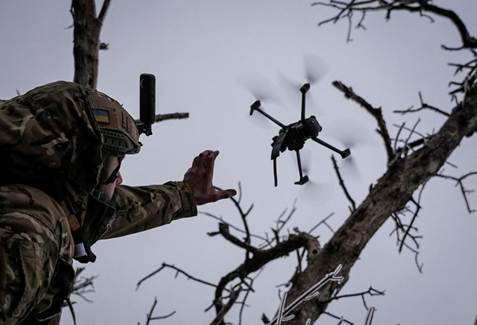
Proliferation of cheap, expendable drones has created an unfavourable interception curve for long range and expensive air defence platforms. Larger drones with a distinct radar cross-section are easy, slow-moving targets for air defence interceptors, while traditional air defence has some limitations against small systems. Army Air Defence gun systems which had become defunct against standoff weapons and fast-moving fighter aircraft have emerged most successful against drones. An emerging challenge of counter-drone defence is its cost-effectiveness, where the counter drone system must be cheaper than its target. Thus, gun systems and EW will be the most cost-effective counter against drones.
Militaries the world over are status quo in attitude and slow to transform. Gone are the days of the second world war type pincer movements carried out by mechanised forces. In general, we are heading in the direction of high technology multi domain network centric warfare where targeting is increasingly becoming a point of focus. Some strategists now believe that military objectives may now be achieved through targeting alone. The Indian army as also the Navy and the Air Force are on a path of transformation with the intended move towards Integrated battle groups and Theaterisation of Commands. With its heavy tilt towards the Infantry and mechanised forces, as of now the force structure surely looks a bit lopsided. Supposedly we are on a path of modernisation, technology upgrade, joint-ness and self-reliance.
Future Force Structure
The lowest formation of the Army that has in its organisation various combat and combat support elements is the Infantry/ Armoured/ Mountain Division. In the context of Future hi tech wars these seem quite imbalanced in terms of the Infantry/ Armoured components. It is a moot point whether colossal organisational structures such as strike corps are relevant any longer. Also at the divisional level, there is a case for inclusion of offensive and defensive capabilities in terms of drones, UAVs, aviation, and even some integral ground air defence. Maybe one or two Fire Power Brigades suitably organised may render the required balance. The future may see some infantry soldiers being replaced by inexpensive robots or AI powered drones. Let us admit that its no longer science fiction, but a reality. There undoubtedly is a case for urgent re-organisation based on a new force structure as applicable to the likely nature of future wars
Technology alone is not a war winning factor. The force with the best technology will not necessarily win, but a combination of mass, manpower and morale is essential for battlefield success. The importance of quality leadership as a battle winning factor cannot be overemphasised. More than at any other time, the nature of high-tech network centric multi domain warfare, demands high quality leadership. Let us therefore examine this factor in isolation.
Is the leadership of the Indian Army – the General Cadre – trained, equipped and prepared for Future Wars??
The Indian Government of late has often promoted officers to the highest appointments and positions based on merit-based selection, overriding the seniority principle which was in vogue for many years. There is of course the growing criticism of this being a politico-bureaucratic strategy to select a pliant military leadership and consequent politicisation of the Defence Forces. This strident criticism has some merit particularly when it is undeniably true that particularly in a country like India, there is no politico-bureaucratic authority or body that can truly judge the competence of military leadership. Often the selection boils down to who is best suited to the current political dispensation in power. So, if the merit-based selection principle is to be put in place, then the Government needs to clearly lay down the rules for such selection including the composition of this selection panel and various other parameters. In the absence of such rules, surely the seniority principle is a lesser evil at the highest levels of the hierarchy. One may even argue that at very high levels of the hierarchy the inter-se difference in merit is so minor that it may be ignored. In any case it is surely better than contentious merit.
Into this vexed question of seniority versus merit comes another lopsided system that of General Cadre. It is more in the nature of a prevalent unwritten convention, as to the best of my knowledge, no Government regulation, or rule or for that matter even an Army Order or instruction defines what General Cadre is. Essentially it is a cadre of officers who become eligible to be appointed to the highest command echelons of the Indian army.
Officers from the Infantry, Armoured Corps and Mechanised Infantry (so called Combat Arms) are sort of born into the General Cadre while those from the other arms (So called combat support Arms) need to be selected into the General Cadre. Once selected on exceptional merit, such officers are then required to Command an Infantry/ Mountain / Armoured Brigade and their continued retention in General Cadre is based on recommendations in their confidential reports by their superior officers.
For those born into the General Cadre, no such recommendations are necessary. Command of such a brigade is automatic if approved for promotion. It is also ironic that at the time of passing out from the military academy, one is required to give one’s choice of Arm/Service, but no one explains what the difference is of being born into General Cadre or otherwise. Often one does not get one’s choice. So, by chance one may be chosen to be a born military leader or denied that opportunity. The very entry to the hallowed system of General Cadre is flawed at the outset.
It is mind-boggling that the system exists by some unwritten norm and is not governed by any government or even Service Order or Instruction. Add to this some classic anomalies exist. Any officer who commands an Assam Rifles battalion, sector and then becomes an Inspector General Assam Rifles now becomes eligible to command the highest echelons of a joint force although his exposure has been limited to that of commanding units/formations of only a paramilitary force.
The present military leadership of the Indian Army consists of mostly Infantry officers and some Armoured Corps and Mechanised Infantry officers. There are hardly any officers from the Regiment of Artillery, Army Air Defence and Aviation who get into the General Cadre. The existing system also promotes favouritism and lanyard culture.
In this era of modern hi tech warfare surely a fresh definition needs to be made as to whether anyone at all fits into this category of officers who are born into General Cadre. What criteria should decide on this selection? This surely needs to be laid down as a set of clear-cut rules and not left to any norm or convention.
With the battlefield dominated by drones, UAVs, missiles and long-range artillery, there is a need to reorganise the General Cadre of the Indian Army. The General Cadre must consist of Artillery, Army Air Defence and Aviation officers. Only those officers who have adequate knowledge and technical skills to manage employment of drones, UAVs, missiles and long-range artillery from the Infantry, Armoured Corps and Mechanised Infantry be considered for promotion to the General Cadre.
The evolving nature of future wars should indeed be a guide for formulation of rules in this regard.
 REJINCES
Reji, Your article is a powerful call for reform. It combines military insight with structural critique, while underlining the importance of technological adaptation and merit-based leadership. Militaries will have to keep thinking and planning for the best cost effective solutions in line with technolgical advancements to remain relevant.
LikeLiked by 2 people
Hi ! 😊 Good Evening. Excited to share that my new book “Silent Skies, Shifting Battles: The Rise of Drones in Modern Warfare” is now live — and the Ebook is FREE TO DOWNLOdAD for the next 2 days! 🎉
If you’d like to support, please don’t reply here — instead, download it from Amazon and leave a kind rating/review there🙂. That really helps 🙏
🛩️ It’s a contemporary topic that affects all of us — whether you’re into defence, tech, or just curious about how modern warfare is changing, I think you’ll enjoy it!
Looking forward to your encouraging reviews! 😊
Thanks
https://amzn.in/d/hwZwpDO
Col (Dr) CP Ramchandani (Truwizard) 🙂
LikeLiked by 1 person