The Roots of CARE: How it Nourished Kerala’s Literacy Revolution

Long before it became a nationally mandated scheme, the mid-day meal program in Kerala had nurtured generations of students, built on a foundation of international aid and local community effort. I now recollect seeing it being played out first hand. Our father, a primary school headmaster in the 1960s and 70s, oversaw one of these early initiatives—a programme fueled by wheat, corn flour, milk powder, and vegetable oil from the US Agency for International Development (USAID) under the PL480 program.
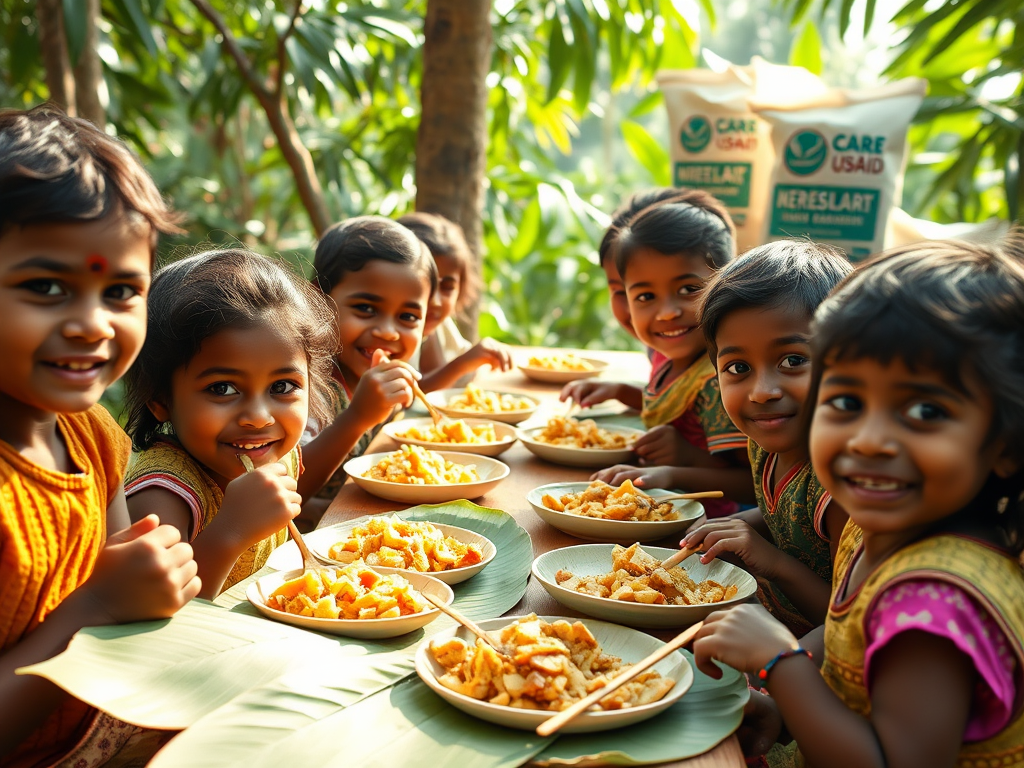
The operation was under CARE (Cooperative for Assistance and Relief Everywhere,) an independent non-governmental organization (NGO) that received funding from USAID. The program laid the groundwork for Kerala’s future success in its educational and consequent social endeavours.

The program was essentially only for the needy. The CARE inspectors visited the schools for a headcount of the children partaking the mid-day meals and that was the only day – we the kids from the families that were comparatively well to do and therefore not included in the program – were allowed to stand in the queue for the mid-day meal. A little cheating for a good cause! The numbers had to be inflated. Many a time, our friends kept a small portion of their meals for us and gave it to us when we returned to school after lunch break. It was something inexplicably philosophical to explain. The impoverished kept a little of their share for their friends who returned from home after a full meal. For us it was the novelty of the corn flour Uppuma and for them its was the innocence of friendship from the core of their heart. 

In 1941, Kerala started the School Lunch Programme by the Travancore Government. Even earlier some sort of mid day meal program was initiated by the Madras municipal corporation on a small scale. In the 1950s K Kamaraj, the Chief minister of Tamil Nadu had initiated the mid day meal project as his pet project, but it did not meet with much success. Later in the 1970s MG Ramachandran (MGR) as chief minister revived the program successfully. On 28 November 2001, the Supreme Court passed an interim order that provided for the conversion of eight food security schemes into entitlements of the poor. Between 2002 and 2004, however, most Indian states instituted universal midday meals in primary schools. Now in India the program is universal, the central and state governments contributing to the funding. But by and large there is no doubt that the program undertaken by CARE in Kerala was an early successful role model.

A Tapestry of Support: How the Scheme Operated

The operation was a remarkable collaboration between international, state, and local entities:

  • International Aid: The core ingredients were provided by USAID and distributed by CARE.
  • State Support: The Kerala government supplied funds for onions, spices, and condiments to make the meals palatable.
  • Local Community: Affluent families and local institutions like the church contributed additional funds, embedding the program into the community’s fabric.

The meals themselves – often uppuma made from the supplied ingredients – were prepared by the school peon, who doubled as the cook, and were served by teachers. In a quintessential Kerala touch, the students used the broad, circular leaves from the Macaronga Peltata tree (വട്ടയില vattayila) as eco-friendly plates.

More Than a Meal: A Lifeline for Many

The benefits of this scheme were profound and personal:

  • Combating Hunger and Malnutrition: For many children, this was not just a snack but a vital lifeline. One classmate in Grade 3 confessed he hated weekends and vacations because, without school, he missed his one guaranteed stomach-full meal. The scheme directly tackled classroom hunger and malnutrition, ensuring children were nourished and ready to learn.
  • Ensuring Education and Literacy: CARE inspectors conducted headcounts to ensure only the neediest children received the meal. On these days, those of us from more affluent families, who typically went home for lunch, were asked to stand in the queue to inflate the numbers and secure more resources for the school. This memory highlights the scheme’s primary goal: to incentivise school enrollment and attendance. It is undeniably one of the key foundations upon which Kerala built its famed 100% literacy rate.
  • A Foundation for the Future: By ensuring children completed primary education, the scheme equipped a generation with the basic skills needed to thrive. It laid the essential groundwork for the mobility and social uplift that later defined Kerala, enabling thousands to seek opportunities across India and in foreign countries, particularly the Gulf region.

A Lasting Legacy

We have all heard of the adage There ain’t no such thing as a free lunch. Sometimes its untrue as in this endeavour.  The CARE programme was more than a free lunch; it was a powerful act of care that nourished bodies, minds, and a community’s future. It seamlessly blended international aid with local compassion, creating a model of effective public welfare. The memories of tasty uppuma on a vattayila leaf are not just merely emotive nostalgia; they are testament to a successful policy that understood a simple truth: a child cannot learn on an empty stomach. This pioneering initiative paved the way for the universal mid-day meal scheme that India implemented decades later, leaving a lasting legacy on the nation’s educational and social landscape.

The Lieutenant: A History of the Unguided Missile

Etymologically, Lieutenant combines the French lieu (in place) and tenant (holding) to mean – one who holds a place for another. Entering English from Old French, it described a deputy acting on behalf of a superior, a definition still central to its use in military and civil ranks (eg lieutenant colonel or lieutenant governor) and phrases like in lieu of.

Fresh from the academy, we joined our regiments as newly commissioned Second Lieutenants—eager to go, but as unguided as a nuclear-tipped missile. Fortunately, during my command tour (2002-2004), that breed had become extinct.

Despite a shared etymology, its pronunciation split into two distinct branches:

  • The British “Left-tenant”: This variant likely stems from a Middle English reading of Old French, where the letters ‘u’ and ‘v’ were often interchanged, influencing the sound to shift to an ‘f’.
  • The American “Loo-tenant”: This version hews more closely to the original French. It became standardised in the United States, partly due to the influence of spelling reformers like Noah Webster, who championed pronunciations that aligned with a word’s spelling.

The rank of Second Lieutenant is the most junior commissioned officer rank in many of the world’s armed forces, typically placed directly below the rank of Lieutenant.

Commonwealth and British Influence

  • Commonwealth militaries, following British practices, began using the rank of Second Lieutenant in 1871 to replace older ranks like Ensign (infantry) and Cornet (cavalry).
  • British Army: The rank was introduced in 1877, abolished in 1881, and then reintroduced in 1887. In 1902, its insignia was standardized as a single star.
  • Indian Army: The rank was used until the turn of the millennium (around the early 2000s).
  • Australian Army: The rank was abolished in 1986.
  • Canadian Forces: Adopted the rank in 1968 and used it until the late 2000s. The Canadian Navy briefly used it before reverting to the naval rank of Acting Sub-Lieutenant.

International Context

  • France: The equivalent rank, Sous-lieutenant, has a long history dating back to the reign of Henry II in 1674.
  • United States Army: The rank bore no insignia until December 1917, when a gold bar was introduced. This led to its common slang names:
    • Butter Bar or Brown Bar: Referring to the color of the insignia.
    • Shavetail: A derisive term from the U.S. Cavalry, referring to an unbroken mule whose tail was shaved to mark it as inexperienced and potentially dangerous.

Insignia

  • The standard NATO insignia for the rank is a single star.
  • In the British tradition, this single star was introduced alongside the two stars of a Lieutenant and the three stars of a Captain.

The young officers of the world’s militaries, whether holding the rank of Lieutenant or Second Lieutenant, are a potent force. They are defined by their readiness to accept any challenge and their commitment to learning the complex art of military leadership.

Fireman’s Lift

The Fireman’s Lift, known in North America as the Fireman’s Carry, was a source of significant dread for us casualties—far more than for the rescuers. At the military training academies, as one of the lighter cadets, my services were in high demand during training exercises, and I found myself hauled across the parade ground umpteen times, perched precariously on a fellow cadet’s shoulders.

This technique is a cornerstone of emergency response, a practical method designed for strength, endurance, and mobility. It allows a single rescuer to swiftly transport an injured person over considerable distances by draping them across their shoulders, distributing the weight to utilise the powerful muscles of the back and core. Its primary purpose is clear: to move victims away from immediate danger with efficiency and speed.

The carry’s name suggests a modern, practical origin, but its legend is rooted in a much older folktale of loyalty and cunning. The story takes us to the siege of Weinsberg in 1140, when King Conrad III of Germany besieged the fortress of Duke Welf VI of Bavaria. Facing certain defeat and starvation, the defenders negotiated terms of surrender. The King, in a gesture of mercy, granted the women of the city safe passage and the right to take with them their most precious possession, provided they could carry it on their shoulders.

Expecting them to emerge with bundles of gold, jewels, and household goods, the King’s men were astonished as the women filed out of the gates. Their most treasured possessions were not objects, but their husbands, whom they carried on their backs. King Conrad, though reportedly urged by his advisors to renege on the agreement, was so impressed by the women’s cleverness and devotion that he honoured his royal word, allowing the men to go free and securing the story a place in history.

Thus, the Fireman’s Carry is more than a mere physical technique; it is a timeless symbol of rescue, born from a clever twist of words and an unwavering commitment to saving what one holds most dear.

While the specific term Fireman’s Carry is a modern invention, the act of bearing another on one’s shoulders is a powerful and ancient motif within Indian tradition. This concept finds profound expression not in a singular mythological tale, but through a tapestry of stories and practices that intertwine the physical, the devotional, and the socially transformative.

The origins of Vikram Aur Vetaal lie in the Vetaal Pachisi, a series of spellbinding stories penned by the 11th-century Kashmiri poet Somdev Bhatt. These tales depict the battle of wits between the legendary King Vikramaditya and a clever ghost, Vetaal. Every time Vikram successfully captures him, Vetaal responds by narrating a story that ends with a complex moral question. Bound by a vow, Vikram must answer if he knows the truth, but the moment he speaks, Vetaal vanishes—forcing the king to begin his pursuit anew. The stories were vividly brought to life in many comics and a 1985 mythological series on Doordarshan, memorable for its iconic image of Vikram carrying Vetaal in a Fireman’s Lift.

The most poignant example comes from the epic Ramayana in the story of Shravana Kumara. A paragon of filial piety, Shravana carried his blind and elderly parents on a pilgrimage. He bore them in two baskets suspended from a bamboo pole across his shoulders, fulfilling their every wish. This image is the quintessential Indian archetype of the carry—not as a combat technique, but as an ultimate act of duty, love, and sacrifice.

Beyond mythology, the principle of leveraging weight and momentum is deeply embedded in Indian physical culture. In traditional Indian wrestling, or Kushti, a move known as Kalajangh (or Kalajang) is a classic takedown. This technique involves hoisting an opponent onto one’s shoulders to throw them, demonstrating that the conceptual strength and biomechanics of the carry have long been recognised and perfected in martial practice.

The motif evolves further from physical burden-bearing to carrying a profound spiritual and social message. A powerful narrative, often associated with saints like Ramananda or Namdev, tells of a sage who carried an ostracised Dalit devotee into a temple on his shoulders. In one version, this sage is Loka Saaranga. This act defied rigid caste hierarchies, asserting that divinity resides in all humanity. By literally elevating the marginalised individual, the carry became a radical symbol of equality and a vehicle for divine grace, leading to the devotee’s sainthood.

Although Hindu deities like Vishnu or Shiva are often depicted with multiple arms, this iconography symbolises omnipotence and the ability to wield multiple divine powers simultaneously, rather than a literal representation of carrying people. The true essence of carrying in Indian thought is less about sheer multi-tasking and more about the profound responsibility, devotion, and transformative power embodied in the act itself.

From the physical discipline of the wrestler to the sacred duty of Shravana Kumara and the revolutionary act of Loka Saaranga, the act of carrying another is a deeply embedded symbol of strength, sacrifice, and liberation.

Mother Mary Comes to Me by Arundathi Roy : My Views – Not a Book Review

During a family dinner in 1986, my brother, then a budding advocate, recounted a landmark Indian Supreme Court verdict. The court had just ruled in favour of Mary Roy, affirming that Syrian Christian women in Kerala possessed equal rights to their parental property. This was a seismic shift. Until then, our community in the former Travancore region was governed by the 1916 Travancore Christian Succession Act, which denied women inheritance rights, offering only a dowry at marriage in lieu of a share.

My mother listened intently, then offered her impression. “Mary Roy fought like Rani Lakshmibai,” she said, evoking the warrior queen who tied her child to her back and fled the British. “She was a tigress battling evil,” our mother insisted. Mary’s victory was quiet but profound; though the clergy and laymen of various churches largely opposed the decree. A new truth had been established, and they could not publicly utter a word against it.

This book is a work of literary impressionism, painted with the colours of emotion, memory, and sensation. It merges into a panoramic kaleidoscope of human relationships, much like the narrative of Mary Roy’s and Arundathi Roy’s lives. Arundathi charts her path from the tea estates of Assam, big-city life in Delhi via Ooty, Madras, Calcutta, Pachmarhi, Goa, Kashmir and above all her ancestral village – Ayemenem- the places I too experienced and loved during my growing up years in a Syrian Christian home in Amayannoor village in Kottayam – very similar to Ayemenem in all aspects – and three decades of military life. My Ayemenem connections come from my maternal grandmother and mother-in-law – both strong ladies – who hailed from Ayemenem.

The characters in this book are unvarnished, their natural grain exposed and absorbent. Unprotected, they are vulnerable to scratches, stains, and wear – a living, breathing soup of imagination and memory, possessing squirrel-like survival skills. Mary’s relationship with her brother Isaac was typical of the era: help and harm in equal measure. Mary’s children grew up in the cleft between a syrupy dream and a capricious nightmare, amidst shouting and silence.

My own memories intersect with this history in unexpected ways. My first movie experience was at Kottayam’s Star Theatre. Decades later, in 2002, while commanding our Regiment, I chanced upon the district’s Disaster Management Plan, duly signed by the Chief Secretary of Kerala state. To my astonishment, it designated the long-demolished Star Theatre as the site for an army field hospital – a ghost from the past, official – yet impossible.

Other important figures from our childhood find their place in this tapestry. We brothers once presumed ChellappanBhavani was a single person; they were, in fact, a husband-and-wife duo whose Bharatanatyam performances were essential to every local temple festival in Kottayam. In 1982, our cousin’s home was constructed by the renowned architect Laurie Baker—an inspiration for many—and though skeptics doubted it would survive the monsoon, it stands today as a testament to his visionary style.

Even my struggles echoed those in the narrative. Learning Hindi at the National Defence Academy (NDA) was a nightmare, much like the author’s challenges at the Delhi School of Planning and Architecture. I derived a sadistic pleasure from annoying the Hindi pundits, coining new words and inventing grammar rules just to sow doubt in their minds—a small vengeance that brought me joy.

During the Delhi riots, in the aftermath of Indira Gandhi’s assassination, our Regiment was at Delhi and we were responsible for the security of Teen Murthi Bhawan where her mortal remains lay in state. I witnessed the mayhem and for the first time someone had the courage to point out the real perpetrators- the Congress Party goons and the right-wing Hindu nationalists.

Arundathi’s relationships, specially with men follows her lament in the God of Small Things- Who can love whom and by how much was written in the love laws a long time ago. For her, the family unit is the rope on which the whole world swings and the families are drawn close by the threads of acute sufferings.

Her relationship with her mother Mary whom she describes as unpredictable, irreplaceable spark of mad genius – a dreamer, warrior teacher – is of fear, love, respect, empathy and pity. Arundathi as per Mary was an unwanted child whom she tried to abort during pregnancy. Their relationship was always thorny and conflict ridden to end with Mary’s declaration ‘There is no one in the world whom I have loved more than you.’

Reading the book, I was struck by the number of ‘would’s—a hesitant, non-committal tense that seems to shy away from affirmation. Removing them would have condensed the book by ten pages, and I wondered if, in her meticulous detail, the author occasionally missed the woods for the trees.

In the end, I was left with the echo of a Beatles song from 1970, Let It Be, written by Paul McCartney after a dream in which his mother, Mary, offered wisdom and comfort in a time of trouble.

When I find myself in times of trouble, Mother Mary comes to me
Speaking words of wisdom, let it be.

The book and the song are a universal balm, but in this context, it felt uniquely specific. It was a refrain not just of resignation, but of hard-won peace, arriving after a long and righteous fight for what is undeniably equal.