
Recently I was stunned by a video of Shiv Khera explaining why he is not a Gandhian. No one expects anybody else to be Gandhian. Fair enough, it’s a difficult individual choice to be Gandhian in democratic modern India. But the management Guru, chose to denigrate the national icon by selective quotes from religious scriptures to indicate that anyone who is a Gandhian should be ashamed of himself. He also implied that if you are a proud Hindu you cannot be a Gandhian. Even Brutus would have agreed that this was the unkindest cut of all. He was and is a Mahatma to so many not only in India but in every corner of the world. The moral depravity of Khera implying that he was a coward and a charlatan, somehow hurt my sensibilities deep within and like a maggot in the brain it kept growing. There is no peace until my conscience finds expression. Thus this piece.
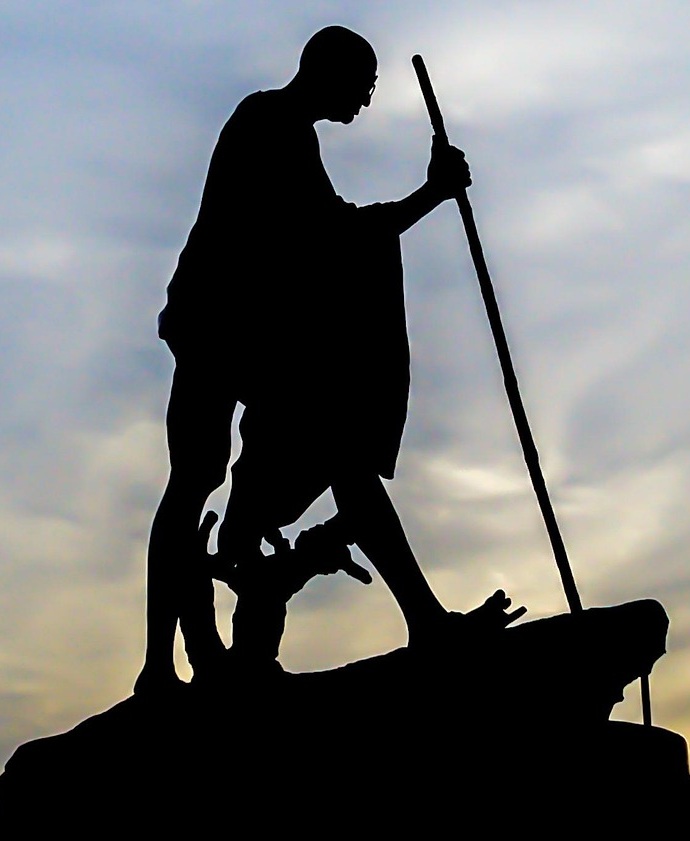
In watching Shiv Khera’s viral dismissal of Mahatma Gandhi, I was struck by how easily the complex machinery of history is dismantled by the superficial logic of corporate management. Mahatma Gandhi is undoubtedly still a national icon. Every Prime Minister and President of India has referred to him as the Mahatma and/or Father of the nation. Visiting foreign dignitaries are taken to the Raj Ghat, as a national memorial. Plaques there and at many other places refer to him as Father of the nation. Many official sites such as the PMO, the ministry of culture and Press information Bureau often refer to him as Father of the Nation. It was none other than the great patriot Subhash Chandra Bose who first called him Father of the Nation. The Supreme Court of India has observed that while the title isn’t formal, it is a collective responsibility to respect him as Father of the Nation, noting his status is beyond any formal recognition. One of India’s three national holidays is Gandhi Jayanti. His image appears on our currency notes. All this, only to re-emphasize that he remains a national icon. In a democracy it is perfectly fine for any citizen to not accept his status as Father of the nation or The Mahatma. One may not agree with his world view or ideology. But surely no citizen, even if the blue blood of patriotism is not flowing in his veins, should be disrespecting a national icon in public spaces until there is a change in status.
Khera attempts to manage Gandhi out of our history books by using a selective reading of Indian epics, portraying the Mahatma as a peddler of passivity and cowardice. As an Indian, I find this not just historically inaccurate, but a profound betrayal of the very moral foundation upon which our Republic stands.
The Fallacy of the Passive Mahatma
Khera’s central argument hinges on the idea that Lord Ram and the Sikh Gurus took up arms, while Gandhi chose neutrality or tolerance. This is a fundamental misreading of Gandhi’s philosophy. Gandhi never advocated for the non-violence of the weak—the submission of the coward who is afraid to fight. He advocated for Satyagraha, which is the non-violence of the strong.
As Gandhi himself famously wrote, “If there were only a choice between cowardice and violence, I would advise violence.” However, he saw a third, more difficult way: the courage to stand unarmed before a charging Lathi, to absorb the blow without striking back, and in doing so, to strip the oppressor of their moral authority. That is not neutrality; that is the ultimate stand, which needs a lot of courage.
The Greatest Mass Movement in History
Unambiguously, Mahatma Gandhi singularly conceptualised and led the freedom movement of India, which many scholars acknowledge as the greatest mass movement in the history of the world, excepting for some religious and totalitarian movements. He innovated and adopted a political strategy which up until then was unknown to the world. In many ways he changed the course of world history in successfully waging an anti-colonial movement and inspiring such movements in many parts of the world.
A great Political and Spiritual Leader
Mahatma Gandhi’s status as one of history’s most influential political and spiritual leaders is not just a matter of opinion; it is substantiated by his global status and honors, numerous global studies on leadership and the testimony of many world leaders. Let us not take this as a congress construct. It is not. Here is how the world formally recognizes his legacy:
- United Nations Recognition.In 2007 The United nations General Assembly voted unanimously to establish October 2 as the International day of Non-Violence. This is a rare honour where a global community formally adopts an Individuals birthday to promote their specific philosophy as a tool for political change.
- Global Successor Movements. Gandhi’s methods of Satyagraha provided the blue print for most significant human rights movements of the 20th century. Martin Luther King Jr. (USA): King famously stated, “Christ gave us the goals and Mahatma Gandhi the tactics.” He traveled to India in 1959 to study Gandhi’s methods, which became the bedrock of the American Civil Rights Movement.
Nelson Mandela frequently referred to Gandhi as his political role model, noting that Gandhi’s spirit helped South Africa transition out of Apartheid without a total racial bloodbath. The Dalai Lama identified himself as a follower of Gandhi’s philosophy of non-violence in his struggle for Tibetan autonomy.
- International Tributes and Monuments. Gandhi is one of the most statued individuals in the world outside of his home country. There are over 70 countries with official monuments dedicated to him, including high-profile locations like Parliament Square in London (placed alongside Churchill and Lincoln) and Union Square in New York. In 1999, Time magazine named Gandhi the runner-up to Albert Einstein as the Person of the Century. Einstein himself famously said of Gandhi: “Generations to come… will scarce believe that such a one as this ever in flesh and blood walked upon this earth.” I asked Gemini to list 10 greatest leaders of all recorded history. This is what it said before listing out the 10 names… “Defining the greatest leaders is subjective, but these 10 figures are consistently cited for their transformative impact on world history”. At the very top spot was Mahatma Gandhi. AI simply does logical analysis of data available to it.
- Academic and Intellectual Influence. Gandhi’s political strategy—using moral authority to defeat military might—is taught in political science and conflict resolution courses globally. Oxford & Harvard University hold extensive archives and dedicated chairs for Gandhian Studies, treating his writings on self-reliance and ethics as core philosophical texts.
The Architect of the Indian Mind
Khera speaks of management and leadership, yet he ignores the greatest management feat in human history. Before Gandhi, India was a collection of 565 princely states and British provinces. There was no Indian identity that could unite a peasant in Kerala with a lawyer in Bombay. Gandhi conceptualised a movement that didn’t just target the British; it targeted the Indian psyche, transcending religious, cultural and language boundaries
He didn’t just lead a protest; he forged a nation. By picking up a handful of salt or sitting at a spinning wheel, he gave the common man—regardless of caste or literacy—a sense of agency. He took the geographical expression of India that the British mocked at and turned it into a psychological reality. We should be proud of him because he proved that a colonized people could regain their dignity not by mimicking the brutality of their masters, but by transcending it.
A Debt of Gratitude
We owe Gandhi our gratitude because he ensured that when India was born, it was born with a democratic soul. If India had won its freedom through the barrel of a gun or the muscularity that Khera admires, we might have become just another post-colonial military dictatorship. Instead, Gandhi gave us a tradition of mass mobilization and dissent that remains the bedrock of our democracy.
To call Gandhi’s legacy cowardly while sitting in the safety of a free country that he lived and fought for is the height of historical amnesia. Gandhi managed the most difficult resource of all: the human conscience. He taught us that true power doesn’t lie in the ability to kill, but in the refusal to be intimidated. As Indians, our pride should stem from the fact that our revolution was led by a man who was strong enough to be kind and wise enough to be inclusive. The great man’s character and reputation will surely outlive such assassination attempts.
 REJINCES
A well written article by Reji. Gandhi is a universal truth and so is Gandhian philisophy. No body in the world and atleast an Indian has the power to erase his legacy. Its too big to touch or lets say the word Untouchable by anybody for now and future. But yes in the same breadth we must understand he was a human being too with his own shortcomings. May be lots of them. At the hindsight one may question his many decisions. All of them have been well documented. But when we see the full picture, his greatness and what he achieved clearly dwarfs his shortcomings. History does not spare anybody and surely the actions of even the Mahatma, but this is also true, he has etched such a deep mark that he will remain a Mahatma and continue to inspire many till the humanity remains.
LikeLike