
By Veteran Brigadier Dr VD Abraham, Sena Medal
Sixteen months in Antarctica – and an accident that nearly claimed my life -reshaped my worldview. What once appeared to be coincidence slowly revealed itself as design. Philosophy seeps into every day. Gain and loss felt indistinguishable, each merely part of a larger pattern. A Greek philosopher from 500 BC advised: Seek ye first the good things of the mind, and the rest will either be supplied, or its loss will not be felt. Centuries later, Matthew 7:7 echoes the same eternal principle: Ask, and it shall be given to you; seek, and ye shall find; knock, and it shall be opened unto you.
But what if the door does not open? Perhaps we must return to the first truth – that polishing a stone into a diamond demands persistence. With every rub, life shapes us into something brighter.
I stand here as that raw stone – not in confession, but as someone walking a destined path. Born into a conservative Syrian Christian family in Chunakara, Kerala, I grew up as an only child. My mother travelled with my father, an Indian Army soldier, leaving me to navigate childhood like a misguided missile – with no guidance, no role model, no affection, and no sense of divine direction. Only now do I understand that He was watching over me through every peril. But who was He? Perhaps by the end of this story, you will have an answer.
Beginnings
My schooling began at Olakettiampalam, continued in Chunakara, and then at Kayamkulam for high school. I completed my Pre‑Degree at Bishop Moore College. Those were turbulent years. As I wrote in The Pilgrimage to Peace, student unrest often forges leaders. I witnessed M. Muralee rise from those very strikes to eventually become an MLA.
At first, I admired the activism; soon, I grew weary of classes disrupted by protests. Many of my peers turned to tuition centres; I immersed in extracurriculars – sometimes at the cost of academics. I stumbled, even failed Hindi once, yet clawed my way back through revaluation.
The turning point came when I shifted to the Defence Services. Destiny seemed to take my hand – guiding me into roles I had never envisioned: facing terrorists as ADC to the Governor of Jammu & Kashmir, earning an Army Chief’s Commendation, and ultimately joining an Antarctic expedition.
Journey to Antarctica
I was selected as the Army Team Leader for the 15th Indian Scientific Expedition to Antarctica – an electronics engineer applying for what was essentially a mechanical engineer’s role. I had no influence or patronage backing me. My biggest battle was convincing my father to allow me to leave my wife and little daughter, given the unspoken dangers of the continent.
I walked out of home like a modern‑day Gautama Buddha – driven not by renunciation but a desperate urge to explore the unknown. Perhaps divine guidance led me through sacred sites of various religions, igniting an inner transformation I didn’t yet comprehend.
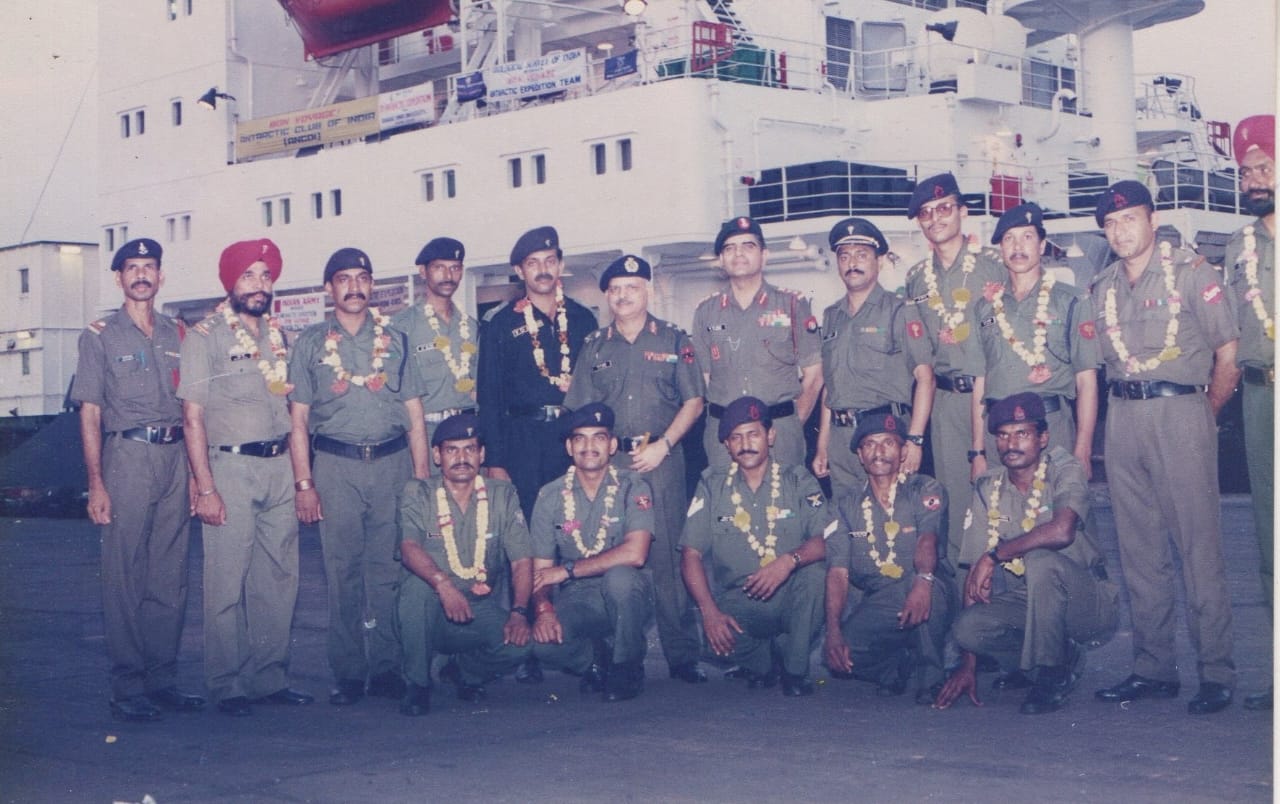
Arriving in Goa, I saw the massive German icebreaker for the first time. Its sheer scale startled me – I instinctively ran the length of its 100‑metre deck several times. Observers may have thought I was simply warming up, but in truth, the ship overwhelmed me.
Soon, responsibilities began to define me. I was asked to articulate the vision and discipline expected of the expedition team. I prayed, secluded myself in a small cabin, prepared my words, and then delivered them. From that moment, something shifted – my speech, my conduct, my entire bearing began aligning with my role.
We sailed past the Equator into the Southern Ocean, crossing the Roaring Forties, Furious Fifties, and Screaming Sixties. Waves towered 10–15 meters. The deck was forbidden; seasickness was common. Yet sharks, seabirds, and albatrosses glided alongside reminding us of the world’s silent beauty.
A brief halt in Mauritius allowed us to load two Australian helicopters, along with two pilots and an engineer‑pilot – a living lesson in technical self‑reliance.
Closer to Antarctica, the sea mellowed, then paled. Ice sheets thickened; seals lounged on floating ice under the eerie white‑out of 24‑hour daylight. We donned snow boots, goggles, gloves, and masks gradually surrendering to the polar world.
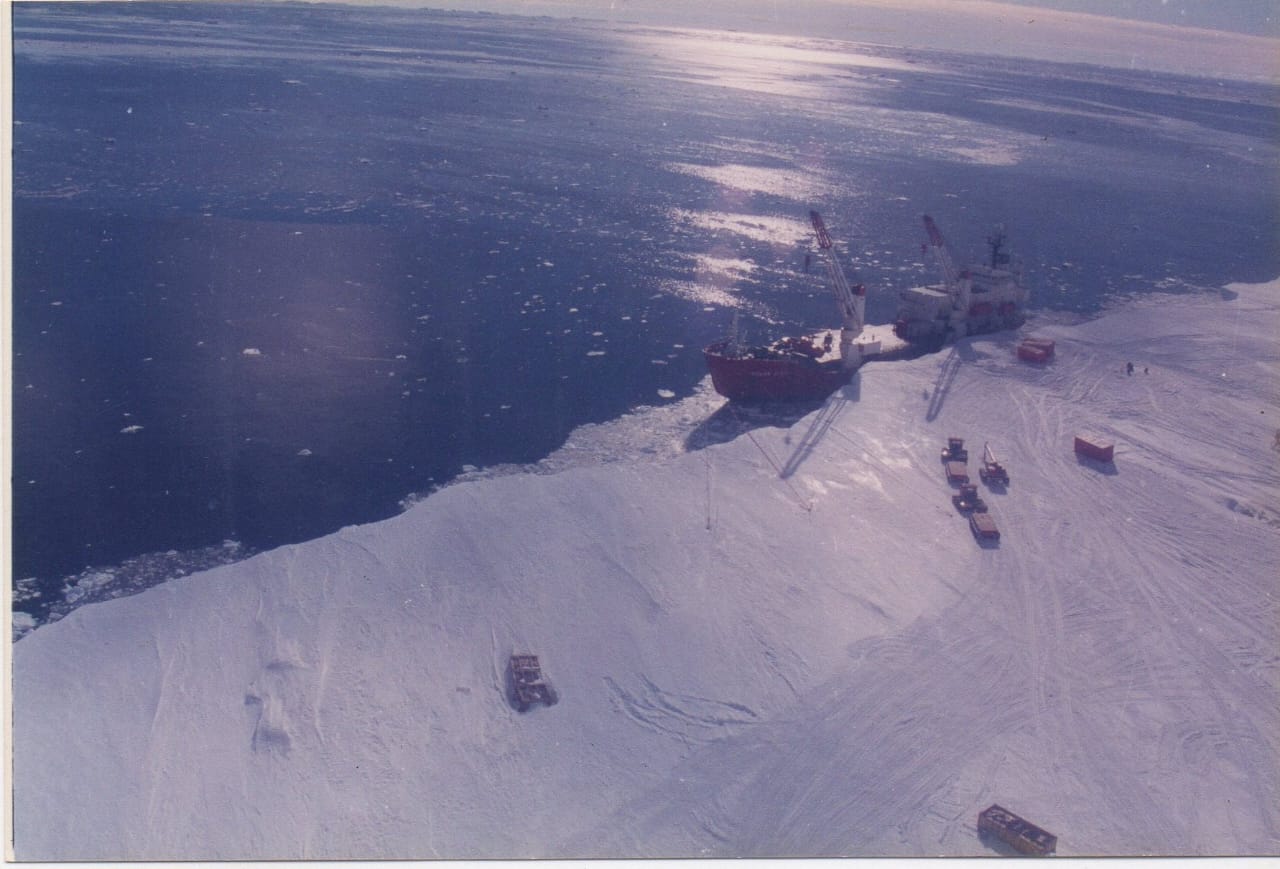
The ship anchored by massive shelf ice stretching kilometers into the ocean. India’s second station, Maitri, stood 125 km away – the first, Dakshin Gangotri, now buried under ice.
On 31 December 1995, both helicopters took off. A selected group flew to Maitri to celebrate New Year with the outgoing team, weary after 16 months. Soon after, we began unloading cargo – food, fuel, medicines, snow vehicles. The work was relentless, but the unsetting sun kept exhaustion at bay.
The Accident — 27 February 1996
By February’s end, we had grown confident. That afternoon, the former Team Leader, a Major, and I headed to the ship for lunch. A crane was to lift us in a bucket large enough for ten people, resting on the ice shelf.
As I stepped onto it, a loud crack split the silence.
In an instant, nearly 900 ton of ice broke beneath us and crashed into the Antarctic Ocean, slamming the ship violently. Freezing water surged up, drenching me. I clung to the bucket’s rim as the ice sank. In such temperatures, survival is barely three minutes freezes, consciousness fades.
The ship tilted. The Captain, who was filming the operations, shouted orders to raise the bucket. Only then did I realise the Major was missing – trapped beneath the collapsing shelf.
I yelled for them to lower me back, but the German crew, perhaps misunderstanding my English, continued lifting. Someone hurled a rope. I tied it around me and slid down. Icicles tore into my skin; visibility dropped to a blur of bubbles.
Time was drowning. Then – a frozen hand.
Without thinking, I leapt from the bucket, grabbed it, and pulled. Our clothes were heavy, fighting every movement, but instinct outweighed fear. I dragged him towards the bucket and collapsed across his arms, numb and powerless to lift him alone. The crane lowered the bucket, and together we heaved him inside.
Doctors fought to restore his circulation. Hallucinations plagued him for hours, but slowly he returned to life. I thanked Him – for using me as an instrument of His will.
On 15 August 1996, I received a gallantry award from the President of India. The German crew began calling me the Nicholas of India.
Reflection
Surviving that moment redefined me. I turned more toward philosophy than religion. No institution, no doctrine, no scripture can wholly enlighten you. Ultimately, the search is within.
Tat Tvam Asi — Thou art That.
The divine you seek is the divine within.
 REJINCES