Reasonable Reasons

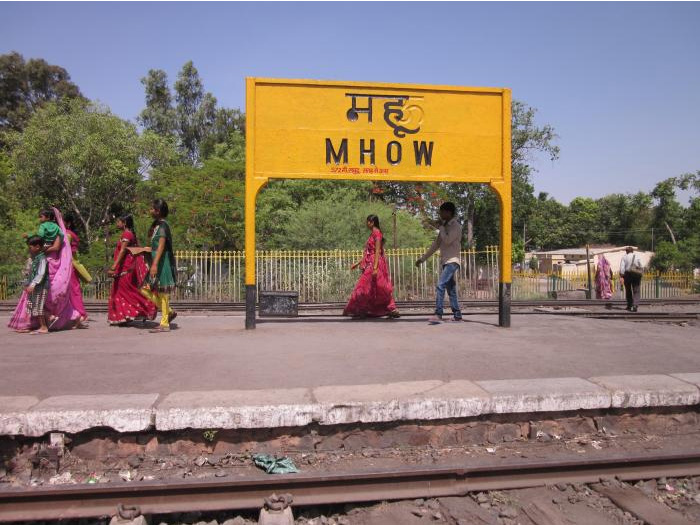
We attended the Junior Command Course at Mhow, India in 1993 and after the course went to our home at Kottayam, Kerala for a month’s vacation. In those days, we travelled on vacation by train and the journey took over 48 hours and two train changes at the most awkward hours of night.  You can imagine my plight with Marina and our two-year daughter Nidhi in tow, with paraphernalia of assorted baggage – in all sizes and shapes.
We reached home and my next ordeal was to get a return reservation from Kottayam to Delhi and onward to Jammu.  During summers, the seats in the trains from Kerala to anywhere in the country were lapped up the moment the reservation counters opened on the exact 60th day before the date of journey.  The only option for me was to contact our Member of Parliament, Mr Suresh Kurup, who always obliged with his emergency quota.  Mr. Kurup is well known for his soft corner and respect for all soldiers.

Armed with the allotment of Emergency Quota and my Warrant (Military form authorising travel by Indian Railways,) I reached Kottayam railway station.  At the reservation counter the booking clerk refused to book the seats – Why?  Our Regimental clerk had committed a grave sin!! He spelt KoTTayam with one T.

I contacted the Station Master and the Reservation Supervisor.  All expressed both sympathy and empathy a soldier deserved, but the cardinal sin of spelling KoTTayam with only one T, they could not condone.

While at Sainik School Amaravathinagar, Thamizh Nadu, our nearest railway station (NRS) was Udumalaipettai – with one P and two Ts. In Thamizh and Hindi, it has two Ps, but in English only one – Any reasonable reasons?

 The town was known amongst the locals as (உடுமலை) Udumalai and all the bus boards read so.  The British called it Udumalpet and that too caught on, but no one ever used Udumalipettai, other than the Indian Railways and some Military clerk sitting in the remote border, preparing a warrant for a soldier from Udumalpet – counting the Ps and Ts.

When we filled our application for the National Defence Academy (NDA,) our teachers insisted that we spelt Udumalaipettai with the correct number of Ps and Ts as the Indian Railways insisted.

To return to the Regiment on time, the only option to me was to buy two tickets and claim the cost later from the Comptroller Defence Accounts (CDA.) I requested the Reservation Supervisor to block the seats until I either got a fresh warrant or bought the tickets by paying cash. He agreed saying that he got to finalise the reservation chart two days before the date of journey.  

I shot off a letter to our Adjutant, narrating my agony.  Major Ranjan Deb (now a Veteran Colonel,) an Aviator with an uncanny sense of humour was in chair and he despatched a soldier to Kottayam with a fresh warrant with two Ts for KoTTayam. Unfortunately, the soldier could reach Kottayam a day prior to my journey and by that time, I had to buy the tickets by paying cash.
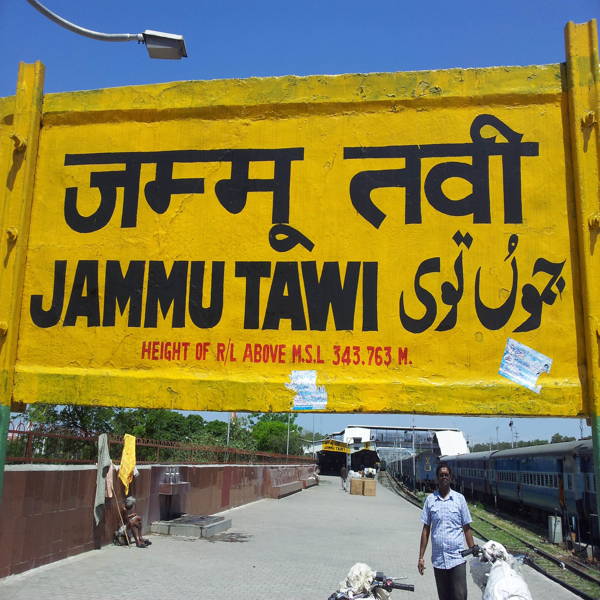
On reaching the Regiment stationed in Jammu & Kashmir, I sent the forms for claiming the cost of the tickets to CDA, explaining the reasons as to why I had to buy the railway tickets by paying cash.  The reasons I stated appeared beyond reasonable doubt to the powers at the CDA, but how can they allow such a claim without raising any objection?  It will go against the ethos of the Accounts Department anywhere in India. 

My claim was approved in principle, but the CDA raised a query “How did the Officer and his wife make the onward journey from Jammu Tawi to Kottayam?”

Beyond reasonable doubt, Major Ranjan Deb promptly replied “By walking.”  In a week’s time my bank account was credited with full reimbursement for the cost of tickets.

Now let us fast forward to 2016.  Our family is in Canada – Marina, Nidhi, Nikhil and myself – all Canadian citizens. 

Nikhil decided to travel to Kolkata to serve in Mother Teresa’s Ashram for a month.  I said to him “If you find time, visit Veteran Colonel Ranjan Deb, our Regimental Officer who lives in Barrackpore.”  I had narrated many incidents about Colonel Deb, especially when he was our Battery Commander with 75 Medium Regiment (Basantar River.) 
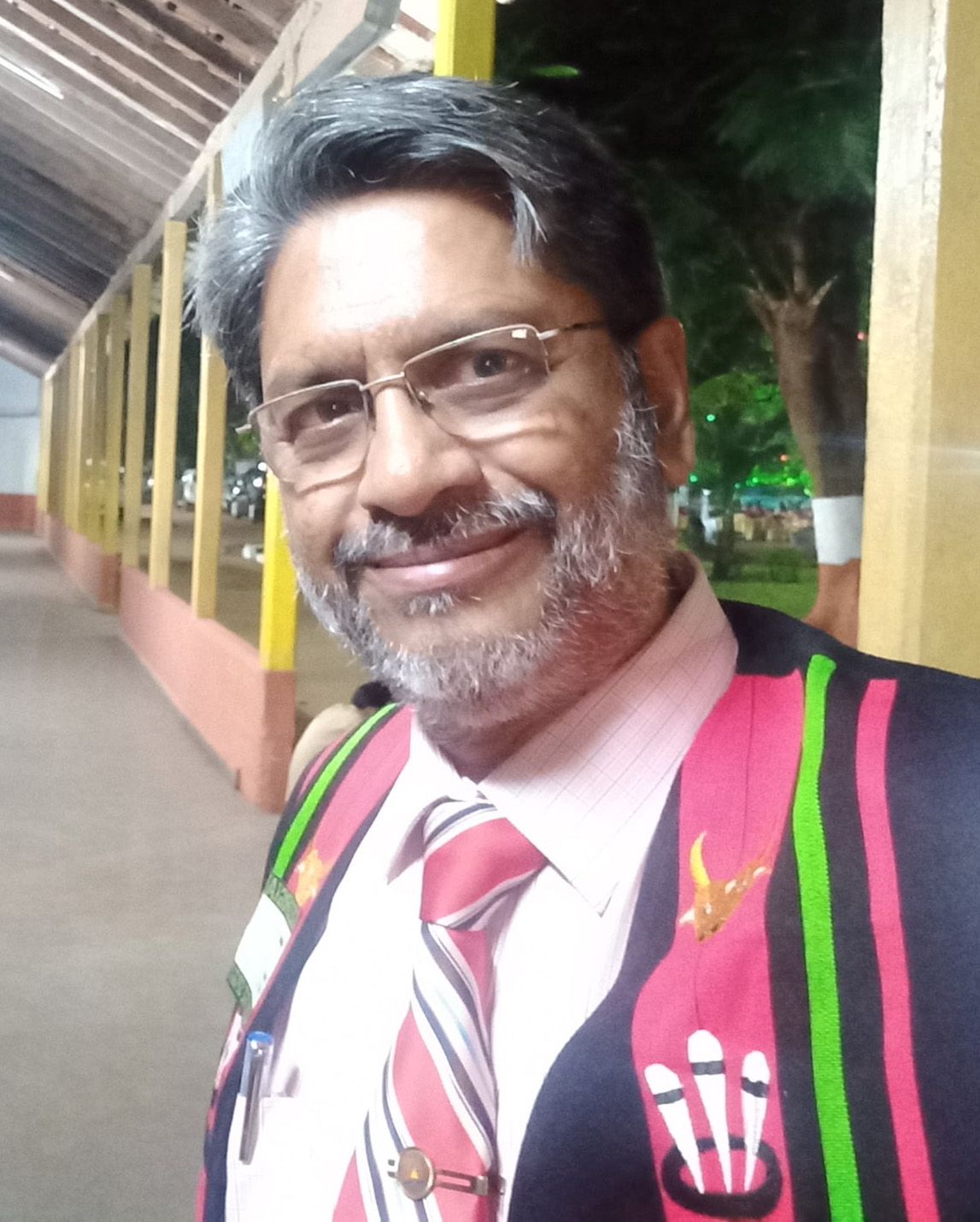
On a Wednesday, when Nikhil had a day off from Mother Theresa’s Ashram, he took a cab to Barrackpore.  Colonel Deb and Nikhil spend a day together and at the end of it Colonel Deb remarked “Reji, I spent a few hours with Nikhil. I was amazed at his all-round development at his age. No Indian student will be able to match up with Nikhil’s thought process. His education in Canada stands out distinctly. I am 63 and he is 19 years of age. I did not get bored for even a second of the six hrs we were together. Healthy engrossing discussion.

This is what is called Regimental spirit.  A kid, not born – why – not even planned while we served together, comes all the way from Canada to meet us – a Veteran Colonel and his wife.  What else can we ask for in life?  What other recognition do we need? He made our day!!”
Coorgis

When I joined our Regiment – 75 Medium Regiment (Basantar River) – in 1982, we had Subedar Chinnappa, Subedar Bidappa, Havildar Muthanna, etc in the South Indian Class (SIC) Battery. These Coorgis (Kodava community) were great soldiers and outstanding hockey players.  By 1986, Coorgis stopped joining our Regiment and we did not have any Coorgi when I left the Regiment in 1997. It appeared that for the Coorgis, Indian Army was no more attractive.

Kodagu, also known as Coorg, is a rural district in the southwest Indian state of Karnataka.  It is the birthplace of Cauvery, a river that local Kodavas consider sacred. Located on the Western Ghats, Kodagu is also referred to as the Scotland of India for its salubrious weather. Kodagu is the most beautiful hill station of Karnataka and is well known for its coffee, especially Robusta variety.

Most of the Coorgi soldiers in our Regiment came from 37 (Coorg) Medium Regiment. Until 1901, this Regiment was designated as the 11 Madras Infantry and in 1902, the Regiment was reorganised and the basis of recruitment changed from Thamizh and Telugu to only Coorgi soldiers.

In 1903, the restructured Regiment was then renamed the 71 Coorg Rifles. The Regiment was disbanded in 1904 because of insufficient recruits. In 1942, Coorgis were again recruited into the newly raised 1st Coorg Battalion. In 1946, it was converted to 37 Coorg Anti-Tank Regiment of the Royal Indian Artillery.

Today, the 37 (Coorg) Medium Regiment is part of the Regiment of Artillery with their war cry “Cauvery Mata ki Jai.”

Up to 1970s, this Regiment was manned by soldiers from Coorg. Now this Regiment is manned by soldiers from the South Indian States with hardly any Coorgis – still the name persists.

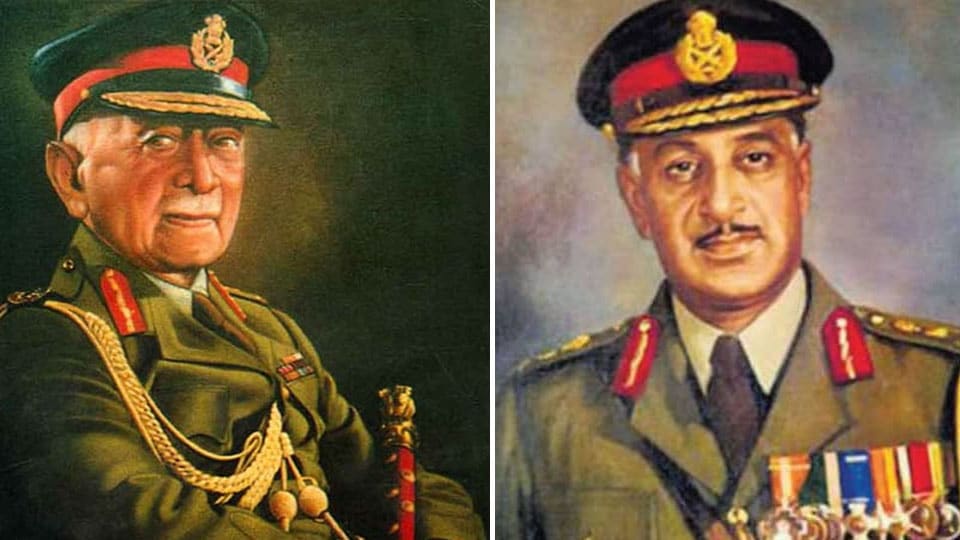
I did come across a few officers in the Indian Army from Coorg, and they proved their metal as most became Generals.  Field Marshal K M Cariappa, the first Indian General and first Commander-in-Chief of India, first comes to my mind, followed by General Kodendera Subayya Thimayya. All the more because two Battalions of the Indian Military Academy (IMA) are named after them.

Lieutenant General PC Thimmaya, Lieutenant  General  CB Ponnappa and Lieutenant  General  CP Cariappa were all at the National Defence Academy and we trained together. 

A total of eleven officers from Kodagu became Lieutenant Generals in the Army so far. This apart, from twenty  Major Generals and four Air Marshals, which undoubtedly makes Kodagu, the Land of Generals.

Indian Hockey team too had many Coorgis, but now hardly anyone. Coorg produced more than 40 Hockey internationals and some of them like M P Ganesh and MM Somaiya captained the Indian team.

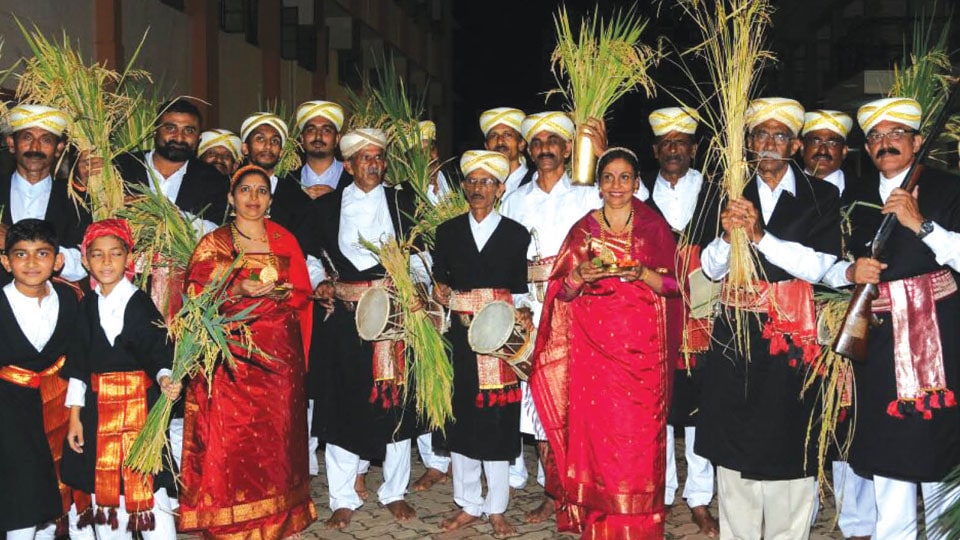
37 (Coorg) Medium Regiment maintains many of the traditions of the Kodava community. On the Regiment’s raising day, officers and soldiers, regardless of their ethnicity, wear the traditional ‘Kupya Chele’, which consists of a traditional jacket and headgear. The officers wear Peeche Kathi (a traditional dagger.)  The ladies wear Kodava Podiya or Coorgi style saree.

The Coorg style of draping a sari involves tucking the pleats at the back of the waist, instead of the front. The end of the sari is brought below the left shoulder and secured over the right shoulder in a firm knot called ‘Molakattu.’

Peeche Kathi has a handle shaped like a parrot or peacock. The sheath may be made of pure silver, silver and wood, or silver/gold embedded with precious stones. The sheath is linked to an intricately designed long silver chain, which ends in an assortment of miniature replicas of Kodava weapons.

Unlike ‘Change of Baton’ followed by other artillery Regiments when a new the Commanding Officer takes over, a Peeche Kathi is handed over as a sign of change in command.  The residence of the Commanding Officer is called Mercara house, named after the Mercara town in Coorg

37 (Coorg) Medium Regiment is so closely affiliated with the Kodagu community that it is a tradition for the unit to take part in the annual hockey tournament in Kodagu.  For the Kodavas, the annual hockey tournament is very important it is part of their culture. In this tournament, various families of Kodagu compete against each other. The Regiment gives an award for the first goal scored in the tournament and it is a matter of pride for the people because the Regiment named after their community is taking keen interest.

Running Away From Studies

The Arrival: Twenty Cadets from Kerala

In July 1971, about twenty of us landed at Sainik School, Amaravathi Nagar, in Tamil Nadu. We arrived armed with little more than our mother tongue, Malayalam. English, Hindi, and Tamil were entirely alien to us.

Our medium of instruction was English. We began with the English alphabet under Ms. Sheila Cherian, gradually progressing to Wren & Martin’s grammar and Ridout’s English Today. It was a slow, painstaking journey into a new world of words.

The Language Gauntlet

Tamil as a second language was out of the question – it would have required us to cram Thirukkural and ancient poetry from the start. Tamil literature is not easily grasped by beginners. So we were assigned Hindi as our second language.

We fared predictably badly. Hindi became our nightmare, especially during the Grade 10 public examination. Only the Almighty and the examiner who evaluated our papers know how we managed to pass. Our method was simple: cram until the last alphabet and reproduce everything on paper. Fortunately, Grade 11 and 12 required no second language.

Tamil remained our third language, taught by Mr. M.V. Somasundaram and Mr. K. Ekambaram. We began with the Grade 1 Tamil textbook in Grade 5. The only saving grace was that our agony ended in Grade 8 with a Grade 4 textbook – four years of effort condensed into four grades of progress.

The 10+2 Revolution

Our 1979 batch became the first to face the newly introduced 10+2 education system under the Central Board of Secondary Education (CBSE) – an extra year of studies. The previous batch had graduated in 1977 after Grade 11.

Grade 12 loomed as a particular terror for those like me, academically undistinguished, never having achieved any scholarly glory throughout school.

The Escape Plan

Why did I join the National Defence Academy (NDA) and subsequently serve the Indian Army for over two decades?

The honest answer: I ran away from studies.

The bonus of clearing the NDA entrance examination was immediate: we joined after Grade 11. No Grade 12. No culminating public exam. What relief!

School had led us to believe that NDA training was predominantly outdoor activities – Physical Training, games, drill, weapon training, equitation, military tactics – with minimal academic demands.

Reality dawned upon arrival.

The Reckoning

We had to complete a Bachelor’s degree programme covering over thirty subjects, from Engineering Drawing to International Relations, culminating in a degree from the prestigious Jawaharlal Nehru University (JNU) – the only Bachelor’s degree this premier research university confers.

The Gods had not forgotten my academic transgressions, particularly in linguistics. How could they spare me from Hindi and Tamil?

Commission and Consequences

I was commissioned into the Regiment of Artillery – 75 Medium Regiment (Basantar River). The Regiment then had an intriguing class composition: one battery of North Indian Brahmins, another of Jats primarily from Haryana and Uttar Pradesh, and a third manned by soldiers from the four Southern states.

Now I had to master Hindi as spoken by Brahmins and Jats, and Tamil as the medium of communication for South Indian soldiers. The languages I had fled returned to haunt me.

The Irony of Escape

I had joined the military to escape studies. Two decades later, I retired having never stopped studying -and having never stopped running.

Even while commanding the Regiment, learning continued unabated. Modern high-tech radar systems, survey equipment, Unmanned Aerial Vehicles (drones) – all unfamiliar, all demanding mastery. Command required understanding, and understanding required poring over volumes of operational and maintenance manuals.

The Lesson That Lingers

My studies did not end when I hung up my military boots. They continued. They continue still. They will continue forever.

The boy who fled from textbooks discovered that learning cannot be outrun. It follows. It pursues. It eventually catches up, transforming the runner into a reluctant but perpetual student.

Perhaps that is the ultimate irony – and the ultimate gift. The escape artist became, despite himself, a lifelong learner. And in that transformation, discovered that the running itself was the education.

Anyone who stops learning is old, whether at twenty or eighty. Anyone who keeps learning stays young – Henry Ford.

Hussainiwala – A Village on Indo-Pak Border


During our visit to India to attend the Golden Jubilee celebrations of raising of our regiment – 75 Medium Regiment (Basantar River) – we watched the Retreat Ceremony at Hussainiwala Border Post.


Railway line connecting Peshawar to Mumbai was built in 1885, passing through Hussianiwala.  During the Pre-Partition days, Punjab Mail connected the cities of Mumbai, Delhi, Ferozepur, Lahore and Peshawar. In those days, most British troops and businessmen arrived at Mumbai and made their way to their destinations in the North-West Frontier Province by train. The train track from Ferozepur to Hussainiwala was an engineering fete, with Qaiser-e-Hind bridge, which stood over several round pillars (all of them intact even today, as depicted in the image above).


When Pakistan was carved out of British India, the border was drawn along the Sutlej River in Punjab and it passed through Hussainiwala Village.  Now, Sutlej River has changed its course over the years, running further East in Indian territory.  This made Hussainiwala an enclave into Pakistan, with the Sutlej River behind it.


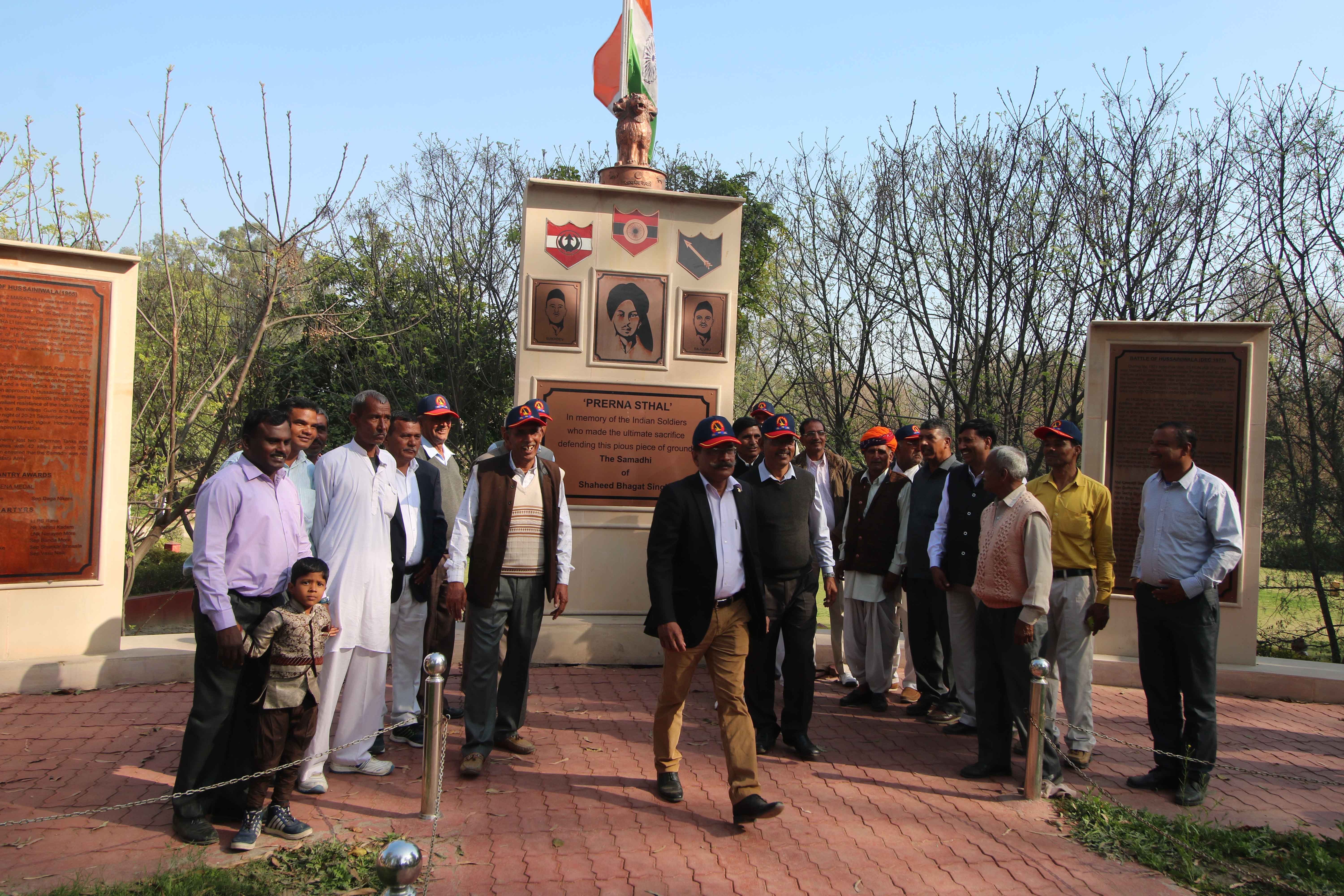
Hussainiwala is named after a Muslim Peer (Saint), Hussaini Baba, whose shrine is located at the entrance to the Border Post.  This small hamlet came into prominence on the evening of 23 March 1931 when British soldiers tried to cremate the bodies of three young Indian freedom fighters – Bhagat Singh, Sukhdev and Raj Guru – who were hanged at the Lahore Central Jail.  The hanging, scheduled for 24 March was rescheduled a day earlier as the British feared a revolt in Lahore as the situation had become very tense.  They  secretly transported their bodies to Hussainiwala and while cremating them on the banks of the Sutlej, the locals got wind of it.  They assembled near the cremation site.  Fearing repercussions, British soldiers fled the scene, leaving behind the dead bodies which were cremated by the villagers.  This site today is a memorial – aptly called ‘Prerana Sthal‘ (Motivation Site).


Later Bhagat Singh’s mother, Vidyawati, and freedom fighter BK Dutt were cremated at this site as per their wishes. The cremation site is called ‘Shaheedi Sthal’ (Martyrs’ Place).   This is where Indians from all over the country make an annual pilgrimage to honour the martyrs on March 23 as they observe ‘Shaheedi Diwas’ (Martyrs’ Day).


(Defences on the Indian side on Bund (wall) with a bunker as inset)

This enclave has witnessed three bloody battles between India and Pakistan,  with the very first one fought on 18 March 1956.  At that time, heavy floods had damaged Bela Bund and Sulaimanki Headworks at Hussainiwala and as the Indian engineers were repairing the damage, Pakistan Army launched an unprovoked attack at 9 PM.  4 JAK RIF was guarding the bund, and they fought  gallantly causing heavy causalities on the enemy.  This resulted in a hasty withdrawal by the attackers.


During partition of British India in 1947,  Hussainiwala, an enclave of 12 villages went to Pakistan. The railway line no more had trains running through Hussainiwala.  The railway station at Hussainiwala as it exists today is depicted in the image above.  Now Punjab Mail connects Mumbai to Ferozepur via Delhi.  Pakistan destroyed  Qaisere- Hind Bridge leaving behind the round pillars across the river. The Shaheedi Sthal was in a dilapidated state without any maintenance. In 1961, Jawaharlal Nehru, then Prime Minister, brokered an exchange deal and Hussainiwala came to India while Sulaimanki Headworks –  from where three major canals which supply irrigation water to a large area in Pakistan  Punjab originate –  went to Pakistan. India immediately restored Shaheedi Sthal to its due dignity and reverence.

During Indo-Pakistan War of 1965, 2 Maratha Light Infantry (Kali Panchwin) was deployed to defend Hussainiwala. The battalion fought valiantly to thwart a  frontal attack resulting in two enemy tanks destroyed and two captured, with several enemy killed. The Commanding Officer Lieutenant Colonel Nolan was killed in enemy artillery shelling. The unit ensured that the Samadhi of Bhagat Singh was not desecrated by Pakistan Army. The battalion was visited by then Prime Minister Lal Bahadur Shastri, Defence Minister YB Chavan, Congress Party President  K Kamraj, the Chief of Army Staff and other senior officers. Kali Panchwin was awarded the battle honour ‘Hussainiwala’ for its role in the 1965 War. The citizens of Firozpur, in honour of the Battalion’s contribution in defending the bridge and Firozpur town, presented a silver replica of the Hussaniwala Bridge.

During the 1971 War, it was 15 PUNJAB defending Hussainiwala enclave and the Memorial.  On 03 December, Pakistan Army launched a heavy attack.  The valiant Punjabis withstood the attack gallantly despite suffering heavy casualties until withdrawing on 04 December night.


Did the three freedom fighters, who laid down their lives for Indian independence in their wildest dreams ever visualise that post independence, there would be a partition on religious lines and it would all end up in three bloody wars at the very same site their ‘Samadhi’ stood?