
The full moon of November 5, 2025, will be a notable celestial event: the second supermoon of the year, adorned with the traditional name Beaver Moon. This occurrence provides a perfect opportunity to explore the fascinating interplay of lunar nicknames, orbital mechanics, and the science behind these brilliant apparitions.

The Cultural Tapestry of Full Moon Names
Each month’s full moon carries a name rooted in cultural and natural history, often originating from Native American, Colonial American, and European traditions. The November full moon is known as the Beaver Moon. According to the Old Farmer’s Almanac, this name signifies the time when beavers begin to retreat to their lodges for the winter. An alternative explanation points to the historical fur trade, as this was the season to set beaver traps before the swamps froze.
These names create a yearly almanac in the sky, connecting the heavens to the rhythms of life on Earth. Below is a list of the commonly accepted full moon names:
| Month | Full Moon Name |
| January | Wolf Moon |
| February | Snow Moon |
| March | Worm Moon |
| April | Pink Moon |
| May | Flower Moon |
| June | Strawberry Moon |
| July | Buck Moon |
| August | Sturgeon Moon |
| September | Corn Moon (or Harvest Moon) |
| October | Hunter’s Moon (or Harvest Moon) |
| November | Beaver Moon |
| December | Cold Moon |
The Science of Supermoons
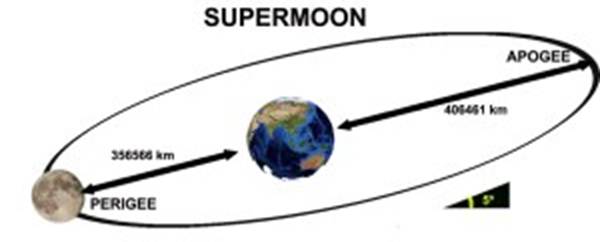
To understand a supermoon, one must first examine the Moon’s orbit. The Moon does not circle Earth in a perfect circle but in an elliptical orbit, which is inclined about 5 degrees to Earth’s orbital plane. This path has two key points:
- Perigee: The point where the Moon is closest to Earth.
- Apogee: The point where it is farthest.
A supermoon occurs when a full moon coincides with or is near the Moon’s perigee. At this moment, the Moon can appear up to 7% larger and 16% brighter than an average full moon. Conversely, a micromoon is a full moon near apogee, appearing noticeably smaller and dimmer.
The term supermoon was popularised by astrologer Richard Nolle in 1979 and gained widespread use in the media during a particularly close approach in March 2011.
The Lunar Cycle: Phases and the Blue Moon
The Moon’s phases are governed by two distinct cycles:
- Sidereal Month (27.55 days): The time it takes the Moon to complete one orbit around Earth and return to the same position relative to the stars.
- Lunar Month (29.53 days): Also called the synodic month, this is the time from one new moon to the next, which is longer due to Earth’s simultaneous revolution around the Sun.
This discrepancy between the lunar month and our calendar months (30 or 31 days) gives rise to the Blue Moon. The idiom once in a blue moon describes a rare event, but astronomically, a seasonal Blue Moon (the third full moon in a season with four) or a monthly Blue Moon (the second full moon in a single calendar month) occurs roughly every 2.7 years. Because February is shorter than a lunar month, it can never host a Blue Moon.
On rare occasions, a double Blue Moon can occur within a single year, a phenomenon that happens only 3 to 5 times per century. The last was in 1999, and the next will be in 2037.
A Celestial Convergence
The supermoon of November 14, 2016, was a record-setter, being the closest full moon since 1948—a record that will not be surpassed until November 25, 2034. The Beaver Moon on November 5, 2025, continues this cycle of celestial wonder, offering a brilliant reminder of the dynamic and predictable dance of our closest celestial neighbour. It is a chance to witness a beautiful fusion of ancient tradition and modern astronomy.
Indian Astronomy and Full Moons
While the term Supermoon is a modern astronomical concept without a direct equivalent in Indian astronomy, the tradition of naming full moons is deeply rooted in Indian culture. The Sanskrit word for full moon, Purnima, serves as the foundation for a calendar of lunar observations tied to seasons and festivals. These are not merely astronomical markers but are imbued with cultural and religious significance. For instance, Chaitra Purnima (March/April) often heralds the Hindu New Year, while Ashadha Purnima (June/July) is revered as Guru Purnima, a day to honour teachers. The harvest moon of Sharad Purnima (September/October) is dedicated to the goddess Lakshmi, and Kartik Purnima (October/November) celebrates the birth of the deity Kartikeya. Thus, each full moon connects the celestial cycle to the rhythm of life and spirituality in India.
 REJINCES