Indian Army Water Bottle

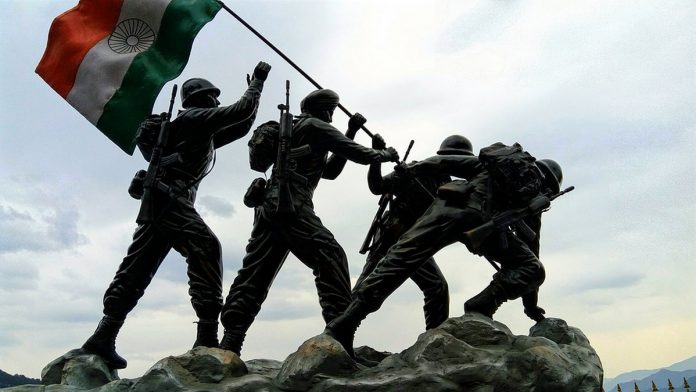
Let me begin this post dedicating it to Naik Gulab Singh, Vir Chakra of 13 Kumaon Regiment. He fought valiantly and charged at the Chinese machine gun position in the Battle of RezangLa at Ladakh in Nov 1962.

This water bottle with many bullet holes stands testimony to the valour and dedication to duty of Naik Gulab Singh.

Water is one of the most important elements of a soldier’s life – it is vital for all human beings, animals and plants.  Our body is made up of almost two-thirds water. Blood contains  92 percent water; the brain is 75 percent water; muscles are 75 percent water; and bones 22 percent.

Hydration, or consuming enough water is crucial for humans: to regulate body temperature, keep joints lubricated, prevent infections, deliver nutrients to cells, and keep organs functioning properly. Being well-hydrated improves sleep quality, cognition, and mood.

Soldiers used to carry water for personal consumption in a water-bottle, attached to the belt. Today’s soldier needs a hydration system that is effective, allows freedom of action, and is easier to carry and use than the current water-bottles.  An ideal hydration system will encourage the soldier to drink more water, resulting in better performance in battle and facilitate in delivering personal combat power- surely not an obstruction.
My tryst with the water-bottle began on joining the National Defence Academy (NDA) in 1979.  We were issued with the Field Service Marching Order (FSMO) with the all important water-bottle.  In the Scale A version of FSMO with the bigger backpack, the smaller haversack was attached to the belt on the left  and the water-bottle on the right.  Most soldiers were right-handers and for easy access the water-bottle was placed on the right.  In the Scale B version where the small haversack became the backpack, the water-bottle was attached to the back of the belt.

Scale B was used for most training as a cadet – for endurance runs, weapon and tactical training, etc – and the water-bottle hanging by the belt at the back kept pounding one’s butt as we cadets ran.  It was more of an encouraging tap on the butt that kept many of us going and the wet felt outer casing did cool our butts in the warm Indian afternoons.
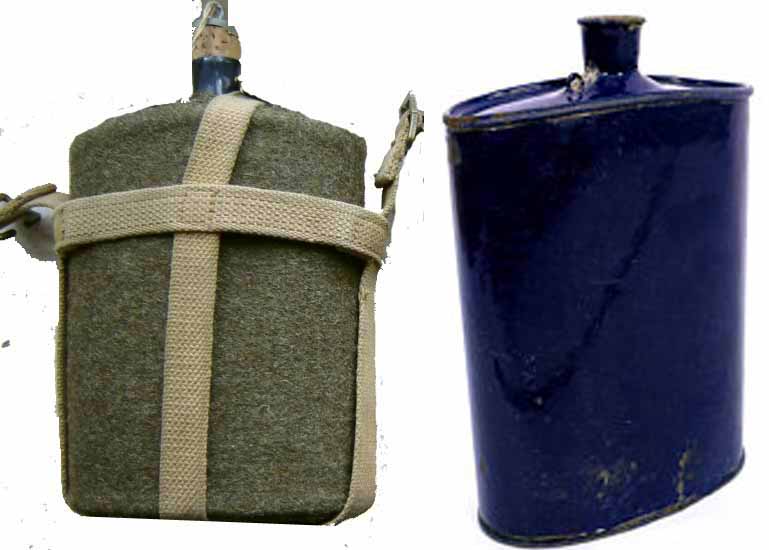
This water-bottle, officially known in the Indian Army as  Bottle Water Mark 7, owed its origin to the British Army’s 1937 Web Equipment.  Made of blue colored sheet metal welded at the shoulder and at the bottom with outer side convex and  the inner side concave to fit with the contours of the human body.  The spout was closed with a cork stopper and the stopper was attached to an eye on the top of the bottle  with a string. The outer felt cover protected the metallic bottle and when kept soaked, evaporative cooling kept the water inside cool.  These enamelled water-bottles were manufactured in India mostly by the Bengal Enamel Works of Kolkata and also by the Madras Enamel Works of Chennai.

The British Army originally called the water-bottle a Canteen.  A canteen is a place outside a military camp where refreshments are provided for members of the armed forces. This very ‘place of refreshment’ became the water-bottle that the soldier carried on a march.  This canteen’s design and use have remained the same since 1937.  It appears that the technological revolution marched right past one of the Indian soldier’s most vital personal equipment – the water-bottle.

After we were commissioned in 1982, the Indian Army introduced the plastic cousin of the age old enamelled water-bottle, officially known as Bottle Water Complete M83.  This water-bottle continued with us as late as 2002.  While in command of the Regiment in operational area in Rajasthan when the Indian army was deployed along the Indo-Pak border in the aftermath of a terrorist attack on the Indian Parliament, we ordered for the water-bottles, but the Ordnance Depot did not supply us with any.

The new plastic water-bottle consisted of a green, plastic, square shaped bottle  with a  screw-on cap.  It had a plastic cover on top with  handles made of aluminum, and could be used as a cup when detached. The whole set was inserted into a canvas carrier lined with a thin layer of foam. This helped to keep the contents of the bottle warm in winter and cold in summer .  Though the water-bottle had straps to be attached to the belt, most soldiers carried it in their backpacks,

These plastic water-bottles were manufactured by some unheard-of  private plastic manufacturers, located in and around Delhi.  Though it was supposed to be made of food-grade High Density Poly Ethylene (HDPE), the water stored inside these water-bottles had unpleasant odour and left an after-taste.  Cracks developed as a result of any accidental drop or extra-pressure exerted by the soldier on the water-bottle, especially while resting after a tiring long march.  That was why our soldiers carried their water-bottles in their backpacks.  By 2003, the Indian Army withdrew this plastic water-bottle.

The soldier of the future will have a heads-up display on his helmet, a sophisticated weapon and a computer wired to his pack frame.  The soldiers operating in such an environment will have little time for a nap or to get a drink of water.  A quickly accessible hydration system close to the soldier’s mouth will help the soldier take small sips on a regular basis.

The CamelBak hydration system is a plastic water bladder connected to a length of hose that fits into an insulated bag that can be strapped on the soldier’s back or attached to a backpack. The mouth of the hose is positioned close to the carrier’s mouth for easy access. The ‘bite’ valve at the end of the hose makes the water readily available to sip or drink.

The Indian Army could develop its own hydration system that will be less expensive than a CamelBak system.  A change to the current water storage and delivery system is long overdue. A potable, palatable, easily available hydration system that allow soldiers to move easily and quickly on the battlefield and encourage water consumption will be an important force multiplier.  Importantly, soldiers under fire on the battlefield should be able to get a sip of water without taking their hands off their weapons.
The Razor’s Edge: A Military Tradition of Shaving and Self-Discipline

The First Task of the Day

In 2014, Admiral William H. McRaven, the retired United States Navy Admiral who served as the ninth commander of the US Special Operations Command, delivered the commencement address at the University of Texas at Austin. His words that day resonated far beyond the graduating class: “If you make your bed every morning, you will have accomplished the first task of the day.

For cadets at Sainik School, where I spent my formative years from nine to sixteen, the ‘making the bed’ ritual was precisely that – the first accomplishment of each morning. At the National Defence Academy (NDA), however, the first task evolved. Morning shave became the ritual that set the tone for the day ahead.

During early school years, facial hair was not a concern. Shaving was a weekly ritual accompanying the barber’s haircut. At NDA, shaving became mandatory for all cadets – a discipline that would continue through over two decades of service in the Indian Army.

A Winter Morning Lesson

One winter morning in the eighties, I was a young Lieutenant serving as Senior Subaltern of the Regiment. Word arrived that an important political leader had passed away, and the day was declared a holiday. I had already shaved and was changing into my PT whites. Stepping out of my room, I found all the other Lieutenants similarly dressed and ready for physical training.

We have already shaved and put on our PT dress,” I said. “Let us go for a run. Once you have shaved early morning, holiday or not, it makes no difference.”

That morning run became more than exercise. It was a lesson in discipline that transcended circumstance – a reminder that self-respect and routine should not be dictated by calendar or convenience.

The Foundation of Soldierly Pride

In the Army, a uniformed service, discipline is judged partly by how a soldier wears prescribed dress, and partly by personal appearance. A well-groomed appearance is fundamental to military life, contributing to pride and esprit-de-corps. Every soldier must be self-disciplined and proud of belonging to a noble profession.

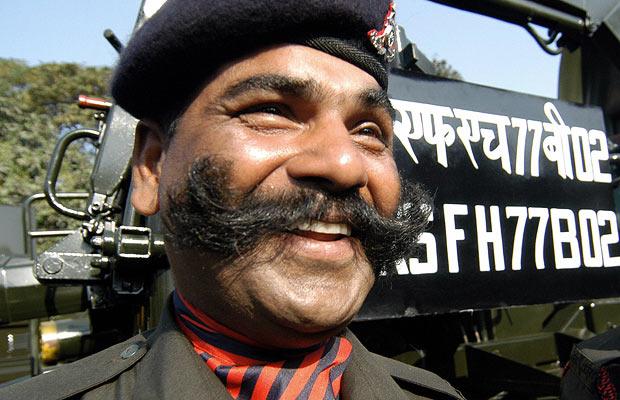
Commanders bear primary responsibility for ensuring that soldiers under their command present a smart, soldierly appearance – at all times, in or out of uniform, on or off duty. A properly shaved soldier, sporting a mustache if preferred, embodies that soldierly bearing.

The Origins of the Clean-Shaven Face

The tradition of clean-shaven soldiers traces back to Alexander the Great. Legend holds that he ordered his troops to shave so that enemy combatants could not grab them by their beards and throw them to the ground.

In the Indian Army today, soldiers are expected to be clean-shaven, with Sikhs as the exception, permitted to grow their beards as part of their religious practice. Mustaches, if worn, must remain above the upper lip.

Sir Douglas Haig with his army commanders and their chiefs of staff – World War I – (Image Courtesy Wikimedia)

British Military Tradition

Many of the Indian Army’s traditions and regulations derive from the British Army, whose orders regarding shaving date back to the eighteenth century. Until that time, British soldiers were clean-shaven and did not wear mustaches. Soldiers of the Hussar Cavalry Regiments adopted mustaches specifically to intimidate their enemies. The trend spread across the British Army, with the mustache serving as a distinguishing mark separating soldier from civilian.

Influence from Indian royalty and the Indian belief that mustaches signified manliness may also have played a role. By the late eighteenth century, mustaches had gained popularity among British civilians, as did sideburns.

The Great Mustache Revolt

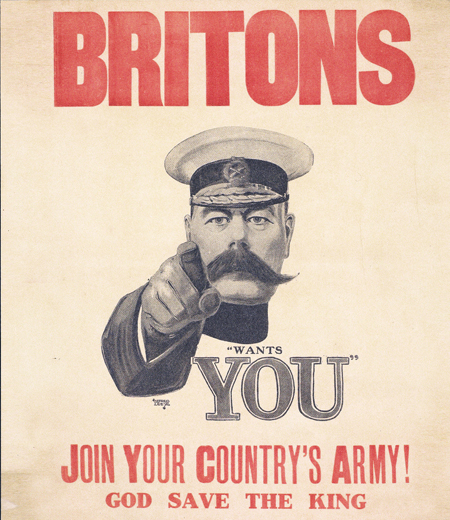
The iconic World War I poster featuring Lord Kitchener – sporting a formidable handlebar mustache – urging citizens to join the army remains an enduring image from that era

During World War I, Commonwealth soldiers found mustaches cumbersome to maintain while fighting trench warfare. Many soldiers and officers preferred to shave them off, leading to what amounted to a quiet revolt. Some soldiers faced court-martial for failing to comply with the mustache order.

In 1913, General Nevil Macready investigated the matter and submitted a report recommending that mustache orders be withdrawn. No action was taken. In 1915, King George reinforced the necessity of mustaches for soldiers. Macready resubmitted his recommendations in 1916, and on 8 October of that year, an order was finally passed abolishing the mandatory mustache requirement.

Debunking the Myth

It is a common myth that hair grows thicker and darker after shaving. Forensic anthropologist Mildred Trotter debunked this belief in 1928. She asked three college students to shave their legs, from ankle to knee, twice weekly for eight months. Using a microscope, she compared each student’s hair growth rate, colour, and thickness. Her conclusion: shaving had no impact on hair’s texture or growth.

Shaving Beyond the Military

Wrestlers are predominantly clean-shaven – Olympic rules require either a full beard or a clean-shaven face, as stubble can irritate an opponent’s skin. Swimmers often remove all body hair, believing that even minimal resistance can affect performance.

Among married Amish men, beards are worn with trimmed mustaches, substituting for wedding rings.

A Curious Footnote

For reasons still unclear, Parliament once dismissed the personal barber of Charles I of England. Famously slow to trust others, King Charles never shaved again – fearing that a new barber might attempt to kill him. History offers no evidence for the suspicion, but the king’s caution speaks to the intimate trust placed in those who hold a razor to one’s throat.

Conclusion

From Alexander’s battlefield strategy to trench warfare’s practical demands, from regimental discipline to personal pride, shaving has remained a constant thread in the fabric of military life. The morning ritual that began each day with a clean face taught lessons that extended far beyond grooming: self-discipline, attention to detail, and respect for oneself and one’s uniform. Admiral McRaven’s first task of the day may have been making the bed, but for generations of soldiers, the razor’s edge has served the same purpose – a small accomplishment that sets the stage for all that follows.