
Roman Charity

Roman Charity was a popular story in 17th-century Italy that many writers, thinkers, painters and sculptors depicted in their work of art, literature, and philosophy as a testament to human compassion.
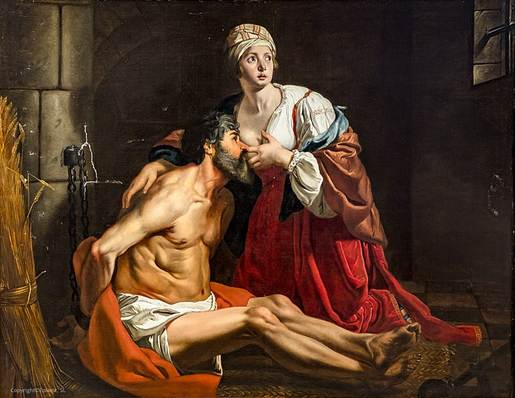
This is based on an exemplary story of a woman Pero who secretly breastfed her imprisoned father Cimon. The poor man was sentenced to death by starvation for stealing a loaf of bread during the reign of Louis XIV in France. Pero was his only daughter and the only visitor to his cell. She was allowed to visit him daily but was searched thoroughly so that no food was taken in.

The selfless devotion of Pero to nourish her father Cimon at her own breast is called Roman Charity. It is history’s most altruistic story of honouring one’s father. The kindness of Pero towards her starving father depicts mercy – To feed the hungry.

This story of Pero and Cimon finds a place in Factorum ac dictorum memorabilium by Valerius Maximus – an ancient Roman historian. It is believed that this story is related to the mythological story of Juno, the goddess of Wisdom, the daughter of Saturn, wife of Jupiter and mother of Mars, breastfeeding of the adult Hercules.

The God Jupiter wished to immortalise his son Hercules, whose mother was the mortal Alcmene. For that he held him to the breast of his sleeping wife, the Goddess Juno, to drink her milk. Juno woke immediately and pushed Hercules aside. The milk which spurted upwards formed the Milky Way, while that which fell downwards gave rise to lily flowers.

When after four months the man still lived on with no weight loss, the prison guards were perplexed and started spying on her. To their astonishment found she breastfed her father, sharing her baby’s milk.

A case was initially filed against her but realising the love and compassion of a daughter towards her father softened the judge’s heart and eventually he pardoned the father and released him free. It was considered a noble act worthy of honour.

In all its various depictions, the image is intended to be seen as a horrific act against nature, but an example of human survival – the most natural, innate instinct. It also depicts love and care for the father. Pero’s outward gaze depicts her nervousness and fear of repercussions from the society of a daughter breastfeeding her father.
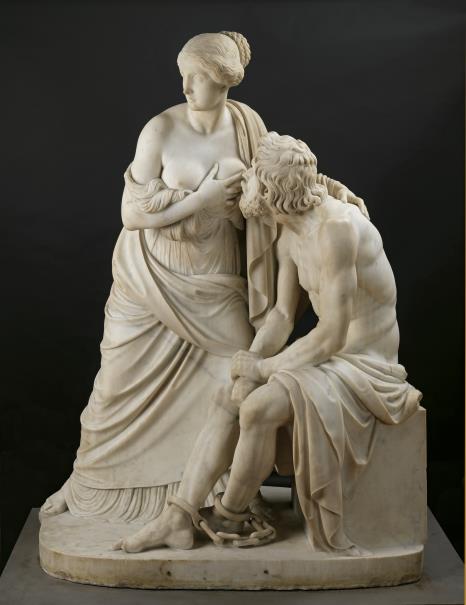
The story serves as a reminder of the sacrifices people make for their loved ones and the power of human kindness. In a world often driven by self-interest, the story encourages individuals to act with empathy and moral strength. It also highlights the importance of care-giving, whether in family relationships or professions like healthcare, nursing and social work.

The works of Hans Sebald Beham, Peter Paul Rubens, Charles Mellin and countless other classical artists who portrayed the Roman Charity story, there exists an uncomfortable testament to female sacrifice. It could well be because it was considered as an unnatural act based on social taboos of the time. The story raises moral dilemmas about breaking societal norms for the sake of love and duty.

Roman Charity is a powerful narrative of devotion, love, and moral courage. It transcends time and culture, inspiring generations with its message of selflessness. The story of Pero and Cimon reminds us that acts of compassion, no matter how unconventional, have the power to move hearts and change lives.

In an era where personal sacrifice is often overlooked, Roman Charity remains a beacon of true altruism and humanity.

Where to Find God

A very pertinent question being asked in today’s world, filled with evangelists from all religions and sects, standing on rooftops and on TV, shouting at the top of their voices.  Everyone it appears want to prove to the world that the Gods they sell are the best, accompanied  by miracles in various forms.  Most of these evangelists, exploiting the greed of humanity, have amassed wealth that even their Gods cannot fathom.

The city of Kottayam in Kerala, which boasts of near cent percent literacy, is better known as the city of three Ls – Latex , Letters and Liquor.  It is the trading centre of natural rubber in India and the Indian Rubber Board is also located here.  The city boasts of many educational institutions with their glorious past and also is the home for most publishing houses in Kerala with Malayala Manorama and its allied publications leading the pack.  It also set many records in liquor consumption, but of late, other smaller towns have leaped miles ahead of Kottayam.  The city boasts of many Hindu temples, Muslim mosques and Christian churches that dot the townscape.  It is the headquarters of most factions of the Syrian Christians.   

Panhandling has been banned in Kottayam since my childhood, but one can always spot a few beggars in and around the town, especially adjacent to religious places of worship.  On the  days of various festivals in these religious places, an army of beggars, mostly immigrants from the other Indian states congregate here.  It appears to be an organised racket and the way they are moved from one place to another and the methodology employed in locating them at vantage points will put any army to shame.

On a Friday morning, a  beggar, desperate to get a few bucks as he was really hungry, located himself in front of a mosque in Kottayam.  In the afternoon, everyone came for the prayers (Jummah).  (The schools in Kerala have a long recess on Fridays, extending till 2:30 PM to facilitate Muslim students to offer Jummah.).  On culmination of the prayers, everyone folded their caps, dusted and rolled their prayer mats and went home.  No one even bothered to give a glance at the hungry beggar.

On Saturday morning the beggar placed himself at the vantage point of Shiva Temple of Kottayam.    Devotees came in droves (Second Saturday of a month is a holiday for all offices and schools of Kerala) and offered Poojas, Nivedyams and Abhishekams and left and no one gave any offering to the hungry beggar.

On Sunday morning the beggar placed himself in front of the Cathedral.  He reached there well before the priest and the church manager could even open the doors.  During the Holy Mass, Gospel reading was from the Gospel According to Saint Mathews – Chapter 25 – Verses 35 to 40.  Verse 35 says  “For I was hungry and you gave me something to eat, I was thirsty and you gave me something to drink, I was a stranger and you invited me in.”  At end of the mass, priest in his sermon reminded all true followers of Christ that they must feed the hungry as it would be equivalent to any offering to God. 

The beggar was full of hope that he would surely get something, especially after the priest’s sermon.  The Clergy and the Laymen all assembled after the Holy Mass for the meeting and elected  committee for the coming year and dispersed.  No one gave anything to the beggar.

On Monday morning, by about 10′ o clock, the beggar perched in a shady corner, next to the outlet of Beverages Corporation of Kerala (liquor vent).  A queue of about 30 people had already formed, without any jostling or pushing, awaiting the auspicious time of 10 AM for the sale window to open.   The salesman at dot 10 AM opened the window and brisk sales proceeded and more people joined the queue.

God22
By about 11 AM, the beggar found his pan full of money and overjoyed with it, he prayed to God Almighty.  He wanted God to answer his query as to why He gave him His wrong address.  God appeared in front of the beggar and explained to him His reasons.

“Look! These are the real devotees.  Everyone has formed a proper and well disciplined queue which you will never find in front of any other places you had been till now.  There is no difference between rich and poor; literate and illiterate.  There is no segregation  along caste, creed or religious lines.    They stand in a queue in most decent manner, braving storms, rains or hot sun.  They respect each others privacy and ensure that they do not even touch the one in front. Now they maintain social distance norms.”

“These devotees are only asking for what they want and never for their parents, children, relatives or friends.  They never request that others should not be given what they want.  They ask what they want in minimum words, in a language everyone understands.  They neither sing praises about their brand of liquor  nor do they sermonise about evils and goodness of liquor.  Here there are no VIPs and one does not have to pay upfront at various counters and obtain a receipt for services rendered.  There are neither  any commission agents nor are there any long forms to be filled.  There is no need for any written application on a white sheet of paper.  They never try to bribe Me with their offerings in cash or in kind, without realising that if offered to the needy would be of immense help and if offered to Me would never be of any use to anyone.”

“Hence isn’t this the best place in Kottayam for the God to be?”.

On hearing the reasons given by the God, the beggar asked “Then why did You make me beg around for the past three days?”

The God replied “That is to show you beggars as to where to find God.