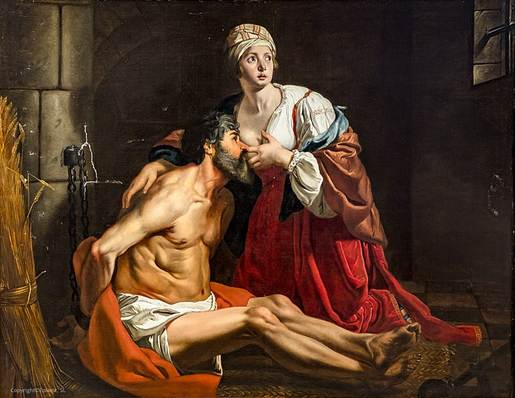
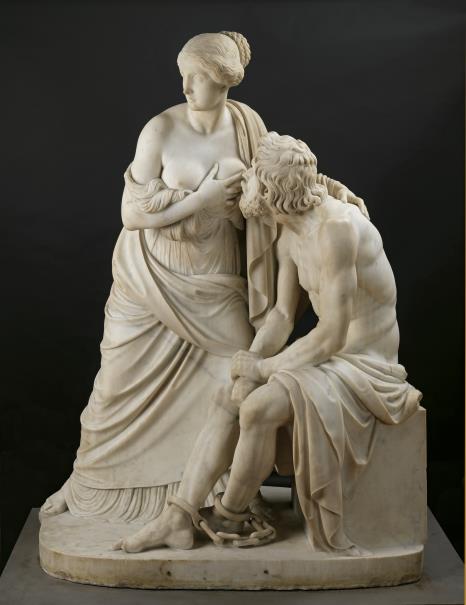
Roman Charity was a popular story in 17th-century Italy that many writers, thinkers, painters and sculptors depicted in their work of art, literature, and philosophy as a testament to human compassion.
This is based on an exemplary story of a woman Pero who secretly breastfed her imprisoned father Cimon. The poor man was sentenced to death by starvation for stealing a loaf of bread during the reign of Louis XIV in France. Pero was his only daughter and the only visitor to his cell. She was allowed to visit him daily but was searched thoroughly so that no food was taken in.
The selfless devotion of Pero to nourish her father Cimon at her own breast is called Roman Charity. It is history’s most altruistic story of honouring one’s father. The kindness of Pero towards her starving father depicts mercy – To feed the hungry.
This story of Pero and Cimon finds a place in Factorum ac dictorum memorabilium by Valerius Maximus – an ancient Roman historian. It is believed that this story is related to the mythological story of Juno, the goddess of Wisdom, the daughter of Saturn, wife of Jupiter and mother of Mars, breastfeeding of the adult Hercules.
The God Jupiter wished to immortalise his son Hercules, whose mother was the mortal Alcmene. For that he held him to the breast of his sleeping wife, the Goddess Juno, to drink her milk. Juno woke immediately and pushed Hercules aside. The milk which spurted upwards formed the Milky Way, while that which fell downwards gave rise to lily flowers.
When after four months the man still lived on with no weight loss, the prison guards were perplexed and started spying on her. To their astonishment found she breastfed her father, sharing her baby’s milk.
A case was initially filed against her but realising the love and compassion of a daughter towards her father softened the judge’s heart and eventually he pardoned the father and released him free. It was considered a noble act worthy of honour.
In all its various depictions, the image is intended to be seen as a horrific act against nature, but an example of human survival – the most natural, innate instinct. It also depicts love and care for the father. Pero’s outward gaze depicts her nervousness and fear of repercussions from the society of a daughter breastfeeding her father.
The story serves as a reminder of the sacrifices people make for their loved ones and the power of human kindness. In a world often driven by self-interest, the story encourages individuals to act with empathy and moral strength. It also highlights the importance of care-giving, whether in family relationships or professions like healthcare, nursing and social work.
The works of Hans Sebald Beham, Peter Paul Rubens, Charles Mellin and countless other classical artists who portrayed the Roman Charity story, there exists an uncomfortable testament to female sacrifice. It could well be because it was considered as an unnatural act based on social taboos of the time. The story raises moral dilemmas about breaking societal norms for the sake of love and duty.
Roman Charity is a powerful narrative of devotion, love, and moral courage. It transcends time and culture, inspiring generations with its message of selflessness. The story of Pero and Cimon reminds us that acts of compassion, no matter how unconventional, have the power to move hearts and change lives.
In an era where personal sacrifice is often overlooked, Roman Charity remains a beacon of true altruism and humanity.
If you browse the spice aisle of any grocery store in Canada, you will almost certainly find jars labeled Malabar Black Pepper and Tellicherry Black Pepper. While Malabar easily evokes the historic, tropical coast of southwestern India, it raises a fascinating question: how did Tellicherry—a relatively small coastal town in Kerala—earn its own permanent, premium designation on global spice shelves?The answer lies in a convergence of geographical luck, deep colonial history, and the ancient trade routes that shaped world religions.
From Head of Offices to the Paris of Kerala
Tellicherry is the Anglicised name given by the British to Thalassery. The name originates from the Malayalam words Thala (Head) and Kacheri (Office), translating directly to the head of offices. During the colonial era, European traders fell in love with the town’s vibrant culture, unique charm, and strategic location, nicknaming it the Paris of Kerala. This moniker was particularly fitting due to its close proximity to Mahé, which served as the primary French military base in the region before the French eventually consolidated their forces there and abandoned Thalassery to British hands.
The Geographical Advantage and the Rise of the East India Company
Thalassery’s rise as a global trade hub was purely geographic. It was the closest point on the Arabian Sea coast to the dense, high-altitude spice-growing regions of Wayanad.
The 16th Century: The town developed aggressively when the British East India Company secured permission from the local ruler to construct a trading factory.
1708 (The Fort Walls): Following routine friction with local chieftains, the British built the massive Thalassery Forton land gifted by the local king. To sweeten the alliance, the king granted the British the right to trade pepper duty-free.
Capital of North Malabar: With a fortified base and tax-exempt trade, Thalassery transformed into British Malabar’s premier port. Following the defeat of Tipu Sultan at the Battle of Seringapatam, the British assumed absolute administrative authority over the entire region, cementing Thalassery as the capital of British North Malabar.
The Industrialisation of Spice: The World’s Largest Plantations
The British quickly moved from merely trading spices to controlling their production:
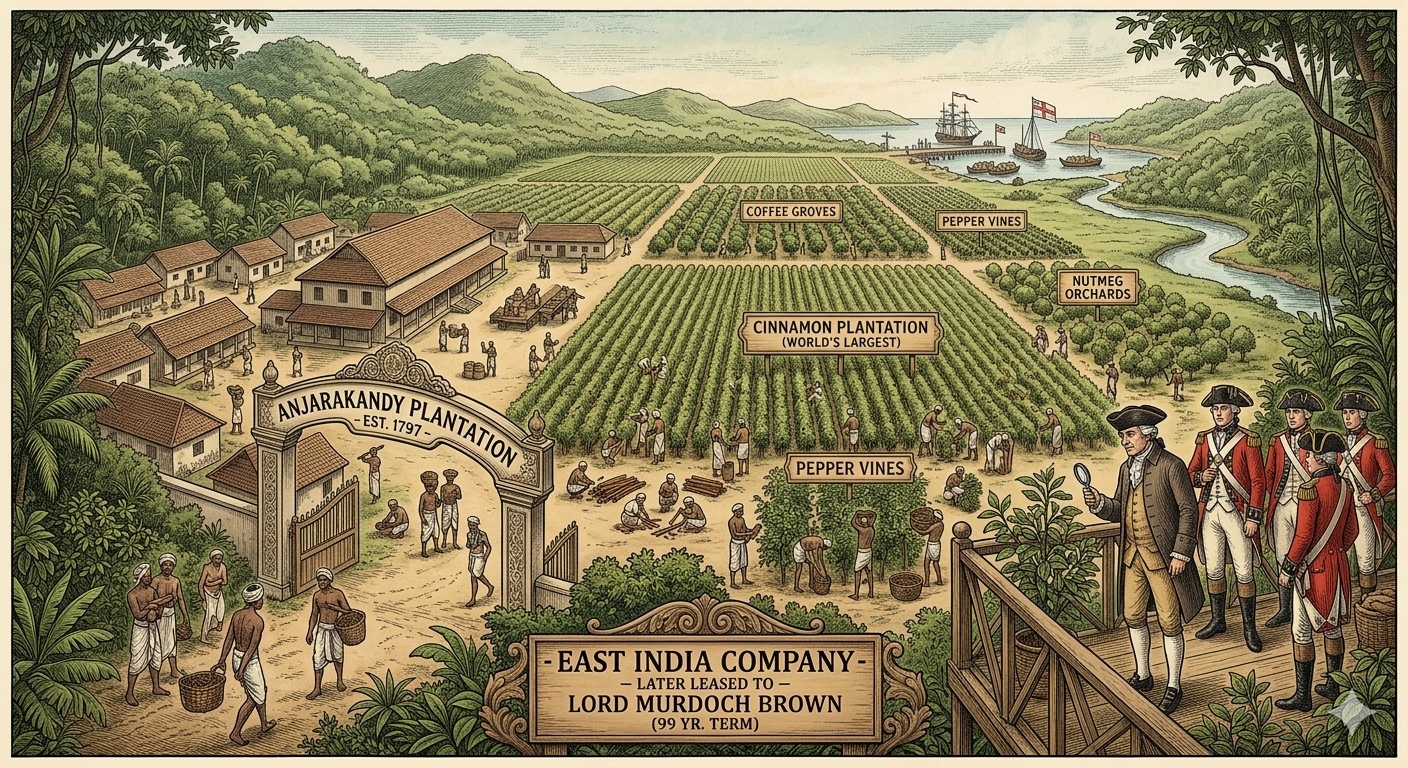
1797 (The Anjarakandy Plantation): The East India Company established a massive spice plantation in nearby Anjarakandy, later leased to Lord Murdoch Brown on a 99-year term. It cultivated coffee, cinnamon, pepper, and nutmeg, eventually growing into the world’s largest cinnamon plantation at the time.
Infrastructure Enablers: The colonial government built the Tellicherry Lighthouse in 1835 to guide heavy trade vessels, constructed a massive new spice warehouse in 1863, and even opened South India’s very first Sub-Registrar Office in 1865—solely to handle the complex property legalities of Murdoch Brown’s sprawling plantation.
1866 (Municipal Milestone): Under the Madras Act of 1865, the Thalassery Municipality was officially formed on November 1, 1866, making it the second oldest municipality in the state of Kerala.
The Ancient Monopolies: From Egyptian Mummies to Serpent Myths
Long before Europeans stepped foot in India, Arab traders held a strict monopoly over the Malabar pepper trade dating back to roughly 1500 BC. They navigated the coastline of the Arabian Sea, entering the inland regions via Kerala’s sprawling backwaters and rivers.
The scope of this ancient trade network was jaw-dropping. When the great Egyptian Pharaoh Ramesses II died in 1213 BC, his body underwent complex mummification rituals that included stretching black peppercorns from Malabar directly into his nostrils to preserve the shape of his nose.
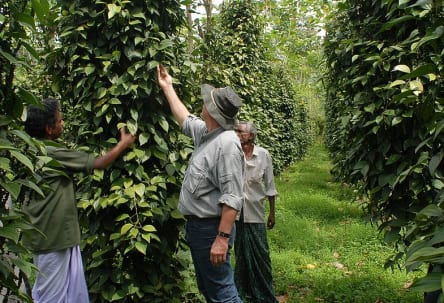
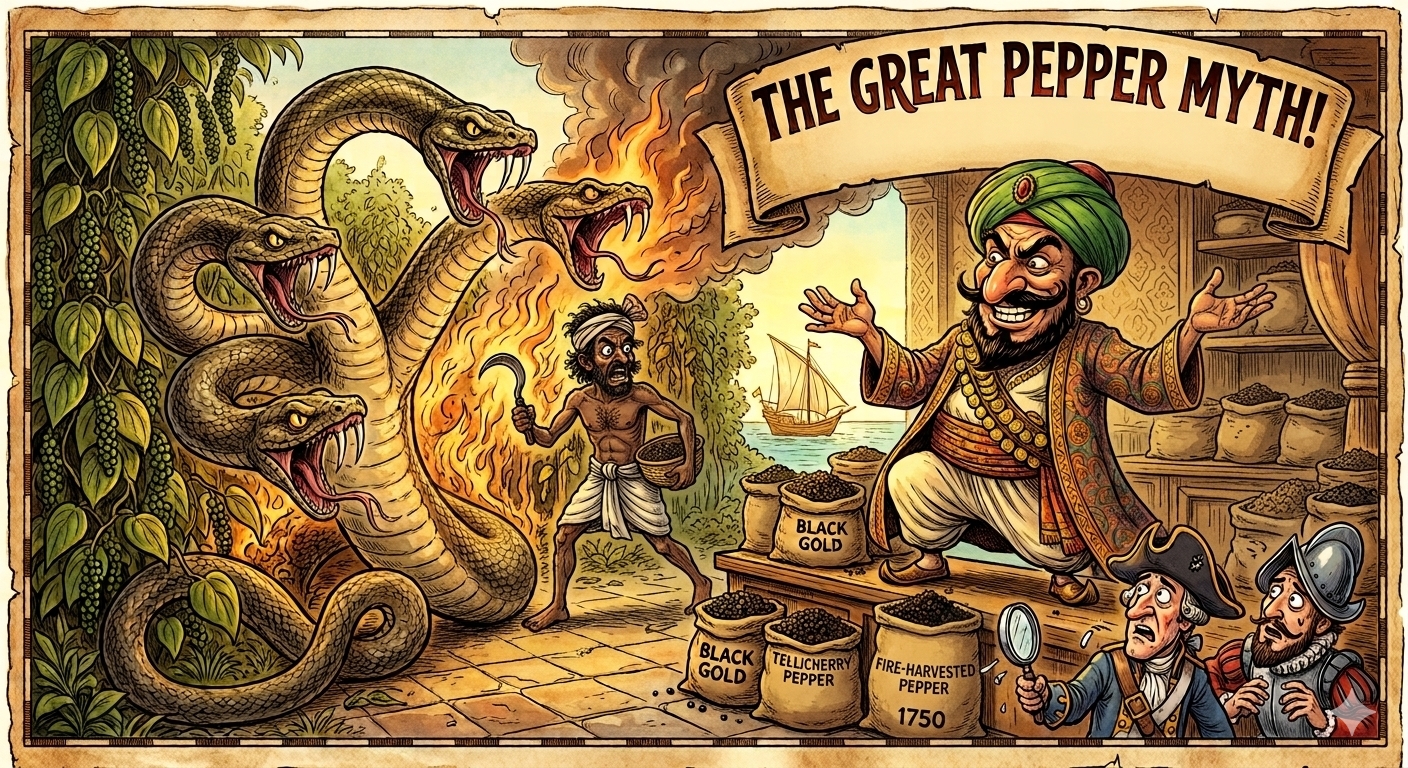
To protect this incredibly lucrative trade from inquisitive European empires, Arab merchants spun elaborate, terrifying myths. The merchants claimed that Tellicherry’s deep pepper forests were guarded by vicious, multi-headed serpents. To harvest the spice, locals supposedly had to set the forests on fire to scare the snakes away. According to the myth, it was this intense harvesting fire that scorched the peppercorns, giving them their signature shriveled, pitch-black color.
How Trade Sewed the Seeds of Religion
Unlike many regions of the world where religion arrived at the edge of a sword, Judaism, Christianity, and Islam came to Kerala purely through the peaceful channels of trade.
Islam: Continuous maritime interactions between Arab merchants and local communities led to settlements, marital alliances, and a flourishing Muslim population. In southern trading outposts like Kottayam’s Thazhathangady (Lower Market), Islam grew naturally around the riverbanks where spice barges docked. Kerala boasts the Cheramaan Juma Masjid (built in 629 AD), widely recognised as the oldest active mosque in the Indian subcontinent.
Christianity & Judaism: Local Saint Thomas Christians trace their roots back to the 1st century, believing that St. Thomas the Apostle traveled to Malabar on an ancient spice trading vessel. Later, waves of Jews and Christians fleeing persecution in Persia fled to Kerala on Arab ships and were welcomed with open arms by Hindu rulers. The Malabar Jews settled in Fort Kochi by the 12th century, building historic synagogues and even developing Judeo-Malayalam, a localised dialect of the native language
Black Gold and the Currency of the Modern World
Peppercorns were so highly valued in medieval Europe that they were known as Black Gold. The spice was used as direct commodity money to pay rent, taxes, and dowries.
This historic legacy still exists in modern Western legal systems today through the term peppercorn rent—a legal phrase denoting a nominal, token payment made simply to keep a contract legally binding. Similarly, the Dutch language still uses the phrase peperduur (pepper expensive) to describe items that carry an astronomical price tag.
It was this very financial desperation for pepper that drove Vasco da Gama to circumvent Africa in 1498, opening a direct sea route to India and eventually allowing the Portuguese to claim exclusive rights to the Malabar pepper trade under the Treaty of Tordesillas.
The Legacy Today
At one point in history, black pepper accounted for a staggering 70 percent of the entire international spice trade. As more global trade routes opened over the centuries, production democratized, prices stabilized, and the fiery spice integrated itself into the everyday cuisines of ordinary people across the globe.
Today, global agricultural dynamics have completely shifted. Vietnam is now the world’s largest producer and exporter of black pepper, supplying roughly 34% of global demand. Yet, despite the rise of massive corporate mega-farms across Southeast Asia, the culinary world still looks to the coast of Kerala. Jars in Canadian supermarkets proudly retain the names Malabar and Tellicherry—a tribute to the tiny Paris of Kerala and the historic black gold that fundamentally rewrote global geography.
A typical Syrian Christian family history will forcefully trace its roots to the to the 31 Brahmin families supposed to have been converted to Christianity by St Thomas, one among Jesus’ 12 disciples or to Pakalomattom, Kali, Kaliyankal, Shankarapuri Namboothiri (Brahmin) families, even though no documentary evidence exists to prove the connection.
After Jesus descended to heaven, all ten disciples moved Westward to spread the message of Christ and establish churches. Only St Thomas was sent Eastward (East must be a punishment posting then also as prevalent in the Indian Army.) This could be because St Thomas was known as the Doubting Thomas who refused to believe that the resurrected Jesus had appeared to the ten other disciples (Judas had committed suicide by then,) until he could see and feel the wounds received by Jesus on the cross. From this originated the English idiom of Doubting Thomasas a skeptic who refuses to believe without direct personal experience.
In the earlier days, the Syrian Christian priests could only be ordained from the Pakalomattom family (an effect of the Hindu caste system prevalent then.) Vasco da Gama landed in Kerala in 1498 and was surprised to find local Christians, involved in spice trade. In those days the Christians followed most customs of the local Hindus (some of it even continues today) and used Syriac as the liturgical language because of the association with Persia due to the spice trade. Hence the Portuguese called the local Christians as Syrian Christians and the Christians they converted as Latin Christians as they used Latin as their liturgical language.
The Portuguese after landing in Kerala realised that the princely priesthood of the Pakalomattom family had to be broken to have a hold on the local Christians and so ordained priests from other rival families. By 1660 they weaned away 84 of the 116 churches who aligned with Rome and became the Syro Malabar Catholic Church and the rest thirty-two churches and their congregations formed the Syrian Orthodox Church. The purported aim of the Portuguese was to wean away the local traders, mainly Christians, from the Muslim Arab traders.
It would be foolish on my part to do the same mistake others did and hence would limit to the details I had obtained by way of many discussions I had with our grandfather Karottu KT Varkey (he lived to the age of 104 and died in 2002.) Surely some of these would have been his figment of imagination and he also must have added enough spice to make it interesting for a hyper-active young boy.
In the nineteenth century Koduvath Easo (in those days the family name preceded the christen name) came with his daughter Eli and occupied Malamelkavu (in Malayalam meaning hillock with a temple on top,) in Kolladu village, about eight kilometer from Kottayam and settled there. Nothing is known about the other family members and from where Koduvath Easo came. Thomas married Eli and moved into Koduvath family as the Adopted Son (Jamai जमाई) (DathuPuthran ദത്തുപുത്രൻ.) From then on it is said that the ladies of the family have been more dominating and I can see it in today’s generation in the form of our daughter and her cousin sisters. Thomas and Eli had nine sons and two daughters with our grandfather being the eleventh. The nine sons and their further generations continue to live in and around Malamelkavu and some moved out in search of better jobs and opportunities.
The family belongs to the parish of St George Syrian Orthodox Church, Puthuppally (ex-Chief Minister of Kerala, Late Oommen Chandy’s family also belongs to the same church.) Kolladu village is located West of Puthuppally village and is separated by a river. Crossing the river up to 70’s was by means of a ferry, now by a bridge. The annual festival of the church is celebrated in first week of May and is like the annual festivals of the Hindu temples in Kerala. Vechoottu (a ceremonial feast), adya choroonu (a ritual in which children get their first rice feeding by priests,) etc. are some of the rituals associated with the festival. Later Raza, the grand festival procession taken out with the holy golden cross from the church, accompanied by Chenda Melam (drums of Kerala) and caparisoned elephants. The Raza is received by every household which falls on its route, irrespective of their religion, with a lighted lamp. In the evening the entire church is illuminated with lamps like any Hindu temples of Kerala.
The main offering to the church on the annual festival is fowl (preferably a rooster) as St George the patron saint of the church was a soldier and is believed to enjoy chicken. In the earlier days the fowls offered were slaughtered on the church premises and the fried chicken was served as Prasad to the devotees. This cruel practice was terminated by the 70’s being cruelty to animals.
I had heard a myth about the fowl slaughtering at the church from my grandfather. In the earlier days, there was a Kali (Hindu Goddess) temple situated atop the hill adjacent to the church. The fowls were offered there also on the annual festival day of the temple, which coincided with the festival day of the church. One day both St George and Kali came together in a dream of the village chieftain and they came to a compromise that the fowls are to be slaughtered at the church and meat prepared there (St George enjoyed the meat,) but the blood had to be collected and offered to Kali in the evening (Kali seemed to be interested only in blood) and that way only a few birds had to be sacrificed.
The next day the Holy Mass is offered at the church. At the end of the festivity, the Chicken Prasad is distributed to the devotees at the East and West gates of the church. The chicken pieces are carried to the gates in bamboo baskets. The teenagers from the Koduvath family now come into action and they snatch the chicken baskets and run as a relay race handing over the basket from one to another and swim across the river. The prasad thus snatched is distributed among the family members. The taste of the fried chicken will give run for the money to today’s Kentucky Fried Chicken (KFC.)This practice continued for some years and all our family members, whether barristers, teachers, government officials of those days were all nicknamed ‘ഇറച്ചിക്കൊട്ട (Irachi Kotta)’ (in Malayalam meaning Meat Basket) and many of us still carry the same nickname, especially while studying in schools and colleges in Kottayam.