The Music of the Scissors: A Lifetime of Rituals, from Kerala to Canada

Going for my monthly haircut at the local Canadian barbershop is more than just a routine; it is a quiet ritual I carried with me from my days in the Indian Army. The tradition began when I was just a nine-year-old Cadet joining Sainik School—a strict, weekly discipline that followed me all the way until I retired from military service in 2004. Over the decades, time claimed most of my hair, and the weekly requirement gracefully slowed into a monthly affair.

Here in Canada, it is often women who stand behind the barber chair. They are highly trained, licensed professionals. While many of them specialise in modern trends like intricate fades, beard grooming, or chemical treatments, my own stylist enjoys an incredibly easy assignment. My request never changes: a number 1 guard on the trimmer. It is one of the shortest settings before a bare blade, leaving a clean, near-skin look across my entire head for the few brave hairs that remain. Sitting in that modern Canadian chair, the hum of the electric trimmer often fades away, replaced by the distant, rhythmic sounds of my childhood in Kerala.
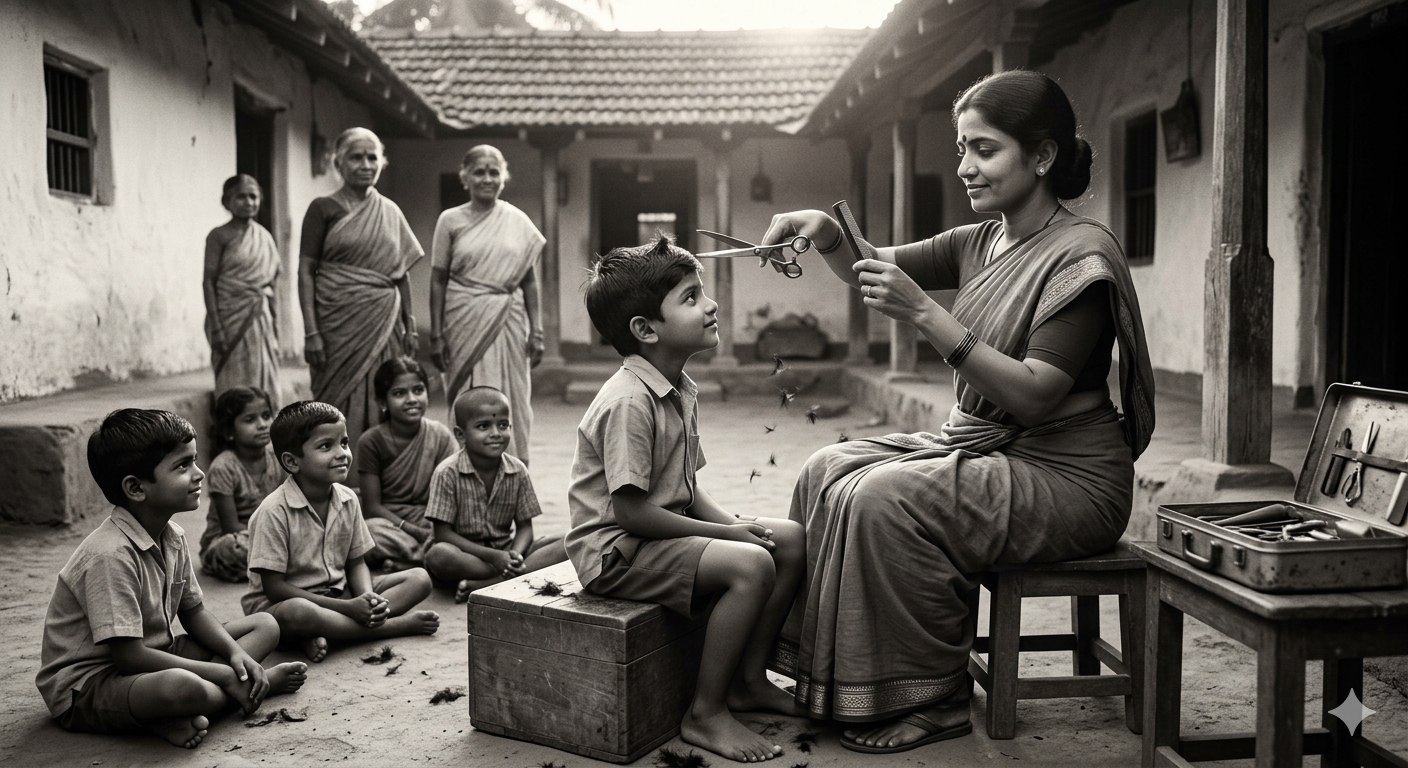
Back then, our neighborhood stylist didn’t work out of a shop. She was Kamalamma, and she walked from home to home to cut the hair of all the village children. Kamalamma had only one signature style for both boys and girls: as short as humanly possible.

Everyone in the village respectfully called her മൂപ്പത്തി (Mooppathi). In her late twenties, shortly after the birth of her second son, she tragically lost her husband, who had been the village barber. Left alone to run a household and feed three mouths, she did something incredibly brave for her time: she picked up her late husband’s tools and took over his trade. To me, she was the very definition of women’s empowerment—long before the word became a modern trend. She lived strictly on her own terms, driven by a quiet, fierce resilience.

Kamalamma had a gift. While other children screamed and rebelled against her blades, she could calm them instantly with a mother’s gentle authority. For me, the crisp snip-snip of her scissors wasn’t something to fear; it sounded like musical notes. I sat perfectly still, enchanted by the rhythm, as she softly hummed old Malayalam movie melodies while her hands gracefully worked.

As we crossed into our teenage years, Kamalamma stopped visiting our homes. Perhaps we had outgrown her simple, uniform cuts, or perhaps we had simply grown up. Our grooming moved to Gopi’s village barbershop—a lively place filled with community gossip where Gopi always held court, and we, wrapped in his barber capes, were reduced to passive, smiling listeners.

Today, my haircut takes only a few minutes. But every time I hear the blades move, I am briefly reminded of a brave woman, the familiar tunes of old Malayalam cinema, and the gentle music of a pair of scissors from a time long gone.
Wah Ustad Wah!!

Based on my last article about Drill Instructors at the Military Academy, (please click here to read) many readers asked about the Guru-Shishya (mentor-disciple) relationship. Specifically, how does it work when a Cadet becomes a commissioned Officer, yet their former instructor remains a Subedar (Warrant Officer) or Havildar Major (Sergent Major) —technically much junior to them in the military hierarchy?

This rare phenomenon is unique to the military, spanning across India and the globe. No matter how high a Cadet rises, they hold their instructors in the highest esteem. Every officer is deeply indebted to these mentors for shaping them into leaders.

A Historic Reunion: The Chief and the Instructor

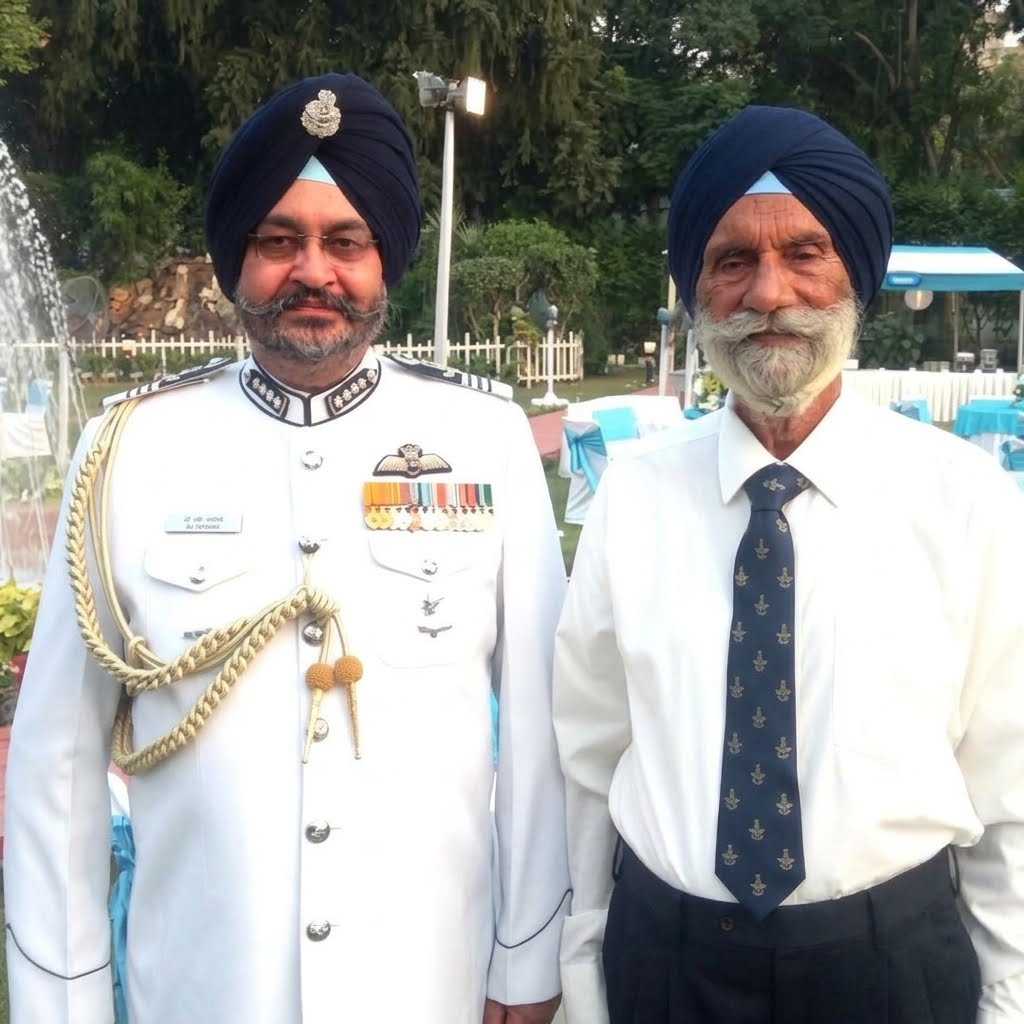
A perfect example of this bond occurred at the Indian Air Force (IAF) Day reception in October 2018. The former IAF Chief, Air Chief Marshal (ACM) BS Dhanoa, warmly reunited with his former National Defence Academy (NDA) drill instructor, Honorary Captain Faqir Singh.

Captain Faqir Singh had served as the Drill Instructor for E Squadron at the NDA before moving on promotion to become the Subedar Major of the 5 Sikh Regiment. Subedar Kalyan Chand replaced him and became our Drill Instructor thereafter.

That evening, Captain Faqir Singh was the most special guest at the Air Chief’s Akbar Road residence—a profound gesture of respect and gratitude. While Captain Singh praised ACM Dhanoa as an exceptionally disciplined cadet who excelled at drill, the Air Chief honoured his mentor by introducing him directly to Prime Minister Narendra Modi and the nation’s top military brass.

The Paradox of Rank and Authority

The relationship between an Officer Cadet and a Drill Instructor is one of the most foundational and unique dynamics in the armed forces. It is defined by a striking paradox: on paper, an Officer Cadet occupies a legal status above the enlisted ranks; in reality, the Drill Instructor holds immense institutional power, decades of experience, and absolute authority over the cadet’s daily life and training.

Drill Instructors are master tacticians, disciplinarians, and the keepers of military standards. They hold total operational authority to train, test, discipline, and evaluate. Their primary purpose is to transform a civilian into an elite leader of soldiers. They do not treat cadets as officers; they treat them as blank slates that must be forged under extreme stress. To an outsider, the interaction is characterized by flawless military bearing, strict customs, and intensive discipline.

Reel Life Mirroring Real Life: An Officer and a Gentleman

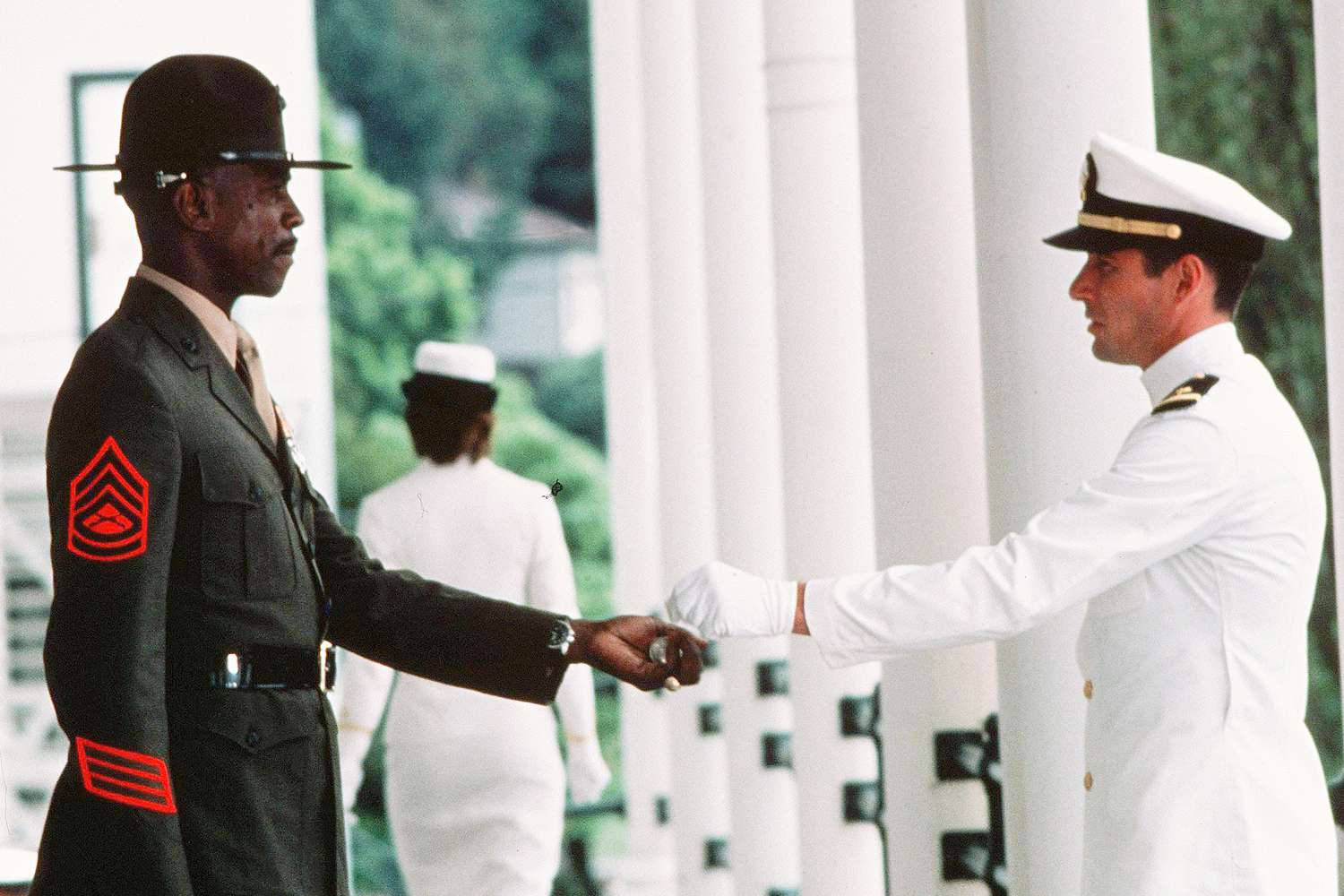
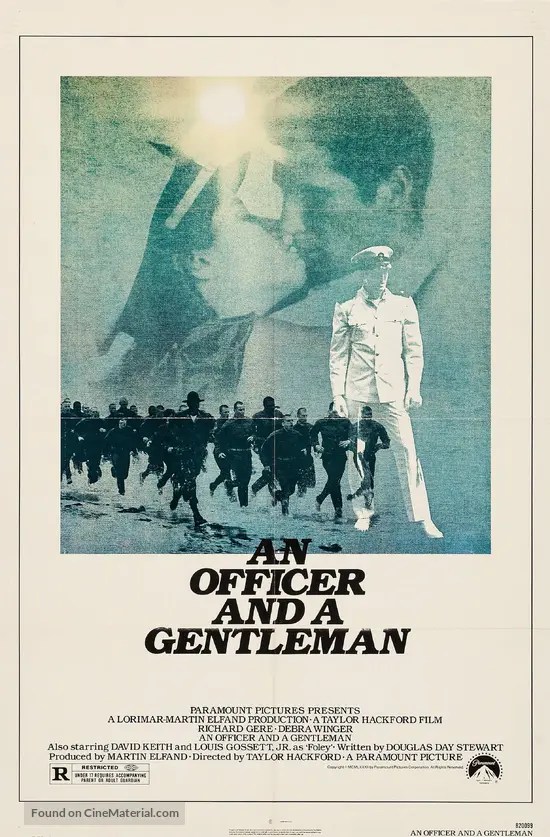
The relationship between Officer Cadet Zack Mayo (Richard Gere) and Drill Sergeant Gunnery Sergeant Emil Foley (Louis Gossett Jr.) in the 1982 movie An Officer and a Gentleman perfectly depicts this dynamic. It is a story defined by intense psychological warfare, a mutual testing of wills, and an eventual deep, unspoken respect.

Though Cadet Mayo will technically outrank Foley upon graduation, the drill sergeant holds absolute authority over him during the 13 weeks of Officer Training. Foley views Mayo as selfish, arrogant, and emotionally detached—someone using the Navy to escape a troubled background rather than possessing the integrity to lead sailors.

To expose his true character, Foley subjects Mayo to brutal physical punishment, extra chores, and constant psychological pressure. During an exhausting, weekend-long hazing session, Foley demands Mayo quit. Mayo breaks down and screams the iconic line, “I got nowhere else to go!” This vulnerability proves to Foley that Mayo genuinely needs the Navy and has the resilience to stay.

After this breakthrough, Foley shifts from trying to break Mayo to building him into a leader. He pushes Mayo to look beyond himself, which is realized when Mayo abandons his attempt to break an obstacle course record to help a struggling classmate.

The Final Silver Dollar

The climax of their dynamic occurs during graduation. By military tradition, a newly commissioned Officer gives a silver dollar to the first enlisted service member who salutes them.

When Mayo receives his commission, he locks eyes with Foley. Foley gives him a flawless, sharp salute and says, “Congratulations, Ensign Mayo.” Mayo hands him the silver dollar, smiles, and replies, “I’ll never forget you, Sergeant.” Foley’s gruff response—”Get out of here“—proves that beneath the harsh exterior, he succeeded in creating a capable leader.

It is this exact spirit that echoes in every academy across the world, captured perfectly in our own traditional salute: Wah Ustad Wah!

The Illusion of Efficiency

We Stay Late and How to Stop It

People often continue working in the office long after official hours to finish tasks without daytime interruptions, avoid immediate new assignments, or meet intense competitive pressures. In many corporate cultures, face time has become a proxy for productivity.

Why Employees Stay Late

Fewer Distractions: The office becomes quiet after hours, making it easier to focus without the constant barrage of daytime interruptions.

The Penalty for Efficiency: Finishing work quickly often leads managers to assign extra tasks rather than rewarding employees with an early departure. This deeply disincentivises efficiency.

Career Advancement & Perception: Employees work extra hours to stand out, hit ambitious goals, or simply to show the boss they are putting in the time.

The Boss Stays, I Stay Precedent: A toxic culture exists in many offices where subordinates feel obligated to remain at their desks as long as their manager is in the building.

Always-On Culture: Constant connectivity through mobile devices makes it increasingly difficult to disconnect once the formal workday ends.

Commute Timing: Some stay late simply to let rush-hour traffic clear before heading home.

Leading by Example: An Army Perspective

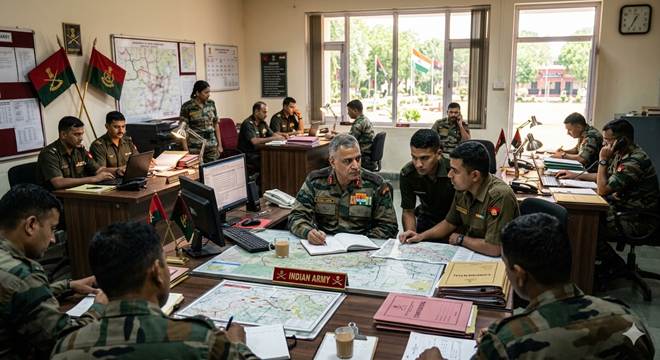
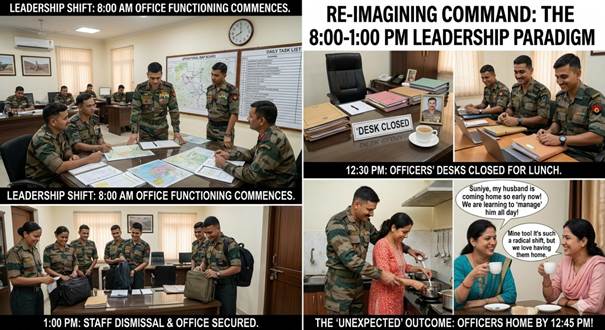
Breaking this cycle requires a deliberate shift in leadership. While commanding our Regiment, I insisted that office functioning commence strictly at 8:00 AM and that officers close their desks by 12:30 PM. This facilitated the office staff closing by 1:00 PM for lunch.

This was a radical shift from the norm. Historically, it appeared most Indian Army officers took their most critical decisions after 1:00 PM, dragging the workday into the evening. Our new schedule was so out-of-the-box that even the subordinate officers’ wives jokingly complained—their husbands were suddenly coming home by 12:30 PM, leaving the wives to manage them for the rest of the day!

Results Over Presence

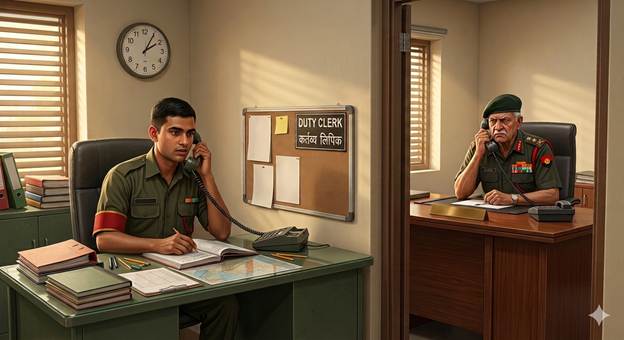
Predictably, this boundary-setting faced resistance from the traditional hierarchy. One afternoon, I received a call from a very senior Staff Officer—a Brigadier at the Headquarters—who was unhappy that a Duty Clerk, rather than an officer, had attended his call at 1:30 PM.

I asked him directly: “Was your order received correctly, and were the necessary actions executed to your satisfaction?“

He replied in the affirmative but reiterated that he wanted to speak to an officer, if not the Commanding Officer himself.

To this, I replied: “Our officers leave by 12:30 PM and the office closes by 1:00 PM. You spoke to the Duty Clerk, and he took down your orders without question. Had it been any of our officers, they would have raised queries and debated the issues. Had I been there, I might have even refused to undertake the task, as you understand our Regiment is already over-committed.“

The Power of Respect

True capability speaks louder than late-night desk-sitting. Two months after that conversation, our Adjutant, a young Captain, visited this same Staff Officer at the Headquarters. The Brigadier made our Adjutant sit down and personally offered him a cup of tea.

Upon returning to the Regiment, the Adjutant came to me, pleasantly surprised: “Sir, he made me sit in his office while many officers senior to me who came in were left standing. He even gave me a cup of tea.“

I told him: “As far as he is concerned, you are commanding the Regiment, and he needs to get work out of you. He knows very well that our Regiment will execute all his critical tasks—night or day, at a moment’s notice—most effectively. Because of our competence, he knows he must keep you on his right side.”

Efficiency isn’t about how many hours you log under the office lights. It is about building a well-oiled machine that delivers flawless results on time, allowing its people the freedom to rest, recharge, and return sharper the next morning.

The Best Kind of Tattoos: A Parent’s Reflection on Family, Military Service, and Choices

Like many Canadian teenagers, our children went through a phase when they desperately wanted tattoos—largely because all their friends were getting them.

Whenever the topic came up, I gently discouraged them. I reminded them that we have no right to disfigure the beautiful, God-given skin we are born with. I told them to remember that their mother carried them for ten months, and together, we poured our hearts into raising them and protecting their health.

My own mother used to look at me and lament that not even an inch of my skin was left intact—courtesy of my reckless childhood pranks and my years in military service. Pointing to my own scars, I always jokingly suggested to our children, “If you want tattoos, get the natural ones, just like mine.”

To add a bit of practical deterrence, I also made it clear that I wasn’t going to foot the bill for any ink. Of course, they earned good money from their part-time jobs during high school and didn’t actually need my financial help, but the principle stood.

How can I forget my first tattoo?

In my childhood, I was always fascinated by the brood my mother reared. The most dominant cock assumed the position of a rooster, leading the flock. There were many duels to establish supremacy, and the defeated cocks submitted to the rooster. The rooster always pushed ahead of the females to have first pickings of the food while the hens stood back. Our neighbour’s rooster was bigger and always bullied ours. In one such fight, I—then aged about four—barged between the two roosters in an attempt to protect ours. The neighbour’s rooster literally flew into a rage and pecked my forehead, leaving me bleeding and presenting me with a scar that became my identification mark. A mark of recognition! How would I be identified without the help of the neighbour’s rooster? A philosophical poser.

Today, looking back, we feel an immense sense of parental pride. Our children heeded our advice, respected our perspective, and still carry their pristine, God-gifted skin.

Tattoos and the Canadian Armed Forces (CAF)

Ironically, given my own military background and the scars that came with it, the military has evolved significantly regarding body art. For those who do choose to serve, the Canadian Armed Forces (CAF) currently permits tattoos, body art, branding, and scarification. However, they must adhere to the specific standards of dress, deportment, and non-offensive content outlined in the CAF Dress Instructions:

  • Allowed Tattoos: Most tattoos on the arms, legs, and torso are fully acceptable in uniform.
  • Prohibited Content: Tattoos are strictly banned if they depict nudity, are associated with criminal activities, or promote hatred, violence, discrimination, or harassment. This includes content reflecting racism, sexism, xenophobia, or sexually explicit material.
  • Head and Face Restrictions: Tattoos on the face, head, and scalp are generally prohibited. Rare exceptions are made only for approved cultural, religious, or natural-looking cosmetic purposes. Furthermore, extreme body modifications—such as sclera (eyeball) tattoos—require an individual medical assessment.

In the end, whether it is the regulations of the military or the guidance of a parent, the boundaries we set are always about pride, respect, and how we choose to present ourselves to the world. And sometimes, the best tattoos are the ones life gives us—whether we ask for them or not.