
Going for my monthly haircut at the local Canadian barbershop is more than just a routine; it is a quiet ritual I carried with me from my days in the Indian Army. The tradition began when I was just a nine-year-old Cadet joining Sainik School—a strict, weekly discipline that followed me all the way until I retired from military service in 2004. Over the decades, time claimed most of my hair, and the weekly requirement gracefully slowed into a monthly affair.
Here in Canada, it is often women who stand behind the barber chair. They are highly trained, licensed professionals. While many of them specialise in modern trends like intricate fades, beard grooming, or chemical treatments, my own stylist enjoys an incredibly easy assignment. My request never changes: a number 1 guard on the trimmer. It is one of the shortest settings before a bare blade, leaving a clean, near-skin look across my entire head for the few brave hairs that remain. Sitting in that modern Canadian chair, the hum of the electric trimmer often fades away, replaced by the distant, rhythmic sounds of my childhood in Kerala.
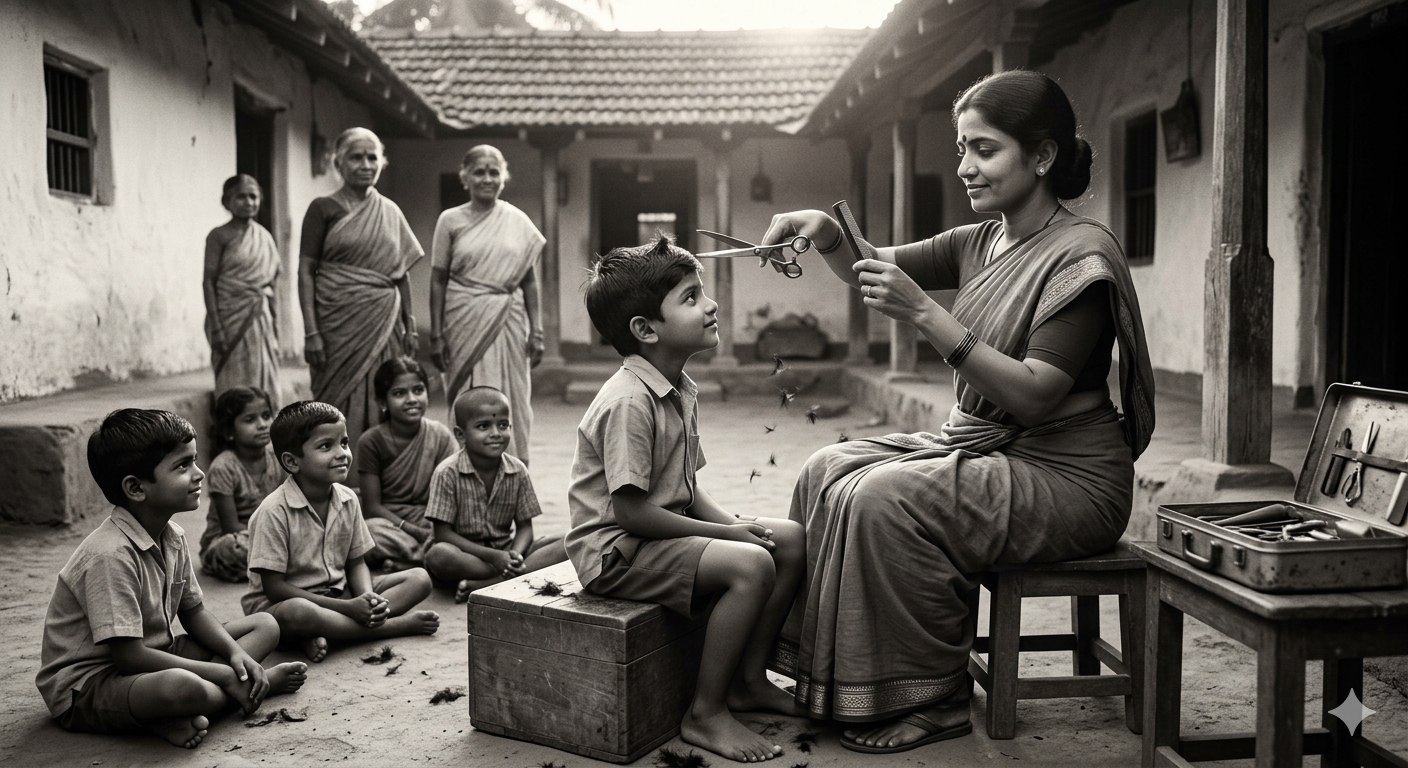
Back then, our neighborhood stylist didn’t work out of a shop. She was Kamalamma, and she walked from home to home to cut the hair of all the village children. Kamalamma had only one signature style for both boys and girls: as short as humanly possible.
Everyone in the village respectfully called her മൂപ്പത്തി (Mooppathi). In her late twenties, shortly after the birth of her second son, she tragically lost her husband, who had been the village barber. Left alone to run a household and feed three mouths, she did something incredibly brave for her time: she picked up her late husband’s tools and took over his trade. To me, she was the very definition of women’s empowerment—long before the word became a modern trend. She lived strictly on her own terms, driven by a quiet, fierce resilience.
Kamalamma had a gift. While other children screamed and rebelled against her blades, she could calm them instantly with a mother’s gentle authority. For me, the crisp snip-snip of her scissors wasn’t something to fear; it sounded like musical notes. I sat perfectly still, enchanted by the rhythm, as she softly hummed old Malayalam movie melodies while her hands gracefully worked.
As we crossed into our teenage years, Kamalamma stopped visiting our homes. Perhaps we had outgrown her simple, uniform cuts, or perhaps we had simply grown up. Our grooming moved to Gopi’s village barbershop—a lively place filled with community gossip where Gopi always held court, and we, wrapped in his barber capes, were reduced to passive, smiling listeners.
Today, my haircut takes only a few minutes. But every time I hear the blades move, I am briefly reminded of a brave woman, the familiar tunes of old Malayalam cinema, and the gentle music of a pair of scissors from a time long gone.

