
What is a Blue Moon?
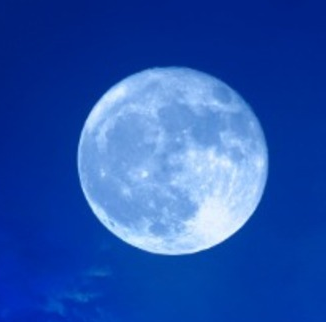
A Blue Moon is traditionally defined as the second full moon occurring within a single calendar month. On May 31, 2026, a full moon will follow the Flower Moon of May 1. This particular event will also be an Apogee Micro-Moon, meaning the moon will appear slightly smaller and dimmer than average.
This exceptionally rare phenomenon of Micro Blue Moon—a convergence of two events: the second full moon of the month and the moon reaching apogee, its farthest point from Earth in its orbit. As a result, it will be the smallest and dimmest full moon of 2026, a Blue Moon and the most distant full micromoon of the year. It is also the Flower Moon.
The May 30–31 full moon will appear roughly seven percent dimmer than an average full moon and approximately 25 to 30 percent dimmer than a Supermoon—that is, a particularly close full moon.
What is a Flower Moon?
Scientifically, a Flower Moon is simply a standard full moon phase, during which Earth sits directly between the sun and the moon, making the lunar disk appear completely illuminated from our perspective. The moon does not physically change shape or sprout petals; the name is entirely seasonal.
The name Flower Moon originates from The Old Farmer’s Almanac, which compiled traditional names used by Native American, Colonial American, and European sources. The specific term Flower Moon is attributed to Algonquin communities, honouring the abundance of spring wildflowers that bloom across North America during May.
What is a Blue Moon?
The concept of a Blue Moon as the second full moon in a month is more recent. It stems from the March 1946 issue of Sky and Telescope magazine, which published an article titled Once in a Blue Moon by James Hugh Pruett. He referenced the 1937 Maine Farmer’s Almanac, which defined Blue Moons as the third of fourth full moons in a season. However, he inadvertently simplified the definition, writing: ‘Seven times in 19 years there were – and still are – 13 full moons in a year. This gives 11 months with one full moon each and one with two. This second in a month, so I interpret it, was called Blue Moon.‘
Had Pruett examined the actual date of the 1937 Blue Moon, he would have found it occurred on August 21, 1937. Moreover, there were only twelve full moons in 1937; a calendar year generally requires thirteen full moons to have two full moons within a single month. Despite this oversight, his interpretation gave birth to a new and perfectly understandable definition of the Blue Moon.
This notion lay buried for decades. Then, in the late 1970s, EarthSky’s Deborah Byrd chanced upon a copy of the old 1946 issue of Sky and Telescope in the stacks of the Library at the University of Texas Astronomy Department. Subsequently, she began using the term Blue Moon to describe the second full moon in a calendar month on the radio series StarDate, which she wrote and produced.
Later, this definition was popularised by a children’s book by Margot McLoone-Basta, titled The Kids’ World Almanac of Records and Facts, published in New York by World Almanac Publications in 1985.
Looking Ahead
The next seasonal Blue Moon will fall on May 20, 2027—another opportunity to gaze up and marvel at the poetry of our skies, where even a “simple” moon can carry centuries of stories, misunderstandings, and wonder.