
By Brig Azad Sameer (Retd)
Back in 2005 I was posted at Baramulla, where the security of the military station was one of my responsibilities. In a region where the line between peace and insurgency is razor-thin, my days were defined by a restless vigilance. You learn to expect the unexpected in the valley, but nothing – no tactical briefing, no combat experience, no seasoned intuition – could have prepared me for the raw, celestial terror of that morning.
My mission was to visit and familiarise myself with the Kayian Bowl, a sensitive deployment right on the Line of Control (LOC.) I set off from Baramulla in a staff car, eventually reaching the high-altitude pass of Tutmari Gali (TMG) at an altitude nearly 11000 feet. As we began our descent from the pass, the world opened up into a view that was nothing short of jaw-dropping. The Kayian Bowl lay beneath us like a hidden emerald kingdom, framed by the jagged, snow-dusted peaks of the Himalayas that seemed to pierce the very fabric of the sky with a majestic beauty. The Lipa valley lying across the LOC looked equally enchanting. It was a vista of deceptive serenity – vast, silent, and breathtakingly beautiful—a reminder of why this land is both loved and fought over.
At TMG, I swapped into an Army Gypsy, with a young Major taking the wheel to navigate the rugged mud tracks. We were a small convoy of three vehicles; behind us, a protection party sat armed to the teeth, their eyes scanning the dense tree line for any sign of hostility. In these ancient forests, a sudden crack of a branch usually signaled an ambush. We were prepared for a firefight. We were not prepared for the earth waiting to betray us.
Suddenly, the world went mad.
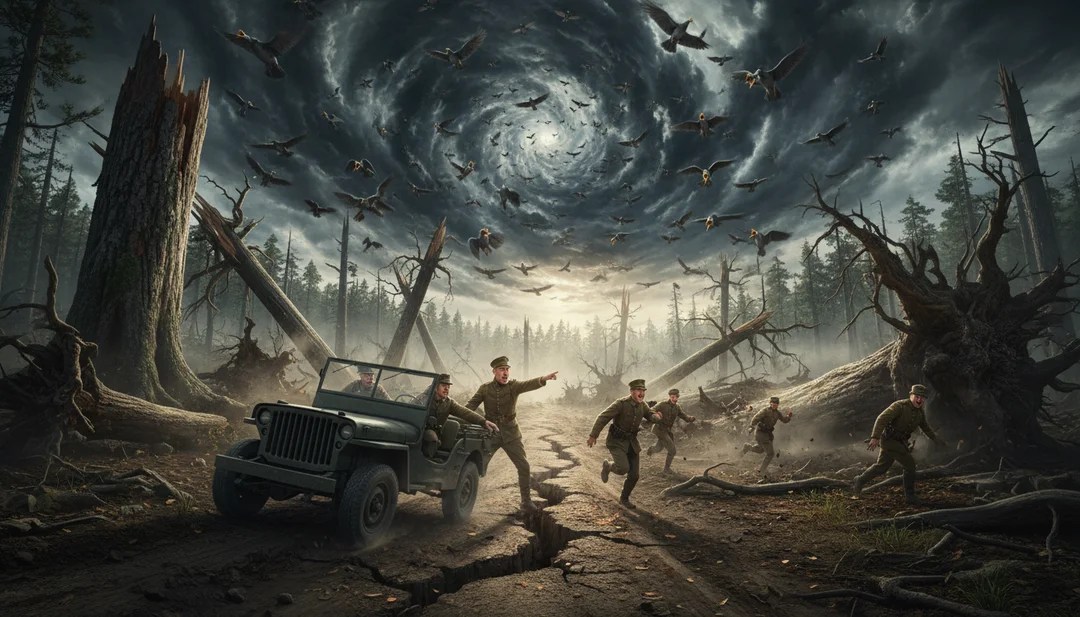
At first, it looked like a freak gale. The towering pines began to sway with a violent, rhythmic intensity that defied logic. “It’s a sudden storm!” I shouted over the rising roar.
“No, Sir,” the Major yelled back, his voice tight with a realisation that chilled my blood. “It’s an earthquake! Run for the clearing!”
He jammed on the brakes, the tyres skidding as the very track beneath us began to ripple like a carpet being shaken. We scrambled out, and the sensory assault became a nightmare. The forest wasn’t just moving; it was screaming. Thousands of birds took flight in a panicked, black cloud, their shrieks creating a deafening, discordant cacophony. Then came the sound of the giants falling – massive, deeply rooted trees snapped like matchsticks, hitting the ground with bone-jarring thuds that competed with the underground growl of the shifting tectonic plates.
In that moment, decades of military tactics evaporated. We weren’t soldiers or commanders; we were fragile organisms clinging to a dying planet. We huddled together in the center of a small clearing – a dozen men, shoulder to shoulder, stripped of rank and held together by a primal, shivering terror.
“Hug the ground!” I roared, throwing myself down.
Lying face-down, I felt the pounding of my heart and the trembling of the earth merge into an eerie resonance that vibrated through every pore of my being. It wasn’t just shaking; it was a violent heaving. The ground felt liquid, bucking and surging in a relentless, rhythmic assault that seemed to last an eternity. I remember the terrifying sight of the soil itself breathing, cracks snaking through the mud as we pinned ourselves to the earth. Would the cracks open up and just swallow us whole?
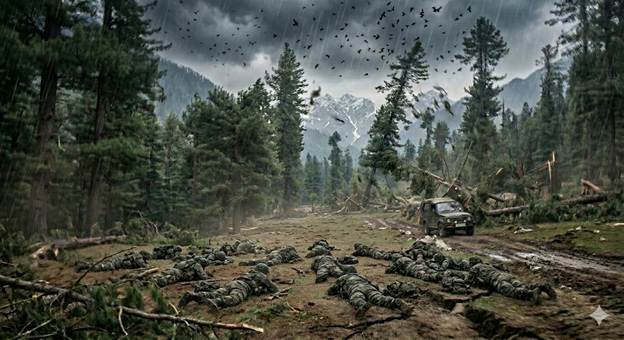
When the first tremors finally petered out, a heavy, suffocating silence fell – only to be shattered moments later by the aftershocks. Each time the earth shuddered anew, the terror felt sharper, more exhausting, and a cruel reminder of our helplessness.
After what felt like the longest ten minutes of my life, the earth finally went still, though the animals continued their frantic, wild cries. The transition back to soldiering was jarring. The Major, shaking off the paralysis of the moment, immediately began checking personnel and gear. We were lucky. We were all there. But the track we had just traveled told a grim story—a massive tree lay across our path just fifty yards from where we had stopped. Had we stayed in the vehicles for seconds longer, we would have been crushed into the mud.
Leaving a party with the vehicles, we trekked the rest of the way to the Battalion Headquarters on foot. When we arrived, the Commanding Officer (CO) greeted me with a crisp salute and a calm smile, as if the mountains hadn’t just tried to tear themselves apart.
“Tea, Sir?” he asked, his voice steady.
Over a hot cup of tea, he gave the status report: one collapsed bunker, two injured boys, and a mule. He spoke with the courage of a man used to hardship, but as I held my cup, I could still feel the phantom vibrations in my bones. We had survived the harrowing unpredictability of the LOC for eternity, but that day, we learned the ultimate truth: the greatest threat isn’t always the enemy in the woods – it could be the very ground beneath your feet.
Looking toward the West, I watched the blue sky churn into a muddy brown, as though an invisible hand had shaken a jar of silt into a basin of clear water. The rising dust told me at once that the epicenter was somewhere over Pakistan Occupied Kashmir (POK,) yet I remained oblivious to the chilling reality: we were standing a mere 20km from the heart of the upheaval. We were also unaware of the human tragedy that was unfolding all around us. In his characteristic business as usual tone, the CO commenced his briefing for me. Halfway into the briefing, there was a fresh wave of tremors and we hit the ground. When it was over we were back on our feet. “May I have your permission to resume sir”? Military etiquette. Both of us must have been a bit crazy. Resume he did and completed his briefing ten minutes later.
All through the briefing, I was contemplating the return to TMG. The track was blocked by fallen trees. As though reading my thoughts, he said “Sir, for your return to TMG, I can give you one mule, the rest of your party will have to trek along.” And so it was. A little later, I bid good bye and we commenced our climb back to TMG.
The return journey to TMG was a three-and-a-half-hour climb into a world that felt fundamentally broken. Perched atop a mule – a sturdy, stoic creature led by a civilian porter – I looked out over a landscape transformed by violence, not of man, but of the nature itself. Behind me followed a small party of half a dozen soldiers, my trusted protection party. On any other day, our eyes would have been scanning the ridgelines for the glint of a barrel or the movement of a shadow; but today, the threat of terrorism had vanished, replaced by a much older, more primal fear. We weren’t looking for insurgents; we were watching the sky and the very ground beneath the mule’s hooves.
The terrain was a graveyard of geology. Around every bend, the hillsides bore the jagged white scars of fresh landslides, and the mule track was frequently bisected by deep, sinister fissures – cracks in the earth that looked like lightning bolts frozen in soil. There were stretches where the path narrowed to a mere ribbon of dirt, and the mule walked with a terrifying, casual grace barely inches from the edge of a precipice. From my vantage point, the drop was a dizzying plunge into bottomless depths. One misstep, one loose stone, and the journey would end in a silent, terrifying dive into nothingness.
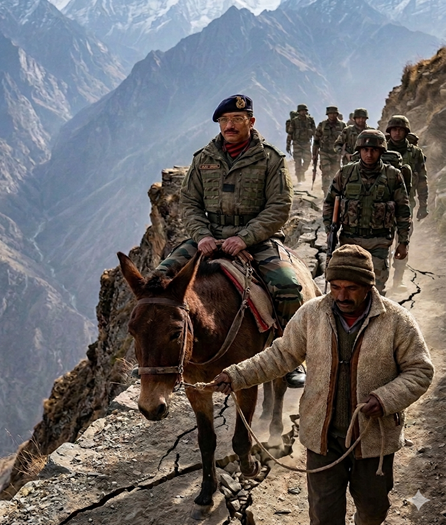
Nature seemed to have a rhythmic, punishing pulse. Every thirty minutes or so, the mountain shivered with a fresh aftershock. It was uncanny; seconds before the tremors hit, the mule froze and let out a snort two, sensing the vibration before it reached us. Our soldiers instantly dropped into a lying position, seeking safety in the dirt, while I remained stuck atop the animal – exposed and conspicuous, a sore thumb in a landscape that was trying to shake us off. We watched in breathless silence as boulders, dislodged by the quakes, thundered down distant slopes. It felt as though the Almighty was shielding us with an invisible hand, guiding the rocks away from our narrow path, yet the terror remained a constant cold companion.
The mental pressure of the precipice eventually broke my nerve. I decided to trust my own aging and tired feet than the hooves of even the most sure-footed beast. I dismounted and walked the rest of the way, feeling the tremors through my boots. Then, a surreal touch of the modern world pierced the desolation. Through a technological miracle of military communication patching, a phone call from Delhi crackled to life over our radio’s handset. It was a General, a stalwart former CO of our Regiment, his voice booming with impeccable radio telephony. He was calling because my wife in Pune was in a state of panic; the TV news was a montage of destruction, and I had been unreachable. Speaking into the handset amidst the dust and the shifting rocks, I told him we were safe, under the watchful eye of some Super Power. Minutes later the good news travelled to Pune and comforted a family in panic. We finally limped into TMG at 3:00 PM, weary survivors of a trek across mountains that refused to stay still.
The aftershocks even as far as in Baramulla continued for many days until we became sort of immune to them and stopped reacting. As the dust finally settled and the tremors grew faint, the true scale of the catastrophe began to emerge from the haze. What we had experienced on that lonely mountain track was just a fraction of a larger, more distressing tragedy. The earthquake of October 8, 2005, had not recognised the LOC; it had carved a path of devastation through the mountains, leaving a trail of death and ruins on both sides. Populated towns on either side were reduced to rubble. Villages that had stood for centuries were reduced to piles of stone and timber, and the vibrant life of the hills was replaced by a hollow, haunting silence. Thousands had perished in an instant, and for those who survived, their livelihoods and homes had vanished into the very earth that once sustained them. Just one piece of statistics. Nearly 75000 people perished, mostly in POK.
In the days that followed, our role shifted from the vigilance of soldiers to the compassion of rescuers. The Army was drawn into one of the most complex and grueling disaster relief operations in history. We found ourselves navigating fractured terrain to reach isolated hamlets, airlifting supplies to the stranded, and sharing what little we had with those who had lost everything. The uniforms that usually symbolized the fight against terror and infiltration now stood for hope. Amidst the immense loss and displacement, we witnessed the resilience of the human spirit, but the scars on the landscape and in the hearts of the people would remain long after the mountains finally stopped shaking.

