
By Brig Azad Sameer (Retd)
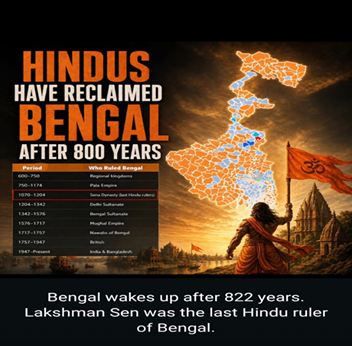
Earlier today, a friend sent me a digital poster. It featured a map of Bengal, a timeline of dynasties, and a bold headline: Hindus have reclaimed Bengal after 800 years. I am someone who by accident of birth is a Muslim, although the funny part is that some of my clan demand proof. To, me the image of the poster didn’t just feel like a political update; it felt like a silent, invisible boundary line being drawn across a shared past. My friend insisted it was just history and general knowledge. I accepted the words in silence. We continue to be the great friends that we have been all these years, bound by shared memories that predate these shifting sands. Yet, beneath that clinical defense lies a troubling psychological shift: the quiet transformation of a modern democratic mandate into a narrative of ancient civilizational warfare. It makes one wonder when our personal bonds became so fragile that they required the armor of historical justifications.
This uneasy realisation feels particularly sharp against the backdrop of my own life. I spent nearly three and a half decades serving in the Indian Army, retiring some fifteen years ago. In all those years of wearing the uniform, moving shoulder to shoulder with men of every conceivable background, I never once felt a sense of exclusion. The camaraderie was absolute, the shared identity unquestioned. But today, something seems to have changed decisively. A subtle, cold current has entered our collective consciousness, making me look back at my service not just with pride, but with a quiet, growing yearning for a time when belonging was simply understood.
When a political victory is framed as a religious reclamation, the implications feel heavy and deeply unsettling. It suggests that for more than a millennium, anyone not of a specific faith was merely an occupier, an interloper, or a guest whose time has run out. This mindset views the ballot box not as a tool for governance or social welfare, but as a sword for correcting history’s perceived grievances. It forces us into an archaic mindset, replacing the quiet dignity of a citizen with the harsh, binary identity of the conqueror or the conquered. We are no longer neighbors building a future together; we are ghosts re-enacting ancient battles.
If the majority begins to view political success as a religious re-conquest, the delicate concept of a pluralistic society starts to fracture. Where does that leave the minorities? It leaves them in a state of perpetual audition – constantly needing to prove their belonging to a land that their ancestors have called home for generations. It turns everyday neighbors into others and shared regional histories into a zero-sum game of winners and losers. There is deep loneliness in realising that the soil you walked upon, defended, and loved is suddenly being measured by a yardstick you can never meet.
True knowledge should tell us that history is a complex tapestry, woven with threads of coexistence, compromise, and shared survival. It is more often than not a perspective of the writer and the reader, not a scoreboard of tribal triumphs. When we celebrate a political win as a religious victory, we don’t just exclude millions; we diminish the very democratic values that allowed the win to happen in the first place. In trying to reclaim a past that cannot be changed, we risk losing the fragile, precious present we have built together.


Dear Reji with all deference to the august Author, this is absolute tripe and BS at least in current times. I know how you have worked thru all kinds of personnel from the AIC units. You proudly narrate it and I also feel enthused by those narrations. I have yet to experience this kind of looking over the shoulder foreboding as the author espouses. What nonsense. We are not in the dark ages. We are part of a professional mission oriented Army working on Naam, Namak, Nishaan. I daresay we shall ever need an algorithm to add a criteria of religious inclination in getting any team together for any msn. IN and IAF for example work on skill sets and not on religious overtones. Army has a religious overtone but then that is on basis of history and its class composition. I have commanded both SIC and AIC units and have never felt this negative vibe. We have been thru the thick of it thru Khalistan, Babri Masjid, Insurgency and what not. This demon has never reared its head. May I kindly request you to moderate such articles which are more divisive and need junking. The present dispensation has done a lot for the services both on personal and on eqpt modernisation front with no diktats. The politics is not part of our verbal and non verbal exchange in the service. Yes as civilians we do build opinions but in uniform we wore blinkers to it (at least you and I did). Sorry for being upfront but it has riled my OG origins which were laid foundation to thru my teenage years in NDA and consolidated to my late 40s. Jai Hind
LikeLiked by 2 people
Thank you for the response. I Respect your views. But I wonder if you read a little too much into it. It was purely the author’s reaction to the poster which you can see. It was a lament on the idea of equating a political victory to a religious reclamation and on the mindset of the people who make such posters. If you differ on that count, you are welcome. After all we all are entitled to our views.
LikeLike