
Geography class just got a lot more complicated.
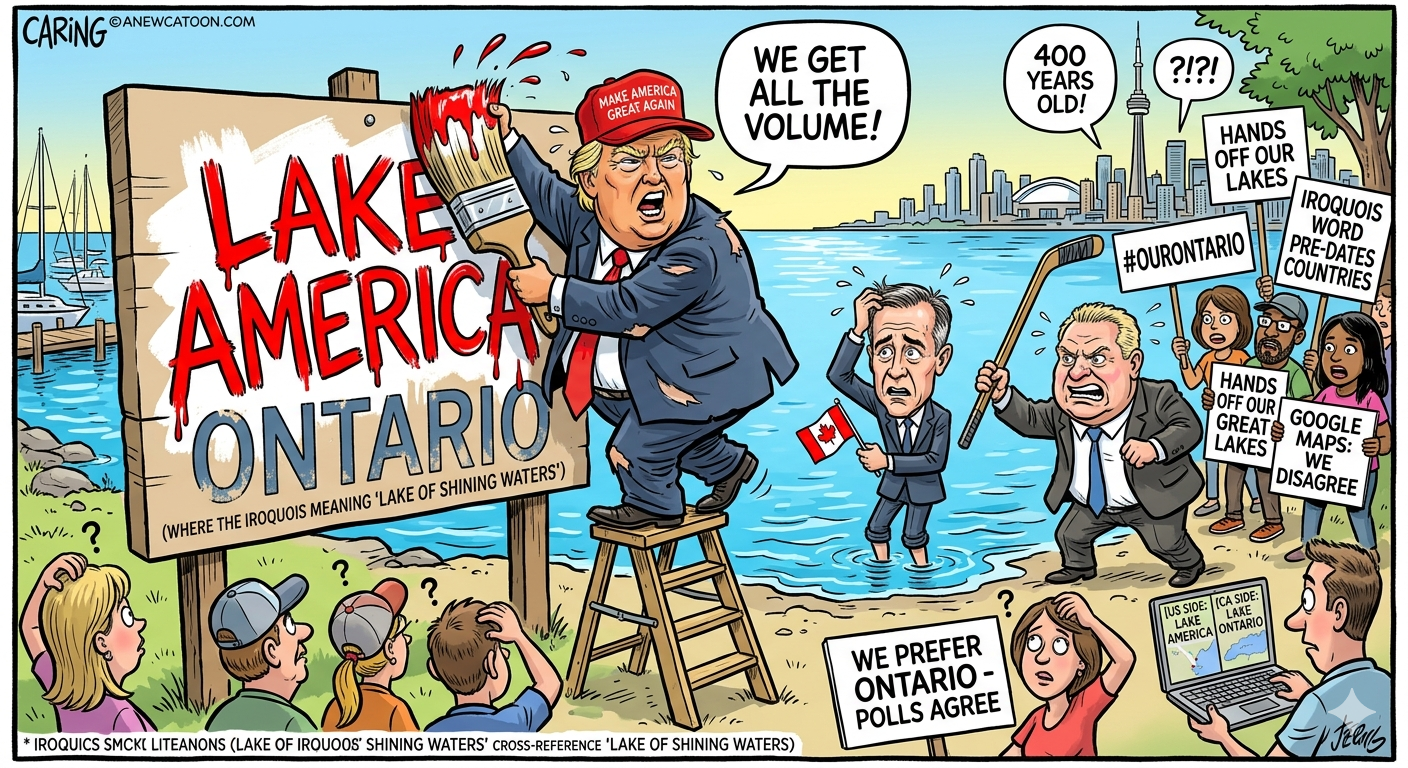
On August 27, 2026, U.S. President Donald Trump signed a striking executive order: the American portion of Lake Ontario is officially being rebranded as Lake America. Trump directed Interior Secretary Doug Burgum to update the domestic Geographic Names Information System (GNIS), justifying the change by claiming that the deepest channels and most of the lake’s water volume physically sit inside U.S. borders.
If this sounds familiar, it is because it is part of a pattern. The move mirrors a 2025 executive order that attempted to rename the Gulf of Mexico to the Gulf of America—an effort that mostly resulted in international blank stares.
Silicon Valley Picks Sides
The executive order has instantly fractured our digital maps. Tech giants Google and Apple quickly rolled out geo-fenced updates. If you open Google Maps inside the U.S., you will see Lake America. But if you log in from Canada or anywhere else in the world, it still reads Lake Ontario.
Not everyone is playing along, though. Legacy mapping services like MapQuest have publicly refused to implement the change, choosing to stand by the traditional name across all versions of their software.
The Backlash from Canada
The diplomatic response from Canada was swift and blistering. Canadian Prime Minister Mark Carney and Ontario Premier Doug Ford slammed the rebrand. They pointed out that the name Lake Ontario is over 400 years old, originating from the Iroquois word Ontarí’io (lake of shining waters)—a piece of history that predates the existence of both modern nations.
The resistance is not just international; it is domestic too. In the U.S. House of Representatives, bipartisan lawmakers have already introduced the Hands Off Our Great Lakes Act to starve the renaming project of federal funding. Early polls show that a solid majority of everyday Americans are also pushing back against the change.
Hormuz Strait
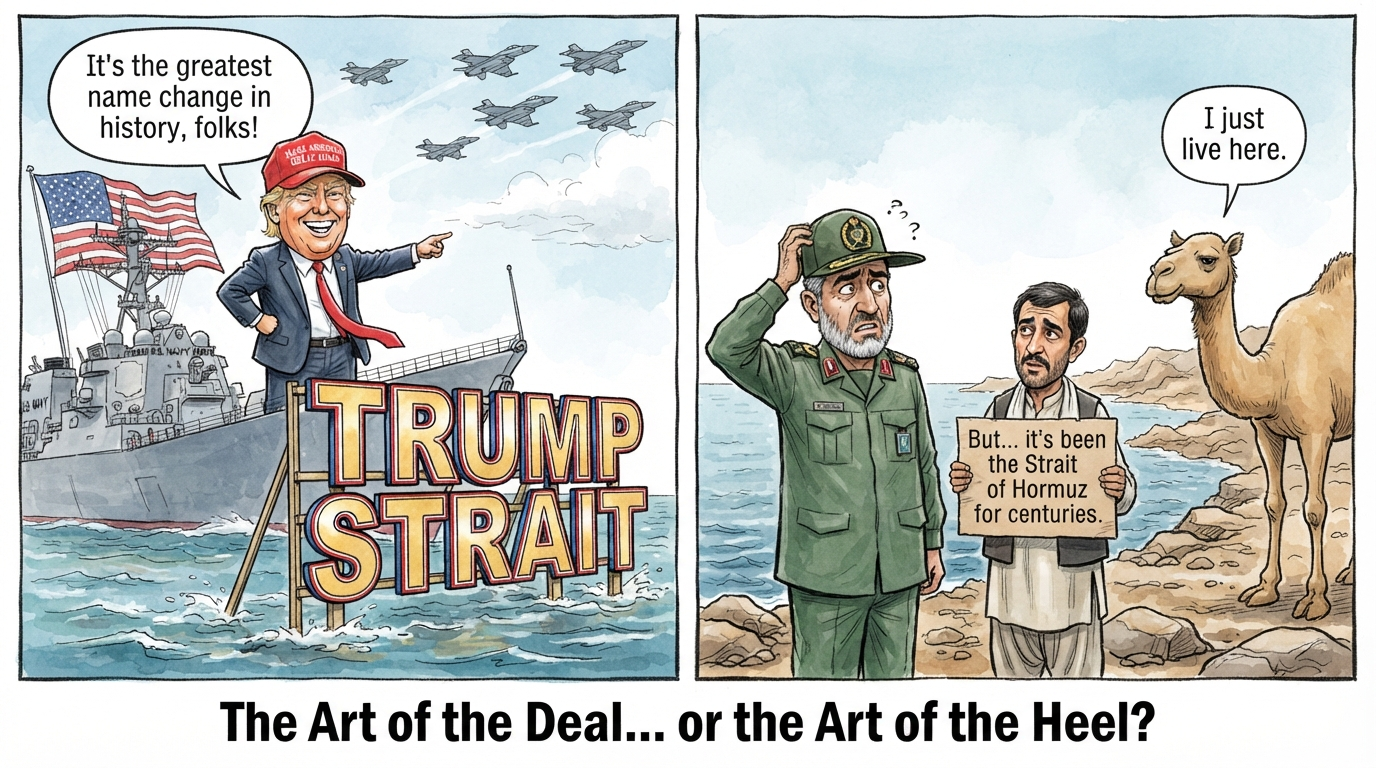
On September 2, Trump went a step further in that he proposed renaming the Strait of Hormuz to the Trump Strait in the midst of an ongoing military conflict with Iran. In a post on Truth Social, he wrote, “Now that we have it under U.S.A. control, should we change the name Hormuz Strait to TRUMP STRAIT???” Despite active clashes and ongoing attacks in the region, Trump asserted that the U.S. military now controls this vital oil shipping route—a claim as audacious as the proposal itself.
Could the Indian Ocean Be Next?
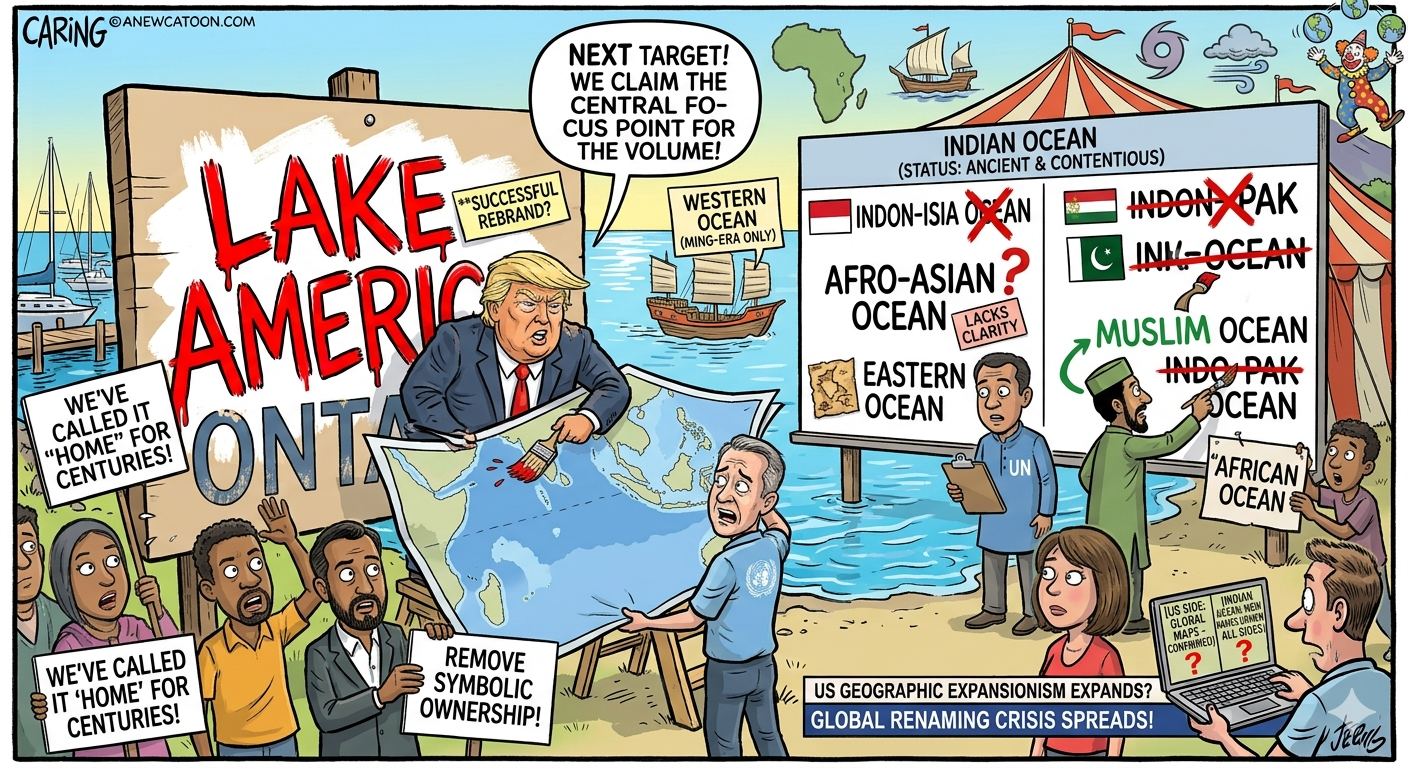
With nationalistic rebrands hitting the headlines, a bigger geopolitical question is floating around the internet: Is the Indian Ocean on the renaming anvil?
The Indian Ocean holds a unique title: it is the only global ocean named after a modern country. The name stems from the Indian subcontinent, which juts dramatically into the water to form the structural and cultural anchor of the northern basin.
Ancient Greek and Roman geographers officially locked in Oceanus Indicus (Latin for Indian Ocean) by the 2nd century BCE because India centrally dictated the trade routes, cultural exchanges, and vital monsoon patterns linking East Africa, the Middle East, and Southeast Asia.
No Modern Rebrand in Sight
Despite internet rumors and trending social media debates, there is no official plan or international agreement to rename the Indian Ocean. Unilateral domestic decrees do not carry weight on global high seas, which are governed strictly by international maritime consensus under UNCLOS.
However, looking back through the history books, neighbouring regional powers have tried to pitch alternative names to challenge India’s symbolic monopoly over the ocean:
- Indonesian Ocean: In 1963, Indonesian President Sukarno ordered his navy to use this term to project post-colonial pride and assert naval dominance.
- Afro-Asian Ocean: Proposed by scholar Latif Ahmed Sherwani at a 1971 seminar to more equitably represent the two massive continents framing the water.
- Indo-Pak / Muslim Ocean: Historical alternatives floated by Pakistani strategists who argued that naming shared regional waters after a single country was inherently unfair.
- African Ocean: Periodically suggested by researchers to highlight the deep, distinct historical and economic ties of the western maritime zone to the African coast.
- Western Ocean: The term used heavily in Chinese literature, poetry, and navigation charts during the Ming Dynasty—most notably during the epic voyages of Admiral Zheng He.
The Psychology of Map Wars: Why Leaders Rename Landmarks
The psychology behind seemingly superficial geographic name changes is rooted in much more than mere whimsy. These acts are driven by dominance, symbolic projection, and the deliberate weaponisation of identity. While renaming a landmark may appear trivial on the surface, the underlying mental drivers are deeply embedded in human behavioural science.
The Leader’s Mindset : The Illusion of Absolute Control: Leaders who engage in political toponymy—the renaming of geographic features—are often propelled by a potent blend of hyper-nationalism and an urgent need for immediate gratification. Real policy is slow, complex, and frustrating. Changing a map provides an instant, low-effort illusion of absolute power and ownership. It satisfies a primal psychological need to mark territory and secure a legacy. It also offers a cognitive shortcut: a way to appear decisive without actually solving deep-seated, material issues.
The Populace : Tribal Belonging and Dopamine Hits: For citizens who support such initiatives, the mental state is fuelled by in-group bias and the comforting embrace of oversimplified narratives. During times of economic friction or trade disputes, a bold identity claim acts as a stabilising psychological anchor. Redrawing a boundary triggers a collective dopamine hit—a surge of patriotism that reinforces tribal belonging.
Strategic Othering: These gestures also provide a visible mechanism to other an adversary—asserting psychological dominance over a neighbour or rival. It feeds followers a sense of defensive superiority and tribal safety, reinforcing the idea that their identity is under threat and must be defended at all costs.
The Strategy : Weaponised Outrage and Media Control
Ultimately, these actions function as intentional political rage-baiting, carefully engineered to exploit the cognitive biases of both allies and rivals. By forcing tech platforms to redraw digital maps, the instigator provokes predictable outrage from opponents. This outrage cycle creates a powerful psychological feedback loop:
- Opponents mock or protest the change.
- Supporters interpret the outrage as proof that the move successfully disrupted the status quo.
- The Outcome – a purely symbolic gesture is transformed into a highly effective tool for media control, hijacking the public’s collective attention span.
Renaming landmarks is never just about names. It is about power, identity, and the manipulation of public perception. In an age of information overload and political polarisation, the map becomes a battlefield—and the victor is not the one who controls the land, but the one who controls the narrative.
The Takeaway
While maps of the Great Lakes are currently divided by IP addresses and political boundaries, the Indian Ocean remains secure. For now, centuries of maritime history and strict international hydrographic standards are keeping the world’s third-largest body of water insulated from political rebrands.

