
If you browse the spice aisle of any grocery store in Canada, you will almost certainly find jars labeled Malabar Black Pepper and Tellicherry Black Pepper. While Malabar easily evokes the historic, tropical coast of southwestern India, it raises a fascinating question: how did Tellicherry—a relatively small coastal town in Kerala—earn its own permanent, premium designation on global spice shelves?The answer lies in a convergence of geographical luck, deep colonial history, and the ancient trade routes that shaped world religions.
From Head of Offices to the Paris of Kerala
Tellicherry is the Anglicised name given by the British to Thalassery. The name originates from the Malayalam words Thala (Head) and Kacheri (Office), translating directly to the head of offices. During the colonial era, European traders fell in love with the town’s vibrant culture, unique charm, and strategic location, nicknaming it the Paris of Kerala. This moniker was particularly fitting due to its close proximity to Mahé, which served as the primary French military base in the region before the French eventually consolidated their forces there and abandoned Thalassery to British hands.
The Geographical Advantage and the Rise of the East India Company
Thalassery’s rise as a global trade hub was purely geographic. It was the closest point on the Arabian Sea coast to the dense, high-altitude spice-growing regions of Wayanad.
- The 16th Century: The town developed aggressively when the British East India Company secured permission from the local ruler to construct a trading factory.
- 1708 (The Fort Walls): Following routine friction with local chieftains, the British built the massive Thalassery Fort on land gifted by the local king. To sweeten the alliance, the king granted the British the right to trade pepper duty-free.
- Capital of North Malabar: With a fortified base and tax-exempt trade, Thalassery transformed into British Malabar’s premier port. Following the defeat of Tipu Sultan at the Battle of Seringapatam, the British assumed absolute administrative authority over the entire region, cementing Thalassery as the capital of British North Malabar.
The Industrialisation of Spice: The World’s Largest Plantations
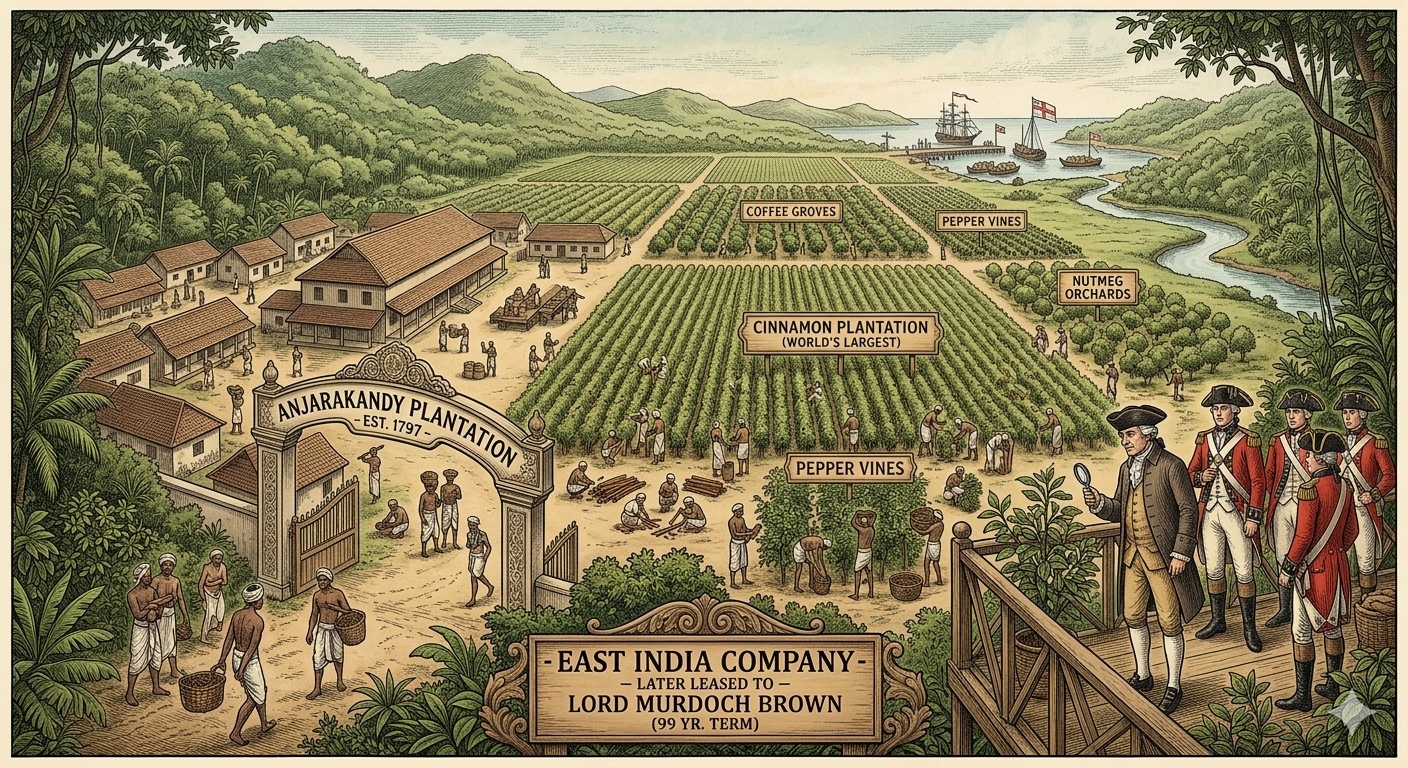
The British quickly moved from merely trading spices to controlling their production:
- 1797 (The Anjarakandy Plantation): The East India Company established a massive spice plantation in nearby Anjarakandy, later leased to Lord Murdoch Brown on a 99-year term. It cultivated coffee, cinnamon, pepper, and nutmeg, eventually growing into the world’s largest cinnamon plantation at the time.
- Infrastructure Enablers: The colonial government built the Tellicherry Lighthouse in 1835 to guide heavy trade vessels, constructed a massive new spice warehouse in 1863, and even opened South India’s very first Sub-Registrar Office in 1865—solely to handle the complex property legalities of Murdoch Brown’s sprawling plantation.
- 1866 (Municipal Milestone): Under the Madras Act of 1865, the Thalassery Municipality was officially formed on November 1, 1866, making it the second oldest municipality in the state of Kerala.
The Ancient Monopolies: From Egyptian Mummies to Serpent Myths
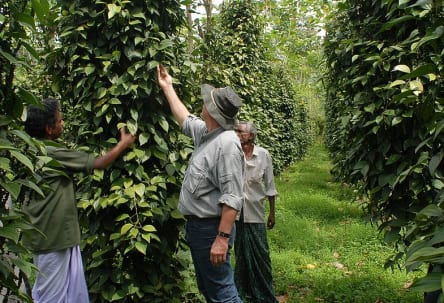
Long before Europeans stepped foot in India, Arab traders held a strict monopoly over the Malabar pepper trade dating back to roughly 1500 BC. They navigated the coastline of the Arabian Sea, entering the inland regions via Kerala’s sprawling backwaters and rivers.
The scope of this ancient trade network was jaw-dropping. When the great Egyptian Pharaoh Ramesses II died in 1213 BC, his body underwent complex mummification rituals that included stretching black peppercorns from Malabar directly into his nostrils to preserve the shape of his nose.
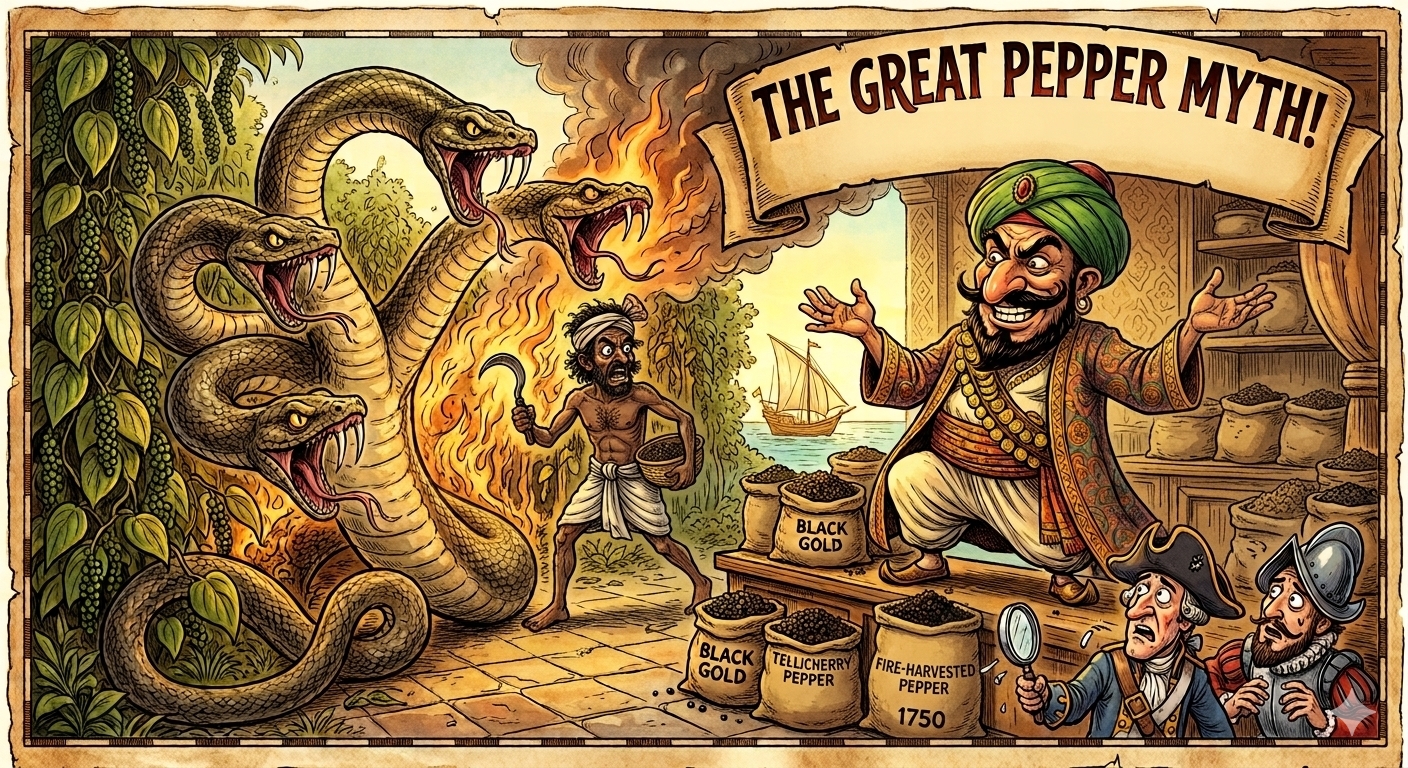
To protect this incredibly lucrative trade from inquisitive European empires, Arab merchants spun elaborate, terrifying myths. The merchants claimed that Tellicherry’s deep pepper forests were guarded by vicious, multi-headed serpents. To harvest the spice, locals supposedly had to set the forests on fire to scare the snakes away. According to the myth, it was this intense harvesting fire that scorched the peppercorns, giving them their signature shriveled, pitch-black color.
How Trade Sewed the Seeds of Religion
Unlike many regions of the world where religion arrived at the edge of a sword, Judaism, Christianity, and Islam came to Kerala purely through the peaceful channels of trade.

- Islam: Continuous maritime interactions between Arab merchants and local communities led to settlements, marital alliances, and a flourishing Muslim population. In southern trading outposts like Kottayam’s Thazhathangady (Lower Market), Islam grew naturally around the riverbanks where spice barges docked. Kerala boasts the Cheramaan Juma Masjid (built in 629 AD), widely recognised as the oldest active mosque in the Indian subcontinent.
- Christianity & Judaism: Local Saint Thomas Christians trace their roots back to the 1st century, believing that St. Thomas the Apostle traveled to Malabar on an ancient spice trading vessel. Later, waves of Jews and Christians fleeing persecution in Persia fled to Kerala on Arab ships and were welcomed with open arms by Hindu rulers. The Malabar Jews settled in Fort Kochi by the 12th century, building historic synagogues and even developing Judeo-Malayalam, a localised dialect of the native language

Black Gold and the Currency of the Modern World
Peppercorns were so highly valued in medieval Europe that they were known as Black Gold. The spice was used as direct commodity money to pay rent, taxes, and dowries.
This historic legacy still exists in modern Western legal systems today through the term peppercorn rent—a legal phrase denoting a nominal, token payment made simply to keep a contract legally binding. Similarly, the Dutch language still uses the phrase peperduur (pepper expensive) to describe items that carry an astronomical price tag.
It was this very financial desperation for pepper that drove Vasco da Gama to circumvent Africa in 1498, opening a direct sea route to India and eventually allowing the Portuguese to claim exclusive rights to the Malabar pepper trade under the Treaty of Tordesillas.
The Legacy Today
At one point in history, black pepper accounted for a staggering 70 percent of the entire international spice trade. As more global trade routes opened over the centuries, production democratized, prices stabilized, and the fiery spice integrated itself into the everyday cuisines of ordinary people across the globe.
Today, global agricultural dynamics have completely shifted. Vietnam is now the world’s largest producer and exporter of black pepper, supplying roughly 34% of global demand. Yet, despite the rise of massive corporate mega-farms across Southeast Asia, the culinary world still looks to the coast of Kerala. Jars in Canadian supermarkets proudly retain the names Malabar and Tellicherry—a tribute to the tiny Paris of Kerala and the historic black gold that fundamentally rewrote global geography.


Very informative and well written.
LikeLiked by 1 person
Quite informative & interesting
LikeLiked by 1 person
An interesting read, with historical details. Reji, but why the two different names? The title pointed towards a possibility of different quality, taste or both – but didn’t find any mention in the text.
LikeLiked by 1 person
The Arabs would buy pepper,cardamom,ginger and Calico,the fine variety of cotton cloth from Calicut, (Presently named as Kozhikode) in Kerala and sell it to the Europeans at substantial profit. This prompted the Europeans to search for a sea route to India.
The most hazardous journey undertaken by the human race was to find a sea route to India and in this process, many parts of the world were discovered.
A very well researched article by Reji.
Keep it up.
LikeLiked by 1 person
Thalassery or Tellicherry has many other achievements to its credit. Cricket was played for the first time in India in Tellicherry. The first English medium school in Kerala was set up in Tellichery, that school later on grew as the current, Government Brennan College. The teak wood for building Naval Dockyard at Mumbai came from Tellicherry and those sluice gates nearly 300 years old are still in use. Late Admiral Pereira, the most popular Naval Chief till date, and the harbinger of Ration in Kind (RIK) for officers in 1983. It is also the nearest town & railway station to the village of Peravoor, where I hail from.
Also the main use of Pepper in the days of yore was not to add spice to food, that came much later as a collateral benefit. Wrapping in Pepper was the primary way of preserving meat before the arrival of refrigeration Ships proceeding on Voyages had to carry meat and to extend its longevity without decay it was preserved in pepper ( that’s why it was found in the nostrils of Ramesses II’s mummy). Since it was as essential for sailing as water or Biscuit ( the variation of bread for sailing use) it was very much in demand and in short supply in those nations who were ardent sailors, and hence it earned the name ‘ Black Gold’.
LikeLiked by 1 person