A Symbol That Commands Attention
Everyone must have noticed military vehicles plying across Commonwealth countries bearing a distinctive marking – a number beginning with a vertically upright Broad Arrow (↑). This marking, officially termed the Broad Arrow Number or BA Number, is used by the Army, Navy, Air Force, and various civilian establishments functioning under the Ministry of Defence.
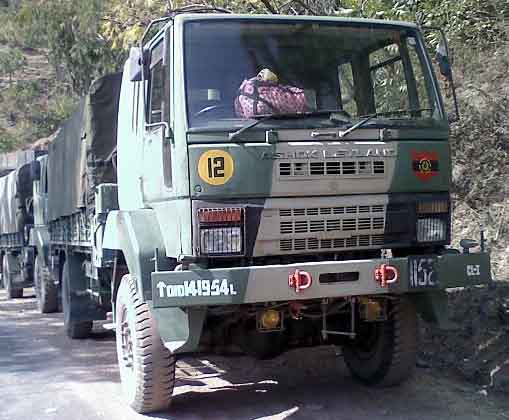
Many, including those in military service, have humorously misinterpreted this ↑ symbol as This Side Up – akin to the markings on packing cartons. Does it exist so that no one erroneously parks the vehicle upside down? Is it meant to indicate the right side up in case the vehicle topples? The humour, while entertaining, misses the mark entirely.
The Historical Origins

The Broad Arrow was employed by the British to denote military property. It was also referred to as the Crow’s Foot or the Pheon. When combined with other symbols, numbers, and letters, the Broad Arrow number conveys various details about equipment – manufacturer, year of entry into service, ownership, inspection, alteration, repair, and more.

The precise origin of the Broad Arrow remains somewhat unclear, though historians generally attribute its adoption to Henry Sidney, Earl of Romney, who served as Master of Ordnance to William and Mary (1689-1694 AD). Tasked with reducing theft of British government property, Sidney was asked to imprint a mark on all official stores. He chose his family emblem – the Broad Arrow. Interestingly, prisoner’s uniforms were also stenciled with this symbol for a time, though the practice was later discontinued.
In his authoritative work A Complete Guide to Heraldry, A.C. Fox-Davies offers this illuminating commentary:
Perhaps the case which is most familiar is the broad arrow which is used to mark Government stores. It is a curious commentary upon heraldic officialdom and its ways, that though this is the only badge which has really any extensive use, it is not a Crown badge in any degree. Although this origin has been disputed it is said to have originated in the fact that one of the Sydney family, when Master of the Ordnance, to prevent disputes as to the stores for which he was responsible, marked everything with his private badge of the broad arrow, and this private badge has since remained in constant use. One wonders at what date the officers of His Majesty will observe that this has become one of His Majesty’s recognised badges, and will include it with the other Royal badges in the warrants in which they are recited. Already more than two centuries have passed since it first came into use, and either they should represent to the Government that the pheon is not a Crown mark, and that some recognised Royal badge should be used in its place, or else they should place its status upon a definite footing.
Early British military equipment was often marked B↑O, signifying that it fell under the purview of the Board of Ordnance. Later, W↑D denoted War Department ownership. By World War II, a standalone ↑ simply indicated British military equipment.
Decoding the Indian Broad Arrow Number
Now that we understand the historical context, let us decipher the Broad Arrow number on an Indian military vehicle, which begins with the symbol ↑.
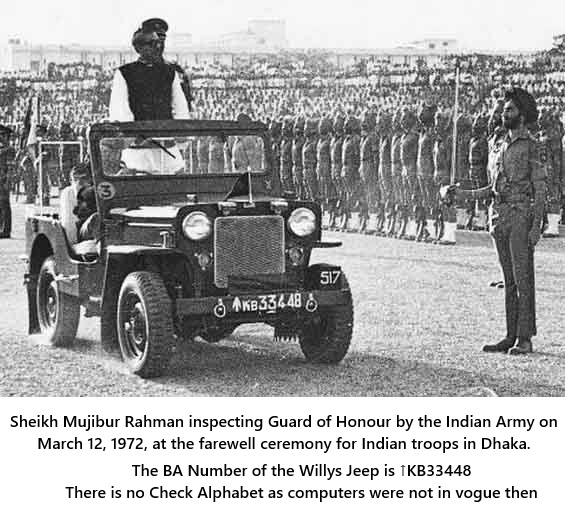
The Broad Arrow is followed by two digits indicating the year the vehicle entered service. Prior to 1972, however, a single letter denoted the year of entry. The letter ‘Z’ represented 1971. From 1972 onward, with only 26 letters available in the alphabet, the system logically shifted to using the last two digits of the year of entry.
A Case Study: The Jeep of a Legend
Consider a Jeep displayed at the Grenadiers Regimental Centre in Jabalpur. It is reputed to be the very vehicle used by Company Quartermaster Havildar (CQMH) Abdul Hamid, Param Vir Chakra (Posthumous), of 4 Grenadiers, who famously destroyed eight Pakistani Patton tanks during the 1965 Indo-Pak War using the Recoilless Rifle mounted on it.

Examine the Broad Arrow number on this historic Jeep. It bears the letter Y, which would indicate a year of entry as 1970. This presents an obvious discrepancy – the vehicle was NOT in service during the 1965 war.
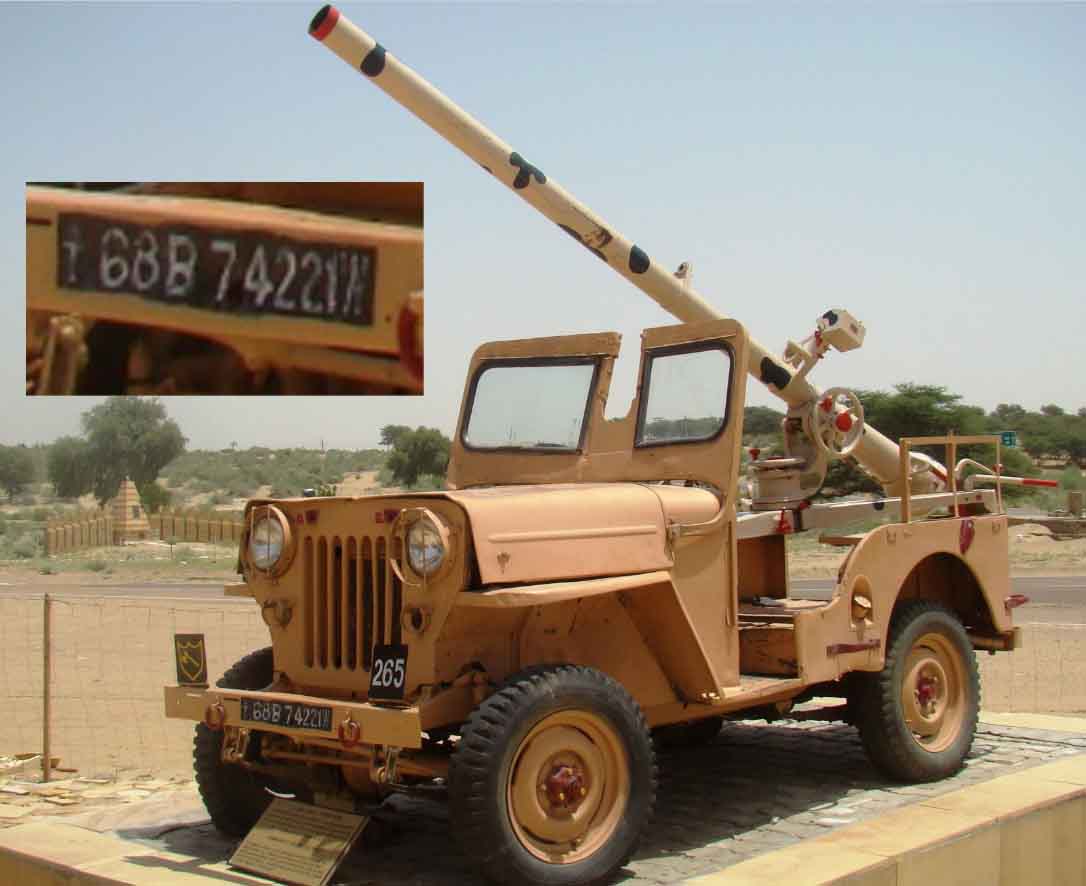
The repainting error becomes evident: if the year of entry into service is indeed 1968, the correct marking should have been the letter ↑W, not ↑68, according to the policy prevalent at that time.
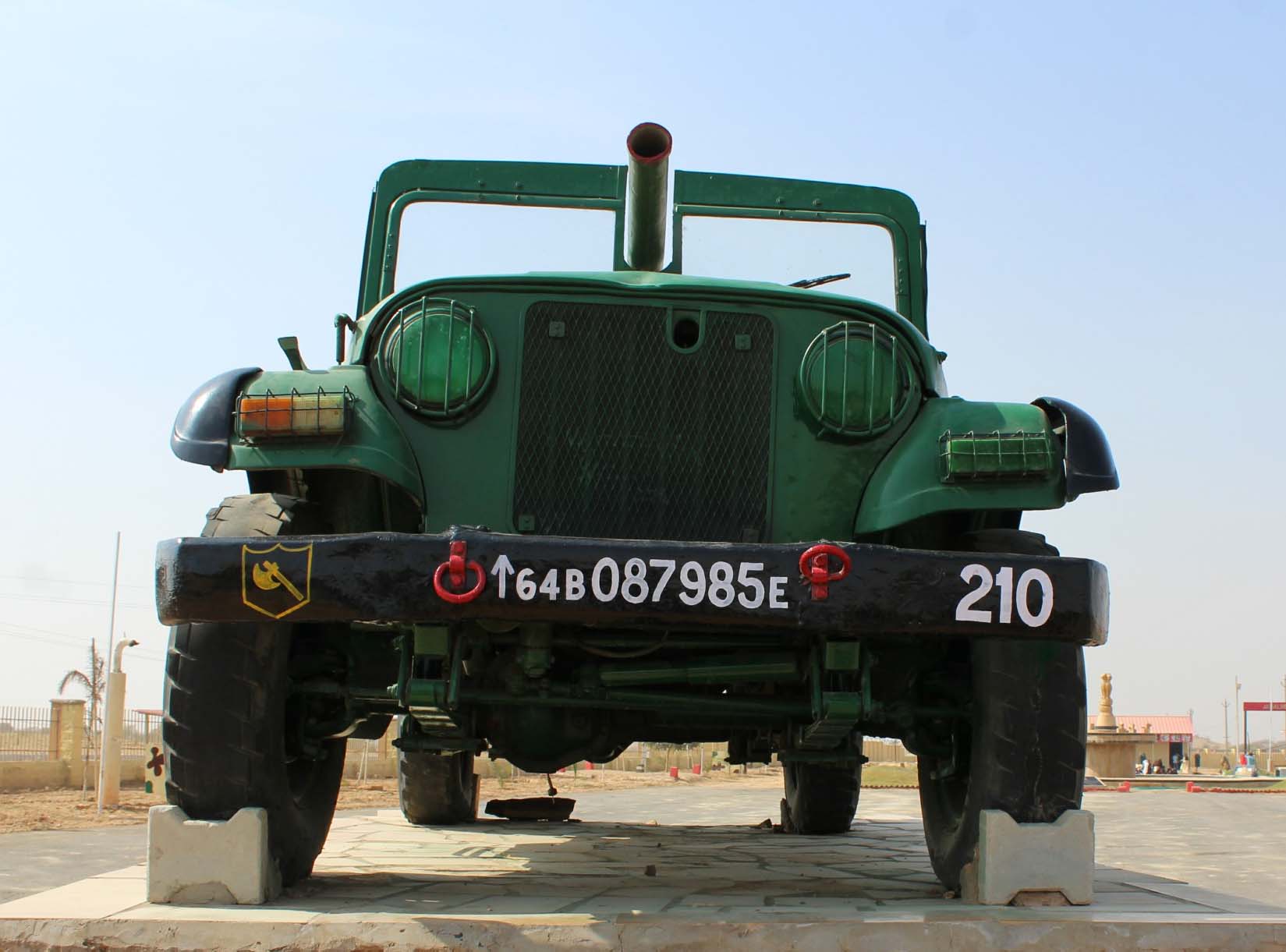
Similarly, a Jeep marked ↑64B should properly have been ↑SB. The body of this particular vehicle does not justify its claimed vintage – suggesting questionable craftsmanship by the military workshop responsible for its restoration.
The Full Code Explained
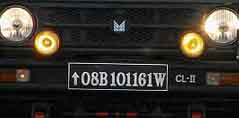
Following the year indicator, a letter denotes the vehicle’s class. During my military service, I encountered various classifications:
- A: Motorcycle
- B: Car or Jeep
- C: Light Truck
- D: Heavy Truck
- E: Towing Vehicle
- F: Specialist Light Vehicle
- H: High Mobility Vehicle (with material handling)
- J: Snow-cut / Snow-clearing vehicle
- K: Ambulance
- P: Buses, Tankers & Support Vehicles
- Q: Engineering Vehicle
- R: Missile / Special Role Vehicles
- X: Armoured Vehicles
This classification letter is followed by the vehicle’s serial number, assigned by the Ministry of Defence. Finally, a check alphabet appears – calculated using the Modulus 11 formula. This check digit serves as a form of redundancy check, enabling error detection in identification numbers.
Conclusion
The Broad Arrow number is far more than a whimsical marking. It represents a carefully designed system of identification, classification, and error detection that has evolved over centuries. Next time you encounter a military vehicle bearing the ↑ symbol, you will know that it carries not just equipment, but a legacy of heraldry, history, and meticulous record-keeping. It most certainly does not indicate This Side Up.
 REJINCES