Recently, on social media, there was an image of the calendar page of August 1947. The Forwarder pointed out that 15 August 1947 was not printed as a holiday. This of course was quite natural as the calendar was printed prior to the beginning of the year at which time nothing was known about the epoch-making events which were to follow during the year. What struck me however was that the calendar was of Mr PC Mathew of Ettumannoor, Kottayam and that he was a Jaggery Merchant. In those days besides the Malayala Manorama newspaper only a few rich businessmen printed calendars. So one can surmise that Mr. Mathew had a flourishing Jaggery business in Kottayam.

The Central Travencore prior to independence had extensive sugarcane cultivation, in the areas watered by Pampa, Manimala, Achenkovil and Meenachil rivers. The area mainly comprising present day Kottayam and Patthanamthitta districts, was ideally suited for Sugarcane cultivation as the climate and soil conditions of the area is suitable for the crop. Areas like riverbanks, waste lands etc. where other crops could not be cultivated were profitably utilised through sugarcane cultivation. Moreover, sugarcane could tolerate heavy rainfall and short duration water-logging. The golden brown, sweet Central Travencore Jaggery was famous all over India. This is history and the area has very little sugar cultivation now. Recently there have been some reports of individual attempts to revive sugarcane cultivation in the area but largely to no avail.
Up to late 1960’s areas around Kottayam cultivated sugarcane, more than rice and tapioca. In our young days, children often sneaked into the sugarcane fields to enjoy the ripening cane. The landowners or their sentries shooed us away, but we were quite successful more often than not. During our National Defence Academy (NDA) days, the fields around NDA too had sugarcane. Cadets did the famous गन्ना Ganna (sugarcane) Raids. In 1996 when I visited the NDA, I found no sugarcane cultivation in the area. It was sad to see a concrete jungle instead of the rolling sugarcane landscape.
By late 1960s, the sugarcane cultivation stopped in our area and entire Kottayam as there were some pests infesting the crops and the canes turned red. The pests sucked away all the juices and left the canes to wilt. Advent of Rubber was also another reason which dealt a deathblow to sugarcane cultivation in the areas around of Kottayam. Please click here to read about introduction of Rubber plantations in Kottayam.

Non-availability of sugarcane led to the closure of the sugar division of The Travancore Sugars & Chemicals Ltd. (TSCL) in 1998. The company was incorporated in 1937 with the factory at Thiruvalla in Pathanamthitta District, which commenced commercial sugar production on November 1948. The Company was originally owned by M/s Parry & Co. Government of Kerala took over the company in 1974. Now its distillery division produces Jawan brand Rum. Thiruvalla is also home to the Sugarcane Research and Development Centre. Like many research centres in the country, it is a white elephant milked by its employees. Their website shows no research paper ever published and has hardly contributed to the reintroduction of sugarcane in the region.

The sugarcane farmers crushed the sugarcane on a ചക്ക് Chakku. The Chakku had two vertical metallic cylinders rotated by a bull going around. The sugarcane was passed between the two metallic cylinders and the juice collected at the bottom.
The metallurgy of the cylinders was not that well developed, and they got worn out over prolonged use, especially in the middle, due to the extensive pressure the passing sugarcane exerted. As the rollers lost their cylindrical shape, their effectiveness reduced drastically and had to be turned on the lathe, especially at the two ends to make them cylindrical.
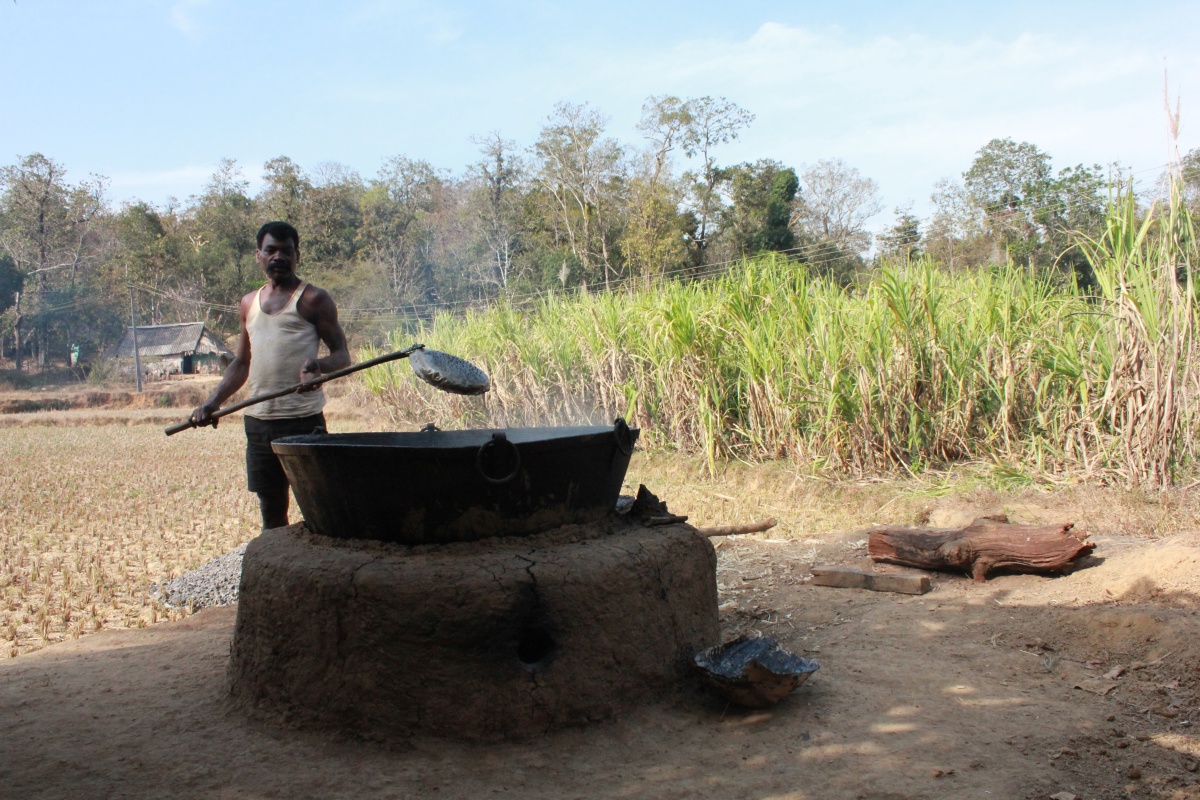
The sugarcane juice was boiled in a huge വാർപ്പ് (Vaarppu,) a flat iron boiling pan of about three-meter diameter. During boiling, chemical bleaching agents or vegetables were added to clean the juice and the extraneous matter was constantly removed to give a bright golden colour. The boiled juice was then left to cool in pots to form the jaggery blocks.
Our village blacksmith, Shankara Panickan lived across the street. He manufactured and sharpened farm implements and knives. The main source of income for Panickan was not from sharpening tools, but from his lathe, housed in a shed between his house and the foundry. To turn the lathe there was a wheel of a bullock cart attached at one end, which had to be rotated manually at a particular speed. Panicking’s elder son Thankan, was an expert at the task.
The customers at the lathe were mainly the sugarcane crusher owners. They had to turn their worn out vertical metallic cylinders on a lathe. Panickan charged 20 rupees per roller he turned on his lathe, but this bonanza came to Panickan only on a few days, limited to the crushing season.
The day Panickan got his bonanza, the evenings were more entertaining, especially for the neighbourhood (no one had a radio then.) Panickan that evening visited the കള്ളു ഷാപ്പ് Kallu Shappu (Toddy Bar). (Toddy is an alcoholic beverage made from the sap of palm trees by fermentation). He returned home drunk by nightfall and sang folk and devotional songs with such endearing passion that I can still feel the melody wafting through the still air. The way he used to sing will put some of today’s professional singers to shame. His favourite songs were the one he sang in praise of Lord Aiyyappa of Sabarimala.
For the current generation, sugarcane cultivation in Kottayam is history.
 REJINCES
This reading lures me even more to Kottayam where my friend Kali lives with his plantations- coffee, rubber dunno but certainly not sugar! I can almost imagine Panickan singing after his toddy!
Great Reading. 🙏 👍
LikeLiked by 1 person