
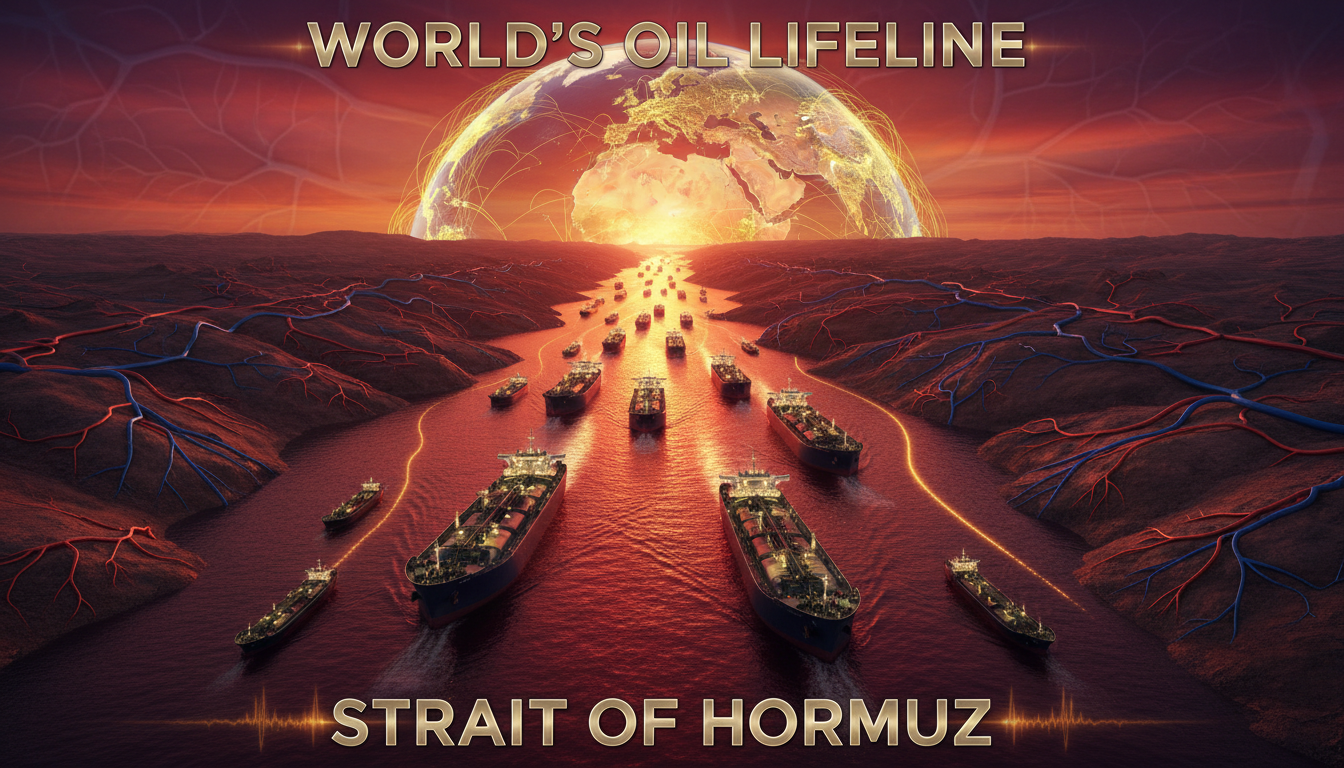
Following the blockade of the Strait of Hormuz by Iran, the Global economy is indeed reeling and pretty badly at that. In the meantime a heated debate has possibly ignited within the Pentagon and among Allied planners: Is a terrestrial intervention on Iran’s northern coast to secure the dominating costal high grounds, the only way to permanently break the blockade on the world’s most vital oil artery?
For a long time, strategic thinkers have described the Strait of Hormuz as the world’s jugular vein. For the effective blockade, the Iranians are known to be using comparatively cheap tactics, utilising anti-ship cruise missiles (ASCMs), smart mines, and swarming drone technology. The U.S. military doctrines boasts of Command of the Seas and Command of the Air strategies and capabilities. While the USA does seem to enjoy command of the air, the ‘command of the seas doctrine’ has been tested severely as never before. Carrier-based airstrikes can degrade Iranian capabilities, and possibly even remove the blockade temporarily. Even this will take some doing. However, there is near unanimity among military analysts that as long as Iranian forces control the rugged, mountainous terrain of the Hormozgan Province, the blockade can be made effective once again, within hours.
The Case for Terrestrial Operations
The rationality for land-based buffer zone is rooted in what is called as the Whack-a-Mole problem. Iran’s mobile missile launchers, such as the Noor and Ghadir systems, are skillfully camouflaged within the limestone cliffs and complex of coastal caves overlooking the shipping lanes. They can emerge from a hidden cave or hardened bunker, fire a missile and relocate within minutes. By the time the launch is located and counter measures considered, the mole is back in its hole. The problem is complicated by the fact that sinking of even a single vessel in the narrow passage may cause a permanent blockade.
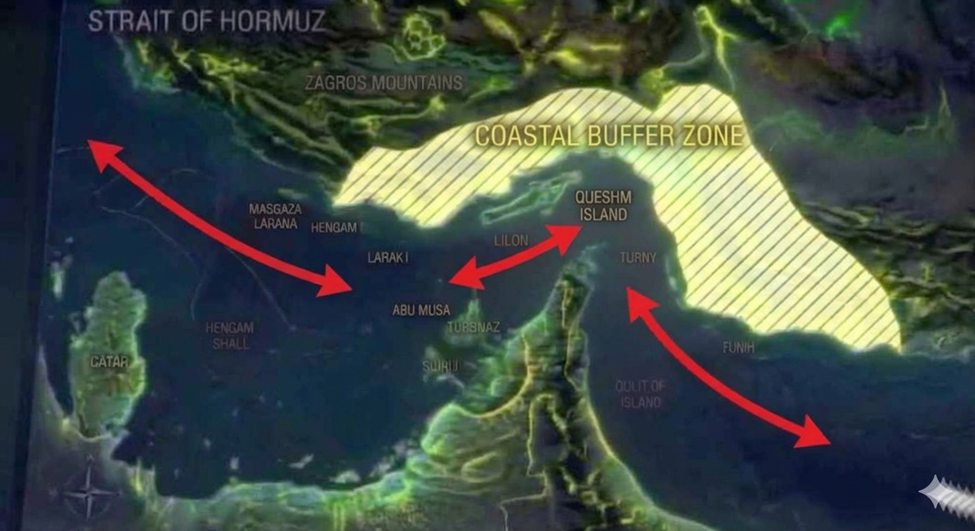
To anyone familiar with basic military tactics, it is abundantly clear that to effectively clear the strait, one must seize and secure the following:
- The Island Chain to include the islands of Queshm, Larak, Abu Musa, Tunbs and maybe Hormuz.
- Tactical high grounds on the northern coast line. A terrestrial operation to occupy the high grounds extending from Bandar e Lengeh and running east for about 250 km will be needed to clear the threat and physically displace the weapons that currently hold global energy markets to ransom. The depth of this zone is about 70 to 200 km Northward from the coast line and include all the lower ridge lines that dominate the water way and at least some points on the main Zagros mountain ridge lines.
This is not an easy task, the hostile terrain extending over a vast area of approximately 2500-3000 sq km. The contours of such an operation if undertaken will primarily hinge around vertical envelopment employing very large sized heli-borne and air-borne forces in conjunction with special operations, to seize the tactically important high grounds overlooking the coast line as well as the island chain. This necessarily may have to be followed up with frontal assaults to link up with forces landed in depth. In addition may an extensive Air Bridge operation may have to be established for logistic sustenance of a large force, at least for initial phase of the operation until the land link up completed.
Minimum Estimated Force Levels
- Amphibious Assault Force consisting of 2 to 3 Marine expeditionary Units (5000 to 7000 marines).
- Special Operations Command. 2-3 seal teams and Army rangers for silent insertion.
- Air Superiority and Suppression. 2/3 Carrier Strike Groups together with land based A-10s and AC 130s operating from bases in UAE and Oman for close air support
- Seizing and Holding the coastal buffer. 1 Army Airborne Division and 2 infantry Divisions.
Time Frame
Initial operations to clear the blockade may take about 2 to 3 weeks. To fully sanitise the coast line, many months of counter insurgency operations will be required, difficult to estimate or define.
Financial Implication
All the above add up to a full scale invasion which according expert estimates may involve a financial implication of roughly 5 billion dollars per month if successfully executed.
The Challenge of Fortress Iran
However, the feasibility of such a campaign is fraught with extreme danger. The northern coast of the Strait is a defender’s dream. In essence, for the attacker to win in this kind of terrain, the defender must flee. Any attacking force must face the tyranny of the terrain which is characterised by jagged mountains that rise abruptly from the sea, leaving little room for the kind of large-scale amphibious landings seen in the 20th century. Key assets of the US Mechanised Forces are of little use in this kind of terrain. More hostile than the terrain will be the weather. Not all troops are accustomed to operating in temperatures over 40 degrees combined with extreme coastal humidity. While the US military may well have adequate forces trained for such vertical envelopment and amphibious operations, it’s a moot question whether they are trained to operate in harsh mountainous terrain and very hostile weather conditions.
U.S. forces will face the Islamic Revolutionary Guard Corps (IRGC) Mosaic Doctrine – a decentralised, asymmetric defense designed to bog down high-tech invaders in a war of attrition. Any landing force will be met with pre-positioned, motivated insurgent cells, man-portable air-defense systems (MANPADS), and a civilian population likely to view the intervention as a violation of national sovereignty, potentially sparking a decades-long insurgency. More than three weeks of the operation comprising ruthless air and missile attacks by the combined forces of USA and Israel have resulted in almost 70% of the Iranian surface missile force being destroyed. But even the Pentagon has admitted that the even the island chain is far from neutralised, despite an almost complete air superiority of the attacking force.
The Logistics of an Impossible Shoreline
Logistically, sustaining even brigade-sized force on the Iranian coast will indeed be a herculean task. Capturing and holding a coastline of 250 km may well require beyond a Corps size force. The humongous nature of the logistics involved is indeed a never ending nightmare.
Furthermore, a terrestrial invasion might almost certainly escalate the conflict beyond a localised maritime dispute. It will likely trigger a total mobilisation of the Iranian state and could draw in regional proxies, and perhaps other global players turning a mission to open the taps into a full-scale theater or global war.
The Verdict
A limited raid-and-destroy mission by Special Operations Forces to hit specific batteries is highly feasible, especially involving an aerial insertion and exfiltration. But a sustained terrestrial occupation to control the choke point remains an operation in the realm of very low probability, an operation of last resort. A large scale terrestrial operation of sort is far too expensive, far too dangerous involving unacceptable casualties in the long run and the probability of successful execution not very high. For now, Washington appears to be tethered to a strategy of maritime escort and aerial suppression. But as oil prices climb and the blockade holds, the pressure to take the coast and islands may soon enter the realm of active consideration.
 REJINCES
Very well explained sir.
LikeLiked by 2 people
Thank you subhash
LikeLike