A Journey Through Time and Altitude

My inaugural flight experience in 1983 remains a vivid memory I still often reminisce about. In those early days of air travel, the cabin crew’s pre-flight safety demonstration surprisingly did not include instructions on how to fasten or remove a seatbelt.

The air hostess came by for her final cabin check before take-off and efficiently buckled me in. After we were airborne, I applied all my military ingenuity to unlatch the belt but failed miserably. Looking around, I realised I was the only passenger in my entire row, isolated in my predicament. I remained securely fastened to my seat for over two hours, too hesitant and embarrassed to ask the air hostess how to release myself.

Upon landing at Dabolim Airport in Goa, salvation arrived. I keenly observed the passenger sitting across the aisle unbuckle their seatbelt, and with a quiet Eureka, I finally decoded the intricate contrivance.

Years passed. In 1989, shortly after our wedding, my wife Marina accompanied me on a flight to Kashmir. As we boarded the aircraft at Kochi, I proudly demonstrated the workings of the seatbelt to her, ensuring she wouldn’t suffer my previous silent ordeal.

Eventually, pre-flight safety briefings evolved to include the simple solution to my 1983 mystery. That’s when I realised there must have been many other idiots like me!

The Annual Ritual: Indian Airlines and Nostalgia

From 1983 onward, flying Indian Airlines from Delhi to Kochi became an annual ritual. The flights used the old airport located within the Naval base. The flight ticket, even with my military concession, cost more than my one month’s pay at the time.

The aircraft were often sparsely populated, and I frequently found Members of Parliament as my co-passengers. On two memorable occasions, my seatmate was Commander Surjith Kandal, a course mate from the National Defence Academy (NDA), coincidentally flying Kochi to his home at Delhi for his vacation while I returned from mine.

We flew on a Boeing 737 with a configuration rarely seen today: all economy seating, but with luxurious legroom. The tray tables were double the size of modern ones, and the food served was equally generous.

The journey began with a 0530 hrs take-off from Delhi, stopping in Dabolim, Goa. Substantial meals were served after both departures. A true bliss for a smoker like me back then, the seats at the rear of the aircraft even permitted smoking. We would typically land in Kochi by noon.

The Jolt of Acclimatisation

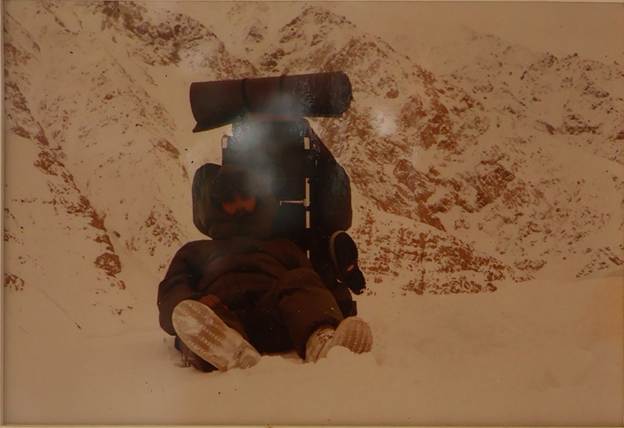
The most memorable flight of all took place in 1988. I was posted at a remote location on the Line of Control (Kashmir), at about 10,000 feet above sea level. For my annual leave, reaching the airport required an entire night of trekking across snow-clad Himalayas (to avoid avalanches), followed by a three-hour drive in an Army vehicle to Srinagar Airport.

The Delhi flight departed at 1500 hrs, and the next morning, I connected to the Kochi flight. Mid-afternoon, I landed at Kochi airport and descended the mobile ladder—aerobridges didn’t exist there yet. I was now standing barely a foot above sea level. The moment my boots hit the tarmac, I was instantly drenched in sweat, as though I had just walked out of a shower fully clothed.

My senses were numb for a couple of minutes until I realised my folly: I had skipped the crucial process of acclimatisation, a core tenet of the good old Indian Army way. For the next two years I was posted in Kashmir, I always ensured I took a mandatory three-day break at the Regimental Headquarters in between altitudes before venturing home to Kochi.

New Flights, Familiar Rituals

Next week, I will be flying Air India from Toronto to Delhi to attend our Regiment’s Diamond Jubilee celebration. I typically fly Etihad Airways as it offers a convenient routing from Toronto to Abu Dhabi, with a comfortable five-hour layover in their lounge before the final flight to Kochi. This routine helps me reset my biological clock and effectively fight jet lag. Etihad’s business class service, both in the air and in the lounge, has always been outstanding.

I am hoping for an excellent experience with Air India this time around, especially now that the Tata Group is controlling its operations and revitalising the airline.

Beyond The Rainbow – A Collection of Poems by Hema Irene John

Compliments to Hema – all the poems all have a flow of ideas that are set in rhythm and rhyme.  I enjoyed each one of them as I could identify with each one.  It could be because we both traced similar paths in our lives.

Let me introduce the poetess. Dr Hema Irene John graduated in medicine from the Christian Medical College in Vellore, Thamizh Nadu. She married Late Lieutenant Colonel John, Corps of Electrical and Mechanical Engineers (EME.) She served in the Army Medical Corps (AMC,) retiring as a Major. They later moved to Australia, where she practices medicine now.

I have taken the liberty to create a collage of lines from the collection rather than writing a review.

Each artist has a unique style; the art produced does beguile.  Important to make our time rhyme; and leave footprints on the sands of time. Step by step, climb up high; you’ll get there, don’t sigh.  Relax always, do not frown.  Appreciation has lasting benefit and we need resilience to win fame. Celebrate the day with a great attitude; life is not life, without gratitude. Whatever happens, life goes on; we have to brave life and strive on.

Humans are made in different colours; also bestowed with varied powers. ‘Difficulties come, difficulties go’ – be strong always – our logo. Parents are the pillars they lean on; responsibility they need to own. The world would be a sad place without children; happiness is found in our grandchildren. Always plan your baby’s name.

Love and compassion stand on top, if we want all our worries to stop. When we see shells, our joy overflows; we possess them, and love bestows.

Friends can be angels, too, bringing joy and support in all we do. On home return, a splendid greeting. A dog is always man’s best friend. The older the wine, the better the taste; So are old friends, as the bonding is great.

Sight, smell, hearing, taste, and touch; without any of you, life is tough. Dance is all about communication, the whole of it needs concentration. Words are special when put to music, every song, endearing and does the trick.

There’s so much beauty that meets the eye; everyone can be very happy if we just try. True, happiness is a virtue; yes, surely this is true. It’s strong, like a lion’s roar; it sure will make hearts soar. With those who stay, we need to be happy, for this is life, for both you and me. Move on with life the best one can; Joy should be sandwiched in our plan. Happiness, sure, happiness in a smile; always makes our lives worthwhile.

Health is something we need to treasure; do our best without too much pressure. Leisure is a time made for our pleasure; it’s something we always need to treasure.  Remember, gifts are always memorable; they steal our hearts and are adorable. Be optimistic and not pessimistic; be always cheerful and realistic.  Eggs can be compared to family and friends; we’ll love them always until life ends. Our life’s journey is like a great salad; you can make your life a great big ballad.

Without the moon, night wouldn’t be night. The moon always is a splendid sight. Looking down from the very top, we see the beauty of the drop. Everyone loves rainbows, both young and old; a rainbow is always a beauty to behold. When you have finally cast your spell, the rainbow assures us all is well.

Every time we see the tall skyscrapers, we’ll appreciate their construction workers. Next time you see a uniform, know it took training to get to this form.

I am sure you all will enjoy the collection of poems as I did. The book is available on Amazon.

The Lieutenant: A History of the Unguided Missile

Etymologically, Lieutenant combines the French lieu (in place) and tenant (holding) to mean – one who holds a place for another. Entering English from Old French, it described a deputy acting on behalf of a superior, a definition still central to its use in military and civil ranks (eg lieutenant colonel or lieutenant governor) and phrases like in lieu of.

Fresh from the academy, we joined our regiments as newly commissioned Second Lieutenants—eager to go, but as unguided as a nuclear-tipped missile. Fortunately, during my command tour (2002-2004), that breed had become extinct.

Despite a shared etymology, its pronunciation split into two distinct branches:

  • The British “Left-tenant”: This variant likely stems from a Middle English reading of Old French, where the letters ‘u’ and ‘v’ were often interchanged, influencing the sound to shift to an ‘f’.
  • The American “Loo-tenant”: This version hews more closely to the original French. It became standardised in the United States, partly due to the influence of spelling reformers like Noah Webster, who championed pronunciations that aligned with a word’s spelling.

The rank of Second Lieutenant is the most junior commissioned officer rank in many of the world’s armed forces, typically placed directly below the rank of Lieutenant.

Commonwealth and British Influence

  • Commonwealth militaries, following British practices, began using the rank of Second Lieutenant in 1871 to replace older ranks like Ensign (infantry) and Cornet (cavalry).
  • British Army: The rank was introduced in 1877, abolished in 1881, and then reintroduced in 1887. In 1902, its insignia was standardized as a single star.
  • Indian Army: The rank was used until the turn of the millennium (around the early 2000s).
  • Australian Army: The rank was abolished in 1986.
  • Canadian Forces: Adopted the rank in 1968 and used it until the late 2000s. The Canadian Navy briefly used it before reverting to the naval rank of Acting Sub-Lieutenant.

International Context

  • France: The equivalent rank, Sous-lieutenant, has a long history dating back to the reign of Henry II in 1674.
  • United States Army: The rank bore no insignia until December 1917, when a gold bar was introduced. This led to its common slang names:
    • Butter Bar or Brown Bar: Referring to the color of the insignia.
    • Shavetail: A derisive term from the U.S. Cavalry, referring to an unbroken mule whose tail was shaved to mark it as inexperienced and potentially dangerous.

Insignia

  • The standard NATO insignia for the rank is a single star.
  • In the British tradition, this single star was introduced alongside the two stars of a Lieutenant and the three stars of a Captain.

The young officers of the world’s militaries, whether holding the rank of Lieutenant or Second Lieutenant, are a potent force. They are defined by their readiness to accept any challenge and their commitment to learning the complex art of military leadership.

The Invisible Wounds of War: Understanding PTSD in Indian Soldiers

A General’s Final Salute

When Lieutenant General Savi (name changed) jumped from his eighth-floor apartment, his death shocked the military community. Friends revealed he had withdrawn from social life for three years—a classic red flag for Post-Traumatic Stress Disorder (PTSD). His tragedy underscores a silent crisis: India’s soldiers are fighting battles long after retirement.  As a veteran, I’ve experienced this firsthand.

The Indian Army operates in extreme environments—Siachen’s glaciers, Kashmir’s counterinsurgency ops, Insurgency-hit jungles—yet denies the psychological toll. While the Defence Institute of Psychological Research (DIPR) likely has PTSD data, reports gather dust in South Block’s bureaucracy.

PTSD: The Enemy Within

What is it?

PTSD isn’t a weakness—it’s a brain injury caused by trauma (combat, explosions, losing comrades). PTSD isn’t a Western concept. Ancient Indian texts describe warriors’ psychological wounds—we just forgot to listen. In Mahabharata, Arjuna, experiences profound distress and hesitation to fight, displaying signs of what could be interpreted as PTSD. It’s time to honour our soldiers by healing their invisible scars. Symptoms include:

  • Reliving Hell: Nightmares, flashbacks (e.g., smelling gunpowder years later).
  • Emotional Numbness: Avoiding weddings, unable to hug children.
  • Hypervigilance: Startling at fireworks, road rage incidents.

Why Soldiers Are Vulnerable:

  • Delayed Onset: Symptoms may emerge years after retirement.
  • Stigma: Seeking help assuming it to be unsoldierly.
  • Institutional Denial: No PTSD modules in training at various academies and training institutions.
  • Psychiatric Department in Military Hospitals – they resemble a German Concentration Camp and the Psychiatrist’s office an interrogation cell.
  • Lack of confidence in Psychiatric Intervention.  Sometimes it has been used as a mode to punish those who do not Fall-in-Line. The infamous AFSF10 is mostly misused.

The Hidden Fallout of PTSD

  • Depression: Life loses meaning. Nothing feels joyful. Feelings of guilt over surviving when others didn’t can lead to isolation.
  • Anxiety: A constant sense of dread, often misinterpreted as a physical illness.
  • Substance Abuse: Affected soldiers may turn to alcohol or drugs. General Savi reportedly had a dependence on alcohol.
  • Relationship Issues: Loved ones may perceive veterans as distant or self-centered. Emotional intimacy and sexual relationships may also suffer.
  • Career Disruption: PTSD can impair focus, memory, and work performance. Some veterans bury themselves in work to cope, while others find even simple tasks overwhelming.

The Ripple Effects of Untreated Trauma

  1. Families Under Fire:
    • Spouses describe living with ghosts – Soldiers/ Veterans physically present but emotionally absent.
    • Children learn to tiptoe around Dad’s unexplained anger.
  2. Career Collateral:
    • Workaholism or Self-Sabotage become coping mechanisms.
    • Alcohol Abuse.
  3. National Betrayal:
    • Veterans feel abandoned by the system they served. As one soldier remarked: “They give us medals but took away our dignity.”

Breaking the Silence: A Battle Plan

For the Indian Army:

  • Mandatory mental health screenings during/after high-risk deployments.
  • Trauma-informed leadership training for officers (Battalion Commanders must recognise PTSD and be capable of counselling soldiers suffering from PTSD).
  • De-stigmatise therapy by involving soldiers/ veterans in awareness campaigns. Making everyone aware that consulting a psychiatrist/ psychologist does not mean that one is mad.

For Veterans:

  • Therapy Works: CBT and EMDR can rewire trauma responses.
  • Brotherhood Heals: Join peer groups like Ex-Servicemen Mental Health Foundation.
  • Small Wins Matter: Daily walks, fixed sleep times, reconnecting with one friend.

For Society:

  • Stop asking “Were you in combat?”—PTSD can stem from training accidents or peace-time deployments.
  • Demand Veteran Mental Health Policies.  Ex-Servicemen Contributory Health Scheme (ECHS) clinics are devoid of psychiatrists.

Last Post

General Savi didn’t die from weakness—he was failed by a system that equates mental health with shame. Until we accept that uniforms don’t armour minds, more silent salutes will follow.

“The bravest thing I ever did was asking for help.”  – Anonymous Para SF Veteran

Conclusion

The silence around PTSD in the Indian military is costing lives. The first step to healing is acknowledging that PTSD exists. It is not weakness. It is the cost of duty, paid in silence. For soldiers like General Savi, that silence turned fatal. But with greater awareness, empathy, and institutional support, we can ensure others don’t have to suffer in silence. Above all, remember you are not alone. Across generations, soldiers and veterans have faced similar struggles—and overcome them.

Thanks to Veteran Major General SK Dutta who prompted me to pen this article.

Srinagar Airport Incident: A Symptom of a Larger Crisis

Recent reports of an Indian Army officer assaulting SpiceJet staff over baggage fees shocked many. While inexcusable, this aggression may point to a deeper issue: Post-Traumatic Stress Disorder (PTSD). Unlike Canadian soldiers—who enjoy baggage allowances up to 32kg ×3 pieces without fees – Indian personnel often face logistical stressors that compound existing traumas.

Canadian Soldiers are not charged overweight/ and or oversized bag fees for in all Canadian airlines including ultra-low-cost airlines – both on official and private travel.  

This incident mirrors my own awakening to PTSD after moving to Canada. When our children teased, “Dad, PTSD is kicking in!”, I realised how ill-equipped I was as a former Commanding Officer to recognise this invisible wound in my soldiers or myself.

PTSD: The War That Doesn’t End

PTSD is a psychological injury caused by trauma (combat, accidents, witnessing death, etc.) Symptoms include:

  • Intrusions: Flashbacks, nightmares (e.g., reliving Siachen avalanches).
  • Avoidance: Shutting down when asked about operations.
  • Hyperarousal: Explosive anger, sleep disorders, constant vigilance.

Historical Context.  In the American Civil War, it was referred to as Soldier’s Heart; in the First World War, Shell Shock; in the Second World War, War Neurosis; Vietnam War, Combat Stress Reaction. Many soldiers suffering from PTSD were labelled as Combat Fatigue and many soldiers continued and in 1980, it was categorised as PTSD.

Why PTSD Goes Unchecked in the Indian Army

  1. Cultural Stigma: Mental health – Considered a weakness in hyper-masculine environments.
  2. Lack of Training: No PTSD education for both officers and soldiers.
  3. Systemic Neglect: Low reported rates (officially) may reflect fear of career impacts or denied benefits.

Devastating Consequences of PTSD

  • Relationships: Emotional numbness destroys marriages (Why won’t he hold our baby?)
  • Substance Abuse: 50% veterans with PTSD self-medicate with alcohol.
  • Work Dysfunction: Alternating between workaholism and uncontrollable rage.

Breaking the Silence: Pathways to Healing

  • Therapy: Cognitive Behavioral Therapy (CBT,) Eye Movement Desensitisation and Reprocessing (EMDR), a psychotherapy technique to alleviate the distress associated with PTSD.
  • Routine: Exercise, sleep hygiene, small daily goals.
  • Community: Creation of Veteran support groups.

For the Indian Army:

  • Accept Prevalence of PTSD.
  • Mandate PTSD Screening post-deployment (especially CI ops, high-altitude postings.)
  • Train officers to recognise symptoms.
  • Destigmatise PTSD. Confidential counseling without career penalties.

For Society:

  • Stop glorifying Sacrifice while ignoring suffering.
  • Demand veteran mental health budgets (current: <1% of defense spending).

A Call to Action

That officer at the airport wasn’t just misbehaving—he was likely re-experiencing trauma. Until India acknowledges PTSD as a war injury (not a disgrace,) we fail those who defend us. Indian Army claims that prevalence rates of PTSD is much lower compared to global averages – may be to ensure that the Veterans do not claim disability benefits.  In my opinion, about 50% of the Indian Veterans suffer from PTSD.
Shyam Benegal – Doyen of Indian Parallel Cinema

As long as I have the strength and my mind is working, I’d like to make movies – Shyam Benegal

Shyam Benegal (14 December 1934 – 23 December 2024) made over 20 feature films, 70 documentaries and short films. Born in Hyderabad, he was the State cycling champion and State swimming champion.

In the 1970s, when mainstream Hindi cinema was dominated by commercial movies with Angry Young Man themes, Shyam Benegal came out with Ankur (The Seedling, 1974,) marking the beginning of parallel cinema movement in India. The movie was a criticism of the caste system and rural feudalism in India and received widespread national and international acclaim.

Benegal directed Ankur, Nishant (1975,) Manthan (1976,) Bhumika (1977,) Junoon (1979,) Kalyug (1981,) Arohan (1982,) Mandi (1983,), Trikaal (1985,) Susman (1987,) Suraj Ka Satvan Ghoda (1993,) Mammo (1994,) The Making of the Mahatma (1996,) Sardari Begum (1994,) Zubeidaa (2001,) Netaji Subhas Chandra Bose: The Forgotten Hero (2005,) Welcome to Sajjanpur (2008,) and Well Done Abba (2010).

He also made Television series Yatra (1986) and Bharat Ek Khoj (1988) – based on Jawaharlal Nehru’s book Discovery of India, Samvidhaan – on the making of the Constitution of India.

Benegal was Member of Parliament (Rajya Sabha) from February 2006 to February 2012.  The Indian Government honoured him with the Dada Saheb Phalke Award in 2005.  He won many accolades in India and from the International Film Festivals.

My association with Shyam Benegal was in 2004 when he was making the movie Netaji Subhas Chandra Bose: The Forgotten Hero.  Some parts of the movie – scenes depicting World War II – were shot in the Devlali Field Firing Ranges.  Our Regiment was responsible for providing necessary administration support to the crew.

One morning, I was on my walk and came to the Inspection Bungalow where Shyam Benegal was staying.  He was walking on the verandah.  I said “You were shooting the entire night.  I thought you must be sleeping now.”

The Director of the movie is the Captain of the ship and cannot afford to sleep.  I keep visualising the scenes I am to shoot this evening in the morning,” he replied.

I called for two cups of tea and the discussion went on.  I asked, “You are making a movie on a great personality of our freedom struggle.  His contributions are immense but always shrouded in secrecy and controversies.  Will your movie ever see the light of the day, or will it remain in the cans?”

Without flinching an eye, he said, “I make a movie which I am very much immersed in, and the subject is very close to my heart.  I enjoyed making all my movies and controversies are not new to me.”

After immigrating to Canada, I purchased a copy of the movie Netaji Subhas Chandra Bose: The Forgotten Hero (it came in two CDs then.) I realised that Shyam Benegal made the movie with his heart, soul and mind.

I visited the sets and everyone on the set – from the cast to the light boy – addressed him as Shyam Babu.  He commanded real respect from one and all and he was a true Captain of the ship.

During a break in the shoot, I moved to a corner for a smoke.  Rajit Kapur, the actor was with me, and I offered him a cigarette which he politely refused saying, “This is Shyam Babu’s set.  No one dare to smoke here.” (Shyam Babu smoked too!) I put the cigarette packet in my pocket and returned to my seat.

Rest in Peace Shyam Babu

Women Commanding Officers of Indian Army

In a recent review by a senior officer of the Indian Army, concerns were raised regarding the performance and leadership styles of women Commanding Officers (COs) in the Indian Army. The review highlights a range of interpersonal and leadership issues, including ego problems, frequent complaints, and a lack of empathy in decision-making.

Integrating women into key positions of leadership in the Indian Army began after the Supreme Court’s landmark judgment in 2020, allowing permanent commission for women officers. Following this, in 2023, 108 women officers were promoted to CO roles.

The review dwells into entitlement and ego issues exhibited by women COs, demanding personal privileges and prioritising their comfort over the needs of their soldiers. The report also speaks of minor management issues that, instead of being resolved internally by the women COs, were often escalated to senior commanders, which led to distrust within the ranks.  Lack of delegation; reduced trust in subordinates; harsh decision-making with a lack of empathy; rigid leadership styles to compensate for perceived gender biases; over-celebration of small accomplishments – have all been highlighted as the trademark characteristics of women COs.

What appeared in the social media is a copy of a Demi official letter initiated by a Corps commander addressed to the Army Commander with copies endorsed to the Adjutant General and Military Secretary – Principal Staff Officers (PSOs) at the Army HQ.  Several issues come to the fore beside the contents of the DO. Let’s discuss these first before we come to the contents.

The contents of this DO, to my mind, deals with the demonstrated performance of the women COs and therefore a matter of high sensitivity. The letter should have had a CONFIDENTIAL security classification. It is beyond my comprehension how this letter has been initiated UNCLASSIFIED and consequently now floating around in social media and discussed on mainstream TV. The leakage of such confidential matter is perhaps as serious as the contents.

The senior officer who initiated this letter is a Corps Commander. Given the sensitivity of the matter, I have a strong feeling that such a matter would first have been discussed one to one with the Army Commander, or in a senior officer’s conference first, before formally being put in black and white. It is very likely that pursuant to discussion, someone at a higher level accepted the notion that there is a problem at hand and the matter needs to be formally examined and corrective measures adopted. Therefore, the Corps commander was asked to initiate a formal letter. The letter being simultaneously addressed to the PSOs at the Army HQ, in some ways violating the chain of command, is also indicative of this likelihood. One letter has leaked into the media. We are not sure whether there are other such reviews supporting or contradicting the views in this report.

There is also a social media view that this letter was deliberately leaked to the media to address a problem which the Army feels is an albatross hung around its neck by the courts and the Government, a subject on which the Army has little or no control. Proponents of this view argue that the main purpose of a deliberate leak was to stir an hornet’s nest and bring out a problem into public awareness. Given my knowledge of the working of the Army, I doubt whether this could be true.

Let us now come to the contents of this letter. Initially I was inclined to dismiss the contents of the letter as a sexist rant from an imbalanced senior military officer. Male COs whom I have come across in service displayed to a lesser or greater degree some or all of the traits enumerated in the letter. This observation sort of confirmed my initial outlook. But then am I being too judgemental in my view? Is there a possibility that the letter indeed reflects some actual facets of the demonstrated performance of women COs of the formation observed by the Corps Commander? Could it be that there is some truth which has been wildly exaggerated? Is it possible that due to some quirk of probability, a set of very poor specimens got posted to the formation and based on their performance the General resorted to unfair gender generalisation?

The fact is that the contents of the letter could be anywhere in the spectrum between absolute fiction to the bitter truth. Your guess is as good as mine. Let’s leave it at that.

As per media reports there are 108 women COs in the Indian army and the formation in question had eight of them. It is not necessary that what the General observed, even if it is deemed to be objective, reflects a wider malady. That the letter seemed to suggest the issue as a wider malady, is the main reason why it struck me as a sexist rant.

The General pleads for gender neutrality in appointments rather than gender parity. In other words, appoint the meritorious irrespective of gender rather than ensure that there is some parity in the gender equation as the courts seemed to have ordered. To my mind this is a reasonable point of view and indeed a fair point. But feminists argue that the generalisation is wrong at a time when the NATO forces and the Israeli Defence Forces apparently have women as 3-Star Generals. It is worth considering the employment of women officers in the Indian defence forces from a historical perspective.

Initially the main purpose of employing women officers in the Indian defence forces was primarily to address the problem of shortage of officers. They were commissioned as short service officers employed for five years extendable to 10 or 15 years without any pension liability. This appeared to be grossly unfair. The women officers took legal recourse and after a long battle got their rights to permanent commission. They pressed further and recently the courts ordered their appointment as COs as well. The sore point is that since their initial commission did not envisage their role as COs many of them did not get the training and exposure that is necessary before an officer assumes the appointment of CO. Some of them were not even exposed to command criteria appointments in lower ranks. In the case of the current lot of women COs, the requirement of having reports in command criteria appointments before promotion to the rank of Colonel may possibly have been waived in many cases. These aspects present some serious lacunae in an environment where I feel even the male counterpart receives inadequate training to be a CO. There is obviously a case to better train our COs in general and not only our women COs.

In comparison with NATO and other defence forces. We have a very peculiar situation. In the foreign defence forces women were enlisted in All Ranks and not only as officers. In our defence forces there is still hardly any entry at the Personal Below Officer Rank (PBOR) level. Women officers who initially came in as stop gap remedy for officer shortage have now aided by the government and courts risen to be COs. So, we have a very anomalous situation. We are the ONLY nation in the world where we have soldiers who are nearly 100% male being commanded by a woman CO.

Short sighted planning by the defence forces and perhaps inadequate understanding of these dynamics by the courts have resulted in this strange situation. If at least 10 to 20% of the PBOR under command are women, the issue would not have been as incongruent as it is today. Firstly, we are a nation where the notion that fighting is seen to be a man’s profession is deep rooted. Secondly the concept of patriarchy cuts across all sections of our society and is strongly entrenched. I am of the view that these notions are outdated and need to go. But as of now when we have a single woman, often not fully trained for the job, commanding a 100% male force, problematic dynamics are bound to arise.

Let me now divert from the issue of Women COs and look at the issue of training of COs in general and what an ideal CO should be. Was I prepared to command the soldiers on being appointed the CO?

I will emphatically say “NO.” It was merely by my own observation of my own and other COs and analysis that helped me in my command. The Senior Command Course every officer underwent prior to taking over command was nothing but re-frying of what one learnt during Junior Command Course and the Staff College Course, and it had nothing to do with nuances of being a CO.

Soldiers want to be led by leaders who are inspirational, provide strength, and guidance and who will listen to them and help them become leaders and champions. Mutual trust is one of the most important principles in mission command, for that it is a key factor in the Army profession, more so than any other profession. Soldiers want to be led by someone they are willing to trust their lives on. 

Command is far from a popularity contest. It is about getting results and meeting goals and objectives. Good COs put time and effort into self-improvement. They take pride in all areas of their life and set standards by example. Leadership is also about disappointing your own people at a rate they can absorb.

COs do not have followers; they have people entrusted to their care. COs train their subordinates and equip them with the tools they need to be effective junior leaders by effective delegation.

Every CO must read the Chetwood’s motto every morning-

The safety, honour and welfare of your country come first, always and every time.
The honour, welfare and comfort of the men you command come next.
Your own ease, comfort and safety come last, always and every time.

Our son when in Grade 12 worked at the city’s swimming pool in Canada as a swimming instructor and lifeguard. One day he said “I teach the kids for thirty-minute class and to become an instructor and lifeguard I had to undergo ten levels of swimming, three courses on leadership and swimming instructorship, first aid, Cardio-Pulmonary Resuscitation (CPR), child psychology and obtain a life saving certificate. What qualifications did you have to be a parent?”

I did not have any qualifications to be a parent. It was all by trial and error and by the knowledge gained through reading observation and interactions.

Now I asked myself – “What qualifications did I have to be a CO? Was I trained for it? Did I have any formal qualifications like first aid, CPR or soldier psychology?

After a few days into command, our Subedar Major (Master Warrant Officer) Thangaswamy, asked me one morning, “You do not want to be received at the office when you come in. In my over 35 years of service, I have never seen a CO not wanting to be received when he comes in. It is the duty of the Adjutant and SM to receive the CO at the office.”

I reasoned with him “At the Army Headquarters, even General Officers are not received. They got to carry their own briefcase and lunch box after alighting from their vehicles. I carry nothing to or from the office and hence even the Stick Orderly is not required. You and the Adjutant must be busy with your chores early in the morning or passing orders to your staff and if you have to leave the office every time the CO arrives, it will not only impede your chain of thought but will also be time wastage for all those awaiting you in the office.”

Our SM did not appear convinced and hence asked me “How come all my previous COs wanted to be received at the office?

I replied “I am not too sure why they wanted it that way. I am quite confident that I am commanding the Regiment, and I don’t need these props to reassure me about that fact.

The need of the hour is to train the officers to be leaders at various levels, especially to be COs. Command is the function of both the heart and the mind, and it must come from within and by setting examples. Some of the matters of the mind do get into some training curricula while matters of the heart are not addressed at all.

Good military leaders are groomed and grown from within, through a lot of hard work and strong leadership by their COs, officers and soldiers. COs need to train their young officers to be engaged leaders who know their soldiers and can effectively train them while ensuring that the soldiers and their families are well taken care of. I was lucky to learn some of these traits from our COs.

Good leaders develop through a continuous, career-long process of self-study, education, training, and experience. COs must ensure that all available resources are utilised in training, mentoring and developing young leaders. The COs must always remember that these officers (including women officers) are the ones who will replace the CO. If the baton must pass on meaningfully, every CO must look upon this as a sacred duty.

Right to Live or Die with Dignity

Recently an Indian Army Veteran friend chose to take his own life. Such decisions are often very complex and invariably there is a psychological dimension. He was afflicted by oral cancer and by and large we presume that it was an issue of the threshold of pain tolerance combined with a sense of hopelessness that came from the lack of response to prolonged medical treatment.  That probably pushed him beyond the edge. He was in obvious excruciating pain; neither could he speak, nor could he eat solid food. He must have deliberated the consequences of his action on his family. It was his personal decision, and he did not disclose it either to his wife or to his friends.  The decision to end his life and say goodbye to his near and dear ones, would have been taken with a deep sense of grief and sadness.

This episode brought into focus the need for euthanasia. In India, euthanasia is a crime. Section 108 of the Bharatiya Nyaya Samhita (Indian Penal Code) deals with the attempt to commit suicide and is punishable. So here the situation was one where his near and dear ones could be of no help in arriving at and executing a difficult decision. It is not an impractical utopian world. There are places in the modern world where such decisions could have been arrived at jointly with the help of near and dear ones and implemented in as painless a manner as possible. To my mind the concept of euthanasia is one of compassion.

The difference between euthanasia and physician-assisted death lies in who administers the lethal dose. In euthanasia, this is done by a doctor or by a third person, whereas in physician-assisted death, this is done by the patient himself. There is also a concept of active and passive euthanasia. The latter merely refers to the aspect withdrawal of all measures that support life artificially and allowing the patient to die naturally.

Many governments and societies base their laws regarding criminality of suicide and homicide on the belief that human life is God-gifted, and no human has the right to take it away. It is sadly ironic that most countries that legislate death penalty do not provide for any form of assisted dying. It is a crime in these jurisdictions to assist another person in ending his/her own life. As a result, people who are grievously and irremediably ill cannot seek a physician’s assistance in dying and may be condemned to a life of severe pain and intolerable suffering.

A person facing this prospect has two cruel options; either he/she can take his/her own life prematurely, often by violent or dangerous means, or he/she can suffer until he/she dies from natural causes. In all the jurisdictions that allow some form of assisted dying, the death penalty is not in vogue. Only in a small portion of the developed world is some form of euthanasia legally permissible. In the developing world it is almost universally conspicuous by its absence except some cases of passive euthanasia. Even in the US there are barely 10 states where it is legal.

There is a related concept of voluntary death called Voluntary Stoppage of Eating and Drinking (VSED.) Although instances of abuse are possible here too, as in cases of euthanasia, it is a practical alternative in jurisdictions where euthanasia is not legal.  Dr Michael Gregor in his best-selling book How Not to Age dwells on this concept. The ancient Hindu concept of Samadhi may well encompass VSED.  Samadhi is a state of intense concentration achieved through meditation. In Hindu yoga this is regarded as the final stage, at which union with the divine is reached before or at death.

Many who witnessed VSED describe it as peaceful, dignified and painless. It is believed that terminal dehydration causes a painless feeling in the last stages, and one drifts gradually from deep painless sleep into death. Dr Gregor gives an account of a physician who witnessed his mother’s death adopting this method and who describes it as almost ideal.

In 2016, Canada became the first Commonwealth country to legalise assisted dying. A person suffering from a grievous and irremediable medical condition can receive Medical Assistance in Dying (MAiD) if they meet the following criteria:

  • Be at least 18 years old
  • Be eligible for Canadian health insurance
  • Be capable of making health care decisions
  • Have a grievous and irremediable medical condition
  • Make a voluntary request for MAiD
  • Give informed consent after being told about other treatment options, including palliative care

A physician or nurse practitioner must determine if the person meets the eligibility requirements, and a second physician or nurse practitioner must confirm. The person must also sign a written request for MAiD, and have a witness sign it. Before receiving MAiD, the person must be given the opportunity to withdraw the request.

MAiD affords dying people autonomy and compassion during the most difficult time, improves end-of-life care even for those who don’t choose the option, and costs states almost nothing to implement. Among those who sought MAiD in Canada, the reasons were disease-related symptoms, loss of autonomy, loss of ability to enjoy activities, and fear of future suffering.

Please refer to Medical assistance in dying: Overview – Canada.ca.

On March 27, 2018, the Brickendens – George (95) and Shirley (94) died holding hands in their bed in a Toronto retirement home. The Brickendens are one of the few couples in Canada to receive a doctor-assisted death together, and the first to speak about it publicly. They wanted to die at a time and place of their choosing.

The Brickendens were married for 73 years. He was a Navy Veteran and she an Air Force Veteran. George was the co-founder of an insurance company and an accomplished show jumper whose family bred horses. Shirley was a renowned artist whose watercolours and acrylics were sold through Montreal galleries and the Art Gallery of Ontario. Their children who stood at the foot of the bed, said that the couple drew their last breaths at almost the same moment.

In the case of Ms Lee Carter, she took her mother Kathleen, 89, to Switzerland in 2010 for a doctor-assisted death because of a degenerative spinal condition. Kathleen said in an affidavit she did not wish to live as an ironing board, flat on her back, unable even to read a newspaper. Ms Lee Carter said that after her mother’s death, the entire family were elated as Kathleen got what she wanted. The case of Kathleen led to the Supreme Court’s decision, which gave Canadians a choice to die with dignity in their own country, surrounded by friends and family.

If forced into a choice between MAiD and VSED what would you choose?

Currently Australia, Austria, Belgium, Colombia, Luxembourg, Netherlands, Spain and Switzerland, permit some form of assisted dying.  In the US, several states allow assisted dying, including California, Colorado, Hawaii, Maine, Montana, New Jersey, New Mexico, Oregon, Vermont, and Washington.

In most countries/jurisdictions where euthanasia is legal, the process of legislation often followed prolonged public debate, and almost everywhere judicial intervention forced the passage of such legislation. While opponents to legalisation emphasised the inadequacy of safeguards and the potential to devalue human life, a vocal minority spoke in favour of reform, highlighting the importance of dignity and autonomy and the limits of palliative care in addressing suffering. The majority expressed concerns about the risk of abuse under a permissive regime and the need for respect for life.

For those suffering unbearably and coming to the end of their lives, merely knowing that an assisted death is open to them can provide immeasurable comfort – Bishop Desmond Tutu

The terminally ill also have rights like normal, healthy citizens do and they cannot be denied the right not to suffer – Christaan Barnard – South African cardiac surgeon who performed the world’s first human-to-human heart transplant operation

Pending Tray

The recent US Presidential election was a turbulent and defiant campaign by both Donald Trump and Kamala Harris. Trump won to become the 47th president of the USA.  The election wasn’t a nail-biter like many expected. It was a resounding one-sided victory for Trump and a rejection of Harris

Kamala faring badly can be attributed to the delay in her nomination by the Democrats. She secured the Democratic nomination without receiving a single vote as Democrats quickly rallied around her following Biden’s exit.

Was Harris the right choice to take on Trump? Should they have looked elsewhere? Or should they have stuck with Biden?  Harris unexpectedly joined the presidential race in July after Biden stepped aside. Her delayed entry into the scene was solely because Biden kept pending his decision to withdraw from the presidential race until July 2024.It was a costly procrastination for the Democrats.

The verb to pend means to remain undecided or unsettled, or to hang. It simply implies putting off action that is required to be taken. More often than not there is no justifiable reason to delay action. The old adage says it all, procrastination is the thief of time. Sometimes the action is vitally urgent and the delay could be extremely costly to individuals and organisations. Let me analyse this all pervasive phenomenon which occurs at all levels and describe my approach and attitude to this problem.  

On assuming command of our Regiment, I inherited the office from my predecessor.  My instruction was to leave everything in an As-Is where-is condition with no changes or additions to be made other than placing my computer that had served me for five years, on the Commanding Officer’s table.

Like most military offices, there were three trays on the right-side of the table marked IN, PENDING and OUT. I got these labels removed. For me the entire table was my workstation, and nothing pended on it.  Any file or document that came in had to go out with my decision or remarks ASAP.  I wished to strictly abide by the Observation Post Officers dictum of the Regiment of Artillery – Your first reaction is the best reaction.

During my military service I found that most files or documents sent to the higher-ups found their way out at 1 PM and then began the hectic activity by subordinates to implement action on various tasks.  Why couldn’t they take the decisions earlier in the day?

Whenever I visited a senior officers’ office, I found that most had their Pending Tray full. On inquiry they said that these files need further studies and deliberations before they took a decision.  One officer said slyly that it was to show how busy he was. Once I was called by a General Officer to his office as he wanted to personally brief me on a task. I was horrified by the mountains of files on his table. I could barely see his face between them and felt sorry for the formation that he was commanding. This when he had dozens of very competent staff officers who could crunch any issue into an easy decision-making capsule which he could deal with in minutes.

When you keep a file pending, ask yourself the reason for keeping it pending. Think how much your subordinates suffer due to your delayed decisions.  Many justify pending a job to think and deliberate about it and come out with better decisions.  That may be true for one or two issues in a week and does not call for a filled up Pending Tray. Some pend a decision not because they are unable to decide but simply because others around them, more often than not their bosses, are not going to like the decision. Sometimes we know the right decision but we are afraid to take the decision due to many extraneous reasons. There are still others who find the decision making very problematic and throw the file into the pending tray somehow believing that the problem will resolve itself. It is popularly believed that in India we had a Prime Minister with this tendency

When I look back at my life in the military, I have no doubt that subordinates always loved quick decision making leaders, particularly those that don’t pend difficult and unpleasant decisions. These leaders invariably are much loved and popular and their organisations eminently flourish during their leadership.

Each of us need to squarely face our demons and exorcise them if you don’t want files in your pending tray. In life too as in the workspace we need to keep our tables clean and our pending trays empty if we choose to have one. IDEALLY JUST GET RID OF IT as I did.

RIP Lt Col VC Poulose (Retd)

During the annual audit of the Northern Command Postal Unit in 1990, the Adjutant was Major VC Poulose and that is where I met him. From his name, I could make out that he was a Mallu. I went through the audit as objective as possible and had a few questions for Major Poulose.

Major Poulose gave satisfactory justification, I thanked him, and while signing various documents asked him “നാട്ടിൽ എവിടെയാണ്?” (Where are you from Kerala?)

“മൂവാറ്റുപുഴ – താൻ എവിടെനിന്നാണ്?” (Moovattupuzha. Where are you from?) and it started a great relationship.

We were blessed with Nidhi on 20 March 1991. Major Poulose came home after two weeks and said, “Better get the birth registered with the Udhampur Police Station and obtain an Urdu Birth Certificate.

I got the Birth certificate from the Command Hospital,” I replied.

That is fine, but this may help the child to secure admission in a medical college in Kerala being a Kashmiri Citizen,” he suggested.

I immediately tasked our Havildar Major and, in a week, I received the Birth Certificate of Nidhi as a Kashmiri Citizen – Remember Article 370!!!!

In 2008, on vacation from Canada to Kerala, I visited the home of Late Colonel Baby Mathew. In front of his house stood a gigantic and artistically intrinsic gate. I inquired as to from where he got the gates as it looked much different from the gates in Kerala homes. Prompt came Colonel Baby’s reply, “Colonel Poulose got it sent from Ambala. He designed it and got it fabricated and shipped it all the way to Palai, Kerala.

It bears Colonel Poulose’s signature all over it,” I replied. Colonel Baby was sweetly surprised that I knew Colonel Poulose well.

That was the quintessential Colonel Poulose – brilliant, witty, and extremely generous. Rest In Peace.
Remembering General Paddy

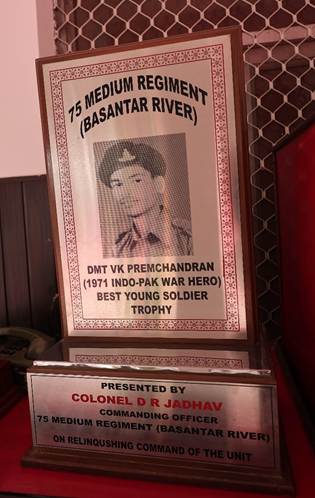
General Sundararajan Padmanabhan PVSM, AVSM, VSM (General Paddy) (5 December 1940 – 18 August 2024) –was our Artillery Brigade Commander in 1986 and I, a Lieutenant with 75 Medium Regiment (BASANTAR RIVER,) then located at Gurgaon. 

Our first interaction was during the Administrative Inspection of the Regiment.  I was positioned at the Radio store that day.  Brigadier Paddy walked in and asked me to demonstrate measuring the resistance of the cable drums in the store.  I took out the multimeter, positioned the switch to 1000Ώ, connected the probes to the cables and read off the resistance.

Brigadier Paddy asked me the principle on which the resistance was measured.  I explained, “Multimeters measure resistance by injecting a small current into the circuit, and then measuring the voltage drop across those points in the circuit. The known current, and the resulting voltage drop are then used to calculate the resistance using Ohm’s Law, V = I × R.”

What principle is it based on?” queried Brigadier Paddy.

Ohm’s Law, Sir” I replied.

Isn’t it based on Post Office Box?” asked Brigadier Paddy.

A Post Office Box is used to measure an unknown resistance. It works on the principle of Wheatstone bridge to identify the resistance of wire connected and then by using wire resistivity and cross section calculating length of wire and thus determining where the cable had broken. This is based on the Ohms Law, Sir” I stood my ground, having faith in the basics of physics taught to us by Mr. PT Cherian at Sainik School Amaravathinagar. (To read more about Mr. PT Cherian, please click here.)

Well done young man, I need to go back and revisit my basic physics,” said Brigadier Paddy patting my back as he left the store.

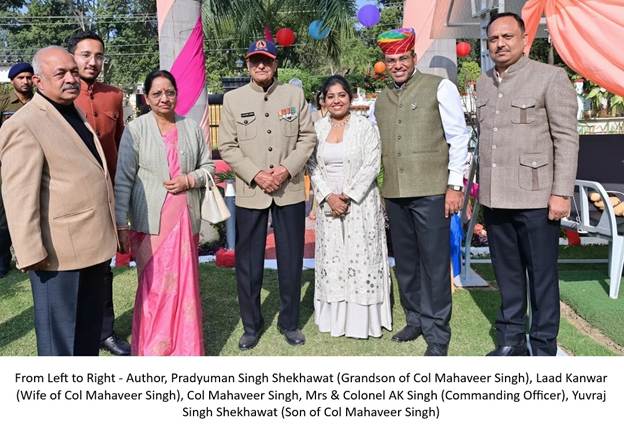
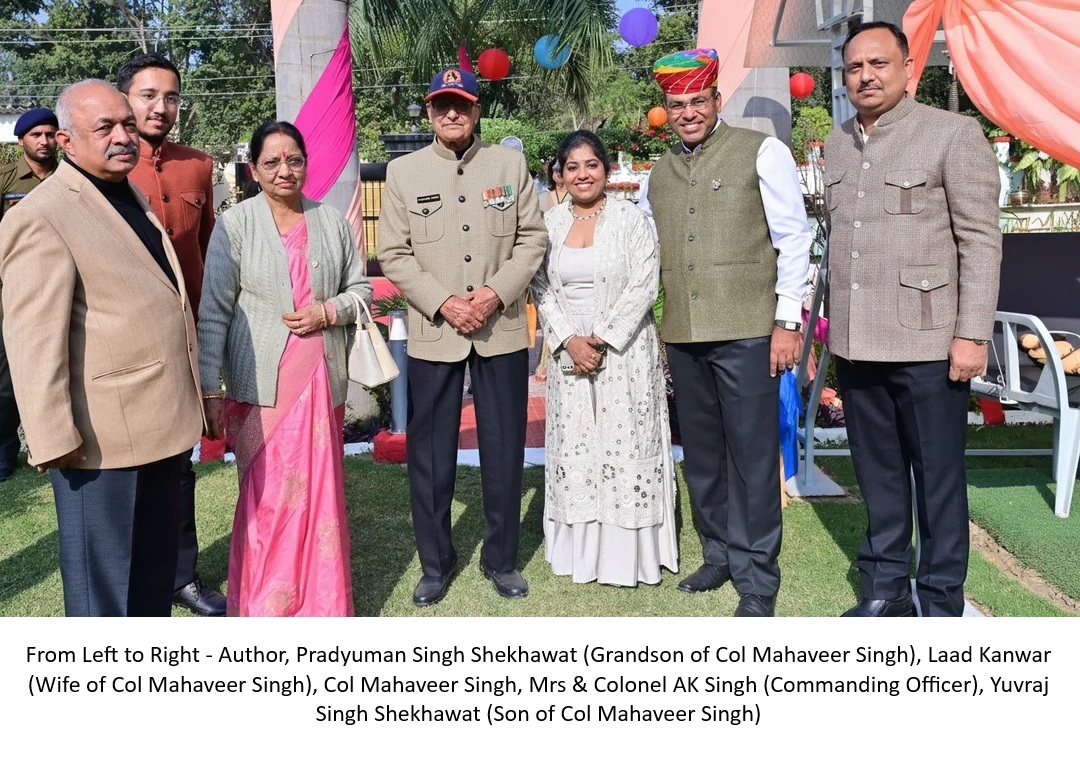
After the inspection, Colonel Mahaveer Singh, our Commanding Officer while debriefing all the officers said, “Reji, I must compliment you for your confidence and knowledge.  I did not understand a word of what you discussed.  I thought you both were conversing in Thamizh.”

Thank you, Sir,” I said.

It is not easy to engage in a conversation with Brigadier Paddy.  You got him confused,” said Colonel Mahaveer in his innocent way.

With Veteran Colonel Mahaveer Singh during Golden Jubilee celebrations of 75 Medium Regiment in 2018

Fast forward and our next encounter was during the Gunners’ Day celebration at Delhi in 2001.  General Paddy was the Chief of the Army Staff, and I was a Lieutenant Colonel posted at the Army Headquarters.  I wished him good evening and went on to thank him for all the support he gave our Commanding Officer Colonel Mahaveer Singh on quite a few issues that I had had with the local police.  (Click here to read more about it.)

You were the young man who made me re-visit my basic physics when I visited your regiment.  On your issues with the Police, it was your Commanding Officer who took a strong stand supporting you and I had to follow suit.  I did hardly anything other than backing your Commanding Officer,” replied General Paddy.

After that I met Mrs. Angela Rajan conversing in Thamizh with an elegant woman, gracious and stylish.  Mrs. Rajan is the wife of Major General Daniel Rajan from our school – he was the Military secretary to General Padmanabhan.  They both had commanded 7 Field Regiment (GAZALA.)

On seeing me, Mrs. Rajan greeted me in Thamizh and said, “haven’t met you for a long time since our meeting at Udhampur in 1991. How is the family?”

Our conversation in Thamizh went on for a few minutes and the other lady joined in.  After five minutes I asked, “We haven’t been introduced, Madam, you are….”

Mrs. Rajan promptly said, “Reji, what!!! You do not know her? She is the Chief’s wife?”

I realised that the brick that I dropped had actually landed on my toes. Flustered a bit, and apologising, in a jiffy I evaporated from the scene to condense among our course mates in the party.

A few years later I was in command of my unit and we were deployed in Op Parakram. The Gujarat Riots had broken out. When the army was called out, General Paddy tasked the Bison Division, then Commanded by General Zameer Uddin (Zoom) Shah for the task of quelling the riots. The task of course was executed with typical military efficiency in 48 hours. But it was the decision then that I had contemplated with great admiration. Years later, General Paddy said that many eyebrows were raised at the choice of the formation for the task and that he had to hold his ground, entertaining no debate on a military decision.

That was the quintessential General Paddy. Brilliant, witty, extremely generous and a true leader of men. Adieus General, we pray your legacy will live on and flourish.

Turn Table

Recently I received a video on social media about a disused Turntable at a railway depot. My journey with the Indian Railway commenced with my first travel way back in 1966 when I was in Grade 1. Little did I realise as a toddler then that I will serve in the Indian Army and travel the length and breadth of the country on trains. It was the beginning of a long and cherished association with the Indian Railways.

During the steam-engine years of the railways, the turntable was located at most terminals and at depots.  It was used to change the direction of the steam-engine.  These engines operated most efficiently in the forward direction and thus had to be turned every time.  They could run in the reverse direction, but at a lower speed.  The turntables were operated manually or by hydraulics.

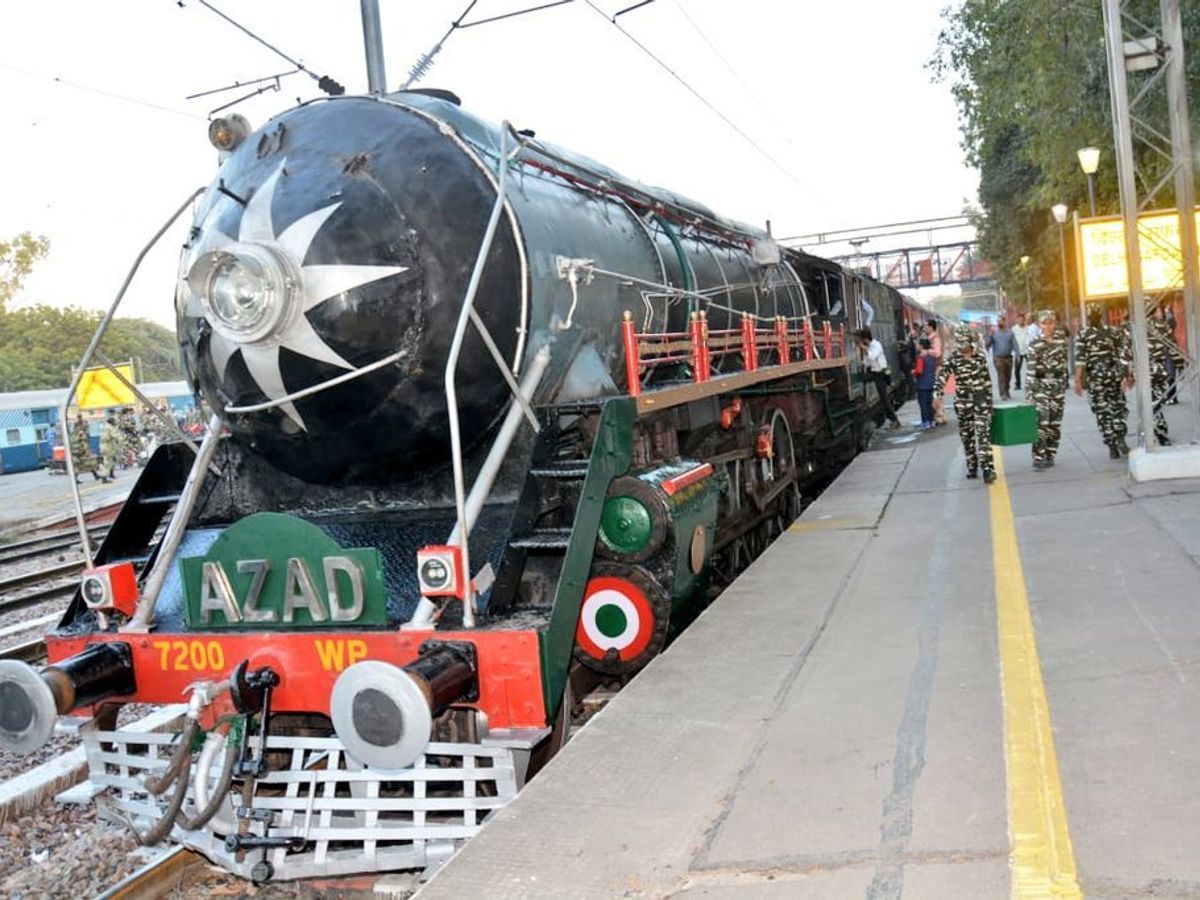
Steam engines are not extinct. The Indian Railways currently runs a luxury heritage train from Delhi to Alwar, renamed The Palace On Wheels, powered by a 70-year-old renovated steam engine, named Azad – engine number WP 7200, built in 1947 in the US.  Indian Railways is still maintaining its oldest working steam locomotive named Fairy Queen at New Delhi.

With the arrival of diesel locomotives, which could run equally well in either direction, the need for turntables waned. By the 1990s, most steam engines were replaced by diesel/ electric engines and the turntables became obsolete.

Aerial view of Roundhouse Park

In North America, many turntables have been restored and now find a place of pride in many rail museums – Roundhouse Park at Toronto, B&O Railroad Museum at Ohio, etc. Roundhouse Park, Toronto, created in 1997 features the original, fully restored and operational 120-foot-long locomotive turntable and a collection of full-sized railway equipment.

Early turntables were very small, sometimes just six feet in diameter since nothing larger was needed with the relatively small steam-engines and wagons in use during much of the 19th century.  As the size of the steam-engine grew larger, heavier, and longer – the size of the turntables too increased.  During the 20th century most roundhouse terminals featured turntables of at least 70 feet, with some as large as 120 feet or more in diameter.

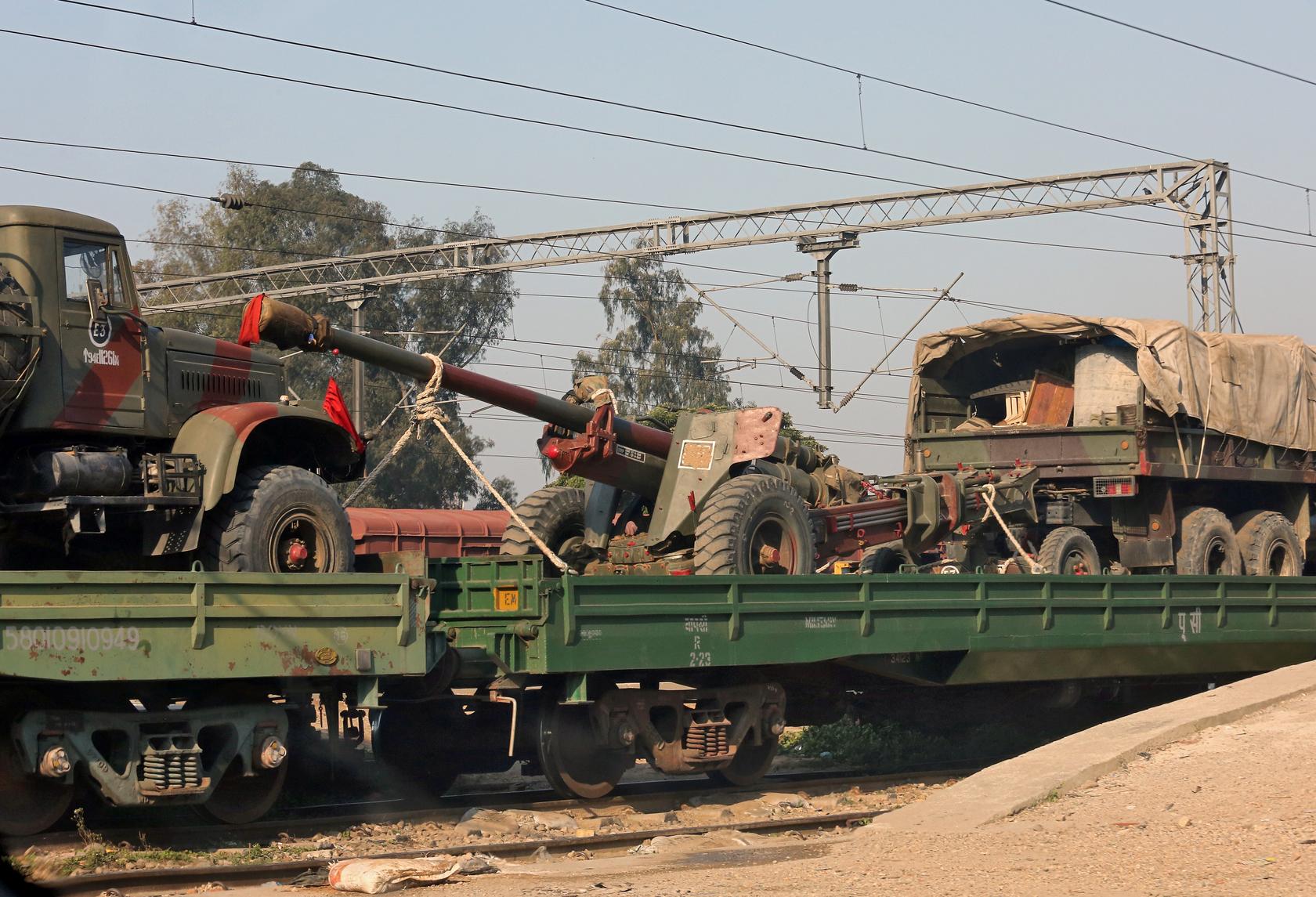
I had my first experience of travelling with our Regiment by a military special in 1983, a move from Delhi by a meter gauge military special for firing practice of 130mm medium guns at Pokaran Ranges in Rajasthan.

A 24-wagon rake for loading of the medium guns – MBFU – (M – Meter Gauge, B – Bogie Wagon, FU – Well Wagon) was placed at the military siding ramp at Delhi Cantonment Railway Station -12 for loading guns and 12 for Russian Kraz towing vehicle. The gun weighs over 8 tonnes and the wheelbase just about narrowly fit on to the meter gauge rake.  Today with broad gauge rakes, the wagons offer sufficient width to maneuver the guns.

On reaching Pokaran railway station siding, we realised that the guns were facing the opposite direction of the ramp. It was indeed a great ordeal to load these guns in the forward position, getting them out in the reverse was near impossible.

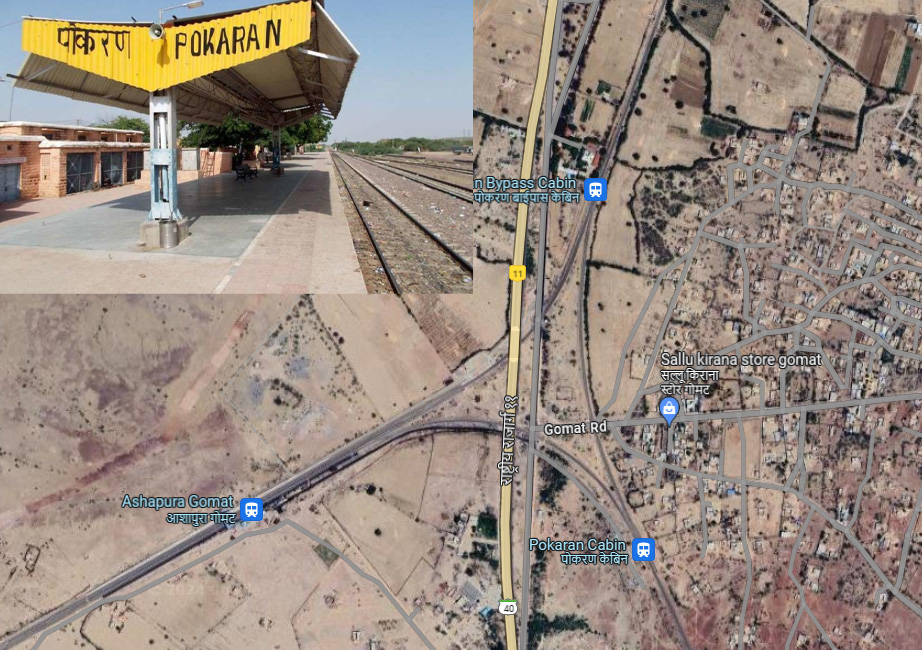
The Yard Master at Pokaran railway station came to our rescue.  He ordered the train to be put through a Triangle to change the direction the train faced.  I had until then seen only turntables at many railway stations but was unaware of a triangle.

A Triangle in Indian Railway parlance (Wye Junction in North America) is a triangular shaped arrangement of rail tracks where two rail lines join to allow trains to pass from one line to the other line in two directions and/or is used for turning railway equipment.

I jumped on to the steam-engine used for shunting along with the Yard Master to watch the operation.  The engine was connected to the rear of the rake and was pushed forward, crossing the Pokaran Cabin, until it crossed Ashpura Cabin.  Then it was a reverse travel until the entire rake crossed the Bypass Cabin. Then the train was pushed to the railway siding, and we were now facing the forward direction.  We then unloaded the guns and vehicles with ease.

After several decades, the turntables have made a reappearance – in a much more technologically advanced avatar on many metro rails across the world. Three turntables are in operation at Chennai Metro’s Koyambedu depot. With the help of digital technology, the turntables will help turn bogies, wheel sets and axles of metro rail trains for maintenance.

The bogies are pulled on to the turntable using a mini engine and then turned in the direction to which it must be taken. Two pairs of rails are mounted and positioned perpendicular to each other across diameter on the deck of each turntable to accommodate the bogies. Once the turntable completes the required turn – 90 or 180 degrees, the bogie is pulled out. This mechanism helps move bogies from one section of the depot. This equipment saves space, says an official, as otherwise lengthy tracks must be laid for trains or bogies to be turned around.

Our most valuable resources – creativity, communication, invention, and reinvention – are, in fact, unlimited David Grinspoon (American Astrobiologist)

One rule of invention: before you can invent it, you have to imagine it – James Gunn (American filmmaker and studio executive)

Fire Fighting

During my military service, we were periodically detailed as Field Officer of the Regiment for the week during which one was required to carryout many checks and procedures. One of the many laid down tasks was to carryout a practice Fire-Fighting drill and record how effective the effort was.  The Regimental Havildar (Sergeant) Major (RHM) lighted a fire and shouted “Fire, Fire, Fire!!” at the top of his voice.  The sentry on duty at the Regimental Quarter Guard rang the bell continuously denoting all ranks to assemble with all fire-fighting equipment they could get hold of. Some soldiers came with buckets filled with sand or water; some with the Soda-Acid/ Foam fire-extinguishers; some with rods; some with hooks; some bare handed.  The RHM dutifully made a list of the number of soldiers present and the equipment they brought. No one ever asked the soldiers whether they knew what to do with the equipment they carried in case it was a real fire.

Although the routine orders for the week specified which sub-unit should carry out the duties of the firefighting party, the cordon party and the salvage party, rarely did the soldiers knew what they were required to do and how they were to execute the task. Theirs is not to question how, theirs is not to make reply and theirs is not to reason why!!I and that’s what the military is all about.

It may be deemed as a catch 22 situation of sorts, yet a rudimentary system was in place to cope with an accidental fire and that was vitally important. In many cases of the infamous Bukhari (Kerosene or Coal fired room heaters) fires during the harsh Himalayan winters, such a system at least occasionally saved lives and prevented damage. Please click to read Fire! Fire! Fire!

In Canada we have an elaborate system to respond to an accidental fire. During the freezing winter months, one of the most common emergencies experienced by Canadians is a fire in their home. They are most likely to occur between December and March. Heating equipment like portable heaters are the leading cause of home fires.  In as little as 30 seconds, a small flame can grow into a dangerous fire. Within minutes, an entire home can be filled with black smoke and large flames. Other common causes of home fires are cooking (leaving the stove unattended,) improperly extinguishing cigarettes and candles left unattended. The recommended way to protect yourself and your family from a home fire is to follow these steps:

  • Know and practice your evacuation plan.
  • Get out and STAY OUT – never return to a burning building.
  • Install smoke alarms and carbon monoxide detectors on every level of your home.
  • Test the alarms every month and replace the batteries twice a year, at Daylight Savings Time (March and November).

Sometimes accidental fires are caused by gas leaks. Sometime back when I compared the sense of sight with that of hearing in my previous post, I couldn’t help but reflect on how vital the sense of smell is to detect such a gas leak.

How do we test the smoke alarms at our home?

We fry fish, meat cutlets, etc. on the deck in our backyard in summer.  In the cold Canadian winters, we got to do it in our kitchen.  At least once a month, this operation triggers the fire alarm.  We got to switch the alarm off in 30 seconds, else the Monitoring Centre will call to check.  In case there is no response, they will activate the emergency centre to dispatch the fire tenders, ambulance and the police cruiser.

A False Alarm is when an alarm call where the emergency services responded and were not required; or where an alarm response cancellation request was received after dispatch from the Monitoring Station, advising the emergency services response was not required. In case of a false alarm, the caller is charged around $175.  The emergency services reserves the right to suspend response at any time at their discretion. Those under such suspension may be subject to cost recovery fees.

When a user dials 9-1-1, the call goes directly to the Regional Police 9-1-1 Communications Center. The caller is connected immediately to an experienced 9-1-1 operator. The operator will dispatch the appropriate emergency service required and will stay on the line to aid you until help arrives.

On the long weekend of February 2024 coinciding with the Family Day, our children were home.  Marina was frying fish for lunch and it triggered the fire alarm.  Our son Nikhil dashed downstairs and switched it off and said, “Why don’t you ensure that the chimney exhaust fan is rung high when you fry fish?

That’s the way we test our smoke alarm!” I replied.

THREE minutes — that is the time people must get out of their home in Canada if it catches fire. It used to be 17 minutes, but because of modern building materials and the proliferation of inexpensive, inflammable products, a home could be destroyed in a few minutes. Quick evacuation therefore becomes vital.

A typical modern Canadian home with newer, synthetic furniture made with chemicals like polyurethane, the backing on the carpets, the drapes, the stuffing in the mattress and pillows, are all highly inflammable and they burn hotter and faster as they contain hydrocarbons. A fire triggered in such homes results in flames raging in less than TWO minutes – what the firefighters call a flash-over.  The old furniture burns more slowly. It takes more than 13 minutes to flash-over. 

The first Christmas we celebrated in Canada was on 24 December 2005.  We had invited all our friends and acquaintances.  The party was planned in our basement with a wood-burning fireplace.  A week before the party, I called the chimney cleaning service and got the chimney cleaned and they tested the safety aspects of the fireplace.

On the eve of the party, I activated the fireplace by burning logs.  A sudden downdraft of wind filled the basement with some fumes, though not much it was sufficient to trigger the fire alarm.  I rushed and before I could deactivate the alarm, the telephone rang.  It was from the Monitoring Centre and I explained the cause of the alarm and confirmed everything to be safe.

Marina advised that I should give up my plans on lighting the basement fireplace.  The soldier in me was not giving it up just as yet.  I tried again and the result was much the same.  I profusely apologised to the Monitoring Centre associate for my gaffe.

Soon the first set of guests arrived and one of them reported “There is a long queue of Fire Tenders, Ambulances and Police Cruisers outside your home with all their lights flashing.  Is Anything serious?”

They might have come to some other home in our vicinity!” I calmed their nerves.

In a minute the doorbell rang and I opened the door to find the Fire Marshal.  My immediate response was “I had informed the Monitoring Centre that we are all safe!!!”

We had that information, but we are here to practice our emergency response drills.  I have listed out the Emergency Vehicles here and you are requested to sign at the bottom,” replied the Fire Marshal. I heaved a sigh of relief. Not much different from signing the Field officers report form.

Signing the document, I asked “How do I know if it is real emergency response or a practice one?”

If it was a real emergency response, the sirens would be blaring.  Now only the flashers are on,” replied the Fire Marshal.

A subtle difference. I was wondering how the boys in the Regiment would know the difference between real and practice. Remember theirs is not to make reply.

Fire marshal gracefully thanked me and departed. We then had a ball. It was time for a different sort of fire…. fire in the belly.

Vision or Hearing – Which is More Important?

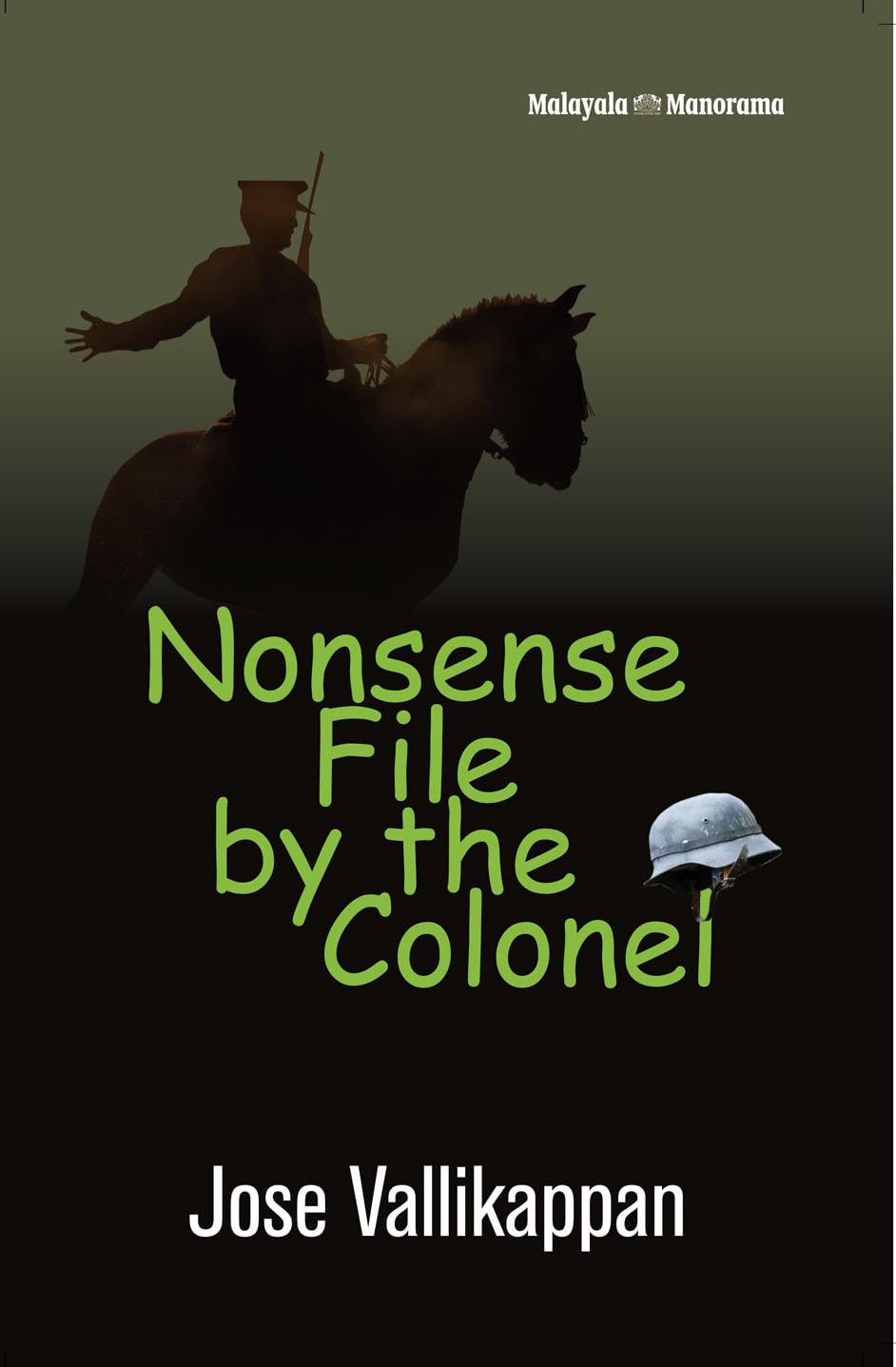
Veteran Colonel Jose Vallikappan of 18 Cavalry Regiment of the Indian Army magnanimously sent me a copy of his book Nonsense File by the Colonel through his nephew who lives in Canada.  I immediately sat down to read it.  I was familiar with Colonel Jose’s writing as he has been a columnist of note in The Week for a very long time.  It was lighthearted, humour-based reminiscences of his experience in the Indian Army.  He ran the column for 15 years.

In the book, Colonel Jose writes, “I had always thought that eyes are more important than ears and that seeing is more critical than hearingIt was from the kind and angelic Sister Resella of Karuna Speech and Hearing School at Kozhikode that I learned that hearing is indeed more critical than seeing.  Without hearing you cannot speak, without speech there is no language and without language there is no concept of ideas and what is life without ideas?”

On reading this, I paused and analysed the paragraph.  I too, until reading this line, thought that seeing is more critical than hearing. It is quite natural to think that with critical loss of vision, one is perpetually in a traumatic dark world. But surprisingly, many people with vision loss are able to lead successful lives as compared to those with hearing loss, congenital or otherwise. There are many visually impaired PhDs, professors, doctors, musicians and so on. Hearing loss is a global disability of gigantic proportions. According to a UN report, a quarter of all people in their sixties, half of those in their seventies and eighty percent of those in their eighties suffer from serious hearing loss. Age related hearing loss (Presbycusis) is indeed a serious widespread problem. In addition to being deprived of the world of ideas as pointed out by Sister Rosella, loss in ability to communicate often leads to social distancing, loneliness, depression and other mental health issues.

For far too long hearing loss has been relegated to the sidelines of health care. It is unimaginable to think that in a country like the US, legislation was required to make available over- the -counter hearing aids. This came about only as late as October 2022.  

A few weeks back, I rented a chainsaw from the store to cut a tree. Along with the chainsaw came the ear protection mufflers. On inquiry the store man said, “it is mandatory that the ear mufflers be issued with the equipment whose noise levels are higher than the prescribed limit, but it is up to you to use it or not.”

My mind raced back to my young officer days in the Indian Army. It was considered not manly enough to wear the ear plugs while firing the heavy caliber guns. After every firing practice, we heard a thousand bees buzzing in our ears for the next few days. We all got used to this sound as we got used to the firing, without realising that we were getting into a world of Noise Induced Hearing Loss. The effects of it continue and I have a hard time listening to whispers or soft noises.

The store man gave me protective goggles too – to protect my eyes from the flying debris while operating the chainsaw.  I reminisced about our workshop lessons at the National Defence Academy. Other than wearing the thick military dungaree, we had no protection for our faces while operating the lathe, milling and cutting machines.  Luckily during our time at the Academy, no Cadet suffered any injuries while operating these machines.  By Western standards, it may be criminal negligence!!!

Of the five human senses, sight, smell, hearing, taste, and touch, if you had to go without one of your senses, which would it be? Aristotle proposed a hierarchy of senses in the fourth century BC. He ranked sight first, followed by hearing, smell, taste and then touch.

Research has shown that people rate sight loss as a greater concern than loss of memory, loss of speech/hearing. A clinical study with patients experiencing sensory loss has shown that loss of sight and touch cause the greatest decreases in quality of life before loss of hearing, taste, and smell.

People with hearing loss can often hear what other people are talking but cannot make out what they are saying. They can hear, but their ability to listen and communicate with other people is curtailed. When our sense of hearing is impaired, misunderstandings emerge. The frustration experienced by the speaker and the listener can lead to both parties avoiding social interactions and exchanges.

It is akin to travelling to a foreign country where nobody speaks or even understands your native language. You are frustrated when people do not respond to you asking for directions or trying to order from a local menu.

While in a dense forest on a dark night, all you can see are trees and shadows.  Nature’s sounds tell you what is happening around you. Here our brain meshes with our vision and hearing to create an image of what is happening around us. What you see can influence what you hear, and likewise hearing can affect vision.

Adequate vision and hearing are paramount to educational performance.  Impaired vision and/or hearing in children can seriously impede learning and result in development of educational, emotional and behavioral problems.  Early discovery and treatment can prevent or at least alleviate many of these problems.

Children with hearing or vision loss often are not aware they do not hear or see as they should.  For this reason, it is up to the parents to identify if their children have hearing or vision problems. Hearing and vision screening must be provided annually to children from the age of three years up to third grade. Equally important is age related hearing /vision loss which we need to address as individuals. Loved ones play an equally important role in this aspect as often the affected older adult is unaware of the problem or reticent to address it

An interesting aside on the power of hearing. On September 8, 1941, the German Army laid siege to Leningrad and the Luftwaffe subjected Leningrad to massive bombing.  Special non-sighted soldiers – Eavesdroppers – were recruited into the Russian Army.  They picked out the noise of the approaching enemy aircraft and warned their comrades. Their device consisted of a system of tubes of various sizes that made it possible to hear the hum of approaching enemy aircraft at a great distance. These eavesdroppers could detect enemy aircrafts long before they came close to the front line. They could identify the type and model of approaching German aircraft and, sometimes, the approximate number of planes in a group.

It is heartening to note that the world’s biggest cricket event, the Indian Premier League (IPL,) have joined hands with the India Signing Hands (ISH) News to curate and create a commentary feed for the hearing impaired and the visually impaired. It provides ball-by-ball updates using the Indian sign language, and the regular verbal score updates. There is no denying that the unique thrill of a live game is a mix of visual drama and sound dynamics. For those with vision or hearing loss, the experience might become a bit challenging, but that doesn’t mean they can’t soak in the energy and excitement of the game.

Can you decide whether Vision or Hearing – which is more important?

Trust and Turnout  

A decade and a half ago, Veteran Major General Jambusarwalla and Mrs. Hufreez Jambusarwalla visited Niagara Falls, US side.  We all decided to meet them there as they did not have a Canadian Visa. Our children were very excited to meet the General as they had heard from their dad a great deal about the wonderful human being and adorable military leader worthy of emulation. It is believed that on the first day of raising the Artillery Division, the General called his two principal staff officers and said to them, “To be efficient the formation must first be happy. You look after the happiness part and I the efficiency part.

 Much as the General requested us not to bother, I wasn’t going to miss this opportunity to meet someone whom I so admired and more so I wanted the children to meet him. On the appointed day, we set out from home, crossed the international border and reached the hotel where the couple were to check-in. We received them there, and on meeting us, the General quipped with characteristic humour, “What better can a retired General from the Indian Army ask for at the Niagara Falls than a General Salute from a Colonel and family.” We then had dinner and shared a couple of wonderful hours together. The children were overwhelmed by the couple’s warmth and love.

One anecdote that he narrated particularly warmed the cockles of my heart. Interacting with Nikhil the General said, “Your Dad was arrogant and a bit of it did rub on his soldiers.”

“You can’t be serious Sir!” I interjected.

In a positive way, I must add,” said the General and he narrated an incident that occurred while he was the Commandant at the School of Artillery and our Regiment – 125 SATA Regiment – a cooperating unit with the School.

“Most evenings Hufreez and I went on a long walk in the cantonment.  Generally, the soldiers walking in the opposite direction conveniently turned left or right as they understandably preferred not to confront a General.   Few soldiers with a bit of instilled confidence walked past us smartly with a greeting. One evening, when two soldiers crossed us with a smart greeting, I said to Hufreez, ‘They are from 125 SATA.’ She wasn’t convinced and said that possibly I was needlessly over-impressed with the Commanding Oficer. The next evening a similar event occurred. When two soldiers crossed us, I summoned them after they greeted us and I asked them, ‘Which Regiment are you from?’

Both said in unison ‘Sir, 125 SATA Regiment,’ visibly proud and confident.”

While driving back, our son Nikhil said that the General was so down-to-earth and that he did not fit into the frame of a General that he had in mind. He was expecting a rigid, tall and a perfect military figure from what he had heard about him, but what he experienced was a simple human being full of energy, warmth and lots of humour, who came down to a kid’s level to enable a smooth and easy interaction. Nikhil summed up his final opinion with a statement – He is very Napoleonic.

Great things in your life will mostly come in short packets. One’s got to look for them, identify them, explore them, imbibe them and learn from them,” was my reply.

As I continued to drive homeward, I reminisced about the unit I commanded and my effort to transform the outlook of the boys. On assuming command of the Regiment while we were deployed in Rajasthan in 2002, my first command order was a somewhat quixotic one about dress code for soldiers.  Please click here to read.

On returning to Devlali after the operational deployment, I was irked by the number of worthless documents/registers that the unit maintained. The first to be thrown out the window was the Out Pass Register. To my mind, Out Pass is the vestige of the British Indian Army where the officers – mostly British – did not have the requisite faith in the Indian soldiers. They had to instill checks and procedures to reduce their movements in civil areas, particularly with a view to minimise the effect of any possible subversive influence.

We did away with the Out Pass Register as I had complete trust in our soldiers that they will abide by orders and instructions and will conduct themselves in a soldierly manner when outside the Regiment, more so under the pressure of such a trust. The need to treat them as soldiers worthy of trust rather than as jail inmates was foremost in my thoughts. The soldiers’ trust in the command echelons too increased manifold by this action that they realised their actions should not bring any blot on the Regiment. Instructions were passed that any soldier leaving the Regimental area only needed to inform his Section/ Platoon Commander about his going out and the likely time of return. It was a little thing with a big impact.

The only covenant was that they should all be smartly turned out in their Sunday best – pants, full-sleeved shirt tucked in, belt and leather shoes, well groomed hair, aptly perfumed.

One morning when I complimented the Stick Orderly – Gunner Deepak Pathak on his turnout, he replied, “Sir your orders on out-pass and soldiers’ turnout have gone down well with everyone. Even  Havildar Dharambir (Kabaddi Team Captain and Soccer Team Vice Captain – Please click here to read more about Havildar Dharambir) has shed his favourite Kurta-Pyjamas and now wears full-sleeved shirts and pants.”

Are the Indian Navy’s sonars and radars switched On?

For more about Gen Jambusarwalla, please click here.

Conical Flag or Honourable Flag

A flag is a piece of cloth which can be attached to a pole, which is used as a sign, signal, or symbol of something, especially of a particular country.  It is normally flown at full most – atop a pole.

The national flag is the highest and most recognisable symbol of national pride, a symbol of a nation’s glory. It displays the sense of belonging and pride to the citizens. Certain flag etiquettes and norms are attached to the use of the national flag. The flag is to be prepared and used according to the prescribed size, dimensions and colour. It should never touch the ground. If a flag is damaged, torn or discoloured, then it must be disposed off in a dignified manner according to the rules.

Recently, I have noticed a tendency in the Indian Armed Forces to display the national Flag in a conical shape, especially in offices of senior officers and in auditoriums.  It goes against the basic tenets of the Indian Flag Code.

As per the Indian Flag Code – Para 2.2(v) – When a flag is displayed on a speaker’s platform, it should be flown on the speaker’s right as he faces the audience or flat against the wall, above and behind the speaker.

Indian Flag Code Para 2.2(ix) says that the Flag should not be used as a festoon, rosette or bunting or in any other manner for decoration.

Flags are half-masted as a sign of respect and to express a collective sense of sorrow during a time of national mourning. National flags are recognised throughout the world as the ultimate symbol of their respective nations, the act of half-masting is a dramatic visual statement that speaks to the sense of loss that is shared by all their citizens.

When lowering a flag to the half-mast position, it must first be raised to the masthead (top of the flagpole) then lowered slowly to the half-mast position. To lower a flag that is at the half-mast position, the flag is first hoisted to the masthead, and then lowered completely.

In Canada, Flags placed on a flagpole with cravat on a flagpole with base as a sign of mourning. This practice was customary in former times but has faded in modern times. The flagpole is placed at the entrance of the building (indoors, never outdoors). The flag is draped with a piece of black crepe (ribbon, tied in a bow at the base of the finial. The ends, cut diagonally, should hang halfway down the sleeve of the flag. A cravat is never attached to the National Flag of Canada.

The portion of the US Flag denoting honour is the canton of blue containing the stars representing states and the soldiers. The field of blue dresses from left to right and is inverted only when draped as a funeral cloth over the casket of a soldier/ veteran who has served the US in uniform.

At events, such as military funerals, the US Flag is folded thirteen times.  After the flag is completely folded and tucked in, it has the appearance of a cocked hat, reminding of the soldiers who served under General George Washington, the sailors and marines who served under Naval Commander John Paul Jones. The thirteen folds represent: –

  • The first fold is a symbol of life.
  • The second fold is a symbol of our belief in eternal life.
  • The third fold is made in honour and remembrance of the soldiers/ veterans, who gave a portion of their life for the defence of the country.
  • The fourth fold represents the American citizens trusting in God, it is Him we turn to in times of peace, as well as in times of war, for His divine guidance.
  • The fifth fold is a tribute to the country.
  • The sixth fold is a pledge of allegiance to the flag of the United States of America.
  • The seventh fold is a tribute to the armed forces.
  • The eighth fold is a tribute to the mother.
  • The ninth fold is a tribute to womanhood.
  • The tenth fold is a tribute to father.
  • The eleventh fold represents the lower portion of the seal of King David and King Solomon and glorifies the God of Abraham, Isaac and Jacob.
  • The twelfth fold represents an emblem of eternity.
  • The thirteenth and last fold, when the flag is completely folded, the stars are uppermost, reminding USA’s national motto, In God We Trust.

Covering of the dead with flags and carried from the field of battle on a caisson – this custom began during the Napoleonic Wars (1796-1815.)

Paragraph 3.58 of the Indian Flag code states that on occasions of state/ military/ central para- military forces funerals, the flag shall be draped over the bier or coffin with the saffron towards the head of the bier or coffin. The flag shall not be lowered into the grave or burnt in the pyre.

When the U.S. flag covers the casket, it is placed so the union blue field is at the head and over the left shoulder. It is not placed in the grave and is not allowed to touch the ground.

In Canada, being laid to rest with the flag is an honour that is not solely reserved for the funerals of soldiers, veterans and dignitaries; all Canadians are eligible. As the National Flag belongs to all Canadians, any Canadian may choose to have their casket draped with the flag. When draping a casket, the top of the leaf should point to the right and the stem to the left when observing from the foot of the casket.

Historically, during naval warfare or acts of maritime piracy, enemy ships may have deceived their targets by flying the colours of allied nations before hoisting their proper identifying flags at the time of attack. This may be the origin of the expression to show one’s true colours, meaning to reveal one’s true nature after misleading or deceiving behaviour.

The things that the flag stands for were created by the experiences of great people. Everything that it stands for was written by their lives. The flag is the embodiment, not of sentiment, but of history – Thomas Woodrow Wilson, the 28th president of the United States from 1913 to 1921. 

Godfather in the Indian Army

Recently I read the sad news of a young officer of the Indian Army who died after the officer was Dined-In the previous evening, and was made to consume a lot of alcohol. It is learnt from various WhatsApp posts – which I do not believe at all– some claiming that the officer underwent the strenuous Battlefield Physical efficiency Test the following morning and collapsed.

Many feel tired after drinking because of the calming and relaxing effect of alcohol. A night of over-indulging may result in you fighting weariness the next day. Drinking lowers your Rapid Eye Movement (REM), leading to poor quality sleep. When you wake up, you will feel drained of energy and will struggle to concentrate.

When you wake up, the body experiences alcohol withdrawal symptoms as it works to get rid of the toxins. Most studies show that those who consume large amounts of alcohol before going to bed are likely to experience delayed sleep onset. It is because during the night, the liver enzymes metabolise the alcohol, which leads to a decrease in the alcohol level. This process will lead to poor sleep quality and night-time disturbances.

It is important to Hydrate when you stop drinking. Water plus other healthy fluids will help your body remove toxins and improve how you feel. During the early stages of detoxification, you may experience symptoms such as vomiting, nausea, and sweating. These symptoms further dehydrate the body.  Light exercises such as walking, or biking will help you feel more energetic. Such exercises boost your blood flow and help improve your physical and mental health.  You can also try moderate physical activity to increase your energy and boost your stamina, but never heavy physical exertion.

Most of us, on joining our Regiments as Second Lieutenant/ Lieutenant underwent a similar Dining-In.  That was when we hardly knew any officer in the Regiment.  Everything was alien to us – soldiers, equipment, etc – much different from what we experienced in our training days at the Academy.

That is where we need a Godfather in the Regiment.  I was lucky to have Captain (now Veteran Colonel) Rahul Gowardhan as our Battery Captain (BK.)  We were deployed in Rajasthan, and I had a small bivouac to live.   He often called me to his tent, made me sit down, offered me a cup of tea and spoke to me at length.  Every time he reassured me that I was doing well and gave me many tips about being a gentleman and a good officer.

Our Battery Commander (BC) was Late Major Daulat Bharadwaj.  The way he taught me and the life lessons I learned from him, I have reflected in my novel Son of a Gunner (available on Amazon.)

Captain Gowardhan was later our Adjutant for seven years.  Let me quote him: – “Reji used to follow the dictum that as youngster commit any mistake but keep the Adjutant informed. Therefore, it was quite often that I used to jump from the chair when he used to come and inform “Sir, chhotasa galati ho gaya. (Sir, I Committed a small mistake.)” The so-called small mistake used to be slapping the Superintendent of Police or bashing up BSF Dy Commandant. It wasn’t for the wrong reasons, but we had to sort out the issues.

On 31 Oct 1984, Regiment’s column was ordered to move and take responsibility of security of Teen Murty Bhawan, where mortal remains of our late Prime Minister, Mrs Indira Gandhi were kept. Regiment was also responsible for controlling VIP visitors, who came there to pay homage to late the Prime Minister. Reji stopped Inspector General of Delhi Police, who along with family was sneaking through the VIP gate. This resulted into arguments with the Police Officer asking, “What are you doing here and who are you to stop me?”  Reji said to that officer, “Had police been working properly, Army would not have come to control this.” This was being heard and observed by Minister-in-Charge there Mr Shivraj Patil and he appreciated Reji for his dedication to duty and rebuked Police Officer. Later, the Regiment received an appreciation letter and cash prize from the Minister.”

As a Lieutenant, during a Regimental party in December 1984, I got badly drunk.  By midnight, Colonel Gowardhan put me in the guestroom of the Officers’ Mess and closed the door.  I woke up by mid-noon next day and went to the Adjutant’s office.  He asked me if I had any hangover effect of headache or dehydration.  He made me drink three glasses of water followed by an advice “Never go overboard!” 

I quit drinking that day to consume my next peg on 17 March 1997 to celebrate the birth of our son.

While in command, my Godfather was Colonel (now Veteran Brigadier) Azad Sameer, our Colonel General Staff (Col GS.)  I sought his counsel whenever I was in a difficult situation.  He counselled me, motivated me, and admonished me when necessary.  He treated me more as his younger brother than a subordinate. 

Colonel Sameer is a great thinker, and we had many discussions varying from military subjects to parenting and our outlook towards religion and politics. We both believed in our God and did not believe in wearing our God on our sleeves or placing the images of our God in our vehicles in that many in the army never realised that Colonel Sameer was a Muslim and I a Christian.

Please read Abiding Faith by clicking here.

During many tactical discussions and exercises we had, I had the opportunity of accompanying Colonel Sameer. He is an ever smiling, soft spoken soldier who easily passed off as a young Lieutenant. After preparations for the tactical discussion the next day, in the evening we visited the bar at the Officers’ Mess. He ordered his favourite Old Monk Rum and I a peg of Teachers Whiskey. The barman, assuming Colonel Sameer to be a young officer, served me first. At last, I had to request him “Sir, whenever we are together, we both will always move around in our uniforms.

Book Review : Dare Dream Different by General Tharakan

Dream, Dream Dream; Dreams transform into thoughts and thoughts result in action. You must dream before your dreams can come true. Great dreams of great dreamers are always transcended,” thus wrote Dr Adbul Kalam, a great dreamer of all times.

This book is all about such a dream by a child Jake to fly by air and visit places.  Not he alone, but he wanted his parents too to enjoy the pleasure of flying in an aircraft.  How Jake fructified this dream – by his dedication, hard work and will to fulfill is narrated well.

It is the story of the journey of Jake from his birth to his travel from Atlantic Coast to the Pacific Coast of USA.  It is a detailed travelogue where Jake recalls his journey in USA and connects it with what he underwent growing in Kerala, Military School, University and over three decades of dedicated military service.  Throughout the book, Jake travels between his life in India and the journey through USA.

The book is akin to what Jake says – Life is a story that unravels page by page every day and we individually script and star in that story. The book can well be summarised into this line.  Jake felt very proud when the lady at the counter at Hollywood offered him a Veteran’s concession ticket and said, “Thank you very much Sir, for the service to Your Nation.”

Jake brings out many life lessons through his journey.  While apple picking, he realises – Those overtaken by greed end up with fewer apples and a torn bag.

Walking through the woods during the Fall, Jake philosophises – When winter wore off, green shoots sprang up all over.  Nobody noticed the dead leaves fall. People noticed only the green.

Jake is a foodie and he concludes – Food has a strong sense of identity.  It is one way of reaching and breaching cultural barriers.

Driving through Carmel Bay and on seeing The Lone Tree, Jake’s outlook is worth a read – She is called the Lone Tree, not the Lonely Tree. She exemplifies the will to live.

Looking at this book as a travelogue, it brings out many tips to the travelers to North America.

  • Nothing comes free in this part of the world.
  • Every town has a museum or two – every other street in a city houses a museum.  These museums display artefacts very well documented.  You must visit those which interests you.
  • Research well before setting out.  Collect as much information about the place, weather, places on interest, buildings and monuments to be visited, etc. 
  • Whatever you see, correlate with what you have seen in your motherland, learn what you can do to improve your life, your family’s, and the people around you.
  • Observe courtesies extended to you by mostly unknown persons  – what ever small it may be -and try and practice it in your day-to-day life on return.
  • Armed with the information, you will enjoy and understand the culture and history better.
  • Observe the enactments of various historical events – least you can help your grandchildren to in their presentations to be Different.
  • Your friends and well wishers are your life’s investment.  If you have been kind to them, they will be kind to you in a foreign land, where no one has time for anyone else.

The book is titled Dare Dream Different, but if you Dream then you will Dare which will make you Different.

The book is available on Amazon

Rest In Peace – Colonel Baby Mathew

August 25, 2023 – the morning brought me the sad news of bereavement of Colonel Baby Mathew. 

Colonel Baby Mathew hailed from Pala, Kottayam.  He was commissioned in 31 Medium Regiment and later moved to 255 Field Regiment.  I met him while he was attending Long Gunnery Staff Course and I Advance Gunnery Course at School of Artillery, Devlali in 1988.  In 1992-93, we served together – he with 255 Field Regiment and I with 75 Medium Regiment, then part of 39 Mountain Artillery Brigade.

In 1996-97, he was commanding 255 Field Regiment at Bagrakot and I was with 75 Medium Regiment at Sikkim.  During my vacation and official trips, I visited him at Bagrakot.  Please read https://rejinces.net/2017/07/23/lungi/

He commanded 255 Field Regiment during the Kargil Conflict.  The Regiment played an active role in providing close fire support to the attacking soldiers who captured Tiger Hill and Tololing.

Post retirement, he worked with Federal Bank.

Colonel Baby Mathew was ever smiling with a positive attitude to life.  He always remained calm, even in the most adverse situations.  He was a great friend, mentor and guide to me during my military service and also during our immigration to Canada and life there after.

Rest in Peace Colonel Baby Mathew.  I will ever cherish that smile of yours.

Veteran Centre Forwards

Many Veterans have now turned into excellent Centre Forwards – not in the game of Soccer- but on social media.  They forward anything and everything they receive including some of their personal messages; without realising that the group or person to whom one is sending has already received the very same wisdom from someone with a faster finger. The speed at which their finger moves on their mobile screen is akin to applying lime on a betel leaf. In effect, they glance and never read.

The tendency to forward messages on social media could be to prove to themselves that they are Virtually Alive.  They tend to forward every kind of message without thinking of its consequences. Most of the messages they forward are far from the truth and are from unreliable/ unverified sources.  They are unaware that the truth travels at the speed of sound whereas fakes travel at the speed of light.

Forwarding someone else’s message is plagiarism and a copyright violation.  Forwarding a fake or incorrect message is a crime.  In 2018, Madras High Court rejected the anticipatory bail of a journalist-turned-party leader for his allegedly derogatory Facebook post on women journalists. The judge noted “Forwarding a message is equal to accepting the message and endorsing the message.”

In another case of fake social media messages in 2020, Justice N Seshasayee remarked, “Mine would be the first vote for freedom of expression. But irresponsible, unverified and unsubstantiated social media posts cannot be tolerated.”

Social media is highly addictive and habit forming. In one’s spare time or breaks between our day-to-day tasks, many are trying to be Centre Forwards on social media.  The time they should have spent with their family or friends, engaging in a conversation, pursuing a hobby, reading, exercising etc are wasted by being a Centre Forward. A sure way to kill whatever creativity left in you.

The Centre Forwards on two Whatsapp groups I am a member of, were my superior officers – Majors, Colonels, Brigadiers and Generals – who were either my commanders or my instructors during many army courses I attended.  As Cadets at the Academies, we had to come up with ingenious ideas to escape the prying eyes of our instructors.  As young Lieutenants, we were asked to be innovative.  As Captains we had to be unconventional and unorthodox.  As Majors we had to think out-of-the-box and be imaginative.  As Commanding Officers our senior commanders expected us to be enterprising and insightful.

Many of these superior officers who wanted me to be Original and outthink the enemy are now spectacular Centre Forwards on Whatsapp.  One Veteran Brigadier even justified being a Centre Forward and gave a detailed argument supporting it akin to the use of faculty notes (pinks) by student officers during various army courses. Our academy coursemates, many of whom were instructors at various military institutions and commanders at various levels, are now exceptional Centre Forwards.

In both the Whatsapp groups, it is 99% forwards with 1% original content.  These Centre Forwards were never creative while in the army and continue to be so post retirement.  Many of these Centre Forwards pass the ball without even reading it, analysing it and evaluating its relevance and truth. They carry out blind passes, many times ending in scoring self-goals.

In this age of unparalleled transparency, it is impossible for anyone to disown a statement or opinion expressed on these public forums. Every netizen is both accountable and responsible for all their actions on social media.  Any post once made, becomes the ‘property’ of the social media.  Even if you delete or edit the original post, the original remains somewhere. 

The new generation in Canada do not want any of their photographs posted or tagged showing them smoking, drinking or partying as they feel that their prospective employers might dig into the social media.  Some political leaders are now haunted by some innocent photos of their youth that their friends posted on social media.

These Centre Forwards do not realise that their unverified and unsubstantiated forwards raise many questions about their credibility – if they had any while in service.  The most important aspect regarding communication is the credibility and trust your friends and the society bestows on you, especially as a Veteran.  While forwarding any mail or making any posts or comments, ensure that this trust is never betrayed.

When in Doubt, Do Not Post It, Always Throw it Out. Never become a Centre Forward.

If you do not read the messages on social media, you are uninformed. If you read them, you are misinformed.  Courtesy Mark Twain 

Indian Army & Agniveers

On 14 August 2022, Ipsos Group S.A. (French pronunciation: ​[ip. sos]; Institut Public de Sondage d’Opinion Secteur,) a multinational market research and consulting firm with headquarters in Paris, France, published a pan India survey to identify India’s Most Trusted Institutions.

65% of respondents ranked the Defence Forces first followed by the Reserve Bank of India with a 50% rating.  Indian Prime Minister received 49% of citizens’ trust and was followed by the Supreme Court of India with 47%.  The Central Bureau of Investigations was ranked fifth with 43% and the Police came sixth with 38%.   

The Parliament received 33%, Media 32% and the Election Commission of India 31%. At the bottom of the heap were Politicians (16%), Political Parties (17%), Community Leaders (19%) and Religious Leaders (21%). 

It wasn’t surprising at all for the Defence Forces being the most trusted institution.  It is based on the ethos, credibility, respect, integrity and discipline that the Defence Services of India has exhibited.  It is all about Naam, Namak & Nishan – ethos of the Indian Army to strive for the name of the country/ regiment, the salt partaken and the glory of the national/ regimental flag.

Of late it appears that there is a concerted effort by the political leadership and the bureaucracy to belittle the Armed Forces.  The Generals, Admirals and Air Marshals appear to have played along, accepting all the diktats in silence.

De-Regimentalisation is one of the methods to break the effectiveness of the Indian Army.  It does not apply as much to the Navy or the Air Force by virtue of their structure and functioning.  Adoption of a common uniform for Brigadiers and Generals is intended to bolster a common identity and approach in service matters amongst the senior hierarchy. The aim could well be to reduce parochialism towards one’s own regiment or corps. If so, a change of mindset is more important to achieve cohesion than cosmetic changes in uniform

Many proposals  have come up to De-Regimentalise the Indian Army by way of changes in uniforms, regimental names, traditional ceremonies, rituals, procedures, etc – all in the name of getting rid of colonial legacies. Some of these are already under implementation.

The system of recruitment to the armed forces has recently undergone a sea change, again to put the Armed Forces at their Right place. The Agnipath Scheme has been introduced.  The Agniveers of the scheme wherein a soldier serves four years and 25% of them are to be absorbed on merit as regular soldiers.  Those discharged on completion of four-year term will not be eligible for any kind of pension or gratuity, neither will they be eligible for Ex Servicemen Contributory Health Scheme (ECHS), Canteen Stores Department (CSD) facilities, Ex Serviceman status nor other related benefits.

Ostensibly, the new scheme has been  introduced with a view to improve the age profile and thereby the combat efficiency of the Defence Forces. But many critics point out that the primary aim of the scheme is to reduce the pension bill of the armed forces in the long run while it may actually change the ethos of the Defence Forces and may be detrimental to the combat efficiency of the armed forces.

In case the defence expenditure is to be curtailed and pension expenditure reigned in, the defence production factories and the Defence Research and Development (DRDO) must be cut to size. Most of these institutions are white elephants and need to be corporatised/ privatised at the earliest. Many may claim them to be national strategic assets. Look at VSNL and  Air-India – they  were claimed to be national strategic assets once and on becoming corporatised/ privatised, their performances are well known. 

If the money saved in cutting defence expenditure is spent on education or healthcare, it is beneficial to the country; else, … it is a pointless exercise.

To maintain the Armed Forces young, part time soldiering is one solution. Implementing a four-year or two-year term may be workable in countries with mandatory conscription. Many countries with voluntary military service, voluntary retirement is allowed at eight/ ten years of service with about 50% pension.  For Officers, only those with command potential are allowed to continue after ten years of service. Thus, the steep pyramidal rank structure gets better with less  crowding at the top.

The Agnipath scheme is already under implementation. In four to five years time approximately 25000 to 30000 Agniveers will be released from the services every year. Useful utilisation of such a large number of trained soldiers will indeed be a gigantic problem. The government does indeed have some rehabilitation and resettlement plans for the discharged Agniveers. At least some of these personnel will be absorbed into the police, paramilitary services and other governemnt services. Going by the past record, it does not seem likely that the problem will be addressed in any meaningful manner.

Decades of reality belied all such current day platitudes.   A Veteran Indian soldier of the day finds it difficult to get employment in private/ public enterprises.  Most governmental institutions do give some preference to the Veteran soldier, but the opportunities available are limited compared to the number of retiring soldiers.  Many Veteran soldiers remain either unemployed or are under-employed with very minimal salary and benefits. But these present day veterans do have a pension and the problem of penury is not very acute.   How can you expect a soldier who returns after four-year military service to find a job? The numbers are going to be large and large scale unemployment of trained military personnel could lead to serious problems for the society at large.

Critics point out that unemployed Agniveers could become potential recruits for criminal gangs. Such trained manpower could also be exploited by insurgents and terrorists generally lead to criminalisation of civil society and contribute to increased lawlessness. Large numbers may also become mercenaries abroad to fight someone else’s war on foreign soil. This is seen as an accelerating trend.

The way out

To attract the best talent and to ensure that they put in their best and serve the nation with dedication, it is suggested that giving 5 percent additional marks to the Agniveers who complete four-year tenure with unblemished record for all entrance examinations held by the Central and State Government agencies for professional courses – medical, dental, engineering, management, law, AIIMS, IIT, IIM, etc and also for examinations of  the central and state public service commissions. Further this could be backed up by concessional scholarship schemes at the state and central level.

A study of US Military Veterans deployed to Iraq and Afghanistan since 9/11, who joined various universities and colleges across America says that over 3 million veterans of the post-9/11 generation have entered higher education after service.  Most of them are between the ages of 25 to 34 and come from a host of different backgrounds and cultures. Majority served in the enlisted ranks of the military (82%) with about Army (47%), Navy (18%), Air Force (21%), Marine Corps (12%), Coast Guard 2%. Many of them are members of the National Guard or the Reserves (45%).

For successful utilisation of the Agniveers,  education is the key to their future.  If such large numbers of  US veterans pursue education as a means to future gainful employment, there seems no logical reason to believe that it is not practical in India.  Like the National Guard of the Reserves in the US, India too can raise its voluntary force with the Agniveers.

Like the US Veterans, the Agniveers are high-school graduates.  Research has shown that, on the average, US Veteran students maintain higher GPAs than traditional civilian students and are more likely to persist and graduate at higher rates as compared to their civilian counterparts.  Veteran students account for 3–4% of college students in the US.

Agniveers will bring valuable perspectives to the student community.  They possess maturity, discipline, work ethic, and leadership skills learned in the Defence Forces. They are also focused on achievement and success and are mission oriented. They are more likely to demonstrate appreciation, affiliation, and loyalty towards their institution. They will continue to  push themselves to achieve even higher levels of education over the course of their lifetime. They will bring along advanced technical skills along with proficiency in multiple languages. They will possess characteristics such as adaptability, self-discipline, leadership, management skills, work ethic, teamwork, professionalism, resilience, and mental fortitude – A sure recipe for a successful student in any field.

Book Review : Nation First by Shikha Akhilesh Saxena

Most books/ articles by military spouses are never focused on the impact of the military partner’s deployment on their spouse’s psychological health. Nation First dwells into mental and physical well-being, depression and issues arising out of family relationships, especially daughter-in-law Vs mother-in-law. My salute to Shikha for being candid and straight faced – which many military spouses will bury in deep sand.

Shikha has narrated her experiences with a poker face.  She has brought out the shock of the first combat deployment of her spouse, that too soon after the wedding. She has explained well as to how she coped with separation though the mother-in-law finds fault with her and blames her for all the ordeals her son had to undergo.

Kudos to Shikha for taking it on and forgiving her mother-in-law for all her taunts.  That takes a lot of courage, magnanimity, and commitment to her spouse.

The life of a military spouse, the duties she is expected to carryout and her role in a Regimental life is all truthfully narrated.  A military spouse spends nearly the entire time at the current duty station speculating about where you will go next.

The book rolls out the metamorphosis of a young girl with no military exposure into a military spouse.  To be a military spouse, it is all about imbibing the Regimental spirit, learning acronyms and abbreviations, hearing about the escapades of her spouse while at the National Defence Academy and as a Lieutenant in the Regiment – it is endless. 

The author brings out the difficulties a military spouse faces to remain unemployed after being an entrepreneur prior to wedding.  Shikha has listed out the tasks a military spouse can execute, especially during intense combat like the Kargil War.

For Shikha, homecoming was like being on a blind date. First comes the honeymoon phase, and then it just gets awkward, especially when the soldier receives his posting order to nowhere.  She explains the loneliness she felt and the turmoil in her mind as to what in the world she was doing with her life.

True to the indomitable spirit of a military spouse, she too went through the highest of highs and lowest of lows emotionally. She deftly handled tough situations and rose exponentially.

Whatever a military spouse narrates, it is difficult to understand her mind, the turmoil she underwent and the support she gave to her husband.  Resilience, strength, and courage are the core of a military spouse. 

The book covers in detail the planning and conduct of tactical battles with a micro perspective. The accounts of the operations for the capture of Tololing and Three Pimples and many other such battles, told the story of human endeavour, perseverance, grit and determination. Shikha has described in detail the anatomy of a herculean challenge, the nuances of fighting in extreme rugged high-altitude terrain, inclement weather and an entrenched enemy. 

Shikha has codified the emotions of her husband who was stepping into an arduous task knowing very well that there may be no return. It tells the story of fortitude, of agony and ecstasy, of raw courage and exemplary leadership, particularly as a Forward Observation Officer with attacking Infantry Battalions.

The only aspect the book does not dwell into is Post-Traumatic Stress Disorder (PTSD.)Akhilesh suffered many injuries – both physical and psychological – but there is no mention about PTSD in the book.  May that the Indian Army is yet to recognise the existence of PTSD amongst the soldiers.

The military marriage always grows apart, back together over and over and it will turn the two into a strong couple.

The Book is available on Kindle and Amazon @Nation First eBook : Saxena, Shikha Akhilesh: Amazon.in: Kindle Store

Newton and Recoil of a Gun

While preparing for the entrance examination for the Long Gunnery Staff Course (LGSC) in 1988, the prescribed book on basic physics had a question – Recoil of a gun is based on which of Newton’s Laws of Motion?  The options were:-

  • First Law
  • Second Law
  • Third Law
  • None of the above.

Based on my previous knowledge, I presumed that the answer is the Third Law, but the book stated that it is the Second Law.  I sought help of our senior officers who had graduated from LGSC and they all said that it’s the Third Law.  I concluded then that it might be a typo error in the book.

In 1996, I attended Technical Staff Course.  Those of us without any technical qualifications like B Tech had a six months scientific orientation course prior to the commencement of the course.  This orientation course covered basic sciences and mathematics. 

During the class on Newton’s Laws of Motion by Dr Ganesh, a young scientist, I queried about Newton’s Laws and Gun’s Recoil to clear my mind of the lingering doubt.  Dr Ganesh explained it in detail.

  • The gun with the bullet/ shell housed inside prior to pressing of the trigger, total momentum of the system equals zero. 
  • On pressing the trigger, the bullet gains velocity and the gun recoils.  Here too the total momentum of the system does not change.  Momentum is the product of the Mass and Velocity. 
  • That is why we calculate recoil by equating the momentum of the Gun and the bullet by the formula – Mg X vg = mb x Vb where
    • Mg is Mass of the Gun
    • vg is Velocity of the Gun
    • mb is Mass of the Bullet
    • vB is Velocity of the Bullet

We account for both the forward momentum of the bullet and the rearward momentum of the gun.  Here the sum of the magnitude and direction of the momentum of both the bodies involved does not change being in opposite direction. Hence, momentum of the system is conserved.

This conservation of momentum is why gun recoil occurs in the opposite direction of bullet projection – the mass times velocity of the projectile in the positive direction equals the mass times velocity of the gun in the negative direction. Thus the sum of momentum before the trigger is pulled or when the gun fires remains the same.

Thus, the recoil of a gun is attributed to the Law of Conservation of Momentum – that is the Second Law.

Now I realised that the basic Physics book I read while preparing for LGSC was correct.

81mm Mortar: Infantry Battalion’s Artillery

My first close encounter with the 81mm Mortar happened in 1993 when I had to organise Inter-Battalion Mortar Competition as the Brigade Major of the Artillery Brigade. I wanted to have a first-hand feel of it and requested the Mortar Platoon of one of the battalions for a demonstration of their drills.

81mm mortar is a joint design by the UK and Canada and was introduced into service in 1965–66, replacing the 3-inch Mortar. To match and then overwhelm German firepower during World War I, British engineer Sir Wilfred Stokes invented the Stokes 3-inch Mortar System.

81mm Mortar can be man-packed by the mortar detachment, in which case the ammunition is to be carried by other soldiers of the battalion. In addition to their normal equipment, each soldier carries four bombs. These mortars are the Infantry Battalion’s organic firepower, better known as the Commanding Officer’s Artillery and can be used to deliver a heavy volume of fire down on an objective in an extremely short period.

As the mortar was being brought into action, the detachment was heard shouting “Mathy, Mathy, Mathy.” I interpreted it to be ‘Maththi’ (മത്തി) – Sardine in Malayalam. The shouting subsided and the chaos settled with the mortar set in action.

I wanted to know why the clamour was all about and what they were shouting. A Mallu officer came out – he must have realised my confusion – and said “Sir, it is Madhya (मध्य)” -meaning centre. It appeared that the detachment shouted “Madhya, Madhya, Madhya” as they brought the bubbles of the spirit levels on the two axes on the dial-sight in the centre to level the mortar on a horizontal plane.

Now I had a closer look at the dial-sight to find neither bubble was centered. I asked as to what the shouting was all around. (Gunners do not shout while levelling the bubbles.)

That’s the drill sir,” replied the officer. (A standard reply to most questions in the Army!!)

As we progressed through the competition, I realised that all Platoon Commanders assembled their platoons to indicate the AP (Aiming Point.) He said “Door se door, sahi pehachan, achcha laying edge – Abhi keliye 100-meter pe jhanda.” (दूर से दूर, सही पहचान, अच्छा laying edge – अभी केलिए 100-meter पे झंडा.)

An Aiming Point provides a point of angular reference to aim a gun in the required horizontal direction. An aiming point must be as far as possible, sharply defined and easily distinguished feature, such as the edge of a building. The Platoon Commander was correct in the definition which all Platoon commanders rattled out, but everyone used the Flag @ 100 meter.

Was the flag designated as Aiming Point at 100 meter?? No way!  Even if I stretched my imagination beyond its elastic limits – it could at most be 100 feet.  May be, an Infantry soldier can stretch a foot to a meter!!  

I knew that selection and use of an Aiming Point on ground presents problems in featureless areas, in bad visibility or at night as putting lights on distant aiming points is seldom practical. Therefore, modern guns employ a ‘Collimator’ to simulate an Aiming Point at artificial infinity on the principle of parallel lines meet at infinity. Many Gunners – including officers – call it colli-METER.

The Flag @100 meter baffled me, and my gunnery brain cells worked on hypersonic speed to resolve the riddle. Unsuccessful, I gave it up and summoned the very same Platoon Commander who first demonstrated the functioning of a Mortar Platoon. He claimed that he was an instructor at Infantry School. He failed to convince me as all his explanations were illogical and unscientific.

Where do you conduct your Mortar Platoon training at Infantry School? Is the area surrounded by buildings?” I asked. “Yes,” said the Platoon Commander

Now I realised that the Flag @ 100 meter (feet) was creating the artificial infinity at Infantry School, and it was being carried to all the battalions by the Platoon commanders trained at Infantry School.

Infantry will make parallel lines to meet even @ 100 feet.

All Together Heave

On return to our regiment – 75 Medium Regiment – after completion of the ‘Computer Course’ in August 1991, our then Commanding Officer (CO) Colonel Rajan Anand appointed me as the Battery Commander (BC) of 751 Medium Battery.  75 Medium Regiment then had three batteries with fixed class composition.  751 Medium Battery consisted of Brahmins from North India, 752 Medium Battery had Jats and our 753 Medium Battery had South Indians. 

That was the first time I became the BC of the Brahmin Battery and always commanded the same Battery during the rest of my service with the unit.  Our Regiment was then located at Udhampur (Jammu & Kashmir).  The Regiment was tasked to display the newly acquired 155mm Bofors Gun for the Gunners’ Day on Saturday, 28 September 1991 for everyone in the station and school children.  Our CO gave the task of the equipment display to me.  The previous day, I briefed everyone about the task at hand and the next morning at 8AM, we marched off to the stadium where the display was being conducted.  The event was organised under the aegis of 8 Artillery Brigade, who were then staging at Udhampur on their induction into the Kashmir Valley.  Our Regiment was under 39 Artillery Brigade.  On reaching the stadium, I was shown the area where the Bofors gun and allied equipment was to be displayed by the Deputy Commander of 8 Artillery Brigade.  The Deputy Commander was a Colonel with over 25 years of service, while I had eight years behind me.

I took Havildar (Sergeant) Major Lekh Ram and the Gun Detachment Commander – Havildar Chaman Prakash – and briefed them about the placement of the Gun and other equipment and various boards and charts defining the characteristics of the equipment.  By 8:30AM, I moved to the tent where the Deputy Commander was sitting, pulled a chair and sat next to him.  From his body language, it was evident that he did not approve of my action a wee bit.  All the officers of other Regiments, mostly from 8 Artillery Brigade, were busy supervising the equipment display and were all near their detachments.

The Deputy Commander now asked me as to why I was not next to the detachment supervising their actions.  I told him that I had briefed everyone well about the impending task and the Havildar Major would do his job and report to me on completion of the task and my job would commence then.  I had faith in my soldiers and NCOs and I was sure that they would do an excellent job.  I also said that everyone is going to see the Bofors Gun, being in the news for wrong reasons then, and not many would be interested in the field guns and mortars displayed by 8 Artillery Brigade.  

Adjacent to our Bofors Gun was the detachment of the 105mm Light Field Gun, from a field regiment of 8 Artillery Brigade.  By 9 AM, when the field gun detachment got ready, the Subedar Major (Master Warrant Officer) of that regiment held a practice of bringing the gun into action.  This entailed the detachment of five soldiers heaving the gun on to a circular metallic platform.  Due to heavy downpour for the previous four days, the ground was soggy and the detachment had to heave hard to pull the gun on to the platform.  While pulling the gun on to the platform, the detachment would shout in chorus “All together heave!” 

At this time Havildar Major Lekh Ram reported to me that everything is ready.  After seeing the entire arrangement, I summoned everyone and said a few words of appreciation for executing the assigned task well.  I ordered everyone to have a tea break, change into their ceremonial uniform and to be ready by 9:45 AM as the demonstrations were to commence at 10 AM. 

After ten minutes, it was the turn of the Adjutant (Captain) of the field regiment and he too ordered the detachment into action.  The detachment pulled the gun on to the platform “All together heave!”   Now came the Battery Commander (Major) and the same drill was repeated.  With each practice, the ground beneath the platform sank in more, making it overly difficult for the detachment.

I now told the Deputy Commander sitting beside me that with so many practices, the detachment will be tired and any more practice will surely sink the ground furthermore.  He gave me a frown.  Next was the turn of the CO (Colonel) of that regiment and the soldiers became even more tired. 

At 9:45 AM, the Brigade Commander of 8 Artillery Brigade arrived and his first question (as expected) was as to where our CO was.  I said that he was busy with other important commitments and hence had deputed me for the task.  The Brigade Commander wanted me to convey his displeasure to our CO for his absence, which I dutifully agreed.

The Brigade Commander now moved on to the field gun and ordered the detachment into action.  It was again “All together heave!”  It left the detachment in a state of exhaustion, with their ceremonial uniforms all crumbled. 

At the appointed time, the Army Commander of Northern Command arrived and he headed straight to the Bofors Gun.  We gave an excellent demonstration of the capabilities of the gun and briefed about the computers for ballistic calculations, Scania gun towing vehicle and other equipment.  The Army Commander complimented all our soldiers for their smart turnout, actions and briefing and moved on to the field gun.

All together heave!” the detachment commander shouted at the top of his voice, the overly tired soldiers pulled with all their might, but the gun refused to climb on the platform as the ground beneath it had sunk in. 

Once the Army Commander left, all visitors made a beeline to the Bofors gun as expected and hardly anyone cared for the field guns and mortars. 

All together heave!” and similar cries during Gun Drill has a colonial linkage.  It may soon be changed to Hindi cries.