Godfather in the Indian Army

Recently I read the sad news of a young officer of the Indian Army who died after the officer was Dined-In the previous evening, and was made to consume a lot of alcohol. It is learnt from various WhatsApp posts – which I do not believe at all– some claiming that the officer underwent the strenuous Battlefield Physical efficiency Test the following morning and collapsed.

Many feel tired after drinking because of the calming and relaxing effect of alcohol. A night of over-indulging may result in you fighting weariness the next day. Drinking lowers your Rapid Eye Movement (REM), leading to poor quality sleep. When you wake up, you will feel drained of energy and will struggle to concentrate.

When you wake up, the body experiences alcohol withdrawal symptoms as it works to get rid of the toxins. Most studies show that those who consume large amounts of alcohol before going to bed are likely to experience delayed sleep onset. It is because during the night, the liver enzymes metabolise the alcohol, which leads to a decrease in the alcohol level. This process will lead to poor sleep quality and night-time disturbances.

It is important to Hydrate when you stop drinking. Water plus other healthy fluids will help your body remove toxins and improve how you feel. During the early stages of detoxification, you may experience symptoms such as vomiting, nausea, and sweating. These symptoms further dehydrate the body.  Light exercises such as walking, or biking will help you feel more energetic. Such exercises boost your blood flow and help improve your physical and mental health.  You can also try moderate physical activity to increase your energy and boost your stamina, but never heavy physical exertion.

Most of us, on joining our Regiments as Second Lieutenant/ Lieutenant underwent a similar Dining-In.  That was when we hardly knew any officer in the Regiment.  Everything was alien to us – soldiers, equipment, etc – much different from what we experienced in our training days at the Academy.

That is where we need a Godfather in the Regiment.  I was lucky to have Captain (now Veteran Colonel) Rahul Gowardhan as our Battery Captain (BK.)  We were deployed in Rajasthan, and I had a small bivouac to live.   He often called me to his tent, made me sit down, offered me a cup of tea and spoke to me at length.  Every time he reassured me that I was doing well and gave me many tips about being a gentleman and a good officer.

Our Battery Commander (BC) was Late Major Daulat Bharadwaj.  The way he taught me and the life lessons I learned from him, I have reflected in my novel Son of a Gunner (available on Amazon.)

Captain Gowardhan was later our Adjutant for seven years.  Let me quote him: – “Reji used to follow the dictum that as youngster commit any mistake but keep the Adjutant informed. Therefore, it was quite often that I used to jump from the chair when he used to come and inform “Sir, chhotasa galati ho gaya. (Sir, I Committed a small mistake.)” The so-called small mistake used to be slapping the Superintendent of Police or bashing up BSF Dy Commandant. It wasn’t for the wrong reasons, but we had to sort out the issues.

On 31 Oct 1984, Regiment’s column was ordered to move and take responsibility of security of Teen Murty Bhawan, where mortal remains of our late Prime Minister, Mrs Indira Gandhi were kept. Regiment was also responsible for controlling VIP visitors, who came there to pay homage to late the Prime Minister. Reji stopped Inspector General of Delhi Police, who along with family was sneaking through the VIP gate. This resulted into arguments with the Police Officer asking, “What are you doing here and who are you to stop me?”  Reji said to that officer, “Had police been working properly, Army would not have come to control this.” This was being heard and observed by Minister-in-Charge there Mr Shivraj Patil and he appreciated Reji for his dedication to duty and rebuked Police Officer. Later, the Regiment received an appreciation letter and cash prize from the Minister.”

As a Lieutenant, during a Regimental party in December 1984, I got badly drunk.  By midnight, Colonel Gowardhan put me in the guestroom of the Officers’ Mess and closed the door.  I woke up by mid-noon next day and went to the Adjutant’s office.  He asked me if I had any hangover effect of headache or dehydration.  He made me drink three glasses of water followed by an advice “Never go overboard!” 

I quit drinking that day to consume my next peg on 17 March 1997 to celebrate the birth of our son.

While in command, my Godfather was Colonel (now Veteran Brigadier) Azad Sameer, our Colonel General Staff (Col GS.)  I sought his counsel whenever I was in a difficult situation.  He counselled me, motivated me, and admonished me when necessary.  He treated me more as his younger brother than a subordinate. 

Colonel Sameer is a great thinker, and we had many discussions varying from military subjects to parenting and our outlook towards religion and politics. We both believed in our God and did not believe in wearing our God on our sleeves or placing the images of our God in our vehicles in that many in the army never realised that Colonel Sameer was a Muslim and I a Christian.

Please read Abiding Faith by clicking here.

During many tactical discussions and exercises we had, I had the opportunity of accompanying Colonel Sameer. He is an ever smiling, soft spoken soldier who easily passed off as a young Lieutenant. After preparations for the tactical discussion the next day, in the evening we visited the bar at the Officers’ Mess. He ordered his favourite Old Monk Rum and I a peg of Teachers Whiskey. The barman, assuming Colonel Sameer to be a young officer, served me first. At last, I had to request him “Sir, whenever we are together, we both will always move around in our uniforms.

Book Review : Dare Dream Different by General Tharakan

Dream, Dream Dream; Dreams transform into thoughts and thoughts result in action. You must dream before your dreams can come true. Great dreams of great dreamers are always transcended,” thus wrote Dr Adbul Kalam, a great dreamer of all times.

This book is all about such a dream by a child Jake to fly by air and visit places.  Not he alone, but he wanted his parents too to enjoy the pleasure of flying in an aircraft.  How Jake fructified this dream – by his dedication, hard work and will to fulfill is narrated well.

It is the story of the journey of Jake from his birth to his travel from Atlantic Coast to the Pacific Coast of USA.  It is a detailed travelogue where Jake recalls his journey in USA and connects it with what he underwent growing in Kerala, Military School, University and over three decades of dedicated military service.  Throughout the book, Jake travels between his life in India and the journey through USA.

The book is akin to what Jake says – Life is a story that unravels page by page every day and we individually script and star in that story. The book can well be summarised into this line.  Jake felt very proud when the lady at the counter at Hollywood offered him a Veteran’s concession ticket and said, “Thank you very much Sir, for the service to Your Nation.”

Jake brings out many life lessons through his journey.  While apple picking, he realises – Those overtaken by greed end up with fewer apples and a torn bag.

Walking through the woods during the Fall, Jake philosophises – When winter wore off, green shoots sprang up all over.  Nobody noticed the dead leaves fall. People noticed only the green.

Jake is a foodie and he concludes – Food has a strong sense of identity.  It is one way of reaching and breaching cultural barriers.

Driving through Carmel Bay and on seeing The Lone Tree, Jake’s outlook is worth a read – She is called the Lone Tree, not the Lonely Tree. She exemplifies the will to live.

Looking at this book as a travelogue, it brings out many tips to the travelers to North America.

  • Nothing comes free in this part of the world.
  • Every town has a museum or two – every other street in a city houses a museum.  These museums display artefacts very well documented.  You must visit those which interests you.
  • Research well before setting out.  Collect as much information about the place, weather, places on interest, buildings and monuments to be visited, etc. 
  • Whatever you see, correlate with what you have seen in your motherland, learn what you can do to improve your life, your family’s, and the people around you.
  • Observe courtesies extended to you by mostly unknown persons  – what ever small it may be -and try and practice it in your day-to-day life on return.
  • Armed with the information, you will enjoy and understand the culture and history better.
  • Observe the enactments of various historical events – least you can help your grandchildren to in their presentations to be Different.
  • Your friends and well wishers are your life’s investment.  If you have been kind to them, they will be kind to you in a foreign land, where no one has time for anyone else.

The book is titled Dare Dream Different, but if you Dream then you will Dare which will make you Different.

The book is available on Amazon

Rest In Peace – Colonel Baby Mathew

August 25, 2023 – the morning brought me the sad news of bereavement of Colonel Baby Mathew. 

Colonel Baby Mathew hailed from Pala, Kottayam.  He was commissioned in 31 Medium Regiment and later moved to 255 Field Regiment.  I met him while he was attending Long Gunnery Staff Course and I Advance Gunnery Course at School of Artillery, Devlali in 1988.  In 1992-93, we served together – he with 255 Field Regiment and I with 75 Medium Regiment, then part of 39 Mountain Artillery Brigade.

In 1996-97, he was commanding 255 Field Regiment at Bagrakot and I was with 75 Medium Regiment at Sikkim.  During my vacation and official trips, I visited him at Bagrakot.  Please read https://rejinces.net/2017/07/23/lungi/

He commanded 255 Field Regiment during the Kargil Conflict.  The Regiment played an active role in providing close fire support to the attacking soldiers who captured Tiger Hill and Tololing.

Post retirement, he worked with Federal Bank.

Colonel Baby Mathew was ever smiling with a positive attitude to life.  He always remained calm, even in the most adverse situations.  He was a great friend, mentor and guide to me during my military service and also during our immigration to Canada and life there after.

Rest in Peace Colonel Baby Mathew.  I will ever cherish that smile of yours.

Veteran Centre Forwards

Many Veterans have now turned into excellent Centre Forwards – not in the game of Soccer- but on social media.  They forward anything and everything they receive including some of their personal messages; without realising that the group or person to whom one is sending has already received the very same wisdom from someone with a faster finger. The speed at which their finger moves on their mobile screen is akin to applying lime on a betel leaf. In effect, they glance and never read.

The tendency to forward messages on social media could be to prove to themselves that they are Virtually Alive.  They tend to forward every kind of message without thinking of its consequences. Most of the messages they forward are far from the truth and are from unreliable/ unverified sources.  They are unaware that the truth travels at the speed of sound whereas fakes travel at the speed of light.

Forwarding someone else’s message is plagiarism and a copyright violation.  Forwarding a fake or incorrect message is a crime.  In 2018, Madras High Court rejected the anticipatory bail of a journalist-turned-party leader for his allegedly derogatory Facebook post on women journalists. The judge noted “Forwarding a message is equal to accepting the message and endorsing the message.”

In another case of fake social media messages in 2020, Justice N Seshasayee remarked, “Mine would be the first vote for freedom of expression. But irresponsible, unverified and unsubstantiated social media posts cannot be tolerated.”

Social media is highly addictive and habit forming. In one’s spare time or breaks between our day-to-day tasks, many are trying to be Centre Forwards on social media.  The time they should have spent with their family or friends, engaging in a conversation, pursuing a hobby, reading, exercising etc are wasted by being a Centre Forward. A sure way to kill whatever creativity left in you.

The Centre Forwards on two Whatsapp groups I am a member of, were my superior officers – Majors, Colonels, Brigadiers and Generals – who were either my commanders or my instructors during many army courses I attended.  As Cadets at the Academies, we had to come up with ingenious ideas to escape the prying eyes of our instructors.  As young Lieutenants, we were asked to be innovative.  As Captains we had to be unconventional and unorthodox.  As Majors we had to think out-of-the-box and be imaginative.  As Commanding Officers our senior commanders expected us to be enterprising and insightful.

Many of these superior officers who wanted me to be Original and outthink the enemy are now spectacular Centre Forwards on Whatsapp.  One Veteran Brigadier even justified being a Centre Forward and gave a detailed argument supporting it akin to the use of faculty notes (pinks) by student officers during various army courses. Our academy coursemates, many of whom were instructors at various military institutions and commanders at various levels, are now exceptional Centre Forwards.

In both the Whatsapp groups, it is 99% forwards with 1% original content.  These Centre Forwards were never creative while in the army and continue to be so post retirement.  Many of these Centre Forwards pass the ball without even reading it, analysing it and evaluating its relevance and truth. They carry out blind passes, many times ending in scoring self-goals.

In this age of unparalleled transparency, it is impossible for anyone to disown a statement or opinion expressed on these public forums. Every netizen is both accountable and responsible for all their actions on social media.  Any post once made, becomes the ‘property’ of the social media.  Even if you delete or edit the original post, the original remains somewhere. 

The new generation in Canada do not want any of their photographs posted or tagged showing them smoking, drinking or partying as they feel that their prospective employers might dig into the social media.  Some political leaders are now haunted by some innocent photos of their youth that their friends posted on social media.

These Centre Forwards do not realise that their unverified and unsubstantiated forwards raise many questions about their credibility – if they had any while in service.  The most important aspect regarding communication is the credibility and trust your friends and the society bestows on you, especially as a Veteran.  While forwarding any mail or making any posts or comments, ensure that this trust is never betrayed.

When in Doubt, Do Not Post It, Always Throw it Out. Never become a Centre Forward.

If you do not read the messages on social media, you are uninformed. If you read them, you are misinformed.  Courtesy Mark Twain 

Indian Army & Agniveers

On 14 August 2022, Ipsos Group S.A. (French pronunciation: ​[ip. sos]; Institut Public de Sondage d’Opinion Secteur,) a multinational market research and consulting firm with headquarters in Paris, France, published a pan India survey to identify India’s Most Trusted Institutions.

65% of respondents ranked the Defence Forces first followed by the Reserve Bank of India with a 50% rating.  Indian Prime Minister received 49% of citizens’ trust and was followed by the Supreme Court of India with 47%.  The Central Bureau of Investigations was ranked fifth with 43% and the Police came sixth with 38%.   

The Parliament received 33%, Media 32% and the Election Commission of India 31%. At the bottom of the heap were Politicians (16%), Political Parties (17%), Community Leaders (19%) and Religious Leaders (21%). 

It wasn’t surprising at all for the Defence Forces being the most trusted institution.  It is based on the ethos, credibility, respect, integrity and discipline that the Defence Services of India has exhibited.  It is all about Naam, Namak & Nishan – ethos of the Indian Army to strive for the name of the country/ regiment, the salt partaken and the glory of the national/ regimental flag.

Of late it appears that there is a concerted effort by the political leadership and the bureaucracy to belittle the Armed Forces.  The Generals, Admirals and Air Marshals appear to have played along, accepting all the diktats in silence.

De-Regimentalisation is one of the methods to break the effectiveness of the Indian Army.  It does not apply as much to the Navy or the Air Force by virtue of their structure and functioning.  Adoption of a common uniform for Brigadiers and Generals is intended to bolster a common identity and approach in service matters amongst the senior hierarchy. The aim could well be to reduce parochialism towards one’s own regiment or corps. If so, a change of mindset is more important to achieve cohesion than cosmetic changes in uniform

Many proposals  have come up to De-Regimentalise the Indian Army by way of changes in uniforms, regimental names, traditional ceremonies, rituals, procedures, etc – all in the name of getting rid of colonial legacies. Some of these are already under implementation.

The system of recruitment to the armed forces has recently undergone a sea change, again to put the Armed Forces at their Right place. The Agnipath Scheme has been introduced.  The Agniveers of the scheme wherein a soldier serves four years and 25% of them are to be absorbed on merit as regular soldiers.  Those discharged on completion of four-year term will not be eligible for any kind of pension or gratuity, neither will they be eligible for Ex Servicemen Contributory Health Scheme (ECHS), Canteen Stores Department (CSD) facilities, Ex Serviceman status nor other related benefits.

Ostensibly, the new scheme has been  introduced with a view to improve the age profile and thereby the combat efficiency of the Defence Forces. But many critics point out that the primary aim of the scheme is to reduce the pension bill of the armed forces in the long run while it may actually change the ethos of the Defence Forces and may be detrimental to the combat efficiency of the armed forces.

In case the defence expenditure is to be curtailed and pension expenditure reigned in, the defence production factories and the Defence Research and Development (DRDO) must be cut to size. Most of these institutions are white elephants and need to be corporatised/ privatised at the earliest. Many may claim them to be national strategic assets. Look at VSNL and  Air-India – they  were claimed to be national strategic assets once and on becoming corporatised/ privatised, their performances are well known. 

If the money saved in cutting defence expenditure is spent on education or healthcare, it is beneficial to the country; else, … it is a pointless exercise.

To maintain the Armed Forces young, part time soldiering is one solution. Implementing a four-year or two-year term may be workable in countries with mandatory conscription. Many countries with voluntary military service, voluntary retirement is allowed at eight/ ten years of service with about 50% pension.  For Officers, only those with command potential are allowed to continue after ten years of service. Thus, the steep pyramidal rank structure gets better with less  crowding at the top.

The Agnipath scheme is already under implementation. In four to five years time approximately 25000 to 30000 Agniveers will be released from the services every year. Useful utilisation of such a large number of trained soldiers will indeed be a gigantic problem. The government does indeed have some rehabilitation and resettlement plans for the discharged Agniveers. At least some of these personnel will be absorbed into the police, paramilitary services and other governemnt services. Going by the past record, it does not seem likely that the problem will be addressed in any meaningful manner.

Decades of reality belied all such current day platitudes.   A Veteran Indian soldier of the day finds it difficult to get employment in private/ public enterprises.  Most governmental institutions do give some preference to the Veteran soldier, but the opportunities available are limited compared to the number of retiring soldiers.  Many Veteran soldiers remain either unemployed or are under-employed with very minimal salary and benefits. But these present day veterans do have a pension and the problem of penury is not very acute.   How can you expect a soldier who returns after four-year military service to find a job? The numbers are going to be large and large scale unemployment of trained military personnel could lead to serious problems for the society at large.

Critics point out that unemployed Agniveers could become potential recruits for criminal gangs. Such trained manpower could also be exploited by insurgents and terrorists generally lead to criminalisation of civil society and contribute to increased lawlessness. Large numbers may also become mercenaries abroad to fight someone else’s war on foreign soil. This is seen as an accelerating trend.

The way out

To attract the best talent and to ensure that they put in their best and serve the nation with dedication, it is suggested that giving 5 percent additional marks to the Agniveers who complete four-year tenure with unblemished record for all entrance examinations held by the Central and State Government agencies for professional courses – medical, dental, engineering, management, law, AIIMS, IIT, IIM, etc and also for examinations of  the central and state public service commissions. Further this could be backed up by concessional scholarship schemes at the state and central level.

A study of US Military Veterans deployed to Iraq and Afghanistan since 9/11, who joined various universities and colleges across America says that over 3 million veterans of the post-9/11 generation have entered higher education after service.  Most of them are between the ages of 25 to 34 and come from a host of different backgrounds and cultures. Majority served in the enlisted ranks of the military (82%) with about Army (47%), Navy (18%), Air Force (21%), Marine Corps (12%), Coast Guard 2%. Many of them are members of the National Guard or the Reserves (45%).

For successful utilisation of the Agniveers,  education is the key to their future.  If such large numbers of  US veterans pursue education as a means to future gainful employment, there seems no logical reason to believe that it is not practical in India.  Like the National Guard of the Reserves in the US, India too can raise its voluntary force with the Agniveers.

Like the US Veterans, the Agniveers are high-school graduates.  Research has shown that, on the average, US Veteran students maintain higher GPAs than traditional civilian students and are more likely to persist and graduate at higher rates as compared to their civilian counterparts.  Veteran students account for 3–4% of college students in the US.

Agniveers will bring valuable perspectives to the student community.  They possess maturity, discipline, work ethic, and leadership skills learned in the Defence Forces. They are also focused on achievement and success and are mission oriented. They are more likely to demonstrate appreciation, affiliation, and loyalty towards their institution. They will continue to  push themselves to achieve even higher levels of education over the course of their lifetime. They will bring along advanced technical skills along with proficiency in multiple languages. They will possess characteristics such as adaptability, self-discipline, leadership, management skills, work ethic, teamwork, professionalism, resilience, and mental fortitude – A sure recipe for a successful student in any field.

Book Review : Nation First by Shikha Akhilesh Saxena

Most books/ articles by military spouses are never focused on the impact of the military partner’s deployment on their spouse’s psychological health. Nation First dwells into mental and physical well-being, depression and issues arising out of family relationships, especially daughter-in-law Vs mother-in-law. My salute to Shikha for being candid and straight faced – which many military spouses will bury in deep sand.

Shikha has narrated her experiences with a poker face.  She has brought out the shock of the first combat deployment of her spouse, that too soon after the wedding. She has explained well as to how she coped with separation though the mother-in-law finds fault with her and blames her for all the ordeals her son had to undergo.

Kudos to Shikha for taking it on and forgiving her mother-in-law for all her taunts.  That takes a lot of courage, magnanimity, and commitment to her spouse.

The life of a military spouse, the duties she is expected to carryout and her role in a Regimental life is all truthfully narrated.  A military spouse spends nearly the entire time at the current duty station speculating about where you will go next.

The book rolls out the metamorphosis of a young girl with no military exposure into a military spouse.  To be a military spouse, it is all about imbibing the Regimental spirit, learning acronyms and abbreviations, hearing about the escapades of her spouse while at the National Defence Academy and as a Lieutenant in the Regiment – it is endless. 

The author brings out the difficulties a military spouse faces to remain unemployed after being an entrepreneur prior to wedding.  Shikha has listed out the tasks a military spouse can execute, especially during intense combat like the Kargil War.

For Shikha, homecoming was like being on a blind date. First comes the honeymoon phase, and then it just gets awkward, especially when the soldier receives his posting order to nowhere.  She explains the loneliness she felt and the turmoil in her mind as to what in the world she was doing with her life.

True to the indomitable spirit of a military spouse, she too went through the highest of highs and lowest of lows emotionally. She deftly handled tough situations and rose exponentially.

Whatever a military spouse narrates, it is difficult to understand her mind, the turmoil she underwent and the support she gave to her husband.  Resilience, strength, and courage are the core of a military spouse. 

The book covers in detail the planning and conduct of tactical battles with a micro perspective. The accounts of the operations for the capture of Tololing and Three Pimples and many other such battles, told the story of human endeavour, perseverance, grit and determination. Shikha has described in detail the anatomy of a herculean challenge, the nuances of fighting in extreme rugged high-altitude terrain, inclement weather and an entrenched enemy. 

Shikha has codified the emotions of her husband who was stepping into an arduous task knowing very well that there may be no return. It tells the story of fortitude, of agony and ecstasy, of raw courage and exemplary leadership, particularly as a Forward Observation Officer with attacking Infantry Battalions.

The only aspect the book does not dwell into is Post-Traumatic Stress Disorder (PTSD.)Akhilesh suffered many injuries – both physical and psychological – but there is no mention about PTSD in the book.  May that the Indian Army is yet to recognise the existence of PTSD amongst the soldiers.

The military marriage always grows apart, back together over and over and it will turn the two into a strong couple.

The Book is available on Kindle and Amazon @Nation First eBook : Saxena, Shikha Akhilesh: Amazon.in: Kindle Store

Newton and Recoil of a Gun

While preparing for the entrance examination for the Long Gunnery Staff Course (LGSC) in 1988, the prescribed book on basic physics had a question – Recoil of a gun is based on which of Newton’s Laws of Motion?  The options were:-

  • First Law
  • Second Law
  • Third Law
  • None of the above.

Based on my previous knowledge, I presumed that the answer is the Third Law, but the book stated that it is the Second Law.  I sought help of our senior officers who had graduated from LGSC and they all said that it’s the Third Law.  I concluded then that it might be a typo error in the book.

In 1996, I attended Technical Staff Course.  Those of us without any technical qualifications like B Tech had a six months scientific orientation course prior to the commencement of the course.  This orientation course covered basic sciences and mathematics. 

During the class on Newton’s Laws of Motion by Dr Ganesh, a young scientist, I queried about Newton’s Laws and Gun’s Recoil to clear my mind of the lingering doubt.  Dr Ganesh explained it in detail.

  • The gun with the bullet/ shell housed inside prior to pressing of the trigger, total momentum of the system equals zero. 
  • On pressing the trigger, the bullet gains velocity and the gun recoils.  Here too the total momentum of the system does not change.  Momentum is the product of the Mass and Velocity. 
  • That is why we calculate recoil by equating the momentum of the Gun and the bullet by the formula – Mg X vg = mb x Vb where
    • Mg is Mass of the Gun
    • vg is Velocity of the Gun
    • mb is Mass of the Bullet
    • vB is Velocity of the Bullet

We account for both the forward momentum of the bullet and the rearward momentum of the gun.  Here the sum of the magnitude and direction of the momentum of both the bodies involved does not change being in opposite direction. Hence, momentum of the system is conserved.

This conservation of momentum is why gun recoil occurs in the opposite direction of bullet projection – the mass times velocity of the projectile in the positive direction equals the mass times velocity of the gun in the negative direction. Thus the sum of momentum before the trigger is pulled or when the gun fires remains the same.

Thus, the recoil of a gun is attributed to the Law of Conservation of Momentum – that is the Second Law.

Now I realised that the basic Physics book I read while preparing for LGSC was correct.

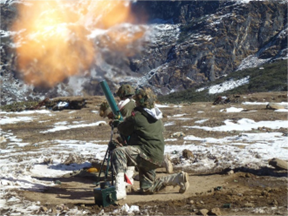
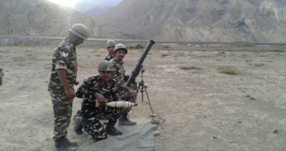
81mm Mortar: Infantry Battalion’s Artillery

My first close encounter with the 81mm Mortar happened in 1993 when I had to organise Inter-Battalion Mortar Competition as the Brigade Major of the Artillery Brigade. I wanted to have a first-hand feel of it and requested the Mortar Platoon of one of the battalions for a demonstration of their drills.

81mm mortar is a joint design by the UK and Canada and was introduced into service in 1965–66, replacing the 3-inch Mortar. To match and then overwhelm German firepower during World War I, British engineer Sir Wilfred Stokes invented the Stokes 3-inch Mortar System.

81mm Mortar can be man-packed by the mortar detachment, in which case the ammunition is to be carried by other soldiers of the battalion. In addition to their normal equipment, each soldier carries four bombs. These mortars are the Infantry Battalion’s organic firepower, better known as the Commanding Officer’s Artillery and can be used to deliver a heavy volume of fire down on an objective in an extremely short period.

As the mortar was being brought into action, the detachment was heard shouting “Mathy, Mathy, Mathy.” I interpreted it to be ‘Maththi’ (മത്തി) – Sardine in Malayalam. The shouting subsided and the chaos settled with the mortar set in action.

I wanted to know why the clamour was all about and what they were shouting. A Mallu officer came out – he must have realised my confusion – and said “Sir, it is Madhya (मध्य)” -meaning centre. It appeared that the detachment shouted “Madhya, Madhya, Madhya” as they brought the bubbles of the spirit levels on the two axes on the dial-sight in the centre to level the mortar on a horizontal plane.

Now I had a closer look at the dial-sight to find neither bubble was centered. I asked as to what the shouting was all around. (Gunners do not shout while levelling the bubbles.)

That’s the drill sir,” replied the officer. (A standard reply to most questions in the Army!!)

As we progressed through the competition, I realised that all Platoon Commanders assembled their platoons to indicate the AP (Aiming Point.) He said “Door se door, sahi pehachan, achcha laying edge – Abhi keliye 100-meter pe jhanda.” (दूर से दूर, सही पहचान, अच्छा laying edge – अभी केलिए 100-meter पे झंडा.)

An Aiming Point provides a point of angular reference to aim a gun in the required horizontal direction. An aiming point must be as far as possible, sharply defined and easily distinguished feature, such as the edge of a building. The Platoon Commander was correct in the definition which all Platoon commanders rattled out, but everyone used the Flag @ 100 meter.

Was the flag designated as Aiming Point at 100 meter?? No way!  Even if I stretched my imagination beyond its elastic limits – it could at most be 100 feet.  May be, an Infantry soldier can stretch a foot to a meter!!  

I knew that selection and use of an Aiming Point on ground presents problems in featureless areas, in bad visibility or at night as putting lights on distant aiming points is seldom practical. Therefore, modern guns employ a ‘Collimator’ to simulate an Aiming Point at artificial infinity on the principle of parallel lines meet at infinity. Many Gunners – including officers – call it colli-METER.

The Flag @100 meter baffled me, and my gunnery brain cells worked on hypersonic speed to resolve the riddle. Unsuccessful, I gave it up and summoned the very same Platoon Commander who first demonstrated the functioning of a Mortar Platoon. He claimed that he was an instructor at Infantry School. He failed to convince me as all his explanations were illogical and unscientific.

Where do you conduct your Mortar Platoon training at Infantry School? Is the area surrounded by buildings?” I asked. “Yes,” said the Platoon Commander

Now I realised that the Flag @ 100 meter (feet) was creating the artificial infinity at Infantry School, and it was being carried to all the battalions by the Platoon commanders trained at Infantry School.

Infantry will make parallel lines to meet even @ 100 feet.

All Together Heave

On return to our regiment – 75 Medium Regiment – after completion of the ‘Computer Course’ in August 1991, our then Commanding Officer (CO) Colonel Rajan Anand appointed me as the Battery Commander (BC) of 751 Medium Battery.  75 Medium Regiment then had three batteries with fixed class composition.  751 Medium Battery consisted of Brahmins from North India, 752 Medium Battery had Jats and our 753 Medium Battery had South Indians. 

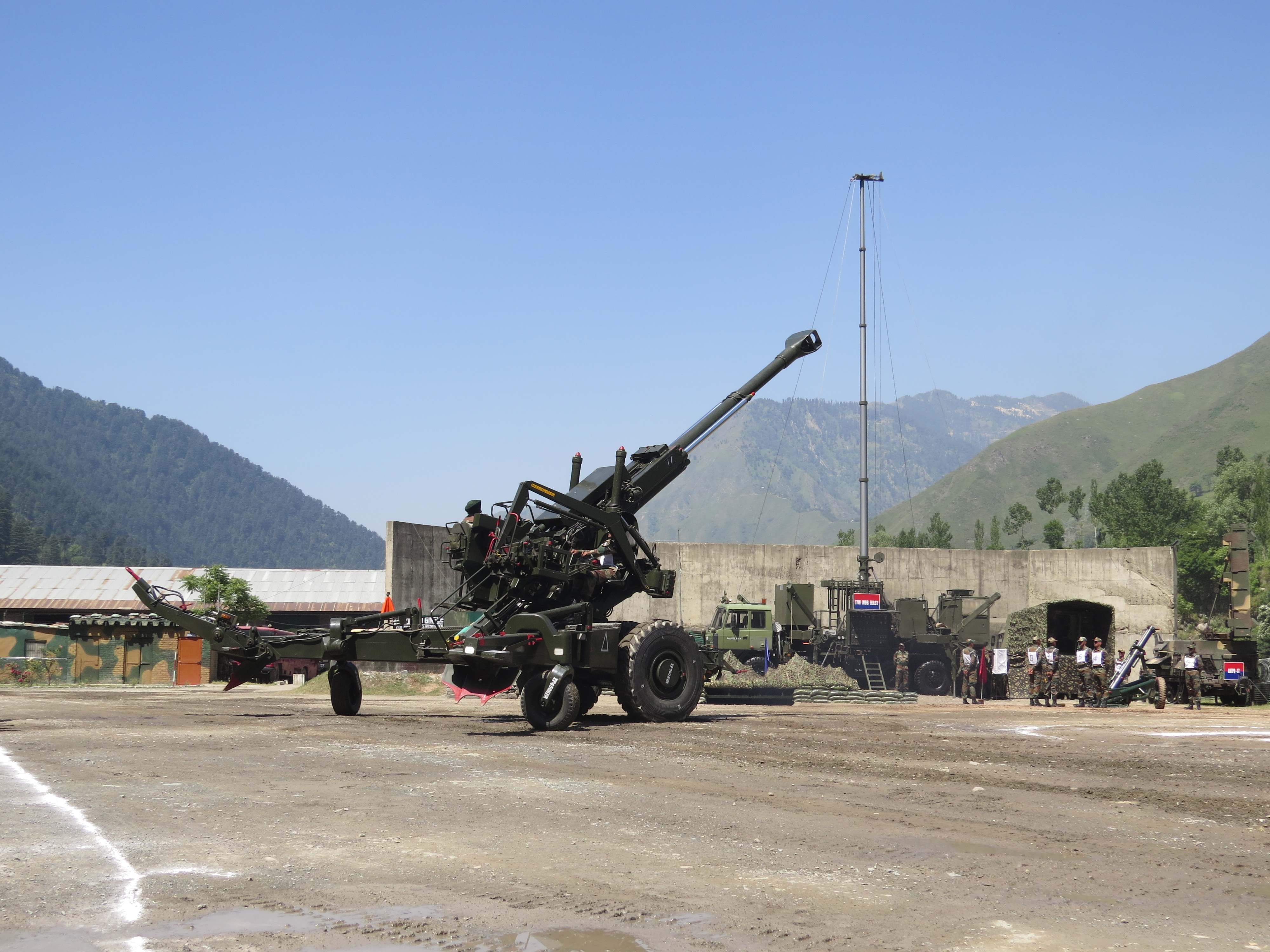
That was the first time I became the BC of the Brahmin Battery and always commanded the same Battery during the rest of my service with the unit.  Our Regiment was then located at Udhampur (Jammu & Kashmir).  The Regiment was tasked to display the newly acquired 155mm Bofors Gun for the Gunners’ Day on Saturday, 28 September 1991 for everyone in the station and school children.  Our CO gave the task of the equipment display to me.  The previous day, I briefed everyone about the task at hand and the next morning at 8AM, we marched off to the stadium where the display was being conducted.  The event was organised under the aegis of 8 Artillery Brigade, who were then staging at Udhampur on their induction into the Kashmir Valley.  Our Regiment was under 39 Artillery Brigade.  On reaching the stadium, I was shown the area where the Bofors gun and allied equipment was to be displayed by the Deputy Commander of 8 Artillery Brigade.  The Deputy Commander was a Colonel with over 25 years of service, while I had eight years behind me.

I took Havildar (Sergeant) Major Lekh Ram and the Gun Detachment Commander – Havildar Chaman Prakash – and briefed them about the placement of the Gun and other equipment and various boards and charts defining the characteristics of the equipment.  By 8:30AM, I moved to the tent where the Deputy Commander was sitting, pulled a chair and sat next to him.  From his body language, it was evident that he did not approve of my action a wee bit.  All the officers of other Regiments, mostly from 8 Artillery Brigade, were busy supervising the equipment display and were all near their detachments.

The Deputy Commander now asked me as to why I was not next to the detachment supervising their actions.  I told him that I had briefed everyone well about the impending task and the Havildar Major would do his job and report to me on completion of the task and my job would commence then.  I had faith in my soldiers and NCOs and I was sure that they would do an excellent job.  I also said that everyone is going to see the Bofors Gun, being in the news for wrong reasons then, and not many would be interested in the field guns and mortars displayed by 8 Artillery Brigade.  

Adjacent to our Bofors Gun was the detachment of the 105mm Light Field Gun, from a field regiment of 8 Artillery Brigade.  By 9 AM, when the field gun detachment got ready, the Subedar Major (Master Warrant Officer) of that regiment held a practice of bringing the gun into action.  This entailed the detachment of five soldiers heaving the gun on to a circular metallic platform.  Due to heavy downpour for the previous four days, the ground was soggy and the detachment had to heave hard to pull the gun on to the platform.  While pulling the gun on to the platform, the detachment would shout in chorus “All together heave!” 

At this time Havildar Major Lekh Ram reported to me that everything is ready.  After seeing the entire arrangement, I summoned everyone and said a few words of appreciation for executing the assigned task well.  I ordered everyone to have a tea break, change into their ceremonial uniform and to be ready by 9:45 AM as the demonstrations were to commence at 10 AM. 

After ten minutes, it was the turn of the Adjutant (Captain) of the field regiment and he too ordered the detachment into action.  The detachment pulled the gun on to the platform “All together heave!”   Now came the Battery Commander (Major) and the same drill was repeated.  With each practice, the ground beneath the platform sank in more, making it overly difficult for the detachment.

I now told the Deputy Commander sitting beside me that with so many practices, the detachment will be tired and any more practice will surely sink the ground furthermore.  He gave me a frown.  Next was the turn of the CO (Colonel) of that regiment and the soldiers became even more tired. 

At 9:45 AM, the Brigade Commander of 8 Artillery Brigade arrived and his first question (as expected) was as to where our CO was.  I said that he was busy with other important commitments and hence had deputed me for the task.  The Brigade Commander wanted me to convey his displeasure to our CO for his absence, which I dutifully agreed.

The Brigade Commander now moved on to the field gun and ordered the detachment into action.  It was again “All together heave!”  It left the detachment in a state of exhaustion, with their ceremonial uniforms all crumbled. 

At the appointed time, the Army Commander of Northern Command arrived and he headed straight to the Bofors Gun.  We gave an excellent demonstration of the capabilities of the gun and briefed about the computers for ballistic calculations, Scania gun towing vehicle and other equipment.  The Army Commander complimented all our soldiers for their smart turnout, actions and briefing and moved on to the field gun.

All together heave!” the detachment commander shouted at the top of his voice, the overly tired soldiers pulled with all their might, but the gun refused to climb on the platform as the ground beneath it had sunk in. 

Once the Army Commander left, all visitors made a beeline to the Bofors gun as expected and hardly anyone cared for the field guns and mortars. 

All together heave!” and similar cries during Gun Drill has a colonial linkage.  It may soon be changed to Hindi cries.

Rest In Peace : Colonel Manu Satti

Col Manu Satti bid farewell to this world to be with his creator on January 25, 2023 at his home in Kakinada due to cardiac arrest. It came as a shock to me as I have been interacting with him through my blogs on various subjects.

He was a gentleman to the core who cherished great values, but was physically one among the toughest soldiers I came across.

Colonel Manu Satti graduated from Army Cadet College (ACC) and was a course senior to us at the Indian Military Academy. He was ever smiling and quiet. He was competing in the final bout of the inter-company boxing championship.  His opponent was Gentleman Cadet (GC) Hamilton from Botswana.  GC Hamilton was better built than GC Satti.

There was a psychological game being played against GC Satti – both by the GCs from the Hamilton’s company and by fellow GCs from Botswana – by claiming that GC Satti will not last the first round.  Many made fun of him, teased him and he replied with his charming smile. GC Satti remained cool as a cucumber but was obviously boiling inside which everyone realised after what happened on the boxing ring.

Within five seconds of the gong sounding the commencement of the first round, GC Hamilton was on the mat, writhing in pain.  Luckily the medical specialist at the Military Hospital Dehradun realised the seriousness of the injury suffered by GC Hamilton. He was immediately evacuated by helicopter to Command Hospital, Lucknow, and GC Hamilton’s life was saved.  GC Satti’s punch was so powerful that GC Hamilton had a rupture of his small intestine and suffered heavy internal bleeding.

Colonel Satti was commissioned to 36 (Maratha) Medium Regiment in June 1982 when the Regiment was located at Meerut.   We shared a good bonhomie as we were Second Lieutenants in the same Artillery Brigade. We competed fiercely on the games field and during various technical competitions, but our friendship was everlasting.

Generally, our Regiment, 75 Medium Regiment (Basantar River) used to comfortably win basketball and other games against 36 (M) Medium Regiment.  But for a change, in 1985, 36 (M) Medium convincingly defeated 75 Medium. Colonel Satti was the Team Captain and the Marathas slogged for almost three months, practising morning and evening, ultimately to win the inter-regiment championship.

Colonel Mahavir Singh, our Commanding Officer played with our team.  He had developed an immense liking for Colonel Satti – could be that he saw us, the Subalterns of our Regiment enjoying the company of Colonel Satti and that he was leading and coaching most sports teams of 36 (M) Medium Regiment.

In the year 1986, Colonel Satti’s father’s leg was amputated and required an artificial limp at Artificial Limb Centre (ALC) Pune. At that time, a vacancy for an officer to attend Field Engineering (FE) Course at College of Military Engineering (CME) Pune, was allotted to our Regiment.  During a Commanding Officers’ conference, Colonel Mahavir came to know about his case and our Brigade Commander wanted a change of the course allotment from 75 Medium to 36 Medium.

Colonel Mahavir readily agreed once he came to know that it was Colonel Satti’s father. Such type of Commanding Officers is rare to be found. I was the nominated officer for the course and I was very happy that I could help Colonel Satti at a crucial time.

Now, Colonel Satti must be smiling at us from the heavens.  Rest In Peace Buddy.  We will cherish the memories and live on.

Major Hijacks Bus at Udhampur

By Veteran Colonel Josey Joseph (Army Service Corps)

One Monday morning of 1995, all hell broke loose at the Northern Command HQ during the Army Commander’s morning prayer.  Many Major Generals thundered that a Major had hijacked the Transit Camp Bus, leaving behind their PAs and Clerks.  “How can the officer leave the soldiers behind.  The officer got to be fixed. It should be a lesson for all,” opined various two starred Generals.

What lead to all these upheavals?

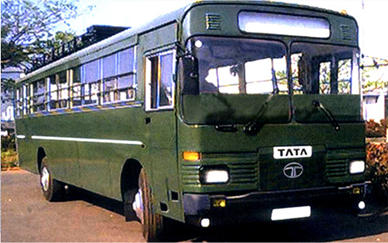
The young officers of Udhampur station were always critical of the Officers’ Transit Camp Bus plying between Udhampur and Jammu. Their grudge was that the senior officers, Colonels and above, travelled to Jammu on leave in Jeep, leaving the lesser mortals to travel by the Army Bus starting from the Officers’ Transit camp.

This bus was preferred by the sizeable number of clerical staff and sahayaks (helpers) of Command HQ.  Every Saturday, they travelled by this bus to Jammu, spent the weekend with their families and returned Monday morning.

On Saturdays, by the time the officers reached the transit camp, all seats were occupied by these VIPs and it was a herculean task to remove them.  The VIPs were stuck to their seats with bond stronger than that of Fevicol.  If an officer requested for a seat, these VIPs turned their head in the opposite direction. Fevicol was not allowing them to get up and their ego of being the personal staff of Generals did not permit them to move.  The bus driver and conductor remained helpless and the transit camp NCO responsible for allotment of seats tactically vanished from the scene.  No one wanted to annoy the VIPs, typically following the famous Malayalam saying, You must be equally scared of the elephant shit as much as the real elephant.

On social occasions, after a few drinks, young officers of Udhampur did vent their ire on Army Service Corps (ASC) Officers and after few more drinks cursed the ASC as the bus was from one of the ASC battalions in Udhampur. It made no difference to them if the officer was from the Animal Transport Battalion.  They said “Yes, AT and MT are same. Both are transport only.” Now, who would argue that Animal Transport had mules and that the technology was ages behind Motor Transport?  

On that fateful Saturday, this Major reached the transit camp to travel to Jammu to see off his four-year-old daughter who had joined him for a week during Dussehra holidays.  His wife, staying in SF accommodation in Delhi, had boarded her at the Delhi airport as an unaccompanied minor.

As the Major got into the bus, he found all seats occupied by the VIPs.  His request to provide him a seat fell on deaf ears and the bus driver pleaded helplessness. Officers senior to him, seated in the bus did not take any action.  The Major took a command decision and ordered all the JCOs/OR to get down. Reluctantly and expecting this to be some sort of prank, one by one, they came down from the bus.  Finally, with the last VIP disembarked, the Major ordered the driver to start the bus and leave for Jammu. So, the officer, his daughter and another five officers left for Jammu in a bus with a seating capacity of 42 passengers.

The VIPs had been wronged! They vowed to fight together and avenge insult to their status!

Mera 25 saal naukri mein aisa kabhi nahin hua,” (In my 25 years of service, it never happened like this,) declared the PA of Brig A. The rest nodded in agreement. “Iska kuch karna hoga,” (We got to do something about it,) and the rest again agreed.   They then boarded a Shakthiman truck from the JCOs/OR transit camp, fuming at the insult to their status.

Bad news spreads fast but gossip spreads faster. My Company Second-in-Command (2IC,) receiver, and broadcaster of all gossip in Udhampur, came to me with the news that a Major had hijacked the Officer’s Bus and was moving to Jammu with the bus.

I laughed. The 2IC lost his senses. He stared at me as if I was also a hijacker. In between laughter, I assured him that the Major will come out of it.  He still could not understand. He said, “Do you know, PA of Brig A had to travel in a Shakthiman truck?” I was soon identified as course-mate of the hijacker.

On that Monday, I was summoned by the DDST to enquire about the Major. With a straight face, I answered all his queries and found him to be appreciative of the Major.  The Generals and Brigadiers wanted to order a Court of Inquiry and fix the officer.  The Major requested for the same under Army Rule 180, wherein the person against whom allegations have been made has to be present and ask questions to the witnesses.

Since there were many loose ends and it was revealed that many of the Command HQ staff did not have official leave approval; the case was left to die a natural death. 

The happiest were the ASC officers as we did not have to listen to complaints on social occasions. The ASC Branch was happy that someone had the guts to take such an action.  Orders were passed that the Officers’ Transit Camp Bus was meant only for Officers and all the VIP JCOs and NCOs were barred from travelling in it, giving some relief and respect to young officers. 

Two weeks later, the hijacker proceeded on Technical Staff Course at AIT, Pune and the case was finally closed. 

You must be itching to know who the officer was?

None other than Reji Koduvath nick named ‘Kaduva’ (Meaning Tiger in Malayalam,) a veteran of several such battles. As a Lieutenant, while serving in Delhi, he had thrashed a Superintendent of Police and sorted out many senior Police officials.

Foot Drill and Stress Fracture

Historically armies practised drill to prepare soldiers for battle. Drill enabled commanders to quickly move their forces from one point to another, mass their forces into a battle formation that afforded concentration of both human effort and firepower and maneuver the forces as the situation developed – akin to our school morning assembly.

The first lesson of Drill or Foot Drill for most of us was the school morning assembly.  We trooped into the Assembly Hall/ Ground, wearing our school uniform, from our classrooms in single file, mostly led by our class teacher.  The files then assembled, aligning in a straight line from the front and to our sides.  We stood at ‘Attention’ for the prayer and the national anthem and for the rest of the assembly was in ‘Stand at Ease’ position.

The drill was employed to train soldiers over and over until a task became second nature and everyone knew how the whole formation moved at any given time. It was in fact Drilled into every soldier that they reacted to commands than thought. The Greeks and Romans had the phalanx involving the soldiers standing side by side in ranks. Just before contact with the enemy, the soldiers moved in very close together so that each man’s shield helped to protect the man on his left. In the beginning, drill gave the soldiers the ability to lock their shields together and form a moving wall of swords and spears. Today, this drill is employed by police across the globe for riot control by locking their shields.

Mahabharata describes Chakravyuh (nodal point defence), Kamalvyuh (lotus array formation), Ardh-Chandravyuh (half-moon array formation) and Shakaatvyuh (T shape formation with a Chakra on it.)  Vyuh is a geometrical shape formed for battle with battle drills by maneuvering foot-soldiers, horses, chariots, and elephants. To beat any formation, it was by Makarvyuh (assaulting human waves) which the Indian Army employed during Kargil War.  The origin of chess is attributed to these arrays so that the new maneuvers and formations could be war-gamed to surround the enemies.

The hallmarks of military drill are efficiency, precision, and dignity. These qualities are developed through self-discipline and practice. They lead to unit pride and cohesion.  Military troops which display constant competence in drill are considered highly trained, well-disciplined, and professional. Drill develops individual pride, mental alertness, precision, and esprit-de-corps which will assist the soldiers to always carry out orders instinctively.  Good drill, well-rehearsed, closely supervised, and precise, is an exercise in obedience and alertness. It builds a sense of confidence between commanders and subordinates that is essential to high morale.

The personal qualities developed on the parade ground must be maintained in all aspects of military life. Commanders must insist on the same high standards both on and off parade, to instill these qualities strongly enough to endure the strain of military duty in peace or war. The systematic correction of minor errors strengthens these characteristics and improves both individual and unit standards.

Goose Stepping, throwing their legs as high as they could while marching was a form of extreme marching held by German, Prussian, and Russian militaries to be an ultimate display of the unbreakable will and discipline of its soldiers.  While marching, they do not dig their heels hard. Most modern armies have done away with this ‘fascist’ approach to marching as being too extreme.  Only a few countries use it as a powerful display of military discipline. 

Today, foot drill is a fundamental activity of the military and is practised regularly during initial military training.  Foot drill involves marching with an exaggerated heel strike, and regimented manoeuvres performed while marching and standing characterised by an exaggerated stamping of one foot into the ground.

High levels of bone strain caused by such exaggerated drills results in stress fracture.  It may also cause micro-damage to bones.  Digging down of heels, especially with the foot raised over the head may cause severe strain to the neck and spine and brain damage.  These soldiers may also end up with joint pains, migraines, and headaches.

A recent post on the social media that the large number of stress fracture of the hips among Lady Cadets in OTA was attributed was the difference in bone structure of women and the fact that the female hips are not meant to take the same stress as males because they have widened pelvis to enable childbearing.  This made me research into the subject of stress fracture during military training.

Stress fractures represent one of the most common and potentially serious overuse injuries, especially among recruits and Officer Cadets the world over.  Repetitive weight-bearing activities such as running and marching are the most frequently reported causes of stress fracture.  Stress fractures have been reported in most bones of the limbs, as well as the ribs and the spine, but the most common location is the lower limb.

Military foot drill generates higher forces, loading rates and accelerations on the human body and especially the lower limbs compared to running and load carriage.  This large biomechanical loading of foot drill may contribute to the high rate of stress fracture during initial military training.  Lower limb injury rates, in particular stress fractures, are reportedly higher for running in women compared with men. [i]

A US Army study found that 14% of women suffered stress fractures[ii] compared to 2.3% of men. Women have an anatomical disadvantage that increase their risk of developing stress fractures. Women have wider pelvic breadths, which negatively alter loading strains. A wider pelvis alters the angular tilt on the hips and knees, increasing the stress on these bones and on those of the lower leg and foot. This anatomical difference may explain the greater distribution of stress fractures in the pelvis and hip observed in female recruits.[iii]

In female Army cadets, women who had fewer than 10 menstrual cycles in the year preceding training had significantly lower spine and hip Bone Mineral Density (BMD) than women with at least 10 cycles.  In studies of elite Australian female athletes, those who suffered from stress fractures had significantly fewer menstrual cycles/year. Thus, female bones may be more sensitive to severe energy deficiencies that cause depressed estrogen levels and altered bone remodeling.[iv]

3,025 US Marine recruits were studied for 12 weeks of training at Parris Island, South Carolina. Polymer and standard mesh insoles were systematically distributed in boots that were issued to members of odd and even numbered platoons. The most important finding was that an elastic polymer insole with good shock absorbency properties did not prevent stress reactions of bone during a 12-week period of vigorous physical training.[v]

Another study that examined 1,299,332 US Soldiers found that female soldiers had a 3.6-fold higher incidence of stress fracture than male soldiers.  They examined age, sex, Body Mass Index (BMI,) and race-origin of stress fracture cases. In both sexes, non-Hispanic white men and women had the highest risk of stress fracture, with a 59% and 92% higher risk respectively, than non-Hispanic blacks. The second highest risk group was Hispanics, with Hispanic men and women having a 19% and 65% greater risk respectively, than non-Hispanic black men and women.  Among Native Americans /Native Alaskans and Asians, only women showed increased stress fracture risk compared with their non-Hispanic black counterparts. Asian women had 32%, higher risk of stress fracture than non-Hispanic black women.[vi]

Notwithstanding women joining the Indian Army, it is time to revisit the training norms – both for drill and Physical Training (PT.)

That brings me to the Gun Drill of the Regiment of Artillery where the detachments are trained to bring the gun into/ out of action and engagement of targets, as if in a war situation.  Here too, over a period, exaggerated movements did creep in, causing skeletal damage to soldiers.


[i] Force and acceleration characteristics  of military foot drill: implications  for injury risk in recruits : Patrick P J Carden, Rachel M Izard, Julie P Greeves, Jason P Lake, Stephen D Myers

[ii] The impact of lifestyle factors  on stress-fractures in female Army recruits: Lappe JM , Stegman MR , Recker RR :.

[iii] Females Have a Greater Incidence of Stress Fractures Than Males in Both Military and Athletic Populations: A Systemic Review Laurel Wentz , MS, RD ; Pei-Yang Liu , PhD, RD ; Emily Haymes , PhD ; Jasminka Z. Ilich , PhD, RD

[iv] Bone density of elite female  athletes with stress-fractures : Carbon R , Sambrook PN , Deakin V , et al :. Med J Aust 1990..

[v] Prevention of lower extremity stress fractures: a controlled trial of a shock absorbent insole. L I Gardner, Jr, J E Dziados, B H Jones, J F Brundage, J M Harris, R Sullivan, and P Gill

[vi] Risk of Stress Fracture Varies by Race/Ethnic Origin in a Cohort Study of 1.3 Million US Army Soldiers.  Lakmini Bulathsinhala, Julie M Hughes, Craig J McKinnon, Joseph R Kardouni, Katelyn I Guerriere, Kristin L Popp, Ronald W Matheny Jr, Mary L Bouxsein

Three Musketeers

by Veteran Colonel RB Gowardhan

I was commissioned into 75 Medium Regiment (Basantar River,) a great unit which participated in 1971 war with elan and earned laurels. The Regiment had a unique combination of soldiers, Brahmin, Jat and South Indian Class. Being a Medium Regiment, the unit had all tall and well-built gunners. The unit won most of the sports trophies and excelled in all training competitions. The unit had moved from J & K to Gurgaon. Due to its proximity to New Delhi, unit was posted with full complement of officers. During those days it was an honour and privilege to be the Adjutant of the Regiment.

Adjutant of the Artillery unit is responsible for administration and assist the Commanding Officer in administration, training and discipline. In the battle and training, the Adjutant’s duty is to control and coordinate fire of 18 guns of the Regiment.

I was lucky to have all three officer GPOs (Gun Position Officers) responsible to control fire of each battery and ready to assist me in all regimental duties. The first one was Captain Paramjit Singh Ralhan, a handsome sardar who graduated from IMA as Direct Entry. He had decent manners and a smiling face. Second was Lieutenant Koduvath Reji, Sainik School and NDA brat, who was enthusiastic and bubbling with energy, sometimes exceeded limit of his enthusiasm. The third one was Lieutenant Gulshan Rai Kausik, matured service entry officer with boxer built and red eyes. His looks were sufficient to make any soldier to behave. All three were josh machines and when ordered can produce anything.

Ralhan was of a great help to control discipline of Brahmin battery and to organize any event in the unit or officer’s mess. Ralhan with his diligence and demure resolved any kind of situation or indiscipline with his cool mind and report “Sir, no problem, matter is resolved.” I remember one incident, where the problem was created by a rogue soldier. Ralhan handled the situation exceedingly well and disciplinary action was taken against the defaulter.   

Reji used to follow the dictum that as youngster commit any mistake but keep Adjutant informed. Therefore, it was quite often that I used to jump from the chair when he used to come and inform “Sir, chhotasa galati ho gaya.(Sir,I Committed a small mistake.)The so-called small mistake used to be slapping Superintendent of Police or bashing up BSF Dy Commandant. It wasn’t for the wrong reasons, but we had to sort out the issues.

On 31 Oct 1984, Regiment’s column was ordered to move and take responsibility of security of Teen Murty Bhawan, where mortal remains of our late Prime Minister, Mrs Indira Gandhi were kept. Regiment was also responsible for controlling VIP visitors, who came there to pay homage to late Prime Minister. Reji, stopped Inspector General of Delhi Police, who along with family was sneaking through VIP gate. This resulted into arguments with the Police Officer asking, “What are you doing here and who are you to stop me?”  Reji told that officer, “Had police been working properly, Army would not have come to control this.” This was being heard and observed by Minister-in-Charge there Mr Shivraj Patil and he appreciated Reji for his dedication to duty and rebuked Police Officer. Later, the Regiment received an appreciation letter and cash prize from the Minister.

Kaushik, with his presence of mind could handle any situation. Once the Regiment was playing final match of Kabaddi with Rocket Regiment, the hosts. They had arranged referees who were biased and obvious that they were helping Rocket Regiment. Our soldiers could not tolerate that injustice and warned referees. But referees again gave a wrong decision in favour of Rocket Regiment and our soldiers could no longer bear this injustice. They entered ground and caught hold of one of the referees. This resulted into commotion and big fight broke out between the soldiers of both Regiments. Adjutant of Rocket Regiment and I intervened to control the situation but we too faced the wrath of fighting soldiers. Lieutenant Kaushik fearlessly entered mob and with his commanding voice ordered Savdhan. To everyone’s surprise, we found all soldiers stood to attention. Then he ordered “Rocket Regiment dahine mood and Medium Regiment baye mood; tej chal.(Rocker Regiment Right Turn and Medium Regiment Left Turn; Quick March.)” Soldiers followed the orders and moved out of the field. The worst was averted.

All three officers were real assets in our Regimental life and during the training too. During firing of those monster 130 mm guns, I had to be careful and watchful as in Artillery they say that, once ordered and fired round/rounds of gun/guns cannot be corrected and result is depicted on the target. As an Adjutant, whenever all guns were ordered to fire together, I had to control my GPOs to ensure all guns fired accurately and in unison. As soon as I used to pass order for firing and report ready. Reji, who was most chatak(quick,) reacted and made his guns ready and report, thereafter, would not stop to point out mistakes of others if any. Ralhan, who was as cool as penguin checked, rechecked and took his time. To keep an atmosphere warm in his command post, I used to pass on heat online of fire control net.  Kaushik, with good sense of hearing and watchful eyes used to take time and get ready. The end result was accurate and coordinated fire.

There is lot to write about them. I can never forget their contribution to maintain josh, discipline, and winning competitions. All three are now well settled – Ralhan in USA, Reji in Canada, and Kaushik in South Delhi. I wish them very best for their endeavours.     

Human Instruments

Can you ever imagine that the survey of the Trans-Himalayan Region was done mostly on foot? That a human being walked all the way through the Himalayas, while counting each step he took to calculate the distances between places.

Reading a 36-page document by Dr Kapil Raj, When Human Travellers Become Instruments: The Indo-British Exploration of Central Asia in the Nineteenth Century, I was fascinated by the ability of the human body and mind to find methods to overcome any difficult situation.

British India in the aftermath of the 1857 mutiny went into mapping and stabilising its surrounding territories. The British needed to bring the Trans-Himalayan region into the ambit of British trade, followed by military intervention. The first step was to map the area of the Kashmir Kingdom, some surrounding areas under the Chinese Empire and some areas in Tibet, Nepal, and Bhutan.

Captain Thomas George Montgomerie of the Royal Engineers was entrusted with the task of mapping Kashmir. He was commissioned as a Second Lieutenant in 1849, arrived in India in 1851, and joined the Great Trigonometrical Survey. The Great Trigonometrical Survey was a project which aimed to survey the entire Indian subcontinent which was begun in 1802 by William Lambton. Under his successor, George Everest, the project was made the responsibility of the Survey of India.

After the survey of Kashmir, Montgomerie had to survey and map Tibet, an autonomous region. Tibetans were very suspicious of the Europeans. Thus, he had to enroll the services of locals who could travel as part of trade caravans to Tibet.  Even if he found locals for the task, how could they be trained to use conventional surveying techniques and instruments?

Captain Montgomerie trained the natives, drilled them night and day for weeks, to take a stride of exactly 31.5 inches whatever the terrain or incline. At 63360 inches to a mile, every 2,000 such paces marked a mile.

As his first ‘human instrument’, Montgomerie nominated Mahomed-i-Hameed, aka Moonshee who reached Leh on 4 July 1863 after meticulously mapping his route from Kashmir. On 24 August Hameed, disguised as a merchant and accompanied by two servants and a pony-load of merchandise, joined a caravan heading for Yarkand, a major oasis city on the trade route between China, India, and Central Asia.

The party arrived at Yarkand on 30 September. Hameed had precisely traced the entire route, carefully noting all that he had observed, especially the vegetation and human dwellings. He drew a map of the city and the region and transcribed the history of the region as narrated by locals.

On 27 March 1864 the party commenced their return journey to Leh, but Hameed died en route, after eating poisonous rhubarb, according to his companions. Montgomerie’s assistant, William Johnson, was the first to reach the scene of the tragedy. Hameed’s entourage had meanwhile made off with his most saleable belongings. Fortunately, no one had touched his notes.  Armed with Hameed’s notes, Montgomerie sailed for England on 20 February 1865 after thirteen years in India. Using this leisure, he drew a map of the route between Leh and Yarkand.

This new mission was entrusted to two Kumaoni Bhotiya cousins, schoolteacher Nain Singh, and Mani Singh, the patwari, the village record-keeper. They had already taken part in topographical surveys and were familiar with geodesic and astronomical instruments and could handle any hurdles in crossing the frontier from Kumaon. 

Disguised as Lamas, they carried a prayer wheel and a rosary, perfectly normal adjuncts for the pilgrimage to the holy city of Lhasa. The prayer wheel concealed a small compass, and other miniature survey instruments. Rudraksh Rosary helped count paces, one bead for every hundred paces. The Buddhist rosary has 108 coral beads; those of the cousins only had a hundred, every tenth bead being much larger than the others. A complete round of the Rosary represented exactly 10,000 paces or five miles.

After months of rigorous drilling in the use of the sextant, compass and other survey instruments and techniques, Nain Singh and Mani Singh left for Tibet in March 1864 and returned to DehraDun on 27 October 1866. They were turned back at the Tibeto-Kumaoni border, so they tried to enter Tibet through Nepal, all the while charting the route they followed. Despite the advantage of their origin, they had to adopt different guises and resort to devious ploys for entering Tibet: passing off as merchants with the survey instruments cleverly hidden in their wares, or even as healers curing people of minor ailments! 

During a two-and-a-half-year expedition, Nain Singh walked 1,200 miles at a steadily maintained pace. He counted 2.5 million paces on his rosary! He not only succeeded in pinpointing the location of Lhasa, but also measuring the distance between several important Tibetan cities, thirty-one stations in all. He also mapped the 700-mile upper-course of the Tsangpo River from its source to Lhasa and reported that Tsangpo and the Brahmaputra were the same river.

Nain Singh also gave a detailed account of Tibet’s general climatic conditions, demographics, its cities and monasteries, army, agricultural production, economy, the state of its roads, transportation, communications, and most importantly, Tibet’s trade with China and Kashmir. . The Royal Geographical Society awarded Nain Singh a gold watch in 1868 and the Victoria gold medal in 1875.

Kishen Singh, alias AK, a cousin of Nain Singh, travelled across the Tibetan plains and the Kunlun Mountains between 1878 and 1882. In Lhasa, AK was delayed for over a year waiting for his caravan to leave. He was robbed twice, and even imprisoned by the Mongolians!  He was freed by a Tibetan merchant who forced him. to ride a horse, which prevented him from counting his strides. Undeterred and innovative, he got round the problem by measuring the length of the horse’s pace and counting each time the right foreleg hit the ground. When he returned to British India in 1882, he had travelled 2,800 miles and counted an incredible 5.5 million paces!

This confidence in natives to record and narrate facts so vital for the survival of the British Empire is especially surprising when one remembers that geography in the nineteenth century consisted not only in taking topographical readings but also in collecting cultural, ethnolographic, political, and commercial information.

Though the survey instruments used then have long become museum pieces, these measurements are accurate and still the basis on which the maps are made in times of GoogleEarth, GPS, and satellite,

Back to School

Back-to-School period usually starts and ends in August before the school year starts in Canada, United States, and Europe. In Australia and New Zealand – being in the Southern Hemisphere, this occurs in February, after their summer break.

In merchandising, Back-to-School is the period in which students and their parents purchase school supplies and clothes for the coming school year.  At many Canadian Malls, Back-to-School sales are held for school supplies, children and young adults’ clothing, office supplies, back-packs, laptop computers and so on. 

Labour Day, which falls on the first Monday of September, a holiday in Canada and the US, marks the end of Back-to-School shopping. Labour Day also marks the unofficial end of summer, though Fall (Autumn) begins only on September 22 – Fall Equinox. The day after Labour Day – first Tuesday of September – marks the beginning of a new school year.

Back-to-School shopping tradition caught on in North America as women flocked to colleges and universities in the early twentieth century.  These young women were trend setters for new fashions. Many clothing stores started special lines to cater to college going women. Every September, college these women shopped for their clothing needs and the stores obliged by setting up discounted sales. 

Every student is excited about the new academic year they are entering.  The first day of school is one of the most important day in the academic year as they show off their latest clothing and discussing as to what about their escapades during the summer holidays. Gossips too are as important.

There is an inherent discomfort at the bottom of the stomach of each student on the first day at school. About 2.5% of school children suffer from acute fear of going to school and this fear is called Didaskaleinophobia– derived from Greek Didasko meaning to teach and Phobos meaning fear. Equivalent Latin term is Scholionophobia.

Am I competing with Mr Tharoor?? No way!!!

It is a North American tradition to gift an apple to the teacher by the students on the first day of school when school opened in September as it coincided with the ripening of apples in North America. This tradition of gifting apples to teachers dates to the 16th century when parents in Denmark and Sweden often gifted teachers with baskets of apples and other food to help compensate for their low wages. Tradition of bringing apples to teachers carried on even after schools were modernised.

In the 1920s, apple polishing was used as a slang for trying to curry favour to the teacher. Bing Crosby and Connie Boswell sang in 1939:-

 “An apple for the teacher that seems the thing to do because I want to learn about romance from you.

An apple for the teacher to show I’m meek and mild If you insist on saying that I’m just a problem child.

An apple for the teacher will always do the trick when you don’t know your lesson in arithmetic.

We have other words that mean the same thing. We also call this type of person a kiss-up, toady or boot-licker. Another popular one is teacher’s pet.

It is an apple-polisher’s dream to become the teacher’s pet – much to the anger of fellow classmates.”

Nothing much has changed to this day. We were all mortally scared on our first day of school. Our stomachs were churning. We all went through it and so did our children. Now it is the turn of our grandchildren.

The only change is that today Apple denotes not the fruit for the young generations.

On assuming command of our Regiment in June 2002, I gifted an umbrella to all school going children of our Regiment when the schools opened. Please Click Here to read about it. At that time, I was unaware of the Back-to-School traditions.

In 2003, I ordered our Religious Teacher [Regimental Chaplin- a Hindu Pundit] to prepare a packet for each school going children of the Regiment with necessary school supplies and gift the same to the children. Our Religious Teacher was a bit reluctant initially, having never heard of such a practice during his two decades of military service. On completion of the assigned task, he reported, “Sir, this is the apt method to spend the Mandir Fund. It will inspire all our children to put in their best at school.”

Education is the most powerful weapon which you can use to change the world.” – Nelson Mandela

Selections @ Devlali

Those were the days when Selections ruled the roost at School of Artillery Devlali.  It was skimming at the highest level of the Regiment of Artillery.

When we passed out of Indian Military Academy in 1982, we were forced to return our Blue Patrols for mere Rs 100 – all because the Artillery version had a red stripe on the trousers’ side which was half an inch thicker than what was provided by Kapoor & Co at the Indian Military Academy, Dehradun. While officers commissioned to all other arms/ services retained their Blue Patrols, we the Gunners had to return them to Kapoor & Co.

On joining Young Officers Course at School of Artillery, Devlali, every student officer had to get a new pair of Blue Patrol and winter ceremonial uniform or Service Dress (SD) stitched – costing over a thousand rupees those days – only from Selections.  The reasons – obvious. A Second Lieutenant’s pay was much less than a thousand rupees a month then. Free rations was not entitled then and monthly mess bill ate into over half a month’s salary.

Service Dress is the style of khaki serge dress uniform introduced by the British Army for use in the field from the early 1902, following the experiences of a number of imperial wars and conflicts, including the Second Boer War. The uniform was originally issued as a field uniform, later designated as SD. Variant of this uniform continues to be worn today, although only in a formal role, as No. 2 Pattern dress by the British and the Commonwealth Armies. Indian Army too continued with a similar winter SD for the officers until 1990s. Today the Indian Army officers wear a similar uniform designated as Dress No. 5SD.

No. 1 Dress , sometimes referred to as ‘blues’ or ‘blue patrol,’ is a universal ceremonial uniform which is almost consistent throughout the Commonwealth Armies. For most regiments and corps, this No. 1 dress consists of dark blue tunic and trousers. Different units are distinguished by the colouring of the cap, piping on the tunic and of the welts or stripes on the trousers, as well as badges and in certain Cavalry Regiments by the colour of the collar.

Indian Army Blue Patrol consists of a ‘bandgala’ tunic and a trouser. The shoulder pips are embroidered along with ranks on the coat except for Armoured Corps officers who wear a chain mail along with their ranks on the shoulders.

Veteran Colonel SP Mudholkar. He now leads a retired life at Pune

It was not until 1981 when Second Lieutenant SP Mudholkar issued a show-cause notice and raised the issue with the School of Artillery against the order of getting the SD and Blue Patrl stitched only from Selections, inclusion of a private firm in the Offices’ Mess Bills for recovery .  In those days, Mess Bills of various messes at School of Artillery had a serial dedicated to Selections.  You can well imagine as to the patronage Selections enjoyed from the highest levels of the Regiment of Artillery – mostly occupied by officers belonging to the Khlan.

By the time we went to Devlali to attend our Young Officers’ Course in 1983, Blue Patrol and SD procurement was done away with – thanks to Second Lieutenant SP Mudholkar – else I too would have succumbed to the pressure from the Chief/ Senior Instructor.  In those good-old days, any Young Officer refusing to procure their SD and Blue Patrol were marched up to the Chief/ Senior Instructor until they relented. Another tactic was to blackmail the Young Officer with a poor grading, though most ended up with a C grading. The Great Good-Old Days!!! Who wants to begin their military career on the wrong foot?

Selections appeared on the Mess Bills during our course- luckily for us it remained at zero value.

Three years later, Lieutenant General Sood, Commandant, School of Artillery, was appointed the Director General of Artillery – and away went Selections.  The ‘baby‘ of the erstwhile higher-ups of Regiment of Artillery was thrown out with the tub, water, soap, and loofah to land in Devlali market. 

Disc Identity – The Disc That Defines a Soldier: Identity, Memory, and Sacrifice

A Discovery After Thirty-Eight Years

On August 13, 2022, the mortal remains of Lance Naik Chandra Shekhar of the 19 Kumaon Regiment were found in an old bunker on the Siachen Glacier. He had died in May 1984 – thirty-eight years earlier.

Chandra Shekhar was part of a team tasked with capturing Point 5965, one of the earliest actions under Operation Meghdoot, India’s mission to occupy the Siachen Glacier. The team halted for the night and was caught in a devastating avalanche. Eighteen soldiers, led by Second Lieutenant P.S. Pundir, perished. Chandra Shekhar’s body was discovered at an elevation of over 16,000 feet, identified only by a small metal disc bearing his army number.

That disc proved its purpose. It provided a name to skeletal remains that otherwise would have remained anonymous forever.

The Twin Purpose of the Identity Disc

Identity discs are worn by soldiers worldwide. They bear the soldier’s personal number, name, regiment, religion, and blood group. They serve two essential purposes: they provide recorded evidence of a soldier’s death in action, and they enable the eventual recognition of a body when recovery is delayed.

When mass casualties occur over a short duration, identity discs become indispensable for keeping accurate records of the fallen.

On a philosophical level, the disc reminds every soldier that martyrdom may be just around the corner. On a practical level, it has a very specific, life-saving function.

To the uninitiated, this may sound eerie. But to a soldier, the disc hanging close to the chest is not morbid – it is reassuring. It reminds him who he is. It gives him the confidence that if he makes the ultimate sacrifice, he will not be forgotten.

In the United States, some spouses of soldiers deployed to Afghanistan and Iraq wore their partner’s identity discs as a symbol of true love and unwavering commitment.

The Mystery of Wearing the Discs

In the Indian Army, identity discs are worn during operations and training exercises. The set consists of two discs: an oval disc with holes punched at either end, and a round disc with a single hole.

For reasons no one could explain, our soldiers wore the oval disc on their left wrist and the round disc around their neck. When asked why, they said it was to ensure that one disc would remain with the body even if the hand sheared off. The logic did not appeal to me – surely we were not fighting battles with swords where hands would be severed. Yet I could find no official instructions on the proper way to wear them.

I had no difficulty wearing the round disc around my neck, but the oval disc on my wrist was a constant worry. I lost it during most training exercises and had to get a new one made each time. Something was clearly amiss.

The Armourer’s Art

When we joined the Regiment, the Armourer had a punching set for stamping blank identity discs with each soldier’s particulars. Later, soldiers began getting them engraved by the unit contractor – the same engraving tool used for steel vessels.

The Mystery Solved

In 1988, I was preparing for a promotion examination. Military Administration was one of the subjects, and the disposal of mortal remains of soldiers killed in action was a recurring question.

I approached Major VN Singh, our Battery Commander, a veteran of the 1971 Indo-Pak War. He was renowned for his meticulous administrative knowledge, having served as an administration and logistics staff officer in an infantry brigade.

He clarified the mystery.

The oval disc is threaded with a 24-inch cord and worn around the neck. The round disc is attached to the bottom hole of the oval disc using a six-inch cord.

In the event of death in war, the round disc is removed immediately for identification. The oval disc remains with the body, ensuring identification whenever the body is eventually recovered. The round disc, along with the soldier’s personal belongings, is dispatched to the Depot Regiment of the Regimental Centre. The oval disc is removed only at the time of cremation, burial, or dispatch of the body to the soldier’s home – and is then kept for official records.

British Origins

The Indian Army’s identity discs trace their origin to the British Army. The first British identity disc was introduced in 1907 – a single disc worn around the neck under clothing. The single disc created post-mortem problems: when it was removed for administrative purposes, the body was left without any identification.

In May 1916, a second disc was introduced. It was octagonal, known as Disc Identity, No.1, Green. The original disc became Disc Identity, No.2, Red. The No.1 disc was attached to the long cord around the neck, and the No.2 disc was threaded on a six-inch cord from the No.1. The No.1 disc remained on the body; the No.2 disc was removed for administration.

The American Experience

US Army identity discs also consist of two discs: one on a 24-inch chain and the other attached by a four-inch chain.

During World War II, the discs were rectangular with rounded ends and a notch at one end. A rumour circulated that the notch was designed to be placed in a dead soldier’s mouth to hold it open, allowing gases to escape and preventing the body from bloating. In reality, the stamping machine simply required the notch to hold the blank disc in place while it was stamped.

During the Vietnam War, new stamping machines eliminated the notch. Soldiers also discovered that the clinking of metal discs gave away their positions – so rubber covers were introduced to keep them silent.

Some American soldiers tied one disc to their bootlaces, believing it would facilitate identification if their body was dismembered.

The Canadian Practice

Canadian identity discs are scored with a horizontal groove so that the lower portion can be detached. If the wearer becomes a fatal casualty, the lower portion is detached and returned to Headquarters with the soldier’s personal documents. The chain and upper section remain with the body.

A Modern Reflection

In the case of Lance Naik Chandra Shekhar, the identity disc proved its enduring value. It identified skeletal remains nearly four decades after death.

As technology advances, DNA sampling may one day replace metal discs for identifying fallen soldiers. Yet the symbolic value of the identity disc will likely endure. In Canada and the United States, military spouses and fiancés wear their partner’s discs as symbols of love and commitment. Some veterans continue to wear their discs long after retirement.

A Question Worth Asking

Having examined the identity discs worn by soldiers across the world, one question lingers: Isn’t it time the Indian Army designed a meaningful identity disc – one worthy of being worn with pride by its soldiers, and perhaps even by their spouses?

The disc is more than metal. It is memory. It is identity. It is the last promise a nation makes to those who give everything: that they will not be forgotten.

Jerrycans

An object that fascinated me while in military service was the Jerrycan.  This 20 Litre can was used for storage of fuel and lubricants and at times for water.  As a young officer in 1984, it was the time of Operation Meghdoot when India gained dominance in Siachen Glacier, the world’s highest battlefield. In the glacier, kerosene is the lifeline and was delivered in jerrycans by helicopters to various posts. The cost of each jerrycan with its precious contents can well be calculated with each helicopter sortie ferrying about 10 jerrycans. It must be the costliest fuel in the world!!

Jerrycans get their name from the Germans who invented them. The original steel fuel cans (Wehrmacht-Einheitskanister, in German for Armed Forces Unit Canister) were a huge improvement over the square cans used by Allied Forces.  These jerrycans were easier to carry, easier to pour and more durable.

The term ‘Jerry,’ is a slang term for Germans used by Allied forces. In preparation for the war, the Germans had thousands of jerrycans in stock and they effectively used them during the war. In 1942 the British Army in North Africa captured some of these cans from the Germans. These cans were sent to England, where they were soon reverse-engineered and put into production. 

In preparation for the war, Hitler came up with a novel idea of holding a design competition for the slickest can for carriage of fuel and water.  Hitler realised the need to keep his men and machines effectively lubricated and hydrated.  He also knew how critical a smoother, more efficient way to move fuel and water would be to win the war.

Vinzenz Grünvogel, chief engineer with the firm Müller of Schwelm, is credited with devising the winning can.  This simple looking can has more to the design than meets the eye.  Developed under the utmost secrecy, the jerrycan featured flat sides that were rectangular in shape and was made in two halves that were welded together like an automobile fuel tank.

It had three handles, which allowed it to be easily passed from one man to another.  The handles were designed in a way of enabling four empty cans to be carried by one person using the outside handles, or two full cans using the middle handle.

An air chamber at the top ensured buoyancy and a short spout which was secured by a snap cover and could be popped open for pouring, eliminating the need for a funnel. A gasket made the mouth leak-proof.  An air-breathing tube from the spout to the air space facilitated easy and smooth pouring.

The design ensured that it was easy to make, easy to handle, easy to stack, easy to transport, durable, and efficient. 20 liters capacity made it easy to calculate bulk amounts.

The two flat sides of the can were stamped with a large X shape, providing better strength and ability to weather changing temperatures, along with the gas volume fluctuations that came with them.  It facilitated up to five jerrycans to be stacked in a row.

The Allied forces used containers nicknamed flimsies. It was made of light-gauge sheet metal pieces poorly welded together. They were a hassle to carry and ruptured quite easily.  The flimsies required a wrench to open, a spout to pour and a funnel to receive the liquid.

There is an Indian connection to the jerrycans landing in Washington. Paul Pleiss, an American engineer who worked in Berlin, persuaded his German colleague to join him on a vacation trip overland to India by car. As they prepared to leave on their journey, they realised that they had no provision for emergency water. The German engineer took three jerrycans stored at Tempelhof Airport and mounted them on the underside of the car.

When the two were halfway across to India, Field Marshal Goering sent a plane to take the German engineer back home. Before departing, the engineer gave Pleiss complete specifications for the jerrycan’s manufacture. Pleiss continued alone to Calcutta where he put the car in storage and returned to Philadelphia.

Back in the US, Pleiss told military officials about the container, but without a sample can, he could stir no interest.  The risk involved in having the cans removed from the car and shipped from Calcutta seemed too great, so he eventually had the complete vehicle shipped.  It arrived in New York in the summer of 1940 with the three jerrycans intact. Pleiss immediately sent one of the cans to Washington. The War Department looked at it but unwisely decided that an updated version of their container would be good enough.

As the Americans did not listen to Pleiss, the British showed keen interest as they were scavenging all the jerrycans they could.  Pleiss got the second of his three jerrycans flown to London. The British immediately reverse engineered the jerrycan and commenced production on a war footing.

Meanwhile, the US was using flimsies with slight modifications to the previous versions, but they still leaked and exploded and required a wrench to open and a funnel to pour.

It was reported that 40 percent of fuel was lost in transport because of the cans. It raised an alarm and the flimsies were scrapped as the US conceded production to Britain, which by 1944 had set up many factories manufacturing jerrycans out in the tens of millions.

In 1944, President Roosevelt stated that “without these cans it would have been impossible for our armies to cut their way across France at a lightning pace, which exceeded the German Blitz of 1940.

For want of a nail, the shoe was lost.
For want of a shoe, the horse was lost.
For want of a horse, the rider was lost.
For want of a rider, the battle was lost.
For want of a battle, the kingdom was lost,
And all for the want of a horseshoe nail.

Benjamin Franklin included a version of this proverb, preceded by the words, A little neglect may breed great mischief, in Poor Richard’s Almanack in 1758.

During World War II, this verse was framed and hung on the wall of the Anglo-American Supply Headquarters in London to remind everyone the importance of seemingly trivial repair
parts and inventory replenishment.

Reasonable Reasons

We attended the Junior Command Course at Mhow, India in 1993 and after the course went to our home at Kottayam, Kerala for a month’s vacation. In those days, we travelled on vacation by train and the journey took over 48 hours and two train changes at the most awkward hours of night.  You can imagine my plight with Marina and our two-year daughter Nidhi in tow, with paraphernalia of assorted baggage – in all sizes and shapes.

We reached home and my next ordeal was to get a return reservation from Kottayam to Delhi and onward to Jammu.  During summers, the seats in the trains from Kerala to anywhere in the country were lapped up the moment the reservation counters opened on the exact 60th day before the date of journey.  The only option for me was to contact our Member of Parliament, Mr Suresh Kurup, who always obliged with his emergency quota.  Mr. Kurup is well known for his soft corner and respect for all soldiers.

Armed with the allotment of Emergency Quota and my Warrant (Military form authorising travel by Indian Railways,) I reached Kottayam railway station.  At the reservation counter the booking clerk refused to book the seats – Why?  Our Regimental clerk had committed a grave sin!! He spelt KoTTayam with one T.

I contacted the Station Master and the Reservation Supervisor.  All expressed both sympathy and empathy a soldier deserved, but the cardinal sin of spelling KoTTayam with only one T, they could not condone.

While at Sainik School Amaravathinagar, Thamizh Nadu, our nearest railway station (NRS) was Udumalaipettai – with one P and two Ts. In Thamizh and Hindi, it has two Ps, but in English only one – Any reasonable reasons?

 The town was known amongst the locals as (உடுமலை) Udumalai and all the bus boards read so.  The British called it Udumalpet and that too caught on, but no one ever used Udumalipettai, other than the Indian Railways and some Military clerk sitting in the remote border, preparing a warrant for a soldier from Udumalpet – counting the Ps and Ts.

When we filled our application for the National Defence Academy (NDA,) our teachers insisted that we spelt Udumalaipettai with the correct number of Ps and Ts as the Indian Railways insisted.

To return to the Regiment on time, the only option to me was to buy two tickets and claim the cost later from the Comptroller Defence Accounts (CDA.) I requested the Reservation Supervisor to block the seats until I either got a fresh warrant or bought the tickets by paying cash. He agreed saying that he got to finalise the reservation chart two days before the date of journey.  

I shot off a letter to our Adjutant, narrating my agony.  Major Ranjan Deb (now a Veteran Colonel,) an Aviator with an uncanny sense of humour was in chair and he despatched a soldier to Kottayam with a fresh warrant with two Ts for KoTTayam. Unfortunately, the soldier could reach Kottayam a day prior to my journey and by that time, I had to buy the tickets by paying cash.

On reaching the Regiment stationed in Jammu & Kashmir, I sent the forms for claiming the cost of the tickets to CDA, explaining the reasons as to why I had to buy the railway tickets by paying cash.  The reasons I stated appeared beyond reasonable doubt to the powers at the CDA, but how can they allow such a claim without raising any objection?  It will go against the ethos of the Accounts Department anywhere in India. 

My claim was approved in principle, but the CDA raised a query “How did the Officer and his wife make the onward journey from Jammu Tawi to Kottayam?”

Beyond reasonable doubt, Major Ranjan Deb promptly replied “By walking.”  In a week’s time my bank account was credited with full reimbursement for the cost of tickets.

Now let us fast forward to 2016.  Our family is in Canada – Marina, Nidhi, Nikhil and myself – all Canadian citizens. 

Nikhil decided to travel to Kolkata to serve in Mother Teresa’s Ashram for a month.  I said to him “If you find time, visit Veteran Colonel Ranjan Deb, our Regimental Officer who lives in Barrackpore.”  I had narrated many incidents about Colonel Deb, especially when he was our Battery Commander with 75 Medium Regiment (Basantar River.) 

On a Wednesday, when Nikhil had a day off from Mother Theresa’s Ashram, he took a cab to Barrackpore.  Colonel Deb and Nikhil spend a day together and at the end of it Colonel Deb remarked “Reji, I spent a few hours with Nikhil. I was amazed at his all-round development at his age. No Indian student will be able to match up with Nikhil’s thought process. His education in Canada stands out distinctly. I am 63 and he is 19 years of age. I did not get bored for even a second of the six hrs we were together. Healthy engrossing discussion.

This is what is called Regimental spirit.  A kid, not born – why – not even planned while we served together, comes all the way from Canada to meet us – a Veteran Colonel and his wife.  What else can we ask for in life?  What other recognition do we need? He made our day!!”

Parade State

A Different Kind of Command

While commanding our Regiment – 125 Surveillance and Target Acquisition (SATA) Regiment – I attended office mostly on Friday afternoons. That was when I signed the official documents requiring the Commanding Officer’s signature, most notably the Daily Parade State.

At the time, I was a single parent CO. Marina had already migrated to Canada, and the responsibility of bringing up our two primary school–going children – feeding them, sending them to school, ensuring homework was done, making them bathe – all fell on my shoulders. Command had to coexist with parenthood.

What Is the Daily Parade State?

For the uninitiated, the Daily Parade State is a large table detailing every officer and soldier authorised and posted to the Regiment, along with their daily whereabouts. Compiled each evening by the Regimental or Battery Havildar Major (RHM or BHM), it shows the status of all personnel as of 8 AM the following morning.

The Detail Master, the understudy to the RHM or BHM, is responsible for compiling the Parade State. Typically a soldier with good handwriting and skill at mental arithmetic, he provides all secretarial support to the RHM and BHM. Battery Detail Masters prepare their Battery’s Parade State in the evening and hand it over to the Regimental Detail Master, who then compiles the Regimental Parade State.

The Challenge of Cooperation

Our Regiment was then a cooperating unit with the School of Artillery, Devlali, carrying both station commitments and training commitments – collectively called Range Detail. Unlike at many other Schools of Instruction in the Indian Army, at the School of Artillery, student officers and soldiers do not draw, clean, or maintain equipment. That responsibility falls entirely on cooperating Regiments.

Details of manpower and equipment to be provided – along with administrative arrangements such as pitching tents and preparing Observation Posts – were issued a week before the beginning of each month. Soldiers were thus well aware of their commitments and duties.

We were always short of manpower, as soldiers also needed to avail their leave. Yet our Section and Platoon Commanders managed the show admirably, often with radio operators or drivers doubling as radar operators or surveyors. Clerks were utilised as radio operators, surveyors, or kitchen assistants. Tradesmen pitched in. Even the Religious Teacher was not spared.

Failure or shortfall in Range Detail resulted in the CO being summoned by the General – the Commandant of the School of Artillery. Our RHM and BHMs ensured that all Range Details were executed flawlessly. They had their own methodologies for dealing with shortcomings. Whatever they did, I was never summoned by the General.

The Daily Ritual

Every morning, BHMs presented their Parade State to their Battery Commander, while the RHM presented the Regimental Parade State to the Adjutant, then to the Second-in-Command, and finally to the CO. The Daily Parade State is an auditable document used to account for rations drawn from the Supply Depot for the soldiers. Hence, the CO’s signature is mandatory.

Three months into command, RHM Kaptan Singh summoned enough courage and asked, “Sir, how come you do not ask any questions while you sign the Parade State? You simply tell me to turn the pages and place my finger where you are to sign. You do not even look at it.

Why this question now?” I asked, knowing the answer well.

Your predecessor used to grill me for over ten minutes every morning about various figures in the Parade State – number of soldiers on leave, soldiers on various out-station duties, and so on. I know that you know about every soldier,” RHM Kaptan Singh explained.

Thank God! You had to suffer this agony for only ten minutes; I had to endure over thirty,‘ I thought.

A Painful Memory

My mind raced back to my Battery Commander days. Even then, I had hardly paid attention to the figures on the Parade State. But our CO then was not of the same disposition. He believed that every figure on the Parade State was gospel truth.

He summoned each Battery Commander and questioned us about the number of soldiers on leave or on out-station details. I always rattled off some numbers. Then he summoned our BHM and asked the very same questions. What a pathetic example of command!

Our BHM’s figures never tallied with mine, and the thirty-minute ordeal ended with our CO’s remark: “You do not know what is happening in your Battery.”

This continued daily, and my figures never matched our BHM’s. Other Battery Commanders, I later learned, coordinated their figures with their BHMs before being summoned. I had no such coordination. Fortunately for me, I moved out of the Regiment within two months to attend the Staff College Course.

The Explanation

Now I had to justify my blind signing of the Parade State to RHM Kaptan Singh.

This document is a proverbial elephant’s teeth – for show only,” I began. “This Parade State was prepared by your Detail Master the previous evening, giving out the likely state of all personnel of our Regiment, including me, the next morning. He put in herculean effort, with much erasing and rewriting, to tally all the figures.

If this is accurate, then your Detail Master must be a genius – hell of a Prediction Master. Last evening, I did not know where I would be this morning. Hence these figures can never be accurate. If they are accurate, then the Detail Master must be sitting in my chair.

Do you want me to grill you on it now?”

RHM Kaptan Singh broke into his characteristic smile, saluted, and walked away – fully convinced. The Parade State continued to be signed on Friday afternoons, and our Regiment continued to function without I ever being summoned by the General.

36 (Maratha) Medium Regiment

When I wrote about 37 (Coorg) Medium Regiment, I would be failing in my duties if I did not write about its sibling unit – 36 (Maratha) Medium Regiment.

When I joined our Regiment – 75 Medium Regiment (Basantar River) as a second Lieutenant in 1982, 36 (M) Medium was part of the same Artillery Brigade.  They were located at Meerut and we at Gurgaon. The young officers of both regiments bonded well in that we stayed with the young officers of 36 (M) Medium whenever we visited Meerut.  It was mostly for various competitions – both professional and sports.

The two Regiments competed vigorously on the field, but at the end of the day, we were friends again.  I still cherish the nicest memories of our association with 36 (M) Medium, especially Veteran Colonels Manu Satti, Atul Mishra, Mitra and Mukherjee. 

36 (M) Medium, well known among the Gunner fraternity as Chathis, meaning 36, is also known for most conversions an Indian Regiment has ever been through.  The Regiment was raised as 7/5 Maratha Light Infantry at Faizabad on October 10, 1940, by Lt Col AL Collingwood.

Like all Maratha Infantry Battalions, 36 (M) Medium too have the battle cry – Bol Shivaji Maharaj ki Jai,, meaning ‘ Victory to Emperor Shivaji.’  This war cry is believed to have been conceived while the Marathas were fighting Italian forces in World War II in Gallabat, Sudan. It was in January 1941. An attack on an Italian garrison was not going as per plan with the Marathas on the verge of losing the battle. It was then that Captain Boomgart, the officer in charge, was advised to inspire the Marathas by reminding them of the Emperor Shivaji, the famous Maratha king who had the courage to stand against the Mughals’ misrule. Thus was coined the famous war cry, “Bol Shivaji Maharaj ki Jai.”  Hearing the war cry, the Marathas lept forward with great aggression and overcame the Italian garrison.

Soon after raising, in 1942 the Regiment converted from an Infantry Battalion to 51 (M) Armoured Regiment. It was part of the 268 Indian Infantry Brigade which saw operations on the Japanese front during World War II.

During the war, in 1943, the Regiment became 8 (M) Anti-Tank Regiment and served under 44 Indian Armoured Division, in Burma.  The Regiment in 1944-45 was part of 33 Corps Troops and later participated in the Burmese operations in 1945 as part of 7 Indian Infantry Division.

At the end of 1945, 2 Indian Airborne Division was reorganised in preparation for the independence of India.  This resulted in Indianisation of the Division. All British soldiers moved into 6 (British) Independent Parachute Brigade, though it remained part of the 2 Indian Airborne Division. 36 (M) Parachute Anti-Tank Regiment (Royal Indian Artillery) joined the Division in 1946.

On Indian independence, the Regiment was rechristened as 36 (M) Anti-Tank Regiment of the Regiment of Artillery of the Indian Army.  In 1956, the Regiment converted to become 36 (M) Heavy Mortar Regiment.

The Regiment saw action in the Tsangdhar-Zimithang and the Tawang – Sela Sectors in the 1962 Sino-Indian conflict.  62 Bravehearts of the Regiment laid down their lives during this war.

In 1965 the Regiment converted to 36 (M) Light Regiment, equipped with 120 mm Mortars and was deployed in the Dera Baba Nanak and Amritsar sectors. The Regiment participated in the operations to occupy areas up to the Icchogil Canal and in the Battle of Dograi.

Before the 1971 Indo-Pak war, the Regiment reconverted to be 36 (M) Heavy Mortar Regiment with Tampella 160 mm Mortars and participated in operations in the Shakargarh Bulge and Sialkot sectors.

In 1981, the Regiment was equipped with the Russian made M-46 130 mm Medium Gun and subsequently converted to the 155mm Bofors gun.

Coorgis

When I joined our Regiment – 75 Medium Regiment (Basantar River) – in 1982, we had Subedar Chinnappa, Subedar Bidappa, Havildar Muthanna, etc in the South Indian Class (SIC) Battery. These Coorgis (Kodava community) were great soldiers and outstanding hockey players.  By 1986, Coorgis stopped joining our Regiment and we did not have any Coorgi when I left the Regiment in 1997. It appeared that for the Coorgis, Indian Army was no more attractive.

Kodagu, also known as Coorg, is a rural district in the southwest Indian state of Karnataka.  It is the birthplace of Cauvery, a river that local Kodavas consider sacred. Located on the Western Ghats, Kodagu is also referred to as the Scotland of India for its salubrious weather. Kodagu is the most beautiful hill station of Karnataka and is well known for its coffee, especially Robusta variety.

Most of the Coorgi soldiers in our Regiment came from 37 (Coorg) Medium Regiment. Until 1901, this Regiment was designated as the 11 Madras Infantry and in 1902, the Regiment was reorganised and the basis of recruitment changed from Thamizh and Telugu to only Coorgi soldiers.

In 1903, the restructured Regiment was then renamed the 71 Coorg Rifles. The Regiment was disbanded in 1904 because of insufficient recruits. In 1942, Coorgis were again recruited into the newly raised 1st Coorg Battalion. In 1946, it was converted to 37 Coorg Anti-Tank Regiment of the Royal Indian Artillery.

Today, the 37 (Coorg) Medium Regiment is part of the Regiment of Artillery with their war cry “Cauvery Mata ki Jai.”

Up to 1970s, this Regiment was manned by soldiers from Coorg. Now this Regiment is manned by soldiers from the South Indian States with hardly any Coorgis – still the name persists.

I did come across a few officers in the Indian Army from Coorg, and they proved their metal as most became Generals.  Field Marshal K M Cariappa, the first Indian General and first Commander-in-Chief of India, first comes to my mind, followed by General Kodendera Subayya Thimayya. All the more because two Battalions of the Indian Military Academy (IMA) are named after them.

Lieutenant General PC Thimmaya, Lieutenant  General  CB Ponnappa and Lieutenant  General  CP Cariappa were all at the National Defence Academy and we trained together. 

A total of eleven officers from Kodagu became Lieutenant Generals in the Army so far. This apart, from twenty  Major Generals and four Air Marshals, which undoubtedly makes Kodagu, the Land of Generals.

Indian Hockey team too had many Coorgis, but now hardly anyone. Coorg produced more than 40 Hockey internationals and some of them like M P Ganesh and MM Somaiya captained the Indian team.

37 (Coorg) Medium Regiment maintains many of the traditions of the Kodava community. On the Regiment’s raising day, officers and soldiers, regardless of their ethnicity, wear the traditional ‘Kupya Chele’, which consists of a traditional jacket and headgear. The officers wear Peeche Kathi (a traditional dagger.)  The ladies wear Kodava Podiya or Coorgi style saree.

The Coorg style of draping a sari involves tucking the pleats at the back of the waist, instead of the front. The end of the sari is brought below the left shoulder and secured over the right shoulder in a firm knot called ‘Molakattu.’

Peeche Kathi has a handle shaped like a parrot or peacock. The sheath may be made of pure silver, silver and wood, or silver/gold embedded with precious stones. The sheath is linked to an intricately designed long silver chain, which ends in an assortment of miniature replicas of Kodava weapons.

Unlike ‘Change of Baton’ followed by other artillery Regiments when a new the Commanding Officer takes over, a Peeche Kathi is handed over as a sign of change in command.  The residence of the Commanding Officer is called Mercara house, named after the Mercara town in Coorg

37 (Coorg) Medium Regiment is so closely affiliated with the Kodagu community that it is a tradition for the unit to take part in the annual hockey tournament in Kodagu.  For the Kodavas, the annual hockey tournament is very important it is part of their culture. In this tournament, various families of Kodagu compete against each other. The Regiment gives an award for the first goal scored in the tournament and it is a matter of pride for the people because the Regiment named after their community is taking keen interest.

Mess Tin

During an outdoor tactical training exercise at the National Defence Academy, Captain Raj Mehta (now a Veteran Major General) was our instructor.  It was all about section tactics in defence and we were expected to dig a three-man trench – four feet long and in depth and two feet wide.  With the pickaxes and shovels, it was near impossible to dig on the stony mountains of Pune.

In the evening when Captain Mehta came on his rounds, he found our progress real slow.  We blamed it on our blunt pickaxes and shovels and on the hard surface.  Captain Mehta, not too pleased said “When bullets fly, you will dig down with your mess tins! Why? You will do it with your bare hands and dig much deeper than this rat hole in minutes!!

Now what is this wonder tool called a Mess Tin?

A mess tin is an item of a soldier’s mess kit, designed to be used over a portable cooking apparatus. It’s a pair of rectangular-shaped tins of similar depth, one fits inside the other, both having extendable handles that are fixed to the tins by brackets. Mess tins were originally a military design but are also popular among civilian campers.

Mess tins are generally rectangular with rounded-off edges as the rounded edges make it easier to clean inside than sharp corners. Most mess tins are supplied as a set, with one slightly larger than the other, allowing them to nestle together for easy packing. This arrangement is also useful when using the tins for boiling, as the smaller tin can be used to hold the liquid, with the larger tin placed on top to act as a lid. It also uses space as efficiently as possible, especially as the space and weight are premium in a soldier’s haversack. The nesting mess tins in use with the British Indian Army during World War II, making them one of the longest serving items of equipment in the Indian and British Army.  

The word ‘mess’ in the 14th Century meant ‘a supply or provision of food for one meal.’ The word came from Old French ‘mes’ meaning ‘portion of food, course at dinner,’ and was spelt ‘mes.’ By the 16th Century the word was spelt ‘mess’ with its meaning evolving from ‘a company of persons eating together at the same table’ to the current meaning ‘a communal eating place (especially a military one.)’

In a book published in 1916 ‘Camps, Billets, Cooking, Ceremonial,’ written by an Officer of the British Army and edited by Captain E John Solano lays out rules regarding health and hygiene; water supply; the inspection of food; preserving food, milk, and water from contamination; personal cleanliness and sanitation in billets, camps, and bivouacs. This is the most comprehensive document I read about camping and how to use the mess tin.  I followed it post-retirement during various camping trips we undertook with our children. An extract from the book says:-

‘It is especially useful that men and cadets should know how to cook various articles of food in their service mess -tins, which are so designed that, besides serving as a cup or dish and plate to eat from, they can also be used to cook certain rations in the same manner as in the camp kettle of the field-kitchen.

Cooking in Mess Tins. – The capacity of the mess tin is 1 quart, and it will cook sufficient food for one person if the diet consists of meat and vegetables cooked together, as in the case of Irish stew or sea- pie. Variety in diet is both essential and desirable, and it can be obtained to some extent when cooking in mess -tins by dividing up the rations of, say, two men, so that one mess -tin is used for cooking their meat, and another mess -tin is used for cooking their vegetables. It will be possible in this manner to vary the food slightly, provided such dishes as meat puddings, plain stews, stewed steak, or curry and rice, are given.  When this is done, the front -rank men prepare the meat, and the rear-rank men prepare the vegetables.’

As Cadets at the Academy, the mess tins were our best companions during tactical exercises as we collected our meals in them, ate in them, brewed our tea in them, etc.  It was the most sacred place for the smokers to hide the cigarette packs during tactical exercises. 

Mess Tin may be from the World War but is still popular with campers for similar reasons.  It is unbreakable, light and occupies minimum space.  You can use them to cook and eat out of, and they can be cleaned easily.  You can barbecue, fry and cook in it. 

Book Review: The Old Man & She by Veteran Avinash Chikte

Can you fall in love at 60?  Why not?? We got to be in love at all stages of our life – with someone or the other, to make our existence meaningful.  At 60, it is more for companionship, after the children have flown to greater heights.

This is the essence of this book – The Old Man & She! – by Veteran Indian Air Force Officer Avinash Chikte.  We trained at the National Defence Academy and he was a year senior – 59th Course – E Squadron.

The book tells the story of Liz and Ravi – she’s 55 and he’s 60. The story confirms that love can begin at any age and stage and there is no place today for cultural or religious barriers.  The author has explored the tornadoes that go through the minds of people in a relationship – that too across religions, cultures, and race.  I have experienced it and I vouch for the authenticity of most situations well crafted in this book.

A good read, and a feel-good book for those who have an open mind, and are not moored by the chains of religion, caste, and race.

Here is the Author for you.

You can buy the book by clicking the link:

In India –  The Old Man & She! (Ebook) – Avinash Chikte

In other countries – https://books2read.com/theoldmanandshe

Great Betrayal of Indian Soldier

Third Pay Commission fixed the soldiers’ pension to 50% of last pay drawn.  To complicate it, a clause of 33 years of qualifying service was added – in effect reducing the pension of a soldier.  Here the soldier was betrayed.

History of Military Pension

In 1873, the Indian Military Service Family Pension Fund was started. It was financed solely by compulsory contributions from officers of the Indian Army, who paid so much a month according to rank. There were what we would call to-day ‘special contributions’ on marriage, or when infants reported their arrival. That fund was used by the Government of India for financing various projects—for instance, the Kidderpore Docks on the Hooghly—and even to finance Frontier campaigns. The Government of India credited the fund with a rate of interest equal to current rates of interest on long-term Indian sterling securities. That pension fund was never popular, not because of what it did, or did not do, for widows and orphans, but by reason of the way in which it was administered. I think everyone had a grievance because they felt that a fund which was built up solely from their pockets ought to be treated as a trust fund, and that they should be represented on a board of trustees. Moreover, it was believed that if the fund had been invested in trustee securities in India, it would have received a higher rate of interest than was in fact accorded to it by the Government of India.  (https://api.parliament.uk/historic-hansard/lords/1949/mar/09/indian-army-pensions)

Formula for computing pension was substantially liberalised since the time of First Central Pay Commission.  The pension was earlier payable at the rate of 30/80 (37.5%) of the average emoluments.  This was later revised to 41.25% (33/80). From 31/3/1979, a slab system for payment of pension was introduced, wherein pension was paid at various rates ranging from 50% to 42.86%.   The formula was further liberalised by the Fourth Central Pay Commission and from 1/1/1986, the pension was payable at the rate of 50% of the average emoluments comprising basic pay, dearness pay, non-practicing allowance and stagnation increments. (http://aicgpa.org/content/resc/bulletin/topicid44.pdf)

As per the Pension Regulations for the Army 2008, pension was calculated on actual qualifying service rendered by the individual plus a weightage of 10 years in the case of Sepoy, 8 years in the case of Naik and 6 years in the case of Havildar and 5 years in the case of Junior Commissioned Officer subject to the total qualifying service including weightage not exceeding 30 years in the case of Sepoy, Naik and Havildar and 33 years in the case a Junior Commissioned Officer. In other words, a soldier who served for 17 years was given an additional 10 years, making it 27 years.  Now his pension was calculated by a factor of 27/33.  Thus the soldiers ended with 80% of their pension in effect.  This anomaly has been rectified in 2016 after many court cases.

All these ‘shortchanging’ of soldiers commenced soon after the famous victory achieved by the defence forces in liberating Bangladesh in 1971.  After the war, General Manekshaw was elevated to the post of Field Marshal for sure but was sidelined and send home unceremoniously.  Generals who followed did not make any effort to even raise an issue with the government.  It could be because the officers, especially the Generals ‘trusted’ the government and were ‘dreaming’ that the government would take ‘care’ of the soldiers.  The irony is that many officers, especially Brigadiers and above, are virtually unaware of any aspect of their own pay & allowances, let alone the of their soldiers.  Many of them were and are shrouded with a mask of ‘too complicated and technical’ and often remarked that they were not ‘babus’ (clerks) to work out pay & allowances.’

A Field Marshal never retires, but Field Marshal Manekshaw was eased out post 1971 victory.  Still, he was entitled for pay and allowances for life. The bureaucrats and the government cut all his pay and allowances for the next 36 years of his life. This was an award to the General who led the Indian Army to victory in the 1971 war for India, for a man who led his life with at most dignity and served India with all respect.  He was paid his dues only in 2007, that too on his death bed by the then Defence Minister AK Antony.

It required a junior officer, Major Dhanapalan who took up the matter of ‘Rank Pay’ with the Kerala High Court and got a favourable verdict. It was contested at all levels, even up to the Supreme Court by the government.  Obviously, it had no support from the Army Headquarters and the Ministry of Defence as is evident from various submissions by the government.  The Fourth Central Pay Commission, in 1986, while introducing running pay scale for officers in the ranks of Captain to Brigadier introduced a rank pay in addition to the basic pay. However, the bureaucrats who drafted the orders managed to have the rank pay reduced from the basic pay while fixing the basic pay thus denied all the officers serving at that time their lawful dues. Worse, none of the 50,000 odd officers serving in the armed forces then never realised the treachery and the senior officers never allowed anyone to speak up on the matter.

Cruelty dealt by the Seventh Central Pay Commission is the Military Service Pay (MSP.)  It is a meager Rs 15,900 for officers and Rs 5, 200 for soldiers, which is a compensation for the various aspects e.g., intangibles linked to special conditions of service, conducting full spectrum operation including force projection outside India’s boundaries, superannuation at a younger age and for the edge historically enjoyed by the Defence Forces over the civilian scales, will be admissible to the Defence forces personnel only.  (https://doe.gov.in/sites/default/files/7cpc_report_eng.pdf) Para 6.1.28 (Page 103)
To top it all there is a rider to it.  MSP will continue to be reckoned as Basic Pay for purposes of Dearness Allowance, as also in the computation of pension. MSP will however not be counted for purposes of House Rent Allowance, Composite Transfer Grant, and Annual Increment.

Now comes the One Rank One Pension (OROP.) The recent judgement will adversely affect the soldiers and officers below the rank of Colonel.  In the early 1980s, Selection Grade Lieutenant Colonels were the Commanding Officers and many retired as Lieutenant Colonels as Colonel was an appointment then and not a rank.  About a third of Lieutenant Colonels were promoted to Brigadier.  In 2006, Lieutenant Colonels became a timescale promotion and there were no more Selection Grade Lieutenant Colonels in the Indian Army.

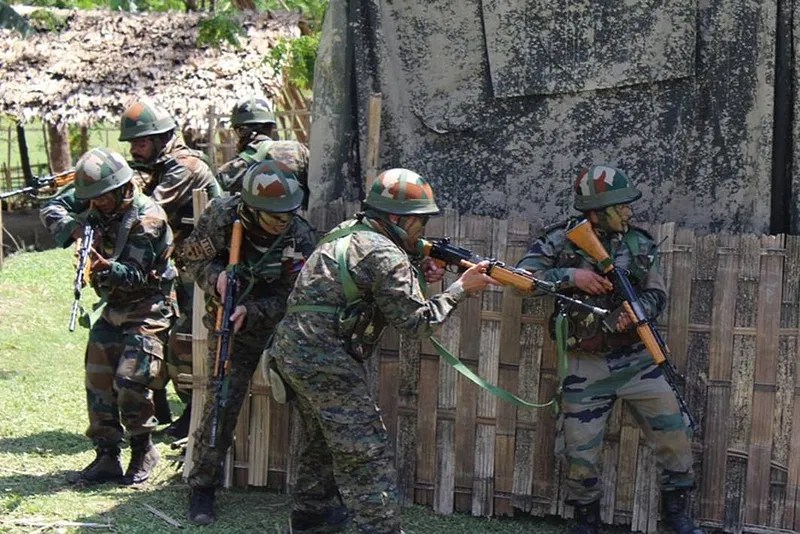
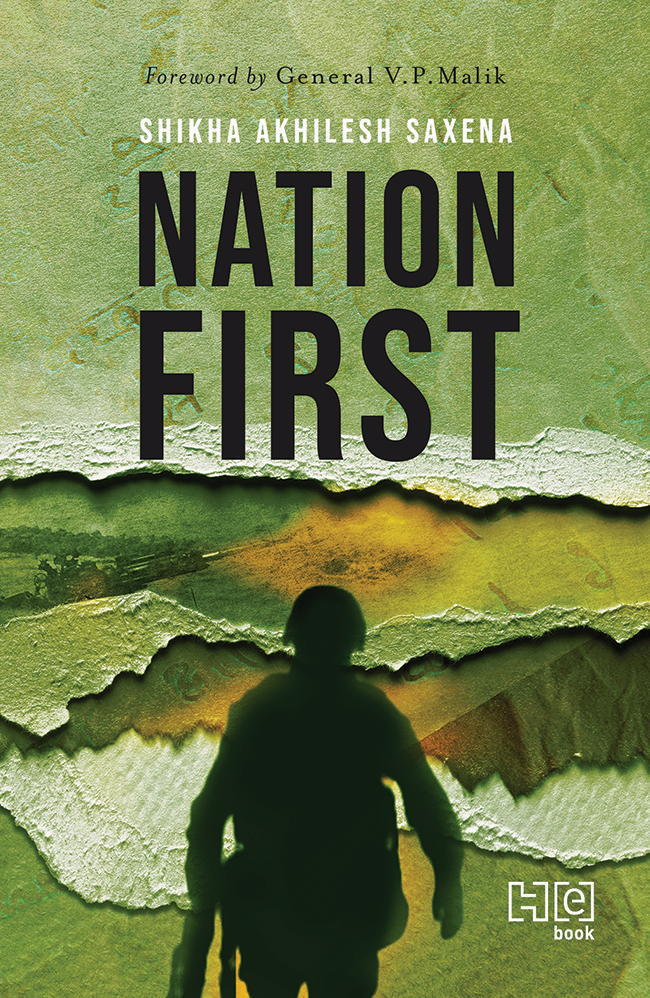
These Selection Grade Lieutenant Colonels who performed the duties of today’s Colonels and retired as Lieutenant Colonels are the most affected due to the current judgement of OROP and by the 6th & 7th Pay Commission. They should be clubbed with the Colonels for pension.

Has the soldier been betrayed by the Government or the Generals?