Going Gets Tough

Camp2 1

On the morning of 28 June 2015, Sunday, after a sumptuous breakfast, everyone got into action, packing up the camp. The children got into dismantling and packing up of the three tents. It took them some time and effort to fold the first tent to fit into its bag. The parents were busy packing up the rations and the cooking equipment and also garbage disposal. We bid goodbye to the Fort William camp at about 10 AM and drove back to Wawa on the picturesque Trans Canadian Highway 17. A 83-kilometre section of the Trans-Canada Highway, between Thunder Bay and Nipigon, is renamed the Terry Fox Courage Highway to honour him for his courageous one-legged a cross-country run for cancer research – the Marathon of Hope. At the intersection of Highway 17 and Highway 11, about 10 kilometers from Thunder Bay, stands a nine foot high bronze statue of Terry, set on a 45-ton granite base, at the Terry Fox monument. The monument also offers a breath-taking view of Lake Superior.

We reached Wawa by 3:30 PM and halted for lunch. After lunch, we drove for an hour to reach the Visitor Centre of the Lake Superior Provincial Park located at Agawa Bay. Being a Sunday, the centre was closed, but there was a self-serve kiosk for the campers. We filled the form to camp at the Crescent Lake Camp Ground, giving details of the vehicle, number of persons and the number of tents to be pitched. The form along with the money towards the camping charges were deposited in the box placed there.

The kiosk also had literature giving out details of the camping grounds, the actions needed from the campers to protect the ecological integrity of the park. The mantra appeared to be “Leave your pristine surroundings just as you found them; take nothing but pictures, leave nothing but footprints“.

We drove another hour South along Highway 17 and took a diversion on a gravel track and drove for about 5 kilometers to reach the Crescent Lake Camping area. The camping ground was empty as the camping season had just commenced with the closing of schools. The camp sites are picked based on first-come-first-serve basis and there are no reservations.
Camp Cres Lk1

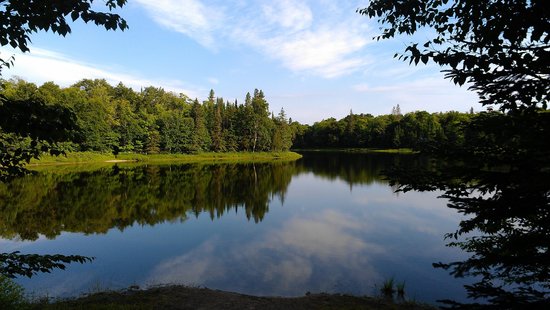
Crescent Lake is an undeveloped lake surrounded entirely by the remote Superior National Forest. It is characterised by clean, blue, unpolluted, undisturbed, quite waters. This quiet campground has waterfront campsites with easy access to fishing, exploring the nearby wilderness and simply enjoying the beauty of the natural area. Superior National Forest, located in northeastern Minnesota’s arrowhead region, comprises of 3 million acres. The forest spans 150 miles along the United States-Canada border. Superior National Forest is known for its coniferous forest ecosystem, numerous clean lakes and diversity of plants and animals. The entire campground is heavily wooded with white pines, red pines, spruce, balsam, birch and aspen. Birds and wildlife are abundant, from moose and bear to bald eagles and Canadian Goose.

The campground has 32 sites situated on a peninsula that juts out into the lake, providing many sites with nice views of the water and some sites with access to the water. Picnic tables and campfire grates are provided on each site. We drove through the camping area and chose a site closest to the water front and parked our van. The children got into the act of pitching the tents. Alas! they did it in 10 minutes flat – with all the experience they had from the previous location. The parents were into setting up the barbeque to cook the dinner.

After pitching the tents and unloading the necessary bedding, rations and cooking utensils, I led the children into the woods to collect firewood for the campfire. Walking on the forest ground, I felt a spongy feeling, as if walking on a rubber mattress, which I had never experienced in the coniferous woods of Kashmir or Sikkim. That was when I remembered the lesson on coniferous family of trees by our botany teacher at Sainik School, Mr AD George. He had taught us that the coniferous forests are found mainly in the Northern hemisphere, called Taiga or Boreal forests and they cover vast areas of North America from the Pacific to the Atlantic. Coniferous trees thrive where summers are short and cool and winters long and harsh, with heavy snowfall. The needle-like leaves have a waxy outer coat which prevents water loss in freezing weather and the branches are soft and flexible and usually point downwards, so that snow slides off them. The coniferous trees shed their leaves and grow new ones. The needles fall to the forest floor and form a thick springy mat. Thread-like fungi help to break down or decompose the fallen needles. These fungi provide nutrients from the decomposed needles back to the roots of the trees.

The major concern for everyone was to ward off the mosquitoes and the bugs. The best methodology was to wear a track pant and a jacket with a hood. One has to apply the bug repellent lavishly to all the exposed parts. The repellants now available in Canada are surely not as messy and does not have the pungent smell as the ones I was used to while in the Indian Army. Everyone was extra conscious not to let any insect into the tents. The scariest of all was to go into the woods to relieve and one had to carry a can of repellent to keep the insects at bay.

We set the campfire going and I got into cooking the dinner – mainly barbequing the meats and the veggies. The children entertained us all with their singing, mimicry, storytelling and et all. After dinner, everyone set out to take precautions to ensure that no wild animals came calling on to our site. It was mainly garbage collection and storage in the van for the night. Based on the instruction pamphlet we got from the kiosk, all the trash, leftover food, and litter were packed into a bag. All the spilled food was collected and the dishes and plates were washed and stored in the van. All the leftover rations were also placed in the van. Everyone retired to sleep after a tiring day.

At night, as there was no ambient light from any human settlements and as the sky was clear, we did a bit of star gazing. The Astronomy knowledge I had gained during the Regimental Survey Officers’ Course I did in 1984 came in handy. We could locate the Pole Star, Jupiter, Constellations like the Ursa Major (Big Bear), Ursa Minor (Small Bear), Cassopia, Orion etc. We could also see two meteors shooting across the sky.

Next morning, after breakfast, everyone had a swim in the lake and went on a trek along the trail in the campground. Children improvised a fishing rod, line and hook as we had not carried any angling equipment (an inadvertent omission on my part), and tried their hand at fishing, but was not a successful one. The least, they learnt to improvise. By about noon, ladies prepared lunch and all other got into the packing up drill. After  pack-up, it was garbage disposal at the designated site in the campground. The site again had huge animal proof bins. After lunch, we drove to Sault Ste Marie (Soo), about an hour away, to check into a hotel that we had booked.

Some of the lessons learnt:-

  • Plan your route and learn the park regulations.
  • Carry proper clothing and equipment – including angling equipment. Be prepared for extreme weather, hazards and emergencies. (Luckily we had none.)
  • Pack food in reusable, leak-proof containers to minimise waste.
  • Inspect your campsite and rest areas for trash or spilled foods. Pack out all trash, leftover food, and litter. Do not bury garbage as animals will just dig it up.
  • Respect what you encounter. Leave any natural object where you found it. It is illegal to cut any live vegetation, harass wildlife or disturb or remove cultural artifacts in a park.
  • Clean your boots, vehicles and gear so you do not transport invasive species.
  • Pack food securely and hang your pack between trees, at least 6 metres above the ground or store them in the vehicle. Do not bring food of any kind into your tent.
  • Remember that sound travels across water. Noise pollution disturbs wildlife and will diminish everyone’s wilderness experience. Chances of seeing wildlife are better if you travel quietly and camp in smaller groups.
  • Before you leave, complete a final scan of your campsite. Ensure the fire is out, all garbage is collected and all your equipment is packed away. Leave the area in better shape than when you arrived.

Home Coming in the next Blog
Nikhil’s Grad Breakfast

GradBreak1

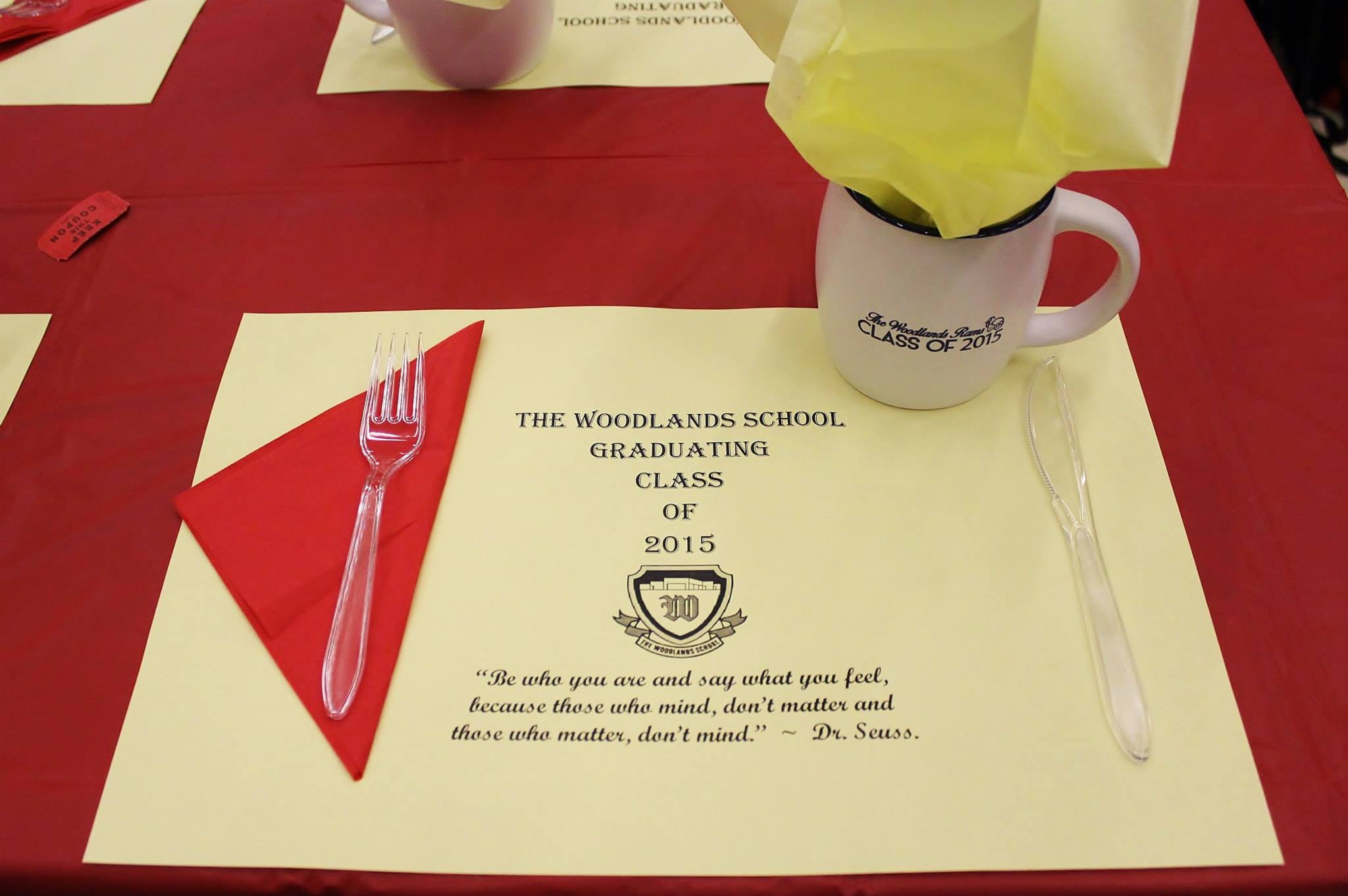
Grad Breakfast is a wonderful high school tradition where the graduating Grade 12 students get together one last time and enjoy breakfast as a group. This is an excellent opportunity to celebrate the hard work and achievements of the graduating students. The Grade 11 students serve the Grad Breakfast for the graduating Grade 12 students, generally during the last week of the class. It may also be a charity event and the money generated may be send to a deserving charity. This occasion also marks the passing of the mantle to the Grade 11 students, who will now be the seniors in the coming academic year.

GradBreak3

The Woodlands Secondary School from where our son Nikhil is graduating from, had their Grad Breakfast on Friday, June 12, 2015. The occasion is also used to select the valedictorian from a pool of applicants. The prospective candidates apply to run as a Valedictorian and the application got to be validated by two high school teachers. All candidates have to deliver a short speech at the Grad Breakfast, in front of the graduating Grade 12 students. The term ‘Valedictorian’ is an Anglicized derivation of the Latin ‘vale dicere’ meaning ‘to say farewell’, historically rooted in the valedictorian’s traditional role as the final speaker at the graduation ceremony. So the valedictory address generally is considered a final farewell to classmates, before they disperse to pursue their individual paths after graduating from the high school.

The major criteria for the Valedictorian applicants was that the valedictorian must be a well-rounded individual whose accomplishments reflect the values of the school community. The recipient of this honour would have to meet the requirements for Graduation with a minimum of 30 credits; must be a honour student (80% average) from Grade 9 to 12; have demonstrated respectful behaviour in school as well as in the community at large; have not been in any discipline cases; must be a positive role model for the junior students; must have demonstrated leadership in various aspects of school life throughout the school career; and be able to represent the entire graduating class.

Nikhil along with four other classmates had applied to be the Valedictorian. After the Grad Breakfast, all five candidates delivered their speeches. Nikhil spoke about the changes the graduating students are going to bring to the community, the country and the world. Click here to listen to Nikhil’s speech on YouTube.

The graduating students were asked to vote online to select their Valedictorian. This was not merely a popularity contest, but the chances of an unpopular candidate winning it despite an awesome speech is very slim. Nikhil was confident that he would win it. After a few days it was announced that Nikhil was selected as the Valedictorian for 2015.

Being a Valedictorian, it will surely confer one bragging rights and will also and a line to one’s resume and will also look good. It normally does not provide you any extra boost for your university admissions, but for sure, the admission panel will take a close look at it.

Now Nikhil had to nominate one of his teachers to introduce him as the Valedictorian at the Commencement. He chose Miss Pils, his French teacher. Ms Pils is the only teacher who taught him for all the four high school years. She was the one who recommended Nikhil for the cultural and educational exchange programme in France based on his performance in French. As per Nikhil, one month he spend in Nantes, France with the Le Floch family was very fruitful and memorable. It was not only an important career milestone, but also a personal one for him. It had a telling impact on Nikhil’s outlook and conduct.

The Valedictorian has to deliver the Valedictory address at the ‘Commencement’, to be held in October 2015. There is no greater recognition of a graduate’s achievements than a high school graduation ceremony, or Commencement. Diplomas are conferred or handed out to graduating students. Various award winning graduating students are honoured during the ceremony. The speakers selected for this event often include community dignitaries, alumni and the valedictorian. During our daughter Nidhi’s Commencement in 2009, it was Ms Hazel McCallion, the then Mayor of our city Mississauga (Please click here to read more about her), who delivered an inspiring motivational speech to the graduating students.

Commencement is a very special event for the graduating class, teachers, staff and the families of graduating students. The occasion is used to celebrate the achievements of students with many special guests in attendance. It is a formal celebration that has associated with it a high level of maturity and respect for one another’s achievements.

US senator Orrin Hatch aptly said about High School Commencement that there is a good reason they call these ceremonies ‘commencement exercises’, as graduation is not the end; it is only the beginning.

SexEd Ontario

sexed3When the Ontario government unveiled the new sex education curriculum in February 2015, (the current policy is of 1998 vintage), a poll showed that almost half the population supported it, while 34 per cent were opposed. Two months and a new poll later, only 42 per cent still support the curriculum, while 40 per cent are opposed. In May 2015, 35,000 Toronto-area elementary students were kept home by their parents as a protest against the curriculum, while thousands more were absent from schools in the surrounding suburbs.

Clearly, Ontario has a sex problem. Opposition to the curriculum is growing, and the people behind it smell blood. They protested so noisily against the new curriculum when it was originally released in 2010 that the former premier, Dalton McGuinty, backed off and put it into a state of political freeze. It is very unfortunate that a man charged with multiple counts relating to child pornography had a hand in developing the failed 2010 curriculum. The opponents of sexed has used this handle to corrupt the minds of the parents. The same groups hope to pull off a similar coup now that the new Premier, Kathleen Wynne, has revived the curriculum and intends to have it start being taught in the session commencing in Fall 2015.

In the Ontario Legislative Assembly, the opposition Conservative Party member Monte McNaughton, openly criticised  the updated curriculum and said that it is not the job of the premier – “especially Kathleen Wynne” – to tell parents what age is appropriate for their children.  Wynne, who is openly gay, demanded that McNaughton explain why he feels she is not qualified to set standards for kids in schools.

The 2015 curriculum has been designed by experts from the fields of health, law enforcement agencies, child welfare, education, and policy experts, as well as over 4,000 heads of school parent councils across Ontario. The proposed changes are research-supported and intended to make children less vulnerable to exploitation, including over the Internet.

Many of the critics base their opinion on distorted facts, mostly sowed by the clergy and the so called protectors of ‘culture’. The sexed surely does not teach or encourage anal sex or masturbation as claimed by these keepers of ‘faith’. Many parents opposed to the sexed curriculum have let themselves to be manipulated by these keepers of faith and culture and have fallen prey to their misinformation campaign.

The curriculum is a wordy 240-page document, available on the internet, with the straightforward title ‘The Ontario Curriculum, Grades 1-8: Health and Physical Education‘. As per this document, students learn about fire safety, nutrition, wearing a helmet on a bike, nut allergies, why they shouldn’t open the medicine cabinet and swallow pills like candy, how to catch a ball and that it’s bad for you to sit inside all day watching television. When they get older, they learn about the impending changes brought on by puberty. The document also deals with sugary soda pop, cigarettes and sexually transmitted diseases.

It is not mandatory for the children to attend the sexed classes. Parents have the option to remove their children from all or part of the Physical and Health Education curriculum. Children whose parents make this choice are usually kept home or supervised in the library or another part of the school while the class takes place.

On the subject of sex, the curriculum is a reflection of the Canadian Charter of Rights and Freedoms. It promotes diversity and inclusiveness protected by Canadian laws. Children are taught that, while they might have a mother and a father, some of their classmates might have two mothers, or just a dad, or maybe they are raised by a grandparent. They are introduced slowly to the issues of sexual orientation and gender identity, but this is done in the most neutral of terms. The curriculum covers some of the visible and invisible differences in people, differences that also include body size, clothing, learning ability, family background and eye colour.

It is this neutrality regarding sexual orientation that has in fact infuriated the keepers of faith and culture. They claim that the curriculum shows neither respect nor tolerance for traditionally-principled families. The values reflected in the new curriculum are not family values, but are society’s values.

The curriculum falls a bit short when discussing sex, it never mentions marriage or love. Marriage  has its place and value in the society, and it is a fundamental part of many of the religions in Canada, and is also an important civil ceremony. Great nations are built on strong families and hence there is a need to modify the curriculum to acknowledge the role of marriage, traditional or otherwise. If children can learn over time about the different sorts of parents that exist in their world, then they can also learn that some parents are married and why that is important.

Based on the Canadian Charter of Rights and Freedoms, Canadians want children to be armed against abuse, to be able to grow on their own terms and with own identity, and also to accept the differences in others. Canadians want young men and women to grow up with a clear understanding of consent in sexual relations. These are the lessons that a public school system should teach, as long as it is done with care and the lessons are based on sound educational principles.

It is strongly felt that the students should start learning facial cues and how to read body language as early as Grade 1 to give them the ability to understand the concept of consent. This will surely help them in protecting them from sexual abusers. They would realise what happened to them and will surely report such instances to parents, teachers, health workers, etc. It is pertinent to note that in many cases, the child abusers are well known to the child’s family and some cases close relatives.

The curriculum addresses the issues faced by modern day children like Sexting, cyber-bullying and Internet porn.

As per the Ontario Government site, the salient aspects of sex education in various grades are:-

  • Grade 1: Identify body parts, including genitalia, using correct terminology.  Children will be taught to use correct terms (penis, testicles, vagina, vulva) and to recognize exploitative behaviours such as inappropriate touching.
  • Grade 2: Basic stages of human development. Identify related bodily changes. Explain the importance of standing up for themselves. Describe how to relate positively to others and behaviours that can be harmful in relating to others, including both online and face-to-face name calling. The concept of ‘consent’ will be introduced very broadly as the right to say ‘no’ in threatening situations. This has been misrepresented by many critics as ‘teaching children the concept of consent,’ which is then in turn further misrepresented as ‘teaching children to consent to sex.’
  • Grade 3: Identify the characteristics of healthy relationships, including those with friends, siblings and parents. Describe how visible differences, such as skin colour, and invisible differences, including gender identity and sexual orientation, make each person unique. Identify ways of showing respect for differences in others. Develop safety guidelines for Internet use.
  • Grade 4: Describe the physical changes that occur at puberty, as well as the emotional and social impacts. Demonstrate an understanding of personal hygienic practices associated with the onset of puberty. Identify risks associated with communications technology and describe how to use them safely. Describe various types of bullying and abuse and identify appropriate ways of responding. The concept of human and animal reproduction — presented broadly as the union of the egg and sperm will be introduced in Grade 4.
  • Grade 5: Identify the parts of the reproductive system. Describe the processes of menstruation and spermatogenesis. Describe stresses related to puberty and identify strategies to manage them. Explain how a person’s actions, either in person or online, can affect people’s feelings and reputation, including making sexual comments and sharing sexual pictures. First discussion of sexual intercourse occurs in Grade 5.
  • Grade 6: Identify factors that affect a person’s ‘self-concept,’ for example stereotypes, gender identity and body image. Describe how to lay a foundation for healthy relationships by understanding changes that occur during adolescence. Assess the effects of stereotypes on social inclusion and relationships. Masturbation is defined in Grade 6 and characterized as normal and not harmful, but students are not ‘taught to masturbate.’
  • Grade 7: Explain the importance of understanding with a partner about delaying sexual activity and the concept of consent. Identify common sexually transmitted infections and describe their symptoms. Identify ways of preventing STIs and unintended pregnancy. Assess the impact of different types of bullying or harassment, including sexting. Oral-genital contact and anal intercourse are discussed in Grade 7. They are listed as potential sexual activities that one should consider abstaining from or delaying and is not offered up as alternatives to delaying vaginal intercourse. This is aimed to reduce teen pregnancy and sexually transmitted infection rates and raise the age of onset of first sexual activity.
  • Grade 8: Identify and explain factors that can affect decisions about sexual activity. Demonstrate an understanding of gender identity and sexual orientation. Demonstrate an understanding of contraception and the concept of consent. Analyze the benefits and risks of relationships involving different degrees of sexual intimacy.
  • Grade 9: Demonstrate an understanding of the benefits and risks of using communication technologies. Describe the relative effectiveness of methods to prevent unintended pregnancy or STIs. Demonstrate an understanding of factors influencing a person’s gender identity and sexual orientation. Apply their knowledge of sexual health and safety, including to the concept of consent.
  • Grade 10: Demonstrate an understanding of factors that enhance mental health. Describe factors that influence sexual decision making. Describe some common misconceptions about sexuality in our culture, and explain how these may harm people. Explain how being in an exclusive relationship with another person affects them and their relations with others.
  • Grade 11: Demonstrate an understanding of a variety of mental illnesses and addictions. Describe how proactive health measures and supports, for example breast and testicular examinations, can be applied to avoid or minimize illness.
  • Grade 12: Demonstrate an understanding of the effects and legal implications of different types of harassment, violence, and abuse in different relationships and settings and describe ways of responding to and preventing them. Demonstrate an understanding of how relationships develop and how to maintain a healthy relationship.

The curriculum (both 2015 and 1998) also indicates that students should seek guidance from trusted adults in their lives, such as parents, doctors, elders, or religious leaders, when considering sexual choices.  The curriculum also  supports the rights of parents to influence their children’s values and beliefs when it comes to making decisions.

Very little has actually changed from the previous curriculum in terms of what is actually being taught. There have been major, necessary updates in keeping with law and technology — changes to marriage equality, social media and digital safety. The main difference between this and the 1998 curriculum is that the 2015 curriculum includes much more detail.

Nikhil’s Prom

Prom1Prom (promenade) is a semi-formal dance or gathering of graduating high school students. It is a celebration of hard work and friendship these teens underwent during their four years at the high school. The term ‘prom’ comes from the word ‘promenade,’ meaning a march of guests into a ballroom to announce the beginning of a formal event or ball. This event is typically held near the end of the year for the Grade 12 students. Prom is a major event among high school students and is believed to be the most important teenage event in Canada. Many teens feel this event to be an important event in their life, next to their wedding.

In the early 1900s, prom was a simple tea dance where high school seniors wore their Sunday best. In the 1920s and 1930s, prom expanded into an annual class banquet where students wore party clothes and danced afterward. In the 1950s, proms became more extravagant and elaborate, moving  to hotel ballrooms and country clubs from the school gymnasium, bearing similarity to today’s proms. With this, competition blossomed, as teens strove to have the best dress, the best mode of transportation, and the best looking date. In 1975, President Ford’s daughter Susan held her high school’s senior prom at the White House.

Our son Nikhil attended the Prom in June 2015 with his date Vivian Elizabeth as both were graduating from Grade 12. The preparation for the event started in full earnest in May after Vivian accepted Nikhil’s proposal to be his Prom Date. This event is called a ‘Promposal’ and can mimic marriage proposals. Nikhil with a bouquet in his hands, dropped down to one knee, and proposed to Vivian to be his Prom Date.

Many of Nikhil’s friends did come up with creative methods for Promposal. Some did a ‘Bhangra’ with a ‘Dhol’; some sang a song duly supported by chorus of friends; some proposed with flowers and special cup-cakes; some had flash-mobs; some had special T-Shirts with a message and the list is endless. With these creative methods, teens are making each other feel special. This trend can be attributed to the power of social media and every teen want to post something special about every important event and promposal is really important.

Nikhil wanted to wear a tuxedo for the event and we went to the store renting tuxedos to pick up one suiting him. He did not want to invest in the costly outfit as he realised that he is hardly ever going to wear it after the prom and in all probability will outgrow his tuxedo soon. He had to procure a bow-tie and a pocket square in Royal Blue colour to match with Vivan’s dress.

Two days before the event, Nikhil visited the barber for a stylish haircut and also procured a set of perfumes and creams to wear on the prom day. He went to the florist and placed an order for a corsage for Vivan. The boutonnières to be worn by the boys are procured by the girls. The entire exercise cost us around $400. When our daughter Nidhi had her prom seven years back, it cost us around $600.

In case of girls, they got to buy their evening gowns and the jewellery to go with it. They got to get a pedicure and a manicure done, got to do up the nails, put on an apt facial makeup and also get a hairdo for the occasion. All these cost handsomely and all appointments have to be booked well in advance and the father got to get her to each place well before the appointed time.

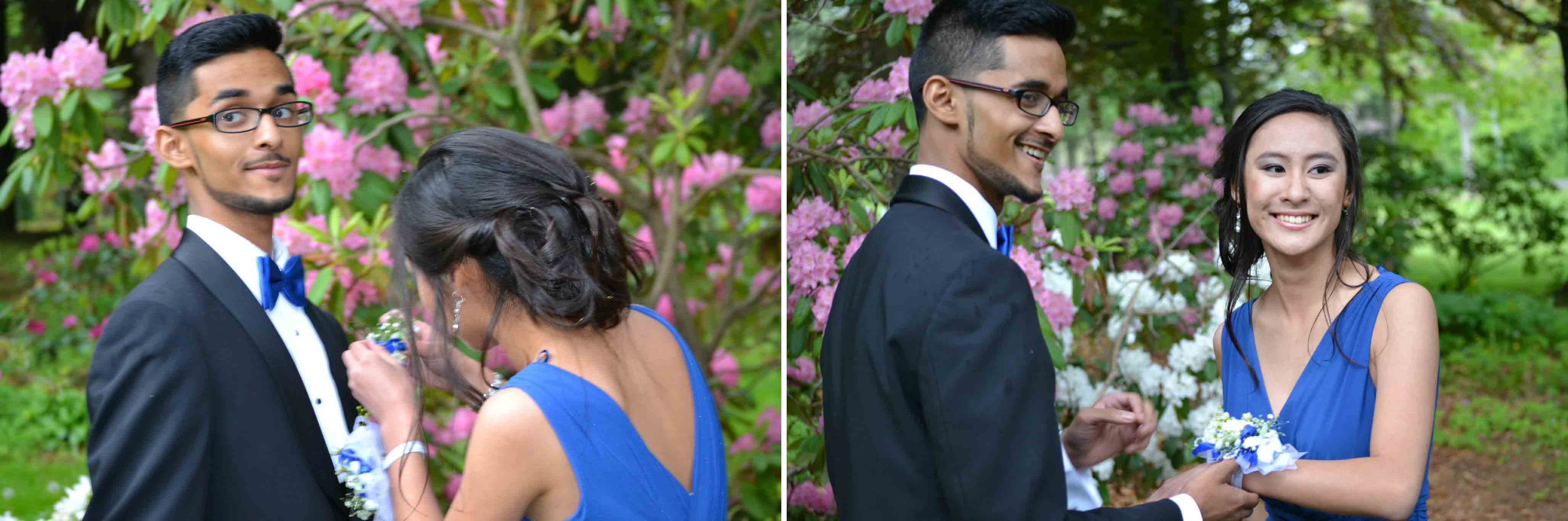
Prom2On the day of the prom, prom-couples gather at a park, garden, or their own and their dates’ houses for single and/or group photographs. In Nikhil’s case (and also Nidhi’s), the location for the photo-shoot was the Rhododendron Gardens located at Port Credit on Lake Ontario. The Rhododendron Gardens as the name suggest has about 60 different hybrids of Rhododendrons and are in full bloom by late June, as if to coincide with the high school proms. The park has a micro-climate that suits rhododendrons because of its acidic soil, the humidity from its exposure to Lake Ontario and its tree cover, which includes many white pine and oak.

Prom3

At the park, the prom couples gathered by 3 PM, exchanged the corsage and the boutonnière and after the photo-shoot, which took about three hours, proceeded to the banquet hall for the dinner and dance. The dinner and dance is organised by the school and is supervised by a few teachers.

The mode of transport for prom couples is another important aspect as everyone wants to make a grand entry. Normally the parents drop off the children to the venue. Some hire limousines for the event. One Nova Scotia student rented a helicopter for around $2000 to make a grand entry. One teen showed up in an ambulance as a ‘Sleeping Beauty’, to be kissed by her prince charming to wake her up (she later had to apologize after a severe social media backlash). The teens outdo each other by showing up to prom in vehicles such as fancy cars, horse chariots and even ox-pulled carriages.

The grand entry to the prom party will remind you of the Oscars. It is a red-carpet moment and the boys and girls really feel like a prince and a princess. It has all the glamour, glitz, camera flashes, etc.

After the dance and dinner, group of friends congregated at a student’s home for the after-party. Some moved from one after-party to another and we picked up Nikhil the next morning.

Since high school prom only happens once in a teen’s life, many feel it worth investing in it. Every teen wants to look back on pictures and remember the fun they had and how it was a night they felt and looked at their best. Everyone wants these memories to last forever, so they want to make sure they are the best ones.

High school prom with all its glamour surely contributes to the increased stress in the present day teenager’s already cooked up life. It also pinches heavily on the parent’s wallet. With every passing year, the marketing companies, media and the social media hypes the event and the pressure on the teens will surely keep increasing.

Matha Pitha Guru Deva (Mother Father Teacher God)

माता पिता गुरु देवा * மாதா பிதா குரு தெய்வம் * മാതാ പിതാ ഗുരു ദൈവം

‘Matha Pitha Guru Deva’ translates into most Indian languages as ‘Mother Father Teacher God’. It owes its origin to the Vedic times and is said to be the greatest truth. It is the order of reverence as laid down by the Hindu philosophy.

mataPitaGuruDeva

First comes the mother (Matha), obviously as she is the one who carried us in her womb for ten months, developed as into a human being from a mere cell, who gave her essence to create us and brought us into this world.

Then is the father (Pitha), as he has contributed 23 chromosomes. Nearly half your traits are inherited from the father. The mother and father then take us to the teacher (Guru), and it is the guru(s), through their teachings, develop our minds and channelize our thinking. All the three have a very important role in identifying our Gods (Deva) and bringing us closer to the God.

As per Hindu mythology, Lord Shiva and his consort Parvati received a ripe mango. Their children Ganesha and Karthikeya, both wanted it. To break the impasse, Lord Shiva asked them to go around the world and the one who returns first would win the mango. Karthikeya immediately set off to encircle the world on his mount, the peacock. Ganesha realising that his mount, the rat is no match for the peacock, went around his parents once and claimed the prize saying that the parents are the whole world to him and by going around them once, he had in effect gone around the world. The happy parents gifted the fruit to Ganesha. When Karthikeya returned after going round the world, he saw Ganesha with the fruit in his hand. His non-understanding of this simple truth upset him so much that he is believed to have gone away to live alone and meditate in the hills of Palani in Southern India.

Based on my earlier articles about our teachers at Sainik School and the National Defence Academy (NDA), Veteran Brigadier Azad Sameer expressed his views. He said that many of our teachers are unsung heroes who have mentored a generation of students and taught them values and ideals which are everlasting. He is reminded of many of teachers in school, especially those associated with English, maths, physics, boxing, football and so on. Besides the subject proper, many of them taught lessons that one carries for life.

Brigadier Sameer is of the opinion that essentially this reverence for teachers is born out of a typical Indian value. A special bond between the teacher and pupil. 5000 years of Indian history will bear testimony to this special bond and special value system. Elsewhere in the world, he wonders whether one get to see this emotional connect between the teacher and the taught.

In my opinion, in case such an umbilical cord between the teacher and the students did not exist in the entire world, we would never have had the novel and then the movie like ‘To Sir With Love.’  The reverence for teachers exist in all the societies across the world.

Jesus Christ in the bible is referred to as Lord, Savior, Master, and Redeemer. In the four Gospels, out of 90 times Jesus was addressed directly, 60 times he was called Teacher. As per St John (13:13), Jesus is supposed to have said that ‘You call me Teacher and Lord, and rightly so, for that is what I am.

The reverence for their teachers what students demonstrate here in Canada is very much the same as what the students do in India. Most of the Indian guru-shishya (teacher-student) relationship of today is mostly hypocritical and that was what many of my classmates on leaving our school realised. We always addressed our teachers as Mister Raman or Miss Murphy; we never added the typical ‘Sir‘ as what most Indian teachers expect the students to. When our classmates reached their universities, they addressed their teachers in the same way and they faced castigation not only from the teachers, but also from their peers. Many took offense to addressing the professor as ‘Mister.’.

The teachers in Canada, expect the students to address them as ‘Mister/Miss‘ and some even insist on being addressed with only their first name. The teachers in Canada are much more straightforward in their relationship with the students. Here the teachers earn the students’ respect rather than forcing themselves on the students.

I feel that the teachers in Canada give more freedom to the students for developing their ideas and thoughts.  The teachers are much more approachable and appear to be multi-talented and many have both formal and informal qualifications and experiences in varied fields other than the subjects they teach. The students discuss anything and everything under the sun with their teachers. We were lucky during our school days that we had similar teachers as in Canada.

The importance of high school teachers for the students are much more in Canada as the students need at least two teachers’ recommendations for university admission.  For any job as a teenager or even later, two high school teachers’ recommendation is mandatory, even if it is for an assistant’s job at a coffee or burger shop.  Our son Nikhil needed it while applying for the job of swimming instructor and lifeguard at the city’s swimming pool and also when he applied for a volunteer position at the city hospital.

About 70% of a high school student’s assessment is done by the teacher throughout the semester. The assessment is based on various assignments, presentations, written submissions, tests, quizzes, etc. The attitude and aptitude of the student and his organisational ability is also reported upon. The final semester examinations generally carry only 30% of the marks.   This demands real effort from the students to maintain a healthy relationship with their teachers.

The teacher-student relationship is celebrated during the valedictory address by the student valedictorian of Grade 12 and also at Grade 8 during the graduation ceremony.  You must have watched many valedictory addresses posted on the YouTube or social-media.

Teachers play an important role in nation building by developing young students into responsible citizens. Teachers through their perseverance, love and sacrifices has shown us the right path in which great men have built the nations. Any strong and powerful nation is endowed with committed and dedicated teachers, without whom these nations would never have achieved glory.

In the modern world of information overload, we may even define it as ‘Matha, Pitha, Google, Deva.’

Smile Knows No Barriers

Let us make one point, that we meet each other with a smile, when it is difficult to smile. Smile at each other, make time for each other in your family,” said Mother Teresa. Happiness comes from one’s heart and if you are happy on the inside, it will show on the outside, especially through a smile. You must put a smile on your face as it will not only encourage others to do the same, but you will feel good and probably have a better attitude for doing it.

smiley

While walking our dog Maximus in the morning and evening, I come across many passersby, some walking and some in stopped cars at the traffic intersections.   I make it a point to exchange a smile with most of them. Some do reciprocate and some do not.

One day in the evening during my walk, I met a lady carrying two heavy bags in her hands and walking. Many who passed by her, passed a sympathetic glance, which is for sure not going to mitigate the suffering of the lady. As I reached the lady, who appeared to be a new immigrant from South East Asia in her mid thirties, she had put down the two bags and was taking a breather. I suggested to her that I will carry one bag and she can carry the other. Very reluctantly she agreed after saying to me that it would be difficult for me to handle the dog and carry the bag.

We moved ahead with me carrying one bag and she the other. Maximus it appears had sensed the situation as he followed me meekly without his usual explorations of the fire-hydrants and the traffic signal posts. (Please refer my blog http:/rejinces.net/2014/07/15/fire-hydrants-and-the-dogs/). The lady asked me as to why I was helping her, to which I said that I thought that she deserved my assistance and my assistance will surely mitigate her agony to some extent. Then I spoke to her about Simon who carried Jesus’ cross. Simon had never heard of Jesus before and when he saw a man being abused and made to carry a cross, he went to help Him when all the Jesus’ disciples had deserted Him with Peter, supposedly the most trusted disciple, even denying that he ever knew or heard of Jesus.

After few steps, the lady asked me as to why I smiled at all the passersby and I said that it was a practise I developed mainly to mitigate my own difficulty of walking about 5 km and managing the dog and also to spread a little happiness around. The lady said that she did not smile at people as she did not know proper English. To this I said that a smile knew neither any language nor any boundaries and is the best way to spread happiness around you. You may even add a ‘Hi’ or a ‘Good Morning/ Evening’ if you wish to.

The lady said that many a times she did try to smile, but was hardly reciprocated. To this I said that in my case too it was the same. I considered anyone who did not smile back to be less luckier and less happier than what I was and that was why that person did not smile back. One should be thankful to God that one is capable of smiling, despite all the problems one has on hand. The person who did not smile back might have had a bad day at work; may have fought with someone at home or office; may be suffering immense pain or may be sick; or may have lost someone close.

After walking a kilometer, we reached the apartment building of the lady and she thanked me immensely for helping her out. She also said that she will make it a point to smile at everyone she came across. As I was about to leave, the lady said that I must become a preacher, to which I said that I do not intent to sell  any God.

I have always been fascinated by the ‘Smiley ‘ with its various avatars, especially the modern Emoticons. For sure a simple tool to spread happiness in the digital world.  The Smiley arrived in the early 1970s and it was the perfect yellow circle with a childlike depiction of a happy face of two vertical, oval eyes and a large, upturned semi-circular mouth. The yellow background colour was the colour of spring and the sun.

The origin of the design of Smiley is contested, it seems that it first appeared in 1963 in American children’s TV programme The Funny Company, which featured a crude smiley face as a kids’ club logo with a message ‘Keep Smiling’. Harvey Ross Ball, a graphic artist from Massachusetts was the first person to come up with the smiley faces . A company had employed him to come up with something that would boost the morale of its employees. The smiley face was popularized by two brothers, Bernard and Murray Spain, who were in the business of making would-be fad items. Over the period of time, small variations were made on the same idea, but it maintained its original yellow colour. Ball was paid $45 for his 10 minutes work. However, neither he nor the company copyrighted the design. A Seattle designer called David Stern later claimed authorship.

In September 1970, two brothers Bernard and Murray Spain, came up with the classic Smiley design to sell novelties. Adding the words Have a Nice Day, the Spains shipped at least 50 million Smiley badges in 1972. Later it appeared on key chains, coffee mugs, caps, badges, stickers, etc.

From the Smilies, the modern-day emoticons we use in emails, texts and instant messaging emerged. These emoticons can be traced to Scott Fahlman, a professor at Carnegie Mellon University, who is widely considered to be the father of the emoticons. Fahlman started it with a message “I propose the following character sequence for joke markers.   :- )  Read it sideways.”

Emoticons took off as instant messaging became a popular form of quick online communication. AOL’s Instant Messenger in the 1990s provided 12 emoticons. This helped users convey a wide range of emotions with a simple click of the mouse. Emoticons became much more popular with the popularity of online communications and mobile devices. They soon multiplied into a cast of thousands and the users found that they could covey much more without using any words.

So Keep Smiling and spread happiness around.

Super Brats : Girls in the Forefront

Superbrats2

Sulagna Panigrahi, daughter of our coursemate Colonel Panigrahi, debuted in the leading role in the Hindi movie ‘Ek Adbhut Dakshina’. Colonel Ajay Sharma, another of our coursemates and my next room friend at the India Military Academy, his wife Ashima and their daughter Anushka Sharma (now a leading actress and celebrity) were present to encourage the young girl during a special screening of the movie.  It appears that acting, talent and confidence runs through the veins of the children of our coursemates and also all the defence personnel.

It is much more heart warming to see girls out performing the boys.  Navneet Kaur Dhillon was crowned Miss India 2013, comes from an Indian Army background and Sobhita Dhulipala adjudged the first runner-up, comes from an Indian Navy background. The list of women from defence background winning such pageants gets longer – from Sushmita Sen – (Air Force) in 1994 onwards to include Gul Panag – (Army), Priyanka Chopra – (Army), Lara Dutta – (Air Force), Celina Jaitly- (Army), Neha Dhupia – (Navy), the list goes on. These pageants are not only for the girls who are beautiful, but they also need to be intelligent, confident, well mannered and well groomed.

What gives them the edge over others? What really makes these defence children such inborn winners? These children, raised in military cantonments around the country, display a lot of grace, wit, confidence and poise – all at the same time.

The parents of these children- mostly the father (now-days both father and mother) – are serving defence officers. The selection process for these officers – with a written examination, a five-day interview which scientifically analyses each candidate’s potential, personality and intelligence tests, and a stringent medical examination has no comparison in the country, which tests one in all aspects of human development and behaviour. The selected candidates undergo a tough training where they are polished into better humans and leaders. When they select their spouses, its no surprise that they select the best to suit them – (if the spouse is a serving officer, the job has already been done by the defence). The children born to these parents have to be as good or even better than their parents. They are born in the military hospitals which provide the best of medical care and excellent hygiene conditions.   They are well natured into this world and the military society nurtures them really well to be better human beings and responsible citizens.

A typical army kid will claim to be natured in Srinagar, and nurtured in Siliguri, Coimbatore, Ferozpur, Allahabad, Bhatinda, Manipur, Imphal and Patiala. These children have grown up in small towns as well as big cities, they are used to the cold mountains of Kashmir to the hot deserts of Rajasthan, they amalgamate with Malayalee culture to Mizo culture, they learn Thamizh to Assamese during their school days.   In short they are adaptive, open-minded, a survivor and thus a winner.

The life in a typical military home for these kids is well organised and is set to the rules and standards dictated by the parents. They have to rise early, attend school and then participate in sports and cultural activities after school. In the evenings they have to attend social functions – both formal and informal. They need to welcome guests who come calling-on or to attend parties and keep everyone in good humour. Its a tough job for these kids as they must study well and obtain good grades at school and pass all entrance examinations. Hence, it is no wonder that these children develop great conversational skills and carry themselves with lot of confidence. They interact with a lot of people who belong to different age groups and cultures. They never hesitate to speak to a stranger or a new person. Ultimately, these communication skills help them to be winners.

Most of the military parents are avid readers, a habit developed mostly due to their intellect and also the loneliness of being posted in remote areas with no access to television. The mothers pickup this habit while living separately from their husbands while he is posted in remote areas or during the endless train travels – while on posting or while proceeding on vacations. The parents are also good with all aspects of communication and are capable of discussing all aspects of life – from spirituality to sports to movies. The children listen to these conversations and are active participants in many such discussions – mostly ending with the father shooing them off to bed when he has nearly lost his point of argument. Thus these children ought to have stronger personalities, and are also very disciplined and punctual. They are trained and groomed well as to — how to walk, how to sit, how to talk etc. They are taught grace and poise from an early age. It comes naturally to them

Along with every new posting of their parent – an event these children undergo once the least in three years- puts a lot of pressure on the children too. They got to adapt to a new place, a new culture, often a new language and above all to a new school. Making new friends, going to new schools make them ooze confidence. Most of these children  have seen at least half a dozen schools by the time they complete their higher secondary education.

When our son Nikhil landed in Canada in grade 1, his teacher said to him, “You may find it difficult to adapt to the Canadian culture as you are new to it.” Nikhil replied, “Until now to my grade 1, I studied in four states of India with diverse cultures, speaking three different languages.  I will quickly adapt to the Canadian culture.”

Children from the defence background are tougher, calmer, and in control of their emotions. When their parent is posted in remote areas of India, they naturally get trained to be tough survivors, adapt to new situations and people. Many children learn to be independent at a young age as their parent is posted in far-flung and inaccessible operational areas and the family has to look after themselves, with the children shouldering a lot of responsibilities.

These kids are excellent in stress management – a phenomenon unknown to the present day kids as they undergo a lot of stress in everyday life and a few succumb to these stresses and pressures. Most defence kids have seen off their parent on posting to hazardous areas and also to fight militancy – and many a times not knowing whether they will ever meet again. Every day passes with fear and uncertainties of their parent’s return and the role the mothers play to keep the household going and in bringing up the children needs to be commended.

The grooming and etiquette also come naturally to these kids, as they watch their mothers wear their clothes with grace, fathers adopt immaculate manners, the effort that goes into organising and conducting parties and get-togethers at home, etc. These kids are taught table manners and good etiquette from an early age at home.

The army cantonments provide a lot of sporting facilities like swimming, squash, tennis, golf, horse-riding etc. The children, without any sexual bias, are encouraged to participate in these activities. During these sports activities, people mingle with one another. The military stations organise summer adventure camps for the kids – from trekking to hang-gliding. These go a long way in developing physical fitness and also a sense of adventure- daily military life is by itself full of adventures for these kids.

A defence hub has a particular social culture, which becomes an integral part of the child’s personality. They pick up good etiquette and manners. They know how to talk and more importantly what to talk about. They know exactly how to avoid or get out of tricky situations. These are qualities imbibed by the children with defence upbringing of over 20 years and can never be learned over a month-long crash course. These assets help the children to stand out and win in every field of life.

Most military stations – even in the remotest places- have musical and dance schools – mostly run by the defence officers’ wives. They go a long way in nurturing the cultural aspects of these children. These children get many an opportunity to showcase their talents – both at home and also at military functions, clubs and messes. These make them very confident and they develop and master the art of presentation.

Contrary to popular belief, defence personnel are very religious and also spiritual. They celebrate all festivals and observe all religious occasions. They celebrate Holi, Onam, Pongal, Baisakhi and also Christmas, Dushera, Durga-Pooja, Eid and Guru-Purab. The kids attend all the religious functions in the station along with their parents and visit all religious places of worship – they are familiar with the rituals followed in the Mandir, Masjid, Gurudwara and the Church. It would be very common to see a Christian child singing the Arati or Slokas as fluent as they say the Lord’s prayer. They learn to respect all religions and accept everyone irrespective of their caste, creed, colour or religious beliefs. This facilitate the children to develop a multidimensional personality and hence adapt to various cultures and people with ease.

One reason attributed to the women-power in the military circles is due to the fact that the only society in the country where women are treated equally with men is the military. Many a times men complain that the women are often treated more equally than men. The General or a senior officer will always rise from their seats to receive a lady walking in though the lady may be a Lieutenant’s wife. The only place in India where the ladies are served first – whether at formal or informal or at-home functions – is in the armed forces. Even in the military’s religious places of worship, women are offered ‘prasad’ first. The officer on duty or the Captain of the Indian Navy ships will salute all ladies entering or leaving the ship irrespective of their social or military hierarchy. The ladies are always respected at home and outside by the defence service personal and the sexual discrimination is minimal in this society. That may be reason why we have defence service officers’ daughters performing extremely well in the society and winning many crowns and laurels.

The facilities like swimming, tennis, golf, libraries etc are available in all the cities of Canada at a real subsidised price or at times even free of cost. The government provides tax benefits for these activities. The need of the hour is to take time out of your schedules and take the children for these activities. The environment at home need to be upgraded to facilitate children’s development and the children must be trained to actively part-take in all the activities and chores at home. This will ensure that our next generation will turn out to be better citizens and human beings.

The School Bus

Schoolbus
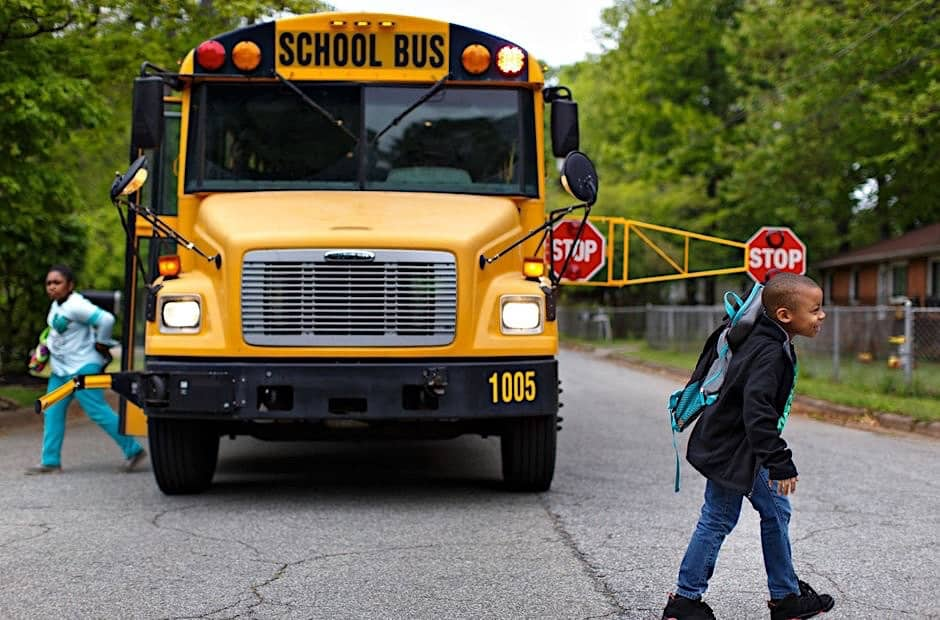
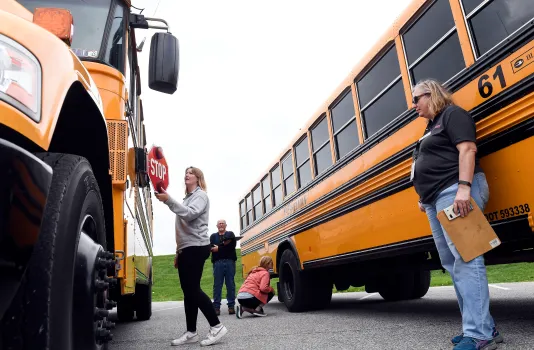
Driving through the residential area to work or to drop off children at the school, one got to cater for a few extra minutes to stop for school buses. The rule in Canada and US is that whether on a city street, highway or county road, and regardless of the speed limit and the number of lanes, motorists travelling in both directions must stop when approaching a stopped school bus with its upper red lights flashing. A flashing stop arm will swing out while passengers are boarding or leaving the bus. While stopping behind a school bus, the drivers got to ensure that they are at least 20 meters away. Once all passengers have boarded or disembarked, the ‘Stop’ arm will fold away. Any infringement to this rule fines ranging from $400 to $2,000. School bus drivers and other witnesses can report vehicles that have illegally passed a school bus. The modern school buses are fitted with cameras to record events inside and outside the bus.

School buses have been specifically designed and equipped to carry students. Therefore, they are one of the only vehicles on the road with their size and design that maximizes safety for children. The highly distinguishable ‘National School Bus Chrome’ colour later renamed as ‘National School Bus Glossy Yellow’ as lead was removed from the pigment.  Black markings on an yellow background is meant to attract visual attention of any driver or pedestrian.

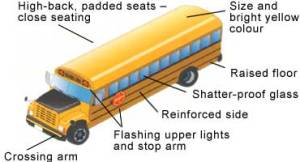
All school buses are equipped with flashing lights and a stop arm, which swing out whenever a child is picked up or dropped off. These signals indicate to traffic approaching from both sides of the road to come to a full stop and to remain so until the indicator is deactivated. The crossing arm when deployed, ensures that the students who have to cross the road before boarding or after leaving their bus, have to go around it and thus are always at a safe distance away from the front bumper. This enables the driver to see them or locate them in the bus mirrors. School bus design includes strategically placed grid of six mirrors, three on either sides (two convex and one plain mirror), that allow the driver 360 degrees visibility.

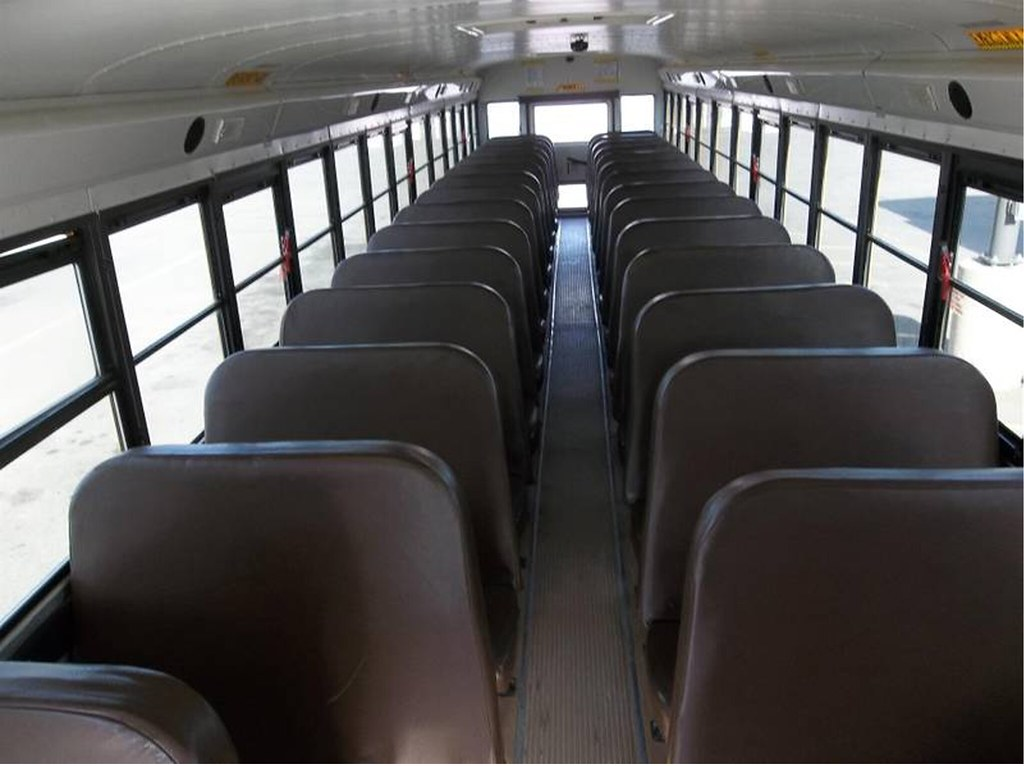
Transport Canada, after analysis of various accidents involving school buses have decided to do away with seat belts in school buses. The current school bus design provides a high level of protection to occupants and that seat belts may trap the children on school buses in case of an accident. School buses protect passengers through “compartmentalisation”, a design that includes seats filled with energy-absorbing material and high backs seats anchored strongly and placed close together to form compartments. In case of a collision, these special compartments would absorb the impact dispersing it throughout the entire body as opposed to solely the head and neck.

Studies have shown that adding seat belts to the current seating configuration of a school bus can increase the chance of head and neck injuries. For a seat belt to be effective, it must be worn correctly, snug and on the upper thighs. Because school vehicles carry passengers from the very young to high school students, if seat belts were used, they would need to be readjusted and their use monitored. A seat belt not worn correctly may cause serious injuries.

Raised floors in the school bus ensures that in the event a vehicle collides with a school bus, that vehicle will impact beneath the seated passengers, since the school bus seats are above the crash line. Structural strength and integrity of the joints between body panels of buses ensure protection in rollover-type accidents. Burn resistance form materials are used inside the school bus.  A protective cage is provided for the fuel tank to reduce the possibility of fuel leaks. The windows are made of shatter proof glass.

Most school buses employ GPS systems to provide the exact location and speed of a school bus at any time. They also have an on-board electronic reminder system that reminds drivers to check for sleeping children before leaving the bus.

For the purposes of evacuation, school buses are equipped with a minimum of at least one emergency exit in addition to the main entry door. The rear-mounted emergency exit door is a design feature retained from when school buses were horse-drawn wagons and the entrance door was rear-mounted to avoid frightening the horses.

Many cases were reported about the clothing of students getting entangled in the handrail at the entrance, resulting in a fall or a major accident. The most common piece of clothing that can be snagged on the handrail is a jacket with a drawstring at the waist. These drawstrings commonly have a large bobble or knot at the ends that can become lodged in the handrail. However, other articles of such as scarves, long straps on backpacks, or dangling key chains can also be snagged on the handrail. The redesigned handrails minimises entanglement by filling in the gaps with rubber washers.

At the start of each day, the school bus driver has to conduct daily safety inspections, read instruments and gauges, perform routine tests, and confirm proper mirror adjustments. The inspection is recorded in a vehicle logbook to prevent and minimize mechanical breakdowns. Post-trip inspections are performed to verify that every child has exited the bus at the appropriate stop. In addition to regular mechanical maintenance and daily vehicle inspections by the driver, a Motor Vehicle Inspection Station will perform at least two mechanical inspections each year on every school bus in Ontario. School buses are also subjected to unannounced roadside safety inspections at their intended destination rather than at the roadside to avoid inconvenience to the students.

The prime need to keep our children safe at all times is a national responsibility. Redesigning the school buses to make them safer is an ongoing process and will continue to evolve to make our children safer.

Arithmetic of Licence Plates

Our son Nikhil in his Grade 3 found division a bit difficult. Along with the division difficulty came the prime numbers and factors. We decided to solve the problem by making arithmetic interesting by me giving out various tips that I had learned while at school, especially from Mr Venkitesha Murthy, our Grade 7 mathematics teacher. Mr Murthy taught us mathematics through various stories, anecdotes and riddles. He also inspired us with the achievements of great Indian Mathematicians like Ramanujam, Bhaskara and Aryabhatta. It took me some time and effort to grasp the concept of factors and prime numbers even while in Grade 7 and hence Nikhil’s difficulty with the same was not at all surprising to me.

licenceplate

Everyday Nikhil and I spent almost half an hour in the car – dropping him off at school, picking up after school, commute to the swimming pool or tennis court or for music class in the evening. Nikhil called it a father-son time and used it to discuss all those which he thought would attract a comment or a spoof from his mother or sister. This practice continues to date, and the subject kept changing as Nikhil grew up to his current Grade 12.

To solve the riddle of division and factors, I came up with a game. In our province, Ontario, most licence plates on vehicles have four alphabets followed by three digits. Three digit numbers can be easily handled by a Grade 3 student. Any vehicle we came across on our drive, we used to analyse the number.

To begin with was to see whether the number was even or odd and hence conclude its divisibility by ‘2’. Then it was to add all the digits and if the resultant sum was either ‘3’ or ‘6’ or ‘9’, it was to be concluded that the number is divisible by three.

In case the number was an even one and the last two digits (ten and unit place) was divisible by ‘4’, then ‘4’ is a factor. If the unit place is either ‘5’ or ‘0’, the number is divisible by ‘5’. In case ‘2’ and ‘3’ are factors, then ‘6’ will also be a factor. If the sum of the digits resulted in ‘9’, the number is divisible by ‘9’. If the unit place has ‘0’, then ’10’ is a factor.

With this game on, every day we analysed about 10 licence plates and with that the difficulty of division, factors and prime numbers was resolved to a great extent.

The first car my wife bought for me on arrival in Canada was a new Honda Accord and when I went to take the delivery, the agency had already procured the licence plate for me. The number was ‘BBZW 139’. In North America, licence plates move with the owner, not with the vehicle. If you sell or change vehicles, you keep the licence plates and affix them on your new vehicle. Hence this number plate remained with me, though I changed three cars.

The number also reflects a bit on my personality as 139 is an odd number and also a prime number. It has only 1 and itself as a factor and is not fully divisible by any other number. I believe that I cannot be affected by any factors or divided by any other than 1 – the God Almighty – and myself.

The digits 139 fascinated me as it added to 13, my day of birth – 13 March. My school Roll Number was 931, which again added up to 13 and my Defence Account Number was 161005, which again added up to 13 and the list goes on. This is mere coincidence and has nothing to do with the unlucky 13 and it has never bought the lady luck to my side, and I cannot claim to be unlucky also. I do not believe in numerology or astrology and hence this trail of 13 never ever cast its bad luck on me.

’13’ is also known as Baker’s Dozen – instead of 12, bakers always packed 13 for a dozen in Britain. In the mid-thirteenth century, Britain enacted the statute of Assize of Bread and Ale, which set the relationship between the price of wheat and what the subsequent price of a loaf of bread from a certain quantity of wheat should be. If the baker accidentally cheated a customer by giving them less, they were subject to extremely severe fines and punishment. In order to avoid such accidents, bakers started to count 13 for a dozen.

Children turn teenagers when they turn 13 and we are all aware of what it means.   Apollo 13 is the only unsuccessful moon mission. An oxygen tank exploded and the survival of the astronauts on board was hanging in balance for several days, but they all came home safely. Many Christians believe that 13 is unlucky as there were 13 people in the Last Supper.

Triskaidekaphobia – the fear of number 13 (from Greek tris (three), kai (and), and deka (ten,) and Paraskevidekatriaphobia is the term used to describe the fear of Friday the Thirteenth – (Greek words paraskevi (Friday) and dekatria (thirteen) with –phobia as a suffix to indicate ‘fear’). Researchers estimate that at least 10 percent of the US population has a fear of the number 13, especially for Friday the thirteenth.

Mathematicians point out that 13 is not so unlucky, but it earned all its bad name as it is an odd number and a prime number. It is 13’s bad luck that it follows the perfect number 12. Many believe that 12 is perfect as it counts to a dozen, there are 12 months in an year, a day consists of two 12-hour cycles etc. The extend of Triskaidekaphobia in the US is so high that more than 80 percent of high-rise buildings do not have a thirteenth floor, and the vast majority of hotels, hospitals and airports avoid using the number for rooms and gates as well.

The number 13 may be lucky or unlucky, but one cannot blame the number for it and will always follow number 12 and precede number 14.

Vet Plate

PS.  Now I do not have the above licence plate.  The Government of Ontario, Canada, in recognition of my service with the Indian Army has given me a new Veteran Plate.  My gratitude to Canada for honouring a Veteran from another country.

Library

During childhood days, our village in Kerala had a public library, housed on the upper floor of the Post Office building. The library had a good collection of books, periodicals and newspapers. The library used to be bustling with activity in the evening. Students and youth came there to borrow books, many came to read newspapers and periodicals and above all, it had a radio connected to a public address system which beamed the news from All India Radio. Those were the days when most households did not own a radio and Television had not become a reality. Our village with its literate masses needed something to read as a source of information and entertainment and the library provided it. My brothers used to borrow the books from library and our grandmother who lived with us then used to read them after everyone went to school.  Now my mother, a grandma, watches the tear-jerking serials on the TV after everyone leaves the home to school or to work.

During my recent trip home, I found the library totally deserted. The reading habit seems to have died down. How can you expect children overloaded with assignments, tuition and above all entrance coaching to find time to read? Various tear-jerking serials have occupied the free time of housewives and senior citizens, which in those days was spend reading.

Sainik School Amaravathinagar, our school, also had a well stocked library. I started using the library only from my Grade 8 onward as I was not all that proficient in English till then. At that time Mr Stephen, our librarian had taken over. Untill then the librarian was a clerk or an administrative staff member who hardly had any clue about the real duties of a librarian.

Mr Stephen with an ever smiling pleasing personality was a graduate in Library Sciences. He was the first person to encourage many of us to use the facility of the library and also explain to us the wealth of information available there. He always used to remind us as to how lucky we were to have such a library which he said many colleges and universities in India did not have.

Other than being the librarian, Mr Stephen used to actively participate in all extra-curricular activities. One could always see him in the gymnasium helping students, playing all games with the students and also participating in adventure activities like trekking and rock-climbing. This helped him develop a special rapport with the students. I spend some of my free time in the library and also whenever I was made an ‘outstanding’ student in the classes, I straight away moved into the library.  Mr Stephen exactly knew what would have happened in the class, but never asked me a question and let me into the library.

On migration to Canada, we settled down in the city of Mississauga. The City runs  Mississauga Library System. It is one of the largest public library systems in Canada with over 300,000 registered users. There are 18 locations, including a multi-floor Central Library with material allocated by subject areas. Anyone who lives, works, attends school, or owns property in Mississauga can obtain a Library Card required to borrow materials.

All the library branches I visited were always full of customers, especially students and seniors. The library system has a large collection of books, DVDs, video tapes etc in 22 languages including Hindi, Thamizh and Punjabi. The excellent catalogue system followed by the library can be accessed online from the home. One can place a hold on a material through the online system. The moment the material arrives the customer is intimated by email or over the phone. In case a desired items not in the Library’s catalogue, it may be obtained through inter-library loan.

In case the library branch one visited does not have a desired material, but is available in another branch, the same is transferred to the library if you request for a hold. All materials borrowed from any branch of the library can be returned at any branch. The catalogue system caters for it.

The Library offers access to downloadable eBooks and audio books. One can download these to a computer or a mobile device.  One can also sign up to receive sample chapters from new books and newsletters about new books and authors.

Library staff are always available to help the customer to find information and choose materials. The Library offers extensive information on occupations, educational planning, career planning, training and job search strategies.

An extensive collection of fine, old and rare materials, dealing with the history of Mississauga City is available for in-library use at the Mississauga Central Library and includes scrapbooks, local archives, and a large collection of photographs. Genealogical materials are available through Ancestry at all Library locations. The Historic Images Gallery brings together the image collections of multiple institutions providing centralized access and is searchable online.

eResources provide access to reference eBooks, newspaper and magazine articles, scholarly journals, book reviews and more. Search over 30 eResources covering a wide variety of topics including health, business, world news, literature, sports, arts, and entertainment. With a valid Mississauga Library card, you can do your research from home, school or office.

Children’s Dial-A-Story can be called as often as you want, any time of the day to listen to a new preschool story each week in the comfort of your home.

Public access to the Internet and Microsoft Office is available at all Library locations. One can book a session to use a Library computer with a valid Library card. Photocopiers are available at all Library locations at a minimal payment. Copying is subject to copyright laws.

Large Print Books are available from all library locations and rotate from library to library. In partnership with the Canadian National Institute for the Blind (CNIB) Braille Books are provided via mail.

Libraries store the energy that fuels the imagination. They open up windows to the world and inspire us to explore and achieve, and contribute to improving our quality of life.”   – Sidney Sheldon
Post Script :- My book ‘Suit, Boot and Tie‘ now finds a place with Mississauga Library System.
Search Results for suit boot (sirsidynix.net)

Nikhil’s Poems

nik

Here are some poems Nikhil wrote as part of Grade 10 English Assignments.

Order and Chaos
Discipline is the greatest strength
Restraint the greatest virtue
Control is the highest aspiration
Order the only truth
Order is what everyone seeks
Order: a utopian fruit
Disorder is the natural state
Anarchy is the final end
Lawless is the nature of the world
Into chaos we all descend
Chaos is past, present and future
Chaos we can achieve

Love
I am defenseless, I must surrender
I am under your enchantments
You speak and I hear Venus’ voice
You laugh at my inept replies
The philosophers deride
Those who lose to passion
Yet my soul knows what I don’t
I cannot deny this
You are perfect as the rose is perfect
In this game I am green as grass
You are the light which kisses my world
But soon you must be gone
You will move on
Leave me incomplete
I must simply trudge on thereafter
From one heartbreak to the next
In grief to grief, from dust to dust

Time Travel
I used to serve
obeying other’s commands
Now I have tasted command
I can never obey again
I used to plan
deciding on my future
I now live in the moment
planning as i go
I used to consume knowledge
to prove achievement
I now seek wisdom
for the sake of it
I used to fear failure
and facing disappointment
I now fear obscurity
dying not remembered
I used to believe
I knew what I wanted
I now know
I must be willing to change
I used to watch TV
so I could be entertained

I now use what I saw
to entertain others
I was once blind
Stumbling for the truth
But now I see

Bottom of the Bottle
Her love so fierce she couldn’t contain it
She expected to be happy so long
Letters of love so many were writ
Her love a great flag flapping
She could not have known the a lurking
For in the shadows he works
The tiger’s name was her love’s drinking
One of life’s horrid quirks
She forgave his smelling everyday like booze
He said he was sober yet she could tell
She thought life’s game in which I can’t lose
Now she’s in a hell wet not hot
When she has a child her greatest terror
Is he’ll follow his father and commit his error

The Desert Fox

DF

A Ballad composed by Nikhil as part of Grade 10 English curriculum. Based on the North African Campaign of World War II.

The third hunter Monty he comes from the East
He has finally defeated the beast
Unaccustomed to desert sands and rocks
He has now whipped the desert fox
The desert fox he tests the king’s patience
He leads the king’s hunters a merry dance
Moving swift across deserts running tall
He had best fear Monty or face his downfall

The first hunter let the fox come to him
He waited with patience, his outlook grim
The fox in a flurry of speed and dash
Attacked the hunter in a move considered rash
The fox had beat hunter the first
But underestimated the hunter’s king’s thirst
So the king sent in bold hunter the second
The sands of the desert with blood would now redden
The desert fox he tests the king’s patience
He leads the king’s hunters a merry dance
Moving swift across deserts running tall
He had best fear Monty or face his downfall

The second hunter set traps and snare
The fox would die if an attack he dare
Though when the fox came the traps did fail
The second hunter oh did he go pale
The king’s patience was now truly wearing thin
He removed the second hunter for defeat is a sin
He then sent a hunter he long hated
His relation with the king quite complicated
The desert fox he tests the king’s patience
He leads the king’s hunters a merry dance
Moving swift across deserts running tall
He had best fear Monty or face his downfall

The third hunter not as dashing as his prey
He chose a position well sited in which to stay
He held his ground well near the sea
He gathered around him a vast hunter army
Once he gathered more hunters than needed
He attacked the weary fox who retreated
All we shocked that fox had lost
Then all were shocked at the cost
Several hunters maimed and so much expense
So many tools broken it makes no more sense
It makes one wonder who was the better
The defeated fox or his bankrupt hunters
The desert fox he tested the king’s patience
He lead the king’s hunters a merry dance
Once moving swift across deserts running tall
He should have feared Monty his final downfall

Education and Punishment

STThe rape of a first class student in school premises on July 17, 2014 in Bangalore added one more to the long list of child abuse cases, many of which remains unnoticed. It has brought back light on one of the worst perils that our country is facing today – child sexual abuse. It is a pity that most of such abusers are either close relatives or teachers of the children. In this case too, it was the physical education teacher. Most Principals let loose these physical education teachers (goons) on to the children to ‘discipline’ them, especially during assemblies or sports or cultural events. These teachers mostly end up misusing the ‘authority’ vested in them by the Principal and in many cases resulting into physical, sexual and mental abuse to the children. Majority of such physical education teachers have no qualification to be one.

Joshi Philip, our family friend, invited me to attend the prize distribution ceremony at their daughter’s primary school. Ann Maria, their daughter, a Grade 2 student, that day had the annual prize distribution ceremony at the end of the academic year. I accompanied Joshi to the school and at the reception we signed-in and were given a round yellow sticker which said “A Proud Parent”. I stuck it above my shirt’s pocket, close to my heart, as anyone will feel proud of it rather than hanging a visitor badge around the neck.

We entered the gymnasium where the award ceremony was to take place. Every primary school here has at least two such gymnasiums and we used to boast about the one we had at the National Defence Academy. We did not have one in the Sainik School. The gymnasium is a hardwood floored hall which serves as a basket ball court, assembly area, an auditorium and a lunch room or a cafeteria. At the end of the gymnasium was a stage where all the award winners were seated. The students marched in class wise with their teachers leading them and the students sat on the wooden floor while the teachers occupied their positions at the end near the wall. As expected of little children from Kindergarten to Grade2, they were talking and then the Principal appeared on the stage and raised her right arm. All children became silent and she said “eyes and ears towards me please” and introduced the two Masters of the Ceremony (MC) who were Grade 5 students.

The prize distribution ceremony went on beginning with the Kindergarten and any time when the children became noisy, the Principal would appear with her right hand raised and everyone became silent. During the entire proceedings not even a single teacher moved from their positions. At the end of the ceremony the Principal came on stage to thank everyone and to congratulate the prize winners and at the end wanted the children to do their usual “Silent Cheer”. I had no clue what it was. It was all the body and face expression of a cheer but done without a sound and was impressive and unique.

On leaving the school I realised that the self-discipline inculcated in these children will make them better citizens of the country and they do not need any “policing” to implement any laws or regulations.

Looking back to my Sainik School days, we mostly had the Principal and the Headmaster from the Education branches of the three services, and most of them one felt were the least ‘educated’. This was further reconfirmed during my training at the Academies and service tenures. Most of the Education Corps officers are masters in some discipline or the other and today we have many officers from the Arms and Services holding masters degree by virtue of undergoing the Staff College or the Long Gunnery or the Engineering degree courses. Some even hold Doctorates too. Academically these officers are many times better than their Education Corps counterparts.

Then why post such officers to the Military/Sainik Schools? Many of them behave no better than the physical education teachers of the Bangalore incident. Most are incapable of moulding and motivating the students to join the defence services and are pretty ordinary in teaching. Any officer in the Indian Army can conduct a better class than these Education officers. The only qualification these Education officers boast of is their Bachelor of Education (B Ed) degree. Most of the Haviladrs (Sergeants) who have attended any courses of instruction in various military training establishments (where they are luckily not trained by the Education officers) will beat them hollow in the art of teaching. Then why not even do away with the Education Corps, considering the education standards of the present recruits into the army.

Importance of Music in School Curriculum

On the social media there was a post with a video of a school band performing during the interval of a basketball match. The caption said “When will we have such performances from our school bands in India”. It took my memories back to school days when we thought that music was not our cup of tea and joining the school band was a sheer waste of time as it did not provide any extra marks and did cut into one’s free time.  Mr Guddu Sahib, our Band Master tried his level best to teach me the notes of music, but they all looked to me like a few designs all coming to eat me up.  That was it, I gave up not to even look back at it.  Having realised my school folly as one grew up; it was too late to learn music at that belated stage.   Now the only option available was to ensure that our children learned music at their young age.

Why the school bands in India do not have such good standards and such good performances when compared to those in North America? The main reason could be attributed to our notion that it does not bring in marks. In North American schools, band or music is part of the curriculum and it brings marks with it.

As band/music is part of the North American school curriculum, the music teachers are graduates in music and some are post-graduates. Our son’s music teacher in Grade 10 was a post graduate in English and music and that year he taught Nikhil both the subjects. During a meeting with him I asked him as to how he got into the two.  He said music was his passion and English was his interest and hence studied both. In India, the band is trained by an ex-bandmaster from the Army or from the police and has no formal qualification in music. The qualification of music teachers back home leaves a lot desired, even though plenty of talent with graduate and post-graduate qualifications in music are available. Music does not form part of the School Board Exams and is limited to performances in Youth Festivals in most schools in India. The reality TV competitions have encouraged parents to impart music training to their children.

Unlike in North America, where the time spent for rehearsing and performing a band routine is counted towards community service hours required for graduation, in India no such advantages is accrued by the children. The most they get for a performance in India may be a T-shirt or a meal.

music

Music helps to bring out the best in young people. It nourishes self-esteem and keeps them engaged. Promoting music in schools provides students with interests that take up considerable time and energy outside the academic activities. Students become involved in extracurricular activities and by being busy with music-related activities helps to keep students away from getting involved in the kinds of negative activities that lead to serious problems, such as drugs and alcohol.

Musical training has a profound impact on other skills including speech and language, memory and attention, and even the ability to convey emotions vocally. Children who have had music lessons tend to have a larger vocabulary and better reading ability than those who haven’t had any musical training.

Music education helps in a child’s overall development intellectually, socially and emotionally. Music offers creative challenges and aesthetic appreciation as well as self-expression and self-discovery opportunities.   Music education fosters emotional maturity, as students learn to set and achieve personal goals. Time management, self-assessment, the ability to accept criticism and performance skills are all important attributes students learn through music education.

Music education plays a big part leading to personal development, such as self-discipline, dedication, teamwork, self-confidence and practice. All these values and the behaviours that demonstrate them are necessary to be a well-rounded person in all realms of life. Although these values are taught through other disciplines in various ways, the importance of learning them through music education in schools is that they translate into other disciplines so naturally. Students who enjoy music can easily transfer the habits learned to pursue their music to academic subjects.

Scientists have also discovered that learning to read music or play a musical instrument develops higher thinking skills. This means that children who learn music in schools are better problem-solvers and are better at analysis and overall critical thinking, because studying or playing music uses the same part of the brain that is used in mathematical thinking.  Music education can help promote better math students.

The importance of music in schools is that it fosters the kind of discipline that contributes to the development of personality traits and characteristics that bring one success in all of life’s endeavors. Music education helps develop overall intelligence, which translates to success in academic subjects in school. Music education also opens doors socially and culturally.  All these factors lead to success in life.

Say Thank You

tuDuring my visit to India in 2012, I traveled from Thiruanathapuram to Kollam in Kerala on the State Transport bus.  The ticket was for Rs 9 and I handed over a Rs 10 currency note to the conductor.  I requested the conductor to drop me off at a particular stop and when the bus reached my stop, the conductor stopped the bus and nodded me to get off.  I went to the conductor, and he put his hand into to his bag, may be to return Re 1 which he owed me.  I said “Thank You” for his service of dropping me off at the correct stop.  The conductor gave a flabbergasted look – Is it that he never expected someone to thank him for a such service?

After landing in Canada, one day I asked our son to make me a cup of coffee, which he did immediately.  He brought it to my table, and I took a sip, continuing to read the book I was immersed in.  Our son waited for a few seconds and said “Welcome”.  It really knocked me down.  Then our son said – “What does it cost you to say THANK YOU?

I learnt this value from the Canadian society, as they always express their gratitude for any little service or help one does for someone else, even if it may not be from the bottom of one’s heart. Canadians are well known for their courteous behaviour.  Modern Canadian children are usually permitted to be relatively outspoken and independent from a young age.  They may speak to adults, even teachers or parents, in the same casual style they use for friends. The same is mostly true for employer-employee relations, and maintaining a friendly workplace where everyone acts as if they are on the same level.

I for one hardly ever thanked anyone during my days working in India; mainly subordinates for any help they rendered.  I hardly appreciated anyone for any work done by them.  We are very poor at appreciating our children and subordinates – may be thinking that it will spoil them.  It does not cost anything; but may make a day for the person who gets appreciated.  Everyone wants to be appreciated.

When our son graduated from Grade 8 (Middle School, they have a graduation ceremony – to instill in the students that they are going to High School next and got to be more serious about it and that the fun time is over.  He was the valedictorian and after he gave his valedictory address all the Canadian parents stood up and gave a standing ovation and all parents from our sub-continent kept slitting.  We even ration appreciation for a small kid.

This ‘rationing’ approach to appreciation for our children, I feel has come from the society back home.  Recently my wife confessed that she realised how incorrect she was in bringing up our daughter when back home; how she used to castigate our daughter for the 8% marks she lost in her test, rather than appreciating her for the 92% she scored.  This may be the result of my wife’s upbringing back home that one must get 100% in all tests, whether the child has interest in that subject or the child is capable of achieving it.

Many children had to hide their interests in non-academic activities like poem writing, story writing, arts, sports etc because the parents never encouraged any distractions from their academic goals.  Any inclination to a non-academic activity was severely condemned and brutally nipped in the bud.  Had the parents and children followed the academic model in North America, we would have surely produced many a great in all fields of life.

The major impediment back home is the way the marks of all tests are announced publicly in the class and to make the situation worse, the teachers tend to pass unwarranted comments along with it.  This is further complicated by the boastful parents who announce to the world as to how their child scored high marks and what the scores of other children were.  In the Canadian schools, test results are never displayed or announced and are kept confidential.

Attending the Parent-Teacher interviews used to be very scary back home as one often heard only complaints about our wards and hardly any words of appreciation.  The Parent-Teacher interviews in Canada, one experienced the opposite.  It was more of a celebration of the hard work and achievement of the child, and it always begun with “Your son is doing really well ...”

The Canadians are stereotyped as being excessively, or even absurdly polite, even if not entirely warranted.  They never miss an opportunity to appreciate or compliment while Canadians deal with one another.  Mrs Lalita George, wife of Late Colonel Raju George, while on her visit to Niagara, was really taken aback when a girl at a ticket counter appreciated the handbag she was carrying.  The girl asked her about the source and when informed that it was from India, she expressed her dream of visiting India after her graduation.

On receiving the progress report of our son, I (may be because of my upbringing back home), enquired from our son as to how others in their class had performed.  He said that it was indecent to ask others in the class what their grades were and in case I had to see the class performance, the mean and median for each subject is given in the report card.  That was when I realised the application of those statistical terms we were taught in school.

Every year for Christmas, I fly to India to spend a few days with my mother.  On arrival in India, the first person one mostly deals with is the immigration authority at the counter.  Almost all the countries I have been, these immigration authorities are mostly pleasant and very courteous.  The interaction with them generally culminates with “Welcome to (their country)”.  Anyone who has ever passed through the Indian Immigration counters will always have the opposite story to narrate.  I often felt that the Ministry of External Affairs has imparted special training to all those who man the immigration counters, to be putting up with such morose faces and least courteous conversation.  The final look they give you while returning the documents almost conveys ‘Why the hell are you back?’

So please think it over and make small efforts at your level – it may make a difference to someone, and it does not cost you anything.

Set an Example

fmlIn December 2012 our son Nikhil wanted to accompany me on my trip to Kerala as he had two weeks of Christmas vacation.  I asked him the reason behind such a decision and he said that it was to spend a few days with his grandmother, uncles and cousins.  He also wanted to visit all the old temples and churches in Kottayam and what interested him the most was Sree Padmanabha Temple at Trivandrum as he had read a lot about the billions worth of treasure the temple had.

Accordingly and we landed early morning in Trivandrum and checked into the Taj Hotel.  He was really flabbergasted by the services rendered by the darwan (Person guarding the main entrance and receives the guests), the bell boy and the room service, which he had never experienced in all our travel across North America.  After visiting the temple we headed to Kottayam and stayed with my eldest brother, with whom my mother lived.

During every Kerala visit, I make a trip to Kochi to meet my Sainik (Military) School classmates, Veteran Commander Reginald and Mr Roy John (Collector, Customs) and this time too Reginald was gracious enough to arrange an evening at the Naval Institute.  Nikhil was again surprised that once he was about to empty his Coke glass, it was refilled by the waiter, a privilege he had never enjoyed.

On our way back, we came through Chennai as we had planned to spend an evening with Major General Ramachandran, who was our Commanding Officer and at that time serving with the Area Headquarters at Chennai.  On reaching his residence, the sight of the guards, the way the lawn was manicured and the fabulous garden, the way he was looked after by the General and his wife and all the services he received from the staff at the General’s home seem to have touched a nerve or two in the teenager.  When we went to bed, Nikhil asked me as to why did I leave all these luxuries behind and quit the army and whether I missed these.  To this I said that I really miss all these, but had to make a choice between the family and the army and hence I migrated to Canada to join the family.  Had I continued in the army, they would have visited me during their vacations for few weeks and I would have visited them for two or the most three months (including furlough) an year.  I was touched by his reply “That is a real sacrifice for our sake.”

One day at Kottayam, we decided to set off on foot to visit the old temples and churches around my elder brother’s home.  Nikhil was finding it difficult to keep up with me and I asked him whether he was feeling good to walk or should we hire an auto-rickshaw.  He said that he had a heavy breakfast as his grandmother wanted him to put on a few kilos and hence piled up his plate.  He was upset that the granny did not realise that his body structure and metabolism did ensure that he remained thin and it was not that he did not eat enough and he added that granny being a school teacher, who is well read and well travelled should realise it.  “You could have always refused her and could have left the meal half eaten,” I said.  “Your mother is too powerful and I can never say ‘no’ to her.  Look at your eldest brother who is four years elder to you and your elder brother, the city’s public prosecutor, they never said ‘no’ to her and instantly obeyed all what she said.  When she was in Canada with us, you never said ‘no’ to her.  How do you expect a little boy like me stand up to her and ever say a word,” said Nikhil.

Then I realised that this trip was worth more than a thousand times its cost.