The Last Evening in Heraklion


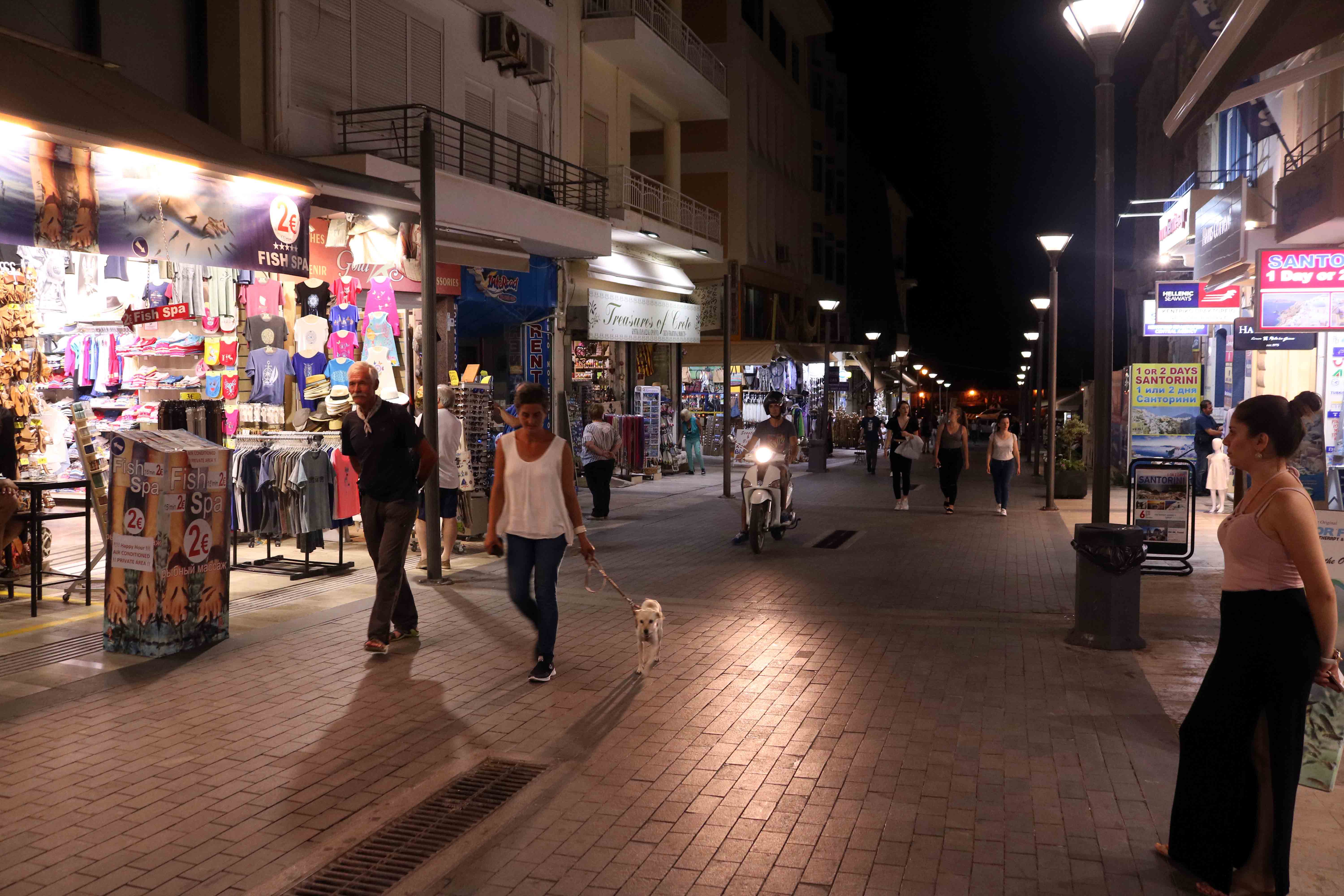
As the night set in, we walked from our hotel to the 25th August Street.  It is now a paved pedestrian street, and boasts the most beautiful Neoclassical buildings that house banks, travel agencies and tourist shops.   This street may have been first cut by the Arabs in the 9th or 10th century, the main thoroughfare of Heraklion, linking the town centre to the harbour. During the Venetian period it was called the Ruga Maistra (Main Street), while in Ottoman times it was known as Vezir Tsarsi (Vizir’s Market) after the Vezir Mosque. The modern name of the street relates to a tragic event. On the 25th of August 1898, during the feast of St Titus, fanatic Muslim mob slaughtered many Christians, including 17 British soldiers and the British Consul.


Walking down the street, we came to the Lions Square.  It holds the ornate Venetian fountain of four lions with water gushing from their mouths. The fountain is officially in ‘Eleftheriou Venizelou’ Square in the centre of Heraklion, but the inhabitants of the city never use the official name, usually referring to it as the Lions Square or the Lions for short. The Venetians built it in 1629 as a solution to the problem of supplying Heraklion with water, providing 1,000 barrels of water a day.


Opposite the Lions Square is one of the first and most important works of the Venetian settlers, the St Mark Church.    Next to the church on the South-West corner was a high bell tower with a clock. During the long Turkish siege of the city, the bell was used as a bomb alarm, resulting in the bell tower becoming the target of the Turkish cannons. When the Turks took over the city, the church was converted into a mosque.  The bell tower was demolished and in its place they built a minaret.  Restoration of the building commenced in 1956 and today it houses the Municipal Art Gallery.


Down the street is the Loggia (noblemen’s club), constructed in 1626-28 AD by Francesco Morosini, the same man who built the Lions Fountain. This is the fourth and final Loggia built during the period of Venetian rule. Very little information is available on the first three.  Venetian political and social customs demanded the construction of a public building in Heraklion, as a meeting-place for the nobles, rulers and feudal lords, where economic and commercial decisions were made. It was also a place for them to relax.   The building is a faithful reproduction of Palladio’s famous Basilica in Vincenza, demonstrating the significance the Venetians attached to the city of Heraklion.  . Today the Loggia has been restored to its former glory and houses the Town Hall.


In 961 AD, the Arabs were driven out from Crete, bringing the island back under Byzantine Empire. This is when the first Orthodox church of St Titus (Agios Titos in Greek) must have been built, to rekindle the Christian faith and tradition in Crete, which had declined due to the Arab conquest of the island.  Saint Titus was a disciple of the Apostle Paul and the first Bishop of Crete.  At the fall of Heraklion to the Turks, all relics were removed to Venice, where they still remain today. The single exception is the skull of St Titus, which was returned to Heraklion in 1966 and is now kept in a silver reliquary in the church.  During the Turkish rule, the church was converted into a mosque known as the Vezir Mosque.  The great earthquake of 1856 totally destroyed the church. It was rebuilt in its present form as an Ottoman mosque.  The minaret of the church was demolished in the 1920s, when the last Muslims left Heraklion   The church was further modified in 1925.


Heraklion, a city well known for its intense and vibrant nightlife, offers many a chance for a night out.  The night entertainment consists of modern and traditional spots to choose from. There is an interesting variety of bars and clubs and they stay open till 3 o’clock in the morning. These bars play lounge or loud music and on some live bands perform.   Many taverns host bands which play live traditional music, with dancing.  One can enjoy a dinner at the many taverns which offer delicious local Cretan delicacies, local wine and salads.
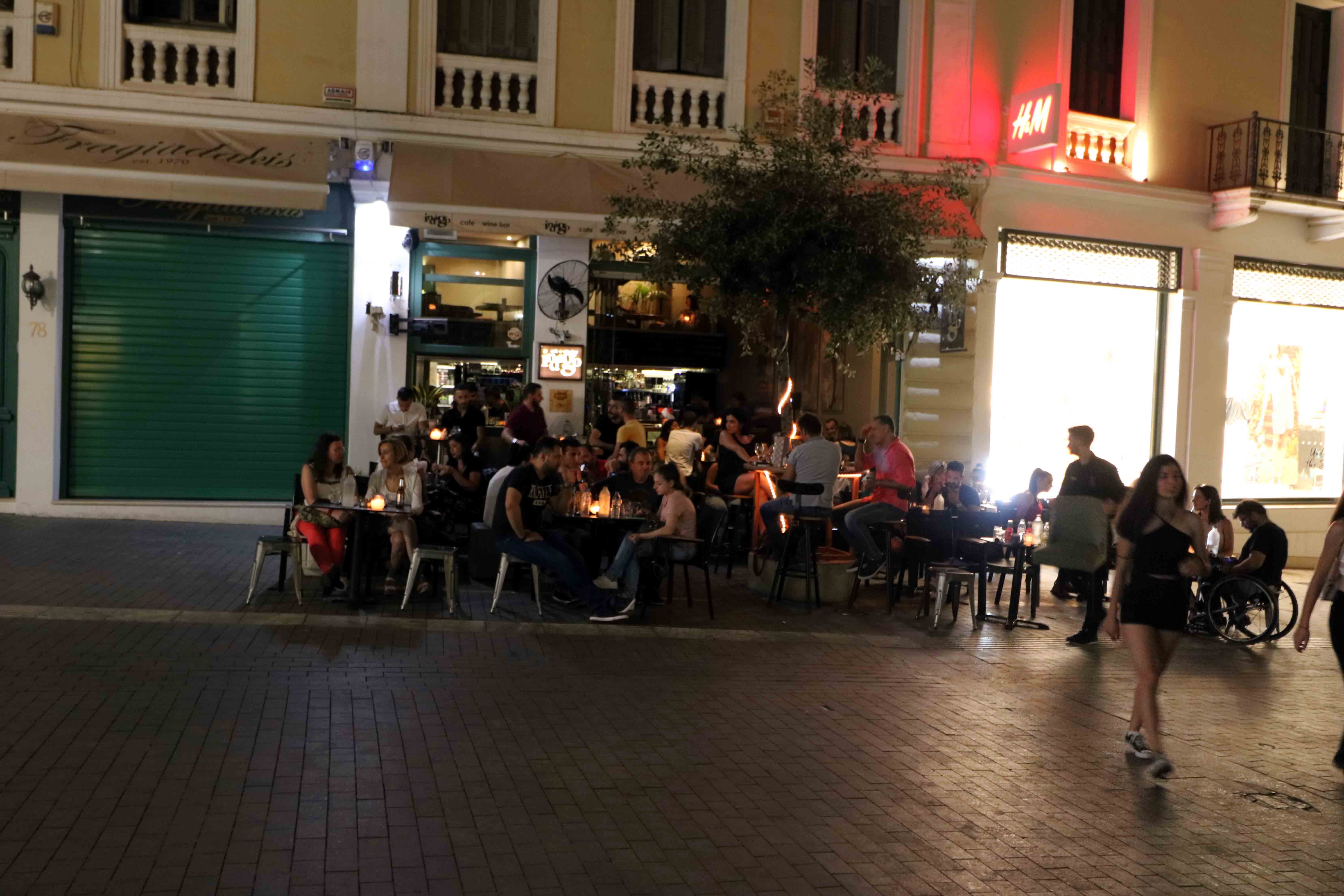

We observed that almost all restaurants had many tables outside, especially after the sunset.  Taverns and bars serve traditional local drinks like ‘tsikoudia’ and ‘ouzo’ and special snacks.


The beautiful narrow streets with its narrower lanes and by-lanes, are brimming with tourists and locals all through the night.  It may well be the most ‘fashion oriented’ city in the Greek islands.


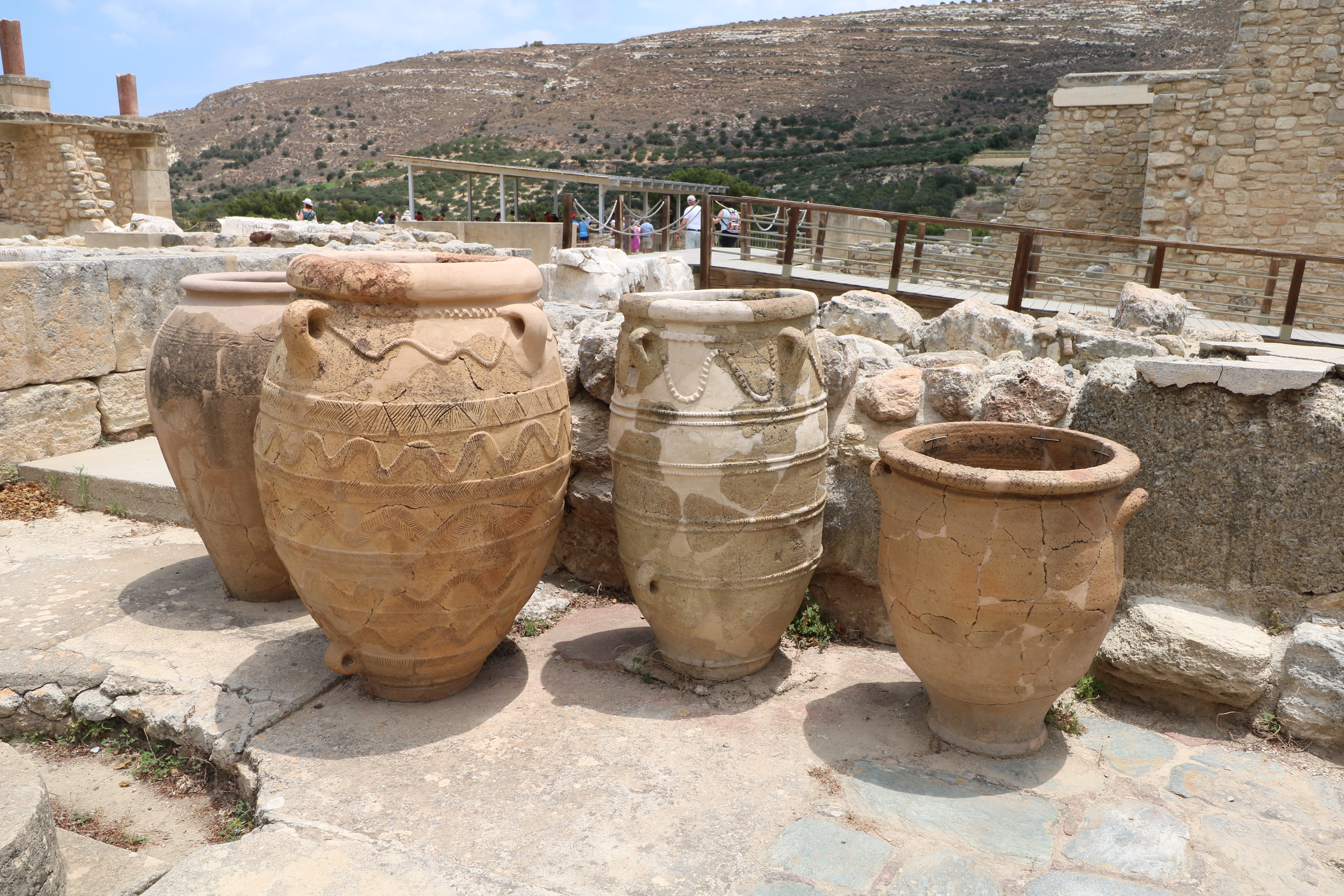
Crete has one of the oldest and perhaps the most delicious gastronomic traditions in the world with Cretan olive oil as one of the basic ingredients of Cretan cuisine.  Archaeological excavations indicate that the ancient Cretans used to consume almost the same products as the contemporary islanders. Large jars for storing olive oil, cereals, pulses and honey we saw at Knossos palace possibly stand testimony to this tradition.   This storage habit would have helped them to survive many sieges the island experienced, mainly by the Arabs, the Venetians and the Ottomans.


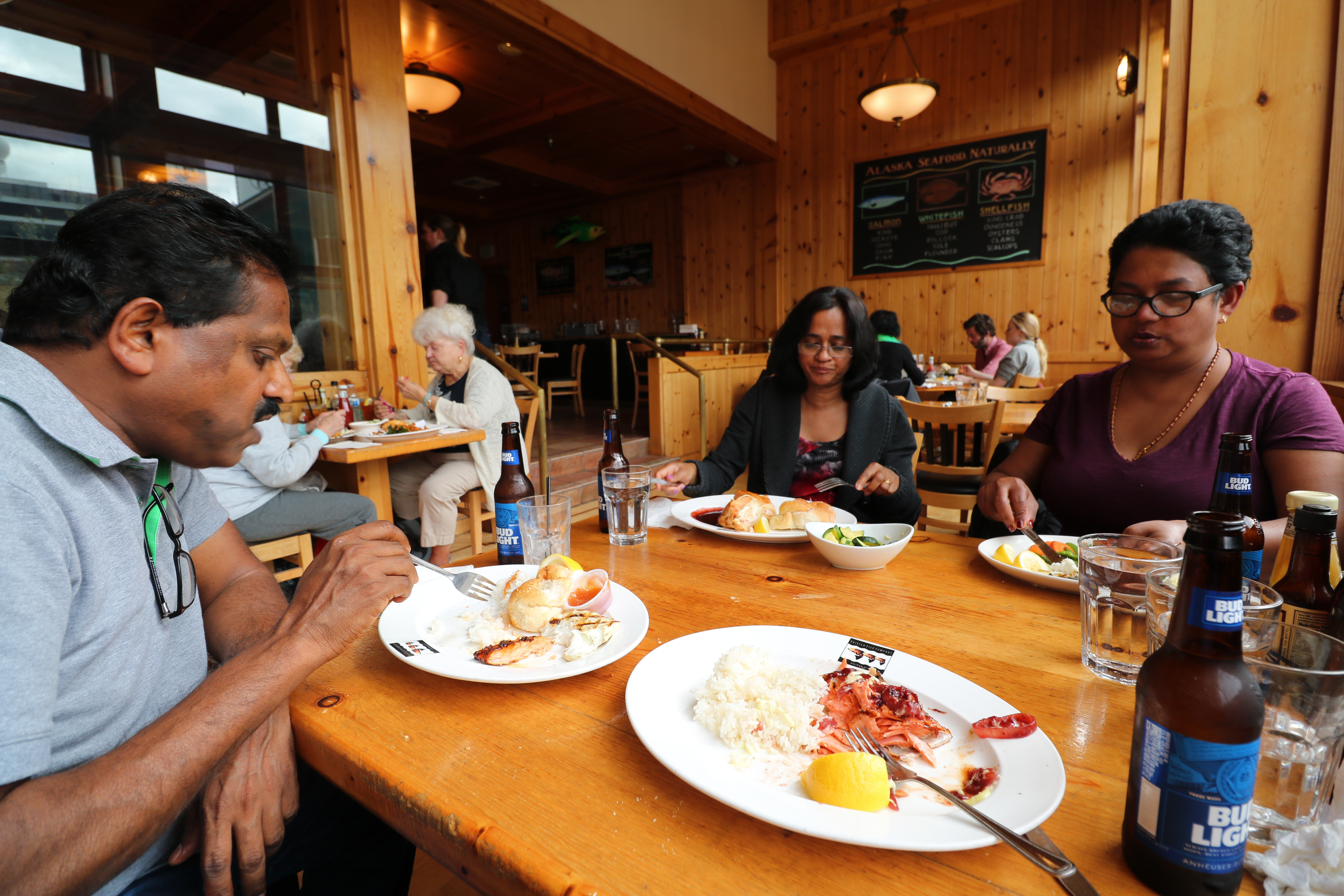
We dined at a restaurant next to the Lions Square. The Menu was Greek Mussaka –  Oven baked Greek dish with layers of eggplant, zucchini, potato and minced meat; Shrimps Saganaki – shrimps with white Feta cheese cooked in spicy tomato sauce; slowly cooked goat with citrus fruits served with sautéed Cretan greens, carrot jello, Greek yogurt and tahini (a paste made from ground sesame seeds.)

On 17 June 2016, we took the Air Canada flight from Athens to return home. At the end of the journey I would like quote Douglas Noel Adams, an English author, humourist and satirist who said ” I may not have gone where I intended to go, but I think I have ended up where I intended to be.”

Island of Crete and City of Heraklion


The island of Crete in the past two thousand years has changed hands many times over.  The Romans arrived in Crete as mediators  in 67 BC and settled here as conquerors. After three years of fighting, Crete became a Roman province and enjoyed a period of prosperity.  During this period it is believed that Bishop Titus converted the population to Christianity by order of the Apostle Paul.  In 285 AD, with the division of Roman Empire into Roman and Byzantine Empires, Crete came under the Byzantine Empire.

From 824 to 961 AD Crete was occupied by the Arabs. After a struggle lasting for many years, Byzantines  succeeded in freeing Crete from the Arabs and the second Byzantine Period lasted from 961AD to 1204 AD.  During this period, Byzantium nobles, European merchants and Christians from eastern countries settled in Crete and attempts were made to destroy all traces of the Arabs.  Crete was then sold to the Venetians who occupied it for the next 450 years.

Turkish attempt to conquer the island started with a pirate raid against the coastal towns in 1645.   Turks captured Crete in 1669.  The entire Cretan population deserted the city  and settled on the neighbouring islands and in Venice.

Crete was ceded to the Egyptians in 1821 from whom the Turks took over again in 1840.  Crete was not part of Greece when Greece state was formed in 1832 as it was under Egyptian control. Crete became independent in 1898 after the ‘Great Cretan Revolt’.  Crete was  united with Greece in 1913.

With the outbreak of World War II, Germans occupied Crete in 1941 The Battle of Crete was the first airborne invasion using paratroopers in military history.  Commonwealth forces, mainly British and New Zealanders, supported by the local resistance, fought hard for a week before being forced to evacuate the island.  Germans used it as a naval base to control the sea lanes in the Mediterranean Sea.  It also served as a supply base in maintaining supplies to Rommel’s Afrikan Korps  fighting in North Africa, until vacated by the Germans in July 1945.


On June 16, we decided to familiarise with the city of Heraklion and the best method was to get on the ‘Hop on-Hop off’ open double-decker bus.  Onboard audio commentary available in English, Greek, German, Italian, French, Spanish, Russian, and Turkish, gave out information about various sites enroute.


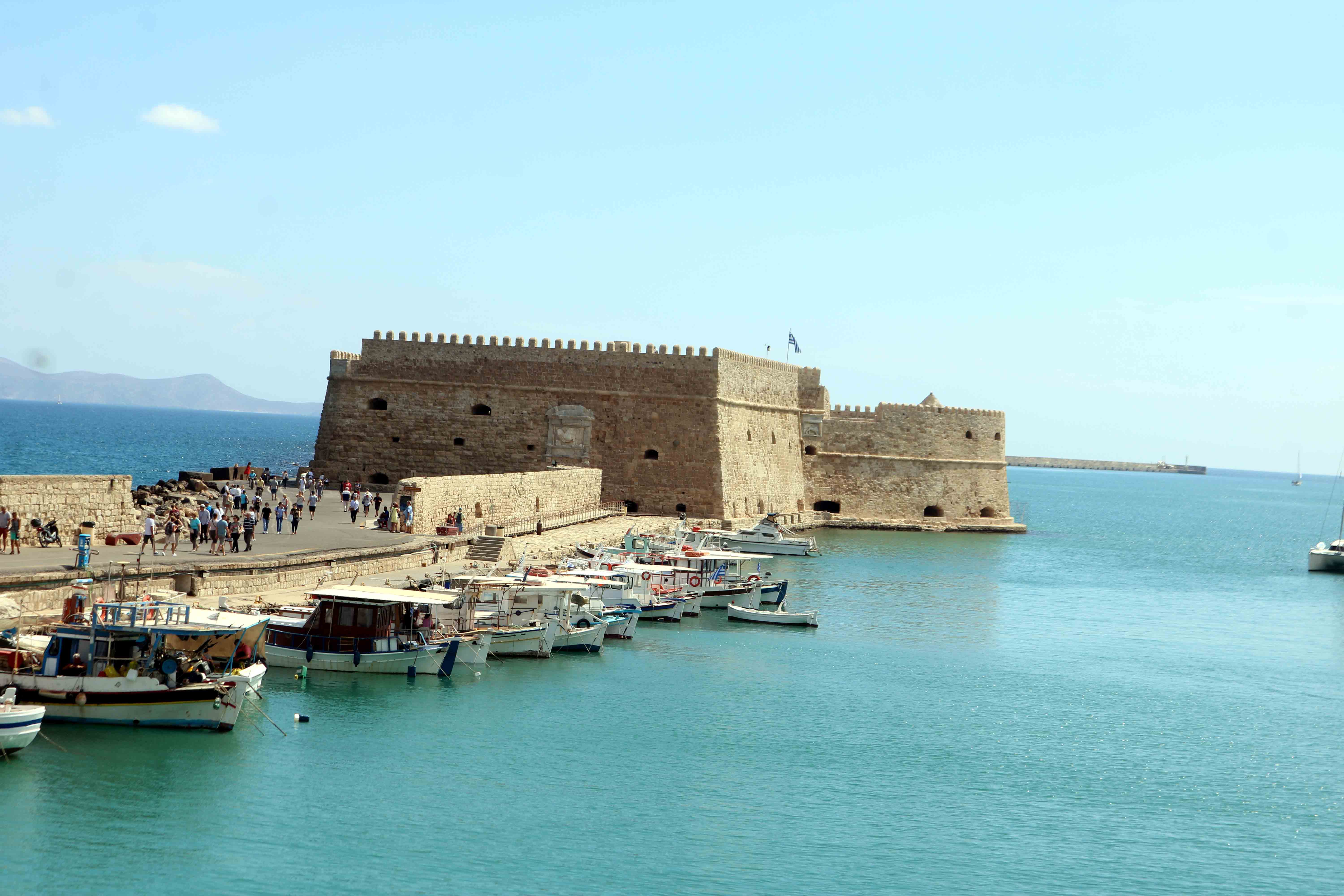
We boarded the bus at this seaside Venetian fortress situated at the entrance of the old harbour, built by the Venetians to protect the port  between 1523 to 1540.  This two-floored fortress was built with big blocks of stone.  The ground floor used to house captains of ships and also to store food and ammunition.  The upper floor had canon emplacements.  The upper parts of the castle are Turkish additions.


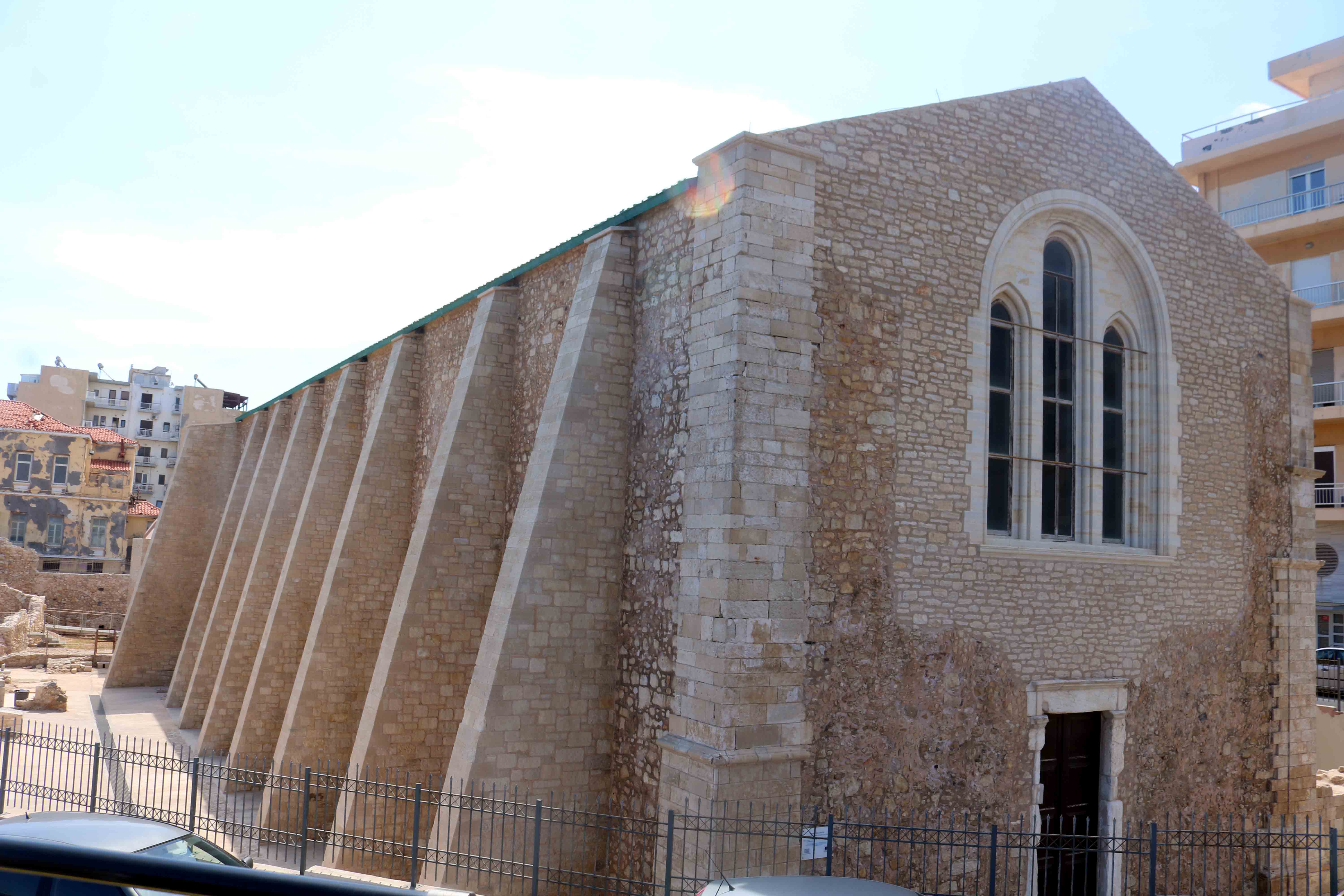
Driving along the coast road, we came to the ruins of the Dominican Church of Peter and Paul. It was built in the 13th century, during the Venetian period.


This ruins are of the second church, built on the site of the original building after it was destroyed by an earthquake in 1508.  During the period of Turkish rule, this church  was converted into a mosque.  It is currently being restored by the Archaeological Service.


Opposite the church is the Natural History Museum, functioning under the University of Crete. It is aimed  to study, protect and promote diverse flora and fauna of the Eastern Mediterranean region.  The museum is based in a restored industrial building that housed an electric power plant.


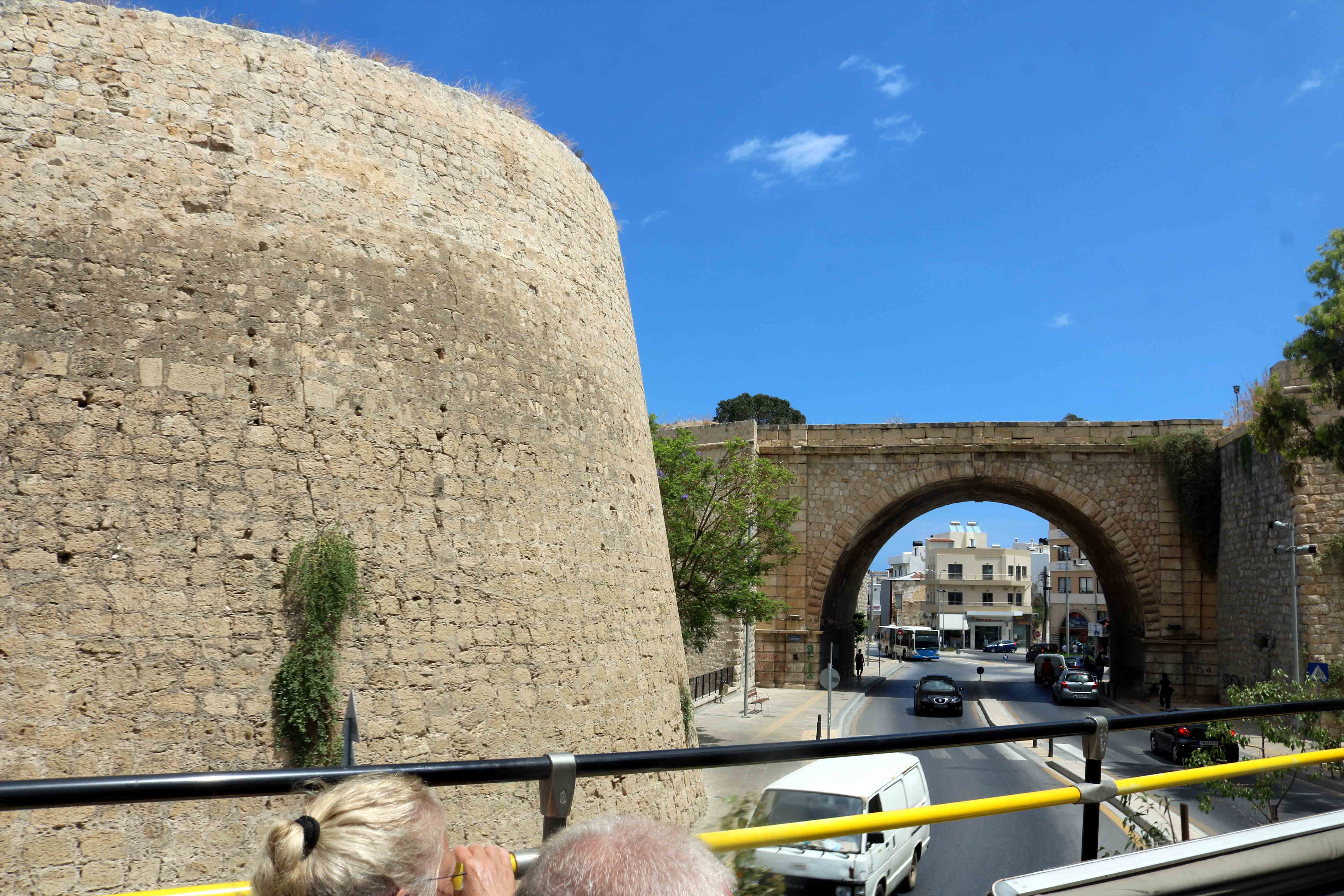
The bus drove along the Venetian Walls  fortifying the city of Heraklion.  It is a series of defensive walls which surround the city with a perimeter of roughly 5 km, supplemented with a ditch without water and bastions.  The first city walls were built in the Middle Ages, but they were completely rebuilt by the Venetians.  The fortifications managed to withstand the longest siege in history for 21 years, before the city fell to the Ottomans in 1669.  The walls remain largely intact to this day, and they are considered to be among the best preserved Venetian fortifications in Europe.

The gate of St. George at the East of the city was demolished in 1917. The gate Jesus is at the South, the gate of Pantocrator (known and as gate of Chanias) was at the West.


St George gate on the wall connected the then Venetian town of Chandaka to Eastern Crete.   This gate was built in 1565. Its name comes from a relief decorative representation of St George, which is today exhibited in the historical museum of the city.


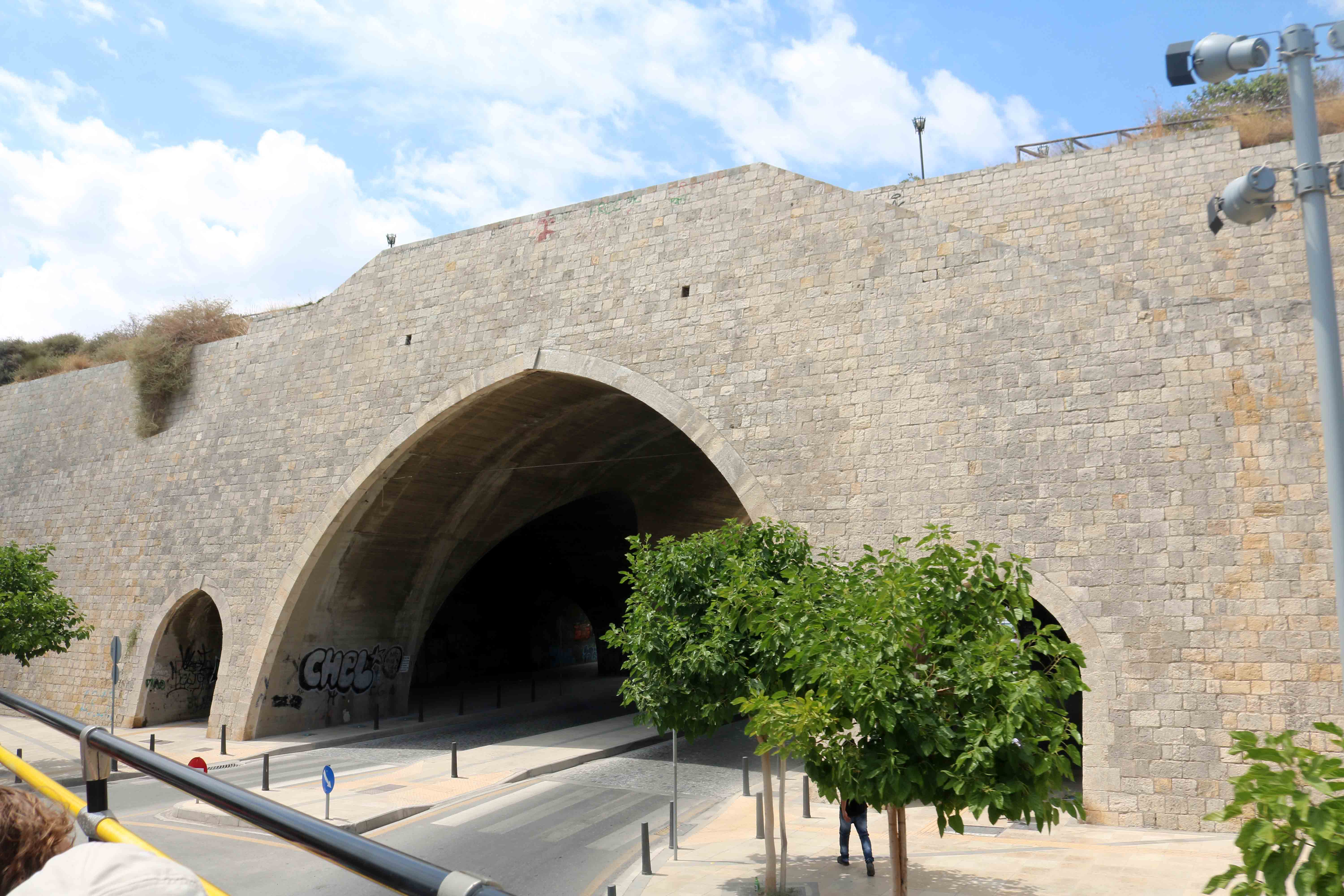
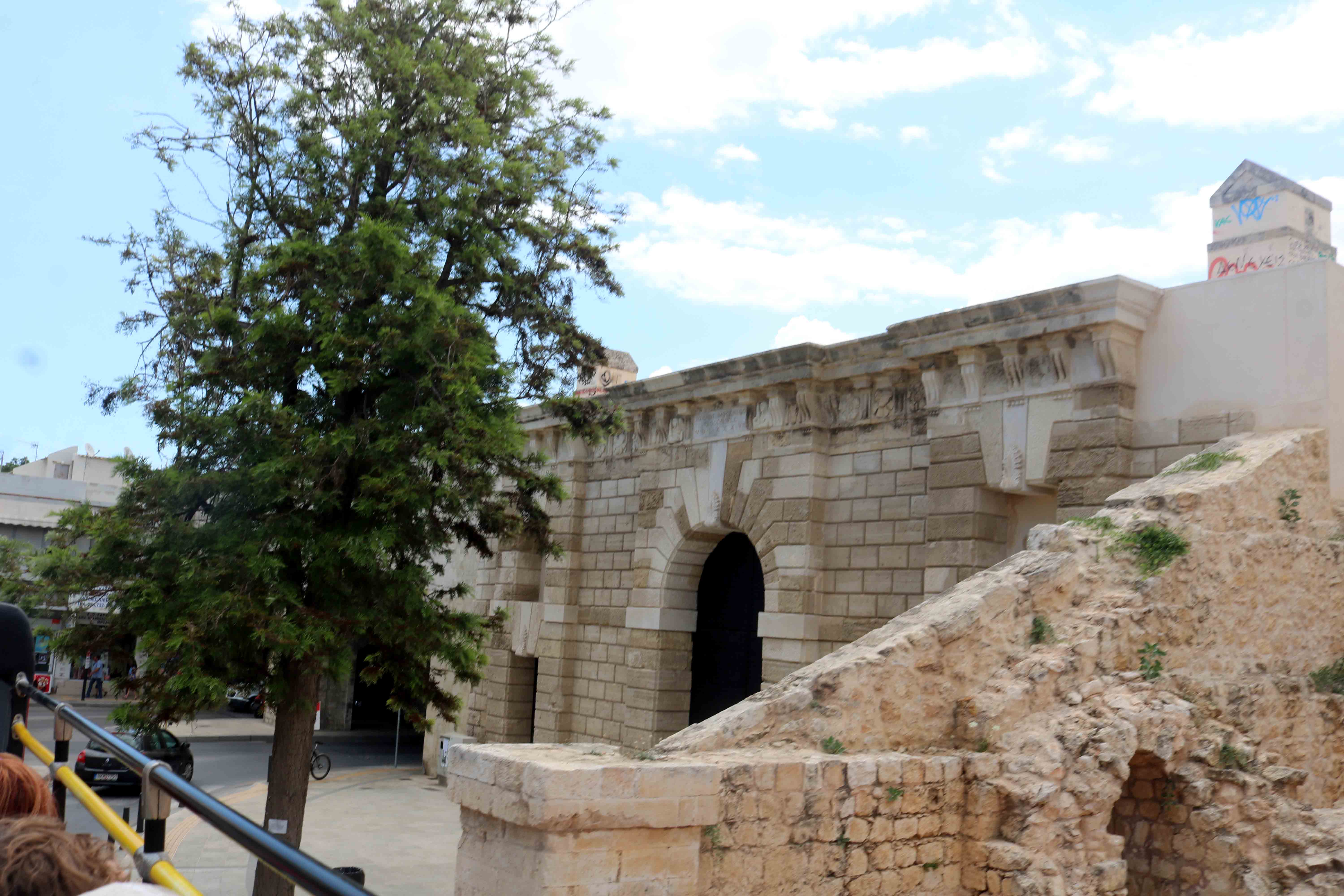
Gate of Jesus or New Gate (Kenourgia Porta) was built on the South side of the Venetian Walls in 1587.   The gate also hosted the pipeline which supplied water to the city.   An arched passage across the wall was constructed in the 1970s for cars.  On either side of the central doorway there are some openings corresponding to stairs, windows and secondary entrances to adjacent locations, and to rooms above and inside.  The rooms were used for storing weapons and for accommodating the guards of the gate.


We ‘hopped off’ the bus to visit the Tomb of Nikos Kazantzakis, the famous Greek writer born in Heraklion in 1883.  Throughout his life he received many critics, particularly from the Church, as he was trying to explain the notion of God and humans.  When his book, ‘The Last Temptation of Christ’ presenting Jesus Christ as a tragic figure who had been fighting all his life between the duty and mission on one side and the human desire to live a normal life on the other side, was published in 1951, the Roman Catholic Church banned it.  He left for the United States  in 1911.  As the Church had excommunicated him, he was not allowed to be buried in a cemetery when he died in 1957.  He was buried  outside the walls of his hometown as per his will.  His tomb is plain stonework and surprisingly it has a wooden cross on it.  Epitaph on his tombstone in Greek, when translated reads ‘I hope for nothing. I fear nothing. I am free.’

We hopped on to the next bus and got off to visit the Palace of Knossos built around 1900 BC.

The last leg of a long Sojourn: Heraklion, Crete

Crete is an island steeped in ancient history, lore and legend. It is the seat of the oldest civilisation in Europe. For centuries it has been attacked by many including the Romans, the Iberian Muslims, the Byzantines, the Venetians and the Ottomans. The locals met each of these aggressors with courageous and stiff resistance.  The architectural and cultural fusion of the various attackers and the locals could be seen everywhere by the discerning eye.

Crete tickled my military mind. Two facets from military history. One, the Siege of Candia (modern Heraklion). The venetian ruled city was besieged by the Ottomans for 21 long years from 1648 to 1669. The second longest siege in military history. Despite stiff resistance the Ottoman forces were eventually victorious. And then more recently the Battle of Crete. On 20 May 1941, the Germans launched Operation Mercury, the first ever Airborne invasion in military history. The Allies and Greek forces simply capitulated in 48 hours and the island of Crete fell into German hands.

After alighting from the bus, we walked a kilometer to the Minoan Knossos Palace, a city steeped in antiquity, which was inhabited continuously from the Neolithic period until the Fifth Century AD.  The palace was built on the Kephala hill and had easy access to the sea and the rest of the island.   According to tradition, it was the seat of King Minos.  The Minoan civilization was a Bronze Age civilization on the island of Crete and neighbouring islands which flourished from about 2600 to 1600 BC.

The first excavation of the site was conducted in 1878 and was followed by the long-term excavations (1900 to 1930) by Sir Arthur Evans, a British archeologist, who uncovered virtually the entire palace.  The palace was a multi-storey building with painted plaster, marble revetment and wall-paintings adorning the rooms and passages.  The palace also had a complex drainage and water-supply systems.


As we walked into the palace compound, we were welcomed by a dancing peacock.  The dance was obviously not to impress us, but the peahens in the vicinity.


Let me venture into a pictorial account. This is where the ‘West Porch’ of the palace stood, a roofed area opening onto the central court, supported by a column of which part of the gypsum base remains.


Here is a restored version of ‘South Propylaeum’ by Evans who put up a copy of the ‘Cup-Bearer’ fresco on the wall, depicting a man holding a libation vase.


The ‘Pitho’i (large storage jars) on the East side of the Propylaeum indicate that this area was used for storage.


The ‘Throne Room’ as per Evans is the room used for ceremonies with the king in his religious capacity. However, Evans believed that it was unlikely to have been a ‘Throne Room’ in the modern sense of the word.


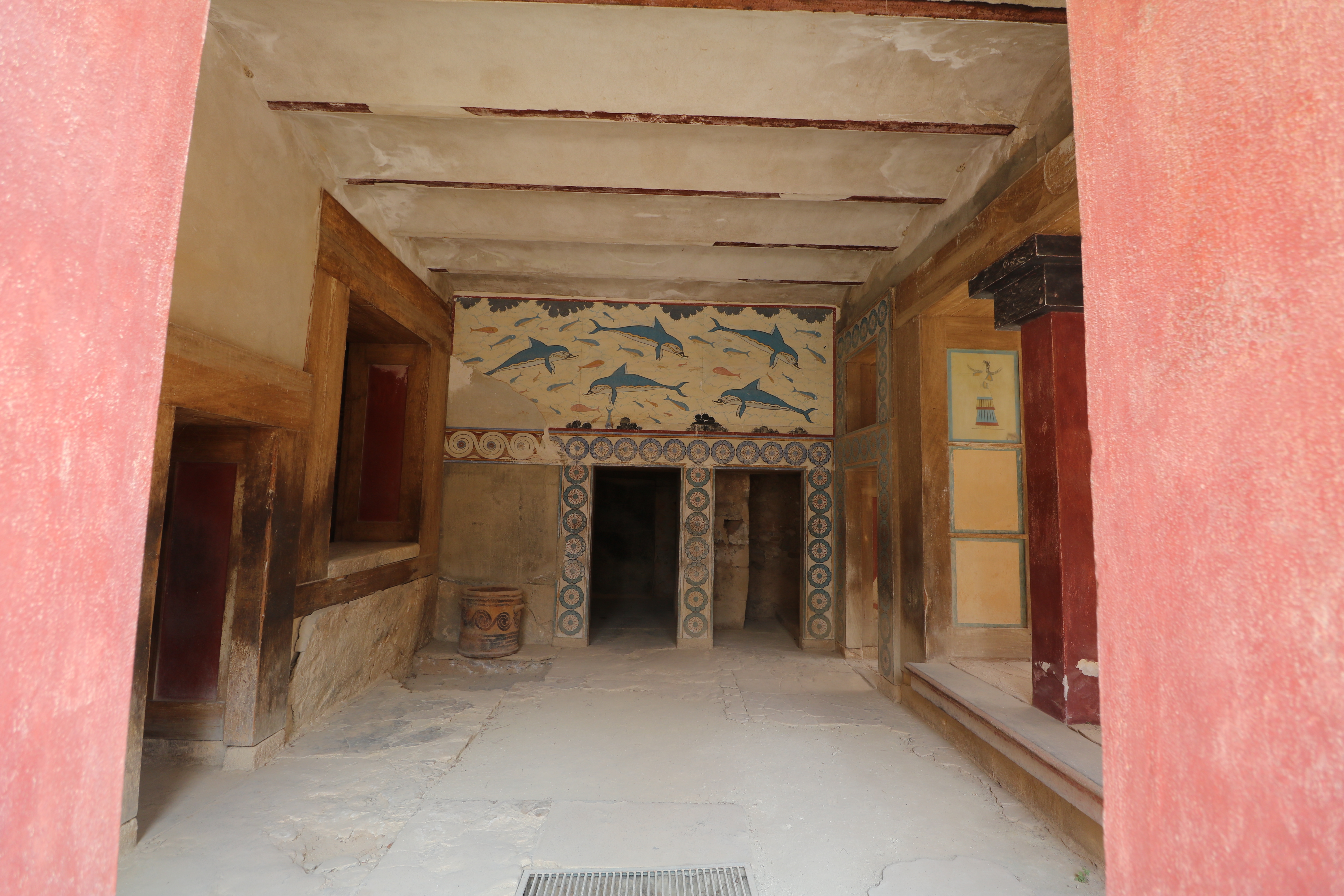
The “Queen’s Megaron” at the South-Eastern part of the Palace is believed to be the apartment of a queen. The suite includes a toilet, bathroom, and store room, as well as a light well to provide the apartment with light during the day. This is famous for the Dolphin  Fresco,  reconstructed from fragments as a wall fresco by Evans.


The ‘East Wing Staircase’, was built into the side of the hill on top of which lies the rest of the Palace, with two storeys below the level of the Central Court. Today, a large part of it has been reconstructed in concrete.  Evans believed it to be the residential quarters of the Royal family.


The ‘Magazine’ to the north of the East wing staircase took its name from the pithoi that were found here. The jars have relief disk and rope decoration.


An open air paved narrow passage linked the Central Court with the North Entrance. On the right and left were two raised colonnades known as ‘Bastions’.  Evans reconstructed the Bastion on the West side with a copy of a restored relief fresco of a bull. The wall painting may have formed part of hunting scene.


We hopped on to the next bus at the Palace of Knossos and hopped off at Eleftherias Square to commence our walking exploration of the city centre.  In the Venetian period, Eleftherias Square was used as a training ground for the Venetian mercenary army, and was called Campo Marzio or Piazza d’Armi.   When the St George Gate was built in the 16th century, the square was renamed St George Square.   Eleftherias Square also housed circular underground granaries, in which the Venetians stored grain for emergencies such as sieges and houses a large water cistern.  During the Turkish period, Eleftherias Square was an open space.   Prior to World War II, British troops camped on the walls and trained in the square, as the Venetians had done centuries earlier. Any connections with ‘Game of Thrones?’

At the turn of the 20th century, the square was the inhabitants’ main recreation area.  The most recent restructuring was intended to give it a modern look and the air of a major European city.  The square, retaining some of its eucalyptus trees, was paved with marble and was decorated with metal pylons symbolising ships’ masts, reminiscent of the city’s maritime history. The people of Heraklion have never been happy with this new square and there are ongoing discussions about changing it and we all generally tended to agree with the locals.


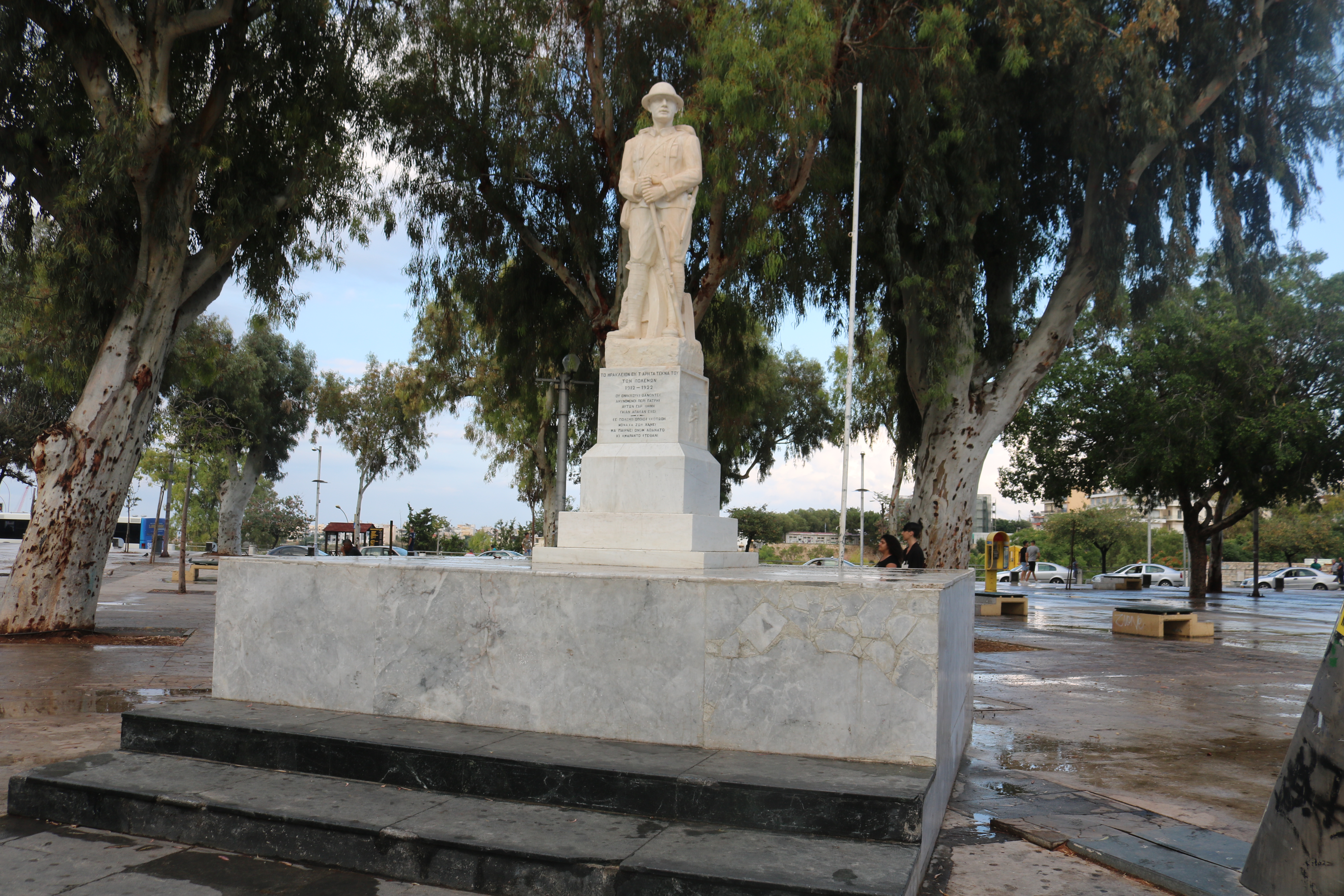
In the centre of Eleftherias Square stands the statue of the Unknown Soldier, a 20th century creation.  On national days and on the anniversary of the Battle of Crete, the Heraklion authorities lay wreaths here in honour of those who sacrificed their lives for their motherland.


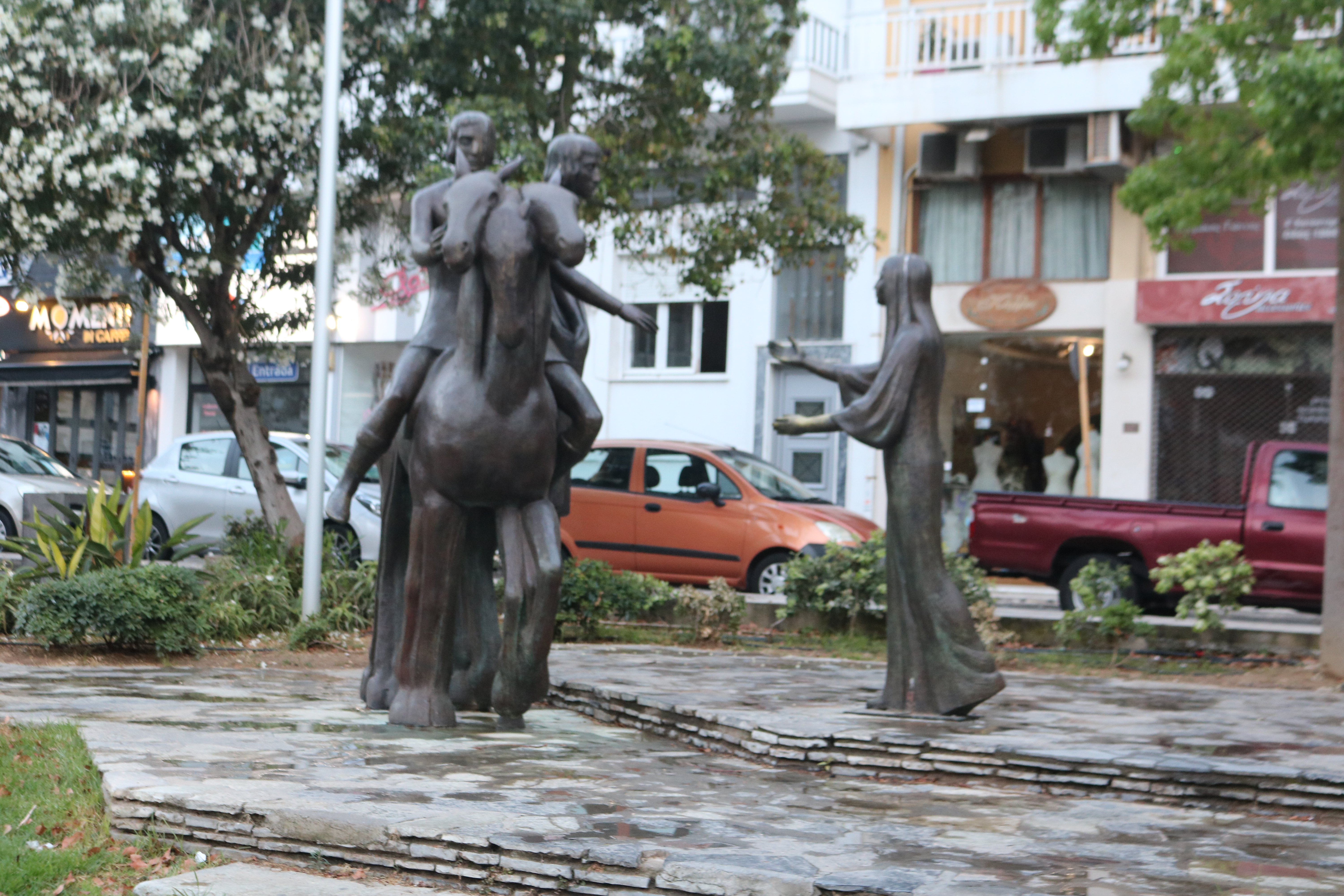
We then walked to Kornarou Square, named after the great Cretan poet Vincenzos Kornaros (1552-1613), who grew up in Heraklion and wrote ‘Erotokritos’. This is a romantic epic poem written in the Cretan language about the love of Erotokritos and Aretousa, often compared to ‘Romeo and Juliet’.  Kornarou Square is adorned with a fountain and a statue of Erotokritos on horseback, bidding farewell to his beloved Aretousa.  The statue was a bit confusing to us as we initially perceived it as a multi-headed and multi-legged horse with two horsemen.  On reading the information tablet we realised that it was the artist’s multidimensional depiction of the hero and his horse showcasing movement and drama of the scene.


We then moved to the Agios Minas Cathedral, the seat of the Archbishop of Crete of the Greek Orthodox Church, dedicated to Saint Minas, who was declared the patron saint of Heraklion during the Turkish period.  It was built over the time period of 1862 to 1895. The construction was interrupted during the Cretan Revolution of 1866 to 1869. The church has a cruciform architecture with a central dome.

The name Minas is rare in Heraklion, which sounds strange for a city whose patron saint he is. The reason for this is given in an old story.  During the Turkish rule, illegitimate children were often left on the steps of the church of Saint Minas. The church took care of the children and named the boys Minas.  Thus the Cretans preferred to avoid the name.


To the Left of the St Minas Cathedral stands the original little church of Saint Minas built in 1735.  It housed the Greek Orthodox Church’s Metropolitan of Crete for the first time after the Turkish occupation.

From the cathedral, we returned to our hotel for a wash, change and rest.


Lunar Landscape of Nea Kameni to Heraklion


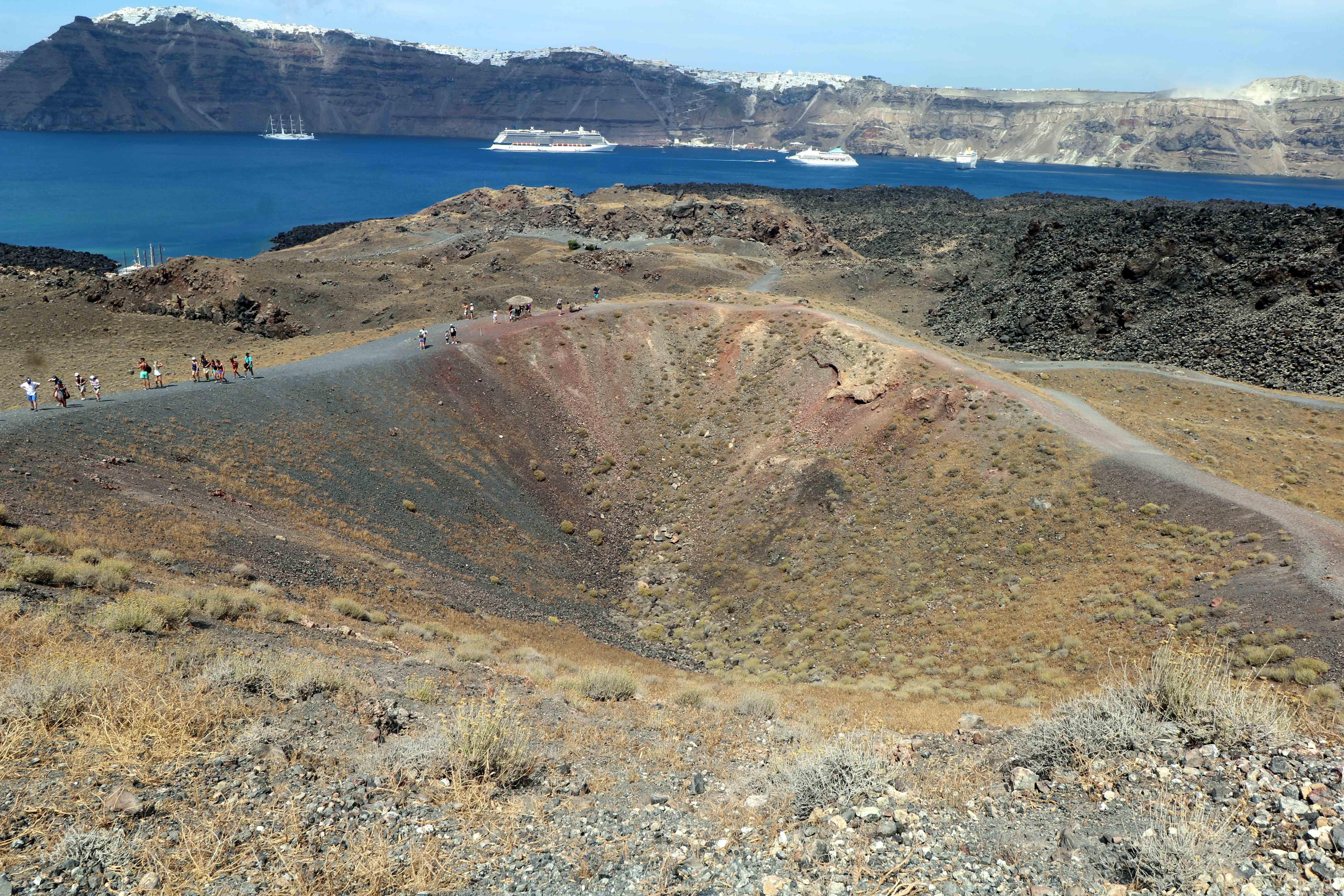
Our boat anchored at the wooden pier of Erinia cove of Nea Kameni island.  We disembarked from the boat and entered the Nea Kameni National Geological Park.  There is a two Euro entry fee and the proceeds go to support monitoring of the volcano.


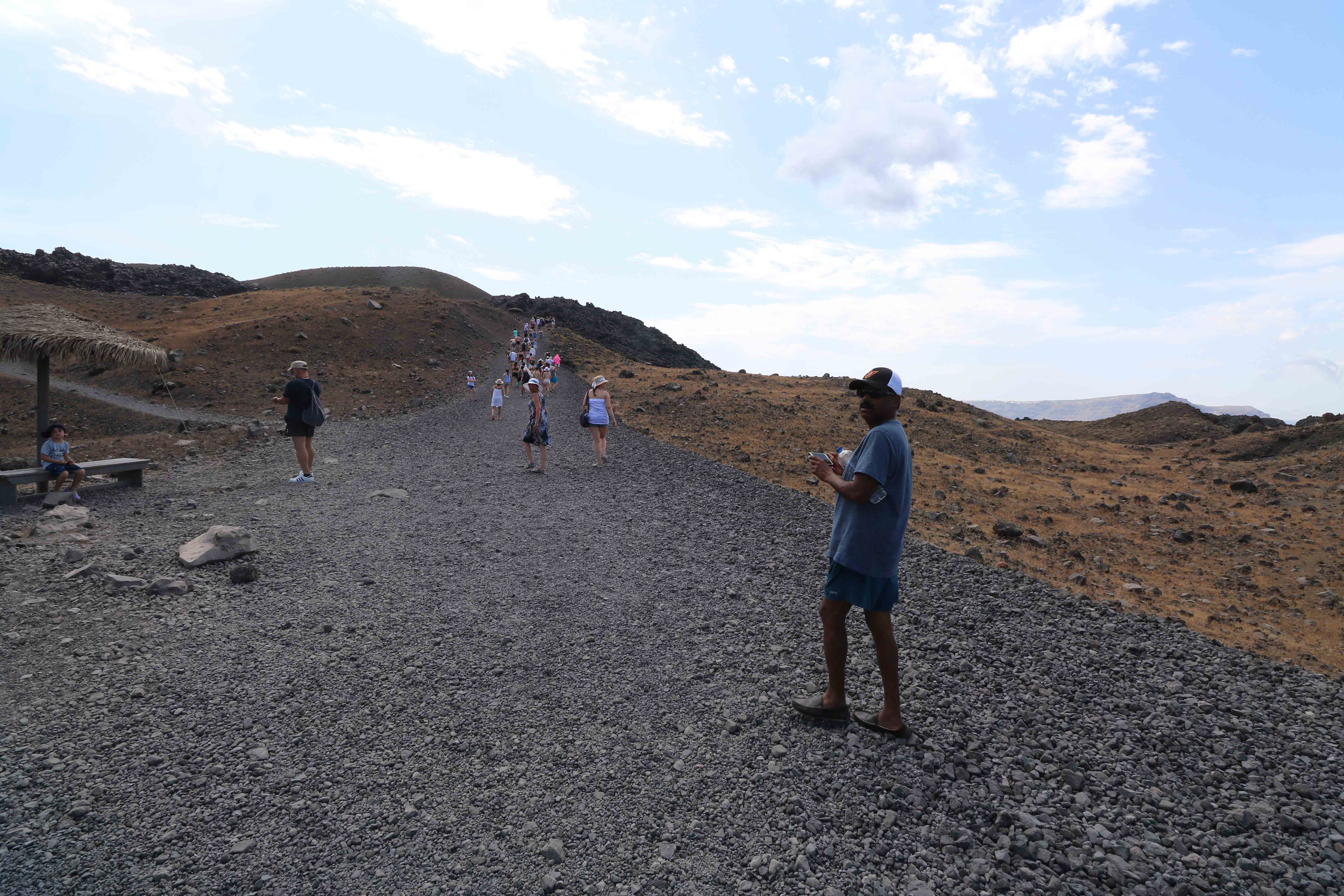
Vegetation is sparse with the volcanic rocks covered by red grassy bushes and yellow sulfur deposits.  The 30-minute hike up over this volcanic mountain is moderately challenging but worth the effort for the breathtaking view that it offers.  Hikers need to keep to the track full of stones and gravel formed due to cooling lava.  Hence, proper walking shoes are a must.


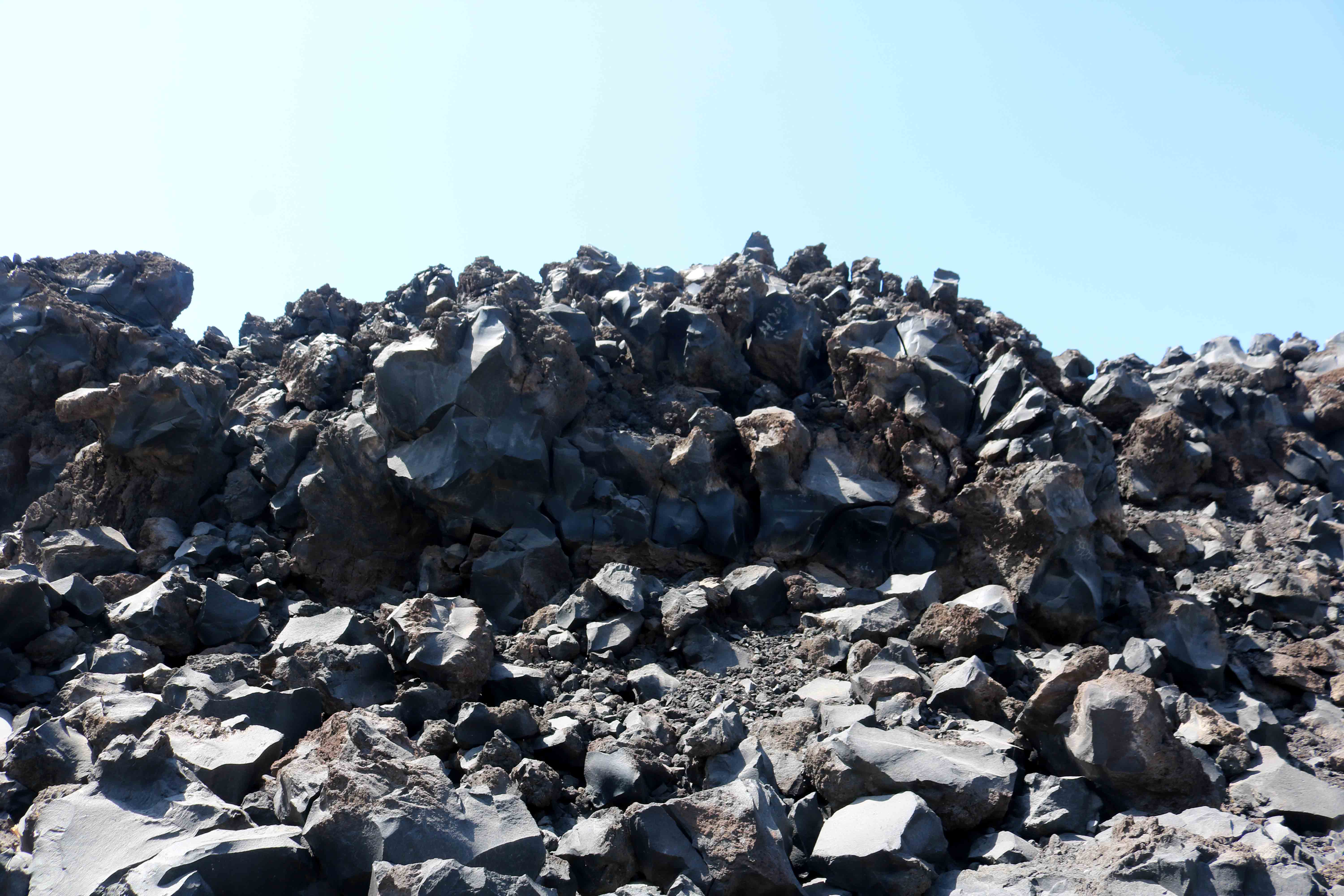
As we stepped into the Geological Park, the terrain was akin to that of a lunar-landscape.  As we climbed up the hill, on the sides were solidified lava ejected by the volcano called volcanic bombs.  These are the oldest volcanic bombs on the island and were the result of volcanic eruptions of 1573.


Further walking up, we reached slopes of the dome of Mikri Kameni, the oldest lava on the island. The path that led us to the top of this dome, to the crater of 1570 eruption.


Our next halt was at the Dafne crater caused due to volcanic activity of 1925-1926.


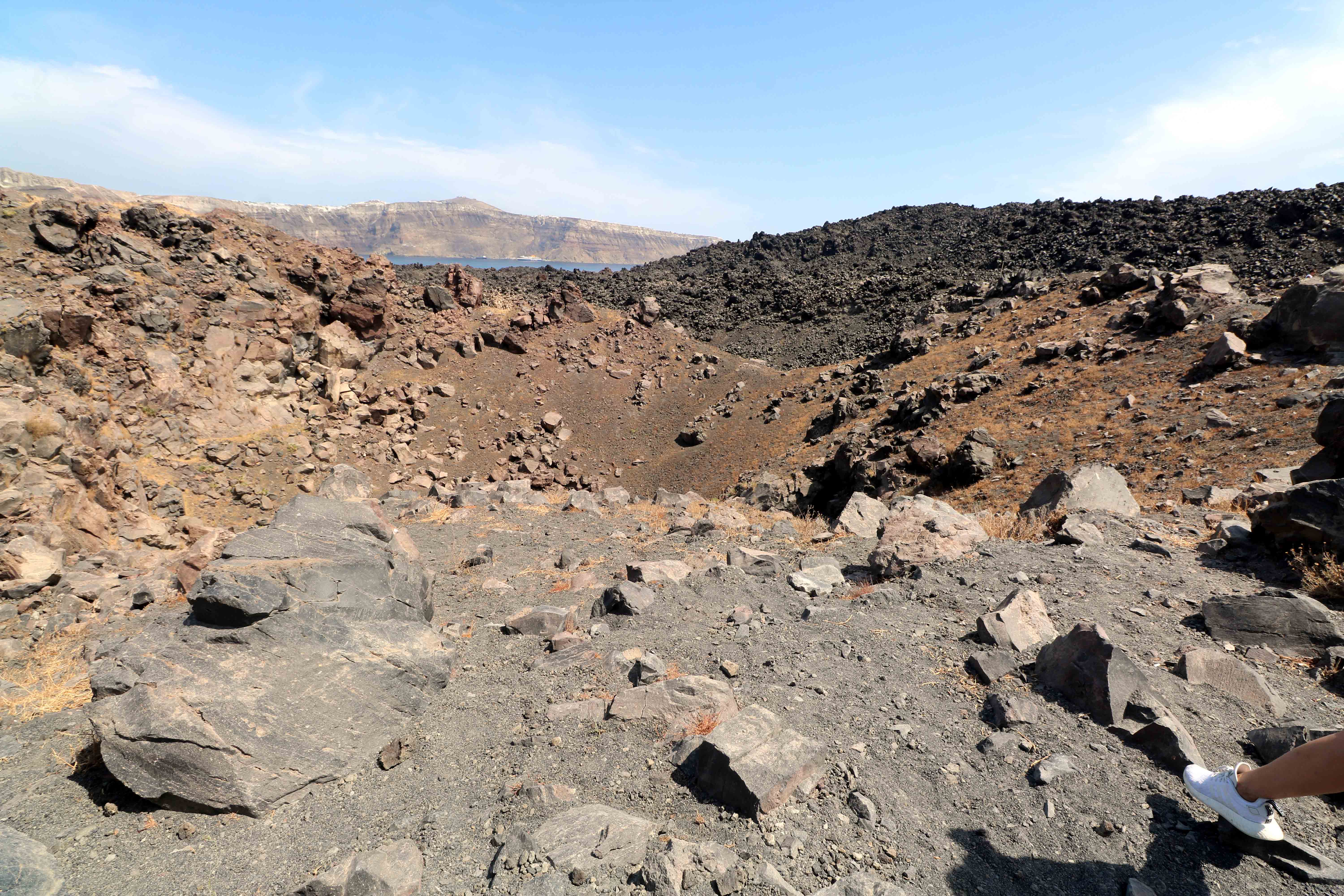
We then came to the twin craters formed as a result of 1940 volcanic eruption.


Climbing further up, we came to Georgios dome peak.  The crater here was created in August 1940 by two large volcanic eruptions atop of the dome of George, which was created in 1866.


On top of the hill at about 127 meter we saw deposits of solidified Lava.  These rocks were formed due to cooling and solidifying of molten lava which erupted in 1950.


On the top we could see that many sensors were deployed. The seismic sensors monitor tectonic activity that may precede a volcanic eruption.  Carbon dioxide (CO2) emissions are also monitored.  With modern technology and monitoring, it is believed that scientists are in a position to forecast the volcano’s next eruption, at least a few months to a year in advance.


After spending about 90 minutes at Nea Kameni, our boat headed back to the Fira port.  As we stepped out of the boat, we could hear the cacophony of donkey drivers hailing for passengers.  The donkey is Santorini’s logo, its trademark mascot. During a Greek wedding, the bride rides a donkey to the church and back to her home.  We all decided to take the donkey ride up the 588 steps of Karavolades stairs.


These donkeys are well trained and the rider is required to sit firmly on the saddle.  There are no reigns and so the rider has little or no control over the animal’s movements.  As we sat on the donkey, they set off on the way up.  There were many pedestrians walking up and down, so also other donkeys coming down the stairs.  These donkeys steered their way through this ‘crowd’, as if they exactly knew what to do.   For the donkeys it appeared that their only aim was to reach the top as quickly as possible. The level of training was quite akin to that of the famed ‘Mule Artillery’ of the Indian Army.


On reaching the top, the donkeys stood at the donkey-taxi stand.  The drivers helped everyone to dismount.  We then had dinner at the Fira and returned to our hotel.

On June 15, after breakfast we checked out of our hotel.  Our ferry to Crete island was scheduled for 4 PM.  We then set out to explore the area around our hotel.


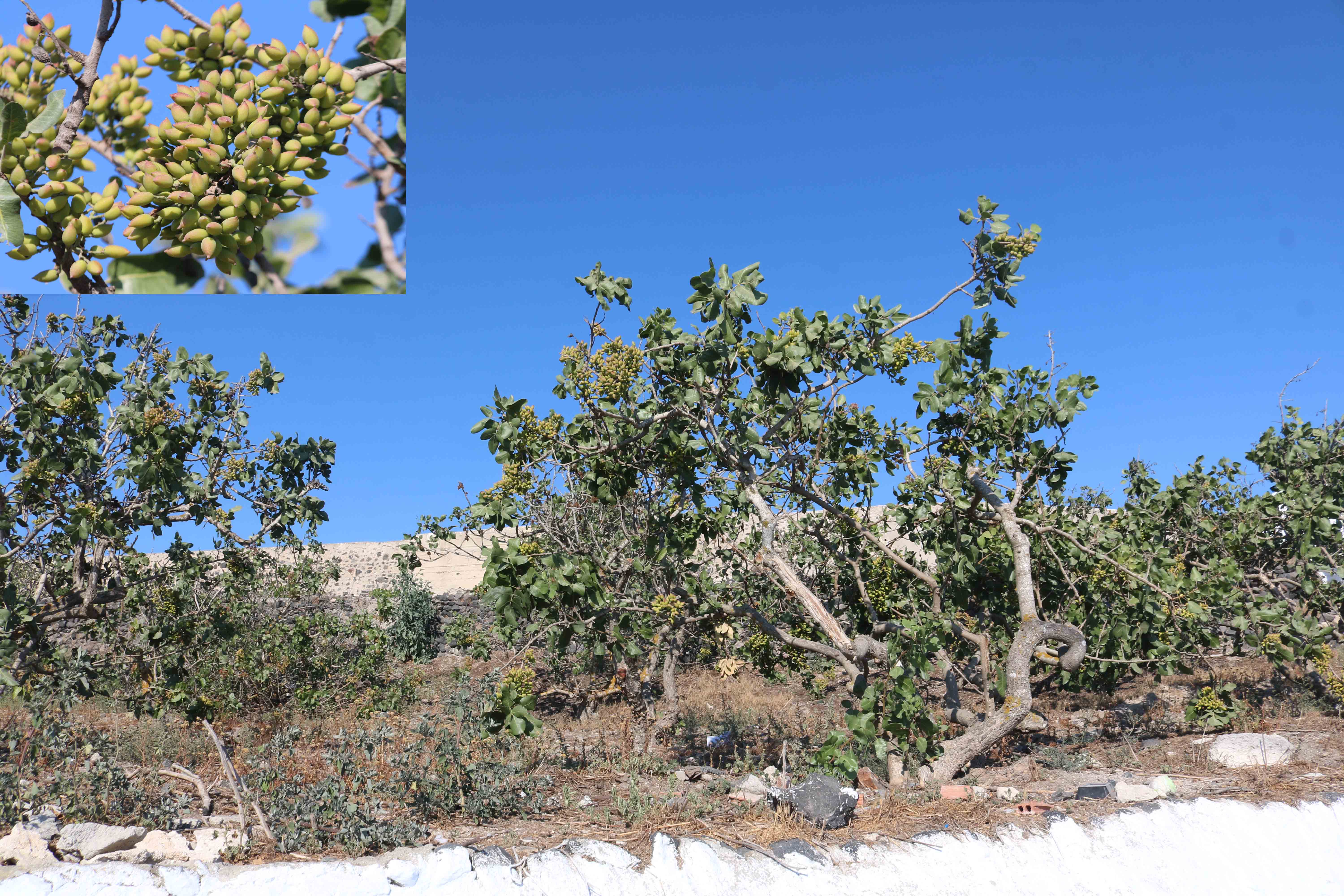
Economy of Santorini, like all other Greek islands, is supported by tourism.   Santorini grows a special variety of small cherry tomatoes, fava beans, yellow peas, cucumbers and white eggplants.   There are lots of wild fig trees growing all over the island.


Unlike the mainland of Greece, Santorini does not grow olive trees due to the strong winds and the lack of water.  Instead they grow a lot of pistachio trees.  The olive tree above grows between the buildings at the hotel.


From the Hotel, we walked down to Kamari beach resort.  On the Southern end towers the enormous rock of Mesa Vouno with the archaeological site of Ancient Thira on its top, 400 meters above the sea. The beach offers a wide range of facilities like sun-beds, umbrellas and various water sports.


The water is deep and blue, the sand is black.  The beach is filled with black sand and pebbles as a result of extensive volcanic activity over centuries.


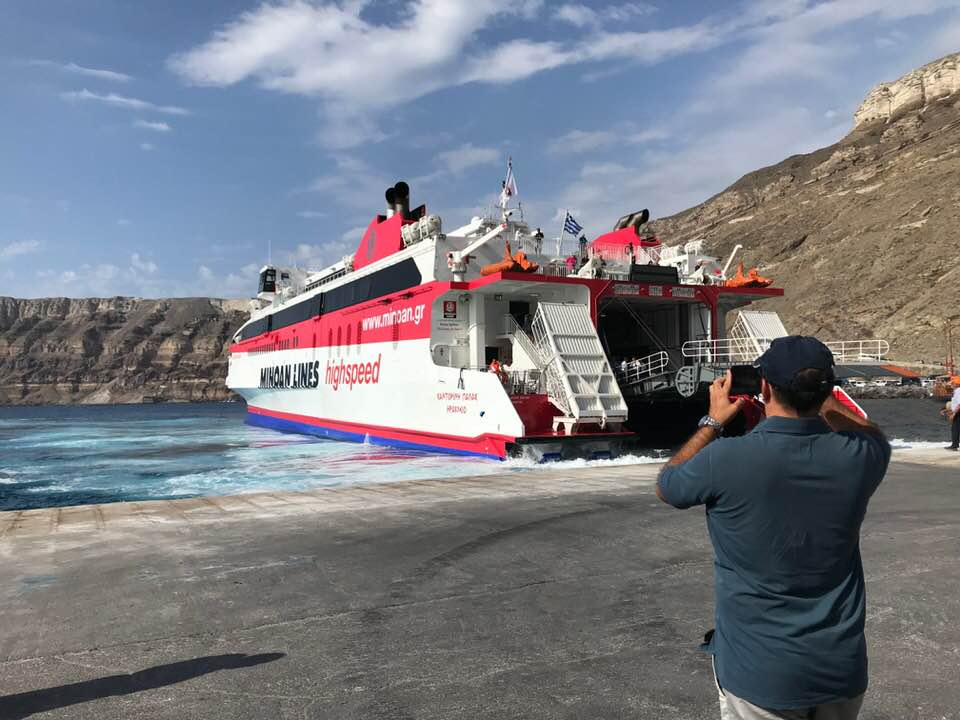
We boarded the high-speed ferry operated by Minoan Lines to Heraklion, Crete.  The cruise was very comfortable and smooth.


We reached Heraklion port by 5:30 PM.  We drove to our hotel by taxi and checked in.  As the night fell, we walked to explore the city.


We walked to the largest cistern to provide drinking water to the Heraklion port. The cistern consists of two oblong vaulted chambers linked by arched openings. Light and air enter the cisterns through large light shafts on the top of the vaults.  Today, all the daily garden watering needs of Heraklion Port Authority (about 7000 litre of water) is provided from an underground cistern, built by the Venetians (People from Venice), hundreds of years ago.


Venetians also built a series of shipyards (known as Arsenali) at the southern and the eastern area of the port, in order to house and protect the activities of the building and repairing of ships.  These large, barrel-vaulted buildings were shipyards built by the Venetians and were capable of housing ships in need of protection or repair and for the construction of new vessels.


Night life in Heraklion is very hectic with shops, restaurants, taverns, discos, clubs, etc, all open till 3 o’clock in the morning.


Summer in Crete and in Greece means ‘tables outside’: The guests meet the local people and everyone joins the party.  We had Cretan cuisine for dinner and retired to our hotel.

Volcanoes of Santorini


On June 16, after breakfast we set out to visit the volcanic islands of Nea Kameni, meaning ‘new burnt’ and Palea Kameni meaning ‘old burnt’.


During the Bronze Age, Santorini was called Strongyli, meaning ‘rounded.’  Devastating volcanic eruption of 1650 BC resulted in decimation of Strongyli, creating the crescent shaped Santorini and several surrounding islands.

The island of Hiera was formed due to volcanic eruption which started around 197 BC.  In 47 AD the volcano reawakened spewing huge quantities of magma forming a new island which merged with Hiera to form Palia Kameni.  Breakup of Palia Kameni occurred between 1457 and 1458, as per Roman historian Aurelius Victor’s ‘Historia Romana’. At that time the island had a perimeter of 5,550 meters.  It gradually acquired its present shape through fragmentation by great cracks and collapse of its shoreline, with the current perimeter of only about 4000 meters. Like a slumbering demon, the volcano remained dormant for the next seven centuries. It became active again, very violently in 726 AD.

Nea Kameni is Eastern Mediterranean’s youngest volcanic landform.  It is a protected natural monument and national geological park.  In 1573 AD, about 65 years after Palea Kameni reached its present form, volcanic activity broke out resulting in the formation of a small island called Mikra Kameni meaning ‘small burnt’.  Formation of Nea Kameni commenced with the volcanic eruptions from 1701 to 1711.  Volcanic eruptions of 1866 to 1870 caused the smaller island of Mikra Kameni, to be joined with the larger Nea Kameni.  During the period 1939-1941, many eruptions occurred in Nea Kameni which changed the topography of the island.  The volcanic activity ended in July 1941.  Today, magma exists at depths of a few kilometers, giving Nea Kameni its trademark sulfur odour.


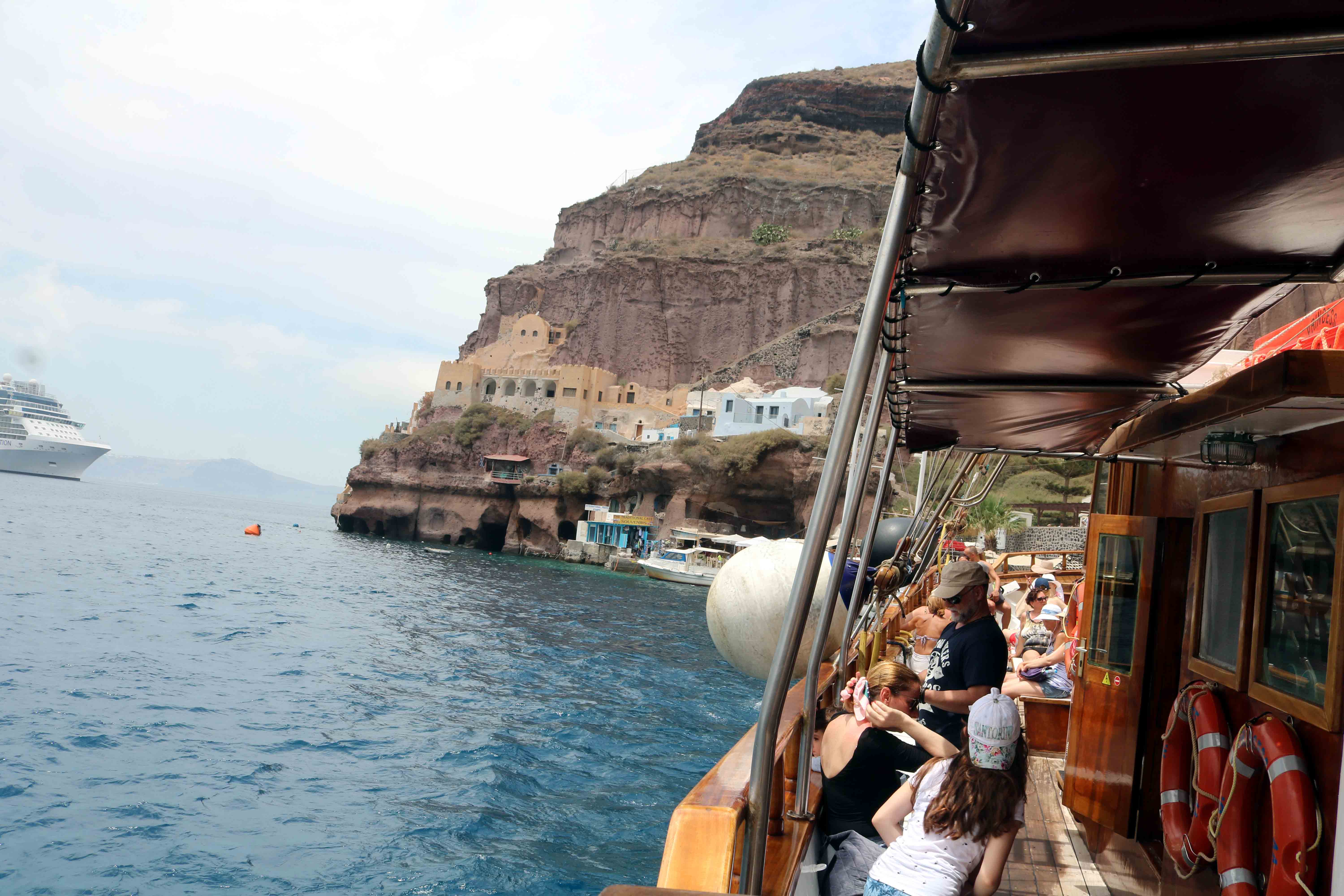
From our hotel we rode a local bus to Fira, the capital of Santorini on the West coast of the main island.  Fira is a ‘whitewashed’ town of cafes, bars, restaurants and shops, all filled with tourists.  We had to now go to Gialos, the old port of Fira to sail to the volcanic islands.   Till a few decades ago, Gialos was the main commercial port of the island.  The port now is active mostly in summer and serves only the cruise ships, the excursion boats to the volcano, and a few fishing boats.   The port is located about 275 meters below the cliff.

Alighting from the bus, we walked to the cable-car terminal to purchase tickets for the ride to the port.  The queue was pretty long and we got our tickets after about 30 minutes.  The ladies made use of this time to buy trinkets and memorabilia from the shops around, while the men stood in the queue.


There is a zigzag track of 588 steps called Karavolades stairs from the Fira to the Old Port.  There were many tourists walking up and down these steps.  There are mule-taxis, that operate on the same track, taking tourists up and down.   The Karavolades stairs have several large bends which offer magnificent view of the volcanic islands.


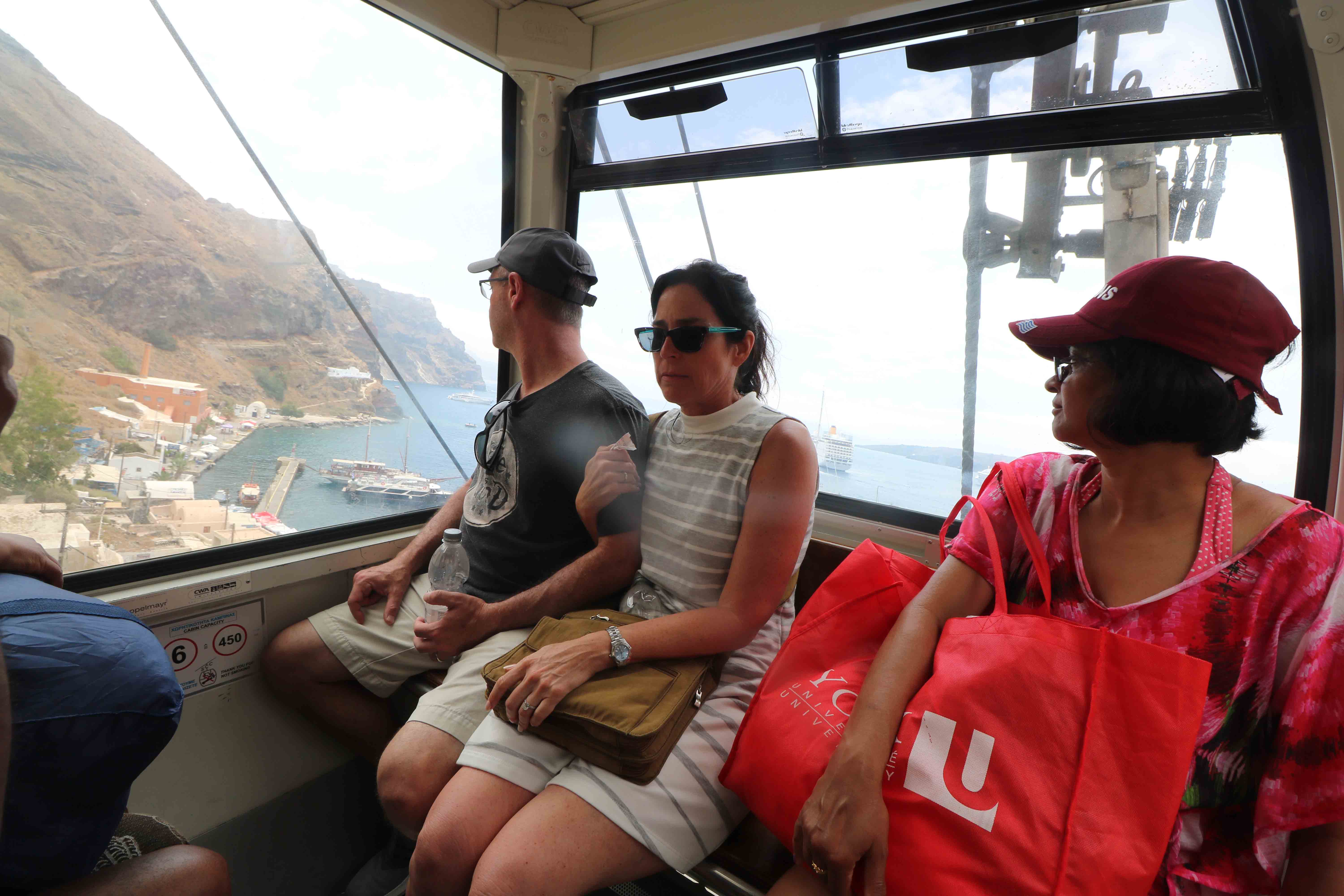
The fastest option to reach the old port is surely by the cable car system, commissioned in 1982.  The project was funded by Loula & Evangelos Nomikos Foundation created by the wealthy Santorini ship owner Evangelos Nomikos.   He mediated with the traditional mule drivers who were operating here and ensured that a part of the income went to the mule drivers and the rest to the city. The cable car runs every 20 minutes and a single ride takes 3 minutes. The cable car ride to the old port gave us a stunning view of the volcanic islands, bizarre cliff sides and still blue waters.


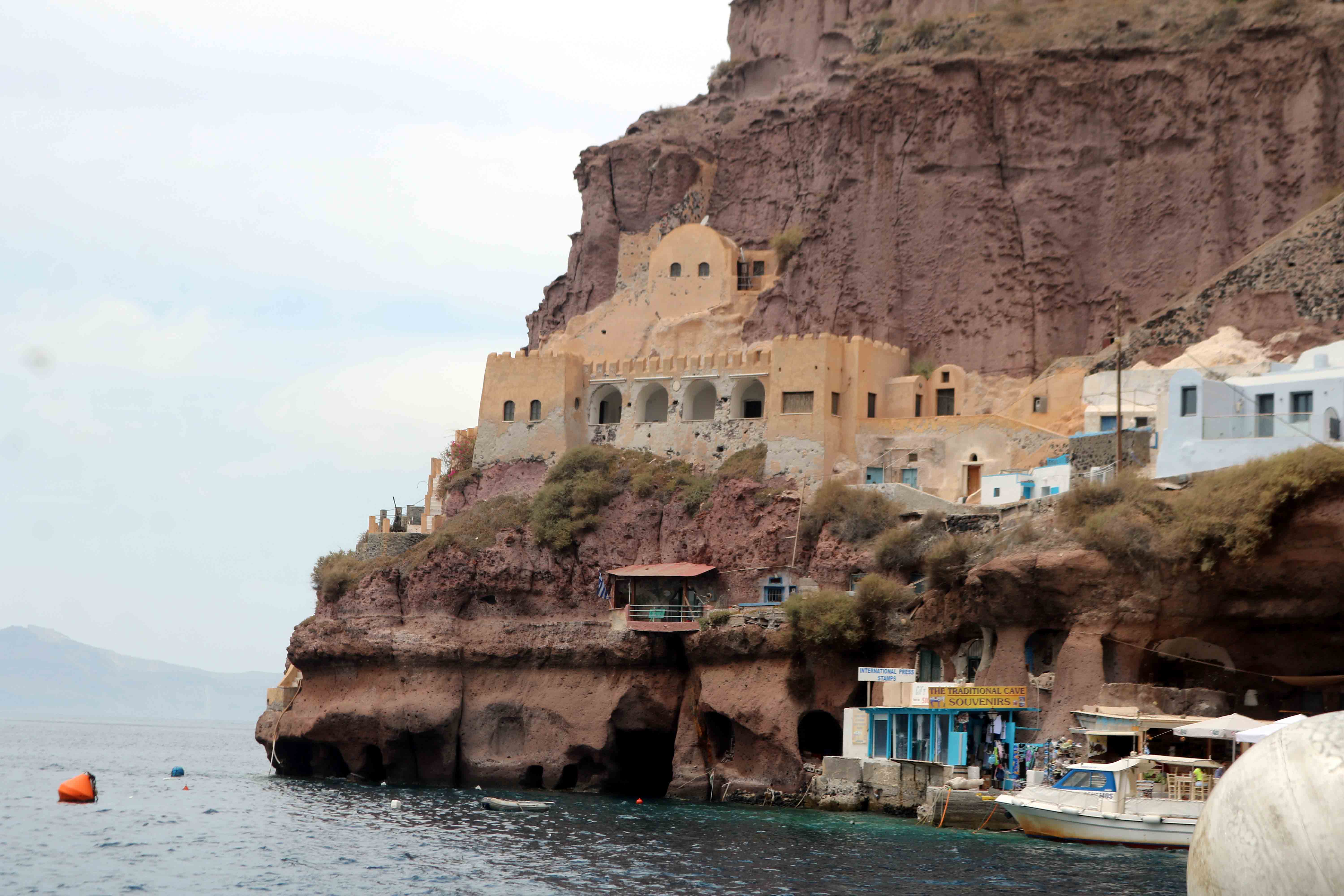
On all sides of the old port were restaurants, taverns and small shops, mostly catering to cruise ship tourists who come ashore by chartered boats as the huge cruise ships cannot berth at the harbour.  At one end of the port is the caved houses that appear stuck on to the rock and rock caves that have been created by erosion.  We booked our tickets for the boat journey to the volcanic islands and had lunch at a restaurant at the pier.


We set sail on a boat from the port at around 2 PM to the island of Palea Kameni.  After about 20 minutes, the boat anchored at the cove of Agios Nikolaos.


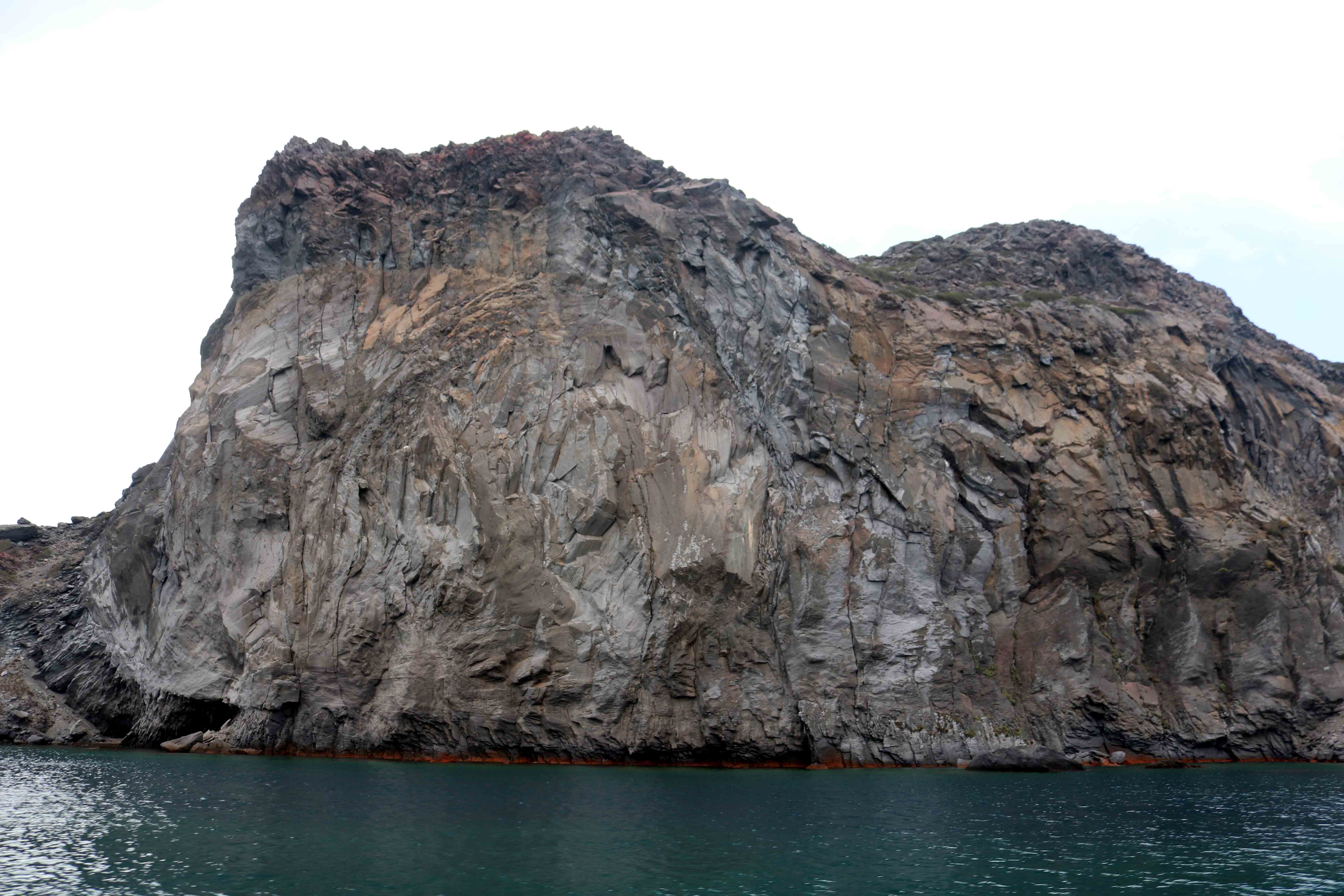
As we came closer to Palea Kameni island, we were greeted by steep cliffs formed by solidified lava.


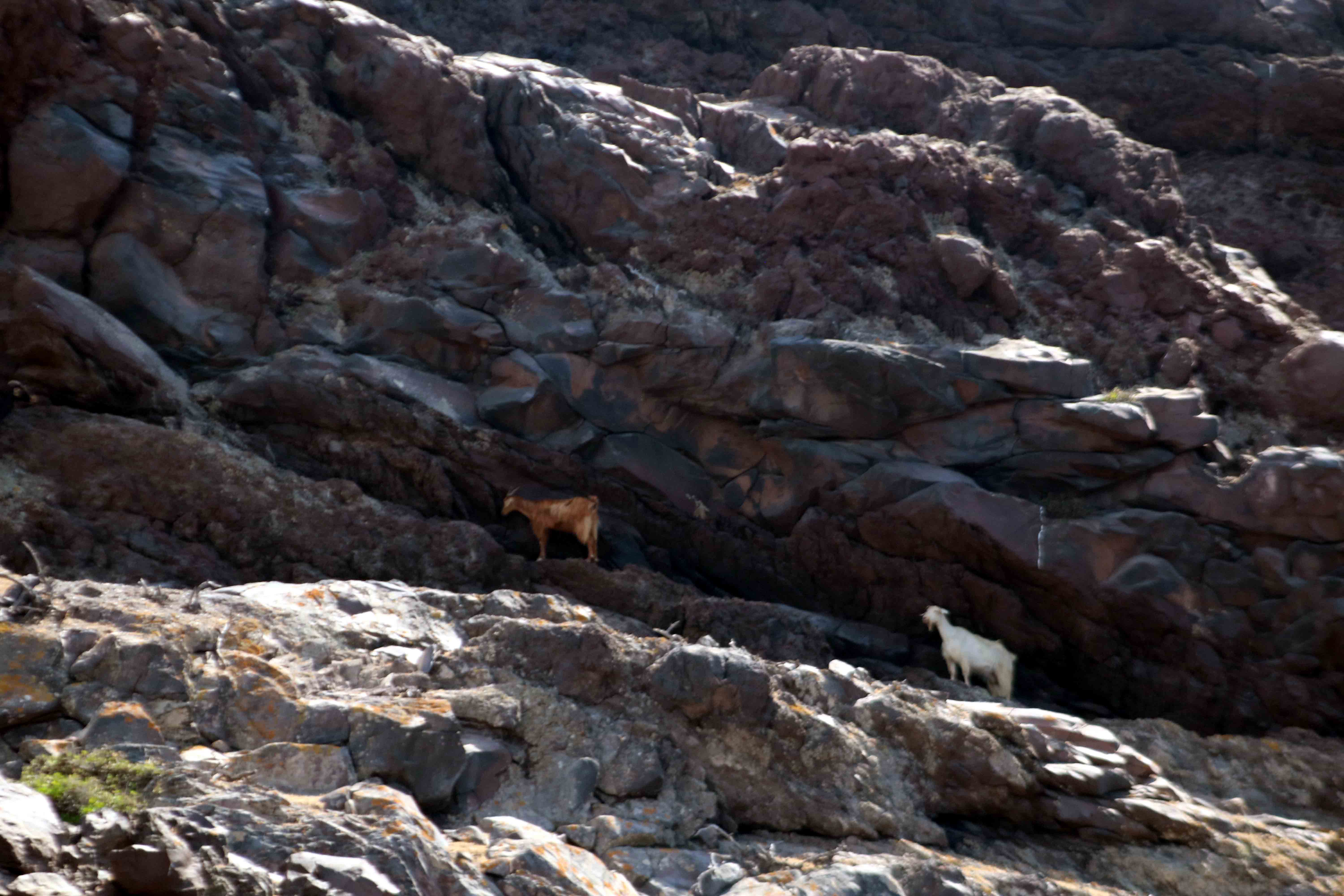
The cove is formed between small cliffs filled with solidified lava rocks.  The island is uninhabited, but we saw goats grazing, presumably wild, miraculously perched on the ledges on the cliff, chewing away on the almost non-existent shrubbery.


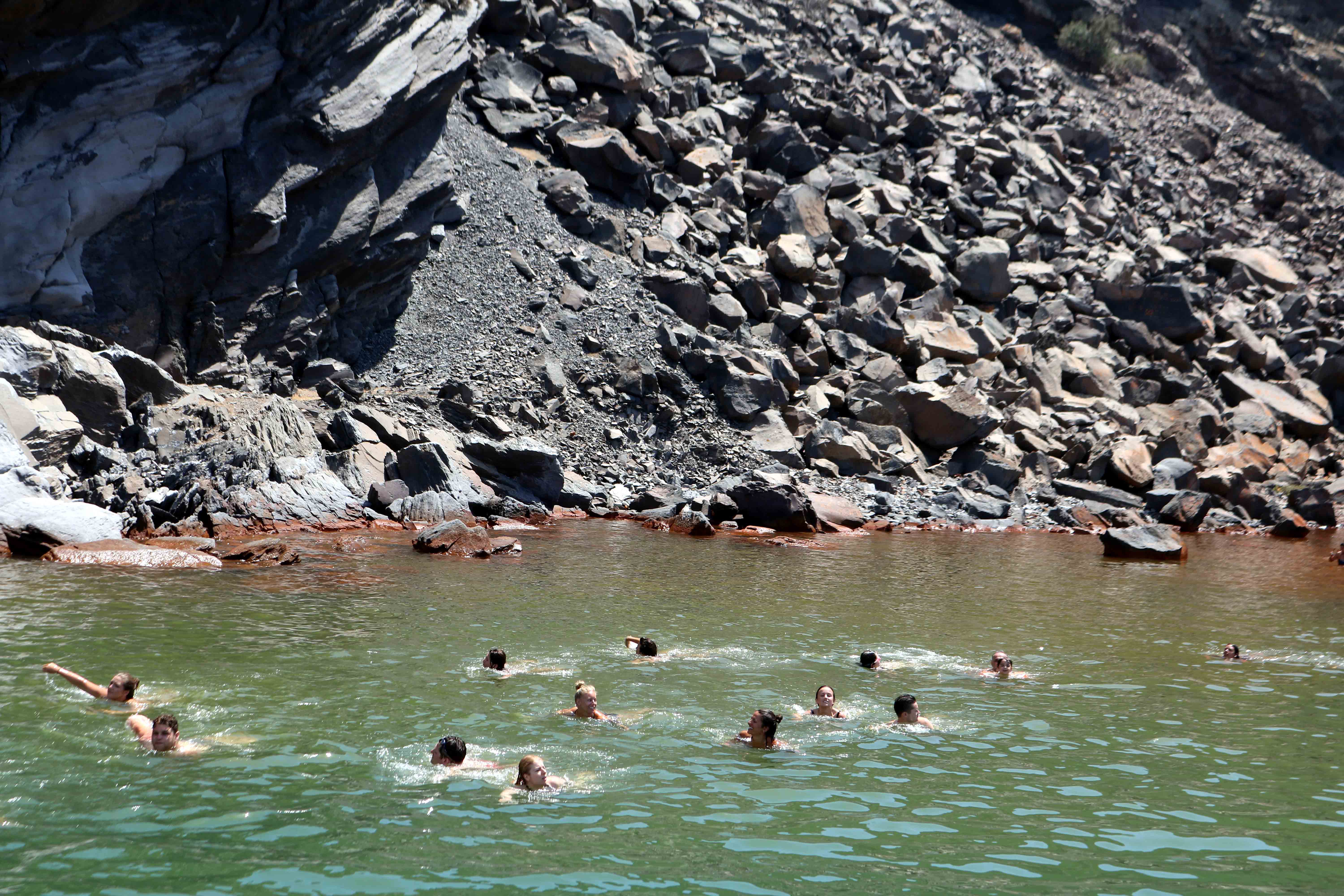
The boat anchored about 75 meter away from the hot springs.  We had to jump seven meters from the boat deck, plunging into deep cold sea water which is greenish yellow and then swim for about five minutes towards the orange coloured hot springs.  (Attempt this only if you are a good swimmer.)  At the mouth of the hot springs stands a little Greek Orthodox church dedicated to Saint Nikolaos, the patron saint of sailors in Greece.


Due to volcanic activity in the cove area, the water is warm and rich in sulphur, iron and manganese.   This gives the water an orange colour and is believed to have therapeutic benefits.  As one swims closer to the cliff where the water is orange, one can feel the increasing water temperature.  It is slightly warm and there is no fear of getting burned.  The seafloor around the hot springs is muddy, rocky and slippery, making it difficult to walk on.

After about half hour stay at the cove, a swim in the warm waters, a view of how the earth would have evolved, the boat steamed off to Nea Kameni, the younger sister island of Palea Kameni.

Wine & Sunset at Santorini


While at Megalochori, we visited Katsoyannopoulos Vineyard for wine tasting.  The vineyards of Santorini date back almost 5000 years and are believed to be the oldest in Europe.  Volcanic eruptions left behind a mixture of volcanic ash, pumice stone and pieces of solidified lava and sand, which together make up the soil of Santorini.   This soil, rich in essential minerals, result in wines with low pH level or high acidity.


About 1400 hectares is under vineyard cultivation in Santorini.


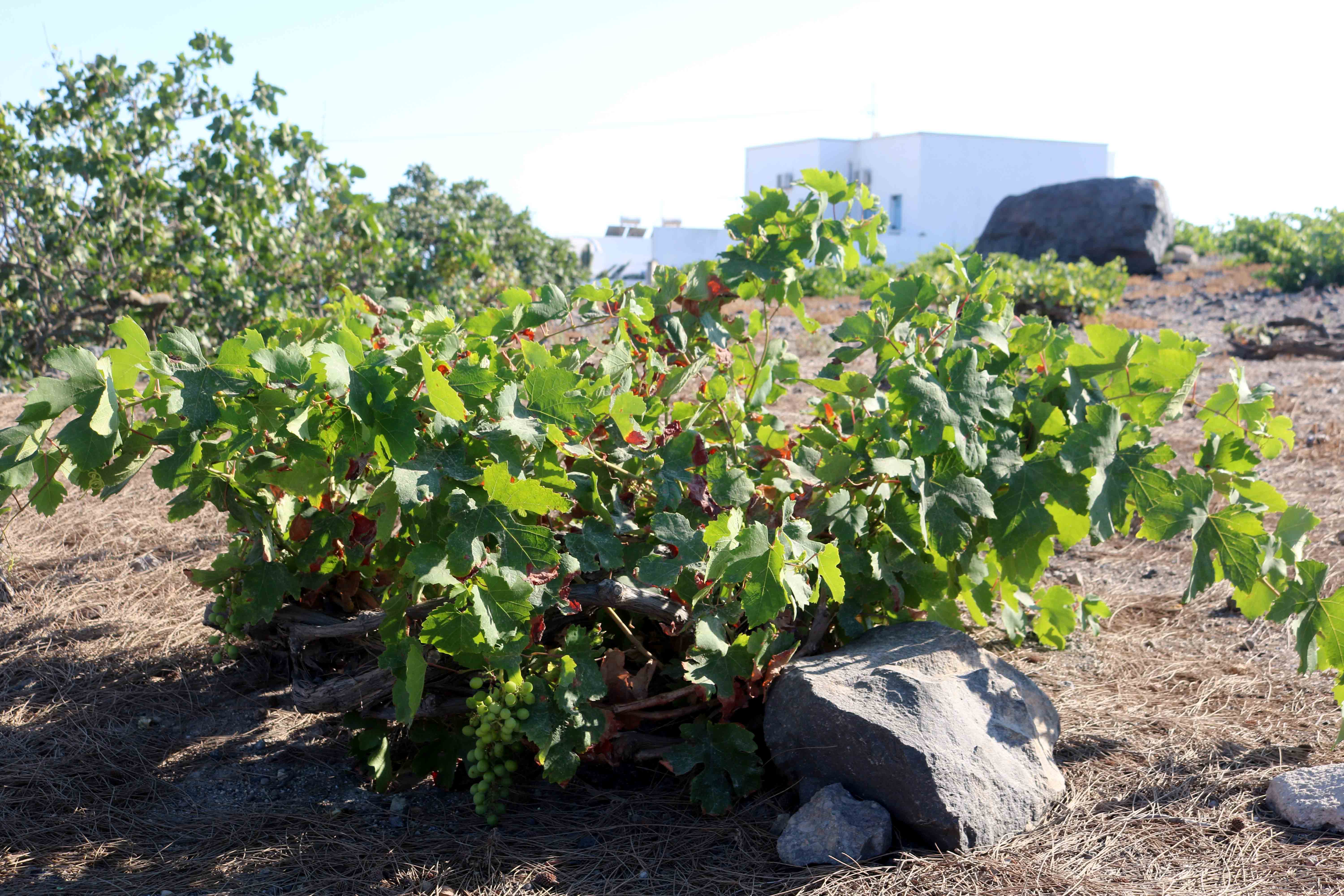
Lack of rain coupled with constantly blowing sea-winds has resulted in vines being grown in the “koulara” method, that is, they are woven into continuous circles to form a basket.  This protects the vines ion from the strong winds and the harsh summer sun.


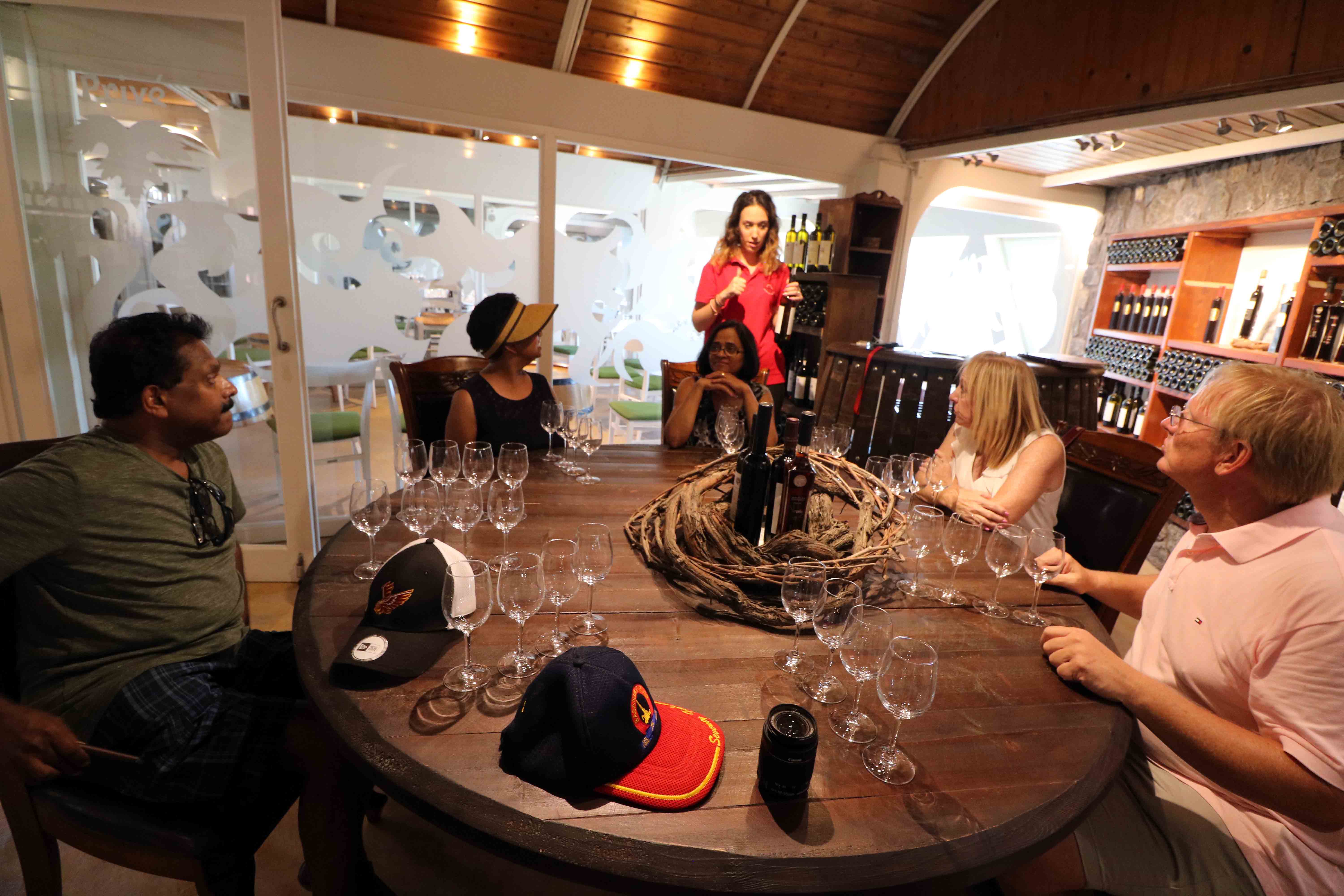
After viewing the vines, we visited the Wine Museum showcasing history of wine and the life of vine-growers in Santorini from 1660 to 1970.  It was followed by wine tasting where we tasted four vines – two red and two white.  The white wines from Santorini are bone-dry with a distinct aroma of citrus combined with hints of smoke and minerals from the volcanic soil.   The dessert wines are sweet with aromas of crème, chocolate and dried apricots.


From Megalochori, we drove to the northern tip of Santorini and reached the village of Oia (pronounced ia).  It is considered to be the best sunset viewing location on the entire island. Oia is one of the most beautiful and picturesque villages of Santorini, situated atop an impressive cliff.  It offers a spectacular view over the volcanoes of Palia and Nea Kameni and the island of Thirassia.


Like the other Greek villages and cities, cobblestone paved lanes led us through the village to its Western end.  Both sides of the lanes are lined with shops selling jewellery, paintings, gifts, etc.  There are many taverns, cafes, and restaurants too.

We visited the Church of Our Panagia Platsanis located in the village centre.  It was originally constructed inside the walls of the Castle of Oia. The church was rebuilt in the village center, on higher and more stable ground following the earthquake of 1956.


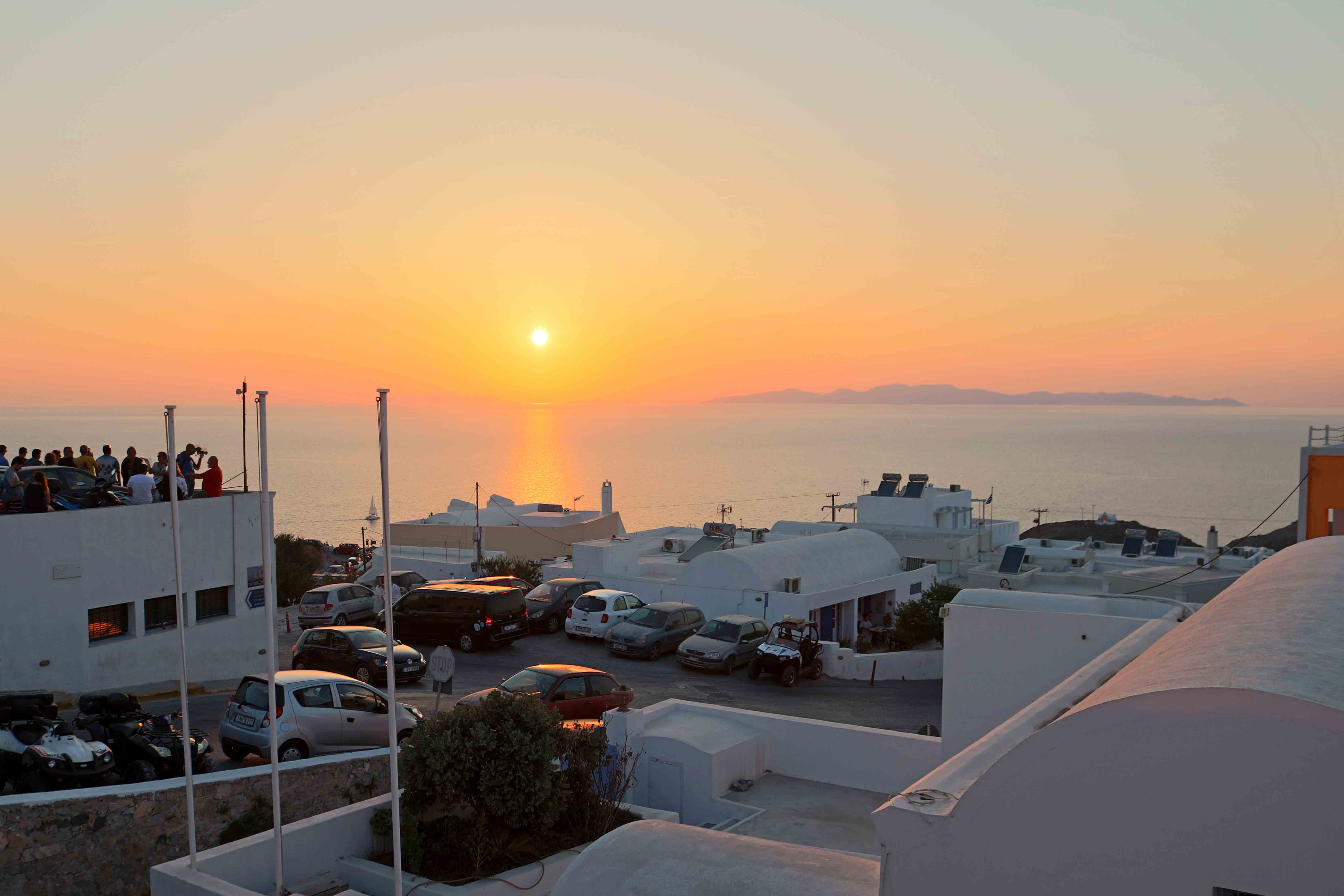
As the sun was setting, the area was getting crowded.  Every parking space was occupied and also all the seats in the cafes and restaurants were taken by tourists – all awaiting the sunset.


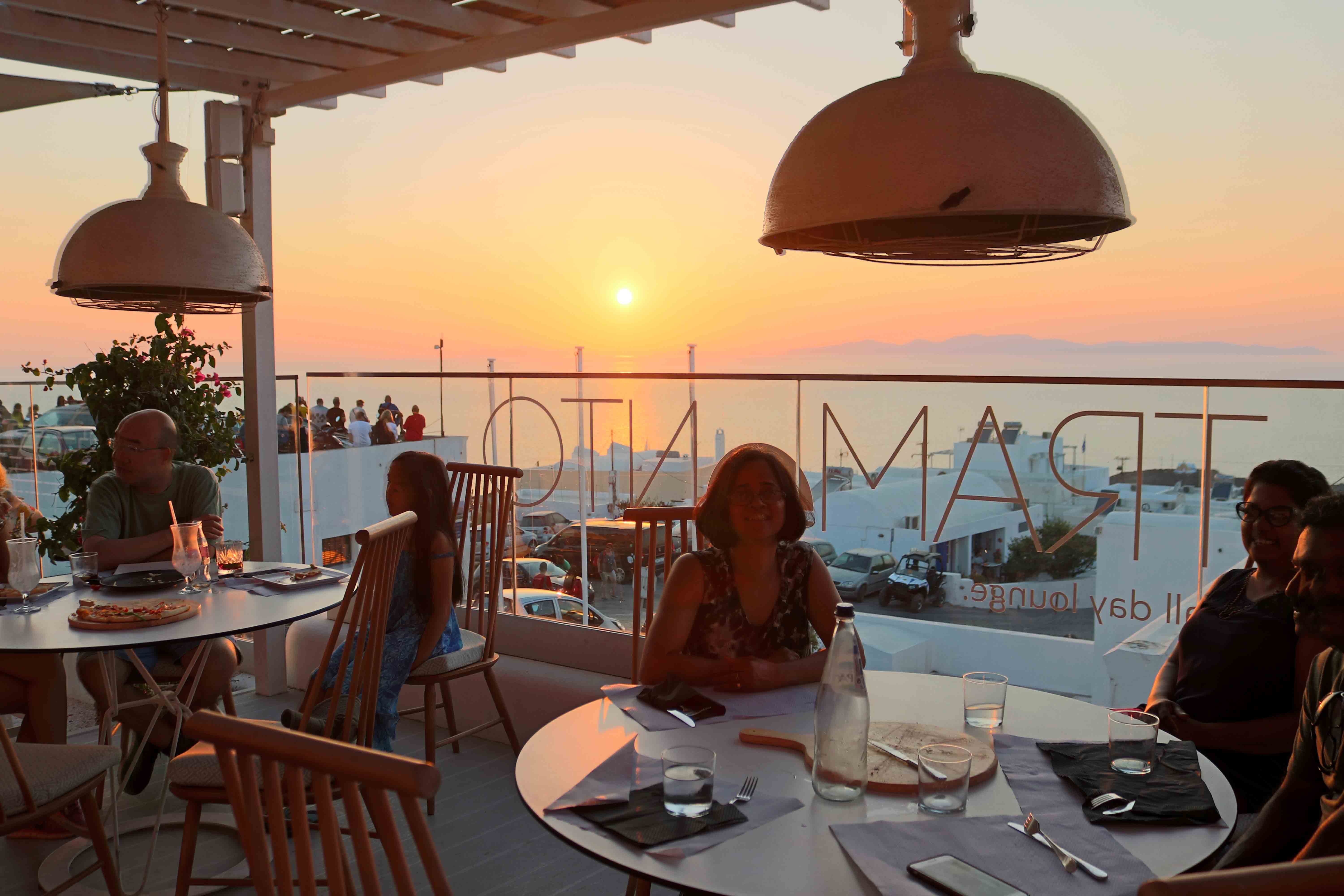
We too took up a vantage position at a cafe to enjoy every single moment of that spectacular natural phenomenon.


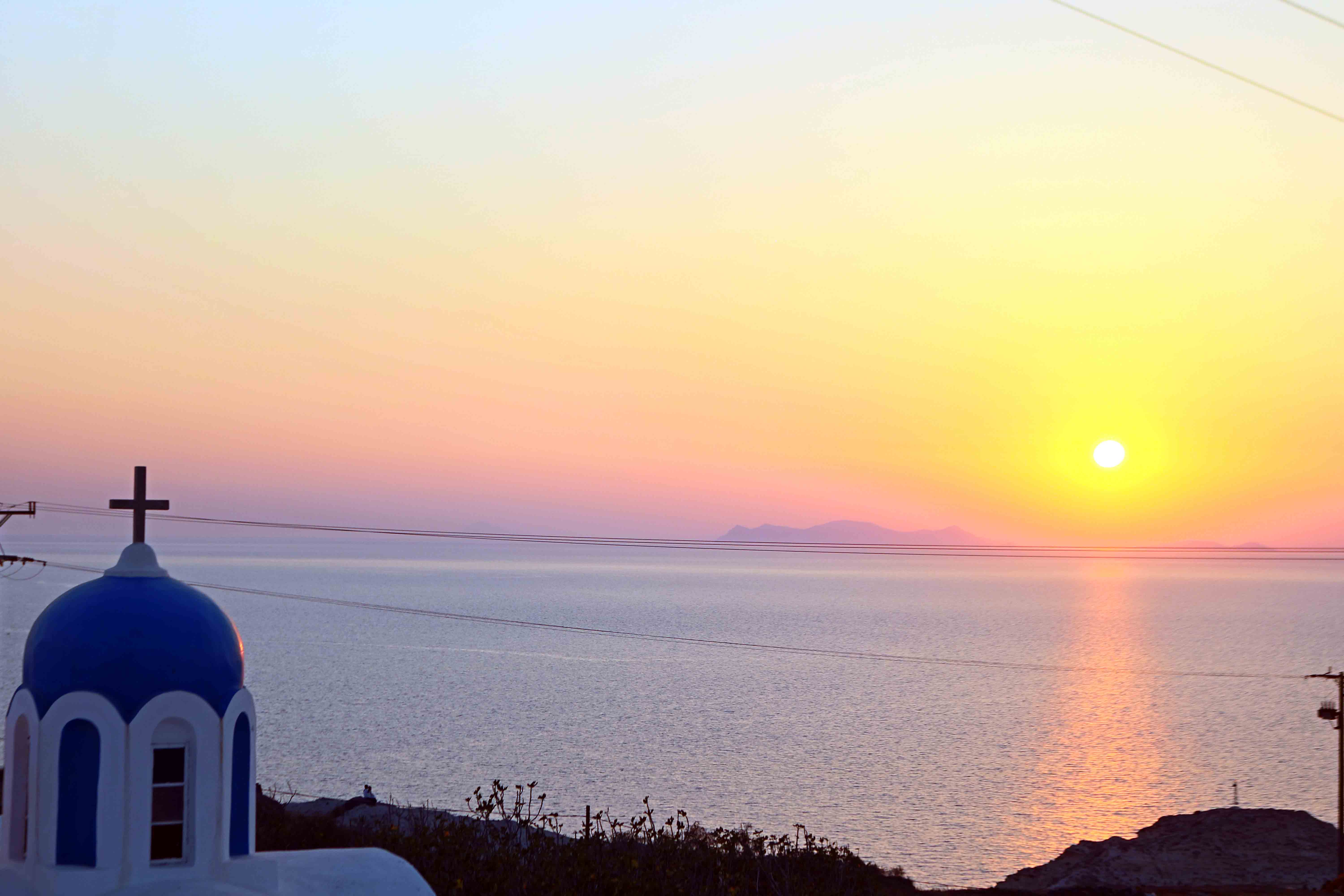
As minutes clicked past, the sky appeared to have been painted with various colors like yellow and orange in striking contrast to the blue dome of the church.


The sun then turned to myriad shades of pink and purple as it went down into the Aegean Sea. Sunset over water is often both spectacular and sublime. It’s just that we often wait until we reach Greece or some such similar destination to realize how incredibly beautiful it is. After watching the sunset and dinner, we retired to our beds after a tiring day of walking in the hot sun.

Santorini -An Island on a Volcano


On June 13, after breakfast, we sailed from Mykonos to Santorini Island on a high-speed ferry.  The voyage lasted over two hours.  The ferry offered comfortable seating and a few restaurants, but the menu was expensive as seen in all ferries in Greece.


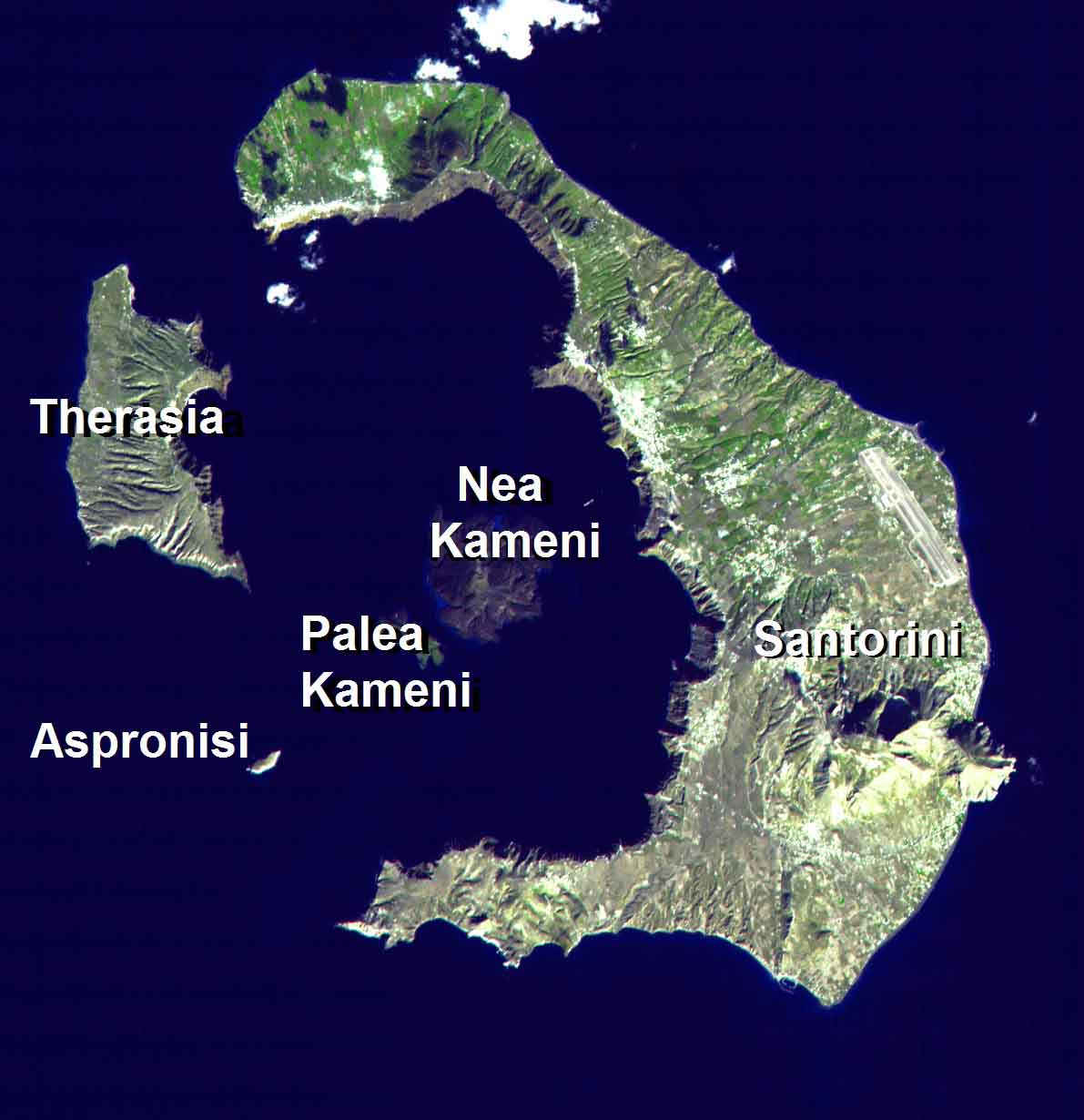
Crescent-shaped Santorini or Thíra in the Aegean Sea, is a group of islands consisting of Santorni, Therasia, Aspronísi, Palea and Nea Kaméni.  Santorini, the youngest volcanic land in the Eastern Mediterranean, is still an active volcano and probably the only volcano in the world whose crater is in the sea.  The islands that form Santorini came into existence as a result of intensive volcanic activity.  12 huge eruptions occurred, one every 20,000 years approximately, and each violent eruption caused the collapse of the volcano’s central part creating a large crater (Caldera). The volcano, however, managed to recreate itself over and over again.

The last big eruption occurred 3,600 years ago during the Minoan Age, when ash, pumice and lava stones covered the islands.  The eruption destroyed the thriving local prehistoric civilization, evidence of which was found during the excavations. The solid material and gases emerging from the volcano’s interior created a huge vacuum underneath, causing the collapse of the central part and the creation of today’s Caldera– with a size of 8×4 km and a depth of up to 400m below sea level.


Eruption of the submarine volcano Kolúmbo, located 6.5 km North-East of Santorini, on 27 September 1650, was actually the largest recorded volcanic eruption in Eastern Mediterranean during the past millennium.   The most recent volcanic activity on the island occurred in 1950.  The whole island is actually a huge natural geological/volcanological museum where you can observe a wide range of geological structures and forms.

Caldera is a lagoon of sea water surrounded on three sides by the steep cliffs of Santorini and on the fourth side by the island of Thirassia, which was part of Santorini before the eruption. The currently active volcano on the island of Nea Kameni sits in the middle of the Caldera.  It is active but presently not at risk of erupting.


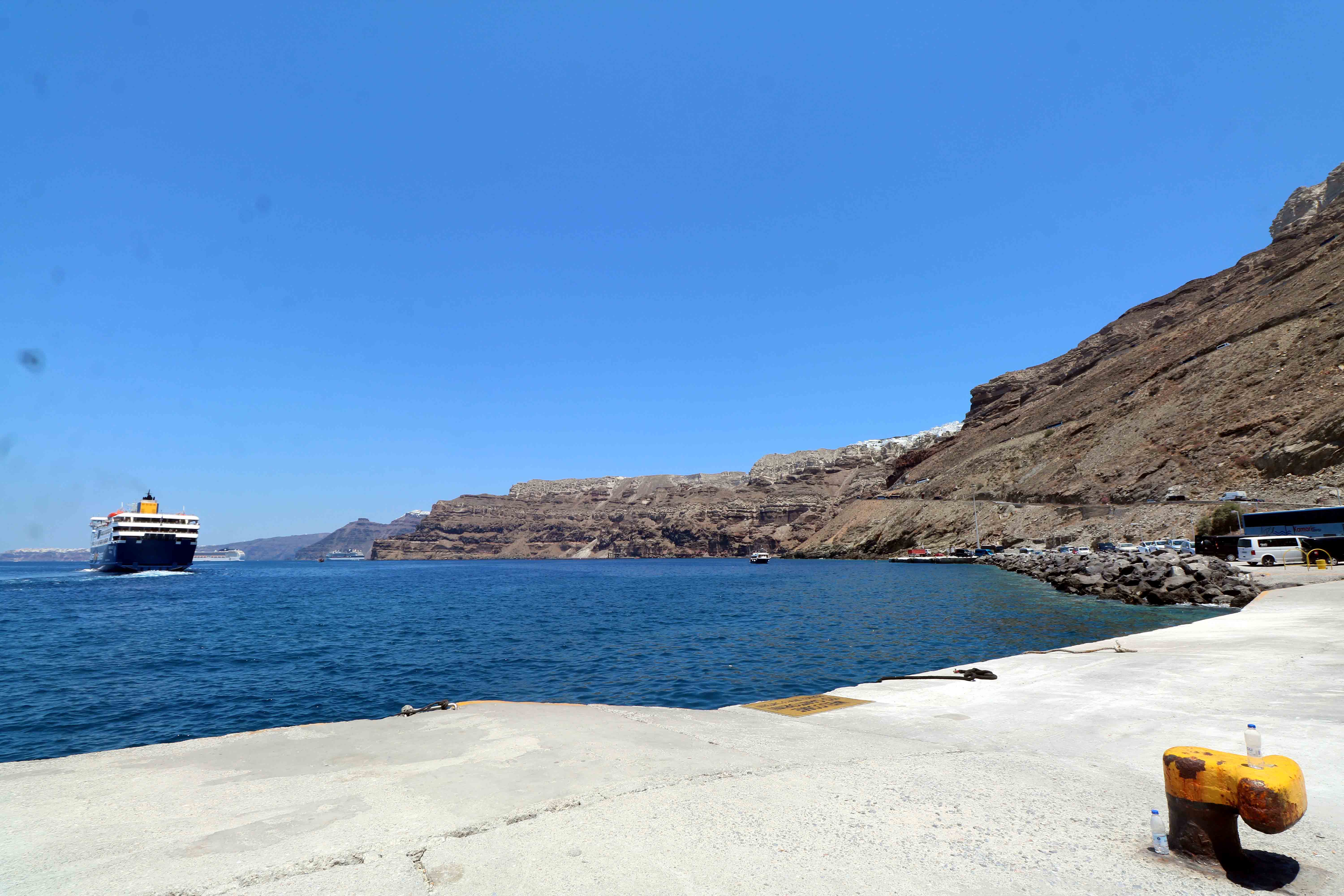
As our ferry pulled closer to Santorini Island, we could see the steep escarpment of Santorini Island formed due to volcanic activity.


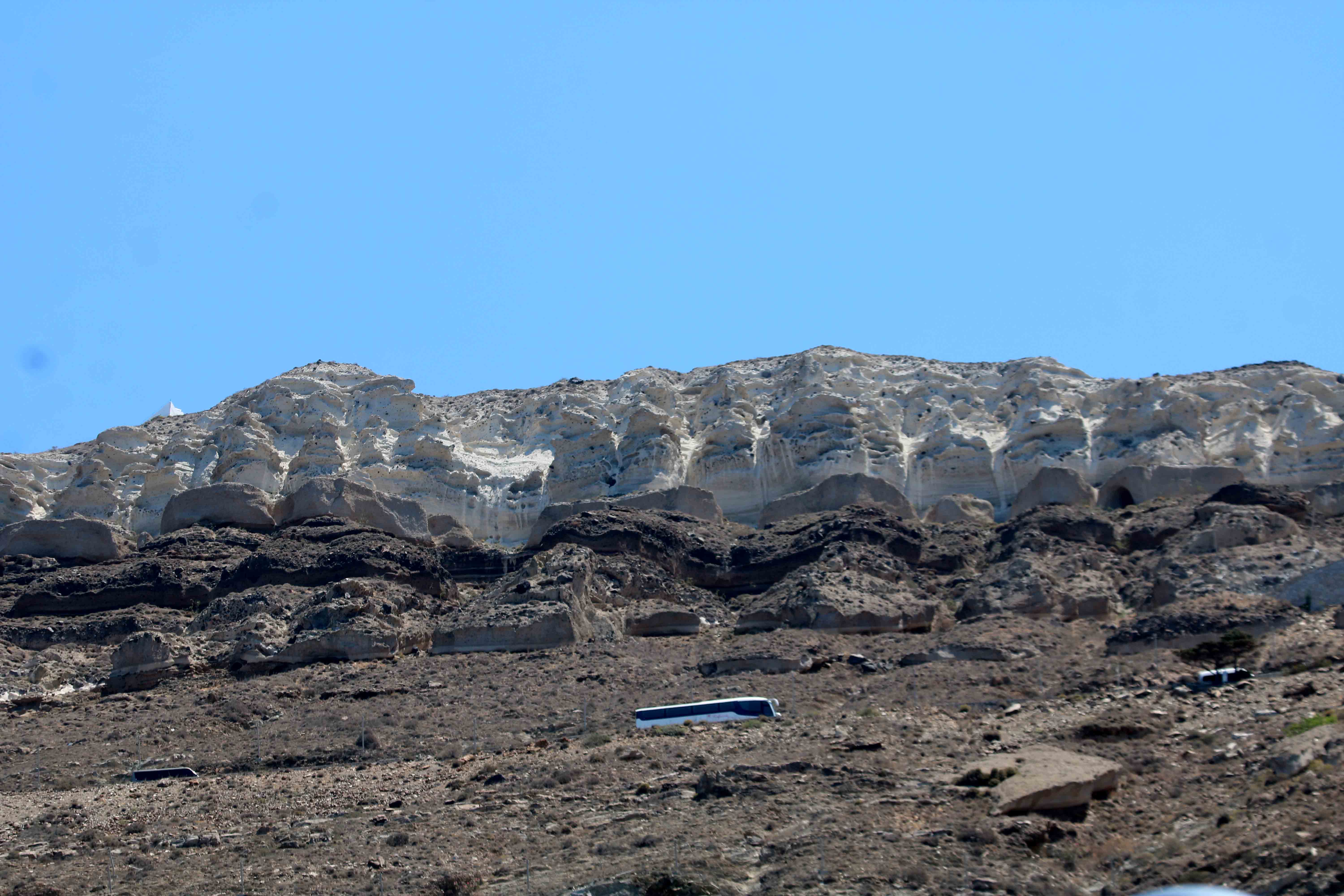
The colours of different layers of rocks up the escarpment is due to lava deposited during various volcanic eruptions.  The upper crust is mostly pumice and below it is red and black granite.


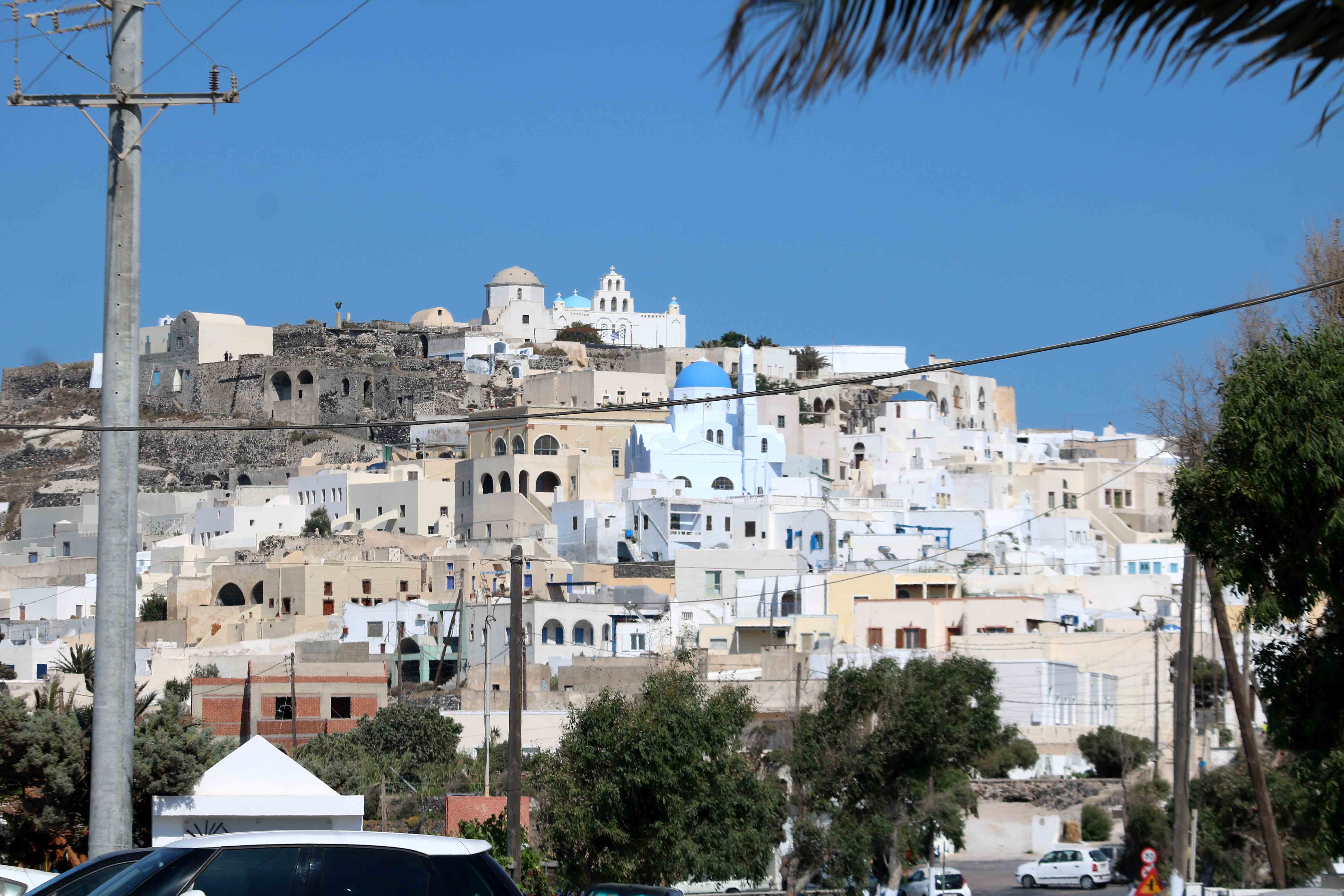
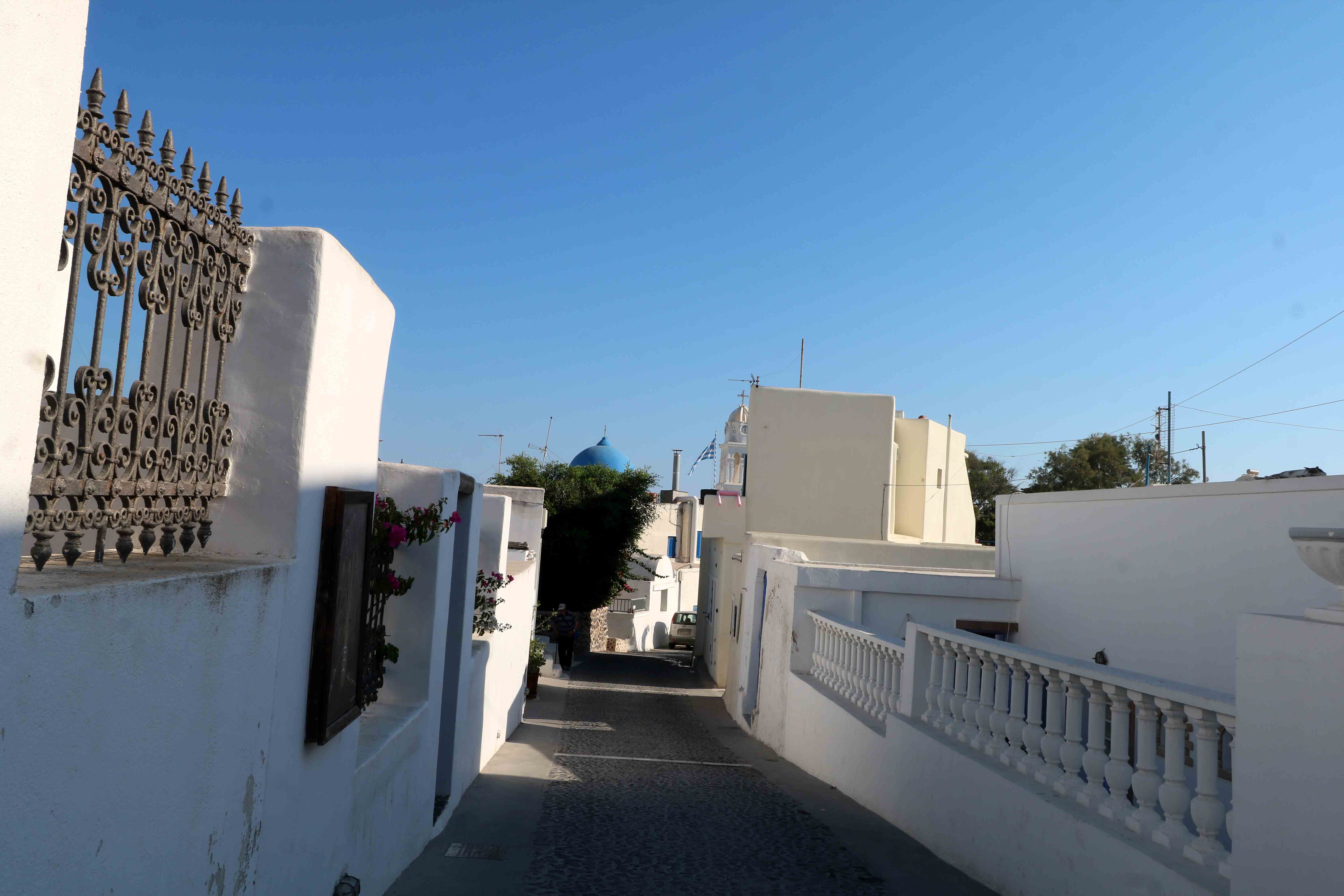
We  checked into our hotel and post lunch set out to explore Santorini.  Our first halt was Pyrgos, a medieval settlement that is nestled at the highest spot of the island. We drove up to the entrance of the settlement by taxi.  As the village lanes are narrow and cobblestoned, we had to walk up to the castle and churches atop the hill.  On to the left of the image above is the castle, which is well-preserved despite the serious damage caused by the earthquake of 1956.  It was built to protect the people from marauding pirates.


Pyrgos is said to be the first capital of Santorini, before the onset of the 19th century. It is built on top of a hill overlooking the Aegean Sea, which makes it an exceptional observatory.


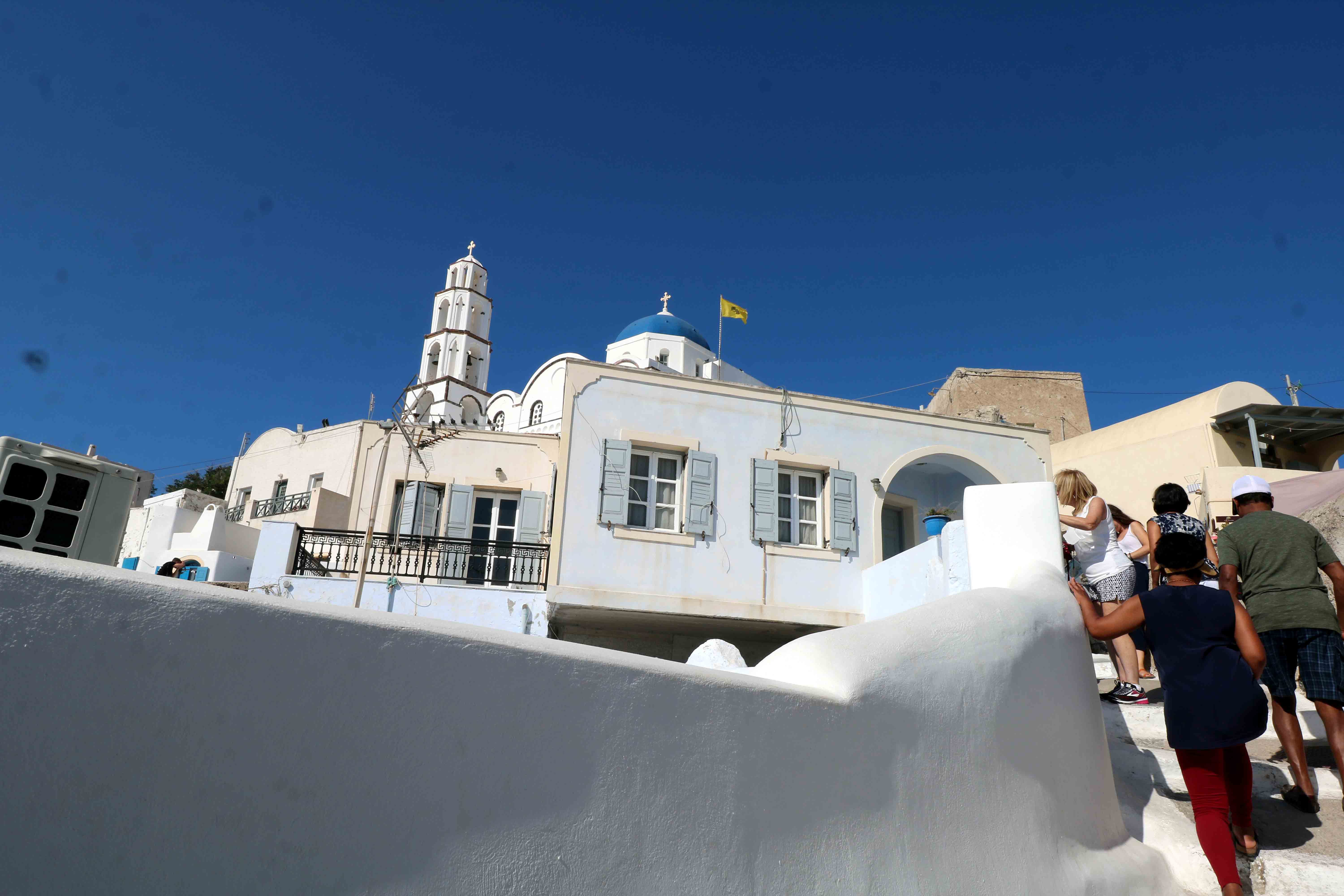
As we walked up the track, close to its entrance to the castle lies the church of Agia (Saint ) Theodosia.  This church was built in 1639 and renovated in 1857, but it collapsed in the earthquake of 1956. In its place, the present church was built in 1965.


Further uphill we walked and came to  the church of Christos.  The bell tower of the church is visible from a distance. This is the only church on the island with an octagonal cupola while the rest have a round cupola on top.  The bell tower and the yellow flag of Greek Orthodox Church resembles that of old Syrian Orthodox churches of Kerala.


We walked downhill and drove to the village of Megalochori.  Here we all for the first time saw a Pistachio tree with fruit.  The debate that erupted amongst us was as to whether Pistachio is a nut or not.  Pistachio, though known as a nut, the fruit of the Pistachio is botanically a drupe, a type of fleshy fruit (like a coconut), the edible portion of which is the seed.


Megalochori  offers a nice mix of white Cycladic (Cyclades –a civilisation that existed in the Bronze Age)  houses, several churches and narrow alleys.  A prominent feature of the historical homes and mansions are the high walls, inner courtyards and solid wooden door entrances, built for privacy and for safety against pirates.


In the center of the village, stood a wonderful traditional square with taverns, restaurants with bougainvillea-covered patios and trees providing shade for a quick cup of coffee. The square is the heart and soul of Megalochori, a gathering place for the locals to play a game of cards


Megalochori has two well-known bell towers spanning the street. This one is part of the Panagia church and is characterised by the clock on top.

Megalochori is famous for its winery and wines and we went ahead to visit a winery, covered in the next part.

Exploring Mykonos Island


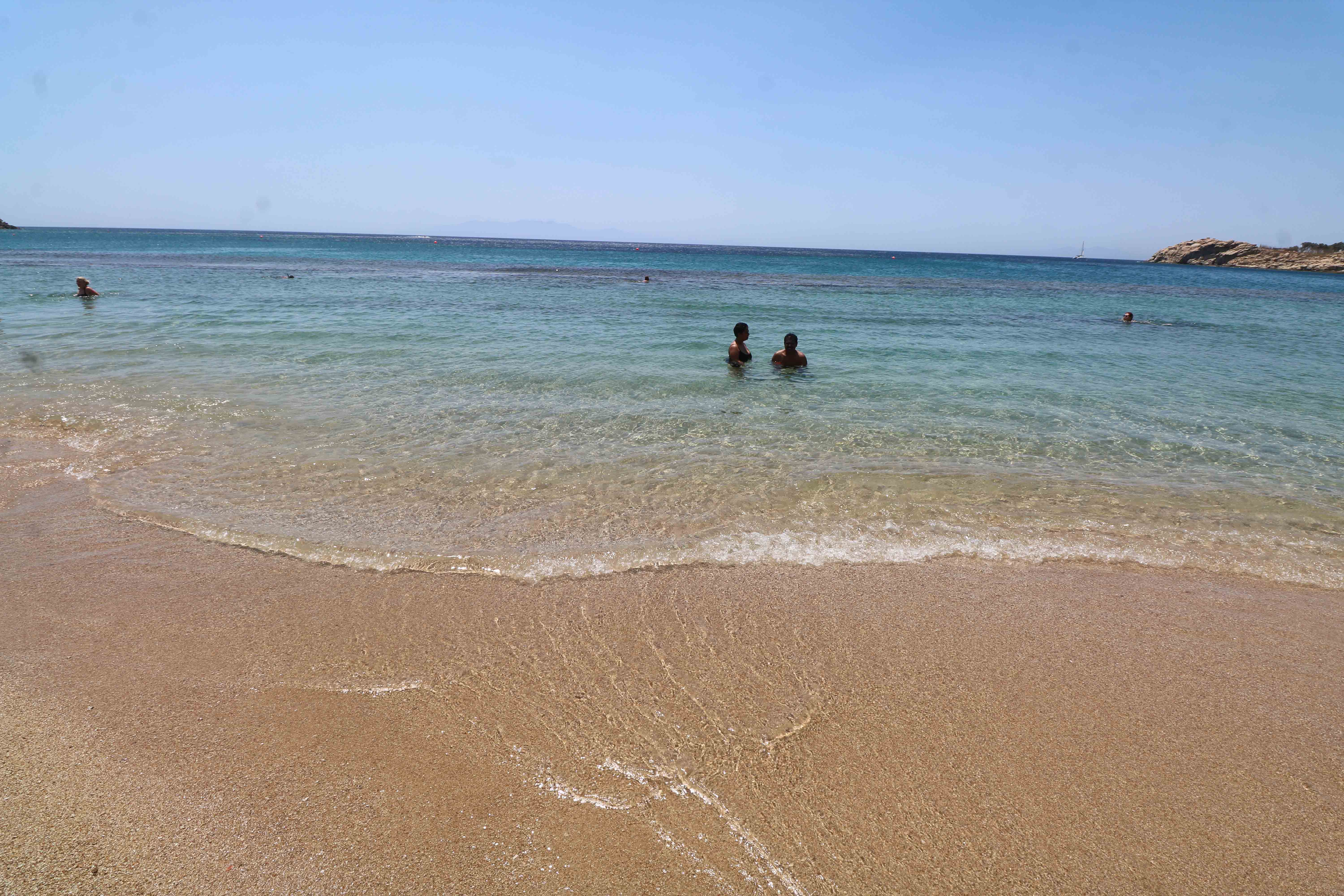
June 12, Tuesday, was spent exploring Mykonos Island.  After breakfast, we boarded a bus from Chora to Paradise Beach, a 10 km trip. We walked about a kilometer to reach Paradise Beach.  Here we rented a canopy with sun-beds.  We enjoyed a swim in the cool, crystal-clear, blue green coastal waters. The setting simply forces you to adopt a laid back attitude and let the rhythm slow down under the warm and bright sunlight. A local Greek cocktail played its part too.


The famous Paradise beach is a nice, flat, white-sandy beach of impeccable beauty, dotted with a number of popular bars.  It is a getaway, mainly for the young and also for the not so young.  It is now Greece’s number one open-air seaside clubbing venue.  There is live music playing from all the restaurants.  Sun-beds with grass canopy are available on rent. It has to be seen to believe.  The place comes alive mainly with the hep crowd, young, wild and rich. Glamorous parties and endless entertainment in the infinite sunshine with a picturesque landscape as a backdrop.


After lunch, we returned to Chora.

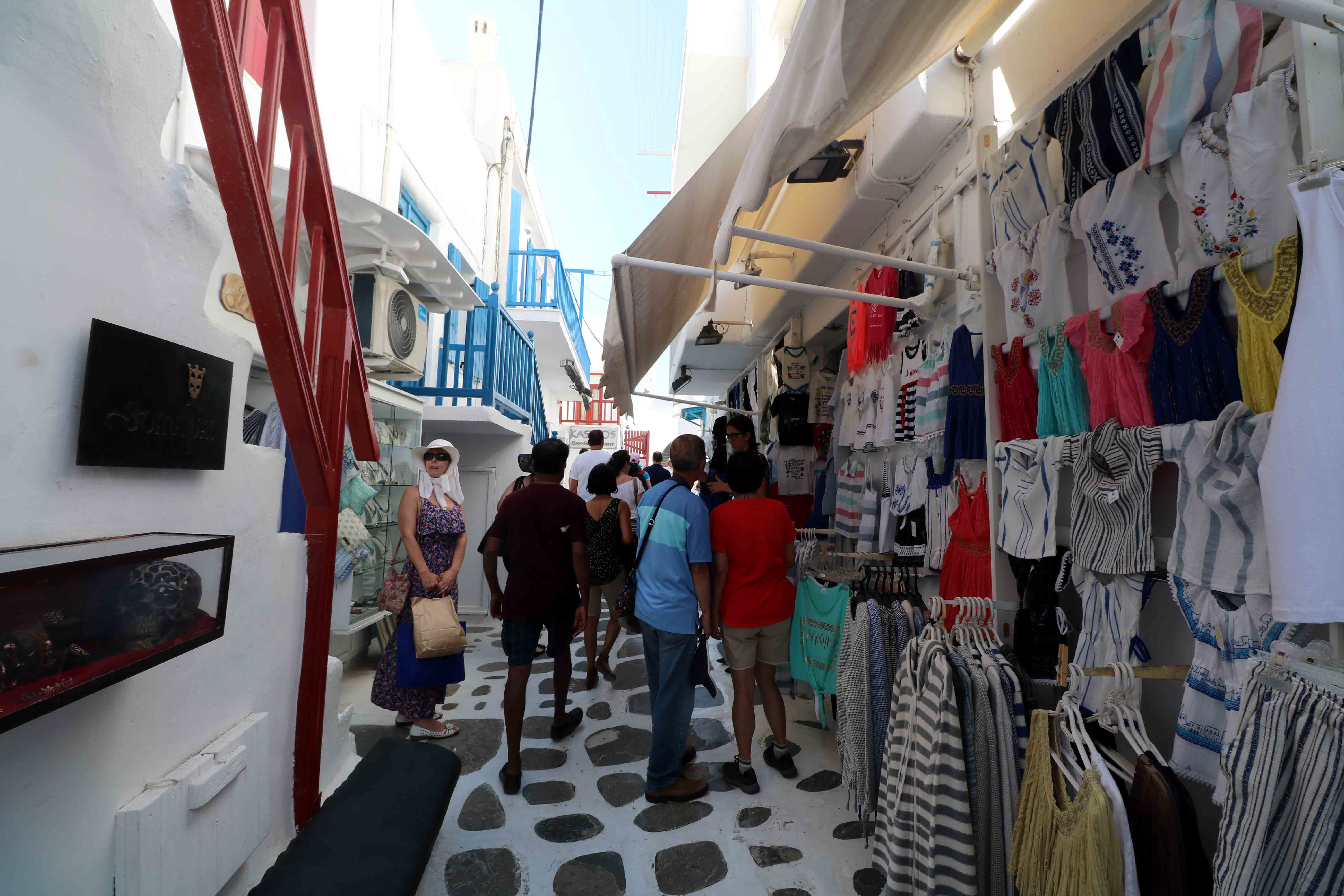
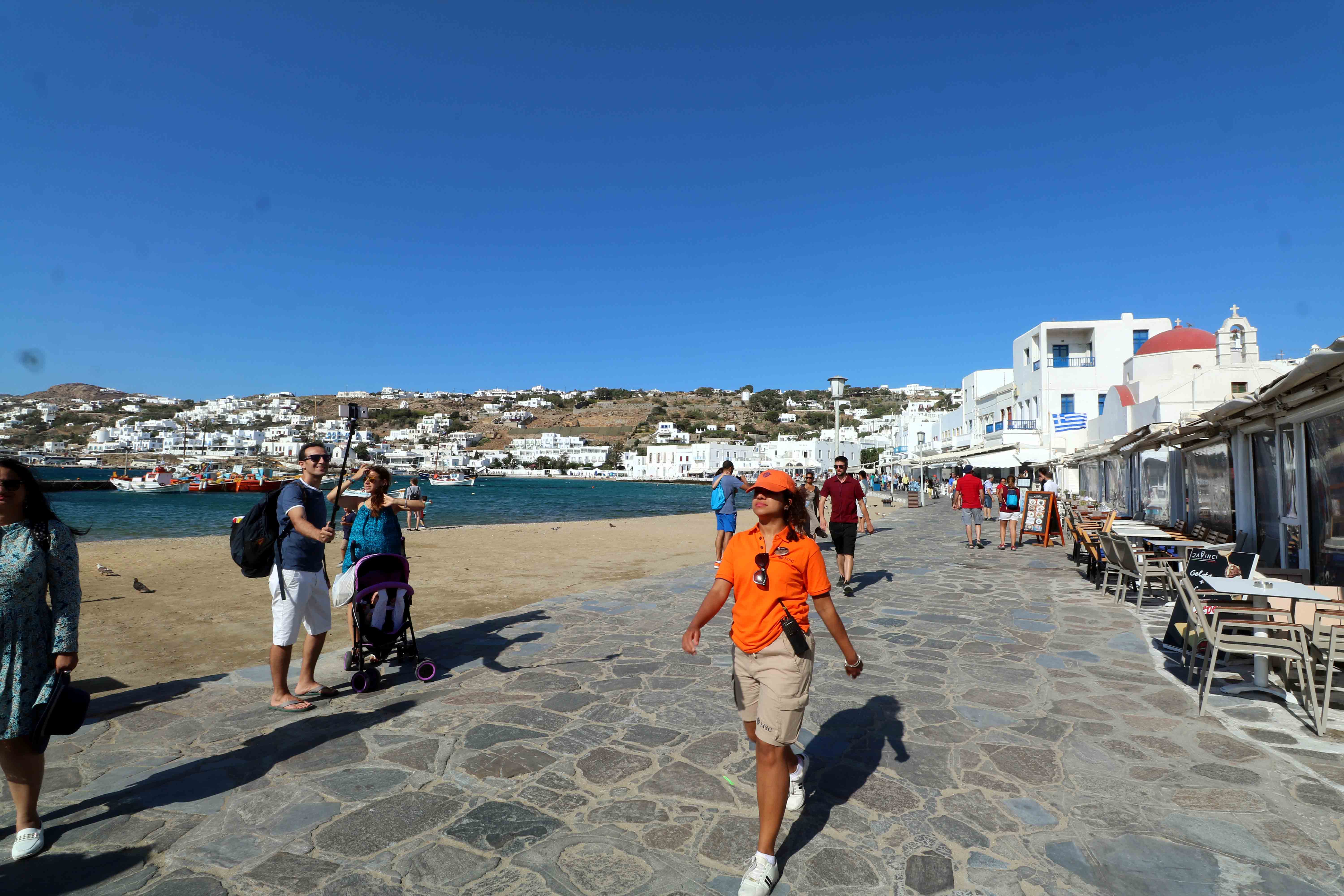
Located on the island’s Western harbour is Chora.  It is a very beautiful old town, which in the past was visited by merchant fleets from all over. Today it has become a popular tourist destination.  There are whitewashed houses, windmills, a multitude of chapels, busy back streets with balconies full of flowers and multi-coloured fishing boats in the port.  It becomes very crowded after sunset as tourists throng this luxurious marketplace, restaurants, bars and discos.


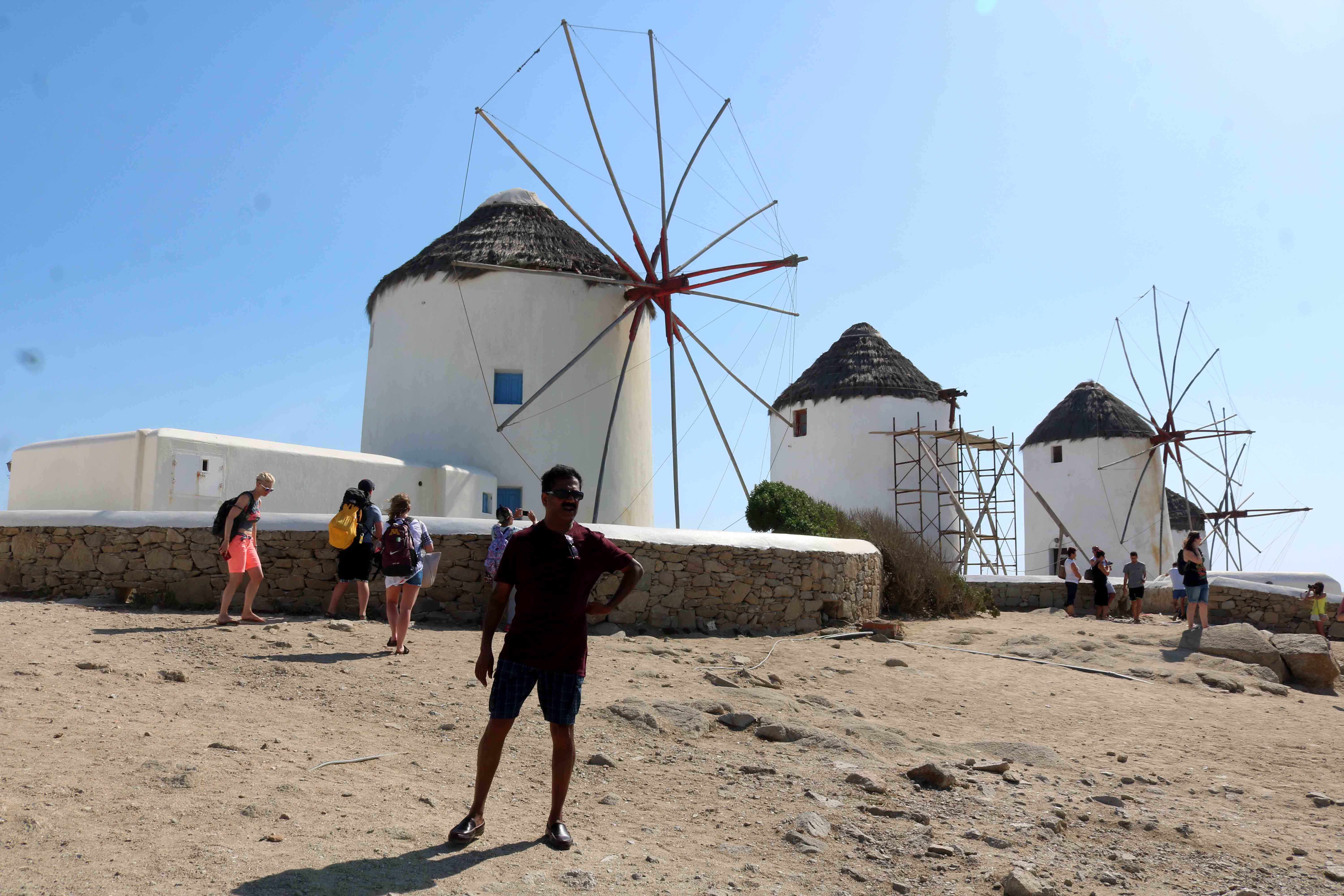
We got off from the bus and headed towards the windmills on foot.  From as early as the 16th century these windmills have been the classic landmarks of Mykonos. Due to its geographic location, Mykonos being situated on major sea trade-route, traded in grains. The need to grind grain flour and then ship it out to distant lands, must have made Mykonians to set up windmills, as there was plenty of regular wind all the year round.  To facilitate easy access to the harbour, these windmills were positioned in or around the main port.

The windmills of Mykonos must have contributed to the economic prosperity of the island in those days.  In 1700 AD, about 11 windmills were in operation around the port.  With the advent of modern technology, especially after World War I, these windmills ceased their operations as more efficient flour mills were commissioned. Today these well preserved windmills stand as iconic landmarks of a medieval period, sentinels of simplicity to balance the surfeit of all round glamour!

Though the Greek islands have been blessed with strong dry winds that blow from the Aegean Sea all through the year, we did not come across any wind turbines in any of the islands we visited.  There were no solar panels either to be seen.  May be the Greeks did not want to displease Anemoi – the Geek God of wind – and Helios – their Sun God.


From the area of the windmills, narrow and endless cobblestone paved alleys lead us to Little Venice.  It is a charming little area looking into the sea.  Buildings with balconies that overhang the water and the windmills in the background make this area the subject of many paintings and is a photographers dream.


Little Venice is an area that lines the waterfront with rows of Eighteenth century fishing houses with balconies that jut into the sea. These houses originally belonged to shipping merchants which gave them direct access to the sea. Being built right on the water, it resembles Venice of Italy, hence the name ‘Little Venice’.


The old fishing houses have been converted to house cafes, restaurants, bars and shops. Taking advantage of the beautiful view both by day and especially at sunset, restaurants have been set up all along the sea front, to give diners a unique experience.  It is quite peaceful during the morning but afternoon onward, you will be jostling for a seat. This area becomes a beehive of activity at sunset as thousands of people throng here to watch the enchanting sunset

Most of the cafes will start putting out reserved signs on the tables that are right on the edge of the sea as these are the prime tables. You may not find fine dining here but it is all about the experience of sitting beside the seawaters for a special dinner, a once in a life time experience.


Like in Venice, the balconies of houses here are interconnected over the lanes at many places.  It is to facilitate the residents to move around in rains without getting their feet and shoes wet and muddy.


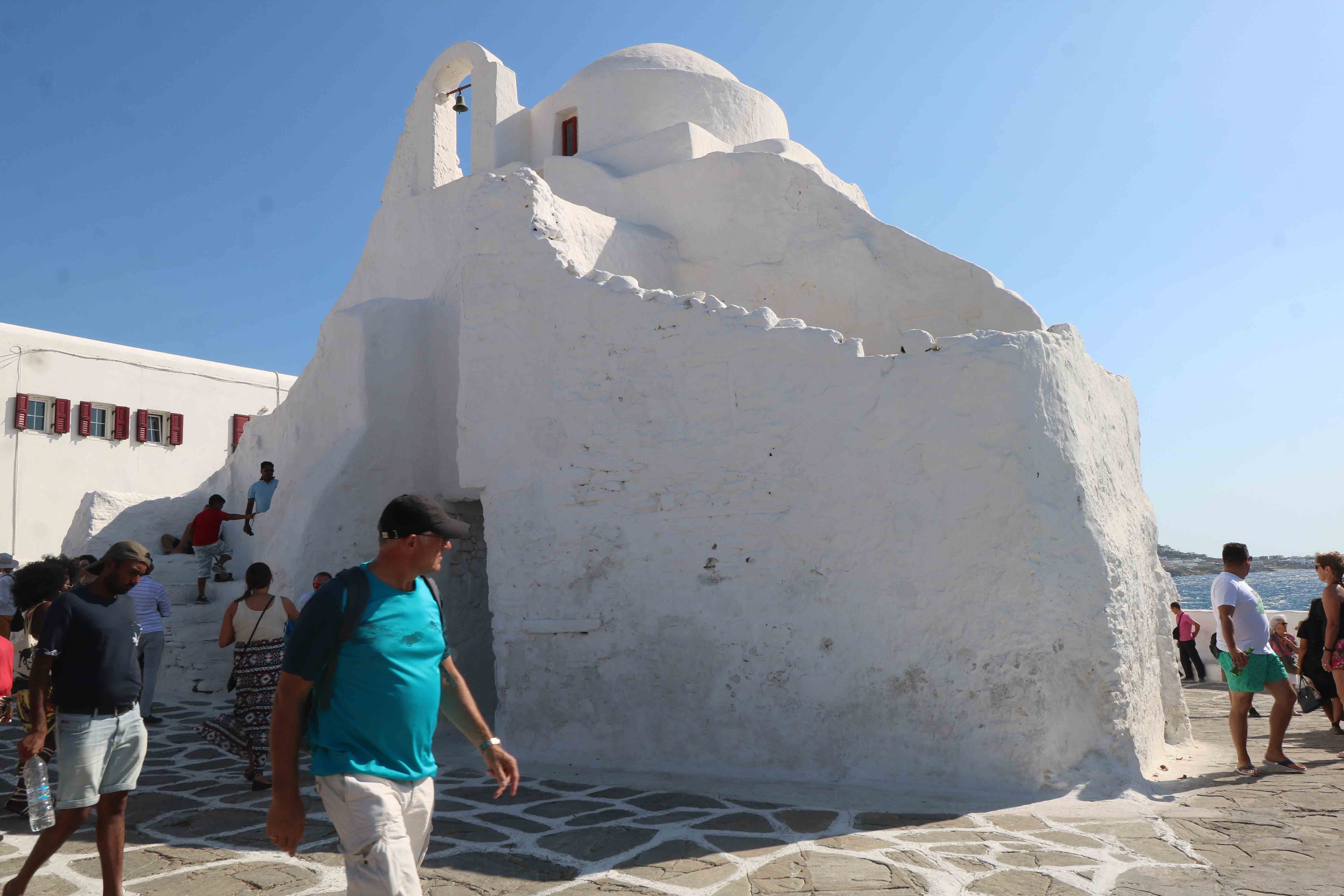
Surrounded by the boutiques and bars in Little Venice stands the flower-bedecked Church of Panagia Paraportiani (Our Lady of the Postern Gate). This church is a cluster of four whitewashed chapels, topped by a further bright white chapel on the upper storey, reached by an external staircase. Built between the Fourteenth and Seventeenth Centuries, the church once guarded the entrance to the town’s castle, long since destroyed.


The multi-layered nature of the church gives it a unique shape, rising from the squared-off white chapels on the ground level to the domed church of the Virgin Mary on the top.  The church has no windows or doors as seen from the sea.  Rather from the seaside, it does not resemble a church.  It was constructed this way not to attract attention of attacking pirates.


From Chora, we took a bus ride of 10 kilometres to Elia Beach.  Elia is the longest sandy beach of Mykonos, offering a wide choice of taverns and bars as well as water sports facilities such as water-skiing, parasailing and windsurfing.   There are comfortable lounge beds and umbrellas lined along the sand.  We enjoyed the views of the Aegean Sea and the nearby island of Naxos on the horizon, obviously with a cocktail in hand.  Elia is one of the most popular nudist and gay beaches in Mykonos.


We returned to Little Venice in the evening, well before sunset to take up our reserved seats at the restaurant at the brim of the sea.  The area was thronging with tourists as everyone comes here in the evening, to watch the magnificent sunset.  As the sun goes down, the sky shows off some brilliant colours of red, orange and pink.  The reflection on the water is awesome. The expression “picture perfect postcard” some how seemed be so very apt. At sunset, we watched a profusion of colours ever so slowly leak out of the Aegean sky, enjoyed a sumptuous Mediterranean dinner, mainly of seafood and Greek salad and then returned to our hotel, quite exhausted and a lot more contended.


Mykonos Island- A romantic Getaway


Early morning on June 11, we checked out of the hotel and drove to Piraeus Ferry Port and boarded the high-speed ferry operated by Hellenic Seaways.  The journey of about three hours was very comfortable, more so because it was a large ferry and hence more stable.  Food in the restaurants onboard was pretty expensive. Luckily our hotel had provided us with packed breakfast.  I would recommend travellers to read a book or watch a downloaded movie during this journey.


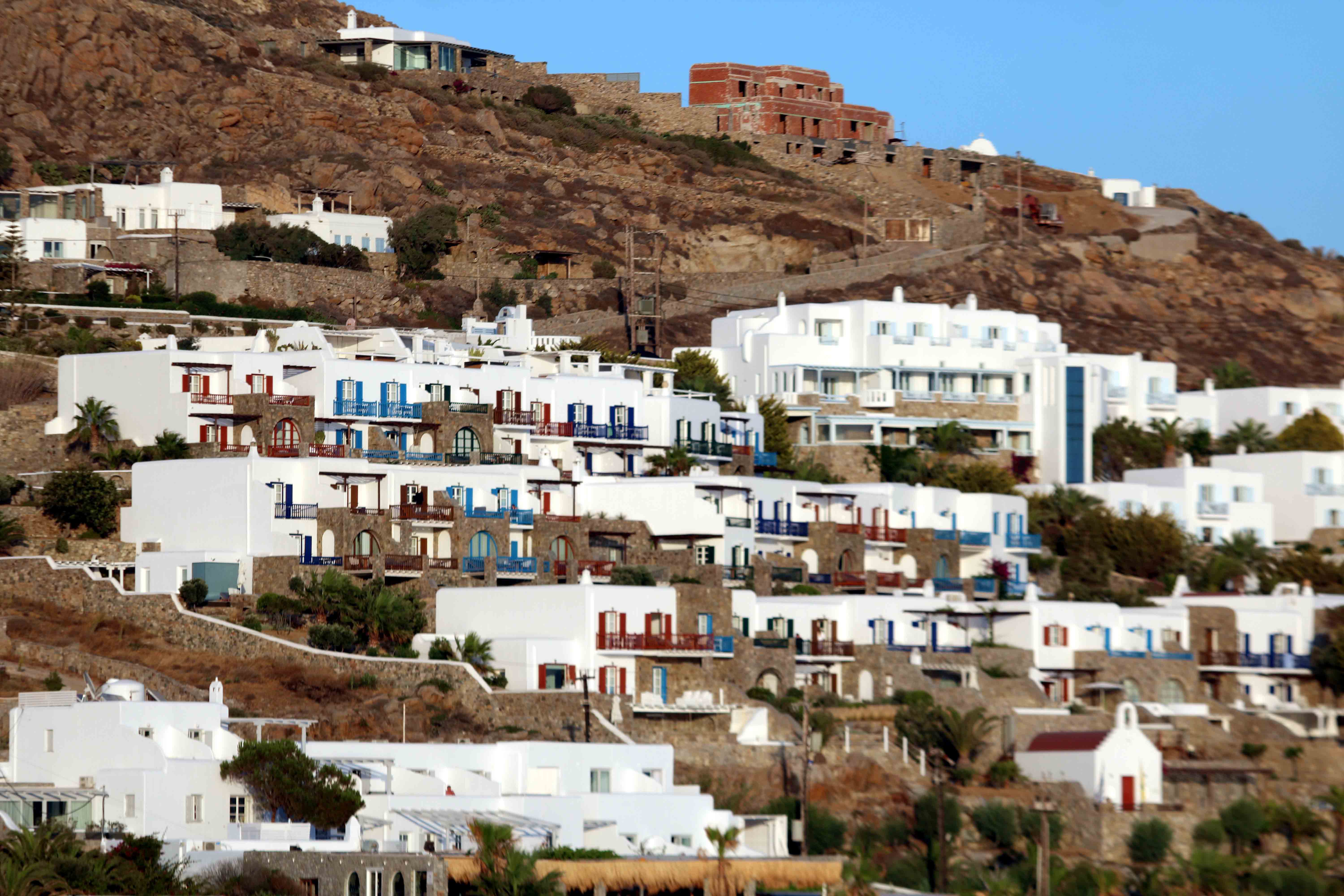
After three hours of sailing on the Aegean Sea, Mykonos Island with its prominent whitewashed buildings with blue windows and doors came into our view.    As per Greek mythology, Mykonos was formed from the petrified bodies of giants killed by Hercules. The island took its name from the grandson of Apollo, ‘Mykonos’. Some how, all these Greek deities still seem to be hanging in the air.


It is mandatory in Greece for the houses to be whitewashed with blue painted windows and doors – the colour of the Greek flag.  In 1974, the then military government made it a law that all houses must be painted in the beautiful Greek colors of white and blue as a patriotic gesture to represent the colours of the Greek flag.  The law remains in place although some island authorities have begun to permit other pastel colours.


Mykonos is one of the islands of the Cyclades and is one of the most beautiful sites, very popular with tourists traveling to Greece. It is a relatively small island, measuring 85.5 km2; inhabited by about ten thousand people.  Tourism is their mainstay and they receive visitors from all over the world with open arms.  Mykonos has a rich night life with many restaurants and cafes which attract famous performers and the not so famous ordinary people and lots of young couple in love. Add white sandy beaches, crystal clear, blue green sea and breathtaking cliff-side views, make it a romantic paradise.


Myknonian landscape is dotted with many churches and many more little chapels.   It appeared that every household or family had a small chapel attached to their homes.  Roof of these small chapels were painted blue, red or white, depending on the family occupation.  Red indicated that the chapel belonged to a farmer family, blue meant the owning family are seafarers, sailors or fisher-folk, and white indicated that the family were migrants.  .


As per Mykonian customs, the bones of a person buried in the church is excavated by the priest after six years and is handed over to the family.  The family then place the bones in their family chapel.


98% of Greek population is Greek Orthodox Christians and the rest two percent is Muslims, Catholic and Jewish. Greece and Russia are the only countries to have such a great proportion of Orthodox Christians. Even though Catholics  and Orthodox  believe in the same God, they differ in that for Catholics deem the Pope as infallible while Orthodox believers don’t.   Catholic priests cannot marry, while Orthodox priests can marry before being ordained as a priest.  Latin is the main language used during Roman Catholic services, while Orthodox churches use native languages.  Catholics venerate statues as much as  Orthodox believers venerate icons.

Our family belong to the Syrian Orthodox Church of Kerala, India.  It is believed that Saint Thomas, disciple of Jesus, spread Christianity in Kerala in the First Century.  These Christians received episcopal support from Persian bishops, who traveled to Kerala in merchant ships through the spice route. Hence they are called Syrian Orthodox Christians and use Syriac and Malayalam – language of Kerala – in their services.

After checking into our hotel, we travelled to Ano Mera, a village about seven kilometers away to visit the 18th Century Monastery of Panagia Tourliani.


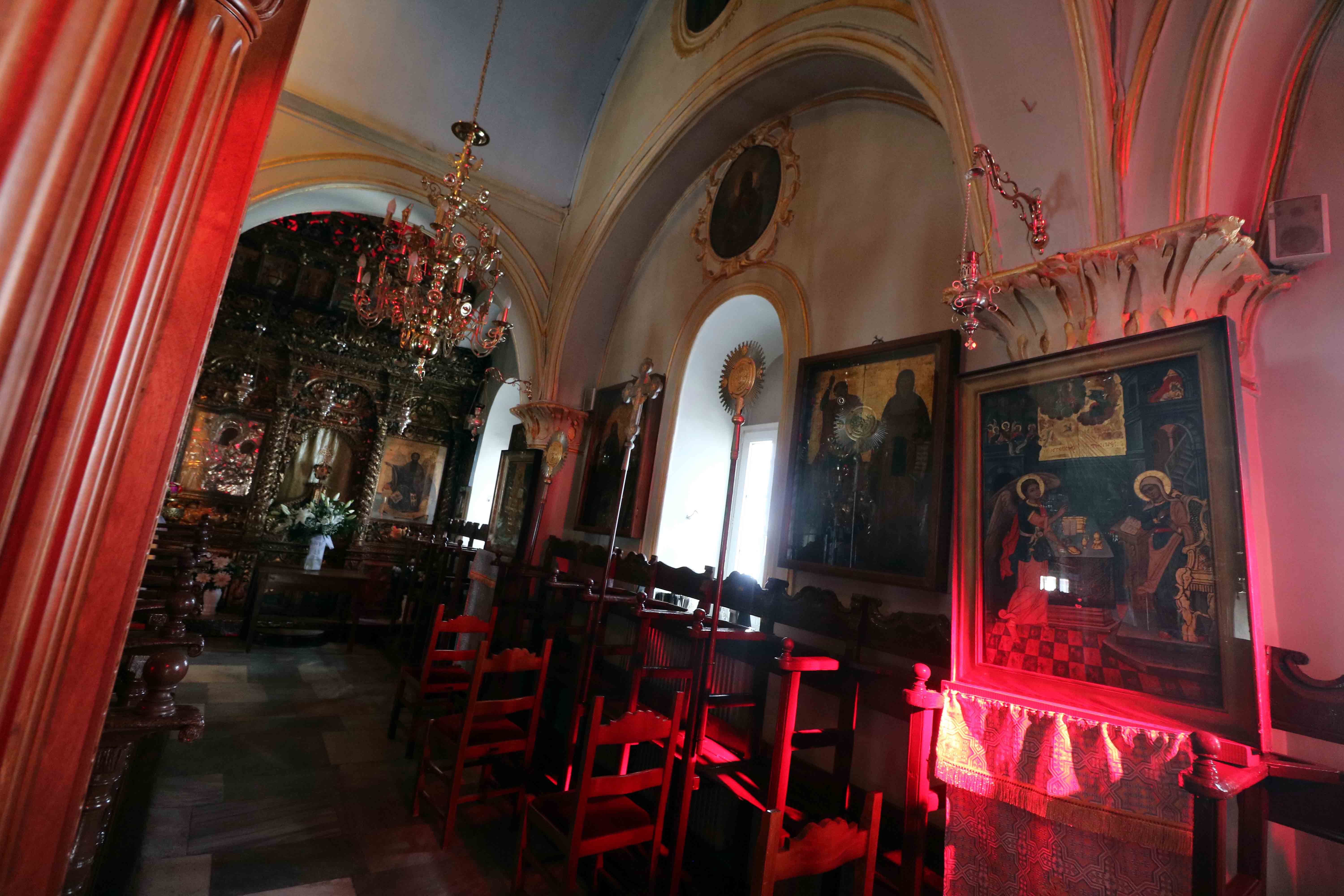
The church looked almost similar to many of our Syrian Orthodox churches in Kerala.  A marble bell tower with intricate folk carvings was a standout point of the church building.


The altar screen, like those seen in our Orthodox Churches, has small icons carefully placed amid the wooden structure’s painted green, red, and gold-leaf flowers.  At the top are carved figures of the apostles and large icons depicting the New Testament scenes.


Most liturgical instruments used during prayers looked similar to those in our Orthodox churches.


After lunch, we walked to the jetty at Mykonos Port to board a boat to the island of Delos.  According to Greek mythology, Delos is the birthplace of Apollo, God of music, and his Moon-Goddess twin sister Artemis, Goddess of hunting.  In 1100 BC, Delos was inhabited by the Ionians who worshiped God Apollo. (The Ionians were one of the four major tribes that the Greeks considered themselves to be divided into during the ancient period; the other three being the Dorians, Aeolians, and Achaeans.)  The Ionians also managed to develop the island into a powerful commercial and spiritual centre (7th century BC).  Thereafter, the Roman period was the most prosperous and wealthy period for Delos which turned the island into an important port.  In 88 BC, the King of Pontos who was against the Romans completely destroyed Delos and Mykonos.


History of Delos remains completely unknown after this period as there are no historical records. The excavations that brought to light rich archaeological finds in Delos started in 1873 and continue to be carried out by the French School of Archaeology.


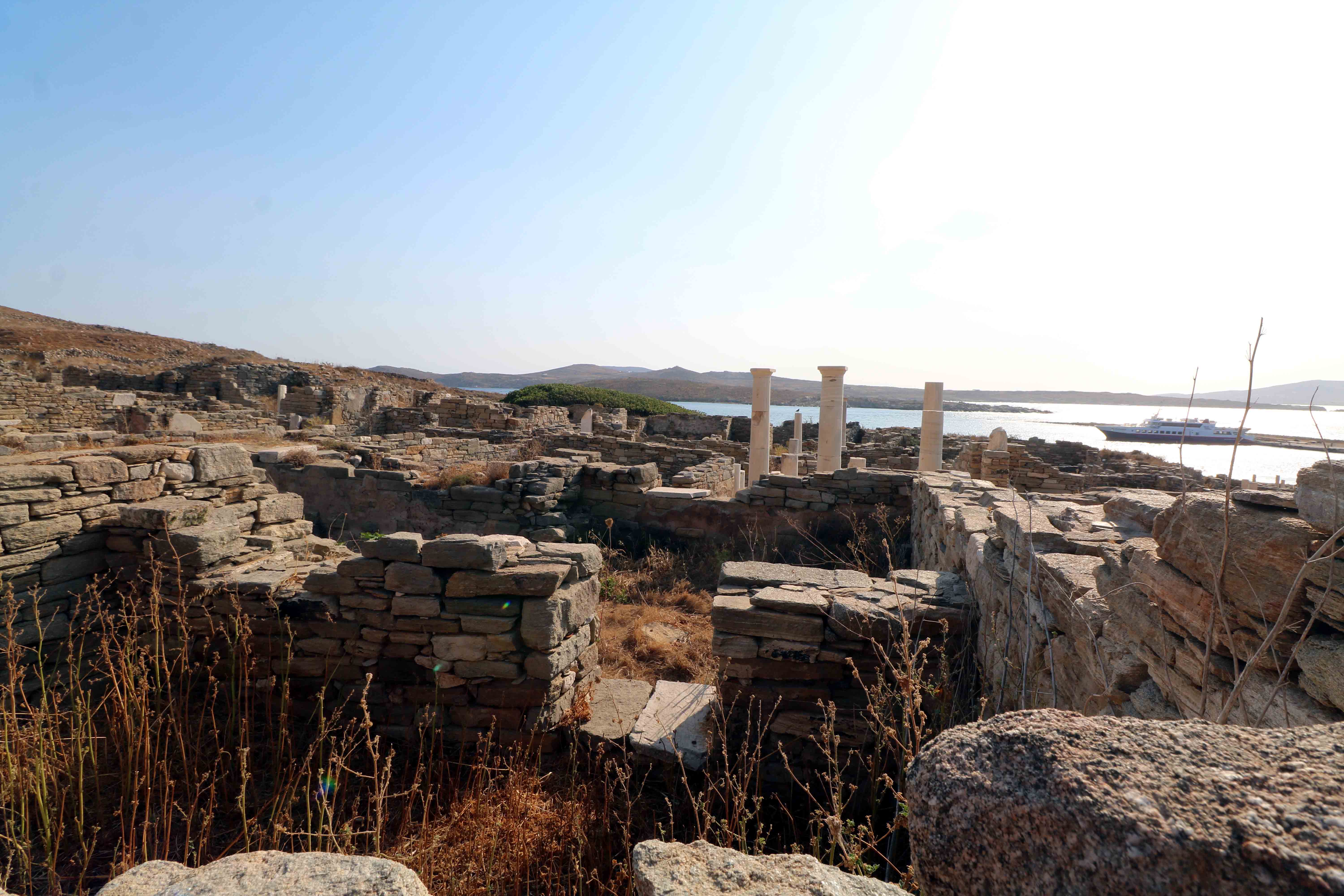
The island boasted of many temples, market places, living quarters, theatres, gymnasium, etc, all to cater for traders, sailors and locals.


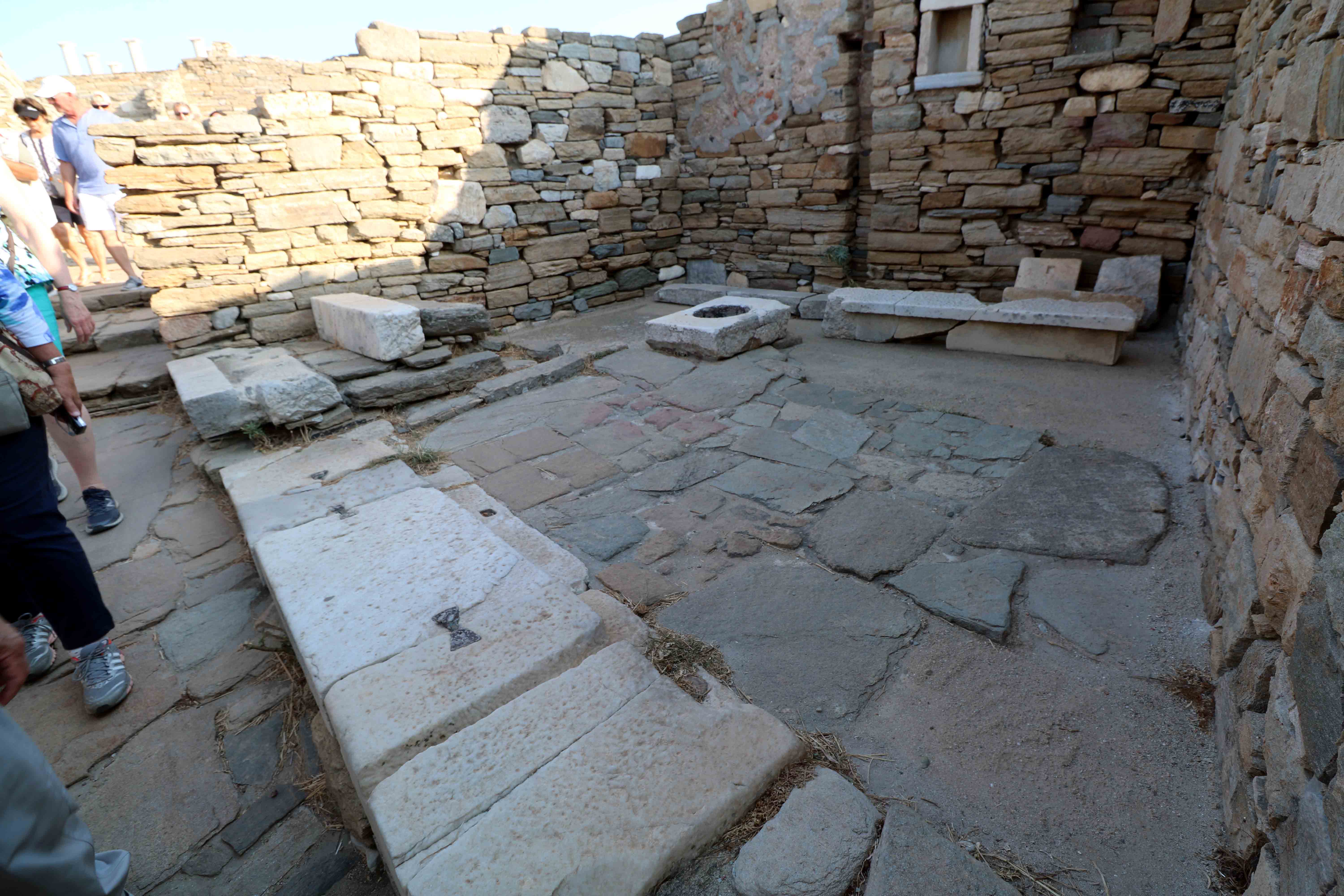
As trade prospered, rich merchants, bankers, and ship-owners from all over the world settled in Delos.  They attracted many builders, artists and craftsmen to build luxurious houses, richly decorated with statues, frescoes and mosaic floors. This well preserved house has an atrium with a mosaic floor which portrays Dionysus seated on a leopard.


The houses in Delos varied in size, layout and construction based on the requirement and wealth of the owner.  Most houses looked inwards and the rooms were built around an open square to allow air-circulation and to receive light.  Ground floor rooms did not have windows making the houses cooler, safer and quieter.  These houses had separate kitchen and latrines and drainage system.


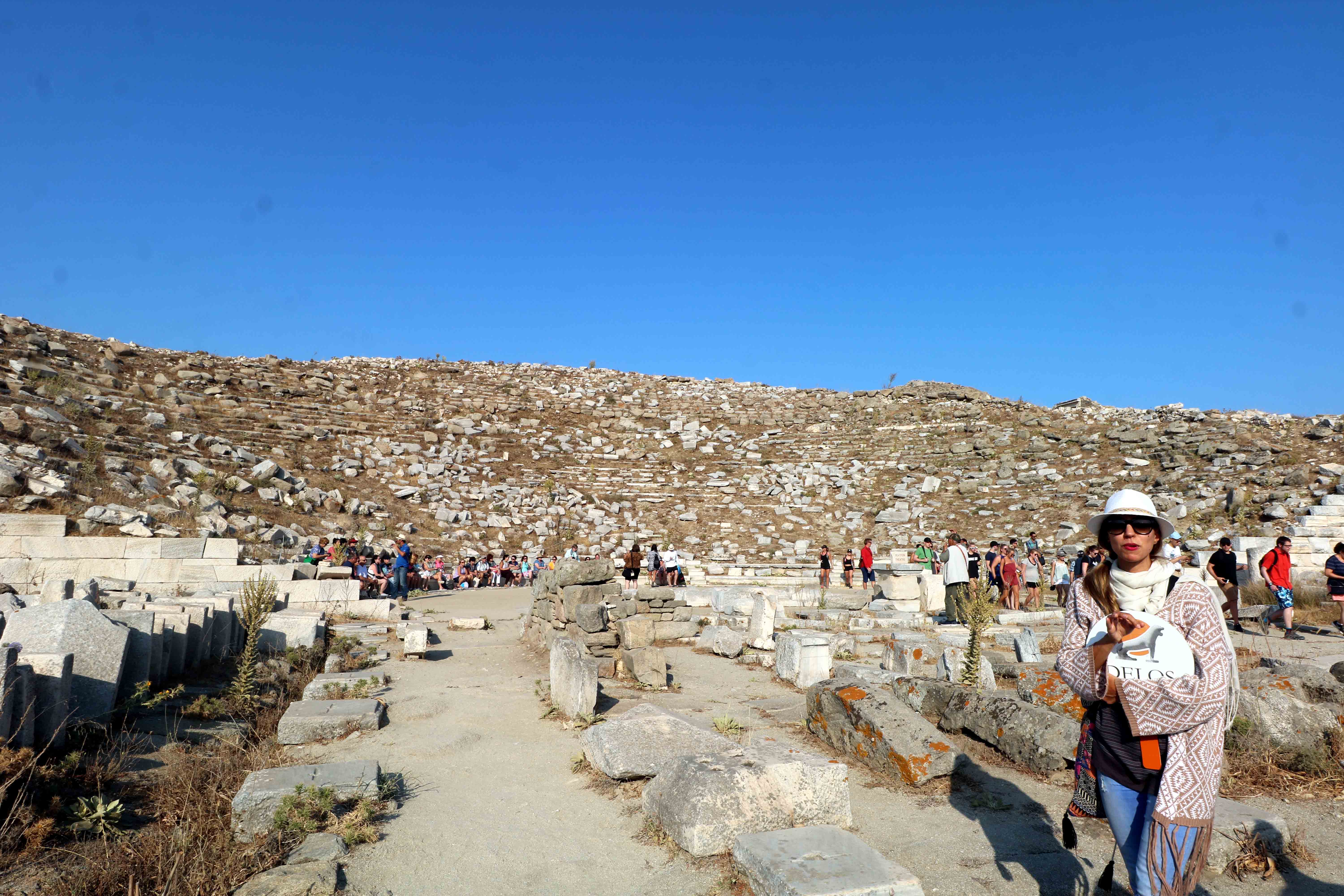
This is a theatre in ruins.


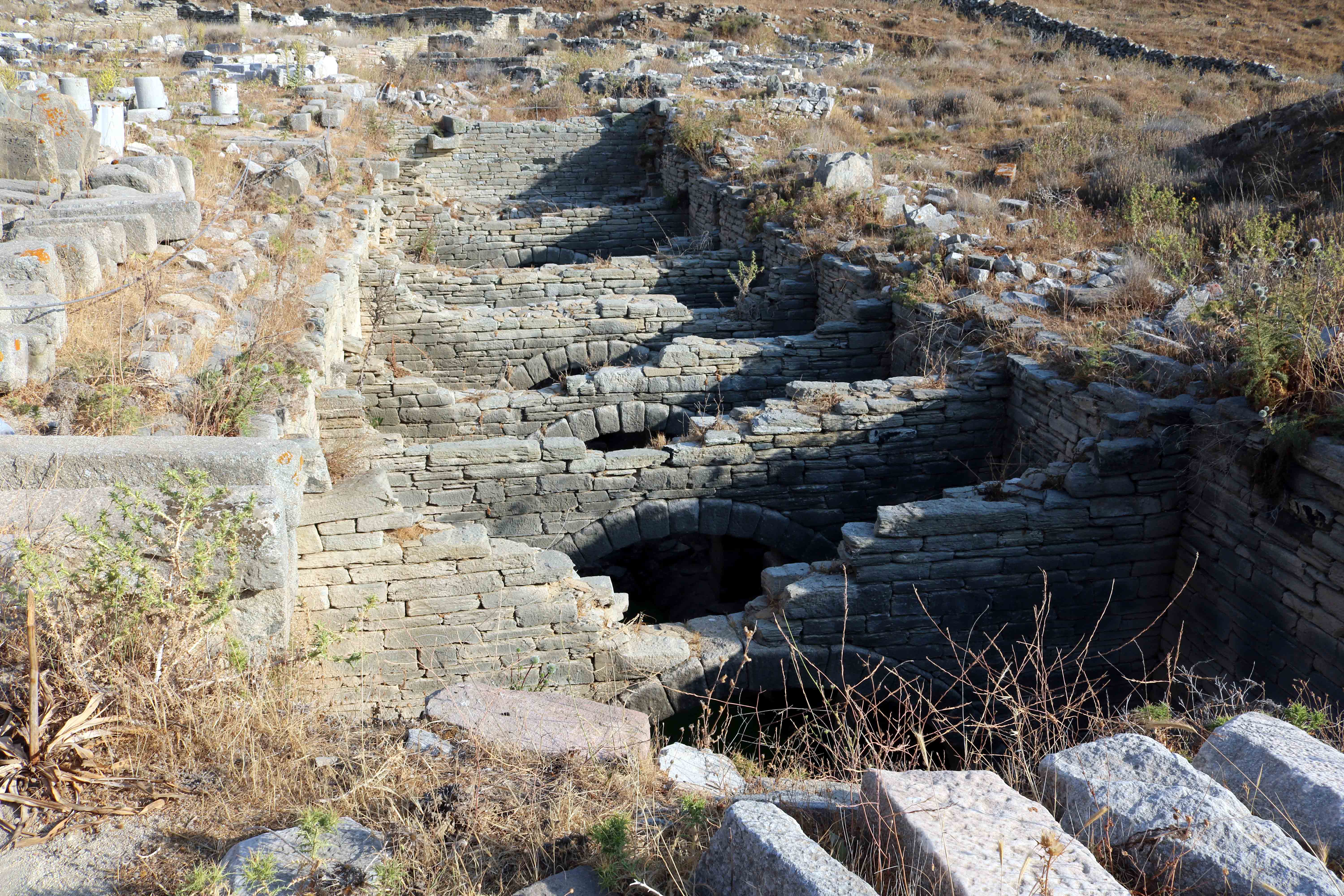
Rainwater was collected in drains connected to a large reservoir.

In the evening, we returned to Mykonos island, after spending over three hours at Delos.

Historical Landmarks of Athens


After lunch, we set out on foot to explore the city of Athens to visit other important historical landmarks.  Our first stop was at the Panathenaic Stadium.


Panathenaic Stadium or Panathinaiko, is also known as the Kallimarmaro, which means ‘beautifully marbled’ and is the world’s only stadium made entirely of marble.  It was built in 1896 for the first modern Olympics on the ruins of the ancient marble stadium that was built in 329 AD for the Panathenaic Games, replacing an even older stadium made of wood.  In 140 AD it was enlarged and renovated and it seated 50,000.  During the 1896 Olympics it accommodated 80,000 spectators.


The stadium was excavated in 1869 and hosted the Zappas Olympics in 1870 and 1875. After being refurbished, it hosted the opening and closing ceremonies of the first modern Olympics in 1896 and was the venue for four of the nine contested sports.  In the 2004 Athens Olympic Games, archery contests were held here and was the finishing venue for the Marathon race.


We then walked to the Zappeion Exhibition Hall, or the Zappeion as the Athenians call it.  It has witnessed the history of Athens for the past 130 years. A major scene for some of the most significant moments in the country’s history, it has always been integrally linked to the Olympic Games.    It was built by Evangelis Zappas, a rich businessman living in Romania, who participated in the Greek War of Independence (1821–1832).


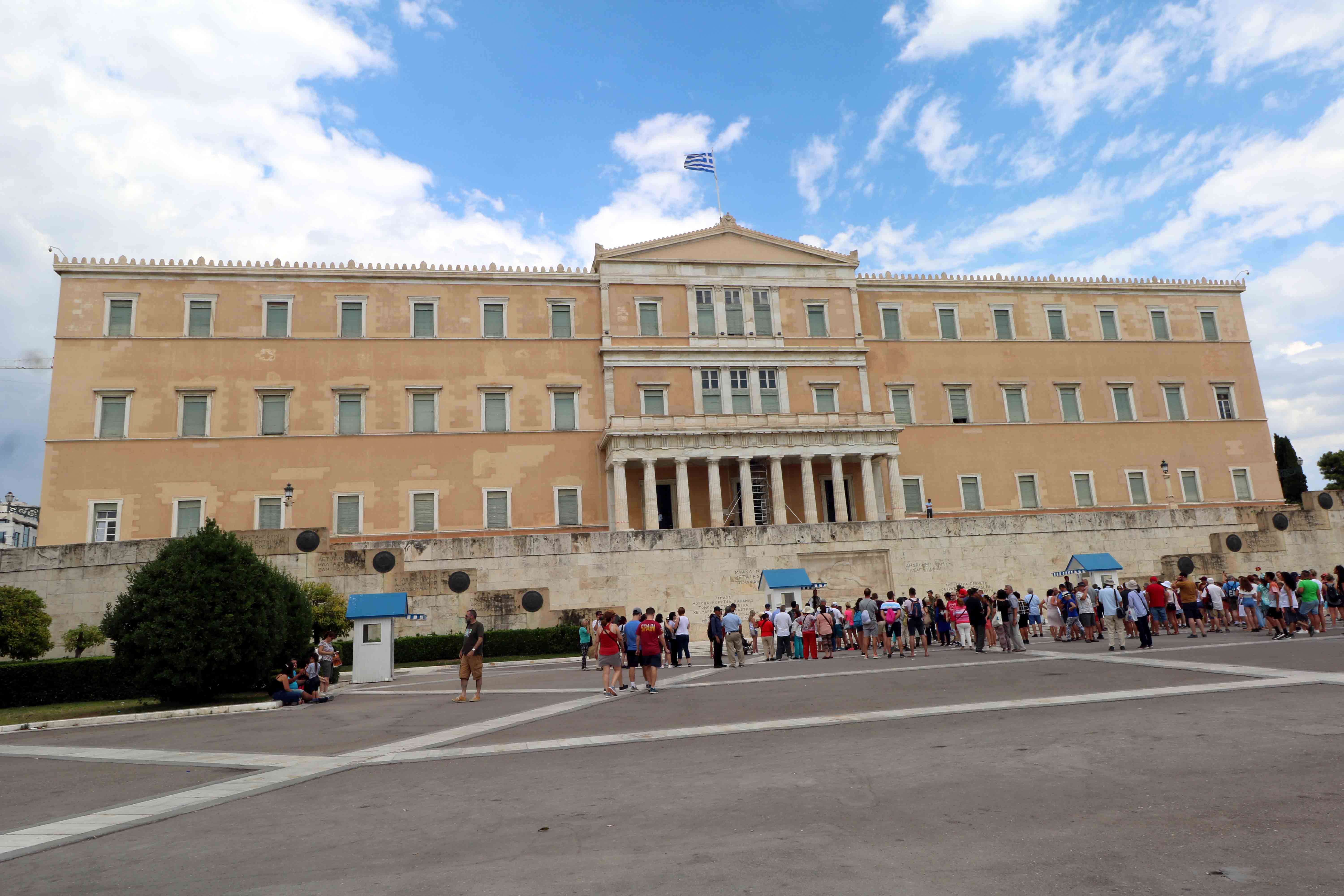
From the Zappeion we moved to the Greek Parliament Building.  This building was erected between 1836 and 1842 as the royal palace for King Otto I, the first king of modern Greece. After a fire damaged the palace in 1909, the king moved to a nearby building (now the presidential palace) and the original palace became known as the ‘Old Palace’. In 1929, after the monarchy was abolished, the Greek government decided to move the parliament from its existing building (now the National Historical Museum) to the old Palace. The parliament has resided here ever since 1935.


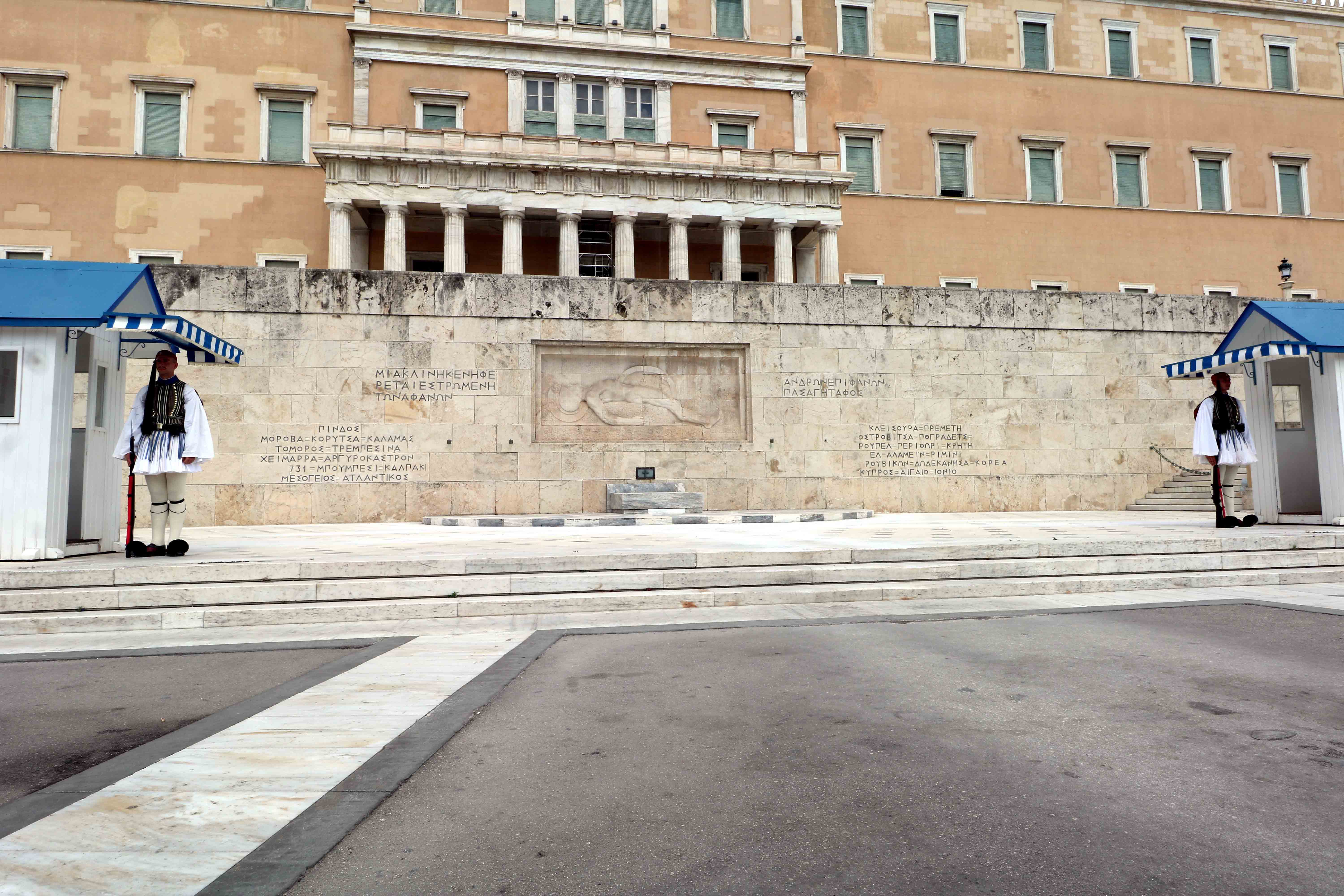
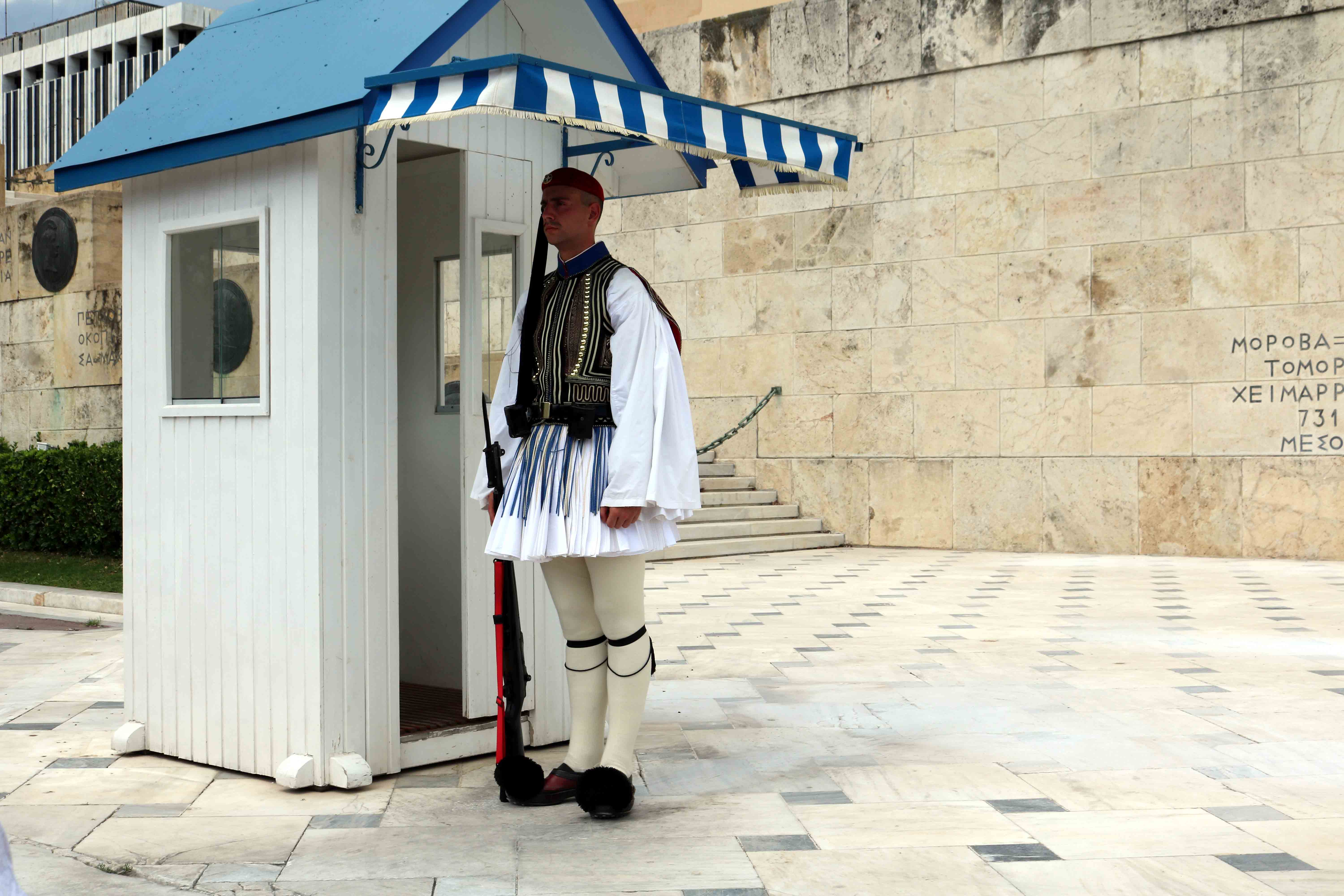
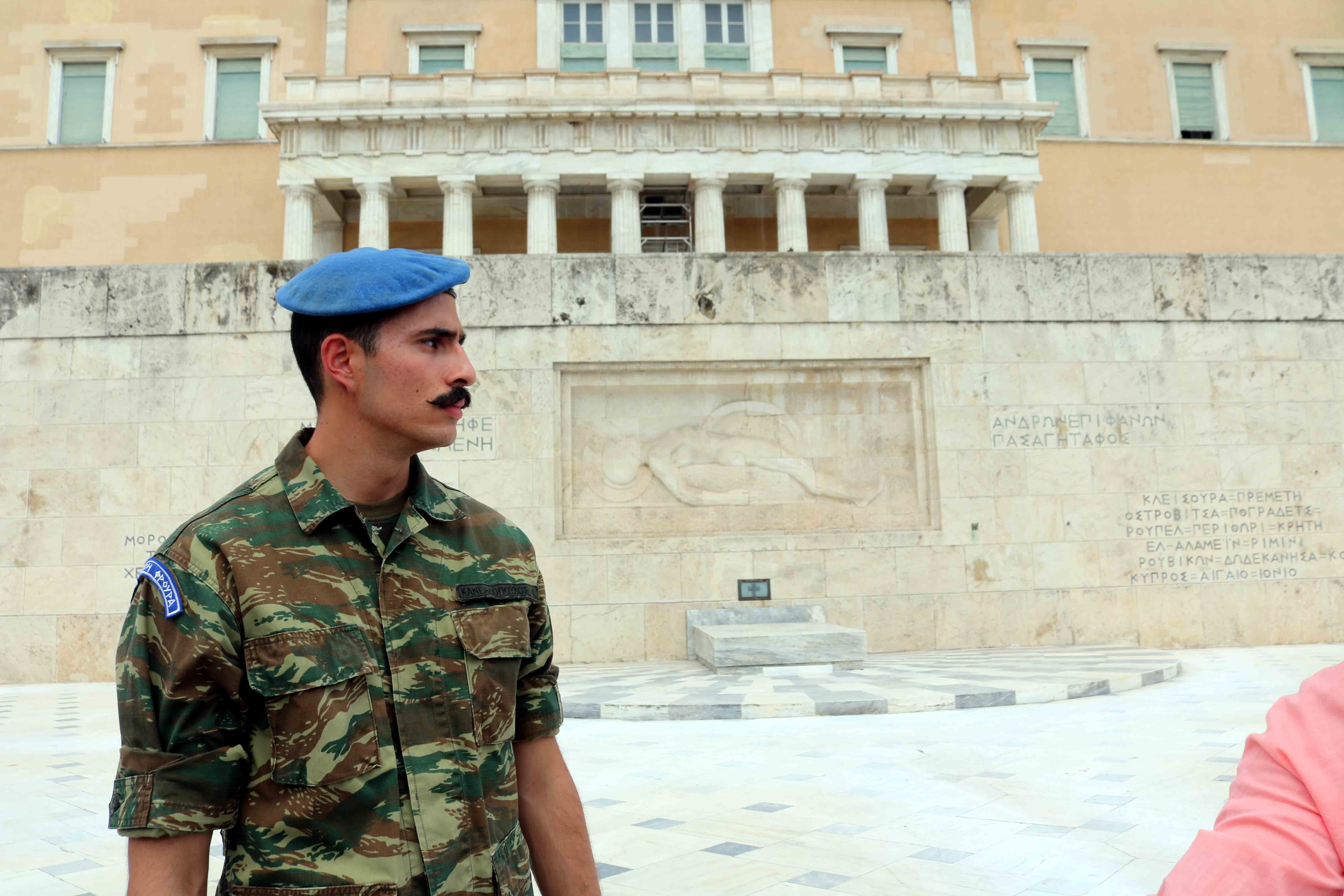
In front of the Parliament Building is the Tomb of the Unknown Soldier.  The monument, with a large relief depicting a nude, dying hoplite (citizen soldier of Ancient Greece, quite different from a professional soldiers), was inaugurated on March 25, 1932, on the Greek day of independence. On either side of the tomb are excerpts from Pericles’s famous funeral oration inscribed on the wall.

The Tomb is guarded by the Evzones, a special unit of the Hellenic Army, also known as Tsoliades. A pair of soldiers guard for one hour and throughout these 60 minutes, they stand perfectly still until it is time to switch with another guard


We were impressed by the ceremonial uniform the guards were turned in.  The uniform consists of the Phareon -a hat – made from red baize with a black tuft, white shirt with loose sleeves, Phermeli, a handmade waistcoat with many shapes wrought on it, Greek kilt made of 30 meters of white cloth, Tsarouchia, traditional leather shoes of Evzones with a small tuft in front, (each shoe weighs three kilos) and a leather belt.


As we stood there at 3 pm, we witnessed the elaborate drill associated with the changing of guards, very similar to such ceremonies worldwide.  The only difference here is that most drill movements are carried out in slow-motion.  The change of guard takes place every hour and it attracts many tourists.


Since 1914, Greece (Hellenic Republic) has mandatory military service (conscription) of nine months for men between the ages of 16 and 45, quite in tune with the practice in ancient Greece.  Citizens discharged from active service are normally placed in the reserve and are subject to periodic recall of one to ten days at irregular intervals.  That could well be the reason that we hardly ever came across a Police Officer or a Police Cruiser.

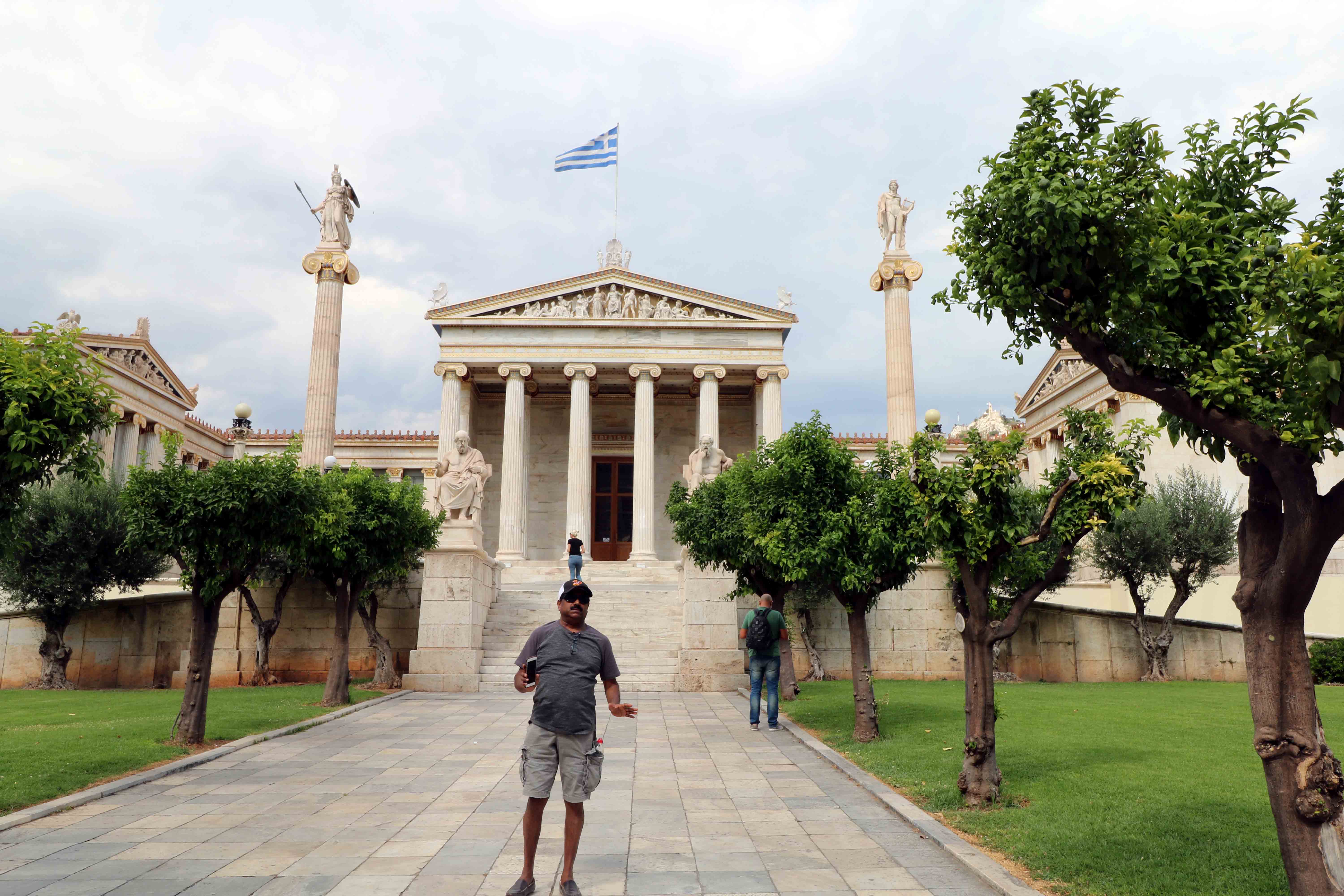
Our next stop was the Athenian Triology, three buildings, the Academy, the University Building and the National Library, located next to each other.


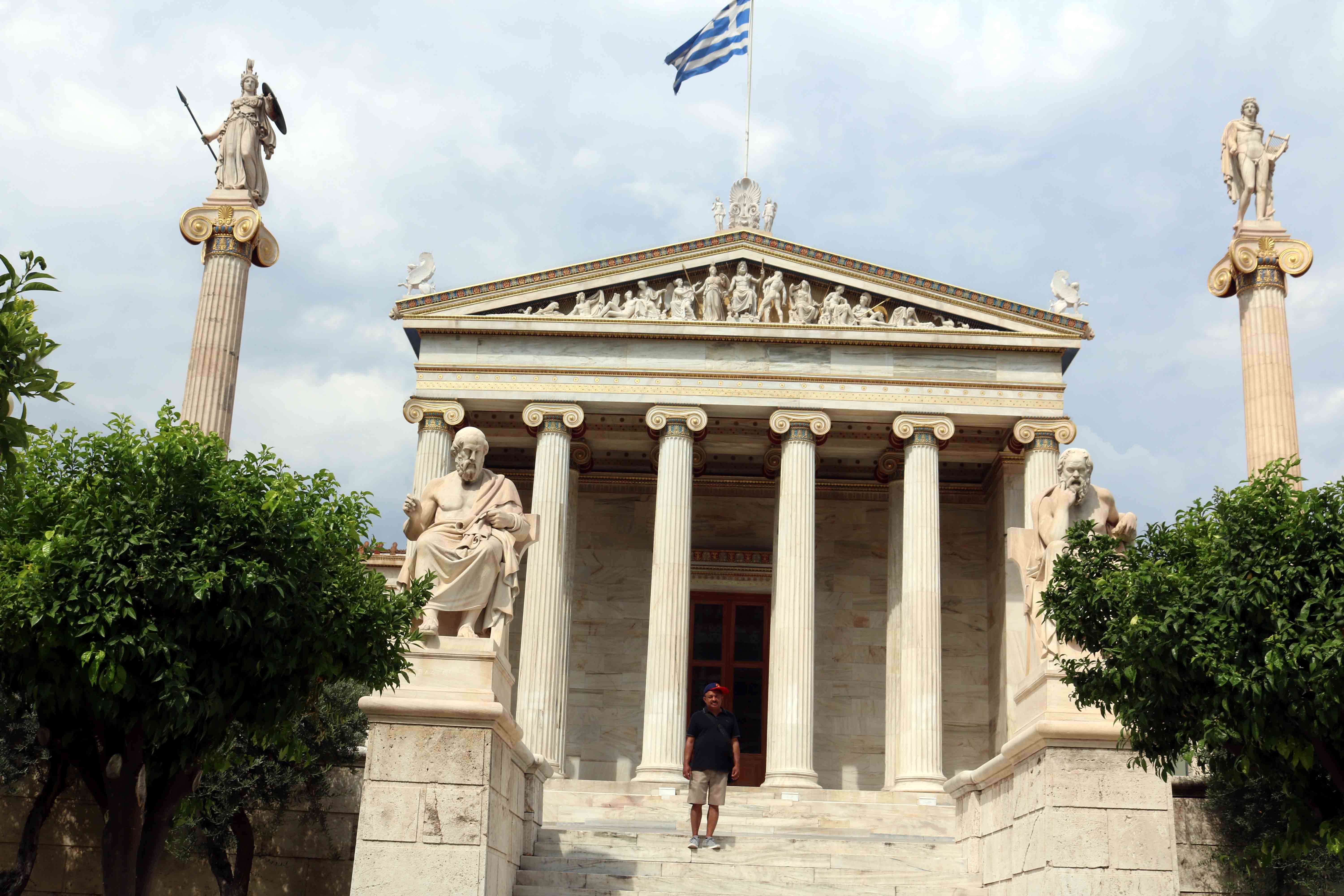
The Academy is the most magnificent of all the neoclassical buildings, constructed in Athens during the nineteenth century. The Academy is the most acclaimed of the three buildings.  It was constructed in marble between 1859 and 1885.


The design of the central temple, with a large Ionic portico, was based on the East side of the classical Erechtheion at the Acropolis. Relief sculptures atop the entrance symbolise the birth of Goddess Athena.

Flanking the main temple are two tall Ionic (the Ionians were one of four major tribes of ancient Greece) columns with statues of Athena and Apollo. Athena, the Greek Goddess of wisdom, arts, civilization, warfare and justice is shown dressed in armor, holding a shield and a spear. Apollo, God of music and poetry, is depicted holding a lyre in his left hand.  On either side of the main entrance leading to the Academy are the statues of the famous Greek philosophers Plato and Socrates, shown seated.


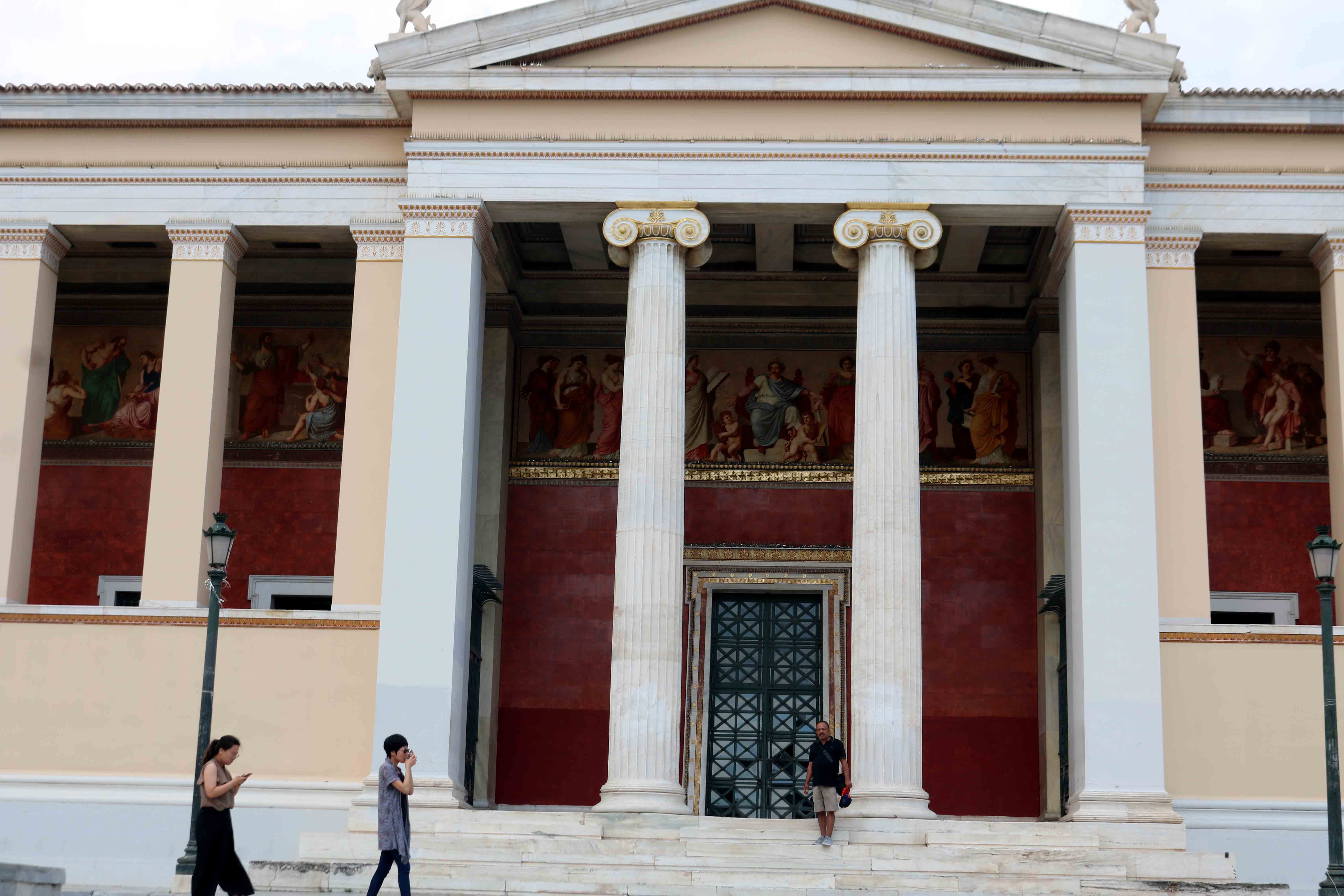
The next building was the University.  It has functioned as a university ever since its establishment in 1837 and is the oldest institution of higher education in modern Greece.  Today it is one of the largest universities by enrollment in Europe, with over 100,000 registered students.

To the left of the steps leading to the building stands a statue of John Capodistrias, who founded the University after declaration of Greek independance in 1821.   On to the right is the statue of Alexander Korais, a Greek scholar credited with laying the foundations of Modern Greek literature and a major figure in Greek Enlightenment.


The frieze (wall decorations) inside the portico shows King Ortho with great Greek arts and science personalities of the time.


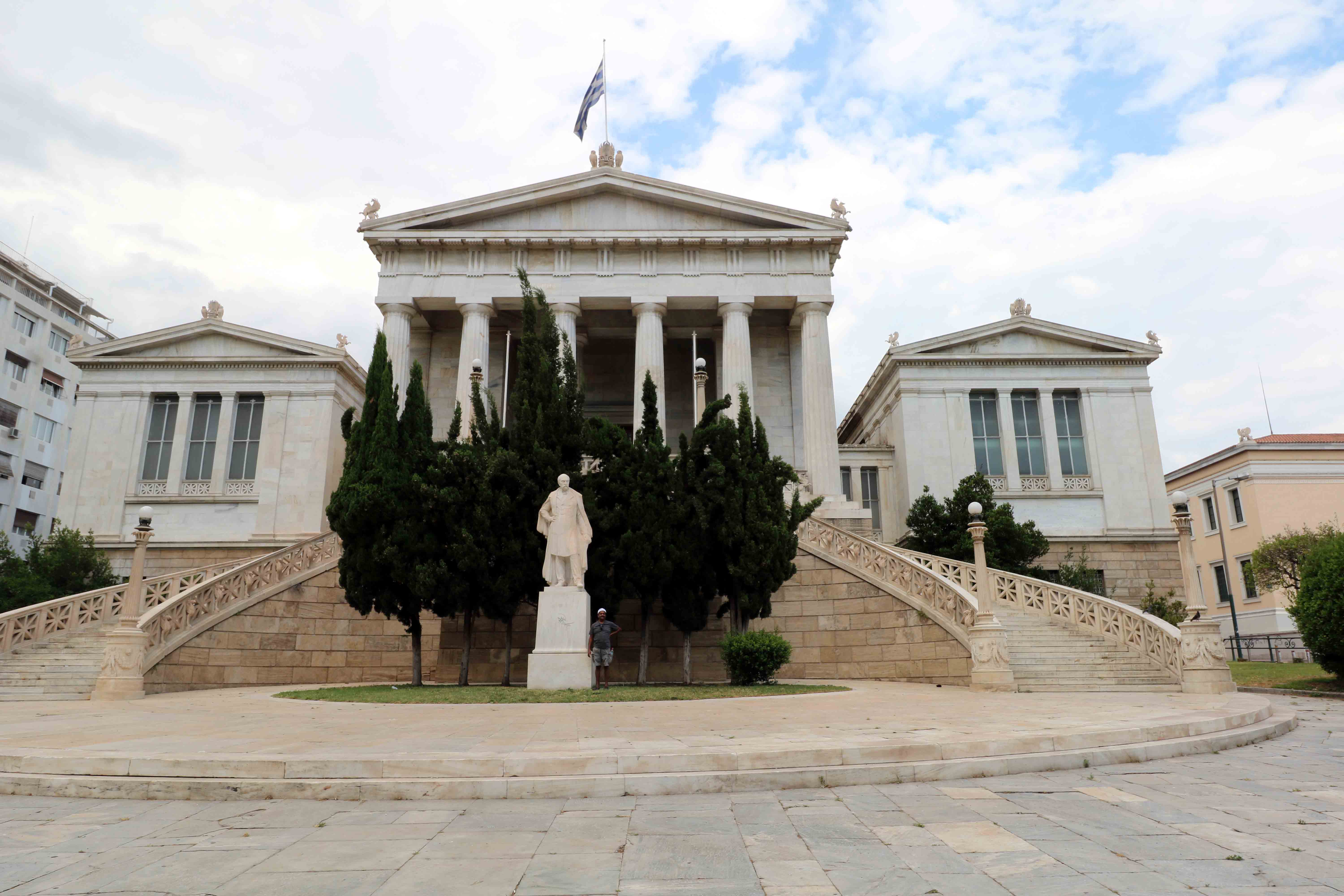
We then moved on to the National Library of Greece.  This library building was built at the end of the nineteenth century, as the last of the neoclassical trilogy of Athens.  In front of the building is the statue of Paul Vallianos, one of the Vallianos brothers who helped fund the construction of the building.  The library’s collections include more than half a million books, with many dating back before 1500 AD.  It boasts of the largest and best-kept collections of ancient Greek manuscripts.


From the National Library we took a taxi to the base of  Lykavittos hill.  Lykavittos is the highest hill in Athens, rising 277 meters, and is visible from all over the city. We then boarded the funicular (cable based) railway, operating every 30 minutes, to reach the top of the hill.


Perched on top of Lykavittos sits the whitewashed chapel of St George. This Greek Orthodox chapel was built here in the nineteenth century and replaced an older Byzantine church dedicated to Prophet Elias.


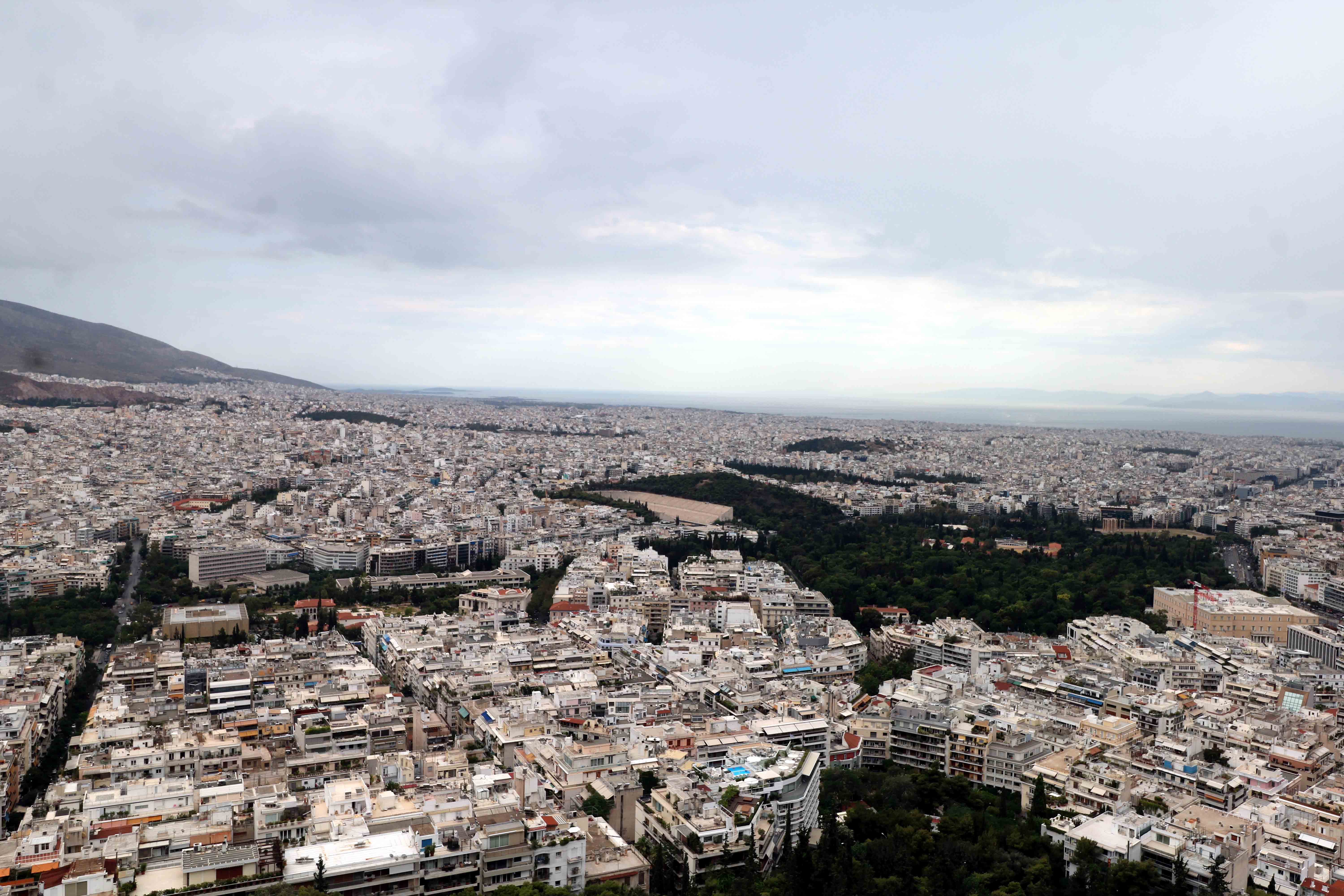
The hill top offered many a scintillating view over the Acropolis and the city of Athens, especially the Acropolis, the Temple of Zeus, the Panathenaic Stadium and the Parliament Building.  We returned to the base of the hill by the funicular railway, though there were many tourists walking downhill.

By now we were all well and truly exhausted and we decided to return to the hotel as we had to catch the early morning ferry to Mykonos island.

Athens – A Historical City


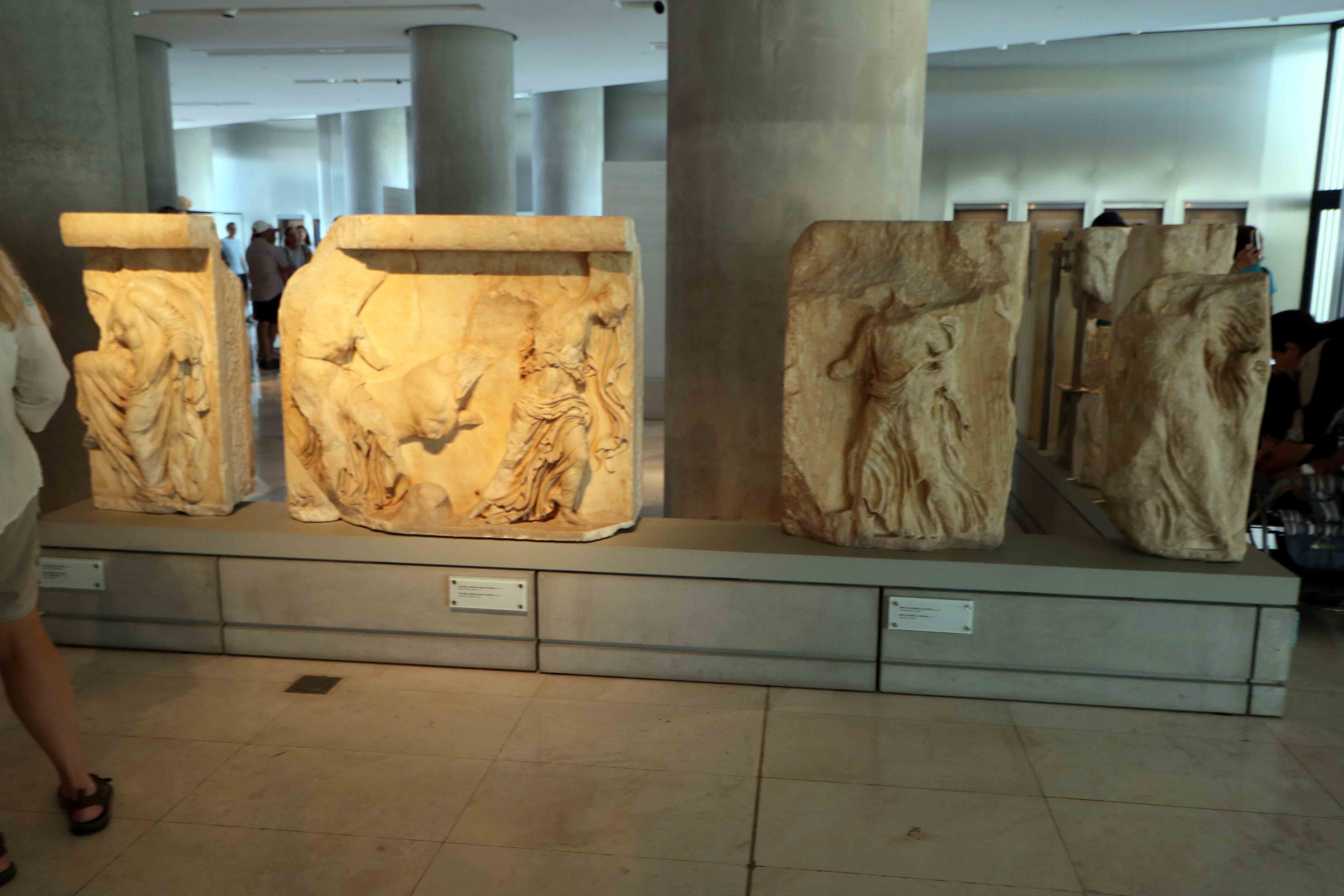
On June 10, we set out to visit the Acropolis Museum. Voted one of the best museums in the world, with a total area of 25,000 square meter, the museum showcases Greek history through its three floors.  The museum was inaugurated in the summer of 2009.


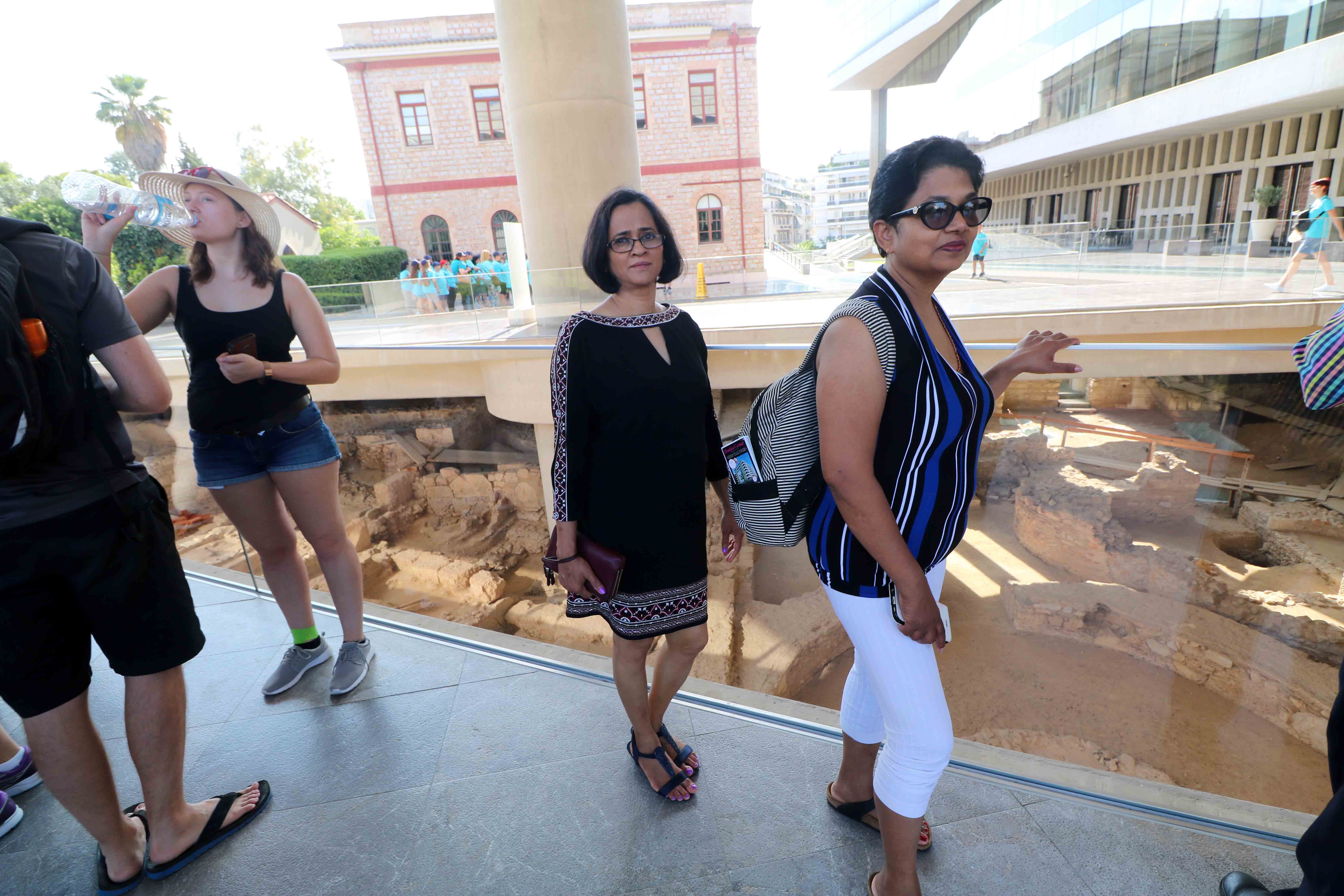
The Museum is built above a large urban settlement on the Makriyianni site dating from Archaic to Early Christian Athens.   This discovery is being integrated into the Museum and is yet to open to public.  As we walked on the glass floor, we could see excavation and restoration process of the Makriyianni site.


On the ground floor, the ‘Gallery of the Slopes of the Acropolis’ houses exhibits from the sanctuaries that were established on the slopes of the Acropolis, as well as objects that Athenians used in everyday life from all historic periods. ‘Archaic Gallery’, on the first floor, hosts the magnificent sculptures that graced the first temples on the Acropolis.  Photography is not permitted in these two floors.


Third floor, ‘Parthenon Gallery’, where sculptures of the Parthenon period are exhibited in continuous sequence along the perimeter.


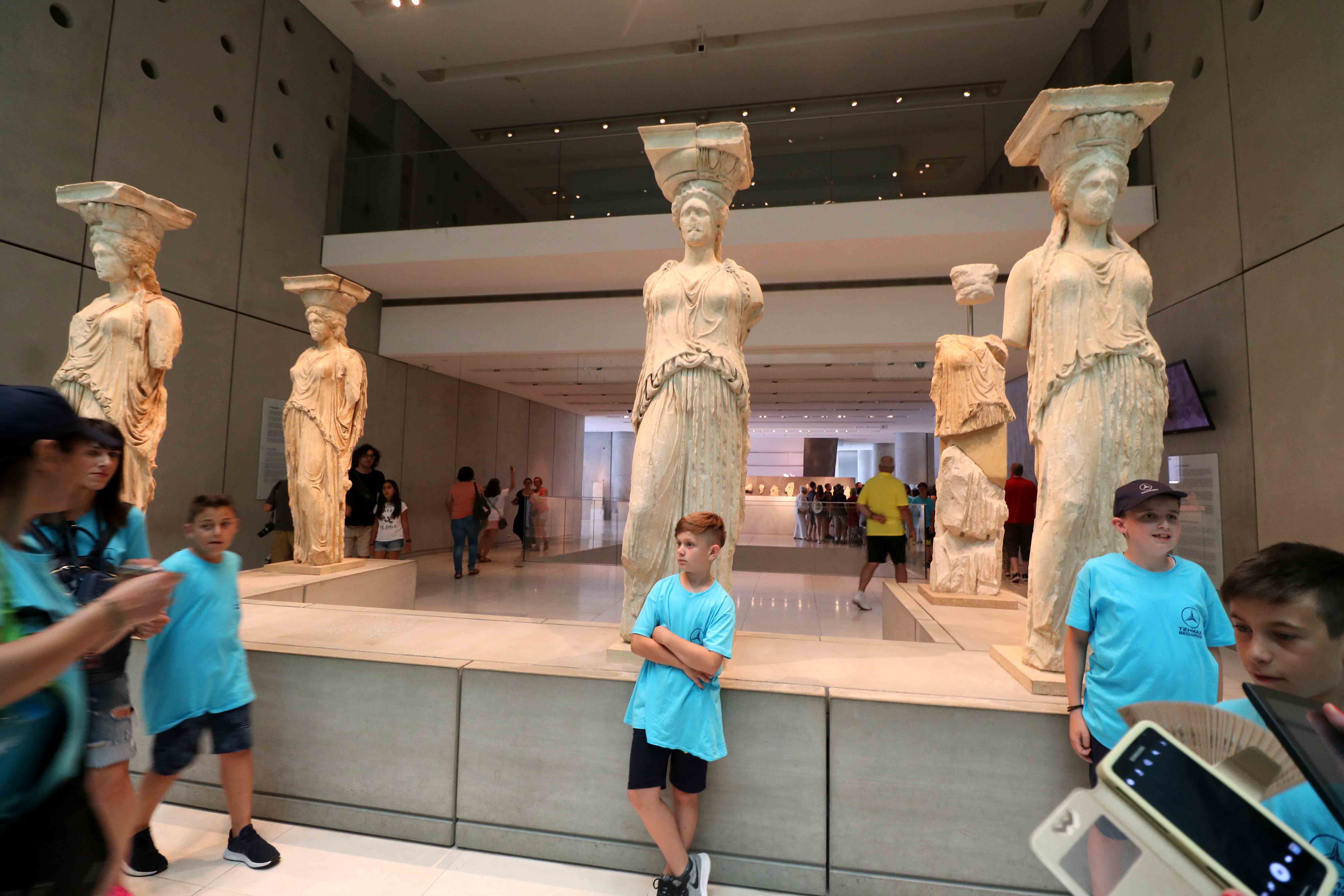
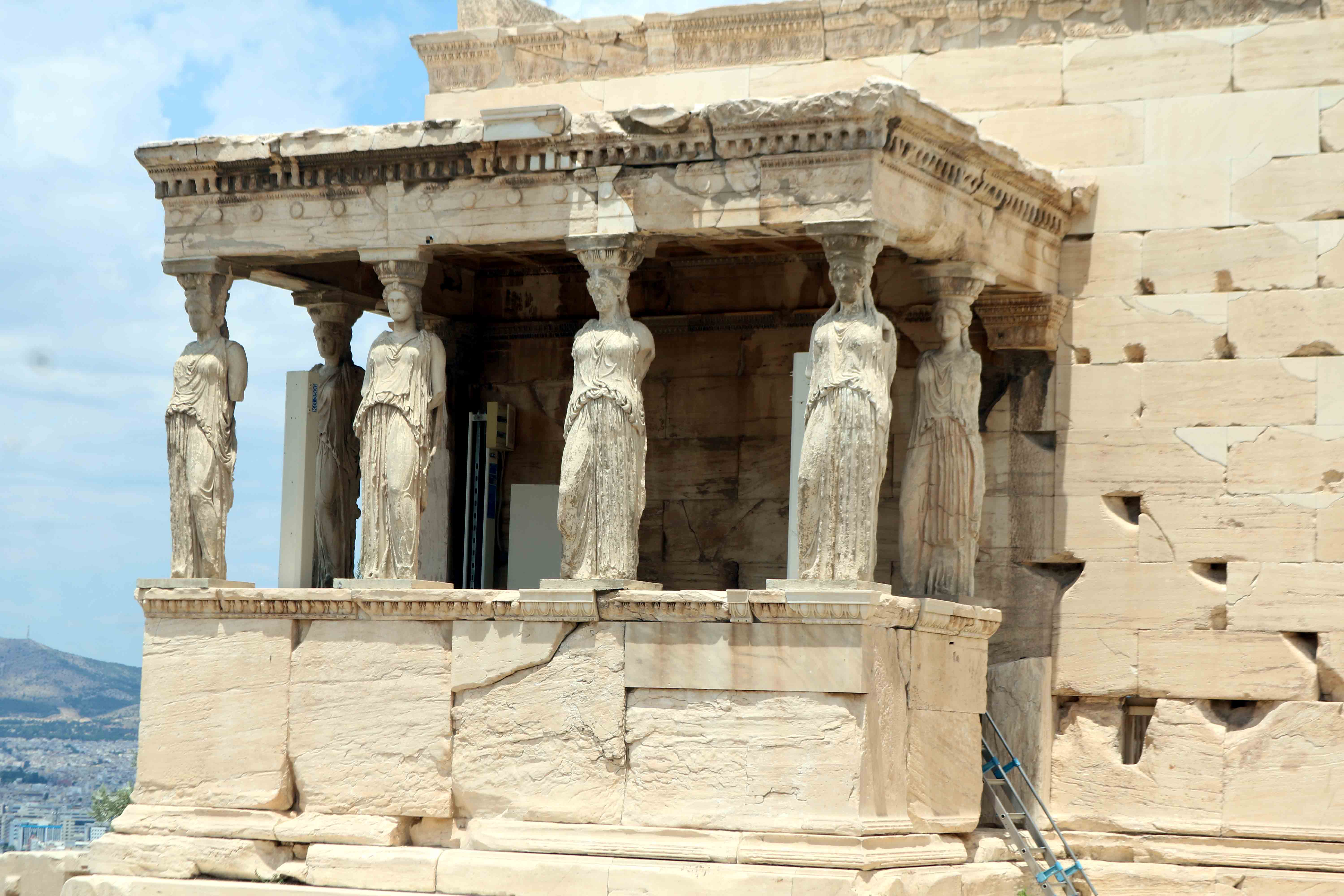
The most impressive among the exhibits is the Caryatids.  A Caryatid is s a sculpted female statue, used as a column or a pillar, supporting the structure on her head. This Greek term literally means ‘maidens of Karyai.’   These original statues once supported the roof of the North porch of Erectheion.  Five statues of Caryatids are in the museum.  Statue on right-rear was smashed by a Turkish canon-ball in 1687, when the Parthenon was shelled during a battle between the Turks and the Venetians.  The sixth is installed at the British Museum in London, which acquired it nearly two centuries ago after Lord Elgin, the British ambassador to the Ottoman Empire.  He had it sawed off the Erechtheion’s porch, along with shiploads of adornments from the Parthenon to decorate his mansion in Scotland before selling the pieces to pay debts.  Cast reproductions of six Caryatids now support the porch of Erectheion.


After spending about three hours at the museum, we walked to the iconic Acropolis.  An `acropolis’ is any citadel or complex built on a high hill. The name derives from the Greek language meaning ‘High City’ or ‘City on the Edge’ or ‘City in the Air.  Most famous being the Acropolis of Athens, built in the Fifth century BC.

Acropolis is the most characteristic monument of the ancient Greek civilisation. It symbolises democracy and the beginning of Western civilisation and stands as an icon of European culture.  More than half of the sculptures and artifacts from the Acropolis are in the British Museum in London and their return to Greece is a cultural and a political issue between the two nations, yet to be resolved.  The Brits claim that Lord Elgin saved the marbles from destruction, and acquired them fairly.


As we walked up the hill, we come across the Propylaea, meaning a monumental gate or entrance to a specific space, usually to a temple or religious complex.


As we climbed up the Propylaea, on the Southern flank stands the Temple of Athena Nike.  It was a place of worship for deities associated with wars, ‘Nike’ Gods or Goddesses.  The Nike statute had no wings, as it was customary for Nike statues of the time, the temple acquired the name Apteros Nike (wing-less victory). It is said that the statue was deprived of wings so it could never leave the city of Athens.


Propylaea stands as an impressive building that surrounds the natural entrance to the plateau.


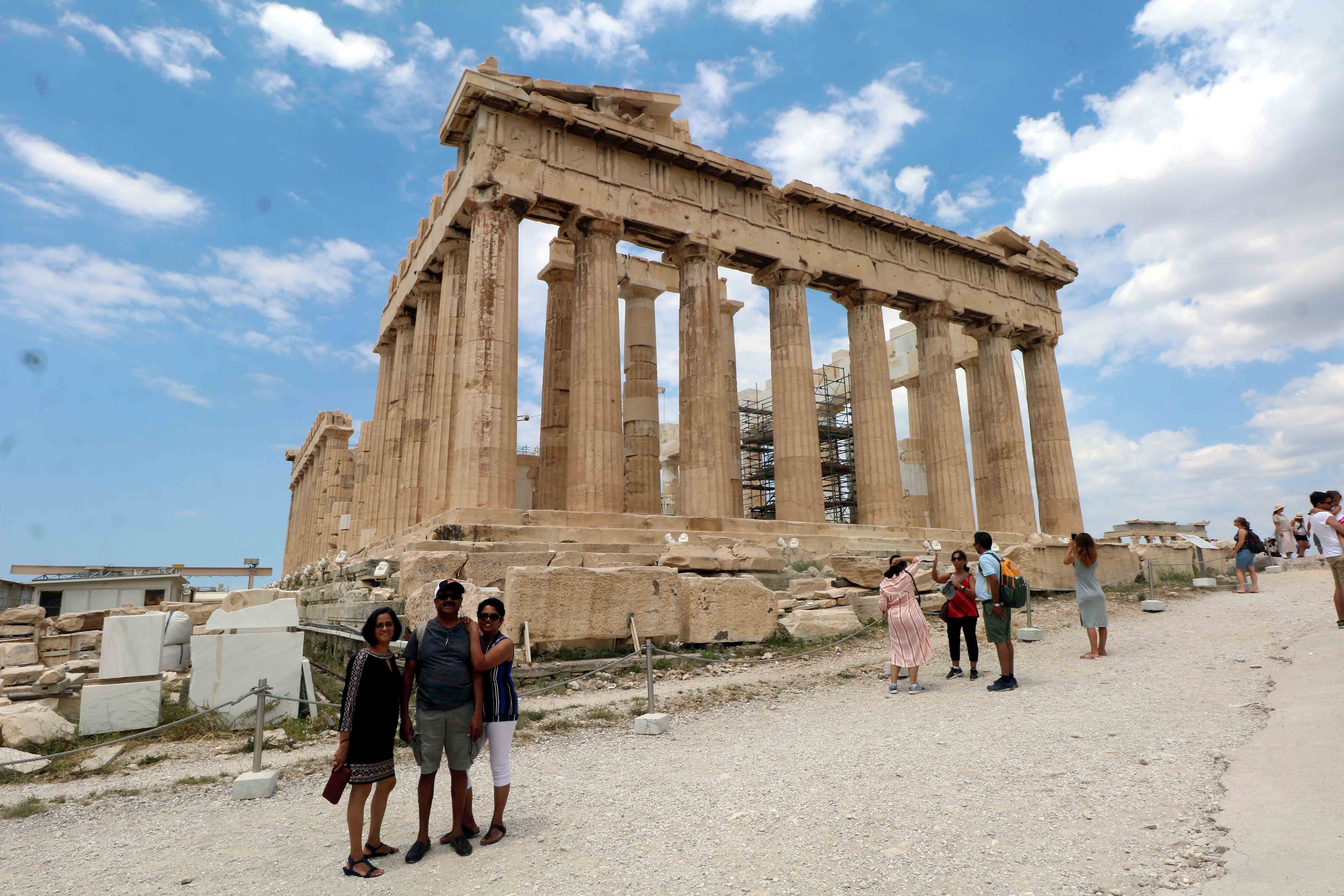
After walking for about five minutes on the plateau, we were at the Parthenon.  The Parthenon is a former temple dedicated to Goddess Athena, considered the patron Goddess of Athens. Construction began in 447 BC and was completed in 438 BC, although decoration of the building continued until 432 BC. It is the most important surviving building of Classical Greece.  The temple was built to shelter the monumental statue of Athena that was made of gold and ivory.

In 1975, the Greek government began a concerted effort to restore the Parthenon and other Acropolis structures and these efforts are still ongoing.


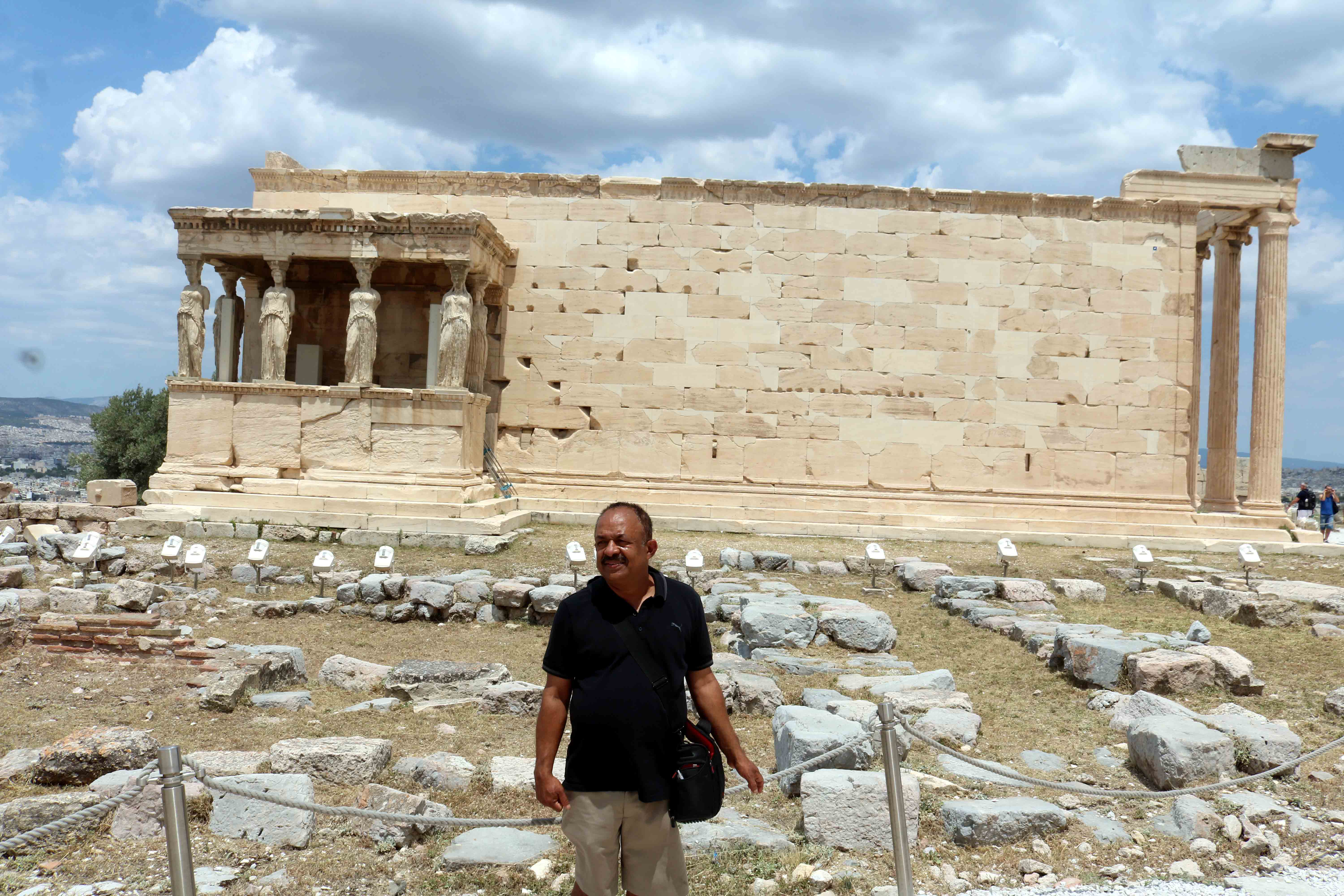
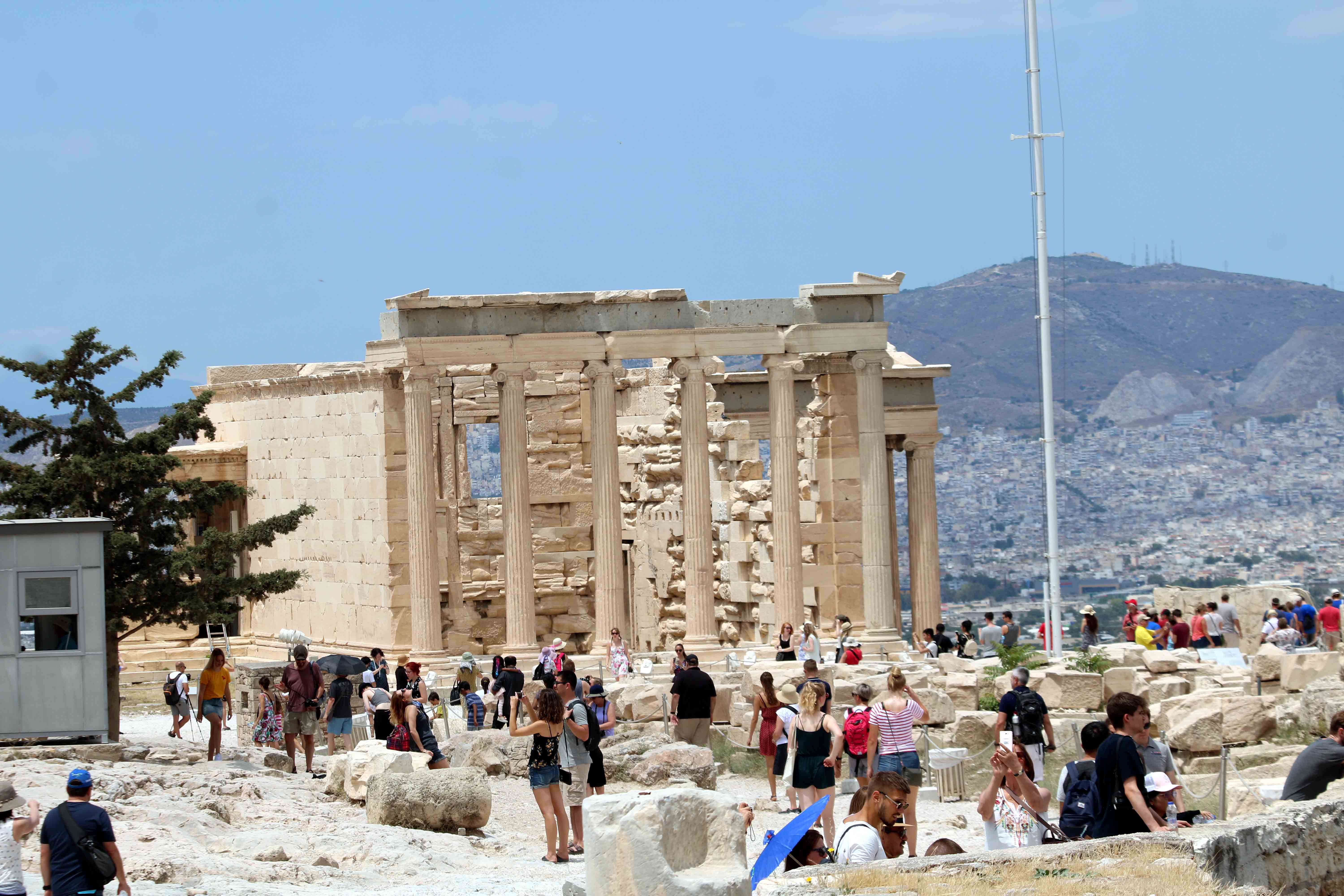
Walking around the Parthenon, we came to the Erechtheion.  This temple was built to house the religious artifacts that the old temple housed. Construction of the Erechtheion began in 420BC.  It is an intricate temple designed to accommodate the uneven ground on which it stands.  The need was to build a temple without disturbing sacred shrines like the altars to Poseidon and Hephaestus, and the spot where Poseidon is believed to have hit the Acropolis with his trident. Other shrines that needed to be accommodated included the sacred olive tree, a well containing sea water and the tomb of Kekrops.


The temple faces East and its entrance is lined with six long Ionic columns.


To the North and West, the wall of the temple drops dramatically to almost twice the altitude of the front and South sides.


The temple is unusual in that it incorporates two porches; one at the North-West corner which is supported by tall Ionic columns, and one at the South-West corner which is supported by six massive female statues, the famous Caryatids.  The Caryatids (replica as the original is in the museum) have become the temple’s signature feature, as they stand and seem to casually support the weight of the porch roof on their heads.


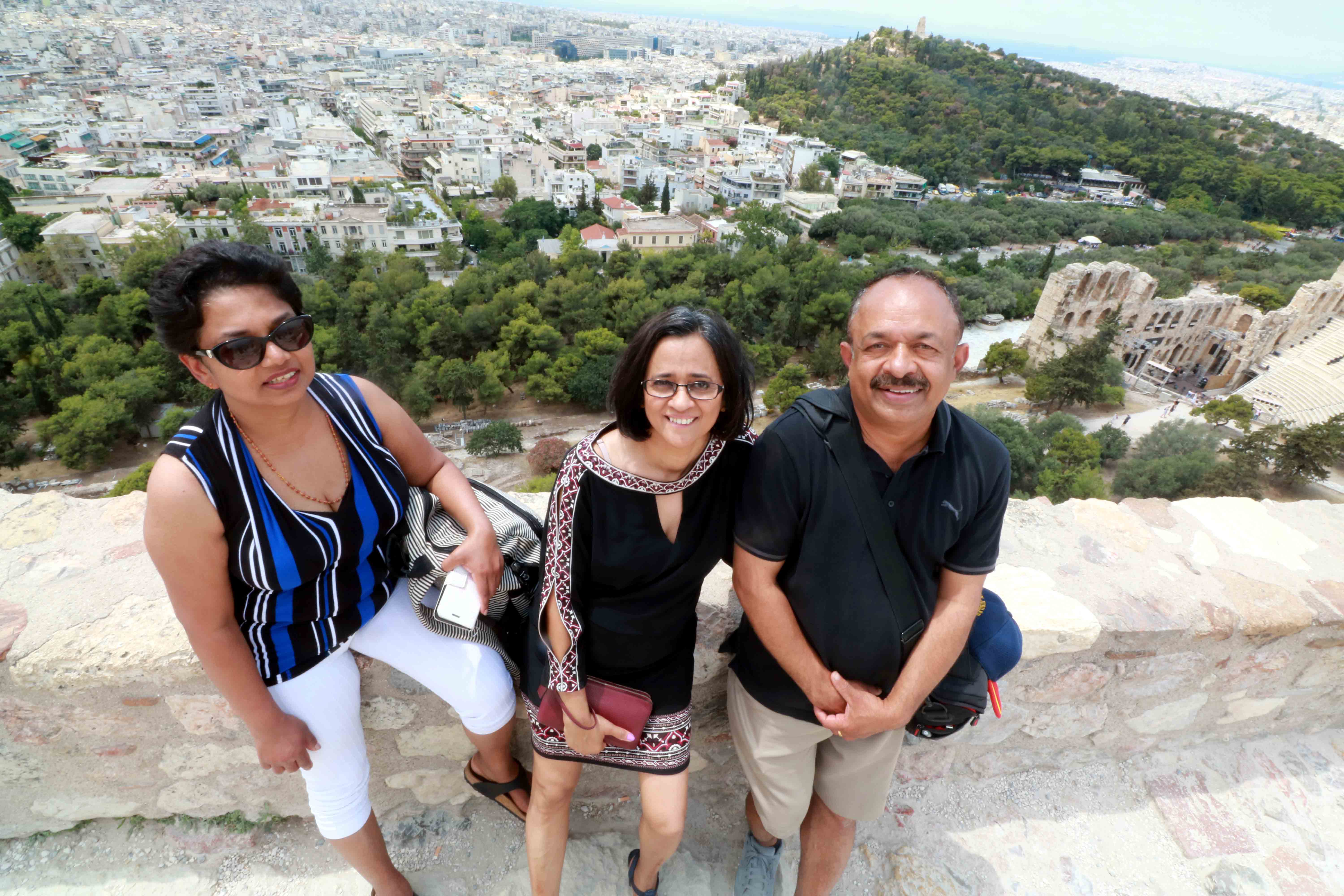
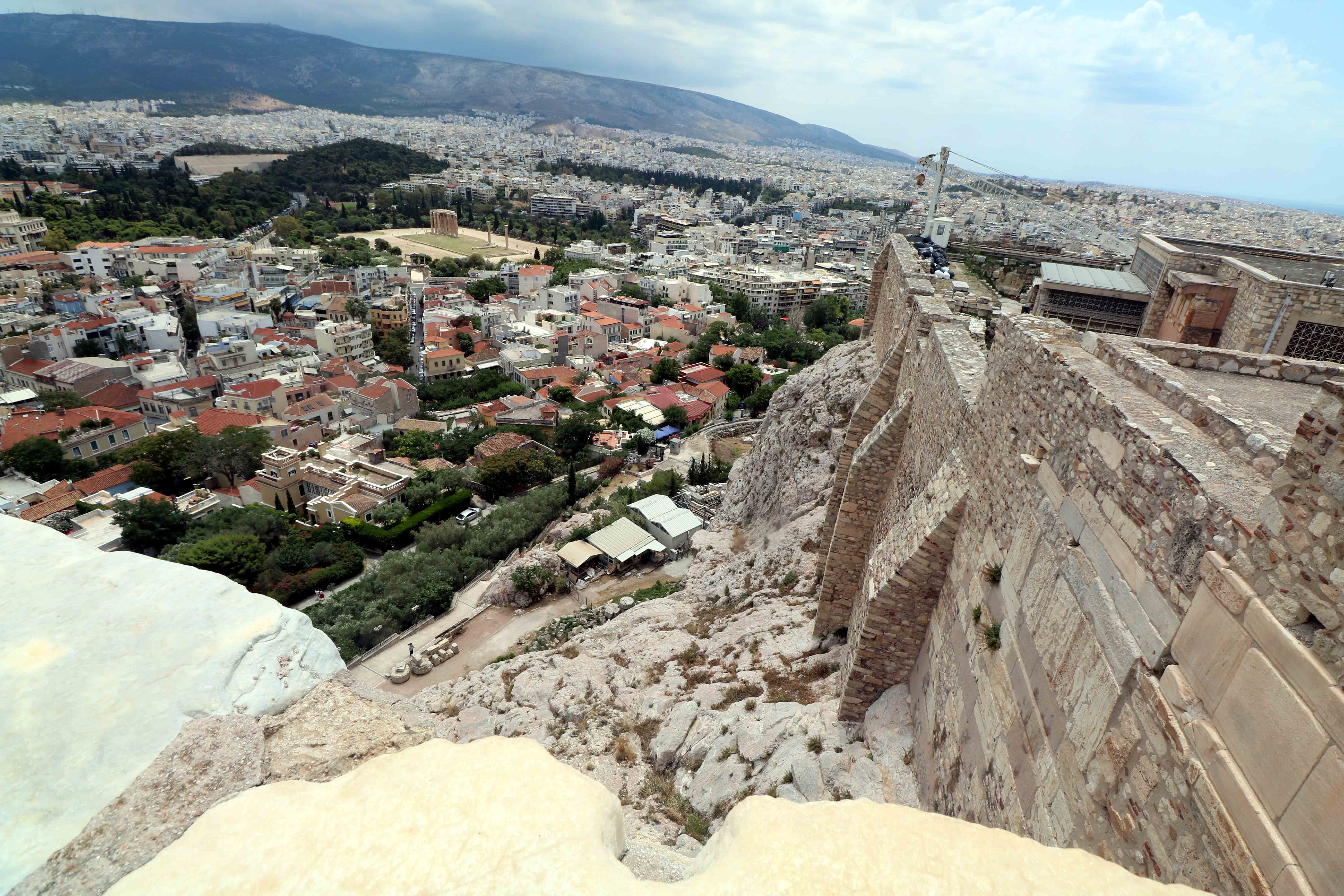
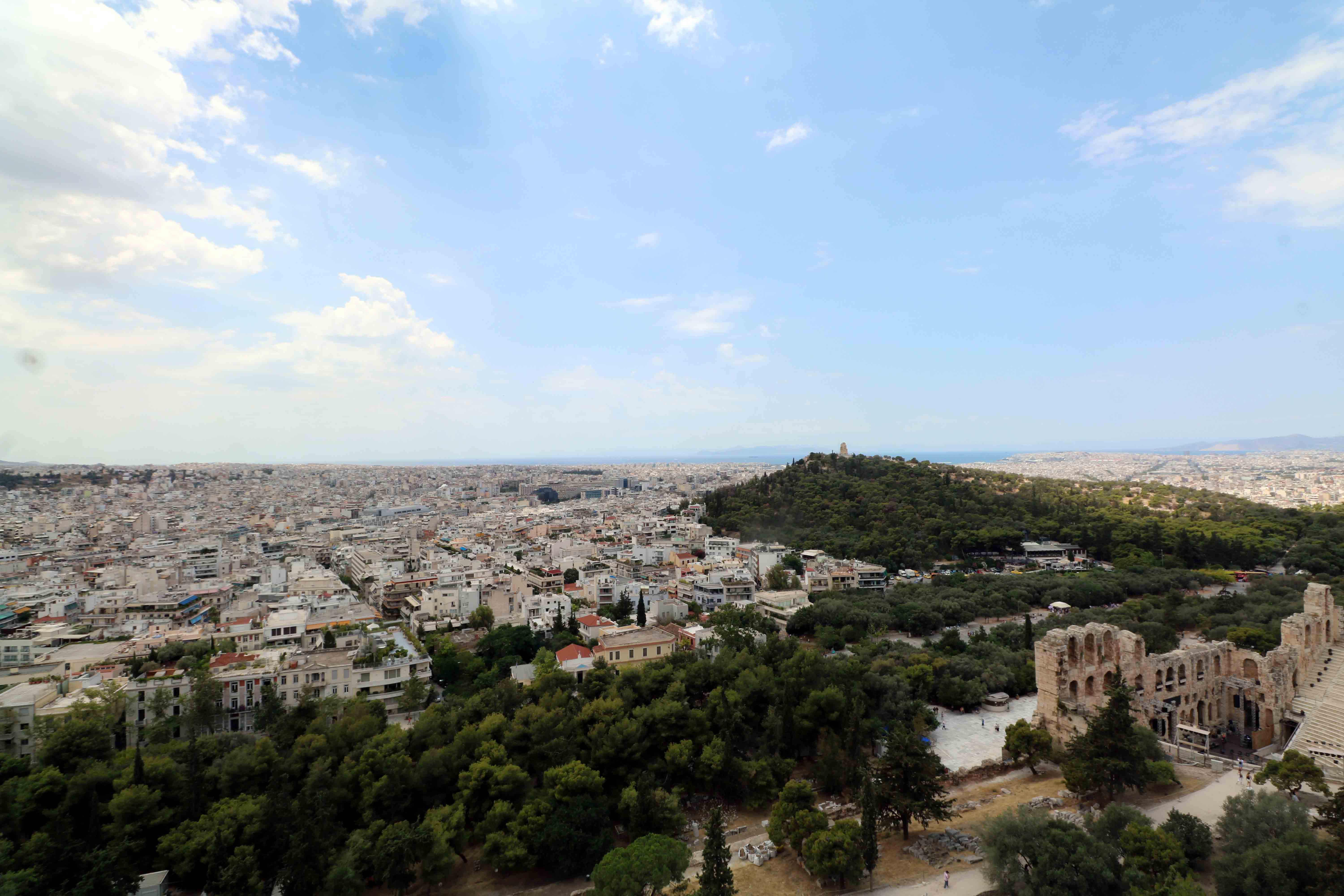
Acropolis also provides an excellent view of Athens and some important historical monuments adjacent to it.


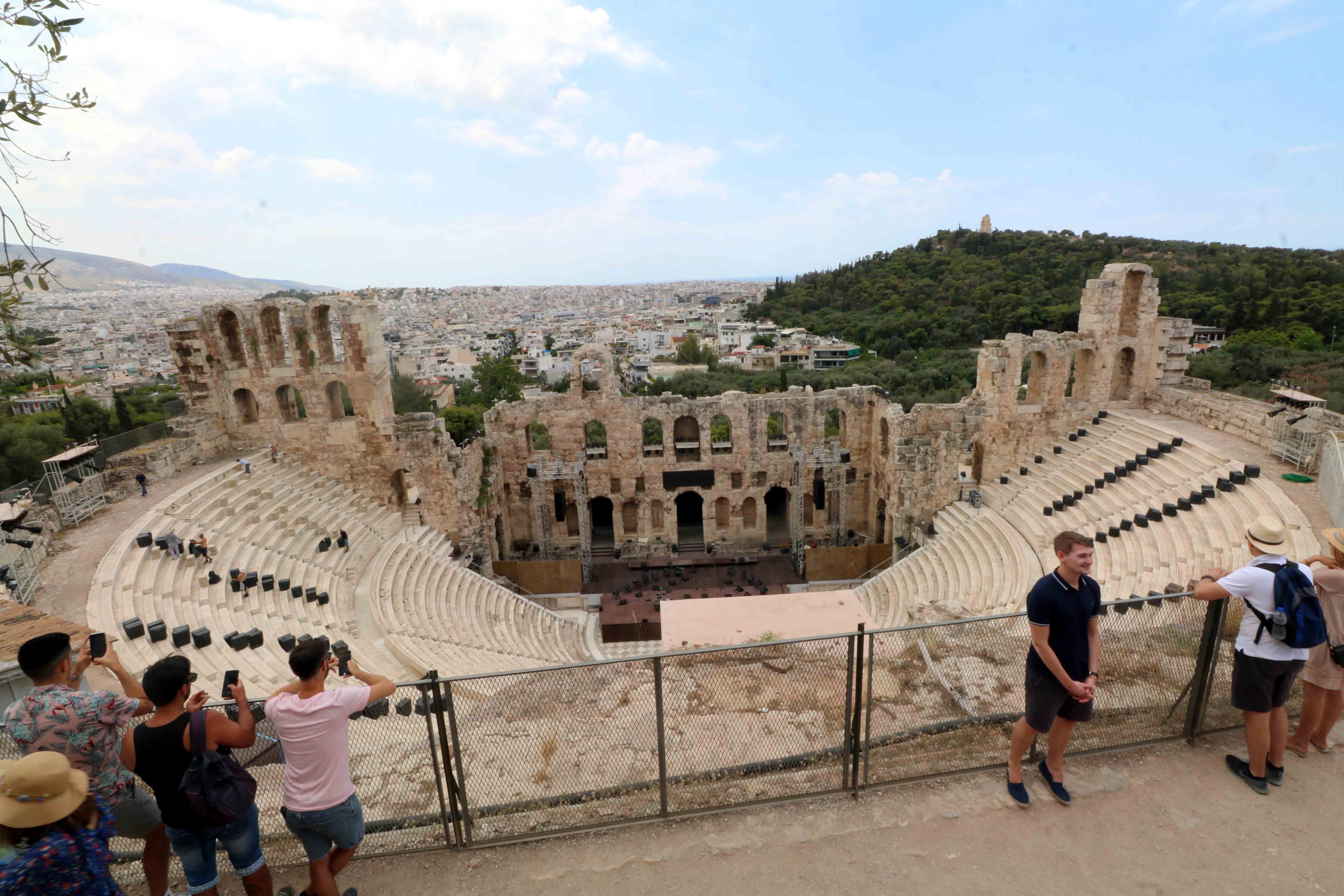
The Odeon of Herodes Atticus, built at the base of the Acropolis is an ancient amphitheatre.  This ancient theater, with a capacity of about 5,000, was built in the Roman times, about 161 AD. by the Roman philosopher, teacher and politician Herodes Atticus in memory of his wife Aspasia Regilla.  It was destroyed in 267 AD and was in ruins until restored in the 1950s.  Since then it has been the main venue of the Athens Festival, which runs from May through October each year.  Many world renowned musicians have held concerts here and was the venue for the Miss Universe 1973 pageant.


This is the facade at the entrance to Odeon of Herodes Atticus


Temple of Olympian Zeus in Athens, also known as the Olympieion, is located on the South-East of Acropolis.  It was built over several centuries starting in 174 BC and completed by Roman emperor Hadrian in 131 AD. Its unusually tall columns and ambitious layout made the temple one of the largest ever built in the ancient world.


The Theatre of Dionysus Eleuthereus is considered to be the world’s first theatre, built at the foot of the Acropolis, cut into its southern cliff.  Dedicated to Dionysus, the God of plays and wine, the theatre could seat 17,000 people.  It was the location for ancient Athens’ biggest theatrical celebration, the Dionysia.  It was an engineering marvel with perfect proportion of depth/circumference. Here is where the great masterpieces by Aeschylus and Sophocles were first performed. I tried to imagine the great  Greek tragedies being enacted with 17000 spectators, seated all around. The thought quietly transported me into a bygone era.


So time for first impressions. Great food, great people and an immense sense of history in every nook and cranny, all together a great getaway.

Greece – The Cradle of Western Civilization


(Image Courtesy Google)

Greece was our destination in the Summer of 2018.  Greece is a country in South-Eastern-Europe with thousands of islands in the Aegean and Ionian seas with Athens as its Capital.

First traces of human habitation in Greece appeared during the Paleolithic Age (120000 – 10000 BC). During the Neolithic Age that followed (7000 – 3000 BC), many buildings spread throughout the country.  The beginning of the Bronze Age (3000-1100 BC) is marked by the appearance of the first urban centers in Greece.


Conquest of Greece in 146 BC by Romans ended Greek dominance.  Christianity was propagated in Greece by Apostle Paul during the First Century.  By the Third Century, Greece became part of the Byzantine Empire.

The Ottomans empire expanded to engulf Greece from the Fourteenth Century.  Around four centuries of Ottoman domination ended with the Greek War of Independence in 1821.  The Greek State took its current form after the end of World War II.  In 1974, after the seven-year dictatorship, a referendum was held and the government changed from a Constitutional Monarchy to a Presidential Parliamentary Democracy, and in 1981 Greece became a member of the European Union.


We landed at Athens on June 09 and drove straight to our hotel.  We were briefed by our Tour Coordinator at the hotel


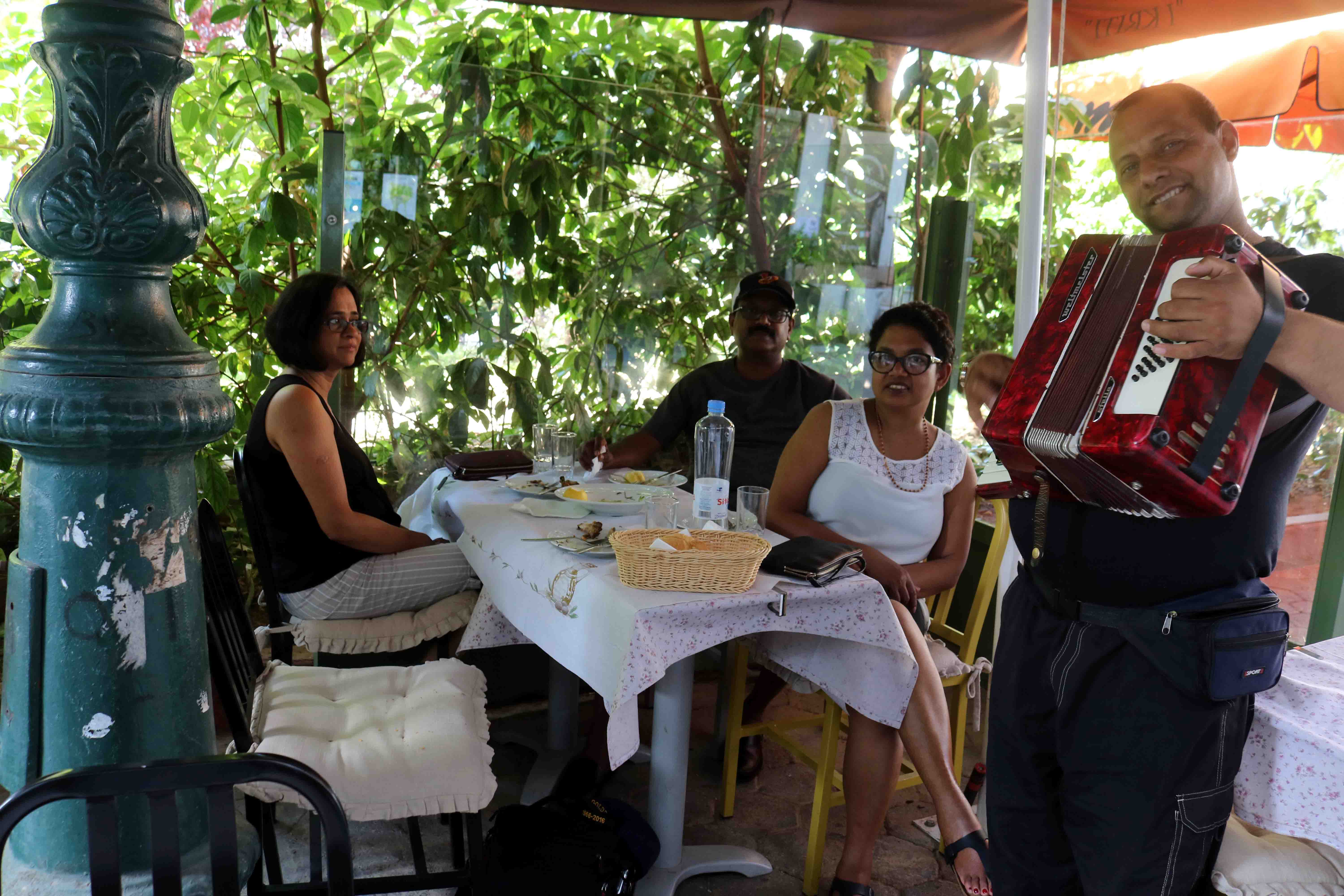
After completing our  check-in formalities at the hotel, we walked to ‘I Kriti’ Restaurant nearby as recommended by our Tour Coordinator.  The restaurant served a sumptuous Cretan food consisting of fish, lamb in a pan, pork ribs and Greek salad.   Crete is the largest island of Greece and every Cretan village has its own signature cheese, which form part of every Cretan cuisine. They are usually made from sheep or goat’s milk, or a combination of both and each cheese variety has its local interpretation.  We were also entertained by a local musician playing his accordion.


After lunch we walked to National Archeological Museum housed in the old parliament building.  It is an imposing neoclassical building of the nineteenth century which earlier served as the Greek Parliament.  It houses over 20,000 exhibits, providing  a panoramic view of the great Greek civilization.

Some of the museum exhibits of extraordinary splendour  that caught our attention are:-

 
Dipylon Amphora
. This is a large Ancient Greek painted vase, made around 750 BC.  Such large sized painted vases were used as grave markers.  The vase was made on a potter’s wheel in three sections that were joined together to form a single large vessel,  over five feet high. The base has a hole to allow offerings to be poured for the dead.


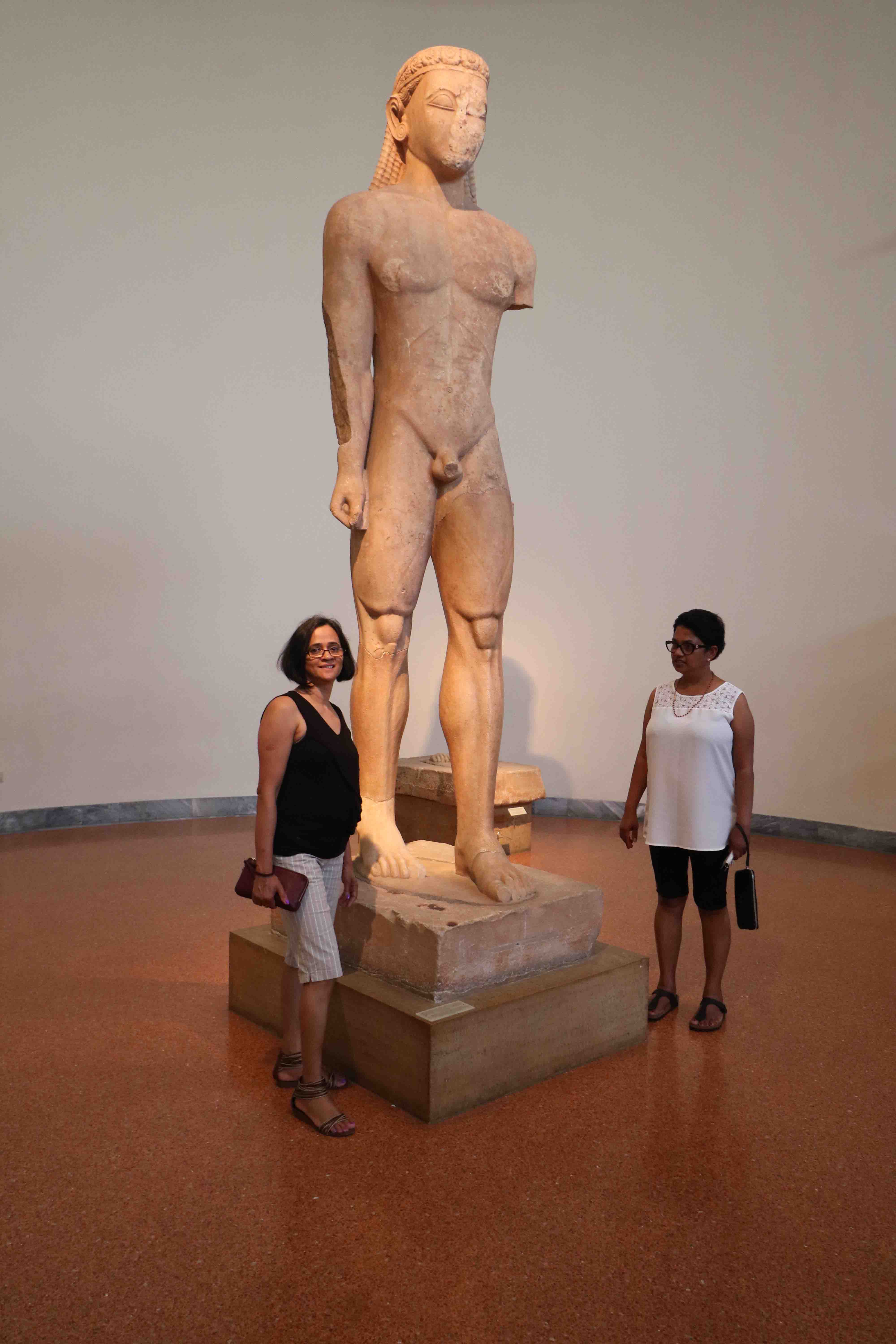
Kauros
. A marble statue of a naked youth (530 BC), erected on the grave of Kroisos, who fell in battle, according to the epigram carved on the front of the pedestal.  He is represented standing frontally with his left leg forward and fists clenched.  He symbolises youthfulness, beauty, power and hope.


Kore (Maiden)
. This marble statue of a maiden (550-540 BC), stood on the grave of Phrasikleia. The Kore is depicted by the sculptor wearing a wreath on the head, jewellery and a long gown.

Statues depicting men had their left foot forward and women were depicted standing with their feet together.  This could also prove my observation of ‘Left Foot First’.  Please click here to read my earlier post.


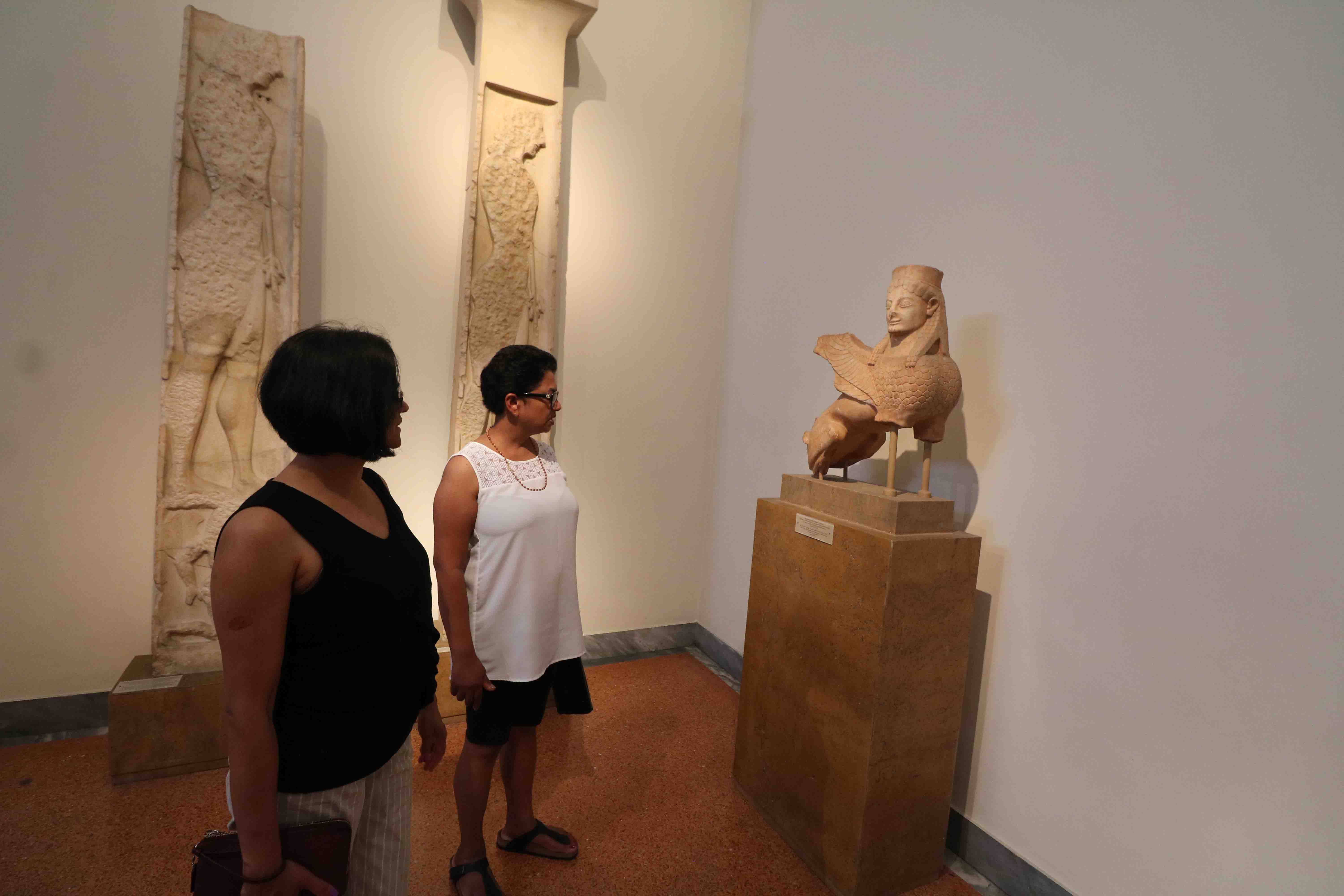
Sphinx
. This marble statue of a Sphinx (570-550 BC) is one of the earliest known Archaic Sphinxes and it was set above a grave.  Sphinx is a mythical creature with the head of a human and the body of a lion.


Bronze statue of Zeus or Poseidon. This statue (460 BC) was recovered for the seabed is still debated as to whether it represented Zeus or Poseidon.  The statue is over two meter tall.  The God is depicted with left leg forward in a  great stride, with His left arm forward, while throwing the thunderbolt or the trident held in His right hand.  Notable feature is  the exquisite rendering of motion and anatomy.


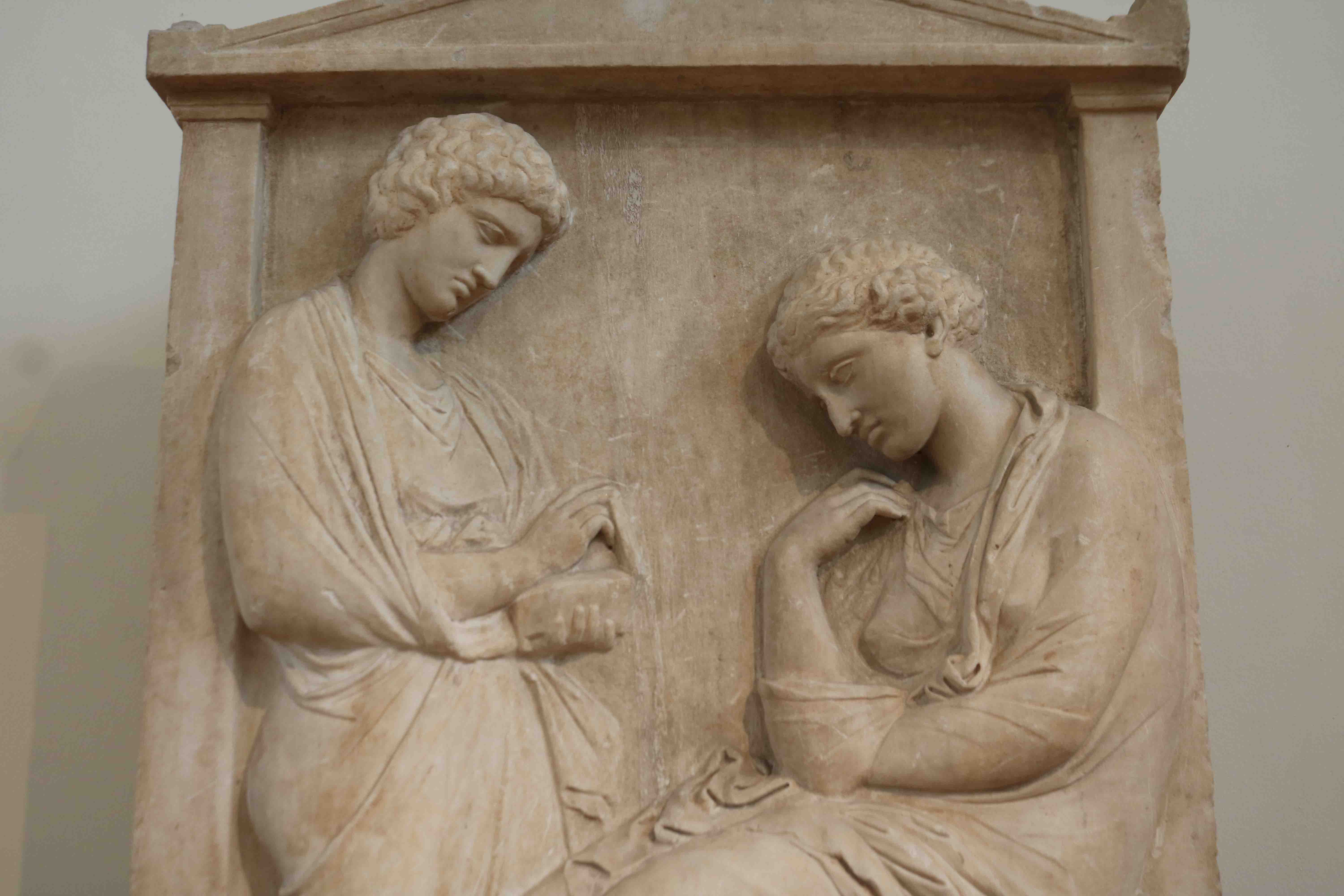
Funerary Stele
. This marble piece (400 BC) was found in 1870 in an ancient cemetery. It shows a lady seated on a chair, looks at a piece of jewellery held in her raised right hand. Opposite her, a sorrowful standing attendant holds an open jewellery box belonging to a dead woman.  The sorrowful expressions on the face of the two ladies, their hairstyles and rendering of their jewellery and dress is all very impressive.


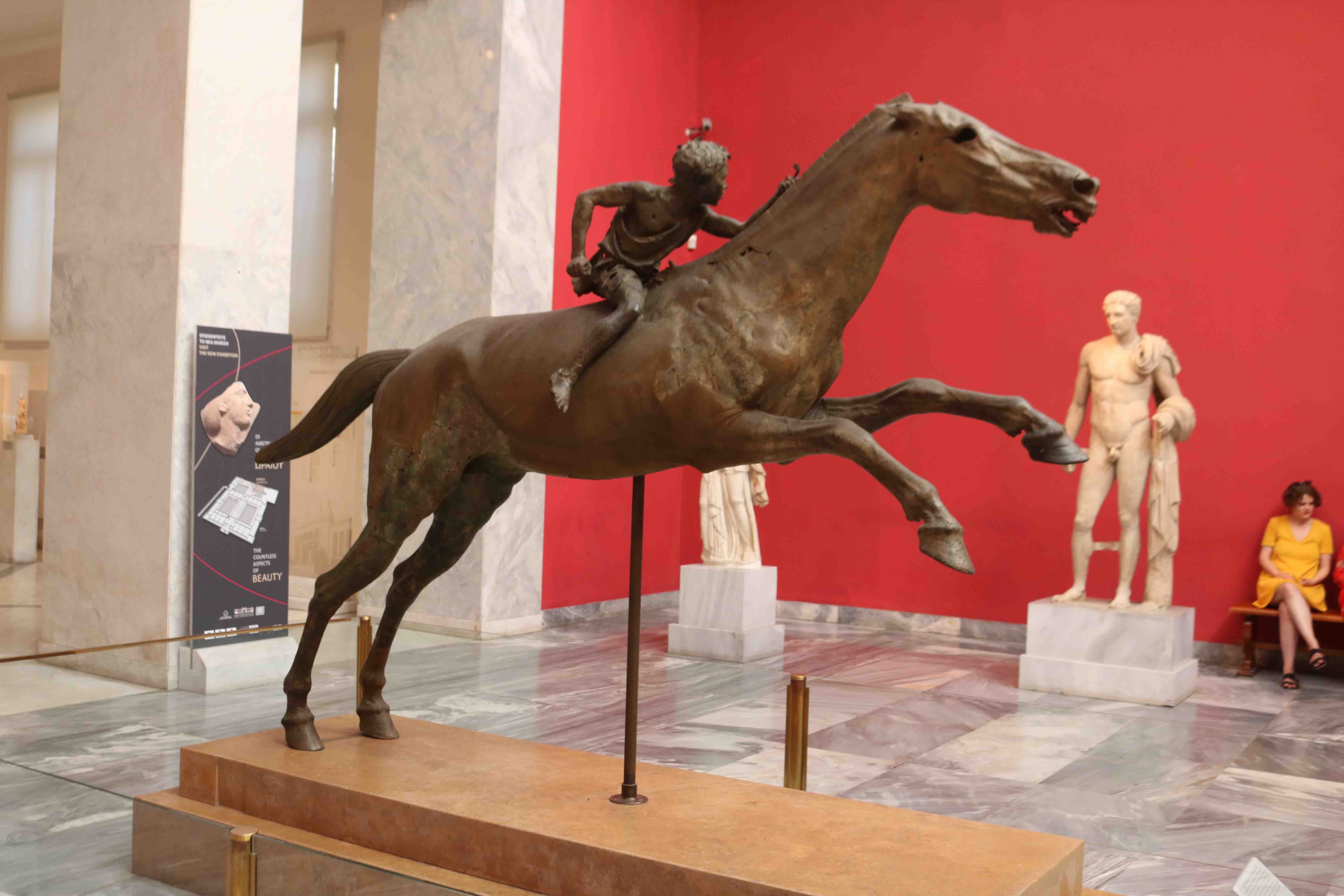
Artemision Jockey
. Bronze statue of a horse and a young jockey (140 BC) retrieved in 1928 and 1937 in pieces from the seafloor. The word Artemision comes from Cape Artemision, the site of the shipwreck. The young jockey, probably of African origin, holds the reins of the galloping horse in his left hand and a whip in his right. The contractions and furrows in his face, especially on the forehead, reveal agony and passion.


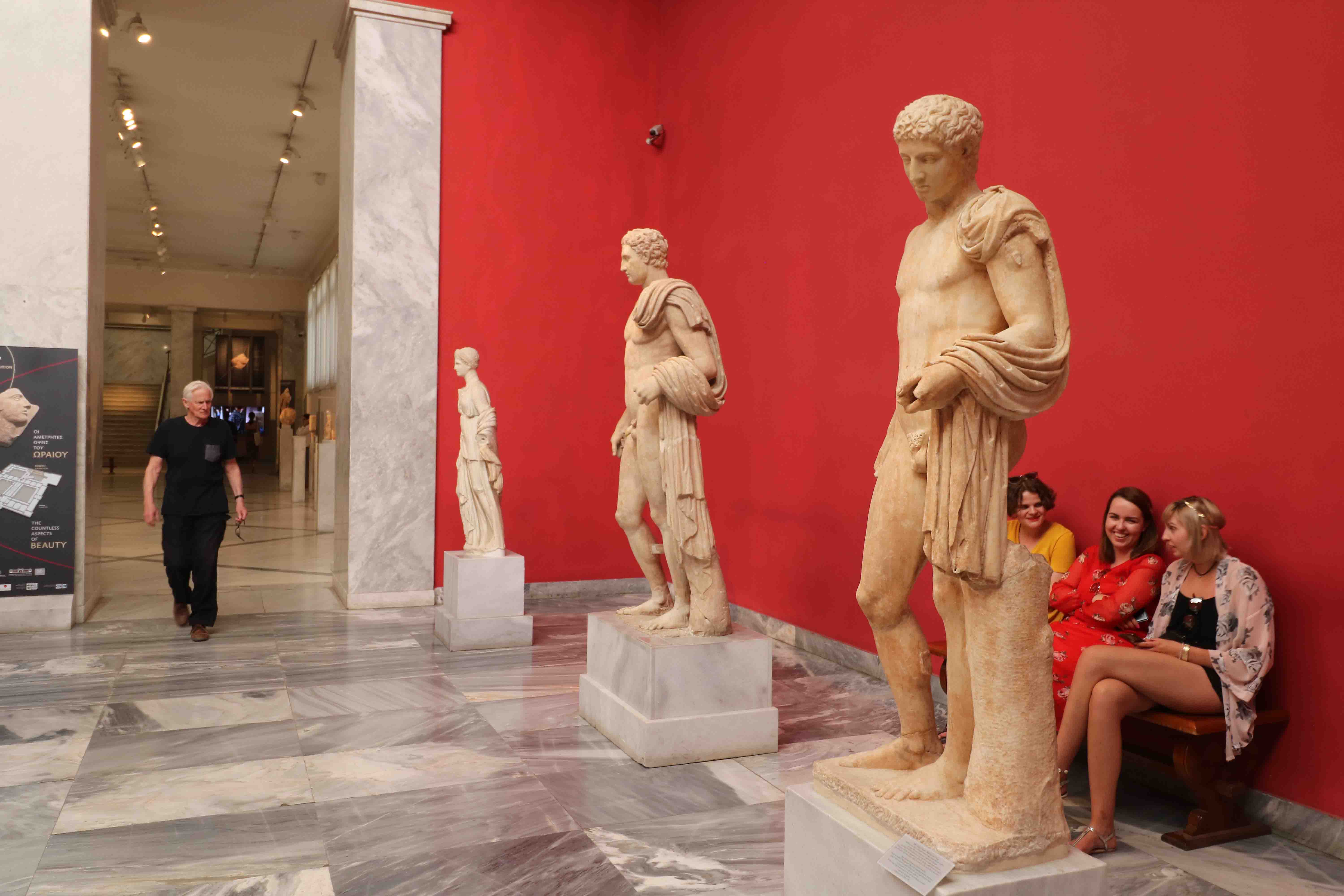
Statue of Hermes
. This marble statue (27 BC-AD 14), is probably a funerary and was found in 1860. Hermes was the  Greek God of trade, wealth, luck, fertility, animal husbandry, sleep, language, thieves, and travel.  He is depicted standing, wearing a short cloak that is wound around his left arm. In his right hand he is holding  a purse and in his left the Caduceus, his staff.


Bronze Statue of a Youth
. A bronze statue (340-330 BC), recovered in 1990 from  an ancient shipwreck on the sea floor.  It depicts either Perseus, who would have been holding the head of Medusa, or, more probably, Paris, with the ‘apple of Strife’, ready to award it to the most beautiful Goddess, Aphrodite.  Outstanding feature of this statue is the strongly modeled muscles and the expressive face.

National Archeological Museum with its numerous and outstanding exhibits give the visitor a peep into Greek history.   Unique treasures displayed with detailed captions and signboards will mesmerise you and it is really worth a visit.  The sculpture collection depicts the evolution of ancient Greek sculpture from 700 BC to the Fifth Century AD.  It requires plenty of time to read through various information boards and enjoy the artistic value of the statues and artifacts displayed.


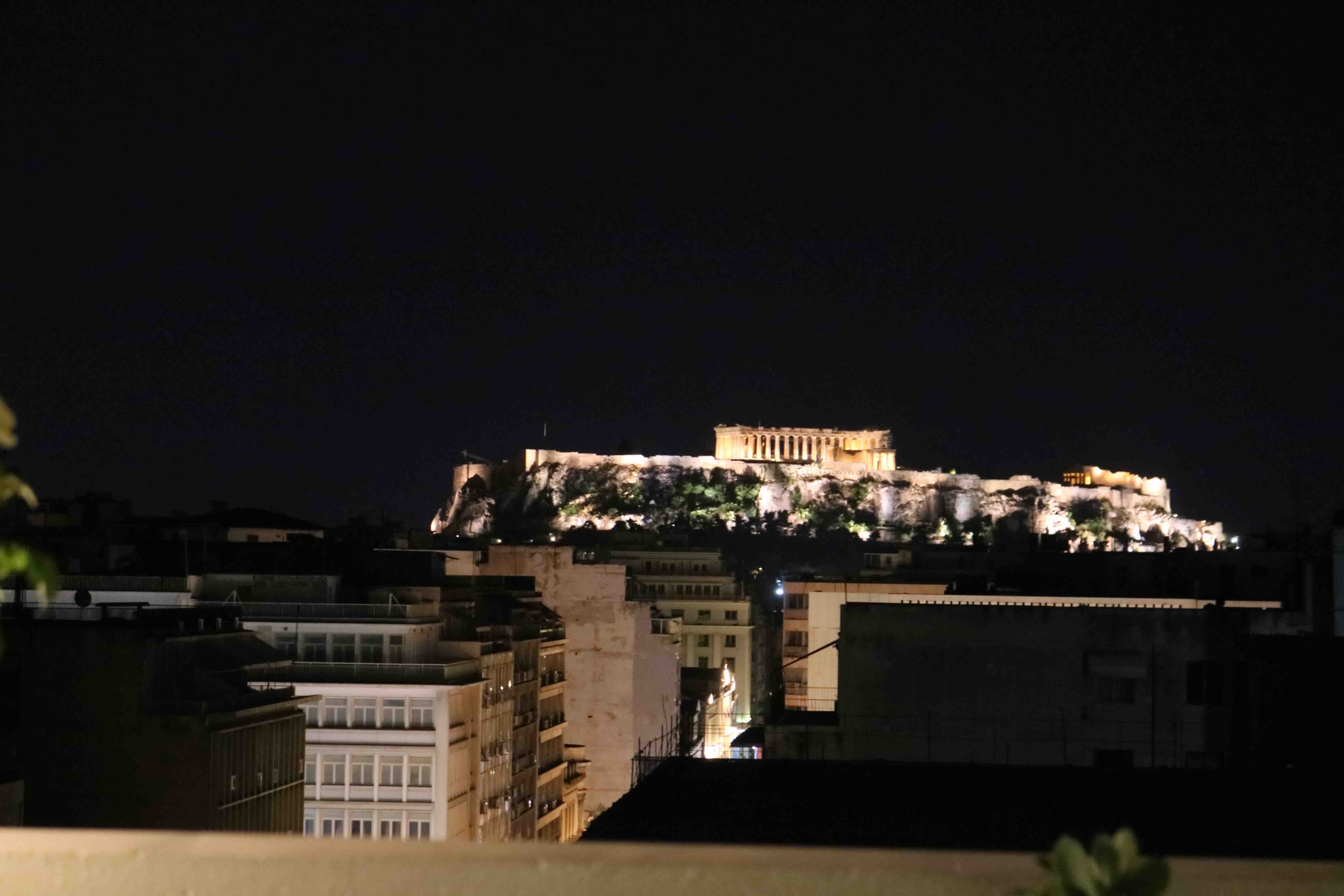
We returned to our hotel rooms by dusk.  We had dinner at the roof-top restaurant of the hotel which offered a stunning view of illuminated Acropolis.

I felt a fleeting sense of awe and humility. Looking at the brilliance of what is left of a more than 2000 year old structure, i couldn’t help but feel that despite the ravages of time, here is where history stands tall, with elegance and poise.

Retreat Ceremony at Hussainiwala

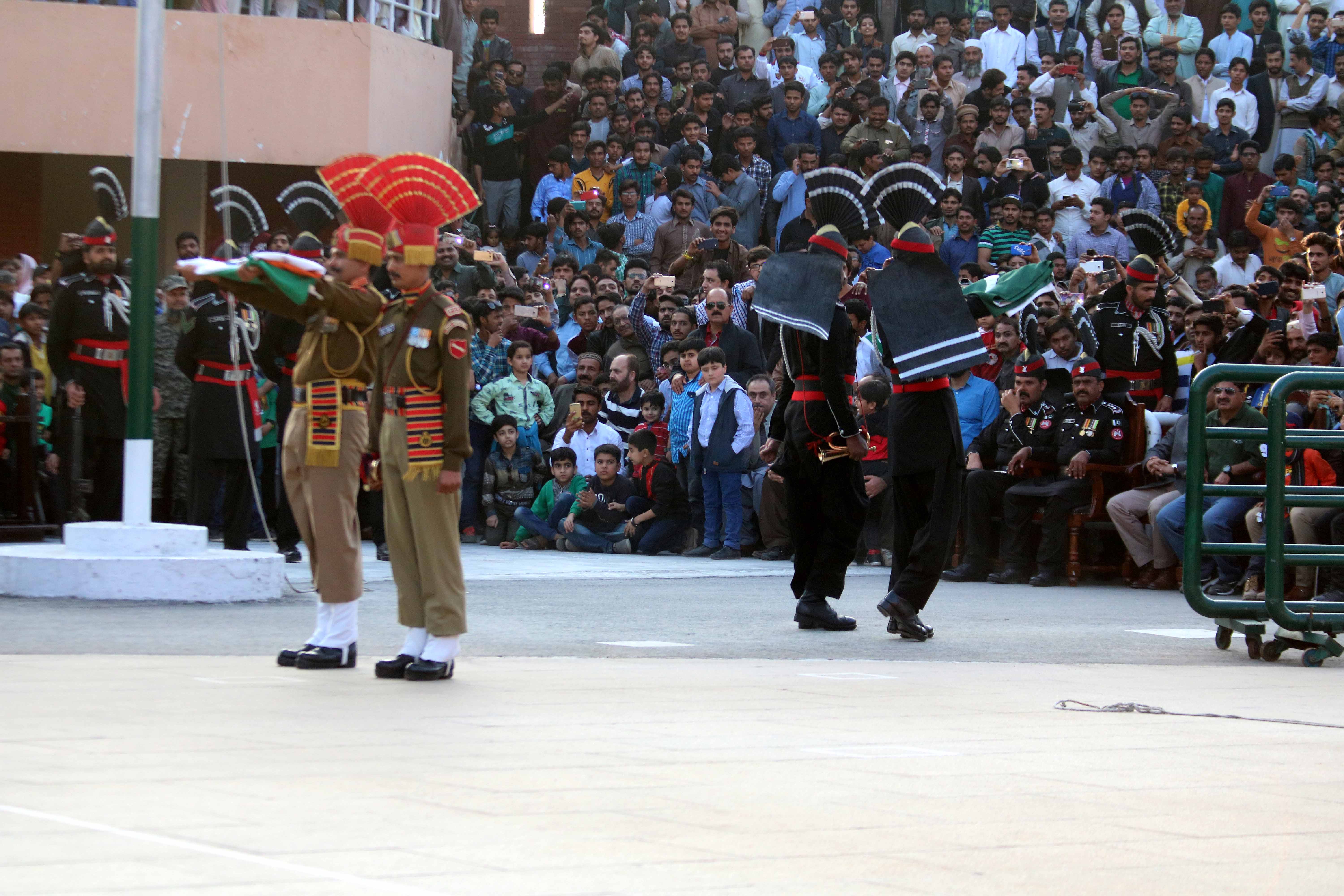
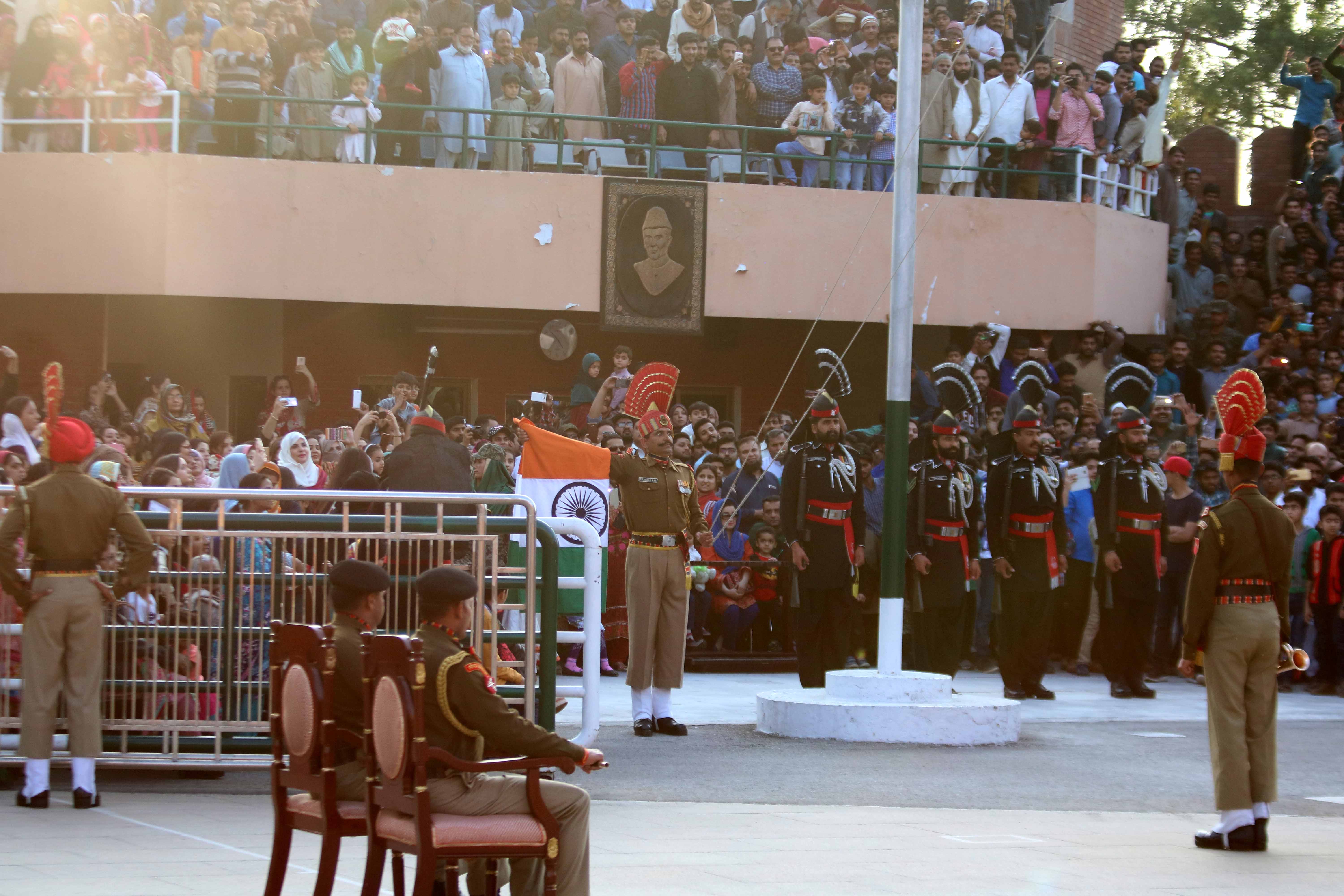
During our visit to India to attend the Golden Jubilee celebrations of raising of our regiment – 75 Medium Regiment (Basantar River) – we watched the Retreat Ceremony at Hussainiwala Border Post.  Unlike most international borders, where no such daily ceremonies are held, retreat ceremonies are held on Indo-Pak border at dusk.

Canada and USA share the longest International Boundary in the world, which is mostly unmanned, except at crossing points.  The border came into existence at the end of bitterly fought American Revolutionary War between Great Britain and the United States with the Treaty of Paris of 1783.  In 1925, the International Boundary Commission came into being with the task of surveying and mapping the boundary, maintaining boundary pillars and buoys and keeping the boundary clear of bush and vegetation for six meters.

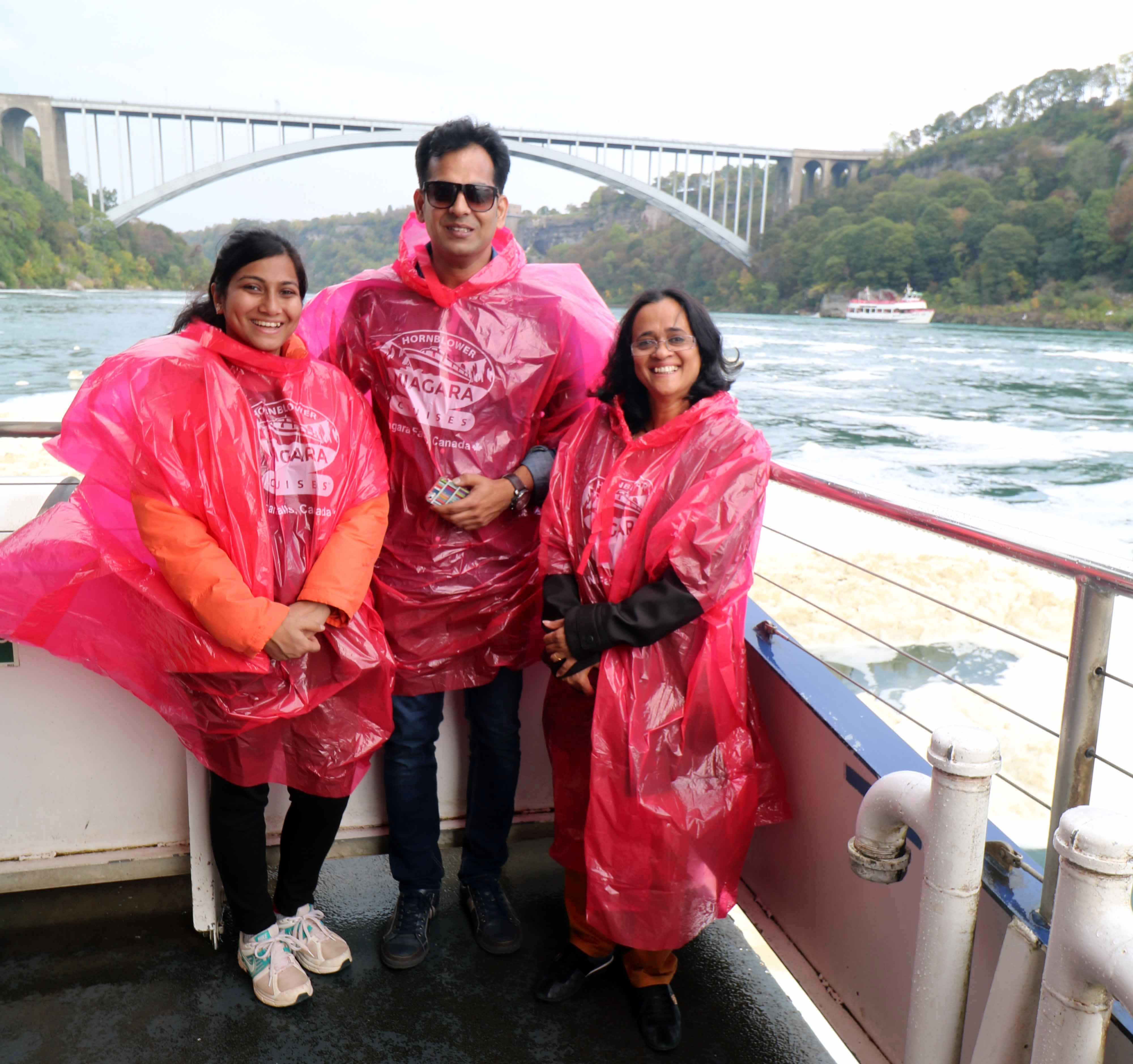
Ontario province has 14 road border crossings, one truck ferry, and four passenger ferries with the United States.  The most popular crossing is the Rainbow Bridge (above) near Niagara Falls.  This is a popular border crossing for pedestrians, however, trucks are not permitted to use this bridge.  The boundary runs through the centre of this bridge.  Surely, the two countries hardly ever hold any border ceremonies.

There are only three trading posts, Wagah (Punjab), Chakan da Bagh (Rajouri, Kashmir) and Kaman (Uri, Kashmir) on the Indo-Pak border through which people and goods move.  Chakan da Bagh Post and Kaman Post is manned by Indian Army soldiers and they do not hold any ‘retreat’ ceremonies.  However, they exchange sweets on important national and religious days.

A ‘retreat ceremony’ in military parlance signals the end of duty day and when the national flag is brought down.  The band if present or the bugler will sound ‘retreat’.  The lowering of the flag is coordinated with the playing of the music so the two are completed at the same time.  It is a ritual in every military unit and often coincides with the change of guard for the night.

Retreat ceremonies are held on the Indo-Pak border in Punjab at Wagah (Amritsar), Hussainiwala (Firozepur and Sadiqi (Fazilka) by the Border Security Force (BSF) of India and Rangers of Pakistan.  Neither the Indian Army nor the Pakistan Army is involved in this heavily choreographed flag-lowering ceremony.  The drill movements are over exaggerated and at times is near ridiculous and mostly absurd.  One would even wonder as to whether such ceremonies hold any value in modern civilised world.  Whatever it may be, the ritual has endured through half a century despite many diplomatic upheavals, border skirmishes, economic warfare and mutual misunderstandings.

Hussainiwala Border served as the major road crossing between Indian and Pakistan till 1970. At that time, it acted as a trade route for truckers, mainly to import Kandahari Angoor (dehydrated grapes) as well as other fruits and food products from Pakistan and Afghanistan.   The post was closed for trade in 1970 as tensions rose between India and Pakistan.  The retreat ceremony commenced in 1972 after the Indo-Pak War.

We were all seated in the Amphitheatre to witness the ceremony.  On the Indian side there was no segregation of. men and women.  The only concern was the glare of the setting sun as we faced Westwards.

On the Pakistan side, there were separate enclosures for men and women.   The only commonality was most women and men including the Rangers – all wore Salwar Kameez.

As the seats were getting filled up, the audio systems from both sides begun belching out ‘patriotic’ songs with as much volume they could muster.  At the auspicious time of 5 PM, the soldiers from both sides ‘enacted’ their choreographed drills.

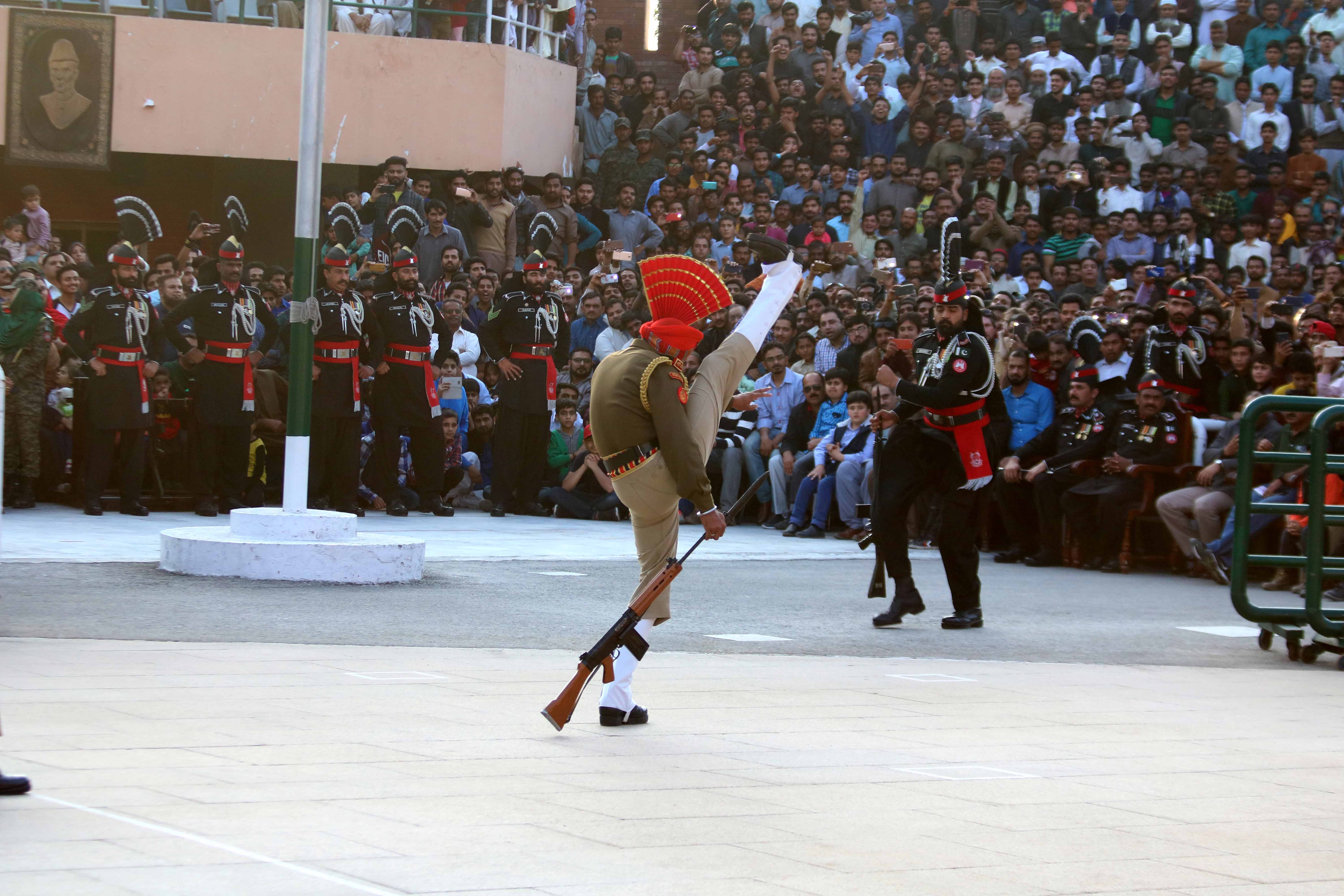
They marched ‘Goose Stepping’, throwing their legs as high as they could.  This was a form of extreme marching held by German, Prussian, and Russian military to be an ultimate display of the unbreakable will and discipline of its soldiers.  Most modern armies have done away with this ‘fascist’ approach to marching as being extreme.  Only a few countries use it as a powerful display of military discipline.

Foot drill is a fundamental activity of the military and is practised regularly during initial military training.   Foot drill involves marching with an exaggerated heel strike, and regimented manoeuvres performed while marching and standing characterised by an exaggerated stamping of one foot into the ground.

The soldiers were wearing leather soled boots with heavy metal attached to them.  It made ‘metallic’ sound when they came in contact with the concrete floor every time the a soldier stamped his foot, that too much higher than needed.

The soldiers from both the sides pose showing their aggression and fearlessness.  They widen their chests, twirl their mustaches, thrust open their  eyeballs, and what not – all to invite applause and cheers from the audience on either side.

After enacting all these choreographed caricature of a drill, soldiers  cross the white line to come to the other country and form a beautiful cross X with the flag threads. Both the flags are held together at the junction and then are brought down at speed and folded neatly.  Throughout the ceremony sloganeering and clapping many a times reached frenzied levels.  The only saving grace during the entire routine was the exchanges of sly smiles between the soldiers of both nations.

The question here is as whether we need such exaggerated drills to incite national passion and fervour among the citizens?  How long can a country sustain such a fervour?  What about the soldiers who are enacting this routine?  Have you considered the unwanted  physical and mental stress they undergo?

High levels of bone strain caused by such exaggerated drills will surely result in stress fracture.  It may also cause micro-damage to bones.  Digging down of heels, especially with the foot raised over the head may cause severe strain to the neck and spine and also brain damage.  These soldiers may also end up with joint pains, migraine and headaches

Ultimately who cares?  The show must go on.

Hussainiwala – A Village on Indo-Pak Border


During our visit to India to attend the Golden Jubilee celebrations of raising of our regiment – 75 Medium Regiment (Basantar River) – we watched the Retreat Ceremony at Hussainiwala Border Post.


Railway line connecting Peshawar to Mumbai was built in 1885, passing through Hussianiwala.  During the Pre-Partition days, Punjab Mail connected the cities of Mumbai, Delhi, Ferozepur, Lahore and Peshawar. In those days, most British troops and businessmen arrived at Mumbai and made their way to their destinations in the North-West Frontier Province by train. The train track from Ferozepur to Hussainiwala was an engineering fete, with Qaiser-e-Hind bridge, which stood over several round pillars (all of them intact even today, as depicted in the image above).


When Pakistan was carved out of British India, the border was drawn along the Sutlej River in Punjab and it passed through Hussainiwala Village.  Now, Sutlej River has changed its course over the years, running further East in Indian territory.  This made Hussainiwala an enclave into Pakistan, with the Sutlej River behind it.


Hussainiwala is named after a Muslim Peer (Saint), Hussaini Baba, whose shrine is located at the entrance to the Border Post.  This small hamlet came into prominence on the evening of 23 March 1931 when British soldiers tried to cremate the bodies of three young Indian freedom fighters – Bhagat Singh, Sukhdev and Raj Guru – who were hanged at the Lahore Central Jail.  The hanging, scheduled for 24 March was rescheduled a day earlier as the British feared a revolt in Lahore as the situation had become very tense.  They  secretly transported their bodies to Hussainiwala and while cremating them on the banks of the Sutlej, the locals got wind of it.  They assembled near the cremation site.  Fearing repercussions, British soldiers fled the scene, leaving behind the dead bodies which were cremated by the villagers.  This site today is a memorial – aptly called ‘Prerana Sthal‘ (Motivation Site).


Later Bhagat Singh’s mother, Vidyawati, and freedom fighter BK Dutt were cremated at this site as per their wishes. The cremation site is called ‘Shaheedi Sthal’ (Martyrs’ Place).   This is where Indians from all over the country make an annual pilgrimage to honour the martyrs on March 23 as they observe ‘Shaheedi Diwas’ (Martyrs’ Day).


(Defences on the Indian side on Bund (wall) with a bunker as inset)

This enclave has witnessed three bloody battles between India and Pakistan,  with the very first one fought on 18 March 1956.  At that time, heavy floods had damaged Bela Bund and Sulaimanki Headworks at Hussainiwala and as the Indian engineers were repairing the damage, Pakistan Army launched an unprovoked attack at 9 PM.  4 JAK RIF was guarding the bund, and they fought  gallantly causing heavy causalities on the enemy.  This resulted in a hasty withdrawal by the attackers.


During partition of British India in 1947,  Hussainiwala, an enclave of 12 villages went to Pakistan. The railway line no more had trains running through Hussainiwala.  The railway station at Hussainiwala as it exists today is depicted in the image above.  Now Punjab Mail connects Mumbai to Ferozepur via Delhi.  Pakistan destroyed  Qaisere- Hind Bridge leaving behind the round pillars across the river. The Shaheedi Sthal was in a dilapidated state without any maintenance. In 1961, Jawaharlal Nehru, then Prime Minister, brokered an exchange deal and Hussainiwala came to India while Sulaimanki Headworks –  from where three major canals which supply irrigation water to a large area in Pakistan  Punjab originate –  went to Pakistan. India immediately restored Shaheedi Sthal to its due dignity and reverence.

During Indo-Pakistan War of 1965, 2 Maratha Light Infantry (Kali Panchwin) was deployed to defend Hussainiwala. The battalion fought valiantly to thwart a  frontal attack resulting in two enemy tanks destroyed and two captured, with several enemy killed. The Commanding Officer Lieutenant Colonel Nolan was killed in enemy artillery shelling. The unit ensured that the Samadhi of Bhagat Singh was not desecrated by Pakistan Army. The battalion was visited by then Prime Minister Lal Bahadur Shastri, Defence Minister YB Chavan, Congress Party President  K Kamraj, the Chief of Army Staff and other senior officers. Kali Panchwin was awarded the battle honour ‘Hussainiwala’ for its role in the 1965 War. The citizens of Firozpur, in honour of the Battalion’s contribution in defending the bridge and Firozpur town, presented a silver replica of the Hussaniwala Bridge.

During the 1971 War, it was 15 PUNJAB defending Hussainiwala enclave and the Memorial.  On 03 December, Pakistan Army launched a heavy attack.  The valiant Punjabis withstood the attack gallantly despite suffering heavy casualties until withdrawing on 04 December night.


Did the three freedom fighters, who laid down their lives for Indian independence in their wildest dreams ever visualise that post independence, there would be a partition on religious lines and it would all end up in three bloody wars at the very same site their ‘Samadhi’ stood?

Military Lounge @ Buffalo Airport


On 04 February 2018, I traveled to Buffalo Airport, USA to pick up Reshma Sameer, daughter of Veteran Brigadier Azad Sameer. To read more about Brigadier Sameer,Please Click Here.

Buffalo Airport is 160 km from our home, about two hours of drive by car.  She was scheduled to land at 2 PM.  It was snowing in the morning and was foggy.  Hence, I left home by 10 AM, catering adequate time for a slow drive,  breaks, and crossing at the Canada-US border.  We generally cater for about 30 minutes for border crossing formalities.


As I pulled up at the US Customs & Border Protection counter, there was hardly anyone waiting there to cross.  I drove up to the counter and the officer manning the post came out.  As I was handing over my passport he asked “Sir, aren’t you watching the Super Bowl?”  “I am off to Buffalo Airport to pick up our family friend”  I answered.  Returning my passport he said “Drive safely, have a nice day, Sir.”  This quick clearance must have been due to the ‘Veteran‘ Licence Plate of my car.

The Super Bowl is the final game of the National Football League (NFL), played on the first Sunday in February.  It is one of the most watched TV event in United States with more than 100 million people from the United States alone watching it.  Every year the TV commercials, known as Super Bowl ads attract a lot of interest and also money.  This year it featured Hollywood stars Cardi B, Tiffany Haddish, Keanu Reeves and Morgan Freeman.

I reached the Airport at noon and was looking for a place to spend two hours at my disposal.  I picked a book I had in the car and my reading glasses after parking the car in the parking lot.  As I entered the arrival area, I read a sign ‘Freedom Lounge – A Courtesy Centre for Military Service Members and Veterans.’

This lounge was setup in 2016 by WNY Freedom Lounge Inc in recognition of  sacrifices by the US Military Service personnel.  It ensures a welcoming environment for traveling Military personnel & Veterans at the Buffalo-Niagara International Airport. The lounge is open to members of the military, veterans and their families free of charge.


WNY Freedom Lounge Inc is a private, non-profit organization, headed by Veteran Lieutenant Colonel Dan Walther of Kenmore, who raised funds and made arrangements for the lounge. The lounge provides morale and recreational services to members of the US Military and their families. The lounge offers comfortable seating, reading material, TV, phone, snacks, and internet access. It is staffed by veteran volunteers, veteran organizations and military supporters.

I was welcomed in by Veteran Chief Petty Officer Ronald of the US Navy.  After exchanging usual pleasantries, he ushered me in and showed me three rooms – a reception area, a kitchenette and a small living room with sofas and chairs.  He opened the fridge, well stocked with beverages and asked “What would you like to have Sir?”  “Black Coffee” I replied.  He brewed a cup for me in the coffee maker and we sat down and talked.

He said that this lounge has been created for transitioning Military personnel, who  often have significant wait times between connecting flights.  Most Military personnel often travel alone and they need a place to rest.  The lounge is staffed and maintained fully by volunteers.  It is generally open from 9 AM to 10 PM and during other times, the Information Desk staff would open it.

We spoke about all matters two Veterans would speak – about our service in the Forces, places served, family, children, aspirations, dreams, et al.  At the end I realised that we Veterans – from US and India – why from world all over – speak the very same language.  The Military is in our blood and it cannot be shed easily.

Canada’s African Lion Safari

It has become a ritual for me to take our guests to the African Lion Safari, located in Cambridge, Ontario.  I have even lost count on the number of times I have been there.  I can for sure claim that I am now an accomplished tour guide for anyone visiting the Safari.  When Air Vice Marshal TD Joseph (Joe) and Sophie Joseph came calling in May 2016, how could I omit the African Lion Safari from the itinerary.

Joe210

African Lion Safari, a family-owned private entrepreneurship, is a picturesque and fun-filled Wildlife Park that offers not only a Safari trip of 9 km, but also conducts educative shows on birds and elephants.    This conservation theme-park showcases many different and rare animals from Africa, Europe, Asia, and the Americas. The drive through the game reserve will get you as close as you can ever get with fascinating wildlife.

At the Safari, animals are exhibited in an entirely different way – visitors are caged in their cars or tour bus, and the animals are free to roam the 5-to-50-acre reserve, in their natural habitat.  The Safari Trail comprises seven game reserves that showcase a diverse collection of species such as lions, cheetahs, baboons, rhinos, ostriches, giraffes, and many other exotic and native species.

In case you take your own car, you are in better control of the time that you spend observing and photographing the animals, and it affords a great deal of flexibility. There is a guided tour on the Safari bus, which takes just over an hour.  The tour guides offer great information about the animals you encounter.  Visitors who spend a full day at the African Lion Safari, often exercise both options. I prefer the drive in our car and surely there are a few risks involved.

It is worthwhile to note some interesting facts about the founder of this wonderful place. Late Colonel GD Dailley founded the Safari with a vision to create an environment for self-sustaining populations of declining wildlife species.  It opened with 40 lions in three reserves in 1969.  Today the park houses in excess of 1,000 animals comprised of more than 100 species.

Joe211

Colonel Gordon Debenham Dailley  (July 24, 1911 – May 3, 1989), was born in Winnipeg, Canada and was educated at St John’s College at the University of Manitoba.   He was a member of the team which won the gold medal in ice hockey for Great Britain at the 1936 Winter Olympics. The team consisted mostly of British-born Canadian citizens, as well as Dailley, whose only justification for playing for Britain lay in his long years of living in England.  He led the team to European Championships in 1937 and 1938, after which he left hockey to join the Canadian Army.

Colonel Dailley served in England throughout World War II. After the war, he remained with the Canadian Forces and held a number of posts in Ottawa and served on the United Nations Armistice Commission in Korea. He was promoted to the rank of Colonel in 1955 and was assigned to Belgrade, Yugoslavia as the Canadian Military Attaché.  In August 1960 he was appointed the base commander at Gagetown in New Brunswick.  He retired from the army in 1964.

After about an hour’s drive from our home, we generally reach the Safari gates at 9:55 AM, five minutes before the gates open.  In order to avoid the rush, it would be better to visit the park on a weekday, that too well before the schools close for summer vacations.  This gives all the time to watch and photograph the animals as there is no pressure from the vehicles following.

First reserve is Nairobi Sanctuary which houses elegant birds like the crowned crane and white stork with llamas and robust Watusi cattle from Africa with its large distinctive horns that can reach up to 8 feet.

Next is the Simba Lion Country, home to a large pride of lions, perched on large rocks or in the shade of trees.

If you are lucky, you can capture the lions in such poses too.

There is a separate enclosure for the White Lions.  They are same as their African Lion cousins with a rare color mutation.  They are found in the Timbavati area of South Africa.

Joe213

Adjacent to the lion sanctuary is the Duma Cheetah Preserve.  African Lion Safari has been very successful with breeding cheetahs, who are notoriously difficult to breed in captivity, with over 40 cubs to date.

Joe214

Most entertaining reserve is Wankie Bushland Trail where you will encounter baboons.  This is where the risk of taking your car lies.  These baboons have developed special skills to pull at wipers or peel rubber stripping or to simply perch atop the car’s roof and take a ride around their habitat.

Joe215

Next enclosure is the Rocky Ridge Veldt representing the Savannahs of Africa.  It is home to a mix of species from the curious ostrich to the highly endangered Rothschild giraffes, as well as zebras, eland and rhinos.

Joe216

Ostriches and giraffes come very close to the cars, and this shot of the giraffe saying hello through the moon-roof of our car.

Joe217

Last reserve takes you to North America which houses animals like elk and the bison

Joe218

There are also a number of entertaining, educative and informative shows starting with the Elephant Swim.  The keepers bring the Asian elephants, all cutely holding the tail of one in front by their trunk. They range from the oldest at 35 to the youngest at two years.

Joe219

Next show, the ‘Birds of Paradise’ where various birds showcase their incredible intelligence like a crow cleaning up tin cans to put in a blue recycle bin to a macaw deciphering colours, as well as the red-legged Seriemas,  a long-legged bird from South America, showing off their natural abilities.  The Serena displayed its skill at killing a snake by picking it up and throwing it repeatedly hard on to the ground.  They also showcased a wide assortment of birds like macaws, emu, an Indian bat, peacock and ended the show with a talking and singing parrot.

Joe220

The next is another great show, the ‘Birds of Prey’. The flying and hunting skills predator birds are on display here. The birds include marabou stork, a bald and golden eagle, a couple of owls and peregrine falcon ,the fastest moving creature in the animal kingdom.

Joe221

Elephant Round-Up show is a display of elephant’s impressive strength, agility and intelligence.  One even paints a t-shirt in the show, holding the paint brush in its trunk.  It was heartening to see that not even once was an elephant shouted at or goaded with a pointed metal rod as seen in some parts of Asia. African Lion Safari is home to the largest Asian elephant herd in any zoological facility in North America and has one of the most successful breeding programme.  The Safari announced the birth of Jake in 2009, a healthy male calf, through artificial insemination, the first ever in Canada.

Joe222

African Queen boat cruise piloted by one of the parks guides, circles a lake to see exotic birds, primates, ring-tailed lemurs, ground hornbills, spider monkeys, black and white ruffed lemur and endangered Angolan Colombus monkeys that reside on the islands.

Joe223

The shows were conducted mostly by university students, many pursuing their degrees in zoology related fields.  What an opportunity and environment for these students to earn, learn and apply their knowledge and also improve their confidence levels, communication skills and self-esteem?

How do these animals, mostly from the tropics, survive through the harsh Canadian winter?  The Safari has large barn-like centrally heated housing where the animals can go in and out.  As per the Safari staff, the Cheetahs love playing in the snow and enjoy the winters.

Since its inception in 1969, the Park has been successful in breeding 30 species, considered endangered, and 20 species, considered threatened. The original idea of maintaining self-sustaining populations of species in decline is still the Park’s priority, all while providing its visitors with a safe, entertaining, and educational environment.

Fishing @ PEI


In the summer of 2010, we decided to travel to the Eastern most province of Canada, the Prince Edward Islands (PEI).

Savanna Style Location Map of Prince Edward Island
PEI is located close to the Eastern Canadian coast in the Atlantic Ocean. The Confederation Bridge links Prince Edward Island with mainland Canada. The 12.9-kilometre bridge opened on 31 May 1997. One can also reach the island on a ferry. There is no toll on the bridge or charges on the ferry while entering PEI, but on leaving one got to pay.

The island is named after Prince Edward, Duke of Kent and Strathearn, the fourth son of King George III and the father of Queen Victoria. The Island is 224 km long and from 6 to 64 km wide with a total area of 5,660 square km. No place in the province is more than 16 km from the sea and the highest point is 152 metres or 466 feet above sea level.

Classic Style Map of Prince Edward Island
The island has three counties: Prince, Queens and Kings. The Island is formed from sedimentary bed rock of soft, red sandstone which produces the rich, red soil. The redness of the soil is due to the high iron-oxide (rust) content.


Agriculture remains the dominant industry, especially potato farming in the red soil. The province currently accounts for a quarter of Canada’s total potato production. In the PEI, fishing, particularly lobster fishing as well as oyster fishing and mussel farming, is second to farming as an occupation and is a highly regulated industry.


The lobsters are fished using a lobster trap. Lobster traps are constructed of wire and wood and an opening permits the lobster to enter a tunnel of netting. The size of the opening depends upon the size of the lobster to be caught. The majority of the newer traps consist of a plastic-coated metal frame.  Traps are usually constructed in two parts, called the ‘kitchen’, where there is bait, and exits into the ‘parlour’, where the lobster is trapped from escape.

During fishing season, bait fish is placed inside the trap, and the traps are dropped onto the sea floor. A long rope is attached to each trap, at the end of which is a plastic or Styrofoam buoy that bears the owner’s license number and is identified by their colour coding. The traps are checked every day by the fisherman and re-baited if necessary.

The activity that really enthused us was the lobster and crab fishing tour, operated by Captain Mark Jerkins and assisted by his younger brother Codi. Captain Mark runs this tour in July and August at the end of the fishing season. During the tour we experienced what the lobster fisher folk undergo. It involved locating a buoy, hauling a trap and banding a claw of the lobsters. The claws are banded to ensure that the lobsters do not fight with each other and lose their claws. Watch how Cody holds the lobster’s claws in the image. Outside water, if not handled properly, these claws will fall-off as they are really heavy.


As per Mark, this Lobster is about 40 yrs old.


Everyone took a turn at the boat’s wheel and learned how to use modern technologies to fish for lobster. Captain Mark also shared his personal experiences while fishing for lobster and also how this fourth generation lobster fishing family makes their living on the water. At the end of the tour we were treated to a sumptuous dinner of lobsters and crabs.


More than 1,200 lobster fishers set out for these waters to haul in lobsters during the first fishing season in PEI that runs from April 30 to June 30 each year. Setting Day marks the start of the eight-week lobster fishing season. The annual event starts at 4:45 am when the fishing communities across the island come out to cheer on their local fishing fleets as they head out to the sea. The first lobster boat that leaves the wharf is that of the most veteran fisher and his crew and other boats follow and the wharf roars with the sounds of engines, cheers and silent prayers. Some harbours invite local clergy to bless the boats and crews during this annual spring rite.

PEI’s lobster industry strongly believes in sustainability and would never jeopardize their rich resources for short term gains. Its fishery is strong because of the aggressive and sustainable management strategies implemented throughout its history. The Canada government’s Department of Fisheries and Oceans (DFO) sets minimum legal sizes to sustain the lobster fishery and fines fishermen caught with smaller lobsters on their boats.

The smaller lobsters called the ‘Canners’ are unique to the PEI, where the warmer temperatures cause the lobsters to mature quickly. These small lobsters were canned in the earlier days and so they got their name. Minimum size of ‘Canners’ is now set to 72 mm and they weigh between 250 and 375 grams. This is where the marine-scientific community believes the population is sustainable, as 50% of female lobsters in PEI’s waters would have reproduced at least once by the time they reach this size. In other regions, the minimum legal size is 81 mm. The waters are colder there and it takes longer for the lobsters to mature – when they do, they are much bigger. The ‘Market’ lobsters are about 81 mm and weigh more than a pound. They are used in the restaurants and are exported live to the United States.


The Island’s 27 crab fishermen are engaged in the trade.  Their allotted annual quota for PEI fishermen is about 600 tons which include snow crab, rock crab and spider crab.


In PEI, during a  tuna fishing season (mid July to mid October), each licence is allotted  one tuna and the captain owns that fish, to conserve Bluefin tuna population. According to Captain Mark, he stays in the high-seas until a Bluefin Tuna  weighing about 400 kg is caught.  Tunas are fished using ‘tended line’ method where a baited hook is attached on a line, connected to a powerful motor on the boat to reel in the catch.  At the hook end Captain Mark ties a kite which flutters in the air and goes down once the fish bites the bait.  The line is now pulled in and if the tuna is not large enough, is released and the operation is repeated.


95 %of the Bluefin Tuna is exported to Japan. A fish can be caught on a Monday, trucked to Halifax on Tuesday and arrive by plane in Tokyo on Thursday.  A fish that fetches about $25,000 at the PEI Wharf may fetch half a million dollars in the Tokyo’s fish market auction.

The fishing industry being regulated stipulates that there is a need for a licence to fish lobsters. The licenses are passed on from generation to generation and it is not that easy to get a new license as the DFO has put a cap on it. With each licence comes stipulations regarding the harvesting season dates, area they can set their traps, the number of traps permitted, the minimum and the maximum size of the lobsters that can be caught. Any violation of the stipulations will lead to hefty fines and also suspension of the license for three days. There have been hardly any violations reported as a three day suspension during a sixty day harvesting season will prove to be big loss.

The fishing community along with the DFO officials and the environmentalist have succeeded in maintaining the equilibrium of the fragile eco-system and also ensure optimum market value for their catches.


From Bog to Bottle – Johnston’s Cranberry Marsh

On October 24, 2017, we travelled to Bala in Muskoka Region of Ontario to visit Johnston’s Cranberry Marsh. Johnston and his wife, Wendy Hogarth, now run the oldest commercial cranberry farm in Ontario. The farm was founded in 1950 by Johnston’s father, Orville, and his wife June.

Early North American settlers from Europe called it ‘Crane Berry’ as the shape of the blossom resembled the head of a crane. Over time, they dropped the ‘e‘ and the fruit came to be called Cranberry. Captain Henry Hall was the first to successfully cultivate cranberries with the first documented harvest occurring in 1816 in Dennis, Massachusetts, USA. William MacNeil planted Canada’s first commercial cranberry farm in Nova Scotia in 1870.

Cranberry is a native fruit of Canada. The vines on which the cranberry grows is very hardy and can easily survive a Canadian winter. The fruit is packed with antioxidants and other healthy plant chemicals. Cranberry got a boost in the early 1990s when scientists at Harvard University found that drinking cranberry juice was a natural way of preventing and relieving Urinary Tract Infections (UTI.) Then came research that said cranberries helped to keep the arteries healthy, are a good source of vitamin C and may even help to prevent cancer. This resulted in most retail grocery stores selling cranberry and various other cranberry related products like juices, crasins (dried cranberries,) sauces, capsules, etc.


Cranberry vines grow in bogs and these bogs evolved from deposits left by the glaciers more than 10,000 years ago. These deposits were left in low lying areas lined with clay when the Ice Age ended. The clay prevents materials from leaching into the groundwater. As the glaciers receded after the ice age, they deposited peat, sand and moss in these low-lying areas, creating a marshy land.

Cranberries thrive best in these bogs, which consist of alternating layers of sand, peat, gravel and clay. Cranberry vines produce horizontal stems called runners that may grow up to 2 meter long and spread profusely over the bog’s floor. The runners spread along the ground and rise only a foot above. The fruit grows at the lower side of the runners and hence picking it is a difficult job. Cranberry growing season extends from April to October. Thus, it is often the last of the fruits are harvested in Ontario.

Many people believe that cranberries are grown in water. The berries are mostly depicted floating on top of the water during harvest. The vines flower in early spring, but the chill of the Canadian Spring may damage them. To prevent this damage, the bogs are flooded to ensure that the blooms and the tender buds are not exposed to the cold. The vines need to be irrigated all through their growing season.

There is an extensive network of pumps and pipelines, coupled with water reservoirs controlled with floodgates all through the farm for irrigation. Most of the irrigation and flooding is carried out from these reservoirs with the water flowing down due to gravity.

Come harvest time in Fall and the bogs are flooded again to facilitate picking. The cranberry fruit has four air pockets and hence they float in water. Once the bogs are flooded with about 2 feet of water, the vines holding the cranberry fruits rise up.

A water reel picker now rakes the fruits off the vines. The cranberry fruits float up on the water surface as the picker moves ahead. This method ensures that the vines are not damaged while picking.

The red berries floating on top of the water are swept together with the help of a floating hosepipe and pumped into trucks to be taken to the packing plant for further processing.

The truck carrying the cranberries from the bogs empty them into a hopper. From here begins the packing journey of the cranberries. The cranberries now travel through a conveyer belt up to the Vibrating Table of the Air-Cleaner. The table has holes, adequate enough to let the cranberries pass through. The vines are collected here. From this table, the cranberries fall through a wind tunnel. The wind clears all the leaves.

The cranberries again travel up a conveyer belt to the Dryer. The dryer houses a huge fan which blows cold air on to the cranberries. As the cranberries move from the top step to the bottom one, the forced cold air dries surface moisture off the fruits. This process last about one hour.

The dried fruit is delivered to fresh fruit receiving stations where it is graded and screened based on color and ability to bounce. These berries bounce because they have four air-pockets in them. An early cranberry grower named John Webb had a wooden leg – and he couldn’t carry his cranberries down the stairs. So apparently, he dropped them instead. The story goes that “He soon noticed that the firmest berries bounced to the bottom, but the rotten ones stayed on the steps.”
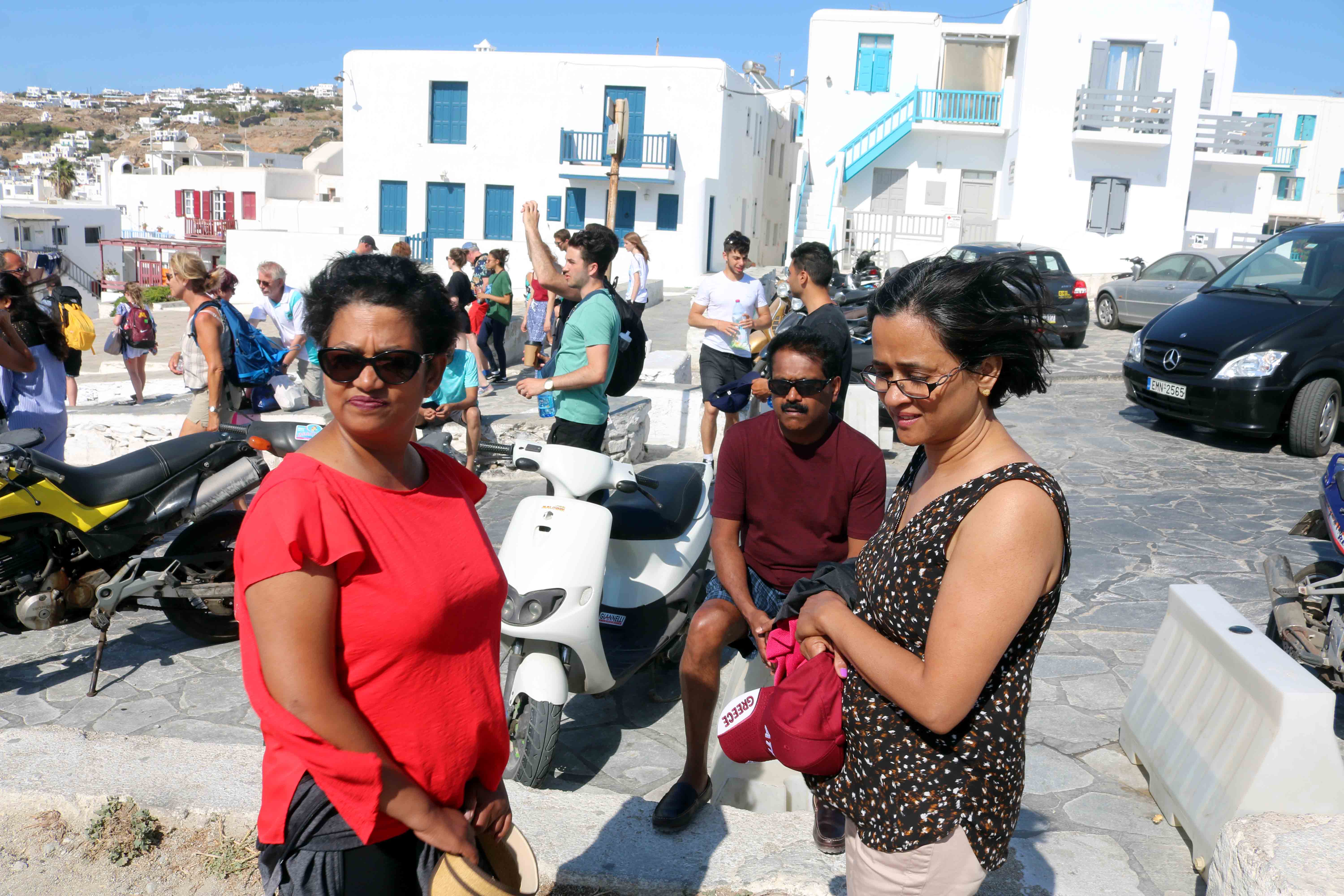
Most of the cranberries are red, but there are white ones too. They are surely ripe ones. They are white because they did not get enough exposure to sunlight. The anthocyanin (red pigment) that gives red colour to these berries have not come out to the surface. Cooking or freezing these white cranberries will turn them Red. At the Johnston’s farm, they convert these white cranberries into their specialty product – White Cranberry Wine. It has become very popular and are an immediate sellout.


The bogs are also flooded in winter to form a protective layer of ice over the vines. Sand is then placed on the ice, where it falls to the bog floor in spring, allowing the vines’ long runners to set roots. At the Johnston’s farm, they convert the bogs into a 10 km skiing and skating trail that wind around and through the 350-acre farm.

The Johnstons run a Shop at their farm, open all year around. The shop sells fresh cranberries during harvest season and cranberry products like wines, crasins, jams, jellies, preserves etc through the year. The products are hand made by Mrs June Johnston and is sold as ‘Mrs J’s Preserves’. Mrs Johnston also and wrote a cookbook and is also available in the store.

The farm also offers a tour of the farm aptly named Bog to Bottle Tour. The tour commenced with a briefing about cranberry, its history, how the Johnston’s farm was established etc. Then we moved to the bogs to see how cranberry is grown and harvested. the tour gave many interesting insights into cranberry and its cultivation.

The tour ended at the shop with wine tasting. We tasted their famous Cranberry Wine, Blueberry Wine, Red Maple Dessert Wine and also their signature White Cranberry Wine. At the end we picked up a few bottles of wine to be taken home.

As we bade goodbye to the Johnstons Farm, rain clouds had formed up in the sky. As we drove through the countryside, a huge rainbow appeared in the horizon. Might be wishing us all the luck for our next journey.

Butterfly Conservatory @ Niagara Falls

When Air Vice Marshal TD Joseph (Joe) and Sophie Joseph visited us in May 2016, how could we miss a trip to the Niagara Falls.   Niagara Region has much more to offer, other than the falls, like Niagara Gorge, Welland Canal, and Wine Country.  (Please click on each one to read about them on my earlier Blog Posts).

Joe301

The place, a nature lover should not miss is the Butterfly Conservatory, filled with beautiful free flying butterflies, a tropical wonderland located on the grounds of the Niagara Parks Botanical Garden. It really is a near ethereal experience.

Joe302

Whenever I see butterflies, my mind races back to the nostalgic memories of our childhood in Kerala, India.  Kerala is home to more than 500 birds, 330 butterfly species from the largest butterfly in India, Birdwing, with a wingspan of about 25 cm to the smallest, the Grass Jewel with only 2 cm.  It is also home to 68 species of dragonflies –   the most common types being Malabar Torrent Dart, Yellow Bush Dart, Pied Reed Tail, and the Long-legged Clubtail.  Many writers and poets were fascinated and inspired by these romantic creatures that they became subjects of some great contributions to Indian literature.

As kids, we enjoyed the sight of butterflies and dragonflies fluttering around, especially after the monsoons (June to August) and during the Onam Festival (end August / early September), when the flowers were in full bloom.  We chased and caught a few of them.  Then we tied a small thread to their tails so as to control them and make them take short flights.

Joe303

We prompted the dragonfly in our captivity to pick up small pebbles. We increased the size of the stones until the dragonfly could lift no more.  This sadistic game ended with the death of the dragonfly, when it severed its head from its torso.

Advent of rubber cultivation and extensive use of pesticides in Kerala for over three decades have driven these beautiful creations of God from our farmlands.

Thumbi Thullal (Dance of Dragonfly) is a dance performed by women of Kerala as a part of Onam celebrations.  About six to seven women sit in a circle and the lead performer (called Thumbi meaning Dragonfly) sits in the middle of the circle. The lead performer sings melodious fast paced songs and other performers clap their hands and sway to the melody.  Gradually the tempo of the song increases, and the lead performer brushes the floor with her hair as if she is possessed by a spirit.  It usually ends with the lead performer fainting or playacting so.

Joe304

Back from nostalgia. At the commencement of the Niagara Gorge, about 10 km from the spectacular falls is the Butterfly Conservatory.  This glass-enclosed conservatory is home to over 2000 butterflies.  This state-of-the-art facility is designed to have a tropical environment within a Canadian climate characterised by both warm and cold weather.  The mechanical and electrical systems maintain optimum environmental conditions for the butterflies and plants while accommodating comfort needs for its visitors.

Joe305

Around 45 different species of butterflies can be found fluttering in this rainforest setting spread over 11,000 square feet. The exact number of butterflies and species fluctuate on a day-to-day basis.  The butterfly conservatory accommodates as much as 300 visitors per hour.

The self-guided walking tour of the Butterfly Conservatory begins with a short, informative video presentation that is close captioned for the hearing impaired.  After this, one is allowed to explore the area and spot different species of butterflies as they fly all around you. The setting has a lovely pond, waterfall and a series of meandering pathways amidst several tropical plants with lovely flowers.

Joe306

The jungle vegetation and delightful fluttering of hundreds of beautiful butterflies are unusual and a very uplifting experience.  Everywhere there are exquisite butterflies floating in the warm, moist air or spreading their iridescent wings on leaves and flowers.  One can even catch them mating.

Joe307

It is a great place to see beautiful butterflies up close, but you are not allowed to touch them, because if you touch their wings, they get damaged and they cannot fly anymore and may die.  One may photograph them, but surely, they need to be kept out of harm’s way.

The Conservatory currently hosts species such as Monarchs, Swallowtails, Owls, Mosaics, Red Lacewings, Blue Morphos and Small Postmans. The green house setting also hosts goldfish, turtles, beetles, toads and Eurasian quails to help regulate insect population.

The best part about the tour is that you can actually get the butterflies to land on you. Some might be even willing to rest on your outstretched hand. Visitors are encouraged to wear bright clothes, wear perfume or cologne and move slowly if they wish to have butterflies land on them.

Joe308

Plates filled with fruits are kept at certain places to attract butterflies who like to feed on these and you can watch them doing so.

Most of the butterflies have been imported from farms in tropical countries while some have been raised in a greenhouse behind the conservatory.  The tour is not only entertaining but also educative.  One can watch the metamorphosis process and the life cycle of a butterfly in real time.  One can also observe the butterflies come out of their cocoon, dry their wings and take their first flight.

Adjacent to the Butterfly Conservatory is the Floral Clock.  This unique and stunning display is a very popular stop and is photographed almost as often as the Falls.  The planted face is maintained by the Niagara Parks horticulture staff, while the mechanism is kept in working order by Ontario Hydro, the originally builders of the clock.

The Floral Clock is 40 feet wide, with a planted area 38 feet wide, making it one of the largest such clocks in the world.  The Tower at the back of the clock, houses Westminster chimes that chime at each quarter of an hour.  There is a 10-feet wide water garden that curves 85 feet around the base of the timepiece.

Joe310

If you are lucky you may come across the Niagara Parks Commission’s gardeners crawling along the special aluminium ladder they lay across the face of the clock, in order to plant and tend the clock face. Designs are created a year in advance to allow for the proper preparations. Tin dividers are built and installed to prevent soil slippage caused by the slope of the face of the clock. The clock is stopped during the planting process.

The floral design is changed twice each year.  Spring designs are made up with Tulips, Forget-Me-Nots or similar plants, therefore, do not last long.  It is followed by Violas planted in late Spring to provide a colourful design.  From the latter part of May, traditional carpet bedding material is used until frost occurs. The summer designs in general are made up of approximately 24,000 carpet plants whose foliage rather than their blooms provide the necessary contrasting colors. Flowering plants are not suitable for summer planting because the plants that are used must be kept trimmed to form relatively sharp contrasting patterns and not be allowed to grow up and interfere with the movement of the hands. For this reason, reddish, green and yellow Alternanthera and Santolina form the background and markings of the various dial designs from year-to-year.   California Golden Privet and Blue Festuca Grass may be used for contrast. In winter, the summer design is perpetuated by using rock chips of various colours.

Anyone planning a visit to the Niagara Falls on the Canadian side must include these little wonderful sites in their itinerary.  Always remember that the falls are better viewed from the Canadian side as one can hardly see it from the US side.  So, always obtain a Canadian Visa in case you are visiting the Niagara Falls.

Bermuda : So Much More Than the ∆

During the third week of September 2017, we travelled to Bermuda for a week’s vacation. Bermuda is Britain’s oldest and smallest British Overseas self-governing (except for external affairs and defense) overseas territory. It lies 1000 km East of USA in the North-West Atlantic Ocean. Bermuda is about 56 square km in total land area, a cluster of six main islands and 120 small islands.


We landed at LF Wade International Airport, the sole airport connecting Bermuda only to Canada, USA and UK. It is named in honour of Leonard Frederick Wade, Leader of the Opposition, who passed away in 1996. Bermuda is home to registered corporate offices of many multinational business entities, particularly for investment, insurance, reinsurance and real estate companies. Tourism is the other major industry.

We drove to the Hotel in a Taxi. Being a British territory, all vehicles are Right-Hand drive unlike the Left-Hand drive ones in Canada and USA. The electric power supply is 110 Volts and not 220 Volts. Please click here to read more about it.


As we drove through, the pastel coloured houses with slanting white roofs caught my attention. The roofs are designed to harvest rain. The steps slow down heavy rainfall helping the gutters to collect the water and store it in a tank under the house. The tanks get topped up regularly with every rainfall and every home is self-sufficient for water. There is no governmental or municipal water supply system in Bermuda.

Bermuda is not blessed with any fresh water source like lakes, rivers or ponds. The lakes and waterholes hold brackish water, hence unfit for human consumption. As Bermuda gets abundant rainfall, well distributed all through the year, the early settlers were forced to harvest rain.

The design of the slanting white roof has multiple benefits. It is mostly made of limestone and hence is heavy and not easily shifted by hurricanes or heavy winds. The white paint help reflect ultra-violet sunrays, thus keeping the homes cool.

Bermuda is the only country where the national dress for men is known by the country’s name. It is worn by male Bermudians and visitors from all walks of life for business and  parties. It is a colourful shorts, worn three inches above the knee. Bermuda Shorts are not uniquely Bermudian, but were originally worn by British military forces. It was designed as a light attire for the British Military while deployed at British garrisons in tropical and sub-tropical colonies of the erstwhile British Empire.


We spent five days in Bermuda, swimming and relaxing on its beaches. The beaches are characterised by its pink textured sand and turquoise blue water. We also enjoyed Kayaking in the serene quiet waters.


We visited the Crystal Caves on a guided tour- a journey of amazing natural beauty – on pathways of floating pontoons spanning a crystal clear underground lake, about 50 feet below ground level.

Mark Twain, one of the first visitor to this wonder of Mother Nature wrote in a letter “The most beautiful cave in the world, I suppose. We descended 150 steps and stood in a splendid place 250 feet long and 30 or 40 wide, with a brilliant lake of clear water under our feet and all the roof overhead splendid with shining stalactites, thousands and thousands of them as white as sugar, and thousands and thousands brown and pink and other tints.”
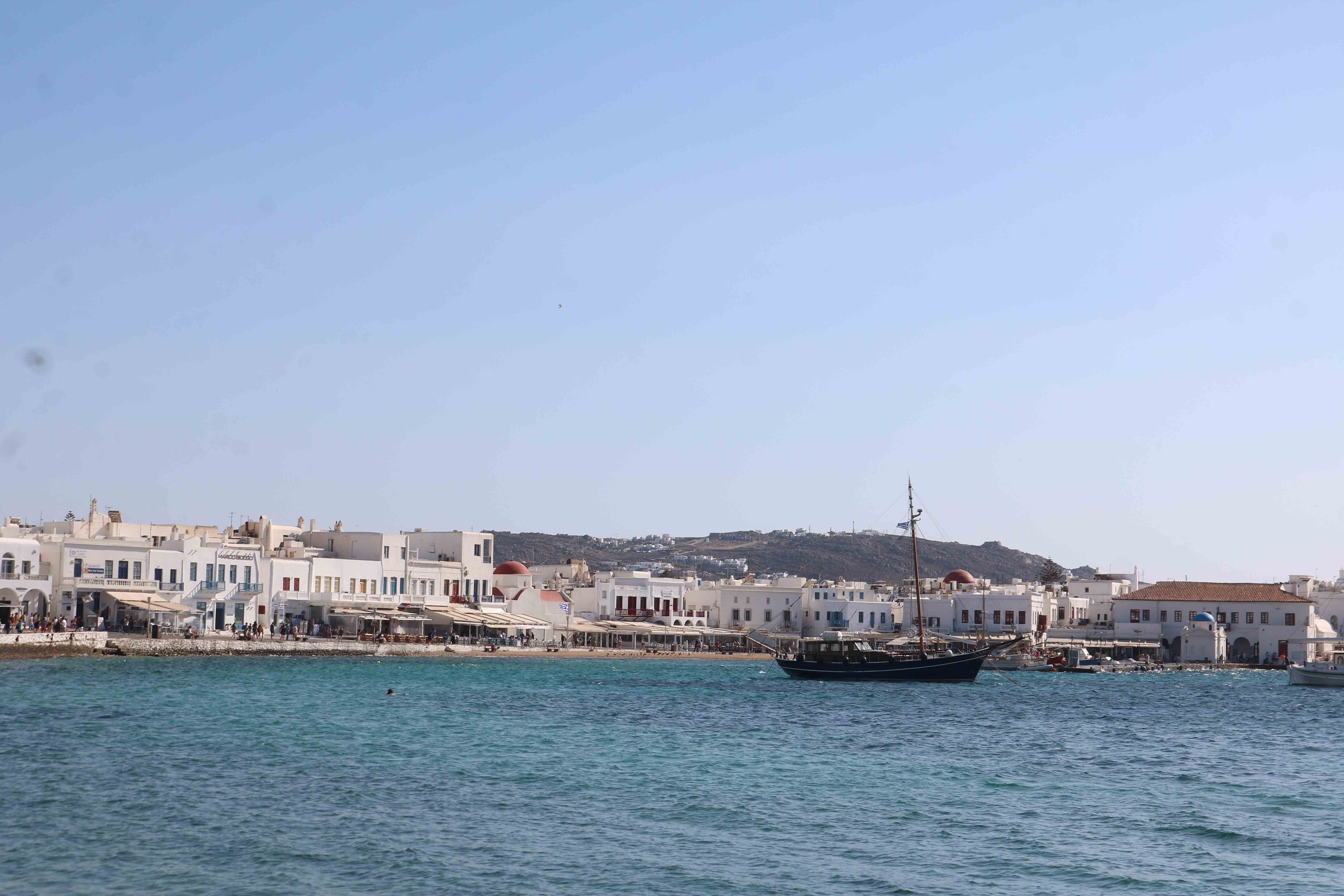

Crystal cave was discovered in 1907 when two young boys were attempting to retrieve a lost cricket ball. They saw the ball dropping into a large hole. As one of them went deeper and deeper into the hole to fetch the ball, he realised that it wasn’t an ordinary hole. It was leading to some wondrous cave.

The owner of the property Mr Wilkinson was immediately informed. He then used a rope and lowered his 14-year old son through the hole. At a depth of about 120-ft and using a bicycle lamp, his son for the first time saw the wonder of the caves. The hole through which the boys entered is still visible.


The dramatic formations of stalactites and stalagmites which are crystal-like pointed structures naturally formed out of limestone rocks, offer an awesome view. A stalactite is an icicle-shaped formation, with a pointed tip, that hangs from the ceiling of a cave. It is produced by precipitation of minerals and lime from water dripping through the cave ceiling. They grow at a yearly rate of about 3 mm.


A stalagmite is an upward-growing mound of mineral deposits that have precipitated from water dripping onto the floor of a cave. Most stalagmites have rounded or flattened tips.


When a stalactite touches a stalagmite it forms a column as seen on the Right side of the image, which will surely take thousands of years.


Different chemical elements along with the limestone give different colours to the stalactites and stalagmites. Iron and other minerals, as well as acids from surface vegetation, combine with calcite crystals to add shades of red, orange and black.

Crystal Cave, just like other caves in Bermuda, formed, when sea level was considerably lower than now. When the Ice age ended and glaciers melted, sea level rose and inundated the beautiful cave formations.


We Visited HMD Bermuda (Her Majesty’s Dockyard, Bermuda) after a 30 minute ferry ride. This base was the principal base of the Royal Navy in the Western Atlantic between American independence and the Cold War. After the closure of most of the base as an active Royal Navy’s dockyard in 1957, the base fell into a state of disrepair. Storms and lack of maintenance caused damage to many buildings. Beginning in the 1980s increased tourism to Bermuda stimulated interest in renovating the dockyard and turning it into a tourist attraction. The Naval Air Station located here was called HMS Malabar by the Royal Navy, after the Indian princely state, now forming part of Kerala State.

Bermuda Triangle, for sure everyone must have heard about it; it did not engulf any of us. It is surely a myth. Even if it is not, I have no place there. I would better stay in Bermuda.

The Last Lap

We steamed off from Ketchikan by 5 PM on 03 August and we had to sail for about 40 hours to our final destination – Vancouver. The ship cruised through Inside Passage, crossing from US to Canada. On either sides were coastal mountains cut off by glaciers millions of years ago. It provided a spectacular view of coastal rain-forests, beaches, waterfalls and mountains. The passage has been the preferred route since the first passenger steamers of Yukon Gold Rush in 1890’s. Inside Passage provides safe transit as a sheltered West Coast waterway.  The journey offered a view of many fishing trawlers laden with their catch heading to harbour, historic lighthouses on rocky isolated shores, coastal First Nations houses fronted with proud totem poles and bald eagles.

In the evening, crew of the ship (882 crew members from 44 countries) put up an absorbing and entertaining cultural programme to bid goodbye to their guests.

Next morning, Fabrizio Fazzini, Executive Chef of the ship held a culinary demonstration, showcasing few of his signature dishes. Jean Paul Misiu, the Maître d’Hôtel was the host. In large organisations such as hotels, or cruise ships with multiple restaurants, Maître d’Hôtel is responsible for overall dining experience including room service and buffet services, while head waiters or supervisors are responsible for specific restaurant or dining room they work in.

The culinary show was followed by a tour of the kitchen. The kitchen was spread over two decks, connected by two sets of escalators. It was a well laid out kitchen with adequate space for the staff to work and was all spick and span. Every section had separate storage lockers, maintained at specified temperature as dictated by the items stored.

Pasta and Spaghetti Section

Pastry Shop where 7000 assorted pastries are produced each day. All baking needs like bread, cakes, and pastries are made here.

Soup Section

Sauce Section

Vegetable Section where four tonnes of vegetables are used.

Butchers Shop where 700 kg of fish and seafood and 1600 kg of meat is prepared and served each day.

Garde Manger (French for ‘keeper of the food’) is a cool, well-ventilated area where cold dishes (such as salads and appetizers) are prepared and other foods are stored under refrigeration. The person in charge of this area is known as the Chef Garde Manger or Pantry Chef.

At the end of the tour Marina purchased a cookbook authored by Fabrizio Fazzini, the Executive Chef. The book was autographed by the Executive Chef and Jean Paul Misiu, the Maître d’Hôtel.

Our ship docked at the Vancouver’s Fraser Port on 05 August morning. The port resembled a modern airport with all the facilities like aero-bridge, customs and immigration offices, car parking etc. This port has been is consistently ranked as one of the most passenger friendly ports in the world and so is no surprise over 800,000 cruise passengers come through this port each year,

On coming out of the cabin balcony, I realised that the visibility was pretty poor with smoke hanging in the air. It was all due to wildfires in British Columbia (BC), about 150 of them burning that day. Since April, there have been 928 fires due to a combination of lightning and tinder-dry conditions. Of these over 500 of them have been confirmed to be naturally caused while another 364 were human caused. These numbers are consistent with previous years where roughly 60 per cent of fires are natural and 40 per cent are caused by people.

Bans on campfires as well as the use of off-road vehicles on public lands had been in effect for most of BC. People were warned about the heavy smoke causing poor visibility on roads and drivers should have their headlights on and watch out for any wildlife. The smoke also posed a health risk for infants, the elderly and people with chronic health conditions.

The BC Province and Canadian government have left no stone unturned to fight these wildfires. They have moved in firefighters with their equipment from all other Canadian provinces and also requisitioned water-bomber aircrafts. The Canadian Armed Forces (CAF) through Operation LENTUS is in the forefront by providing aircrafts for transportation of the firefighting crew and equipment from all over Canada. The CAF aircrafts are also employed in evacuating locals who are affected by the wildfires, transporting first responders (Ambulance with Paramedics, Police and Firefighters), delivering essential aid to isolated communities and in assisting the local police in providing information to the public and conducting observation and reporting tasks at assigned points along access roads in affected areas.

We disembarked from the Coral Princess and bid goodbye to the crew and boarded a coach to the Vancouver Airport to catch out flight to Toronto,

All good voyages and travels must come to an end, but surely the next experience is awaiting.

Ketchikan – City of Totem Poles and Salmon

Over 80 Native American Totem Poles dot Ketchikan and a traveler  cannot go a few blocks without seeing one.  These Totem Poles serve as important illustrations of family lineage and cultural heritage of Native American people.

Totem Pole shown above tells the story of a Raven, who desired the sun, the moon and the stars believed to have been owned by a powerful Chief.  The Raven is depicted on the top of the pole.  Below the Raven is the Sun.  In order to procure the heavenly bodies, Raven changed form to appear as the Chief’s daughter’s son.  The Chief’s daughter is depicted below the Sun.  The Raven cried to his grandfather until the Chief gave him the boxes containing the heavenly bodies.  Raven opened the box, bringing the sun, moon and the stars to the earth.

This is the Chief Johnson Totem Pole.  The figures symbolise a single story about Raven.  On top is the mythological Kajun Bird.  The un-decorated long blank space symbolises high regard in which  Kajun Bird is placed.  Below the blank space are Raven’s slaves with the Raven below it.  The bottom figure is that of the Fog Woman.  She is identified with the summer salmon run. It was believed that the Fog Woman produced all salmon and caused them to return to the creeks of their birth.

Life story of Alaskan Salmon is another interesting tale – a story that takes the Salmon  from the rivers and streams of Alaska’s wild frontier to the Pacific Ocean and back again.  How they find their way back from Pacific Ocean is intriguing.

Starting out as small eggs in a stream bed, they hatch and begin their journey downstream towards the ocean. They spend a couple of years in the streams and rivers growing up. During this time, their bodies change to adapt to seawater. Young adult salmons then head out to sea and spend several years swimming in Pacific Ocean.

Adult salmon spend one to four years swimming and feeding in Pacific Ocean. They grow to their adult size and develop unique adult markings . Their ocean journey is long and hazardous as they are constantly hunted by seals, whales and fishermen. After swimming more than 2000 miles throughout Pacific Ocean, they swim back to their original stream or river where they re-adapt to fresh water and swim back up the stream to reach their spawning grounds, the place of their birth.

To ‘spawn’ means to release or deposit eggs.  Sometimes this involves swimming up rugged rivers with rapids and even waterfalls to leap.  Upon reaching their spawning ground, female adult clears a spot in the stream-bed by sweeping her tail back and forth creating a gravel nest and lays her eggs.  Male adult salmon now fertilizes the eggs with his sperm and protects them until both die within a couple of weeks and leave the embryos to fend for themselves.  Their carcasses decompose in the stream creating a nutrient-rich environment for new infant salmons that are about to hatch.

It is obvious that Alaska salmon have interesting lives. One has to admit that a salmon that has returned to its birth stream after years at sea is an admirable fish to say the least. Due to the excellent salmon management practices that now exist in Alaska, salmon populations are well protected.

If the salmons could come up the Ketchikan’s  streams  to spawn, men of Ketchikan were not far behind.  By the turn of the Twentieth Century, population of male workers in the city was almost double that of females.  This encouraged prostitution and thrived until banished in 1954. In 1903, the City Council ordered all bawdy houses to be moved to the Creek Street.  At the time in Alaska, prostitution was tolerated but only if it did not occur on land.  This gave birth to Creek Street, where houses were built on stilts above a creek.  The women who worked in Creek Street called themselves as ‘sporting women.’

As per the then Alaskan laws, more than two ‘female boarders’ constituted a prostitution house.  Hence, most Creek Street ladies lived in pairs or alone.  Only exception was Star Dance Hall, (the building with the salmon), a two storey building with 21 rooms, with live music and dance partners.

Single men frequented Creek Street openly, whereas married men used more discreet Married Man’s Trail through the woods.  The girls could easily identify them by the mud on their shoes

At the other end of Creek Street lived Dolly who bought this house in 1919 and lived here till her death in 1975.  Dolly lived all alone as she preferred to work alone. In those days when an average Ketchikan male worker earned $1 a day, Dolly charged each man $3.  She purchased her house for $800 and paid it off in two weeks.

Dolly neither smoked nor drank, but her house was the most sought after ‘watering hole’ as prohibition was in place.  Dolly earned more money selling small amounts of liquor for large sums to her clients than she did through prostitution.  She kept one or two bottles in the house at a time and hid the rest under the dock. It was easier for her to discard them in case of a raid.   Many of the Creek Street houses had trapdoors where they could receive alcohol deliveries under the dock in the darkness of night.

Dolly was an industrious lady.  As soon as people realised the ineffectiveness of French Silk Condoms in vogue then, with the dead stock Dolly had, she made flowers out of them to decorate her bath curtain.

Dolly’s bedroom was done up very tastefully, obviously it was here she conducted her business.  It appears she loved pink, red and green colours.  Furniture in this room was a gift from a client a from Petersburg.

When Dolly died on July 1975 at the age of 87, all major newspapers in Alaska carried her obituary, paying tribute to a woman with an indomitable spirit exemplified the tough, roistering years of Ketchikan’s early history.

By evening, It was time for us to bid adieu to the colourful historic city of Ketchikan.  We embarked on our ship for the last leg of our sailing to Vancouver, Canada.

Next : The Last Lap

Ketchikan – The First City of Alaska


Our ship reached Ketchikan Port in the early hours 03 August.  After breakfast, we disembarked and walked to the Great Alaskan Lumberjack Show arena.

The term ‘lumberjack’ is a Canadian derivation and are workers in logging industry who perform  initial harvesting and transportation of trees. The term usually refers to a bygone era when hand tools were used in harvesting trees. The lumberjack’s work was difficult, dangerous, intermittent, low-paying, and they lived in makeshift cabins and tents. However, these men built a traditional culture that celebrated strength, masculinity and  confrontation with danger. Lumberjacks, exclusively men, worked in lumber camps and often lived a migratory life, following timber harvesting jobs as they opened. Their common equipment were axe and cross-cut saw.

In popular culture, a stereotypical lumberjack is a strong, burly, usually bearded man who lives to brave the natural environment. He is depicted wearing suspenders, a long-sleeved plaid flannel shirt, and heavy caulk boots.  With a rugged group of expert lumberjacks, some razor sharp equipment, and a mix of corny jokes, a hour long exhibition of logging events was worth watching. Great Alaskan Lumberjack Show featured a page right out of history with old fashion axe swinging and lumbering skills.

Great Alaskan Lumberjack Show is the re-enactment of how lumberjacks competed and displayed their skills.  There was a rivalry between Dawson Creek Mill in British Columbia, Canada and  Spruce Mill in Alaska, USA.  Both camps claimed they produced better timber and their lumberjacks were more skillful.  To stake their claims, they held an annual Lumberjack Competition and the winners won bragging rights.  Arena where we watched the Lumberjack Show was the very same place where  Spruce Mill was functioning.  The show began and it was a hysterical, hand clapping and foot pounding spectacle as the audience were also divided into two sides supporting each team –  Canadian and American.

First event was Underhand Chop while standing on a log.  It required the lumberjack to swing an axe fractions of an inch from his feet, mimicking how early lumberjacks would cut fallen logs to length in the forests.  It needed immense skill and control of the axe as margin of error was very narrow.  The axe had to move vertically up and down, else would land on the lumberjack’s foot.

This was followed by the Standing Block Chop.  To a casual observer, standing block chop may resemble a baseball swing.  It involves swinging a razor sharp axe at a 11 inch thick pine chopping block. It was surely more than just smashing on a log with brute muscle power.  The lumberjack had to ensure that the axe met the log at the correct angle to cut the wood fibers and slice into the block.

Next event was the Springboard Chop.  The lumberjacks had to severe a log placed about nine feet high.  In the earlier days springboards used to allow lumberjacks a flat working surface in uneven terrain or where tall trees were cut by hand in steep hills.  The lumberjacks started by cutting a small pocket with an axe at roughly hip level for the first springboard, then jumped onto the first board before cutting another pocket higher up the pole.  Then they placed the second board into this hole and jumped on it, providing a secure location to chop the log.   Standing on this springboard, they chopped and severed the block.

This was followed by Stock Saw cutting.  The lumberjacks had to cut two cookie shaped slices from a block using a powered chainsaw, first cutting down and then next cutting up.  The lumberjacks had to have a keen ear to the sounds the saws made while feeding the saw just enough wood  to ensure that it is cutting fast but not too much wood that it got bogged down

Next competition was the 60-feet Speed Climb where in the lumberjacks climbed a 60-feet-tall cedar pole using steel-core climbing ropes  and spurs and then came down slithering. While descending, the lumberjacks had to touch the pole once every 15 feet.

This was followed by Double Buck Sawing where two sawyers working as a team with a two-man bucking saw had to cut through a 20-inch-diameter pine log.

Next event was Axe throwing where the lumberjacks threw an axe at a target, attempting to hit the bulls eye as near as possible in the allowed five throws for a maximum score of 25. The target was a three feet diameter circle, consisting of five rings  four inches wide. Scoring was based on where the axe struck with the outside ring worth one point, the next one in worth two, then three, then four and finally the bulls eye worth five points. Distance of the throwing line to the target was 21 feet.  In case the thrower stepped over the throwing line, or the axe did not lodge correctly on the target,  he got no points.

Final event was Logrolling, also known as Birling.  Two lumberjacks from opposing teams stepped onto a floating log and started  the roll and spin it rapidly in water with their feet.  They would  stop it suddenly by digging into the log with special caulked birling shoes and a reverse motion to maneuver their adversary off balance and into water, a feat called ‘wetting’. Dislodging an opponent constituted a fall.

The Lumberjack Show reflected upon North America’s rich logging history and came to life with thrilling displays of strength and agility. The show in fact honours an industry that was the backbone of Ketchikan’s economy from the late 50s to the 80s.

Next : Ketchikan – City of Totem Poles and Salmon

Juneau – The Capital City of Alaska

Our ship’s next port of call was Juneau on 02 August early morning.  Juneau has been the capital of Alaska since 1906.  Juneau is rather unusual among US state capitals (except Honolulu, Hawaii) in that there are no roads connecting the city to rest of the state or to the rest of America. Absence of a road network is due to extremely rugged terrain surrounding the city.  All goods and persons coming in and out of Juneau must go by plane or ship.  Downtown Juneau is located at sea level, with tides averaging 5 m, surrounded by steep mountains about 1,200 meter high.

Even though Anchorage is the biggest city in Alaska and is well connected by rail, road and air network, how did Juneau become the capital of Alaska?

Sitka was the Alaskan capital when US took over Alaska from Russia. The capital was moved to Juneau in 1906 because the gold rush had made it and other towns in the Northern Alaska much more economically significant than Sitka. When Alaska officially became a territory in 1912, Anchorage did not exist. Anchorage came into being during the summer of 1915 as a construction depot on the Alaskan railroad. Anchorage wasn’t that important of a town until the US Military moved in before World War II.

After the war, Alaskans considered moving the capital out of South-East Alaska to a more central location. Anchorage was considered suitable with its central location, but poverty and lack of agreement prevented any action from being taken. Resolution to move the capital was put to vote in 1984 and 1996, but was defeated and is unlikely that the state government will ever physically move.

We got off our ship and headed on a bus to Auk Bay, about 20 km from the port, for whale watching.  We were ushered into a boat captained by  Emily.  John, a university student pursuing his pre-medical degree was her assistant.  Both Emily and John were very knowledgeable about Auk Bay and  surrounding areas and also about whales.   We were a group of 12  in the boat and after everyone boarded, Captain Emily gave out safety briefing followed by a talk about what we were expecting to see.  After leaving the jetty, Emily went full throttle, skimming over the water to locate  the whales.  During this journey John gave a detailed briefing on whales.

After about an hour, we sighted Sasha, a humpback whale. The whales located in  Auk Bay are given numbers and names.  Alaska is only a feeding area for the whales as there are lot of fish to feed on and is not a breeding ground due to the cold temperature. We watched bubble-net feeding by Sasha as she dived down and released a ring of bubbles from her blowhole beneath a school of fish. As the bubbles rose to the surface, it created a net, trapping the fish.

The next whale we located was Flame.  Humpback whales have patterns of black and white pigmentation and scars on the underside of their tails or flukes that are unique to each whale.  These black and white patterns are their bio-metric identification akin to our fingerprints.

After watching the whales, Emily steered the boat to an island where over two hundred sea lions were sunbathing.  The males had their heads up while the females and the cubs were all lying down like an arrangement of sausages on the beach. After watching the sea lions, Emily dropped us at the jetty to board a bus back to Juneau.

Back at Juneau, we drove on Goldbelt Mount Roberts Tramway,  a five-minute ride through the rain forest, from the cruise ship pier to the  Mount Roberts at an elevation of 600 meter.  It offered a breathtaking view of the cruise ships, the port and  downtown Juneau as depicted in the images at the top. Mount Roberts Tramway is one of the most vertical tramways in the world.

We came down on the tramway and decided to enjoy lunch at Juneau’s Twisted Fish Company, rather than going on board our ship anchored 100 meters away.  This place was recommended to us by locals and it was worth it. We savoured a menu of salmon, halibut and clam, sourced straight from the docks.

At the dock stood a plaque commemorating ultimate sacrifice by 690 member crew of Anti-Aircraft Light Cruiser Ship USS Juneau.  This ship was torpedoed and sunk by the Japanese submarines in the  Battle of Guadalcanal on the morning of 13 November 1942 in Pacific Ocean.  Only 10 crew members survived to narrate the tale.  Aboard USS Juneau were  George, Francis, Joseph, Madison and Albert – five brothers from the Sullivan family.  Even though US  Navy’s policy of separating siblings was in place,  it was not always followed and the five brothers enlisted to serve together and were assigned to USS Juneau.  The two oldest brothers George and Francis had served in the Navy before World War II and both had been discharged in May 1941. When war broke out, two older brothers with their three younger siblings volunteered to serve in the Navy but only if they could serve together.

After a sumptuous lunch, we boarded the ship and we sat in the balcony enjoying the breeze and the view outside on the waterfront.  There were many sea planes taking off and landing on water and a fishing boat crew were spreading their nets to catch salmon between the cruise ships and the ‘runway.’

The day for us ended with dinner and our ship bid goodbye to Juneau on its onward journey to Ketchikan, our last port of call in Alaska.

Next : Ketchikan – The First City of Alaska

Skagway – Gateway to the Klondike Gold Rush

On 01 August morning, our Ship anchored at the Port of Skagway.  The City of Skagway has a population of less than a thousand, but in summer months the population doubles with many temporary workers manning various restaurants and shops. Skagway becomes a busy port destination during summer months, welcoming more than a million visitors from around the globe in more than 400 cruise ships.


Skagway came into prominence when gold was discovered in 1896 at Bonanza Creek in Klondike in Yukon, Canada.  Headline of the Seattle newspaper – Intelligencer –  on 17 July 1897 read  “Gold! Gold! Gold!”, broadcasting the news of discovery of gold in Canadian Klondike. In 1897, first ships from San Francisco, Portland and Seattle arrived in Skagway, packed with gold-seekers, beginning Klondike Gold Rush.

In Klondike Gold Rush, an estimated 100,000 people tried to reach Klondike goldfields, of whom only around 30,000 to 40,000 eventually succeeded in reaching there. Out of them, only about 300 actually  found gold and became rich.  Everyone from doctors to farmers, all wanted a share of gold as there was severe unemployment and poverty due to a series of financial recessions and bank failures in  1890s in USA.

Gold-seekers were required, as per Canadian laws to pack and carry one ton of goods, which was needed to last one year, if they wanted to reach Klondike Goldfields. The average man took about 40 trips over three months to haul his ton of supplies to Klondike Gold Fields from Skagway. Soon, Skagway boomed and peaked at a population of 10,000 people, many of them prospectors in the midst of their journey, but many were permanent residents offering goods and services to the gold-seeking hoards.

During Klondike Gold Rush, Skagway was a lawless town, where fights, prostitutes and liquor were ever-present on its streets.  The period saw the rising of a con man Jefferson R Smith, better known as ‘Soapy’ Smith, who was a sophisticated swindler.  He headed a gang of thieves who swindled prospectors with cards, dice, and shell game.  Smith came up with his ingenious ‘Soap Swindle’, which earned the nickname of ‘Soapy.’ The trick began with Soapy wrapping up cakes of ordinary soaps with  paper currency ranging from one dollar bill up to a hundred bill. He would then mix it with other ordinary cakes, re-wrap all in plain paper and would sell them for $1 to $5 a bar. He had his ‘men’ in the crowd who would buy a soap cake, opening it to find a $100 bill. The crowd was then anxious to buy their own, which, of course, held nothing but a 5 ¢ent soap cake.

Soapy Smith was shot and killed by Frank Reid, a town guard, on July 8, 1898, in a shootout when the two men fired their weapons simultaneously. Frank Reid died from his wounds twelve days later. Smith is buried in a corner of the Gold Rush Cemetery, where as the tomb of Reid is located in the center of the cemetery.

Klondike Gold Rush saw two men coming together- Sir Thomas Tancrede, representing investors in London and Michael J Heney, an experienced railroad contractor interested in finding new work for his talents and interests.  Though Tancrede had some doubts about building a railroad over the Coastal mountains, Heney claimed  “Give me enough dynamite and I will build a railroad to Hell.”  Construction of a narrow gauge ‘White Pass & Yukon Route’ railway line commenced on 28 May 1898.  After two years, two months and two days, on 30 July 1900, first train from Skagway arrived at White Horse, Yukon, Canada, about 110 miles.  Agony was that by the time the railway line was completed,  Gold Rush was nearly all over.

Today, fully restored cars, pulled by vintage diesel locomotives climb nearly 1,000 m over 30 km of steep grades and around cliff hanging turns, taking tourists on a  three-hour excursion to White Pass Summit.

We booked our tickets for the morning trip and boarded the train. The train pulled out of the Skagway station and after two km, we came to the railway yard where a fully functional vintage steam engine Number 73 rested.

This  monstrous looking machine is a enormous snow cutter used to cut through the deep snow to allow the train to pass during winter.

The train passed by the grave of the city’s most notorious Soapy Smith in the Gold Rush Cemetery.  Then the train commenced its climb .

We then passed Inspiration Point, looking down on the Skagway Harbour where our ship was anchored.

This abandoned  Switch-Back Bridge came into our view after traveling 24 km from Skagway.  It is a cantilever steel bridge over Dead Horse Gulch with a span of about 400 feet.  It was the world’s longest cantilever steel bridge when it opened.  In the Fall of 1969, a new tunnel and bridge that bypassed Dead Horse Gulch was built to replace the tall steel cantilever bridge that could no longer carry heavier and longer trains pulled by the diesel engines.

Dead Horse Gulch, it is believed that more than 3,000 animals, mostly horses, died on this trail and many of their bones still lie at the bottom on this ravine.

After another three km, we reached White Pass Station on US-Canada Border.  A pillar marks the International Boundary with US and Canadian Flags on either side.  Here the train stopped for its return journey to Skagway.

After alighting from the train we embarked on a five mile trek to the gorgeous Reid Falls, located North of Gold Rush Cemetery.  The Falls is named in honour of  Frank Reid, the town guard who shot dead Soapy Smith.

On return to the ship, it was dinner time.

Dinner was followed by a movie ‘Beauty and the Beast’, watched in the open air theater on the top deck of the ship, aptly named ‘Movie under the Stars.’

Next : Juneau – The Capital City of Alaska