Mother Mary Comes to Me by Arundathi Roy : My Views – Not a Book Review

During a family dinner in 1986, my brother, then a budding advocate, recounted a landmark Indian Supreme Court verdict. The court had just ruled in favour of Mary Roy, affirming that Syrian Christian women in Kerala possessed equal rights to their parental property. This was a seismic shift. Until then, our community in the former Travancore region was governed by the 1916 Travancore Christian Succession Act, which denied women inheritance rights, offering only a dowry at marriage in lieu of a share.

My mother listened intently, then offered her impression. “Mary Roy fought like Rani Lakshmibai,” she said, evoking the warrior queen who tied her child to her back and fled the British. “She was a tigress battling evil,” our mother insisted. Mary’s victory was quiet but profound; though the clergy and laymen of various churches largely opposed the decree. A new truth had been established, and they could not publicly utter a word against it.

This book is a work of literary impressionism, painted with the colours of emotion, memory, and sensation. It merges into a panoramic kaleidoscope of human relationships, much like the narrative of Mary Roy’s and Arundathi Roy’s lives. Arundathi charts her path from the tea estates of Assam, big-city life in Delhi via Ooty, Madras, Calcutta, Pachmarhi, Goa, Kashmir and above all her ancestral village – Ayemenem- the places I too experienced and loved during my growing up years in a Syrian Christian home in Amayannoor village in Kottayam – very similar to Ayemenem in all aspects – and three decades of military life. My Ayemenem connections come from my maternal grandmother and mother-in-law – both strong ladies – who hailed from Ayemenem.

The characters in this book are unvarnished, their natural grain exposed and absorbent. Unprotected, they are vulnerable to scratches, stains, and wear – a living, breathing soup of imagination and memory, possessing squirrel-like survival skills. Mary’s relationship with her brother Isaac was typical of the era: help and harm in equal measure. Mary’s children grew up in the cleft between a syrupy dream and a capricious nightmare, amidst shouting and silence.

My own memories intersect with this history in unexpected ways. My first movie experience was at Kottayam’s Star Theatre. Decades later, in 2002, while commanding our Regiment, I chanced upon the district’s Disaster Management Plan, duly signed by the Chief Secretary of Kerala state. To my astonishment, it designated the long-demolished Star Theatre as the site for an army field hospital – a ghost from the past, official – yet impossible.

Other important figures from our childhood find their place in this tapestry. We brothers once presumed ChellappanBhavani was a single person; they were, in fact, a husband-and-wife duo whose Bharatanatyam performances were essential to every local temple festival in Kottayam. In 1982, our cousin’s home was constructed by the renowned architect Laurie Baker—an inspiration for many—and though skeptics doubted it would survive the monsoon, it stands today as a testament to his visionary style.

Even my struggles echoed those in the narrative. Learning Hindi at the National Defence Academy (NDA) was a nightmare, much like the author’s challenges at the Delhi School of Planning and Architecture. I derived a sadistic pleasure from annoying the Hindi pundits, coining new words and inventing grammar rules just to sow doubt in their minds—a small vengeance that brought me joy.

During the Delhi riots, in the aftermath of Indira Gandhi’s assassination, our Regiment was at Delhi and we were responsible for the security of Teen Murthi Bhawan where her mortal remains lay in state. I witnessed the mayhem and for the first time someone had the courage to point out the real perpetrators- the Congress Party goons and the right-wing Hindu nationalists.

Arundathi’s relationships, specially with men follows her lament in the God of Small Things- Who can love whom and by how much was written in the love laws a long time ago. For her, the family unit is the rope on which the whole world swings and the families are drawn close by the threads of acute sufferings.

Her relationship with her mother Mary whom she describes as unpredictable, irreplaceable spark of mad genius – a dreamer, warrior teacher – is of fear, love, respect, empathy and pity. Arundathi as per Mary was an unwanted child whom she tried to abort during pregnancy. Their relationship was always thorny and conflict ridden to end with Mary’s declaration ‘There is no one in the world whom I have loved more than you.’

Reading the book, I was struck by the number of ‘would’s—a hesitant, non-committal tense that seems to shy away from affirmation. Removing them would have condensed the book by ten pages, and I wondered if, in her meticulous detail, the author occasionally missed the woods for the trees.

In the end, I was left with the echo of a Beatles song from 1970, Let It Be, written by Paul McCartney after a dream in which his mother, Mary, offered wisdom and comfort in a time of trouble.

When I find myself in times of trouble, Mother Mary comes to me
Speaking words of wisdom, let it be.

The book and the song are a universal balm, but in this context, it felt uniquely specific. It was a refrain not just of resignation, but of hard-won peace, arriving after a long and righteous fight for what is undeniably equal.
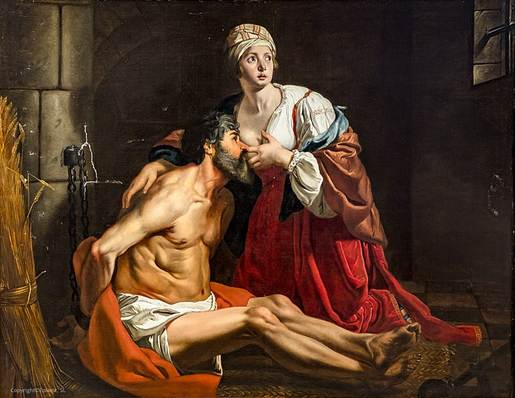
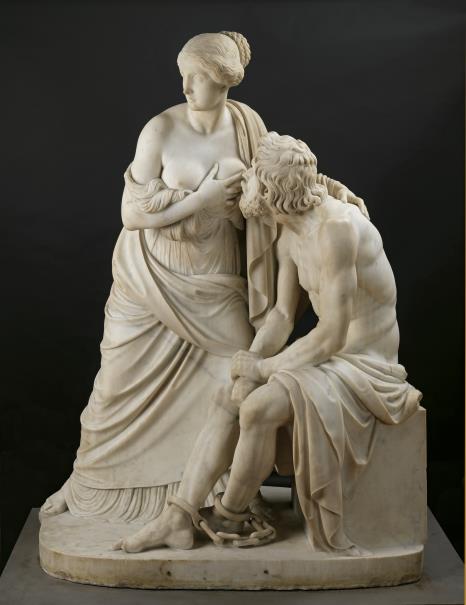
Roman Charity

Roman Charity was a popular story in 17th-century Italy that many writers, thinkers, painters and sculptors depicted in their work of art, literature, and philosophy as a testament to human compassion.

This is based on an exemplary story of a woman Pero who secretly breastfed her imprisoned father Cimon. The poor man was sentenced to death by starvation for stealing a loaf of bread during the reign of Louis XIV in France. Pero was his only daughter and the only visitor to his cell. She was allowed to visit him daily but was searched thoroughly so that no food was taken in.

The selfless devotion of Pero to nourish her father Cimon at her own breast is called Roman Charity. It is history’s most altruistic story of honouring one’s father. The kindness of Pero towards her starving father depicts mercy – To feed the hungry.

This story of Pero and Cimon finds a place in Factorum ac dictorum memorabilium by Valerius Maximus – an ancient Roman historian. It is believed that this story is related to the mythological story of Juno, the goddess of Wisdom, the daughter of Saturn, wife of Jupiter and mother of Mars, breastfeeding of the adult Hercules.

The God Jupiter wished to immortalise his son Hercules, whose mother was the mortal Alcmene. For that he held him to the breast of his sleeping wife, the Goddess Juno, to drink her milk. Juno woke immediately and pushed Hercules aside. The milk which spurted upwards formed the Milky Way, while that which fell downwards gave rise to lily flowers.

When after four months the man still lived on with no weight loss, the prison guards were perplexed and started spying on her. To their astonishment found she breastfed her father, sharing her baby’s milk.

A case was initially filed against her but realising the love and compassion of a daughter towards her father softened the judge’s heart and eventually he pardoned the father and released him free. It was considered a noble act worthy of honour.

In all its various depictions, the image is intended to be seen as a horrific act against nature, but an example of human survival – the most natural, innate instinct. It also depicts love and care for the father. Pero’s outward gaze depicts her nervousness and fear of repercussions from the society of a daughter breastfeeding her father.

The story serves as a reminder of the sacrifices people make for their loved ones and the power of human kindness. In a world often driven by self-interest, the story encourages individuals to act with empathy and moral strength. It also highlights the importance of care-giving, whether in family relationships or professions like healthcare, nursing and social work.

The works of Hans Sebald Beham, Peter Paul Rubens, Charles Mellin and countless other classical artists who portrayed the Roman Charity story, there exists an uncomfortable testament to female sacrifice. It could well be because it was considered as an unnatural act based on social taboos of the time. The story raises moral dilemmas about breaking societal norms for the sake of love and duty.

Roman Charity is a powerful narrative of devotion, love, and moral courage. It transcends time and culture, inspiring generations with its message of selflessness. The story of Pero and Cimon reminds us that acts of compassion, no matter how unconventional, have the power to move hearts and change lives.

In an era where personal sacrifice is often overlooked, Roman Charity remains a beacon of true altruism and humanity.

Jesus’ Triumphal Entry

The story of the triumphal entry  appears in all four Gospel accounts (Matthew 21:1-17; Mark 11:1-11; Luke 19:29-40; John 12:12-19). On that day, Jesus rode into Jerusalem on the back of a donkey’s colt, one that had never been ridden before.

This day is celebrated by Christians world over as Palm Sunday.  The Friday that follows is the ‘Good Friday‘ – the day Jesus was crucified and the Sunday, the Easter Sunday – marking the resurrection of Jesus from the dead.  Palm Sunday marks the beginning of the Passion Week.

Jesus traveled to Jerusalem knowing that this journey would end in his sacrificial death on the cross for the sins of all mankind. As Jesus rode on a donkey into Jerusalem, people cut palm branches and waved them in the air, laid them out on the ground before Jesus. The palm branch represented goodness and victory and was symbolic of the final victory.

The crowds shouted, “Hosanna (save now) to the Son of David! Blessed is he who comes in the name of the Lord! Hosanna in the highest heaven!” (Matthew 21:9, NIV)

The date of the first observance of Palm Sunday is uncertain. A detailed description of a palm processional celebration was recorded as early as the 4th century in Jerusalem. The ceremony was not introduced into the West until much later in the 9th century.

Many churches, distribute palm leaves to the congregation on Palm Sunday to commemorate the Triumphal Entry.  The worshipers take home the venerated palm leaf and display it near a cross or crucifix, or place it in their Bible until the next year’s season of Lent. Some churches collect baskets to gather the old palm leaves to be burned for  Ash Wednesday.

Why did he ride on a donkey?

Mathew 21 says ‘1. …Jesus sent two disciples, 2 saying to them, “Go into the village in front of you, and immediately you will find a donkey tied, and a colt with her. Untie them and bring them to me. 3 If anyone says anything to you, you shall say, ‘The Lord needs them,’ and he will send them at once.” The disciples spread their cloaks on the donkey for Jesus to sit on.’

In those days in that land, horses were owed by the nobility and donkeys by the lower society – often animals of burden used by the potters, washer-men, load or water carriers, etc.  No one owning a donkey  would have had the courage to refuse or fight against the noble looking disciples.  Irony of the narration in all the Gospels is that none speaks about returning the donkey to its owner.

Riding a donkey or a horse that has never been rode upon is a very difficult task.  The animal did not have a saddle, hence the disciples removed their cloaks and spread it on the animal’s back to act as a saddle.  Still it is a very difficult ride – Ask anyone who ever rode a bare-back horse!!  When we were cadets at the National Defence Academy, during horse-riding classes, bare-back riding (without a saddle, but with a blanket,) was the most dreaded one.

Jesus’ purpose in riding into Jerusalem was to make public His claim to be their Messiah and King of Israel in fulfillment of Old Testament prophecy. Matthew says that the King coming on the foal of a donkey was an exact fulfillment of Zechariah 9:9, “Rejoice greatly, O Daughter of Zion! Shout, Daughter of Jerusalem! See, your king comes to you, righteous and having salvation, gentle and riding on a donkey, on a colt, the foal of a donkey.”

It is the story of the King who came as a lowly servant on a donkey, not a stallion, not in royal robes, but on the clothes of the poor and humble. Jesus Christ came not to conquer by force as earthly kings but by love, grace, mercy, and His own sacrifice for His people.

All the prophets before Jesus were military Generals and they all must have rode on a horse, dressed in complete nobility, carrying a sword.  Here came Jesus, on lowly donkey, with neither any military ceremonial uniform nor a sword.  He came with a smile on his face and heart pouring out with his Godly love.

Now compare Jesus triumphant entry with that of our Bishops – riding on a luxury sedan with a flag flying on their cars, dressed in all gold and finery!!!!!