The Razor’s Edge: A Military Tradition of Shaving and Self-Discipline

The First Task of the Day

In 2014, Admiral William H. McRaven, the retired United States Navy Admiral who served as the ninth commander of the US Special Operations Command, delivered the commencement address at the University of Texas at Austin. His words that day resonated far beyond the graduating class: “If you make your bed every morning, you will have accomplished the first task of the day.

For cadets at Sainik School, where I spent my formative years from nine to sixteen, the ‘making the bed’ ritual was precisely that – the first accomplishment of each morning. At the National Defence Academy (NDA), however, the first task evolved. Morning shave became the ritual that set the tone for the day ahead.

During early school years, facial hair was not a concern. Shaving was a weekly ritual accompanying the barber’s haircut. At NDA, shaving became mandatory for all cadets – a discipline that would continue through over two decades of service in the Indian Army.
A Winter Morning Lesson

One winter morning in the eighties, I was a young Lieutenant serving as Senior Subaltern of the Regiment. Word arrived that an important political leader had passed away, and the day was declared a holiday. I had already shaved and was changing into my PT whites. Stepping out of my room, I found all the other Lieutenants similarly dressed and ready for physical training.

We have already shaved and put on our PT dress,” I said. “Let us go for a run. Once you have shaved early morning, holiday or not, it makes no difference.”

That morning run became more than exercise. It was a lesson in discipline that transcended circumstance – a reminder that self-respect and routine should not be dictated by calendar or convenience.

The Foundation of Soldierly Pride

In the Army, a uniformed service, discipline is judged partly by how a soldier wears prescribed dress, and partly by personal appearance. A well-groomed appearance is fundamental to military life, contributing to pride and esprit-de-corps. Every soldier must be self-disciplined and proud of belonging to a noble profession.

Commanders bear primary responsibility for ensuring that soldiers under their command present a smart, soldierly appearance – at all times, in or out of uniform, on or off duty. A properly shaved soldier, sporting a mustache if preferred, embodies that soldierly bearing.

The Origins of the Clean-Shaven Face

The tradition of clean-shaven soldiers traces back to Alexander the Great. Legend holds that he ordered his troops to shave so that enemy combatants could not grab them by their beards and throw them to the ground.

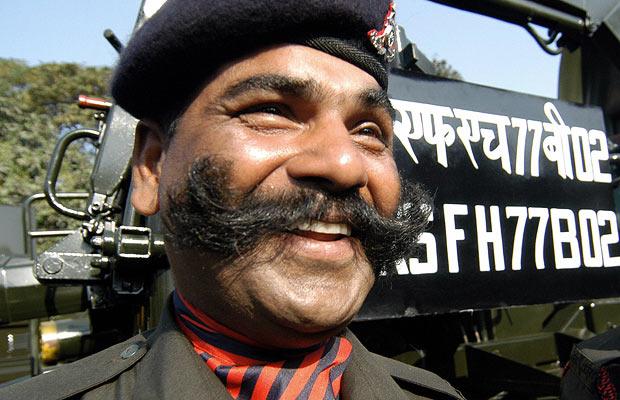
In the Indian Army today, soldiers are expected to be clean-shaven, with Sikhs as the exception, permitted to grow their beards as part of their religious practice. Mustaches, if worn, must remain above the upper lip.

Sir Douglas Haig with his army commanders and their chiefs of staff – World War I – (Image Courtesy Wikimedia)

British Military Tradition

Many of the Indian Army’s traditions and regulations derive from the British Army, whose orders regarding shaving date back to the eighteenth century. Until that time, British soldiers were clean-shaven and did not wear mustaches. Soldiers of the Hussar Cavalry Regiments adopted mustaches specifically to intimidate their enemies. The trend spread across the British Army, with the mustache serving as a distinguishing mark separating soldier from civilian.

Influence from Indian royalty and the Indian belief that mustaches signified manliness may also have played a role. By the late eighteenth century, mustaches had gained popularity among British civilians, as did sideburns.

The Great Mustache Revolt
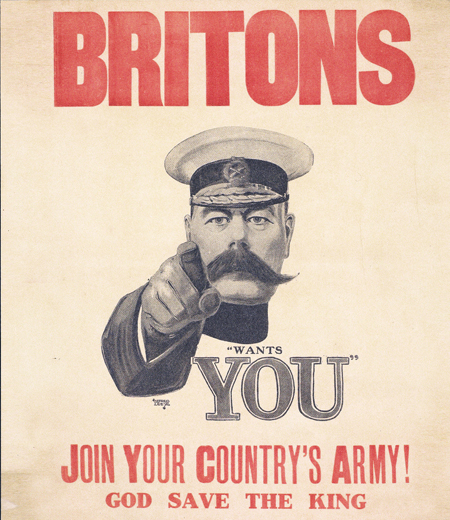
The iconic World War I poster featuring Lord Kitchener – sporting a formidable handlebar mustache – urging citizens to join the army remains an enduring image from that era

During World War I, Commonwealth soldiers found mustaches cumbersome to maintain while fighting trench warfare. Many soldiers and officers preferred to shave them off, leading to what amounted to a quiet revolt. Some soldiers faced court-martial for failing to comply with the mustache order.

In 1913, General Nevil Macready investigated the matter and submitted a report recommending that mustache orders be withdrawn. No action was taken. In 1915, King George reinforced the necessity of mustaches for soldiers. Macready resubmitted his recommendations in 1916, and on 8 October of that year, an order was finally passed abolishing the mandatory mustache requirement.

Debunking the Myth

It is a common myth that hair grows thicker and darker after shaving. Forensic anthropologist Mildred Trotter debunked this belief in 1928. She asked three college students to shave their legs, from ankle to knee, twice weekly for eight months. Using a microscope, she compared each student’s hair growth rate, colour, and thickness. Her conclusion: shaving had no impact on hair’s texture or growth.

Shaving Beyond the Military

Wrestlers are predominantly clean-shaven – Olympic rules require either a full beard or a clean-shaven face, as stubble can irritate an opponent’s skin. Swimmers often remove all body hair, believing that even minimal resistance can affect performance.

Among married Amish men, beards are worn with trimmed mustaches, substituting for wedding rings.

A Curious Footnote

For reasons still unclear, Parliament once dismissed the personal barber of Charles I of England. Famously slow to trust others, King Charles never shaved again – fearing that a new barber might attempt to kill him. History offers no evidence for the suspicion, but the king’s caution speaks to the intimate trust placed in those who hold a razor to one’s throat.

Conclusion

From Alexander’s battlefield strategy to trench warfare’s practical demands, from regimental discipline to personal pride, shaving has remained a constant thread in the fabric of military life. The morning ritual that began each day with a clean face taught lessons that extended far beyond grooming: self-discipline, attention to detail, and respect for oneself and one’s uniform. Admiral McRaven’s first task of the day may have been making the bed, but for generations of soldiers, the razor’s edge has served the same purpose – a small accomplishment that sets the stage for all that follows.

Academy Drill Instructors

Drill is the bedrock of discipline and the Drill square is often compared to a potter’s yard, wherein clay of various hues and textures are shaped into commendable works of art; each piece unique in itself and yet part of a whole. Passing the Drill Square Test (DST) entitles every cadet to the two ‘Ls’ he craves for; the Lanyard and Liberty. Here the Liberty is a pass to go out of the Academy on a Sunday.

DI11

Every Defence Service Officer would always remember their Drill Instructors – the Havildar Majors (Sergeant Majors) and Subedars (Warrant Officers) – who taught them the basics of drill. These Drill Instructors have to constantly maintain a high standard of military bearing and a super intense level of performance while they are training Officer Cadets. They are always under the microscopic eye of the Cadets.  They are in a competitive environment against other Drill Instructors of other Squadrons/ Companies to ensure that their Squadron/ Company emerge as champions at drill in the Academy competitions.

Above all, they take on a huge challenge to accomplish, making soldiers out of raw teenagers, coming from different parts of the country, speaking different languages (I could hardly understand Hindi when I joined the Academy,) from different family/educational backgrounds.

There is a lot of prestige associated with being a Drill Instructor at the Academy. The training to become a Drill Instructor is tough and the job has long hours and can be extremely demanding. These Instructors, mostly from the Infantry Battalions, are real go-getters and are always looking for opportunities to push themselves. It is one of the highest honours a Non-Commissioned Officer (NCO) of the Indian Army can get. Only the most qualified NCOs are chosen to attend Drill Instructor Course and from them the cream is selected to be appointed at the Academies.

The Drill Instructors train the Cadets under the watchful eyes of the Drill Subedar Major (Master Warrant Officer) and the Adjutant of the Academy has the overall responsibility for the Drill Training.

DI22

Our course-mates stationed at Mumbai organised a get together on 26 February 2016, to honour our Drill Subedar Major (SM,) now Honorary Captain Ghuman Sinh. He was the first Drill SM when we joined the Academy and he was the best Drill SM I have come across in life. As a cadet both at the National Defence Academy (NDA) and at the Indian Military Academy (IMA,) I had seen a few more, but he was easily the best. He had a roaring thunderous voice at the Drill-Square, but had the softest tone elsewhere. He had mesmerisingly penetrating blood-shot eyes at the Drill-Square, which metamorphosed into large pools of kindness when outside the square. He was surely a soldier to the hilt, perfect with his drill and above all a great Guru.

SM Ghuman Sinh never believed in punishments. At times we got late for the Drill class by virtue of previous class getting delayed and our drill instructors got into the act of punishing us for being late. SM Ghuman Sinh would reprimand these drill instructors saying “These Cadets do not deserve punishments as they are not responsible for the delay. Treat them like your sons and teach them Drill.”

DI22a

One Sunday morning, cycling my way to the Church, (the route was through the Drill Instructors’ Quarters,) I met a soft-spoken, humane person, dressed in his civvies, waiting with the NDA cycle near the church. He inquired as to where I was off all alone in a hurry. I said I was off to the church and the mass was to commence in about ten minutes. This person I knew from his bearing and being with the NDA cycle was a Drill Instructor and he spoke to me with a lot of compassion, care and love (for NDA Cadets, it’s a rare experience.) At the end of the conversation, I bid goodbye to him and assuming that he might be a recently posted Drill Instructor, my last question  was – “By the way who are you?” The man said “I am your Drill SM Ghuman Sinh.” I just could not believe my ears and eyes, as the man in the civvies was really humane and I had seen him only in his military uniform until then.

At the NDA, in Echo Squadron, we had Subedar Kalyan Chand from the Dogra Regiment as the chief Drill Instructor with Regimental Havildar Major Karnail Singh Chauhan from the Para Commandos as his deputy. They were really good at their job, thoroughly professional and real hard-task masters.

Two years after my Academy Training, as a Lieutenant, I was leading the Artillery Brigade Athletic team for a competition at Dehradun. On reaching the ground for the march-past, I realised that a button was about to come off my blazer and I needed a needle and thread to fasten it. I looked around and saw SM Kalyan Chand there. He, a roaring salute, me, a bear hug! I then requested him for the much needed needle and thread. The service came in no time, but SM Kalyan Chand insisted on fixing the button himself. He said that it would be a matter of honour for him to do the favours for his cadet. I was pleasantly taken aback by his kind gesture.

In 1990, our Regiment moved to Udhampur and was co-located with a Para Commando Battalion. An officer from the battalion was my neighbour and while conversing with him he said that their SM was Karnail Singh Chauhan. Next day I walked into the SM’s office and he could immediately recognise me. He introduced me to all the Havildar Majors of his battalion who had assembled there as “My Cadet at the NDA, now a Major in the neighbouring Artillery Regiment.” After that the two units developed such a great rapport that they would help each other with troops, vehicles and other resources whenever needed.

Our classmates’ from the 1979 batch of Sainik School Amaravathinagar had a reunion at the NDA on 22 December 2015.  It  commenced with the wreath laying ceremony at the Hut of Remembrance, to pay homage to the martyred officers, who had passed out of NDA. The solemn ceremony was an acknowledgement of the courage, valour and sacrifice of those who served the country. The ceremony had a patriotic impact on everyone present, especially the children.

DI33

The Drill Instructors (Havildar Majors) provided an excellent ceremonial guard for the occasion. At the end of the ceremony, I thanked them and spoke to them to say that the Drill Instructors at the Academies are the most blessed lot of Gurus as they are the only ones to see their wards placed above them on completion of training under them. Hence, they are doing the most divine job and must always strive to impart the best Drill education to the cadets.