A Stitching Lesson

At Sainik School Amaravathi Nagar, Thamizh Nadu, we had an MI Room (Medical Inspection Room) – the refuge for the tired souls – both physical and mental.  The boss out there was Mr KP Damodaran who  can well be described as a Nursing Assistant by profession, whom everyone called a Compounder, but always acted as a Doctor.
Forever for any medical condition, worth it or not, he prescribed a combination of APC with sodium-bicarbonate, a pink coloured magic potion, an awful tasting mixture, compounded by our Compounder Mr Damodaran, a Veteran from the Royal Indian Navy who saw action during World War II.

I was admitted for mumps in the isolation ward for 21 days while in grade 7. During one of his daily rounds, Mr Damodaran saw me reading the history book. As he turned the pages, it was about the Viceroys and Governor Generals of British India – Lord Wavell and Mountbatten. Mr Damodaran said “I’ve met both Lord Wavell and Lord Mountbatten during World War II.  Lord Wavell’s sketch in this book least resembles his personality.” 

What was the magic tablet APC? It was a combination tablet containing aspirin, phenacetin and caffeine. In those days (early 70’s), it was perceived to be a magic drug – a solution for most diseases and medical conditions. It disappeared in 1983 because of harmful side effects of phenacetin.

Sodium-bicarbonate is a mixture of  Sodium-bicarbonate with sugar and salt.  It was used as an antacid to treat heartburn, indigestion and upset stomach as Sodium-bicarbonate is a very quick-acting antacid.

When we were in grade 11 in 1978, we were the senior-most in school. During a movie show on a Saturday night, a bench we were seated broke and a piece cut through the thigh of Palanivel, our classmate. Everyone else were engrossed in watching the movie, but I saw Palani bleeding and writhing in pain. I helped him walk to the MI Room and there was Mr Damodaran.

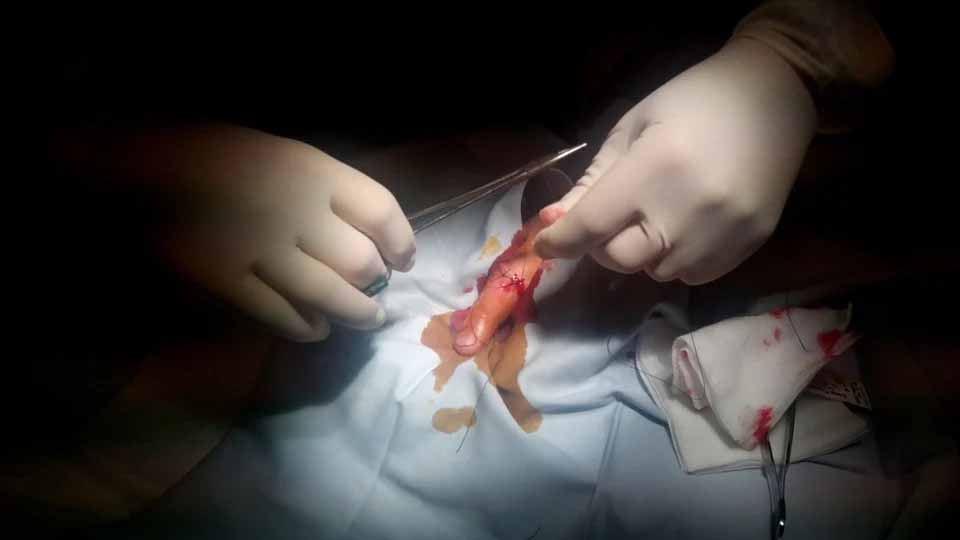
Palani was immediately administered a dose of Tetanus Toxoid (TT) and the next step was to suture his six inch long gash. Mr Damodaran switched on the steriliser and after five minutes asked me “put on the gloves and take out the suturing thread and a needle with a tong.” I did as ordered.

Then came a surprise ordeal for me.  Mr Damodaran had a failing eyesight and he asked me “Please thread the needle.”  Unfortunately for us, Mr Damodaran’s spectacles broke a few days before and to get a new one he had to travel to Udumalpet, the closest town, about 24 km away.  That could be feasible only the next day being a Sunday.

His next command was a bigger surprise – “now start stitching.”  He instructed each step and I put six sutures through Palani’s skin.  Palani must still be carrying the scar on his thigh today.

How could I execute such a mission?

When we were in Grade 2 & 3, we had stitching classes by Annamma Teacher, who also taught us Malayalam.  On a piece of cloth we began with hemming, then running stitch, cross stitch and then stitch English Alphabets, a flower and a leaf.  It came in handy that day.

Annamma Teacher remains etched in my memory as she was very compassionate to the young kids and was an epitome of dedication.  She was always dressed in her spotlessly white ‘Chatta, Mundu and Kavani,‘ the traditional Syrian Christian women’s attire.  Chatta is more like a jacket, while the mundu (dhoti), unlike the one worn by a man, is elegance personified, especially at the back, where it is neatly pleated and folded into a fan-like ‘njori‘.  Both Chatta and Mundu are pure cotton, Kavani, generally off-white with hand sewn embroidery is made of a thinner material and is draped across the body.

During our younger days, Chatta, Mundu and Kavani was the most common wear for the ladies, especially while attending the Sunday Mass and also during social and religious occasions. Chatta consists of two pieces of cloth cut into T shape and hand stitched prior to the arrival of sewing machines.  My grandmother said that they used to cut the cloth into two Ts with a kitchen knife as the scissors were not in vogue then and hand sew them.

Muslim women of Kerala in those days wore a white Mundu called ‘Kachimundu’ with blue and purple borders. The Muslim women’s Mundu do not have the fan-like Njori at the back. The head covering ‘Thattam‘ is better known as ‘Patturumala.’ The torso is covered by a long blouse with full sleeves. This type of dress is known as Kachi and Thattam.
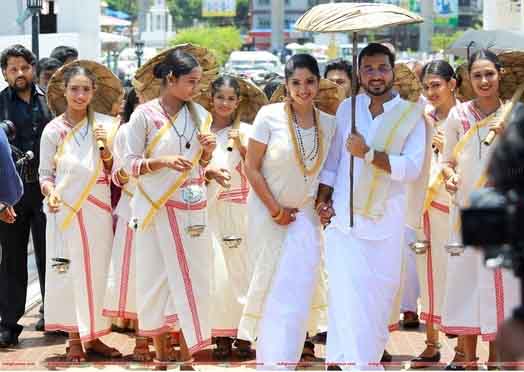

Difficulty in maintaining the white outfit spotlessly white and availability of cheaper, easy to wear and maintain sarees resulted in the saree becoming the common wear for the Syrian Christian ladies.  Modern day wedding planners have revived the Chatta, Mundu and Kavani by showcasing it by asking a few relatives of their client to dress up so.
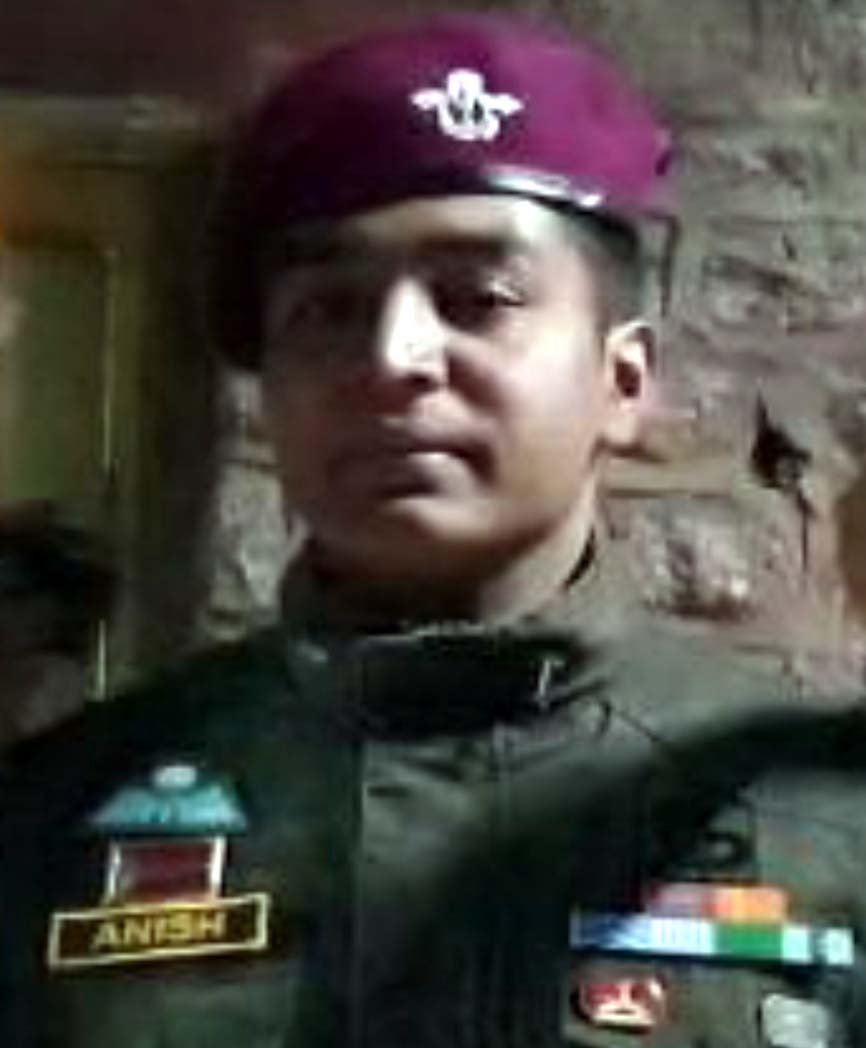

Annamma Teacher’s son, Veteran Colonel OM Kuriakose and her grandson Lieutenant Colonel Anish Kuriakose – both father and son are from The Parachute Regiment of the Indian Army.

First, Middle and Last Name

In school and during my service in the Indian Army, my name was recorded as Koduvath RejiKoduvath being our family name. (Please click here to read more about Koduvath family).

Names

 Among the Syrian Christians of Kerala, names traditionally consist of three parts: the family name, the father’s name, and the christened (given) name. However, my siblings and I had only two—the family name and our christened names. As a curious teenager, I once asked my father why our names were so short. Being a headmaster, he gave a characteristically practical reply: the most common question in primary language classes is “What is your name?” He didn’t want his children struggling with lengthy responses, so he kept our names simple. I often wonder how I’d have managed with a typical Syrian Christian name like KuruvillaPhiliposePunnoose, or Zachariah!

The Many Reasons for Name Changes

In Kerala’s Malayala Manorama newspaper, classified columns frequently feature name-change advertisements—mostly women altering their surnames post-marriage. Some adjust the order of their names, while others cite astrological or numerological reasons.

But motivations for name changes vary widely. Some dislike the name their parents gave them. Couples may hyphenate surnames, creating a double-barrel identity. Others anglicize their names to avoid mispronunciation or unintended meanings in foreign languages. Occasionally, a name becomes a professional liability, or a change is needed to counter identity theft.

A Family Tradition: Keeping One’s Name

My mother, Pallathettu Kurian Sosamma, married my father, Koduvath Varkey George, in 1956. Both were teachers, and neither changed their names. My father believed marriage shouldn’t demand the sacrifice of one’s identity. He also considered the bureaucratic hassle unnecessary. This principle extended to his daughters-in-law—my wife, Marina Mani, retained her name, derived from her father’s.

In the Indian Army, it’s common for officers to change their wives’ surnames post-marriage through Part II Orders (official documentation). Many were surprised when I insisted Marina keep her maiden name. Most officers didn’t realize that marriage alone doesn’t legally authorize a name change—proper legal procedures must be followed. Soldiers, too, often bypassed the process, relying on uninformed officers to approve their paperwork.

Naming Our Children: A Deliberate Choice

After marriage, Marina was often addressed as Mrs. Reji—a natural assumption in the Army, where Reji was mistaken for my surname. She disliked it but eventually accepted it. When we named our daughter Nidhi, Marina felt a single name seemed incomplete. I argued against adding my name to hers, avoiding future change of name complications.

Eventually, Marina named her Nidhi SusanSusan being the anglicized form of my mother’s name, Sosamma. Today, she goes by Nidhi Parkinson-Watson, adopting a hyphenated surname. When our son was born, Marina chose Nikhil George Koduvath, giving him a complete name.

The Passport Predicament: Two Identities

While emigrating to Canada, I swapped my first and last names for the passport, becoming Reji Koduvath instead of Koduvath Reji. This left me with dual identities—Indian and Canadian. Our daughter faced minor issues in Canada, where Susan (her last name) is typically a first name, often prompting double-checks during documentation.

Correcting Documentation in the Army

As a commanding officer, I noticed gaps in soldiers’ documentation, especially regarding marriage and children’s birth records. During a Sainik Sammelan (monthly address), I explained the legal name-change process in India (similar to many developed countries):

  1. Affidavit: File before a District Court or Magistrate.
  2. Newspaper Advertisements: Publish in two local newspapers.
  3. Gazette Notification: Finalize in the state’s Official Gazette.

One soldier from Rajasthan raised a concern: in his community, unmarried women used Kumari (virgin) as their second name, which changed to Devi post-marriage (e.g., Ritu Kumari → Ritu Devi). I quipped, “Until legally changed, she remains ‘Kumari’ for life!” I instructed all personnel to regularize any unofficial name changes.

The Canadian Quirk: Searching by Last Name

In Canada, medical searches often use last names. Since Nikhil and I share Koduvath, while Nidhi and Marina have different surnames, I ask clinics to search by our home phone number instead.

Once, a pharmacy technician pulled up five names under our number and remarked, “All three males share a last name, and the two females have different ones.” Puzzled, she asked who the third male was. The answer? Maximus Koduvath—our dog, who also gets his meds under our family file!

Names2

Koduvath the Meat Basket

A typical Syrian Christian family history will forcefully trace its roots to the to the 31 Brahmin families supposed to have been converted to Christianity by St Thomas, one among Jesus’ 12 disciples or to Pakalomattom, Kali, Kaliyankal, Shankarapuri Namboothiri (Brahmin) families, even though no documentary evidence exists to prove the connection.

After Jesus descended to heaven, all ten disciples moved Westward to spread the message of Christ and establish churches. Only St Thomas was sent Eastward (East must be a punishment posting then also as prevalent in the Indian Army.)  This could be because St Thomas was known as the Doubting Thomas who refused to believe that the resurrected Jesus had appeared to the ten other disciples (Judas had committed suicide by then,) until he could see and feel the wounds received by Jesus on the cross. From this originated the English idiom of Doubting Thomas as a skeptic who refuses to believe without direct personal experience.

In the earlier days, the Syrian Christian  priests could only be ordained from the Pakalomattom family (an effect of the Hindu caste system prevalent then.)   Vasco da Gama landed in Kerala in 1498 and was surprised to find local Christians, involved in spice trade.  In those days the Christians followed most customs of the local Hindus (some of it even continues today) and used Syriac as the liturgical language because of the association with Persia due to the spice trade.  Hence the Portuguese called the local Christians as Syrian Christians and the Christians they converted as Latin Christians as they used Latin as their liturgical language. 

The Portuguese after landing in Kerala realised that the princely priesthood of the Pakalomattom family had to be broken to have a hold on the local Christians and so ordained priests from other rival families. By 1660 they weaned away 84 of the 116 churches who aligned with Rome and became the Syro Malabar Catholic Church and the rest thirty-two churches and their congregations formed the Syrian Orthodox Church.  The purported aim of the Portuguese was to wean away the local traders, mainly Christians, from the Muslim Arab traders.

It would be foolish on my part to do the same mistake others did and hence would limit to the details I had obtained by way of many discussions I had with our grandfather Karottu KT Varkey (he lived to the age of 104 and died in 2002.)  Surely some of these would have been his figment of imagination and he also must have added enough spice to make it interesting for a hyper-active young boy.

In the nineteenth century Koduvath Easo (in those days the family name preceded the christen name) came with his daughter Eli and occupied Malamelkavu (in Malayalam meaning hillock with a temple on top,) in Kolladu village, about eight kilometer from Kottayam and settled there.  Nothing is known about the other family members and from where Koduvath Easo came.  Thomas married Eli and moved into Koduvath family as the Adopted Son (Jamai जमाई) (DathuPuthran ദത്തുപുത്രൻ.)  From then on it is said that the ladies of the family have been more dominating and I can see it in today’s generation in the form of our daughter and her cousin sisters.   Thomas and Eli had nine sons and two daughters with our grandfather being the eleventh.  The nine sons and their further generations continue to live in and around Malamelkavu and some moved out in search of better jobs and opportunities.

The family belongs to the parish of St George Syrian Orthodox Church, Puthuppally (ex-Chief Minister of Kerala, Late Oommen Chandy’s family also belongs to the same church.)  Kolladu village is located West of Puthuppally village and is separated by a river.  Crossing the river up to 70’s was by means of a ferry, now by a bridge.   The annual festival of the church is celebrated in first week of May and is like the annual festivals of the Hindu temples in Kerala.   Vechoottu (a ceremonial feast), adya choroonu (a ritual in which children get their first rice feeding by priests,) etc. are some of the rituals associated with the festival.  Later  Raza, the grand festival procession taken out with the holy golden cross from the church, accompanied by Chenda Melam (drums of Kerala) and caparisoned elephants.  The Raza is received by every household which falls on its route, irrespective of their religion, with a lighted lamp.   In the evening the entire church is illuminated with lamps like any Hindu temples of Kerala.

The main offering to the church on the annual festival is fowl (preferably a rooster) as St George the patron saint of the church was a soldier and is believed to enjoy chicken.  In the earlier days the fowls offered were slaughtered on the church premises and the fried chicken was served as Prasad to the devotees.  This cruel practice was terminated by the 70’s being cruelty to animals.

I had heard a myth about the fowl slaughtering at the church from my grandfather.  In the earlier days, there was a Kali (Hindu Goddess) temple situated atop the hill adjacent to the church.  The fowls were offered there also on the annual festival day of the temple, which coincided with the festival day of the church.  One day both St George and Kali came together in a dream of the village chieftain and they came to a compromise that the fowls are to be slaughtered at the church and meat prepared there (St George enjoyed the meat,) but the blood had to be collected and offered to Kali in the evening (Kali seemed to be interested only in blood) and that way only a few birds had to be sacrificed.

The next day the Holy Mass is offered at the church.  At the end of the festivity, the Chicken Prasad is distributed to the devotees at the East and West gates of the church.  The chicken pieces are carried to the gates in bamboo baskets.  The teenagers from the Koduvath family now come into action and they snatch the chicken baskets and run as a relay race handing over the basket from one to another and swim across the river.  The prasad thus snatched is distributed among the family members.  The taste of the fried chicken will give run for the money to today’s Kentucky Fried Chicken (KFC.)This practice continued for some years and all our family members, whether barristers, teachers, government officials of those days were all nicknamed ഇറച്ചിക്കൊട്ട (Irachi Kotta)’ (in Malayalam meaning Meat Basket) and many of us still carry the same nickname, especially while studying in schools and colleges in Kottayam.