Brig Azad Sameer (Retd)
According to the official Pentagon narrative, the rescue of DUDE 44 B was the most devoted act of camaraderie in human history. After an F-15E Strike Eagle went down on April 1, 2026, the pilot (DUDE44A) was whisked away within hours. However, the Weapons System Officer (WSO: DUDE44B) took a bit longer, leading to a mission that can only be described as a tactical overkill. To save one man, the U.S. launched an armada of 155 aircraft and landed two $100-million MC-130J Commando II transports on a wet, sandy farm field. It’s a touching story, provided you don’t look at a map—or a balance sheet.
Holes in the Narrative
In the world of standard Search and Rescue, you send a couple of agile HH-60W Jolly Green II helicopters or maybe a CV-22B Osprey. You do not land two massive, 70-ton fixed-wing transports in the mud 100 miles away from the guy you’re looking for. Using an MC-130J to rescue a single airman is like using a cruise ship to pick up a stranded jet-skier: it’s flashy, but it’s a logistical nightmare that puts hundreds more people at risk. By putting 96 personnel on the ground in the heart of Iran, the Pentagon didn’t just plan a rescue; they accidentally invited a hundred people to a potential hostage crisis party.
The geography of the mission is where the official story really starts to sink – much like those MC-130Js in the Isfahan mud. The landing site was uncomfortably close to Iran’s primary underground nuclear facilities and missile infrastructure. Furthermore, the cargo involved—four MH-6 Little Bird helicopters that had to be offloaded and reassembled – is the textbook signature of a Direct Action raiding party. You don’t bring an assembly-required helicopter kit to a time-sensitive rescue mission unless you were already heading there to kick open a very specific, very nuclear door.
Strategic Mission
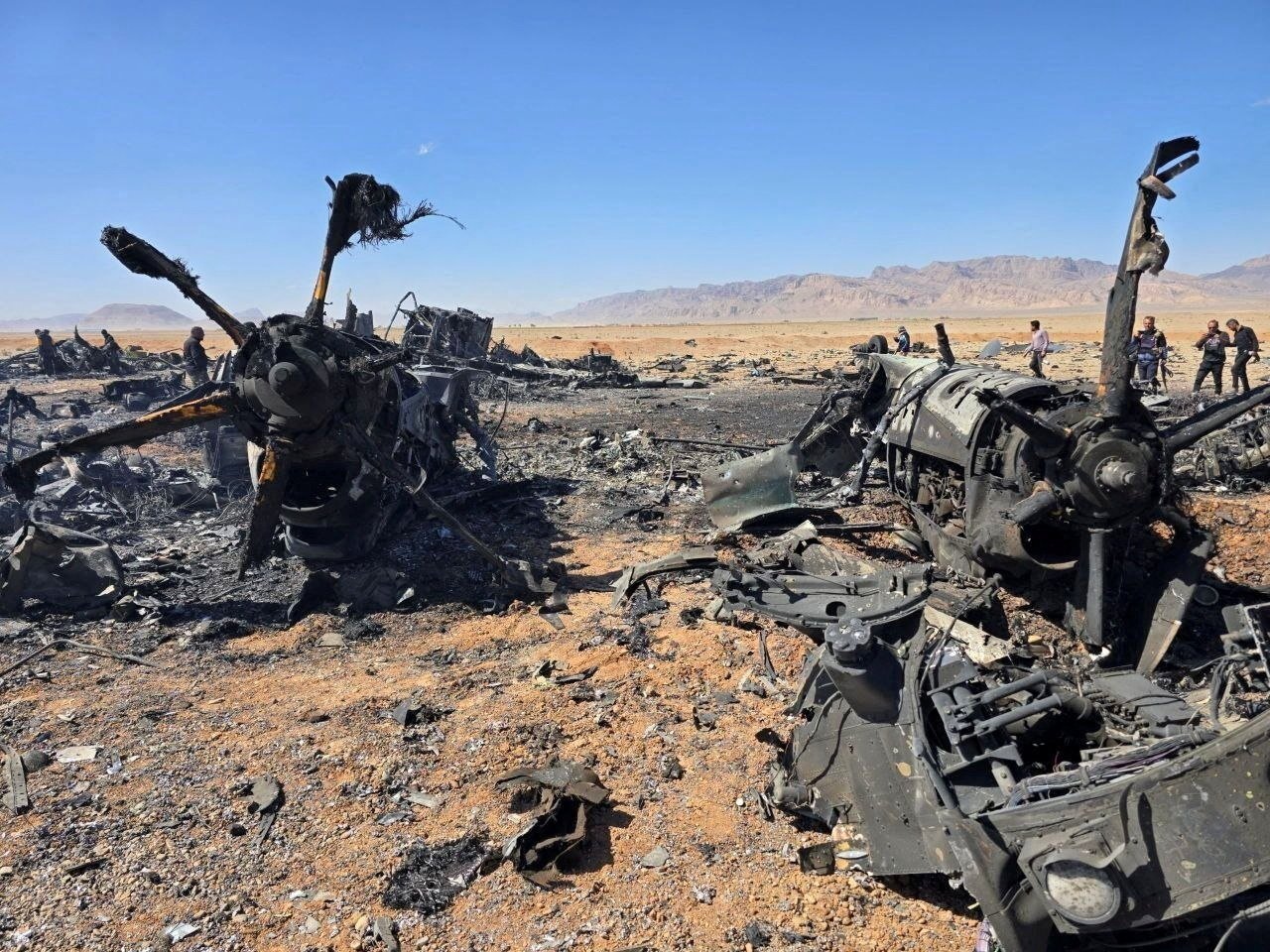
The logical conclusion is that the rescue of DUDE 44 Bravo was a mission of opportunity. The 96 personnel and their heavy-lift aircraft were almost certainly on a primary strategic mission – likely a counter-proliferation raid or a high-value target seizure near Isfahan. That also explains the use of 155 combat aircraft for the rescue mission. The Iranian airspace had to be sanitised for a strategic mission which involved the move of two clumsy, elephantine transport aircraft. When the F-15E crashed nearby, the Pentagon pivot was swift: if the secret raid failed (which, given the stuck in the mud outcome, it seemingly did), they could blow the sensitive gear to smithereens and tell the world it was all a heroic, albeit a bit expensive, effort to leave no man behind. It’s much easier to explain losing $300 million in hardware as saving a brother than as getting the tyres stuck during a botched nuclear heist. Also, a new word got added to our glossary of military terminology: scuttle. To be used when the getaway car gets stuck in the mud.
The Great Escape
However, we must give credit where it is due: the eventual extraction of those 96 personnel was a genuine feat of professional airmanship. When the heavy-hitters failed, the U.S. successfully pivoted to three lighter CASA CN-235 aircraft. These nimble turboprops did what the massive Commandos couldn’t – they landed on that same soggy strip, packed in nearly a hundred elite soldiers, and hummed their way back to safety. While the Official Version might be a tall tale, the fact that all the personnel returned home without a single casualty remains the highlight of the story that holds water. Its tactical brilliance that really needs a standing ovation. Someone took a very smart abort mission decision, early enough to make the great escape possible. It’s a bit funny though, 96 went in to save one and then the 96 had to be rescued!
The Concluding Question
One odd question remains. Why were the CASA CN235 aircraft not used for the special mission in the first place, when it was evidently clear that these were more suited for the sticky airstrips available? They could not obviously carry the Little Bird choppers, necessary for the onsite move.Logically, it appears that ONLY MC130Js had a mission appropriate pay load capability. Something really heavy had to be brought in or taken out or probably both ways. We generally know that enriched uranium is normally carried in very heavy lead lined steel containers. It’s also a probable reason why the aircraft refused to take off from the sand after they landed. It’s a different matter that these special containers, now melted and mangled, maybe somewhere amongst the aircraft wreckage.
 REJINCES
My read exactly. Map Coords give a clearer picture. Smoke screen to cover their tracks. Very fact that the WSO was a Colonel speaks of a very high priority op. His capture would have laid bare the subterfuge. Eagle Claw all over again. I think that is why post haste acceptance of cease fire. They will give solid reparations to cover this entire facade.
LikeLiked by 1 person
Thanks for your views
LikeLike