Hindu-Arabic Numerals

Indian Numerals

The numerals in various languages interested me a lot. During our childhood, the Bible at home had chapters numbered with the Malayalam numerals and the verses with Indo-Arabic numerals. During our cadet days at the National Defence Academy, we travelled to Pune city by the municipal transit bus. The tickets were printed with the price shown with Devnagiri numerals and I had no clue of it. Once in the bus, the conductor gave me the ticket and I asked him as to what the cost was. He shot back saying that you dress in a suit and how come you cannot read. I came back and learnt the Devnagiri numerals immediately.

Our son Nikhil while in Grade 2, came home from school and asked me as to what has Hinduism to do with numerals. Taken aback, I asked him to narrate the context and he said the he was taught in the Math class that the common numerals are called Hindu-Arabic Numerals. In North America anything to deal with the country/sub-continent India is referred to as ‘Hindu’ (Hindustan) so as not to confuse with the American Aboriginals, commonly referred to as ‘Red-Indians’ or ‘Indians’.

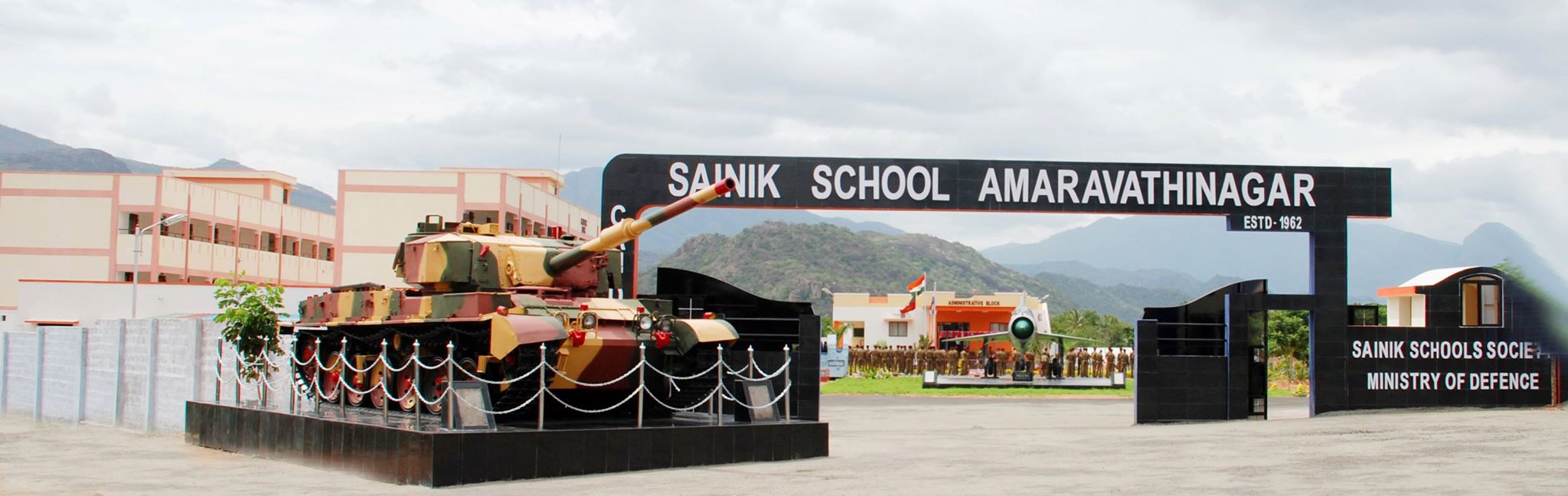
My mind raced back to 1974, while in Grade 8 at Sainink School, Amaravathinagar, Thamizh Nadu, India, our math teacher, Mr Venkatesha Murthy had explained to us that the numerals we use every day would be known as Indo-Arabic Numerals and not as Arabic Numerals. These numerals were invented by mathematicians in India. They were later called ‘Arabic’ numerals by Europeans, because they were introduced in Europe by Arab merchants. The Europeans were intrigued by the speed at which these Arab merchants calculated mentally when the Europeans were struggling with their Roman numerals and their Abacus.

Mr Murthy also spoke to us in detail about important contributions made by mathematicians like Aryabhata, Bhaskara and Ramanujam. He also spoke to us about contributions of Indian mathematicians to the study of the concept of zero as a number, negative numbers, arithmetic, and algebra.  Mathematicians from Kerala (India) had developed trigonometric functions like sine, cosine, and tangent in the 15th century. They even had developed calculus two centuries before its invention in Europe. As usual, India being a timeless and record-less civilisation, no one formulated a systematic theory of differentiation and integration and there is no evidence of their findings being transmitted outside Kerala.

The Indian Science Conference of Jan 2015 had lectures about ancient knives so sharp they could slit a hair in two, 24-carat gold extracted from cow dung and even 7,000-year-old planes that could travel to other planets. Among other technologies, introduced at the congress there were polymers to build houses made of cactus juice, egg shells and cow dung; a cow bacteria that turns anything eaten by an animal into pure gold, and the curious procedure of an autopsy, conducted by leaving a dead body floating in water for three days. The surprising discoveries were said to be based on ancient Hindu texts, such as the Vedas and the Puranas, and were presented at a session on ‘Ancient Indian Sciences through Sanskrit’. There were some who claimed that Indians had travelled to other planets, and the helmet-shaped object found on the surface of Mars was the hair worn on the head by space travellers. These stories would not even have found a place in children’s comics. Surprisingly there were not one lecture about the mathematical contributions made by the Indians.

Providing a scientific platform in a prestigious science conference for a pseudo-science is appalling. It for the first time such a session is held in Indian Science Congress. Indian Prime Minister by saying to an audience of doctors and scientists that plastic surgery and genetic science existed and were in use thousands of years ago in ancient India and how the Hindu god Ganesh’s elephant head became attached to a human body. The Gujarat State school science books on various myths are now well known. These alarming developments happened after the change of government in Delhi. The scientific community should be seriously concerned about the infiltration of pseudoscience in science curricula with backing of the government. The accelerated pace with which it is being promoted will seriously undermine nation’s science and it will have a disastrous effect on the future generation.

With this at the back of my mind, while in India in Jan 2015, I decided to interact with my nephews and nieces, mostly engineering students. To my surprise none knew that the numerals were called Indo-Arabic and they had no clue of the achievements of Indian mathematicians. It appeared that the textbooks in Canada have been amended, but the Indian books still carried Arabic numerals.

Cross Country Race

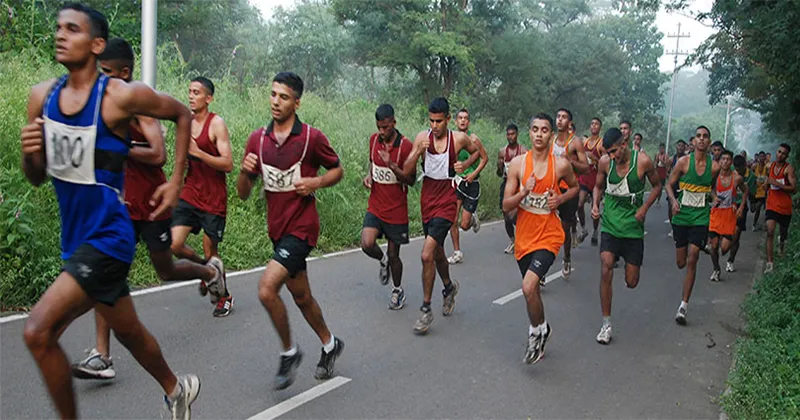
The first cross-country  race (Marathon in North America), I ran was as a Grade 5 student at Sainik (Military) School Amaravathinagar. It was a 5 km run along the base of the Western Ghats on the North side of the school. With every passing year, the distance increased. with it the difficulty. On joining the National Defence Academy (NDA), the cross country race became a ritual in every semester (half-year) and thus I ran six races in three years of about 14 km. During the first 10 years of service in the Army, I ran seven races. On reaching Canada, I ran two such races, in support of charitable causes.

Running a marathon is one of the largest physical challenges you can set, often it is more of a mental challenge – the mental strength to complete the race despite the panting, tiredness and pains. It results in an accomplishment every time, irrespective of your age. It does not matter even if you are the last, you are part of an elite club of people that have completed the race successfully.

At the NDA, the cross country race was more of a team event. The Squadron which won the trophy every semester claimed more bragging rights than the cadet who came first or second. It was a matter of pride for the cadets that their Squadron did well and hence every cadet put their heart, soul and body into doing well at the race.

The practice for the race at NDA began nearly a month prior with all cadets running a full race almost every evening and morning on Sundays and holidays. The final race was on a Sunday morning, starting at the famous Glider Dome and ending there. One witnessed cadets completing the race despite physical injuries – a cadet finished the race after he fractured his leg halfway. There have been many cadets running the race with fever. All to ensure that they do not bring in negative points for their Squadron and let the team down.

In 1987, our Regiment was located in Gurgaon near Delhi and we formed part of the Brigade stationed at Meerut – about 50 km from Delhi. Cross country race was a closely contested competition among the regiments and our unit had the rare distinction of winning it for the previous five years. 1987 was the final year at Gurgaon as the unit had received its move order to the Kashmir Valley.

Our Commanding Officer, Colonel Mahaveer Singh called Late Captain Pratap Singh, Maha Vir Chakra and self to his office in March 1987 and briefed us that we had to win the cross country competition for him. We both were Captains then and by virtue of being the senior, I became the team captain. Among young subalterns, one was away on a training course and the other admitted in the Military Hospital.

The team to be fielded for the competition was to consist of one officer and 15 soldiers. We started practicing for the race – two officers and 20 soldiers. Every morning at 5 we were picked up from our residence and the team used to be dropped off about 20 km from the regimental location. Now everyone had no option but to run back to the regiment. The faster one did it, lesser the agony.

After a month’s practice, we decided to move to Meerut a week before the race to carry out a few practices there. The race was scheduled for 11 April, Saturday to commence at 6 AM. The day we had planned to leave, Pratap’s mother took seriously ill and he had to hospitalise her and take care of her. I told Pratap to reach Meerut by Thursday evening the latest.

As Pratap had not practiced for the last week, I had made up my mind to run the race. Pratap landed up in Meerut on his motorbike on Thursday evening. On Friday I showed him the route and told him to be stand-by.

In the evening we reached the Officers’ Mess for dinner and all the young officers participating in the race were there. Seeing the senior Captains set to run the race, Lieutenant Atul Mishra wanted to know as to who amongst us was running the race. Pratap said that the person who woke up first woke up the other and the latter will run the race. Everyone believed it as the same was narrated by Atul after a decade.

After the race, I received the trophy from the Brigade Commander and after a few minutes there was Pratap with his motorbike asking me to get on to the pillion. We rode off and as I was too tired, I hugged on to him and slept off. I woke up only on reaching our regimental location after over an hour of drive.

We handed over the trophy to Colonel Mahaveer, who appreciated us for the efforts and wanted to know where the rest of the team was. Pratap said “Please do not come out with your clichéd question as to who is commanding the unit, I have ordered them to relax at Meerut for the next two days and also to visit the Nauchandi Mela“, Colonel Mahaveer passed his unique smile as a sign of approval for Pratap’s actions.

Nauchandi Mela is held every year at Meerut in April-May. It is a rare symbol of communal harmony with Hindu and Muslim shrines – Nauchandi temple and the Dargah (shrine) of Muslim saint, Bala Mian. Visitors pay obeisance at both the shrines irrespective of the religion they belong to.  The mela, which originally brought sellers and buyers of utensils and domestic animals together, now includes various kinds of goods, entertainment and food.

Colonel Mahaveer had a knack of delegation and had immense trust in all of us. He always encouraged the young officers to be decisive and whenever we goofed it up, he always held our hands and took the responsibility for our actions.

Library

During childhood days, our village in Kerala had a public library, housed on the upper floor of the Post Office building. The library had a good collection of books, periodicals and newspapers. The library used to be bustling with activity in the evening. Students and youth came there to borrow books, many came to read newspapers and periodicals and above all, it had a radio connected to a public address system which beamed the news from All India Radio. Those were the days when most households did not own a radio and Television had not become a reality. Our village with its literate masses needed something to read as a source of information and entertainment and the library provided it. My brothers used to borrow the books from library and our grandmother who lived with us then used to read them after everyone went to school.  Now my mother, a grandma, watches the tear-jerking serials on the TV after everyone leaves the home to school or to work.

During my recent trip home, I found the library totally deserted. The reading habit seems to have died down. How can you expect children overloaded with assignments, tuition and above all entrance coaching to find time to read? Various tear-jerking serials have occupied the free time of housewives and senior citizens, which in those days was spend reading.

Sainik School Amaravathinagar, our school, also had a well stocked library. I started using the library only from my Grade 8 onward as I was not all that proficient in English till then. At that time Mr Stephen, our librarian had taken over. Untill then the librarian was a clerk or an administrative staff member who hardly had any clue about the real duties of a librarian.

Mr Stephen with an ever smiling pleasing personality was a graduate in Library Sciences. He was the first person to encourage many of us to use the facility of the library and also explain to us the wealth of information available there. He always used to remind us as to how lucky we were to have such a library which he said many colleges and universities in India did not have.

Other than being the librarian, Mr Stephen used to actively participate in all extra-curricular activities. One could always see him in the gymnasium helping students, playing all games with the students and also participating in adventure activities like trekking and rock-climbing. This helped him develop a special rapport with the students. I spend some of my free time in the library and also whenever I was made an ‘outstanding’ student in the classes, I straight away moved into the library.  Mr Stephen exactly knew what would have happened in the class, but never asked me a question and let me into the library.

On migration to Canada, we settled down in the city of Mississauga. The City runs  Mississauga Library System. It is one of the largest public library systems in Canada with over 300,000 registered users. There are 18 locations, including a multi-floor Central Library with material allocated by subject areas. Anyone who lives, works, attends school, or owns property in Mississauga can obtain a Library Card required to borrow materials.

All the library branches I visited were always full of customers, especially students and seniors. The library system has a large collection of books, DVDs, video tapes etc in 22 languages including Hindi, Thamizh and Punjabi. The excellent catalogue system followed by the library can be accessed online from the home. One can place a hold on a material through the online system. The moment the material arrives the customer is intimated by email or over the phone. In case a desired items not in the Library’s catalogue, it may be obtained through inter-library loan.

In case the library branch one visited does not have a desired material, but is available in another branch, the same is transferred to the library if you request for a hold. All materials borrowed from any branch of the library can be returned at any branch. The catalogue system caters for it.

The Library offers access to downloadable eBooks and audio books. One can download these to a computer or a mobile device.  One can also sign up to receive sample chapters from new books and newsletters about new books and authors.

Library staff are always available to help the customer to find information and choose materials. The Library offers extensive information on occupations, educational planning, career planning, training and job search strategies.

An extensive collection of fine, old and rare materials, dealing with the history of Mississauga City is available for in-library use at the Mississauga Central Library and includes scrapbooks, local archives, and a large collection of photographs. Genealogical materials are available through Ancestry at all Library locations. The Historic Images Gallery brings together the image collections of multiple institutions providing centralized access and is searchable online.

eResources provide access to reference eBooks, newspaper and magazine articles, scholarly journals, book reviews and more. Search over 30 eResources covering a wide variety of topics including health, business, world news, literature, sports, arts, and entertainment. With a valid Mississauga Library card, you can do your research from home, school or office.

Children’s Dial-A-Story can be called as often as you want, any time of the day to listen to a new preschool story each week in the comfort of your home.

Public access to the Internet and Microsoft Office is available at all Library locations. One can book a session to use a Library computer with a valid Library card. Photocopiers are available at all Library locations at a minimal payment. Copying is subject to copyright laws.

Large Print Books are available from all library locations and rotate from library to library. In partnership with the Canadian National Institute for the Blind (CNIB) Braille Books are provided via mail.

Libraries store the energy that fuels the imagination. They open up windows to the world and inspire us to explore and achieve, and contribute to improving our quality of life.”   – Sidney Sheldon
Post Script :- My book ‘Suit, Boot and Tie‘ now finds a place with Mississauga Library System.
Search Results for suit boot (sirsidynix.net)

Linguists

madras

In 1971, after the anti-Hindi agitation that raged through Thamizh Nadu, I joined Sainik School Amaravathinagar in the state then known as Madras.   The school almost resembled any British Military School as all the military words of command were in English like “Attention” and “Stand-at-Ease”. There I started to learn Thamizh and also English and Hindi.

Thamizh is one of the longest surviving classical languages in the world and the script has only 18 consonants unlike Devnagari script which has about 37 consonants. When Devnagari script has क, ख, ग, घ (ka, kha, ga, gha), Thamizh has only க (ka) and similarly for the other corresponding consonants. All the other South Indian languages namely Malayalam, Kannada and Telugu follow their own script similar to the Devnagari script. Further these three languages unlike Thamizh, have a lot of Sanskrit vocabulary. Hence learning of Hindi or any Devnagari script based language becomes difficult for a Thamizh in comparison to the people from the other states.

After the anti-Hindi agitation in Thamizh Nadu, the Official Languages Act was amended in 1967 by the Indian Government to guarantee the indefinite use of Hindi and English as official languages. This effectively ensured the current bilingualism and use of English in education in India. This bilingualism has helped the Indians to a great extent in ensuring acceptance all over the world.

Hindi as a national language was not accepted all over India due to the implementation issues. The Hindi Pundits coined many a difficult terms to replace commonly used English terms. Many of the terms coined were not even accepted by the Hindi speaking population. Lot of money and efforts were pumped in by the government for the enhanced use of Hindi as an official language, but it never had any results other than a few Members of Parliament making a foreign sojourn to study the use of Hindi in some country or the other and the practise still continues.

To further make the matter worse, all forms were printed in both Hindi and English and so also all the government publications. This resulted in higher production costs without serving any purpose. While serving in the Indian Army, I recommended all my subordinates to read and understand the pamphlet ‘Glossary of Military Terms’. The pamphlet was printed in Hindi on the left page and English on the right. I also used to advise them to read the Hindi side whenever they got bored – the Hindi equivalents were hilarious and many a times grossly incorrect.

In our school the English department was headed by Mr KG Warrier and the Thamizh department by Mr M Selvaraj. Both of them were strong linguists and always ensured that they spoke the language with purity in that when they spoke, they always used only one language. Both had excellent communication skills and were near perfect in their pronunciations. Both of them never taught me at school, but I had extensively interacted with them during various extra-curricular activities.

KGW

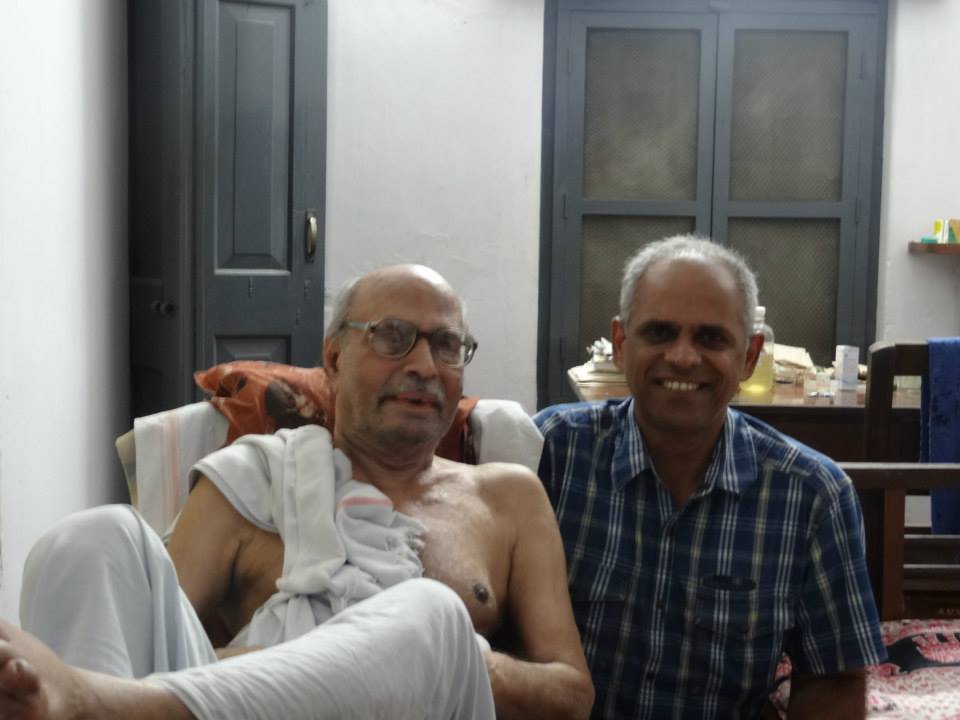
(Mr KG Warrier with our Class-mate AP Sunil Kumar at Kottakkal.  The photo is of 2013 when Mr Warrier turned 90)

Mr KG Warrier hails from the family of world renowned Ayurveda Physicians of Kottakkal in Kerala. He is currently enjoying his retired life at Kottakkal. He is staying with his daughter, Rathi. The Warrier community connected to the Vaidya Sala stay at ‘Kailasa Mandiram’ in the Vaidya Sala premises at Kottakkal, Malappuram District, Kerala.

His specialty was that he dressed in his starched and pressed cotton pants and shirt, wear a felt hat and hold a pipe in his hands. I was always intrigued as to how he managed to maintain the crease of his pants perfect even at the end of the day.

A few days before leaving school to join the National Defence Academy I met Mr KG Warrier and he asked me in Thamizh as to when I was joining the academy and how the preparations were progressing. My answer was in the usual ‘mixed language’ of Thamizh, Malyalam and English. To this he said “உனக்கு தமிழும் தெரியாது, மலையாளவும் தெரியாது, ஆங்கிலவும் தெரியாது. உனக்கு என்ன தெரியும்? (You do not know Thamizh or Malayalam or English. What do you know?)”.

I still recollect a few words of advice Mr KG Warrier had given us.  He said that everyone should always carry and use three books – a Dictionary, an Atlas and a Wren & Martin Grammar book.  At the beginning of each year at the school, these were the first set of three books we were issued with.  Later on during my army service I did carry these three books.  Nowadays with the power of the internet with browsing tools like the Google, most information is at one’s fingertips and these three books have become almost extinct.

Mr M Selvaraj was well known for his voice and his oratory skills which were showcased during all the cultural programmes at the school. His orations in both Thamizh and English will be remembered by all his students. I was very curious as to how he managed to handle the two languages independently and so effectively. During my final year in school, I did manage to summon enough courage and asked Mr M Selvaraj about the secret.

Mr M Selvaraj said that when he joined the school he had very little grasp of English having done his Masters degree in Thamizh. Major MMR Menon, then Headmaster of the school had advised him that to be a successful teacher in a school like this, mastery over English would go a long way. So with reluctance he approached Mr KG Warrier, but was surprised when Mr KG Warrier accepted to be his Guru and thus he started to learn English. He ended the chat by saying “the English I speak is all what Mr KG Warrier and Ms Sheela Cherian had taught me like any student who graduated under these great teachers.

Mr M Selvaraj left our school in 1987 to be the first Principal of Navodaya Vidyalaya at Mahe. After establishing the school, he moved as the Principal of Navodaya Vidyalaya at Pondichery and now leads a retired life in Trichy.

After leaving the school, I always tried to complete a sentence in one language and many a times I did fail. After joining the army, I picked up Hindi. Luckily for me, I served mostly with the Brahmin soldiers from North India and that helped me improve my Hindi to a great extent. Now with Hindi also joining the bandwagon of languages in my mind, maintaining purity of language became near impossible.

Hats-off to all those Thamizh news readers in any television channels, they speak pure Thamizh only and would use another language vocabulary only in case it is unavoidable.

madras1

Arts and Crafts

cc

One could either take arts or crafts as a non-elective subject from Grade 8 to 10 at Sainik School Amaravathinagar. Half the class joined either of the two based on their aptitude and inclination. Generally the well built boys went for the crafts as it involved a lot of planeing, chiseling and cutting. In our class we had PV Sumon, who had the thinnest frame of all, but wanted to enroll for the crafts class. The crafts teacher was a bit reluctant, but agreed to accept him into his fold on the sheer insistence of Sumon. At the end of it all, Sumon turned out to be best student from out batch in crafts. In the arts class, which I too had joined, had Mouli Marur as the best student who ultimately ended up as a designer and creative director with expertise in digital graphics and later a lecturer at the School of the Art Institute of Chicago.

The arts and crafts were taught to us by two simple, dedicated and hardworking teachers. They had no Masters degree to boast of, but their love for what they taught and whom they taught made them stand out in the crowd of teachers at the school.

Late Mr AK Rama Varma (AKR): The Royal Artist

akr

Mr AKR hailed from the Kochi Royalty and the art was in his blood. He taught us how to use colours to express one’s imagination, how to design various posters, book covers, cards etc. Even though I was not good at them, but the seeds Mr AKR had sowed were harvested much later by me with the advent of computers. I became a bit of an expert in making PowerPoint presentations by using the best colour layouts, designing covers and cards etc.

Mr AKR was a Kathakali (classical dance of Kerala, India) dancer too and he essayed various characters from the Mahabharata with grandeur during various cultural shows staged in the school. He also doubled up as our swimming instructor and everyone remembers him mostly for the role he did as a drowning victim for Mr CM Nair’s life saving demonstrations at the swimming pool.

How can anyone in our class ever forget the beautiful and confident Vanaja Varma, the daughter of Mr AKR. Vanaja, a year junior and she holds the honour of being the first girl most of our classmates ever interacted with. Even to this date many of us have a special place for her in our hearts.

Mr KS Krishnan Kutty (KSK) : Man for All Seasons

kskKSK

Mr KSK spend most of his time, many days until midnight, in his crafts section, completing many projects he had undertaken in addition to his teaching. His wife Ms Valsala and children always complained that he was never home, that high was his level of commitment and dedication. He had to be there everywhere, to make a set for the drama to be staged, to make any model for any other department, to repair the school furniture, to make various boards etc.

He was an excellent crafts teacher who could make his students visualise their own woodwork projects, design them and execute them. Anyone could walk into the crafts section and ask for any assistance at any time and he would smilingly oblige.

He was the school hockey coach and was also assisting with the canoeing club. He designed and fabricated about a dozen canoes with locally available material at a very minimal cost and these canoes became the showpiece of the canoeing club.

Mr KSK must be the only crafts teacher in India to be bestowed with the President’s Best Teacher Award. It was given for his dedication to duty and his ability to inculcate good values in his students. We had the honour of hosting Mr KSK and Ms Valsala when they came to Delhi to receive the President’s award. Mr KSK was a loving father and his two sons studied in our school and the younger son Colonel Sareesh is today an Air Defence officer.

I would be failing in my duty if I do not mention about Ms Valsala. She was an energetic, well mannered and active lady who always carried herself with poise. She was an athletic champion in her school days and after marriage moved to Amaravathinagar from Kerala. When the school wanted to start a Kindergarten for the children in the area the then Principal did not even think twice before handing over the responsibility to her, even though there were many other graduate ladies in the school campus. With Mr KSK’s support, the Kindergarten became well known and students started to enroll from far away villages.

Today the couple has settled down in their native village near Kochi, Kerala after Mr KSK’s retirement from school.

Your dedication and hard work will always enable you to achieve your goals.

Education and Punishment

STThe rape of a first class student in school premises on July 17, 2014 in Bangalore added one more to the long list of child abuse cases, many of which remains unnoticed. It has brought back light on one of the worst perils that our country is facing today – child sexual abuse. It is a pity that most of such abusers are either close relatives or teachers of the children. In this case too, it was the physical education teacher. Most Principals let loose these physical education teachers (goons) on to the children to ‘discipline’ them, especially during assemblies or sports or cultural events. These teachers mostly end up misusing the ‘authority’ vested in them by the Principal and in many cases resulting into physical, sexual and mental abuse to the children. Majority of such physical education teachers have no qualification to be one.

Joshi Philip, our family friend, invited me to attend the prize distribution ceremony at their daughter’s primary school. Ann Maria, their daughter, a Grade 2 student, that day had the annual prize distribution ceremony at the end of the academic year. I accompanied Joshi to the school and at the reception we signed-in and were given a round yellow sticker which said “A Proud Parent”. I stuck it above my shirt’s pocket, close to my heart, as anyone will feel proud of it rather than hanging a visitor badge around the neck.

We entered the gymnasium where the award ceremony was to take place. Every primary school here has at least two such gymnasiums and we used to boast about the one we had at the National Defence Academy. We did not have one in the Sainik School. The gymnasium is a hardwood floored hall which serves as a basket ball court, assembly area, an auditorium and a lunch room or a cafeteria. At the end of the gymnasium was a stage where all the award winners were seated. The students marched in class wise with their teachers leading them and the students sat on the wooden floor while the teachers occupied their positions at the end near the wall. As expected of little children from Kindergarten to Grade2, they were talking and then the Principal appeared on the stage and raised her right arm. All children became silent and she said “eyes and ears towards me please” and introduced the two Masters of the Ceremony (MC) who were Grade 5 students.

The prize distribution ceremony went on beginning with the Kindergarten and any time when the children became noisy, the Principal would appear with her right hand raised and everyone became silent. During the entire proceedings not even a single teacher moved from their positions. At the end of the ceremony the Principal came on stage to thank everyone and to congratulate the prize winners and at the end wanted the children to do their usual “Silent Cheer”. I had no clue what it was. It was all the body and face expression of a cheer but done without a sound and was impressive and unique.

On leaving the school I realised that the self-discipline inculcated in these children will make them better citizens of the country and they do not need any “policing” to implement any laws or regulations.

Looking back to my Sainik School days, we mostly had the Principal and the Headmaster from the Education branches of the three services, and most of them one felt were the least ‘educated’. This was further reconfirmed during my training at the Academies and service tenures. Most of the Education Corps officers are masters in some discipline or the other and today we have many officers from the Arms and Services holding masters degree by virtue of undergoing the Staff College or the Long Gunnery or the Engineering degree courses. Some even hold Doctorates too. Academically these officers are many times better than their Education Corps counterparts.

Then why post such officers to the Military/Sainik Schools? Many of them behave no better than the physical education teachers of the Bangalore incident. Most are incapable of moulding and motivating the students to join the defence services and are pretty ordinary in teaching. Any officer in the Indian Army can conduct a better class than these Education officers. The only qualification these Education officers boast of is their Bachelor of Education (B Ed) degree. Most of the Haviladrs (Sergeants) who have attended any courses of instruction in various military training establishments (where they are luckily not trained by the Education officers) will beat them hollow in the art of teaching. Then why not even do away with the Education Corps, considering the education standards of the present recruits into the army.

Importance of Music in School Curriculum

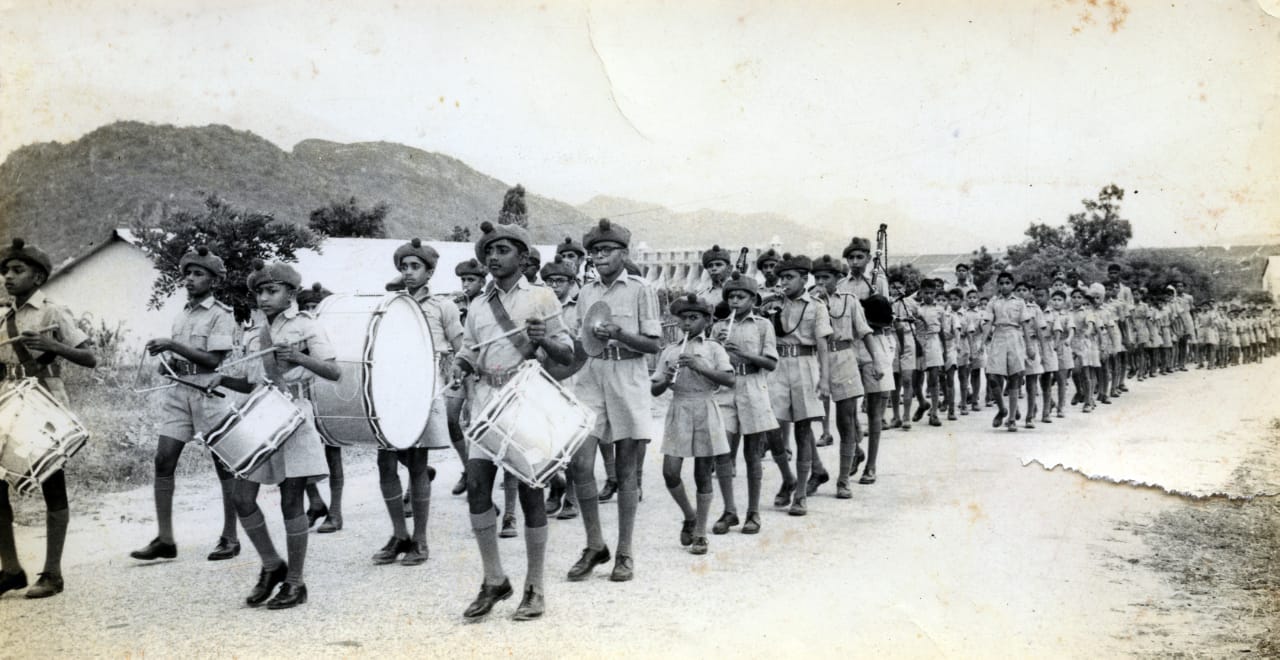
On the social media there was a post with a video of a school band performing during the interval of a basketball match. The caption said “When will we have such performances from our school bands in India”. It took my memories back to school days when we thought that music was not our cup of tea and joining the school band was a sheer waste of time as it did not provide any extra marks and did cut into one’s free time.  Mr Guddu Sahib, our Band Master tried his level best to teach me the notes of music, but they all looked to me like a few designs all coming to eat me up.  That was it, I gave up not to even look back at it.  Having realised my school folly as one grew up; it was too late to learn music at that belated stage.   Now the only option available was to ensure that our children learned music at their young age.

Why the school bands in India do not have such good standards and such good performances when compared to those in North America? The main reason could be attributed to our notion that it does not bring in marks. In North American schools, band or music is part of the curriculum and it brings marks with it.

As band/music is part of the North American school curriculum, the music teachers are graduates in music and some are post-graduates. Our son’s music teacher in Grade 10 was a post graduate in English and music and that year he taught Nikhil both the subjects. During a meeting with him I asked him as to how he got into the two.  He said music was his passion and English was his interest and hence studied both. In India, the band is trained by an ex-bandmaster from the Army or from the police and has no formal qualification in music. The qualification of music teachers back home leaves a lot desired, even though plenty of talent with graduate and post-graduate qualifications in music are available. Music does not form part of the School Board Exams and is limited to performances in Youth Festivals in most schools in India. The reality TV competitions have encouraged parents to impart music training to their children.

Unlike in North America, where the time spent for rehearsing and performing a band routine is counted towards community service hours required for graduation, in India no such advantages is accrued by the children. The most they get for a performance in India may be a T-shirt or a meal.

music

Music helps to bring out the best in young people. It nourishes self-esteem and keeps them engaged. Promoting music in schools provides students with interests that take up considerable time and energy outside the academic activities. Students become involved in extracurricular activities and by being busy with music-related activities helps to keep students away from getting involved in the kinds of negative activities that lead to serious problems, such as drugs and alcohol.

Musical training has a profound impact on other skills including speech and language, memory and attention, and even the ability to convey emotions vocally. Children who have had music lessons tend to have a larger vocabulary and better reading ability than those who haven’t had any musical training.

Music education helps in a child’s overall development intellectually, socially and emotionally. Music offers creative challenges and aesthetic appreciation as well as self-expression and self-discovery opportunities.   Music education fosters emotional maturity, as students learn to set and achieve personal goals. Time management, self-assessment, the ability to accept criticism and performance skills are all important attributes students learn through music education.

Music education plays a big part leading to personal development, such as self-discipline, dedication, teamwork, self-confidence and practice. All these values and the behaviours that demonstrate them are necessary to be a well-rounded person in all realms of life. Although these values are taught through other disciplines in various ways, the importance of learning them through music education in schools is that they translate into other disciplines so naturally. Students who enjoy music can easily transfer the habits learned to pursue their music to academic subjects.

Scientists have also discovered that learning to read music or play a musical instrument develops higher thinking skills. This means that children who learn music in schools are better problem-solvers and are better at analysis and overall critical thinking, because studying or playing music uses the same part of the brain that is used in mathematical thinking.  Music education can help promote better math students.

The importance of music in schools is that it fosters the kind of discipline that contributes to the development of personality traits and characteristics that bring one success in all of life’s endeavors. Music education helps develop overall intelligence, which translates to success in academic subjects in school. Music education also opens doors socially and culturally.  All these factors lead to success in life.