Garbage Disposal 

It was heartening to see the Japanese fans, after witnessing their team lose to Greece in the FIFA World Cup Match in Brazil on 19 June 2014, and also in Russia 2018, set an example of true sportsmanship by cleaning up the stadium of all the garbage left there.  This habit of correct disposal of garbage got to be nurtured at home – a habit that needs to be inculcated in all the citizens – irrespective of age.  In India, you keep your home clean, but throw the garbage in the street or in any vacant area and the cities do not have a garbage collection policy or methodology.

gbg

In Canada and USA, this habit begins at home (some exceptions –especially from the immigrants from the sub-continent), and is further firmed up at the school.  This is where the children are made aware of their responsibility to ensure a clean environment and also respect the mother nature.  The children are taught the correct procedures for sorting and disposing garbage.

Garbage collection in Canada is the municipal responsibility and is collected on a weekly basis.  The limits are laid down by the city.  In our city the limits per home are two bags (each not more than 20 kg) of general unsorted garbage, recyclables – unlimited (Blue Box), compostable (Green Box)- unlimited and yard waste (Brown Paper Bag) – unlimited, but collected on seasonal basis.  Only catch is that one got to segregate the garbage according to the above classes and put them in separate special bins provided by the city.  Do not worry, nothing comes free in North America (there is no “raddiwala” who will ever pay for your garbage). We pay a heavy house tax to the municipality for these services.  Any hazardous goods, or any heavy garbage is to be taken to the recycling centre and they charge you for accepting your garbage.

Studies in the City of Mississauga, where we live,  indicate that the average household generates 567 kg/year of waste, of which 34 percent is garbage, 13 percent is recyclable  and 45 percent is organics.

The general garbage is incinerated and the heat produced runs a steam turbine and electricity is generated.  Some cities use landfills too.  The recyclables are recycled and the compost is sold to the residents at a minimal cost, after due decomposition.

At every school, mall, park, bus shelter, restaurant etc, where ever garbage may be generated, you will always see garbage bins – with different buckets for waste and recyclables.  Anyone depositing garbage are expected to do so in the specific bins (here again people from the sub-continent are the culprits).

Only problem of applying the same in India is that the general garbage and the compostable will have to be picked up on a daily basis as the day temperatures are much higher when compared to Canada.  It may also put some raddiwalas out of business too.

Goodwill Stores.    Reducing the amount of waste we generate by reusing and recycling items instead of discarding them helps save natural resources, conserves energy and decreases the need for landfill.  Any household items that are gently used and in working condition, consider giving them a new home instead of throwing them in the garbage.  We drop off our reusable old clothes, books, toys, household appliances and furniture at a store run by the city or at the Recycling Centers.  They clean them and in case found fit for reuse, will sell them at a very cheap price to the needy – and the name of the store is “GOODWILL”.  When we landed in Canada we stayed in the basement apartment of a house and all our furniture came from the same “GOODWILL” store. It was a real GOODWILL.

The 5Rs Waste Hierarchy.

  • RETHINK – your waste and adopt environmentally-friendly practices!
  • REDUCE – the amount of waste you produce.
  • REUSE – materials repeatedly.
  • RECYCLE – materials through the Blue Box or Green Bin Programs or donate them to a Community Recycling Centre so that others can create new uses for them.
  • RECOVER – refers to generating energy-from-waste (e.g. through landfill gas-to-energy).

Organics Recycling.    Organic material includes such things as food waste and used tissues or paper towels.   Organics recycling diverts this material from landfill by converting it into a useful end product – compost.  In 2012 the city diverted almost 51 per cent of waste through the first 4Rs and recovered an additional 25 per cent by converting waste to energy.

About two-thirds of the solid waste collected in Mississauga is incinerated at the Algonquin Power Energy-from-Waste facility  – a 15 Acre complex located within the city limits.  A clean and efficient operation that not only gets rid of the waste but also generates 9 megaWatt of electricity, enough  to provide power for up to 6,000 homes. At temperatures in excess of 1,000ºC, most of the waste is vaporized but, just like burning wood in a fireplace.  There is always some ash created in the combustion process. Not too much of a problem for a wood burning stove but a considerable problem when you are incinerating 18,000 truckloads of waste a year.   The by-products include 40,000 ton bottom ash and 3,000 ton fly ash.  Bottom ash is a non-hazardous by-product of combustion, a glassy, sand like material of melted sand and lime, with smaller amounts of oxides.   It is disposed in the local landfill or used as an aggregate in hot mix asphalt or is blended with other aggregates, but is usually less durable than conventional aggregates.

The exhaust gas leaving the boilers is directed to two parallel air pollution trains which are designed to absorb 90 per cent of the acid gases by the injection of hydrate lime and to remove 99.9 per cent of all particulate using fabric filter bag houses.  Continuous emission monitors are utilized both for control and monitoring of the flue gases. These units are calibrated automatically each day and quarterly audits and annual relative accuracy tests are conducted.

Poor Banian or a Wife Beater

One day our teenaged son came up to me and asked me if he could borrow my ‘Wife Beater.’ I lost all my balance and composure and I told him that I neither ever had beaten their mother nor ever intend to do so. I stopped short of telling him that the idea did sprout in my mind a few times, but good senses always prevailed over my impulse. Our son understood my predicament and explained that he wanted the sleeveless white vest I used to wear while in India. Hardly seen anyone wearing it in Canada; could be something to do with the weather and reduced perspiration level.

Our son explained that in the TV show ‘COPS‘ had a lot do with the creation of this word. Every time they showed a guy getting arrested for beating his wife, he was shown wearing one of those sleeveless vests.

Some say that in 1947 in Detroit, Michigan, when police arrested a local man (James Hartford, Jr.) for beating his wife to death, the local news stations aired the arrest and elements of the case for months after, constantly showing a picture of Hartford, Jr, when he was arrested, wearing a vest and constantly referring to him as ‘the wife beater.

I always marveled the simple in design white sleeveless vest for all the services it rendered. It never even cared where it ended up after its owner threw it out after clinging to his skin and exploiting it to the hilt. They mostly ended up as a shoe-shining cloth, a mop, a duster, etc. Why should someone discard such good quality pure white cotton cloth?

I never understood why any more layers than absolutely necessary are worn in a hot climate, but I always felt that it absorbed the sweat. It absorbed the sweat, got wet, making me feel a bit uncomfortable at times, but it always stopped the passage of the sweat to the outer layer of the Olive Green (OG) Uniform. The white salt left on the shirt after the sweat dried up was rather un-soldierly. My skin never felt comfortable touching the thick clothed OG shirt. The poor banian maintained an impregnable gap between my skin and the thick shirt.

Some of my friends in the Army wore a banian with sleeves. I always preferred the sleeveless version to avoid ‘Sunday is longer than Monday‘ syndrome. This happens when you wear a short sleeved shirt or T shirt, under which you have worn a sleeved banian and the sleeve of the banian creeps out of the shirt sleeve.

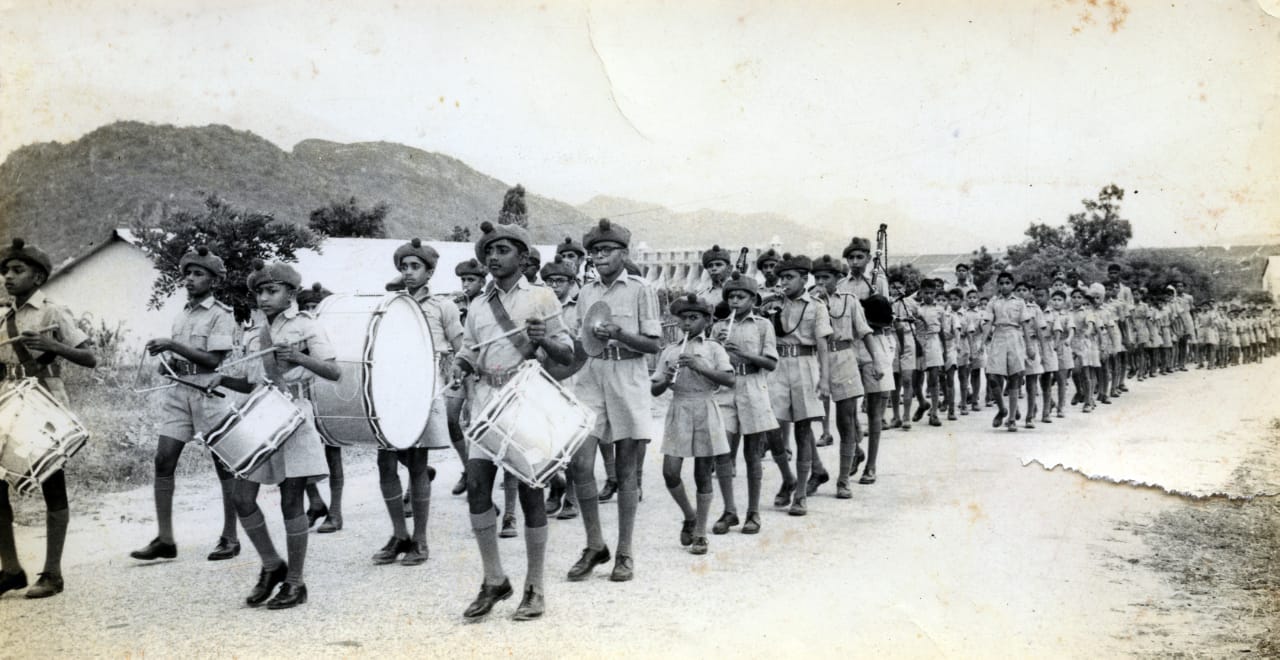
On joining Sainik School Amaravathinagar (TN) at the age of nine, my box had a dozen banians. We had to wear the banian for the morning Physical Training (PT). The aim was to observe the physical development of the body and to ensure that there were no skin infections. This practice of wearing the banian for PT continued on to the National Defence Academy (NDA) and the Indian Military Academy (IMA), till I was commissioned as an officer, after which I started wearing the white T-shirt as was the practice for all officers. The men still wore the faithful banian for PT. I still enjoyed the banian clinging to my skin and ensured that I had it on at all times.

My sahayak (helper) in the regiment was Sepoy Hukum Chand, who served me with at most dedication, love and care. He was my accountant, my personnel assistant, my bodyguard, my radio operator, my buddy in all aspects. He ensured everything for me – from when I got up, my morning tea, my cigarettes, my uniform, my room, my wardrobe, my outfit for the evening party etc. This continued for long seven years until seven year itch erupted – I got married and Hukum Chand refused to be dictated to as to what dress I wore for the evening party. My wife did not approve the suit Hukum Chand had chosen for me to wear that evening as it did not match her saree. My wife won and Hukum Chand lost.

Sepoy Hukum Chand had observed my keenness to wear the banian at all times and every six months he bought a dozen of them from the regimental canteen (he paid for it with my money as he was my accountant and I had no clue about the expenses). On enquiring as to why he bought new banians every six months, he told me that they become yellow on washing repeatedly in brackish water used by the washerman. He used to snip off the shoulder straps and cut open the trunk and it became a shining cloth for him to polish the leather boots and the belt and also the brass badges of rank. He said that the yellow shining-cloth available at the regimental canteen left yellow lint on the OG uniform and the black boots and looked awesome and he had to put in extra effort to clean-up after polishing. Used and many-time washed white banian was best suited for it and one did not have to pay to buy the shining-cloth – What a costly saving?  He had the thin cloth for the leather boots and belt and the thicker ones for the brass.

After five years of postings on staff and various long courses, I returned to the regiment at Sikkim as a Battery Commander. Sepoy Sri Chand was this time assigned as my Sahayak and Hukum Chand was by then promoted to the rank of a Havildar. A few days after I rejoined the unit, Havildar Hukum Chand came to my bunker while I was having my afternoon siesta and started admonishing Sepoy Sri Chand as he had not maintained the Saheb’s bunker as per standard. Hukum Chand started advising Sri Chand about my likes and dislikes, my preference of tea, food, clothes, cigarette, etc. At the end he said “Saheb likes wearing a banian at all times, even while he is sleeping.” That was the time I observed that I was sleeping in my favourite lungi-banian. He added that I preferred wearing the thick banian under the uniform and the thin ones under the civil dress. A preference I never had and may have been cultivated by Hukum Chand to ensure that he had a constant supply of thin and thick cloth for polishing the leather and the brass.

Many a times your preferences and habits are not self-developed, but thrust upon you by the environment.