
By Brig Azad Sameer (Retd)
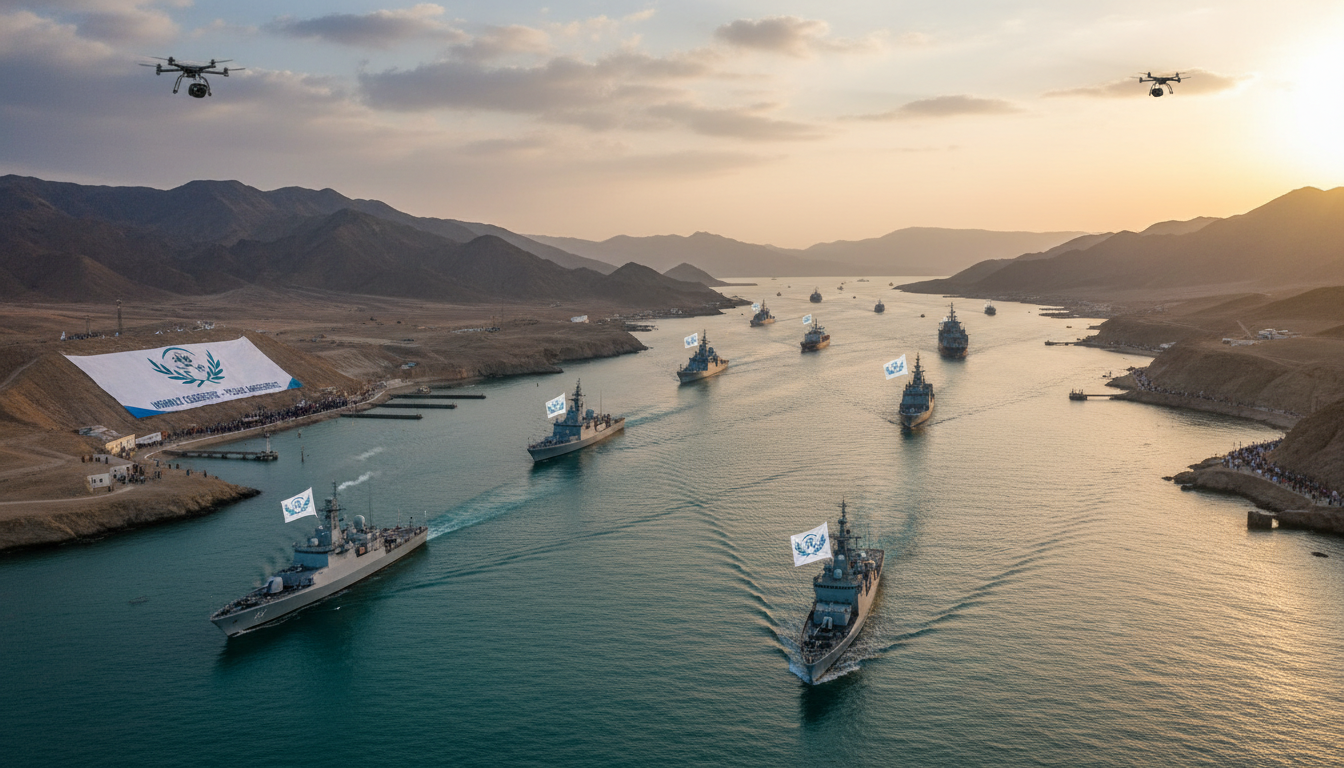
The chronicles of military history are awash with peace periods used not for de-escalation, but for the strategic repositioning of offensive assets that would be too vulnerable during active hostilities. As of 11 April 2026, the transit of U.S. guided-missile destroyers into the Persian Gulf under the mantle of a humanitarian mine-clearing mission appears to be a classic war college case of this maneuver. While the Islamabad talks superficially aim for a diplomatic exit to the conflict, the physical movement of the USS Frank E. Petersen Jr. and USS Michael Murphy into the heart of the Gulf suggests that the United States is not preparing for peace, but may well be instead maximizing it’s configuration for the failure of talks and more lethal phase of Operation Epic Fury.
A ceasefire, by definition, is a standstill agreement intended to freeze the tactical map to allow for negotiation. By moving high-value combatants through the Strait of Hormuz and into what Iran considers its territorial waters the U.S. has fundamentally altered the military status quo. If the introduction of front-line warships into a contested combat zone during a cessation of hostilities does not constitute a violation, the term ceasefire loses all functional meaning and will need to be redefined. It is a confrontational act of naval encroachment that weaponizes the diplomatic process to bypass the very A2/AD (Anti-Access/Area Denial) barriers that kept the U.S. fleet at bay during the height of the kinetic exchange.
The skepticism surrounding the mine-clearing narrative is justified. Heavy destroyers are not the tools of maritime sanitation; they are the tools of power projection. The reality is far more clinical: the U.S. is possibly shaping the battlefield. By establishing a permanent naval presence inside the Gulf now, they get rid of the bottleneck risk of the Strait of Hormuz for the future. These warships serve as the vanguard for a much larger logistical build-up. With the Iranian fast boat threat suppressed by the ceasefire terms and the coastal missile batteries momentarily silenced by diplomacy, the U.S. is free to conduct the hydrographic surveys and coastal reconnaissance necessary for terrestrial operations. It is also a high stake method of testing Iranian resolve.
The true objective likely lies in the preparation for full-scale amphibious operations. An invasion of the Iranian littoral requires more than just air superiority; it requires a sanitised Gulf where amphibious assault ships (LHAs) and transport docks (LPDs) can operate without the incessant threat of a closed door behind them. By this maneuver now, the U.S. is in essence pre-staging the heavy lifters. The current destroyers are the scouts ensuring that when the ceasefire inevitably collapses – or is deemed expired by Washington – the heavy iron of the Marine Expeditionary Units will already be in position to strike the Iranian mainland.
In conclusion, the U.S. naval movement is possibly a classic example of strategic opportunism. By taking cover under the ceasefire, the U.S. has achieved through a peaceful transit what may have been far more dangerous during active war. This is not the behavior of a nation seeking a durable exit; it is the behavior of a superpower positioning its pieces for a final, knockout blow on the terrestrial plane. Operation Epic Fury is not ending; it is possibly just reloading. What we cannot figure out now is whether the ceasefire is entirely an eyewash or some serious effort towards peace during which the pawns are being moved quite unfairly, to prepare for the contingency of failure of talks.
 REJINCES