
It’s Natural, Biological and Not the Stork

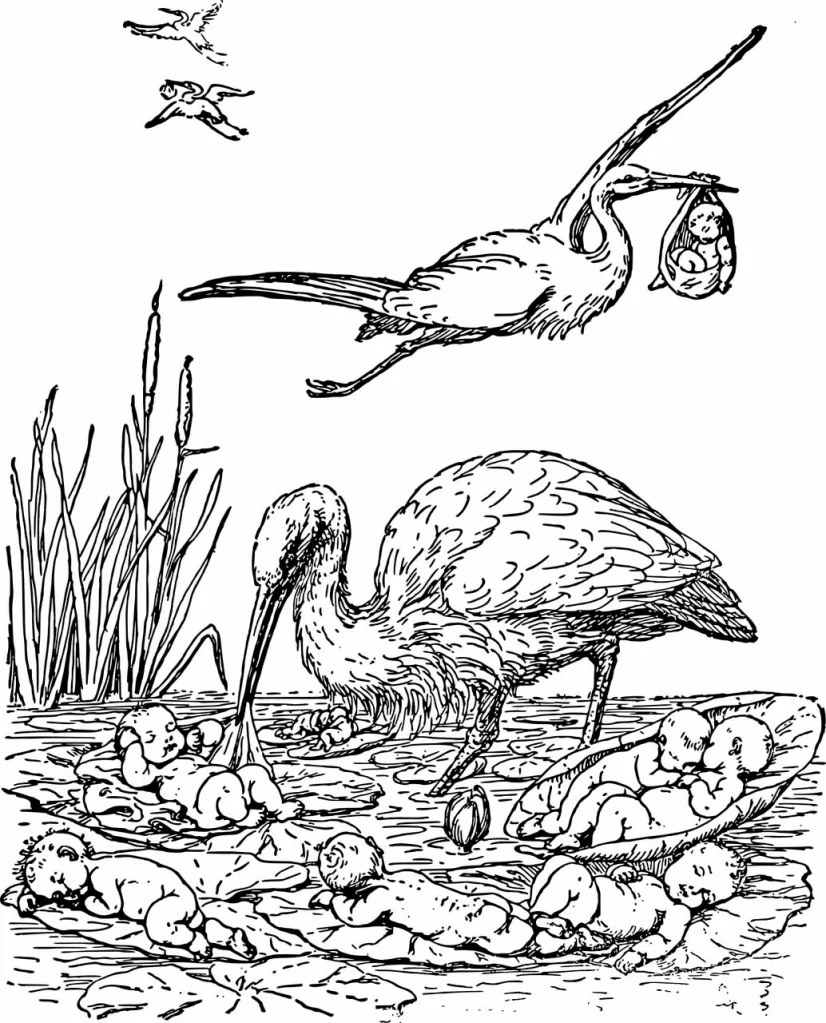
In the Netherlands, Germany and eastern Europe the myth is that the storks nesting on the roof of a household were believed to bring good luck — and the possibility of new birth — to the family living below.
Marina broke the news of her pregnancy to our daughter, “There is a little baby growing in my belly and we will have a baby in March.”

How did the baby get into your belly and how old is the baby now?” asked inquisitive five-year-old Nidhi.

The God placed the baby in my belly and is three months old,” replied Marina.

I did not see the God in our home, but Dad came home four months back from his military post in Sikkim.  Whatever it is, I want a sister and not a brother as boys are bullies,” said an innocent Nidhi.

How to break the news of a sibling’s arrival to a child?

Young children are not geared to handle a lot of information about conception and childbirth.  Hence, breaking such a news got to be straight and simple and be ready to answer the questions that may follow.  Never pre-empt the child with your explanations, wait for the child’s questions.  If the child is not asking any questions, then it is not n his/her mind.  If the child asks more questions, then by all means go into more detail.

A good method is to make your explanation into a story on the lines that Mom and Dad make a baby, the baby grows inside Mom’s belly, and the baby comes out when fully developed after ten months.  Always ask a few probing questions to determine your child’s level of understanding of pregnancy is all about.  This will help you to choose your words.  You can begin with the fusion of the sperm and an egg in the way fruit grows from a seed.  You can also explain as to how the child develops, its movements, how it feeds, how it sleeps, etc.  If your child is school going, you can ask a few questions to find out what they already know about where babies come from and then follow their lead.  Ensure that you use accurate anatomical language like womb or uterus instead of belly, etc.

Here comes the importance of using accurate anatomical terms for our body parts, especially the private parts.

Most of us grew up with funny sounding names for our private parts – tuckus, tush, peepee, peekki and so on.  Our parents do it for the sake of propriety and also, they wanted to save themselves from embarrassment.  Imagine a kid screaming in a busy shopping mall “My penis hurts!” or “My vagina is itching!!”

It is neither an embarrassment nor a stigma.  It becomes so only if you visualise it to be so.  The proper names for their genitals – penis, testicles, vagina, vulva are taught in Canada in Grade 1 as per the new sexual health education curriculum.  By giving alternative names for our private body parts, we are doing a lot of disservice to our kids.  It has to begin at home and our kids should not be surprised at school.  A study found that kids who easily understood to the terms were the ones who used the proper names for their body parts at home with their parents.

It helps children develop a healthy, more positive body image, instead of feeling that their genitals are something shameful or bad.  It also facilitates the children to understand their bodies better and will prompt them to ask questions about sexual development.  Teaching kids the proper terms for their body parts enhances their awareness of their body, positive body image, self-esteem and confidence.

Kids who are comfortable talking about their bodies are more likely to be able to disclose when something worrisome or uncomfortable is happening to them. They can explain confidently to the doctors about their problems like itching or pain in their private parts.  They can also inform their parents when someone touched them inappropriately. 

Child-sex predators are less likely to pick confident, informed kids who obviously talk openly with their parents about their bodies, and who are aware that other people touching their private parts must be stopped and any attempt reported to the parents immediately.

A study found that even though kids in pre-school learn the proper names for their body parts, only kids with parents who used the right terms caught on. So, do not leave this important task to the teachers. You can begin using proper terminology when changing diapers, bathing the child, or at any other time that the subject might come up.

Sex education must begin at home, and it has to be age appropriate.  You may seek the assistance of your pediatrician.  Many of us are uncomfortable with the use of anatomically correct terminology; hence it is important to practice before you talk with your kids.  If they sense that you are uncomfortable, it will never sink in.  Every question from your child about his or her body must be answered as appropriate to the child’s age, as accurately and honestly as possible. Never make it a big deal!!

For me, my first sex education teacher was my Amma and to read more about it, Please Click Here.

These are two well illustrated books I recommend for parents and grandparents.  The books will help you answer young children’s delightful, thoughtful, and often non-stop questions about their own bodies and about how girls’ and boys’ bodies are the same and are different questions that are seemingly simple, but often not easy to answer. 
My First Sex Education

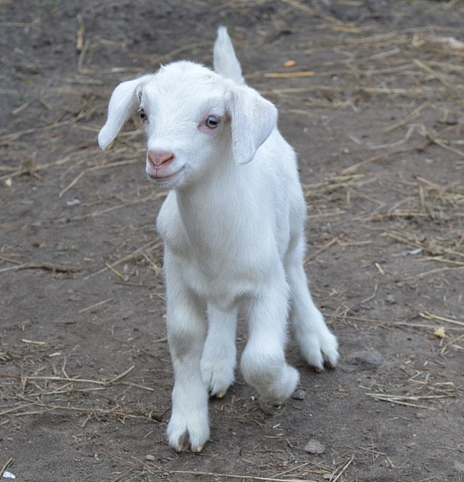
During our childhood my brother, the youngest in the family, then aged four, came up with an unusual request. He wanted someone younger to him. It was all because he was at the losing end of all the physical fights we siblings had.  At the time our parents solved the problem by getting him a kid, a goat’s kid, a female one.  That was how goat rearing commenced at our home.

In the evenings, after school, we used to take the goat out into our farmland for grazing.  We had to be on the lookout to ensure that the goat did not forage on the Tapioca (Kasava) cultivation, mainly to save the cultivation and also to save the goat from food poisoning. Little did I then know that the toxicity of the tapioca foliage was due to the presence Hydrogen Cyanide (HCN).    During the Monsoon rains, we had to cut the necessary forage from the trees which acted as support for the black pepper wines.

The kid grew real fast with all the attention and forage that we children heaped on her.  In a year she matured into a beautiful doe and was ready for a mate.  A Doe would come to heat by the end of summer and it lasts for two or three days and the cycle is repeated every three weeks.

In Kerala, the schools reopen after the summer vacations on 01 June but my Alma Mater, Sainik School Amravathinagar, reopens only by 15 June.  During my Grade 7 summer vacation, after the schools reopened for my brothers, our doe bleated one entire night.  In the morning Amma said that the doe is on heat and it is time to mate her.  That day our farm-hand did not turn up as he had pneumonia due to drenching in the monsoon showers the previous day.  I was the only one now free to take the doe for mating.

The village had a ചായക്കട (Chayakkada – teashop) run by Kuttappai.  The teashop is an integral part of urban and rural landscape of Kerala. The teashop served as the meeting place for all village elders and doubled up as a reading room.  All dailies and magazines published from Kottayam found their way there.  It also served as the village parliament‘. It was indeed a house of knowledge and doubled up as a cultural-political-social-entertainment institution, where anything and everything under the sun – from international relations to state and village politics; science to the Bible; communism to capitalism – were discussed.  Gossips too found their way in, as spicy as the narrator could make it.

Kuttappai reared a flock of goats housed in a thatched shed to the rear of the tea-shop.  He used the milk from the goats to make tea and obviously the village folk relished his special tea.  The flock was led by a majestic buck.  The buck also served as the village stud and Kuttappai charged Rs 10 for every mating.

At about 11 o’ clock, I walked our doe to Kuttappai’s tea shop, as per Amma’s advise because that was the time when the teashop would be empty of customers as people would have returned home after fiery debates and discussions.  Obviously, that was the only time Kuttappai would be free to facilitate the mating.

On reaching the teashop, Kuttappai instructed me to tie our doe closely on to a coconut tree adjacent to the goat shed.  The smell and sight of the doe in heat made the buck tied in the shed restless and his snorting and kicking increased, at times reaching a violent stage as if he would bring the entire shed down.

After 15 minutes, Kuttappai emerged from his tea-shop.  The buck was tied with a long rope and Kuttappai released him so as to make him reach the doe.  The buck went around the doe, smelled and licked her vulva and when he was about to mount her, Kuttappai pulled him back into the shed and tied him up.  That was a staged foreplay for the buck.

Now the buck had turned real violent as the frequency of his kicking multiplied and the volume of his snorts became louder.  After 10 minutes Kuttappai again released the buck and he came charging in and mounted the doe and the entire mating was completed in a few seconds.  Kuttappai now pulled the buck back into the shed and like a conqueror, the buck stood with his head high, but the tone of his snorts had changed as if to announce his accomplishment.

A doe generally gets into heat in the later part of summer and in Kerala it coincides with the onset of Monsoons (June to September).  There are certain indications the doe gives out when in heat.  Her vulva swells and become red, and she may have some vaginal discharge.    She tends to eat less and become restless because the hormones associated with fertility kick in.  A milk producing doe may decrease her milk production due to the hormonal changes.  Her frequency of tail-wagging suddenly increases and her bleats become longer, especially at night.

During the monsoons when the doe goes into heat, the buck goes into rut.  During rut the buck urinates into his mouth and on his chest, face, and beard, turning them yellow.  The scent glands near his horns become overactive.  These lead to an unbearable stink – in reality the stink is to attract a doe in heat towards him.  During rut a buck snorts, grunts and kicks its hind legs.  It tends to give a terrorising look with its upper lip curled up.

In the evening when Amma returned from school I dutifully reported to her the events of the day and posed some uncomfortable questions about the procedure and the need for it.  The School teacher in Amma responded with poise and she summarised the entire event as an act of depositing the sperm by the buck in the doe’s womb where it would fertilise an egg and would result in the formation of an embryo.  She also explained that the rooster and the hens also did the same and so did humans. Thus began my introduction to sex education.