
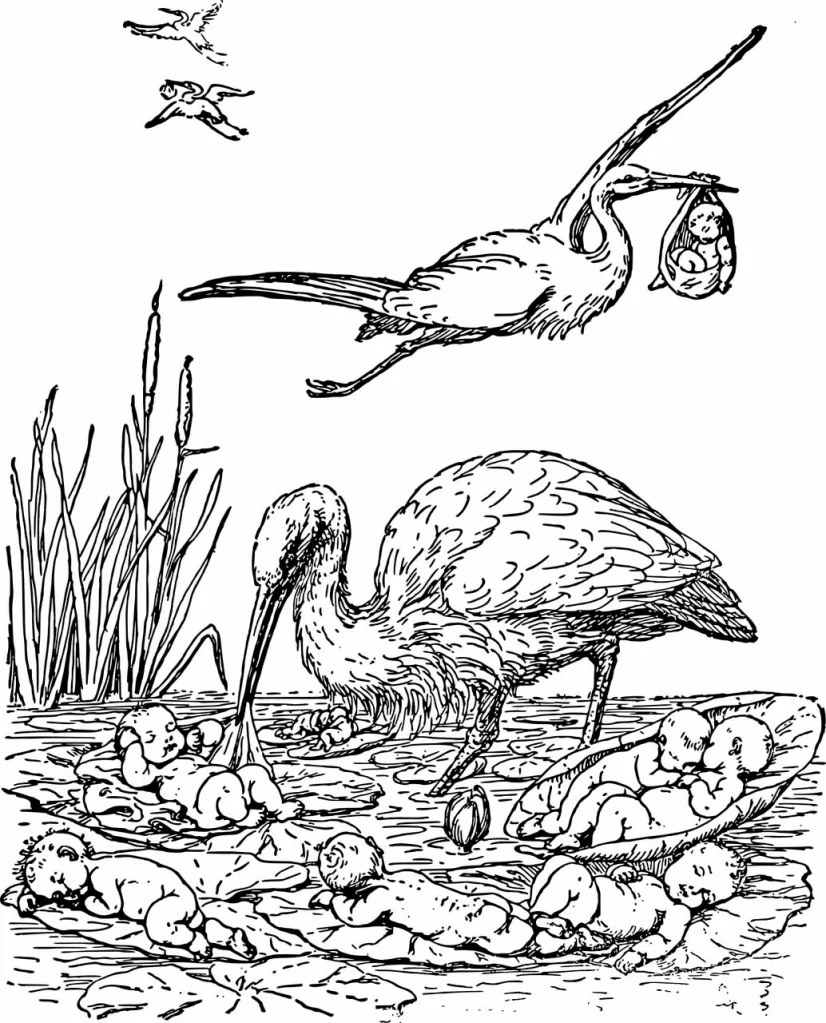
In the Netherlands, Germany, and parts of Eastern Europe, there is a charming myth: storks nesting on rooftops brings good luck – and the possibility of new birth – to the family living below.
When Marina broke the news of her pregnancy to our five-year-old daughter, Nidhi, she said, “There is a little baby growing in my belly. We will have a baby in March.“
Nidhi’s inquisitive mind immediately fired back: “How did the baby get into your belly? And how old is the baby now?“
“God placed the baby in my belly,” Marina replied. “It is three months old.”
Nidhi thought for a moment and said, “I didn’t see God in our home. But Dad came home four months ago from his military posting in Sikkim. Whatever it is, I want a sister – not a brother. Boys are bullies.“
How to Break the News of a Sibling’s Arrival
Young children are not equipped to process complex information about conception and childbirth. When breaking the news, keep it straightforward and simple. Be ready to answer questions – but do not pre-empt the child with long explanations. If they are not asking, it is not yet on their mind. Wait for their cues. If they ask for more detail, you can expand.
A good approach is to frame it as a story: Mom and Dad make a baby, the baby grows inside Mom’s womb, and after about nine months, the baby is ready to be born. Ask gentle probing questions to gauge your child’s understanding. This will help you choose the right words.
You can begin with the idea of seeds and growth – like a fruit growing from a seed – and explain how the baby develops, moves, feeds, and sleeps. If your child is school going, ask them what they already know and follow their lead. Always use accurate anatomical language – like womb or uterus instead of belly.
The Importance of Using Accurate Anatomical Terms
Most of us grew up with euphemisms for private parts – tuckus, tush, peepee, peekki, and so on. Parents often use these for propriety or to avoid embarrassment. But imagine a child screaming in a busy shopping mall, “My penis hurts!” or “My vagina is itching!” It is not an embarrassment; it becomes one only if we treat it as such.
In Canada, children are taught proper anatomical terms – penis, testicles, vagina, vulva—in Grade 1 as part of the sexual health education curriculum. By using alternative names, we do our children a disservice. This education must begin at home, so children are not surprised at school. Studies have shown that children who easily grasp these terms are those whose parents use the correct language at home.
Using proper terminology helps children develop a healthy, positive body image, rather than feeling that their genitals are shameful or bad. It also encourages them to understand their bodies better and ask questions about sexual development. It enhances body awareness, self-esteem, and confidence.
Children who are comfortable talking about their bodies are more likely to disclose if something worrisome or uncomfortable happens to them. They can confidently tell doctors about itching or pain in private areas. They can also inform their parents if someone touches them inappropriately.
Child-sex predators are less likely to target confident, informed children who clearly talk openly with their parents and are aware that inappropriate touching must be stopped and reported immediately.
A study found that even when pre-schoolers learn the proper names for their body parts at school, only those with parents who reinforced those terms at home truly internalised them. So, do not leave this important task to teachers alone. You can begin using proper terminology when changing diapers, bathing your child, or whenever the subject naturally arises.
Sex Education Starts at Home
Sex education must begin at home and be age appropriate. You can seek assistance from your paediatrician if needed. Many of us are uncomfortable using anatomically correct terminology—so practice before you talk to your children. If they sense your discomfort, the lesson will not land. Every question about their body should be answered as accurately, honestly, and age-appropriately as possible. Never make it a big deal.
For me, my first sex education teacher was my Amma.
Recommended Books
To help you navigate these beautiful but often surprising conversations, here are two highly recommended, well-illustrated guides:
- Amazing You! An Explanation of Birth and Babies by Dr. Gail Saltz: Perfect for younger children, using warm imagery and correct terms.
- It’s Not the Stork! by Robie H. Harris: A fantastic, trusted book that answers basic biology questions honestly and age-appropriately.
These are two well illustrated books I recommend for parents and grandparents. The books will help you answer young children’s delightful, thoughtful, and often non-stop questions about their own bodies and about how girls’ and boys’ bodies are the same and are different questions that are seemingly simple, but often not easy to answer.

