Regimental Fund

On taking over command of our Regiment in June 2002, we were deployed in our operational area in Rajasthan, ready to be launched into battle any time.  The mercury tipped many days over 40°C and the Regiment had been there since the dawn of the New Year.
The entire Regiment was living in tents with the Commanding Officer (CO) provided with a much more spacious and larger tent.  The other luxury the CO enjoyed was a desert cooler in the tent and the Second-in-Command (2IC) too had this luxury.  A 5kW generator meant for the workshop powered the lights, fans and desert coolers from 9 AM to 2 PM and then from 7 PM to 10 PM.

My first day in command was spent on familiarisation of the Regiment and the area around.  It ended with my first command order.  Please click here to read https://rejinces.net/2016/04/01/first-comd-order/.

That was when I realised that the dreams and plans I had in mind to be executed on taking over command had to be kept in abeyance as there weren’t adequate funds.  The only money at my disposal was Rs 200000 from a fixed deposit that had matured.  That wasn’t my money and if I used it, I had to make it up.

After working out the power requirement, it was decided to procure three 15kW generators and fifty desert coolers to equip every tent in the Regiment.  Two Young Officers with a team of soldiers were deputed to purchase the same from Jodhpur, the nearest town.  From that evening we had a well lit and well cooled township.  My only worry was that I had spent most of the Regimental Fund.

That evening at the Officers’ Mess, I gave out my command policy.  Anything that does not have a utility value to the Regiment in our operational area or for the families of our officers and soldiers at our permanent location must be disposed offAll funds, Regimental and others must be utilised towards the war efforts.

All Officers and soldiers were asked to propose anything they needed and I found they were too contented with what I gave them the very first day and wanted no more.

We procured two desktop computers to support my automation endeavours. Now I had to conserve all that was left with our Regimental Fund.  The first step was to reduce stationary usage by automation and we succeeded to a great extent.

In November we were ordered to return to our permanent location at Devlali. I ordered that only one of the three generators to be carried along and the rest two and all fifty coolers to be sold off at 60% of their cost with the first priority for our soldiers.  The coolers and generators were of no use to the Regiment at Devlali and would have turned into junk later.  Our soldiers from Rajasthan picked up the entire lot and I recouped half the Regimental Fund I had spent.

The first project we executed was a washroom cleaning device based on the mobile cleaning unit employed by the Indian Railways to clean the toilets of the trains on the platform.  Our soldiers designed and built it.  Now every soldier could carry out janitorial duties and the Safaiwalas (Janitors) were available to accompany radar detachments, survey teams and also operate radio sets.  They turned up smartly in their combat uniforms every morning walking with a swag with the radio set on their back and the operators pad in their hand.

Most of my time in the Regiment was spent at the Computer Cell.  Whenever needed, I relieved at the soldiers’ washroom rather than using the washroom at my office. This ensured that all soldiers kept their washrooms spic and span.

Two weeks after landing at Devlali, Major General RS Jambusarwalla, our Divisional Commander visited us.  I received him at the Regiment and he walked to the rear end of his car and ordered his driver to open the boot.  There it was – a computer, a printer and a multimedia projector.  That was the only time in my military career a visit by a senior officer began with a gift to the Regiment.

Two weeks later was the inspection by Lieutenant General GS Sihota, PVSM, AVSM, VrC, VM,   the Army Commander, Southern Command and his proposal for other units to procure the software we had developed for Rs 10000 was a great boon.  Now I had all the money at my disposal to implement all my ‘wild ideas.’

We were a SATA Battery being converted to a SATA Regiment.  We did not have a JCOs’ Club, an important Regimental institution.  Fighting many a battle with the Station Headquarters, we managed to get a near dilapidated building allotted as our JCOs’ Club. I summoned our SM and tasked him to get the building done up, procure furniture, crockery, cutlery, etc.  I gave him a month’s time for executing the task with my final advice “It’s got to be better than our Officers’ Mess.”  After a month our SM invited all officers for a cocktail at the JCOs’ Club for inauguration.  The above image is the testimony to that day.

The next project was to create a high-end barber shop.  Please read https://rejinces.net/2016/04/29/acgo/.

Our soldiers came up with a request for a multi-gym.  SM Thangaswamy was tasked to execute the project with the assistance of other JCOs.  They suggested procuring the equipment  from Ambala as it would a cheaper option.  I advised them to procure it locally from Nashik to ensure installation and warranty services.

Two weeks later SM Thnagswamy asked me about my availability to inaugurate the gym.  I asked him to inaugurate immediately and make it available to our soldiers.

We automated our kitchen with flour kneader, freezers and coolers for storage of milk, meat and vegetables.  We were allotted a ‘Steam Jacketed Cooking System’ for the soldiers’ kitchen procured from special funds under the Army Commander’s Special Financial Power. I did not want it to turn into an elephant’s teeth for show alone.  How we extracted its full value, please read https://rejinces.net/2019/03/31/elephantteeth/.

I was lucky that I had a great lot of officers and soldiers who accepted me, supported my ideas and worked wholeheartedly to ensure fulfilment of all my dreams.  I must sincerely thank all Officers, JCOs, NCOs and soldiers and a special high-five for our Subedar Major (SM) Thangaswamy who kept me in high spirits with his sense of humour.


Did I realise all the dreams I came with to command?  It’s an emphatic Yes and much more; all because of a great Regiment that I was lucky to command.
The Razor’s Edge: A Military Tradition of Shaving and Self-Discipline

The First Task of the Day

In 2014, Admiral William H. McRaven, the retired United States Navy Admiral who served as the ninth commander of the US Special Operations Command, delivered the commencement address at the University of Texas at Austin. His words that day resonated far beyond the graduating class: “If you make your bed every morning, you will have accomplished the first task of the day.

For cadets at Sainik School, where I spent my formative years from nine to sixteen, the ‘making the bed’ ritual was precisely that – the first accomplishment of each morning. At the National Defence Academy (NDA), however, the first task evolved. Morning shave became the ritual that set the tone for the day ahead.

During early school years, facial hair was not a concern. Shaving was a weekly ritual accompanying the barber’s haircut. At NDA, shaving became mandatory for all cadets – a discipline that would continue through over two decades of service in the Indian Army.

A Winter Morning Lesson

One winter morning in the eighties, I was a young Lieutenant serving as Senior Subaltern of the Regiment. Word arrived that an important political leader had passed away, and the day was declared a holiday. I had already shaved and was changing into my PT whites. Stepping out of my room, I found all the other Lieutenants similarly dressed and ready for physical training.

We have already shaved and put on our PT dress,” I said. “Let us go for a run. Once you have shaved early morning, holiday or not, it makes no difference.”

That morning run became more than exercise. It was a lesson in discipline that transcended circumstance – a reminder that self-respect and routine should not be dictated by calendar or convenience.

The Foundation of Soldierly Pride

In the Army, a uniformed service, discipline is judged partly by how a soldier wears prescribed dress, and partly by personal appearance. A well-groomed appearance is fundamental to military life, contributing to pride and esprit-de-corps. Every soldier must be self-disciplined and proud of belonging to a noble profession.

Commanders bear primary responsibility for ensuring that soldiers under their command present a smart, soldierly appearance – at all times, in or out of uniform, on or off duty. A properly shaved soldier, sporting a mustache if preferred, embodies that soldierly bearing.

The Origins of the Clean-Shaven Face

The tradition of clean-shaven soldiers traces back to Alexander the Great. Legend holds that he ordered his troops to shave so that enemy combatants could not grab them by their beards and throw them to the ground.

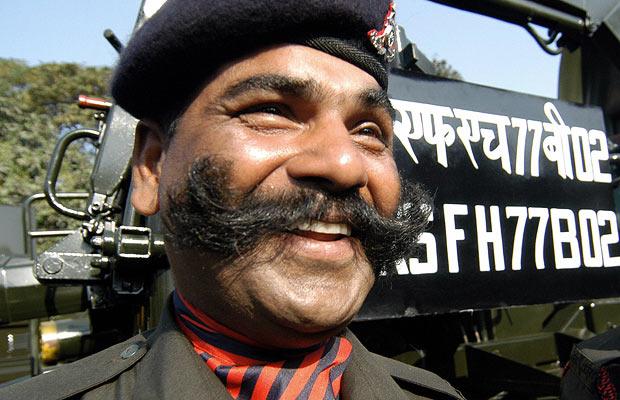
In the Indian Army today, soldiers are expected to be clean-shaven, with Sikhs as the exception, permitted to grow their beards as part of their religious practice. Mustaches, if worn, must remain above the upper lip.

Sir Douglas Haig with his army commanders and their chiefs of staff – World War I – (Image Courtesy Wikimedia)

British Military Tradition

Many of the Indian Army’s traditions and regulations derive from the British Army, whose orders regarding shaving date back to the eighteenth century. Until that time, British soldiers were clean-shaven and did not wear mustaches. Soldiers of the Hussar Cavalry Regiments adopted mustaches specifically to intimidate their enemies. The trend spread across the British Army, with the mustache serving as a distinguishing mark separating soldier from civilian.

Influence from Indian royalty and the Indian belief that mustaches signified manliness may also have played a role. By the late eighteenth century, mustaches had gained popularity among British civilians, as did sideburns.

The Great Mustache Revolt

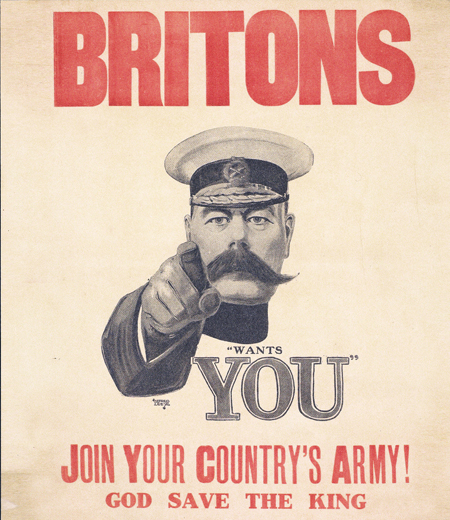
The iconic World War I poster featuring Lord Kitchener – sporting a formidable handlebar mustache – urging citizens to join the army remains an enduring image from that era

During World War I, Commonwealth soldiers found mustaches cumbersome to maintain while fighting trench warfare. Many soldiers and officers preferred to shave them off, leading to what amounted to a quiet revolt. Some soldiers faced court-martial for failing to comply with the mustache order.

In 1913, General Nevil Macready investigated the matter and submitted a report recommending that mustache orders be withdrawn. No action was taken. In 1915, King George reinforced the necessity of mustaches for soldiers. Macready resubmitted his recommendations in 1916, and on 8 October of that year, an order was finally passed abolishing the mandatory mustache requirement.

Debunking the Myth

It is a common myth that hair grows thicker and darker after shaving. Forensic anthropologist Mildred Trotter debunked this belief in 1928. She asked three college students to shave their legs, from ankle to knee, twice weekly for eight months. Using a microscope, she compared each student’s hair growth rate, colour, and thickness. Her conclusion: shaving had no impact on hair’s texture or growth.

Shaving Beyond the Military

Wrestlers are predominantly clean-shaven – Olympic rules require either a full beard or a clean-shaven face, as stubble can irritate an opponent’s skin. Swimmers often remove all body hair, believing that even minimal resistance can affect performance.

Among married Amish men, beards are worn with trimmed mustaches, substituting for wedding rings.

A Curious Footnote

For reasons still unclear, Parliament once dismissed the personal barber of Charles I of England. Famously slow to trust others, King Charles never shaved again – fearing that a new barber might attempt to kill him. History offers no evidence for the suspicion, but the king’s caution speaks to the intimate trust placed in those who hold a razor to one’s throat.

Conclusion

From Alexander’s battlefield strategy to trench warfare’s practical demands, from regimental discipline to personal pride, shaving has remained a constant thread in the fabric of military life. The morning ritual that began each day with a clean face taught lessons that extended far beyond grooming: self-discipline, attention to detail, and respect for oneself and one’s uniform. Admiral McRaven’s first task of the day may have been making the bed, but for generations of soldiers, the razor’s edge has served the same purpose – a small accomplishment that sets the stage for all that follows.

The Elusive Diamonds

IdliVada
Our Regiment was equipped with the Russian made 130 mm M46 Guns when I was commissioned to the Regiment in 1982.  130 mm Gun was manufactured in erstwhile Soviet Union in 1950 and entered service with the Indian Army in 1965.  The gun boasts of having achieved longest range of 27.5 km with conventional munitions.  It traces its origin back to its predecessors used in ships and coastal defence by Russians during World War II.  The gun was in the equipment list of many countries and some even produced their variants.  The gun saw action during many conflicts across the globe – from Vietnam War to the recent civil war in Syria and Iraq. 

To be fair to the Russians, it must be said that indeed the gun was good and extensively used in the 1965 and 1971 Indo-Pak Wars. The problem however was with the accessories that came with the gun. When Indian Army procured the 130 mm Guns, a plethora of accessories were supplied by the Russians.  Most appeared to be tried, tested and failed – hence the Russians wanted to somehow palm them off to others.  India must have paid a hefty sum for these accessories.  Most of them found their due place in the technical stores of the regiments, and hardly ever used

The biggest of them was the PPL Periscope – the wooden box for storage of the periscope looked more like a coffin.  The periscope must have had its origin from the gun being used as a Naval Gun.  Thankfully, no one in the regiment appeared to have even unpacked them or set them up for training or operations.  No Observation Officer would have bothered to carry it to war as it needed at least six men to lift.   On a ship, the carriage problem would not have been there and a need for a high periscope to observe the horizon was the requirement for any Observation Officer deployed on a ship in the high-seas.

The next biggest was the Range Finder DS1.  From its looks and make, it also appeared to have its origin from the days of the gun being used in its naval version.  It seems that someone in the Indian Artillery hierarchy of the 60s took a liking for this cumbersome piece that a chapter for observing and engaging targets with this monster was incorporated in the Gunnery Technical Hand Book (fortunately it has been removed  from the recent editions).

The technique of employment was that the observation post officer measured the distance to the spot where a round fell and ordered the required correction in terms of ‘ Left/Right or Add/Drop’, having already made a similar measurement to the target, to make the round hit the target.  

For measuring the distance with the DS1, one needs to manipulate a knob and make five ‘diamonds’ that appeared on the viewfinder so as to position the center one on the object to which distance is to be measured  and two each equidistant in front and behind it. This needed a high degree of practice and skill.

Whenever I tried to operate the DS1, I could either see the object or the diamonds and never both, however hard I tried.  I requested our Technical Section Commander – Subedar Bidappa – for help and he excused himself from the task owing to his poor vision.  He suggested Havildar (Sergeant) Nahar Singh of the Survey Section as he had undergone a four-week long course at School of Artillery in operating the Range Finder.  Havildar Nahar Singh agreed to transfer some of his skills and the art of manipulating the diamonds. 

On the set day, I got the Range Finder set up at the training area next to the Survey Section and Havildar Nahar Singh commenced his lessons.  We got struck at the stage where the elusive diamonds are to be manipulated –  as usual  I could either see the diamonds or the object and not both.  Havildar Nahar Singh demonstrated his skill with the range Finder and measured distances to many objects around the training area.  He read out the distances nearest to a meter and to verify it, he read the distance to a telephone pole to be 376 meters and asked me to pace it.  Great! it was indeed about 375 meters.

I felt very small about my inability and kept trying to catch the elusive diamonds.  Now came a warning from Havildar Nahar Singh – in case one operates the DS1 for a long period, one’s eyesight will deteriorate.  He padded his comment with a line that soldiers operating the DS1 in the earlier days were authorised an extra egg in their rations to compensate for the struggle their eyes went through.

 Never to accept a failure in front of the soldiers, I tried with all my efforts to catch the elusive diamonds for the next two hours despite Havildar Nahar Singh’s warning.  Seeing my resolve Havildar Nahar Singh must have felt bad and he came to me and requested me to pack up the DS1.  He now gave me his piece of wisdom.

He said that he too had never seen the elusive diamonds ever in his life.  How the hell on earth did he measure the distances to various objects so accurately?  He disclosed the secret that in the training area he knew the distance to all the visible objects as he had been conducting training for his section there.  Whenever he measured the range to an object, he would focus the Range Finder on the object and set the distance on the scale. 

How did he manage it during the training at the School of Artillery?  There too all the students carried a small notebook with the accurate distances to various objects from various training areas.  He claimed that hardly any student ever caught the glimpse of the elusive diamonds.

Guruji and Bhagawan (God) Shoot follows.