
By Brig Azad Sameer (Retd)
To understand strategic paradox of Operation Epic Fury, we can juxtapose the empirical data of Iran’s physical devastation into the broader narrative of its psychological and political survival. Who lost or won and whether the conflict achieved anything more than mindless devastation is a million dollar question. The history of modern warfare is littered with victors who mastered the battlefield only to find themselves paralyzed by the peace that followed. As of now Operation Epic Fury stands as the ultimate testament to this phenomenon. While the United States has functionally dismantled Iran’s conventional military capacity, the stalled diplomacy in Islamabad suggests that military obliteration has failed to translate into strategic submission.
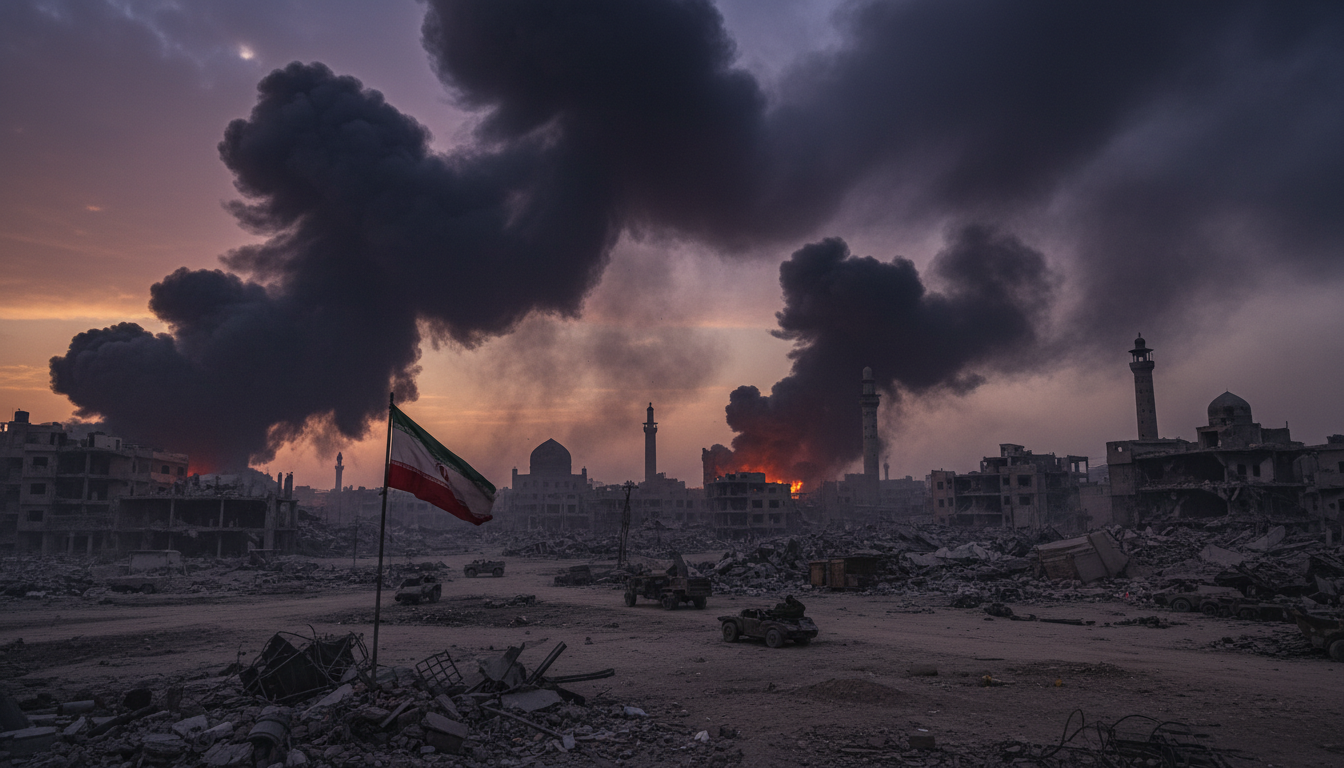
The scale of the beating endured by the Islamic Republic is historically unprecedented for a 38-day campaign. According to IHS Jane’s Defense and satellite analysis from the International Institute for Strategic Studies (IISS), the kinetic degradation of Iran’s sovereignty is almost total. Neutral observers estimate that 90% of the Iranian regular Navy and approximately 55% of the IRGC’s fast-attack fleet now rest at the bottom of the Persian Gulf. Iran’s Integrated Air Defense System (IADS), once a formidable layered shield of S-300 and Khordad-15 batteries, has been degraded by over 80%, leaving the nation’s skies effectively under the management of Allied air power.
Furthermore, the bleeding extends deep into the industrial heart of the regime. Combined data from European intelligence agencies and neutral maritime monitors suggest that 85% of Iran’s defense industrial base—specifically the facilities responsible for the Shahed drone series and the Fateh ballistic missile families—has been reduced to rubble. With over 2,000 command-and-control nodes neutralized, the Iranian military is currently a headless giant, possessing the mass of a nation but the coordination of a ghost.
Yet, despite being bombed back to a pre-industrial state, the Great Wall of the Iranian state remains standing. Like a heavyweight boxer who has lost every round and is bleeding from every pore, Tehran refuses to throw in the towel. This defiance is not born of military strength, but of a calculated asymmetric resilience. By mining the Strait of Hormuz and retreating into a deep state of guerrilla governance, the regime has ensured that the U.S. cannot claim a total victory. The very fact that U.S. Vice President J.D. Vance found himself at a negotiating table in Islamabad—rather than accepting a formal surrender—proves that Iran has achieved at least a defensive draw. Many analysts continue to argue that the much talked about US rescue operation was indeed a delightful smokescreen for a strategic operation aimed at seizing the enriched uranium located at the Isfahan facility. The fact that this operation failed implies that not all the operational objectives of the US have been achieved. Before the Operation commenced the Strait of Hormuz was well and truly open. For over six weeks now the maritime traffic through the strait is just a trickle, causing severe economic migraine to the global community. These two facets further reinforces the defensive draw evaluation.
In this light, the net effect of Operation Epic Fury is a stalemate of extremes. The U.S. has achieved most of its kinetic objectives: the missile factories are dust and the nuclear infrastructure is severely compromised. However, the political objective—a fundamental change in the regime’s behavior or its collapse—remains elusive. Iran has traded its physical infrastructure for a hardened, singular narrative of survival. As U.S. destroyers now are in the close vicinity of the treacherous, mine-laden waters of the Gulf, they do so not as conquerors, but as co-custodians of a fragile ceasefire. Iran may be broken, but as long as it refuses to concede, it has not truly lost. The hurricane has passed, the wall is scarred and crumbling, but it has not yet fallen.
 REJINCES
My POV, The US is scared shit. Their last untouched bastion is its Navy. Soldiers and aircrafts have been bloodied over the years but the Navy barring odd sabotage attacks of past has remain unscathed. They can’t afford a bloody nose there as that would be cornerstone being loosened. That’s why they are being kept at arms length. The bluster GO GET YOUR OWN OIL, is akin to having other nations with a very small Navy to go and throw themselves to the wolves. I would say that it is the Giant that has been badly wounded in spite of all its prowess. Exterior lines of communication is one factor and second is underestimating the enemy. Of course losing sight of your own vulnerabilities in GCC which has beautiful tgts spread out along the show window like chinaware has given a leverage to the oppostion. So all the huff and the puff has not blown the house in. Not to forget the GCC itself is prodding the Giant to complete full pulverisation of the enemy lest it gets away to cast a shadow of blight over all of them in times to come. The last one I am very skeptical of. Co-existence is a word that does not exist in the world of Abrahamic religions. History bears it out.
LikeLiked by 2 people
Thank you for your very meaningful views.
LikeLiked by 1 person