Regimental Fund

On taking over command of our Regiment in June 2002, we were deployed in our operational area in Rajasthan, ready to be launched into battle any time.  The mercury tipped many days over 40°C and the Regiment had been there since the dawn of the New Year.
The entire Regiment was living in tents with the Commanding Officer (CO) provided with a much more spacious and larger tent.  The other luxury the CO enjoyed was a desert cooler in the tent and the Second-in-Command (2IC) too had this luxury.  A 5kW generator meant for the workshop powered the lights, fans and desert coolers from 9 AM to 2 PM and then from 7 PM to 10 PM.

My first day in command was spent on familiarisation of the Regiment and the area around.  It ended with my first command order.  Please click here to read https://rejinces.net/2016/04/01/first-comd-order/.

That was when I realised that the dreams and plans I had in mind to be executed on taking over command had to be kept in abeyance as there weren’t adequate funds.  The only money at my disposal was Rs 200000 from a fixed deposit that had matured.  That wasn’t my money and if I used it, I had to make it up.

After working out the power requirement, it was decided to procure three 15kW generators and fifty desert coolers to equip every tent in the Regiment.  Two Young Officers with a team of soldiers were deputed to purchase the same from Jodhpur, the nearest town.  From that evening we had a well lit and well cooled township.  My only worry was that I had spent most of the Regimental Fund.

That evening at the Officers’ Mess, I gave out my command policy.  Anything that does not have a utility value to the Regiment in our operational area or for the families of our officers and soldiers at our permanent location must be disposed offAll funds, Regimental and others must be utilised towards the war efforts.

All Officers and soldiers were asked to propose anything they needed and I found they were too contented with what I gave them the very first day and wanted no more.

We procured two desktop computers to support my automation endeavours. Now I had to conserve all that was left with our Regimental Fund.  The first step was to reduce stationary usage by automation and we succeeded to a great extent.

In November we were ordered to return to our permanent location at Devlali. I ordered that only one of the three generators to be carried along and the rest two and all fifty coolers to be sold off at 60% of their cost with the first priority for our soldiers.  The coolers and generators were of no use to the Regiment at Devlali and would have turned into junk later.  Our soldiers from Rajasthan picked up the entire lot and I recouped half the Regimental Fund I had spent.

The first project we executed was a washroom cleaning device based on the mobile cleaning unit employed by the Indian Railways to clean the toilets of the trains on the platform.  Our soldiers designed and built it.  Now every soldier could carry out janitorial duties and the Safaiwalas (Janitors) were available to accompany radar detachments, survey teams and also operate radio sets.  They turned up smartly in their combat uniforms every morning walking with a swag with the radio set on their back and the operators pad in their hand.

Most of my time in the Regiment was spent at the Computer Cell.  Whenever needed, I relieved at the soldiers’ washroom rather than using the washroom at my office. This ensured that all soldiers kept their washrooms spic and span.

Two weeks after landing at Devlali, Major General RS Jambusarwalla, our Divisional Commander visited us.  I received him at the Regiment and he walked to the rear end of his car and ordered his driver to open the boot.  There it was – a computer, a printer and a multimedia projector.  That was the only time in my military career a visit by a senior officer began with a gift to the Regiment.

Two weeks later was the inspection by Lieutenant General GS Sihota, PVSM, AVSM, VrC, VM,   the Army Commander, Southern Command and his proposal for other units to procure the software we had developed for Rs 10000 was a great boon.  Now I had all the money at my disposal to implement all my ‘wild ideas.’

We were a SATA Battery being converted to a SATA Regiment.  We did not have a JCOs’ Club, an important Regimental institution.  Fighting many a battle with the Station Headquarters, we managed to get a near dilapidated building allotted as our JCOs’ Club. I summoned our SM and tasked him to get the building done up, procure furniture, crockery, cutlery, etc.  I gave him a month’s time for executing the task with my final advice “It’s got to be better than our Officers’ Mess.”  After a month our SM invited all officers for a cocktail at the JCOs’ Club for inauguration.  The above image is the testimony to that day.

The next project was to create a high-end barber shop.  Please read https://rejinces.net/2016/04/29/acgo/.

Our soldiers came up with a request for a multi-gym.  SM Thangaswamy was tasked to execute the project with the assistance of other JCOs.  They suggested procuring the equipment  from Ambala as it would a cheaper option.  I advised them to procure it locally from Nashik to ensure installation and warranty services.

Two weeks later SM Thnagswamy asked me about my availability to inaugurate the gym.  I asked him to inaugurate immediately and make it available to our soldiers.

We automated our kitchen with flour kneader, freezers and coolers for storage of milk, meat and vegetables.  We were allotted a ‘Steam Jacketed Cooking System’ for the soldiers’ kitchen procured from special funds under the Army Commander’s Special Financial Power. I did not want it to turn into an elephant’s teeth for show alone.  How we extracted its full value, please read https://rejinces.net/2019/03/31/elephantteeth/.

I was lucky that I had a great lot of officers and soldiers who accepted me, supported my ideas and worked wholeheartedly to ensure fulfilment of all my dreams.  I must sincerely thank all Officers, JCOs, NCOs and soldiers and a special high-five for our Subedar Major (SM) Thangaswamy who kept me in high spirits with his sense of humour.


Did I realise all the dreams I came with to command?  It’s an emphatic Yes and much more; all because of a great Regiment that I was lucky to command.

Military Special Trains

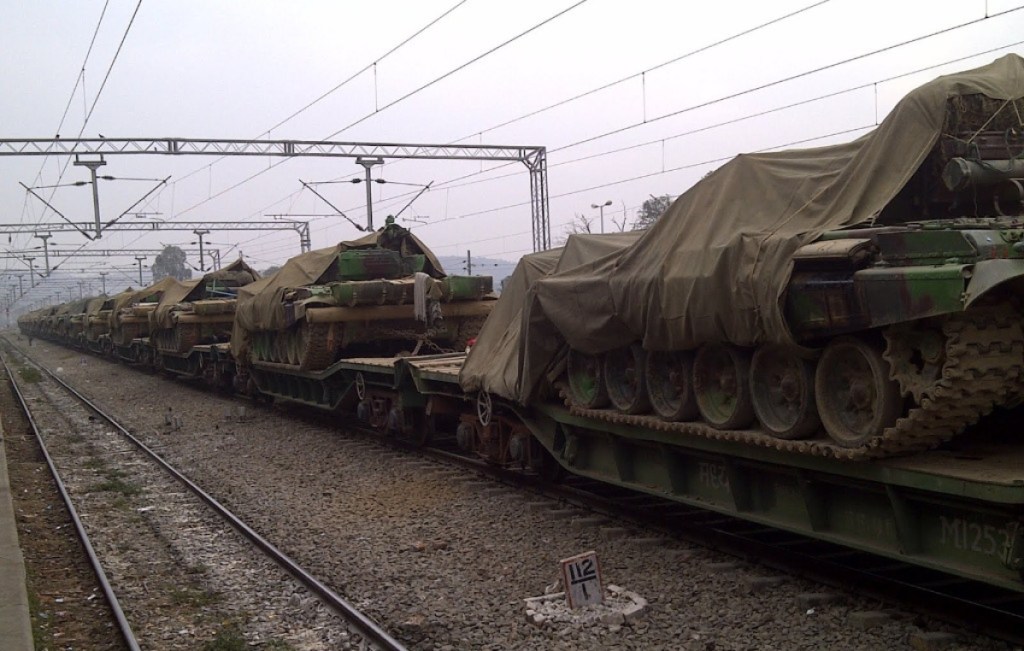
The story of my romance with the Indian Railways is never complete without the story of the military special. Indian Railways and the military have a close and intimate bonding. The military refer to the special coaches as ‘rolling stock’ and the engine simply as ‘power’.  The Military has its own ‘Movement Control Organisation’ (MCO) with its personnel closely integrated with the railways and located at important railway stations/ headquarters.

This special relationship goes back to the very formation of Indian Railways. One of the main reasons for establishing the railway network was to provide an effective and trustworthy method of transporting large number of troops from one part of the country to another. The colonial masters found this as an imperative requirement, which enabled the government of the day to maintain control over the vast lands it governed.

Indian Railways run these Military Special trains all the time. These trains move both in peace and in times war. Some of these trains are freighters only, while others have accommodation for personnel as well. Some military specials carry armed forces personnel for aid to civil authorities, such as earthquake or flood-relief work. Some Military Special trains have rakes formed totally by special ‘Military’ coaches in their own distinctive greens while others have rakes formed by ‘normal’ Indian Railway coaches. Some movements get decided suddenly (such as due to natural or man-made disasters), while other movements are planned well in advance – as per the strategic relocations of operational units of Indian armed forces. The mobilisation plan of military units and formations are made in close coordination with Indian Railways.

I had my first experience of travelling with our Regiment by a military special in 1983, a move from Delhi  by a meter gauge military special for firing practice of 130mm medium guns at Pokhran Ranges in Rajasthan.  We had to move to Pokharan as that was the only Field Firing Range with the Indian Army that offered 30 square km of uninhabited area to fire the guns over 27 km.  Railway lines in Rajasthan then were all meter gauge.  Indian Railways today operate mostly on broad gauge.  The gauge of the railway track is the distance between the inner sides of two tracks.   For broad gauge it is 1676 mm (5 ft 6 in) and for meter gauge it is one meter.

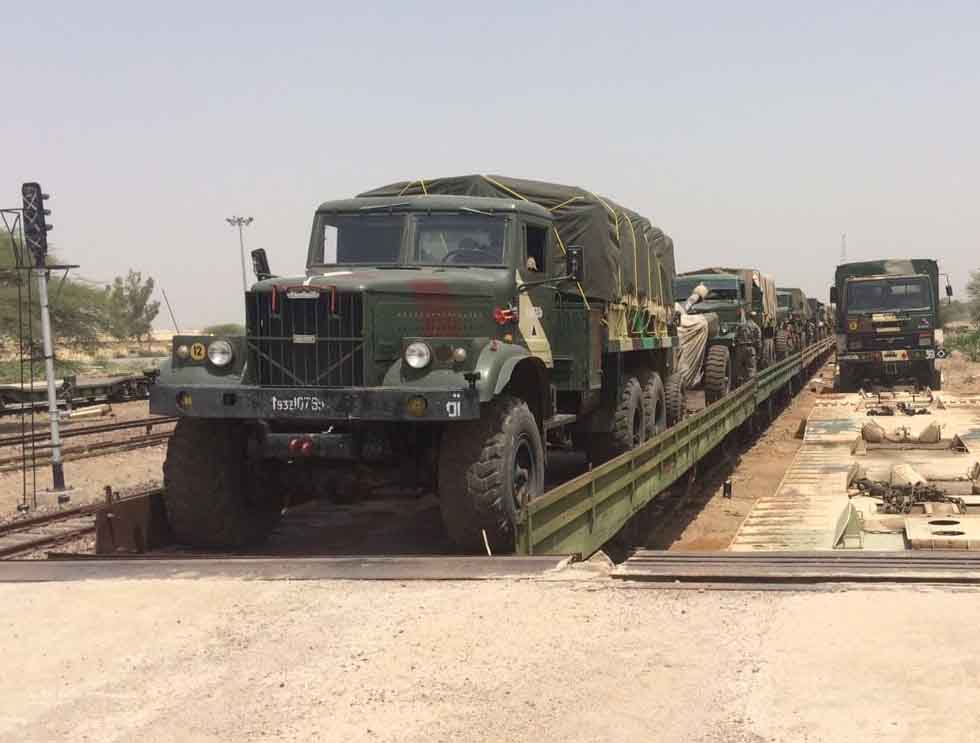
A 24 wagon rake for loading of the medium guns – MBFU – (M – Meter Gauge, B – Bogie Wagon, FU – Well Wagon) was placed at the military siding ramp at Delhi Cantonment Railway Station -12 for loading guns and 12 for Russian Kraz towing vehicle. The gun weighs over 8 tonnes and the wheelbase just about narrowly fits on to the meter gauge rake.  Today with broad gauge rakes, the wagons offer sufficient width to maneuver the guns.

The most crucial part of loading is to mount these guns and Krazes on to the MBFU.  I watched in fascination how the most experienced driver, Havildar Kuriakose, drove the leading Kraz towing the gun.   He drove on to the ramp and then straight through, over the wagons to the last-but-one wagon and halted in such a way that the gun was exactly adjusted in the well of the MBFU.  The gun was unhooked and he drove his Kraz in to the well of the last MBFU.  A slight wavering or error in judgement could have caused the unthinkable. It was a critical operation which only best of the specialist drivers can accomplish.

Tank drivers of Armoured Regiments too face similar predicaments driving onto the MBFU and sometimes end up in mishaps.

By nightfall, the train was formed with 24 MBFU, one first class coach, four sleeper coaches, a military kitchen car and seven wagons for carriage of ammunition and stores.  Now it was an eternal wait at the station for ‘power’- a diesel engine – to tow the train.  They had the crew – loco pilot, his assistant and guard ready, but no ‘power’.  By midnight, an engine was made available after it had towed a passenger train.  There were three halts enroute, each over six hours, all waiting for ‘power’ and after 36 hours, we were at Pokharan railway station.

The last military special train I travelled was while commanding the Regiment in 2002.  Our Regiment was mobilised from its peace location in Devlali (Maharashtra, near Mumbai) on that year’s New Year Eve.  The entire Indian Army had moved into their operational locations after the attack on the Indian Parliament building by terrorists believed to have come in from Pakistan.  The Indian Railways ensured that our Regiment, like all the other units of the Indian Army, were mobilised to their operational locations at super-high priority in two days.  The Military Special trains moved at speeds greater than that of many express trains and were accorded the highest priority.

After ten months, the move back to Devlali from Rajasthan was the opposite. An Army which did not even fire a single bullet, an army which did not fight a war had no priorities in anyone’s mind.  Our Divisional Headquarters had entrusted me with an important and critical task two days prior to the move back of our Regiment.  I was given a week to complete the task and fly back to Devlali on completion.  I did not want to miss travelling in the Military Special, that too as the Commanding Officer.  I burnt the midnight oil for the next two days, completed the task, handed it over to the Divisional Headquarters.

On the day of our train’s move from Jodhpur (Rajasthan), our soldiers loaded all the vehicles and equipment on the train.  A diesel engine was connected but now the Railways had the ‘power’, but no crew.  As many Military Special trains were run from Jodhpur taking the army back home, adequately rested crew was at premium.  We waited for 24 hours for the train to commence its journey. Our train stopped at every possible station, even to give way to freight trains.  Now we were the lowest priority in the eyes of the Indian Railways.  The onward move executed in less than two days now took five days on the return leg.

After my premature retirement and move to Canada, I very much miss my passionate association with the Indian Railways. Now, even when I travel in India, it is mostly by air, due to time pressures. Gone are the days of those never ending train journeys. I can only recollect those days with a sense of loss and nostalgia.

Legendary Lungi

For me, undoubtedly most comfortable evening home wear has always been the down to earth ‘Lungi’.  It is extremely comfortable and is an all season wear.  It is unisex – wearable by both men and women.  It is easy to wear without any hassles of zips, buttons or laces.  One got to  just tie at the waist.  Tying a Lungi at the waist is surely not any rocket science, but to ensure that it remains there is surely an art by itself.  Lungi provides free movement for the lower limbs and also air circulation, especially ideal for the hot and humid climate of Kerala.

A Lungi is a cotton sheet about 2 meter in length and over a meter in breadth and is characterised  by its plain, checkered, floral or window-curtain patterns.  By design, one-size-fits-all, both males and females and surely does not have any caste, creed or religion.  The only variation is that Muslims of Kerala wear it right to left, whereas others wear it left to right.  It is very difficult for a normal eye to make out this subtle difference.  Lungi is worn in India, Sri Lanka, Bangladesh, Pakistan, Nepal, Cambodia, Ethiopia, Myanmar and Thailand. ‘Mundu’ is its white cousin and is worn mostly outdoors in Kerala- to church, family functions and even to office.

While serving in the Indian Army, I wore a Lungi to bed, even in remote border posts – at altitudes above 10,000 feet when the mercury dipped to nearly 30 degrees below the freezing mark.  I wore it while serving in the North in Kashmir, in the West in the deserts of Rajasthan and in the humid jungles of Eastern India. It had no combat or camouflaged design or pattern as it was not an Army ‘issue’ item and did not figure in the ‘Dress Regulations for the Army.’

Once on my trip home on vacation from Sikkim, I called on Colonel Baby Mathew who was commanding an Artillery Regiment located near the airport from where I was to board the flight home.  On reaching the main gate of his regiment, the sentry on guard saluted me smartly and said, “Our CO (Commanding Officer) is waiting at his residence for your arrival” and he then gave directions to the driver about the route.  On entering Colonel Mathew’s residence, I heard his voice saying, “Head straight to my bedroom.”  There was Colonel Mathew, sitting on his bed, adorned in his favourite Lungi.  He ordered me to change into my Lungi and join him for a hot lunch of Kappa (Kasava or Tapioca) and fish curry – a Kerala Christian favourite.  While partaking the meal, Colonel Mathew said “I have placed my residence out of bounds for all ranks for the next 24 hours” – meaning no one to come near his house until I was there.  Obviously, the Commanding Officer did not want his command to see him and his friend in their Lungi.

In June 2002, I took over command of our Regiment in its operational location on the India-Pakistan border in Rajasthan.  The Regiment was mobilised from its peace location in Devlali (Maharashtra, near Mumbai) on that year’s New Year Eve.  The entire Indian Army had moved into their operational locations after the attack on the Indian Parliament building by terrorists believed to have come in from Pakistan.  The Indian Railways ensured that our Regiment, like all the other units of the Indian Army, were transported to their operational locations at super-high priority in two days.  The Military Special trains moved at speeds greater than that of many express trains and were accorded the highest priority.

The move back to Devlali from Rajasthan was the opposite.  An Army which did not even fire a single bullet, an army which did not fight a war surely  had no priorities in anyone’s mind.  The Military Special trains stopped at every possible station, even to give way to the freight trains.  Now we were the lowest priority in the eyes of the Indian Railways.  The onward move executed in less than two days now was sure to take a week.

On the day of our train’s move from Jodhpur (Rajasthan,) the soldiers loaded all the vehicles and equipment on the train.  After accomplishing the task, the Subedar Major (Master Warrant Officer) Thangaswamy had a rollcall to ensure everyone was present and also to brief the soldiers about the return journey.  As I looked out of my railway coach’s window, I saw the entire regiment standing.  I had a brain wave – Why carry all the soldiers on the train?  About a hundred of them is all what I require, mainly to ensure the security and safety of the train and the equipment.  Why not the rest of the soldiers be sent on leave as many had not met their families for a prolonged time due to the operational commitments?  Also, less of a trouble for the chefs to cook meals on a running train and less of administrative issues.

I stepped out of my coach wearing my Lungi and ordered Subedar Major Thangaswamy to only keep about a hundred soldiers and disperse the rest on leave for a week to rejoin at Devlali.  Everyone’s face suddenly brightened up but with that I was christened ‘Lungi CO.’

After moving to Canada, on a warm and sunny summer morning, I was watering the garden wearing my all time favourite Lungi.  There appeared our neighbour, Mr Win of Chinese descent and on seeing me wearing a colourful and comfortable costume enquired “Reji, what skirt are you wearing- looks really colourful.  Sometimes it is a full-skirt, sometimes half-skirt and sometimes mini-skirt.” –That was it! I discarded my favourite Lungi forever.

Umbrella

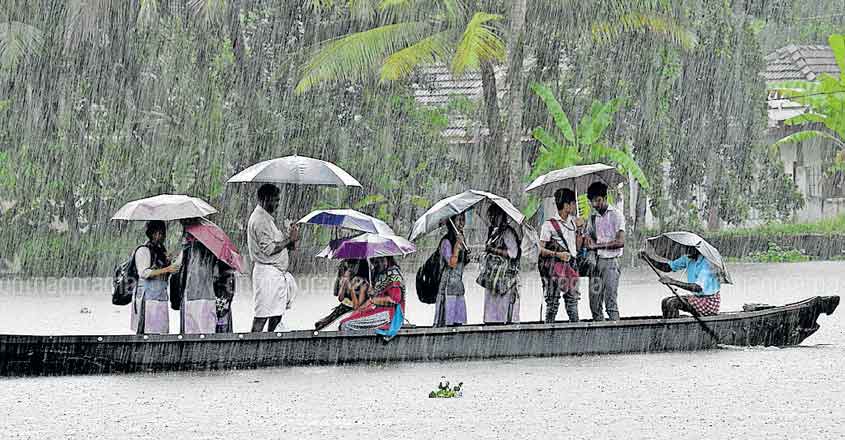
The schools reopen for the new session in Kerala after the summer vacation in June every year.  The school opening is marked by the commencement of the monsoon rains and in the low-lying areas of Kottayam, there would invariably be floods and the schools are often closed at least for a fortnight thereafter.

Our father was the headmaster of a school in thithereafter.qs area near Kumarakom and once I asked him “Why can’t you have an extended school session till April end and have summer vacation in May and June?”

“This idea was tried out unsuccessfully as the combination of extremely hot summer days and scarcity of drinking water posed major difficulties and hence the proposal was shelved,” he replied.

ktd

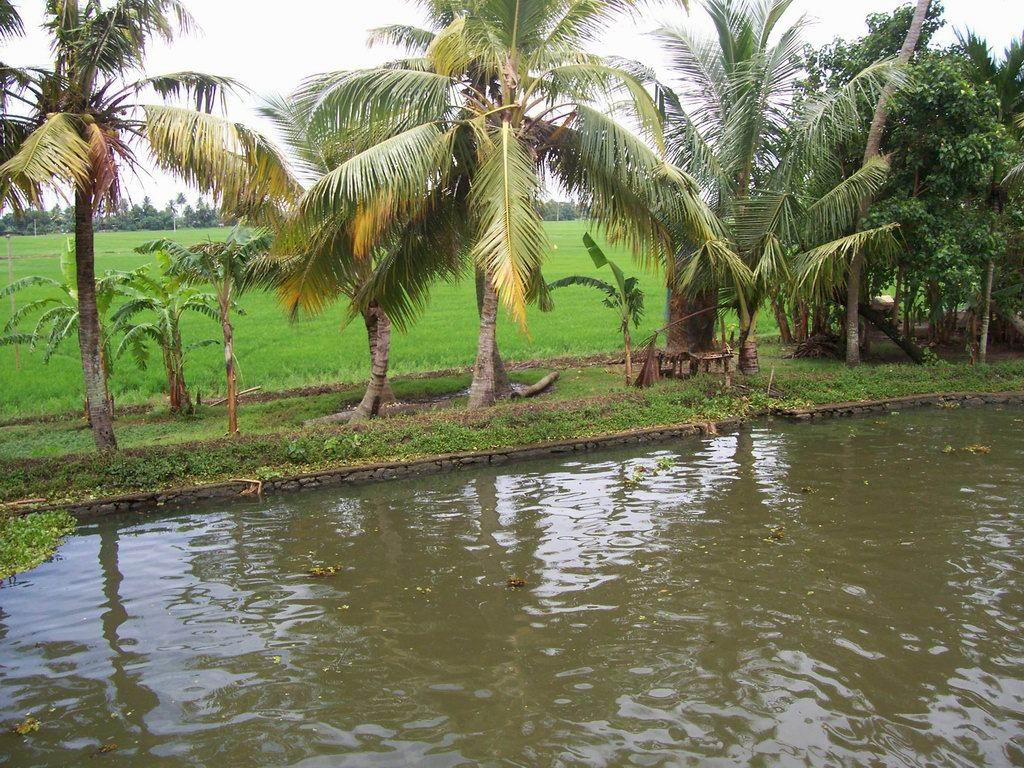
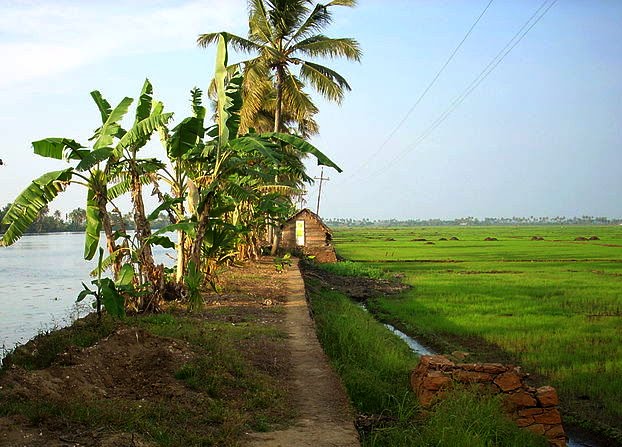
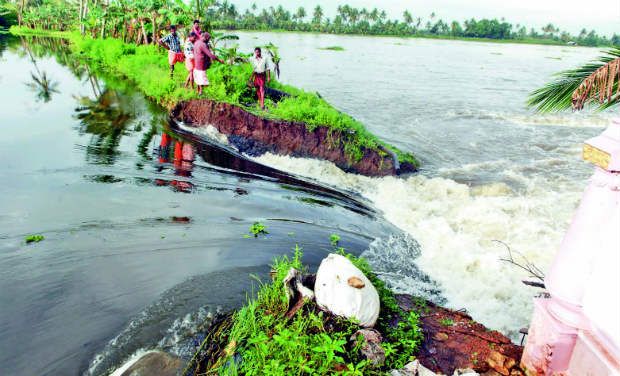
The low-lying areas of Kottayam are a part of the North Kuttanad, known as the rice bowl of Kerala. This is perhaps the only region in the world where rice farming is done at about 2.5 meter below sea level.  The paddy fields are reclaimed land from the backwaters.  In case one embarks on a boat ride through the backwaters, one can observe that the paddy fields are at a much lower level than the water level of the backwaters.  If you carefully observe the images above or below, you can differentiate the two levels.

kuttanad-fields3

Kuttanad meaning ‘low lying lands’ is one of the most fertile regions of Kerala, spread over the districts of Alappuzha and Kottayam, crisscrossed by rivers, canals and waterways.  The region contains the low-lying lands measuring about 25 kilometers East-West and 60 kilometers North-South on the West coast of Kerala. A major portion of this area lies 1 to 2.5 meters below the sea level.  Kuttanad has 1,10,000 hectare area, of which 50 % is reclaimed and 88 % is under agriculture.  The area is characterised by Dyke building in deep waters, land reclamation and maintenance and Rice-Fish rotation farming.

kuttanad-fields111

The dykes (bund) construction and maintenance are intricate tasks, for which an array of long and stout coconut poles are hammered deep enough into the lakebed in two rows, about two meters in width enveloping the entire area. It is then fenced with bamboo mats on either side.  The channels of the bund are now filled to the desired height, first with sand, followed by twigs, interspersed with high quality clay dug from the bottom of the lake.  Then water is pumped out and the land is prepared for rice cultivation.

The dykes are now mostly permanent ones built with granites and concrete.  Only a few gaps are left to facilitate flowing in of water after the harvest.  The gaps are filled prior to cultivation as mentioned above.  In the earlier days, water was pushed out from the low lying areas manually using a waterwheel.  Nowadays, the manual labour has been replaced by electric pumps.

kuttanad-fields22

During heavy monsoons, the flood waters may breach the bunds and inundate the paddy fields, causing heavy losses to the farmers.

The freshwater environment close to rice fields and the canals provide abundance of Pearl spots (Karimeen for which Kerala is well known for), fresh water giant prawns (Attukonju) and freshwater catfish.

So much for the geography of Kuttanad and its peculiarities.

Let me now relate to a monsoon related necessity. It was customary for our father to gift all four of us with an umbrella, with our name inscribed on it, at the beginning of every school year.  One either lost them or damaged them as the school year passed by. In the autumn of his life, he resumed the old habit and continued with the same gift to all his grandchildren.

In China, gifting your friend an umbrella means you want to end the relationship because umbrella sounds like San in Chinese, which means to separate. Giving a married couple an umbrella as a gift should be avoided in all cases, at least in China. The Chinese believe that if it is raining and you are worried, he or she will get wet, it’s better for both of you to huddle under one umbrella until you reach your partner’s destination.

That brings me to a personal anecdote related to the gifting of umbrellas. A few weeks after assuming command of the unit in the operational area in Rajasthan, our Second-in-Command (2IC) Late Col Suresh Babu approached me and said “There are about 100 umbrellas lying unsold in the Regimental Canteen at Devlali, Maharashtra.  I propose a 50% reduction sale for them.”  

I realised with the unit in the operational area, it may not be feasible to execute the sale.

After analysing the loss being incurred by the canteen and the overall cost of the umbrellas, and taking a cue from my father, I said “Let the Regiment buy all the umbrellas from the Regimental fund and let them be gifted to all children of the unit at the beginning of the academic session.”

As in Kerala, in Devlali too, the monsoons pour down heavily coinciding with the school opening, but luckily there are no floods.  The gift must have impressed all the families and children, back in Devlali as they had not yet met the new Commanding Officer.

In 2009, five years after handing over command, I received a call from Subedar Ravinder Singh.  His son came online and said “Sir, the umbrella you gifted to me at the time of taking over command of the unit has been preserved by me and was always a sign of encouragement for me.  Thank you very much Sir and also for training all the children of our unit on computers.  The introductory training to technology I received at that early age made me explore the world further and it has helped me immensely in my career. Thank you, Sir.

Most of your deeds and actions may not matter much to you, but it matters to the one who is in the receiving end.  The resultant effect will always be as to how the receiver perceives it. And, if the recipient perceives it well, he or she will replicate it in later life, in one form or the other.

Good deeds generally have a chain reaction as do bad deeds. But in case of good deeds the chain is generally much longer than in the case of bad deeds.

First, Middle and Last Name

In school and during my service in the Indian Army, my name was recorded as Koduvath RejiKoduvath being our family name. (Please click here to read more about Koduvath family).

Names

 Among the Syrian Christians of Kerala, names traditionally consist of three parts: the family name, the father’s name, and the christened (given) name. However, my siblings and I had only two—the family name and our christened names. As a curious teenager, I once asked my father why our names were so short. Being a headmaster, he gave a characteristically practical reply: the most common question in primary language classes is “What is your name?” He didn’t want his children struggling with lengthy responses, so he kept our names simple. I often wonder how I’d have managed with a typical Syrian Christian name like KuruvillaPhiliposePunnoose, or Zachariah!

The Many Reasons for Name Changes

In Kerala’s Malayala Manorama newspaper, classified columns frequently feature name-change advertisements—mostly women altering their surnames post-marriage. Some adjust the order of their names, while others cite astrological or numerological reasons.

But motivations for name changes vary widely. Some dislike the name their parents gave them. Couples may hyphenate surnames, creating a double-barrel identity. Others anglicize their names to avoid mispronunciation or unintended meanings in foreign languages. Occasionally, a name becomes a professional liability, or a change is needed to counter identity theft.

A Family Tradition: Keeping One’s Name

My mother, Pallathettu Kurian Sosamma, married my father, Koduvath Varkey George, in 1956. Both were teachers, and neither changed their names. My father believed marriage shouldn’t demand the sacrifice of one’s identity. He also considered the bureaucratic hassle unnecessary. This principle extended to his daughters-in-law—my wife, Marina Mani, retained her name, derived from her father’s.

In the Indian Army, it’s common for officers to change their wives’ surnames post-marriage through Part II Orders (official documentation). Many were surprised when I insisted Marina keep her maiden name. Most officers didn’t realize that marriage alone doesn’t legally authorize a name change—proper legal procedures must be followed. Soldiers, too, often bypassed the process, relying on uninformed officers to approve their paperwork.

Naming Our Children: A Deliberate Choice

After marriage, Marina was often addressed as Mrs. Reji—a natural assumption in the Army, where Reji was mistaken for my surname. She disliked it but eventually accepted it. When we named our daughter Nidhi, Marina felt a single name seemed incomplete. I argued against adding my name to hers, avoiding future change of name complications.

Eventually, Marina named her Nidhi SusanSusan being the anglicized form of my mother’s name, Sosamma. Today, she goes by Nidhi Parkinson-Watson, adopting a hyphenated surname. When our son was born, Marina chose Nikhil George Koduvath, giving him a complete name.

The Passport Predicament: Two Identities

While emigrating to Canada, I swapped my first and last names for the passport, becoming Reji Koduvath instead of Koduvath Reji. This left me with dual identities—Indian and Canadian. Our daughter faced minor issues in Canada, where Susan (her last name) is typically a first name, often prompting double-checks during documentation.

Correcting Documentation in the Army

As a commanding officer, I noticed gaps in soldiers’ documentation, especially regarding marriage and children’s birth records. During a Sainik Sammelan (monthly address), I explained the legal name-change process in India (similar to many developed countries):

  1. Affidavit: File before a District Court or Magistrate.
  2. Newspaper Advertisements: Publish in two local newspapers.
  3. Gazette Notification: Finalize in the state’s Official Gazette.

One soldier from Rajasthan raised a concern: in his community, unmarried women used Kumari (virgin) as their second name, which changed to Devi post-marriage (e.g., Ritu Kumari → Ritu Devi). I quipped, “Until legally changed, she remains ‘Kumari’ for life!” I instructed all personnel to regularize any unofficial name changes.

The Canadian Quirk: Searching by Last Name

In Canada, medical searches often use last names. Since Nikhil and I share Koduvath, while Nidhi and Marina have different surnames, I ask clinics to search by our home phone number instead.

Once, a pharmacy technician pulled up five names under our number and remarked, “All three males share a last name, and the two females have different ones.” Puzzled, she asked who the third male was. The answer? Maximus Koduvath—our dog, who also gets his meds under our family file!

Names2