Parade State

A Different Kind of Command

While commanding our Regiment – 125 Surveillance and Target Acquisition (SATA) Regiment – I attended office mostly on Friday afternoons. That was when I signed the official documents requiring the Commanding Officer’s signature, most notably the Daily Parade State.

At the time, I was a single parent CO. Marina had already migrated to Canada, and the responsibility of bringing up our two primary school–going children – feeding them, sending them to school, ensuring homework was done, making them bathe – all fell on my shoulders. Command had to coexist with parenthood.

What Is the Daily Parade State?

For the uninitiated, the Daily Parade State is a large table detailing every officer and soldier authorised and posted to the Regiment, along with their daily whereabouts. Compiled each evening by the Regimental or Battery Havildar Major (RHM or BHM), it shows the status of all personnel as of 8 AM the following morning.

The Detail Master, the understudy to the RHM or BHM, is responsible for compiling the Parade State. Typically a soldier with good handwriting and skill at mental arithmetic, he provides all secretarial support to the RHM and BHM. Battery Detail Masters prepare their Battery’s Parade State in the evening and hand it over to the Regimental Detail Master, who then compiles the Regimental Parade State.

The Challenge of Cooperation

Our Regiment was then a cooperating unit with the School of Artillery, Devlali, carrying both station commitments and training commitments – collectively called Range Detail. Unlike at many other Schools of Instruction in the Indian Army, at the School of Artillery, student officers and soldiers do not draw, clean, or maintain equipment. That responsibility falls entirely on cooperating Regiments.

Details of manpower and equipment to be provided – along with administrative arrangements such as pitching tents and preparing Observation Posts – were issued a week before the beginning of each month. Soldiers were thus well aware of their commitments and duties.

We were always short of manpower, as soldiers also needed to avail their leave. Yet our Section and Platoon Commanders managed the show admirably, often with radio operators or drivers doubling as radar operators or surveyors. Clerks were utilised as radio operators, surveyors, or kitchen assistants. Tradesmen pitched in. Even the Religious Teacher was not spared.

Failure or shortfall in Range Detail resulted in the CO being summoned by the General – the Commandant of the School of Artillery. Our RHM and BHMs ensured that all Range Details were executed flawlessly. They had their own methodologies for dealing with shortcomings. Whatever they did, I was never summoned by the General.

The Daily Ritual

Every morning, BHMs presented their Parade State to their Battery Commander, while the RHM presented the Regimental Parade State to the Adjutant, then to the Second-in-Command, and finally to the CO. The Daily Parade State is an auditable document used to account for rations drawn from the Supply Depot for the soldiers. Hence, the CO’s signature is mandatory.

Three months into command, RHM Kaptan Singh summoned enough courage and asked, “Sir, how come you do not ask any questions while you sign the Parade State? You simply tell me to turn the pages and place my finger where you are to sign. You do not even look at it.

Why this question now?” I asked, knowing the answer well.

Your predecessor used to grill me for over ten minutes every morning about various figures in the Parade State – number of soldiers on leave, soldiers on various out-station duties, and so on. I know that you know about every soldier,” RHM Kaptan Singh explained.

Thank God! You had to suffer this agony for only ten minutes; I had to endure over thirty,‘ I thought.

A Painful Memory

My mind raced back to my Battery Commander days. Even then, I had hardly paid attention to the figures on the Parade State. But our CO then was not of the same disposition. He believed that every figure on the Parade State was gospel truth.

He summoned each Battery Commander and questioned us about the number of soldiers on leave or on out-station details. I always rattled off some numbers. Then he summoned our BHM and asked the very same questions. What a pathetic example of command!

Our BHM’s figures never tallied with mine, and the thirty-minute ordeal ended with our CO’s remark: “You do not know what is happening in your Battery.”

This continued daily, and my figures never matched our BHM’s. Other Battery Commanders, I later learned, coordinated their figures with their BHMs before being summoned. I had no such coordination. Fortunately for me, I moved out of the Regiment within two months to attend the Staff College Course.

The Explanation

Now I had to justify my blind signing of the Parade State to RHM Kaptan Singh.

This document is a proverbial elephant’s teeth – for show only,” I began. “This Parade State was prepared by your Detail Master the previous evening, giving out the likely state of all personnel of our Regiment, including me, the next morning. He put in herculean effort, with much erasing and rewriting, to tally all the figures.

If this is accurate, then your Detail Master must be a genius – hell of a Prediction Master. Last evening, I did not know where I would be this morning. Hence these figures can never be accurate. If they are accurate, then the Detail Master must be sitting in my chair.

Do you want me to grill you on it now?”

RHM Kaptan Singh broke into his characteristic smile, saluted, and walked away – fully convinced. The Parade State continued to be signed on Friday afternoons, and our Regiment continued to function without I ever being summoned by the General.
Regimental Fund

On taking over command of our Regiment in June 2002, we were deployed in our operational area in Rajasthan, ready to be launched into battle any time.  The mercury tipped many days over 40°C and the Regiment had been there since the dawn of the New Year.

The entire Regiment was living in tents with the Commanding Officer (CO) provided with a much more spacious and larger tent.  The other luxury the CO enjoyed was a desert cooler in the tent and the Second-in-Command (2IC) too had this luxury.  A 5kW generator meant for the workshop powered the lights, fans and desert coolers from 9 AM to 2 PM and then from 7 PM to 10 PM.

My first day in command was spent on familiarisation of the Regiment and the area around.  It ended with my first command order.  Please click here to read https://rejinces.net/2016/04/01/first-comd-order/.

That was when I realised that the dreams and plans I had in mind to be executed on taking over command had to be kept in abeyance as there weren’t adequate funds.  The only money at my disposal was Rs 200000 from a fixed deposit that had matured.  That wasn’t my money and if I used it, I had to make it up.

After working out the power requirement, it was decided to procure three 15kW generators and fifty desert coolers to equip every tent in the Regiment.  Two Young Officers with a team of soldiers were deputed to purchase the same from Jodhpur, the nearest town.  From that evening we had a well lit and well cooled township.  My only worry was that I had spent most of the Regimental Fund.

That evening at the Officers’ Mess, I gave out my command policy.  Anything that does not have a utility value to the Regiment in our operational area or for the families of our officers and soldiers at our permanent location must be disposed offAll funds, Regimental and others must be utilised towards the war efforts.

All Officers and soldiers were asked to propose anything they needed and I found they were too contented with what I gave them the very first day and wanted no more.

We procured two desktop computers to support my automation endeavours. Now I had to conserve all that was left with our Regimental Fund.  The first step was to reduce stationary usage by automation and we succeeded to a great extent.

In November we were ordered to return to our permanent location at Devlali. I ordered that only one of the three generators to be carried along and the rest two and all fifty coolers to be sold off at 60% of their cost with the first priority for our soldiers.  The coolers and generators were of no use to the Regiment at Devlali and would have turned into junk later.  Our soldiers from Rajasthan picked up the entire lot and I recouped half the Regimental Fund I had spent.

The first project we executed was a washroom cleaning device based on the mobile cleaning unit employed by the Indian Railways to clean the toilets of the trains on the platform.  Our soldiers designed and built it.  Now every soldier could carry out janitorial duties and the Safaiwalas (Janitors) were available to accompany radar detachments, survey teams and also operate radio sets.  They turned up smartly in their combat uniforms every morning walking with a swag with the radio set on their back and the operators pad in their hand.

Most of my time in the Regiment was spent at the Computer Cell.  Whenever needed, I relieved at the soldiers’ washroom rather than using the washroom at my office. This ensured that all soldiers kept their washrooms spic and span.

Two weeks after landing at Devlali, Major General RS Jambusarwalla, our Divisional Commander visited us.  I received him at the Regiment and he walked to the rear end of his car and ordered his driver to open the boot.  There it was – a computer, a printer and a multimedia projector.  That was the only time in my military career a visit by a senior officer began with a gift to the Regiment.

Two weeks later was the inspection by Lieutenant General GS Sihota, PVSM, AVSM, VrC, VM,   the Army Commander, Southern Command and his proposal for other units to procure the software we had developed for Rs 10000 was a great boon.  Now I had all the money at my disposal to implement all my ‘wild ideas.’

We were a SATA Battery being converted to a SATA Regiment.  We did not have a JCOs’ Club, an important Regimental institution.  Fighting many a battle with the Station Headquarters, we managed to get a near dilapidated building allotted as our JCOs’ Club. I summoned our SM and tasked him to get the building done up, procure furniture, crockery, cutlery, etc.  I gave him a month’s time for executing the task with my final advice “It’s got to be better than our Officers’ Mess.”  After a month our SM invited all officers for a cocktail at the JCOs’ Club for inauguration.  The above image is the testimony to that day.

The next project was to create a high-end barber shop.  Please read https://rejinces.net/2016/04/29/acgo/.

Our soldiers came up with a request for a multi-gym.  SM Thangaswamy was tasked to execute the project with the assistance of other JCOs.  They suggested procuring the equipment  from Ambala as it would a cheaper option.  I advised them to procure it locally from Nashik to ensure installation and warranty services.

Two weeks later SM Thnagswamy asked me about my availability to inaugurate the gym.  I asked him to inaugurate immediately and make it available to our soldiers.

We automated our kitchen with flour kneader, freezers and coolers for storage of milk, meat and vegetables.  We were allotted a ‘Steam Jacketed Cooking System’ for the soldiers’ kitchen procured from special funds under the Army Commander’s Special Financial Power. I did not want it to turn into an elephant’s teeth for show alone.  How we extracted its full value, please read https://rejinces.net/2019/03/31/elephantteeth/.

I was lucky that I had a great lot of officers and soldiers who accepted me, supported my ideas and worked wholeheartedly to ensure fulfilment of all my dreams.  I must sincerely thank all Officers, JCOs, NCOs and soldiers and a special high-five for our Subedar Major (SM) Thangaswamy who kept me in high spirits with his sense of humour.


Did I realise all the dreams I came with to command?  It’s an emphatic Yes and much more; all because of a great Regiment that I was lucky to command.

Z – The Commanding Officer’s Jeep

The Sacred Vehicle

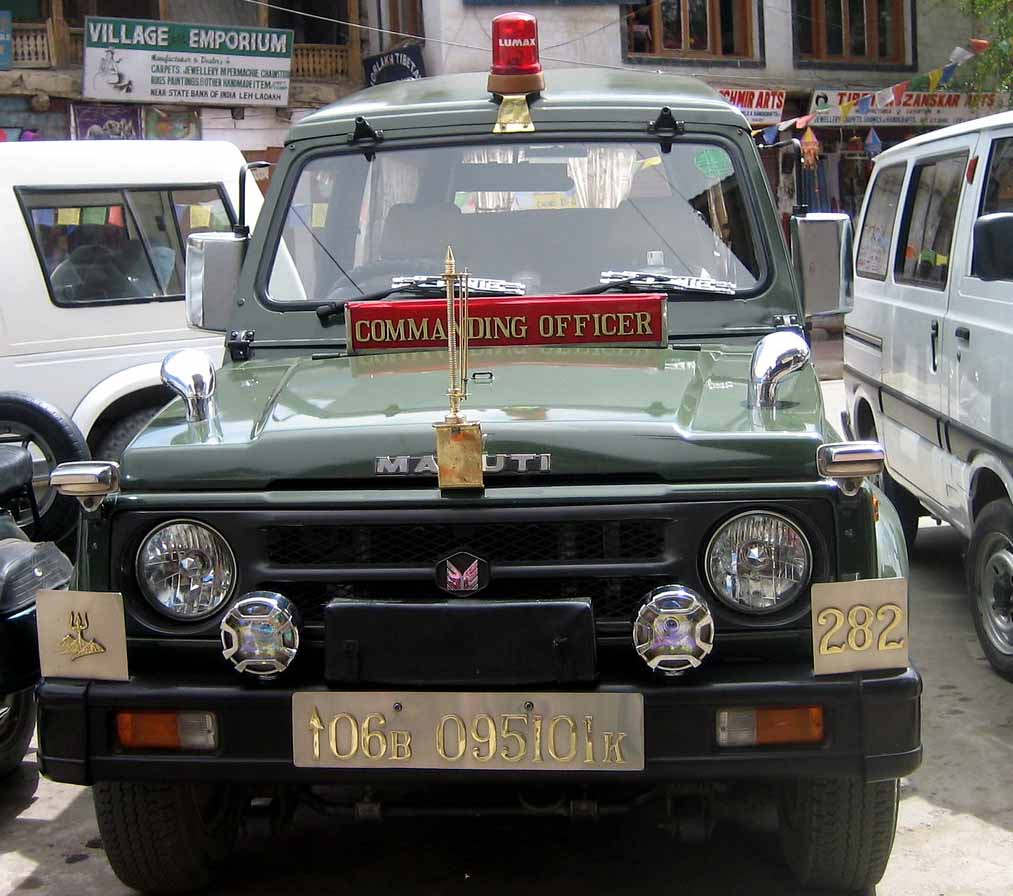
Commanding Officers (CO) of all Artillery Regiments travel in a Jeep – a light vehicle identified by the alphabet Z painted prominently on all sides. Most other arms and services have COMMANDING OFFICER written on the front of the CO’s vehicle. Needless to say, it is the most decked-up and mechanically fit vehicle in any unit, driven by the most competent and disciplined driver. It carries with it an air of sacred and infallible exclusivity – an object of reverence bordering on mythology.

A Single Parent CO

Our unit was a cooperating unit of the School of Artillery, Devlali. We provided equipment and soldiers to ensure the smooth conduct of training for students of various courses. This was at a time when I was a single parent CO – Marina had already migrated to Canada. The responsibility of bringing up our children rested solely on me.

My residence was about 400 metre behind the unit, with the Officers’ Mess in between. I could walk to the unit or the Mess at any time, and hardly ever used the Z.

A Daughter’s Doubt

One day, our daughter Nidhi, a Grade 6 student, returned from school with a question. “Dad, are you a CO?

Yes,” I replied. “What’s the matter?

Everyone in my class tells me that you cannot be a CO,” she said.

But why?” I queried, genuinely curious.

Her reason left me taken aback. “They say that if I am a CO’s daughter, I would be dropped at school on a Z, and not cycling down to school,” she replied, with the innocence only a child can possess.

OK. I am not a CO, then. You continue to cycle to school,” I said, offering a justification that satisfied her young mind.

A Call from the School of Artillery

One morning, I received a call from a senior Staff Officer at the School of Artillery Headquarters. His concern was delicate but pointed: our Regimental officers were travelling in jeeps while Colonels of the Tactical and Field Wings – many approved for Brigadier rank – were travelling on their scooters. It was not just the officers; even their ladies used the vehicles. This was evidently an eyesore for those Colonels who had commanded their regiments well – else they would not have been posted to the School of Artillery.

I did not mince words in my response. “When some of these Colonels were commanding their regiments, they had five jeeps – one for the CO, one for his wife, one for his daughter, one for his son, and one for his dog. I have only one, and the rest are shared by other officers. This is my command, and I will decide what to do with my jeeps. Henceforth, please keep away from my command functions.

The matter was not raised again.

A New Officer’s Dilemma

On a Saturday, our Adjutant informed me that the in-laws of Captain Vikrant – who had joined us just a week earlier – were in station.

Then let us have a get-together in the evening at the Officers’ Mess. Please invite them too,” I suggested. The CO’s mild suggestions are invariably directions to be implicitly followed.

During the evening gathering, I asked Captain Vikrant, “What are you doing tomorrow? It’s a Sunday.”

My in-laws want to visit Shirdi,” he replied.

How are you going?” I enquired.

I have booked seats on the School of Artillery bus leaving from the Club tomorrow morning.

I paused, then said, “When our officers’ parents or in-laws visit Shirdi, they take the Z. Havildar Suresh, my driver, will report to you tomorrow morning.”

Hearing this, our Quartermaster, Captain Subhash, passed the customary instructions to Havildar Suresh: carry adequate water, soft drinks, sandwiches, and a spare jerrycan of petrol.

The Call Before Dawn

Sunday morning at five, I was quite rudely awakened by the telephone ringing. It hardly ever rang unless there was some very, very important information to be conveyed to the CO – which was indeed a rarity.

It was Captain Vikrant on the other end. “Good morning, Sir. Sorry to disturb you at this hour. Your vehicle is standing in front of my residence.”

It’s there to take you all to Shirdi,” I confirmed.

I thought you were not serious when you told me that,” he said, his voice a mixture of embarrassment and apology.

I shot off a volley of the choicest profanities in my vocabulary, ending with, “Now you take the vehicle to Shirdi, and on Monday morning, see me in my office.”

The Explanation

On Monday morning, Major Suresh Babu, our Second-in-Command, escorted Captain Vikrant to my office. “Sir, please don’t get angry with him,” he said. “He is only a week old in our unit. He is yet to know you.”

I looked at Captain Vikrant, and he spoke. “This is my second unit. Before this, I served only in a Field Regiment for five years. There, the Z was regarded as something holy—something of an institution. I have never travelled in a Z till now. That is why I called you early in the morning to reconfirm.”

I dismissed them both with words that summed up my philosophy: “The Z did not come as a dowry to me when I got married to the Regiment.”

Legendary Lungi

For me, undoubtedly most comfortable evening home wear has always been the down to earth ‘Lungi’.  It is extremely comfortable and is an all season wear.  It is unisex – wearable by both men and women.  It is easy to wear without any hassles of zips, buttons or laces.  One got to  just tie at the waist.  Tying a Lungi at the waist is surely not any rocket science, but to ensure that it remains there is surely an art by itself.  Lungi provides free movement for the lower limbs and also air circulation, especially ideal for the hot and humid climate of Kerala.

A Lungi is a cotton sheet about 2 meter in length and over a meter in breadth and is characterised  by its plain, checkered, floral or window-curtain patterns.  By design, one-size-fits-all, both males and females and surely does not have any caste, creed or religion.  The only variation is that Muslims of Kerala wear it right to left, whereas others wear it left to right.  It is very difficult for a normal eye to make out this subtle difference.  Lungi is worn in India, Sri Lanka, Bangladesh, Pakistan, Nepal, Cambodia, Ethiopia, Myanmar and Thailand. ‘Mundu’ is its white cousin and is worn mostly outdoors in Kerala- to church, family functions and even to office.

While serving in the Indian Army, I wore a Lungi to bed, even in remote border posts – at altitudes above 10,000 feet when the mercury dipped to nearly 30 degrees below the freezing mark.  I wore it while serving in the North in Kashmir, in the West in the deserts of Rajasthan and in the humid jungles of Eastern India. It had no combat or camouflaged design or pattern as it was not an Army ‘issue’ item and did not figure in the ‘Dress Regulations for the Army.’

Once on my trip home on vacation from Sikkim, I called on Colonel Baby Mathew who was commanding an Artillery Regiment located near the airport from where I was to board the flight home.  On reaching the main gate of his regiment, the sentry on guard saluted me smartly and said, “Our CO (Commanding Officer) is waiting at his residence for your arrival” and he then gave directions to the driver about the route.  On entering Colonel Mathew’s residence, I heard his voice saying, “Head straight to my bedroom.”  There was Colonel Mathew, sitting on his bed, adorned in his favourite Lungi.  He ordered me to change into my Lungi and join him for a hot lunch of Kappa (Kasava or Tapioca) and fish curry – a Kerala Christian favourite.  While partaking the meal, Colonel Mathew said “I have placed my residence out of bounds for all ranks for the next 24 hours” – meaning no one to come near his house until I was there.  Obviously, the Commanding Officer did not want his command to see him and his friend in their Lungi.

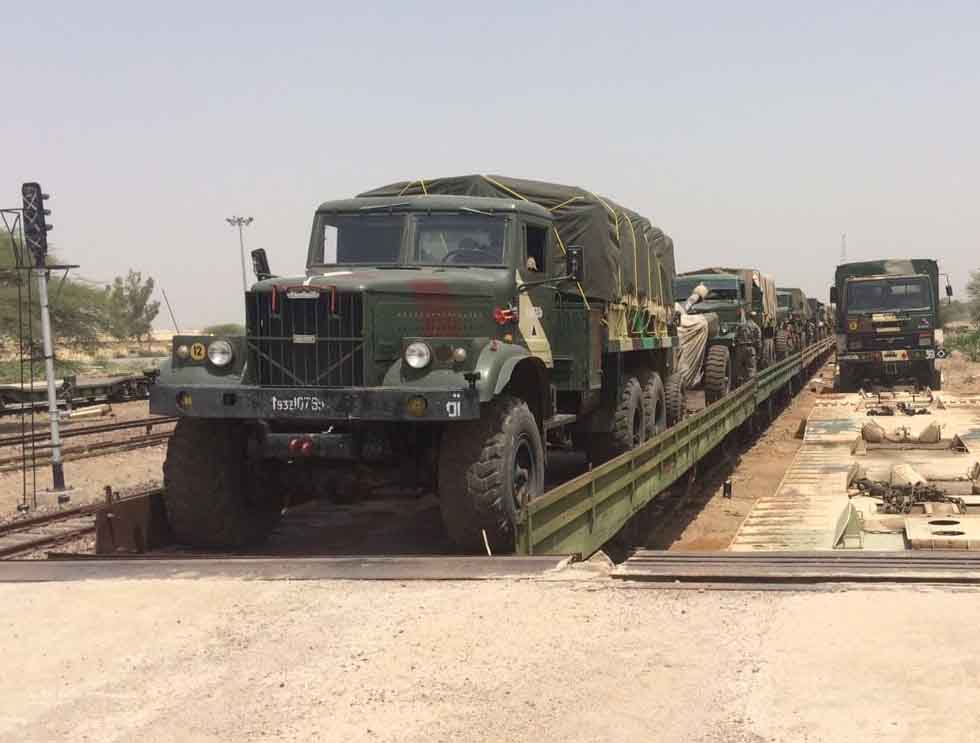
In June 2002, I took over command of our Regiment in its operational location on the India-Pakistan border in Rajasthan.  The Regiment was mobilised from its peace location in Devlali (Maharashtra, near Mumbai) on that year’s New Year Eve.  The entire Indian Army had moved into their operational locations after the attack on the Indian Parliament building by terrorists believed to have come in from Pakistan.  The Indian Railways ensured that our Regiment, like all the other units of the Indian Army, were transported to their operational locations at super-high priority in two days.  The Military Special trains moved at speeds greater than that of many express trains and were accorded the highest priority.

The move back to Devlali from Rajasthan was the opposite.  An Army which did not even fire a single bullet, an army which did not fight a war surely  had no priorities in anyone’s mind.  The Military Special trains stopped at every possible station, even to give way to the freight trains.  Now we were the lowest priority in the eyes of the Indian Railways.  The onward move executed in less than two days now was sure to take a week.

On the day of our train’s move from Jodhpur (Rajasthan,) the soldiers loaded all the vehicles and equipment on the train.  After accomplishing the task, the Subedar Major (Master Warrant Officer) Thangaswamy had a rollcall to ensure everyone was present and also to brief the soldiers about the return journey.  As I looked out of my railway coach’s window, I saw the entire regiment standing.  I had a brain wave – Why carry all the soldiers on the train?  About a hundred of them is all what I require, mainly to ensure the security and safety of the train and the equipment.  Why not the rest of the soldiers be sent on leave as many had not met their families for a prolonged time due to the operational commitments?  Also, less of a trouble for the chefs to cook meals on a running train and less of administrative issues.

I stepped out of my coach wearing my Lungi and ordered Subedar Major Thangaswamy to only keep about a hundred soldiers and disperse the rest on leave for a week to rejoin at Devlali.  Everyone’s face suddenly brightened up but with that I was christened ‘Lungi CO.’

After moving to Canada, on a warm and sunny summer morning, I was watering the garden wearing my all time favourite Lungi.  There appeared our neighbour, Mr Win of Chinese descent and on seeing me wearing a colourful and comfortable costume enquired “Reji, what skirt are you wearing- looks really colourful.  Sometimes it is a full-skirt, sometimes half-skirt and sometimes mini-skirt.” –That was it! I discarded my favourite Lungi forever.

How Did You Manage It?

child

Our father, a primary school headmaster, always believed that it would be better to have the children born in March (Pisceans) as it ensured that the child when joining school did not have to waste a few months. Nowadays it is mandatory that the child must be six years (in our school days it was five) old on the first day of school – 01 June. There had been many instances when the parents wanted the child to begin school early, especially those who missed the age barrier by a few days or a month or two. In the good old days, the parents and the headmaster mutually agreed to enter in records a suitable date of birth to ensure entry into school. This resulted many of our generation (including my wife Marina) ending up with two dates of birth – one the actual day they were born and the other the ‘official’ one. All four of us brothers were born Pisceans and we never had this problem of two dates to remember.

On taking over command of the unit, I went full steam automating the administrative functions in the unit and the priority was to automate the records of the soldiers under command.  This was to ensure that all their necessary documentation were up to date, they receive all their pay and allowances and are fully qualified for promotion to the next rank. The very first step was data capture from the existing manual records. After most data were transferred to the digital media, I called up each individual soldier for an interview to fill in the gaps. As we were deployed in the operational area at that time, these interviews went on till late at night. More than collecting the data, it helped me to a great extent to know the soldiers better as I was totally new to the regiment.

First use of the data captured was to make the weekly Regimental Order look more colourful. Not only that it was printed using a colour printer, the contents were also changed to be colourful. The routine stuff of Duty Officers, punishments etc were all printed in black and the goodies in colour. The goodies included wishes on festivals, compliments for achievements of the men and a special wish from the Commanding Officer (CO) on the soldier’s birthdays. With the data captured, I printed out the list of men celebrating their birthdays the week ahead.

On analysing the data of the unit, I realised that about 20% of the men were born on the first day of the year (01/01) and about 30% born on the first day of the month, especially March, April and May. I concluded that like our father, their school headmasters did the trick.

Case of Marina and her sibling is even better – they all have one ‘official’ birthday – 25 May. The secret was that their grandfather was the headmaster of the primary school and he had taken some liking to that date, like most headmasters of that time.  That is why many in our generation have their official birthdays in and around 25 May – a few days before 01 June. Now in case I got to get them all for our daughter’s wedding in Canada and when I apply for their Visas, the Canadian Immigration will have a lot of questions and lot to analyse.

During my bachelor days, on a vacation home, along with our father, we went to attend a baptism in the family. In those days we had a Bajaj scooter at home and we took off. Being the month of June, the monsoon was in full fury and we had to stop enroute and take shelter in a tea-shop. I ordered two cups of tea and our father said “That is why I always say you should plan your children to be born in March.” I immediately asked him “How did you manage it?” and he gave out his characteristic sly smile.

Years rolled by and in 1997, we were blessed with our son Nikhil on 16 March. At that time, we were located at Pune as I was attending the Technical Staff Officers Course. As customary of the Syrian Orthodox Christians, the baptism had to be done after two months and our son had to take on our father’s name and our father had to be the God Father. During the baptism ceremony, it is the God Father who carries the child to the church and also say the pledges for the child. The entire family congregated at Pune for the occasion. After the ceremony got over, our father asked me “How did you manage it?” and I too passed a sly smile. (Our daughter Nidhi was born on 20 March and I was born on 13 March).

The secret is that both our children were due on 13 March, my birthday, but the gynecologist decided to delay their arrivals.

For your kind information and necessary action please

Thus ended most letters in the Indian Army.  During my young officer days, I asked a senior colleague as the need for ending all official correspondence with such a line.  He said that it padded up the letter and the letter will look incomplete without such an epilogue.

I never understood as to how the information could ever be kind to anyone and what was the need to send the letter in the first place in case no action was needed.  Someone told me that it was to be specific as to what the person at the other end must do.  If that person was ignorant of what is to be done with the letter, I never understood as to how that person could be educated about it with that very clichéd line.

The information asked for is attached herewith as Appendix to this letter.” This is another superfluous  epilogue I found in many letters written in reply to a query requesting data or information.  An Appendix means an attachment and is never mailed in a separate envelop, it is always placed in the same envelop (herewith,) and always with a covering letter (to this letter.)

As a Brigade Major and as a Commanding Officer were the only two occasions when I could get the staff and subordinate officers to doing away with these epilogues.  My reasoning was that it saved time, ink and paper (think of the number of trees that could have been saved.)

One clerk said that it had become an instinct and his fingers never stopped until he typed the epilogue.  One clerk said the idea was great, but will only be in practice until you are around and the next officer taking over from you will insist on the epilogue and hence the reluctance.

LOL, OMG, FTW etc are commonly used abbreviations in the cyber world in the age digital communications and text messaging.  These are understood by everyone across the continents and have been evolved over a period of usage and it still continues to evolve.  As young officers, we were given a book of abbreviations to be used in the Army called ‘Appendix C.‘  The introductory paragraph of the book said that use of abbreviations were to reduce time and effort and assist in assimilation and it will facilitate telegraphy (old analog methodology of transmitting text). 

We used to be summoned to the Adjutant’s office with the abbreviations book, to scan through every word in a document to be sent to the higher headquarters to ensure that any word that found a place in the abbreviations book had been abbreviated and in case the abbreviation used was correctly used.  In case of any errors, either the entire page was retyped or else the correcting fluid was liberally used.  One can imagine the amount of time spent on the task in place of the time it was meant to save.

When the entire world was using the word fax as an abbreviated form for facsimile (the current generation may not be aware of the origin of the word,),the abbreviation book called it fx.  Luckily it was changed to fax.  If you ask someone for a lap, it does not mean that you want to sit on their lap or rest your head on their lap, but it is understood that it is a request for their laptop computer.

There is an abbreviation DHPP and the very same Appendix C calls it as ‘Diesel High Power Point’ in place of ‘Diesel High Pour Point.’  It actually means that this type of diesel has a high pour point.   The pour point of a liquid is the temperature at which it becomes semi solid and loses its flow characteristics. In diesel, the pour point is the temperature at which the paraffin in the fuel has crystallised to the point where the fuel gels and becomes resistant to flow.  It is surely not a Power Point presentation the least.

World over uses left aligned format for all types of correspondence (all lines in the letter are aligned to the left.)  This facilitates easier reading on the hand held PDAs (Personal Digital Assistant) and cell (cellular) phones.  The Indian government for its official correspondence still continues to have subject line centered and some parts offset to the right side, the Indian Army also continues with the age-old practice.  You can imagine how someone using a PDA is to read such a letter and make sense of it.

We need to change with time and cater for all the developments taking place around us in all aspects of life and official correspondence is no different.

Fire! Fire! Fire!

Wedding

Fire! Fire! Fire!” with our exchange operator screaming at the top of his voice; woke me up from deep slumber. Our regiment was located in the higher reaches of Sikkim on 12 December 1997 when this incident occurred. The area was covered with about four feet of frozen solid snow with the temperature touching minus 20 degrees Celsius.

I paid a visit to the dentist in the evening as my wisdom tooth was troubling me and I was under immense pain. The dentist decided that the best way out was extraction and hence administered local anesthesia on my gums and did the extraction. He advised me to take rest for a day or two. I reached my room and I had a splitting headache as a result of the anesthesia. I decided to go to sleep and hit the bed.

At dusk, our Commanding Officer (CO) Colonel PK Ramachandran, wanted to talk to me and called up the Regimental Telephone Exchange to connect the call. The exchange operator tried the call many times but as I was in deep slumber, I did not answer the call. The exchange operator came to my room and saw me in deep slumber and informed the CO about my status. Our CO being a thorough gentleman, advised the operator to let me enjoy my sleep and to put through the call the moment I woke up.

At about 9 PM, the exchange operator noticed smoke and flames in the building I was sleeping. He came rushing into my room screaming and woke me up. He said that my room was on fire. By that time about five soldiers also came in. I ordered everyone to clear off and not get any burn injuries. The soldiers led by the exchange operator were salvaging my desktop PC, the TV and the VCR.

I stepped out of the room engulfed in flames wearing my sandals. Luckily my Identity Card was safe as it was in my uniform shirt’s pocket as I had slept off without changing my uniform. The fire started because the officer staying in the neighbouring room had forgotten to turn off his kerosene based room heating system – Bukhari. As I stood outside in the biting cold, I saw the entire building up in flames. The soldiers were in the act of salvaging everything from the adjacent buildings.

That was when we realised that the water tankers in the regiment were empty as the orders were to keep the tankers empty to prevent them from freezing. The solid frozen snow was of no use to douse the fire as it could not be lifted off the ground. The order was passed immediately that all water tankers will be kept three-fourth full every night to meet such eventualities.   Our CO came to me and asked as to how I felt and I replied that the only thing I could do was to enjoy the warmth the fire was providing on a freezing night.

Next morning the soldiers scouted through the ashes and Subedar (Warrant Officer) Balakishan came out with all my medals (given by the government in recognition of bravery, honour and sacrifice) and a photograph which was intact despite the raging fire. It was our marriage photograph dated 16 April 1989. I immediately said that “What God has united no raging fire, storm or hail can ever separate.

An Orthodox Syrian Christian wedding follows similar procedures as done by other Orthodox faiths like Greek, Slavic, and Egyptian. It begins with the Betrothal service where the Priest blesses the rings of the Bride and Groom, then places them on the ring fingers of their right hands. In the Bible, the right hand is the preferred hand, indicating good. The Betrothal dramatises the free decision made by the Bride and Groom, and is symbolized by the giving of rings.

The Marriage Ceremony begins immediately thereafter culminating in the crowning. It begins with the priest placing a crown on the groom’s head while reciting the crown blessing thrice. Then the crowning ceremony of the bride follows in the similar way. The Greek and Slavic Orthodox use crowns made from olive leaves and the Syrian Orthodox use a gold chain as a symbolic crown. The crowning is a sign of victory, just as athletes were crowned in ancient times at their triumphs. In this instance, the Bride and Groom are crowned on account of their growth as mature Christians, prepared for the responsibilities of a Christian marriage.

This is followed by a series of petitions and prayers with special reference to well known couples of the Old Testament, such as Abraham and Sarah. An epistle excerpt of Saint Paul is read, exhorting husband and wife to unconditional love and support of one another. Then an excerpt from the Gospel of Saint John is read, relating to the wedding at Cana when Christ performed the first of His miracles and blessed the institution of marriage.

The differences in the marriage ceremony between other Orthodox faiths and Kerala’s Syrian Orthodox faith begin here. The groom ties the ‘Minnu’ around the bride’s neck – tying the knot. This has been adopted from the Hindu traditions. the ‘Thali’ used in a Kerala Hindu marriage was in the shape of a leaf of the sacred banyan tree and Christians modified the Thali by superimposing a cross on the leaf and called it a ‘Minnu’. The Minnu is suspended on seven threads drawn out of the Manthrakodi. The seven strands represent the bride, the bridegroom, the couple’s parents and the Church.

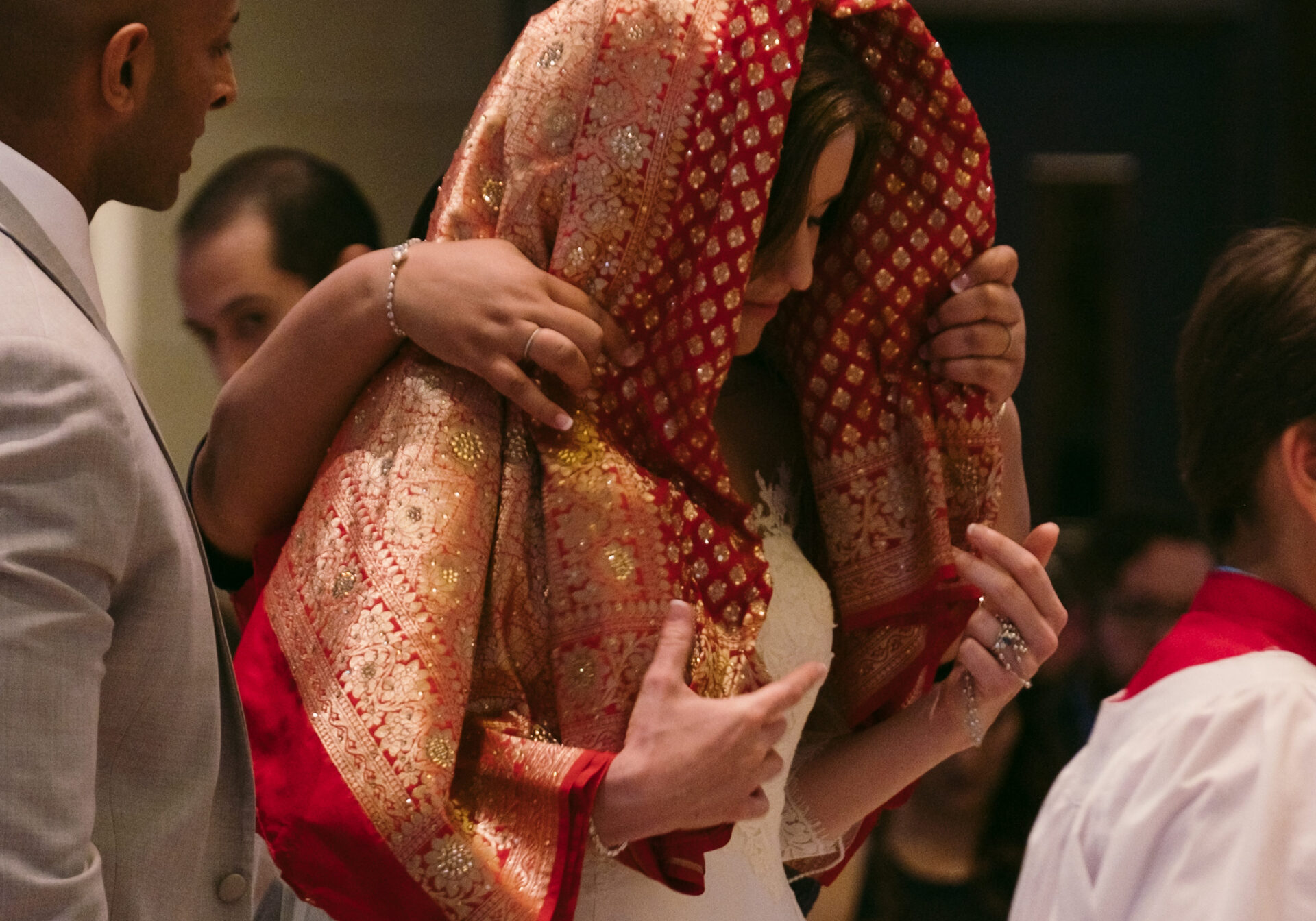
The groom then places the ‘Manthrakodi’, a sari presented by the bridegroom and his family, which is draped over the bride’s head, symbolizing the groom’s pledge to protect, care for and cherish his wife The Manthrakodi is the adaptation from the earlier Kerala Hindu Nair traditions of ‘Pudavakoda’ where the marriage was a contract and handing over clothes for the bride indicated entry into a contracted marriage. At this point, the bride’s relative, who has been standing behind her, yields her place to a female member of the groom’s family as a sign that the bride is welcomed into her new family.

The ceremony ends with a benediction and prayer. The Priest uses the Bible to uncouple the hands of the Bride and Groom signifying that only God can come between them. It is always the priest who will preside over the actual marriage ceremony that is the tying of the Minnu. If a bishop is present, he will only bless the Minnu. This tradition may have emerged from the old Travancore Christian Marriage Acts wherein only the priest had the magisterial power to conduct a marriage.

Even though our marriage was not conducted in the presence of Fire God (Agni), our wedding photograph lived through an Agni Pareeksha (Trial by Fire.)