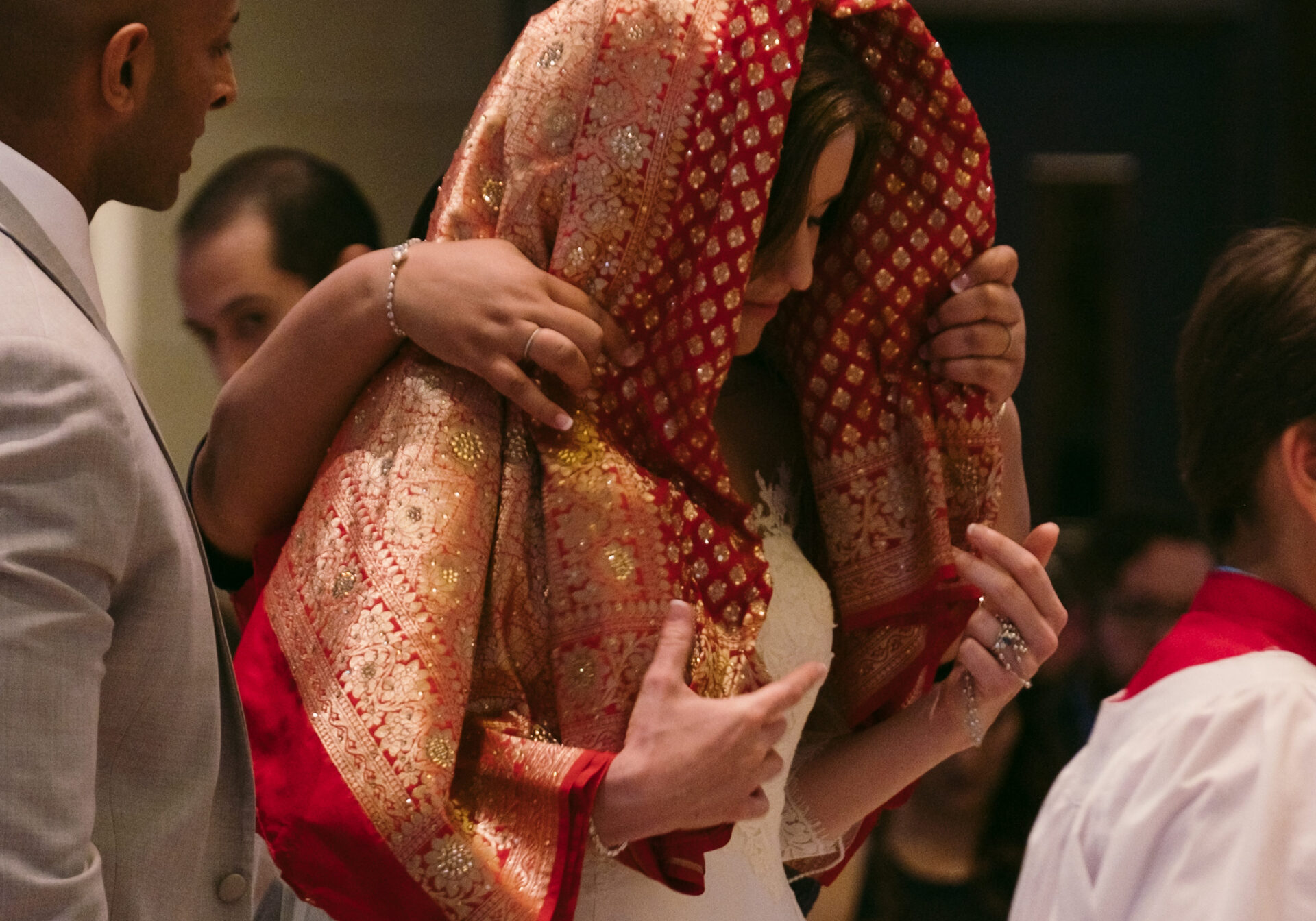
Our niece Deepthi, and her fiancée, Dean exchanged their marriage vows at the picturesque Lake House Inn, Philadelphia, United States on 04 June 2016. The ceremony was presided over by Dr Alan David Fox, Professor of Asian and Comparative Philosophy and Religion in the Philosophy Department at the University of Delaware. Dr. Fox had mentored both Deepthi and Dean while at the university.

At the commencement of the ceremony, Dr. Fox requested all invitees to be seated and not to indulge in any photography. He said that the official photographer present would post the photographs on the internet for everyone to see. He also requested all the attendees to pay attention to the readings and the vows being exchanged and also participate in an important event in the life of the bride and the groom. He opined that such a solemn occasion should never be viewed through the LCD screens or the viewfinder of one’s recording device. A very profound thought.
Is there really a need to record these solemn events in one’s life?
Surely it is a once-in-a-lifetime event and it costs dearly with no upper limit. During any wedding, a great portion of the money would be spent on things that will be gone forever the day after the wedding. Only a few things remain – the rings, the dress, the photos and the memories. In this digital age, the pictures will stay until eternity, perhaps stored away in a virtual cloud, unlike our marriage album – faded, distorted and moth eaten – but the memories will fade.
Turning the pages of ones parent’s or grandparent’s wedding album is a remarkable experience. The youthful looks of the familiar haggard persona, a sort of reverse metamorphosis; the fashions, customs, traditions and rituals of a bygone era; the images of many close and not so close relatives, many of them no longer amongst the living. All of this results in a plethora of emotions flooding the sensitive mind. It is an enthralling experience to cherish. So, why on earth should this privilege be denied to the future generations?
Our son Nikhil, during his cultural exchange programme to France was very enthusiastic to visit the Louvre Museum, mainly to see Leonardo da Vinci’s Mona Lisa. On reaching near the famous painting, he was somewhat disappointed as he felt that the original of the much revered painting now before him in ‘flesh and blood’, looked much like a fake duplicate of the many grand prints and photographs of the same painting that he had seen. Moreover, it was one of the smallest in the room. He was more bothered by some over-enthusiastic tourists, many trying to photograph or ‘selfie’ the painting. They were least bothered about others around and proved to be a real nuisance by getting in the way and sticking cameras and selfie sticks in the face of others. These ‘enthusiasts’ were merely interested in telling the world that they were there and had the least concern for others around or for the masterpieces which they had purportedly come to see!
These days it costs a mini fortune to physically witness any major sporting event. To make it a profitable experience, one must simply soak in the atmosphere of the sporting arena, get emotionally involved in the sporting action and partake of every thrilling moment of the sport. With a cell phone in hand, it appears that everyone has taken on the role of a photographer, resulting in their watching the entertaining action through LCD monitors. They would have done well to sit in the comfort of their homes and watch the same action, inclusive of slow motion replays, on their large LCD television. Then why make all the effort to go to a stadium to watch such a sporting event? Here again the selfie sticks pose a major problem and many sporting arenas in North America have rightfully banned them. These self-styled photographers should realise that all the important moments of the game have been recorded by many professional photographers with their high-resolution cameras and would be available on the websites of the newspapers and the sports organisation. Then why miss such an opportunity? Why not become part of the celebration and enjoy every moment of it?
Many parents see their children growing up through the camera lens. For them, many special events in their life slip by as they have seen them only through a lens. They do not participate with the children while on an outing or at an adventure event or at an amusement park. They fail to see the emotions and expressions on the faces of their children. They forget the prime importance of living the experience and capturing the image in one’s mind rather than in a memory stick. They forget to participate wholeheartedly, live the moment with the children and absorb the experience through every pore. Holding a costly camera or cell phone, one is sure to be scared of action and water. It would be better to take a couple of quick snapshots, then pack the camera and celebrate the occasion with one’s family. Family photos are surely a trigger for memories, but for posterity – when you are old – your eyesight will rarely be good enough for you to appreciate them. But the memory of a cherished moment, etched in one’s mind is joy forever!
I always pity those dads who video/photograph their kid’s birthday parties. They are busy adjusting camera angles and lights and hence do not participate in the celebrations. It would be prudent to call for a professional photographer to cover such events or one can request a friend to do it. Another option is to mount the camera on a tripod and get some shots with a wireless remote.
While visiting any place of interest, spend time fruitfully to learn about it. Listen attentively to the tourist guide if present or read through the information boards posted there. Help your children to understand what they are seeing and a few lines of explanation from the parents would enhance the kid’s learning. In case you are very much interested in photographing the place, reserve it for a subsequent trip.

A photograph of any object would record many a details which one would have missed while seeing it live. One may come across interesting features that the naked eye would have otherwise missed. Sophie and Joe would bear me out.
Unlike the digital cameras of today, film photography of the good old days was a pretty costly affair and one did not see the results until the all the 36 shots were taken. Many a time this would take over six months. In those days, it was easier to maintain the required balance between looking through a viewfinder and experiencing life. Today one can easily get over 200 shots in one day with hardly any effort and at no cost.
Remember that it is vitally important to maintain a right balance between viewing life through an LCD screen and experiencing it through all the senses.