The Wake-Up Call
“Fire! Fire! Fire!“—our exchange operator screaming at the top of his voice—jolted me from a deep slumber. The regiment was located in the higher reaches of Sikkim. The date was 12 December 1997. The area lay buried under about four feet of frozen solid snow, and the temperature hovered at minus twenty degrees Celsius.
The Evening Before
That evening, I had visited the dentist. A troublesome wisdom tooth had been causing me immense pain. The dentist decided that extraction was the best course of action. He administered local anesthesia on my gums and removed the tooth, advising me to rest for a day or two. I returned to my room, but a splitting headache – likely a reaction to the anesthesia – set in. I decided to sleep it off and hit the bed.
At dusk, our Commanding Officer (CO), Colonel P.K. Ramachandran, wanted to speak with me. He called the Regimental Telephone Exchange to connect the call. The exchange operator tried repeatedly, but I was in too deep a slumber to answer. When he came to my room and saw my condition, he informed the CO. Colonel Ramachandran, a thorough gentleman, instructed the operator to let me sleep and to put the call through the moment I woke up.
The Blaze
At around 9 PM, the exchange operator noticed smoke and flames rising from the building where I was sleeping. He rushed into my room, screaming, and woke me. “Your room is on fire!” he shouted. By then, about five soldiers had also gathered.
I stepped out of the room – now engulfed in flames – wearing only my sandals. Fortunately, my identity card was safe, still tucked in the pocket of my uniform shirt. I had slept off without changing out of my uniform.
The fire had started because the officer in the neighbouring room had forgotten to turn off his kerosene-based room heating system – a bukhari. As I stood outside in the biting cold, I watched the entire building go up in flames. The soldiers, led by the exchange operator, were bravely salvaging whatever they could—my desktop PC, the television, the VCR.
The Harsh Reality
That was when we realised a critical flaw: the regiment’s water tankers were empty. Orders had been to keep them empty to prevent freezing. The solid frozen snow was useless for dousing the fire – it could not be lifted off the ground. An order was immediately passed: from that night onward, all water tankers would be kept three-fourths full to meet such emergencies.
Our CO approached me and asked how I was feeling. I looked at the blazing building and replied, “The only thing I can do is enjoy the warmth the fire is providing on a freezing night.”
The Morning After

The next morning, the soldiers scoured through the ashes. Subedar Balakishan emerged from the debris carrying something intact – a photograph that had survived the raging fire. It was our wedding photograph, dated 16 April 1989.
I looked at it and said, “What God has united, no raging fire, storm, or hail can ever separate.”
Our Wedding: An Orthodox Syrian Christian Ceremony
An Orthodox Syrian Christian wedding follows procedures similar to other Orthodox faiths – Greek, Slavic, and Egyptian.
It begins with the Betrothal service, where the priest blesses the rings of the bride and groom and places them on the ring fingers of their right hands. (In the Bible, the right hand indicates good.) The betrothal dramatises the free decision made by the couple and is symbolised by the giving of rings.
The Marriage Ceremony begins immediately thereafter, culminating in the Crowning. The priest places a crown on the groom’s head while reciting the crown blessing three times, followed by the crowning of the bride. Greek and Slavic Orthodox traditions use crowns made of olive leaves; Syrian Orthodox use a gold chain as a symbolic crown. The crowning signifies victory – just as athletes were crowned in ancient times at their triumphs. Here, the bride and groom are crowned for their growth as mature Christians, prepared for the responsibilities of a Christian marriage.
This is followed by petitions and prayers, with special reference to couples from the Old Testament, such as Abraham and Sarah. An epistle of Saint Paul is read, exhorting husband and wife to unconditional love and mutual support. Then an excerpt from the Gospel of Saint John is read, relating to the wedding at Cana, where Christ performed His first miracle and blessed the institution of marriage.
The Distinctive Traditions of Kerala
The differences between other Orthodox faiths and Kerala’s Syrian Orthodox faith begin here.

The groom ties the Minnu around the bride’s neck – the Minnu Kettu (tying of the knot.) This tradition has been adopted from Hindu customs. The Thali used in a Kerala Hindu marriage is shaped like a leaf of the sacred banyan tree. Christians modified it by superimposing a cross on the leaf and called it the Minnu. The Minnu is suspended on seven threads drawn out of the Manthrakodi – a sari presented to the bride by the groom and his family. The seven strands represent the bride, the groom, the couple’s parents, and the Church.
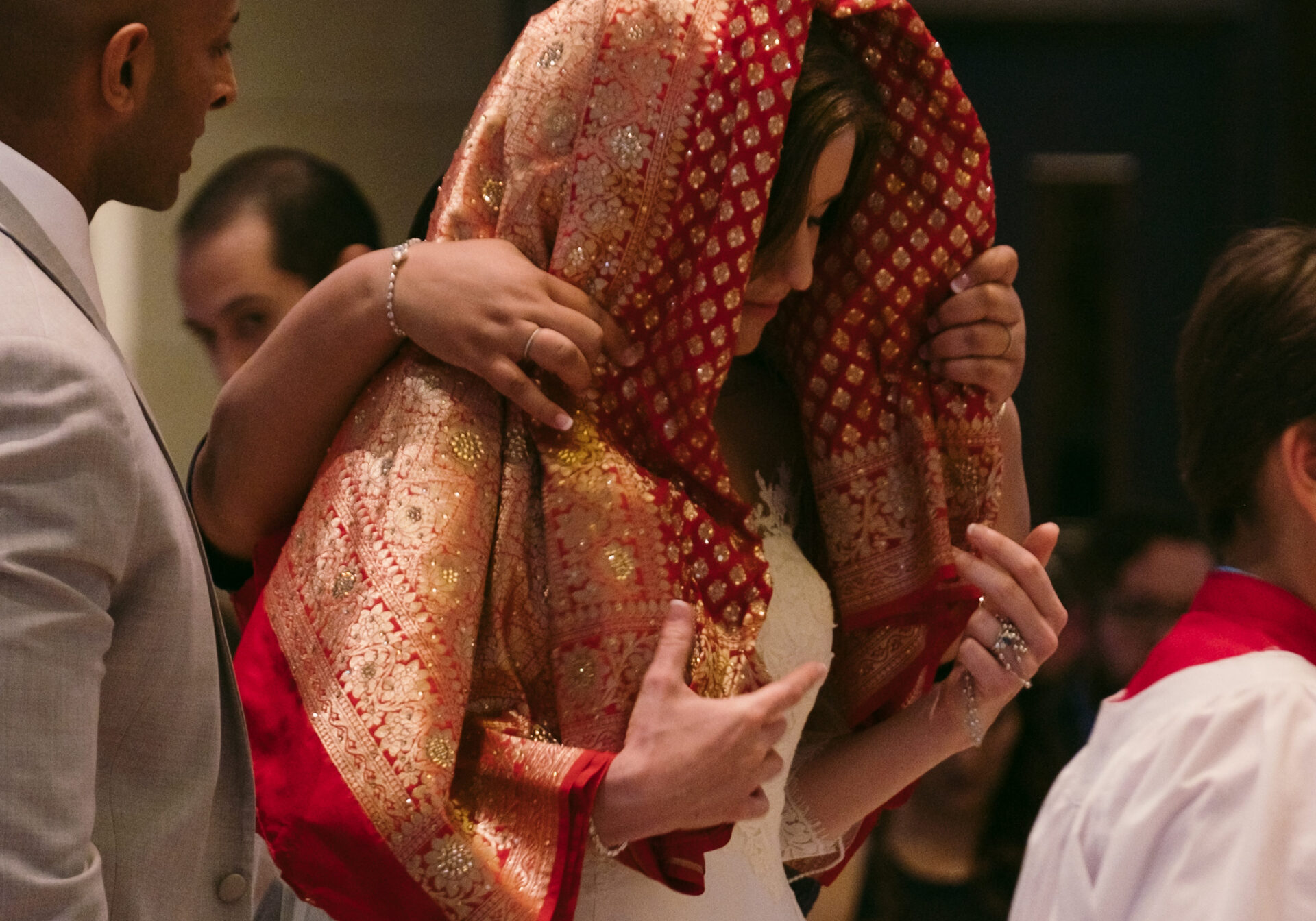
The groom then places the Manthrakodi over the bride’s head. This symbolises the groom’s pledge to protect, care for, and cherish his wife. The Manthrakodi is an adaptation of the earlier Kerala Hindu Nair tradition of Pudavakoda, where handing over clothes to the bride signified entry into a contracted marriage. At this point, the bride’s relative, who has been standing behind her, yields her place to a female member of the groom’s family as a sign that the bride is welcomed into her new home.
The ceremony ends with a benediction and prayer. The priest uses the Bible to uncouple the hands of the bride and groom – signifying that only God can come between them. It is always the priest who presides over the actual marriage ceremony, tying the Minnu. If a bishop is present, he will only bless the Minnu. This tradition may have emerged from the old Travancore Christian Marriage Acts, wherein only the priest held the magisterial power to conduct a marriage.
Epilogue: Agni Pareeksha
Even though our marriage was not conducted in the presence of the Fire God (Agni), our wedding photograph lived through an Agni Pareeksha – a trial by fire. And emerged not just intact, but radiant. What fire could not consume, time will never diminish.

