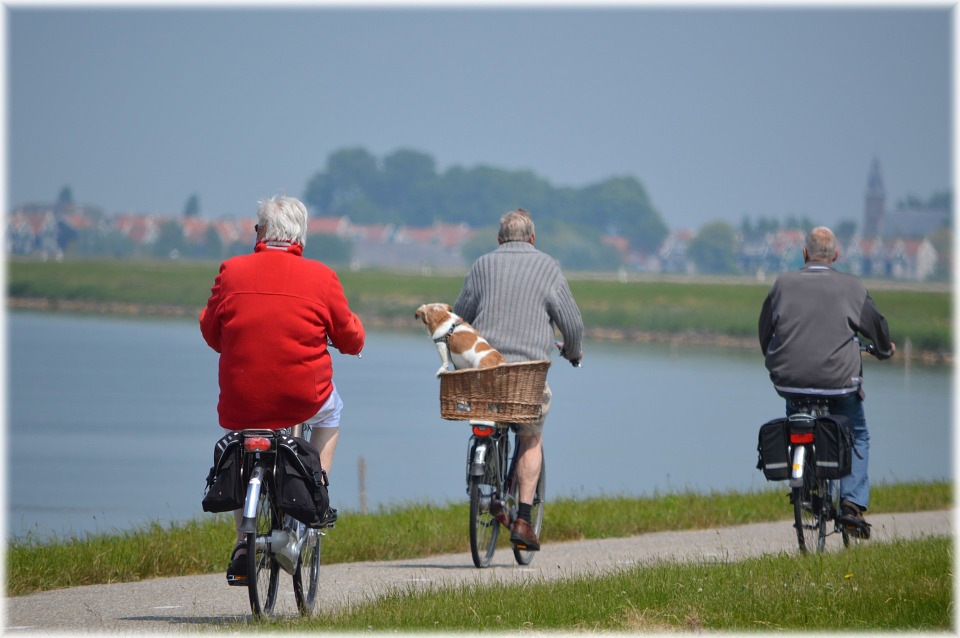
Skydiving Adventure

In the summer of 2009 we decided to visit Chicago for a week for sight-seeing and to meet my old Sainik School classmate Marur Mouli.  Mouli had his desk next to me in the class at the especially reserved place for the abstract thinkers – the last row. We were real outstanding students in Maths that we spend most of the Math period standing outside the class where we continued discussing our teenage ‘philosophies’ of life. We both qualified the entrance exam for the National Defence Academy (NDA) and Mouli was found medically unfit after the Services Selection Board (SSB) interview. He had opted for the Air Force and the medicos said that he had an open sacrum – the last-vertebra in the spine. I thought they would have declared him unfit for an open mouth and not an open sacrum. Never seen Mouli quiet and would even speak while sleeping.

Mouli was a great artist in the true sense. Good at every form of art – drawing, painting, caricature, singing, playing all the instruments available in the school’s band section, acting (his playing the Pied Piper of Hamelin is still etched in my memory), debating etc. When I left school to join the NDA, I realised that Mouli was a bit dejected and in order to raise his morale I said to him “Better things are awaiting you. Better cheer up”. I never realised what I told him until he once called me while in India to say that he saw “the better thing” after a long struggle and that he was working as a graphic designer for Apple Macintosh. In 1989 he had taken up a job as a lecturer in graphic design with the Art Institute of Chicago.

ms

During the boat cruise in the Chicago River, we came across an advertisement for skydiving and all of us decided to try our hand at it the next day. Skydiving is inherently a dangerous activity, given the unknown variables of man, nature, and machine. We reached the Chicagoland Skydiving Center located in an air-strip which was a clearing in the cornfields of Hinckley, Illinois. We reached the Center by noon and we saw a 200 Series DHC-6 Twin Otter aircraft parked next to a shed which housed the office. The receptionist, a young lady, said that the minimum age for skydiving was 18 and hence Nikhil being 12 years cannot undertake the skydiving. Nikhil said that he will come back on turning 18 and wanted me also not to jump that day. So Marina and Nidhi decided to take the jump and the receptionist got all the paperwork done.

There was one man mowing the grass in the strip cleared in the cornfield and another man picking up the garbage and cleaning the washrooms and the sheds. At 12:30 PM. About 15 men came in their pickups and most appeared to be construction workers from what they were wearing. They were the instructors and after a 30 minute orientation and kitting up, they boarded the aircraft with two instructors each – one the tandem and the other the cameraman.

The man moving the grass by then had refuelled the aircraft and was seen inspecting the aircraft as he was the flight engineer. The man picking up the garbage took to the pilot seat and the young receptionist was the co-pilot. The aircraft took off and climbed to 18,000 feet and dropped the jumpers and landed back. The flight engineer, the pilot and the co-pilot – all went back to do what they were doing before the takeoff.

The freefall was for a minute and a half on a tandem with one instructor while the other was video-graphing the fall. They were taken through many manoeuvres by the instructor during the free fall. Since the jumper was in front of the skydive instructor with own altimeter and ripcord, they had the sensation of skydiving on their own. After the ripcord was pulled, the instructor offered guidance as they flew the parachute together and landed.

The greatest advantage of skydiving in the State of Illinois is that it is not mandatory to wear a helmet (even on motorcycles), but the safety goggles is a must to protect the eyes. Thus the videos come out much better without the helmet on.

After seeing as to how the Skydiving Center operated, I had to see-off a family friend from Toronto Airport by the New Delhi flight of Air India. As we reached there, a bus pulled up carrying the cabin crew and they moved to one corner. After five minutes the co-pilots arrived by a car and took position in another corner. After another five minutes the captain arrived in another car and stood in the middle. In case of all the other international carriers, all the crew and the captain all come by the same bus and move into the aircraft as a team. Now I realised why Air India is running in perpetual loss.

How Did You Manage It?

child

Our father, a primary school headmaster, always believed that it would be better to have the children born in March (Pisceans) as it ensured that the child when joining school did not have to waste a few months. Nowadays it is mandatory that the child must be six years (in our school days it was five) old on the first day of school – 01 June. There had been many instances when the parents wanted the child to begin school early, especially those who missed the age barrier by a few days or a month or two. In the good old days, the parents and the headmaster mutually agreed to enter in records a suitable date of birth to ensure entry into school. This resulted many of our generation (including my wife Marina) ending up with two dates of birth – one the actual day they were born and the other the ‘official’ one. All four of us brothers were born Pisceans and we never had this problem of two dates to remember.

On taking over command of the unit, I went full steam automating the administrative functions in the unit and the priority was to automate the records of the soldiers under command.  This was to ensure that all their necessary documentation were up to date, they receive all their pay and allowances and are fully qualified for promotion to the next rank. The very first step was data capture from the existing manual records. After most data were transferred to the digital media, I called up each individual soldier for an interview to fill in the gaps. As we were deployed in the operational area at that time, these interviews went on till late at night. More than collecting the data, it helped me to a great extent to know the soldiers better as I was totally new to the regiment.

First use of the data captured was to make the weekly Regimental Order look more colourful. Not only that it was printed using a colour printer, the contents were also changed to be colourful. The routine stuff of Duty Officers, punishments etc were all printed in black and the goodies in colour. The goodies included wishes on festivals, compliments for achievements of the men and a special wish from the Commanding Officer (CO) on the soldier’s birthdays. With the data captured, I printed out the list of men celebrating their birthdays the week ahead.

On analysing the data of the unit, I realised that about 20% of the men were born on the first day of the year (01/01) and about 30% born on the first day of the month, especially March, April and May. I concluded that like our father, their school headmasters did the trick.

Case of Marina and her sibling is even better – they all have one ‘official’ birthday – 25 May. The secret was that their grandfather was the headmaster of the primary school and he had taken some liking to that date, like most headmasters of that time.  That is why many in our generation have their official birthdays in and around 25 May – a few days before 01 June. Now in case I got to get them all for our daughter’s wedding in Canada and when I apply for their Visas, the Canadian Immigration will have a lot of questions and lot to analyse.

During my bachelor days, on a vacation home, along with our father, we went to attend a baptism in the family. In those days we had a Bajaj scooter at home and we took off. Being the month of June, the monsoon was in full fury and we had to stop enroute and take shelter in a tea-shop. I ordered two cups of tea and our father said “That is why I always say you should plan your children to be born in March.” I immediately asked him “How did you manage it?” and he gave out his characteristic sly smile.

Years rolled by and in 1997, we were blessed with our son Nikhil on 16 March. At that time, we were located at Pune as I was attending the Technical Staff Officers Course. As customary of the Syrian Orthodox Christians, the baptism had to be done after two months and our son had to take on our father’s name and our father had to be the God Father. During the baptism ceremony, it is the God Father who carries the child to the church and also say the pledges for the child. The entire family congregated at Pune for the occasion. After the ceremony got over, our father asked me “How did you manage it?” and I too passed a sly smile. (Our daughter Nidhi was born on 20 March and I was born on 13 March).

The secret is that both our children were due on 13 March, my birthday, but the gynecologist decided to delay their arrivals.

Living Life through an LCD Screen

Our niece Deepthi, and her fiancée, Dean exchanged their marriage vows at the picturesque Lake House Inn, Philadelphia, United States on 04 June 2016.  The ceremony was presided over by Dr Alan David Fox, Professor of Asian and Comparative Philosophy and Religion in the Philosophy Department at the University of Delaware.  Dr. Fox had mentored both Deepthi and Dean while at the university.

At the commencement of the ceremony, Dr. Fox requested all invitees to be seated and not to indulge in any photography.  He said that the official photographer present would post the photographs on the internet for everyone to see.  He also requested all the attendees to pay attention to the readings and the vows being exchanged and also participate in an important event in the life of the bride and the groom.  He opined that such a solemn occasion should never be viewed through the LCD screens or the viewfinder of one’s recording device.  A very profound thought.

Is there really a need to record these solemn events in one’s life?

Surely it is a once-in-a-lifetime event and it costs dearly with no upper limit.  During any wedding, a great portion of the money would be spent on things that will be gone forever the day after the wedding.  Only a few things remain – the rings, the dress, the photos and the memories.   In this digital age, the pictures will stay until eternity, perhaps stored away in a virtual cloud, unlike our marriage album – faded, distorted and moth eaten –   but the memories will fade.

Turning the pages of ones parent’s or grandparent’s wedding album is a remarkable experience. The youthful looks  of the familiar haggard persona, a sort of reverse metamorphosis; the fashions, customs, traditions and rituals of a bygone era; the  images of many close and not so close relatives, many of them no longer amongst the living.  All of this results in a plethora of emotions flooding the sensitive mind.  It is an enthralling experience to cherish.  So, why on earth should this privilege be denied to the future generations?

Our son Nikhil, during his cultural exchange programme to France was very enthusiastic to visit the Louvre Museum, mainly to see Leonardo da Vinci’s Mona Lisa.  On reaching near the famous painting, he was somewhat disappointed as he felt that the original of the much revered painting now before him in ‘flesh and blood’, looked much like a fake duplicate of the many grand prints and photographs of the same painting that he had seen.  Moreover, it was one of the smallest in the room.  He was more bothered by some over-enthusiastic tourists, many trying to photograph or ‘selfie’ the painting.  They were least bothered about others around and proved to be a real nuisance by getting in the way and sticking cameras and selfie sticks in the face of others.  These ‘enthusiasts’ were merely interested in telling the world that they were there and had the least concern for others around or for the masterpieces which they had purportedly come to see!

These days it costs a mini fortune to physically witness any major sporting event.  To make it a profitable experience,  one must simply soak in the atmosphere of the sporting arena, get emotionally involved in the sporting action and partake of every thrilling moment of the sport.    With a cell phone in hand, it appears that everyone has taken on the role of a photographer, resulting in their watching the entertaining action through LCD monitors.  They would have done well to sit in the comfort of their homes and watch the same action, inclusive of slow motion replays, on their large LCD television.  Then why make all the effort to go to a stadium to watch such a sporting event?  Here again the selfie sticks pose a major problem and many sporting arenas in North America have rightfully banned them.  These self-styled photographers should realise that all the important moments of the game have been recorded by many professional photographers with their high-resolution cameras and would be available on the websites of the newspapers and the sports organisation.  Then why miss such an opportunity?  Why not become part of the celebration and enjoy every moment of it?

Many parents see their children growing up through the camera lens.  For them, many special events in their life slip by as they have seen them only through a lens.   They do not participate with the children while on an outing or at an adventure event or at an amusement park.  They fail to see the emotions and expressions on the faces of their children.  They forget the prime importance of living the experience and capturing the image in one’s mind rather than in a memory stick. They forget to participate wholeheartedly, live the moment with the children and absorb the experience through every pore.  Holding a costly camera or cell phone, one is sure to be scared of action and water.  It would be better to take a couple of quick snapshots, then pack the camera and celebrate the occasion with one’s family.  Family photos are surely a trigger for memories, but for posterity – when you are old – your eyesight will rarely be good enough for you to appreciate them. But the memory of a cherished moment, etched in one’s mind is joy forever!

I always pity those dads who video/photograph their kid’s birthday parties.  They are busy adjusting camera angles and lights and hence do not participate in the celebrations.  It would be prudent to call for a professional photographer to cover such events or one can request a friend to do it.  Another option is to mount the camera on a tripod and get some shots with a wireless remote.

While visiting any place of interest, spend time fruitfully to learn about it.  Listen attentively to the tourist guide if present or read through the information boards posted there.  Help your children to understand what they are seeing and a few lines of explanation from the parents would enhance the kid’s learning.   In case you are very much interested in photographing the place, reserve it for a subsequent trip.

A photograph of any object would record many a details which one would have missed while seeing it live.  One may come across interesting features that the naked eye would have otherwise missed.  Sophie and Joe would bear me out.

Unlike the digital cameras of today, film photography of the good old days was a pretty costly affair and one did not see the results until the all the 36 shots were taken.  Many a time this would take over six months.  In those days, it was easier to maintain the required balance between looking through a viewfinder and experiencing life.  Today one can easily get over 200 shots in one day with hardly any effort and at no cost.

Remember that it is vitally important to maintain a right balance between viewing life through an LCD screen and experiencing it through all the senses.

Climbing the CN Tower

CN (Canadian National) Tower is a 553.33 m-high (1,815.4 ft) concrete communications and observation tower in Toronto,  Canada.   It was completed in 1976, becoming the world’s tallest free-standing structure and world’s tallest tower at the time. It held both records for 34 years until the completion of Burj Khalifa and Canton Tower in 2010. It remains the tallest free-standing structure in the Western Hemisphere, a signature icon of Toronto’s skyline, and a symbol of Canada, attracting more than two million international visitors annually.  Its name CN originally referred to Canadian National, the railway company that built the tower, following the company’s decision to divest non-core freight railway assets.

The idea of the CN Tower originated in 1968 when the Canadian National Railway wanted to build a large TV and radio communication platform to serve the Toronto area.  As Toronto grew rapidly during the late 1960s and early 1970s, multiple skyscrapers were constructed in the downtown core and the reflective nature of the new buildings compromised the quality of broadcast signals necessitating new, higher antennas that were at least 300 m tall.  The CN Tower opened on 01 October 1976, but soon microwave communication and terrestrial TV/Radio transmissions were overtaken by satellite communication.  Now the tower is more of a tourist attraction and is raking in more money than what it was intended for.

The 1,776 steps of the CN Tower’s main stairwell are climbed by over 20,000 people annually during two fundraising stair climbs for the World Wildlife Fund (WWF) and the United Way raising well over $3 million for charity every year.  A trek up one of the tallest buildings in the world, the CN Tower Climb is one of the steepest physical challenges in the city.  Climbers face 144 flights of stairs with 1,776 steps, but the knowledge that all that hard work benefits a worthy cause like the United Way or the WWF, and with a bit of help from rest spots along the way, it’s sure to be a feat for over 10,000 climbers, who will look back on with pride.

Our family decided to undertake the feat on 21 April 2012, the day of the WWF climb.  We all practiced for a week by climbing up and down the two flights of stairs at home and going for a jog in the evening.  Our children were enthusiastic about the feat, but were a bit scared about their parents.  Appa had left the army eight years before and added a few inches around his waist and Marina, a school days Kerala State 400m winner, had been out of physical activity for a long time.  So each one decided to take along each of the parents and proving Sigmund Freud correct, our daughter Nidhi decided to accompany Appa and our Son Nikhil decided to go along with Marina.  All set we took off early morning and reached the CN Tower.  We had to shed all our jackets at the registration counter and loose objects like coins, keys, cell phones, water bottles etc are not allowed because in case anything falls off, it is sure to hurt someone climbing below.

There were thousands of people either climbing the tower or queuing up at the registration counters.  We commenced our climb after a frisking for loose objects.  Marina was bit slow to begin with and Nikhil kept company.  Nidhi and self started well with Nidhi leading the way, until about 100 flights of stairs and then realised that Appa still had it in him and I reached the top, first amongst us in about 25 minutes.  Our daughter followed a few minutes later.

The organisation enroute is worth mentioning.  There is a para-medic every four flights of stairs to take care of any medical emergencies.  There were posters made by school children, bringing out the importance of wild life conservation and also about the climb, placed at the landing area after each flight.  As we reached on top, a bottle of water was handed over to each participant.  There were climbers of all ages – from kids to grandparents, differently-able, amputees, veterans, etc.

After about 20 minutes we saw Nikhil pushing Marina out of the last step.  I asked him as to how they took 45 minutes to climb up to which he Marina said that Nikhil was all the way pushing and prodding her, and waiting with her when she took breaks and she would not have completed this climb without his assistance.  I felt really happy about his deed to take care of his mother and I asked him as to why he did not leave her and climb in good time as she would have somehow managed her way up.  To this Nikhil said that this may be the only time when Marina would climb the tower and he can do it in a shorter time later.  It was real moment of pride for all of us and I said to him that he did a great job in taking care of his mother and many teens would not have done so and I see a bright star in the sky in you.

CNTower2

On reaching home in the afternoon, an Indian family friend called us to enquire about the climb.  He asked as to how much we paid and I said that we had to pay $100 per climber as charity to WWF.  To this he said that going up the elevator costs only $25 and you pay $100 to strain yourself and climb all the way.  I did not say a word in response.

In the evening another Indian friend wanted to know as to why I took the entire family for such an ordeal (in case you are mad, you could have done it yourself), and I said that it was aimed to boost self confidence and leadership qualities in children and also to encourage charity for a cause like WWF.  To this he said that he did not understand the connection between climbing 1776 steps and leadership qualities to which I did not respond.

My First Sex Education

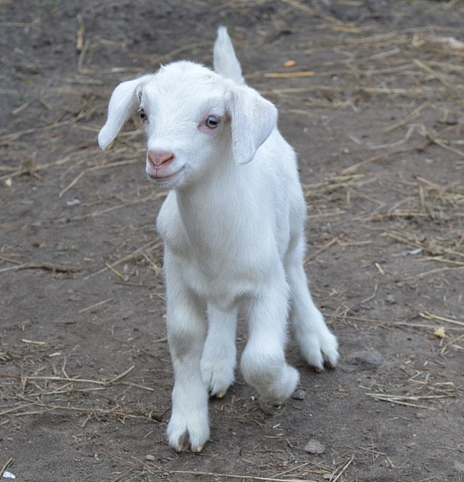
During our childhood my brother, the youngest in the family, then aged four, came up with an unusual request. He wanted someone younger to him. It was all because he was at the losing end of all the physical fights we siblings had.  At the time our parents solved the problem by getting him a kid, a goat’s kid, a female one.  That was how goat rearing commenced at our home.

In the evenings, after school, we used to take the goat out into our farmland for grazing.  We had to be on the lookout to ensure that the goat did not forage on the Tapioca (Kasava) cultivation, mainly to save the cultivation and also to save the goat from food poisoning. Little did I then know that the toxicity of the tapioca foliage was due to the presence Hydrogen Cyanide (HCN).    During the Monsoon rains, we had to cut the necessary forage from the trees which acted as support for the black pepper wines.

The kid grew real fast with all the attention and forage that we children heaped on her.  In a year she matured into a beautiful doe and was ready for a mate.  A Doe would come to heat by the end of summer and it lasts for two or three days and the cycle is repeated every three weeks.

In Kerala, the schools reopen after the summer vacations on 01 June but my Alma Mater, Sainik School Amravathinagar, reopens only by 15 June.  During my Grade 7 summer vacation, after the schools reopened for my brothers, our doe bleated one entire night.  In the morning Amma said that the doe is on heat and it is time to mate her.  That day our farm-hand did not turn up as he had pneumonia due to drenching in the monsoon showers the previous day.  I was the only one now free to take the doe for mating.

The village had a ചായക്കട (Chayakkada – teashop) run by Kuttappai.  The teashop is an integral part of urban and rural landscape of Kerala. The teashop served as the meeting place for all village elders and doubled up as a reading room.  All dailies and magazines published from Kottayam found their way there.  It also served as the village parliament‘. It was indeed a house of knowledge and doubled up as a cultural-political-social-entertainment institution, where anything and everything under the sun – from international relations to state and village politics; science to the Bible; communism to capitalism – were discussed.  Gossips too found their way in, as spicy as the narrator could make it.

Kuttappai reared a flock of goats housed in a thatched shed to the rear of the tea-shop.  He used the milk from the goats to make tea and obviously the village folk relished his special tea.  The flock was led by a majestic buck.  The buck also served as the village stud and Kuttappai charged Rs 10 for every mating.

At about 11 o’ clock, I walked our doe to Kuttappai’s tea shop, as per Amma’s advise because that was the time when the teashop would be empty of customers as people would have returned home after fiery debates and discussions.  Obviously, that was the only time Kuttappai would be free to facilitate the mating.

On reaching the teashop, Kuttappai instructed me to tie our doe closely on to a coconut tree adjacent to the goat shed.  The smell and sight of the doe in heat made the buck tied in the shed restless and his snorting and kicking increased, at times reaching a violent stage as if he would bring the entire shed down.

After 15 minutes, Kuttappai emerged from his tea-shop.  The buck was tied with a long rope and Kuttappai released him so as to make him reach the doe.  The buck went around the doe, smelled and licked her vulva and when he was about to mount her, Kuttappai pulled him back into the shed and tied him up.  That was a staged foreplay for the buck.

Now the buck had turned real violent as the frequency of his kicking multiplied and the volume of his snorts became louder.  After 10 minutes Kuttappai again released the buck and he came charging in and mounted the doe and the entire mating was completed in a few seconds.  Kuttappai now pulled the buck back into the shed and like a conqueror, the buck stood with his head high, but the tone of his snorts had changed as if to announce his accomplishment.

A doe generally gets into heat in the later part of summer and in Kerala it coincides with the onset of Monsoons (June to September).  There are certain indications the doe gives out when in heat.  Her vulva swells and become red, and she may have some vaginal discharge.    She tends to eat less and become restless because the hormones associated with fertility kick in.  A milk producing doe may decrease her milk production due to the hormonal changes.  Her frequency of tail-wagging suddenly increases and her bleats become longer, especially at night.

During the monsoons when the doe goes into heat, the buck goes into rut.  During rut the buck urinates into his mouth and on his chest, face, and beard, turning them yellow.  The scent glands near his horns become overactive.  These lead to an unbearable stink – in reality the stink is to attract a doe in heat towards him.  During rut a buck snorts, grunts and kicks its hind legs.  It tends to give a terrorising look with its upper lip curled up.

In the evening when Amma returned from school I dutifully reported to her the events of the day and posed some uncomfortable questions about the procedure and the need for it.  The School teacher in Amma responded with poise and she summarised the entire event as an act of depositing the sperm by the buck in the doe’s womb where it would fertilise an egg and would result in the formation of an embryo.  She also explained that the rooster and the hens also did the same and so did humans. Thus began my introduction to sex education.

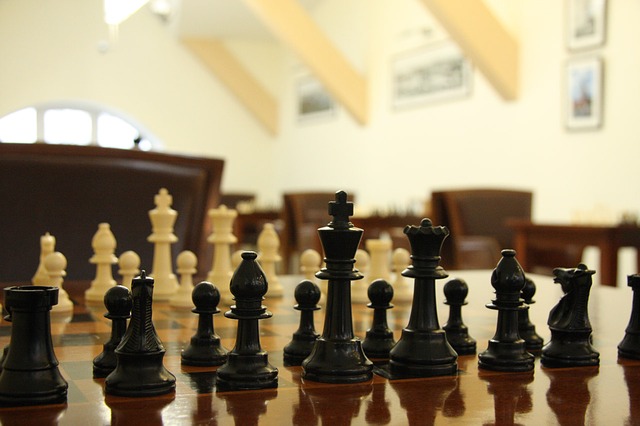
Why Play Chess With Your Children?

Sachin Tendulkar, one of the greatest batsmen in cricketing history recently said that he played a lot of chess with his brother, but without much good result, but he did enjoy the game.  He added that his son too took to chess first and then moved on to cricket.

What are the advantages of chess?  Why should you play chess with your children, at least on weekends?

The best habit you can help create for your child is one that encourages a bond between the two of you. If you play weekly game of chess with them, your kid will feel special.  Become your child’s chess partner and enjoy the results. Always remember that chess is not for nerds! It is for cool parents and cool kids.

Game for of All Ages. You can begin chess at any age and there is no retirement. Age is also not a factor when you are looking for an opponent –you can play with your parents, grandparents, uncles, aunts – the possibilities are endless.   Chess helps children with physical disabilities to improve their motor skills as the movement of pieces are in the left, right, forward, backward and diagonal ways.

Chess is Fun.   Unlike many of today’s video games, chess leads to interesting conversations as well as unsuspecting humour. The game causes a person to interact with another human being in an activity with endless possibilities.

Creative Game.  No chess game ever repeats itself, which means you create more and more new ideas with each game. It is never boring and repetitive. You always have something to look forward to. Every game you are the general of an army and you alone decide the destiny of your soldiers.

Cheap and Easy Entertainment. Considering the monthly bills of satellite TV, and video games, which reduces real communication between family members, chess is a real good option. The game of chess has been around for centuries, and once you begin to play it, you are sure to be immersed in it. Playing chess with your child gives you an excuse to make time for your child.

Develops Memory. The chess theory is complicated and many players memorise different opening variations. You will also learn to recognise various patterns and remember the variations.  Chess is also a game of experience. If you want to win successive games, you will have to learn from your earlier mistakes. Chess surely enhances your memory power.

Develops Logical Thinking.  The game of chess forces players to multi-task, plan ahead, and make real-time executive decisions. Chess disciplines the mind, which  is ideal for children, as they are constantly yearning for opportunities to be challenged. Chess requires some understanding of logical strategy. Mistakes are inevitable and chess is a never-ending learning process.  Chess develops the capability to predict and foresee consequences of actions.

Promotes Imagination, Concentration and Creativity. It encourages you to be inventive. There are an indefinite amount of beautiful combinations yet to be constructed.  Chess has also proven its ability to calm aggressive children. The need to sit still in one place and concentrate on the board will bring  a calming effect on children.

Self-Motivating. It encourages the search of the best move, the best plan, and the most beautiful continuation out of the endless possibilities. It encourages the everlasting aim towards progress, always steering to ignite the flame of victory.  You are forced to make important decisions influenced only by your own judgment.  The more you practice, the better you will become. You should be ready to lose and learn from your mistakes.

Chess and Psychology.  Chess is one game that teaches a child patience and willpower. It improves a child’s ability to interact with his opponent albeit in a silent way. This enhances confidence as well as self esteem and makes one a good listener. Listening can go a long way in improving interpersonal skills.  Chess tests your sportsmanship in a competitive environment.

Body Language.  An important feature one will learn in chess is the ability to judge body language. Being able to read expressions when a game is in progress is what will help one plan in advance. This, while applicable to the moves on the chess board are equally important in one’s life. Being able to anticipate issues will allow you to plan in advance and this will hold you in good stead no matter what situation you are faced with. Planning ahead has some great rewards, while lack of planning can result in a check mate

Chess and Your Child’s Grades. Chess develops the scientific and logical way of thinking. While playing, you generate numerous variations in your mind. You explore new ideas, try to predict their outcomes and interpret surprising revelations. You decide on a hypothesis, and then you make your move and test it.  Each game is different and there are several numerical possibilities to a strategy. Having to deal with this will develop a scientific way of thinking which is very essential when faced with multiple solutions to a problem. Being able to quickly analyse the effects of each move is what will enhance a child’s mental mathematical as well as analytical abilities.

When in Grade 8, being fascinated by the game, I requested my friend Aravinda Bose to teach me the game and he was all too willing to teach me and take me through my ‘Green Horn’ days.  On returning home for vacations, we procured a chess set from our father and I taught my three other siblings to play chess.  We played each other and learnt a lot from it.  Later I taught our children to play the game and now they beat me hollow. From my experience of learning and teaching the game at a young age, one of the recommended methodology to teach chess to children would be as follows.

Acquire pictures of the characters in medieval time warfare from the internet. Then introduce the child to the Pawn first and explain that persons’ role in the army. This is to help him develop a personal relationship with the piece which will give a better understanding, or feel, of that piece’s place and role. Place the chess-board on the table with the bottom right hand square as white.  As you play, engage the child in constant conversation directed at the move just made, potential next move, and so on. Explain why this move might not be such a good one, and why this move would be a good one.

Once you believe he is totally comfortable with the moves and responsibilities of the Pawn, introduce the King. After the pictures and description, add him to the board with the Pawns and continue to play. Continue in this theme introducing the other pieces to the child in this manner, taking whatever pace that child requires. Never rush them to the next thing as long as they are still struggling with what they have been doing. Watch closely for signs of boredom and be prepared to stop play and go do something else for a while. By following this methodology when you have finally arrived at a full board of players, your child will have a thorough knowledge of each one, know them like family and be prepared to move into the more complex moves.

If you are fortunate enough to see your child stick with it and learn the game, you will have set the child’s foot on the path to a much easier adjustment in school, better learning abilities and a far greater chance of succeeding in whatever the child attempts.

Selfie Menace and Images on Social Media

The youth of today seems mesmerised by the selfie trend.  They take selfies anywhere and everywhere, without paying heed to the sentimentality and solemnity associated with the occasion.  They do not even spare funerals. 

Danish Prime Minister Helle Thorning-Schmidt selfie at the memorial service for Nelson Mandela went viral on the social media.  This image showed Thorning-Schmidt flanked by a smiling Barack Obama on one side and David Cameron squeezing in on the other.  All of them appeared to be having fun when everyone was paying their respects to the departed soul of a world leader.  The reactions it created is well imaginable.

Here is a lesson for every netizen.  The moment an image is posted, it travels at the light of speed all over the globe.  Any awkward image provides an opportunity for the netizens to post their comments and most of these comments are going to be unpalatable.  When you post an image on the social media or the Internet, you are responsible and accountable for it.  It is for you to ensure that you do not bring in shame or touch the sensibilities of others with the image.  You need to ensure that you do not hurt anyone’s career or personal life in any way.  Make sure that you have the permission to post someone’s photograph on the social media.  Copying and pasting someone else’s photo without prior permission, even with due credits, is a crime and violation of copyright. 

In today’s world, many legal cases have emerged due to such unauthorised posting of images.  Many have been charged as stalkers/ pedophiles.  This makes it all the more important to avoid taking pictures of children without permission of their parents, even at public events or social gatherings.  Some schools have banned photography in all their school functions, obviously to avoid misuse by unscrupulous elements.  Before tagging anyone on a photograph, it is your responsibility to obtain necessary permission from the person.  Many people today feel offended by such acts.

selfie222

Posting the images of your children need special attention.  Over exposure of your children on the social media is not recommended.  Ensure that the images are not likely to be misused by anyone.  Similarly, posting images with high resolution may also invite trouble.  It is prudent on your part to distort or add noise to the image before posting it.  You can use any photo-editor or use many free online photo-editing app for it.

Avoid posting disturbing images of sick people, accident victims, etc.  This leaves a bad taste in the viewer’s mind.  Selecting necessary security settings to ensure that the persons intended are only seeing the image posted is always a good idea.  In case you are comfortable with the subject of your image, you can broadcast it to the whole world. 

One got to be extra-careful while posting of images during distress or calamities.  Some of your images may spread a feeling that you are not sensitive to the situation.  Similarly, images of funerals, cremation, obituaries, etc must be minimised.  You should pay special attention to the photos you post for such melancholic occasions and remove them immediately thereafter.   

Before uploading, posting or sharing a photograph, always pause and think what potential damage your act can cause.  Consider as to how your friend’s parents, siblings or teachers might react to the photo.  There have been many instances of people losing their jobs due to such inadvertent postings by their friends.  Many companies, prior to hiring, do peruse through the prospective employee’s social media sites to look for such aberrations.  Photos of many politicians in their youth have come haunting them later and have often caused considerable embarrassment. 

selfie1111

Many netizens tend to be bold on the Internet and on social networks and do things they might otherwise not do.  Many create fake profiles and some use tagging to attract the unsuspecting netizens on to their web page or website.  Obviously, these sites are real suspect in their content.

Geo-tagging of photos is a way of letting friends and families know where you are.  At the same time you are also at risk from burglars and stalkers.   Cyber criminals on the prowl can easily find out about your routine and also know when you are away from your home.  If you are out of station and your photo posted with a location far away will be boon for the burglars as they can very well predict your likely time of return.

If you post a photo you did not shoot, you could be violating someone’s copyright.  They reserve the right to take you to court and also sue you for damages.  The Facebook Terms of Service state, “You will not post content or take any action on Facebook that infringes or violates someone else’s rights or otherwise violates the law. We can remove any content or information you post on Facebook if we believe that it violates this Statement or our policies. If you repeatedly infringe other people’s intellectual property rights, we will disable your account when appropriate.” 

If you post pictures from a concert, fair, flash mob or any public gathering, you can post those photos without specific permission of the people you captured on camera.  There is an expectation of privacy in places like a public washroom, swimming pool, courtroom or hospital.  In many schools, photography during the public functions are strictly forbidden.  In such places, obviously, you cannot shoot and will have to depend on the official photographer if any. 

It is the responsibility of every netizen to take responsibility for all the photos and images posted on the Internet.  Hence before posting “Always STOP and THINK” about the likely repercussions your innocent post may bring about.  

Over enthusiasm to shoot a selfie must be curbed, especially at public functions as you become more of an eyesore.  As per The Telegraph, more people have died in 2014 from selfies than shark attacks.  An engineering student from Thamizh Nadu, India, fell to his death while taking a selfie.  Seven Indian youths drowned while taking selfies on Mangrul Lake, Nagpur, India as they had tipped over while posing for a selfie.

Importance of Parent-Child Communication

pcc

Often heard from parents of University students that they do not listen to them. It must all be because when the very same children were young, the parents did not have time and energy to listen to them. Obviously, now one cannot expect the children to listen to the very same parents on becoming adults. Communication play a big role in Parent-child relationship, especially in the modern society.

Being an at-home father and having brought up a daughter and a son through their teenage in Canada and also having observed behaviour of many parents and children, some of the aspects that came to my mind are discussed below.

A family and a home is not a private limited company, but is a public company where the parents and children, all have equal stakes. Along with the stakes comes duties and responsibilities. It is mandatory for the parents to ensure that they do their bit and also that the children do theirs. Making the children do chores at home, making them participate in all family activities, ensuring that their academic pursuits are successful, encouraging them to pursue their hobbies and interest and also their sporting interests and above all communicating with them to achieve the aforesaid is what the parents have got to do.

The rules and ideas suggested below have worked with our family, earlier in the Indian Army environment and now in the Canadian environment. It is neither a remedy nor pill for success nor a Dummies for Good Parenting. You may accept some, modify some and reject some, based on your judgment.

Show Interest.    Convey to the child that you are interested and involved, and you are always available for help. Whenever the child speaks to you, make sure that you turn off the television or put the newspaper down. Avoid taking a telephone call however important it may be, as for most of us, nothing can be more important than your children.

Converse in Private. The best communication between you and the child will occur when others are not around. It would be good idea to take the child out for a drive or to a quiet corner in park or a coffee shop. Many a times the child would like to discuss matters in the presence of either the mother or the father or at times both. Our son opens out his mind and discusses all his thoughts and ideas while I drive him to school or for his swimming/ guitar/ tennis lessons. He never discusses these in front of his mother or sister, fearing ridicule. Our daughter identifies with her mother better.

Do Not Dictate.    Putting a child down, especially in front of others, is both embarrassing and disgusting for any child. This will lead only to resentment and hostility, never to good communication. Try to physically and mentally get down to the child’s level and then talk.

Never React.   When you hear about a behaviour or an incident which makes you angry, do not attempt communication until you regain your cool, because you cannot be objective until then. If you ever admonish the child immediately, you can be rest assured that the child will never report any such instances in the future. Always analyse the situation and try and get maximum details from the child and may be at times from the teachers and friends, and then deliver your judgment. Assist the child in planning some specific steps to the solution and along with it provide or suggest remedial actions or methodology as to how to deal with similar situations in future in a more dignified and mature manner.

Be a Patient Listener.   In case you are tired after a day’s work, you will have to make an extra effort to be an active listener. Coax and encourage your child to bring out more details. Teenagers tend to use slang and at times un-parliamentary language in their narration. Do not ever hang on to these words as the true picture will be lost immediately. You must advise the child to curb his profanity at a later time. Listen carefully and politely. Do not interrupt the child when he is trying to tell his story. Be as courteous to your child as you would be to your boss.

Preach the Least.   Preaching is never helpful in getting communication open and keeping it open. Never come out with sob stories about the difficulties and lack of facilities you had in your childhood. Avoid using the lines like “You only talk when I am done“; “I know what is best for you“; “Do What I say“; “I never spoke like this to my parents“; etc.

Reporting Procedure.  Always encourage the child to speak to you about what happened at school, at an outing for a movie with friends, a party etc. Always be informed as to where the child is going, who all are accompanying and the back-at-home time. Your questioning technique should be such that the child will inform you all these details prior to even planning an outing with friends. On return from the event, make sure that you obtain a feedback on the activity. Never ask why but always ask what happened. You really need to prod to get the teenager speak about it and what you get will always be the tip of the iceberg, rest you got to extrapolate. Your reactions should be such as to ensure that the child reports such events, without asking, in future. Nowadays when I pick up the children after an event, on entering the car, they start off with their briefing.

Encourage, Accept and Appreciate.    Show that you accept your child , regardless of what he/she has or has not done. Always appreciate the child for the 93% marks he scored than admonishing him for the 7% he lost. You got to encourage him and advise him as to how he can do better. Say a word of appreciation like “Thank you” or “You did a nice job“, when the child does any chores at home. Never use put-down words or statements like “Stupid, that makes no sense at all” or “What do you know, you are only a child“. Once when our son made a cup of coffee and brought it up to my table. I took a sip and I heard our son say “Welcome”. I realised my folly that I had failed to appreciate his effort and the least he expected was a “Thank You“. In India we take many such actions for granted and have never developed the habit of appreciating, the idea being driven in that if you appreciate, it will spoil the child.

Participative Decision Making.   Involve the children in as much decision making as possible like the colour scheme for the walls of the home, flowers to be planted in the garden, selection of the restaurant and menu for a family dinner, family summer vacation, etc. Try and accommodate all their aspirations, at times against your own interest and wish; you may not get such an opportunity later in life. During our summer vacation to Chicago, our children wanted to go sky-diving. The main point of interest being video graphed during the free fall without the helmets (wearing helmets in the State of Illinois is not mandatory, but wearing goggles are). On reaching the sky-diving center we realised that our son was not eligible to participate being below 18 years of age. So the mother and the daughter sky-dived and the father-son duo decided to undertake the adventure after our son turned 18.

Cultural and Family Barriers.   Try not to bring in any cultural and family reasons regarding the way the teenagers dress, the friends they interact with and activities they are involved in. Many parents persuade their children from wearing short dresses or going out with friends as being Against our culture. This tends to make the teenagers rebellious and many end up taking rash and illogical decisions, more to prove to their friends that they are liberated, not bound by their parent’s culture or religious beliefs. During a summer barbecue party at an Indian friend’s place, a teenage girl was surprised to find our daughter in shorts. She inquired as to whether the parents had no objection to the dress. Our daughter said that she was used to wearing shorts back home in India as she grew up in a military environment.   The teenager said that she was not permitted to wear shorts, but she always wore one inside her jeans to school and on reaching the school took off her jeans. It is not an uncommon sight around high schools where girls come in fully covered from head to toe and after a few minutes you find them at the smokers’ corner wearing the skimpiest dress.

Parent Teacher Interactions.  “How is my child doing?” is a standard question every parent asks and the standard reply by the teacher will be “very well“. Many fail to understand that it is “very well” to the effort put in by the child and the parent’s involvement. Rather, it would be more prudent to enquire about the behavioral and leaning aspect of the child and the topics being covered in future in the class. This way one can contribute to the child’s development.

Remove all Barriers to Communication.    Modern gizmos like the Cell phone, Ipod, Ipad, hand-held gaming consoles etc are always barriers to communication. Children fail to listen to what is being said and to observe what is happening around. One must lay down strict time slots for their use and never allow them to be used during any family time: during the meals, family outings, get-together, etc. The rule at our home or in the car is that when in company of any family member, no ear phones are permitted. In case music is to be played, it should be audible to all.

Sex Education.  The most difficult subject for many parents to broach with their teenage children, but once you take the first bold step towards it, it becomes easier and would always be a rewarding experience. Studies indicate that adolescents whose parents talk to them about sex tend to be less sexually active and more likely to use an effective means of contraception. Many parents are not able to provide all the information about sex that young people need. Only a few ever got a good idea from their parents that helped them talk about sexual issues with their girlfriend/ boyfriend.   Parents must be the primary source of information about sexual and reproductive health for their children and not what they learn from their friends or through media or from the internet. Our son’s favourite line being “All my thirst for sex was quenched the day I discussed it with my dad.”

We humans are a rare species when it comes to parenting. We are conflicted between excessive care and a willingness to let them loose. We are eager to be their friends, but also to set firm boundaries. We want all their problems to vanish in a blink of an eye, but we also want to prepare them to face hardships on their own. We suffer when they make mistakes, but we don’t let them see our suffering. All these paradoxical behaviors build the barriers we face when communicating with our children.

Dear Lord, make me a better parent. Teach me to understand my children, to listen patiently to what they have to say and to answer all their questions kindly. Keep me from interrupting them, talking back to them, and contradicting them. Make me as courteous to them as I would have them to be to me.” – Author: Gary Myers

Doing it Right

gp

Walking our dog in the mornings and evenings is a ritual undertaken every day. On such a walk, we came to a pedestrian crossing and the signal started to blink red. There was a mother with her two teenaged children trying to cross. The mother started crossing and was howling at the top of her voice in Punjabi, instructing the children to follow her. The children did not move and were advising the mother against her action. The mother crossed over and the children were left behind. Here the generation gap became evident both physically and mentally.  From their diction, it was evident that the mother was brought up back home in India and the children were nurtured in Canada.

On one such walks, we were accompanied by our son and I was about to take the dog across the crossing when the light had started blinking red. Our son advised me not to do it and further added that this act was very much like running over a red light while driving. Even now I do get an itch to cross over in similar situation, but I always remember our son’s advice.

One always wondered as to how come we have that itch to break a simple law – it neither saves time nor is it any way more convenient. One can attribute it to the ethos we had practiced back home and also to the denials we faced. The spirit of winning a competition by using any means and to push forward one’s agenda could have resulted in this.

The competition we faced back home always prompted us to cross-examine our children when they came home with a report card or a test result. We always wanted to know as to who got the maximum marks, where does our child stand in the class, etc. I also followed this when our daughter came home with her first report card in Canada. She said it Is indecent to ask someone their marks in Canada and the marks are confidential and is never announced in public. My mind raced back to our school days and even our army course days; where no marks were ever kept confidential and were mostly put up on a notice board. What an injustice, especially to those who did not fare well.

In Canada, the end-of-term report cards come home in a sealed envelope and there is no discussion about the student’s performance or there is no parent interview.

The parent-teacher meeting is held after six weeks into the semester. One has heard most teachers saying that the child is doing well, whether the child had scored marks or not. In one such meeting I asked the teacher as to what he meant by saying that the child is doing well. He said that the child is doing well to his ability and your effort. My mind went back to the parent-teacher meeting we had back home where it was more of a slew of complaints than any compliments.

After an important presentation of our son in high school, I inquired as to what the teacher had commented on the presentation. He said that the teachers do not make any comment in the class and all assessment aspects would be covered on the marking sheet. The marking sheet is a rubric given to student well in advance, showing all aspects that would be assessed with complete marking scheme. This leads to more objectivity and less subjectivity. During our Long Gunnery or any Army Course teaching practices, we neither had any rubric nor were aware as to how the session would be assessed. A lot of subjectivity was left for the assessor. Each session ended with a detailed commentary by the assessor, many a times touching a high level of ridicule. The said aim of such commentary was that it would bring out the lessons for others, but at what cost?

Our course-mate from the National Defence Academy, Air Vice Marshal TD Joseph, VM, VSM, visited us in June 2016.  At the end of his stay with us, I asked him as to what he is taking with him back to India.  He said that the lesson he learnt in Canada was that in case everyone did everything correctly and the best way they could, this world would be a great place to live.  He was convinced that in case everyone followed the rules and regulations, life would be much better, and breaking rules lead to corruption and chaos, causing inconvenience to one and all.    

Caring for the Old and Differently-Abled

old

Our  son attended a training capsule regarding social service, especially dealing with the old and infirm. He showed me a pamphlet and it described how the old and the infirm need to be looked after and it concludes by saying that its more important to serve a person than looking for their disabilities. This is a lesson to be taught to the coming generations.

Amir Khan through his TV Programme ‘Sathyameva Jayathe‘ tried his best to portray the struggles of the differently-abled in India. Did you observe that the stage from where he was preaching all these was not wheel-chair accessible? There was no ramp! I am sure it would not have cost them much compared to the money the programme generated. Another TV presentation of a retirement home shown on a Malayalm channel, it was observed that the houses in the retirement home neither had a ramp nor were wheel-chair accessible. An old lady was shown climbing the steps with the support of a walker assisted by a girl.

Many buildings in India are not wheel-chair accessible; why even that; many of the Indian homes with old people are not differently-abled-friendly. Our own ancestral home; where my 82 year old mother lives, does not have a ramp for entry from the courtyard into the house. She suffers from arthritis and finds it extremely difficult to step in and out of the house.

During trip home in 2013, I had to take my mother to the Government Treasury, Kottayam, the City of Letters, to muster her pension roll. There were two options – one to drop her by car at the lower level and make her climb 14 steps, the other, to drop her by car at the upper level and make her walk 200 meter. After consulting my mother, I opted for the first option. The powers that be at Kottayam are well aware that most of the pensioners are old and infirm and to make the place for mustering be made easily accessible to them would is not a very difficult.

Public transport buses in many countries are the least differently-abled-friendly. One in the best of health needs some effort to board these buses. Many a times, the conductor/ cleaner would push the old and differently-abled into the bus; could be the next bus is close at his heels and does not want to get delayed.

Seniors in these countries are restricted to their homes –  we respect them too much to be send out for a haircut, for manicure or pedicure, for drinking coffee from the nearby coffee shop, buying vegetables, haggling with the vendors etc. We claim that the children are there to do these for them.

Wait a minute, they also have their feelings too and would love to feel the tomatoes they buy, haggle with vendors to save a few rupees, exchange a few gossip, look pretty and smart.

In most homes, the seniors are confined to a corner of a house and have limited movement or accessibility. To say the least, many are swept under the carpet/ bed. Now days a home nurse is provided to take care of them. Some of our friends here in Canada want to admit their old parents to the available old-age homes. This involves paying a hefty amount as admission fees and monthly payments, which will surprise many. Even though one is ready to pay these, many fear for the social and family stigma that the son has pushed the old parents into an old-age home and is enjoying in Canada/America. All these critics will never do anything to mitigate the problem of the seniors, but will be the first ones to raise shackles of family and social values.

During the three-week vacation in India, I realised that there is no one at home on weekdays as the adults go to work and children to schools. Spending time was the most difficult as there is none to talk to. Only way to pass time was to see those TV serials or listen to music. There is no worthwhile bookstall in Kottayam which sells English novels – most available were old – which I had read before. Then I realised the plight of my mother and I saw that she had read the day’s newspaper from first to last page and had watched four serials by the time her grandchildren were back from school. There are no activities available for the seniors to indulge in and the infrastructure does not permit them to travel around.

OldDisabled

I generally do my chores like groceries, go for a haircut, go to bank etc on weekday mornings – less busy in the Canadian Malls at this time. One sees old couples, dressed in their best, enjoying a cup of tea/coffee, window shopping, talking to other seniors, etc. Some of these seniors are wheel-chair bound. Most of the wheel-chairs are battery powered so that they can move around freely through the Malls.

In case you go for a haircut on a weekday morning, you will find only seniors, waiting for a haircut, a new hair-makeover, pedicure, manicure etc. They would be non-stop chatting with their hairdresser /beautician about their last outing for a movie, holiday, their dog, their children, grandchildren, and the list goes on. The hairdresser would be listening, nodding, at times replying to all those small talks. May be the seniors did spend some time, may be his/ her day was spent very fruitfully. At the end of it, the hairdresser/ beautician gets a decent tip for putting up with all the small talk the seniors did. In India if a senior lady goes to a hairdresser or a spa, she is surely bound to invite comments that the lady is now trying to become a beauty queen. The irony is that many a times these comments originate from their own children and grandchildren.

82-Hazel-McCallion-LR

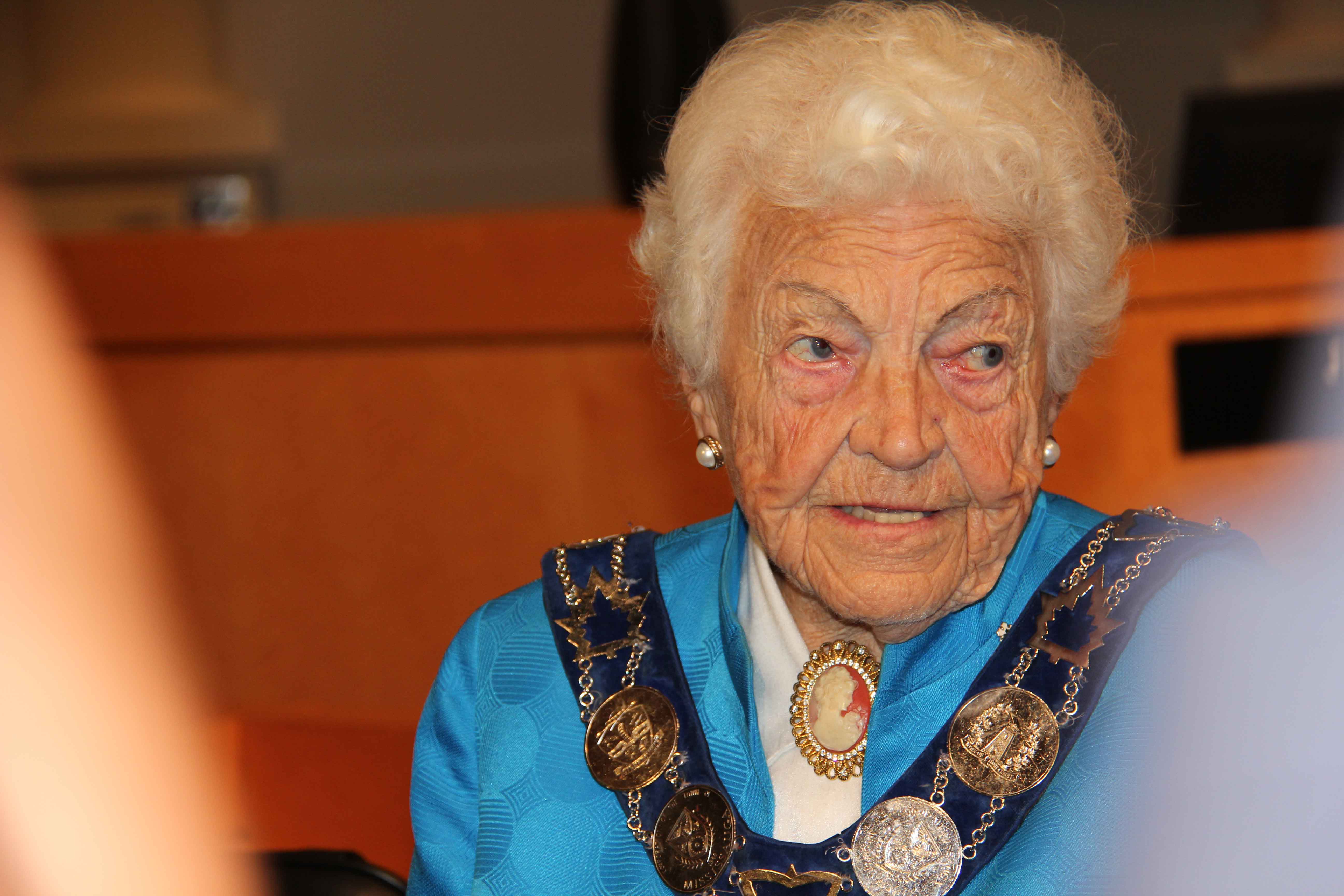
We live in Mississauga, a city adjacent to Toronto. We had Mayor Hazel McCallion until 2014 and she was  was over 92 years old then.  To read more about her, Please Click Here.  A real charismatic lady, who ran the city with an iron hand, drove around in her car etc. Mississauga is the only city in Canada to have a surplus budget and the city boasts of a very high standard of amenities, social life and infrastructure.  Obviously, the real-estate prices are pretty high in comparison to the neighbouring cities.  She spoke at our daughter’s High School Graduation in 2010; what a powerful speaker she is. I wish we also had such powerful seniors back home too.

The public transit in Canada, the public buildings, the malls – all got to be wheelchair accessible by law. Further the Senior Citizens get a good discount on many City Transit systems. Many cannot drive or their licenses have been revoked by the Transport Department due to their medical conditions. These seniors travel on their own without any assistance and do most chores on their own.

Nikhil’s Kerala Trip

In December 2012 our son Nikhil wanted to accompany me on my trip to Kerala as he had two weeks of Christmas vacation.  I asked him the reason behind such a decision and he said that it was to spend a few days with his grandmother, uncles and cousins.  He also wanted to visit all the old temples and churches in Kottayam and what interested him the most was Sree Padmanabha Temple at Trivandrum as he had read a lot about the billions worth of treasure the temple had.

fml

Accordingly we landed early morning in Trivandrum and checked into the Taj Hotel.  He was really astounded by the top quality service rendered by the Darwan (Person guarding the main entrance and receives the guests), the bell boy and the room service, the likes of which he had never experienced in all our travel across North America.  After visiting the temple we headed to Kottayam and stayed with my eldest brother, with whom my mother lived.

During every Kerala visit, I make a trip to Kochi to meet my Sainik (Military) School classmates, Veteran Commander Reginald and Mr Roy John (Collector, Customs) and this time too Reginald was gracious enough to arrange an evening at the Naval Institute.  Nikhil was again surprised that once he was about to empty his Coke glass, it was refilled by the waiter, a privilege he had never enjoyed.

Nikhil interacted with his cousins and became closer to them than before.  They saw a Hollywood movie on DVD.  At the end of the movie, one of the cousins commented that it was for the first time he enjoyed and understood a Hollywood movie.  Nikhil all through the movie paused the DVD, explained to them the context  of the scene with respect to the events in North America and its culture; replayed the scene.  Until then they said they never understood the inner meanings of many scenes and obviously never the subtle humour associated with them.  I told them that my plight is still the same and I do not get the essence of many scenes in the movies as I am not as well versed with the North American society as our children – they go to school in Canada.

Interacting with my elder brother who at that time was the Public Prosecutor and a Communist supporter, helped to enhance Nikhil’s knowledge about the legal system in India.  It also gave him an insight into the growth of Communism in India, especially Kerala, resulting in the first democratically elected communist regime under Mr. EMS Namboodirippadu in 1957.  They held many discussions about the relevance of Communism in the world today and how it played a great role in bringing social changes in Kerala.

They discussed as to how the term ‘Kerala Model’ of development was termed and how Kerala achieved improvements in material living conditions reflected in indicators of social development comparable to those of many developed countries, even though the  per capita income is low.  Achievements such as low levels of infant mortality and population growth, high levels of literacy and life expectancy, along with other factors responsible for such achievements were also discussed.  There was a discourse about contribution of various Communists governments in achieving such development when the rest of India lagged very much behind  (obviously not because of the ‘Gulf Money’ as many from North India think as consolation for their lack of progress).

On our way back to Canada, we came through Chennai as we had planned to spend an evening with Major General PK Ramachandran, who was our Commanding Officer and at that time serving with the Area Headquarters at Chennai.  On reaching his residence, the sight of the guards, the way the lawn was manicured and the fabulous garden, the way he was looked after by the General and his wife and all the services he received from the staff at the General’s home seem to have touched a nerve or two in the teenager.  When we went to bed, Nikhil asked me as to why did I leave all these luxuries behind and quit the army and whether I missed these.  To this I said that I really miss all these, but had to make a choice between the family and the army and hence I migrated to Canada to join the family.  Had I continued in the army, they would have visited me during their vacations for few weeks and I would have visited them for two or the most three months (including furlough) in a year.  I was touched by his reply “That is a real sacrifice for our sake”.

One day at Kottayam, we decided to set off on foot to visit the old temples and churches around my elder brother’s home.  Nikhil was finding it difficult to keep up with me and I asked him whether he was feeling good to walk or should we hire an auto-rickshaw.  He said that he had a heavy breakfast as his grandmother wanted him to put on a few kilos and hence piled up his plate.  He was upset that the granny did not realise that his body structure and metabolism did ensure that he remained thin and it was not that he did not eat enough and he added that granny being a school teacher, who is well read and well-traveled should realise these facts.  “You could have always refused her and could have left the meal half eaten”, I said.  “Your mother is too powerful and I can never say ‘no’ to her.  Look at your eldest brother who is four years elder to you and your elder brother, the city’s public prosecutor, they never said ‘no’ to her and instantly obeyed all what she said.  When she was in Canada with us, you never said ‘no’ to her.  How do you expect a little boy like me stand up to her and ever say a word,” said Nikhil.

 I then realised that this trip was worth more than a thousand times its cost. The value of knowing one’s roots is often incalculable.

Whom Will You Marry?

During lunch, on his return from classes while in Grade 12, our son Nikhil asked me “Why did you marry Mom?  You never dated her, you did not go to school with her, you did not know her from before.  Your parents selected her, you saw and spoke to her for five minutes and agreed to marry her.  What prompted you to take that decision?”

Marry

I said to him that once my parents selected her, they must have seen something good in her and her family.  Her parents and siblings were well educated and she was in her third year of Pharmacy graduation.  Her academic record till then was outstanding, from her high school days until her graduation.  Further, during her high school days, she was the Kerala State champion in 400 meters run.

Now Nikhil wanted to know how it made any difference to me  or to my family.  I explained to him that  by virtue of me  serving as a Major in the Indian Army then, I needed a partner who could cope up with the pressures of being an ‘Army Wife’.  Marina was doing her Pharmacy Graduation at Gulburga in Karnataka State (about 600 km from her home) and hence she had to be independent and ought to have travelled a lot on her own.  She had to be intelligent and hardworking, else she would not have done so well in her Pharmacy course.  Further, she ought to have been physically fit, else she would not have won those laurels in athletics.   She being bit adventurous (I realised after marriage that she was much more adventurous,) would be an ideal life partner  for me.

Now he wanted to know as to whether it has had any effect on the children.  I explained to him that both of us being physically fit and intelligent, the God has blessed us with two kids, intelligent, smart and physically fit.  The kids have no physical deformities like flat foot, knock knees, bow legs, etc, which has enabled them to do well in sports, music and dance. 

WhomWillMarry

With the volley of questions being fired at me, I realised that there had to something more to it.  I prodded him a bit and he said that Ms Kent, the English teacher, was holding a discussion the next day as to “Whom will you marry? A beautiful woman, a rich woman or an intelligent woman.”  The boys in the class had to present their cases and the girls would cross-examine them. 

I now asked Nikhil as to what his take was.  As expected he said he would marry an intelligent woman.  Now we discussed the pros and cons for each case and at the end I said to him not  to be surprised to find that he might be the only one supporting his case.  I advised him to be well prepared to take on the girls and use all his charms, wit, language skills and oratory skills to manage the situation.  

Next evening, at the family dinner, Marina asked Nikhil as to how the discussion in the class went.  Nikhil said that he was the only one supporting the case for an intelligent woman and the rest of the boys were mostly for a beautiful woman.  After everyone presented their cases, most of the questions from the girls were directed at Nikhil.  One girl asked as to whether he would accept a woman if her father offered him a million dollars.  Nikhil countered it by saying that in case the girl is intelligent, he would not stop at a million but would make billions.

Another girl asked him “If the woman is so ugly, then how can you move around with her.”  Nikhil’s point was that he wanted a woman who does neither hitch on to him nor he wanted to hitch on to her.  He was marrying her for companionship and not to show her off as a booty.  Also, he would not have to protect her from gazers.

The boldest among the girls asked “If the woman is so ugly, then how can you have sex with her.”  Nikhil explained that the pleasure of sex is mostly from the mind and hardly from the body.  Most animals during their intercourse do not look at their partners.  Most humans have sex either in the darkness or they mostly close their eyes during an intercourse.  Hence beauty  did not matter to him.

Ms Kent wanted to know the source of this piece of information and Nikhil said “It’s from my Dad”

Now Ms Kent said that she wanted to meet me.  After Nikhil said this, I found Nidhi walking away from the dinner table.  She came back after a few minutes, and I asked as to where she had been.  She said she was chatting with Ms Kent of the Facebook as to why she wanted to meet up with her Dad.  Ms Kent was Nidhi’s English teacher too and were friends after she graduated from high school.  That was when Ms Kent realised that Nikhil was Nidhi’s sibling.

Sitting Position

Walking down our city’s (Mississauga, Canada) streets, one can see many Yoga studios that have sprung up in all the malls.  Anyone will be fascinated by some of the names the studios had – Moksha Yoga, Power Yoga. Parivartan Yoga. Bikram Yoga (named after Bikram Choudhury, the India-born, Beverly Hills-based Yogi,) Infinite Yoga, Hot Yoga, Organic Yoga, etc.  It seems the city has now got into a Yoga craze.  Most gyms in the city offer Yoga classes as part of their fitness regimes.  Our children regularly attended them and are most amused by the Yoga instructors speaking out Sanskrit Yoga terms with their accents.   Most Yogis who teach are non-Indians and the students also cuts across the class divide, with hardly any Indians, as is seen in any outdoor, voluntary, adventure or physical activity in the city.

yyy

Are you familiar with this sign?  Seen it anywhere?  This is the new sign for a Yoga Room, mostly at airports, hotels, gymnasiums across Canada and US.

Think of any busy international airport and you probably think of delays, long lines, hectic and noisy. San Francisco International Airport, however, hopes that those will be replaced by Om and chill because of its new addition: A yoga room, in January 2012.  The facility is open 24-hours a day and is free of charge.  Dallas Fort Worth International Airport opened their Yoga Room in 2012 with Chicago International airport following suit and opened a Yoga Room in 2013.

On a recent trip to India, our connecting flight was delayed by two hours at the Brussels Airport due to inclement weather. As usual the airport lounges were overflowing with stranded passengers. All possible seating were  occupied. There were passengers all over the floor, young and old, some reading, some listening to music, some surfing the Internet on their laptops and some chatting. My attention immediately caught a few children in their early teens from Canada, sitting on the floor with their legs crossed (Chaukadi/ Chamram – Lotus Position) and talking.

I thought with the limited space available, I should take up that position and continue to read the novel I had, to spent the next two hours. My attempt to sit like the children failed miserably in half a minute. I just couldn’t sit like those children. My legs and back were paining and I thought all my muscles had cramped in unison. Then I moved my position next to the wall and with the support of the wall and with my legs stretched out, I could sit and read for five minutes and then I felt I did not have any control over my legs. My attempt to stand took a miserable half minute.

This led me to ponder as to why I had such a problem sitting in Chaukadi position. I travelled through the time graph back to my childhood. I remembered that I could sit like that in the kitchen floor with our father and siblings and we used to eat the meals our mother served. As the economic situation of the family improved over the years, we added a dining room and with it came a dining table and the habit of eating our meals sitting on the floor in lotus position went out of the window.

The only place where I sat on the floor was during the few minutes of sitting interludes we had during the Kurbana (Holy Mass) at the Orthodox Syrian Christian Church. Most of the Mass was offered in our church standing (unlike the catholic churches) and we never had any seating arrangements other than for the old and infirm. The only other time we sat in the church was during the sermon by the priest – I always thought why it had to be that long and mostly repetitive.

In the school we always had a bench and a desk and our father used to tell us as to how privileged we were and that during his school days they always had to sit on the floor, even in high school. Was it a privilege? I started to ponder?

yoga11

On return to Canada, I had to visit our son Nikhil’s Primary school to meet the teacher. As I walked through the aisle, I observed that in all the classrooms, the children and the teachers were sitting on the carpeted floor. Only half the classroom was filled desks and chairs. On enquiring from Nikhil, he said that most of the class time were spent on the carpet.  The children always removed their shoes and placed them in the cupboard outside before entering their classes.  In case someone wanted to wear shoes in the class, the student had to get an ‘indoor’ shoes and had to be kept inside the classroom.  Now I found the answer to my question at the Brussels Airport – as to how the Canadian teens could manage to sit in lotus position for such a long time.

In the school cafeteria, fast-food is banned and pop/ beverages are strict ‘No Go.’  Students are mostly casually dressed and there are no ties and coats/blazers, in most schools there is no uniform.  There is a lot of stress to educate children about the ill-effects of these junk food and pop and the results are showing in the fall of business for these stores.  In India one sees long queues in front of the franchises of American Fast Food Chains.

Later I called up a friend of mine, who is a principal at a private school in Kerala and tried to explain to him the importance of making the children sit on the floor – at least in primary classes. I reasoned with him our old traditions of ‘Ashan Kalari‘ and ‘Gurukulam‘ and as to how children learned to write and read sitting on the floor. The principal said that he could see the advantages of it, but to convince the parents about it would be next to impossible.  In case he implemented my idea, he is sure that his school will face closure as no parent would like to send their children to a school where the students sat on the floor in lotus position.

May be Indians’ loss is Canadians’ gain and Indians are picking up all that the Western World is now rejecting.

Volunteer – To Give Back to the Society

Volunteering

“Service to Mankind is service to God” is the proverb highly prevalent all over the world.

“The best way to find yourself is to lose yourself in the service of others” – Mahatma Gandhi

“One should perform karma for the benefit of humanity.” – Rig Veda

“Truly I tell you, just as you did not do it to one of the least of these, you did not do it to me.” Bible – (Mathew 25: 45)

A friend was admitted in the Intensive Cardiac unit of a hospital in Toronto and I had gone there to give moral support and a few soothing words to the members of the patient’s family. I went there with the pretext that the ICU will be as neat, clean and well looked after like the Military hospitals in India. To my unfathomable surprise what I saw made realize how the Canada government cared for its citizens. In Canada, health-care is all government and there are hardly any private medical services.

The patient had suffered a cardiac arrest and his wife called the Emergency Services, who dispatched an ambulance, a police cruiser and a fire engine. Meanwhile, the person attending the call was giving out instructions to help the wife perform CPR. First to arrive on site was the police cruiser and the police officer immediately took on the task of CPR. The ambulance arrived and the patient was immediately moved to the hospital.

In the ICU, the patient was in a coma and in order to control his metabolic activities, his body temperature was reduced by a degree or two. All modern hi-tech medical instruments were employed to monitor the body parameters – many instruments I had neither seen nor heard of. There was one dedicated nurse manning the station 24 hours, each doing 8 hour shifts. (there were eight other beds in the vicinity and each bed had a dedicated nurse). He briefed me in detail about the patient’s medical condition and the parameters being monitored by him.

While leaving the hospital, I noticed that the person who controlled traffic at the entrance, the old lady on a wheel-chair guiding visitors to various wards, the veteran manning the reception at the ICU – all were volunteers. Then I remembered as to the tough procedure our daughter and son had to undergo to get a volunteer position at the local hospital – medical check-up, police verification and recommendations from two high-school teachers. In Canada 40 hours of community service is mandatory to graduate from high school.  It  is sure to carry you miles when applying for university admissions and also would always look much better on one’s resume.

On my next visit to the hospital, I was greeted by a cheerful man in his late seventies, controlling traffic. I was forced to stop and chat with him as to why he is so cheerful and doing a voluntary service. He said that he had to give back to the society what the society had given him. He further added that he commutes by the subway and bus for an hour each way and does a four hour stint at the gate.These six hours is spent fruitfully by him rather than lying on the bed and cursing the world, the people around him and the God. What a great philosophy?

Many of the volunteers I spoke to had similar explanations for their drive to volunteer. One can see senior citizens volunteering at crossings in front of the schools. They ensure safe passage of children for about an hour in the morning, during lunch-break and when the school session ends. In India such services are available to only political leaders and VIPs, both in civil and the military. The points-men lining up the roads to ensure safe passage of the VIP can effectively be utilized to ensure safety of the children, who are a better investment than the VIP.

These volunteers manning these crossings also had a similar point of view regarding volunteering. One retired police officer manning such a crossing said that the city would have to pay heavily in case the city took up task of manning these crossings and the police force will never be available at the peak hours for ‘real’ policing duties.

During field-trips and outdoor visits by the school children, along with the consent form comes a volunteering sheet, which the parents may fill-up in case they are available to help the teachers in smooth conduct of the event. Visualize one teacher handling 30 children on a field-trip? Generally one found about five to six parents accompanying the kids.

As usual people from our sub-continent are hardly seen volunteering. During one of my hospital visits, I met a senior citizen who had immigrated from India at the coffee shop. I inquired as to why our children and seniors do not engage in such volunteer services. He said that our people also do volunteer services – at religious places of worship where they clean the shoes, sweep the floor, cook food, clean utensils etc. To my surprise and disgust he had his philosophy and justification in place – “there we do service to God directly”.

People volunteer their time to an organization because they want to support their community. As per Statistics Canada, in 2010, almost all (93%) volunteers said that making a contribution to the community was a key motivating factor in their decision. Although most volunteers get involved with a charitable or non-profit organization for altruistic reasons, most also believe that they receive substantial benefits themselves. Many stated that their volunteer activities had given them a chance to develop new skills; for example, about two-thirds said their interpersonal skills had improved. Volunteers also thought their volunteer experience had given them better skills in communications (44%), organizing (39%), fundraising (33%) and technical or office work (27%). One-third (34%) also reported that working as a volunteer had increased their knowledge of such subjects as health, women’s or political issues, criminal justice or the environment.

Now think of the vast pool of human resource available in any community in India, who can contribute back to the society. In India, most people retire from their active employment by the age of 60 unlike in Canada where retirement is generally after 70.

Whether you donate money or time, giving back is beneficial–and not just for the recipients. It’s better to give than to receive. Besides feeling good about yourself for doing something for others, giving back is also good for your physical health. Canadian study found 85% of Ontario volunteers rated their health as “good,” compared to 79% of non-volunteers.

Studies have shown a relationship between volunteering and increased self- esteem, with volunteers reporting both greater personal empowerment and better health. Doing for others may stimulate release of endorphins, which has been linked to improved nervous and immune system functions, too.

Helping others can help take your mind off your own problems and enable you to see the bigger picture. Once you see the difference you can make in another person’s life, your own problems can seem smaller and more manageable.

If you wait until you can do everything for everybody, instead of something for somebody, you’ll end up not doing nothing for nobody.” ~ Malcom Bane

Stone Age Days of My Life

When our son had accompanied me  on our trip to India in 2012, we stayed at our ancestral home, inherited by my younger brother (a Syrian Orthodox Christian tradition, also followed by most Christian households in Kerala), wherein the youngest son inherits the ancestral home and along with it the responsibility to look after the aging parents.  This could be because he is the one most likely to outlive the parents as in the olden days marriages were consummated at an early age and the prevalence of deadly diseases with poor healthcare, in some cases the parents outlived their children.

We spent a few days there and our son, prowling around the backyard, was trying to place the tamarind trees, jack-fruit trees, breadfruit tree, chicken pen, cow shed etc (almost all of them have disappeared now), based on all the stories I had narrated to him about our growing up days.  He suddenly found a stone, looking more like a ‘Shiva Ling‘ as per his perception and knowledge of Hindu mythology.  He imagined that the earlier owners of the property could have been Hindus and they must have left the stone and our family might have stowed it away safely in the backyard.

He called me out and sought my explanation about the origin of this stone.  I explained to him that it was the ‘Aattu Kallu’, a circular base stone with a hole, six inch in diameter and depth, chiselled out to make space to put in soaked rice and lentils to be ground for making batter for Dosa and Idli.  The cylindrical stone applies pressure while being manually churned around in the hole on to the rice and lentils, thus crushing it into a smooth paste.

The kid could not grasp the entire operation as I could make out from his expressions.  The only way to make him understand was to hold a demonstration (experiences in conducting lecture-demonstrations while in the army came handy).  I requested my sister-in-law to soak some rice and lentils overnight for the demonstration scheduled next morning.

Seeing his curiosity, I decided to introduce  a few more items of interest.  Outside the kitchen in the work area, there was the ‘Ammi Kallu’. I took him there to explain as to how the wet-grinding of shredded coconut and spices was done on a two feet by a foot rectangular stone platform with the help of stone cylinder of about six inches diameter and a foot in length.  It is an art to move the stone cylinder over the platform without rotating it.  Rotating the stone cylinder meant less pressure on the material to be ground and hence additional time spent.  My sister-in-law was gracious enough to conduct a demonstration of its utilisation (after she kept aside the Sumeet Mixie), and I conducted the accompanying lecture.

StoneAge115

There is also an interesting cultural association.  The Thamizh Brahmin groom inserts the toe ring (Metti) on the bride’s toes when the bride places her foot on the Ammi Kallu.  It is believed that as per the Indian myths that the Ammi Kallu is a magical stone, and the coconut and spices ground on its surface is believed to be healthier than the ones done in an electric grinder.

Ural

In the corner of the work area was the ‘Ural‘, unused for many years, given way again for the more efficient modern electric mixer grinder.  Ural is again a stone cylinder about two feet tall and two feet in diameter.  On the top surface, similar to the Attu Kallu, a hole, six inch in diameter and depth, chiselled out to hold rice, or coffee beans.  De-husking of raw or boiled and sun-dried rice was done in the Ural.  Powdering of rice or the coffee beans or spices was also executed here.  It was strictly meant for dry grinding only.  There is a five feet tall baton made of hardwood, with a metallic cover at the base, which is lifted up and pounded on the material inside the hole.  Perfecting the art of not spilling the contents while pounding is developed over time – to start with for any learner, the speed of pounding is a bit slow, but with practice, the speed really picks up.  In my younger days I have seen two ladies doing this in tandem.  Real precision timing and coordination is required for each pounding, else it could spell disaster.  With a small quantity of rice, I did a demonstration, but the contents did spill out.

StoneAge22

According to the Hindu mythology, one day Yashoda,   lost her motherly patience after a few pranks by little Lord Krishna.   To keep him quiet, she tied him to an Ural and went into the kitchen to attend to her chores.  Now alone, Krishna dragged the Ural and passed between two large trees. The Ural got stuck between the trees and with one yank, he succeeded in freeing himself and also in bringing down the trees. The trees were in fact two Gandharvas (male spirits with superb musical skills, husbands of the Apsaras [beautiful, supernatural female beings]), who were transformed into trees by a curse by the sage Narada, with a condition that they would be reincarnated by the touch of Krishna.

Next morning, we did the wet grinding practice; I demonstrated the activity and our son followed it up.  Here again coordination is required to rotate the stone cylinder with one hand and push the material into the hole with the other.  We used to take turns, in teams of two, one doing the cylinder rotation and the other pushing the material.  I explained to our son that the secret behind the well toned arm muscles of his dad and the three uncles were courtesy these stone implements.

Helping Teens to Overcome Profanity

rrr

Picking up our son Nikhil one afternoon from school (he was in Grade 12), I noticed that he did not look his normal self.  After driving for a few minutes, I enquired as to what went wrong at school.  A bit surprised with my question and being in no mood to give the answer, he said it was OK.  The answer by itself was evidence enough that it was not all that good.

After a few minutes he came out with the agony he had to face during the group presentation that morning.  Two of the students in the group came unprepared and they had a bad presentation.  He was not feeling good about the entire incident.

There were four students in the group and two of them had really put in a lot of efforts and two had not.  During the lunch break, after the presentation, the boy who had put in a lot of effort literally had the unprepared two on the mat and Nikhil said he did enjoy the show, but did not speak a word.  He added that he wanted to see how silence is golden and also to accept a failure, (even though not due to his fault) with all the humility and also enjoy the way the other student was castigating the other two.

He explained all these with a lot of North American teen adjectives and prepositions – all those spicy words which most sons would not throw at their dads.  I listened patiently and did not utter a word.  I was not all that happy about the coarseness of the language being used, but decided not to react.  I try and avoid immediate reaction as the children at that stage are never ready to listen and see any logic in what we say and will only help to push up our blood pressure and leave a bad after-taste.

While having lunch on reaching home, I said to him that yes, he did not have all that a good day at school and he had been wise enough to accept the failure, but the language he used to explain the same should be avoided as much as possible.  I explained to him that bad language is never a problem solver, but will always end up as a frustration enhancer.

To this he said “Dad, the hormones are kicking in, and as a Teen, I have no control over it”.  My mind went back to the National Defence Academy (NDA) days, where we used the same expressions with our friends to vent out all the frustrations we had after a horrible event or a bad day.

As children grow up, they tend to experiment with inappropriate language and dirty jokes. In most cases, it is an imitation of an adult whom these children have seen at home, in movies, in television shows, or in the community. The need of the hour is to make the children realise the appropriateness of language they use and its impact on the listeners.

Many teens resort to inappropriate language to demonstrate that they  have turned into a matured adult. Parents have to explain to the children that inappropriate language is never an impressive trait and would never fetch any credit, but only disrespect. It is very easy to preach, but when a careless driver cuts you off or when a heavy object falls on your foot, some profanity is sure to slip out of your mouth. As a matured parent, it is one’s duty to acknowledge that one used an inappropriate word and must have avoided it in itself is a good learning for any kid.

Over-bearing and over-controlling of teenagers by the parents results in the children wanting to break the rules and to release the parental pressure. Also to prove that they are ‘cool’ in front of their peers, these children mostly end up using swearwords.

It is the parent’s duty to train their kids in appropriate and correct language use. Some tips which I effectively used are:-

  • Listen, Listen and Listen.  Always make it a point to give a patient listening to your children.  Show keen interest in what they are speaking and provide them with feedback.  If you do not listen to your children, please do not expect them to listen to you when they are teens or youths.
  • Never Laugh it Off. Most children would take it as an approval and will ensure a repeat when the child wants to steal the spotlight.
  • Do Not Over-React.   Your over-reaction will only help to reinforce the behaviour. The child is most likely to use it again to gain attention or to irritate you.
  • Do Not Confront. Anything said to an angry person will only upset him further. Hence it is advisable to explain to the kid an alternative to inappropriate language at a calmer time.
  • Watch Your Words.   When at home or while going out with kids, ensure that you use the most dignified language. Always remember that your kid will pick up your one swearword a thousand time faster than a hundred good words you uttered.
  • Beginners Do Not Realise.   Any kid beginning to talk, often does not realise the meaning or inappropriateness of a swearword. Scolding them or punishing them would serve no purpose. It would be prudent to ignore it and generally they do not repeat.
  • Explain to a Grownup. A simple explanation to a middle or high school kid about the inappropriateness of the word would often ensure good results.
  • Punish Only When Needed. Award of a time out, suspension of certain privileges or grounding for profanity will surely reduce the use of swearwords, especially by the teens.
  • Create Expressions. Encourage the teens to develop a collection of effective expressions to use in place of swearwords and apply it to inescapable situations.

Parents got to set examples for the children at home and help them overcome the need to use swearwords.

Under certain circumstances, profanity provides a relief denied even to prayer.” Mark Twain

Canadian Report Card

Competition we faced back home always prompted us to cross-examine our children when they came home with a report card or a test result.  We always wanted to know as to who got the maximum marks, where does our child stand in the class, etc.  At the end of Grade 3 of Nikhil, when he came home with the report card, he declared “Do not ask me how others did as I have no clue as I did not ask anyone about it.”

repc

It is indecent to ask someone their marks in Canada and the marks are confidential and is never announced in public.   The report cards are handed over to the students in a sealed envelope, obviously to ensure confidentiality.

The aim of a progress report in Canada is to enable the students to reach their potential, and to succeed. It is a real challenge for the school as every student is unique and they got to ensure each student gets adequate opportunities to achieve success according to his/her interests, abilities, and goals. The reporting is fair, transparent, and equitable for all students. It supports all students, including those with special education needs and all those learning the language of instruction (English or French). The curriculum is carefully planned to relate to the expectations, learning goals and cater to the interests, learning styles and preferences, needs, and experiences of all students.

All aspects of learning are communicated clearly to students and parents at the beginning of the school year and at other appropriate points throughout the school year or course.   The reporting provides a descriptive feedback that is clear, specific, meaningful, and timely to support improved learning and achievement. It also develops students’ self-assessment skills to enable them to assess their own learning, set specific goals, and plan next steps for their learning.

The high school report card looks more like the Annual Confidential Report (ACR) in the army – it appears as if it leaves no aspects of learning skills and work habit of the child uncovered.  The aspects covered in the report are Responsibility, Organization, Independent Work, Collaboration, Initiative and Self-Regulation.  Strengths and Steps for Improvement are listed out for each subject separately.

RepotCard33

My mind raced back to our Sainik School days and even our army course days, where no marks were ever kept confidential and were mostly put up on a notice board.  I always looked at the mark list on the notice board to make sure that I was not the last.  What an injustice, especially to those who did not fare well!

Once I perused his report card in Grade 11, I asked him a few questions to find out some details about the steps for improvement and we discussed in detail as to how he is going to prepare for his Grade 12.   After discussing the same, I casually asked our son as to how his friends did.  Our son theorised that students want to either show off their marks or feel a bit good when they have really done well or in case they haven’t, they are looking for someone who did worse.  He was not in either and hence did not find out how others did.  I realised that what he said was what I had been doing all throughout my life, either blow the trumpet, or look for someone who did worse to feel happy that you are not the worst.

Our son had done exceptionally well in French and the teacher rewarded him with a recommendation for a cultural and educational exchange program in France.  He went to  Paris (01 July 2014) and returned  on 31 Jul with a French Grade 11 Student, Guillaume Le Floch.  Nikhil stayed with the Le Floch family for a month in France.  Guillaume stayed with us and returned to France on 31 Aug.

While Nikhil was away for a month, I felt a vacuum, both in my mind and at home.  Our dog Maximus seemed pretty depressed and had been running all over the house looking for Nikhil.

We all got to get used to such absence of the kids and this will prepare us to learn to live without them in times to come.

Bringing Up Our Daughter Nidhi

On 20 March 1991, we were blessed with our daughter and we named her “Nidhi” and she was a treasure in the real sense.  She was christened “Susan” after my mother, in accordance with the customs of the Syrian Orthodox Christians of Kerala.

Nidhi22

After my tenure as a Brigade Major and prior to joining the Technical Staff Course at Pune, there was a three months gap and hence in September 1995, I moved to our parent regiment – 75 Medium Regiment, then located at Udhampur (Jammu & Kashmir.)  Marina, who was running a small business then and our daughter who was attending pre-school were stationed at Delhi.  During the Dushera holidays, Nidhi wanted to visit me and spend a week with me and so she was put on the Air India (then Indian Airlines) flight to Jammu as an unaccompanied minor.  Marina was not scared at all to send her all alone as Nidhi was pretty confident and Marina was pretty sure that Nidhi could handle herself well.  She felt butterflies in her stomach only after seeing her off with the airline ground-staff.

I was waiting at the Jammu airport and when Nidhi came out I asked her as to how the flight was and she said that she had put up an ‘about to cry‘ face and the air hostess got scared and stuffed her with lots of chocolates and cookies.  I was then staying in the single officers’ accommodation in the regimental premises and we dined in the Officers’ Mess.

How to keep a four year old daughter busy all day? That was the intriguing question that came to my mind.  Two people in the regiment came to my rescue.  The first was the Religious Teacher, who would take Nidhi to the Regimental Mandir and narrate all the Hindu mythological stories to her.  The next was the (RHM) Regimental Havildar Major (Sergeant Major) Sengole, who would take Nidhi around the unit with him.  She enjoyed watching the gunners carryout their gun drill practices on the Bofors Guns, the chef in the kitchen rolling out ‘Rotis’ in hundreds for the soldiers, the drill at the Quarter Guard, men maintaining their rifles in the armoury, vehicles being repaired in the workshop, etc.

A word about RHM Sengole.  He is six feet tall, dark and well built soldier with an imposing personality who hailed from Madurai in Thamizh Nadu.  As a Sepoy, he was the Light Machine Gun (LMG) handler when I was a young Lieutenant performing the duties of Gun Position Officer (GPO).  When he became a Naik (Corporal) he was the Commanding Officer’s stick orderly when any VIP visited and when he was promoted to a Havildar (Sergeant) he was special guard commander – all because of his blood red eyes and the moustache he had painstakingly grown, which would easily put forest brigand Veerappan to shame.  Sengole was initially a bit surprised to see a four year old girl smiling at him as all kids were literally scared at the sight of him.  He once confided that even his twins were also scared of him when he visited them during his vacations.  The secret was that after having spent over a decade with Sengole, I knew how soft at heart and calm this God-fearing and fierce looking person was.

Having grown up in a family of four sons and educated at the Military School and later at the Military Academies and having served all the while in a male only environment of the Indian Army, the only issue I had was to comb and set Nidhi’s hair.  She had long and thick tresses and when I tried to run the comb through, I realised how difficult it was to even get the comb down the thick growth.  That was when Mrs Jadeja, wife of Captain Vikram Jadeja, who was our Battery Second-in-Command, came to my rescue.  I would dispatch Nidhi to her house whenever she wanted her hair  done and she could also play with their two lovely daughters Rachna and Archana.

After a few days Nidhi walked up to me and asked “What is the difference between a Gola (गोला) and Goli (गोली)?”  I had no answer and she said that the Gola is as big as what she is and is fired from the Bofors Gun and Goli as big as her middle finger and is fired from a rifle.  After spending two weeks with me, she went back to Delhi, again as an unaccompanied minor with an ‘about-to-cry’ face.  That was my first experience of single-parenting.

Marina migrated to Canada in February 2002 and I moved to take over command of 125 (Surveillance and Target Acquisition (SATA) Regiment which was then operationally deployed in the Rajasthan Sector.  The children were sent to Kottayam, Kerala, to live with their grandparents and study there.  Nidhi immediately picked up Malayalam and started to read and write the language as Malayalam was the third language for her as part of the Grade 5 curriculum.

The children along with my mother moved in with me to Devlali, Maharashtra, as the regiment had moved back to its permanent location after the operational commitments.  There started my second round as a single parent.  Nidhi immediately readjusted to the military environment and she had continued with her fluency in Hindi language.  Our son Nikhil, then in Kindergarten, had completely forgotten Hindi and his brains were reformatted to Malayalam.

The regiment was real well oiled machinery and Late Colonel Suresh Babu was the Second-in-Command, who along with the other officers ran the regiment exceptionally well and was the best unit in town.  The soldiers in the regiment were totally self-disciplined and needed no supervision or ‘spoon feeding’.  It appeared that all they needed was directions with clean and trustworthy leadership.  This ensured that I could spend more time with the children as I had to spend under 10 hours a week in the regiment, and I had mastered the art of total delegation.

Preparing Nidhi for the life ahead in Canada, I wanted to make her totally independent.  She had to polish her shoes, press her school uniform and make her bed.  My helper Naik Santhosh would always help her out after ensuring my absence.  Nidhi had to cycle to and fro her school.  Our home was situated on a hillock and hence going to school on a cycle was bit easy, but the return trip on a warm afternoon was bit difficult.  She would at times call up the regiment to say that the cycle is punctured or the chain had come off and the soldiers in the regiment would gladly send her a truck to pick her up and the cycle and drop off at the home.  One day Nidhi asked me as to whether I was commanding a regiment or not.  I enquired as to from where that doubt had arisen.  “All the kids in the class say that you are not the Commanding Officer, otherwise I would have been dropped off to school in the Commanding Officer’s Vehicle,” she said.  I kept mum for a minute and told her that for the entire world I may not be commanding a regiment, but you know the truth.

That was the days when I got a jolt of my life.  Nidhi had attained puberty and as a dad who had all along lived in a male only world had no clue as to how to deal with the situation.  I immediately rushed to my mother for some tips and was in for a rude shock when she said she too had lived in a man’s world for the past fifty years – with my dad and four sons – and she had never dealt with such a situation and had fully forgotten how it was when she was a teenager.  I called up my wife and she spoke to Nidhi and gave all the motherly advise and how to cope with the changes.

The children joined their mother in Canada in 2004 and Nidhi went to join the school in Grade 8.  She was the fastest among all to adapt to the Canadian culture and environment (even faster than her mom who had spent two years in Canada by then).  During her Grade 9, she bagged a plum role in the high school musical drama ‘Leader of the Pack’ which involved rendering four solo songs and six group songs with over 16 costume changes.  Nidhi kept up with her linguistic skills in Hindi and Malayalam, but Nikhil who joined in Grade 1 has fully reformatted his brains to the Canadian English mode, overwriting all the Hindi and Malayalam.

Nidi11

Nidhi came out with flying colours from her high school and completed  her Bachelor of Sciences degree and is currently runs an event management company in Toronto.  I pray to God to ensure her success in life.

Sympathy & Empathy

mp1

Flying Officer MP Anil Kumar, fondly called MP by friends like us soared to the greatest heights to be with his creator, the God Almighty on 20 May 2014, at the age of 50 after battling cancer – chronic myeloid leukaemia. Marina and I, on our trip to India in February 2014, landed at Mumbai and we drove to Pune to meet MP.  At that time none of us knew that such a tragedy was awaiting MP.

MP was paralysed neck below due to a motorcycle accident on his way back after night flying on June 28, 1988. The accident confined him to a wheelchair for life, and became a permanent resident of Indian Army’s Paraplegic Rehabilitation Centre at Khadki, Pune.

I had heard about the accident from my friends, but as I was busy with my own military career and could never visit him. I went to Pune in 1996 for a long course for 18 months and Colonel Raju George, a common friend and course mate of MP at the National Defence Academy, was posted at Pune. We decided to pay a visit to MP after attending the church services at Khadki – this weekly ritual continued until I was posted out from Pune.

Colonel Raju had briefed me not to show any sympathy and only be empathetic towards MP. I explained my predicament that I could never differentiate between ‘sympathy’ and ’empathy’ and that the word ’empathy’ I had heard many a times in all the beauty pageants, but never understood what it meant. Colonel Raju promptly confessed that his case was no different until he met MP. Colonel Raju did attribute it to the rigours of military life and training where we had time for neither ‘sympathy’ nor ’empathy’ and we had to move on.

On the appointed Sunday we arrived at the Paraplegic Rehabilitation Center carrying a few bars of chocolates – Col Raju, like a good army officer, had advised me to carry a few bars of chocolates as MP relished them. We entered the Paraplegic Rehabilitation Center and MP was sitting on a wheelchair in the corridor. I saw the smiling face of the same MP who used to spend his Sundays in my cabin at the National Defence Academy in 1981. The smile I thought had remained intact despite so many pitfalls and agonies he had faced. As usual I moved my hand forward for a shake hand and suddenly the reality dawned on me that he is quadriplegic and has no control over his limbs. Without showing any expressions, I managed to convert that action into a hug and I planted a kiss on his forehead. The chocolates in my hand I realised cannot be eaten by MP, but had to be fed to him. I broke off a piece and placed it in his mouth and his expressions showed that he really relished it and appreciated it. Now the meaning of the words ‘sympathy’ and ’empathy’ started to sink in my head.

In his journey of self discovery after becoming a quadraplegic, MP taught himself to write, initially by holding a pen with his teeth and subsequently on computer. MP was a prolific writer. His life story, “Airborne to Chairborne”, is part of the syllabus for Class X in Maharashtra and Kerala. In the piece he writes how he conquered the bouts of depression and began the second phase of his life in the paraplegic home, thousands of miles away from his native Chirayinkiizh in Kerala.

After about two hours of reminiscing about the good old academy days, MP wanted to be moved to his computer station in his room. Colonel Raju and I pushed the wheelchair and placed it at the earmarked place. MP asked me to pick up the stylus and he opened his mouth and I placed it between his teeth. He bit the stylus and with expertise started operating his computer, replying all emails he had received. MP was very prompt at replying to emails, and he received plenty from all his “fans”.

At that moment a few young girls walked in, flowers in their hands and greeted MP. They were the students at a local school, who were inspired by his article ‘Airborne to Chairborne’. Sometimes, we are wary of meeting people with disabilities because we don’t know where to begin and what to say to them. During any meeting with MP, one would realise that it was he who took the initiative to make you comfortable and at ease with his scintillating conversation. His positive attitude, his zest for knowledge comes forth within minutes of meeting him and anyone would be impressed with his confidence, determination and most of all, his humour and wit.

After the girls left, the attendants at the Rehabilitation Center moved MP to his bed. A neatly laid out bed and MP was tucked in. There was a board at the bedside and the day’s newspaper was clipped on to it for MP to read. After every five minutes, the attendant would come and flip the pages and re-clip them on to the board. In those days we did not have any online versions of the newspapers.

Now think of a predicament that you have to depend on others for those very little things in life, like combing your hair, scratching your head, swatting a fly sitting on your face, wear a shirt or what today’s youth do – put their hands in the pockets. Despite all these MP with his will to survive is a lesson for all of us who tend to wilt under pressure – far much lesser than what this man has undergone. He will always be a source of inspiration to all of us.

A few lines from MP’s piece Airborne to Chairborne is a proof of this ‘Believe it or not, every cloud has a silver lining. To surmount even seemingly insuperable barriers one has to shun the thought of disability and muster the remnant faculties and canalise ones energies purposefully and whole-heartedly.  It isn’t just physical ability and intelligence but an insatiable appetite for success and unstinted will power that would texture the warp and woof of fabric called human destiny. Greater the difficulty, sweeter the victory.’

His friends have made a short documentary film ‘And the fight goes on’, that in 30 minutes told the tale of the real-life fighter.  To obtain a copy of the DVD (English or Malayalam), please contact Cosmos Institute of Information Technology,  email: AndTheFightGoesOn@gmail.com.

I would be failing in my duty if I fail to appreciate the Director and his team at the Army Paraplegic Rehabilitation Center for looking after MP. In any other place anywhere in the world, MP would have suffered bedsores, depression and pain. Paraplegic Rehabilitation Center houses about 75 paralysed soldiers. Some of the soldiers go to visit their native towns and return dejected because they feel nobody wants them, as they are no more earning any pay, but living on a meager pension. These were men who were strong and healthy once upon a time and they had sacrificed for the safety and security of their motherland. They need a lot of love and understanding. They don’t need sympathy. Just an opportunity to live like other men and that’s what Paraplegic Rehabilitation Centre provides. The aim of Paraplegic Rehabilitation Center is to ensure that paraplegics/ tetraplegics have a positive outlook in life and they should remember that “it is not their disability but ability that counts”.

Writing Skills

For the Canadian youth, armed with Cell phones, Blackberries and Ipods, texting has become the order of the day. The language skills have been relegated and new acronyms, shortcuts and smilies have taken over. Children are also not learning and enjoying social niceties like please, thank you, or it is a pleasure meeting you. They enjoy the anonymity of communicating through technology and tend to say things in text that they would never say face to face.

This phenomenon is not unique to our children. The parents are almost as guilty. They communicate with their children through text messaging. Parents mistakenly think that they are in better contact with their children when the children respond to their messages.

The use of shortcuts while texting hinders a child’s ability to switch between techspeak and the normal rules of grammar. Free flow while writing is hampered, adversely affecting a child’s ability to write a paper, prepare a presentation or write an examination, resulting in poor grades.

The children are not confident enough to speak face-to-face, especially with adults. In many Indo-Canadian homes, I have observed that the children shy away and retreat to their rooms at home when someone comes calling on. The parents need to educate the children the need to come down and meet the guests and exchange a few pleasantries and then retreat to their rooms in case they have any work.

Hence there is an urgent need to go back to the drawing board – that is to write. May be letters to grand-parents and relatives back home or their friends. Another methodology to improve the writing skills is to encourage the child to maintain a journal. In the journal, they can write about anything and everything, like any incidence at school, about a TV programme they watched and so on. Encouraging the child to maintain a diary will surely improve writing skills.

When we joined Sainik School, Amaravathinagar (Thamizh Nadu) at the age of nine (Grade 5) in 1971, the only medium of communication with the parents was the most trusted Post-Card. So we started writing letters at that young age. It was a great fete I thought for a nine year old to write a short letter to his parents and siblings, describing as to how good he felt for being enrolled in a premier school and how good the food was. This was my first attempt at creative writing, not being guided as to what to write, not being corrected and marked by teachers. At the end of each letter writing session, I thought I did accomplish something. The language was Malayalam to start with, but gradually converted to English as I became better at it and could express ideas and thoughts properly. To begin with, the lines I scribbled on the postcard would go up and come down; how good I tried I could never make the letters follow a straight line.

Once we left home and returned to the school after the vacations, we used to write our status reports of our safe arrivals and post it on Monday and would reach home may be following Monday. That was the only time our parents would know that we reached the school safe. They had the trust and confidence in us that we would reach safely, despite change of three trains and bussing to Amaravathinagar. Compare it with today’s children in Canada– not of Grade 5, but even university students – the number of times the cell-phones would have gone-off, even for a trip of an hour. Has the technology made us to lose confidence in our children?  Is it that our parents, with the technology available then, could have only prayed to their Gods and may be that gave then the power not to panic or get pressurised?

fl

Still remember the days I spent at a remote post in Kashmir, cut-off from rest of the world and the only link to civilization was radio and the letters. We used to get a lot of those “Forces Letter” which did not need any postage and that’s when I wrote letters to anyone and everyone, whose postal address I had. Some addresses were wrong and was dutifully returned by the Postal Department.

From our base, one could see the road winding down from the pass and the convoy used to take about two hours to reach the base camp. The convoy was always lead by the mail vehicle, could be that the driver was very experienced with the curves and dangers of the route, or could be that everyone wanted the mail to be the first to reach the base camp. Memories linger of our Soldiers and Officers literally “tracking” the convoy with an expectant gaze, until the convoy reached the base camp. Our Dispatch Rider who used to collect the Dispatches (letters), would be waiting outside the Field Post Office (FPO). Once the Dispatch Rider returned to the post and distributed the letters, the expressions of those who did and did not receive any Dispatches can well be guessed. The next half hour was an undeclared Private time for everyone. Mood of each Soldier who received their Dispatches would depend on the content of each Dispatch. This mood continued to be hidden under their smiles sometimes until he received his next Dispatch; sometimes until he went home on leave, sometimes for months to come. During the snow covered winter months (we used to get 10 to 15 feet of standing snow and the roads were closed), the truck was replaced by a helicopter which used to come once or twice a week carrying the same Dispatches. Rest of the story remained the same but for the difference that the tracking period reduced drastically to less than five minutes.

The art of letter writing may be dead and buried and with it the writing skills of our young generation. Many cannot sit and write a page, with logical thoughts and cannot describe on paper a situation, an event or an experience. Leave alone spelling and grammatical mistakes, even the main idea does not reach the target person. With this reluctance to write, many do not maintain any journals or diaries. Letters, journals and diaries are one of best and cost effective method to develop creative writing skills and you will feel the same sense of achievement what I felt when I wrote those letters at the age of nine.

Challenges in Parenting Faced by Indian Immigrants In North America

Background
A nursing student, 22-year-old daughter of parents who had immigrated to the US from Kerala, was reported missing by her parents on February 24, 2014. She was last heard from by her mother who talked to her, on the phone.  The daughter claimed to be in the library at the university campus, whereas the police investigation revealed that she made the call from a fitness center.

The parents were in for a rude shock when they learned from police that their daughter, who was a nursing student, had not attended classes since May 2013.  All along, her parents believed that she was going to school, and her mother who was under the impression that her daughter was on track to follow in her footsteps. She had been living at home and telling her parents she was attending school all through the fall and winter. The father’s credit card was even charged $6,072 for the Fall 2013 semester. I had heard from our daughter about of a few students who enroll in courses using the parent’s credit card and later cancelling their enrollment and taking the money.

The parents had not been seeing their daughter’s progress card and when her father asked to see the report card, she said there was something wrong with the computer. The mother had noticed that that her daughter wasn’t bringing home college text books. On inquiry, she said that she was doing online reading. In hindsight, how could a mother, who is also a nurse by profession ever accept such an excuse.

On March 11, 2014, the police found her dead body in her car and as per the police, the cause of death appeared to be suicide, due to inhalation of a noxious substance.

Reality Check

This case study reveals the challenges in parenting faced especially by parents emigrating from India. This brings out the need for positive parent-child interactions, especially at teen and adolescence levels. Each age and stage of growth presents unique joys and challenges, and the teen and adolescence years are certainly no exception. In fact, parenting during these years will always present unique situations as a result of the physical, social and emotional changes taking place in your child’s life. The parents have a great deal of influence on the behaviour of their adolescents.

Majority of Indian immigrant parents’ relationships with their children are formal and vertical with regard to age and gender. Communication and authority flow downward consistent with a hierarchical order. Indian parents accept as their duty the care of their children and children’s reciprocated duty is to unquestionably respect and honour their parents. In this context, parents expect children to accede to parental wishes and to behave in ways that reflect well upon the family, and many times the community. Many Indian immigrant parents rely on the inculcation of guilt and shame to keep children, regardless of age, focused on the importance of family obligations and to behave in ways that do not ‘bring shame’ to the family. Anything and everything the child do is castigated with the often-heard remark that ‘it‘s against our culture.

For a majority of Indian immigrant parents in America, the desire for children to succeed educationally and economically is a very high (only doctors and engineers please.) Accordingly, children’s exceptional academic performance is often viewed by parents as an honour to them.

This also forces children to hide their actual performance/ report cards.  Parents are also culprits as they brag about their children’s academic achievements.  It is very significant at high school level and when the child does not secure admission in a worthwhile university, next lot of stories are spun out by the parents.  This further degrades the child’s confidence, and they end up feeling out of place – trying to live in a castle of lies.

Lives of many Indian immigrant children, especially those at high school and university level can well be compared to the Hindi movie ‘Ram Aur Shyam.‘ The children often end up leading a life of double role – one for university and one for home.  It is akin to maintaining two girlfriends at the same time – one should not meet the other.

Concerns of Indian Immigrant Parents in North America

https://rejinces.net/wp-content/uploads/2015/07/prom1.jpg
  • Fear of Losing Children to the American Culture.     Most Indian parents migrate with the hope of making it good with many opportunities North America offers to them and their children. However, they fear that their children, especially those who entered adolescence or young adulthood subsequent to emigrating and those born in North America, are becoming more ‘Americans’ and abandoning the family’s cultural values.  Most of these parents fail to realise that the present young Indian society has changed and have adapted to the American culture of dating, live-in relationships, drugs, pubs, etc, (mostly kept under wraps.)  Some Indian parents often demand that children minimise their activities like dating based on personal choice, partying, using contraceptives, marrying for love vs accepting an arranged marriage, or reject the culture outright. Indian children often perceive their identification with the parental native culture to be a disadvantage to making it big in the American society.
  • Loss of Authority Over Children.           Indian parents become aware of two very painful post-immigration facts of life: that there are vastly different rules for parenting children, and the new rules significantly lessen their general authority over their children. Many parents complain that the children do not listen to them, and some are even scared of saying anything to their children. Parents also lament the ‘permissiveness‘ of the American society that condones children’s rights to challenge parental values and authority and often observe that raising children in North America is same as ‘living with strangers.’
  • Disciplining Children.       Many Indian parents feel restrained in their authority to discipline their children ‘appropriately‘ consistent with the usual and acceptable modes of disciplining children back in India. Many Indian parents used disciplinary practices that by American standards, are considered harsh and even abusive. For these parents, parenting in North America requires accommodation to new value systems, rules, and expectations.  As a result, Indian parents overwhelmingly tend to be cautious in disciplining their children because of their unfamiliarity with other disciplinary methods and fear of breaking the law
  • Loss of Authority to Select Children’s Mate.  Indian immigrant families represent a kaleidoscope of religions and cultures and consider it their right to select and to decide whom the children will (date and) eventually marry. They do not accept the fact that arranged marriages among Indians is on the wane. Notwithstanding the decline in the practice, however, many Indian immigrant parents continue to endorse arranged marriages. Some parents do not hesitate to send marriageable children home to seek a spouse in case there are few or no eligible candidates. Some parents may even ‘import‘ a potential spouse from India.  Some parents do permit culturally exogamous dating and marriages and most children prefer selecting, dating and eventually marrying someone of their own choosing, based on the North American criterion of romantic love. Parents complain that children’s refusal to accept an arranged marriage as a rejection of them and their values and negatively reflect upon them as parents within the community. They also reference the progressively increasing divorce rate among younger Indian immigrants and worry about their children’s ability to ‘make a good marriage.’
  • Loss of Face Within the Community.    Within the Indian community, parents are held responsible for their children’s behaviour and are criticised for their failing as parents, because children’s behaviour reflect negatively upon parents. They believe that it is the paramount duty of their children to enhance family pride by honouring their parents through their culturally appropriate behaviour and outstanding accomplishments. Consequently, when children behave out-of-culture, parents invariably complain that such behaviour dishonour them as ‘Indian Parents‘ and devalue their standing as ‘Indians‘ within the community.
  • Religious Institutions.       Indian parents seem to prove the adage of ‘being more loyal to the king than the king himself’ when it comes to their religious matters. They force their children to attend religious ceremonies, mostly without explaining the details of the ceremony and its significance in real life.  Religious teachers employed by these institutions are ‘fresh off the boat (FOB)‘ from India and do not connect to the North American society and the stresses the children undergo here.   They ensure to instill a feeling of ‘guilt and shame‘ in the Indian parents for not strictly adhering to the religious practices and the ‘sin‘ they are committing by not protecting their children from the ‘hazards‘ of the ‘evil‘ North American society. Their sermons are mostly archaic and have no place in the modern society. Luckily these sermons are in their dialects or in ‘Hinglish/ Punglish/ Manglish,‘ which these children do not understand. These religious heads will talk non-stop on the evils of the North American society but wants you to part with your dollars liberally at any instant.

The Way Ahead

  • Monitor and Supervise your Child.       Children want parents who listen and try to understand, set good examples, and offer guidance. A delicate balance of allowing your child freedom while still exercising a level of parental control is key to your child achieving independence.
  • Monitor Your Child’s Activities.  Show a constant and genuine interest in your child’s life.  Know where your child is at all times. Ask where they are going after school, when they will be home, and which friends they will be with. Parents who actively monitor and guide their children tend to have adolescents who experience positive relationships with peers and who are less likely to use drugs.
  • Check-in Regularly.           Talk to your child after school to ask about their day. If your child is scheduled to be at a friend’s house, call the friend’s parent to confirm the arrangement. Be involved without being overbearing. Your child may protest your monitoring behaviour, but setting boundaries and sticking to them will show your child that you love them.
  • Parent in an Authoritative Style.     Parent with warmth and respect, avoiding being overly controlling or overly lenient. Authoritative parents are warm but firm. They encourage their children to be independent, but as parents, they manage to keep limits and controls on their child’s actions. Authoritative parents openly discuss family rules with their children, which allows the children to express their views. Authoritative parents are nurturing, while providing the rules, guidelines, and standards that children need.

  • Encourage Your Children to Bring Home their Friends.     This will ensure that you meet your child’s friends and know the company he/ she keeps. Interact with your child to find out the activities and conversations that took place during their outing. This is easier said than done as you have to earn the confidence of your child, especially by not reacting to those uncomfortable issues that may crop up. This will provide some insight into the activity pattern of your child outside the school hours
    .
  • Eat Dinner Together.      Eating dinner or at least a meal together as a family provides an ideal opportunity to interact with your children. Talk to your child about their day, their friends, and current events. It also shows that you care enough to take time to listen and learn about their interests. Research finds that teens who eat dinner with a parent five or more times during the week are less likely to smoke, drink, use drugs, get into fights and engage in sexual activity.
  • College and University Students to Study with Education Loan.    The children must utilise the facility of the liberal educational loans, especially those funded by the governments. It not only satisfies the financial need to proceed with higher education but helps in saving income tax also while repayment. Tax benefits on education loan end up reducing overall cost of the loan. Most student loans offer lower interest rates, deferred payment options and a repayment grace period following graduation. This will ensure that the children are better focused on their education. It can also act as a monitoring tool for the parents as the next tranche of the loan would not be released unless the student has scored adequate marks and have the requisite attendance. In case the parents are financially sound, they can assist the child to repay the loan in full or in part upon graduation.

Wishing all parents ‘Great Parenting.’  Remember what Mayim Chaya Bialik, American actress, author, and neuroscientist said, “I came to parenting the way most of us do – knowing nothing and trying to learn everything.

(Photographs are of our daughter Nidhi and our son Nikhil)

First, Middle and Last Name

In school and during my service in the Indian Army, my name was recorded as Koduvath RejiKoduvath being our family name. (Please click here to read more about Koduvath family).

Names

 Among the Syrian Christians of Kerala, names traditionally consist of three parts: the family name, the father’s name, and the christened (given) name. However, my siblings and I had only two—the family name and our christened names. As a curious teenager, I once asked my father why our names were so short. Being a headmaster, he gave a characteristically practical reply: the most common question in primary language classes is “What is your name?” He didn’t want his children struggling with lengthy responses, so he kept our names simple. I often wonder how I’d have managed with a typical Syrian Christian name like KuruvillaPhiliposePunnoose, or Zachariah!

The Many Reasons for Name Changes

In Kerala’s Malayala Manorama newspaper, classified columns frequently feature name-change advertisements—mostly women altering their surnames post-marriage. Some adjust the order of their names, while others cite astrological or numerological reasons.

But motivations for name changes vary widely. Some dislike the name their parents gave them. Couples may hyphenate surnames, creating a double-barrel identity. Others anglicize their names to avoid mispronunciation or unintended meanings in foreign languages. Occasionally, a name becomes a professional liability, or a change is needed to counter identity theft.

A Family Tradition: Keeping One’s Name

My mother, Pallathettu Kurian Sosamma, married my father, Koduvath Varkey George, in 1956. Both were teachers, and neither changed their names. My father believed marriage shouldn’t demand the sacrifice of one’s identity. He also considered the bureaucratic hassle unnecessary. This principle extended to his daughters-in-law—my wife, Marina Mani, retained her name, derived from her father’s.

In the Indian Army, it’s common for officers to change their wives’ surnames post-marriage through Part II Orders (official documentation). Many were surprised when I insisted Marina keep her maiden name. Most officers didn’t realize that marriage alone doesn’t legally authorize a name change—proper legal procedures must be followed. Soldiers, too, often bypassed the process, relying on uninformed officers to approve their paperwork.

Naming Our Children: A Deliberate Choice

After marriage, Marina was often addressed as Mrs. Reji—a natural assumption in the Army, where Reji was mistaken for my surname. She disliked it but eventually accepted it. When we named our daughter Nidhi, Marina felt a single name seemed incomplete. I argued against adding my name to hers, avoiding future change of name complications.

Eventually, Marina named her Nidhi SusanSusan being the anglicized form of my mother’s name, Sosamma. Today, she goes by Nidhi Parkinson-Watson, adopting a hyphenated surname. When our son was born, Marina chose Nikhil George Koduvath, giving him a complete name.

The Passport Predicament: Two Identities

While emigrating to Canada, I swapped my first and last names for the passport, becoming Reji Koduvath instead of Koduvath Reji. This left me with dual identities—Indian and Canadian. Our daughter faced minor issues in Canada, where Susan (her last name) is typically a first name, often prompting double-checks during documentation.

Correcting Documentation in the Army

As a commanding officer, I noticed gaps in soldiers’ documentation, especially regarding marriage and children’s birth records. During a Sainik Sammelan (monthly address), I explained the legal name-change process in India (similar to many developed countries):

  1. Affidavit: File before a District Court or Magistrate.
  2. Newspaper Advertisements: Publish in two local newspapers.
  3. Gazette Notification: Finalize in the state’s Official Gazette.

One soldier from Rajasthan raised a concern: in his community, unmarried women used Kumari (virgin) as their second name, which changed to Devi post-marriage (e.g., Ritu Kumari → Ritu Devi). I quipped, “Until legally changed, she remains ‘Kumari’ for life!” I instructed all personnel to regularize any unofficial name changes.

The Canadian Quirk: Searching by Last Name

In Canada, medical searches often use last names. Since Nikhil and I share Koduvath, while Nidhi and Marina have different surnames, I ask clinics to search by our home phone number instead.

Once, a pharmacy technician pulled up five names under our number and remarked, “All three males share a last name, and the two females have different ones.” Puzzled, she asked who the third male was. The answer? Maximus Koduvath—our dog, who also gets his meds under our family file!

Names2

Nikhil’s Commencement

Comm1aCommencement is a very special event for the graduating class, teachers, staff and the families of graduating students. The occasion is used to celebrate the achievements of students with many special guests in attendance. It is a formal celebration that has associated with it a high level of maturity and respect for one another’s achievements.

US senator Orrin Hatch aptly said about High School Commencement that there is a good reason they call these ceremonies ‘Commencement’, as graduation is not the end; it is only the beginning.  It is one of the most important moments in a student’s life as it marks a transition from high school to university.  Nikhil’s Grade 12 Commencement of the Woodlands School, Mississauga, was held on August 08, 2015.

The high school graduation ceremony in many ways is considered a rite of passage. It commemorates making it through the early, grueling years of homework and science projects. It marks the beginning of a new educational adventure.

Comm2

The graduating students and the faculty wore the traditional black robe and the cap was not mandatory. The use of the graduation robe began in the Twelfth century. At this time no sufficient heating systems existed in universities. To ward off the cold, graduates started wearing long robes with hoods to prevent being cold during the long ceremony. Later on in that century, robes were made the official attire of academics.

The robes that students and faculty wear were modeled on priests’ traditional robes. Students once wore their robes to all classes and lectures (like Harry Potter and his friends at Hogwarts). Today robes are reserved for academic occasions, like graduations, but they still reflect particular academic achievements.

The square cap that graduates wear is called a mortarboard as it resembles to a tool used by masons to hold the mortar while applying it on to a wall. The term was first used in English in the 1850s . The caps became popular in the Fourteenth Century, when it was worn by artists and students, to signify superiority and intelligence. In those days the caps were commonly red in color to signify blood and life.

At the end of the graduation ceremony, many students toss their caps high in the air. This tradition was started by the US Naval Academy in 1912. Prior to the graduation of 1912, graduates of the academy were required to serve two years in the fleet as midshipmen before being commissioned as Navy officers, therefore they still needed their hats. The class of 1912 was commissioned from the time of graduation and received their officers hats, thus their hats were no longer needed, leaving the graduates free to toss their caps into the air and not worry about getting them back. The tradition then caught on at other institutions throughout the country. Now the action is regarded as a symbolic gesture of the end of a chapter in a graduate’s life.

The use of a tassel adorning a graduation cap only started in the last 40 to 50 years. The tassel was originally designed to decorate the graduate’s cap during the ceremony but it has come to have symbolism as well.

The gesture of moving the tassel from one side of the cap to the other symbolizes the individual’s movement from candidate to graduate. Prior to the ceremony the tassel is expected to be worn on the right. During the ceremony it should be moved to the left side after students receive their diploma.

Comm1The Commencement ceremony was a reunion for Nikhil and his friends as it was over a month into their university studies. Everyone appeared to be exchanging notes about their universities, classes and new friends. It began at 7 PM with the Academic procession, being lead by the Principal, followed by the two Vice-Principals, Heads of Departments, Ms Andrea Pils and Nikhil, being the valedictorian.

Ms Andrea Pils, Nikhil’s French teacher, was nominated by Nikhl to introduce him prior to his valedictory address. Ms Pils is the only teacher who taught him for all the three high school years and she was the one who recommended Nikhil for the cultural and educational exchange programme in France based on his performance in French. As per Nikhil, one month he spend in Nantes, France with the Le Floch family was very fruitful and memorable. It was not only an important career milestone, but also a personal one for him. It had a telling impact on Nikhil’s outlook and conduct.

The ceremony commenced with the Canadian Anthem followed by the Principal’s address. Then it was the distribution of degrees to the students who marched up the stage as their name was announced. It was a moment of pride for the student as well as the parents, who looked on with a sense of achievement as the first academic degree was conferred on their child. Along with the degrees, various prizes for outstanding achievements were also given to the students.

comm3The high school diplomas were presented to each student as a roll tied with a string. In the earlier days, diplomas were made of sheepskin, hand-written, rolled and tied with a ribbon and from here originated the saying ” hang your sheepskin on the wall”. It was a phrase to represent showing your education. Many academic institutions still continue with this tradition and some have changed to handing over the certificate in a folder.

Click Here to watch Introduction by Ms Andrea Pils

After all the diplomas and awards were presented to the students, Ms Pils introduced Nikhil as the Valedictorian for the graduating class of 2015.

The Valedictorian delivers a speech known as the ‘valediction’ to his fellow classmates on behalf of them. Nikhil’s speech covered the ups and downs they have all gone through, and provided a humorous and youthful insight of a hopeful future. At the end of the speech, there was a standing ovation as a recognition of his outstanding efforts and success in academic life.

Four-Year Undergraduate Programme

Education in Canada aims at developing all-rounded personality of a student.  Graduation is the stepping stone to the employment market.   Why does Canada/USA have four year graduation courses? After analysing the curricula our daughter and her friends went through for  graduation in life sciences in Canada, my observations are as given below.

ggg

Finances.   The students being over 18 years of age want to be financially independent and do not want to depend on their parents. All of the students I met (including our daughter) had taken student loans to pay for their education. As they were paying for it with their own money, they wanted each and every penny to be counted, resulting in no bunking or whiling away time in the class – every minute had been paid for by them (not by the parents.)

Part-Time Work.   Most students undertook part-time work (our daughter taught in the tuition centre for 10 hours a week) to pay for their other expenses that is not met from the student loans. Studies have proven that the students who take up part-time jobs are more dedicated to their studies, better at time management and outperform the students who do not take up part-time jobs.

Every Academic Year is Three Semesters Effectively.   The academic year commences in September with the first semester and the second semesters beginning in January and ending by April. The period between May to August may be called  summer vacation, but is used up to complete any particular requisite course(s) which could not be taken during the two semesters or pursue a course of interest. Students use this time to volunteer both within and outside the country or join a research team, or work for four months to make money and also to gain experience. Many employers like the government, city, private institutions that conduct summer camps, etc, earmark jobs for the university students. They work as swimming instructors, life guards, kids’ camp guides, area cleaners, gardeners,  etc.

Course Content.   I was flabbergasted to see our daughter taking Bollywood Music and Prem Chand Kahaniya as optional subjects in the second and third year as part of a life science course. I am sure no Indian Universities would be offering such subjects. Here the students have a variety of courses to choose from and there are different pre-requisites for post graduation in different universities.

Assignments.   Assignments typically consist of 15- 20 % of the total grade. One cannot  get away by copying assignment from friends.  Plagiarism is very serious and may even result in failing the course. Original works and ideas are well rewarded. Assignments are given every week or at least once every 15 days and are mostly corrected by the Teaching Assistants (TAs) of the professor. TA is generally a research student under that professor and the TA makes some money by assisting the professor.

Tests.   There are anywhere from two to four tests in a semester. The midterm tests range from 25 to 40 % each. The weightage for the tests are about 50 – 80% depending on the professor. The key point is you do not lose all your points if you miss your final. So, if you get sick or have issues with some chapters, you are not penalised for that. The risk is evenly distributed. The catch is, you are forced to study all through the semester because you have tests every 4 to 6 weeks depending on number of tests.  Some tests are comprehensive, but most are only part of the text. It all depends on the professor. The key thing is, Professor who teaches the class dictates the rules of tests and he is a God for the students.

Quizzes:   The quizzes are quite important and are sometimes online and sometime they are pop-quizzes or surprise quizzes in class. The weightage for quizzes can be from 5 – 20 %. So, you have to be prepared every time with previous class material.

Group Projects and Individual Projects.     They can be from 20 – 40% of the grade. The goal is that the professor wants the students to apply what they learned in the class. There are two types of projects. Group projects as name says, will be between 2 – 5 people. Individual projects, you only work on it. In either case, you end up giving final presentation in the class. The presentation skills are developed in the students from high school onward and they are well trained in executing group and individual projects.

Term Papers.   Some classes do not have anything other than writing papers after extensive research. The research paper has to be based on a given format with full citations. One will have to follow the APA or any other similar format as per the university policy (it starts from High School here). For arts and literature classes, there will not be any exams like mid terms and they usually have two or three papers to write during semester.

Class Participation.   There is about 5 – 15 % of marks for class participation. The students have to actively participate in discussions and hence have to be fully prepared for each class. The TAs sitting behind the class do the marking and the professor will award the final marks.

Co-op. This is where the industry and the academic institution come together to offer the students a chance to work in the industry during graduation. In some universities it is mandatory for all students to take up co-op assignments.  This ensures that education remains at par with the developments in the  industry.  The curriculum aims to provide the students exposure of actual industrial and business processes. Students’ projects are mostly related to real problems identified with the industry/ business.

Recommendations.  For applying for any job, even part-time or for a post graduate course, it is mandatory to provide recommendations of two to three professors. In case you are not well known to them, the professor would end up saying that he/she is not comfortable giving the recommendations. It is not all that easy to buy these recommendations.

The economic progress of a country is strongly linked with the quality of education.  The Canadian education system  from school level onward undertake periodic review of the curriculum and subject content to ensure that they are up to date and not outmoded or obsolete.  They also ensure that the system effectively fulfills the requirements of the country in creating valuable citizens for the future. Norms and standards of education are set up so as to educate the students with appropriate skills suitable for a rapidly changing economic scenario.

We will always get an education system we deserve and not what we desire.

The Burden of Pay

Our son Nikhil, a grade 12 student, applied for a position as a volunteer at the local hospital. The aim of joining the volunteer team at the hospital was to have a firsthand feel of the hospital environment as he intends to pursue a career in the medical field. Volunteering gave him a chance to explore different occupations in the hospital and he would be exposed to a wide range of health care workers, from front line nursing and medical staff to program administrators. He got to know the people, challenges and rewards involved and gain a better understanding of the roles and jobs available.

It was also intended to help him manage his time better. Statistics show that students who work or volunteer are better time managers and fare better in the universities. Volunteering provided him chance to meet new people and through them expand his network, opening up new opportunities. It also facilitated him to use the French language he had improved with a one month stay in France. It also provided him a chance to find out how other people viewed him and his strengths.

Nikhil was called for an interview by the volunteer coordinator at the hospital and motivated with the above factors, he faced the interview. The last question he was asked was about the difference between a job and a volunteer position. Nikhil answered “there is no difference at all except that there is no burden of pay being a volunteer.”

Nikhil  was also hired by the Mississauga City to be a swimming instructor and a life guard at the swimming pool. This job he got after volunteering as an assistant instructor at the pool for an year. To be a swimming instructor one got to be a certified lifeguard by the National Lifeguard Service. The certification involves about twelve levels of swimmer training and a swimming instructor course. Further one got to be certified in first-aid and cardiopulmonary resuscitation (CPR) by the Canadian Red Cross and also be certified in child psychology. All these certifications are valid for only a two year period after which he has to re-certify in all.

In many provinces of Canada and US, forty hours of community service is mandatory for graduating from high school. Nikhil had already completed this requisite as he had volunteered at the pool for over 100 hours. The purpose of the community involvement is to encourage students to develop awareness and understanding of civic responsibility and of the role they can play and the contributions they can make in supporting and strengthening their communities. This also gives the kids the opportunity for new experiences, whether it be visiting a senior-citizens’ home, volunteering in a hospital or working in the library.

Students who engage in community service have many opportunities for personal growth. They gain exposure to people and experiences that broaden awareness and understanding of the world around them. Most kids learn new skills in these situations and work with people of diverse backgrounds and lifestyles. This is often the first time some of them have worked for a boss, and it is helpful in learning how to follow orders on the job.

One of the biggest problem students face in school is lack of motivation. Many students are unable to fathom the gap between the curriculum and their everyday lives. Community service provides an opportunity to apply academic learning to real human needs and to make the knowledge gained usable. This would motivate a child to research further into the subject being taught.

Studies indicate that students who volunteer have demonstrated improvement in positive feelings and mental health, and have helped them to reduce depression and stress. Many students feel that it is ‘cool’ to volunteer and many flaunt their volunteer T-Shirts in the school. Many students have reported an increased sense of social responsibility, and a subsequent desire to “give back” to their communities. This attitude help create social capital, that is, social networks of trust and cooperation.

Most well paying jobs in the health related fields in North America is regulated and the licensing procedure is applicable to both immigrants and the North American students. This is mainly applicable to doctors, pharmacists and nurses. The licensing test consists of a written and a practical element and covers all real-life scenarios encountered in the profession. Most Canadian students are well versed with the system as they undergo on the job training, mostly as volunteers and thus qualify these tests with much ease. The immigrants find it pretty difficult as they are not well versed with the North American system and also they have learnt many an incorrect practices back home. The only way to learn the North American system is to volunteer and obtain some experience.

Most hospitals have over 500 volunteers on their role and some have even over a thousand. There is a long wait-list of people who want to enroll as volunteers. They are high school students and retirees; they are the veterans from the Canadian forces; they are university students, young professionals and seasoned executives. Some have an interest in health care, some are considering a medical profession, while others have spent much time in hospitals recuperating from some serious illness or accidents. To enroll into the volunteers corps at a hospital as a student, one got to get two recommendations from the teachers (not easy to come by) and after the interview with the volunteer coordinator undergo a medical examinations, mainly to ensure that they are not carriers of any communicable disease.

In North America one needs experience to get a job and the best way for gaining experience and showcasing one’s talents and skill is only through volunteering. This not only looks good on the resume, the recommendations by the supervisors at the volunteering organisation also gives one a better chance of getting the job. Volunteering is the only way a new immigrant can gain US/Canadian experience and many immigrants are reluctant to take up a volunteering position as it does not pay or there is no burden of pay.