
The Canadian Paediatric Society has released new guidance for unstructured, outdoor play for children, emphasizing how important risky play can be for their health and well-being.[1] The report finds risky play can improve physical, mental, and social health, and help prevent or manage health conditions like obesity, anxiety, and behavioural issues.
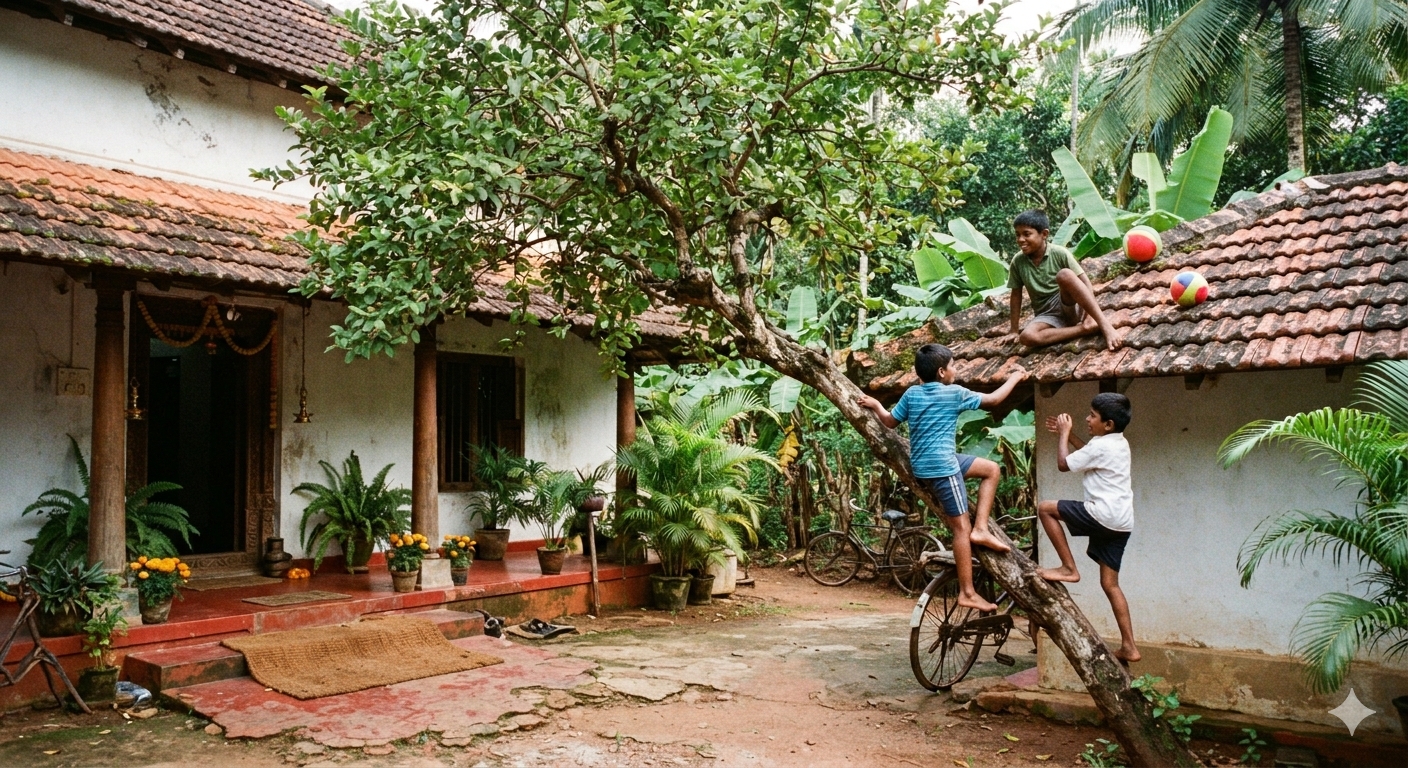
During our vacation to our native place in Kerala in October 2019, standing next to our ancestral home, I could see in my mind’s eye the front courtyard where once a Guava tree stood, leaning on to the roof. I narrated to Marina as to how we as kids – I was less than ten years old – used to climb the Guava tree to leap on to the roof, may be to pick up a ball that had got caught on the roof tile or just for fun. Marina then came out with a story of a similar Guava tree in her ancestral home and how she executed many similar monkey tricks.
The mere sight of the high roof sent a chill up my spine as I could not even fathom my climbing it now. The thought struck me that perhaps I would never even have permitted our children the fun of climbing on such a tree and get on to the roof. The question that intrigued me was ‘How come parents of those days allowed their children such (mis)adventures?‘ After we children grew up into our teens, our father cut the guava tree in 1976 as it was posing a threat to the very existence of the tiles on the roof. Moreover, we children had grown too old to climb on the rooftop to clear the fallen leaves, a periodic ritual.

Opportunities for children to engage in outdoor free play have declined significantly in recent years due to parental worries about play-related injuries. Television, Internet, electronic gizmos – all have turned the children into lazy people. During our childhood, we never reported any minor play related injuries to our parents, else it invited harsh punishments and restrictions. The fun of our childhood pranks was all about the thrills of beating the hazards & risks and reducing the chance of getting caught by our parents or neighbours.
United Nations Convention on the Rights of the Child has listed children’s right to play as a fundamental right[2].
It is the duty of the parents to ensure that the safety of their children only as much as necessary. They must be aware of the child’s abilities and confidence but the thrill and uncertainty of playing at heights, speeds, wilderness, dark nights, etc are beneficial, so are supervised activities like wall climbing, animal petting, camping, trekking, etc.

What is risky play?
Risky play is defined as thrilling and exciting forms of free play that involve uncertainty of outcome and a possibility of physical injury. It includes: –
- Playing at Height : Climbing, jumping, balancing at height
- Playing at Speed : Bicycling at high speed, sledding, sliding, running
- Play Involving Tools : Supervised activities involving an axe, saw, knife, hammer, or ropes
- Playing near fire or water
- Rough-and-tumble play, Wrestling, play fighting, fencing with sticks
- Exploring play spaces, neighbourhoods, or woods without adult supervision, or in the case of young children, with limited supervision
Risky play is essential for children’s development and for their physical, mental, and social health. Restrictive rules about play at home, daycare or school have impacted children’s health. During risky play, children learn to recognise and evaluate challenges, which will in turn help them develop confidence in their decisions and abilities. Risky play can also help children with disabilities develop autonomy and reduce social exclusion.

The children got to experience and recognise the risks while outdoors, near water and fire. Trekking through the forests, camping overnight at camp sites will teach them to recognise such risks and learn how to manage it – all under parental supervision.
It does not mean that parents must push their children ignoring safety measures and leaving children unsupervised in hazardous areas. The parents must be aware of the hazards and be ready to intervene if there is any potential harm.
Risk is inherent to free play. When children play spontaneously, they may choose to push boundaries and test limits. Risky play encourages creative, spontaneous play, first by eliminating hazards, then by supporting risk-taking that is chosen and controlled by the child and appropriate to her/his experience and ability.
The Canadian Paediatric Society’s new recommendations on children’s free and adventurous risky play align perfectly with the memories of our own childhood. Rather than raising children to be as safe as possible, this new study advocates raising them to be only as safe as necessary.
Why did parents of earlier generations permit such risks?
My childhood in Kerala during the 1970s, along with Marina’s memories, makes one thing clear: families and social environments at that time naturally encouraged such play.
- Self-Learned Safety: There were no artificial playgrounds back then. Children learned for themselves which branches were strong enough to hold them and how to maintain balance while climbing trees.
- Recognising Hazard vs. Risk: When our father cut down that Guava tree in 1976 to prevent damage to the roof, he was removing a genuine hazard – not preventing children’s play or healthy risk.
- Collective Supervision: In those days of large families, everyone in the village kept an eye on the children. As a result, children enjoyed far more freedom.
The Dangers of Overprotection
Today’s parents may not even allow children to climb a tree, let alone a rooftop. But studies indicate that this excessive fear and these restrictions are harmful to children.
- Reduced Self-Confidence: Minor falls and minor injuries teach children to overcome fear. Without such experiences, they become hesitant to face life’s challenges.
- Loss of Physical Awareness: Children who hesitate to climb heights or jump will not develop an accurate understanding of distance, speed, or their own physical limitations.
- Mental Health Difficulties: Excessive intervention in everything a child does can lead to anxiety and irrational fear.
What Parents Can Do Today
This does not mean children should be allowed onto rooftops. Rather, parents should grant age-appropriate freedom.
- Avoid Immediate Intervention: When children encounter minor obstacles during play, do not rush to help immediately. Wait a while.
- Let Them Solve it Themselves: Allow children to figure things out independently.
- Expose Them to Different Experiences: Provide opportunities for children to experience risk safely through wall climbing, trekking, camping, and similar activities.
- Change the Way You Speak: Instead of constantly warning, “Don’t climb there, you’ll fall,” ask questions that make them think: “Can you find a good grip there? Where will you place your foot next?“
Parents must ensure children’s safety, but not in a manner that hinders their development. The goal is not to eliminate all risk, but to teach children how to navigate risk wisely – so they grow into confident, capable, resilient adults.
The biggest risk is not taking any risk… In a world that changing really quickly, the only strategy that is guaranteed to fail is not taking risks. – Mark Zuckerberg
Only those who will risk going too far can possibly find out how far one can go.” – T. S. Eliot
[1] https://cps.ca/en/documents/position/outdoor-risky-play Healthy childhood development through outdoor risky play: Navigating the balance with injury prevention | Canadian Paediatric Society (cps.ca)
[2] https://www.unicef.org/child-rights-convention Convention on the Rights of the Child | UNICEF


Well written article and a good reminder to us all. We often forget that play is a child’s work and end up restricting or interrupting them. Any form of play , provides enormous opportunities for learning & growing. Play provides children the sensory inputs required to make sense of the world and regulate themselves thus, making them confident and better individuals.
LikeLiked by 1 person