
The Residence
In November 2002, our Regiment returned to Devlali, Maharashtra, after a ten-month deployment in Rajasthan. I was allotted a residence—a modified British barrack built in the 1940s that had been converted into officer’s quarters. It featured three bedrooms, a drawing room, and a dining room, all arranged in a single, straight line.
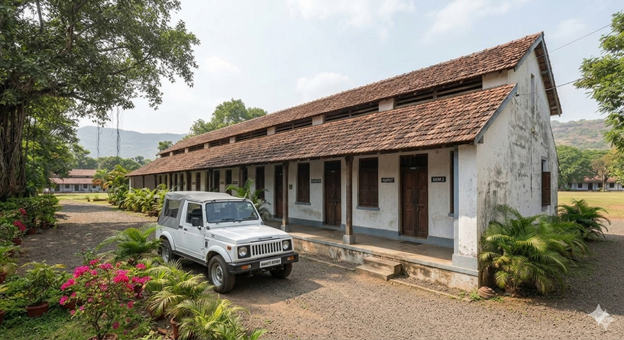
The ceiling loomed about twelve feet high, and the roof, constructed of Kerala tiles, stood another six feet above that. The nights were intriguing, filled with mysterious creaking sounds emanating from the attic. My only real daily challenge was the doors. At eight feet tall, engaging the latches at the top required a buddy. Perhaps the engineers of the British era assumed all soldiers would be six feet tall.
Why This House?
Why did I choose this particular building as the Commanding Officer’s residence? The answer lies in a fond memory from 1987.
While attending a training course at the School of Artillery in Devlali, I dropped by the household of Major Mathew Adipuzha on a Sunday morning. Visiting married quarters for breakfast was a sacred bachelor officer’s ritual, and it took place at this very same house.
During breakfast, Mrs. Elsy Adipuzha had a brainwave: she wanted to demonstrate her newly acquired driving skills. Major Mathew, well aware of her level of expertise, normally refused to let her behind the wheel. His condition that morning was clear: she could drive only if someone else sat in the co-driver’s seat. Suddenly, she had her volunteer—me.
We took our places in the car. She started the engine, pressed the clutch, and smoothly shifted into first gear. Everything suggested she had mastered the art of driving. Then came the horror show. The moment she released the clutch, she slammed the accelerator. The car lurched violently forward, rammed straight into a tree, and stalled. While we escaped unhurt, Major Mathew spent his entire month’s earnings getting the vehicle fixed.
Housewarming: A Clash of Faiths
The day before I officially moved into the quarters years later as the CO, Subedar Major Thangaswamy approached me. “Sir, the Pundit has said there should be a Havan at your residence tomorrow. The auspicious time he has chosen is 5:00 AM.”
“No issues,” I replied. “I will shower and be ready by 4:30 AM so the Gods will be pleased with me.”
I suspect the Pundit wanted to pay me back for all the grueling soldierly tasks I had assigned him over the months, from the Battle Physical Efficiency Test (BPET) to small arms firing.
A Havan (also known as a homa or homam) is a sacred Hindu fire ritual where offerings like ghee (clarified butter), grains, and herbs are made into a consecrated fire in a Havan Kund (fire-pit) while chanting Vedic mantras.
The Sunday morning Havan went off beautifully. However, that afternoon, the Syrian Orthodox Church Priest arrived to bless the Commanding Officer’s home. He proceeded seamlessly through his rituals until he entered the third bedroom. There it stood—the Havan Kund, still smouldering, under the watchful eyes of a row of Hindu deities.
The priest stopped dead in his tracks. “Sir, if you are a true Christian, then you must follow the very first Commandment in letter and spirit.”
I looked at him calmly and replied, “All officers of the Indian Army are trained to internalise and adopt the religious customs of the soldiers they command. It is an inherent part of building trust and rapport. I believe even Jesus Christ would be perfectly fine with it.”
An Enduring Legacy
Even now, whenever we cross paths, Veteran Colonel Mathew winks at his wife and remarks, “Here comes your driving instructor!“
I always smile when he says it. I remember not just the crash, but the historic house that stood witness to it—the house I chose, years later, to be my own. I didn’t select it for its grandeur, but for its stories. It serves as a beautiful reminder that sometimes the best decisions are made not by logic, but by memory—and that the finest faith is the one that opens its arms to all others.


Lovely story as ever Sir
LikeLiked by 1 person
Good one Reji
Thanks
LikeLiked by 1 person