Writing Skills

For the Canadian youth, armed with Cell phones, Blackberries and Ipods, texting has become the order of the day. The language skills have been relegated and new acronyms, shortcuts and smilies have taken over. Children are also not learning and enjoying social niceties like please, thank you, or it is a pleasure meeting you. They enjoy the anonymity of communicating through technology and tend to say things in text that they would never say face to face.

This phenomenon is not unique to our children. The parents are almost as guilty. They communicate with their children through text messaging. Parents mistakenly think that they are in better contact with their children when the children respond to their messages.

The use of shortcuts while texting hinders a child’s ability to switch between techspeak and the normal rules of grammar. Free flow while writing is hampered, adversely affecting a child’s ability to write a paper, prepare a presentation or write an examination, resulting in poor grades.

The children are not confident enough to speak face-to-face, especially with adults. In many Indo-Canadian homes, I have observed that the children shy away and retreat to their rooms at home when someone comes calling on. The parents need to educate the children the need to come down and meet the guests and exchange a few pleasantries and then retreat to their rooms in case they have any work.

Hence there is an urgent need to go back to the drawing board – that is to write. May be letters to grand-parents and relatives back home or their friends. Another methodology to improve the writing skills is to encourage the child to maintain a journal. In the journal, they can write about anything and everything, like any incidence at school, about a TV programme they watched and so on. Encouraging the child to maintain a diary will surely improve writing skills.

When we joined Sainik School, Amaravathinagar (Thamizh Nadu) at the age of nine (Grade 5) in 1971, the only medium of communication with the parents was the most trusted Post-Card. So we started writing letters at that young age. It was a great fete I thought for a nine year old to write a short letter to his parents and siblings, describing as to how good he felt for being enrolled in a premier school and how good the food was. This was my first attempt at creative writing, not being guided as to what to write, not being corrected and marked by teachers. At the end of each letter writing session, I thought I did accomplish something. The language was Malayalam to start with, but gradually converted to English as I became better at it and could express ideas and thoughts properly. To begin with, the lines I scribbled on the postcard would go up and come down; how good I tried I could never make the letters follow a straight line.

Once we left home and returned to the school after the vacations, we used to write our status reports of our safe arrivals and post it on Monday and would reach home may be following Monday. That was the only time our parents would know that we reached the school safe. They had the trust and confidence in us that we would reach safely, despite change of three trains and bussing to Amaravathinagar. Compare it with today’s children in Canada– not of Grade 5, but even university students – the number of times the cell-phones would have gone-off, even for a trip of an hour. Has the technology made us to lose confidence in our children?  Is it that our parents, with the technology available then, could have only prayed to their Gods and may be that gave then the power not to panic or get pressurised?

fl

Still remember the days I spent at a remote post in Kashmir, cut-off from rest of the world and the only link to civilization was radio and the letters. We used to get a lot of those “Forces Letter” which did not need any postage and that’s when I wrote letters to anyone and everyone, whose postal address I had. Some addresses were wrong and was dutifully returned by the Postal Department.

From our base, one could see the road winding down from the pass and the convoy used to take about two hours to reach the base camp. The convoy was always lead by the mail vehicle, could be that the driver was very experienced with the curves and dangers of the route, or could be that everyone wanted the mail to be the first to reach the base camp. Memories linger of our Soldiers and Officers literally “tracking” the convoy with an expectant gaze, until the convoy reached the base camp. Our Dispatch Rider who used to collect the Dispatches (letters), would be waiting outside the Field Post Office (FPO). Once the Dispatch Rider returned to the post and distributed the letters, the expressions of those who did and did not receive any Dispatches can well be guessed. The next half hour was an undeclared Private time for everyone. Mood of each Soldier who received their Dispatches would depend on the content of each Dispatch. This mood continued to be hidden under their smiles sometimes until he received his next Dispatch; sometimes until he went home on leave, sometimes for months to come. During the snow covered winter months (we used to get 10 to 15 feet of standing snow and the roads were closed), the truck was replaced by a helicopter which used to come once or twice a week carrying the same Dispatches. Rest of the story remained the same but for the difference that the tracking period reduced drastically to less than five minutes.

The art of letter writing may be dead and buried and with it the writing skills of our young generation. Many cannot sit and write a page, with logical thoughts and cannot describe on paper a situation, an event or an experience. Leave alone spelling and grammatical mistakes, even the main idea does not reach the target person. With this reluctance to write, many do not maintain any journals or diaries. Letters, journals and diaries are one of best and cost effective method to develop creative writing skills and you will feel the same sense of achievement what I felt when I wrote those letters at the age of nine.

Challenges in Parenting Faced by Indian Immigrants In North America

Background
A nursing student, 22-year-old daughter of parents who had immigrated to the US from Kerala, was reported missing by her parents on February 24, 2014. She was last heard from by her mother who talked to her, on the phone.  The daughter claimed to be in the library at the university campus, whereas the police investigation revealed that she made the call from a fitness center.

The parents were in for a rude shock when they learned from police that their daughter, who was a nursing student, had not attended classes since May 2013.  All along, her parents believed that she was going to school, and her mother who was under the impression that her daughter was on track to follow in her footsteps. She had been living at home and telling her parents she was attending school all through the fall and winter. The father’s credit card was even charged $6,072 for the Fall 2013 semester. I had heard from our daughter about of a few students who enroll in courses using the parent’s credit card and later cancelling their enrollment and taking the money.

The parents had not been seeing their daughter’s progress card and when her father asked to see the report card, she said there was something wrong with the computer. The mother had noticed that that her daughter wasn’t bringing home college text books. On inquiry, she said that she was doing online reading. In hindsight, how could a mother, who is also a nurse by profession ever accept such an excuse.

On March 11, 2014, the police found her dead body in her car and as per the police, the cause of death appeared to be suicide, due to inhalation of a noxious substance.

Reality Check

This case study reveals the challenges in parenting faced especially by parents emigrating from India. This brings out the need for positive parent-child interactions, especially at teen and adolescence levels. Each age and stage of growth presents unique joys and challenges, and the teen and adolescence years are certainly no exception. In fact, parenting during these years will always present unique situations as a result of the physical, social and emotional changes taking place in your child’s life. The parents have a great deal of influence on the behaviour of their adolescents.

Majority of Indian immigrant parents’ relationships with their children are formal and vertical with regard to age and gender. Communication and authority flow downward consistent with a hierarchical order. Indian parents accept as their duty the care of their children and children’s reciprocated duty is to unquestionably respect and honour their parents. In this context, parents expect children to accede to parental wishes and to behave in ways that reflect well upon the family, and many times the community. Many Indian immigrant parents rely on the inculcation of guilt and shame to keep children, regardless of age, focused on the importance of family obligations and to behave in ways that do not ‘bring shame’ to the family. Anything and everything the child do is castigated with the often-heard remark that ‘it‘s against our culture.

For a majority of Indian immigrant parents in America, the desire for children to succeed educationally and economically is a very high (only doctors and engineers please.) Accordingly, children’s exceptional academic performance is often viewed by parents as an honour to them.

This also forces children to hide their actual performance/ report cards.  Parents are also culprits as they brag about their children’s academic achievements.  It is very significant at high school level and when the child does not secure admission in a worthwhile university, next lot of stories are spun out by the parents.  This further degrades the child’s confidence, and they end up feeling out of place – trying to live in a castle of lies.

Lives of many Indian immigrant children, especially those at high school and university level can well be compared to the Hindi movie ‘Ram Aur Shyam.‘ The children often end up leading a life of double role – one for university and one for home.  It is akin to maintaining two girlfriends at the same time – one should not meet the other.

Concerns of Indian Immigrant Parents in North America

https://rejinces.net/wp-content/uploads/2015/07/prom1.jpg
  • Fear of Losing Children to the American Culture.     Most Indian parents migrate with the hope of making it good with many opportunities North America offers to them and their children. However, they fear that their children, especially those who entered adolescence or young adulthood subsequent to emigrating and those born in North America, are becoming more ‘Americans’ and abandoning the family’s cultural values.  Most of these parents fail to realise that the present young Indian society has changed and have adapted to the American culture of dating, live-in relationships, drugs, pubs, etc, (mostly kept under wraps.)  Some Indian parents often demand that children minimise their activities like dating based on personal choice, partying, using contraceptives, marrying for love vs accepting an arranged marriage, or reject the culture outright. Indian children often perceive their identification with the parental native culture to be a disadvantage to making it big in the American society.
  • Loss of Authority Over Children.           Indian parents become aware of two very painful post-immigration facts of life: that there are vastly different rules for parenting children, and the new rules significantly lessen their general authority over their children. Many parents complain that the children do not listen to them, and some are even scared of saying anything to their children. Parents also lament the ‘permissiveness‘ of the American society that condones children’s rights to challenge parental values and authority and often observe that raising children in North America is same as ‘living with strangers.’
  • Disciplining Children.       Many Indian parents feel restrained in their authority to discipline their children ‘appropriately‘ consistent with the usual and acceptable modes of disciplining children back in India. Many Indian parents used disciplinary practices that by American standards, are considered harsh and even abusive. For these parents, parenting in North America requires accommodation to new value systems, rules, and expectations.  As a result, Indian parents overwhelmingly tend to be cautious in disciplining their children because of their unfamiliarity with other disciplinary methods and fear of breaking the law
  • Loss of Authority to Select Children’s Mate.  Indian immigrant families represent a kaleidoscope of religions and cultures and consider it their right to select and to decide whom the children will (date and) eventually marry. They do not accept the fact that arranged marriages among Indians is on the wane. Notwithstanding the decline in the practice, however, many Indian immigrant parents continue to endorse arranged marriages. Some parents do not hesitate to send marriageable children home to seek a spouse in case there are few or no eligible candidates. Some parents may even ‘import‘ a potential spouse from India.  Some parents do permit culturally exogamous dating and marriages and most children prefer selecting, dating and eventually marrying someone of their own choosing, based on the North American criterion of romantic love. Parents complain that children’s refusal to accept an arranged marriage as a rejection of them and their values and negatively reflect upon them as parents within the community. They also reference the progressively increasing divorce rate among younger Indian immigrants and worry about their children’s ability to ‘make a good marriage.’
  • Loss of Face Within the Community.    Within the Indian community, parents are held responsible for their children’s behaviour and are criticised for their failing as parents, because children’s behaviour reflect negatively upon parents. They believe that it is the paramount duty of their children to enhance family pride by honouring their parents through their culturally appropriate behaviour and outstanding accomplishments. Consequently, when children behave out-of-culture, parents invariably complain that such behaviour dishonour them as ‘Indian Parents‘ and devalue their standing as ‘Indians‘ within the community.
  • Religious Institutions.       Indian parents seem to prove the adage of ‘being more loyal to the king than the king himself’ when it comes to their religious matters. They force their children to attend religious ceremonies, mostly without explaining the details of the ceremony and its significance in real life.  Religious teachers employed by these institutions are ‘fresh off the boat (FOB)‘ from India and do not connect to the North American society and the stresses the children undergo here.   They ensure to instill a feeling of ‘guilt and shame‘ in the Indian parents for not strictly adhering to the religious practices and the ‘sin‘ they are committing by not protecting their children from the ‘hazards‘ of the ‘evil‘ North American society. Their sermons are mostly archaic and have no place in the modern society. Luckily these sermons are in their dialects or in ‘Hinglish/ Punglish/ Manglish,‘ which these children do not understand. These religious heads will talk non-stop on the evils of the North American society but wants you to part with your dollars liberally at any instant.

The Way Ahead

  • Monitor and Supervise your Child.       Children want parents who listen and try to understand, set good examples, and offer guidance. A delicate balance of allowing your child freedom while still exercising a level of parental control is key to your child achieving independence.
  • Monitor Your Child’s Activities.  Show a constant and genuine interest in your child’s life.  Know where your child is at all times. Ask where they are going after school, when they will be home, and which friends they will be with. Parents who actively monitor and guide their children tend to have adolescents who experience positive relationships with peers and who are less likely to use drugs.
  • Check-in Regularly.           Talk to your child after school to ask about their day. If your child is scheduled to be at a friend’s house, call the friend’s parent to confirm the arrangement. Be involved without being overbearing. Your child may protest your monitoring behaviour, but setting boundaries and sticking to them will show your child that you love them.
  • Parent in an Authoritative Style.     Parent with warmth and respect, avoiding being overly controlling or overly lenient. Authoritative parents are warm but firm. They encourage their children to be independent, but as parents, they manage to keep limits and controls on their child’s actions. Authoritative parents openly discuss family rules with their children, which allows the children to express their views. Authoritative parents are nurturing, while providing the rules, guidelines, and standards that children need.

  • Encourage Your Children to Bring Home their Friends.     This will ensure that you meet your child’s friends and know the company he/ she keeps. Interact with your child to find out the activities and conversations that took place during their outing. This is easier said than done as you have to earn the confidence of your child, especially by not reacting to those uncomfortable issues that may crop up. This will provide some insight into the activity pattern of your child outside the school hours
    .
  • Eat Dinner Together.      Eating dinner or at least a meal together as a family provides an ideal opportunity to interact with your children. Talk to your child about their day, their friends, and current events. It also shows that you care enough to take time to listen and learn about their interests. Research finds that teens who eat dinner with a parent five or more times during the week are less likely to smoke, drink, use drugs, get into fights and engage in sexual activity.
  • College and University Students to Study with Education Loan.    The children must utilise the facility of the liberal educational loans, especially those funded by the governments. It not only satisfies the financial need to proceed with higher education but helps in saving income tax also while repayment. Tax benefits on education loan end up reducing overall cost of the loan. Most student loans offer lower interest rates, deferred payment options and a repayment grace period following graduation. This will ensure that the children are better focused on their education. It can also act as a monitoring tool for the parents as the next tranche of the loan would not be released unless the student has scored adequate marks and have the requisite attendance. In case the parents are financially sound, they can assist the child to repay the loan in full or in part upon graduation.

Wishing all parents ‘Great Parenting.’  Remember what Mayim Chaya Bialik, American actress, author, and neuroscientist said, “I came to parenting the way most of us do – knowing nothing and trying to learn everything.

(Photographs are of our daughter Nidhi and our son Nikhil)

Guru Dakshina

On 16 Apr 1989, the day I married Marina, still lingers in my mind, as would be for any of us on this auspicious day.  I decided to invite all those teachers who taught me Sainik (Military) School, Amaravathinagar (Thamizh Nadu) for the wedding. 

Wedding

I had requested Mr PT Cherian (PTC), my mentor, house master and physics teacher, to accept the Guru Dakshina (Offering to a Teacher), prior to leaving the home for marriage as per the Syrian Orthodox Christian custom.  Mr Cherian accepted the request and I explained him the route to our home.  Mr Cherian was married to Ms Shiela Cherian, who taught everyone English in their Grade 5, expressed inability to attend owing to her bad health.

Sainik Schools were the brain child of then Defence Minister VK Krishna Menon, established in 1962 each of the major States of India, manned by senior officers of the armed forces with the objective of turning boys into men who can take on the responsibilities of the armed forces.  Ms Sheila Murphy, an Anglo-Indian lady, was among the first group of teachers to join the school at the time of inception.  Mr PT Cherian joined our school a year later in 1963.  After a few years, fell in love and got married, while we were in our eighth grade.  On the evening of their wedding, we were treated to a never ever seen sumptuous dinner at the Cadets’ Mess.  Thus Ms Sheila Murphy became Mrs Sheila Cherian.

Mrs Sheila Cherian is the first teacher anyone who joins Sainik School, Amaravathinagar encountered.  Most of us were from Malayalam or Thamizh medium schools having very little knowledge of English.  The way she taught us English, especially how to write (her handwriting was exceptional,) everyone of us will carry it to our graves.  She taught us table manners, how to sit at a table, use of cutlery and crockery, how to spread butter and jam with the knife, how to drink soup, how to eat boiled egg and most importantly, how to eat with our mouth closed.

Mr PT Cherian was our House Master, Physics teacher, Photography Club in-charge, Basket ball and Volley ball coach, mentor, etc etc, all rolled into one.  More than teaching physics, he dedicated all his time and energy to turn us into brave and confident young men.  We could discuss anything and everything under the sun with him.  He was behind every activity that happened in the school and was a great organiser.  Standing six feet tall, he had an impressive personality that will give run for the money to MGR and Sivaji Ganesan.

The marriage was scheduled for 4 PM and I was scheduled to leave home for the church by 3:30 PM.  All the friends and relatives gathered at our home for the occasion.  Mr AKR Varma – from the Cochin Royalty and our Arts teacher;  Mr George Joseph – English teacher, then Principal of Navodaya Vidyalaya, Neriamangalam; Kerala, Mr AD George –Botany teacher, Principal of Navodaya Vidyalaya, Kottayam; and Mr KS Krishnan Kutty our crafts master, all were there at home to shower their blessings.  There was no trace of Mr Cherian and we waited till 3:40 PM and then it was decided that Mr AKR Varma, being the senior most among our teachers present would accept the Guru Dakshina.

gd

Dakshina is a betel nut and a rupee coin wrapped in a betel leaf.  I handed over the Dakshina to Mr Varma, touched his feet, accepted his blessings and left for the church.  Mr Cherian was standing at the entrance of the church to receive us.

A few months later, we were on vacation in Kerala and attended Mr Varma’s daughter Vanaja’s wedding.  Mr Varma said that the Guru Dakshina came as a surprise to him and he was very much moved and that tears had rolled down his eyes, as it was the first time ever he had received such a gift.  He said he was unaware of the tradition that the Syrian Christians followed, and it is an ideal Dakshina any Guru could ever ask for.

After five years of marriage, we went to Sainik School Amaravathinagar with our daughter, to attend the Old Boys Association (OBA) meeting.  By then Cherians had retired and had settled in the farm they purchased, adjacent to the school.  We decided to call on the Cherians in the evening and reached the farm house.  The house had about 50 old students, some with their families already there.  The Cherians, known for their love for their students, whom they adored as children, as God had been unkind to the couple and had forgotten to bless them with any kids.  They were playing excellent hosts to each and everyone, including little children.

We paid our respects to the couple and I handed over a package containing a few bottles of whisky as Mr Cherian enjoyed his drinks in the evenings.  Accepting the gift, very well knowing what the contents would be said “Is this the Guru Dakshina I missed in 1989?”  I did not understand what he intended by that line.  I brooded over it and got no clue.  By about nine in the evening, most guests had left and my wife and daughter were closeted with Mrs Cherian with our daughter providing the entertainment with her songs.  I was sitting with Mr Cherian enjoying a drink in the coconut grove and suddenly Mr Cherian said “Do you know why I did not come to your home to accept the Guru Dakshina?  It is not that I did not love you or adore you, but because my marriage has not been complete as the God has not blessed us with any children and that was the reason why Sheila had declined to come for the marriage.  Mr Varma being elder to me in age and having a complete family was the most suitable person to receive the Guru Dakshina”.  I just could not speak and our eyes became wet.  We both remained silent for the next five minutes and completed the drink.

Mr Cherian fetched another set of drinks and continued “I Married Sheila very well knowing that she would not bear any children for me, due to her gynecological condition. I wanted to set an example for my students by marrying the person I loved.  I never wanted my students to tell me that I ditched their teacher”. Tears rolled down my cheeks….

PTC

Mr PT Cherian and Mrs Sheila Cherian on the extreme right.  Photo taken in 1969, courtesy  Mr Steve Rosson (in the middle), who taught at our school in 1969 as a Voluntary Service Overseas teacher from England.  Extreme Left is Mrs Mercy Mathai – our Matron when we joined school in 1971 – with Late Mr Mathai.  The children in the pic are Mathais – Robin and Reena.

To Post or Not To

In a judgement by Chennai High Court (India,) Justice S Ramathilagam ruled: “What is said is important but who has said it is very important in a society because people respect persons for the social status. When a celebrity forwards a message like this, the common people will start to believe it.”

ToPost

Social media is a collection of online communication channels dedicated to community-based input, interaction, content-sharing and collaboration. Some of the prominent examples are Facebook,  Twitter, Whatsapp, LinkedIn, and the list is endless.  There are many blogs, chat groups, email groups, etc, which add to the blogosphere.  A number of militant groups around the world are using social media for intelligence gathering, propaganda, recruiting, and also for communicating with other militant groups.

Social media platforms have become part and parcel of our everyday life and also play a crucial role in our society. Every day, thousands share photographs, videos, information, documents, etc through them.  Obviously, they have become an effective tool in the hands of cyber criminals, militant groups and intelligence agencies.

What are the norms to be followed while posting on the social media, making any comments or forwarding emails?  Some suggested tips  are:-

Ensure Your Children and Spouse are Security Conscious.  Always go through the contact list of your spouse and children with them and delete all contacts they and you do not know personally.  Advise them that in case they receive a Friend Request on any social media site from anyone they do not know, never to accept it.  There have been many instances all over the world where in terrorist groups and enemy agents have used social media to harass the family and friends.   Similarly, do not add strangers as your Friends.  It is also a good habit to cull down your Friends list, at least twice in a year.  You may also delete those friends who did not respond to your posts and also those whom you think are a nuisance.

Trust Factor.   The most important aspect regarding communication is the credibility and trust your friends and the society bestows on you.  While forwarding any mail or making any posts or comments, ensure that this trust is never betrayed.

Accountability and Responsibility.   In this is an age of unparalleled transparency, with the social media providing an open window into individual’s personal lives and minds, it is nearly impossible for anyone to disown a statement or opinion expressed on these public forums. Every netizen is both accountable and responsible for all their actions on the social media.  Any post once made, becomes the ‘property’ of the social media.  Even if you delete or edit the original post, the original still remains somewhere.  The new generation in Canada do not want any of their photographs posted or tagged showing them smoking, drinking or partying as they feel that their prospective employers might dig into the social media.  Some political leaders are now haunted by some ‘innocent’ photos of their youth their friends posted on the social media.

Uploading Photographs.  Post only those photographs that you feel are a must and always give a comment as to why you are posting the photograph.  In case you cannot write a line or a few words as to why you are posting it, it is better to avoid posting that photo.  Posting too many photos is never worth the effort.

Disable Geotagging or Location Based Posts.  In case not disabled, it would provide adequate fodder for the snoopers to gain information about the user’s exact geographical location, thereby revealing much more than one can even imagine.

Awareness About What You Post.   There are hundreds of your friends, their friends and acquaintances, reading your posts.  They may come from different backgrounds, beliefs, religions, customs, etc.   In case your post is likely to hurt the sentiments of any individual, group or a community; it is always better to avoid such posts.  Whenever you post anything against any religion, group or community, always think of your colleagues and friends, then decide for yourself about the respect they may have for you after they read it.   Always think before you post.

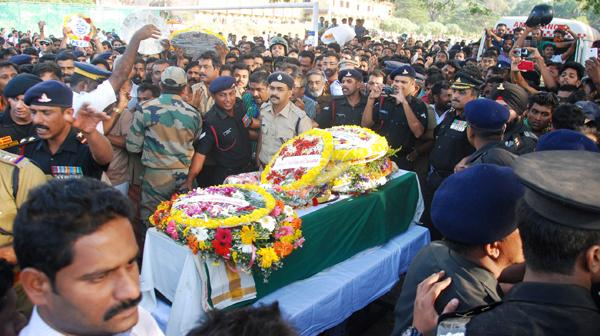
Respect Privacy.  The Indian media does not respect privacy and that does not mean that everyone should follow suit.  During the funeral of martyred Colonel MN Rai, Yudh Seva Medal at Delhi, the media and the netizens went berserk with the video clippings and images of the daughter of Colonel Rai saluting the mortal remains of her brave father.  That was a private moment for a daughter and everyone got to respect it.  The Chief of the Army Staff consoling the daughter was also a very private moment for the Chief and hence need to be respected.

Chain eMails and Chain Status Updates.   One often gets these chain e-mails or posts which says that to receive the blessings of a particular God or Saint, forward it to ten of your friends.  Some demand you to forward to ten of your friends else  you will die a horrible death and the list goes on.  By tracking these emails or posts, intelligence agencies, marketing agencies and cyber-crooks  collect information about you, your friends and their interests, beliefs and political leanings, etc.

eRumours.   Next time you receive an email or a post which sounds it might be an eRumour – when in doubt -check it out. Here are some quick ways to check the facts before forwarding or sharing it:-

  • Contact a reliable source, such as a government agency, a professional society, a company or an organisation with expertise on the subject. Many would have already given clarifications about these rumors on their websites.
  • Verify the source and if you cannot easily verify the original source of an e-mail – either the original sender or the alleged source of the information – it is likely to be an eRumour. The perpetrators of such eRumours often falsely attribute misinformation to a seemingly legitimate source.
  • Some eRumours claim to be based on television news stories or are written to sound like news articles. Most news outlets post recent stories, so you can check them out on the TV’s website, even though many news the media channels put up may have their colour.
  • Visit a myth-busting website that lets you search by key words or phrases. If your topic turns up, you will have more information in seconds. If it does not, you can always submit a new rumor for review. These myth-busting sites have searchable archives. You may even bookmark them for future reference.

Share or Forward Only if You Must.  Many times one receives a post or email about a social cause, encouraging those who read it to share it with their friends.  This sharing or forwarding goes on in the network and the chain help spread awareness about the cause.   The intention of the originator was right, but one gets annoyed to see everyone sharing or sending you the very same message.  Sometimes one may notice something of value worth sharing. Hold your horses for a few hours (minutes)  and you will in all probability see someone else sharing it.  During this ‘hold’ time, analyse as to what part of the post has value and write it while you share or forward the information.  Any sharing or forwarding without this value addition is mere ‘post officing’.  Most forwards or shares is accompanied by statements like ‘Amazing Photo’, ‘Stunning Video’. ‘Excellent Article’ and so on.  Always mention as to what you found amazing, stunning or excellent so that the recipient may be benefited from it.  It may be pertinent to ask oneself these questions prior to making any posts:-

  • What is the purpose of the post I am about to share? Is it to draw attention to myself or lift me up in some way? Am I trying to make myself feel better or get compliments?
  • Is what I am sharing genuine and honest? Am I sharing it for the sake of sharing?
  • Would this post be an encouragement to others or would it tear someone down?

Email Forwarding and Plagiarism.   Forward only if you must and in case you have a line or two to write about it to give it some value addition. When forwarding, trim all unwanted ‘fat’ like forwarding history, unwanted blank spaces, etc. Ensure that the ‘meat’ is intact. Always try and use the ‘BCC’ option for multiple addresses. In case you are copying and pasting someone’s email into yours, always credit the source, else it is plagiarism and infringement of the copyright and intellectual property.

Tone.   The social media is based mostly on textual communication.  There is neither any body language for the receiver to perceive, nor is there any visual contact.   Thus the tone of your written expression conveys a lot more than you think.  It is very easy for someone to misunderstand you and presume that you are being sarcastic when you are not.  Further, everyone has their own style of writing and the reader has every right to perceive it in the way they think.  Use of emoticons can reduce suck risks to a great extent.   Putting a simple smiley face at the end of a sentence can do wonders by relieving the tension.

Use Messaging for Private and Personal Matters.   Avoid posting any private or personal matters in the public domains like the Facebook walls or photo sharing sites.  Many aspects are meant to be private among family members or your co-workers or friends.  No one is eager to hear about such matters from a public forum.  If you need to inform your friends or your family about some important and personal news  like a demise of a family member, do not declare it out in the public domain.  It is better to make a telephone call or send an email  or a message about it.

Putting Down Others.   In the blogosphere, every netizen is entitled to their opinion and are always free to express it.  Hence there is no need to put anyone down just because you disagree with that person or you dislike the person or his ideologies.  At times people criticise their friend’s friend who replied to a post, whom they don’t even know. It is embarrassing both to you and your friend.  It is always preferable to execute communication in the correct spirit.

When in Doubt, Do Not Post It, Always Throw it Out.

Thali, Minnu, Mangalsutra and the Military


Mangalsutra is considered as the symbol of marriage in India. The word Mangalsutra is derived from Sankrit word ‘Mangal’ which meaning holy and ‘Sutra’ meaning thread. The tradition of tying Mangalsutra is followed among almost all the Indian communities. It is a chain or a thread with a pendant tied by the groom around the bride’s neck on the marriage day. There are a wide variety of Mangalsutra used by various communities, castes and sub castes. Nowadays there are trendy Mangalsutras in the market with expensive stones like diamonds and ruby. The days of a Digital Mangalsutra too appears imminent.

How can you leave the soldier and his spouse behind?

Here is my version of a Military Mangasutra! Has any jewellery designer beaten me on this account and has come out with it in the market already? Else I hereby reserve the patent!!!
This design is based on the Identity Discs worn by soldiers around the globe. Please Click Here to read more about it.
In Canada and USA, some military spouses and fiancés wear their partner’s Identity Discs as a symbol of love towards their partner deployed in a far away land. Some Veterans post retirement continue to wear their Discs.
Wedding
Regarding the history of this photograph, please Click Here to read my blog Fire-Fire-Fire.

Pennu Kettu‘ is the colloquial Malayalam equivalent of wedding, which literally means tying of the bride. The Mangalsutras used in Kerala, the Hindus use ‘Thaali’ and the Christians ‘Minnu’. The Muslims in North Kerala (Malabar), traditionally do not have a Thaali. However, nowadays, on the wedding day, the groom does put a gold chain around the bride’s neck, which some brides preserve like the Thaali. The Muslims brides from South Kerala (Travancore) do wear the Thaali.

In the Nair community, women had a special status as they followed a matriarchal system of inheritance of wealth and property. Many Nair families follow this tradition even today though some have moved on to some form of patriarchal system. The Nair males had no role in succession and had no control over the property and were mere managers of the property.

Until 1930s, a Nair lady could enter into cohabitation (live-in relationship) with men of higher castes or even among Nairs and this co-habitation was called as Sambandam. The male gave a white mundu (dhothi) to the lady. The acceptance of mundu was considered as permission to enter into the lady’s bedroom. This mundu given at the Sambandam came to be known as the ManthrakodiManthra meaning blessed and Kodi meaning new. When a lady wanted to terminate a relationship with the man, the mundu could be returned or a thread could be taken out of mundu and broken into two pieces, symbolising end of relationship.

The mother held absolute right over the children and the children never took the name or lineage of their father. Today the practise of Sambandam has been replaced by the institutionalised marriage. Like the Nairs, all other Hindus of Kerala solemnise their wedding by the groom giving the Manthrakodi to the bride. The Thaali is sometimes referred to as Ela-Thaali translated as Leaf-Thaali, because of its peculiar shape like a banyan leaf. It is said that the shape of the Thaali resembles a banyan leaf because a banyan tree itself is a symbol for support, shelter, and care.

Malabar Marriage Act of 1896 was the first legislation to legitimise Sambandham among Nairs.   The act did not achieve the desired results. It was followed by Travancore Nair Act of 1912, 1925 and the Cochin Nair Act of 1920 which made Sambandham illegal and broke the matriarchal system of inheritance among Nairs. Mannath Padmanabhan, a social reformist, exhorted Nair males to find jobs, earn income and take responsibility of their wives and children. EMS Namboothiripad, the first elected Communist Chief Minister of India, exhorted all men to take up the role of producer and provider for their families.

Most Namboothiris – the Brahmins of Kerala – have a patriarchal family system, barring a few with matriarchal system. The marriage ceremony is called ‘Veli‘ and is a four day affair. The specialty is that the Thali Kettu (tying of the Thaali) is done by the bride’s father. Out of the eight different marriage styles for Indian Brahmans, the only style which needs the bride’s father to do Thaali Kettu was opted by Namboothiris and is called Kantthasoothram. The common practice among Indian Brahmans is that the groom does the Thaali Kettu and is called Mangalyasoothram. Namboothiris consider Kantthasoothram better as it enables their ladies to perform Bali and Sraadham (rituals conducted post-funeral to enable the spirits to reach heaven) of her parents.


The Thaali Kettu, originally a Namboothiri ritual, was later on adopted by most Hindus, Christians and Muslims. The Christians called it the ‘Minnu‘. Christians of Kerala are believed to have been converted to Christianity by St Thomas, one of the twelve disciples of Christ in the first century.  The Minnu is a pendant with a cross, the symbol of Christianity, on a gold medallion shaped like a heart. The heart symbolises the concept of love, and the cross reflects that the relationship between a husband and wife must follow the relationship between Jesus and his bride, the Church. The Minnu is put on seven strands of thread from the Manthrakodi. Seven represents the bride, the groom, the couple’s parents and the Church.

The brother-in-law of the groom prepares the thread the evening before the wedding. The knot to be tied is the Aan-Kettu, meaning the male knot, which in fact is the reef knot.   The brother-in-law being experienced with his wedding, acts as a coach to the groom and make the groom practise the knot until achieving perfection. Many grooms tremble while tying the knot as all the eyes and cameras in the church are trained on to the knot being tied. Placing the Manthrakodi upon the bride’s head symbolises the groom accepting the responsibility to protect and cherish his bride. This is a tradition adapted from the Nairs. A woman from the groom’s family, usually the sister or a cousin of the groom, stands behind the bride once the Thaali is tied, signifying the reception into the household of her husband. In some Christian communities, the Minnu remains on the thread for one week until the groom’s mother cuts the thread, and the Minnu is moved onto a chain.

The Muslim wedding in Kerala is an amalgamation of Kerala Nair and Islamic traditions. In India, Islam first came to Kerala through the spice trade with the Arabs who took the spices of Kerala to Europe. It is believed that the first mosque of India, the Cheraman Juma Masjid, was built in 629 (during the life of Prophet Muhammad) in Kerala.

Oppana - the entertainment dance popular in Malabar | Explore Malabar | Kerala Tourism, India
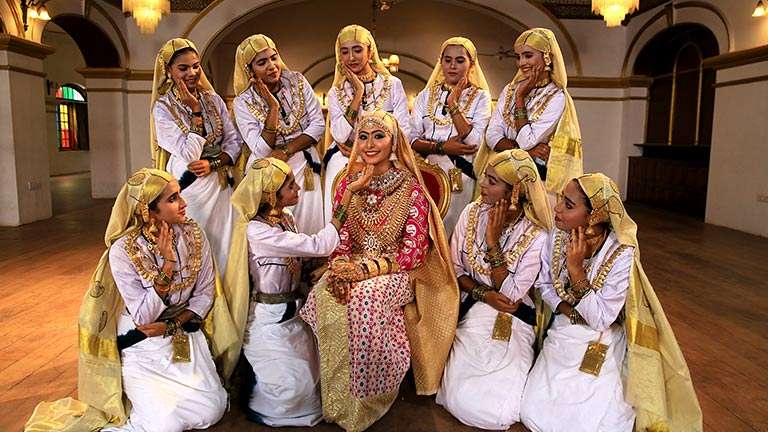
Traditionally, Oppana, a folk dance form specific to the Muslim community of North Kerala, is performed the day before the wedding day. The dance is generally presented by young female relatives of the bride, who sing and dance around the bride clapping their hands. The aim is to entertain the bride who sits in the centre, dressed in all finery, covered with gold ornaments. Today, Oppana in some form or the other is practised amongst Muslims all over Kerala. On the wedding day the Nikkah ceremony is conducted – the official marriage contract – either at the mosque or at the bride’s home. The Nikkah ceremony is mostly all male affair. After the Nikkah ceremony, the Muslims is Southern Kerala have a ceremony for tying the Thaali in the presence of all the relatives and friends.


Marathi Mangalsutra is a combination of black and gold beads in a double layer which symbolises Shiva and Shakti along with a pendant. The black beads chain with diamond pendant is usually used by the Marwaris, Gujaratis etc but it is becoming a widely used trend.


In Telugu communities the Mangalsutra contains coral beads, gold coins etc along with the main pendant and a gold chain.


In Thamizh Brahmans the Thali or Thirumangalyam is a pendent which is worn on a thread dipped in turmeric water.


The Kashmiri Brahmins have a very different way of wearing Mangalsutra called Dejhoor, which goes through the ears.

The tradition of tying Mangalsutra is the symbol of holy matrimony in India. In today’s India people prefer less jewellery and because of this trend people wear Mangalsutra only to family functions, weddings etc. India is famous for its rich and varied traditions and all Indians must be proud of such traditions. It is the duty of the generations to come to preserve such unique customs and traditions.

First, Middle and Last Name

In school and during my service in the Indian Army, my name was recorded as Koduvath RejiKoduvath being our family name. (Please click here to read more about Koduvath family).

Names

 Among the Syrian Christians of Kerala, names traditionally consist of three parts: the family name, the father’s name, and the christened (given) name. However, my siblings and I had only two—the family name and our christened names. As a curious teenager, I once asked my father why our names were so short. Being a headmaster, he gave a characteristically practical reply: the most common question in primary language classes is “What is your name?” He didn’t want his children struggling with lengthy responses, so he kept our names simple. I often wonder how I’d have managed with a typical Syrian Christian name like KuruvillaPhiliposePunnoose, or Zachariah!

The Many Reasons for Name Changes

In Kerala’s Malayala Manorama newspaper, classified columns frequently feature name-change advertisements—mostly women altering their surnames post-marriage. Some adjust the order of their names, while others cite astrological or numerological reasons.

But motivations for name changes vary widely. Some dislike the name their parents gave them. Couples may hyphenate surnames, creating a double-barrel identity. Others anglicize their names to avoid mispronunciation or unintended meanings in foreign languages. Occasionally, a name becomes a professional liability, or a change is needed to counter identity theft.

A Family Tradition: Keeping One’s Name

My mother, Pallathettu Kurian Sosamma, married my father, Koduvath Varkey George, in 1956. Both were teachers, and neither changed their names. My father believed marriage shouldn’t demand the sacrifice of one’s identity. He also considered the bureaucratic hassle unnecessary. This principle extended to his daughters-in-law—my wife, Marina Mani, retained her name, derived from her father’s.

In the Indian Army, it’s common for officers to change their wives’ surnames post-marriage through Part II Orders (official documentation). Many were surprised when I insisted Marina keep her maiden name. Most officers didn’t realize that marriage alone doesn’t legally authorize a name change—proper legal procedures must be followed. Soldiers, too, often bypassed the process, relying on uninformed officers to approve their paperwork.

Naming Our Children: A Deliberate Choice

After marriage, Marina was often addressed as Mrs. Reji—a natural assumption in the Army, where Reji was mistaken for my surname. She disliked it but eventually accepted it. When we named our daughter Nidhi, Marina felt a single name seemed incomplete. I argued against adding my name to hers, avoiding future change of name complications.

Eventually, Marina named her Nidhi SusanSusan being the anglicized form of my mother’s name, Sosamma. Today, she goes by Nidhi Parkinson-Watson, adopting a hyphenated surname. When our son was born, Marina chose Nikhil George Koduvath, giving him a complete name.

The Passport Predicament: Two Identities

While emigrating to Canada, I swapped my first and last names for the passport, becoming Reji Koduvath instead of Koduvath Reji. This left me with dual identities—Indian and Canadian. Our daughter faced minor issues in Canada, where Susan (her last name) is typically a first name, often prompting double-checks during documentation.

Correcting Documentation in the Army

As a commanding officer, I noticed gaps in soldiers’ documentation, especially regarding marriage and children’s birth records. During a Sainik Sammelan (monthly address), I explained the legal name-change process in India (similar to many developed countries):

  1. Affidavit: File before a District Court or Magistrate.
  2. Newspaper Advertisements: Publish in two local newspapers.
  3. Gazette Notification: Finalize in the state’s Official Gazette.

One soldier from Rajasthan raised a concern: in his community, unmarried women used Kumari (virgin) as their second name, which changed to Devi post-marriage (e.g., Ritu Kumari → Ritu Devi). I quipped, “Until legally changed, she remains ‘Kumari’ for life!” I instructed all personnel to regularize any unofficial name changes.

The Canadian Quirk: Searching by Last Name

In Canada, medical searches often use last names. Since Nikhil and I share Koduvath, while Nidhi and Marina have different surnames, I ask clinics to search by our home phone number instead.

Once, a pharmacy technician pulled up five names under our number and remarked, “All three males share a last name, and the two females have different ones.” Puzzled, she asked who the third male was. The answer? Maximus Koduvath—our dog, who also gets his meds under our family file!

Names2

The Atheist

The first atheist I came across in my life was Mr MV Somasundaram (MVS). He taught us Thamizh in Grade 6, Social Studies in Grade 7, English in Grade 8, History in Grade 9 and Civics in Grade 10. He was as versatile as the subjects he taught and had good grasp of all the subjects. He was a very soft spoken man, who hardly ever raised his voice. His son Aravazhi was our classmate.

During our days at Sainik School Amaravathinagar, we always said grace before every meal, to thank God for all what we were to receive and after the meals for what we did receive. While in Grade 7, I noticed that Mr Somasundaram always remained seated when the grace was said. On enquiry, Sunder, my friend said that he was an atheist. I looked up the dictionary to find the meaning of the word as I had never heard it before.

Mr Somasundaram was a rationalist and was against all superstitions that plagued the society. He believed that undue importance was given to religion in our day-to-day lives. He neither forced his viewpoints on to anyone nor did he try to influence his students with his ideals and principles. Needless to say, I did not become an atheist, but the seeds of rationalism were sown by Mr Somasundaram.

Mr Somasundaram subscribed to Viduthalai (Freedom), a Thamizh newspaper and the mouth piece of Dravida Kazhagam (DK). (As per his son that he still continues to subscribe to it.) It was delivered to him by the postman and he always brought it to our class. Once in a while he left it half open on the teacher’s table and I had the opportunity to steal a few glances at it. It had a few different letters of the Thamizh alphabet, especially in its title, which stood out. I again took the help of Sundar for further details. Sundar explained to me about Viduthalai newspaper and that the great Periyar was Mr Somasundaram’s mentor and the raison d’être for his atheism.

Today Mr Somasundaram is leading a retired life and lives in Chennai with his son Aravazhi. He can be contacted at 944 293 6769. So much for the protégé. Now a bit more about his mentor.

MVS6

Erode Venkata Ramasamy (1879 – 1973), affectionately called Periyar by his followers, was a social activist, politician and businessman, who started the Self-Respect Movement in South India. A rationalists who aroused the people to realise that all men are equal and it is the birthright of every individual to enjoy liberty, equality and fraternity. He propagated that the so called men of religion invented myths and superstitions to keep the innocent and ignorant people in darkness. He was an atheist, noted for his anti theistic statement, “He who created God was a fool, he who spreads his name is a scoundrel, and he who worships him is a barbarian.”

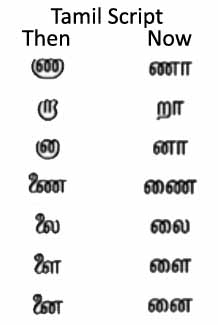
Viduthalai was started in 1935 by Periyar as a magazine. It grew into a daily newspaper by 1937. The newspaper aimed to create a rational, secular and democratic society, and also to fight superstition. The script used in the publication was in keeping with the need to cope with the developing printing technology. Periyar thought that it was sensible to change a few letters, reduce the number of letters, and alter a few signs. He further explained that the older and the more divine a language and its letters were said to be, the more they needed reform.

MVS8

Soon after MG Ramachandran (MGR) became the Chief Minister of Thamizh Nadu in 1978, all ideas of Periyar on the changes and modification of Thamizh alphabets were accepted. An act was passed in the Thamizh Nadu Assembly in 1978, bringing the changes into effect. These modifications have made Thamizh as the first Indian language to be adapted for computerisation, obviously, due to the reduced number of alphabets.

After the act was passed and the ‘Viduthalai’ font became the standard Thamizh font, we had an open house forum at our school to discuss its implications. The forum was an open discussion, led by Mr Somasundaram and moderated by Squadron Leader Manickavasagam, our then Headmaster. The students in attendance were from Grades 9 to 11. During the discussion, Mr Somasundaram made a scathing attack on Hindu religion. He said that when State Bank of India opened its branch in Amaravathinagar, only our school Principal, Colonel AC Thamburaj and the school band were in attendance for the inauguration, whereas, when a branch of the Ganapathy Temple was inaugurated in the bus-stand, the public were dancing. He cited this as a reason for the country not achieving the desired progress.

Some teachers in the audience objected to Mr Somasundaram’s statement and wanted him to withdraw it, but he stood firm. Our Headmaster retrieved the situation by saying that everyone in the audience were mature enough to draw their conclusions and there was nothing objectionable in the statement. I thought that Mr Somasundaram was right and the situation and the public’s attitudes have not changed ever since.

Periyar came into national prominence with the Vaikom Sathyagraha, a nonviolent protest movement to secure temple entry rights and access to temple roads for people of all castes in Vaikom, a small principality of the then princely state of Travancore (now in Kerala). Periyar came to Vaikom in April 1924 and was arrested by the Travancore Police, but he was unrelenting and the satyagraha movement gained strength. Mahatma Gandhi, on an invitation from Rajaji, went to Vaikom and began talks with the Queen of Travancore where it was agreed that the police pickets would be removed. The styagraha resulted in Sree Chithira Thirunal, the Travancore ruler, signing the Temple Entry Proclamation in 1936, allowing everyone entry into the temples.

Periyar created Dravidar Kazhagam (DK) in 1944 from the Justice Party. DK became a non-political socio-cultural movement, which it remains till date, though comparatively inactive. The members were asked to give up the posts, positions and titles conferred by the British rulers. They were also required to drop the caste suffix of their names.

Periyar declared that 15 August 1947, when India became politically free, was a day of mourning because the event marked, in his opinion, only a transfer of power from the British to the upper castes. Though he had basic differences with Mahatma Gandhi, Periyar was terribly grieved when Gandhi fell a victim to an assassin’s bullets on January 30, 1948. He even suggested on the occasion that India should be renamed as Gandhi Nadu.

Annadurai, Karunanidhi and MGR, who were with Periyar in the DK movement, had political aspirations and wanted a share in running the government. They were looking for an opportunity to part ways with Periyar. At the ripe old age of 70, in 1948, Periyar married 30 year old Maniammai. Many led by Annadurai quit DK stating that Periyar had set a bad example by marrying a woman much younger to him in his old age. They formed the Dravida Munnetra Kazhagam (DMK) in 1949. To my mind, one can hardly fault Periyar for marrying a young woman. Perhaps, at the age of 70 he was still young at heart! He went on to live a quarter century more, continuing his social reform movement.

In 1970, UNESCO in recognition of his efforts cited him as “the Prophet of the New Age, the Socrates of South East Asia, Father of Social Reform Movement, and Arch enemy of ignorance, superstitions, meaningless customs and base manners.”

Icewine of Niagara

grapes01

As one drives along the highway to Niagara, on to the West is the orchards and wineries. The orchards grow cherries, peaches, plums, nectarines and apples. The stalls along the roads in the country side sell their produce throughout the early summer to fall. Some orchards allow visitors to pluck the fruits, but all at a cost.

Grapes02

The wineries grow the grape vines vertically, unlike in most places around the world, where it is grown as a horizontal canopy. This vertical vine training systems is aimed primarily to facilitate photosynthesis without excessive shading that could impede grape ripening. The region has severe winter conditions from November through March and as the growing season is limited, the need for vertical vine training systems. This also facilitate mechanisation of tasks like pruning, sprays as well as harvesting the grapes. The grape bunches grow at about two feet above the ground and the leaves grow above it.

Grapes03

Growing grapes and wine making have been a tradition in the Niagara Region from the 17th Century. European settlers who had been growing grapes in Europe, started with native grape varieties as well as the European varieties. They found that the European varieties were prone to disease and easily damaged by humidity.

Prohibition in Ontario from 1916 to 1927 did not affect the wine industry as the wineries were exempted from prohibition for export market only. After prohibition laws were repealed, the Government of Ontario issued a moratorium on the issuing of new winery licenses. This led to a decline in the industry and by 1974 the number of wineries in the province fell from 61 to only six.

1975 marked a turning point for the grape and wine industry as the government issued the first new winery license in the province since 1929. Since then, grape growers began to develop new techniques for better yield and to grow European grape varieties. The industry continued to mature and by the 1990s was beginning to compete on the global market. Today, there are over 180 wineries in Ontario, producing about 70% of Canadian wine.

The Niagara Peninsula is Ontario’s largest and most important grape producing region, producing more than 90% of Ontario’s grapes. The region is a narrow strip that extends 45 km between Lake Ontario and Lake Erie to the East and Lake Huron to the West. The fertile soils, enhanced by the moderating effect of the Great Lakes and moderate climate, combine to produce orchards and vineyards yielding fruits of unique character and supreme quality.

Vintners Quality Alliance (VQA) is Ontario’s Wine Authority, a regulatory agency responsible for maintaining the integrity of local wine production and enforcing wine making and labelling standards. Through origin verification, extensive laboratory testing and tasting by an independent expert panel, as well as comprehensive label reviews, VQA ensures precise adherence to rigorous wine making standards and label integrity that consumers can trust.

The Niagara Region produces three major types of wines. The Dry Wine – both red and white -makes up the majority of all Ontario wines. The most common wines in this category are Chardonnay, Riesling, Merlot, Pinot Noir, and Cabernet Franc. Sparkling wine is now on the rise and is made in the traditional way with fermentation in the bottle. Icewine is an iconic Ontario product made from grapes that have been left on the vine well into winter. The frozen grapes are pressed into a sweet, concentrated juice that produces a wine which is sweet but balanced.

grapes04

Because of the lower yield of grapes and the difficulty of processing, Icewines are more expensive than table wines. The high sugar levels in the frozen grapes lead to a slower than normal fermentation. It may take months to complete the fermentation (compared to days or weeks for regular wines) and special strains of yeasts are used. Icewines are often sold in half-bottle volume (375 ml), and occasionally 200 ml and 50 ml gift packages.

When was Icewine was discovered? No one is sure about it. It is believed that it was accidentally discovered in the Franconia wine region, near the city of Wurzburg, Germany, in 1794. An unexpected frost froze the grapes, and the region’s wine growers wanted to salvage the crops by picking and pressing the frozen grapes. It wasn’t until the late 1960s that Dr. Hans Georg Ambrosi (“The Father of Eiswein”) began experimenting with Icewines in Germany. Germany and Austria continue to produce Eiswein but their moderate European winters do not always provide the cold weather needed to freeze the grapes.

grapes06

In preparation for Icewine season, the grape vines are netted in the autumn when the grapes are ripening to protect them from being devoured by birds. In November, the grapes must be registered with VQA Ontario inspectors and the grape variety, acreage and estimated tonnage is verified. The grapes are then left on the vine until a sustained temperature of minus 8 degrees Celsius or lower is reached. Depending on the season, this could happen anytime from December to February. During the time between the end of the growing season and harvest, the grapes dehydrate and the juices are concentrated and develop the characteristic complexity of Icewine. Typically, a period of at least six hours is needed to harvest and press the grapes—usually during the night. Many wineries harvest by hand.

grapes05

While still frozen, the harvested grapes are pressed, leaving most of the water behind as ice. Only a small amount of concentrated juice is extracted. Juice yields for Icewine grapes are much lower than for table wines. The juice is very sweet and can be difficult to ferment. High sugars can create a hostile environment for the yeast, and fermentation stops early, leaving relatively low alcohol and high sugar levels in the finished wine.

grapes07

German immigrants to Canada carried on the tradition of Eiswein in their new country, with Icewine being made in British Columbia and Ontario beginning in the 1970s. With almost ideal climate conditions for the reliable production of Icewine – warm summers to ripen the grapes and cold but not too cold winters – Ontario is now a leading Icewine producer and has earned global acclaim for its Icewines.

Photos Courtesy Veteran Colonel Abraham Jacob and Major Shona George, Regiment of Artillery. Indian Army

Police & Media

Mediaa

It is a common practise for the Police in India to ‘show off’ their catch and also have the names of all the police personnel who participated in the investigation published in the print media. Luckily, the Indian Army does not follow this practice and one would rarely hear the name of the army unit or the persons involved in any such incidents.

Often the police parade the persons arrested, at times with their faces covered and the media goes full blast to carry out their ‘trial’ and declare the verdict. No one ever cares to issue any clarifications or do any sort of damage control in case the media trial is proved wrong. The way the media trial affected the Arushi murder case was well brought out in the Hindi movie made on the subject.

In case of the Sheena Bora murder case too, the media competed with each other to hype up the case and create a frenzy. There were always some ‘un-named police source’ that was quoted to give authenticity for all their saucy news stories, all in the name of Television Rating Points (TRPs). The media has not only put pressure on the investigating police agencies, but have also been successful in creating an opinion in the public’s mind that a woman, who could pass off her daughter as her sibling, ought to have murdered her.

After the police filed the charge sheets in the TP Chandrasekharan murder case in Kerala, a leading Malayalam Newspaper published an article on 14 August, 2012, with details of all the police officers involved in investigation and charge-sheeting of the persons involved. The details included the names, appointment, location and seniority. To top it all, the article was published with photograph of these Police Officers.

Why are they naming these police officers and compromising their identity and safety? Have you ever seen Canadian or American press ever doing this? When will these ‘James Bond’ journalists ever learn? Why is a reputed Malayalam newspaper publishing such articles? Is this the journalistic Dharma these journalists are supposed to uphold? Is it a deliberate leak by the Police to score some brownie points or for publicity sake?

These were a few questions which came to my mind on reading this journalistic blast. The way the media helped the attackers of Mumbai carnage (26/11) is fresh in our minds. If so, it is high time the Police across the country do a rethinking about their media relations.

The relationship between journalists and the police is a delicate one — a dance in which each party moves gingerly, trying to avoid stepping on the other’s toes. It is a symbiotic relationship in that the police and journalists need each other. But each has a clearly defined role guided by in-house policies, ethical considerations and time-tested practices.

The police disseminate information to further investigations, warn citizens of sudden dangers and educate the public about how to stay safe. In the Internet age, there are now more ways than ever for law-enforcement agencies to accomplish these goals. But police still depend on the media to quickly reach a large segment of the public.

Journalists are citizens, too. So they have an interest in informing the public and giving people the information they need and be responsible members of the community.

In Canada, the police take special care about their press releases and it is handled by a specialised Media Relations Team. This team advises on matters relating to media, community, public and government relations. They also develop, implement and monitor corporate policy, objectives and standards for corporate communication.   The role of the Media Relations Team is to provide information to the various media outlets and facilitate the dissemination of information to the citizens that they serve.

Special care is taken by the Media Relations Team to ensure that the identity of their Police Officers is not compromised. In most cases we do not hear the names of Police Officers responsible for the investigations, let alone seeing their photographs. In many cases the information about those charged or arrested is not disclosed until the media relations team clears it. In case of minors, the identity is hardly ever disclosed.

In cases, especially those involving death or serious injuries, the identity of the victims are not disclosed until cleared by their family members. They uphold and respect the privacy of the citizens. In case of a very important case, a very senior police officer briefs the media about the developments.

In Paul Muthoot murder case in Kerala, India, the press briefing by a Deputy Inspector General of Kerala Police was so disastrous that it adversely affected the police investigations and the prosecution of the case.

Most press conferences in Canada is done with the speaker standing up including the Prime Minister. They follow a script and do not exceed the brief as given by their Media Relations team. In case of a Police briefing on any undergoing investigations, the brief ends with a thank you note and the speaker does not usually take on any questions. (Please read my earlier Blog : Stand Up While You Work).

In India, the speaker briefing the media is often seen sitting down and mostly without a script. There is hardly any specialised media management team. They end up adding spice and fat to the story and often add their ‘personal touches’. The speaker takes on questions and in answering them, often put their foot in their mouth. At the end of it all they come out with their clichéd excuses like “I was quoted out of context”, “the media twisted the facts” and so on.

One must study the operation to hunt Sivarasan and gang, killers of Rajiv Gandhi. Veteran Major AK Raveendran was the one who headed the commando team to capture Rajiv Gandhi’s killers. He has brought out all aspects of the operations in his Malayalam movie “Mission 90 Days.”  The movie ends with a statement that the commandos would have captured all the killers alive had it not been for the delay imposed by former CBI director DR Karthikeyan, who headed the Special Investigation Team. Major Raveendran claimed that the delay was due to the chief’s media appetite to show up at Bangalore where the operations were in progress and earn publicity.

Let us pray to God Almighty that sense dawns upon Police forces of India in these modern day criminal environment and the press play a constructive role is safeguarding the citizens and the police. There is an urgent need to codify the Media Relations aspects for the Central and State Police Forces and also for the Army.


Tap Water Vs Bottled Water

Our family friend, Major Shona George, during a walk around the city, was fascinated by a poster he found next to a drinking water fountain. He immediately clicked the photo below.

Tap water is regulated by Health Canada and the provinces and territories. The Guidelines for Canadian Drinking Water Quality, spell out the maximum levels of potentially harmful substances that are allowed in drinking water. Municipalities test their water sources constantly to make sure that they are within these limits.

Unlike bottled water, the cities test their water quality on a daily basis. Toronto tests water samples every four to six hours and checks for more than 300 potential chemical contaminants. The results of this monitoring are generally easily accessible to the public, often on city websites or on request.

In Canada, bottled water is not subject to the same guidelines because it is classified as a food and falls under the Food and Drugs Act. Aside from arsenic, lead and coliform bacteria, the act does not set limits on specific contaminants but says simply that food products cannot contain ‘poisonous or harmful substances’ and must be prepared in sanitary conditions.

​Bottled water producers insist they perform a comparable degree of testing on their water, as do municipalities, but the results do not have to be made public — although some companies post sample water quality analyses online. The Canadian Food Inspection Agency (CFIA) inspects and takes enforcement action “as required” if it becomes aware of a potential food safety hazard “via a complaint or other means.” There have been efforts to introduce stricter bottled water guidelines, but these have been stalled for years, largely leaving the industry to police itself.

Coca-Cola​ and PepsiCo, two of the biggest manufacturers of bottled water, have come under fire in recent years for not revealing that popular brands like Dasani and Aquafina are essentially treated tap water. Bottled water labels in Canada do have to specify how the water was treated and whether it contains fluoride and must list any added ingredients. Mineral and spring water must specify the mineral salt content while water that has had the bulk of its minerals filtered out must be labelled “demineralised.”

Some brands specify an expiration date, although this is not required, and there is disagreement on whether water — if kept sealed and stored in cool conditions that don’t promote the growth of bacteria — can ever “expire.” The industry has said bottled water has a shelf life of two years, but Health Canada suggests replacing water after one year while the US Food and Drug Administration considers it to have an indefinite shelf life.

As more consumers sip bottled water, fewer of them ingest enough fluoride to prevent cavities. According to the American Dental Association, if bottled water is your main source of drinking water, you could be missing the decay-preventive benefits of fluoride.

Water20

It is really hard to recycle plastic bottles. Most of these plastic bottles are not recycled and end up lying stagnant in landfills, on our streets, on the sidewalks, in parks, front yards and rivers. They end up discharging heavy toxins into the environment and also clogs up the sewage lines. They prove obstacles to the natural drainage of rainwater and causes stagnation. Stagnant water causes many germs to multiply and is an ideal breeding ground for mosquitoes.

These inputs prompted me to study the municipal water supply system in our City of Mississauga, which comes under the Peel Region and investigate the claims of the Government of Ontario.

Lake Ontario is the source for the Peel Drinking Water System. The lake water enters the intake, located about 2 km from the lakeshore and is treated at the treatment facility at the pumping stations.  As the water enters the treatment facility, it passes through travelling screens. These screens prevent items such as fish, sticks and aquatic plants from entering the treatment facility and damaging equipment. Water is then treated by ozonation, reverse osmosis and carbon filtration. Prior to supply into the water supply system, water is disinfected by chlorination for inactivation of bacteria/ disease causing organisms and Fluorine is added for better dental health and to protect teeth from cavities

water66aa

This water is then supplied through pipes, buried 10 feet below to prevent freezing in winter. Water in the pipelines is maintained at about 100 psi. There are three water towers in the city which are also connected to the pipeline. During low water usage hours, the tanks on the water towers get filled and they discharge into the pipeline when the pressure falls due to high usage during peak hours, thus maintaining the optimum pressure. There is thus no need for overhead tanks at the end users’ home as the city guarantees 24 hours water supply at optimum pressure.

As the water in the pipelines is maintained under high pressure all throughout, there is hardly any chance of muddy water from the ground getting into the pipes. Entry of dirty water or sewage into the pipeline is possible only when there is intermittent water supply and there is a crack in the pipe. The water in the pipe leaks into the soil around when under pressure. When the water supply is shut down, the pressure in the pipeline drops below the pressure of water in the soil, forcing muddy water into the pipeline through the crack. When water supply is restored, this muddy water in the pipes reaches the consumer. Thus one often finds muddy water flowing down for a few minutes when water supply is restored.

This is why the claims of the Ontario Government that the best drinking water is the municipal tap water, stand fully vindicated.

“If there were water
And no rock
If there were rock
And also water
And water
A spring
A pool among the rock
If there were the sound of water only
Not the cicada
And dry grass singing
But sound of water over a rock
Where the hermit-thrush sings in the pine trees
Drip drop drip drop drop drop drop
But there is no water”
—-TS Eliot (The Waste Land)

Welland Canal

NiagWELLANDCNL10

Visitors to one of the greatest natural wonders of the world, the Niagara Falls are often unaware of an amazing man-made wonder of the world, the Welland Canal, located close by, on the Canadian side. The Welland Canal is a navigational canal, 43.5 km long, crossing the Niagara Peninsula, from Port Weller on Lake Ontario to Port Colborne on Lake Erie. It overcomes a height difference of 100 m between the two lakes and bypasses the turbulent Niagara River and Niagara Falls.   On average, about 37 million tons of cargo is handled each year through the canal, mainly iron ore, wheat, corn, soyabean, steel and cement.

The first Welland Canal opened in 1829, costing 8 million dollars, under the management of William Hamilton Merritt. It was originally built to solve summer water shortages that affected the operation of a mill owned by Merritt and later converted for passage of ships. It was 2.4 meters deep and consisted of 40 wooden locks. The operation of the canal required a great deal of physical labour as horses, mules and oxen were used to tow the ships from one lock to another.

With the increased traffic and to cater for bigger ships, the canal was reconstructed in 1842 and 1887. The fourth and current 9.1 meters deep canal was constructed between 1913 and 1932. There are now eight locks, each 24.4 meters wide and 261.8 meters long. The canal runs perpendicular to the Niagara Escarpment and is the most direct route of all three previous canals. The canal today caters for ships up to a maximum of 225.5 metres long and 23.7 metres wide.

NiagWELLANDCNL20 copy

There are about 20 bridges that cross the Welland Canal, of which many have been removed, some are still lifted and lowered to allow the ships to pass through. There have been a few accidents of ships colliding with bridges. On September 30, 2015, a German vessel Lena J, travelling from Montreal to Colborne (upstream), hit a bridge near Port Colborne, closing the canal operations for several hours.

NiagWELLANDCNL25
NiagWELLANDCNL24

The most popular position to view the lifting/ lowering operations is at the observation deck at Lock 3. It is co-located St. Catharines Museum and Welland Canals Centre. The history of the Welland Canal and the St Catherines Town is brought to life through various exhibition galleries at the Museum.

The most attractive one, especially for the students of military history, are the galleries that portrays local stories from the war of 1812 to the current day to life.

The ships are lifted/ lowered with the help of gravity and large quantities of water in a watertight chamber called a lock. The force of gravity is used to fill or drain a lock moving about 95 million litres of water in about 11 minutes.

NiagWELLANDCNL30

There are no pumps used to either fill or empty the locks. The water comes in from the ‘reach’ above each lock .  When a lock is emptied, the water goes into the ‘reach’ below the lock.  A small amount of electricity is used to open and close the valves. It is an example of brilliant, yet simple innovative engineering.

NiagWELLANDCNL38

It generally takes about 30 minutes for a ship to cross a lock, even though the actual lowering/ lifting operation takes only about 11 minutes. Most of the time is spent manoeuvring the ship into position and tying it up called Spotting a Ship’.  Smaller Ships would take a longer time because more water is needed to either fill or empty from the lock in order to lift or lower it.

A ship being lifted upstream would enter a lock with lower water level at the open gate and a higher water level at the closed gate. The upstream gate is closed, holding back the water that the force of gravity is attracting downstream.

The water level at the open gate is at a lower level, about 12 meters below the water level at the closed gate upstream. The water level between the gates are always in level with the open gate.

NiagWELLANDCNL401
NiagWELLANDCNL402

A ship approaching the lower end gate of the lock, touches the ‘sliding  wall’, an angular construction about 200 meters from the lock. This sets the bow of the ship on the right course to facilitate easy entry into the narrow lock. Here the ship may berth to facilitate passing of a ship in the opposite direction.

When the ship enters the lock, between the two gates, the lower gate is closed. This makes the lock a somewhat water tight concrete lock chamber. In Lock Number 3, the ship is secured in the lock chamber by a hands-free system that secures a vessel by using vacuum pads mounted to a rail fixed within the lock wall. In other locks, the ship is secured by tying ropes on to the bollards. This ensures that the ship remains stable during the lifting or lowering process.

Once the ship is secured, water from the reach fills the lock chamber by way of a filling valve.

NiagWELLANDCNL50

When the water level in the lock reaches the same water level as that on the upstream gate, the ship has got lifted by about 12 meters from the position it entered the lock. Now the ship is untied from the bollards.

NiagWELLANDCNL54

At this stage, the gate is opened to allow the ship to leave the lock. Before the ship leaves the lock. it signals its departure with a loud blast from the ship’s whistle. The ship proceeds ahead to the next lock, to be lifted again by another 12 meters, until the ship crosses Lock 8 on the Canal to reach Port Colborne on Lake Erie.

The reverse process is followed for lowering a ship downstream. The downstream gate is closed and after the ship enters the lock, the upstream gate is closed. Now the water level in the lock is about 12 meters higher than the water level outside the downstream gate. Once the ship is secured, the water in the lock is drained out and with it the ship lowers to a level outside the downstream gate. Now the downstream gate is opened and the ship proceeds ahead to the next lock, to be lowered again by another 12 meters, until the ship crosses Lock 1 on the Canal to reach Port Weller on Lake Ontario.

NiagWELLANDCNL60

The Canal operates 24 hours a day, 7 days a week, from late March until Christmas week.  By then, the ice is usually fairly thick and at times the last ship requires an escort by a tug.  From January until the last week in March, the Canal may be drained anywhere from Lock 7 down to Lock 1 to allow repairs or reconstruction works.

The total cost of transiting the Welland Canal can cost anywhere from $19,000 to $38,000 Canadian Dollar per trip and is based on the gross tonnage of the ship, whether wholly/ partially laden,  the type of cargo in metric tonnes and the number of persons aboard.

The Welland Canal is important because of its ability to move ships full of cargo up and down the Niagara Escarpment and therefore contribute to the economic growth and development of Canada and the United States. Approximately 40,000,000 metric tonnes of cargo is carried through the Welland Canal annually by over 3,000 ocean and lake vessels.

The transportation of goods is not the Welland Canal’s only purpose. The canal’s water is a major resource for industry in Niagara, serving steel mills, ship builders, paper mills and automobile parts manufactures. The canal also serves the people of Niagara indirectly, by providing water for their everyday use. The canal water is also used to generate electricity at a small power plant. It provides recreational pleasure to all who visit and use its connecting lakes, waterways and surrounding trails. The canal area is full of activity with people ship gazing, fishing, hiking and boating all summer long.

Photos Courtesy Veteran Colonel Abraham Jacob and Major Shona George, Regiment of Artillery, Indian Army

City of Mississauga Remembers Its Braves

WarMemMis1

The City of Mississauga observed the Remembrance Day on November 11, 2015 at 11:11 AM at the Mississauga Civic Centre Community Memorial at the City Hall. The wreath laying and the commemoration ceremony was held at the Community Memorial. The Canadian Flags in the city were lowered to half-mast in honour of Remembrance Day.

WarMemMis2

The Community Memorial consists of a black granite rectangular enclosure with 21 electrically lit candles. These candles represents the 21 gun salute to all the martyrs. Atop the structure, the inscription ” WE WILL REMEMBER THEM” is etched in golden letters.

WarMemMis3

The proceeding was lead by Honourable Navdeep Singh Bains, Minister of Innovation, Science and Economic Development and MP for Mississauga-Malton. Apparently we were the only two India origin attendees among a thousand. The City Commissioners of Police, Fire, Transit, Emergency Medical Services, City Security, all were in attendance. About a thousand people of the City of Mississauaga braved the chilly November morning to assemble at the Memorial to pay their respects and honour the veterans who made sacrifices during times of conflict and those who are still making sacrifices today.

WarMemMis4

There was a choir of primary school children from the neighbouring school in attendance. The schools are where the children usually first learn about who and what Remembrance Day is for. Schools, from Kindergarten to High Schools, go into why we need to give respect and they will usually have an assembly and a veteran or a serving soldier addresses the students. After the assembly, the first hour in class is spent on discussing the sacrifices made by the soldiers and the students are urged to come up with the details of family members, relatives or friends who served or are still serving with the armies around the world.

WarMemMis5

The ceremonies begun with the singing of The Canadian National Anthem. The poem, ‘From the Flanders Fields’, from where begin the tradition of pinning the Red Poppy on Remembrance Day, was recited. The oldest Veteran of the city, Major Robert McNally, a World War II Veteran, gave the memorial address to a standing ovation by the crowd. This was followed by the sounding of the Last Post with a two minutes silence. After that was the wreath laying and all the people trouped past the Memorial, removed their Red Poppies and placed them there.

WarMemMis6a

The history of the City of Mississauga can be traced to the Mississaugas, an Ojibwa band, which migrated South and settled in the area around the delta of Credit River by the 1700s.   ‘Mississauga’ translates as ‘River of the North of Many Mouths’. Through the ‘Mississauga Purchase’ agreement of August 1805, entered by the British Crown and the Native Mississaugas, the Crown acquired over 74,000 acres of land. This area came to be known as the Credit Indian Reserve.

The Mississaugas surrendered all their lands later to the crown through various treaties. This area today forms the cities of Toronto, Mississauga, Brampton and Caledon. By 1847, the Mississaugas relocated and settled in the New Credit Reserve near Brantford, about 100 kilometers South-West of Toronto. The British settlers started arriving by 1800s. They established the villages of Clarkson, Cooksville, Dixie, Erindale, Malton, Meadowvale Village, Port Credit and Streetsville.

By the amalgamation of these villages, the Town of Mississauga was created in 1968, and the City of Mississauga was incorporated in 1974. Today, the City of Mississauga has grown to be Canada’s sixth largest city.

During the World War I, it is estimated that around 800 men enlisted from Mississauga. There are stories about a football team from Port Credit, where all six members reportedly went and enlisted after a game. It is also said about an article in a local newspaper chastising the Streetsville community for having a lower enrollment than Port Credit in an attempt to shame the men of Streetsville to enlist. These brave men fought and died at every major battle, including Vimy Ridge, Somme, Passchendaele and Ypres.

Many war cemeteries in all the villages in today’s Mississauga, stand testimony for the brave deeds of all those who fought in the two World Wars and the Korean War.  Some important memorials are:-

Streetsville War Memorial

WarMemMis6

On July 01, 1926, this monument was unveiled in memory of local veterans who died during World War I in the Village of Streetsville. This 17-foot high Cenotaph has been the centre of many gatherings and ceremonies over the last 70 years. The names of veterans who served in World War II and the Korean War were later added. Over the years, the Cenotaph and its foundation had deteriorated, and the City of Mississauga, assisted by a dedicated community of donors, undertook the restoration work. The Remembrance Day ceremonies in 1993 was conducted at the restored monument. On November 11 of every year, ceremonies are held in remembrance of all those who laid down their lives, the veterans and the serving soldiers of Canada.

Malton Village Memorial

WarMemMis7

The village of Malton played a key role in aircraft production and development for several years. This memorial is featured in two parts.  First is the traditional cenotaph, second is a static aircraft displayed in the same park.

The aircraft is a CF-100, which was produced in Malton, from 1951 to 1958.  It bears the markings of the 414 Squadron from CFB North Bay.  A plaque on the cement pedestal gives thanks to the local production of this all-weather fighter from the cold war era.  The CF-100 monument was erected on this site in 1974 by the Malton branch of the Royal Canadian Legion.  The Malton Legion was also a driving force behind the 1978 unveiling of the cenotaph which pays homage to the war dead of Malton and surrounding regions.

Port Credit Cenotaph

WarMemMis8

Mississauga’s oldest Cenotaph was unveiled on November 9, 1925. It was designed and constructed by Louis Temporale who received the Order of Canada for master craftsmanship in stone masonry. It was built to honour the men who answered the call to serve in World War I. In 1946 and 1983, the names of the soldiers from the area who fell during the World War II and the Korean Conflict were added.

Solomon P. Ortiz, Jr, a former Member of the Texas House of Representatives aptly said “To honor our national promise to our veterans, we must continue to improve services for our men and women in uniform today and provide long overdue benefits for the veterans and military retirees who have already served”.

Women Power in Canada 2015

Cabinet

On November 04, 2015 the twenty-third Prime Minister of Canada, Justin Trudeau, along with his 30 cabinet colleagues were sworn in by David Johnston, the Governor General of Canada. The swearing in ceremony took place at the Rideau Hall called the ‘ Canada’s house’. It is the official residence in Ottawa, the Capitol city of Canada, of the Governor General of Canada.

The Governor General is the representative of the Canadian monarch, currently Queen Elizabeth II.   He is appointed by the monarch on the advice of the Canadian Prime Minister, to carry out most of her constitutional and ceremonial duties.

It was a historical moment for Canada as it was for the first time that the grounds of Rideau Hall were opened to the public to facilitate the crowds to watch the proceedings on giant TV screens. Rather than driving down one by one in their separate cars, as had been the practice in the past, Trudeau and his cabinet arrived at Rideau Hall together on a bus. They then walked up the long driveway, together, while crowds of onlookers clapped and snapped photos. Keeping up with the technological developments, it was for the first time a live video stream of the swearing-in ceremony was shared on Trudeau’s Twitter account.

Finally, but the most important aspect was Prime Minister Justin Trudeau’s ability to fulfill his pledge of gender equality in his cabinet. He had 15 men and 15 women as his ministers. Many supporters claimed that it was a giant leap for the Canadian politics and that Canada never really had gender parity in the past. Many opined that it was a historic day for women and it would send a great message to the country and to the entire world. Canadian politicians have been often talking about parity during campaigns but actually ever implemented it.

On hearing the news, I was reminded of the conversation I had a few years ago with Mr Smith, an octogenarian who lived three streets down our home. He said that when the Second World War broke out, he was living with his parents and two elder brothers up North in a large farm. His dad and the two brothers left to serve the army in Europe and he and his mother were left behind to look after the farm. He added that similarly, most farms, schools, businesses, banks and male dominated jobs like bus/ truck drivers, delivery, factory jobs, etc, were all taken over by the women folk.  As per him, by 1945, when all the male folk returned, they could never take back control of what they had left in the care of women and to the present day, this scenario continues. He opined that this is the reason why we have Hazel McCallion as our Mayor (Click Here to read more about Hazel) (now Bernie Crombie) and Kathleen Wynne as the Premier of Ontario.

When the Prime Minister was posed a question about the gender equality at the swearing in ceremony, he bluntly remarked that it is 2015 and hence he has 15 women and 15 men in his cabinet. Taking a dig at his predecessor, Stephen Harper, Trudeau said that Harper took oath in 2006 and hence he had six women in is cabinet of 26.

Trudeau’s emphasise on gender parity in his cabinet has invited criticism from many fronts. Some termed it as ‘tokenism’ where in the merit has taken a back seat. Some claimed that by not making better qualified and more competent persons as ministers, Trudeau has compromised on national interests.

His supporters on the other hand claim that the women appointed to the cabinet are strong, able and capable. They expect many to leave a mark and also soar to greater heights in terms of competency, recognition and accomplishment.

Worldwide, Finland enjoys the best female representation at the top table of government with 10 women among its 16 ministers. Close behind is Sweden with 52.9 percent female representation. Today Canada ranks in joint-third place with France. In the United Kingdom’s cabinet, only a third is women. At the other end of the scale is  Saudi Arabia and Pakistan, with no women in their cabinets.  The statistics on women members on public company boards is still low with Norway at 36%, Finland & France at 30%, Canada at 21% and USA at 19%.

Prime Minister Trudeau is 43 years old and most of his ministers are aged under 50. This reflects a generation change and a commitment to uphold Canadian values in general, and gender equality in particular.. Justin Trudeau’s father, Pierre Trudeau was the Prime Minister of Canada from 1980 to 1984.

Cabinet1    Cabinet2     Cabinet3

Many of the women ministers have been given key roles. A former journalist, Chrystia Freeland is now in charge of international trade.  Maryam Monsef, who fled Afghanistan as a refugee 20 years ago, will oversee the democratic reform portfolio.The Health Minister, Jane Philpott, is a family physician.

Cabinet4   Cabinet5

Jody Wilson-Raybould, a First Nations leader and former Crown prosecutor, was made the Justice Minister and Attorney General. Catherine McKenna, a lawyer with a graduate degree from the London School of Economics and an impressive background that includes experience in international trade and social justice initiatives, was appointed Environment and Climate Change Minister.

Cabinet7

The Minister of Sport and Persons with Disabilities is Carla Qualtrough. She is visually impaired since birth and she competed for Canada in two Paralympic Games, winning a bronze medal in the 4x100m medley relay at the 1988 Seoul Games, and two more bronze medals in the medley relay and freestyle relay at the 1992 Barcelona Games.  She holds degrees in political science from the University of Ottawa and law from the University of Victoria. She also served as a legal counsel on the Canadian Human Rights Tribunal in Ottawa.

Cabinet8

Kirsty Duncan holds the Science portfolio, has a Ph D in geography and she taught meteorology, climatology, and climate change at the University of Windsor. She has been an outspoken critic of the degradation of scientific research in Canada with government libraries shuttered and government scientists muzzled.

In Canada, women have come to the forefront and Prime Minister Trudeau by his decision to induct 15 women ministers in his cabinet has shown the way ahead.  With more women in Governance, are we heading towards the ideal of a more sane, compassionate and benevolent world?

Niagara Gorge

Visitors to Niagara Falls, a geographic wonder, located at the border of Canada and US, generally view the falls and return without going into its geology and the natural history behind its formation.

Niagaragorge20

Niagara Falls is the aggregate name for three waterfalls that structure the Southern end of the Niagara Gorge. The first person to see and describe Niagara Falls was Father Louis Hennepin, a French priest in 1678.

Niagara Falls is over 12,000 years old and were formed at the end of the last Ice Age, when the melting glaciers formed the Great Lakes. Water from Lake Erie at an elevation of 175 meters above sea level, flowed downhill towards Lake Ontario which is at an elevation of 75 meters. While the water rushed from one lake to another, the Niagara River, about 58 kilometers in length; a natural outlet from Lake Erie to Lake Ontario, was carved out. It is one of the rare rivers in the Northern Hemisphere that flows from the South to North. At one point, the river had to rush over a large cliff (the Niagara Escarpment). As the falls eroded over time, the Niagara Gorge of about 11 km from where the falls were initially formed.

The river formed the gorge, and the Falls has receded upstream and South toward Lake Erie, by slow erosion of hard rock on the surface rock of the escarpment and the relatively soft layers beneath it. The force of the river current in the gorge is one of the most powerful in the world. Due to the dangers this presents, kayaking the gorge has generally been prohibited.

The water that flows over Niagara Falls is greenish-blue and sometimes, after storms, which stir up dirt at the bottom of the river and the Great Lakes, the water briefly turns brown. An estimated 60 tons of dissolved minerals are swept over Niagara Falls every minute. The greenish blue colour comes from the dissolved salts and ‘rock flour,’ very finely ground rock, picked up primarily from the limestone bed and also from the soft rock beneath it.

Niagaragorge21

At the Northern end of the gorge are two hydel power projects on the Canadian side – Sir Adam Beck Hydroelectric Generating Stations I & II. Adam Beck I contain 10 generators and first produced power in 1922 and Adam Beck II contains 16 generators and first produced power in 1954. Today, almost 2000 mega Watts of electricity is generated from these power plants.

In 2019, about 92% of electricity in Ontario was produced from zero-carbon sources: 59% from nuclear, 24% from hydroelectricity, 8% from wind, and 1% from solar.

Niagaragorge22

On the American side of the border is the Robert Moses Niagara Power Plant and the Lewiston Pump Generating Plant, together generate more than 2400 mega Watts of electricity.

The falls still continue to erode, however, the rate has been greatly reduced due to flow control and diversion for hydro-power generation. Recession for at least the last 600 years has been estimated at 1 to 1.5 meters per year. Its current rate of erosion is estimated at 1 foot per year and could possibly be reduced to 1 foot per 10 years. Erosive forces include the action of frost from the spray, the dissolving action of the spray itself, and abrasion action of the softer shales by fallen limestone boulders.

The Great Lakes in general are very sensitive to high-or-low precipitation years, and this can affect the flow from Lake Erie into the Niagara River.  However the levels have been regulated by the International Joint Commission (USA and Canada) since 1910.

The basis for determining the amount of water that can be diverted for power generation is contained in the ‘1950 Niagara Treaty.’ The treaty requires that during the daylight hours of the tourist season (0800 to 2200 hours local time, April 01 to September 15 and 0800 to 2000 hours local time September 16 to October 31), the flow over Niagara Falls must not be less than 2832 cubic meters per second (cubic m/s). At all other times, the flow must not be less than 1416 cu m/s.

From biggest to littlest, the three waterfalls that form the Niagara Falls are the Horseshoe Falls, the American Falls and the Bridal Veil Falls.

Niagaragorge23

The Horseshoe Falls (from its semi-circular shape) lie generally on the Canadian side and the American Falls with the Bridal Veil Falls totally on the American side, differentiated by Goat Island. The best view of the falls is from the Canadian side and you can hardly see the falls from the US side. You are almost always guaranteed to see a rainbow if you are on the Canadian side of the Falls. The best time to capture this beautiful phenomenon is from about noon until sunset in the summer.

Niagara Falls by day is breathtaking, by night it is spectacular. Niagara Falls at night is well-known for the illumination on the falls with coloured lights coming from the Illumination Tower, located on the roof of the Table Rock Centre. The Falls are illuminated in glowing colours creating a stunning vista that can be viewed from near and far. The glowing waters against the dark sky elevate the beauty of the thundering wonder, making Niagara Falls at night unlike anything you’ve ever experienced.

IMG_1588

A boat ride through the gorge to the Horseshoe falls (May through October) is indeed an unforgettable experience for everyone.

The greatest threat to the integrity of the Horseshoe Falls and the American Falls is rock falls. The American Falls has been the victim of many rock falls in the past. As the rock boulders collect at the base, it reduces the distance of the water fall and creates more of a cascade effect.  On July 24, 1954,  a huge section of rock collapsed at the brink of the American Falls, sending about 185,000 tons of rock into the Niagara River Gorge.  Later, many controlled blasts were carried out to remove the fallen boulders beneath the American Falls.

What happens to the Niagara Falls during the freezing Canadian Winters?

Niagaragorge29

Usually in January, after a heavy snowfall, the strong southwest wind breaks up the ice on Lake Erie and sends it down the Niagara River and over the Falls. The wet ice forced up out of the water below the Falls freezes into a huge mass, growing into a structure of considerable size and strength, called an Ice Bridge.   In the 1890s, visitors to the Falls would often venture out on the ice bridge and many vendors would even set up stalls to sell refreshments. Since a tragic event in 1912, when the ice suddenly broke up and two tourists were killed, going out on the ice bridge has been strictly prohibited.

During the severely cold frigid winter days, the falls do appear to be frozen, but the water never actually stops flowing underneath.  The Niagara River being an important source of hydro power, a long ice boom made of steel catches any icebergs, while ice breaker boats work around the clock to prevent the falls from jamming up.

Niagaragorge31

On 29 March 1848, Niagara had stopped for thirty hours. The river bed dried up and those who were brave enough, walked or rode horses over the rock floor of the channel. Then, with a roar, Niagara was back in business. This phenomenon was due to high winds that set the ice fields of Lake Erie in motion and tons of ice got lodged at the source of the river, blocking the channel completely, until finally a shift in the forces of nature released it and the pent up weight of water broke through.

Niagaragorge33

The flow over the American Falls was stopped completely for several months in 1969. The idea was to determine the feasibility of removing the large amount of loose rock from the base of the falls to enhance its appearance.  Visitors from near and far traveled to see this once in a lifetime experience. On one side of the Falls only a trickle of water would flow over the brink, while the Horseshoe Falls were flowing stronger than ever.  The project was abandoned seeing the high cost it involved.

Niagaragorge27

The future of Niagara Falls is not easily predicted. The Falls of Niagara as we know it today will remain as it is for thousands of years to come. Erosion is the largest factor which will alter its appearance in the future. Some have estimated that the Falls would continue eroding Southward for the next 8,000 years at which time it would reach the limits of Lake Erie.

Perhaps the most realistic outlook is that the Falls will continue to erode Southward. There is no doubt that at some point in its future that the main Horseshoe Falls once it has eroded far enough South, will cut off the water flow to the American Falls. The Falls of Niagara will once again become one.

Archive Photos Courtesy Niagara Falls Library

Nikhil’s Commencement

Comm1aCommencement is a very special event for the graduating class, teachers, staff and the families of graduating students. The occasion is used to celebrate the achievements of students with many special guests in attendance. It is a formal celebration that has associated with it a high level of maturity and respect for one another’s achievements.

US senator Orrin Hatch aptly said about High School Commencement that there is a good reason they call these ceremonies ‘Commencement’, as graduation is not the end; it is only the beginning.  It is one of the most important moments in a student’s life as it marks a transition from high school to university.  Nikhil’s Grade 12 Commencement of the Woodlands School, Mississauga, was held on August 08, 2015.

The high school graduation ceremony in many ways is considered a rite of passage. It commemorates making it through the early, grueling years of homework and science projects. It marks the beginning of a new educational adventure.

Comm2

The graduating students and the faculty wore the traditional black robe and the cap was not mandatory. The use of the graduation robe began in the Twelfth century. At this time no sufficient heating systems existed in universities. To ward off the cold, graduates started wearing long robes with hoods to prevent being cold during the long ceremony. Later on in that century, robes were made the official attire of academics.

The robes that students and faculty wear were modeled on priests’ traditional robes. Students once wore their robes to all classes and lectures (like Harry Potter and his friends at Hogwarts). Today robes are reserved for academic occasions, like graduations, but they still reflect particular academic achievements.

The square cap that graduates wear is called a mortarboard as it resembles to a tool used by masons to hold the mortar while applying it on to a wall. The term was first used in English in the 1850s . The caps became popular in the Fourteenth Century, when it was worn by artists and students, to signify superiority and intelligence. In those days the caps were commonly red in color to signify blood and life.

At the end of the graduation ceremony, many students toss their caps high in the air. This tradition was started by the US Naval Academy in 1912. Prior to the graduation of 1912, graduates of the academy were required to serve two years in the fleet as midshipmen before being commissioned as Navy officers, therefore they still needed their hats. The class of 1912 was commissioned from the time of graduation and received their officers hats, thus their hats were no longer needed, leaving the graduates free to toss their caps into the air and not worry about getting them back. The tradition then caught on at other institutions throughout the country. Now the action is regarded as a symbolic gesture of the end of a chapter in a graduate’s life.

The use of a tassel adorning a graduation cap only started in the last 40 to 50 years. The tassel was originally designed to decorate the graduate’s cap during the ceremony but it has come to have symbolism as well.

The gesture of moving the tassel from one side of the cap to the other symbolizes the individual’s movement from candidate to graduate. Prior to the ceremony the tassel is expected to be worn on the right. During the ceremony it should be moved to the left side after students receive their diploma.

Comm1The Commencement ceremony was a reunion for Nikhil and his friends as it was over a month into their university studies. Everyone appeared to be exchanging notes about their universities, classes and new friends. It began at 7 PM with the Academic procession, being lead by the Principal, followed by the two Vice-Principals, Heads of Departments, Ms Andrea Pils and Nikhil, being the valedictorian.

Ms Andrea Pils, Nikhil’s French teacher, was nominated by Nikhl to introduce him prior to his valedictory address. Ms Pils is the only teacher who taught him for all the three high school years and she was the one who recommended Nikhil for the cultural and educational exchange programme in France based on his performance in French. As per Nikhil, one month he spend in Nantes, France with the Le Floch family was very fruitful and memorable. It was not only an important career milestone, but also a personal one for him. It had a telling impact on Nikhil’s outlook and conduct.

The ceremony commenced with the Canadian Anthem followed by the Principal’s address. Then it was the distribution of degrees to the students who marched up the stage as their name was announced. It was a moment of pride for the student as well as the parents, who looked on with a sense of achievement as the first academic degree was conferred on their child. Along with the degrees, various prizes for outstanding achievements were also given to the students.

comm3The high school diplomas were presented to each student as a roll tied with a string. In the earlier days, diplomas were made of sheepskin, hand-written, rolled and tied with a ribbon and from here originated the saying ” hang your sheepskin on the wall”. It was a phrase to represent showing your education. Many academic institutions still continue with this tradition and some have changed to handing over the certificate in a folder.

Click Here to watch Introduction by Ms Andrea Pils

After all the diplomas and awards were presented to the students, Ms Pils introduced Nikhil as the Valedictorian for the graduating class of 2015.

The Valedictorian delivers a speech known as the ‘valediction’ to his fellow classmates on behalf of them. Nikhil’s speech covered the ups and downs they have all gone through, and provided a humorous and youthful insight of a hopeful future. At the end of the speech, there was a standing ovation as a recognition of his outstanding efforts and success in academic life.

Algonquin Park – A Riot of Fall Colours

alogqa1
We along with Stephens went ahead with our plans to camp in the Algonquin Provincial Park and celebrate the Thanks Giving Day of 2015. (Please click here to read more about Thanks Giving Day). The children were excited about the camping and visit to the park to view the fall colours, especially after the good times they had in the summer camp in Northern Ontario.
Algonquin Provincial Park, about 7,600 square kilometres in area, is located between Georgian Bay and the Ottawa River in Central Ontario, Canada. Over 2,400 lakes and 1,200 kilometres of streams and rivers, formed by the retreat of the glaciers during the last ice age, are located within the park. The park is in an area of transition between Northern coniferous forest and Southern deciduous forest. There are over 1,200 campsites in eight designated campgrounds. I booked the Campsite # 45 at Achray Campgrounds in July for the October camping. Most camping sites are booked well in advance as only the early birds will catch the prey. The best time to view the fall colours in the park is during the Thanks Giving long weekend and the traffic on the roads are heavy with campers and tourists. After this weekend, the camp is closed to visitors and campers.
alogqa2
(Image Courtesy Google)
Achray Campground was selected because it was well into the interior of the park with no electricity and cell-phone coverage and also for the view it offered. Achray Campground is located on the East side of Algonquin Provincial Park at the southeast end of Grand Lake. The drive from Toronto took about 7 hours with the last 50 km accessed via a gravel road.
On entering the park, all vehicles and visitors have to register at the main gate and obtain necessary permits and passes. The park staff will brief about the rules to be followed, Do’s and Don’t’s, procedure for garbage disposal, etc. After the registration, we drove about 25 kms on the gravel road to the Achray Campgrounds. The store in the campground, the ‘Stone House’, was part of a railway depot complex that was built in the 1930’s, made with stone quarried on the opposite shore of Grand Lake. The store offers canoe rentals, ice, firewood, chips, chocolate bars, camper’s supplies and park merchandise.
alogqa3
We settled down at our campsite and after a sumptuous lunch, embarked on to the Jack Pine trail, in search of the place where Tom Thompson painted his famous painting ‘The Jack Pine’ which hangs in the National Gallery. Thomson worked as a fire ranger at Achray in 1916. We reached the spot marked with a plaque where the pine was (tree has since died), which inspired the artist.
alogqa4
The walk up to the plaque was mesmerising with the vivid red, yellow and orange colours the leaves of the deciduous trees – maples, birches, poplars, tamarack, etc – had turned into. The coniferous trees with their green needles added variety. The varied colored leaves and the brown pine needles that had fallen on the ground and in the cracks in the rocks provided an interesting view.
alogqa5
The green leaf colour comes from pigments of chlorophyll, used by the trees to make food with the help of sunlight. There are other pigments namely carotenoids and anthocyanins present in the leaves, but are overshadowed by the chlorophyll in the spring and summer. Carotenoids create bright yellows and oranges like in corn, carrots, and bananas. Anthocyanins impart red colour to fruits like cranberries, red apples, cherries, strawberries, etc.
alogqa6
In the fall, trees break down the green pigments and nutrients stored in the leaves. The nutrients are shuttled into the roots for reuse in the spring. Some tree leaves turn mostly brown, indicating that all pigments are gone. Trees respond to the decreasing amount of sunlight by producing less and less chlorophyll and eventually stops producing chlorophyll. Now the carotenoid in the leaves show through and the leaves become a bright cascade of various shades of glowing yellows.
alogqa7
The fall season being characterised by short days and longer and cooler nights. When a number of warm, sunny autumn days and cool but not freezing nights come one after the other, the Maple leaves produce lots of sugar, but the cool night temperatures prevent the sugar sap from flowing through the leaf veins and down into the branches and trunk. The anthocyanins are now produced by the leaves for protection. They allow the plant to move down the nutrients in the leaves to the roots, before they fall off. The nutrients stored in the roots help the trees to sprout out their leaves in the coming spring. During this time, the anthocyanins give leaves their bright, brilliant shades of red, purple and crimson.
alogqa8
In a maple or a birch tree, the tender thin leaves, made up of cells filled with water sap, will freeze in winter. Any plant tissue incapable of living through the winter must be sealed off and shed to ensure the tree’s survival. As sunlight decreases in autumn, the veins that carry sap into and out of a leaf gradually close. A layer of cells, called the separation layer, forms at the base of the leaf stem. When this layer is complete, the leaf is separated from the tissue that connected it to the branch, and it falls. Coniferous trees like pines, spruces, cedars and firs, don’t lose their leaves, or needles, in winter. The needles are covered with a heavy wax coating and the fluids inside the cells contain substances that resist freezing. Evergreen leaves can live for several years before they fall off.
It is easy to track the changing colours on the Ontario Parks’ website with suggestions for the best viewing locations and links to ‘Great Fall Drives’ around each park. There’s also the Ontario Tourism’s fall colour report starting soon at http://www.ontariotravel.net.
alogqa9
In the evening, we celebrated the Thanks Giving with a dinner – but not with the traditional Turkey Dinner, but with chicken barbeque.
As per the old military adage, I decided to take a different route on our way back home the next day. The route was mostly through the country roads up to Peterborough. The roads passed through many townships, all dependant on agriculture and diary interspersed with few timber mills to convert the abundantly available wood into lumber. The region was hilly with many streams and small lakes and again a spectacular display of fall colours.

Yogapalooza and Lululemon

Yogapalooza

Toronto city takes pride in hosting Yogapalooza, a celebration of Yoga, movement, music and meditation. Yoga, dance, martial arts and live music come together for an uplifting community experience. The festival started with Salimah Kassim-Lakha’s vision of bringing people from all walks of life together to share the benefits of the practice.

The first Yogapalooza happened at the Pride Festival in Toronto at Queens Park in 2010. Now Yogapalooza has grown into a multi dimensional festival championed by many. The flagship event takes place at Toronto’s Harbourfront in the third weekend of August. The festival offers free classes for families, those new to yoga, and experienced yogis which all will enjoy.

Many class experiences are on offer over the course of the two-day festival, providing the best opportunity for exploring different levels of Yoga, especially for beginners new to the lifestyle. Different kinds of yoga, including Hatha Yoga, Laughter Yoga and Kundalini Yoga are showcased. Guests can groove to the sounds of the drumming circle, stretch out their stress, and connect to their playful side through yoga, martial arts, dance and music. It includes a kids’ yoga space, wholesome marketplace, community booths, live music and more.

Yogapalooza serves to uplift individuals, families and communities with a mission to inspire connections though consciousness and open hearts. The festival to celebrate the age old Indian traditional Yoga is taking place in Toronto when remote Indian towns (including our town Kottayam) are celebrating opening of a new McDonalds or Kentucky Fried Chicken (KFC) outlet with mile long queues of the young generation.

Here is a great success story of Lululemon Athletica, a Vancouver (Canada) based company catering for Yoga apparels and equipment. The company generates over a billion dollars in revenue and has over 200 outlets in Canada, US, Australia and New Zealand.After 20 years in the surf, skate and snowboard business, Chip Wilson took the first commercial yoga class offered in Vancouver and found the result exhilarating. The post-yoga feeling was so close to surfing and snowboarding that it seemed obvious to him that yoga was an ideology whose time had come again.

Even though Yoga does not require the Yogis to wear any special clothing or shoes, most Yogis in North America were wearing cotton clothing which seemed completely inappropriate to Chip Wilson, whose passion lay in technical athletic fabrics. From this, a design studio was born that became a yoga studio at night to pay the rent. Clothing was offered for sale and an ‘underground’ yoga clothing movement was born. The success of the clothing was dependent on the feedback from yoga instructors who were asked to wear the products and provide their insights.

Founded in 1998, Lululemon’s first real store opened in the beach area of Vancouver called Kitsilano, in November of 2000. The idea was to have the store be a community hub where people could learn and discuss the physical aspects of healthy living from yoga and diet to running and cycling as well as the mental aspects of living a powerful life of possibilities. Unfortunately for this concept, the store became so busy that it was impossible to help the customer in this way and also sell their products.

So the focus of training shifted solely to the Lululemon educator or staff person. The goal was to train people so well that they could in fact positively influence their families, communities and the people walking into the stores. Although the initial goal was to only have one store, it was soon obvious that there was a huge demand for their products as the Yoga Craze had gripped the entire North America by then.

Lululemon Athletica during that time has gone from complete obscurity to now defining and dominating their category. In the process, they have taken away a significant market share from the brands like Nike, Adidas, Puma and Reebok. Unlike these mega-brands, Lululemon have chosen not to spend millions of dollars to sponsors like a Michael Jordan or David Beckham, instead have wisely opted for a more local approach. They identified 20 most respected yoga teachers, personal trainers and fitness leaders in the area and give them a couple of free shirts and bottoms. Simple enough, but they did not stop there.

They then took professional photos of these influencers and blew them up onto massive canvases to display in their stores. The ‘models’ now appeared as celebrities and this increased their credibility as respected and valued members of the community. Plus, because they contain captions such as, ‘Dana Cope, Owner of Chatswood Yoga’ it is free advertising for the local trainers which helped them to grow their business. The combination of free product, free exposure and the more subtle benefit of appreciation, meant these local identities become fiercely loyal and wear only Lululemon clothes.

As their business grew, more people saw and wanted the gear worn by their trainers, which led to hordes of new people into Lululemon stores. An excellent win-win scenario was born. Even though most of their products are high priced, they are in great demand as their business turnover proves.

Yoga for sure has been exploited by the North Americans in a great way to turn out Yoga teaching centers, apparels and equipment. Now let us watch out for the next Indian item on the agenda, waiting to be exploited by the North Americans.


Four-Year Undergraduate Programme

Education in Canada aims at developing all-rounded personality of a student.  Graduation is the stepping stone to the employment market.   Why does Canada/USA have four year graduation courses? After analysing the curricula our daughter and her friends went through for  graduation in life sciences in Canada, my observations are as given below.

ggg

Finances.   The students being over 18 years of age want to be financially independent and do not want to depend on their parents. All of the students I met (including our daughter) had taken student loans to pay for their education. As they were paying for it with their own money, they wanted each and every penny to be counted, resulting in no bunking or whiling away time in the class – every minute had been paid for by them (not by the parents.)

Part-Time Work.   Most students undertook part-time work (our daughter taught in the tuition centre for 10 hours a week) to pay for their other expenses that is not met from the student loans. Studies have proven that the students who take up part-time jobs are more dedicated to their studies, better at time management and outperform the students who do not take up part-time jobs.

Every Academic Year is Three Semesters Effectively.   The academic year commences in September with the first semester and the second semesters beginning in January and ending by April. The period between May to August may be called  summer vacation, but is used up to complete any particular requisite course(s) which could not be taken during the two semesters or pursue a course of interest. Students use this time to volunteer both within and outside the country or join a research team, or work for four months to make money and also to gain experience. Many employers like the government, city, private institutions that conduct summer camps, etc, earmark jobs for the university students. They work as swimming instructors, life guards, kids’ camp guides, area cleaners, gardeners,  etc.

Course Content.   I was flabbergasted to see our daughter taking Bollywood Music and Prem Chand Kahaniya as optional subjects in the second and third year as part of a life science course. I am sure no Indian Universities would be offering such subjects. Here the students have a variety of courses to choose from and there are different pre-requisites for post graduation in different universities.

Assignments.   Assignments typically consist of 15- 20 % of the total grade. One cannot  get away by copying assignment from friends.  Plagiarism is very serious and may even result in failing the course. Original works and ideas are well rewarded. Assignments are given every week or at least once every 15 days and are mostly corrected by the Teaching Assistants (TAs) of the professor. TA is generally a research student under that professor and the TA makes some money by assisting the professor.

Tests.   There are anywhere from two to four tests in a semester. The midterm tests range from 25 to 40 % each. The weightage for the tests are about 50 – 80% depending on the professor. The key point is you do not lose all your points if you miss your final. So, if you get sick or have issues with some chapters, you are not penalised for that. The risk is evenly distributed. The catch is, you are forced to study all through the semester because you have tests every 4 to 6 weeks depending on number of tests.  Some tests are comprehensive, but most are only part of the text. It all depends on the professor. The key thing is, Professor who teaches the class dictates the rules of tests and he is a God for the students.

Quizzes:   The quizzes are quite important and are sometimes online and sometime they are pop-quizzes or surprise quizzes in class. The weightage for quizzes can be from 5 – 20 %. So, you have to be prepared every time with previous class material.

Group Projects and Individual Projects.     They can be from 20 – 40% of the grade. The goal is that the professor wants the students to apply what they learned in the class. There are two types of projects. Group projects as name says, will be between 2 – 5 people. Individual projects, you only work on it. In either case, you end up giving final presentation in the class. The presentation skills are developed in the students from high school onward and they are well trained in executing group and individual projects.

Term Papers.   Some classes do not have anything other than writing papers after extensive research. The research paper has to be based on a given format with full citations. One will have to follow the APA or any other similar format as per the university policy (it starts from High School here). For arts and literature classes, there will not be any exams like mid terms and they usually have two or three papers to write during semester.

Class Participation.   There is about 5 – 15 % of marks for class participation. The students have to actively participate in discussions and hence have to be fully prepared for each class. The TAs sitting behind the class do the marking and the professor will award the final marks.

Co-op. This is where the industry and the academic institution come together to offer the students a chance to work in the industry during graduation. In some universities it is mandatory for all students to take up co-op assignments.  This ensures that education remains at par with the developments in the  industry.  The curriculum aims to provide the students exposure of actual industrial and business processes. Students’ projects are mostly related to real problems identified with the industry/ business.

Recommendations.  For applying for any job, even part-time or for a post graduate course, it is mandatory to provide recommendations of two to three professors. In case you are not well known to them, the professor would end up saying that he/she is not comfortable giving the recommendations. It is not all that easy to buy these recommendations.

The economic progress of a country is strongly linked with the quality of education.  The Canadian education system  from school level onward undertake periodic review of the curriculum and subject content to ensure that they are up to date and not outmoded or obsolete.  They also ensure that the system effectively fulfills the requirements of the country in creating valuable citizens for the future. Norms and standards of education are set up so as to educate the students with appropriate skills suitable for a rapidly changing economic scenario.

We will always get an education system we deserve and not what we desire.

The Longwood Gardens

Longwood2a
Visiting Marina’s sister Charm and her husband Cherian at Delaware, USA, every summer for the past decade, we always plan to visit the Longwood Gardens. The visit materialised only in the summer of 2015. The Longwood Gardens, one of the world’s greatest gardens of today, was established by Mr Pierre Du Pont when he purchased Peirce’s Park in 1906 in order to save the trees in the park. The park owner had contracted a lumber mill operator to remove the trees from the park.

Longwood2b
Mr Du Pont was born in 1870 in Delaware, USA. He was president of the world famous DuPont Company from 1915 to 1919, and served on its Board of Directors until 1940. He also managed General Motors from 1915-1920, became GM’s president in 1920 and served on GM’s Board of Directors until 1928.

During his early years in Wilmington, Delaware, he was influenced by the area’s natural beauty and by the Du Pont family’s long tradition of gardening. His jobs took him to Europe many a times and he was always exposed to a wide variety of garden settings, fountains, grand architecture and the latest technology.

longwood2d
After buying the Peirce’s Park at the age of 36, Pierre started to create a garden, which today is the Longwood Garden. He built the gardens piecemeal, beginning with the Flower Garden Walk and he followed no grand plan or design. He added an open-air theatre in 1912, inspired by an outdoor theatre near Siena, Italy. He then added the “secret” fountains that drenched the unaware visitors.

Longwood Flowrwalk
As a wedding gift to Alice Belin, whom he married 1915, he added a conservatory – Longwood’s first “winter garden” and planted exotic foliage and created a small marble fountain. In 1921, he opened the Conservatory, a perpetual Eden which used the latest technology of the day to heat, water, and power the complex. All the systems were hidden in tunnels so as not to detract from the grandeur of the glass-covered and surrounding rooms. He then opened the greenhouse to the public.

By the mid-1930s, Longwood had grown from the original 202 acres to over 1000 acres due to Pierre’s purchase of 25 contiguous properties over the years. Today the Longwood Gardens has a yearly budget of nearly $50 million and a staff of 1,300 employees, students, and volunteers. Longwood is continuously evolving to become one of the world’s greatest gardens.  The garden is open to visitors year-round to enjoy exotic plants and horticulture, events and performances, seasonal and themed attractions, educational lectures, courses, and workshops.

The Longwood Gardens consists of 20 outdoor gardens and 20 indoor gardens within 4.5 acres of heated greenhouses, known as conservatories It contains 11,000 different types of plants and trees, as well as fountains. The Gardens also has extensive educational programs including a graduate program, and extensive internships. It hosts 800 horticultural and performing arts events each year, from flower shows, gardening demonstrations, courses, and children’s programs to concerts, organ and carillon recitals, musical theatre, fountain shows, and fireworks displays. It also hosts an extensive Christmas light display during the holiday season.

Longwood2e
Longwood Gardens is renowned for its extraordinary fountains. The astonishing shows gather attention from far and wide, and are a favorite among visitors of all ages. Inspired by the success of the Italian water gardens and open air theatre fountains, Mr Du Pont unveiled the Main Fountain Garden in 1931. The goal was to rival the fountains he had seen in Europe. Today, this open air theatre conducts fountain shows featuring 750 jets in changing patterns, this showpiece comes alive with five-minute shows set to music. Since its 1914 Garden Party debut, this Italian-style outdoor theatre has expanded from its simple original fountains to the 750 jets that create the rainbowed curtain of water.

Longwood2c
Tucked into a protected courtyard (accessed via the Conservatory), this stunning outdoor garden features aquatic plants from all over the world. The garden is open from late May through mid-October. Peak bloom occurs mid-July through September (depending on weather). The water-lilies and tropical aquatic plants are displayed here in five large pools. The aquatic plants consists of lilies, lotus and incredible Victoria water-platters with leaves measuring up to four feet in diameter. This leaf might have been used to float the infant Lord Krishna, to be discovered by Markandeya. The same leaf could have been used by Kunti to float infant Karna and also may have been used in the case of infant Moses.

Longwood Orchids
The Orchid House displays a fraction of the 7,500 orchids at Longwood Gardens. To ensure a continuous display, the orchid grower hand picks and replaces the plants three times a week with others from the five orchid growing houses. Orchids were a passion of Pierre Du Pont and his wife, Alice. Orchids were one of the first plant collections—started in 1922. In 1948, the collection was greatly enlarged when Pierre  DuPont’s sister-in-law, Mrs. William Du Pont, donated her well-known and respected collection of more than 2,300 orchid plants to Longwood.

Longwood Palms
The Palm House opened on Palm Sunday, 1966 with a landscape of palms in all sizes and shapes from all around the world. Mr Du Pont preferred temperate houses because they were less expensive to heat and only the small conservatory in the Peirce House was warm enough for an occasional palm.

Longwood2f
The Silver Garden houses the cacti collections. Through the glass roof the moonlight appear to bounce off the gray and silver-foliaged plants that fill this garden. This mimics the dry and arid landscapes found in Mediterranean and desert regions. Slate, rocky outcroppings, and exotic plants combine to create this multi-textured garden. The gray-blue slate pathway gives the impression of a dry streambed that would be found in a desert. The greenhouse containing this garden was built in 1921 and was originally used to grow peaches and nectarines. Following a major structural renovation, the Silver Garden came into being in 1989.

These are some of the few specialities of the Longwood Garden and must be included in the itinerary of anyone visiting this part of America.

Post-It Notes

Mr G Sivakumar, our senior at school commented on my earlier blog For your kind information and necessary action please, that he had worked for a boss who used to write PDTN on the noting and he thought it meant ‘Please Destroy This Note,‘ where as the boss intended ‘Please Do The Needful!‘ On Googling PTDN, I found ‘Professional and Technical Diversity Network‘ and ‘Please Do The Needful!‘ (India.)

The expression ‘Please Do The Needful‘ is currently used in Indian English. The expression was in vogue in both British and American English until the early 20th Century, but is now considered obsolete and improper.

Please Destroy This Note‘ expression reminded me of my tenure with The Army Headquarters at New Delhi where the Post-It notes were used extensively by the senior officers. The yellow coloured piece of paper, which neither stuck nor stood, always irritated me, both in its colour and also in what was written on it. The senior officer when not in agreement with the junior’s noting on a file, or when he thought that noting may raise hackles with his seniors, resorted to sticking up the Post-It note with instructions to change the noting. I always thought that in case the senior officer felt that my line of thought was incorrect, he must put in a note saying so. As the days passed by, I realised that many of the seniors did not have the conviction to do so and hence resorted to much more use of the yellow paper.

Every time a file came back to me with a Post-It note, I removed it and returned the file without any changes to my original note. In most cases, I was summoned by the senior officer and in the end, the case was taken off from my responsibility as I failed to budge and tow someone’s lines. The files that went to the Ministry of Defence came back approved/sanctioned or with a query, but never with the yellow paper stuck on it.

Similarly, the noting sheets used at the Army Headquarters ranged from drafting paper to the photocopying paper. Many a time the noting of General Officers and even the Defence Minister was on a drafting sheet. However, the very same officers when commanding brigades or divisions end up demanding that all the documents put up to them must be on ‘Bond’ paper. Bond paper is a high quality durable writing paper having a weight greater than 50 g/m2. The name comes from it having originally been made for documents such as government bonds.

After the tenure at the Army Headquarters, I took over command of the Regiment and I ensured that the Yellow Post-It note and the ‘Bond‘ paper was banned from all the offices of the unit. I encouraged all the officers to place on record their thoughts, even if it was not in accordance with my thoughts or with the common military thoughts. In case anyone up the chain did not agree with the note, they had to record their disagreement on the same file. This ensured increased faith in the system by the junior commanders and also gave them a feeling that their opinions were heard and many a times adhered to.

My aversion for this poor yellow Post-It note made me research into its origin and development. It appears that the invention was a mere accident at the 3M lab. The 3M Company, formerly known as the Minnesota Mining and Manufacturing Company, has more than 55,000 products, including: adhesives, abrasives, laminates, dental and orthodontic products, electronic materials, car-care products, etc.

Spencer Silver in 1968, researching at the 3M lab to create super strong adhesives for use in the aerospace industry, ended up creating an incredibly weak adhesive. They found that the adhesive when stuck to any surface, can be peeled off without leaving any residue and was re-usable. 3M could not think of any practical and marketable use for this adhesive and hence the research was shelved.

In 1973, Silver came up with a bulletin board with the adhesive sprayed on it. One could then stick pieces of paper to the bulletin board without drawing pins or tape. The paper could subsequently be easily removed without any residue being left on the board or the paper. As the bulletin boards were not much in demand, the idea was dropped being uneconomical and unmarketable.

Chemical engineer Art Fry, worked for 3M and had attended one of Silver’s seminars on the low-powered adhesive. He realised that this adhesive could be used to stick page markers on his church choir book. This facilitated him to turn to the correct page using the markers and the markers never fell out of the book. From his experience, Fry suggested use of the adhesive on the paper than being used on the bulletin board. The early prototypes had the problem that the adhesive often detached from the paper and stayed on the object the paper was stuck to, or, at least, leave some of the adhesive behind.

post-it-305125_1280

Have you wondered as to why most of the Post-It notes are yellow in colour? The colour was never selected but was also an accident. It is believed that the lab next door to where they were working on the Post-It note had some scrap yellow paper and later the developers stuck with the colour. However, 3M’s official version is that good emotional connection with users and that it will contrast well stuck to white paper.

Post-It notes became extremely popular internally at 3M labs and in 1977, 3M began running test sale runs of the Post-It note, then called Press ‘n Peel. It did not become popular and after five years of rejection it slowly became a success and today is a mainstay in offices all over the world and is one of the top five best selling office supply products in the world.

There are many uses I found for the Post-It notes, but never the one as was being used at the Army Headquarters or by the many indecisive bosses in offices. Some of the uses I found are:-

  • Book marker.
  • Mark the notes or glossary at the back of a book for easy repeated access.
  • Coffee coaster.
  • Memory aid
  • Decorating tool.
  • To-Do List.
  • A reminder for the children to be left on their door-knobs.
  • An ideal tool to clean the gaps on the keyboards and other instruments.
  • To be stuck on the refrigerator door as a shopping list, wherein everyone can add their requirements so that I could buy them at the supermarket. The note can be removed and stuck on to the wallet when leaving for the supermarket and at the supermarket it could be peeled off and stuck to the handle of the shopping cart.

Thomas Alva Edison once said that “I never did anything by accident, nor did any of my inventions come by accident; they came by work.  It is mostly true with many inventions by the humanity, but some were mere accidents.

The Burden of Pay

Our son Nikhil, a grade 12 student, applied for a position as a volunteer at the local hospital. The aim of joining the volunteer team at the hospital was to have a firsthand feel of the hospital environment as he intends to pursue a career in the medical field. Volunteering gave him a chance to explore different occupations in the hospital and he would be exposed to a wide range of health care workers, from front line nursing and medical staff to program administrators. He got to know the people, challenges and rewards involved and gain a better understanding of the roles and jobs available.

It was also intended to help him manage his time better. Statistics show that students who work or volunteer are better time managers and fare better in the universities. Volunteering provided him chance to meet new people and through them expand his network, opening up new opportunities. It also facilitated him to use the French language he had improved with a one month stay in France. It also provided him a chance to find out how other people viewed him and his strengths.

Nikhil was called for an interview by the volunteer coordinator at the hospital and motivated with the above factors, he faced the interview. The last question he was asked was about the difference between a job and a volunteer position. Nikhil answered “there is no difference at all except that there is no burden of pay being a volunteer.”

Nikhil  was also hired by the Mississauga City to be a swimming instructor and a life guard at the swimming pool. This job he got after volunteering as an assistant instructor at the pool for an year. To be a swimming instructor one got to be a certified lifeguard by the National Lifeguard Service. The certification involves about twelve levels of swimmer training and a swimming instructor course. Further one got to be certified in first-aid and cardiopulmonary resuscitation (CPR) by the Canadian Red Cross and also be certified in child psychology. All these certifications are valid for only a two year period after which he has to re-certify in all.

In many provinces of Canada and US, forty hours of community service is mandatory for graduating from high school. Nikhil had already completed this requisite as he had volunteered at the pool for over 100 hours. The purpose of the community involvement is to encourage students to develop awareness and understanding of civic responsibility and of the role they can play and the contributions they can make in supporting and strengthening their communities. This also gives the kids the opportunity for new experiences, whether it be visiting a senior-citizens’ home, volunteering in a hospital or working in the library.

Students who engage in community service have many opportunities for personal growth. They gain exposure to people and experiences that broaden awareness and understanding of the world around them. Most kids learn new skills in these situations and work with people of diverse backgrounds and lifestyles. This is often the first time some of them have worked for a boss, and it is helpful in learning how to follow orders on the job.

One of the biggest problem students face in school is lack of motivation. Many students are unable to fathom the gap between the curriculum and their everyday lives. Community service provides an opportunity to apply academic learning to real human needs and to make the knowledge gained usable. This would motivate a child to research further into the subject being taught.

Studies indicate that students who volunteer have demonstrated improvement in positive feelings and mental health, and have helped them to reduce depression and stress. Many students feel that it is ‘cool’ to volunteer and many flaunt their volunteer T-Shirts in the school. Many students have reported an increased sense of social responsibility, and a subsequent desire to “give back” to their communities. This attitude help create social capital, that is, social networks of trust and cooperation.

Most well paying jobs in the health related fields in North America is regulated and the licensing procedure is applicable to both immigrants and the North American students. This is mainly applicable to doctors, pharmacists and nurses. The licensing test consists of a written and a practical element and covers all real-life scenarios encountered in the profession. Most Canadian students are well versed with the system as they undergo on the job training, mostly as volunteers and thus qualify these tests with much ease. The immigrants find it pretty difficult as they are not well versed with the North American system and also they have learnt many an incorrect practices back home. The only way to learn the North American system is to volunteer and obtain some experience.

Most hospitals have over 500 volunteers on their role and some have even over a thousand. There is a long wait-list of people who want to enroll as volunteers. They are high school students and retirees; they are the veterans from the Canadian forces; they are university students, young professionals and seasoned executives. Some have an interest in health care, some are considering a medical profession, while others have spent much time in hospitals recuperating from some serious illness or accidents. To enroll into the volunteers corps at a hospital as a student, one got to get two recommendations from the teachers (not easy to come by) and after the interview with the volunteer coordinator undergo a medical examinations, mainly to ensure that they are not carriers of any communicable disease.

In North America one needs experience to get a job and the best way for gaining experience and showcasing one’s talents and skill is only through volunteering. This not only looks good on the resume, the recommendations by the supervisors at the volunteering organisation also gives one a better chance of getting the job. Volunteering is the only way a new immigrant can gain US/Canadian experience and many immigrants are reluctant to take up a volunteering position as it does not pay or there is no burden of pay.

Cadet Yaseen’s Graduation Parade

Yasin CTC 11

Our family friends – Hussain and Fatima, invited me to attend their son Cadet Yaseen’s Graduation Parade at the Cadet Training Centre (CTC) Blackdown, Ontario on August 14, 2015. CTC conducted a training camp for six weeks to train Cadet Instructors in Drill & Ceremonial, Survival Techniques, Adventure & Expedition, Fitness & Sports, Military Band and Pipes & Drums. Cadet Yaseen was attending the Drill & Ceremonial Instructor Course. The Graduation Parade marked culmination of their training.

On August 14, by 3 PM, I picked up Hussain from their home and drove towards the CTC. Fatima could not attend as she was indisposed. The CTC Blackdown is co-located with the Canadian Forces Base Borden (CFB Borden) and is about 100 kilometres North of Toronto, in the heart of Simcoe County, one of the major tourist areas in Ontario. The drive through the picturesque country side was breathtaking. Being a summer Friday evening, the traffic was heavy on the highways with vehicles towing boats and camper-trailers and cycles, heading to the cottage country to spend the weekend.

Vet Plate

On reaching the CTC, the Military Police points-woman on duty directed my car to the parking lot adjacent to the parade ground as the vehicle had the Veteran’s plate. That was the first time I ever got a preferential treatment after receiving the Veteran’s plate.

The ceremonial parade was in keeping with any British Army parades, being followed by the armies of all the Commonwealth countries. The Reviewing Officer of the day was Lieutenant General Chris Whitecross OMM, CD, a Three-Star General. She is the first lady officer to hold the rank of a Lieutenant General in the Canadian Forces.

Yasin CTC LtGenWhitcross

Lieutenant-General Chris Whitecross enrolled in the Canadian Forces in 1982, joining the Canadian Military Engineers after spending 4 years in the Cadet program. Her postings have taken her from Germany to Afghanistan and almost every province in Canada. She had served with United Nations Protection Force in the Former Republic of Yugoslavia and Commanded 1 Construction Engineering Unit.

Lieutenant-General Whitecross has a Bachelors Degree in Chemical Engineering from Queen’s University and a Masters Degree in Defence Studies from the Royal Military College. She is a graduate of both the Command and Staff College and the Advanced Military Studies Course, both conducted at the Canadian Forces College. She is a recipient of the Order of Military Merit and was awarded the US Defense Meritorious Service Medal for her service at Kabul, Afghanistan. Currently, she is the Commander of the Canadian Forces Strategic Response Team on Sexual Misconduct. She was promoted to her current rank on 26 May, 2015.

Yasin CTC Prd

The graduating cadets smartly marched into the drill square in 14 Squadrons and after the General Officer received the customary General Salute, the reviewing of the parade took place.   There were 14 officers and veterans, mostly Lieutenant Colonels, who reviewed each of the squadrons. This allowed opportunity for the reviewing officers to speak with each of the graduating cadets.

Yasin CTC Review

The Cadets were well turned out and looked very smart. Boys and girls, Army, Navy and Air Force Cadets formed the Squadrons based on the type of course they underwent at the CTC. The Army cadets wore the berets of the Regiments to which their school’s Cadet Company was affiliated to. Cadet Yaseen wore the Red Beret with the Military Police Cap-Badge. Some cadets were wearing Regimental Kilts, Stockings, Belts, etc. This practise of wearing the Regimental accoutrements by the cadets will surely go a long way in inducing pride in the cadets.

Yasin CTC Band

The General Officer reviewed the Band Squadron and at the end of the review addressed all the Cadets of the Band and appreciated them for an excellent show. She reminisced the days she was a cadet in her teens, playing in the very same band and as to how the training she received at the very same place had stood in great stead with her till today. This gesture from the General Officer would have surely enthused the cadets of the Band Squadron.

The review, which took about 30 minutes was followed by the Reviewing Officer’s address. The General Officer was so roused by the spirit of the cadets that she spoke from the saluting base, without moving to the pre-designated rostrum. She opened her speech with the line that she was not going to follow the script that she had prepared and which was duly placed on the rostrum by her Staff Officer, but would speak from her heart. The speech was electrifying and inspirational – in its content and in delivery. She complimented the cadets for the successful completion of their training and exhorted them to carry what they learnt to their Cadet Companies back at school and impart the skills to other cadets there.

Yasin CTC MarchPast

The squadrons then marched past the saluting base, saluting the General Officer and each squadron was applauded by the audience with a standing ovation.

Yasin CTC Gnrs

On culmination of the Parade, Cadet Yaseen left to collect his Course Certificate, Movement Order and his belongings and Hussain and I met Lieutenant Colonel O’Leary from the Artillery Regiment (Gunner) of the Canadian Army. This marked the meeting of two Gunners from two different countries and we exchanged pleasantaries and notes about the life in both armies. A Gunner will always reamin a true Gunner in deed and in spirit, irrespective of the army they served was proved once again.

We bid goodbye to Colonel O’Leary, picked up Cadet Yaseen and drove home. Enroute I treated Cadet Yaseen to a sumptous dinner in appreciation of him graduating from a tough course and also for providing me an opportunity to attend such an august function (in August). We all enjoyed the dinner, especially Cadet Yaseen, as it was surely a welcome change from the usual camp food.

Photographs – Courtsey Hussain Chirathodi ‎

The Home Coming

Camp33

On 29 June 2015, Monday, by afternoon, we checked into Fairfield Inn Hotel of the Marriot group of hotels at Sault Ste Marie. Everyone was in a hurry to take a shower, something they missed for the four days they were out camping. After the shower, Nikhil stretched on his bed and he said that it is a great luxury to have running cold and hot water, a comfortable washroom and a refreshing bath. A soft bed at the end of a tiring day is what looks forward to and one must be thankful to the God and the parents for providing us kids with all these luxuries. I felt that the aim of the camping has been achieved to a great extent.

Nikhil found the Mermon Bible (The Book of Mormons) in the room and settled down on the couch to read it. The Mormons are one of the most successful and prosperous cults that owns large pieces of land in Utah, Hawaii and Canada, along with owning the Marriott Hotel chain, Beneficial Life Assurance Company and many television and radio stations. The cult was started in New York State by a farm worker in the 1820’s named Joseph Smith. Mr Smith was driven to action after he claimed to have been visited by a vision of God and by an angel called Moroni who revealed the whereabouts of buried golden plates to him. The Book of Mormons is based on these very same magical golden plates. Mitt Romney, who ran as Republican Party’s nominee for US President in 2012 election an and who served as the Governor of Massachusetts from 2003 to 2007 belongs to the cult.

In the evening we drove to the Harmony Beach for a swim and dinner thereafter. By evening everyone retired to the bug free environs for a good night’s sleep. After the courtsey breakfast at the hotel, we checked out and drove to Sudbury, about 300 km along Trans National Highway 17. This city of about 160,000 has the most happy people in the country according to Statistics Canada report of 2015. It is also the largest city in Ontario by area and the seventh largest municipality by area in Canada. The city was founded following the discovery of nickel ore by Tom Flanagan, a Canadian Pacific Railway blacksmith in 1883.

We drove to the Science North, an educational resource for children and adults across the province. The centre provides hands-on experience for kids and the exhibits can be handled by kids and they can perform various science experiments. This place is a must visit place for all middle and high school students. Some of the impressive exhibits were:-

  • Northern Forests – In this area, you learn and see animals who live in northern forests. Some of the animals include the Northern Screech Owls, the porcupine and the skunk. Other notable animals include the Northern Flying Squirrels, the Grey Rat Snake and the Big Brown bats. The nocturnal room allows people to see active nocturnal animals during the day. The intricate bee hive, behind a plate glass window, allows visitors to see into the hive.
  • Rivers and Lakes – In this area, animals that live in rivers and lakes are featured. The Beaver, Common Snapping Turtle, Northern Water Snakes and local fish found in Northern Ontario Lakes feature in this section. This sections allow people to get a better understanding of the aquatics systems that surround Northern Ontario and the difficulties and challenges these systems are currently facing and how erosion effects the landscape around us.
  • Tropical Invertebrates – This is where the visitors can learn why our bugs are so small and find out what a snail feels like in your hand or how millipedes protect themselves by touching and handling the real thing.
  • Discovery Theatre – The discovery theatre is where visitors watch live science shows on topics ranging from fire to sound.
  • BodyZone – The exhibits are about DNA and how it makes you unique, and how our body works. There are stations that allow the visitor to measure various body performance.
  • FedNor CyberZone – The focus of CyberZone is on computer and communications technology. You can mix your own music at the DJ station, play with green screen technology, and create stop-motion animation movies.
  • Space Place – This lab focuses on astronomy and space exploration. Exhibits include a 6-foot gravity well, a microgravity drop tower, and information on Canadian space exploration.
  • TechLab – Technology and engineering area where you can create your own circuits, take apart old electronics, and play with pulleys and gears.

At the end of the visit was the film Wildfires! A Firefighting Adventure in 4D. It is a remarkable experience in that it uses 3D film techniques combined with motion seating and special wind, water, scent and smoke effects to explore the science of fire behaviour and firefighting. The film takes you into the heart of a major forest fire to give you a close-up and unforgettable look at how fires are created and ultimately controlled, and how scientific research and practical experience have combined to develop effective forest fire fighting techniques used today. The film captures the valiant efforts of the firefighters and pilots from the Ontario Ministry of Natural Resources’ Aviation, Forest Fire and Emergency Services section – and the equipment and knowledge they use to battle this incredible force of nature.

The entire film was shot during the biggest forest fire in Ontario in nearly a decade. The film also provides visitors with the rare opportunity to ride in a Bombardier 415 Superscooper waterbomber aircraft and experience the intensity of a raging inferno that destroys everything in its path. This aircraft is a Canadian amphibious aircraft specifically built as a water bomber, specifically built for aerial firefighting. These planes move to a pre-reconnoitered lake near the forest fire, then descend from 15 metres altitude, scoop 6,137 litres of water during a 12-second 410 metres long run on the water at 70 knots (130 km/h), then climb back to 15 metres altitude. With the water in their belly, they fly to the place of the fire and discharge this load to quench the fire. That kind of flying takes special skills, training and bravery.

We departed from Science North, had lunch and drove home to reminisce our camping experiences. During the drive the children were more anxious about our next camping and hence I booked for a two day camping at Alogonquin National Park to witness the changing colours of the Fall Season in October.  From the last week of September though October, the leaves in this park are alive with various shades of red, yellow, purple, black, orange, pink, magenta, blue and brown. In the Fall, as daylight hours shorten and temperatures cool, the veins that carry fluids into and out of the leaves are gradually closed off, reducing the chlorophyll contents in the leaves. At this time, the other pigments in the leaves take over and results in a riotous display of colour and then the leaves fall off.

Going Gets Tough

Camp2 1

On the morning of 28 June 2015, Sunday, after a sumptuous breakfast, everyone got into action, packing up the camp. The children got into dismantling and packing up of the three tents. It took them some time and effort to fold the first tent to fit into its bag. The parents were busy packing up the rations and the cooking equipment and also garbage disposal. We bid goodbye to the Fort William camp at about 10 AM and drove back to Wawa on the picturesque Trans Canadian Highway 17. A 83-kilometre section of the Trans-Canada Highway, between Thunder Bay and Nipigon, is renamed the Terry Fox Courage Highway to honour him for his courageous one-legged a cross-country run for cancer research – the Marathon of Hope. At the intersection of Highway 17 and Highway 11, about 10 kilometers from Thunder Bay, stands a nine foot high bronze statue of Terry, set on a 45-ton granite base, at the Terry Fox monument. The monument also offers a breath-taking view of Lake Superior.

We reached Wawa by 3:30 PM and halted for lunch. After lunch, we drove for an hour to reach the Visitor Centre of the Lake Superior Provincial Park located at Agawa Bay. Being a Sunday, the centre was closed, but there was a self-serve kiosk for the campers. We filled the form to camp at the Crescent Lake Camp Ground, giving details of the vehicle, number of persons and the number of tents to be pitched. The form along with the money towards the camping charges were deposited in the box placed there.

The kiosk also had literature giving out details of the camping grounds, the actions needed from the campers to protect the ecological integrity of the park. The mantra appeared to be “Leave your pristine surroundings just as you found them; take nothing but pictures, leave nothing but footprints“.

We drove another hour South along Highway 17 and took a diversion on a gravel track and drove for about 5 kilometers to reach the Crescent Lake Camping area. The camping ground was empty as the camping season had just commenced with the closing of schools. The camp sites are picked based on first-come-first-serve basis and there are no reservations.

Camp Cres Lk1

Crescent Lake is an undeveloped lake surrounded entirely by the remote Superior National Forest. It is characterised by clean, blue, unpolluted, undisturbed, quite waters. This quiet campground has waterfront campsites with easy access to fishing, exploring the nearby wilderness and simply enjoying the beauty of the natural area. Superior National Forest, located in northeastern Minnesota’s arrowhead region, comprises of 3 million acres. The forest spans 150 miles along the United States-Canada border. Superior National Forest is known for its coniferous forest ecosystem, numerous clean lakes and diversity of plants and animals. The entire campground is heavily wooded with white pines, red pines, spruce, balsam, birch and aspen. Birds and wildlife are abundant, from moose and bear to bald eagles and Canadian Goose.

The campground has 32 sites situated on a peninsula that juts out into the lake, providing many sites with nice views of the water and some sites with access to the water. Picnic tables and campfire grates are provided on each site. We drove through the camping area and chose a site closest to the water front and parked our van. The children got into the act of pitching the tents. Alas! they did it in 10 minutes flat – with all the experience they had from the previous location. The parents were into setting up the barbeque to cook the dinner.

After pitching the tents and unloading the necessary bedding, rations and cooking utensils, I led the children into the woods to collect firewood for the campfire. Walking on the forest ground, I felt a spongy feeling, as if walking on a rubber mattress, which I had never experienced in the coniferous woods of Kashmir or Sikkim. That was when I remembered the lesson on coniferous family of trees by our botany teacher at Sainik School, Mr AD George. He had taught us that the coniferous forests are found mainly in the Northern hemisphere, called Taiga or Boreal forests and they cover vast areas of North America from the Pacific to the Atlantic. Coniferous trees thrive where summers are short and cool and winters long and harsh, with heavy snowfall. The needle-like leaves have a waxy outer coat which prevents water loss in freezing weather and the branches are soft and flexible and usually point downwards, so that snow slides off them. The coniferous trees shed their leaves and grow new ones. The needles fall to the forest floor and form a thick springy mat. Thread-like fungi help to break down or decompose the fallen needles. These fungi provide nutrients from the decomposed needles back to the roots of the trees.

The major concern for everyone was to ward off the mosquitoes and the bugs. The best methodology was to wear a track pant and a jacket with a hood. One has to apply the bug repellent lavishly to all the exposed parts. The repellants now available in Canada are surely not as messy and does not have the pungent smell as the ones I was used to while in the Indian Army. Everyone was extra conscious not to let any insect into the tents. The scariest of all was to go into the woods to relieve and one had to carry a can of repellent to keep the insects at bay.

We set the campfire going and I got into cooking the dinner – mainly barbequing the meats and the veggies. The children entertained us all with their singing, mimicry, storytelling and et all. After dinner, everyone set out to take precautions to ensure that no wild animals came calling on to our site. It was mainly garbage collection and storage in the van for the night. Based on the instruction pamphlet we got from the kiosk, all the trash, leftover food, and litter were packed into a bag. All the spilled food was collected and the dishes and plates were washed and stored in the van. All the leftover rations were also placed in the van. Everyone retired to sleep after a tiring day.

At night, as there was no ambient light from any human settlements and as the sky was clear, we did a bit of star gazing. The Astronomy knowledge I had gained during the Regimental Survey Officers’ Course I did in 1984 came in handy. We could locate the Pole Star, Jupiter, Constellations like the Ursa Major (Big Bear), Ursa Minor (Small Bear), Cassopia, Orion etc. We could also see two meteors shooting across the sky.

Next morning, after breakfast, everyone had a swim in the lake and went on a trek along the trail in the campground. Children improvised a fishing rod, line and hook as we had not carried any angling equipment (an inadvertent omission on my part), and tried their hand at fishing, but was not a successful one. The least, they learnt to improvise. By about noon, ladies prepared lunch and all other got into the packing up drill. After  pack-up, it was garbage disposal at the designated site in the campground. The site again had huge animal proof bins. After lunch, we drove to Sault Ste Marie (Soo), about an hour away, to check into a hotel that we had booked.

Some of the lessons learnt:-

  • Plan your route and learn the park regulations.
  • Carry proper clothing and equipment – including angling equipment. Be prepared for extreme weather, hazards and emergencies. (Luckily we had none.)
  • Pack food in reusable, leak-proof containers to minimise waste.
  • Inspect your campsite and rest areas for trash or spilled foods. Pack out all trash, leftover food, and litter. Do not bury garbage as animals will just dig it up.
  • Respect what you encounter. Leave any natural object where you found it. It is illegal to cut any live vegetation, harass wildlife or disturb or remove cultural artifacts in a park.
  • Clean your boots, vehicles and gear so you do not transport invasive species.
  • Pack food securely and hang your pack between trees, at least 6 metres above the ground or store them in the vehicle. Do not bring food of any kind into your tent.
  • Remember that sound travels across water. Noise pollution disturbs wildlife and will diminish everyone’s wilderness experience. Chances of seeing wildlife are better if you travel quietly and camp in smaller groups.
  • Before you leave, complete a final scan of your campsite. Ensure the fire is out, all garbage is collected and all your equipment is packed away. Leave the area in better shape than when you arrived.

Home Coming in the next Blog

Camping at Thunder Bay

Camp 1 2

When we decided to go camping with the Josephs, many of my army friends had only one question – “Aren’t you fed up of camping? Haven’t you had enough of it?”

Every parent today is busy with their lives, profession, social activities, etc and the children are equally busy with their studies, sports and extra-curricular activities. Living in a campsite and sleeping in a tent is a sure way to get everyone together in close proximity. It facilitates the family to explore new activities which would not be possible at home. Every event and chore becomes a family affair and everyone chips in with their bit. Camping ensures that the family works together to setup the tents, cook and serve the meals, clean up after every event, fetching water, collecting firewood, starting up a campfire, etc.

The activities like hiking, fishing, roasting marshmallows, star gazing, exploring, storytelling and singing around the campfire, and that too with the children away from their computers and without a cell phone in their hands is indeed a great achievement.

Research all over the world has proved that children who experience nature are happier, healthier and also helps with cognitive development. It is amazing to note that only 20% of the children of today can climb trees. They surely know more about their cartoon characters, movie superstars and their favourite sport hero than they know about wildlife, plants and nature.

We reached the camp site at Fort William Historical Park, Thunder Bay at 2 PM on 27 June 2015. Located on Lake Superior, Fort William became the key midway transshipment point and a trading post for the French located at Montreal. The aboriginals paddling from the West carrying precious furs bartered with the French coming from the East bearing valuable trade goods and supplies. The treaties that followed the American Revolution (1776 – 1783) banned the Montreal traders from entering the area South of the Great Lakes. From 1804 then until its own absorption by the Hudson’s Bay Company (British) in 1821, the North West Company (French) exercised a virtual monopoly of all trade into the North-West directed from Montreal. As the company’s inland headquarters, Fort William became the pivotal point in a vast fur trading empire. In 1821, the Hudson Bay Company closed down the Fort William trading post as they were focused on the fur trade from the North-West of the Great Lakes, to the Arctic.

Being the first camp, we booked a site with amenities like electric power, water and washrooms. The camp ground caters for about 250 sites and there were many spots already occupied by tents, RVs, camper vans and caravans. Each site had a picnic table, a fire ring for campfire, a water tap, an electric outlet and adequate space to pitch about three tents. The first task was to unload the van and pitch the fly-proof tent around the picnic table. The fly-proof tent is of 10’x10′ size with a canopy and a zipped up net cover all around, thus making it fly proof. This tent effectively covers a picnic table. These tables are placed in all the camping grounds and parks of Canada and are of standard size of 8’x6′. The outdoors in Canada in the wilderness is famous for the bugs and mosquitoes. They will any day beat the ones of Meerut and Kochi.

camp Thunder1

With some assistance, the children managed to set up the tent in about 20 minutes. By then Marina had started cooking Mutton Biryani. She had marinated the meat and had frozen it the day before and carried it in the ice-box. The children then proceeded to set up the living tents. The tents are made of water-resistant fabric and has a cabin-like design that includes a hinged door and angled windows that keep rain out even when they are open. The tents are much lighter, easy to carry, more comfortable, water and wind proof and easy to pitch when compared to the ones we had in the Indian Army. The first tent was pitched in 25 minutes and the second in 20 minutes. Everyone felt that they achieved something and were tired and hungry. That was when Marina served her Biryani and not a morsel was left. It is sure that the children will eat more while outdoors and working hard.

After a hard days labour, sumptuous lunch and tired from travelling for about 15 hours, everyone retired into their tents for a well deserved siesta. By 6 PM the girls had prepared the evening tea and after tea everyone had a refreshing bath. At that time there was a big group which arrived to camp. It was a marriage party. The bride, the groom, the best man, the maids, guests – all had arrived with their tents and were busy pitching it. After an hour, they all got dressed and moved to the banquet hall of the centre for the wedding. It seems the bride and the groom met first at a camp and wanted to celebrate their wedding at a camp.

The evening begun with setting up of campfire. There was the usual barbecue of chicken and pork by me and the ladies laid out the salads. The camp area came alive with the music from the banquet hall and accompanied by the swarming bugs and mosquitoes. Everyone sat around the campfire and the children got busy with the roasting of marshmallows, storytelling and singing.

In the evening Joseph and I decided that we must move to a tougher camp site as the children have got adjusted to the camp life. In hindsight, it was a wise decision to select the first site with basic amenities to put the children through the drill of setting up a camp. After passing instructions to all that after breakfast, we will up stick from the present location and move into a new campsite, deep in the woods in the Lake Superior Conservation area near Wawa, the parents retired to bed and the teenagers as usual continued into the early hours of morning with their usual activities.

The lessons learnt at the camp at Fort William:-

  • Do not over-pack, especially food items.       Carry the least and in case you need more, you can always buy them fresh from the local stores.
  • Be prepared to cope with inconvenience, especially washrooms, The parents must lead by example with a positive can-do attitude.
  • Organize the camp well. Fix locations for important items like forks, spoons, knives, tissue rolls, etc.
  • Brief every member – adults and children about the layout of the camp site. There is every possibility of someone losing their way at night, especially after a visit to the washroom.
  • Ensure that all children are involved in meaningful camp chores, such as gathering firewood, collecting water from the tap, etc.
  • Teach the campers about the knots, hitches and lashings as it would save a lot of time in tent pitching.
  • Pitch the tent in your backyard the previous weekend. This will teach the campers about tent pitching, managing space inside the tent, entry and exit without letting insects in.

The going gets tough – in the next blog