When our Amaravian Colonel Reji koduvath Roll No 931 of SSA, wanted me to share my experience with Vice Chief of Naval staff Vice Admiral G Ashok kumar, an Amaravian I readily accepted heart of hearts, though I didn’t give a positive nod to him on the spot. How can a teacher say ‘No’ when he is asked to say about his student in the past during his formative years in Sainik School, Amaravathinagar. As I am an ardent lover of Reji’s prolific pen who is an author of two books in addition to many blogs penned by him about Masters of SSA.
Since over lapping memories for the past more than four decades give pressure to my thoughts, joining with my age, minute details of our Vice Admiral Ashok Kumar had escaped from my memory.
In the year 1971 Ashok kumar Roll No 870 joined as a raw-clay along with other students like 892 Brigadier T Thomas, Colonel Reji Koduvath and many others. In the process of moulding the cadets through well–designed activities, he made a remarkable lead and made himself fit physically, mentally, intellectually and emotionally for joining the National Defence Academy and other walks of civil life.
Blue colour epaulets with single golden stripes adorned Ashok’sshoulders when he was in eleventh standard as he was made Vice Captain of Chera House by selection and not by election. He was a front line cadet both in scholastic and co-scholastic areas. He lead the Chera House under the guidance of his House Master Mr MV Somasundaram, a nonagenarian, now living in Chennai, ably assisting his House Captain, marched forward majestically towards achieving the target of hugging the covetable Cock-House trophy and to give honour to his House symbol Bow and Arrow.
As all Sainikiens are groomed to become all rounders, he enthusiastically participated in all activities. If my memory track is in the right direction, he was a good basket ball player, a fine tune piper in the school band, ably guided by the Band Master Mr Goodu Sahib. His most liked area is on the stage. He is blessed with the gift of the gap and with his eloquent tongue he enjoyed and made the audience enjoy with elocution and extempore speech competitions also conducted in the school intra-murally.
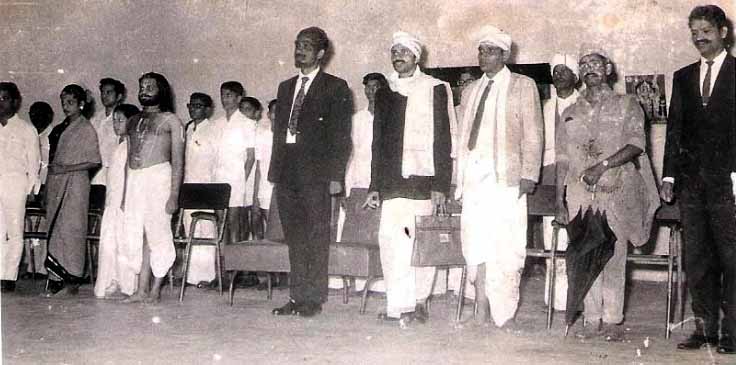
Group Photo of the Play on Ramanujan- Extreme Left : Mr K Ekambaram as Ramanujan, Vice Admiral G Ashok Kumar as Komalambal (Mother of Ramanujan), Late Mr KM Koshy as Professor Hardy, Mr Venkatesha Murthy as Collector of Nellore, Mr M Selvaraj as Father of Ramajujan, Late Mr AKR Varma as the Postman, Mr R Subramanium as Professor EH Neville (Photo Courtesy Mr Venkatesha Murthy).
As we are living in a nuclear family, if the parents don’t have girl child they need not worry, SSA will turn them to be beautiful girl in stage one- act plays. Yes, our Vice Admiral, G Ashok kumar, the then Sainikien is an example as he acted in a lady character, Komalambal, the mother of Ramanujam, world- wide great Indian Mathematician, in a skit entitled Ramanujam, written and directed by Mr Venkatesahamurthy, Maths Master. In addition to students, many Masters like Mr KM Koshy,Mr R Subramanan, Mr K.Ekambaram,Mr KP Nataraja Pillai, Mr King Kristo kumar, myself and the playwright Mr Venkateshamurthy himself enacted various roles.
Right from his joining the SSA Ashok had been a gentleman cadet, the way in which he was moving with his fellow mates, Masters, other staff members and the armed force officers were of exemplary manner and that he was loved by all. He is one of the proud sons of Alma mater SSA , and he has reached the second highest position in the Indian Navy. Normally intelligent people make a soft- pedaling towards intelligence; but our Admiral Ashok kumar is an exemption. If I say that his intelligence coupled with diligence has taken him to such a great height along with other covetable traits in him , it is not an encomium or a hyperbole but it is my heartfelt expression that comes from the bottom of my heart about our past student of Sainik School Amaravathi Nagar, Vice Admiral and Vice Chief of Naval staff.
On behalf of all Amaravians – Defence officers, Masters, Staff members and the students of the past and present let me wish Vice Admiral Ashok kumar, his better half, Mrs Geetha, the woman behind him for his achievement and success, daughters Mrs Sruthi and Ms Sweta all the best. May God’s gracious blessings be showered on them.
The first time I met Ashok Uncle was when I was about 8-9 years old, when we had gone to Darjeeling and Gangtok on a family vacation. We were staying at the officers’ mess at Gangtok. Dad suddenly walked in with a smart energetic gentleman and introduced him as his classmate. They both were overjoyed to see each other. Little did I know back then that our association would stretch so long in our life. Because as an army kid you come across so many coursemates and uncles every now and then. But the strong bond that Sainik School Amaravati Nagar had forged held on stronger than anything.
Many years down the line, I kept on hearing about uncle and as luck could have it, both Ashok Uncle and my dad were posted at Mumbai at the same time. I used to hear that dad used to go meet uncle often despite him holding a prestigious and demanding position. Owing to the fact that I was elsewhere during that tenure I could not get a first hand glimpse of how Ashok Uncle handled his multitudes of roles with such aplomb.
When we went to NDA as a part of the Amaravians get together in 2015, I got to see Ashok Uncle’s cool side. He must have probably been the coolest of all commandants of NDA, his alma mater as well. Finally, in 2019 when we were at Delhi and Ashok Uncle was yhe Vice Chief of Naval Staff (VCNS,) I had probably maximum interaction with him compared to any of his batchmates kids. I am thoroughly convinced that he is the most chilled out person who is always high on energy and ever cheerful; that too while being the VCNS.
Not to forget Geeta Aunty is also retiring with uncle, who is also another one who needs to be mentioned for her cool demeanor. Perfect couple who are always youthful and full of life. I have never seen either of them stressed or tensed despite the numerous tasks and responsibilities at hand. He was kind enough to share few instances of how he had managed to wriggle out of tough spots while ensuring that no one’s ego was hurt and at the same time ensuring the outcome was the best possible one.
It is simply unbelievable. The quick thinking, speed of thought and execution is something I wish to emulate in my life as well. I think I have iterated enough number of times how cool uncle is but it just does not seem enough. It would be incomplete if I don’t mention his amazing singing skills. Oh what a wonderful entertainer he is!! Would have given so many singers in the industry a run for their money. Good for them that he ended up in the Indian Navy.
All the very best Ashok Uncle for your second innings. I’m sure the nation is missing out on an amazing chief of Indian Navy but hopefully he gets to serve in some or the other capacity because he still has enough fire in his belly. Also the nation needs such leaders. Good luck Ashok Uncle and Geeta Aunty. Lots of love yours truly Rohinth (Gucci as Aunty calls me.)
About Rohint Natarajan: – Born in Tiruppur to Veteran Brigadier TM Natarajan, an Amaravian of 79 batch and Mrs Sudha Natarajan. He travelled the length and breadth of the country as an Army Kid. An alumnus of almost 10 educational institutions across the country – Army public school Dhaula Kuan, New Delhi and Kolkata, Bhavans Secunderabad, Kendriya Vidyalaya , Avadi to name a few. A mechanical engineering graduate from SASTRA University, Thanjavur (completed in 2014.)
After a short stint in Tata Consultancy Services, joined the Central Reserve Police Force as Assistant Commandant in 2017 and served at the Indo Pak border in the Kutch Sector. Subsequently, cleared Civil Services Examination in 2018 and joined Indian Revenue Service (Income Tax.) Presently serving as assistant commissioner in Bangalore.
Interests include traveling, playing the guitar, sports and watching movies.
On the eve of retirement of my dear friend, Ravi Prasad, hanging up his boots after nearly four decades of military service and five decades of being in uniform, I sat down to reminisce about our association. We met for the first time in 1979 at the National Defence Academy (NDA) – E Squadron/ 61 Course – and have had a similar journey until I called it quits in 2004. We did many courses and were posted together at many stations with the last one at the Military Intelligence Directorate, Army Headquarters (1998-2000.)
According to Webster’s Dictionary, retirement is defined as a recoil, pullback, pullout, retreat, withdrawal, disengagement – more of Artillery terms. Related words include flinch, recession, revulsion, disentanglement, shrinking, etc. Retirement has also been defined as seclusion from the world; privacy; the act of going away or retreating. If that’s retirement, Ravi you are not going anywhere. Retirement is the time when everybody calls you for crap you don’t want to do because they think you have more time.
Now you are a Veteran and a Veteran is someone who, at one point in their life, wrote a blank check made payable to The Bharat Mata, for an amount of up to and including your life. A soldier like you cannot be separated from or surgically removed from the uniform, which you got into at the age of nine in 1971 at Sainik School, Korukonda, Andhra Pradesh. Your blood runs Olive Green. The uniform has been more akin to Karna’s Kavach – his body armour – which made him near-immortal.
Dear Friend! After all these years of hard work and loyalty to the nation, you have earned this much awaited retirement. You have been a phenomenal friend to me who was always out there to help and hold my hands in difficult situations. During my service days, I wanted to be like you – honest, cool, calm, unruffled, smart, handsome, intelligent and more importantly, a great human being. As parents Marina and I were so proud of the way you and Lalitha parented Tejaswi that we took a few leaves out of your book when it came to parenting our children – Nidhi and Nikhil.
At the end of the day what counts most are reputation and the ability to look in the mirror and know you made decisions based on mission and taking care of your soldiers and their families. You served the nation with loyalty, to the best of your ability, and made the Regiment of Artillery proud, capable, resilient, battle-hardened, well led for which we all are proud of. Your discipline, hard work and love for humanity have earned you all the respect. Now is the time to take the time off and enjoy life.
This is the time for you to revel in all your achievements and take stock of all those humans who helped you to swim through at different stages of life – Parents, Siblings, Teachers, Friends, Colleagues and so on. Reflect on them and you will have volumes to write about. Please do it so that your children, grandchildren and others of the coming generations will have something to feel proud of and also motivate them to achieve higher glory.
As a soldier you never had a holiday in life; but retirement makes every day a holiday. Plan to make your holiday fun loving and entertaining. One suggested way is a visit to Canada. We extent a standing invitation to you to visit Canada. This is a fabulous place for a second honeymoon.
General Ravi Prasad at Devlali with our coursemates and their ladies – from left to right : Rohini Shankar, Lalitha Ravi Prasad, GM Shankar, Shridhar Chitale, Manjushree Chitale, Ravi Prasad, Darshika Suri, Y V Suri and PK Sharma.
Retirement is not a work status, it’s an attitude. You don’t need to follow orders, discipline, restrictions, etc of the military life. The retirement life is meant for careless living with only fun. Retiring is not a sad ending. It’s a chance to let loose and totally unwind.
You may presume that you are your own boss, but wait! You now left your old boss and start a life with your new boss, your wife. You are now a ‘Go Getter‘ – Lalitha will now order you to go get something and like an obedient husband, you will go and get it for her – which was your last priority in your military life.
At the railway stations, there are Retiring Rooms and at night we Retire to bed. In life there is neither any Retiring Rooms nor you Retire. It is never retiring but it’s all about retrying. Retry all those hobbies/ interests you tried before, but gave up due to exigencies of military service. It’s also time to reinvent yourself and pursue new hobbies/ interests, which you never dreamt of.
Veteran Lieutenant General Pankaj Srivastava, who was Ravi’s predecessor as Director General of Artillery says:- ‘Ravi signifies purity, sincerity and dedication. He is a gem in the crown of the Regiment of Artillery. I wish him good luck and success.’
Veteran Air Commodore Joseph Paul has this to say about his Army buddy at E Squadron at the NDA – ‘Ravi as a Cadet, was a gentleman among gentlemen. He did make a vain effort to strike terror among his juniors, but later gave it up as a bad joke. The juniors were fascinated by his accent, which distracted them from the threat of retribution he wished to convey. In particular, was his inability to pronounce the ‘ch’ as in chew, which exited his mouth as ‘soo’. Caused a lot of hilarity among the juniors, till someone more qualified in linguistics came along and made them measure the corridors in units of front rolls!!‘
Veteran Colonel Abhay Mall recalls: ‘Having known Ravi since Academy days and commissioning into Regiment of Artillery; and subsequent fortune of being together on numerous occasions while on postings and training courses; where we shared great bonding and I take pride in being associated with him. Ravi is a very sincere, hardworking with perceptive mind and focused individual. He has been a gifted and result oriented leader, highly competent and well accomplished person; rising to the highest position to head the Regiment of Artillery. Our heartiest congratulations to Ravi on having achieved huge laurels during his distinguished career; and best wishes for the second innings.‘
Lieutenant General VS Sreenivas, PVSM, VSM** writes:- ‘Ravi, my dear friend and I joined Sainik School Korukonda in 1971 – with our roll numbers 1062 and 1063. We joined the same NDA course- 61 NDA and then 71 IMA. Thereafter we grew together in the Service through promotions, courses, school get-togethers, mutual visits and tenures together at Army Headquarters.
I have admired Ravi for his sincerity, simplicity, competence and being a good human being. He contributed immensely for the organisation, quietly, without any self projection. It is a matter of great pride that an alumnus of our School became the Director General of Artillery.
Lalita, a gracious lady, complements Ravi in every way. They are experts in the typical Andhra meals- complete with banana leaves, varieties of rice, sambars, pickles, papads etc – beating the famed 26 item Onam spread any day! We wish Ravi and Lalita the very best in their retired life. I will also be retiring next yr in Jun and we shall be neighbours in Patel’s Signet.’
Veteran Colonel Punna Rao Vesangi, Ravi’s batch-mate from Sainik School Korukonda reminisces:-‘Ravi exhibited leadership qualities from school days and his appointment as House Captain is a testimony to that. One aspect which helped him remain cool and composed was his disciplined life and love for literature and the poems he penned during those blossoming days at School.’
Veteran Vice Admiral MS Pawar proudly remembers:- “Ravi, my friend of 50 years, what an innings you have played! With passion, fairness, humility and leadership par excellence; all along displaying a fine confluence of head and heart. A spirited Saikorian Classmate you made us all proud by your reputation as a top notch professional reaching the highest echelons as the DG Artillery. You headed the Arm with aplomb during a very crucial period.
Lalita, the ever cheerful and gracious lady in your life has been a role model herself; the wind beneath your wings enabling you to fly high. Thank you both for the friendship and your company which we were privileged to enjoy.
Meena and the children join me to wish you and the family continued fair winds and following seas as you now prepare to embark on yet another voyage together. Remember, we are a safe Anchorage should you need one along the passage.’
Veteran Colonel Durga Prasad pens:– ‘Ravi, We are honoured to convey our greetings on the eve of your retirement from service on 31 July. We are associated for the past five decades as Classmates since July 1971. You have held the coveted position of Director General Artillery since 06 March 2019 and inspired all ranks by your professional commitment and exemplary conduct. We will always remember your support to Brig Sravan Kumar in organising our Class get together at Nasik in August 2013. We adore you and Lalitha for the positive and helpful nature. Our best wishes to Tejaswi and Pushyami. Wish you good health, active long life and a pleasant stay at Secunderabad.‘
Ravi (extreme left) with his mother, CHVSR Prasad and TLP Babu with General KV Krisnha Rao at NDA in December 81
Veteran Commander TLP Babu says:– ‘Ravi and I go back a long way, to our School. But we became fast friends only during the latter years. We bonded over our love for music, movies and literature. He is a thoughtful, compassionate and diligent soul. Although we were in adjacent squadrons at the Academy, the busy itinerary ensured minimal interaction. We bonded again through long letters after we left NDA for quite some time, but the Army postings and the Navy sailings meant we drifted apart slowly. Pre social media days spelt minimal interaction and it was after nearly twenty five years that we met again, at our School social. I found that he’s remained the same down to earth self who wore his rank lightly. He organised our most memorable getaway to the northeast when stationed at Tejpur. We’ve been generally in touch since and it was heartwarming to see him scale the pinnacle of his career. Good guys do finish last! Look forward to seeing more of him at the city of Nizams and looking back on the years gone by!!’
Maj Gen BV Rao, Vice Admiral MS Pawar, Ravi and Major General ML Mohan Babu
Veteran Major General ML Mohan Babu writes:- ‘Ravi, the name I always loved, happened to be one of my best friends, I made for ever. First met Ravi in Feb 1971 at Eluru when we were appearing for the entrance examination to join Sainik School Korukonda. My parents fondly know him as the boy from Kamavarapukota. Spent the next eight years in the same House. He was extraordinarily talented and was the most wanted when we had to face our Telugu examination. He was our savior because, with just a day’s guidance we could clear the Telugu exam easily. I caught up with Ravi again, while preparing for the Staff College entrance examination at Devlali in 1994. Yet again, we were together in Delhi in 1998 & 99, before he joined to fight the Kargil War. Undeterred of the war conditions he exemplified the role of Battery commander and Second in Command of the Regiment, which he never served before. Once again joined Ravi for the Higher Command Course and interestingly, together for the Foreign Countries Tour and North East Area Tour also.
He served in nearly six Regiments and yet rose to the highest rank an Artillery Officer could. No small feat. It’s the outcome of his four decades of dedicated efforts. It’s indeed rare to find an Officer and Gentleman of his nature and clean character. Proud to be associated with Ravi during the last fifty years and I consider it as a God’s grace to give me a friend as Ravi. His support all through the School days and till recently at Delhi when Sunita went through a major surgery (Hip Joint Replacement) is immense and invaluable. I’m indeed indebted to him and can’t be paid back in this lifetime… Thankful to God Almighty for giving me such a friend… Many thanks to the beautiful Lady, Lalita Garu who stood with him in every measure and made our friendship only stronger and better. Her hospitality was unmatched and hence made us regular visitor to their home.‘
Veteran Major General BV Rao touching base with Ravi:- ‘On the occasion of your retirement on 31 Jul, we congratulate you for the noteworthy and dedicated service to our great Army and the Nation. You have been a notable influence on all those who knew you with your simplicity, calmness, dedication, logical decision making and above all likeablity. Coming up from a humble background,being a quiet achiever, holding the highest possible post of DG Arty in a challenging environment speaks volumes of your sterling qualities. Of course we will always cherish your boisterous laughter, being a fantastic host, and delicious authentic Andhra meals so fondly served by Lalitha Garu. Our congratulations to Lalitha Garu for being a pillar of support and being through the thick and thin of your challenges. Here is wishing you an equally joyful second innings to do what you like. Once again Sujatha and I wish you and your family a Happy, Healthy retired life.’
Veteran Brigadier YS Kumar fondly recollects:– ‘Ravi, my fellow traveller of 50 years (of course, he was leading the way!!!) says Goodbye to the Olive Greens, but in all probability continue to be one at heart for a lifetime. Looking back; the apt summary of his journey of life could be what Quintus Curtius Rufus , a Roman historian said; “ The deepest rivers flow with least sound”. A quiet Doer, with no frills and of course NO bombast.
We had journeyed quite often together in service together in the same formation. A Leader’s mettle is tested in adverse situations; and he was the calming effect when things had not gone as planned with guidance/ suggestions on what to do in minute details and leading right in the front. Empathy, dedication, and service before self was what he practiced. One who truly practiced Nischkama Seva (Selfless Service.) Lalita Garu, his Lady Love was a true Companion whose hospitality, taste and eye for detail we all appreciated and looked forward to. A fantastic host; savoured traditional south Indian food lovingly served personally by the couple on Banana leaves.
Most of our kids had one serious complaint with uncle and aunt – as all parents took Tejasvi to be the reference point for excellence in behaviour, obedience, academics as also extra curricular activities to be followed to no avail!!! Of course, in due time forging the best of relations with the next generation too. We wish Ravi-Lalita a great second innings and I have no doubt they will have a larger canvas to touch more people while pursuing things dear to them : Happiness – Joy, enjoying simple things, friendship and being a good Samaritan.’
Veteran Commodore SVR Murthy, Ravi’s classmate recalls:– ‘Ravi is very sincere from the heart ,down to earth and very caring in nature. He always led a disciplined life and did very well in school and passed out as a House Captain. He was admired by his juniors and peers too for his admirable qualities. The very fact he rose to be a three star officer and retire as the DG Artillery of a 1.3 million strong Indian Army bears testimony to his service record and professionalism. Knowing Ravi, he rose because of his sterling qualities and nothing else. Lalita remains a pillar of strength for Ravi as also both his mother and mother in law who usually stay with him out of affection for Ravi. Lalita complements Ravi in being as “cool as a cucumber” with her calm and affectionate nature and broad smile. Archana joins me in wishing both Ravi and Lalita the very best as Ravi hangs up his uniform and swallows the anchor.’
‘Never was so much owed by so many to so few’ : — Winston Churchill.
When we – thirty Mallus (a person from the Indian state of Kerala, especially one who speaks Malayalam) – joined Sainik School Amaravathi Nagar (SSA) in 1971 in grade 5, it was our classmate – Cadet G Ashok Kumar – who acted as an interpreter. Our life was made easier as our House Captain was Veteran General PM Hariz, then in his 9th grade – who too was a Mallu. We knew only Malayalam with no knowledge of either Thamizh or English. Ashok, a Mallu, his father served in Thamizh Nadu Police, he studied in Thamizh Nadu, but spoke Malayalam fluently. He was very empathetic towards us and did his interpretation with lot of passion and commitment. I fondly remember him teaching me how to slip a pillowcase over a pillow.
These qualities of Ashok stood with him throughout his life, especially as a Indian Navy Officer, rising to be a Vice Admiral and the Vice Chief of Naval Staff.
Admiral Ashok was commissioned into the Executive Branch of the Navy on 1 July 1982. He is a navigation specialist and served as a Navigation Officer of the Frigates INS Beas and INS Nilgiri, the Destroyer INS Ranvir and the Aircraft carrier INS Vikrant. He attended the Defence Services Staff College (DSSC,) Wellington, the Higher Command Course at the Army War College, Mhow and the Expeditionary Operations course at Quantico, Virginia, USA.
He commanded Indian Naval Ship (INS) Kulish and INS Ranvir. He has also served as the Executive Officer of INS Brahmaputra. He served as the Defence Advisor (DA) at the High Commission of India in Singapore and the Chief Staff Officer (Operations) of the Western Naval Command.
Admiral Ashok has made each one of his classmates proud by his achievements. He displayed his love for us when he hosted us at the National Defence Academy (NDA) – while he was the Commandant – for a get-together on 22 and 23 December 2015. It was the most memorable part of the life of all our classmates and their families. To read more about it, Please click here.
Today, Admiral Ashok hangs his Naval Uniform after nearly four decades of dedicated service to the Indian Navy. How cool is that!! So began the journey we celebrate today, a career in which that nine-year-old cadet at Sainik School Amaravathi Nagar grew up to be a top Admiral of the prestigious Indian Navy.
For your next visit to Swati in the US, ensure that you and Geeta obtain a Canadian Visa and spend some time with us. Remember that the Niagara Falls is better viewed from the Canadian side. This is a fabulous place for a second honeymoon.
Ashok, now is the time for you to sit back and not relax, but to demonstrate your deep love for Geeta. You can now afford to spent more time with her – without the excuse of office or duty. This is a God sent opportunity to express your gratitude to Geeta for all her love and dedication in bringing up your two daughters Sruti and Swati to be great ladies and valuable citizens.
On 24 July, Vice Admiral Ashok dedicated a Sea Harrier aircraft to his Alma Mater – a great act showcasing his love for his Alma Mater. Many of our classmates proudly accompanied Ashok on the solemn occasion.
Mr MV Somasundaram, Ashok’s House Master at Chera House about his protege:- ‘You are a seaman with gratitude to our School, the soil and source of a crusading career; Inhale the sweet fragrance of Sainik Flower, your formative alma mater; Keep navigating viewing the Pole star with a vision, rowing with a compass of rationalism; A splendid torch that would make your life bright and beautiful, With wishes to grow near the sky.‘ To read more about Mr MV Somasundaram, Please Click Here.
Mr M Selvaraj, Ashok’s Thamizh teacher recalls:- சாதாரணக் குடும்பத்தில் பிறந்தவரும் சரித்திர நாயகனாகத் திகழலாம் என்பதற்கு நீயே நல்லதோர் எடுத்துக் காட்டு. உன் மார்பை அலங்கரிக்கும் பதக்கங்களே உனது கடற்படைச் சாதனைகளைப் பறைசாற்றும் படைத்துறை இசைமுரசு. உன்னத சேவைப் பதக்கம், உயரிய சேவைப் பதக்கம், சிறந்த சேவைப் பதக்கம் முதலான விருதுகளே உன் கடற்படைச் சேவைக்கு அங்கீகாரம் அளிக்கும் நற்சான்றிதழ்கள். அன்று (1978 ) அமராவதிநகர் சைனிக் பள்ளியின் சேரர் இல்லத் துணைத் தலைவனாய்ப் பணியாற்றினாய் இன்று (2021) இந்தியக் கப்பற்படையின் துணைத்தலைவராய் விளங்குகிறாய். குடியரசுத் தலைவர் பெருமகனார் அப்துல்கலாம் அவர்கள் சொன்னவாறு அப்போதே கனவு கண்டாயோ? உச்சம் தொட்ட உன்னைக்கண்டு உன்னை ஈன்றெடுத்த பெற்றோர்கள் மட்டும் அல்லாமல் சைனிக் பள்ளியாம் நற்றாயும், சைனிக் குடும்பத்தைச் சேர்ந்த அத்தனைப்பேரும் அகமகிழ்ந்து ஆனந்தக் கண்ணீர் அல்லாவா விடுகிறோம், அன்புச் செல்வனே துணை அட்மிரல் அசோக் குமாரே. தாயக மண்ணில் மட்டும் அல்லாமல், அயலக மண்ணிலும் நம் நாட்டின் பெருமையை நிலைநாட்டிய உனக்கு எங்கள் வீர வணக்கம். கனிவையும், கண்டிப்பையும் காட்ட வேண்டிய இடத்தில் காட்டி, கடற்படை வீரர்களுக்கு நல்லதோர் வழிகாட்டியாய், முன்கள வீரனாய் விளங்குகின்றவன் அல்லவோ நீ. இன்முகமும், இன்சொல்லும் உனக்கு இறைவன் அளித்த அருட்கொடை..கடற்படை ஆயுதங்களோடு இந்த இரண்டு பிரம்மாஸ்திரங்களையும் கொண்டு அல்லவா அனைவர் நெஞ்சங் களையும் வென்று மகிழ்கிறாய். ஓய்வுக்கு ஒய்வு கொடுத்த ஓய்வறியாக் கடற்படை வீரன் நீ. ஒய்வு பெற்ற பின்னும் நீ ஓய்வெடுக்கவா போகின்றாய். இல்லை, இல்லை.தேனீயாய்ச் சுறுசுறுப்பாக என்றும் இருப்பாய் என்று எங்களுக்குத் தெரியும். இதுவரை நாடுகாக்கும் நற்பணியாற்றினாய். இனி, வீடு நலம்பெற அன்பு மனைவி இல்லற நாயகி திருமதி கீதா, அருமைச் செல்வங்களாம் ஸ்ருதி, ஸ்வேதி இவர்களுடன் பல்லாண்டு பல்லாண்டு மகிழ்வுடனும், நலமுடனும் வாழ்க என எல்லாம் வல்ல இறைவன் அருள் வேண்டுகிறோம்.
You are an exemplary example to prove that ordinary common man’s offspring also can shine like a historical legend. The medals that adore your chest are the proclaiming Military band. Param Vishist Seva Medal, Ati Visit Seva Medal, Seva Medal are the right recognition for your outstanding service in Indian Navy. In 1978 you were Vice Captain of Chera House in Sainik School and now in 2021 you are the Vice Chief of the Indian Navy. As our great soul Dr A.P.J.Abdul Kalam said, did you dream to reach this height at that time itself? You have reached the zenith in your career. Seeing you, not only your biological parents but also benign mother – SSA and all members of SSA family shed blissful tears out of extreme happiness. Do you know,our dear Vice Admiral Ashok Kumar? You have impressed the people to know the greatness of our country not only in our mother soil, but in other alien soil also. A Royal Salute to you, our dear. Where you have to show your senility you did show and where you have to show gentility you did show and you stood as a forefront warrior, you are an ideal guide to all your fellow warriors. Aren’t you? Smiling face and soft-spoken words are God’s precious gift to you. Along with the Navy weapons, with these two ‘Brammasthrams’ you have conquered the hearts of all people and make them feel happy. You are an outstanding soldier in Indian Navy who gave rest to rest and you are a work alcoholic. Are you going to take rest after retirement? Never, never. We know that you will be as active as a honeybee as you had been hither to. So far you have put in your very best without any reservation for the Homeland. Now it is time for you to look after your family. We pray to the God Almighty to bless you to have a happy retired life with Mrs Geetha madam, the woman behind you for your success, your affectionate daughters Mrs Sruti and Ms Swati. To read more about Mr M Selvaraj, Please Click Here.
Veteran General PM Hariz writes:-‘It’s been a pleasure knowing Ashok all these years. Apart from our association at Amaravathi Nagar, we served together as instructors at DSSC, Wellington, just prior to his posting as DA to Singapore; and since then have been always in touch with each other. As the Commandant NDA, I had a standing Invitation to visit him; unfortunately could not make it due to exigencies of service. We were indeed very proud when he was appointed as the Vice Chief of Naval Staff; when Lieutenant General Devraj Anbu, PVSM, UYSM, AVSM, YSM, SM, another Amaravian was the Vice Chief of Army Staff. I took the liberty of telling both of them that they needed to get a photograph of them together …. And they obliged! I had then posted this in the Amaravian Alumni Association FaceBook Group. It was indeed a very unique and proud moment for all Amaravians. After my retirement, he was kind enough to visit us at Kovai on his way to DSSC to deliver a lecture.
Ashok has been actively involved in chasing issues on behalf of the School too, both at the Service HQs and at the State Govt level. Recently, when the present Principal was steering the release of funds from the State Govt, Ashok got the Defence Secretary to speak to the Thamizh Nadu Chief Secretary to assist in resolution of the issue. My wife and I had the pleasure of attending his daughter’s wedding at Delhi in Nov 19. Admiral Ashok, an officer and a gentleman has been a shining example of an officer in the armed forces, worthy of emulation. We wish him and his family the very best in the second innings.’
Veteran General Devraj Anbu recalls:- ‘Two Amaravians in the corridor of South Block housing the Ministry of Defence was an envy for everyone. Ashok and self did capitalise to a great extent. Ashok’s tri- service experience gave a great head start in his tenure as Vice Chief. His vast experience, ability to articulate and persuasiveness resulted many a time in deciding very delicate and important issues in favour of the Navy. Many a time he navigated his way through complex and thorny issues to Navy’s great advantage. He was at his best during deliberations in Vice Chiefs’ meetings. Having known Ashok from Chera House days in school, I took the liberty of enjoying his hospitality when he was in Singapore. I cannot forget the way he looked after me from the time I landed there to my departure. Every moment I spent with Ashok’s family is etched in my mind. He has done this for everyone who has come across him .. a great quality that endeared him to everyone.’
From the Left : Chef Vijaya Baskaran; Chef Manjit Singh Gill, President IFCA; Admiral Ashok Kumar; Late Chef (Dr) Soundararajan, then Secretary IFCA
Chef Vijaya Baskaran, Vice President, Indian Federation of Culinary Associations (IFCA,) looking back at the VII International Chefs conference organised by IFCA in 2017 at Delhi writes:- ‘I recall with pride my classmate Admiral Ashok Kumar, addressing over 800 of the finest Chefs, he commenced by saying “What will a Naval officer talk to reputed Chefs about? Both the Chefs and Navy personnel wear whites and work in challenging conditions. Armed forces march on their stomach or ships sail on their stomachs and the most important reason – I was invited by my classmate and I could not refuse. Such is our brotherly bonding.“ The 45 minutes of his talk was repeatedly interrupted by applause from the delegate chefs; such was the power of his words. I am sure many chefs will try to influence their children to enroll in the Indian Navy after such a motivating talk. The aftermath of his powerful speech was that there was a long queue of chefs waiting to click a picture with Admiral Ashok.’
Veteran Commander Daniel Reginald, Indian Navy, our classmate remembers fondly:– ‘Having landed up in the Navy three years junior to Ashok and in a service where even one day seniority matters, I enjoyed the privilege of getting treated at par as a classmate by Ashok, despite our seniority differences. We missed being in the same station most of the time (except for a short period at Naval Headquarters) and I finally caught up with him after taking premature retirement and when he was posted as Flag Officer Sea Training and Chief of Staff Southern Naval Command, Kochi. The bond and friendship we share growing up together in Amaravathi Nagar breaks all the seniority differences, and Ashok is such an approachable person. I had the full liberty to call him up any time and seek his help and guidance in the high positions he held, and I regret not visiting him enough whilst I was in the service. Friends and forever and will catch up with him, post his retirement. Wishing Ashok, Geeta and their two lovely daughters- Sruti and Swati – Godspeed, following winds in their anchorage.’
Veteran Commander MP Joseph, Indian Navy, two years our senior at School reminisces:-‘Ashok was always seen smiling, even when things were not looking very good, a classic example of being bestowed with the stellar quality of sense of humour, he could laugh at himself, rather than complain – a very important quality in a military leader.‘
As we look back on Admiral Ashok’s career of service to our country, I think everyone will agree with me in saying, it was much cooler even than what we all – his nine-year-old classmates at Sainik School Amaravathi Nagar – could’ve imagined.
Veteran Commander N Balasubramanian, our classmate recalls:- ‘It has been a 50 year association with Ashok since joining Sainik School in July 71. We were in the same section in School, thereafter we were coursemates in NDA too and there also we were in the same class following it up with the Indian Navy being in the Executive Branch. We also did 51st staff course together. I was also fortunate to know his wonderful family well and have spent some memorable time with them in our younger days.
Ashok and Geetha have always been warm and large hearted. Though I left Navy in 2007, have enjoyed like many other coursemates, colleague and even strangers their hospitality all along even when he was DA in Singapore.
I had a contribution to him in choosing the Navy, as I suggested to him to give Navy as first choice when we were choosing Service while appearing for NDA, as I was in the Naval wing and he in the Airforce wing in NCC. It proved good for the Navy. Also Geetha rose up to be President Naval Wives Welfare Association (NWWA).
Over the years, I have found Ashok to be down to earth, cheerful, affectionate, humble and helpful to all. He is a thorough family man and a very devoted son. I am confident that more challenging assignments will come his way considering his wide exposure and experience. On behalf of my family and many classmates and coursemates I take this opportunity to wish Ashok, Geetha, Shruti and Swati all the very best, good luck and god speed.‘
Alex Manappurathu, Ashok’s Chera House mate writes:– ‘I remember Ashok being a strong Sivaji Ganesan fan. A movie buff to the core. During school vacations he claimed to go to movie halls every day (and saw multiple movies per day!), and at end of the vacation, returned to school with repertoire of stories to be narrated to his eager classmates.
Cut to the present, having heard him at our Alma mater recently at the Sea harrier dedication ceremony, he was coaxing the students and teachers, connecting the dots of his school days and his naval career to drive home certain points. Makes me wonder if it was this story telling sessions of his school days that honed his oratory skills!
In the past few years whenever I have met folks known to him, it was very clear that all of them spoke of him in very high esteem. Some statements from them … “Made me realise persuasion is the way to get things done, and not Danda (stick.)” “He had done so much for me, this is is least I could do.” “Well accepted personality, gets along with every one.” “Learned so much from him.”
With his strong interpersonal skills, wishing him a very happy and productive second innings too after he hangs his naval uniform.’
Here we are…43 years from this day, I met TD Joseph (Joe) at the National Defence Academy (NDA)- he as an Air Force Cadet and I as an Army Cadet. Until then, we both did not know each other and that we hailed from the same village – Ayarkunnam, Kottayam, Kerala. He graduated from the Mayo College, Ajmer, Rajasthan and I from Sainik School Amaravathi Nagar, Thamizh Nadu. Today, I cannot believe the day has finally come for Joe to hang up this uniform and retire.
Often our vacations home coincided and we met either at the fish vendor’s stall in the village market or at the coconut oil mill. You were the ‘son of the soil’ and I have an anecdote to narrate. My eldest brother, while on a trip to the village market, was hailed by a young man pulling a പിടി വണ്ടി (Pidi Vandi – hand cart), laden with bags of fertilizers, with his father pushing from behind. It took my brother a minute to recognise the person. Behold! it was you – a young Flight Lieutenant.
Joe, by your compassionate and fearless leadership, you have put smiles on all the officers and airmen who served under your command. I witnessed it while I visited you at Shillong in 2017. You were really passionate about everyone’s well-being.
You are a born leader and have been blessed to be able to lead others. You have the power to influence others and you did it very well You always worked towards the betterment of others and never for self-gratification. You surely did enjoy your time with the Indian Air Force and you will undoubtedly miss the camaraderie and the privilege of leading such wonderful human beings.
Sophie was always by your side, and you touched the skies with glory in her company. You both raised two thoroughbred gentlemen sons – Abhishek and Ivan, with Ann Maria now joining your team. Sophie has been your supporting pillar over all those years, and you credit her for that. It was very evident during the days you both spent with us in Canada in June 2016.
Sophie has been a perfect Air Force wife, inspiring others and representing the ladies fraternity. With her love and caring, you have flown safely all these years.
Joe was commissioned into the Indian Air Force as a fighter pilot in December 1982. He was the winner of the Nawanagar Sword of Honour and President’s Plaque for standing first in Order of Merit in his batch of pilots. He has flown over 3800 hours on various fighter and trainer aircraft.
He is a Category A Qualified Flying Instructor and was an Air Force Examiner. He commanded a Fighter Squadron in the Eastern Sector, the Flying Instructors’ School at Chennai and a major Air Base in the Western Sector. He was a senior faculty with the National Defence College, New Delhi, the Air Defence Commander in the South Western Sector and Eastern Sector.
Veteran Air Commodore Joseph Paul recounts:- ‘… and a most inspiring Malayalam address to the audience, on the occasion of Onam, all of which went over my head. Loved his golf and had a mean handicap. When a Sikh C-in-C was retiring, we made him ‘renew his vows’, at a party. Joe was the ‘priest’ who conducted the ceremony, and as in everything else he did, was technically flawless, including his sense of comic timing. Had the audience in splits!!!
As in sailing any sea, one has to take the rough with the smooth. Sometimes, in a Headquarters, when somebody senior got on your nerves, one deftly manoeuvred the boat into Joe’s office, where a cuppa tea, a beatific smile, and a few words of wisdom, were instrumental in inspiring you to take the boat out again.’
Veteran Air Vice Marshal Anil Golani pens :- ‘Joe known since the last four decades, a handsome, smart and erudite officer with impeccable language and diction has been a simpleton at heart. Rarely does one find the combination of an intellectual, hardworking, meticulous and sincere professional who is a simpleton at heart, bears no malice towards anyone and makes an effort to keep in touch with friends. I followed him for the RCDS course in London, UK and his briefing to me was immaculate and precise.
Sophie aka Nirmala has been a pillar of support to Joe, in all his endeavours while carrying out her responsibilities on the social front for the welfare of the extended Air Force family. Fun loving and charming, she has been sought after by seniors and subordinates while being a caring and loving friend to her peers. We wish both Joe and Sophie Good luck, Godspeed and Happy Landings as they begin their Second Innings, which I am sure will be better than the first. Wishing you both many birdies and pars with an odd eagle thrown in to keep you going. Lots of love from Golu & Rekha’
Veteran Air Vice Marshal Michael Fernandez says:- ‘Joe is a super guy, and I mean it truly. Known him ever since NDA, got to know him better when we spent the next decade together. Always ready to help and extend a hand whenever he saw someone in need. Ably complemented by Sophie who I am sure has been his crutch though he is the youngest looking coursemate we have. Hope Sophie remembers the reason she stopped speaking to me for around three months. Looking back, I’m sure she will remember that episode “happily.” Professionally second to none, Joe, possibly, must be one of the few coursemates who has published a professional book. Vaneeta and I wish them all the very best in their life ahead.‘
Veteran Captain Ramesh Babu (Indian Navy) recalls:- ‘Joe was an ideal Cadet at the Academy, excelling in everything that the curriculum prescribed. He followed rules, studied hard, played well, marched smartly and made lifelong bonds with friends, which make up the essence of Academy life. As Malayalees, we shared a special bond and the poor guy often had to put up with my pranks. Together, the two of us smashed over the nets when volleyball got introduced at NDA. The special bond we made at the Academy continues, now encompassing our families.‘
Veteran Colonel Abhay Mall writes:- ‘Our dear Joe, as I saw him during three years of stay in Bravo Squadron during NDA days, has been a perfect gentleman – always cool, silent, and soft spoken and ever smiling. He has been a passionate basketball player. Joe, the fighter pilot, by dint of his caliber, professional acumen and perseverance rose to don the most coveted rank of Air Marshal and achieved numerous accolades and decorations in his illustrious career spanning over four decades. It’s been a matter of great pride for ‘Braves’ to have been associated with him and remember the old bonding. I recall a very brief conversation with you at Braves get-together at Gangtok few years ago wherein I was touched by simplicity and contentment with life when you talked about your humble beginnings and that what God blessed you with Sophie and adorable and successful sons. At this memorable moment, we wish you all the very best in life ahead.‘
Veteran Lieutenant Colonel Tejinder Padda recollects : ‘Hi TD! Heartiest Congratulations on completion of an absolutely awesome tenure with the IAF. Started getting to know you from the time you joined NDA as Cadet TD Joseph and got to know you more when you rose to the pinnacle and became the Air Marshal TD Joseph. There has been hardly any change in you ever since: cool, always smiling, suave, having a good word for everyone and everything, essentially a towering personality. Though happy to note one major change- you’ve grown up to become rather naughty in preparation for your retired life, I presume!
In NDA I remember your full of josh cross country running, awesome Basketball game and not to forget the Green Horn Camp josh run… when you were literally caught with your dungarees down. A fantastic person that you are, may you have a super retirement and get to spend more time with Sophie and the family and get to fulfil all your bucket list. Good luck to you.’
Veteran Colonel Nilesh Lal reminisces:- ‘Joe was good in cross country and he came in fifth in our first term. TD (Tulsi Das) for want of a better name (as TD was unpronounceable) was a genial, unassuming & affable person who steered clear of any controversy & was always on the right side of law; managing that in NDA required some dexterity & manoeuvring skills & guess that is what ensured that Joe mastered his flying skills subsequently. Post NDA we briefly interacted while he was flying in the western sector, and I have a vivid memory of Joe proudly introducing his Flying Bird. Proud to know that Joe is the last of the lot from Bravo 61 still in uniform and wishing him the very Best going forward.‘
Nostalgia struck me when I read a Facebook post by a very senior alumni of our school about the movie – The Guns of Navarone. It was the second English movie I watched in my life. The first English movie was Mackenna’s Gold. The next English movie was Where Eagles Dare.
When I joined the school in 1971, I knew only Malayalam and English was all alien. The ‘scary’ scenes in all these movies ensured that I closed my eyes and slept off in 15 minutes. I later watched all these classics.
A movie was screened every Saturday, Thamizh, Hindi, English and occasionally a Malayalm movie. The swimming pool doubled up as an open-air movie theatre with the viewers sitting on the stadium steps, and the screen placed on the opposite side of the swimming pool. Later, the old Senior Cadets’ Mess was converted into a movie theatre. The cadets had early dinner on Saturday at 7 PM and the screening commenced at 8 PM – after it became dark.
Mr P Gurumoorthy with our classmate Vice Admiral G Ashok Kumar, Param Vishisht Seva Medal, Ati Vishisht Seva Medal, Vishisht Seva Medal – Vice Chief of Naval Staff (Roll No 870)
Mr P Gurumoorthy, our Mathematics Teacher, an expert in local liaison, was responsible for procuring the movie and late Mr PT Cherian, our Physics Teacher was responsible for the screening. To read more about Mr PT Cherian, please click here.
Mr Gurumoorthy was better known as the Naval Officer in the National Cadets Corps. The sight of him in his crisp white Naval uniform was the main motivating factor for many of our friends choosing to opt for the Indian Navy at the National Defence Academy. He was instrumental in I choose the Indian Navy as my first option, but the medical authorities decided that I was fit for the Army only.
The projector used then was RCA Photophone 35mm which used a carbon arc to throw the image of the celluloid film on to the big screen. Today’s digital screening had not come in. The movies came in reels – each reel 1000 feet long, running for about ten minutes. The Indian movies were generally of 16 reels, running for about two and a half hours and English movies about 10 to 12 reels of about 90 minutes to two hours. The reels of a movie were enclosed in steel boxes and were physically transported from theatre to theatre, often by bus or train.
To reduce cost of production and keeping in mind commercial viability, a Thamizh movie was released in about 25 cities/ towns of Thamizh Nadu. Theatres in Udumalpet (Udumalaippettai,) the closest town to Amaravathi Nagar – about 25 km away – hardly ever received a new release Thamizh movie. It featured in the ‘Second-Run’ towns – that meant that a Thamizh movie was screened a month or two after its release. English and Hindi movies came mostly six months to year, many much later, after their release.
English and Hindi movies ran as morning shows on Saturdays and Sundays at Udumalpet theatres. After the Saturday’s morning show, the reels were despatched by bus to Amaravathi Nagar and was screened in the evening. Sunday morning, the first bus carried the reels back to Udumalpet, in time for the theatre to screen their Sunday morning show.
Thamizh movies were screened in Udumalpet theatres as regular shows – matinee (3 to 5:30 PM), first show (6 to 8:30 PM) and second show (9:30 PM to midnight.) Now how to get those reels to far away Amaravathi Nagar on a Saturday evening when the movie was playing its regular shows?
Illustration by Sherrin Koduvath
After the movie played its first five reels, it was loaded into the bus on its last trip at 7 PM from Udumalpet and the bus reached Amaravathi Nagar a few minutes before 8 PM. As the swimming pool was very close to the bus-stand, the screening commenced immediately thereafter.
Mr Menon on his Bullet Motorcycle, stationed at the theatre in Udumalpet, carried the next six reels at 8 PM and reached Amaravathi Nagar by 8:30 PM. He returned with the reels played till then to Udumalpet, in time for the theatre to commence their second show. Then he carried the last six reels to Amaravathi Nagar and returned them after screening. What an idea Sir Ji!!!!
How was any delay in this clockwork precise operation covered? Mr Gurumoorthy had an answer. The local theatre had bits and pieces of song and dance sequences and fight scenes, cut out from reels of Hindi and English movies. These were screened to keep the viewers engaged, as Mr Menon raced to the theatre with fresh reels.
Veteran Colonel T Ravi (Roll No 556) reminisces: – ‘Prior to 1969, the school had only a 16 mm projector. The movies were all ‘black and white’ English movies. May be, there were no Thamizhand Hindi movies available in that format.
That time, Chera, Chozha, Pandya and Bharathi Houses dined in the longish shed. Bigger strength Pallava and Valluvar Houses dined in the Boxing Arena. On Saturdays, if a movie was to be screened, we had to pick up our chairs after lunch and deposit them on the lawn that existed between the two sheds. The mess staff took out the dining tables and made seating arrangement for viewing the movie. Dinner was served outside.
90% of 5th and 6th Graders fell asleep as soon as the movie started. For one, we were tired, and the other, we could not understand the language. Subtitles and close captioning were not heard of or seen. The film strips often broke or Mr Cherian had to change the spool with the help of his lab assistant Manuel. He switched on a lamp he had on his switch board, and wake us from the slumber. After the movie was over, we were woken up and sleepwalked back to the dorms.
Sometime in 1969, a 35 mm projector was installed in the swimming pool and the first movie to be screened was Sivaji Ganesan & Jayalalitha starrer ‘Enga Mama’ – remake of Hindi Film Brahmachari) The students sat on the bleachers, while the Staff sat on the top arena. We started watching movies in Eastman color. Since it was an outdoor pool, the movie screening was dependent on weather. Some evenings the movie show was cancelled even while we were eating our early dinner of tomato rice and kaajaa. There have been occasions we had to scoot halfway through the movie, due to unexpected showers.
Apparently, around 1974, the movie screening moved back to the good old ‘longish’ shed, but with a proper projection room and 180-degree change in the viewing direction – with the stage now becoming the balcony.
Some of the daring 11th Graders (senior most then) sometimes sneaked off to Udumalpet on a Saturday evening, watch a movie, sleep in the bus stand and return on Sunday morning. Not many attempted this risky business, anyway.’
Veteran General PM Hariz (Roll No 579) writes:- ‘Whilst watching 16 mm movies like No Man is an Island – a 1962 war film about the exploits of George Ray Tweed, a US Navy radioman who avoided capture and execution by the Japanese during World War II; Sinbad the Sailor – a 1947 fantasy film about the daredevil sailor Sinbad, who embarks on a voyage across the Seven Seas to find the lost riches of Alexander the Great; etc, changing of reels took some time. This dead time was for the singing talents to pelt a few numbers. I vividly recollect Om Prakash (Roll No 285)- our short hockey wizard – singing ‘Asman sey aaya farishta’ and using the reel cover as the dhol (drum.)‘
Movie watching at Sainik School Amaravathi Nagar will forever linger in the minds of all its alumni.
We all love to see colourful blossoms in our garden. These blooms are meant to attract pollinators. This completes the Mother Nature’s cycle of sex and reproduction. Insects, the major pollinators, their activity in our garden picks up in late June, July and early August and as a result she has planned things nicely: this is the most intense flowering period in the garden. Perennials that flower for the longest period of time and attract the greatest number of insects.
Hydrangeas come in various shades of blues, vibrant pinks, frosty whites, lavender, and rose—sometimes all blooming on the same plant! The colour of the blooms depend largely on the pH value of the soil – Acidic soils with a pH of less than 5.5 produce blue flowers; soils with a pH greater than 5.5 produce pink flowers. White flowers are not affected by pH.
Smooth hydrangeas are among the most popular hydrangeas that are white such as ‘Annabelle,’ ‘Incredi-ball,’ and ‘Invincibelle Wee White.’
The Daisy gets its name from the Sun. Daisy is a feminine given name that comes from the day’s eye. They are known for blooms that are flat and disc-shaped, with petals that form rays projecting outward from a central hub.
Daisies are composite flowers composed of 15 to 30 white ray petals surrounding a centre consisting of bright yellow disk, though other colour combinations are common.
Shasta Daisies bear all-white daisy petals, yellow disk florets, and contrasting glossy, dark green leaves. It was bred by American horticulturist Luther Burbank and named it after the snow-capped Mount Shasta, in California.
Blanket-Flower, the daisy-like flowers of rich reds and yellows in circular concentration, blooms throughout the summer.
Named after the Native Indian’s blankets – the colour the flowers resemble, attracts humming birds and butterflies.
Cone-flowers are popular perennials, come in glorious shades of pink, orange, yellow, and red.
Purple cone-flower (Echinacea Purpurea), is most common, there are other varieties too.
It’s from herbaceous flowering plants in the daisy family. and are found only in eastern and central North America.
Snapdragons have tall spikes of brightly coloured flowers that bloom profusely in cooler weather. Most are intensely coloured and real standouts in our garden. Snapdragon flowers start blooming at the bottom of the stalk and work their way up, making for a long period of bloom.
Numerous varieties of snapdragon exist with dwarf, intermediate and tall flowering stems that provide a range of colors to work with in the garden.
Snapdragons are available in most colours except blue. There are approximately 40 different species of snapdragons, and they are from the family Plantaginaceae, the family of plantains.
The origin of snapdragons is uncertain but it is believed to have been from countries such as Spain and Italy. Snapdragon may reach up to 3 feet or as short as 6 inches. They are also known as ‘dragon flowers’, and the Latin name ‘Antirrhinum’ means ‘counterfeiting nose’ or ‘like a snout’.
The common name derives from the shape of the individual flower heads, which resemble the snout of a dragon, and which even open and close in a snapping motion, as often happens when pollinators open the jaws to reach the pollen.
Snapdragons come in different variations of pink, purple, lavender, white, yellow, orange or burgundy. They are the perfect flowers for the spring and summer seasons since they are usually available at around this time of year!
Lilies (lilium,) come in many colours and types, from exotic-looking stargazer lilies with painted petals speckled in both light and dark dots, to elegant white lilies that sparkle with pure white petals and red stamens.
All lilies comprises large, brilliantly coloured triangular petals that open wide and curl back to reveal delicate stamen in the center of the bloom. They produce intoxicating fragrance.
The lily is ranked as the fourth most popular flower across the world. The blooms open at various times, most lilies live one to two weeks. They come in various colours – white, yellow, pink, red and orange.
White lily signifies, modesty and virginity while Red lilies symbolise passion.
Orange lily stands for passion
Yellow lilies symbolise thankfulness and desire for enjoyment.
Tiger lily, named for its orange with brown spots, in Buddhism represents mercy and compassion
Pink lilies symbolise prosperity and abundance.
Lilies are social plants, growing best in groups of three to five.
Lilies have one of the longest in-vase life spans of any cut bloom, to keep them longer is to clear out the pollen from their centers. This will also prevent staining on the petals.
Let life be beautiful like summer flowers and death like autumn leaves. Rabindranath Tagore
Teach the kids to do all chores at home – you will be a proud parent because you will gift a son or a daughter who can do the dishes, cut the veggies and clean toilets to your future daughter/ son-in-law.
You must have come across a kid tearing a shop upside-down for being refused a toy; a kid holding the parents to ransom for some gizmo in the electronic shop; threatening the parents with dire consequence for not buying a motorcycle; screaming their guts out as the child could not get a window seat on an airplane or bus; and so on. These are entitled kids, and they grow into entitled adults. That kid in his entire life did no chores at home other than disturbing the cushions on the couch.
An entitled kid expects food on the table; to be provided with snacks and drinks at their beck and call; the choice of food to be more like a restaurant menu; someone else or the household help will make their beds, clean up their mess; not follow any time schedules – even to eat or sleep.
Most of us did not enjoy doing chores around our homes. I certainly did not. We were in a Sainik (Military) School from age nine and we had no choice, but to do everything – making our beds, polishing our shoes, keeping the dorms and the area around clean – the list was endless. We all grew up totally unentitled.
When should kids start taking on household chores?
The latest study says as early as two years old. They should begin with age-appropriate tasks, under parental or senior sibling’s observation – clearing up toys, arranging their books, wearing clothes, etc. A child is not born with all the skills to do all of these chores right away, so a little guidance and encouragement is necessary. This will ensure that your child grows unentitled and will not develop into an entitled adult. No parents want to raise entitled kids.
A family and a home are not a private limited company of the parents but is a public company where the parents and children, all have equal stakes. Along with the stakes comes duties and responsibilities. It is mandatory for the parents to ensure that they do their bit and also that the children do theirs. Making children do chores at home and making them participate in all family activities is the responsibility of parents. Let your kids feel like they are part of this family team, and they have to pitch in! Doing chores together help kids feel connected to the family.
Chores teach kids to take care of themselves and do basic activities like clean, cook and maintain the space around them, etc. Giving kids simple responsibilities around the home will inculcate self-reliance and responsibility. It also gives a small much needed breather to the parents.
Kids are not born perfectionist; hence expect them to whine and take too long to complete the task. It will never be up to your expectations, but they will soon be there with a little encouragement and guidance. Many a times, you will end up doing it all over, take it that it’s the best training your kid can get. Ultimately, isn’t it so much easier to do it ourselves! Remember – Everything begins at home.
Children will never learn these by mere observation – They got to do it themselves. Parents have to show the way and also explain to them how to do it. They must also thank them for their effort and also tell them as to how their participation in the chore helped the household. It will teach the child the importance of helping others.
Have you ever written a note to the schoolteacher explaining a reason for the kid not completing an assignment like the dog chewed on the completed work, the hard disk of the computer got accidentally formatted, the laptop computer crashed? You have robbed your child of an opportunity to be responsible and advocate for themselves at school. It’s a sure way of setting them up for failure, which none of us want. We want to see them scaling greater heights, turn into valuable citizens and proud members of the society. That needs a lot of hard work – both from the parent and the child. It isn’t that easy.
When we do things for them all the time, it hinders their development and keeps them from succeeding on their own. It ends up as a message to our children that we don’t believe in their abilities. If you develop your child to be an entitled teen/ adult, they will expect their spouse, their roommate, or you to do everything for them. If your kid hasn’t consistently done chores, it’s never too late to start, particularly if you’re really open with them about why you’re making the change and what your new expectations are.
Experts also recommend linking a new chore with a future behaviour — telling a teen that they’re learning how to help with dinner so they can make meals when they go to college, or when they’re cooking for their partner or spouse later.
Kids are never happy for being reminded about their chores. Even parents are never so happy doing things around the house. They are very likely to nag when asked to do a chore. It should never be used as a tool to discipline the kids. You must be flexible and allow the children to choose what chore they want to do.
Reward your kids when they do their chores and appreciate them for their efforts. Ensure that the rearwards are those you’re comfortable with. Plan the reward in advance and always be consistent.
Prepare the Child for the Path – not the Path for the Child.
(Images are of James Carter Parkinson, our grandson when he was two-year-old)
Roses bloomed in our garden with the onset of summer.With the summer setting in Canada with the Summer Solstice on 20 June, 2021, the roses in our garden came to full bloom.For hundreds of years the rose has been widely recognised as a symbol of love, sympathy or sorrow.The world’s oldest living rose is believed to be 1,000 years old. It grows on the wall of the Cathedral of Hildesheim in Germany and its presence is documented since A.D. 815.Jawaharlal Nehru, the first Prime Minister of India, is associated with his attire of pinning a fresh red rose to his coat every day. He made it a point to wear a rose as a remainder of his life with his wife Kamala, who passed away in 1938 after a prolonged illness.Roses are said to be the favourite flower of Venus, the Roman goddess of love.The rose is one among the only three flowers mentioned in the Bible. The others are lilies and camphire – akin to henna.Rose is England’s National Flower and the United States’ national flower since 1986.George Washington, the first president of USA, was also the first US rose breeder.Roses have been a beautiful symbol of celebration in all cultures. Nothing expresses personal sentiments better than roses, and they’re always in style.Ancient Romans cultivated the flowers to decorate buildings and furniture, and even laid rose petal carpets.According to the Guinness Book of World Records, roses are the oldest species of plant to be grown as decoration.Roses are edible. Their petals can be used to make jams, syrups, and rosewater.About 100 million roses – mainly red – are grown for Valentine’s Day each year.The other popular rose holidays in Canada are Mother’s Day and Christmas.Colour of the rose depends on the species. Roses can be found in different shades of white, yellow, pink, orange and red colors.Red roses are a symbol for love and affection.Pink roses convey poetic romance and gentleness.White rose symbolised innocence and purity, which is how it became associated with weddings and bridal bouquets.Peach coloured roses signal modesty.Orange coloured Roses imply fascination.The colour yellow conveys happy thoughts and a positive feelings of warmth. Though yellow roses signifies friendship, the color once signified the negative traits of jealousy and greed.There are neither any black roses nor blue roses.What might sometimes be referred to as a black rose is actually a dark red rose.Roses do not bloom hurriedly; for beauty, like any masterpiece, takes time to blossom. – Matshona Dhliwayo (Canadian Philosopher, Entrepreneur, and Author)
A recall by Veteran Commander Nanda Kumar Parrat(Roll No 322)
I joined SSA in January 1965 in grade 5, age 9. The School Band members, especially in their ceremonial dress of Blood Red and Steel Grey (School Colours) with White anklets and gloves were a sight to behold for a nine year old.
When the school commenced in 1962, Mr Patrick was the Band Master. Then, we had just a Base Drum, Cymbal, Bugle, Side Drums and an innocuous looking triangular instrument called…obviously…the Triangle. Wikipedia…definition…an Idiophone-type of musical instrument in the percussion family.
Mr Guddu Shaib, a Veteran Pipe Major from the Madras Regiment, joined our school in 1966 and introduced bagpipes for the very first time.
As it happened, from 1965 – 1970, a Senior of mine was the SOLE player of this very light innocuous looking Triangle.
Everyone who was in school during those six to seven years, remember only THAT cadet as playing the Triangle….and NO ONE ELSE.
About 40 years later I met the Triangle player, now an Indian Navy Veteran, and suddenly I realised that it was a real feat and mystery that no other cadet ever got to play the Triangle while he was in school (all of 7 years.) As it was the lightest and easiest instrument in the band to play and to merit the extra ration of milk, etc., there were hordes of others trying for that particular instrument, but never made it.
The reason suddenly flashed to me after 40 years…the Triangle player was the only one to fit into the ceremonial dress which was specially stitched for him in Grade 5 (1964). No other cadet could fit into that small size uniform. That’s how he managed to stave off any attempts of others to play the Triangle for seven long years. Some people are lucky early in life.
Reveille with Bugle
Cadets playing bugle were detailed to sound morning Reveille at our school. It went like this, ‘Taa da Taa da Tat Tat Tat Taa’. We had this song in the same tune, ‘Chaar-lie, Chaar-lie, get up for tea’. At least we then believed….the song line…One Senior used to climb the roof of the dormitory at 0530 hrs to ostensibly increase the range of the sound of the bugle.
Retreat…. Sounds of Last Post
During the Annual School Day, sounding the Retreat, was a sombre occasion and the last act after Prize distribution, VIP speech, etc. Whereas, the Last Post sounded sentimental in itself, the apparent ‘Echo’ played by our cadet buglers from below the distant hill (firing range) made one’s hair stand on end.It is already dusk ..sun already behind the hills…the Last Post…wow.. Totally memorable even after 50 years…… The ECHO …still echoes in my heart.
This image came from the archives of Abe Jacob Abraham (Roll No 114,) as a Cadet at Sainik School Amaravathi Nagar in 1964, sounding the Reveille with Veteran Colonel Ravi Nair (Roll No 131) on his right.
Colonel Nair recalls: “Most memorable phase of life. Waking up the School for the day. An onerous task indeed, which Abe and I did dutifully for the entire tenure in school. After the Reveille, rush to the Mess to have a glass of glucose concentrate and two eggs as compensation to lung power!!“
Dr KT John (Roll No 84) writes from Melbourne, Australia: “I have played the bugle with you and Abe, Ravi, both for waking people and also for the lowering of the flag at dusk.
Remember playing the Reveille with Jaideep GC (Roll No 55) echoing, which used to wake up most of Amaravathi Nagar, including the donkeys, who occasionally joined in the chorus. Oh! what wonderful times.”
Veteran Colonel Jayath Pooviah recalls: “Later it devolved upon me to carry out this task…. Only I stumbled up that hill in my pajamas and woke up with the school while blowing that bugle... Never got that drink after!!“
This image is of Mr Patrick, who was the Band Master until 1965, playing the pipe during the Dinner Night, after the dessert course. After he played the pipe, a toast (generally a tot of rum) was given to him by the Principal, a Lieutenant Colonel then. Later, Mr Guddu Sahib being a tee-totaler, the toast contained fruit juice only.
Joining the BAND Wagon by Veteran Colonel T Ravi(Roll No 556)
In 1967, Pallava and Valluvar Houses were housed in the two storey buildings. Raghavan was the school vice captain. He lived in one of the side rooms along with our House Captain Muthukumar. Every morning Raghavan emerged from his room to blow the Reveille which echoed throughout the Amaravathi Valley.
Each week, Mr Guddu Sahib detailed a buglar to blow the Reveille in the morning and one for the Retreat in the evening. The retreat time was normally 15 minutes before the school ‘fall-in’ for Prep. Most of us running to be in time for the Prep cursed the Retreat. You had to freeze in whatever pose you heard it. The trail that ran behind the MI Room was full of human statues when the buglar blew the Retreat and the flag came down.
There were lots of misconceptions. ‘Blowing a bugle while sitting down, made your balls big,’ was one of them. Not everyone could blow the bugle, even though quite few could blow their own trumpets. Bugle was easy to carry, as compared other equipment, except the Triangle and Cymbals.
The dreaded instrument was the Base Drum, which needed strong shoulders and height. VP Misra (Roll No 179) and R Gnana Prakasam (Roll No 630) were made for Base Drum. Normally, the band used two side drums. The unwieldy kettle drums came out only on occasions. I still can’t recollect how Mr Guddu Sahib mustered those many side drummers.
Mr Guddu sahib’s favorite instrument was the bagpipe. We learnt to play the pipe in stages. Initially, just the chanter. Then we graduated to playing the pipe with the drones blocked. Finally, the pipe with all three drones. Each of the guys in the band, had their own favorite tunes. Mr Guddu Sahib cajoled and convinced the members to play the number he chose.
Sometime in 1969 or 1970, the band was present for an event in Udumalpet (Free Eye Camp.) State Ministers Sadiq Basha and Mathialagan were the guests of honour. When the event finished, the two misters came to the band stand and congratulated Mr Guddu Sahib, who reminisced about the accolades as long as we were at school.
Veteran Captain R Gnana Prakasam writes:
Wow …what nostalgic memories ..I have to confess that I never had any music sense and my motivation to join Band was only Extra Diet..Band Milk. My enormous appetite could be satiated by Band Milk and extras. I played cymbals and base drum. We really had lots of privileges like skipping PT and going out of school for some performances. Best sportsmen from our batch were in School Band. Rajarajan was the favourite of Gudddu Sahib as he was versatile in many instruments. He was our No 1 Bagpiper.
Can you recognise these septuagenarians and correlate with the archived photos above?
Veteran Lieutenant General PM Hariz, PVSM, AVSM, SM, VSM, during an online musical show regretted that he could not read musical notes, though he plays the Saxophone. We both graduated from Sainik School Amaravathi Nagar, Thamizh Nadu – he in 1974 and I in 1979.
(Courtesy Mr Steve Rosson (1969))
We were taught musical notation by our Band Master, the late Mr Goodu Sahab, who led the school’s pipe band. He joined our school in 1966 and retired in 1987. Pipe band players do not refer to any music sheet while playing unlike the brass band. Many of our friends in the band thus were not into reading music, just like General Hariz.
Mr Goodu Sahab was a Veteran Havildar (Sergeant) who joined the Indian Army in 1950 and retired from the Madras Regimental Centre as a Pipe Major in 1966. His education level was not beyond middle school level, but was an excellent Band Master. He was instrumental in adding six bag pipes to our school band when he joined our school in 1968. The performance of the school band during various events and parades at school stood testimony to his ability – both as a Band Master and as a Guru.
(Courtesy Mr Somasunadara Kumar (1974))
He conducted music reading lessons while we were in Grade 5 and it was all Greek and Latin for most of us. Minim, Crotchet, Quaver, Semiquaver, Demisemiquaver, Hemidemisemiquaver – all flew over my head., some danced in front of my eyes. I just could not make any sense of them.
Our classmate Somasunadra Kumar, who played in the school band, reminisces: “Though Mr Goodu Sahab looked simple, rather Chaplinesque, for the band guys, he was a hard task master when it came to the practice and the performance. He made us practice with metronome, so that our beats were as per the requirement of a particular tune for slow/ normal/ double march.
On the ceremonial parade days (Mondays) we had to reach the band room early, check all the instruments practice for a while and then carry all the instruments from band room to the Oval Parade Ground, almost a kilometer away, over an undulating terrain.
Other than teaching us how to play the instruments, he also taught us how to maintain/ repair them. He taught us how to change the drum head membrane (those days it was animal hide and it had to be handled carefully;) how to maintain the bag of the bagpipes (the bag is also made of animal hide) using bore oil (a blend of pharmaceutical grade, all natural, organic oils;) and to clean and service the copper/ brass bugles.”
(Courtesy Veteran Commander N Vijayasarathy (2019))
Whatever it was, all those who played in the school band carried music with them. During the alumni meets, there is a beeline to play the musical instruments while the alumni marched from the Cadets’ Mess to the Academic Block.
Playing in the school band was encouraged with an additional glass of milk and a piece of Mysore-Pak post dinner (better known as Band Milk,) to compensate for the extra hours they spent on practice and the physical effort needed for it. Mysore-Pak, a concoction of ghee, sugar and gram flour, owes its origin to the Royal Palace at Mysore. It was rock-hard indeed, but it melted in the mouth sweetly.
Playing in the band was a way to work out and it improved the muscle memory and coordination of the cadets. Those who played the wind instruments – bag pipe and the bugle – it increased the strength of their respiratory system.
Our children went through music lessons as part of Canadian school curriculum in Grade 7. They were taught to read music and perform. Those students who excelled joined the school band and received an additional credit for music in their high school.
Not all can read music though many enjoy it. Many musically talented people never picked up a musical instrument in their lives. There are many musicians who memorise musical tunes on hearing them and play an instrument without knowing how to read the music. Ray Charles, Stevie Wonder, Ronnie Milsap, George Shearing – they were all well known musicians who were blind.
Why should you learn to read music?
Being able to read music facilitates to understand the structure of the piece and the entire composition. It helps you to remember the music you are playing. With the music sheet handy, you are less likely to goof up.
It is sure to boost your self-esteem and acts as a confidence-booster. Practicing and performing music – instrumental or vocal – by reading the notation is immensely satisfying. The act of practicing and performing are great stress relievers. It is truly exhausting and also good for channeling your mind.
Once you learn to read music, you will find it much easier to learn an instrument and an array of musical styles. It will help you play in a band or with your friends as a group. You can create your own musical compositions too.
It’s never too late to learn anything. So I too am trying to learn to read music, though I am not a musician.
June marks the end of the Tulip season in our garden. June is the month of Pinks and Peonies. The pink colour stands out on the lush green background of the lawn.Neon Star- characterised by their fragrant fluorescent pink blooms, used as edging plants in our garden. The vibrant pink flowers cover the evergreen, blue-grey foliage.Rock Soapwort is a vigorous, low creeping plant. Plants form a low mound of bright-green leaves, smothered by starry bright-pink flowers.Clematis is one of the showiest vines you can grow. With many types of shapes and colours, these plants dress up any kind of structure they climb.Lonicera Keckrottii, named after German botanist Adam Lonicer (1528 – 1586)- commonly called gold-flame honeysuckle, this creeper features extremely fragrant rose pink flowers with yellow interiors. Here it forms a screen for our front sit-out.Thyme flowers are typically lavender-colored and edible. They grow at the top of the stems in a sphere-shape with elongated vertical spikes.Foxgloves are eye-catching tall, slender flowering plants with flowers in clusters of tubular shaped blooms in colors of white, lavender, yellow, pink, red, and purple.Dianthus, also called pinks, is treasured for its grass-like, blue-green foliage and abundant starry flowers. They attract butterflies and hummingbirds, as well as pollinating insects.Peony is named after Paeon (also spelled Paean), a student of Asclepius, the Greek god of medicine and healing.Marco Polo described Peonies, when he first saw them as ‘Roses as big as cabbages.’They are also the 12th anniversary flower – because the peony symbolises honour, fortune, and a happy relationship.. It is the state flower of Indiana.Peonies are native to China. They are highly valued there, and are often referred to as the “king of flowers”. They were the national flower prior to 1929, when they were replaced by the plum tree. Chinese name for the peony is ‘Sho Yu’ meaning ‘most beautiful.’ Chinese have an annual celebration to honor the Peony – the Luoyang Peony Festival.They are regarded as a symbol of good fortune and a happy marriage. Which are important things for your future life! That is why you find them in all the marriage bouquets in North America. Pink: is most romantic form of Peony, making it the ideal color for wedding bouquets and table arrangements.Peonies come in every color except for blue. Pink, and white, are the most popular colours. The Peony features five or more large outer petals called guard petals. At the center of the Peony are the yellow stamens or modified stamens.Deep Red: is most prized in China and Japan, and has the strongest ties to honour and respect. It’s also the most symbolic of wealth and prosperity in those cultures.White or Very Pale Pink: symbolise bashfulness, making it a good choice for communicating your regret over embarrassing yourself or someone else. Ideal for those times when you’ve said or done something wrong and want to apologise. Who can hold a grudge when a beautiful bouquet of white peonies shows up at their door??June 20, 2021 – Summer Solstice – marks the beginning of Canadian Summer. It is the time when the roses come to full bloom.
During our young days, we had an iron box – Theppu Petti – heated by burning coconut shells to embers. The iron box was not made of iron, but brass, weighing over five kilograms. It had a cover over a hollow cavity with holes on either side, looking more like our eyes. These eye-lets acted as air-vents to keep the embers glowing.
A metallic flap attached at the back covered the cavity. On top of the cover was a teak handle, hand-carved to fit the operator’s hand. The ‘Delta’ shaped base, called the sole, facilitated easy gliding of the Theppu Petti over the cloth under it. The sole was heated to about 200°C by the burning embers.
Theppu Petti is the predecessor to the modern electric steam iron. The electric iron was invented in 1882 by New Yorker Henry W Seely. His iron weighed almost seven kilograms and took a long time to warm up. Irons gradually became smaller until they resembled the type we have in our homes today.
The iron box did its job of pressing a piece of cloth to remove creases using a combination of a hard surface, and heat and pressure that pressed on the fibres of the clothes, stretching and flattening them.
Using a Theppu Petti to iron a piece of cloth, the operation commenced with placing the monstrous looking object on a metallic ring on the table. The metallic ring protected the table from getting burnt. The ironing table back then was nowhere akin to the modern ironing boards, but was a multi-purpose large table (mostly the dining or study table) covered with an old blanket and a bed sheet.
Four or five coconut shell-halves were placed in the hollow cavity of the Theppu Petti and burnt to embers, which took about 15 minutes. These embers emitted constant heat for a long time and maintained a near constant temperature. Kerala households had a large stock of coconut shells and burning them in the iron box were their primary use. Some used charcoal in place of the coconut shells.
When we were young, our father ironed our clothes until our eldest brother turned ten. Then he took over the operation and did the job with panache. When our youngest brother turned ten, the mantle was passed on to him and he became such an expert that he would put any professional cleaner to shame. Now it is a ritual for him on Sundays to collect the white shirts and black pants of my elder brother, an advocate, and press the entire stock for a week. He presses all my clothes while I was home and also for the entire household.
തേപ്പ് – Theppu is a modern Malayalam word which means ‘ironed’. As slang, it refers to a girl who dumps their lover when they see a better prospect. The word, though sexist, finds its way into modern Malayalam movies and social-media trolls.
While serving with the Indian Army in Maharashtra, a Priest from our Syrian Orthodox church visited me. His wife hailed from our village and her family was well known to ours. I invited him for lunch and after that took him to the shopping centre at the Cantonment as he wanted a heavy electric iron box to press his long white cassock. He couldn’t find a heavy iron box in the market as the modern one’s were light. He presumed that the Cantonment’s shopping centre would have it as the soldiers always had to press their thick uniforms.
During my next visit home, I narrated the incident to Amma and she passed her characteristic sly smile, which meant there was more to it. I prodded her and she reminisced the days of 1957 when she was just married and they moved into a small rented one-room house next to the school where Amma was teaching.
They hardly had any utensils, leave alone an iron box, which was the last priority. My Dad taught at the school in town and had to bus about 12 kilometer either way, thus had to leave early. The first Sunday, he ironed the clothes required for my mother and him using an iron box which he borrowed from the home of a senior revenue official who lived across the street. The next Sunday his request for the iron box was turned down claiming that it was under repair. Next evening my father walked in with an iron box and that today lies in the attic of our ancestral house.
“What is the connection with this old iron box and the Priest,” I asked.
Amma took a long deep breath and said “This Priest is married to the daughter of that revenue official.“
Malayalis are people hailing from Kerala – The God’s Own Country -often called Mallus because the word Malayali is quite a tongue-twister and difficult to pronounce for many across the globe. They speak Malayalam, a language spoken by more than 38 million people who live in the state of Kerala and Lakshadweep. Many in India refer to Mallus as Madrasis or even Malabaris, which any Mallu worth his name will despise. You call him a ‘Thampi’ and he is sure to spit fire at you!
Malayalam, the eighth most spoken language in India, is believed to have originated from Thamizh, with a heavy influence of Sanskrit. It became an independent language with its own script by AD 9th century.
There is a little known item of cloth that a Malayali is identified with. It is not the Mundu or the Lungi; but a 5’x3′ white piece of cloth called Thorthu; a light bath towel, which you will find in every Malayali’s wardrobe. We have a dozen of them in our Canadian home too. It is universal – one size fits all; used by people of all ages, sex and religion.
Thorthu has a one-centimeter-thick border at both ends called Kara, which is generally black, blue or red. This handy Indian cotton towel is known in North India as Gamcha, and in Thamizh Nadu as Thundu.
The white coloured Thorthu has been around for generations. The warp and weft of this cloth is made of very fine cotton fibre. These hand-woven towels are super absorbent, light weight, soft on skin, and quick drying. In Kerala the relative humidity is around 70% through the year and any thick towel will take its own time to dry out. Then there is the fear of fungus or mildew developing on a wet cloth.
A Mallu uses the Thorthu for rituals, journeys, pilgrimages, functions, traditional events, political rallies, etc. It is all because the Thorthu takes up less space, can be washed easily with hands, and dries quickly.
In every Kerala household, the Thorthu has an important place, so did in our home too. Our father always got the new Thorthu and dare not – no one could ever even touch it. The next one was Amma’s and for all four sons, we had the older ones, but was always on first-come-first-served basis. If one got late for the morning bath, he ended up with a wet Thorthu.
Though the primary use of a Thorthu is to dry one’s self after one’s bath, it has many uses left to the imagination of the user.
To bathe in the pond or river, use it to cover your family treasures and after the bath, hand squeeze the Thorthu and dry yourself.
You will find many children enjoying catching those little fish using a Thorthu.
On your way home, if you intent to climb a coconut tree to bring down some tender coconuts, it comes handy. Tie the two ends and it helps you grip the trunk while you make your way to the treetop.
You will come across four men enjoying their cards game, sitting under a coconut tree. The card table is a Thorthu spread on the ground.
You will see ladies- young or old – draping a Thorthu over their blouse, covering their chest.
In the kitchen, the Thorthu comes handy as a napkin, a hand towel and also as a mitten while handling hot cooking utensils. The Thorthu also serves as a sieve and also is used to cover the cooked food.
Women after a bath will tie their hair in a Thorthu to facilitate faster drying in the humid Kerala weather.
Thorthu has its use in the traditional medicine of Kerala – Ayurveda – especially as the cover for a Kizhi – a fomentation therapy done using a warm poultice containing herbs, herbal powders, rice or sand and massaged on the whole body to enhance, purify or rejuvenate the body.
You will see men and women working in the fields and they use the Thorthu as a headgear to beat the hot sun.You will most likely meet a fish monger, who will proudly have a white Thorthu around his/her shoulder. It is used as a hand towel and how they manage to keep it white everyday is still a secret.You will find a Malayali using his Thorthu in many ways. Only you got to look for it.
During this tough Covid time, I was in for a shock this evening – news of the demise of Colonel PV Ramakrishna, known amongst us – his friends – as Ramki. He was from the technical graduate entry and was commissioned to the Corps of Engineers with us on 24 December 1982. He is survived by his daughters – Ms Neharika and Major Vimala. May the God Almighty give them the strength to bear the loss.
He was widowed soon after he hung his boots. He then took to travelling across the globe and he landed at Toronto in August 2015 and stayed with us for ten days. We explored the Niagara escarpment, the flower-pot islands, Toronto city, Montreal, Blue Mountains, African Lion Safari and so on.
With Nikhil at the Niagara Falls
As I write this eulogy, I’m still reeling from the tragic death of Ramki, we are shocked, scared and angered at the unfairness and senselessness of the Virus that took him from us. Well meaning people will tell us that it is all part of God’s plan, or that this was just Ramki’s time to go, that he is in a better place. While God certainly knows his plan, we do not. Unfortunately, there are no easy answers, and as difficult and painful as it is, we must accept that Ramki is with his Creator.
Ramki was a traveler and an adventurer. He was a person who loved to learn about and experience new places and other cultures. He carefully researched each of his journeys, , taking new and unexpected.
Flower-Pot Island – Tobermory
Ramki was an outstanding father who was very proud of his daughters and their achievements. Whenever we spoke, he always had something to mention about both Neharika and Vimala. He said in his last conversation with me last year to me “My greatest assets and treasures are my daughters and I have allowed them freedom to grow up to be worthwhile ladies and they have come out in flying colours always. You have given much more freedom to your children and they will surely achieve greater heights.”
Rest in Peace Ramki – You can continue with your travel in the other world.
When I opened my Whatsapp this morning, I was in for a shock; a most unexpected one. It was the untimely demise of Colonel Sandeep Dhawan due to Covid. May God give the family courage and fortitude to bear this irreplaceable loss.
Colonel Sandeep Dhawan was commissioned into 17 GRENADIERS on 24 Dec 1982, and commanded battalion in the same regiment from 2002 to 2005. He also served a brief stint with 9n. He had served as a Staff Officer with the Military Operations Directorate, Army Headquarters. He was also an Instructor at Infantry School, Mhow and a United Nations Military Observer in Rwanda (UNAMIR) from 1995-96. He was Team leader of Indian Army Training Teams, Lesotho (Africa). He married Anshu in May 1990 and has two daughters, Akarshita and Nikita.
“13651, Koduvath Reji, this is Sandeep, H/61,” was the salutary call I received three months back. I wasn’t surprised by Sandeep’s ability to recall all our National Defence Academy (NDA) identity numbers, even after 33 years. He was a proud father calling me about his daughter Nikita’s application to University of Toronto for a PhD in machine learning.
I assured Sandeep all support from our end and answered many a query about Nikita’s stay in Toronto, including the financial aspects. We discussed all options threadbare. Sandeep had done his homework well and was a man who went into every little aspect. I promised him a ‘firm base’ at our home for Nikita, where she can walk in freely, and also my availability 24/7 as I am often at home. This was the usual and expected support I always ensure to extend to all our coursemates, military friends and their children.
We had three more tele-conversations, all about Nikita and her stay here in Canada. I researched her professor and told Sandeep he was a tough nut to crack, though I was unimpressed by his student evaluations.
In one such conversation, Sandeep recommended the book ‘Angela’s Ashes.’ I promptly ordered it and was delivered to me last evening by Amazon. I never realised what was in store for me!!!!!
We had planned to meet up at Toronto this fall when he came to drop off Nikita. All this time, I had no idea he would be saying goodbye to us so soon. Rest In Peace Buddy.
Our Garden – All set for the Spring.I wandered lonely as a cloud That floats on high o’er vales and hills, When all at once I saw a crowd, A host, of golden daffodils; Beside the lake, beneath the trees, Fluttering and dancing in the breezeFor oft, when on my couch I lie In vacant or in pensive mood, They flash upon that inward eye Which is the bliss of solitude; And then my heart with pleasure fills, And dances with the daffodils. (I Wandered Lonely as a Cloud By William Wordsworth) As I walked through the tulips this May morning;I was welcomed by the nature with its colourful awning;It struck a gleaming chord in my mind;My camera recorded it with a wind;I watched every morning in quiet admiration;The dew drops on soft petals my appreciation; The tulip flowers in the cool breeze swayed,It brought a cheer and my mind braid.I love my tulips, they grace us and wilt away;If only people too grace this world and fade away.
Prime Minister Justin Trudeau called it the “greatest mobilisation effort Canada has seen since the Second World War.”
Thousands of Canadians, with a wide variety of experiences and expertise, have volunteered their time to help track COVID-19 cases across the country. The voluntary task force members were assembled by the federal government in late May and early June of last year. The task force then began to evaluate the scientific, technical and logistical merits of potential vaccine suppliers. Volunteers were called on to help with three key areas: case tracking and contact tracing, assessing health system surge capacity, and case data collection and reporting.
The next task for the volunteer force was vaccination. St John Ambulance was the leading organisation delivering training to those who signed up as volunteers . The only criteria is that the volunteer be between the age of 18 and 69, have at least two or more A-levels or equivalent, be at low risk of Covid-19 and be prepared to undergo a reference check. In October, the Joint Committee on Vaccination and Immunisation recommended the Government introduce a new national protocol to allow non-medics to administer the Covid vaccine. Then, thousands of volunteers with no medical background were also trained to administer the vaccine. The law facilitated more healthcare workers – such as paramedics, physiotherapists or student doctors and nurses, to vaccinate.
The volunteers were assigned the task of:
Supporting patients before or after their vaccination.
Providing reassurance.
Dealing with any medical emergencies.
React to any immediate adverse reactions.
Major General Dany Fortin, with nearly 30 years of military experience is responsible to oversee the herculean logistical effort to ensure vaccines reach across the country and into the arms of millions of Canadians. General Dany is one of the best operationally-experienced leaders. Canadians could not have asked for somebody better; somebody who understands the leadership challenges, the planning challenges and the logistics challenges. The effort has been underway for some months now, where they have been working out what they predict will be the supply line bottlenecks and difficulties. Previous US President Donald Trump appointed four-star Army General Gustave F Perna to be the chief operations officer for that country’s ‘Operation Warp Speed’ in May.
On 20 April, I was scheduled for my vaccination at University of Toronto Mississauga (UTM) campus at 11:15. I was advised to reach there only ten minutes before the scheduled time. UTM joined forces with Trillium Health (our public health agency,) to open a mass vaccination clinic in the campus’s Recreation, Athletics & Wellness Centre on March 1. It’s expected that the clinic could ultimately vaccinate up to half a million people. UTM offered space and equipment, such as ultra-cold storage freezers, to support these critically important initiatives.
As I parked my car, there were volunteers – mostly university students, to guide us to the vaccination centre. We were then requested to answer a questionnaire on the Trillium Health website using our cellphone. Those not in possession of a cellphone were helped by the volunteers using their PDAs.
As we entered the centre, our temperature was recorded and there were about ten counters manned by volunteers who carried out necessary documentation in less than five minutes. After that we were ushered into the gymnasium where I was administered the vaccine by a sexagenarian lady volunteer.
After the vaccine was administered, I thanked her and said “I did not realise that you did it so fast and that too with no pain.”
“Over forty years of experience as a nurse, young man! Our children and grandchildren are proud that I volunteered for this,” she replied with a smile.
We were then ushered into a waiting area with chairs placed maintaining social-distancing norm. We had to wait for 30 minutes and at the end of it we were issued with our vaccination certificate bearing the Trillium logo of Ontario Ministry of Health
On social-media, a friend, an Indian, now settled in UK commented “For Indians the mode of transport is a status symbol. When my uncle became a Sub-Lieutenant from a Naval rating, the first thing he did was replace push bike for a scooter. In U.K. I have seen Lord Chancellor Hailsham and Prime Minister David Cameron riding bike to the Parliament.”
Indians carry the very same attitude it to the North American shores too – all riding BMW/ Mercedes/ Audi. You will hardly find Indians driving any other brand – even if their salaries are meager.
One Sunday, at the Malayalam Syrian Orthodox Church in Canada, a man told me “Why are you driving on a Honda? You can easily afford a BMW!“
With Veteran General Hariz at Niagara
“I’m comfortable driving a Honda, Why invest so much in a BMW? The gasoline needed is the higher grade which is costlier and the cost of maintenance too is high,” I replied.
I was taken aback by his reply “If you want people to respect you in this church, then you must drive a BMW.“
Remember – Jesus went to the church riding a poor donkey!!! No one should have valued him then!!!!

I said “My ‘VETERAN’ license plate is much more valuable than your BMW. There is many BMWs in the parking lot. Show me another car with a Veteran plate???”
The Veteran Licence plate is available to those who have honourably served in in the Canadian Armed Forces, including Reserve Forces, the forces of the Commonwealth, or its wartime allies. Indian Army Veterans too fall in this category. Indian Army fought the two World Wars alongside the Canadians as part of the Commonwealth and they respect that association.
Canada values Veterans’ contribution, dedication and commitment to serving and protecting our country. The licence plate features a Red Poppy with the word ‘VETERAN.’ The poppy has been a symbol of those who died while fighting for peace since it was first distributed in Canada in 1921. The plate can only be used by the veteran and is non-transferable. In demise of the Veteran, the plate can be held by the family as a souvenir.
Veteran licence plate holders can park for free at on-street metered parking spaces and in municipal paid parking lots in many municipalities. Some parking lots have parking spaces earmarked for Veterans.
With Veteran Air Marshal TD Joseph at Niagara Vinery
In Ontario province of Canada, a regular car licence plate consists of four alphabets and three digits with a crown in between. One can choose to include graphics such as the loon, a trillium, or the logo of your favourite professional sports team, community organisation or university on your personalised licence plate. A personalised licence plate or a Vanity Plate may contain 2 to 8 characters (letters and/or numbers) without a graphic and with a graphic, the maximum is six characters. Thus a personalised licence plate for a veteran can have only six characters as the Red Poppy graphic is to be placed. Offensive meanings or derogatory, profane, racist, sexual, religious, as well as references to a variety of subjects, drugs and alcohol, political opinions, criminal activity, etc are considered objectionable.
With Veteran Brigadier Ram Chillar at Toronto Lake shore
Once again my thanks to Reji for allowing me to use his blog as a vehicle for my reminiscences.
I was very touched to receive so many emails in response to my original piece and I hope that I have replied to all of them. The Amaravian community spreads far and wide and I had responses from the US, Singapore and various parts of the UK as well as, of course from, India.
Here are some further thoughts on looking at the photos again.
Here you see the famous bike that I learned to ride. I think that I look pretty good in that lunghi. I am sure I still have it folded up in a box in the loft along with a blue and white “hippy style” shoulder bag that I used on my travels. The chappals I think I bought from a street vendor somewhere. The soles were made from bits cut from old car tyres. One of my correspondents mentioned my banian (now that’s a word I had forgotten). To read more about the Banian and what it is called in North America, Please Click here (Reji)
The car parked outside the academic building was Maj Menon’s. An internet search tells me it was a Fiat 1100 Delight. Maj Bhoopal had one too but Col Thamburaj, as befitted his higher rank, had an Ambassador. A teacher called Soundarajan (?) had a motorbike but all the other staff had pedal bikes. Strange to think that all those teachers who were highly educated and had secure reasonably well paid jobs owned very little – perhaps just a bike and a radio.
If you want a laugh on the theme of Ambassador cars check out a great video clip by googling “the sculptor peugeot 206”.
The neighbours. Mr Mathai was on a visit home. He worked abroad, somewhere in the Gulf States I think, so Mrs Mathai was able to afford a few luxuries like a fridge. When it was time for me to get going in the afternoon Robin and Reena would come out into the front yard and shout at my window “Wake up Stephen Uncle. Wake up”.
The green kurta story. Here I am eating traditional style, although it doesn’t look like the mountain of rice is on a plantain leaf, at a festival – perhaps Pongal. A few days later I heard that A S Ram was quite put out that I had worn a kurta in Islam’s colour at a Hindu festival. I had no idea that was what I had done. I just liked the colour.
I am ashamed to say that I knew very little about the history of India and particularly the independence struggle and the horrors of Partition before coming to the school. Most of what I came to find out was from reading a sequence of novels by Paul Scott. The British Council Library in Madras sent out boxes of books. You had to choose from a printed list which just gave the titles and I was struck by “The Jewel in the Crown” and chose it. Luckily this was the first in the sequence and I then read all the others in what became known as “The Raj Quartet”. I also read “Train to Pakistan” by Kushwant Singh and I can see that book now on my bookshelves as I am typing this as well as “Kushwant Singh’s India”.
A S Ram was from north India so he had particularly strong feelings.
The white dhoti story. When I appeared in this outfit for another festival Mrs Mathai said “Look at Steve. Pukka”. I only needed a little “Nehru cap” and I could have been a real Congress wallah. Going round the picture from bottom left I think the first two guys worked in the office, then comes Nair one of the ex-army PT instructors, then Krishna Kutty I think, then on the front row Pakianathan, then Ram, the next face is familiar (Mr KM Koshy) but I can’t put a name to it, then Warrier, then me.
The march past. Many of the readers of this piece will be ex-military men so I hope you won’t feel offended when I say that I didn’t really agree with encouraging boys to concentrate on a career in the armed forces from such an early age and to this day I don’t really agree with boarding schools as I think that young children should be at home with their parents. Then again, I recognise that the school was a great springboard for many boys to have a fulfilling well paid career and all of those who got in touch with me obviously hold the school in high regard and have happy memories of their time there.
Regarding employment of women in the Indian Defence Forces, there have been many views expressed. I have tried to analyse it based on the reasons why Canadian women leave the Defence Forces.
Restrictions on the employment of women in Canadian Armed Forces (CAF) have been lifted since 1989 to include combat related military occupations (Combat arms, Naval operations and Pilots.) Restrictions on employment of women in submarines were lifted in 2001.
By the end of 2017, there were 12 women at the general and flag officer ranks in the CAF, a record high with four in each service. The number of women in senior Non-Commissioned Member (NCM) ranks also rose to 57 Chief Warrant Officers and Chief Petty Officers, as did the number of women in Special Forces roles.
A summary of women’s representation rates for officers and NCMs in the Regular Force and Primary Reserve is as follows:
Army
Officer 16.50%
NCM 12.80%
Total 13.50%
Navy
Officer 22.40%
NCM 19.80%
Total 20.60%
Air Force
Officer 21.00%
NCM 19.2%
Total 19.80%
Canadian women have fought alongside men in Afghanistan. Hundreds of women served as combat soldiers between 2000 and 2011, mostly in Afghanistan, with a total of more than 600 deployments of 60 days or more.
The Department of National Defence (DND) has not collected information specifically about Canadian women’s combat experience in Afghanistan, and has no definite plans to do so. DND stated that “Participation on operations is based on the physical and mental ability of soldiers. Those who can successfully complete the requisite work-up training can deploy on operations and this process does not include gender considerations.”
In the Canadian forces, every job is open to people who meet the standard of the job. The job standards that infantry soldiers meet are based on training followed by testing. Women earned the right to fight in Afghanistan alongside other Canadian soldiers by passing a series of tests, including some specific to the challenges they faced in that theatre.
Here is the case of US Marine Corps Captain Katie Petronio, an athlete in college, and a high scorer in Marines training which she graduated in 2007. Five years later, she wrote in the Marine Corps Gazette, “I am physically not the woman I once was and my views have greatly changed on the possibility of women having successful long careers while serving in the infantry. I can say from firsthand experience in Iraq and Afghanistan, and not just emotion, that we haven’t even begun to analyse and comprehend the gender-specific medical issues and overall physical toll continuous combat operations will have on females.”
After over two years in Iraq and Afghanistan she felt that the injuries due to carrying a full combat load, left her with muscle atrophy in her thighs that was causing her to constantly trip and her legs to buckle with the slightest grade change. Her agility during firefights and mobility on and off vehicles and perimeter walls was seriously hindering her response time and overall capability.
She compared that while everyone experienced stress and muscular deterioration, her rate was noticeably faster than that of male Marines and further compounded by gender-specific medical conditions. She categorically states in the article that women can hold their own in combat, but she is concerned about longevity.
Top Five Reasons Why CF Women Leave the Force
Family Separation 27.4 %
Return to School 25.4 %
Stay at Home and Raise Family 19.9%
More Challenging Work 18.4%
Conflict with Spouse Career 18.4%
Three of the top five reasons above is linked to their family responsibilities. Almost 20% of women declared that they had left the CAF to stay home and raise a family, a reason that did not even make the top ten reasons offered by men who left CAF.
US military’s attrition data shows the following top three reasons for American women service members to leave the military:
lack of clear roles and careers paths
differential treatment they received
difficulty in combining career and family.
The same may apply to all women soldiers across the globe as family responsibilities will take precedence.
JOJI – Malayalam Movie set in Covid time – inspired by Macbeth, is a simple story set in a Syrian Orthodox Christian family of Kottayam, told without any frills. Dileesh the director has done an excellent work, so are all the characters. Technically also the movie is brilliant. Justin Varghese’s music is apt for each occasion and every time a new symphony plays, it is a reminder about the Shakespearean tragedy lurking around.
The family background and the name of the protagonist are same as my novel ‘Son of a Gunner,’ and there end the commonalities. The movie tells the story of a hardworking father who made a fortune through his dedication and business acumen in rubber plantation and harnessed his riches. His adamant nature and his treatment of his three sons are typical of such people. The natures of his three sons follow a typical Syrian Christian lineage of the day.
The eldest son is the one most attached to his father, who toiled hard with his father for the well being of the family. He is the least educated – could be that the father could not afford to send him to college during his time. He is a ‘ruffian’ with coarse language, speaks his mind out and the least greedy while dividing the family riches. He is physically tough – the result of his hard work in his youth and dresses in simple mundu and shirt. These qualities must have resulted in a broken marriage and he is depicted as a divorcee, living with his son in the ancestral home.
The second son is better educated, and runs the rubber procurement business. He is less attached to his father and is also greedy. His scheming wife proves an ideal companion. His dress sense is better than his elder brother’s, so is his language, but physically he is no match. He is very diplomatic and flows well with the requirement of the society.
In a Syrian Orthodox family, the youngest son inherits the ancestral house, based on the premise that he is most likely to outlive his parents. He is responsible to take care of the parents in their old-age and also organise family events and get-togethers.
The youngest son grew up when the family’s fortunes were good. He neither witnessed any hardships nor he worked towards enhancing the family’s riches. He had the best of times and the best education his father could afford. Richness of the family ensured that he developed many vices and turned lazy. He is depicted as an engineering degree dropout. He does not even pick up a bottle from the fridge to drink, he wants his sister-in-law to serve him. He is up-to-date with technology and also his dress sense.
Though physically the weakest, he is the most intelligent among the three sons and is also the most scheming. His attitude is that the ancestral house belongs to him and the rest are parasites. He also wants to inherit all the riches the earliest and wants his father dead. He aptly called the ‘useless’ by his father and the oppressive nature of the father turns him into a beast.
The eldest son is the least greedy, the second is greedier and the youngest greediest. The level of greediness is inversely proportional to their efforts towards the family riches. This is a reality and is very evident with many court cases – both civil and criminal – in Indian courts – all for wealth inherited from the parents.
It is all about ‘Dad’s Money‘ ‘തന്തേടെ കാശ്’ ‘बाप का पैसा’ – one of the root cause of most evils in Indian society.
The movie is worth a watch and is available on Amazon Prime.
Kudos to Vikram, the author, for bringing out a wonderful book based on life lessons. The book is replete with life experiences and ‘interesting’ anecdotes- many where someone has gone an extra mile. The aspects covered deals with the hospitality industry, but is applicable to all professions and also in everyday life. The hotel industry, like any other profession, renders many an opportunity to go that extra mile and a good leader/ employee must seek it out. The leaders and employers have to grant that ‘extra’ to an employee who goes that extra mile to encourage others to follow. Empowering the employees will go a long way. In most organisations, red tape is the biggest hindrance to achieving the extra mile. It is all about maturing relationships and enjoying the trust of the customers and subordinates.
The history of hotel industry enunciated in the book is educative and informative. Consumers evolve and the industry got to be in sync, but the need for a good service culture will remain forever. Emotions and gastronomy will add value to the guests’ experience. There is never a second-chance in hospitality as there are no runners-up in a war.
It is all about kindness, compassion and empathy. Get out of your comfort zone, explore the world and recoup your energy. A guest is never a room number; so are your employees and subordinates. You need a thick skin dealing with complaints and worries and learn to say ‘No’ with a ‘Yes.’ One who manages crisis better will always succeed as you are sure to face many. Feedbacks are more important than compliments.
The author brings out many life lessons. Happiness is being positive. Plan your day well. Have a dream, set your aims and achieve your goals. Create a bucket list the earliest and keep ticking them off – Do these consistently – in small measures. Smile is the best weapon in your life.
Success and failures are integral to life. Failures provide you opportunities to become smarter. Branding is very important today and I have tested and tasted all the elements charted in the book. Life cycle of a hotel from inception applies well to all businesses. Why? Even true for a soldier.
The reader will appreciate and also identify easily with some well brought out instance like giving out perfumes to the hotel staff – a novel and a much required need in the Indian context. Changing the lobby mat with ‘Good Morning’ and ‘Good Evening’ – I never thought of. Wall panels to make selfies look great – need of the day.
Learning is a lifelong process. I ran away from studies to join the Army – neither did I stop running nor studying thereafter.
‘Leaders of the future will need to balance technology quotient and emotional quotient. This will be the Extra Quotient of the future.‘
The story of the triumphal entry appears in all four Gospel accounts (Matthew 21:1-17; Mark 11:1-11; Luke 19:29-40; John 12:12-19). On that day, Jesus rode into Jerusalem on the back of a donkey’s colt, one that had never been ridden before.
This day is celebrated by Christians world over as Palm Sunday. The Friday that follows is the ‘Good Friday‘ – the day Jesus was crucified and the Sunday, the Easter Sunday – marking the resurrection of Jesus from the dead. Palm Sunday marks the beginning of the Passion Week.
Jesus traveled to Jerusalem knowing that this journey would end in his sacrificial death on the cross for the sins of all mankind. As Jesus rode on a donkey into Jerusalem, people cut palm branches and waved them in the air, laid them out on the ground before Jesus. The palm branch represented goodness and victory and was symbolic of the final victory.
The crowds shouted, “Hosanna (save now) to the Son of David! Blessed is he who comes in the name of the Lord!Hosannain the highest heaven!” (Matthew 21:9, NIV)
The date of the first observance of Palm Sunday is uncertain. A detailed description of a palm processional celebration was recorded as early as the 4th century in Jerusalem. The ceremony was not introduced into the West until much later in the 9th century.
Many churches, distribute palm leaves to the congregation on Palm Sunday to commemorate the Triumphal Entry. The worshipers take home the venerated palm leaf and display it near a cross or crucifix, or place it in their Bible until the next year’s season of Lent. Some churches collect baskets to gather the old palm leaves to be burned for Ash Wednesday.
Why did he ride on a donkey?
Mathew 21 says ‘1. …Jesus sent two disciples, 2 saying to them, “Go into the village in front of you, and immediately you will find a donkey tied, and a colt with her. Untie them and bring them to me. 3 If anyone says anything to you, you shall say, ‘The Lord needs them,’ and he will send them at once.” The disciples spread their cloaks on the donkey for Jesus to sit on.’
In those days in that land, horses were owed by the nobility and donkeys by the lower society – often animals of burden used by the potters, washer-men, load or water carriers, etc. No one owning a donkey would have had the courage to refuse or fight against the noble looking disciples. Irony of the narration in all the Gospels is that none speaks about returning the donkey to its owner.
Riding a donkey or a horse that has never been rode upon is a very difficult task. The animal did not have a saddle, hence the disciples removed their cloaks and spread it on the animal’s back to act as a saddle. Still it is a very difficult ride – Ask anyone who ever rode a bare-back horse!! When we were cadets at the National Defence Academy, during horse-riding classes, bare-back riding (without a saddle, but with a blanket,) was the most dreaded one.
Jesus’ purpose in riding into Jerusalem was to make public His claim to be their Messiah and King of Israel in fulfillment of Old Testament prophecy. Matthew says that the King coming on the foal of a donkey was an exact fulfillment of Zechariah 9:9, “Rejoice greatly, O Daughter of Zion! Shout, Daughter of Jerusalem! See, your king comes to you, righteous and having salvation, gentle and riding on a donkey, on a colt, the foal of a donkey.”
It is the story of the King who came as a lowly servant on a donkey, not a stallion, not in royal robes, but on the clothes of the poor and humble. Jesus Christ came not to conquer by force as earthly kings but by love, grace, mercy, and His own sacrifice for His people.
All the prophets before Jesus were military Generals and they all must have rode on a horse, dressed in complete nobility, carrying a sword. Here came Jesus, on lowly donkey, with neither any military ceremonial uniform nor a sword. He came with a smile on his face and heart pouring out with his Godly love.
Now compare Jesus triumphant entry with that of our Bishops – riding on a luxury sedan with a flag flying on their cars, dressed in all gold and finery!!!!!
by Steve Rosson My thanks to Reji for allowing me to post these memories on his blog.
As I neared the end of my university course in 1969 I was accepted by Voluntary Service Overseas to work for a year or so in the developing world.
It was in August of that year, a few days short of my 22nd birthday, that I arrived at Sainik School to teach English.
I had flown from London Heathrow (my first time on a plane) to Bombay (as was) and then on to Madras (as was). After a few days of orientation I took the overnight train to Coimbatore to be met by Major Bhoopal (the Registrar), Paul (the volunteer I was replacing) and Driver Menon (with his splendid moustache). We piled into the school jeep and, after Bhoopal had done a few bits and bobs of shopping, we set off on the seemingly endless journey to the school. Route planning software tells me that the drive should take two hours today so maybe the roads were worse then or maybe I was just very tired.
As we approached the school Bhoopal suggested that Paul should take me to meet some of the other teachers at “the cafeteria”. I had visions of a sleek, modern establishment with chrome fittings and bright neon lighting so imagine my surprise when I entered a windowless room with rudimentary lighting, a cement floor and mismatched chairs and tables. I got even more of a surprise when I was introduced to Swami, the proprietor, in his dhoti, beads and full Brahmin tilaka. I grew to really like this place, however, and I was to spend many hours there chatting with friends on the staff, drinking coffee, eating masala dosai and being served by Swami and his waiter Rajamini.
My home for the next fifteen months was to be a small three roomed house in a row of four. The windows were barred and shuttered (no glass) and the door was secured by a huge padlock. In truth I only really used the bedroom and the toilet at the back. The bedroom was furnished with what I presume was an army issue bed and wardrobe made of olive green steel and a desk and chair. I had no need of a kitchen as I took all my meals in the mess except when I was invited to the houses of other staff members. The school had very thoughtfully installed a western style toilet for me. Flushing this involved filling a bucket of water from my storage drum in the room next to the toilet. The dam supplied water twice a day for an hour so water had to be stored. My one luxury was an immersion heater about a foot long that I clipped onto a bucket full of water and then plugged in. After about half an hour the water was warm enough for me to “take bath” as I learnt to say.
I said that was my home. Really it was just my house. The school was my home.
The first thing I had to do was to learn to ride a bike in order to get around the campus. The boys found it absolutely hilarious that someone of my age had never learnt to ride a bike and watching me wobble around the place for the next couple of weeks brought them more hilarity. A couple of the senior students were deputed to teach me and eventually I got the hang of it.
I soon got used to the routine. I was woken early by a mess waiter who brought me a mug of “bed tea” from the vast urns that were being taken to the boys’ dormitories. Then it was off to the mess for breakfast. The mess was a large hall a bit like an aircraft hangar with long tables and benches. As I was attached to Pandya House I sat at the top of their table with the House Captain and his deputy. Most of the other teachers ate at home.
I soon got used to Indian food although I do remember the first time I was given idli sambar for breakfast I just could not manage the spicy sambar and asked for an omelette instead. The omelette arrived a few minutes later ….. with green chillies in it!
Then it was off to the academic block to teach. The classrooms were arranged around four sides of a sort of courtyard of rough ground where the daily assembly was held complete with a rousing rendition of the national anthem. I still have the words and music of “Jana, Gana, Mana” rattling around in my head even after fifty years.
I can not imagine I was much good as a teacher. I had no training and my degree was in English Literature and here I was trying to teach youngsters who were all working in their second language even though it was an English medium school. I think we progressed pretty much page by page through the textbook and all the lessons were fairly formal but that was probably how the school liked it. Discipline was never an issue as the boys were all incredibly well behaved but I was horrified to see on a number of occasions boys being made to crawl across the stony courtyard on their elbows and knees as a punishment for some misdemeanour. Remember that the daily uniform was short sleeved shirts and short trousers.
Lunch in the mess was followed by an afternoon nap and then games at the extensive sports fields. Football, volleyball and basketball predominated but I was truly astonished one day when I saw with what ease and alacrity the senior boys tackled the assault course. I can not remember ever seeing the swimming pool with water in it. Then it was back home to “take bath” and then the evening meal in the mess unless I had been invited out. After that home to mark books, read or listen to my small radio which could pick up, usually with much interference, Radio Ceylon which played British pop music and the BBC World Service for news. I sometimes wandered over to the Pandya House dormitory to chat to the boys but not as often as I wish I had done.
I did get regular invitations to dinner from other staff members and sometimes I was rather uncomfortable when the man and I were served by his wife who then went back to the kitchen to eat her meal. I never knew whether this was shyness or the fact that she had no English or it was just tradition. This was not the case, though, when dinner was with Colonel Thamburaj, the Principal, and his wife or with Major Menon, the Headmaster, and his wife. With them, too, you could usually rely on a good supply of alcohol. (Extreme Left is Mrs Mercy Mathai – our Matron when we joined school in 1971 – with Late Mr Mathai. Late Mr PT Cherian and Mrs Sheila Cherian on the extreme right. Mr Steve in the middle. The children in the pic are Mathais – Robin and Reena.)
There were plenty of other social functions organised like the House Days and at Diwali and Pongal. I always loved the huge buffets that were laid on and one of my favourite foods was the large potato cakes. I never could get on, though, with the custom that nobody could leave before the chief guest. I was often ready for my bed hours before that. Some other random memories include watching a flock of about 100 sheep go past my house being driven by a little boy with no clothes on, sitting on my verandah and watching A K R Varma with his Groucho Marx moustache riding past on his bike ringing his bell furiously and waving to me, eating my first ever mango at Venki’s house and then my first ever papaya at Mrs Mathai’s, the dhobi wallah squatting on my bedroom floor and listing the clothes he was taking away to wash “one kurta, one jibba, one pant, one half-pant”, the frogs croaking after the monsoon, Balan the tailor making trousers for me that fitted perfectly without him even measuring me, a hike in the Animalai Hills with the mess waiters carrying all the gear so that we could have a brew-up en route, a school trip to Mysore and Bangalore, Sports Day with its “Olympic style” march past complete with flags and the band in their red tunics, the view of Idli Malai across the sports fields, learning to eat rice with my hand whilst sitting on the floor. All happy memories. Of course, I wasn’t always happy. Sometimes I felt lonely and sometimes I felt homesick but I look back at my time at the school with great fondness and I have always been grateful for the immense kindness that was shown to me, a young man a long way from home, by all the staff and students.
If anyone would like to contact me please email steverosson@aol.com.