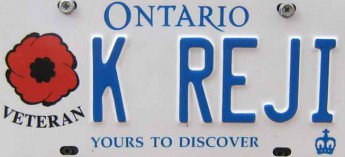
First, Middle and Last Name

In school and during my service in the Indian Army, my name was recorded as Koduvath RejiKoduvath being our family name. (Please click here to read more about Koduvath family).

Names

 Among the Syrian Christians of Kerala, names traditionally consist of three parts: the family name, the father’s name, and the christened (given) name. However, my siblings and I had only two—the family name and our christened names. As a curious teenager, I once asked my father why our names were so short. Being a headmaster, he gave a characteristically practical reply: the most common question in primary language classes is “What is your name?” He didn’t want his children struggling with lengthy responses, so he kept our names simple. I often wonder how I’d have managed with a typical Syrian Christian name like KuruvillaPhiliposePunnoose, or Zachariah!

The Many Reasons for Name Changes

In Kerala’s Malayala Manorama newspaper, classified columns frequently feature name-change advertisements—mostly women altering their surnames post-marriage. Some adjust the order of their names, while others cite astrological or numerological reasons.

But motivations for name changes vary widely. Some dislike the name their parents gave them. Couples may hyphenate surnames, creating a double-barrel identity. Others anglicize their names to avoid mispronunciation or unintended meanings in foreign languages. Occasionally, a name becomes a professional liability, or a change is needed to counter identity theft.

A Family Tradition: Keeping One’s Name

My mother, Pallathettu Kurian Sosamma, married my father, Koduvath Varkey George, in 1956. Both were teachers, and neither changed their names. My father believed marriage shouldn’t demand the sacrifice of one’s identity. He also considered the bureaucratic hassle unnecessary. This principle extended to his daughters-in-law—my wife, Marina Mani, retained her name, derived from her father’s.

In the Indian Army, it’s common for officers to change their wives’ surnames post-marriage through Part II Orders (official documentation). Many were surprised when I insisted Marina keep her maiden name. Most officers didn’t realize that marriage alone doesn’t legally authorize a name change—proper legal procedures must be followed. Soldiers, too, often bypassed the process, relying on uninformed officers to approve their paperwork.

Naming Our Children: A Deliberate Choice

After marriage, Marina was often addressed as Mrs. Reji—a natural assumption in the Army, where Reji was mistaken for my surname. She disliked it but eventually accepted it. When we named our daughter Nidhi, Marina felt a single name seemed incomplete. I argued against adding my name to hers, avoiding future change of name complications.

Eventually, Marina named her Nidhi SusanSusan being the anglicized form of my mother’s name, Sosamma. Today, she goes by Nidhi Parkinson-Watson, adopting a hyphenated surname. When our son was born, Marina chose Nikhil George Koduvath, giving him a complete name.

The Passport Predicament: Two Identities

While emigrating to Canada, I swapped my first and last names for the passport, becoming Reji Koduvath instead of Koduvath Reji. This left me with dual identities—Indian and Canadian. Our daughter faced minor issues in Canada, where Susan (her last name) is typically a first name, often prompting double-checks during documentation.

Correcting Documentation in the Army

As a commanding officer, I noticed gaps in soldiers’ documentation, especially regarding marriage and children’s birth records. During a Sainik Sammelan (monthly address), I explained the legal name-change process in India (similar to many developed countries):

  1. Affidavit: File before a District Court or Magistrate.
  2. Newspaper Advertisements: Publish in two local newspapers.
  3. Gazette Notification: Finalize in the state’s Official Gazette.

One soldier from Rajasthan raised a concern: in his community, unmarried women used Kumari (virgin) as their second name, which changed to Devi post-marriage (e.g., Ritu Kumari → Ritu Devi). I quipped, “Until legally changed, she remains ‘Kumari’ for life!” I instructed all personnel to regularize any unofficial name changes.

The Canadian Quirk: Searching by Last Name

In Canada, medical searches often use last names. Since Nikhil and I share Koduvath, while Nidhi and Marina have different surnames, I ask clinics to search by our home phone number instead.

Once, a pharmacy technician pulled up five names under our number and remarked, “All three males share a last name, and the two females have different ones.” Puzzled, she asked who the third male was. The answer? Maximus Koduvath—our dog, who also gets his meds under our family file!

Names2

Police & Media

Mediaa

It is a common practise for the Police in India to ‘show off’ their catch and also have the names of all the police personnel who participated in the investigation published in the print media. Luckily, the Indian Army does not follow this practice and one would rarely hear the name of the army unit or the persons involved in any such incidents.

Often the police parade the persons arrested, at times with their faces covered and the media goes full blast to carry out their ‘trial’ and declare the verdict. No one ever cares to issue any clarifications or do any sort of damage control in case the media trial is proved wrong. The way the media trial affected the Arushi murder case was well brought out in the Hindi movie made on the subject.

In case of the Sheena Bora murder case too, the media competed with each other to hype up the case and create a frenzy. There were always some ‘un-named police source’ that was quoted to give authenticity for all their saucy news stories, all in the name of Television Rating Points (TRPs). The media has not only put pressure on the investigating police agencies, but have also been successful in creating an opinion in the public’s mind that a woman, who could pass off her daughter as her sibling, ought to have murdered her.

After the police filed the charge sheets in the TP Chandrasekharan murder case in Kerala, a leading Malayalam Newspaper published an article on 14 August, 2012, with details of all the police officers involved in investigation and charge-sheeting of the persons involved. The details included the names, appointment, location and seniority. To top it all, the article was published with photograph of these Police Officers.

Why are they naming these police officers and compromising their identity and safety? Have you ever seen Canadian or American press ever doing this? When will these ‘James Bond’ journalists ever learn? Why is a reputed Malayalam newspaper publishing such articles? Is this the journalistic Dharma these journalists are supposed to uphold? Is it a deliberate leak by the Police to score some brownie points or for publicity sake?

These were a few questions which came to my mind on reading this journalistic blast. The way the media helped the attackers of Mumbai carnage (26/11) is fresh in our minds. If so, it is high time the Police across the country do a rethinking about their media relations.

The relationship between journalists and the police is a delicate one — a dance in which each party moves gingerly, trying to avoid stepping on the other’s toes. It is a symbiotic relationship in that the police and journalists need each other. But each has a clearly defined role guided by in-house policies, ethical considerations and time-tested practices.

The police disseminate information to further investigations, warn citizens of sudden dangers and educate the public about how to stay safe. In the Internet age, there are now more ways than ever for law-enforcement agencies to accomplish these goals. But police still depend on the media to quickly reach a large segment of the public.

Journalists are citizens, too. So they have an interest in informing the public and giving people the information they need and be responsible members of the community.

In Canada, the police take special care about their press releases and it is handled by a specialised Media Relations Team. This team advises on matters relating to media, community, public and government relations. They also develop, implement and monitor corporate policy, objectives and standards for corporate communication.   The role of the Media Relations Team is to provide information to the various media outlets and facilitate the dissemination of information to the citizens that they serve.

Special care is taken by the Media Relations Team to ensure that the identity of their Police Officers is not compromised. In most cases we do not hear the names of Police Officers responsible for the investigations, let alone seeing their photographs. In many cases the information about those charged or arrested is not disclosed until the media relations team clears it. In case of minors, the identity is hardly ever disclosed.

In cases, especially those involving death or serious injuries, the identity of the victims are not disclosed until cleared by their family members. They uphold and respect the privacy of the citizens. In case of a very important case, a very senior police officer briefs the media about the developments.

In Paul Muthoot murder case in Kerala, India, the press briefing by a Deputy Inspector General of Kerala Police was so disastrous that it adversely affected the police investigations and the prosecution of the case.

Most press conferences in Canada is done with the speaker standing up including the Prime Minister. They follow a script and do not exceed the brief as given by their Media Relations team. In case of a Police briefing on any undergoing investigations, the brief ends with a thank you note and the speaker does not usually take on any questions. (Please read my earlier Blog : Stand Up While You Work).

In India, the speaker briefing the media is often seen sitting down and mostly without a script. There is hardly any specialised media management team. They end up adding spice and fat to the story and often add their ‘personal touches’. The speaker takes on questions and in answering them, often put their foot in their mouth. At the end of it all they come out with their clichéd excuses like “I was quoted out of context”, “the media twisted the facts” and so on.

One must study the operation to hunt Sivarasan and gang, killers of Rajiv Gandhi. Veteran Major AK Raveendran was the one who headed the commando team to capture Rajiv Gandhi’s killers. He has brought out all aspects of the operations in his Malayalam movie “Mission 90 Days.”  The movie ends with a statement that the commandos would have captured all the killers alive had it not been for the delay imposed by former CBI director DR Karthikeyan, who headed the Special Investigation Team. Major Raveendran claimed that the delay was due to the chief’s media appetite to show up at Bangalore where the operations were in progress and earn publicity.

Let us pray to God Almighty that sense dawns upon Police forces of India in these modern day criminal environment and the press play a constructive role is safeguarding the citizens and the police. There is an urgent need to codify the Media Relations aspects for the Central and State Police Forces and also for the Army.


Kasava/ Tapioca/ Kappa (കപ്പ)

Kappa1

Walking down the isle of a Chinese vegetable store in Mississauga, Canada, after  immigration in 2004, I was surprisingly greeted by the Kasava/ Tapioca/ Kappa (കപ്പ) placed on a rack. On Closer examination, the tag read ‘Kasava – Product of Guatemala’. Any Malayalee (Mallu) will always and forever relish Tapioca cooked with spices and grated coconut and fish curry marinated with special tamarind (Kudam Puli (കുടംപുളി) scientifically known as Garcinia Cambogia). The concoction served in Toddy (alcoholic extract from coconut trees) shops all over Kerala (Indian Province where Malayalam is the native language and the residents are called Malayalees – now Mallus), is something one can never get in any homes.

Tapioca is not a native of Kerala. Then how come it reached the shores of Kerala?.

Tapioca is said to have originated in Brazil. Portuguese distributed the crop from Brazil to countries like Indonesia, Singapore, Malaysia and Kerala in India in the 17th Century. Some believe that Vysakham Thirunal, the Travancore King (1880-1885 AD), who was also a botanist, introduced this laborer’s food in Travancore (South Kerala). By beginning of 19th Century, people from central Travancore migrated to the Malabar region (North Kerala) and they introduced tapioca to the locals.

Tapioca was promoted extensively during World War II in Kerala by Chithira Thirunal, Maharaja of Travancore and his Governor Sir CP Ramaswamy Iyer. Then rice was the staple food of the people of Kerala and was being imported from Burma and Indonesia. With Japanese Navy enforcing a blockade in the Malaccan Strait, the ships carrying rice to India were either destroyed or captured. This caused an acute shortage of rice.

A large number of people, especially the labour class, accepted the starch-rich Tapioca as a substitute to costly rice. Thus Tapioca came to be known as ‘staple food of the poor.’ Hotels refused to include Tapioca in their menu due to its working class image.

The only place that served Tapioca were the toddy shops, where the labourers turned up for relaxation after a day’s hard work. Today tapioca is a rarity in Kerala and so is a delicacy and hence all hotels including the five-star ones have tapioca with fish curry in all their menus.

During my childhood, we used to cultivate Tapioca on our land. Tapioca is a tropical crop, tolerant to drought, but cannot withstand frost. It is best grown in lower altitudes with warm humid climate with well distributed rainfall. Our land is terraced on the hill slope into 20 x 20 feet sections. Each section is held together with stone masonry retaining wall to avoid soil erosion. On top of these walls pineapple was grown to give additional strength to the retaining wall. On some of these walls a fast growing grass was planted as fodder for cows.

In the month of August, the labourers till the land and make mounds of about a foot after spreading a compost mixture of cow-dung and ash. These mounds are made about three feet apart. Tapioca is planted in June with the onset of the South-West monsoon. Stakes taken from plants of the previous year is now cut into pieces of about a foot and is planted on these mounds. After a month, all the unhealthy or weak sprouts are pinched off leaving only two sprouts to grow into stakes.

As the plants mature, underground stems called tubers enlarge with starch. This is the time when the plant is most susceptible to rodent attacks, mainly from rats. As the tubers matured, a plant was uprooted almost every evening and tubers either were boiled and eaten with chutney or cooked with grated coconut and spices and eaten with fish curry. During weekends our mother had off being a school teacher and she made thin slices of fresh tapioca tubers and fried them in coconut oil.

After about ten months, in April, tapioca is harvested. Firstly the stakes are cut off and the healthy ones are stored for cutting for next planting. Underground tubers are now pulled out manually, pulling at the base of the stakes. The tubers are cut off from their bases and carried to the peeling site.

At the peeling site, the women folk of the village sit on mats and peel the outer skin of the tubers and slice the white starch part into thin slices. The women folk were generally paid in kind at the scale of one for every ten basket of tubers sliced by them. The sliced tubers are now collected in baskets and carried by the men folk to the boiling site. Here the slices are boiled in water until semi-cooked. The slices are now drained and put on the ground to dry under the sun. Once dried, these are collected in gunny bags. Some of the dried tapioca was retained for our consumption and the remainder were sold off to Kunjappan Chettan, the trader who lived across our home. Please refer to my blog https://rejinces.net/2014/07/15/kunjappan-chettan-the-trader/

In the 1980s, labour in Kerala became very expensive and  rodent attacks on tapioca crops became severe. Most tapioca plants were infected with Gemini virus causing ‘Mosaic’ disease curling the leaves and thus reduced yield.  In this period, the price of natural rubber skyrocketed. This turned tapioca farmers to rubber cultivation. With the incoming of rubber, out went the cows first as there was not enough grass to feed them. Further, the skins of the tapioca tubers and leaves from the uprooted stakes, which were the staple diet of the cows for four months, were now unavailable.

Mr AD George, our botany teacher at school had mentioned that the Gemini virus intruded into Kerala through a sample brought in by a professor, who while on a visit to a foreign country where tapioca was cultivated, saw a plant infected by the virus. He collected a leaf to show it to his students and brought it home to Kerala. After demonstrating the specimen to his students, the professor discarded the specimen. This virus then is believed to have spread across Kerala.

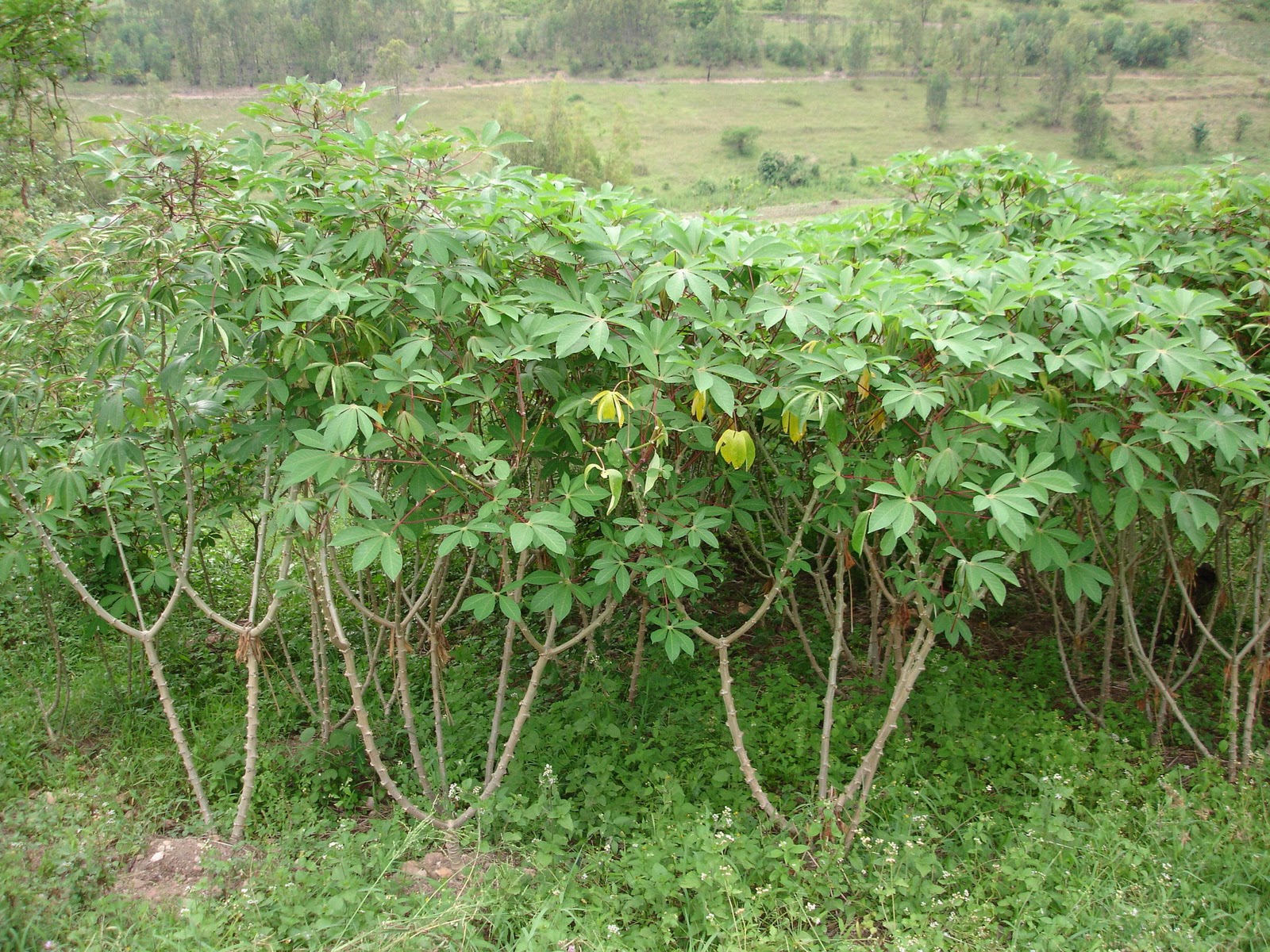
The land lost all its herbal healing powers with the advent of rubber cultivation. Herbal plants like Kurumtotti (Sida Rhombifolia), Kizhukanelli (Phyllanthus Amarus), Paanal (Glycosmis Arboraea), etc, all very abundant until we cultivated tapioca, became nearly extinct. The undergrowth shown in the image above is mostly of these herbal plants. Further, the present generation is totally unaware of the existence of these herbs in our own land and uses of these herbs. The cows used to eat these herbs along with the grass they chewed off the land and hence their milk also should have had some herbal effect.

In 2002 I visited Colonel TM Natarajan, my class mate from Sainik School and he spoke about the Sago (Sabudhana[साबूदाना ] or Chavvari [ചവ്വരി/ சவ்வரிசி]) factory his family had. That was when I realised that Sago was not a seed and it was factory manufactured and tapioca is the main ingredient. As Thamizh Nadu had many Sago factories and in order to feed them with tapioca, tapioca cultivation now moved from Kerala to Thamizh Nadu. The only hitch is that it needs extensive irrigation to grow as Thamizh Nadu does not enjoy as much rainfall as Kerala is blessed with.

Why Do Soldiers Break Step On A Suspension Bridge?

SuspBridge

Our son Nikhil and I had a discussion about the phenomenon of resonance about which he had a class that day. My mind wandered back to Mr PT Cherian’s high school physics classes. Mr Cherian had a knack of explaining basic principles of physics by citing real life examples which were simple and easy to assimilate. For more about Mr Cherian, please refer my blog https://rejinces.net/2014/07/15/guru-dakshina/.

Mr Cherian explained resonance by using a simple experiment.

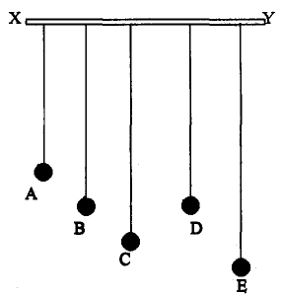
He had three pendulums of different lengths and two of the same length (B & D) tied to a rubber hose. He swung one of the two pendulums of equal lengths and after a few minutes, all the other pendulums begun to swing with the other pendulum of equal length swinging as much as the other. This he explained was as a result of resonance and the frequency of the two pendulums with equal lengths were same and hence they resonated.

Bridges and buildings have a natural frequency of vibration within them. A force applied to an object at the same frequency as the object’s natural frequency will amplify the vibration of the object due to mechanical resonance. Mr Cherian explained that while on a swing, one can go higher with a jerk of a bend knee or a swing of the legs and a car wobbles at a particular speed; are all examples mechanical resonance. The shattering of glass by singers with their voice is also by the same principle.

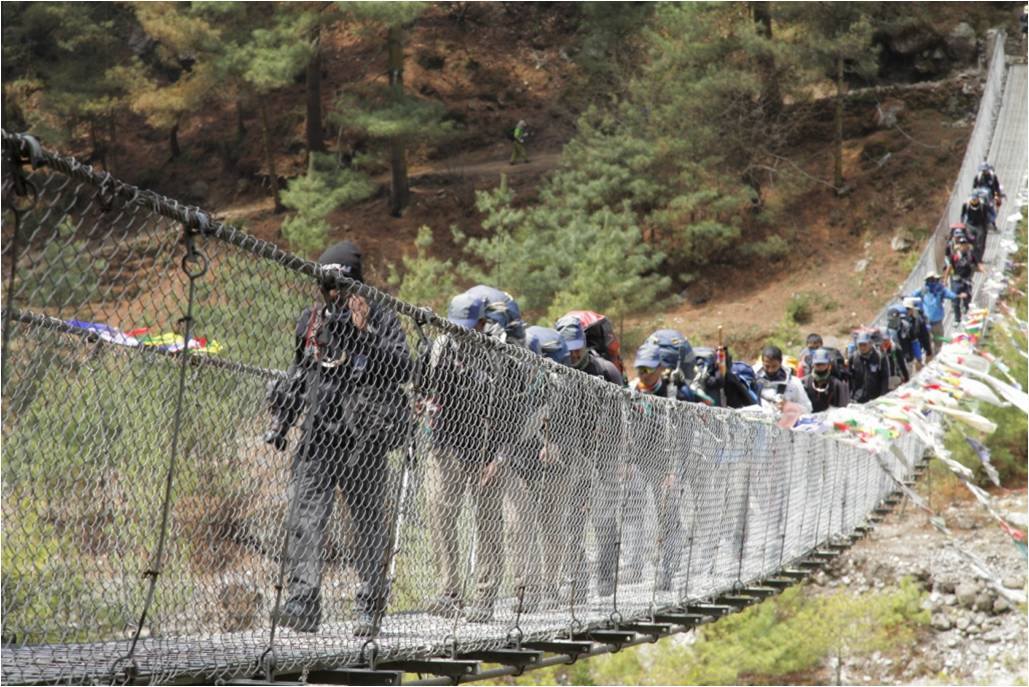
Mr Cherian then narrated an incidence which took place in 1831 when a brigade of soldiers marched in step across England’s Broughton Suspension Bridge. The marching steps of the soldiers happened to resonate with the natural frequency and the bridge broke apart, throwing dozens of men into the water. After this, the British Army issued orders that soldiers while crossing a suspension bridge must ‘break step‘ and not march in unison.

If soldiers march in unison across a,suspension bridge, they apply a force at the frequency of their step. If their frequency is closely matched to the bridge’s frequency, soldiers’ rhythmic marching will amplify the natural frequency of the bridge. If the mechanical resonance is strong enough, the bridge can vibrate until it collapses due to the movement.

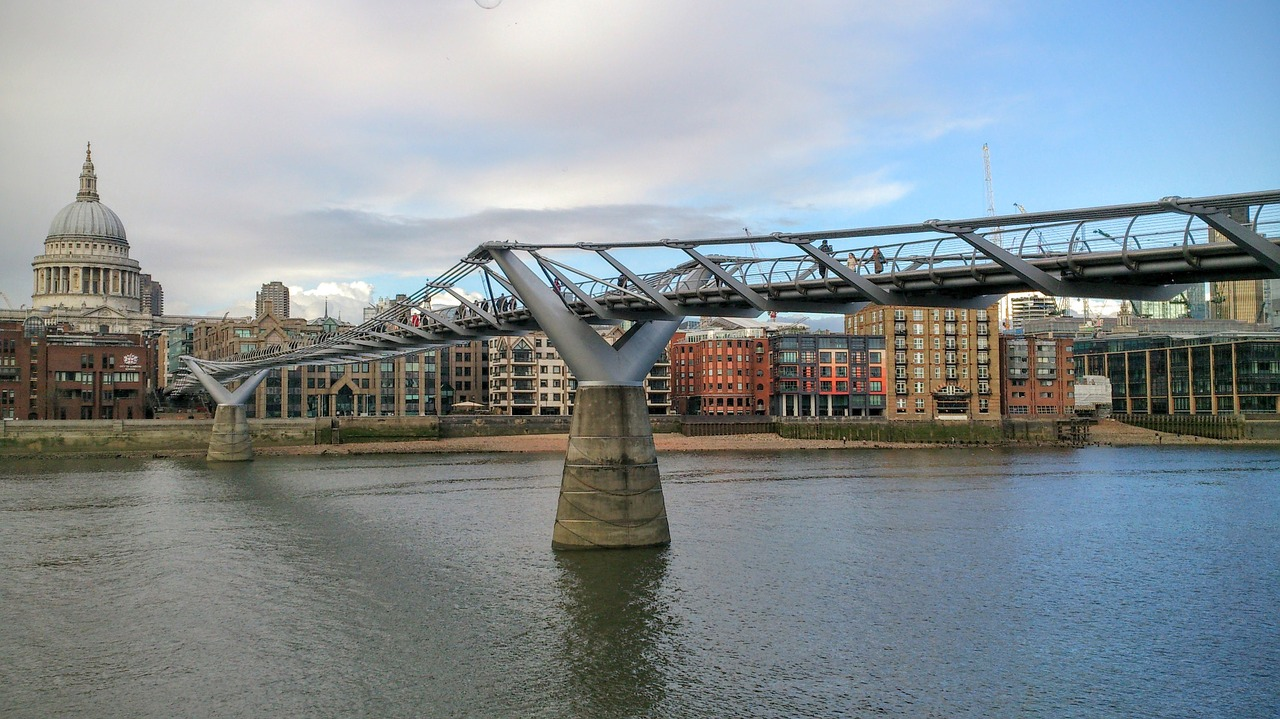
A similar tragedy was averted in June 2000 when a large crowd assembled at the opening of London’s Millennium Bridge. As crowds packed the bridge, their footfalls made the bridge vibrate slightly. Many in the crowd fell spontaneously into step with the bridge’s vibrations, inadvertently amplifying them. The police swung into action to clear the crowd off the bridge. Though engineers insist the Millennium Bridge was never in danger of collapse, the bridge was closed for about a year while construction crews installed energy-dissipating dampers to minimise the vibration caused by pedestrians.

Another example of mechanical resonance was the destruction of Tacoma Narrows Bridge in Washington in 1940. Even though the bridge was designed to withstand winds of up to 200 kmph, on that fateful day the wind speed recorded was mere 60 kmph. A mechanical resonance resulted due to the wind at that particular speed hitting the bridge perpendicularly.   Continued winds increased the vibrations until the waves grew so large and violent that they broke the bridge apart.

In May 1999, two girls were drowned and 15 others injured when a suspension bridge across a river collapsed in Panathur, Kasargod in Kerala State of India. The incident occurred when a group of people taking part in a funeral procession entered the suspension bridge  The bridge tilted and collapsed, again due to mechanical resonance.

In a similar incident in February 2014, eight people died and more than 30 injured when a suspension bridge collapsed over a dry stream in the North-Western province of Lai Chau in Vietnam. The accident happened as a group of local residents walked across the bridge to bring the coffin of a local official to a graveyard. The group had walked 15 meters on the bridge when it suddenly collapsed.

What could have triggered off the mechanical resonance in the above two cases? The villagers participating in the two funerals were surely never drilled down by any Sergeant Majors.

It is felt that anyone while on a funeral procession walks slowly and is often accompanied by the drums or hymns being sung at a melancholic pace. The funeral participants tend to bunch together, mainly due to their sadness. These factors could have forced the funeral participants to march in step, without their knowledge. Another reason of marching in step could be that one does not want to step on another’s foot and the best way to avoid is to walk in step with the person in the front. In both the cases, the coffin was carried by the coffin bearers with their hands. This needed the coffin bearers to walk in unison.

In all probability, the frequency of walking of the mourners in the funeral procession could have resonated with the natural frequency of the bridge, causing the bridge to swing violently. The pandemonium that could have set out must have caused panic, resulting in the mourners rushing to get off the bridge causing a stampede.

Hence in future the rule must be that not only the soldiers need to break steps on a suspension bridge, but also a funeral procession.

Malabar and Tellicherry Pepper

TellicheryPepper

Grocery stores in Canada carry Malabar and Tellichery black pepper. Malabar, one can easily associate with pepper, but how come a small town Tellicherry in Kerala, India, has been associated with this spice.

Tellicherry is the name given by the British to Thalassery. The name originates from the Malayalam word Thala (Head) and Kacheri (Office), thus Thalassery or ‘head of offices’. The Europeans nicknamed the town Paris of Kerala, as it was in close proximity to the sole French military base in Kerala in that era. Later the French abandoned Thalassery and shifted their base to Mahé.

Thalassery had a unique geographical advantage as a trading center being the nearest point from the coast to the spice growing area of Wayanad. The trading center developed mainly after the 16th century when the British got permission to set up a factory in Thalassery from the local ruler. Various conflicts with the local chieftains prompted the British to build a fort in Thalassery. The local king gave the fort and adjoining land to the British in 1708. The fort was later modified and extended by the British East India Company. The king also gave permission to the British to trade pepper in Thalassery without paying duty. After the construction of the fort, Thalassery grew into a prominent trading center and a port in British Malabar. The British won absolute administrative authority over Malabar region after annexation of the entire Malabar region from Tipu Sultan in the Battle of Sree Rangapatnam. Thalassery thus became the capital of British North Malabar.

In 1797 The British East India Company established a spice plantation in Anjarakandy near Thalassery. In 1799 it was handed over to Lord Murdoch Brown with a 99-year lease. Coffee, cinnamon, pepper and nutmeg were cultivated there. Anjarakandy cinnamon plantation was the world’s largest at that time. Construction of the Tellicherry Lighthouse in 1835 evidences the importance the British attached to the area.  The British East India Company built a new spice warehouse in 1863 and also established the first registrar office in South India at Anjarakandy in 1865, only to register the cinnamon plantation of Murdoch Brown.

Thalassery municipality was formed on 1 November 1866 according to the Madras Act of 1865 of the British Indian Empire, making it the second oldest municipality in the state. At that time the municipality was known as Thalassery Commission.

The Arab traders had monopolised pepper trade from the Malabar region from about 1500 BC. They sailed in boats through the Arabian Sea, hugging the coastline and reached Malabar and Travancore regions. From there they used the backwaters and the rivers to move inland. The Arabs sold the pepper procured from these regions in Egypt and Europe. Black peppercorns were found stuffed in the nostrils of Ramesses II, placed there as part of the mummification rituals shortly after his death in 1213 BC.

Peppr10

In order to dissuade the Europeans from sailing into the Malabar coast, the Arabs successfully spun many a stories and myths about black pepper. The most common story was that large many-headed serpents guarded the forests where pepper grew and the local people would set the forest on fire once the pepper ripened. The fire would drive away the serpents and people would gather the peppercorns before the serpents could return. The black colour of the pepper was due to burning.

Peppr01

Trade interactions between the Arabs and the local Hindus from Malabar resulted in many marital alliances. Some Arab traders settled in the Malabar region and Islam flourished there as a result. Today the region is dominated by Muslims. In Kottayam, south of Malabar, spice trade was based on the backwaters and rivers with Thazhathangady (Lower Market) and Puthenangady (New Market) as trading posts established by the Arab traders. Wherever the Arabs established trading posts, Islam also flourished there.

The Cheramaan Juma Masjid at Methala,  near Kodungallur, Thrissur District of Kerala is said to have been built in 629 AD, which makes it the oldest mosque in the Indian subcontinent which is still in use.

Peppr15

The Christians in the region believe that they were converted to Christianity from Hindus by St Thomas, one of Christ’s disciples in the first century, who might have traveled in one such ship.

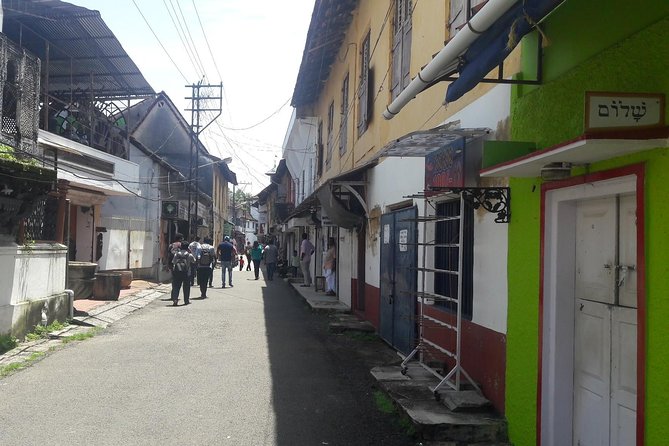
Many Christians and Jews persecuted in Persia fled to Kerala in the Arab ships and settled along the coast. They were welcomed by the local Hindus with open arms. Fort Kochi area was known for its Jewish settlement and these Jews were called Malabar Jews and are the oldest group of Jews in India and settled there by the 12th century.  

Peppr05

They built synagogues in the 12th century and are known to have developed Judeo-Malayalam, a dialect of Malayalam language.

Judaism, Christianity and Islam came to Kerala through trade. but these religions elsewhere in India mostly through the sword.

Peppercorns were a much-prized trade good, often referred to as ‘black gold‘ in Europe and used as a form of commodity money. The legacy of this trade remains in some Western legal systems which recognize the term ‘peppercorn rent‘ as a form of a token payment made for something that is in fact being given. Pepper was so valuable that it was often used as collateral or even currency. In the Dutch language, ‘pepper expensive‘ is an expression for something very expensive.

Its exorbitant price during the Middle Ages was one of the inducements which led the Portuguese to seek a sea route to India. In 1498, Vasco da Gama became the first person to sail to India by circumventing Africa. Gama returned in greater numbers soon after and Portuguese by the 1494 Treaty of Tordesillas gained exclusive rights to trade in black pepper in Malabar.

Pepper’s popularity quickly spread through world cuisines once more trade routes were established. At one time it accounted for a whopping 70 percent of the international spice trade. As it became more readily available, the prices dropped, and ordinary people were able to enjoy it. Regional cuisines began incorporating pepper into their foods alongside native spices and herbs.

Whatever may be the history of black pepper. it is still sold as Malabar or Tellichery pepper even though currently Vietnam is the world’s largest producer and exporter of pepper, producing 34% of the world’s requirements.

Library

During childhood days, our village in Kerala had a public library, housed on the upper floor of the Post Office building. The library had a good collection of books, periodicals and newspapers. The library used to be bustling with activity in the evening. Students and youth came there to borrow books, many came to read newspapers and periodicals and above all, it had a radio connected to a public address system which beamed the news from All India Radio. Those were the days when most households did not own a radio and Television had not become a reality. Our village with its literate masses needed something to read as a source of information and entertainment and the library provided it. My brothers used to borrow the books from library and our grandmother who lived with us then used to read them after everyone went to school.  Now my mother, a grandma, watches the tear-jerking serials on the TV after everyone leaves the home to school or to work.

During my recent trip home, I found the library totally deserted. The reading habit seems to have died down. How can you expect children overloaded with assignments, tuition and above all entrance coaching to find time to read? Various tear-jerking serials have occupied the free time of housewives and senior citizens, which in those days was spend reading.

Sainik School Amaravathinagar, our school, also had a well stocked library. I started using the library only from my Grade 8 onward as I was not all that proficient in English till then. At that time Mr Stephen, our librarian had taken over. Untill then the librarian was a clerk or an administrative staff member who hardly had any clue about the real duties of a librarian.

Mr Stephen with an ever smiling pleasing personality was a graduate in Library Sciences. He was the first person to encourage many of us to use the facility of the library and also explain to us the wealth of information available there. He always used to remind us as to how lucky we were to have such a library which he said many colleges and universities in India did not have.

Other than being the librarian, Mr Stephen used to actively participate in all extra-curricular activities. One could always see him in the gymnasium helping students, playing all games with the students and also participating in adventure activities like trekking and rock-climbing. This helped him develop a special rapport with the students. I spend some of my free time in the library and also whenever I was made an ‘outstanding’ student in the classes, I straight away moved into the library.  Mr Stephen exactly knew what would have happened in the class, but never asked me a question and let me into the library.

On migration to Canada, we settled down in the city of Mississauga. The City runs  Mississauga Library System. It is one of the largest public library systems in Canada with over 300,000 registered users. There are 18 locations, including a multi-floor Central Library with material allocated by subject areas. Anyone who lives, works, attends school, or owns property in Mississauga can obtain a Library Card required to borrow materials.

All the library branches I visited were always full of customers, especially students and seniors. The library system has a large collection of books, DVDs, video tapes etc in 22 languages including Hindi, Thamizh and Punjabi. The excellent catalogue system followed by the library can be accessed online from the home. One can place a hold on a material through the online system. The moment the material arrives the customer is intimated by email or over the phone. In case a desired items not in the Library’s catalogue, it may be obtained through inter-library loan.

In case the library branch one visited does not have a desired material, but is available in another branch, the same is transferred to the library if you request for a hold. All materials borrowed from any branch of the library can be returned at any branch. The catalogue system caters for it.

The Library offers access to downloadable eBooks and audio books. One can download these to a computer or a mobile device.  One can also sign up to receive sample chapters from new books and newsletters about new books and authors.

Library staff are always available to help the customer to find information and choose materials. The Library offers extensive information on occupations, educational planning, career planning, training and job search strategies.

An extensive collection of fine, old and rare materials, dealing with the history of Mississauga City is available for in-library use at the Mississauga Central Library and includes scrapbooks, local archives, and a large collection of photographs. Genealogical materials are available through Ancestry at all Library locations. The Historic Images Gallery brings together the image collections of multiple institutions providing centralized access and is searchable online.

eResources provide access to reference eBooks, newspaper and magazine articles, scholarly journals, book reviews and more. Search over 30 eResources covering a wide variety of topics including health, business, world news, literature, sports, arts, and entertainment. With a valid Mississauga Library card, you can do your research from home, school or office.

Children’s Dial-A-Story can be called as often as you want, any time of the day to listen to a new preschool story each week in the comfort of your home.

Public access to the Internet and Microsoft Office is available at all Library locations. One can book a session to use a Library computer with a valid Library card. Photocopiers are available at all Library locations at a minimal payment. Copying is subject to copyright laws.

Large Print Books are available from all library locations and rotate from library to library. In partnership with the Canadian National Institute for the Blind (CNIB) Braille Books are provided via mail.

Libraries store the energy that fuels the imagination. They open up windows to the world and inspire us to explore and achieve, and contribute to improving our quality of life.”   – Sidney Sheldon
Post Script :- My book ‘Suit, Boot and Tie‘ now finds a place with Mississauga Library System.
Search Results for suit boot (sirsidynix.net)

Fair & Lovely

Washington Post published a survey by the World Value Survey, which measured social attitudes of people in different countries. The survey asked citizens what types of people they will refuse to live next to, and counted how many chose the option ‘people of a different race’ as a percentage for each country. Jordan came out as the country with the highest proportion of ‘intolerant’ people with 51.4% and India with 43.5%.

anita

Look at the Fair & Lovely ad in India and it will prove one aspect of intolerance for the dark complexioned, especially among the fairer sex. The ad shows a miraculous change in the complexion of a girl from being dark skinned to very fair. The effect in the ad must have been achieved by the ‘digital touch-up’ and also by the effective use of light during photography.

Manufactured by Hindustan Lever, Indian arm of international giant Unilever, Fair & Lovely claims to offer dramatic change to fair complexion in just six weeks.  The packing of the cream displays one face six times, in an ever-whitening progression, and includes ‘before’ and ‘after’ photos of a woman who presumably used the product.

Do you think Unilever will ever market or package this product in US/Canada the way they do in India?

As per Indian laws, since Fair & Lovely is not categorised as a pharmaceutical product, Hindustan Lever is not bound to prove efficacy of the product. In India, litigation for not achieving advertised effect or social effect of the advertisement will take a long time and may not get the desired judgement.

Indian media is now trying to establish itself and is in the process of maturing. At this stage, to most the revenue matters and hence are ready to air ‘irresponsible’ news, discussions, advertisements, etc for ensuring better Target Rating Point (TRP) and raking in a few more bucks. Responsibility for ensuring that advertising is truthful is a shared responsibility among advertisers, agencies, and the media. The best regulation is self-regulation and one can expect it from the Indian media houses in the times to come.

Fair & Lovely is the largest selling skin whitening cream in the world, and was first launched in India in 1975. It held a commanding 50-70 % share of the skin whitening market in India. The product is marketed by Unilever in 40 countries in Asia, Africa and the Middle East, with India being the largest single market. One can see them in the shelves of many Indian grocery stores in Canada too.

Our children, both schooled in Canada, their friends with complexions ranging from the darkest to the fairest, have been dismayed with the Fair & Lovely’s television commercials aired on the Indian channels. The ad typically contains the message of a dark complexioned depressed woman, becoming fairer and getting a job or a husband. It also depicts the women becoming happier and more confident after the change of her complexion. The question from our children was as to how come no one is suing them in India for racialism.

The discussion further went on to belief in India that the skin colour is very powerful unlike in North America where the emphasis on a deep and glowing tan. The majority of Indian society still feels that a lighter color skin tone reflects a higher status and is more attractive. This gets further strengthened with the bride searching ads put up by Indian men mostly seeking out fair skinned women. Hence the target market for Fair & Lovely is predominantly young women aged 18-35.

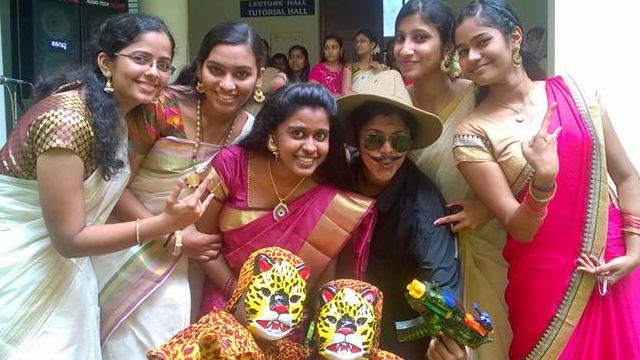
As expected, the discussion moved on to their cousin Anita, an engineering graduate, now working with an IT firm in Trivandrum, Kerala. Anita is a dark complexioned girl and she is well aware of that. Heard her saying to her mother that it was not her fault that she was born with a darker skin.

Our daughter Nidhi always felt that Anita was trying to appear fair and hence was using all unhealthy products. This had a telling effect on her skin. Nidhi, during her visit to India in February 2014, decided to give a few tips to Anita about carrying herself confidently and beautifully with her natural complexion. She had seen many of her dark complexioned friends using cosmetic products and procedures to look beautiful.

The first lesson Nidhi gave Anita was that being dark complexioned is also beautiful and hence there is no need to look fair. Then she took Anita to the local cosmetic store and based on the ingredients, selected cosmetics which suited her skin tone and ensuring that it had no bleaching agent. It was followed by a lesson on how to apply the cosmetics and makeup tips to enhance her facial features.

In June 2014, I got a call from Anita, then a student at the Engineering College and she said that she wanted to run for the post of the Chairperson of the College Union. I felt that she had become really confident and appeared to have come out of the ‘complexion problem’. She won the students election and became  the Chairperson.

Fire! Fire! Fire!

Wedding

Fire! Fire! Fire!” with our exchange operator screaming at the top of his voice; woke me up from deep slumber. Our regiment was located in the higher reaches of Sikkim on 12 December 1997 when this incident occurred. The area was covered with about four feet of frozen solid snow with the temperature touching minus 20 degrees Celsius.

I paid a visit to the dentist in the evening as my wisdom tooth was troubling me and I was under immense pain. The dentist decided that the best way out was extraction and hence administered local anesthesia on my gums and did the extraction. He advised me to take rest for a day or two. I reached my room and I had a splitting headache as a result of the anesthesia. I decided to go to sleep and hit the bed.

At dusk, our Commanding Officer (CO) Colonel PK Ramachandran, wanted to talk to me and called up the Regimental Telephone Exchange to connect the call. The exchange operator tried the call many times but as I was in deep slumber, I did not answer the call. The exchange operator came to my room and saw me in deep slumber and informed the CO about my status. Our CO being a thorough gentleman, advised the operator to let me enjoy my sleep and to put through the call the moment I woke up.

At about 9 PM, the exchange operator noticed smoke and flames in the building I was sleeping. He came rushing into my room screaming and woke me up. He said that my room was on fire. By that time about five soldiers also came in. I ordered everyone to clear off and not get any burn injuries. The soldiers led by the exchange operator were salvaging my desktop PC, the TV and the VCR.

I stepped out of the room engulfed in flames wearing my sandals. Luckily my Identity Card was safe as it was in my uniform shirt’s pocket as I had slept off without changing my uniform. The fire started because the officer staying in the neighbouring room had forgotten to turn off his kerosene based room heating system – Bukhari. As I stood outside in the biting cold, I saw the entire building up in flames. The soldiers were in the act of salvaging everything from the adjacent buildings.

That was when we realised that the water tankers in the regiment were empty as the orders were to keep the tankers empty to prevent them from freezing. The solid frozen snow was of no use to douse the fire as it could not be lifted off the ground. The order was passed immediately that all water tankers will be kept three-fourth full every night to meet such eventualities.   Our CO came to me and asked as to how I felt and I replied that the only thing I could do was to enjoy the warmth the fire was providing on a freezing night.

Next morning the soldiers scouted through the ashes and Subedar (Warrant Officer) Balakishan came out with all my medals (given by the government in recognition of bravery, honour and sacrifice) and a photograph which was intact despite the raging fire. It was our marriage photograph dated 16 April 1989. I immediately said that “What God has united no raging fire, storm or hail can ever separate.

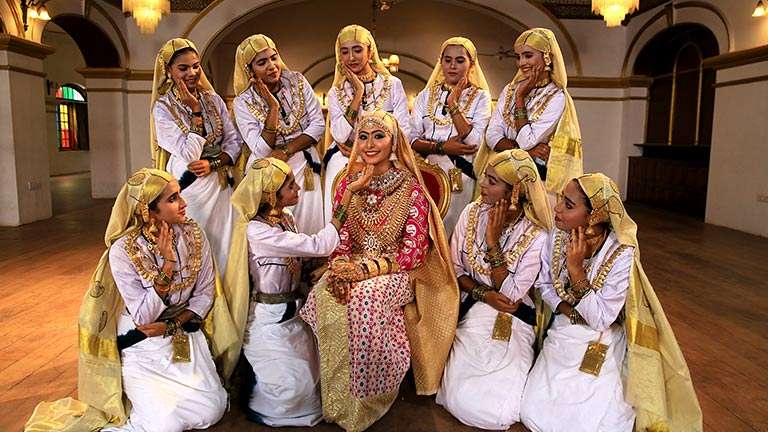
An Orthodox Syrian Christian wedding follows similar procedures as done by other Orthodox faiths like Greek, Slavic, and Egyptian. It begins with the Betrothal service where the Priest blesses the rings of the Bride and Groom, then places them on the ring fingers of their right hands. In the Bible, the right hand is the preferred hand, indicating good. The Betrothal dramatises the free decision made by the Bride and Groom, and is symbolized by the giving of rings.

The Marriage Ceremony begins immediately thereafter culminating in the crowning. It begins with the priest placing a crown on the groom’s head while reciting the crown blessing thrice. Then the crowning ceremony of the bride follows in the similar way. The Greek and Slavic Orthodox use crowns made from olive leaves and the Syrian Orthodox use a gold chain as a symbolic crown. The crowning is a sign of victory, just as athletes were crowned in ancient times at their triumphs. In this instance, the Bride and Groom are crowned on account of their growth as mature Christians, prepared for the responsibilities of a Christian marriage.

This is followed by a series of petitions and prayers with special reference to well known couples of the Old Testament, such as Abraham and Sarah. An epistle excerpt of Saint Paul is read, exhorting husband and wife to unconditional love and support of one another. Then an excerpt from the Gospel of Saint John is read, relating to the wedding at Cana when Christ performed the first of His miracles and blessed the institution of marriage.

The differences in the marriage ceremony between other Orthodox faiths and Kerala’s Syrian Orthodox faith begin here. The groom ties the ‘Minnu’ around the bride’s neck – tying the knot. This has been adopted from the Hindu traditions. the ‘Thali’ used in a Kerala Hindu marriage was in the shape of a leaf of the sacred banyan tree and Christians modified the Thali by superimposing a cross on the leaf and called it a ‘Minnu’. The Minnu is suspended on seven threads drawn out of the Manthrakodi. The seven strands represent the bride, the bridegroom, the couple’s parents and the Church.
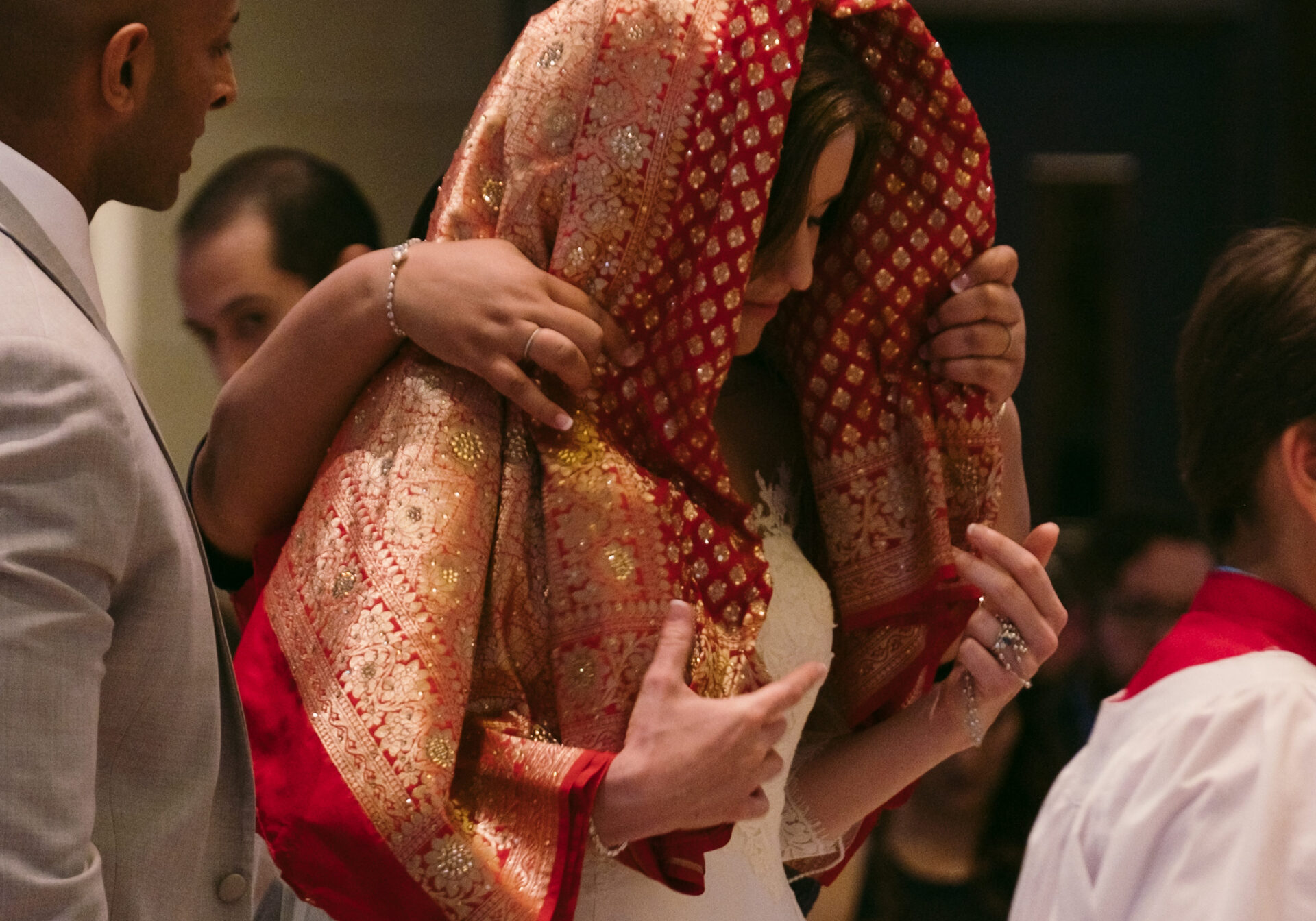
The groom then places the ‘Manthrakodi’, a sari presented by the bridegroom and his family, which is draped over the bride’s head, symbolizing the groom’s pledge to protect, care for and cherish his wife The Manthrakodi is the adaptation from the earlier Kerala Hindu Nair traditions of ‘Pudavakoda’ where the marriage was a contract and handing over clothes for the bride indicated entry into a contracted marriage. At this point, the bride’s relative, who has been standing behind her, yields her place to a female member of the groom’s family as a sign that the bride is welcomed into her new family.

The ceremony ends with a benediction and prayer. The Priest uses the Bible to uncouple the hands of the Bride and Groom signifying that only God can come between them. It is always the priest who will preside over the actual marriage ceremony that is the tying of the Minnu. If a bishop is present, he will only bless the Minnu. This tradition may have emerged from the old Travancore Christian Marriage Acts wherein only the priest had the magisterial power to conduct a marriage.

Even though our marriage was not conducted in the presence of Fire God (Agni), our wedding photograph lived through an Agni Pareeksha (Trial by Fire.)

Why So Much Corruption In India?

Have you ever tried to find an answer to this question? How come that we are forced to pay bribes or approach a middle-man to get our basic government documents like a driving license or passport made? How come in Canada or US one does not have to pay a bribe for such documentation? How come these basic documents are provided to you with one visit to the office concerned in Canada or US? Why is that despite having all the necessary documents and qualifications, you still have to make many a rounds to the offices to get the job done?

CI

Our political/ social/ religious leaders always blame it on the enormity of Indian population.   Anyone with knowledge of automated computerised systems knows that if one person’s documents can be done, then a million of such documents can also be done. It appears that no one wants to correct the system. The politician fears the loss of his vote bank and all other leaders fear the loss of money the corrupt system brings.

What makes the officials corrupt? The salary the government officials receive anywhere in the world is pretty high compared to the common-man’s standard of living in that country. Salaries (and pension) paid are adequate enough to maintain a decent standard of living for a family and does cater for all the basic essentials of food, housing, education etc. Then why is the greed or need for the extra money?

Let us examine a person’s life in both India and North America and analyse as to what are the causes for less corruption in North America.

A child goes to school and that’s where they are trained to be valuable citizens. Most important role in this training is played by the teachers in developing the mind-set of these children and they imbibe good values from them. The teachers’ selection and appointment in North America has its own high standards where as in India we are all well aware of the hefty bribes paid to get the post. In most of the private schools, mostly run by the religious institutions, they sign for a monthly salary of few thousands and take home actually a fourth of it. Here merit and teaching ability are of least concern and only their paying capacity is considered. How can you ever expect such teachers to develop a good value system in their students?

In North American society, children after their high-school education tend to look after themselves and graduate by taking loans and/or doing part-time jobs. In India,  parents cater for all these needs and it continues even after their children marry. Donation/ capitation fees/ normal fees for medical and engineering graduation are pretty high in India and everyone wants their children to be either an engineer or a doctor. When I retired after 25 years of service in 2004, my total pension emoluments was about Rs 30 Lakh (3 Million) and that was the amount needed in case our daughter was to take up medical education in a private medical college at that time anywhere in India. This clearly shows that most of the parents of such students have resorted to some illegal method of getting extra money, either by corrupt practices while serving or have evaded taxes and duties while selling their properties by under-valuation etc. Everyone connected with these professional education institutions – the political leadership, the administration, the courts etc are all well aware of this reality.

Why can’t it be made mandatory for all those parents seeking admissions for their children in these medical and engineering colleges to prove their sources of income? It will never come through as most of these institutions are owned by either the political leaders or by religious groups. Neither the politician nor the God can be made uncomfortable by passing such laws. The politicians do not want to mess up with their vote banks and never antagonise the Gods.

After graduation, everyone looks to get a government job and there too a lot of money changes hand in many places. In some cases it is either recommendation or money and in many cases it’s the merit. Where is this money coming from and where is it being used? Could be to pay for someone’s medical or engineering admission and the cycle continues. The only way out is to make the selection and appointment of all government post as transparent as possible. Only problem is that the looser is still either the politician or the God. So that can never be expected.

Now comes the costliest of all events – marriage. In North America, the bride and the groom have to arrange for their marriage expenses and sometimes parents chip in. The amount of money the bride’s parents in India spend is well known, may be to make up for the money spent on the groom’s education, may be to finance the groom’s higher education, may be to finance the education of the groom’s siblings – possibilities are endless. Still the money gets back into the same system and the cycle continues. Legislation and enforcement can control this menace to a limited scale only. Despite enactment of the Anti-Dowry laws, ill gotten money still changes hands and the Gods also seem to be enjoying it.

Next comes housing – everyone seem to be building houses bigger than their neighbour’s. It is never based on family needs, but in many cases only as a status symbol to show-off one’s mostly ill-gotten wealth. In North America, old parents down-size and move to smaller homes, or to a gated community, or to an old age home once their children move out for education or jobs. In India it is always up-sizing, even when one is on his death bed. Only social awareness can eliminate this problem.

Now comes the ultimate – to get even with the Gods who has to forgive and remit all sins in getting this wealth.  Huge offerings are made in the God’s houses to please Him. Most of the offerings are of no use to humanity like golden crowns, golden crosses studded  with diamonds, chariots, elephants and even one’s hair. It is not understood as to which God is going to be pleased with these offerings. In North America, most old people donate all their wealth or part of it to charities, which could help the humanity and may be the Gods will always be better pleased with them.

Family Prayer

Morning and evening family prayer has been a ritual followed in our family as far as I can recollect. Our father led the prayer real loud (could be because he was a Headmaster and our grandfather who was also a Headmaster, prayed much louder) and we all followed suit. As a child I never understood the meaning of whatever I said during the prayers and also what was the intention of such an act. I always perceived it as a punishment our father meted out to all his children for our unruly behaviour. I actually realised the value and importance of it only after I joined the Indian Army.  (Please CLICK HERE read my blog on Soldier Gods)

fp

The family evening prayer used to begin at 9 PM with our mother singing a hymn followed by one of us children reading a passage from the bible. The prayer commenced after that and it used to last about five minutes. At the end of it everyone was expected to observe a minute or two of silent prayer. I never knew what to pray for most times, but I also sat silently. During the lent, we had special prayers and the agony extended by another five more minutes.

With advent of Television beaming out many tear jerking serials, our parents by then retired from teaching, also got addicted to many of them. In Kerala due to power shortage we have half an hour power-cut on weekdays in the evening. The timing of the power-cut used to change every month and now the evening prayer time was dictated by the power-cut, as that was the time our parents could not watch any serial.

The morning prayers were a nightmare for me as our father woke us all up by 5:30 AM and he commenced the prayer with us in chorus. I always felt that the morning prayers were much longer than the evening prayers. After the prayers, we had to brush our teeth and get cracking with the household chores. Our father distributed each one of us a task and later our eldest brother when he turned a teen took over the responsibility. By that time our father went to milk the cows and clean up the cowshed.

My main chore when I came on vacation was to draw water out of the well in the courtyard using the pulley-rope-bucket system. In those days we did not have the pumping facility. This was the toughest chore among all and as I was away most of the year at school, my brothers wanted a relief and I did not mind it. Drawing of water began by 6 AM and ended only by 9 AM as water was needed for drinking, cooking, bathing, washing and also for the animals in the shed. Last requirement of water was for my mother to bathe before setting out to the school and by that time everyone else left home for their schools/ university. This water drawing chore continued till I turned a teen as by that time a pump set was installed with pipes to distribute water to the kitchen, bathrooms and to the cowshed. During our last visit home, I wanted to show our son the pulley-rope-bucket system, but I could not find it anywhere.

Behind our house lived Vasu and Chellamma with their two daughters and son. Vasu was a daily wage earning farm hand and Chellamma made a living out of rearing cows and goats and selling milk to the neighbourhood. One day Shankara Panikkan (Please read my blog on Shankara Panickan by CLICKING HERE) died at about 5 AM. We all went to Panikkan’s home to console the family. By about 7 AM Chellamma came running to  Panikkan’s home saying that she did not wake up early in the morning as George Sir (our father) did not pray that morning as we all were at Panikkan’s home.

That was when we realised that the loud morning prayers at our home also served as a wake-up call for the neighbourhood (It would have surely woken up the God Almighty too.)

Bharat Mata Ki Jai (Long Live Mother India)

After the Nirbhaya rape case most people of India were outraged and triggered protests demanding tougher laws to punish rapists. The parliament quickly passed the necessary laws, but mere bringing in of legislative changes will not likely to have an impact on the social causes of such incidents.

bm

As recommended by Justice Verma Committee, the executive, the legislature as well as the judiciary -all must respect women’s rights and must treat them in a non-discriminatory manner. In India, sexism begins at conception with parents’ preference for male children, especially if their first child was a girl. Girls suffer for the sake of their brothers. Boys tend to get more food, a better education, and more of the family estate. This has resulted in a skewed male to female ratio – Kerala having 1000 males to 1084 females the best and Delhi having 1000 males to 866 females the worst – among all Indian states as per 2011 census. So the reasons for such actions by Delhi men are obivious.

To compound the matters, we have our political leaders, rather than condemning such atrocities against women, make immature and uncalled for statements, supporting the miscreants. We have religious and spiritual leaders who exploit women and commit rape on their submissive devotes, and some even do not spare young boys.

The Indian society does not allow communication and inter-mingling of both sexes even in schools and at religious places. The boys and girls even in many co-educational schools are made to sit separately. In places of worship they are segregated and some religions do not believe in allowing the females into their places of worship. Even in North America, many places of worship of people of Indian origin follow this very strictly – as if to protect their cultural values. If these people have their way, they will never hesitate to pull a curtain to separate the sexes. Even in front of the Gods, the sexes are not treated equally. The godmen and their cronies ensure this.

Due to this segregation, many young boys conceive that a mere touch or a caress or a pinch or a poke would give them immense pleasure (mental orgasms). The pity is that some grownup men also feel the same, despite being married with children. This has resulted in the kind of ‘street harassment’ of women in India receive and the terror women face when commuting between their homes and their universities or jobs, threatening women for daring to leave their private spheres. Its a form of control over women’s ambitions and lives and such a culture is widespread and gets encouragement with tacit approval by the religions. This gives men permission to use women as the target for any excess anger or frustrations they might have.

In cities like Mumbai and Bangaluru, where boys and girls study, work, play and commute together, the incidents of ‘street harassment’ and incidence of terrorising women are the least. In the developed nations, there exist police forces which will swing into action the moment any such incidences are reported. There are systems in place to provide social support, shelter, counseling and care for the victim. India needs to develop such social security infrastructure to ensure that the women are safe on the streets or any public place.

India has a long history of treating women as property. Sati, an extinct tradition of wives being burned alive on their husbands’ funeral pyres and dowry killings are a few examples. All these because the women are not treated equally in the society.

The offerings from the temples or the Holy Communion are given first to men and then to the women. In the Syrian Orthodox Churches, prior to giving the communion, the priest says “…വിശ്വാസികളായ ദാസീ ദാസന്മാർക്ക് നൽകപ്പെടുന്നു (…visvasikalaya dasee dasanmarkku nalkappedunnu)” (being given to female and male devotees) and gives the holy communion first to all the male devotees.

Some political leaders and holy men are blaming the recent Delhi rape on women not wearing overcoats or sarees, women riding the bus, women using mobile phones, women wearing skirts, women going out with men who are not relatives, co-educational schools, moral character, being out late, fast food, the poison of western culture, and the stars being in adverse positions – the list goes on and on..

The only Indian society that treats women with respect is the Armed Forces. The General or any senior officer will always rise from their seats to receive a lady walking in – the lady may be a Sepoy’s wife of a Lieutenant’s wife. The only place in India where the ladies are served first – whether at formal or informal or at-home functions – is in the armed forces. Even in the military’s religious places of worship, women are offered ‘prasad’ or holy communion first. Officer on duty or the Captain of the Indian Navy ships will salute all ladies entering or leaving the ship irrespective of their social or military hierarchy. The ladies are always respected at home and outside by the defence service personal and the sexual discrimination is minimal in this society. That may be reason why we have defence service officers’ daughters performing extremely well in the society like Moushumi Chatterji, Sushmita Sen, Preity Zinta, Anushka Sharma, Celina Jaitly (Bollywood), Revathy (Malayalam/Thamizh Film), Renuka Chowdhary (Member of Parliament) – the list is endless.

In many Indian homes, women are expected to remain indoors and are never permitted to participate in any discussions or decision making process at home. They hardly have any say in their lives, their marriage, their education and their careers. Every aspect of the woman’s life is dictated by the males.

Sexual harassment of women – especially children (both boys and girls)– in Indian homes is well known. Many are afraid to even tell their mothers about the harassment they were subjected to, fearing social rebuttal. Many families hide such incidents fearing that no prospective groom will ever turn up for their daughter. To further complicate the situation, its a well known fact that the perpetrators of such sexual harassment are close relatives of the victim. There is an urgent need to educate children about sexual harassment and the steps to be taken to avoid it and actions to be taken in case one is subjected to it.

It must be made legally binding on school teachers, medical professionals and others who interact with the children to report cases of sexual abuse. Suppressing or hiding such facts must be made a criminal offence as is prevalent in many developed countries like Canada and US. The police must be mandated to register an FIR and the cases must be investigated as being recommended by the Justice Verma committee.

Until stricter laws are passed in the parliament, we will continue to hear of rape, sexual harassment and ill-treatment of women in India. Merely referring to India as “Bharat Mata (Mother India)” does not ensure respect to the women. The need of the hour is for a social and religious awakening to ensure equal status for women.

Leadership and Bible

(Based on Chapter 10 of the Gospel According to St John)
During our summer vacations while in school, we used to attend Vacation Bible School for 10 days. Every year the theme was based on one of the parables Jesus spoke. The theme for the summer after my Grade 6 was the ‘Good Shepherd’ parable as described in Chapter 10 of the Gospel According to St John.

GS

At that young age of eleven, the parable had a great impact and over the years I must have read it umpteen times and every time I read it, I interpreted it differently. The variations in my interpretations were caused by the varied experience one had serving the Army and the difficult situations one faced. I can now confidently say that the interpretations ‘matured’ with each passing day and with the experiences I gained.

The entire interpretations given below are solely personal and have no theological or religious connotations. I have selected verses 1 to 5 and 11 to 14 and have purposely omitted verses 6 to 10. I have clubbed a few verses being interconnected.

Verse 1.   Very truly I tell you, anyone who does not enter the sheep pen by the gate, but climbs in by some other way, is a thief and a robber.
Verse 2.   The one who enters by the gate is the shepherd of the sheep.

The leader got to face the team he leads from the front. He got to face up to each member of the team and must avoid the tendency to ‘sneak in’ from the side or the back. This applies more in case the team is facing an adverse or difficult situation.

The leader got to be confident and this confidence is the resultant of professional knowledge and integrity. Any leader with good intentions will always be accepted and such leaders will always enter from the main door.

Verse 3.  The gatekeeper opens the gate for him, and the sheep listen to his voice. He calls his own sheep by name and leads them out.

The team has to understand the voice of the leader and there by the leader’s intentions. The team will understand these only in case the leader is willing to communicate effectively with his team members.

Further, one has to know each member of the team and in case you know them well, you will always call them by their names. That could be the reason why in the armed forces everyone wears a name-tag. Earlier the Indian Railway staff and the State Transport staff used to wear their name-tags. In Canada, anyone who comes in personal contact with the customers is always seen wearing their name-tags. Who does not want to be addressed by their names than the “shoo – shooo” one often uses in the Indian Restaurants and public offices.

Leading from the front is the most important aspect of leadership. No one likes back-seat driving, even if the back-seat driver is the spouse or children.

Verse 4.   When he has brought out all his own, he goes on ahead of them, and his sheep follow him because they know his voice.

The necessity for the leader to take the entire team together and lead them from the front is the essence of this verse. Here again the importance of the team knowing the leader is stressed.

Verse 5.   But they will never follow a stranger; in fact, they will run away from him because they do not recognize a stranger’s voice.”

In case the leader fails to communicate well with his team and make his intentions clear, will become a stranger. The team will never accept a stranger and will never be confident to follow a stranger.

Verse 11.   I am the good shepherd. The good shepherd lays down his life for the sheep.
Verse 12.   The hired hand is not the shepherd and does not own the sheep. So when he sees the wolf coming, he abandons the sheep and runs away. Then the wolf attacks the flock and scatters it.
Verse 13.   The man runs away because he is a hired hand and cares nothing for the sheep.

The above three verses apply in literal sense to military leadership, where the call of duty takes one into life and death situations. This also applies to all leaders; the only difference could be that one does not have to lay down one’s life, but at times may have to pay for with his status, money etc.

Any leader who works for self-glorification and physical rewards is the hired hand. The famous saying that ‘in case you work you get more work else you get your pay‘ applies here. Such a person does not ‘own’ the team and is bothered more about his self-interest. They will be the first to sacrifice a team member in case something goes wrong. Often heard these ‘hired hands’ saying “I briefed him in detail about the task, but he goofed it up”. They never realise that their voices were not recognised by the team (sheep) as the briefing must have been ineffective or the leader did not know the ability of each team member (sheep) as to what they can deliver.

The hired hands will vanish from the scene when something goes wrong and will only surface to gobble up all the credit for the effort of the rudderless team to overcome the adverse situation.

Verse 14,   I am the good shepherd; I know my sheep and my sheep know me.

You got to know the team (sheep). You got to know every team member in depth. You got to know the strengths and weaknesses of each. A good leader who knows his team will always project the strengths of his team members while covering up their weaknesses.

Once the leader knows the team, the team will know their leader. In order to know the team, the leader got communicate, both formally and informally with the team members. Theses communications opens up the personality of the leader and based on it each team members makes an opinion or impression about the leader.

Everyone has to assume leadership sometime or the other; it may be at work, in your class, at home, during family or social events etc. Wishing all the leaders the grace of God to became a “Good Shepherd”.

ALCOHOL KERALA

ml

Every year after the Onam, the media in Kerala comes up with an area-wise score card – not of marks scored in exams by the students but is of the money raked in by the Beverages Corporation.   Kerala has overtaken traditionally hard-drinking states like Punjab and Haryana and we boast of the highest per capita consumption in India – over eight litres per person a year. Also, in a strange twist of taste, brandy is the preferred drink in Kerala in a country where brandy outsells every other liquor.   This comes from a stupid notion that the doctors prescribe brandy and is good for health. May be in little quantity it may help you, but not in the volumes Malayalees drink.

A Malayalee, whether in Canada or back home, on hearing that I retired from the Indian Army, is more interested to know about the quota (of liquor) I get, rather than appreciating me for the two decades I served the nation in the most inhospitable terrains and in the most risky situations.

The judgements by various courts and the closure of many bars by the state government has added to the chaos in Kerala.  It got further complicated with many an allegations of bribes and scandals associated with various political leaders of the state.

This has again proved that the legislature and executive never rise to the occasion to ensure that necessary laws are passed and are implemented.   Will the public cooperate with the government to ensure that alcoholism does not become a menace, not that it already has become a menace?

Let us study a few alcohol related cases and laws as applied in Canada.

  • In the case of Lum v. McLintock (1997 B.C. Supreme Court), a patron spent an afternoon at the bar of a golf club where he was a regular customer. He became very intoxicated. The server knew the patron, knew that he was driving, knew that he was intoxicated and even walked him out to his car. The patron drove off and hit a cyclist causing serious injuries. The conduct of the server was found to have been exceptionally negligent and the licensee was apportioned 30% of the blame (with the 60% to the patron and 10% to the plaintiff cyclist).
  • In the case of Francescucci v. Gilker (1996, Ontario Court of Appeal), a patron had become extremely intoxicated at a restaurant. Staff members picked him up, carried him out to his car, put him in it, and threw the keys on his lap. He drove away a short while later and injured someone in an accident. At trial, the jury apportioned 78% of the blame to the restaurant and 22% to the patron. The Court found that the restaurants conduct was deliberate and reckless.

The lesson to take from these cases is that the poorer the job a licensee does of living up to its duty to prevent harm resulting from over-service, the greater the percentage of fault that will be assigned to the licensee in the event someone is injured.

In Ontario, the province I reside, it’s a law that If you plan to work in the industry as a Bartender, Server, Manager, you must be certified by law and undergo a training program designed to educate servers, bartenders, managers and other staff members as to what their responsibilities and obligations are under the law, as well as recognize the signs of intoxication and implement intervention strategies for aggressive customers..

Most people know that it’s not wise to serve alcohol to someone who is obviously drunk. But many aren’t aware that they may be sued and held liable. Even at parties at your home and if you serve alcohol, its imperative of you to ensure that your guests who had alcohol beyond the permissible limit are seen off in a cab or the designated driver has had no alcohol. Never permit your guest to carry their drinks off for the road.

The laws regarding conveying liquor in vehicle is that no person shall drive or have the care or control of a motor vehicle, whether it is in motion or not, if it is carrying any liquor that is readily available to any person in the vehicle, even if the liquor  is packed in baggage that is fastened closed or otherwise.

It’s a proven fact that more North-Americans have died as a result of accidents caused by drunk drivers than in the First World War, Second World War, Korean War and Vietnam War combined. The case in Kerala or in India can’t be any different.

Though the Kerala government is committed to introduce prohibition in the state step by step, the liquor industry says the step would make their business nonviable, the tourism industry feels that it will drive away tourists from the state.

The government is also concerned about its loss of revenue. Liquor is contributing a major share of its tax revenue as the government has been increasing the tax on the booze as part of its policy to curb the consumption. Alcohol helps in giving Kerala’s economy a good high – shockingly, more than 40% of revenues for its annual budget come from booze.

Toddy, the traditional beverage of Malayali that even played a role in promoting tourism in Alappuzha district, has of late courted trouble. The Kerala High Court wondered why the state should not ban it, considering the complaints regarding it being mixed with intoxicants. While no one can dispute the intention behind the ruling, can a ban on toddy really halt the rising alcoholism among people in the state?

Considering this, it is absurd to expect a ban on toddy to make any significant impact on the drinking habits of Keralites, say those fighting to save the traditional occupation of the toddy tappers. It is not the tapper who adds illicit spirit to the toddy, but the contractor who operates hand in glove with the excise department.

The Kerala Agricultural University has developed a technology to extract non-alcoholic ‘Neera’ from coconut trees. The coconut inflorescence sap in its purest form is not alcoholic and contains several ingredients that are good for health, but as it quickly ferments and turns alcohol.  The method is to arrest the fermentation using organic methods. Tapping Neera could also fetch farmer bigger returns than toddy and a farmer can earn up to Rs 1500 in place of Rs 250 for every coconut tree used for toddy tapping.

The religions unknowingly also plays a part in this chaos. The gospel readings in church masses of how Jesus converted water to wine are given as a justification for many like me to consume alcohol. May be, it was the first miracle of Jesus as recorded in the Bible; it may be worthwhile to remove it from the gospel reading. The Hindu mythology speaks of Som Ras believed to have been created Lord Brahma. May be that Islam bans use of alcohol.

Recent Malayalam movies have shown the super-star heroes drinking on any occasion – sad, happy or otherwise and then they come out with a statutory warning about the dangers of alcohol. In comparison, I have hardly seen an English movie depicting the hero in an intoxicated state.

Strict enforcement and stricter punishments are only the way out. Unlike in North America, where many are afraid to take on to the wheel after a drink, mainly because of the fear of a police ticket, the fines and likely suspension of license. Life without a driving license is the most difficult for the North American barring the people who live in the metros. Further, the moment you get charged, the vehicle insurance premiums shoot up, where as in India, it remains the same even in case you are held liable for a death on the roads caused due to driving under the influence of alcohol.

Koduvath the Meat Basket

A typical Syrian Christian family history will forcefully trace its roots to the to the 31 Brahmin families supposed to have been converted to Christianity by St Thomas, one among Jesus’ 12 disciples or to Pakalomattom, Kali, Kaliyankal, Shankarapuri Namboothiri (Brahmin) families, even though no documentary evidence exists to prove the connection.

After Jesus descended to heaven, all ten disciples moved Westward to spread the message of Christ and establish churches. Only St Thomas was sent Eastward (East must be a punishment posting then also as prevalent in the Indian Army.)  This could be because St Thomas was known as the Doubting Thomas who refused to believe that the resurrected Jesus had appeared to the ten other disciples (Judas had committed suicide by then,) until he could see and feel the wounds received by Jesus on the cross. From this originated the English idiom of Doubting Thomas as a skeptic who refuses to believe without direct personal experience.

In the earlier days, the Syrian Christian  priests could only be ordained from the Pakalomattom family (an effect of the Hindu caste system prevalent then.)   Vasco da Gama landed in Kerala in 1498 and was surprised to find local Christians, involved in spice trade.  In those days the Christians followed most customs of the local Hindus (some of it even continues today) and used Syriac as the liturgical language because of the association with Persia due to the spice trade.  Hence the Portuguese called the local Christians as Syrian Christians and the Christians they converted as Latin Christians as they used Latin as their liturgical language. 

The Portuguese after landing in Kerala realised that the princely priesthood of the Pakalomattom family had to be broken to have a hold on the local Christians and so ordained priests from other rival families. By 1660 they weaned away 84 of the 116 churches who aligned with Rome and became the Syro Malabar Catholic Church and the rest thirty-two churches and their congregations formed the Syrian Orthodox Church.  The purported aim of the Portuguese was to wean away the local traders, mainly Christians, from the Muslim Arab traders.

It would be foolish on my part to do the same mistake others did and hence would limit to the details I had obtained by way of many discussions I had with our grandfather Karottu KT Varkey (he lived to the age of 104 and died in 2002.)  Surely some of these would have been his figment of imagination and he also must have added enough spice to make it interesting for a hyper-active young boy.

In the nineteenth century Koduvath Easo (in those days the family name preceded the christen name) came with his daughter Eli and occupied Malamelkavu (in Malayalam meaning hillock with a temple on top,) in Kolladu village, about eight kilometer from Kottayam and settled there.  Nothing is known about the other family members and from where Koduvath Easo came.  Thomas married Eli and moved into Koduvath family as the Adopted Son (Jamai जमाई) (DathuPuthran ദത്തുപുത്രൻ.)  From then on it is said that the ladies of the family have been more dominating and I can see it in today’s generation in the form of our daughter and her cousin sisters.   Thomas and Eli had nine sons and two daughters with our grandfather being the eleventh.  The nine sons and their further generations continue to live in and around Malamelkavu and some moved out in search of better jobs and opportunities.

The family belongs to the parish of St George Syrian Orthodox Church, Puthuppally (ex-Chief Minister of Kerala, Late Oommen Chandy’s family also belongs to the same church.)  Kolladu village is located West of Puthuppally village and is separated by a river.  Crossing the river up to 70’s was by means of a ferry, now by a bridge.   The annual festival of the church is celebrated in first week of May and is like the annual festivals of the Hindu temples in Kerala.   Vechoottu (a ceremonial feast), adya choroonu (a ritual in which children get their first rice feeding by priests,) etc. are some of the rituals associated with the festival.  Later  Raza, the grand festival procession taken out with the holy golden cross from the church, accompanied by Chenda Melam (drums of Kerala) and caparisoned elephants.  The Raza is received by every household which falls on its route, irrespective of their religion, with a lighted lamp.   In the evening the entire church is illuminated with lamps like any Hindu temples of Kerala.

The main offering to the church on the annual festival is fowl (preferably a rooster) as St George the patron saint of the church was a soldier and is believed to enjoy chicken.  In the earlier days the fowls offered were slaughtered on the church premises and the fried chicken was served as Prasad to the devotees.  This cruel practice was terminated by the 70’s being cruelty to animals.

I had heard a myth about the fowl slaughtering at the church from my grandfather.  In the earlier days, there was a Kali (Hindu Goddess) temple situated atop the hill adjacent to the church.  The fowls were offered there also on the annual festival day of the temple, which coincided with the festival day of the church.  One day both St George and Kali came together in a dream of the village chieftain and they came to a compromise that the fowls are to be slaughtered at the church and meat prepared there (St George enjoyed the meat,) but the blood had to be collected and offered to Kali in the evening (Kali seemed to be interested only in blood) and that way only a few birds had to be sacrificed.

The next day the Holy Mass is offered at the church.  At the end of the festivity, the Chicken Prasad is distributed to the devotees at the East and West gates of the church.  The chicken pieces are carried to the gates in bamboo baskets.  The teenagers from the Koduvath family now come into action and they snatch the chicken baskets and run as a relay race handing over the basket from one to another and swim across the river.  The prasad thus snatched is distributed among the family members.  The taste of the fried chicken will give run for the money to today’s Kentucky Fried Chicken (KFC.)This practice continued for some years and all our family members, whether barristers, teachers, government officials of those days were all nicknamed ഇറച്ചിക്കൊട്ട (Irachi Kotta)’ (in Malayalam meaning Meat Basket) and many of us still carry the same nickname, especially while studying in schools and colleges in Kottayam.

Set an Example

fmlIn December 2012 our son Nikhil wanted to accompany me on my trip to Kerala as he had two weeks of Christmas vacation.  I asked him the reason behind such a decision and he said that it was to spend a few days with his grandmother, uncles and cousins.  He also wanted to visit all the old temples and churches in Kottayam and what interested him the most was Sree Padmanabha Temple at Trivandrum as he had read a lot about the billions worth of treasure the temple had.

Accordingly and we landed early morning in Trivandrum and checked into the Taj Hotel.  He was really flabbergasted by the services rendered by the darwan (Person guarding the main entrance and receives the guests), the bell boy and the room service, which he had never experienced in all our travel across North America.  After visiting the temple we headed to Kottayam and stayed with my eldest brother, with whom my mother lived.

During every Kerala visit, I make a trip to Kochi to meet my Sainik (Military) School classmates, Veteran Commander Reginald and Mr Roy John (Collector, Customs) and this time too Reginald was gracious enough to arrange an evening at the Naval Institute.  Nikhil was again surprised that once he was about to empty his Coke glass, it was refilled by the waiter, a privilege he had never enjoyed.

On our way back, we came through Chennai as we had planned to spend an evening with Major General Ramachandran, who was our Commanding Officer and at that time serving with the Area Headquarters at Chennai.  On reaching his residence, the sight of the guards, the way the lawn was manicured and the fabulous garden, the way he was looked after by the General and his wife and all the services he received from the staff at the General’s home seem to have touched a nerve or two in the teenager.  When we went to bed, Nikhil asked me as to why did I leave all these luxuries behind and quit the army and whether I missed these.  To this I said that I really miss all these, but had to make a choice between the family and the army and hence I migrated to Canada to join the family.  Had I continued in the army, they would have visited me during their vacations for few weeks and I would have visited them for two or the most three months (including furlough) an year.  I was touched by his reply “That is a real sacrifice for our sake.”

One day at Kottayam, we decided to set off on foot to visit the old temples and churches around my elder brother’s home.  Nikhil was finding it difficult to keep up with me and I asked him whether he was feeling good to walk or should we hire an auto-rickshaw.  He said that he had a heavy breakfast as his grandmother wanted him to put on a few kilos and hence piled up his plate.  He was upset that the granny did not realise that his body structure and metabolism did ensure that he remained thin and it was not that he did not eat enough and he added that granny being a school teacher, who is well read and well travelled should realise it.  “You could have always refused her and could have left the meal half eaten,” I said.  “Your mother is too powerful and I can never say ‘no’ to her.  Look at your eldest brother who is four years elder to you and your elder brother, the city’s public prosecutor, they never said ‘no’ to her and instantly obeyed all what she said.  When she was in Canada with us, you never said ‘no’ to her.  How do you expect a little boy like me stand up to her and ever say a word,” said Nikhil.

Then I realised that this trip was worth more than a thousand times its cost.